
Objectives To discuss the benefits of wildlife management
Objectives • To discuss the benefits of wildlife management. • To define habitat and components of habitat. • To discuss the different agencies and laws dealing with wildlife management. • To identify techniques of wildlife management. 2
Main Menu • • Wildlife & Fisheries Management Wildlife Habitats Agencies & Laws Enhancement Techniques 3
4
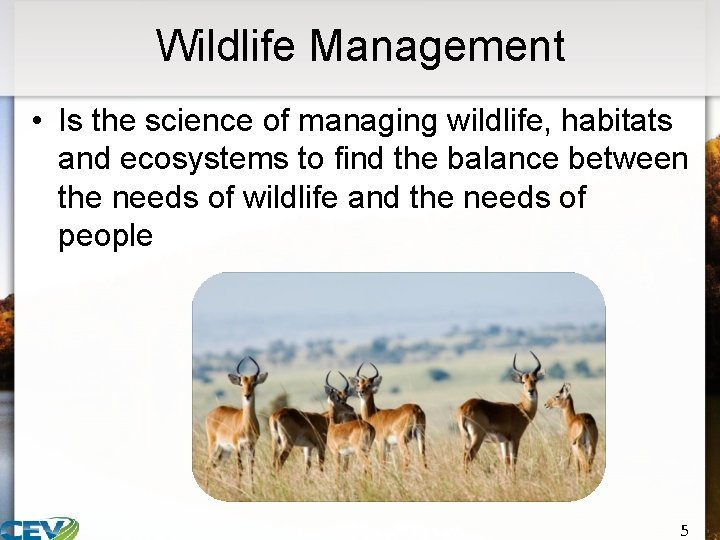
Wildlife Management • Is the science of managing wildlife, habitats and ecosystems to find the balance between the needs of wildlife and the needs of people 5
Wildlife Management • Was established as a profession in the United States in the 1930 s – Aldo Leopold becomes the first professor of wildlife management at the University of Wisconsin in 1933 – Aldo Leopold published a textbook titled “Game Management” in 1933 – the first Cooperative Wildlife Research Centers were established in 1935 – the Wildlife Society was founded in 1937 – the Journal of Wildlife Management began publishing in 1937 6
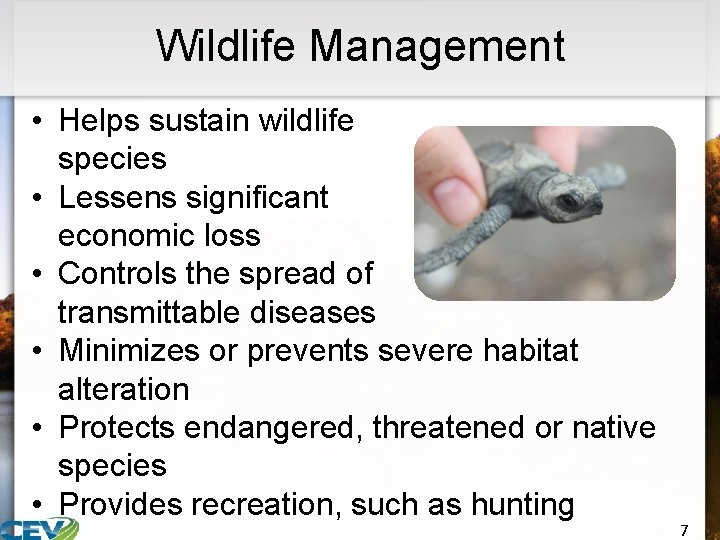
Wildlife Management • Helps sustain wildlife species • Lessens significant economic loss • Controls the spread of transmittable diseases • Minimizes or prevents severe habitat alteration • Protects endangered, threatened or native species • Provides recreation, such as hunting 7
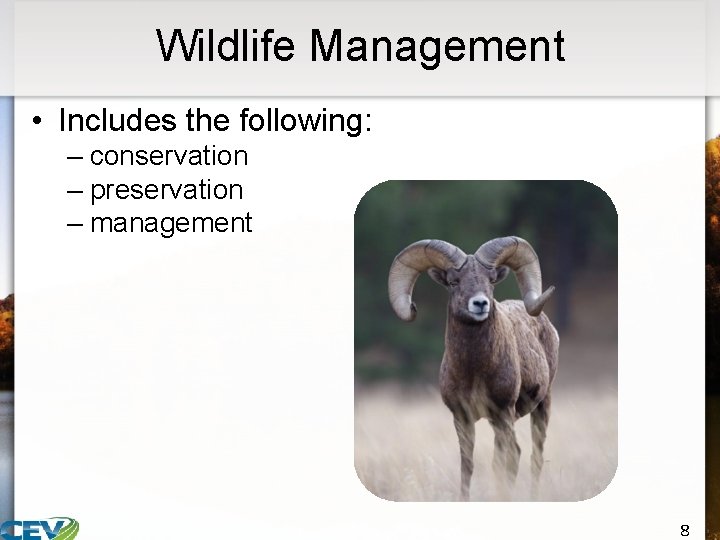
Wildlife Management • Includes the following: – conservation – preservation – management 8
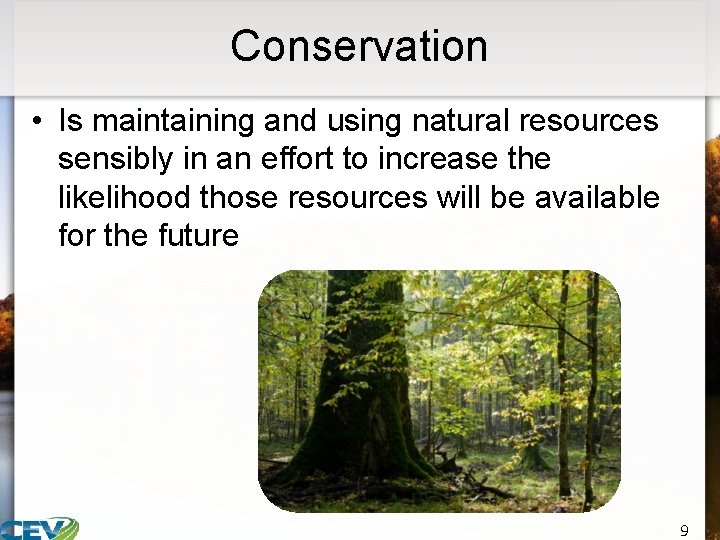
Conservation • Is maintaining and using natural resources sensibly in an effort to increase the likelihood those resources will be available for the future 9
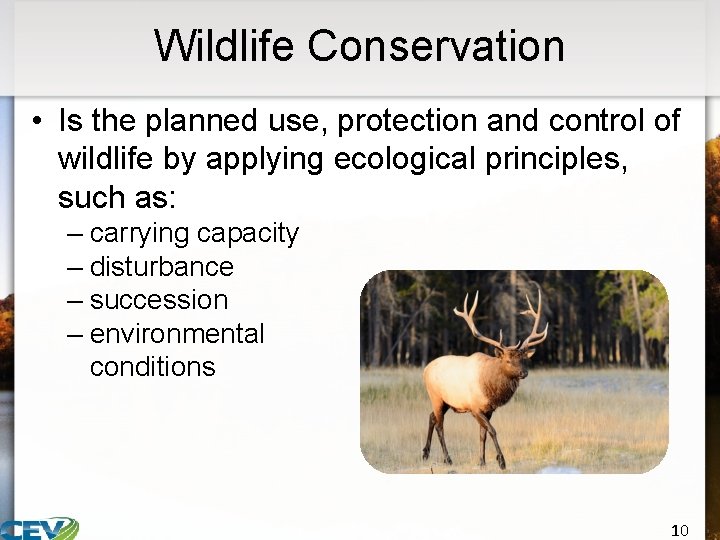
Wildlife Conservation • Is the planned use, protection and control of wildlife by applying ecological principles, such as: – carrying capacity – disturbance – succession – environmental conditions 10
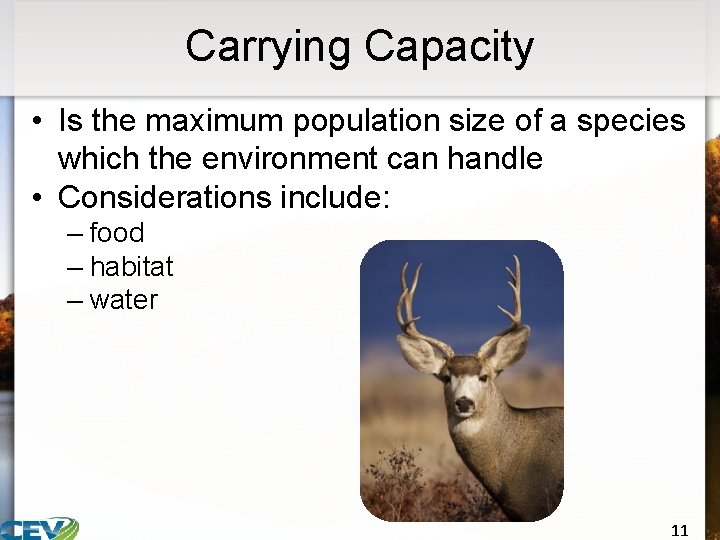
Carrying Capacity • Is the maximum population size of a species which the environment can handle • Considerations include: – food – habitat – water 11
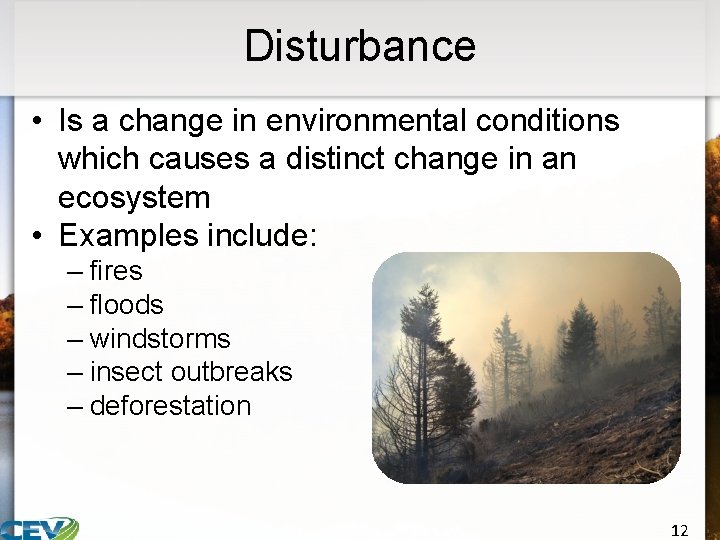
Disturbance • Is a change in environmental conditions which causes a distinct change in an ecosystem • Examples include: – fires – floods – windstorms – insect outbreaks – deforestation 12
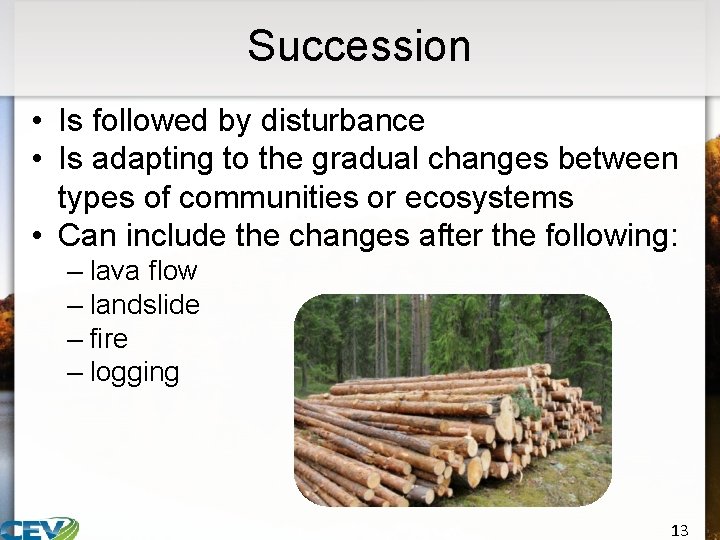
Succession • Is followed by disturbance • Is adapting to the gradual changes between types of communities or ecosystems • Can include the changes after the following: – lava flow – landslide – fire – logging 13
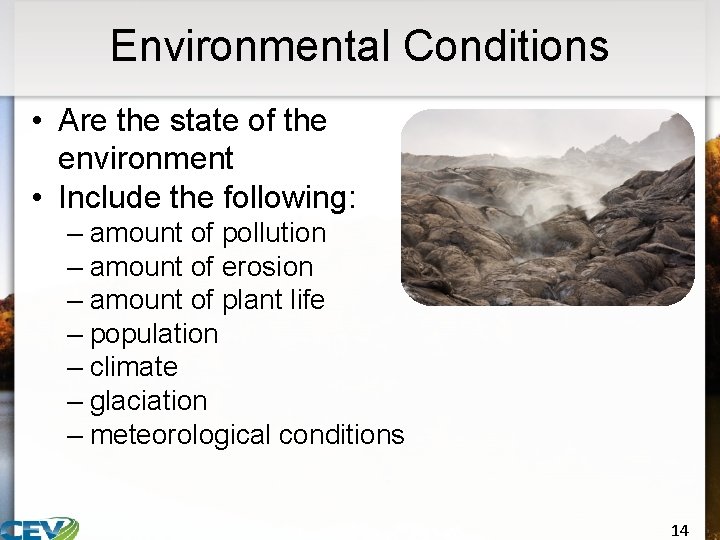
Environmental Conditions • Are the state of the environment • Include the following: – amount of pollution – amount of erosion – amount of plant life – population – climate – glaciation – meteorological conditions 14
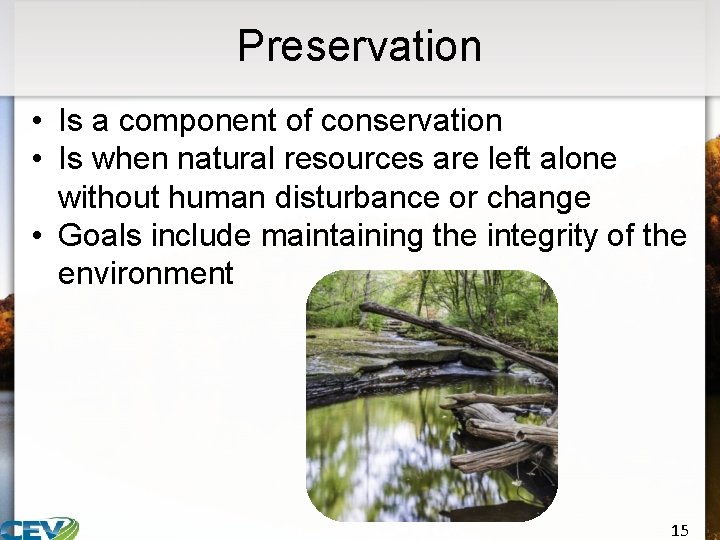
Preservation • Is a component of conservation • Is when natural resources are left alone without human disturbance or change • Goals include maintaining the integrity of the environment 15
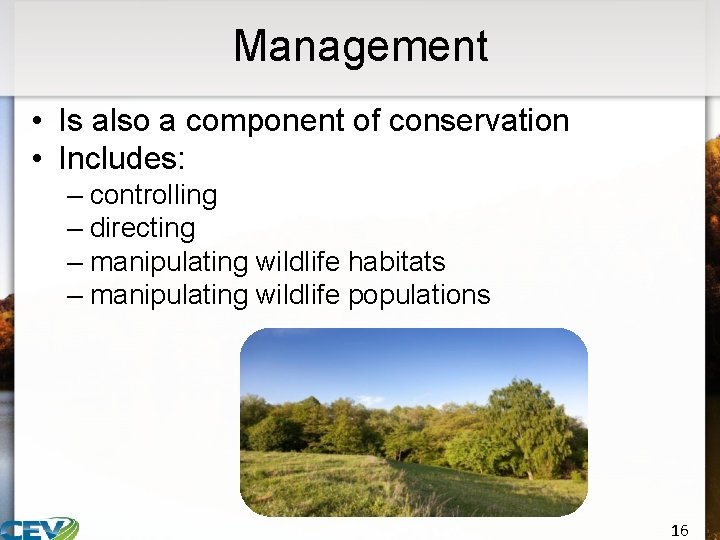
Management • Is also a component of conservation • Includes: – controlling – directing – manipulating wildlife habitats – manipulating wildlife populations 16
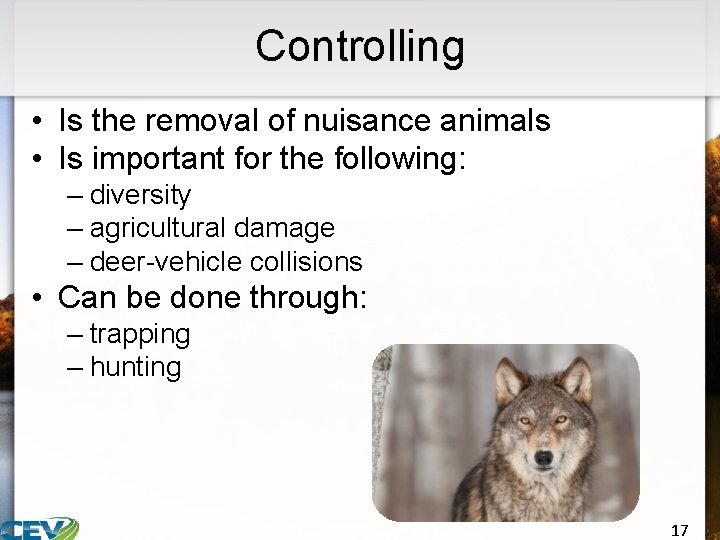
Controlling • Is the removal of nuisance animals • Is important for the following: – diversity – agricultural damage – deer-vehicle collisions • Can be done through: – trapping – hunting 17
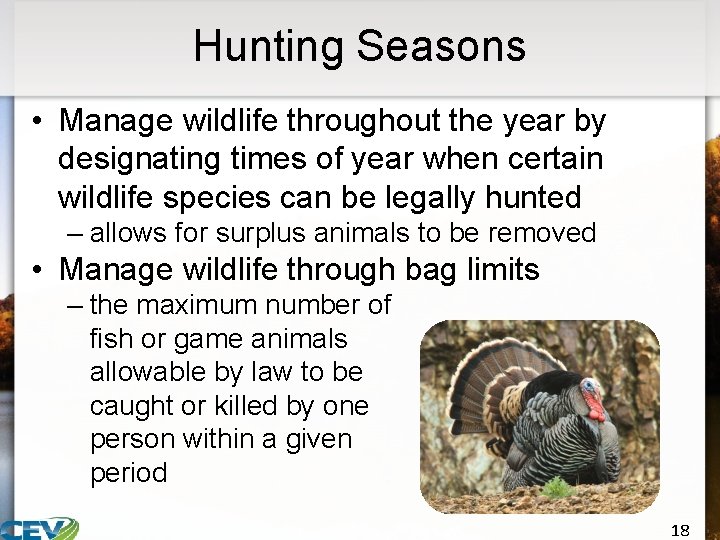
Hunting Seasons • Manage wildlife throughout the year by designating times of year when certain wildlife species can be legally hunted – allows for surplus animals to be removed • Manage wildlife through bag limits – the maximum number of fish or game animals allowable by law to be caught or killed by one person within a given period 18
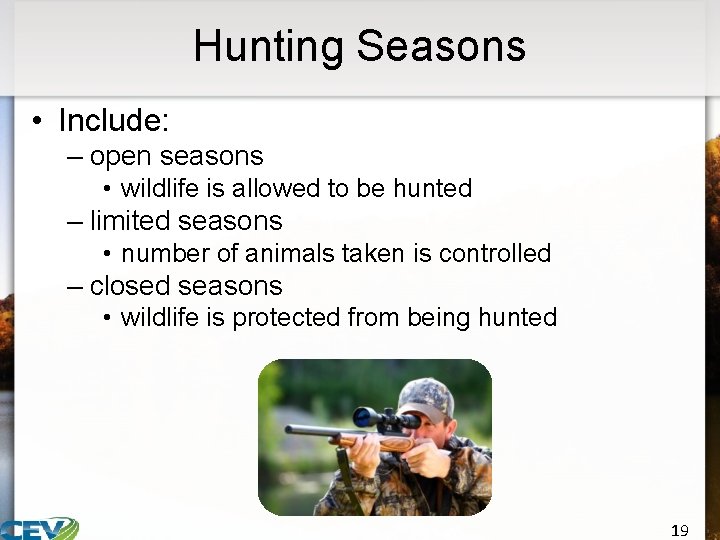
Hunting Seasons • Include: – open seasons • wildlife is allowed to be hunted – limited seasons • number of animals taken is controlled – closed seasons • wildlife is protected from being hunted 19
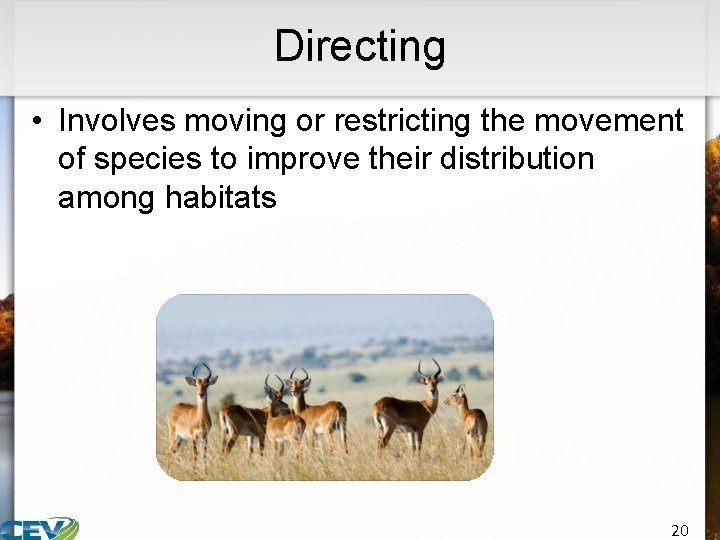
Directing • Involves moving or restricting the movement of species to improve their distribution among habitats 20
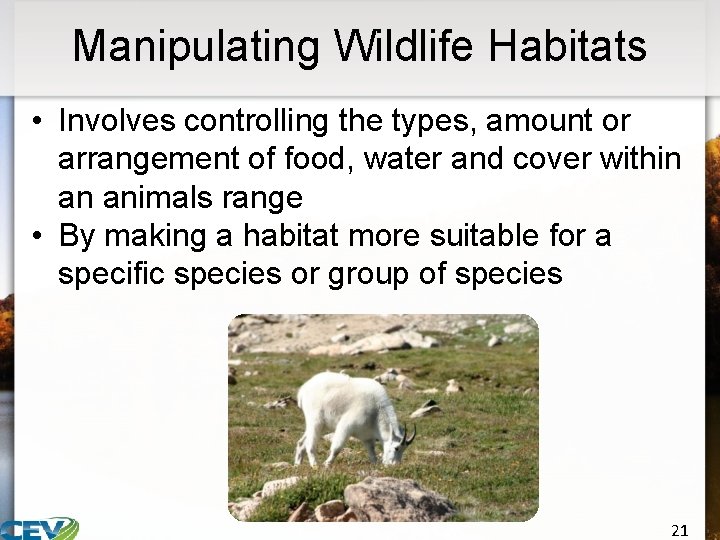
Manipulating Wildlife Habitats • Involves controlling the types, amount or arrangement of food, water and cover within an animals range • By making a habitat more suitable for a specific species or group of species 21
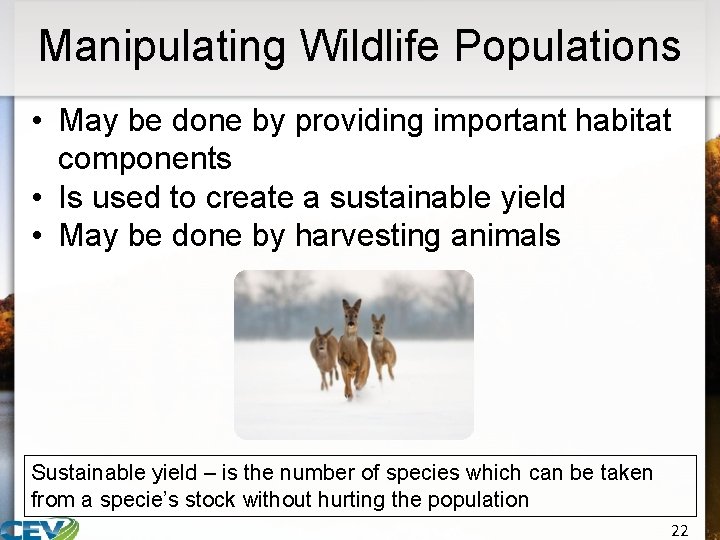
Manipulating Wildlife Populations • May be done by providing important habitat components • Is used to create a sustainable yield • May be done by harvesting animals Sustainable yield – is the number of species which can be taken from a specie’s stock without hurting the population 22
Fisheries Management • Regulates when, where, how and how much fishermen catch to guarantee they will be able to fish for years to come • Relies on fisheries science in order to discover ways to protect resources • Is essential if marine resources are to be utilized in a sustainable and a responsible manner 23
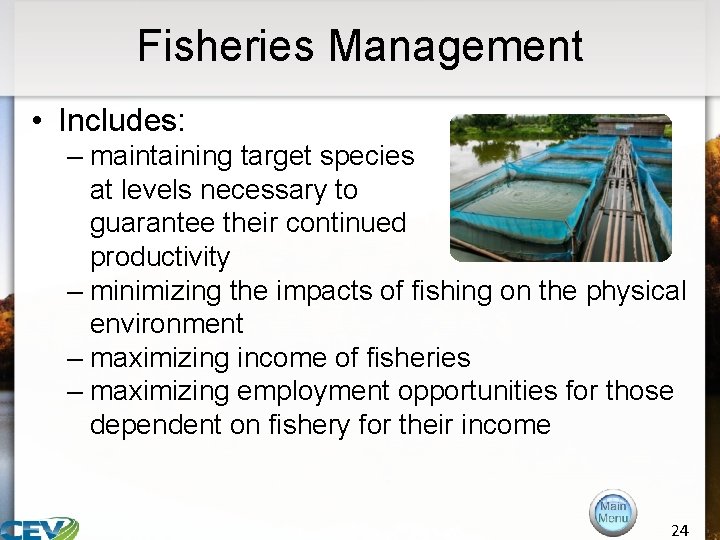
Fisheries Management • Includes: – maintaining target species at levels necessary to guarantee their continued productivity – minimizing the impacts of fishing on the physical environment – maximizing income of fisheries – maximizing employment opportunities for those dependent on fishery for their income 24
25
Assessment 1. Who established game management as a profession in the United States? A. Aldo Leopold B. George Washington C. Edward Rosholt D. Abraham Lincoln 2. Natural resources being left alone without human disturbances is known as which of the following? A. Management B. Conservation C. Preservation D. Relaxation 26
Assessment 3. Carrying capacity is defined as which of the following? A. The planned use, protection and control of wildlife B. The change in environmental conditions C. The gradual change between types of communities or ecosystems D. The maximum population size of a species the environment can handle 4. Which of the following is NOT an importance of wildlife or fisheries management? A. Minimize habitat alteration B. Minimize income of fisheries C. Maximize employment opportunities D. Maintain target species populations 27
Assessment 5. Which of the following is NOT a true statement regarding fisheries management? A. Includes maximizing the net income of fisheries B. Regulates how many fish a fisherman catch C. Maximizes the impacts of fishing on the physical environment D. Maintains target species 28
29
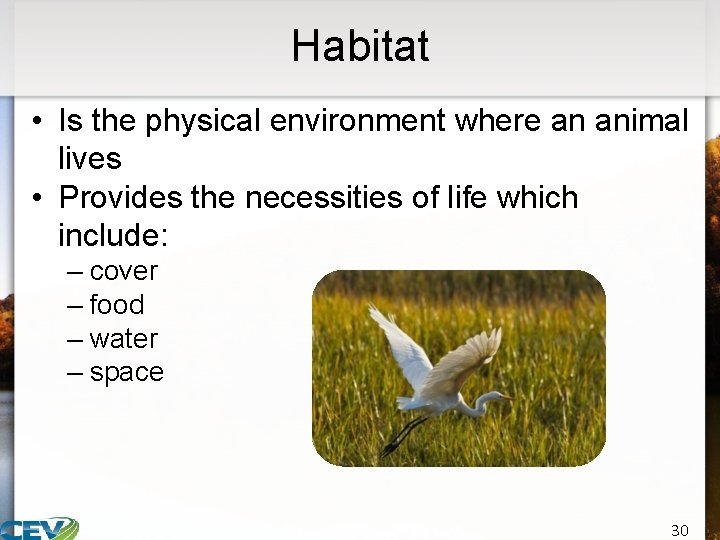
Habitat • Is the physical environment where an animal lives • Provides the necessities of life which include: – cover – food – water – space 30
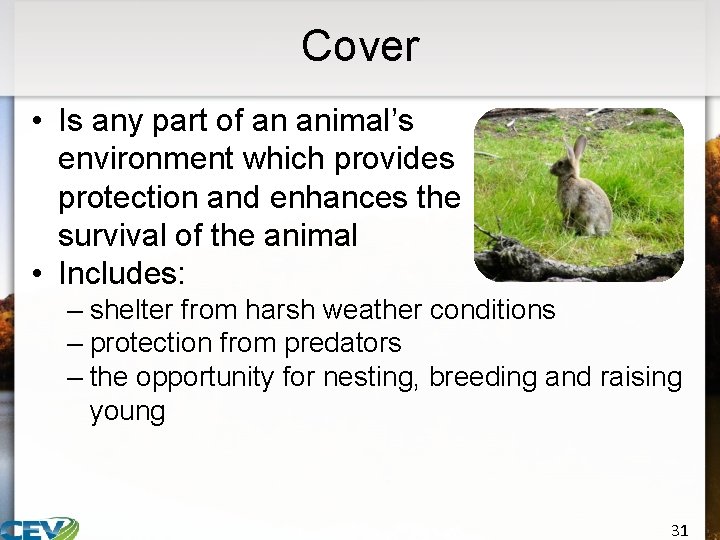
Cover • Is any part of an animal’s environment which provides protection and enhances the survival of the animal • Includes: – shelter from harsh weather conditions – protection from predators – the opportunity for nesting, breeding and raising young 31
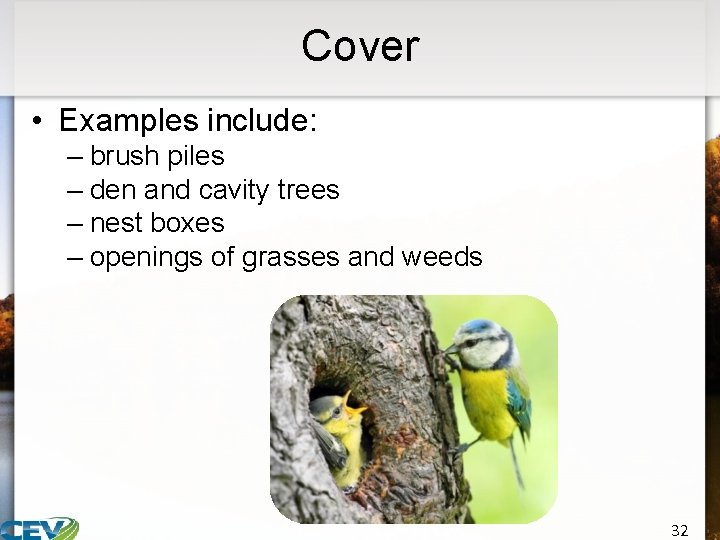
Cover • Examples include: – brush piles – den and cavity trees – nest boxes – openings of grasses and weeds 32
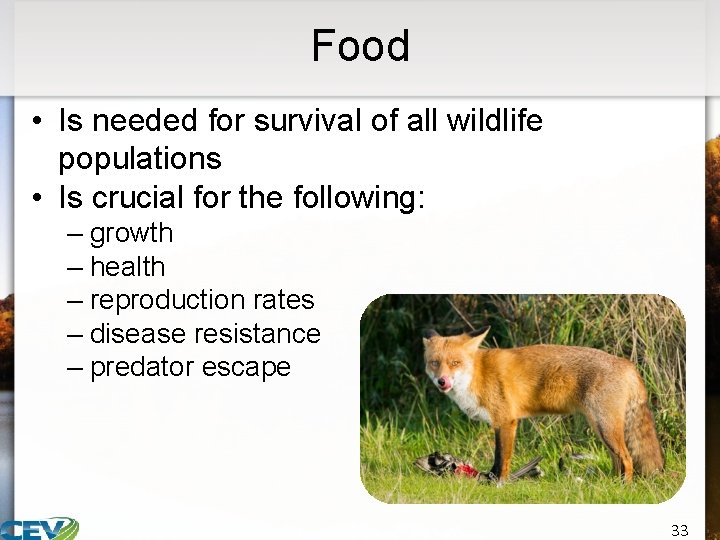
Food • Is needed for survival of all wildlife populations • Is crucial for the following: – growth – health – reproduction rates – disease resistance – predator escape 33
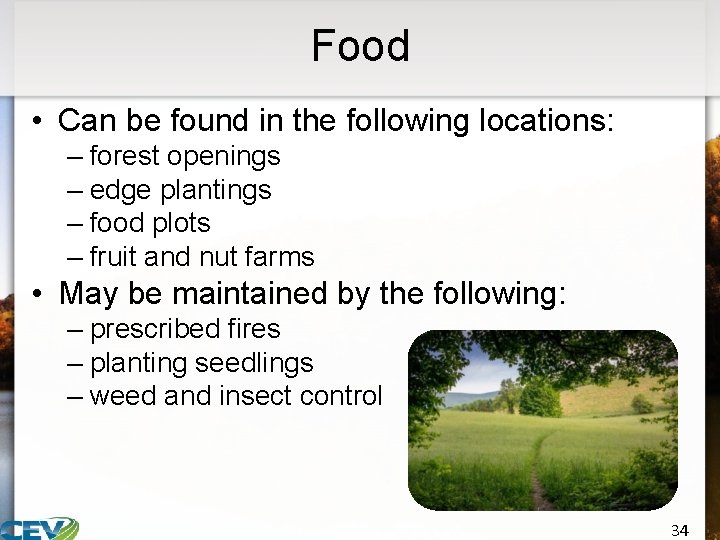
Food • Can be found in the following locations: – forest openings – edge plantings – food plots – fruit and nut farms • May be maintained by the following: – prescribed fires – planting seedlings – weed and insect control 34
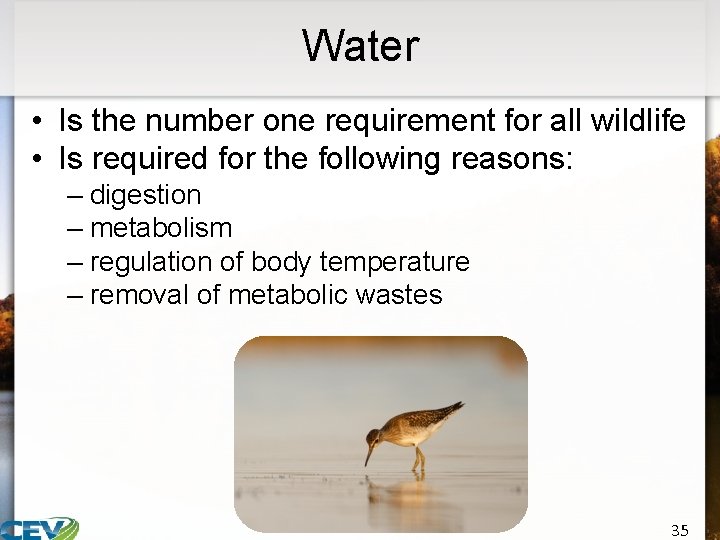
Water • Is the number one requirement for all wildlife • Is required for the following reasons: – digestion – metabolism – regulation of body temperature – removal of metabolic wastes 35
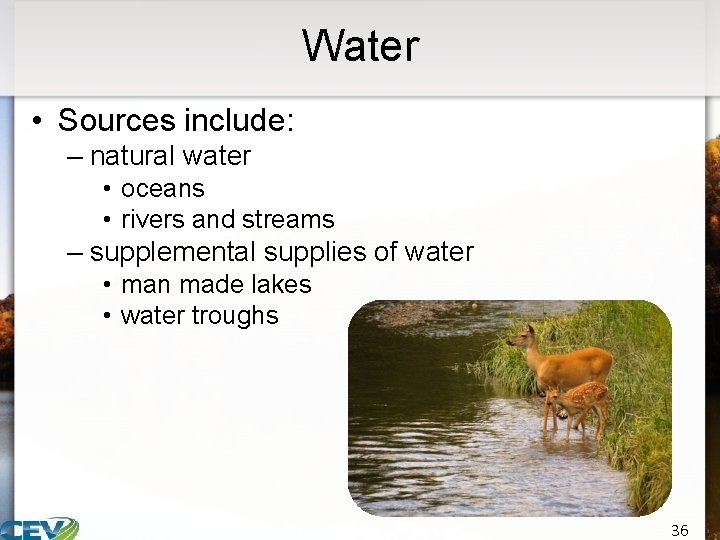
Water • Sources include: – natural water • oceans • rivers and streams – supplemental supplies of water • man made lakes • water troughs 36
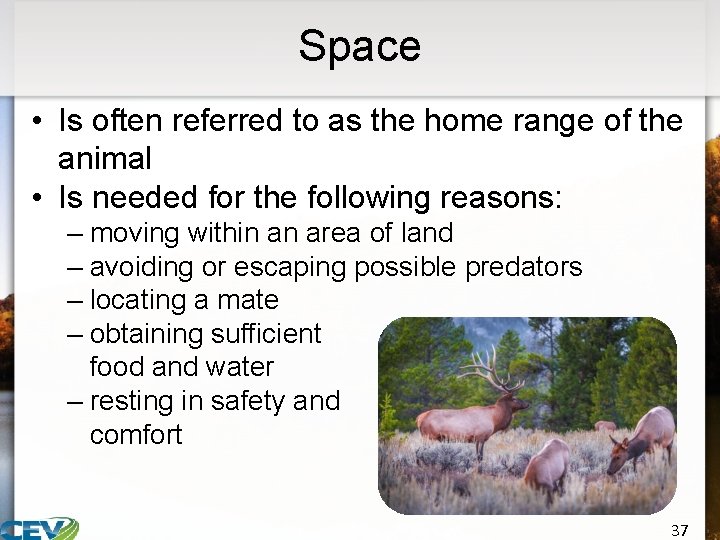
Space • Is often referred to as the home range of the animal • Is needed for the following reasons: – moving within an area of land – avoiding or escaping possible predators – locating a mate – obtaining sufficient food and water – resting in safety and comfort 37
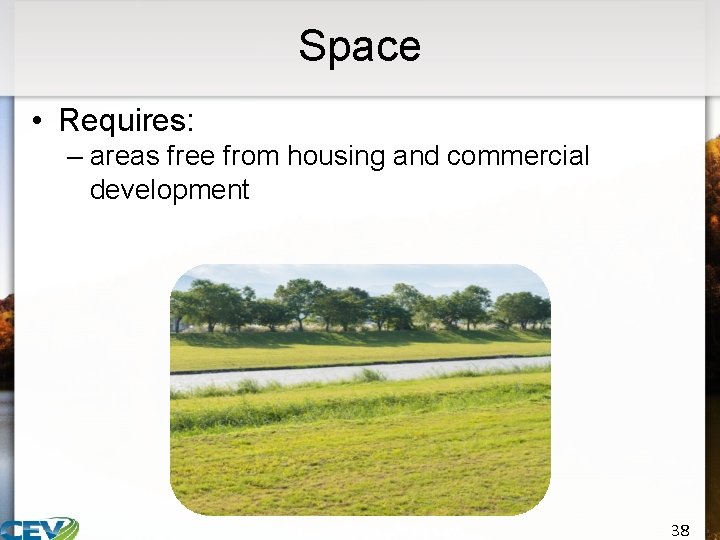
Space • Requires: – areas free from housing and commercial development 38
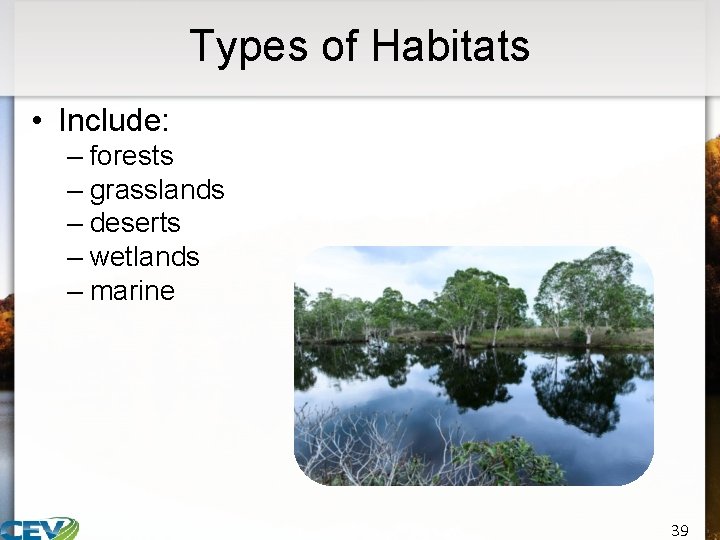
Types of Habitats • Include: – forests – grasslands – deserts – wetlands – marine 39
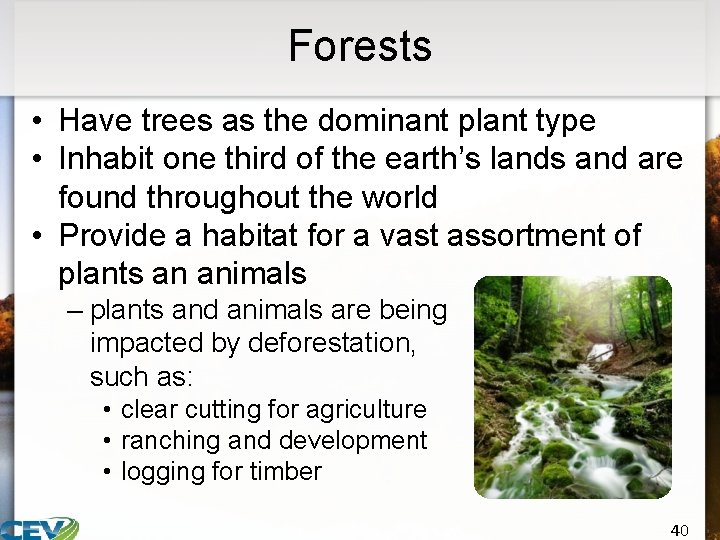
Forests • Have trees as the dominant plant type • Inhabit one third of the earth’s lands and are found throughout the world • Provide a habitat for a vast assortment of plants an animals – plants and animals are being impacted by deforestation, such as: • clear cutting for agriculture • ranching and development • logging for timber 40
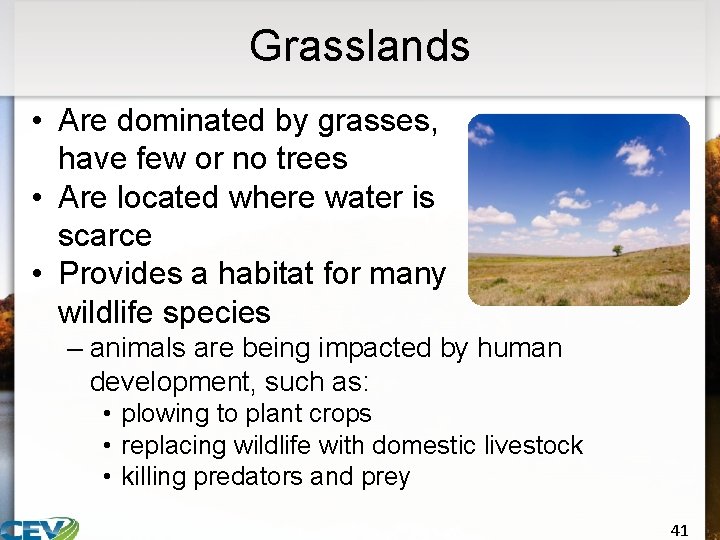
Grasslands • Are dominated by grasses, have few or no trees • Are located where water is scarce • Provides a habitat for many wildlife species – animals are being impacted by human development, such as: • plowing to plant crops • replacing wildlife with domestic livestock • killing predators and prey 41
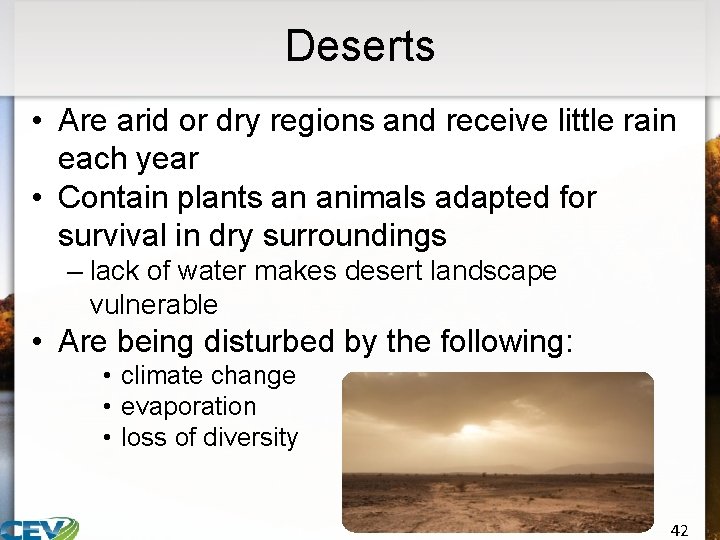
Deserts • Are arid or dry regions and receive little rain each year • Contain plants an animals adapted for survival in dry surroundings – lack of water makes desert landscape vulnerable • Are being disturbed by the following: • climate change • evaporation • loss of diversity 42
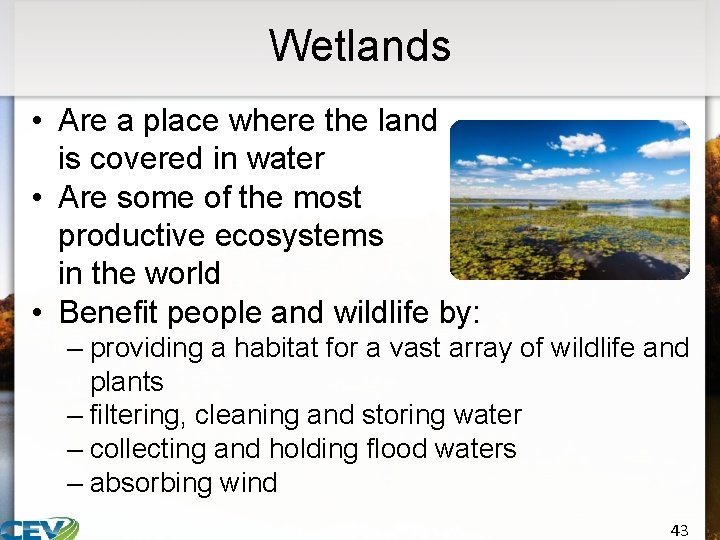
Wetlands • Are a place where the land is covered in water • Are some of the most productive ecosystems in the world • Benefit people and wildlife by: – providing a habitat for a vast array of wildlife and plants – filtering, cleaning and storing water – collecting and holding flood waters – absorbing wind 43
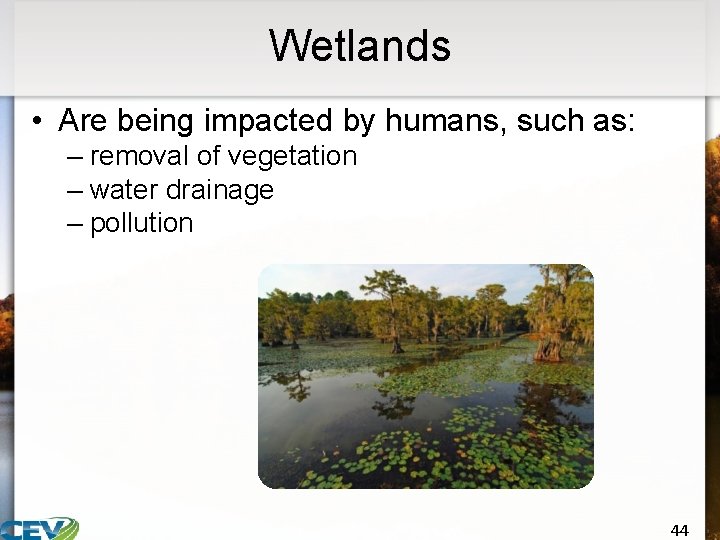
Wetlands • Are being impacted by humans, such as: – removal of vegetation – water drainage – pollution 44
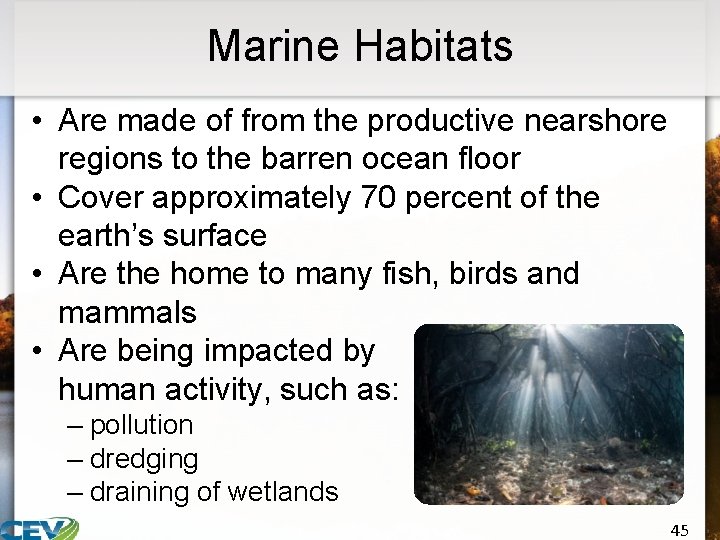
Marine Habitats • Are made of from the productive nearshore regions to the barren ocean floor • Cover approximately 70 percent of the earth’s surface • Are the home to many fish, birds and mammals • Are being impacted by human activity, such as: – pollution – dredging – draining of wetlands 45
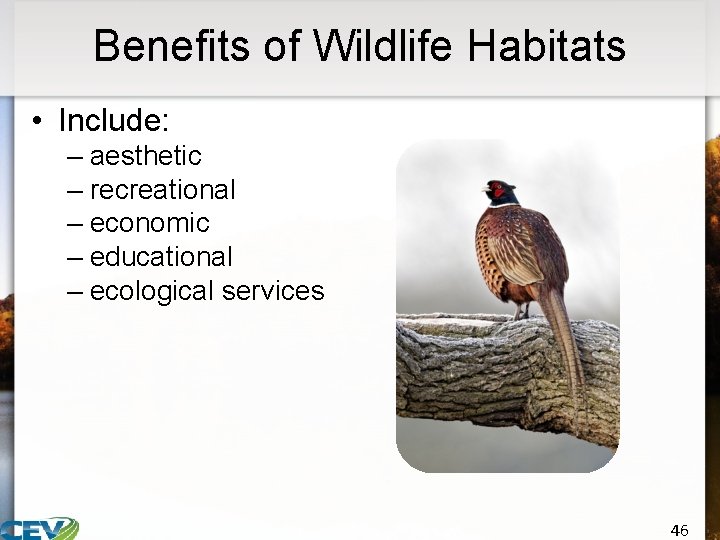
Benefits of Wildlife Habitats • Include: – aesthetic – recreational – economic – educational – ecological services 46
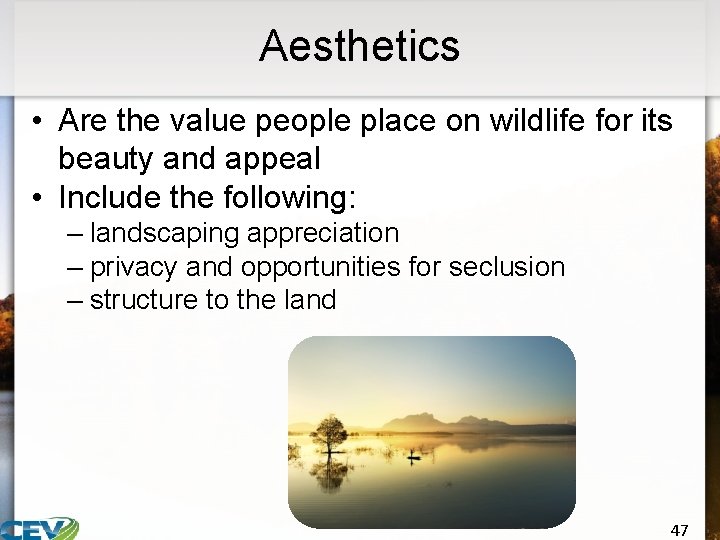
Aesthetics • Are the value people place on wildlife for its beauty and appeal • Include the following: – landscaping appreciation – privacy and opportunities for seclusion – structure to the land 47
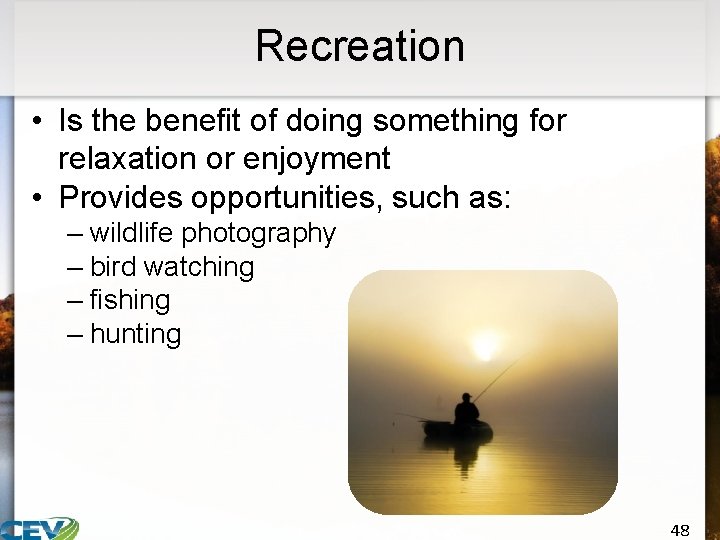
Recreation • Is the benefit of doing something for relaxation or enjoyment • Provides opportunities, such as: – wildlife photography – bird watching – fishing – hunting 48
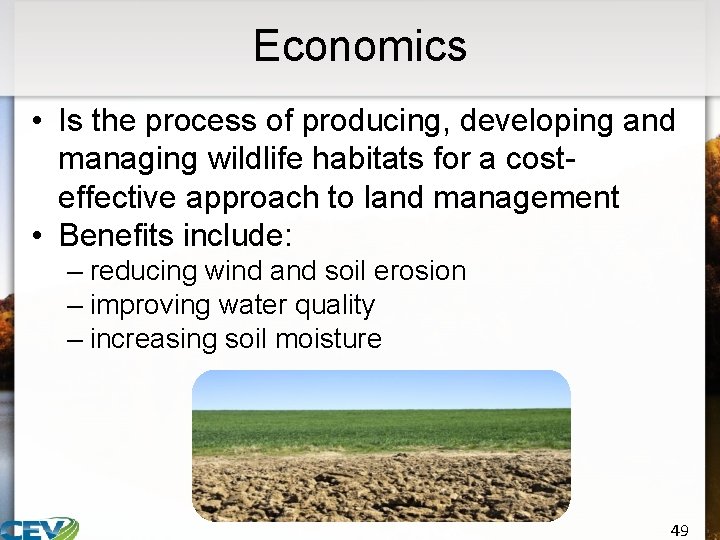
Economics • Is the process of producing, developing and managing wildlife habitats for a costeffective approach to land management • Benefits include: – reducing wind and soil erosion – improving water quality – increasing soil moisture 49
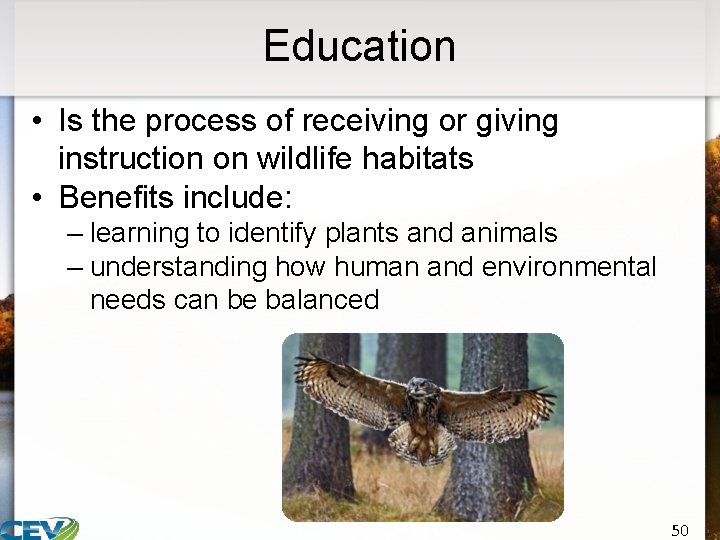
Education • Is the process of receiving or giving instruction on wildlife habitats • Benefits include: – learning to identify plants and animals – understanding how human and environmental needs can be balanced 50
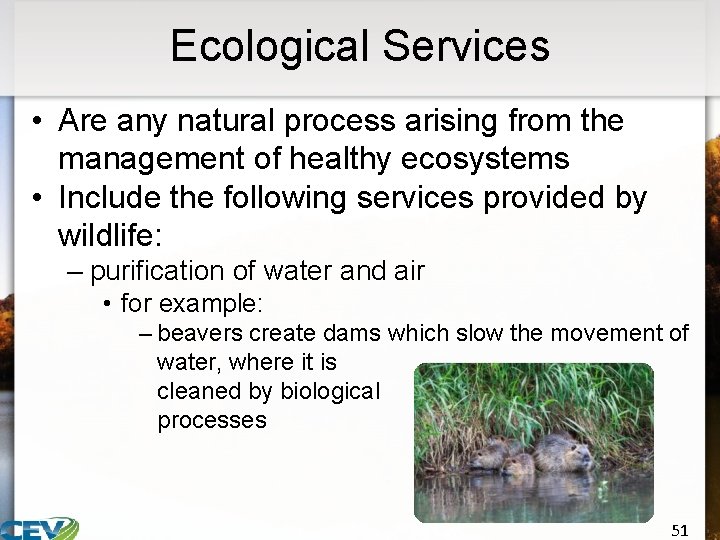
Ecological Services • Are any natural process arising from the management of healthy ecosystems • Include the following services provided by wildlife: – purification of water and air • for example: – beavers create dams which slow the movement of water, where it is cleaned by biological processes 51
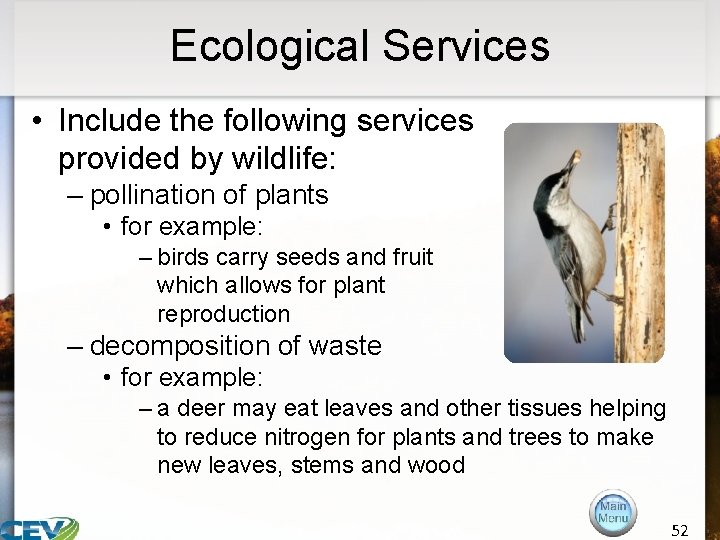
Ecological Services • Include the following services provided by wildlife: – pollination of plants • for example: – birds carry seeds and fruit which allows for plant reproduction – decomposition of waste • for example: – a deer may eat leaves and other tissues helping to reduce nitrogen for plants and trees to make new leaves, stems and wood 52
53
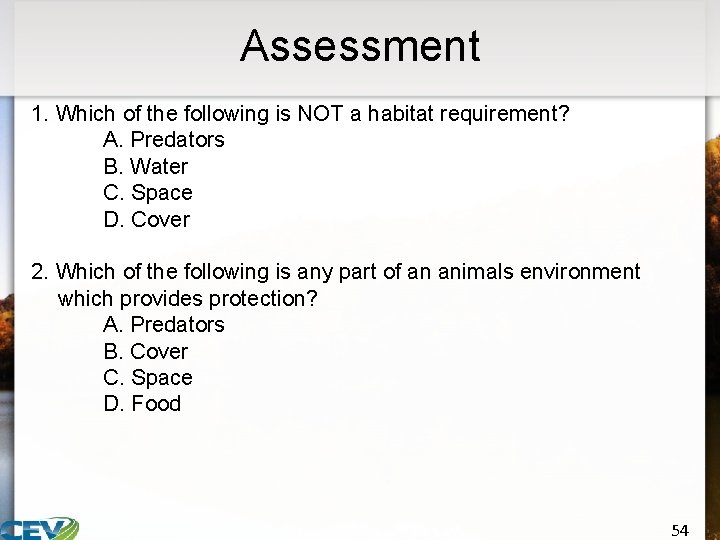
Assessment 1. Which of the following is NOT a habitat requirement? A. Predators B. Water C. Space D. Cover 2. Which of the following is any part of an animals environment which provides protection? A. Predators B. Cover C. Space D. Food 54
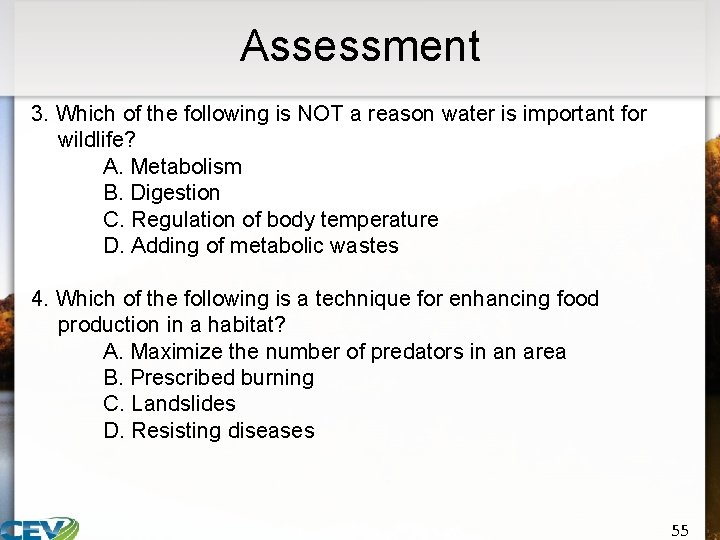
Assessment 3. Which of the following is NOT a reason water is important for wildlife? A. Metabolism B. Digestion C. Regulation of body temperature D. Adding of metabolic wastes 4. Which of the following is a technique for enhancing food production in a habitat? A. Maximize the number of predators in an area B. Prescribed burning C. Landslides D. Resisting diseases 55
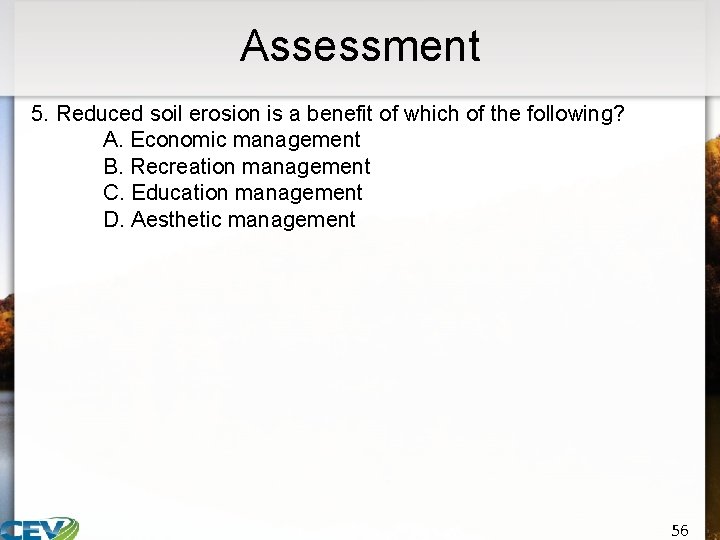
Assessment 5. Reduced soil erosion is a benefit of which of the following? A. Economic management B. Recreation management C. Education management D. Aesthetic management 56
57
Agencies • Are designed to improve wildlife management • Include the following: – National Parks Service – U. S. Fish and Wildlife Service – Wildlife Conservation Society – National Wildlife Federation – The Wildlife Society – National Marine Fisheries Service 58
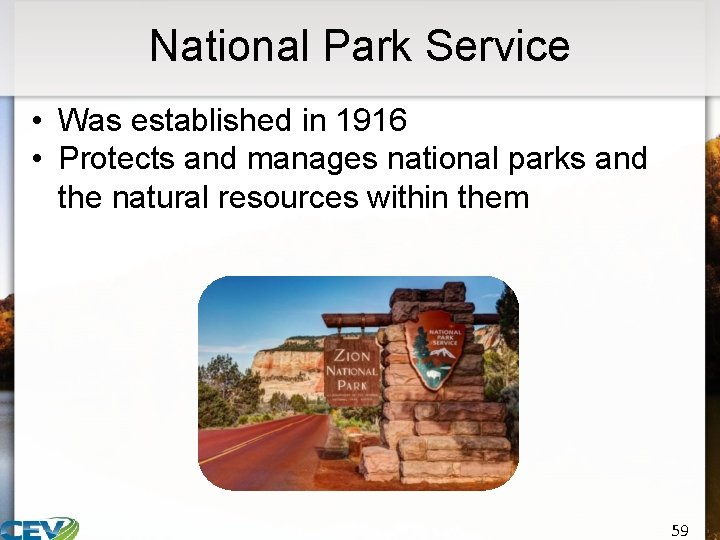
National Park Service • Was established in 1916 • Protects and manages national parks and the natural resources within them 59
National Park Service • Collects standard inventory data describing the natural resources under its stewardship and will monitor those resources at regular intervals to detect or predict changes 60
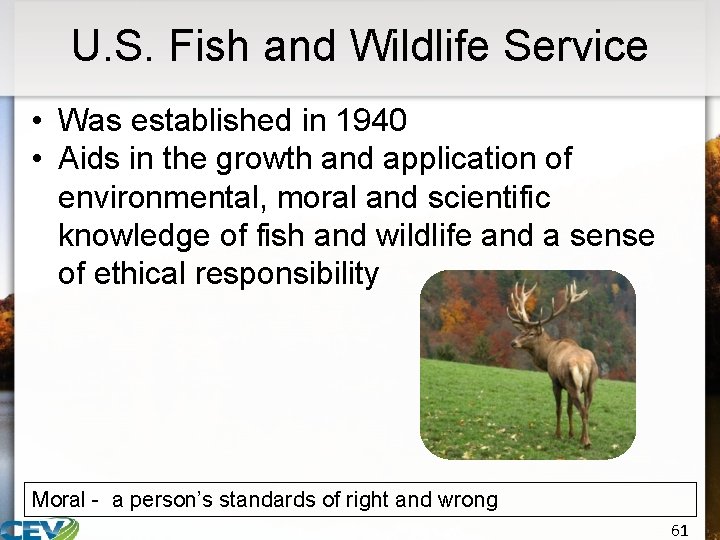
U. S. Fish and Wildlife Service • Was established in 1940 • Aids in the growth and application of environmental, moral and scientific knowledge of fish and wildlife and a sense of ethical responsibility Moral - a person’s standards of right and wrong 61
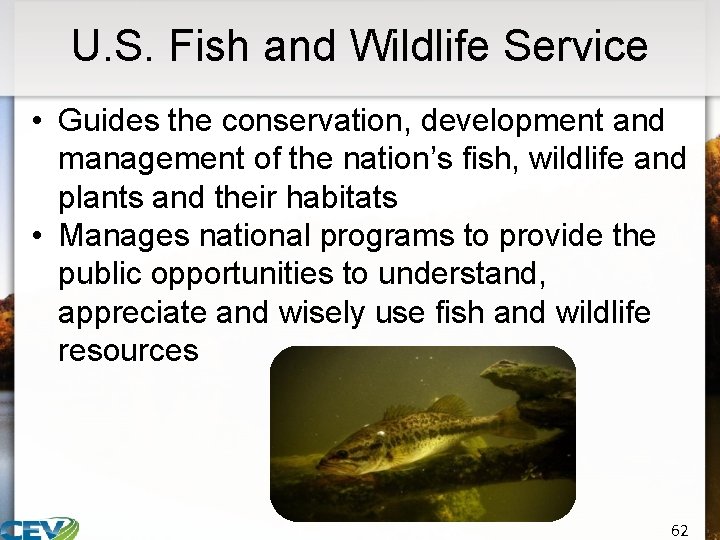
U. S. Fish and Wildlife Service • Guides the conservation, development and management of the nation’s fish, wildlife and plants and their habitats • Manages national programs to provide the public opportunities to understand, appreciate and wisely use fish and wildlife resources 62
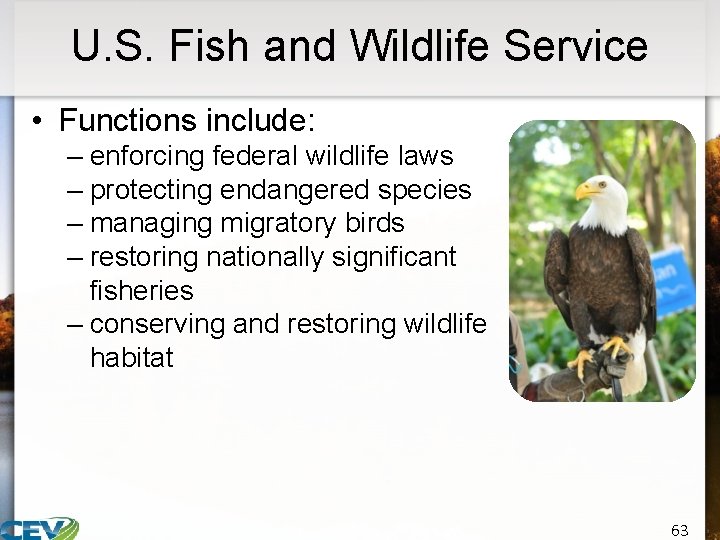
U. S. Fish and Wildlife Service • Functions include: – enforcing federal wildlife laws – protecting endangered species – managing migratory birds – restoring nationally significant fisheries – conserving and restoring wildlife habitat 63
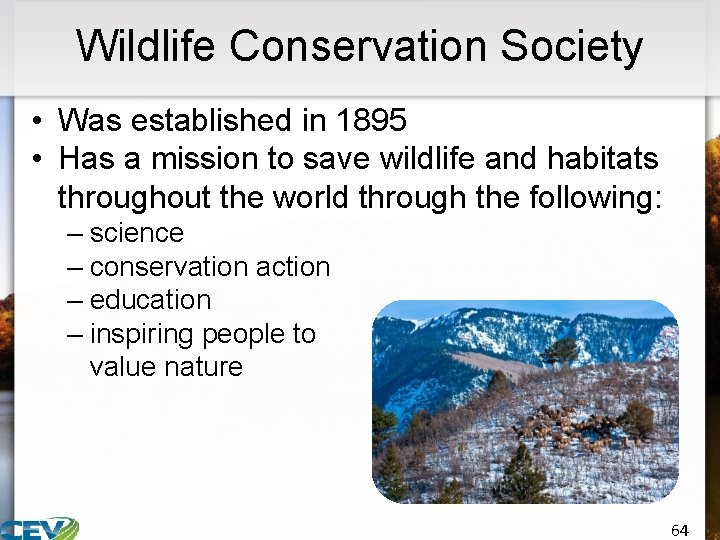
Wildlife Conservation Society • Was established in 1895 • Has a mission to save wildlife and habitats throughout the world through the following: – science – conservation action – education – inspiring people to value nature 64
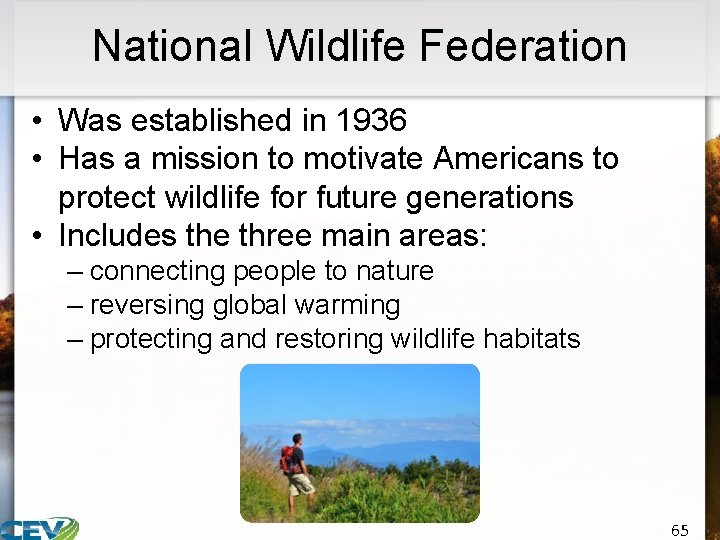
National Wildlife Federation • Was established in 1936 • Has a mission to motivate Americans to protect wildlife for future generations • Includes the three main areas: – connecting people to nature – reversing global warming – protecting and restoring wildlife habitats 65
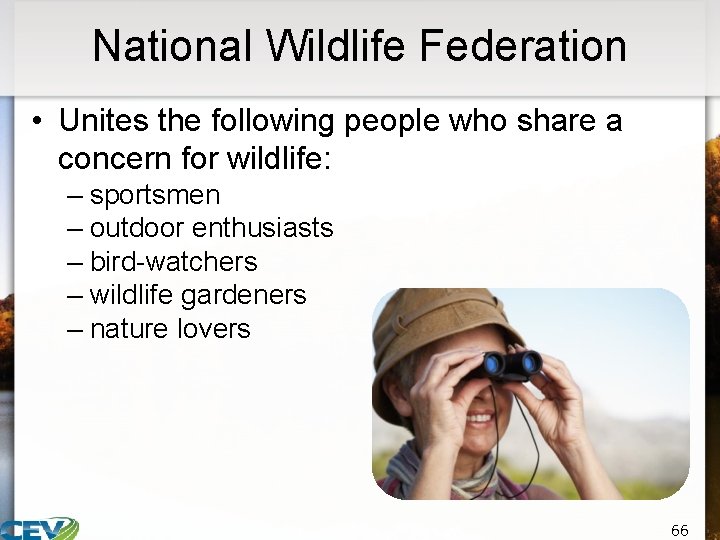
National Wildlife Federation • Unites the following people who share a concern for wildlife: – sportsmen – outdoor enthusiasts – bird-watchers – wildlife gardeners – nature lovers 66
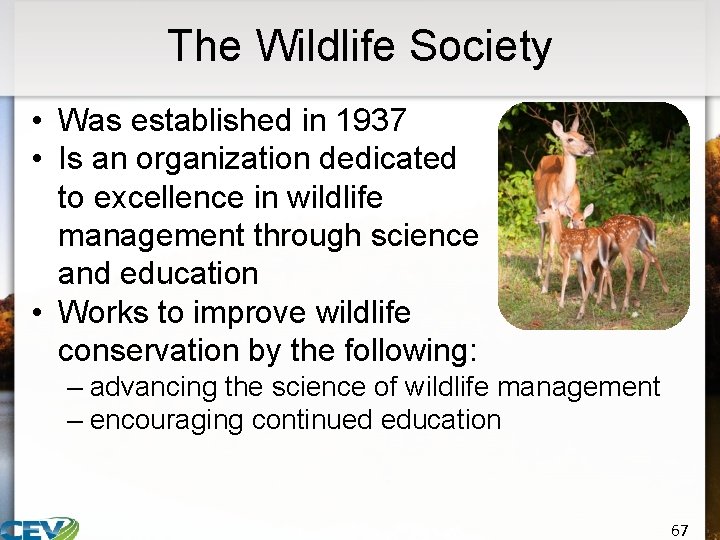
The Wildlife Society • Was established in 1937 • Is an organization dedicated to excellence in wildlife management through science and education • Works to improve wildlife conservation by the following: – advancing the science of wildlife management – encouraging continued education 67
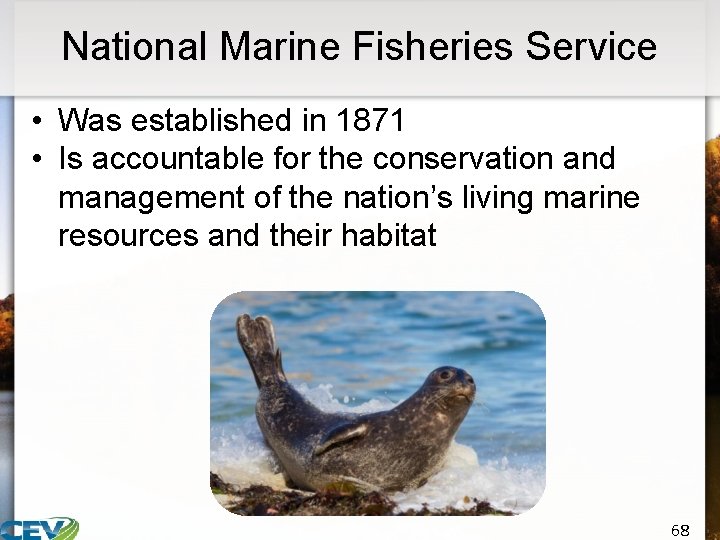
National Marine Fisheries Service • Was established in 1871 • Is accountable for the conservation and management of the nation’s living marine resources and their habitat 68
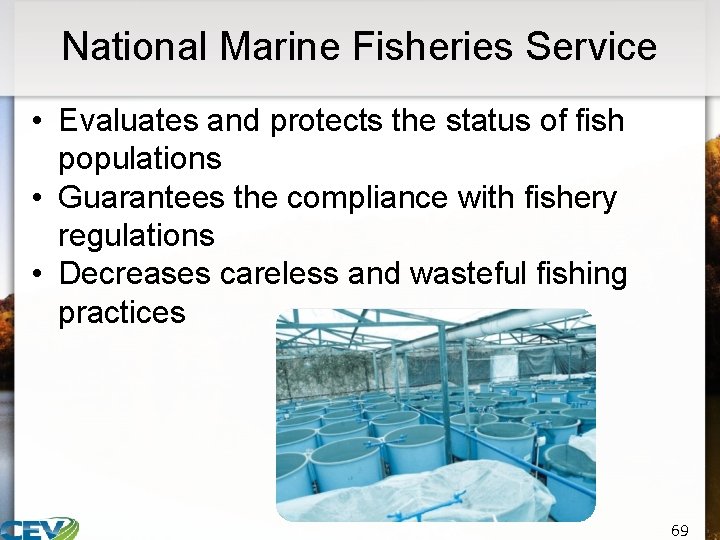
National Marine Fisheries Service • Evaluates and protects the status of fish populations • Guarantees the compliance with fishery regulations • Decreases careless and wasteful fishing practices 69
National Marine Fisheries Service • Works to encourage sustainable fisheries • Prevents lost economic potential related to the following: – overfishing – diminishing species – degraded habitats 70
Laws • Are set to improve wildlife management • Include: – Fish and Wildlife Act – Migratory Bird Conservation Act – Fish and Wildlife Coordination Act – Endangered Species Act – Magnuson-Stevens Fishery Conservation and Management Act – Pittman-Robertson Act 71
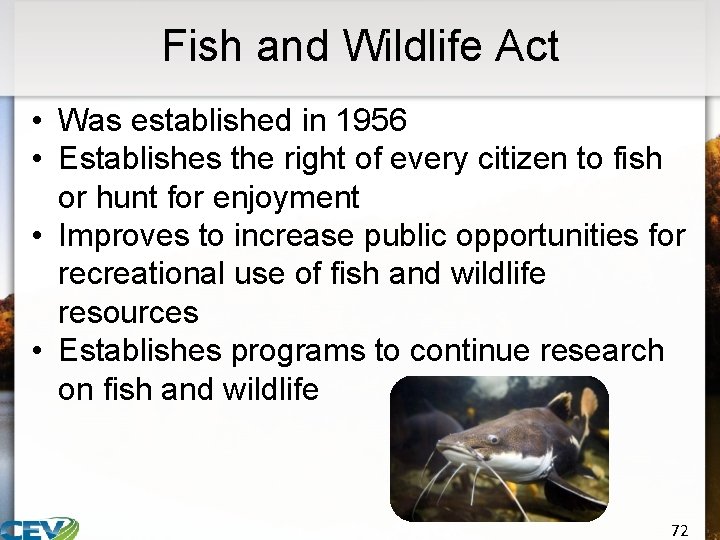
Fish and Wildlife Act • Was established in 1956 • Establishes the right of every citizen to fish or hunt for enjoyment • Improves to increase public opportunities for recreational use of fish and wildlife resources • Establishes programs to continue research on fish and wildlife 72
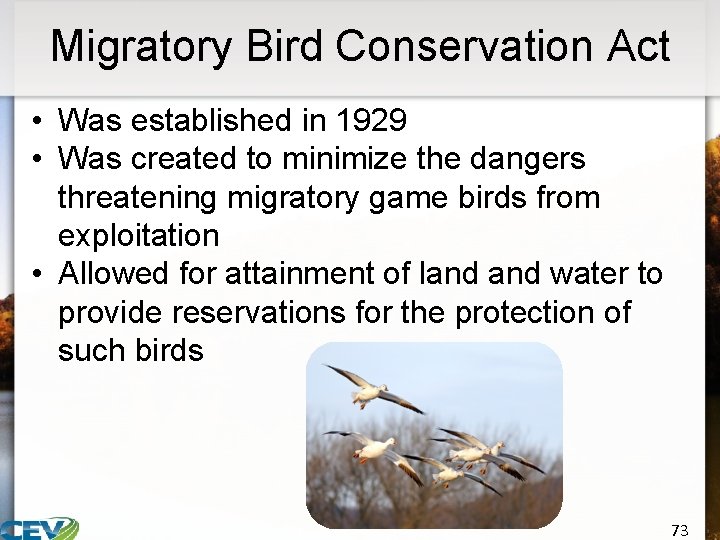
Migratory Bird Conservation Act • Was established in 1929 • Was created to minimize the dangers threatening migratory game birds from exploitation • Allowed for attainment of land water to provide reservations for the protection of such birds 73
Fish and Wildlife Coordination Act • Was established in 1958 • Provides support to federal and state agencies as a means to protect and conserve the supply of wildlife and wildlife resources • Delivers assistance to: – develop and protect all species of wildlife and their habitats – control losses from diseases – minimize harms from overabundant species – provide public hunting and fishing areas 74
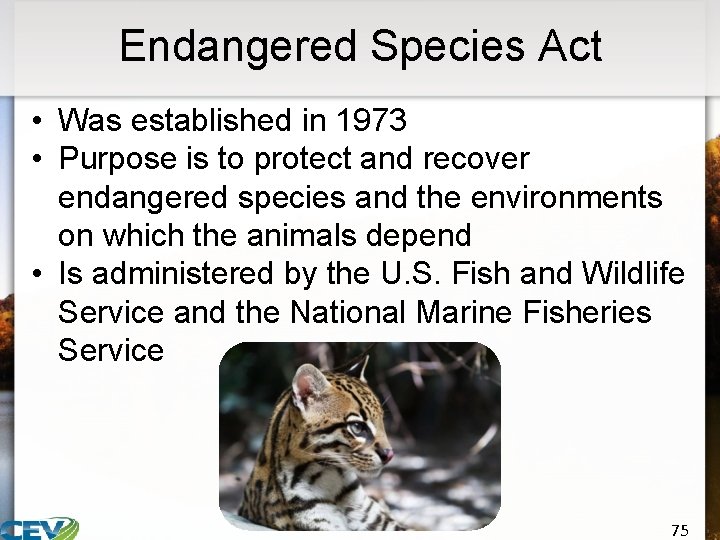
Endangered Species Act • Was established in 1973 • Purpose is to protect and recover endangered species and the environments on which the animals depend • Is administered by the U. S. Fish and Wildlife Service and the National Marine Fisheries Service 75
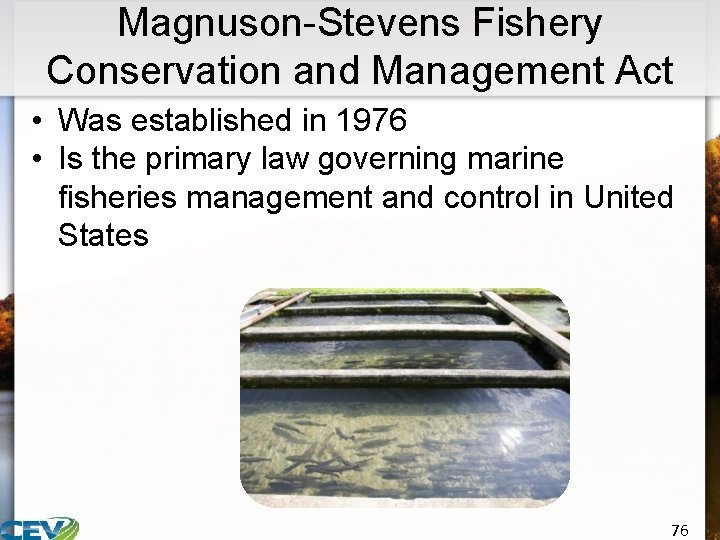
Magnuson-Stevens Fishery Conservation and Management Act • Was established in 1976 • Is the primary law governing marine fisheries management and control in United States 76
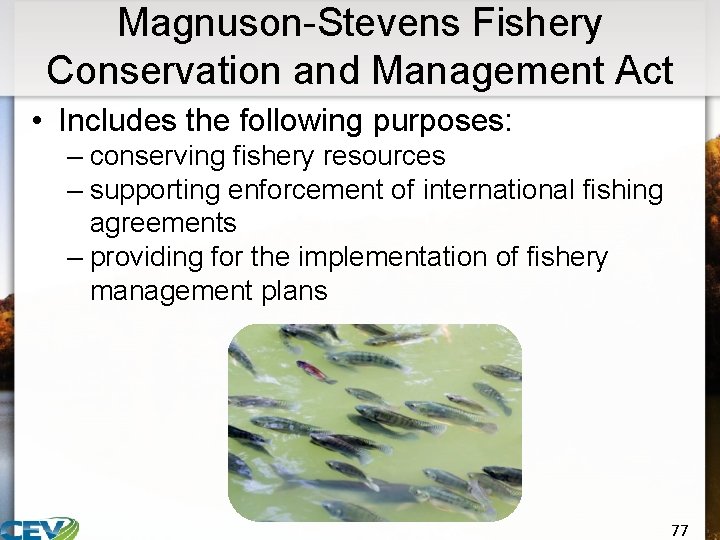
Magnuson-Stevens Fishery Conservation and Management Act • Includes the following purposes: – conserving fishery resources – supporting enforcement of international fishing agreements – providing for the implementation of fishery management plans 77
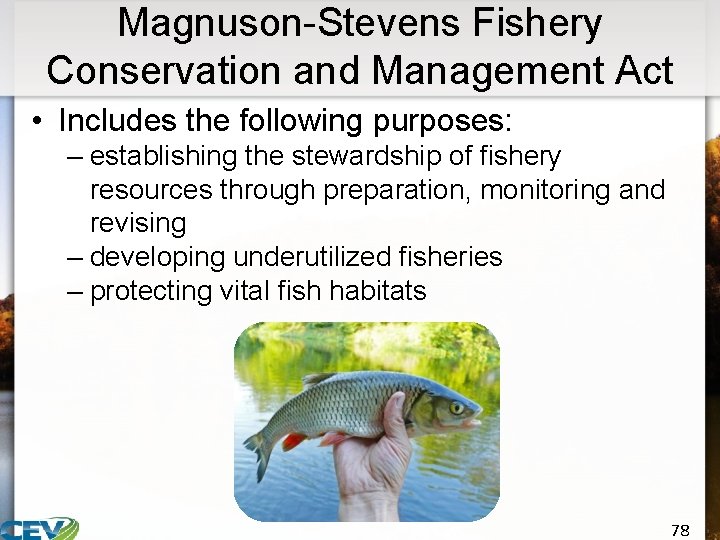
Magnuson-Stevens Fishery Conservation and Management Act • Includes the following purposes: – establishing the stewardship of fishery resources through preparation, monitoring and revising – developing underutilized fisheries – protecting vital fish habitats 78
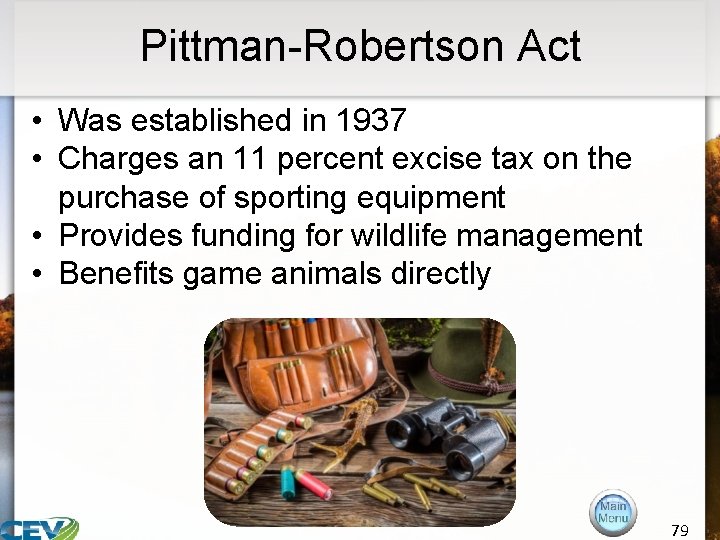
Pittman-Robertson Act • Was established in 1937 • Charges an 11 percent excise tax on the purchase of sporting equipment • Provides funding for wildlife management • Benefits game animals directly 79
80
Assessment 1. Which Act charges an 11 percent excise tax on the purchase of sporting equipment? A. Fish and Wildlife Coordination Act B. Fish and Wildlife Act C. Pittman-Robertson Act D. Migratory Bird Conservation Act 2. Which of the following is the primary law governing marine fisheries? A. Fish and Wildlife Act B. Pittman-Robertson Act C. National Marine Fisheries Service D. Magnuson-Stevens Fishery Conservation and Management Act 81
Assessment 3. Which agency has a mission to save wildlife and wildlife habitats throughout the world? A. National Wildlife Federation B. Wildlife Conservation Society C. National Marine Fisheries Service D. Endangered Species Agency 4. In which year was the U. S. Fish and Wildlife Service created? A. 1940 B. 1948 C. 1953 D. 1967 82
Assessment 5. Which of the following agencies manages migratory birds? A. National Wildlife Federation B. Wildlife Conservation Society C. National Bird Association D. U. S. Fish and Wildlife Service 83
84
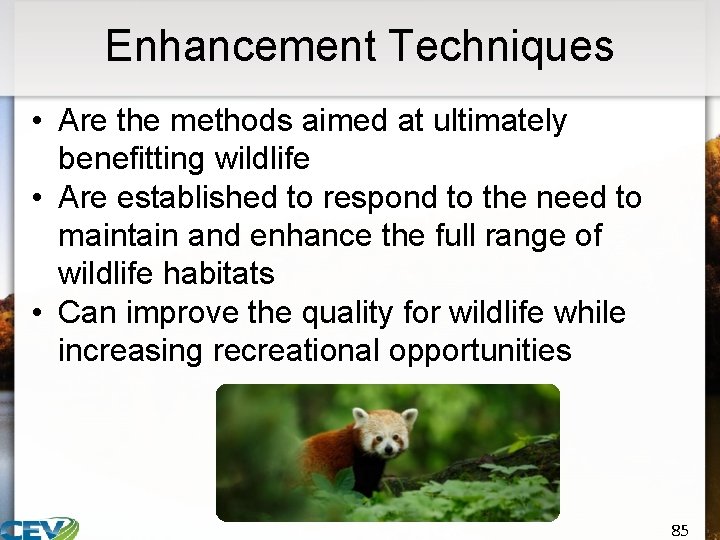
Enhancement Techniques • Are the methods aimed at ultimately benefitting wildlife • Are established to respond to the need to maintain and enhance the full range of wildlife habitats • Can improve the quality for wildlife while increasing recreational opportunities 85
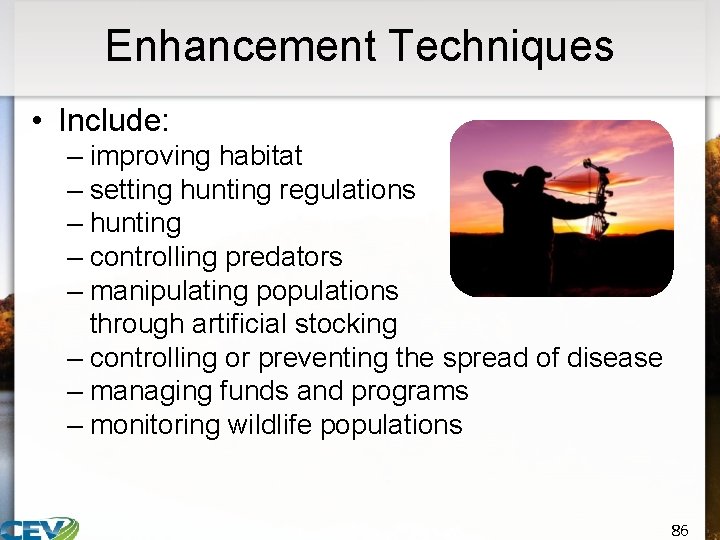
Enhancement Techniques • Include: – improving habitat – setting hunting regulations – hunting – controlling predators – manipulating populations through artificial stocking – controlling or preventing the spread of disease – managing funds and programs – monitoring wildlife populations 86
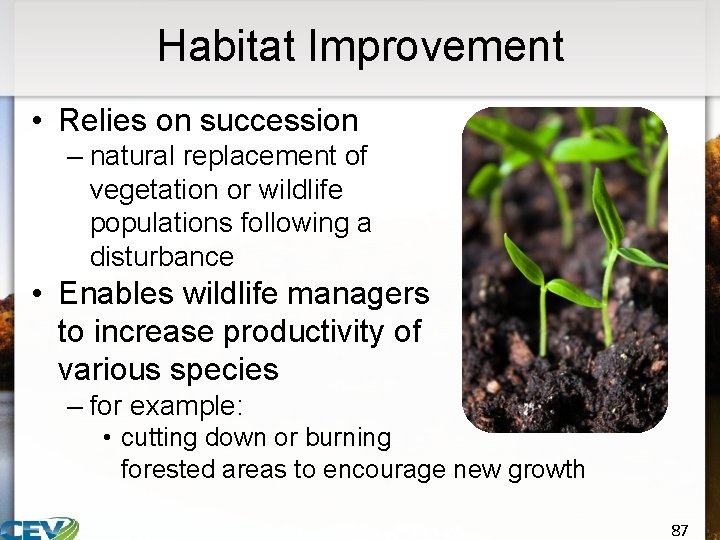
Habitat Improvement • Relies on succession – natural replacement of vegetation or wildlife populations following a disturbance • Enables wildlife managers to increase productivity of various species – for example: • cutting down or burning forested areas to encourage new growth 87
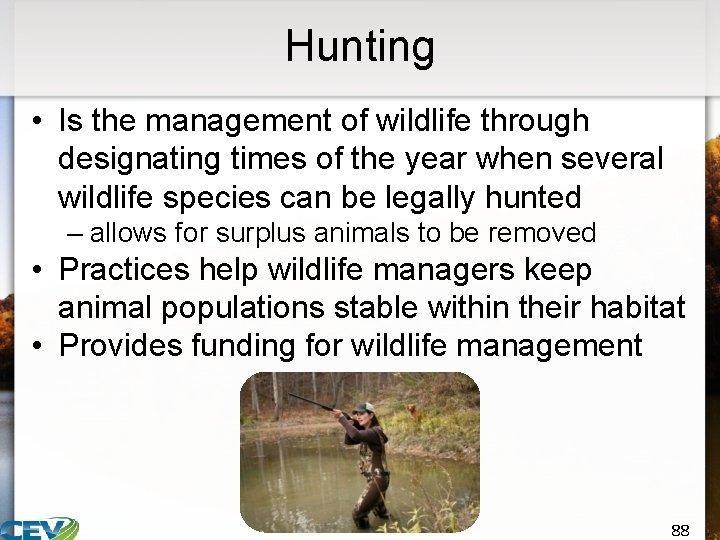
Hunting • Is the management of wildlife through designating times of the year when several wildlife species can be legally hunted – allows for surplus animals to be removed • Practices help wildlife managers keep animal populations stable within their habitat • Provides funding for wildlife management 88
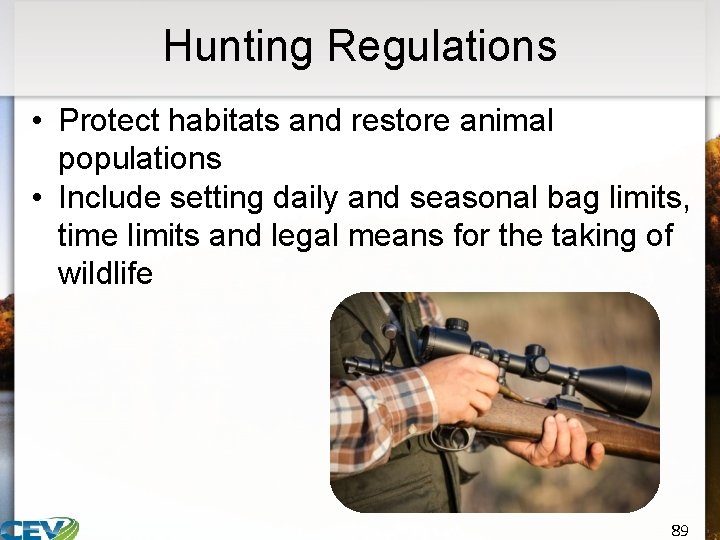
Hunting Regulations • Protect habitats and restore animal populations • Include setting daily and seasonal bag limits, time limits and legal means for the taking of wildlife 89
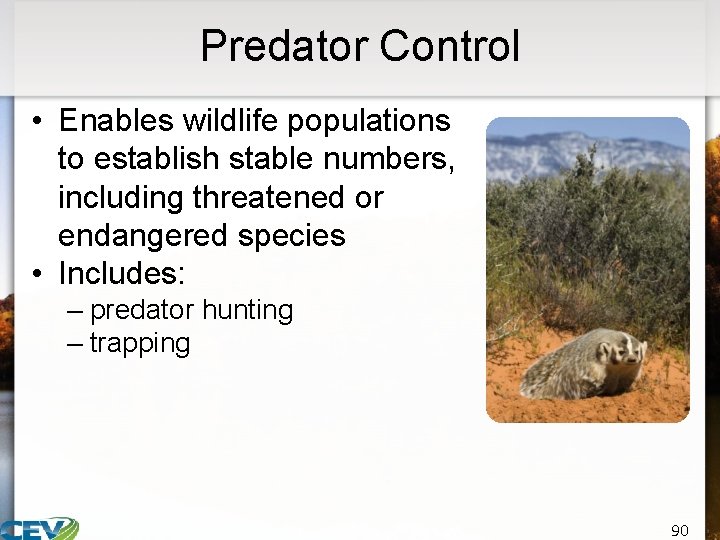
Predator Control • Enables wildlife populations to establish stable numbers, including threatened or endangered species • Includes: – predator hunting – trapping 90
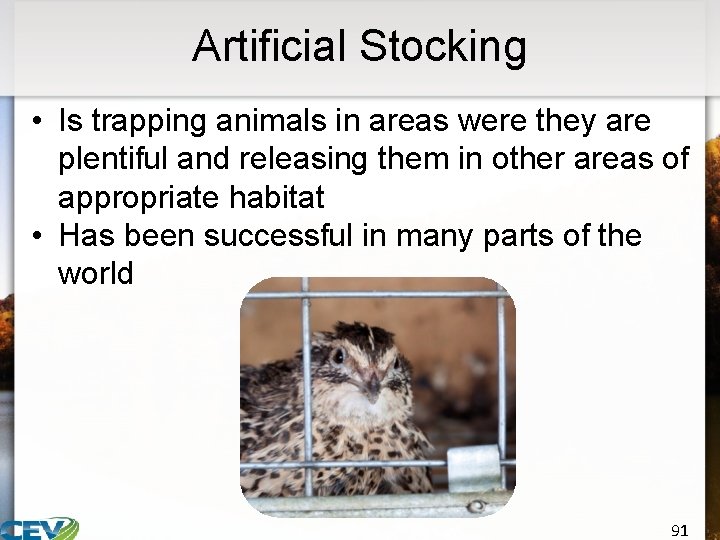
Artificial Stocking • Is trapping animals in areas were they are plentiful and releasing them in other areas of appropriate habitat • Has been successful in many parts of the world 91
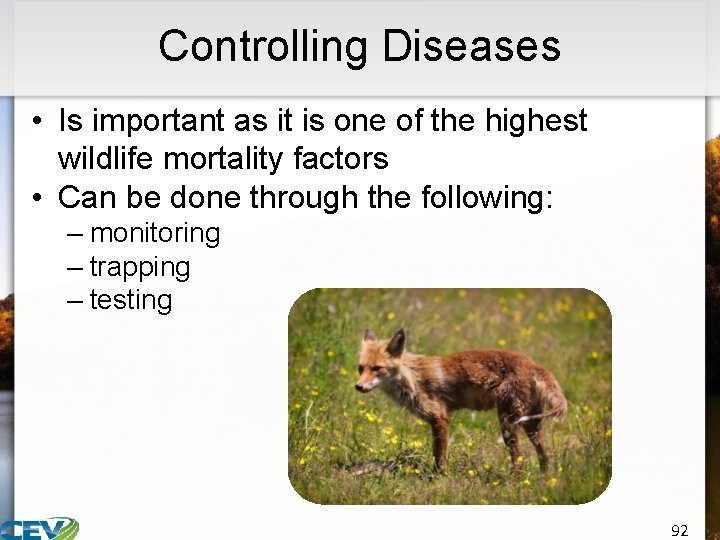
Controlling Diseases • Is important as it is one of the highest wildlife mortality factors • Can be done through the following: – monitoring – trapping – testing 92
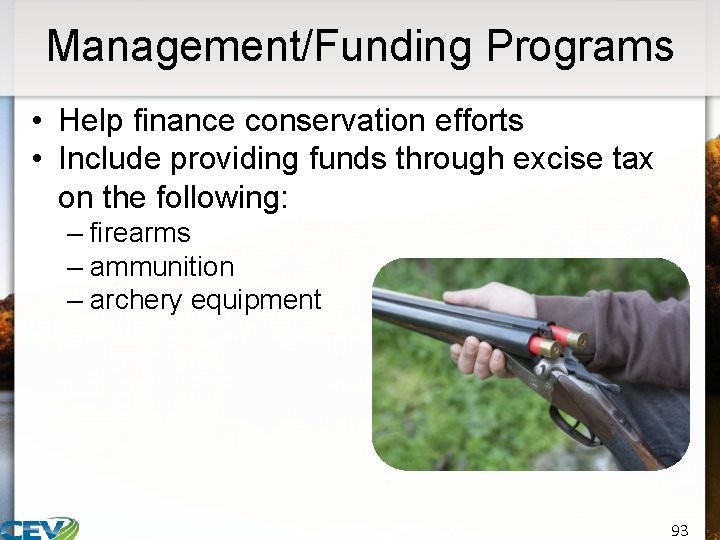
Management/Funding Programs • Help finance conservation efforts • Include providing funds through excise tax on the following: – firearms – ammunition – archery equipment 93
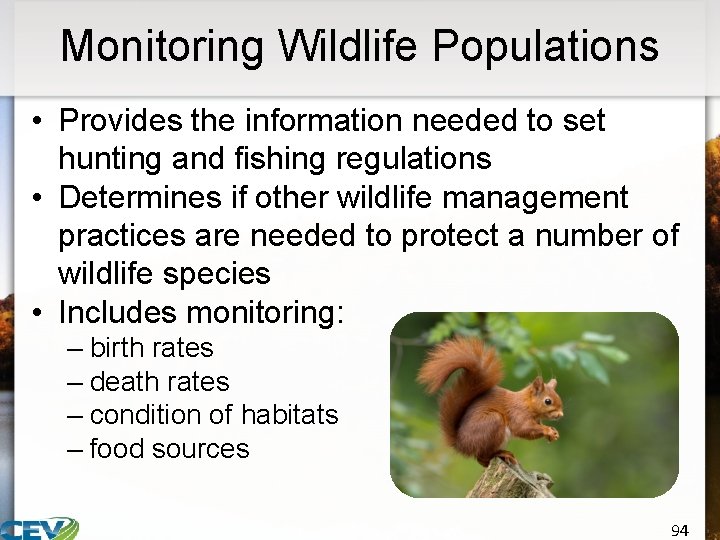
Monitoring Wildlife Populations • Provides the information needed to set hunting and fishing regulations • Determines if other wildlife management practices are needed to protect a number of wildlife species • Includes monitoring: – birth rates – death rates – condition of habitats – food sources 94
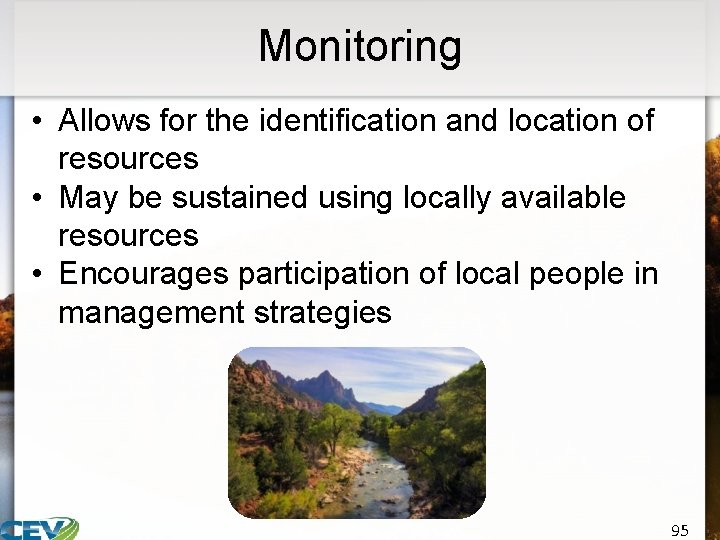
Monitoring • Allows for the identification and location of resources • May be sustained using locally available resources • Encourages participation of local people in management strategies 95
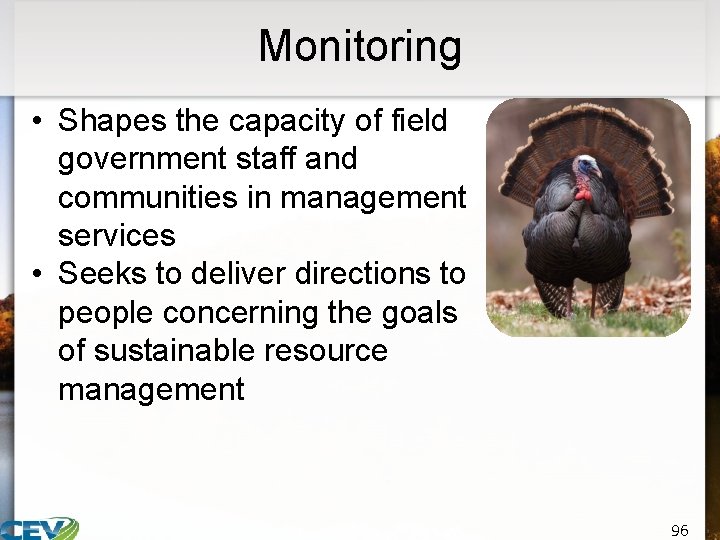
Monitoring • Shapes the capacity of field government staff and communities in management services • Seeks to deliver directions to people concerning the goals of sustainable resource management 96
Monitoring • Includes observing the following: – air and climate – geology and soils – water – biological integrity – human use – landscapes 97
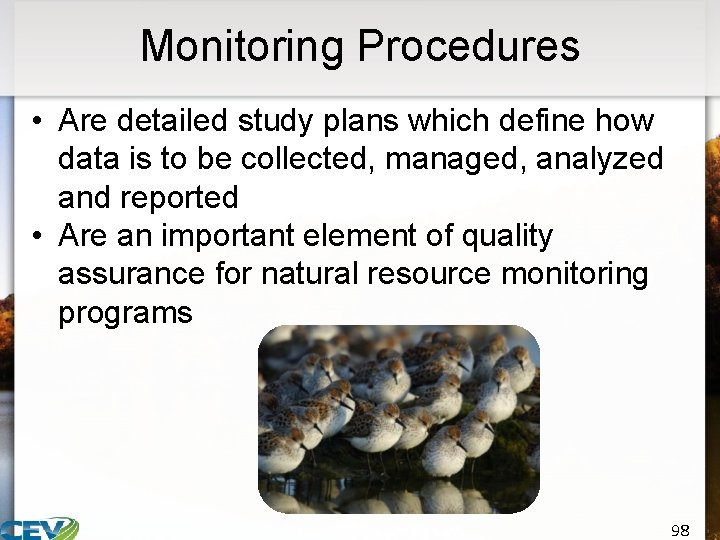
Monitoring Procedures • Are detailed study plans which define how data is to be collected, managed, analyzed and reported • Are an important element of quality assurance for natural resource monitoring programs 98
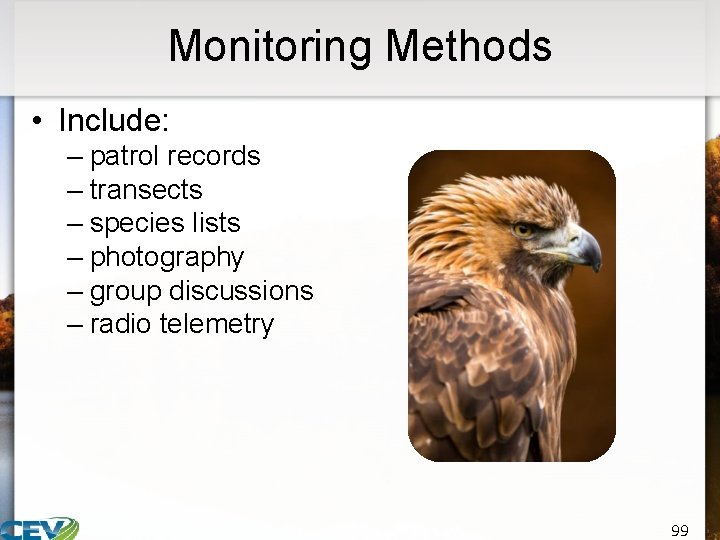
Monitoring Methods • Include: – patrol records – transects – species lists – photography – group discussions – radio telemetry 99
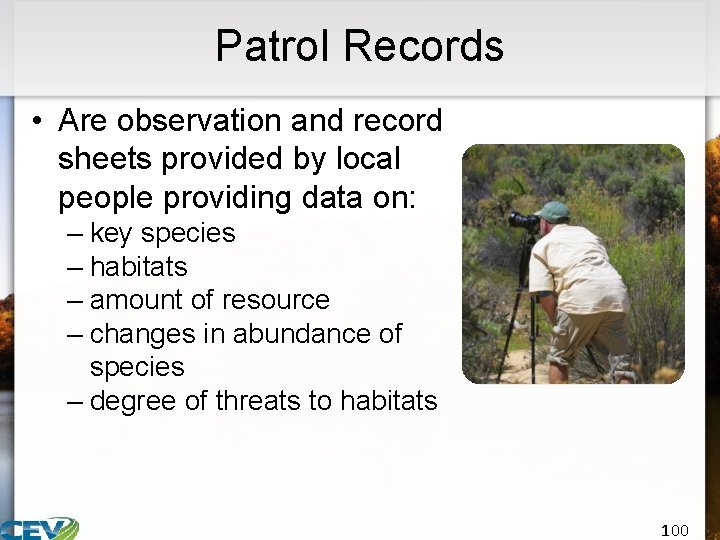
Patrol Records • Are observation and record sheets provided by local people providing data on: – key species – habitats – amount of resource – changes in abundance of species – degree of threats to habitats 100
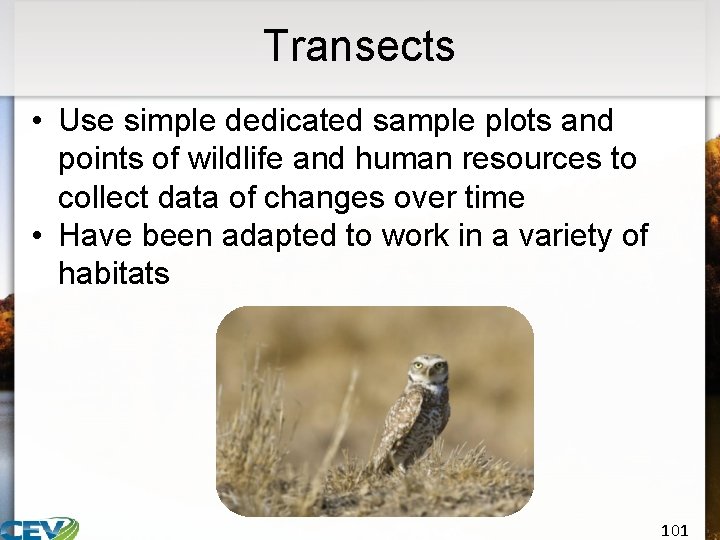
Transects • Use simple dedicated sample plots and points of wildlife and human resources to collect data of changes over time • Have been adapted to work in a variety of habitats 101
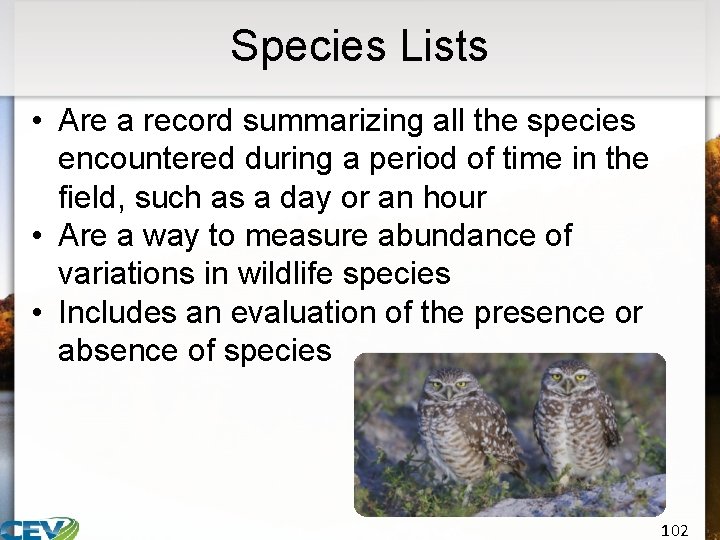
Species Lists • Are a record summarizing all the species encountered during a period of time in the field, such as a day or an hour • Are a way to measure abundance of variations in wildlife species • Includes an evaluation of the presence or absence of species 102
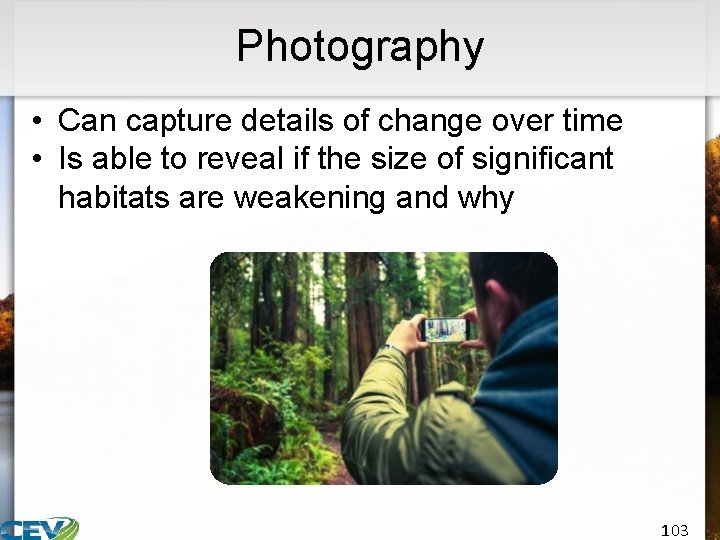
Photography • Can capture details of change over time • Is able to reveal if the size of significant habitats are weakening and why 103
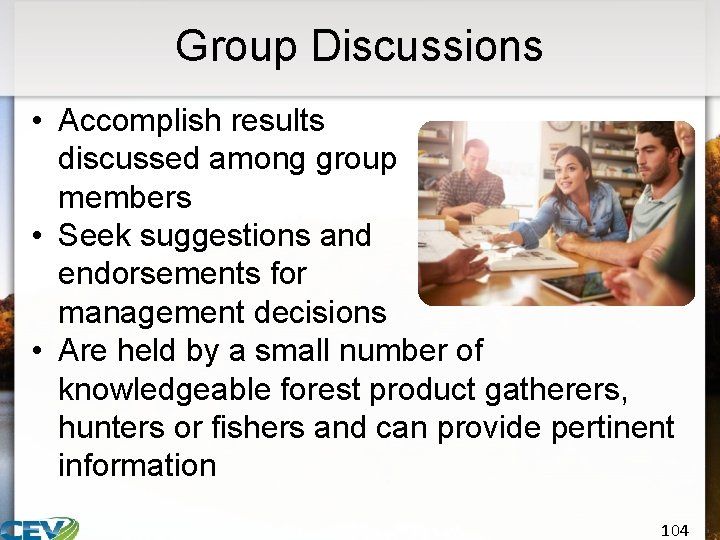
Group Discussions • Accomplish results discussed among group members • Seek suggestions and endorsements for management decisions • Are held by a small number of knowledgeable forest product gatherers, hunters or fishers and can provide pertinent information 104
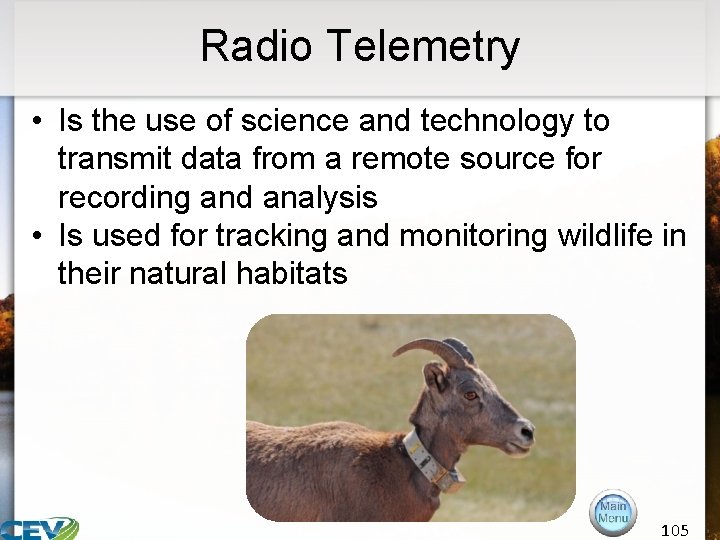
Radio Telemetry • Is the use of science and technology to transmit data from a remote source for recording and analysis • Is used for tracking and monitoring wildlife in their natural habitats 105
106
Assessment 1. Which of the following is a management technique which deals with the time of the year? A. Birth rates B. Hunting C. Predator control D. Artificial stocking 2. Which of the following is NOT a true statement? A. Hunting provides funding for wildlife management B. The spread of disease is one of the highest wildlife mortality factors C. Funding programs may be provided through excise tax on ammunition D. Hunting regulations do not protect habitats 107
Assessment 3. Which of the following provides funding for wildlife management? A. Predator control B. Habitat improvement C. Hunting D. Artificial stocking 4. Trapping animals in areas where they are plentiful and freeing them in other areas is known as which of the following? A. Disease prevention B. Predator control C. Hunting D. Artificial stocking 108
Assessment 5. Habitat improvement relies on which of the following? A. Birth rates B. Succession C. Death rates D. Bag limits 109
110
Assessment 1. Which of the following is NOT a wildlife management practice as stated in the presentation? A. Habitat improvement B. Trapping C. Bird watching D. Artificial stocking 2. Which of the following is an ecological service provided by wildlife as stated in the presentation? A. Artificial stocking B. Landslides C. Birth rates D. Pollination of plants 111
Assessment 3. In which year was the National Wildlife Federation established? A. 1936 B. 1945 C. 1949 D. 1955 4. Which agency includes a mission of reversing global warming? A. The Wildlife Society B. National Wildlife Federation C. Wildlife Conservation Society D. U. S. Fish and Wildlife Service 112
Assessment 5. Which of the following is NOT a true statement? A. The Migratory Bird Conservation Acts purpose is to protect and recover endangered species B. The Fish and Wildlife Act creates programs to continue research on fish and wildlife C. The Pittman-Robertson Act provides funding for wildlife management D. The Magnuson-Stevens Fishery Conservation Act protects essential fish habitats 113
Assessment 6. Which of the following is NOT a benefit of wildlife habitats? A. Education B. Aesthetic C. Recreation D. Excise tax 7. Which of the following Acts allows for acquisition of land water reservations? A. Endangered Species Act B. Migratory Bird Conservation Act C. Fish and Wildlife Act D. Pittman-Robertson Act 114
Assessment 8. Which of the following is NOT a true statement? A. Monitoring provides little data for management activities B. Radio telemetry is a way to track and monitor wildlife populations C. Photography is a means of monitoring natural resources, including wildlife D. Monitoring allows for identification of resources 9. Which of the following describes transects? A. Held by a small number of knowledgeable forest product gatherers, hunters or fishers B. Sample plots and points C. Detailed study plans D. Insects affecting wildlife 115
Assessment 10. Which of the following is a means of monitoring? A. Bird watching B. Bow hunting C. Fishing D. Group discussions 116
Resources • Yarrow, Greg Wildlife and Wildlife Management May 2009 https: //www. clemson. edu/extension/natural-resources/wildlife • Gamborg, Christian Ethics of Wildlife Management and Conservation 2012 http: //nature. com/ • Texas Parks and Wildlife 2015 http: //tpwd. texas. gov • U. S. Fish and Wildlife Service 2015 http: //fws. gov • NOAA Managing Fisheries 2015 http: //fishwatch. gov/wild_seafood/managing_fisheries • Management Practices for Enhancing Wildlife Habitat 1998 • http: //pubs. cas. psu. edu/freepubs/pdfs/uh 107. pdf • New Hampshire Fish and Game Habitat Management 2015 http: //www. wildlife. state. nh. us/wildlife_plan 117
Resources • Wildlife Conservation Society 2015 http: //www. wcs. org • National Wildlife Federation 2015 http: //www. nwf. org • National Marine Fisheries Service 2015 http: //nmfs. noaa. gov 118
Acknowledgements Production Coordinator Stevi Huffaker Graphic Designer Melody Rowell V. P. of Brand Management Clayton Franklin CEV Multimedia, Ltd. ©MMXV Executive Producer Gordon W. Davis, Ph. D. 119
- Slides: 119