Lecture 5 LR Parsing CS 540 George Mason


- Slides: 52
Lecture 5: LR Parsing CS 540 George Mason University CS 540 Spring 2009 GMU
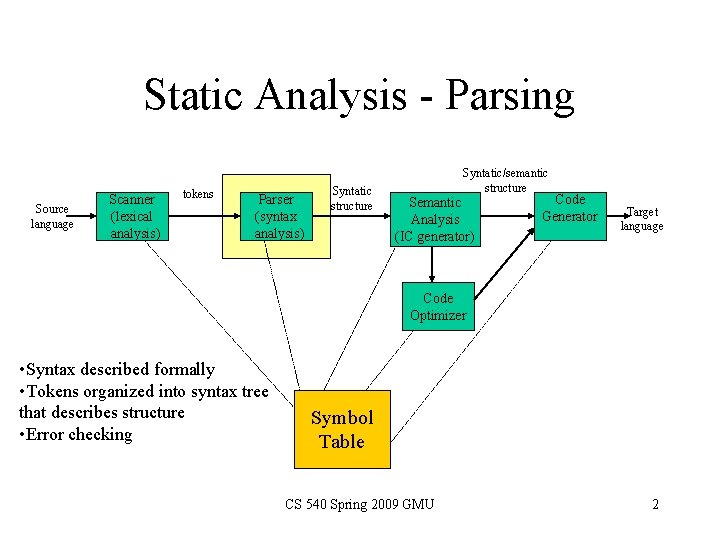
Static Analysis - Parsing Source language Scanner (lexical analysis) tokens Parser (syntax analysis) Syntatic structure Syntatic/semantic structure Semantic Analysis (IC generator) Code Generator Target language Code Optimizer • Syntax described formally • Tokens organized into syntax tree that describes structure • Error checking Symbol Table CS 540 Spring 2009 GMU 2
LL vs. LR • LR (shift reduce) is more powerful than LL (predictive parsing) • Can detect a syntactic error as soon as possible. • LR is difficult to do by hand (unlike LL) CS 540 Spring 2009 GMU 3
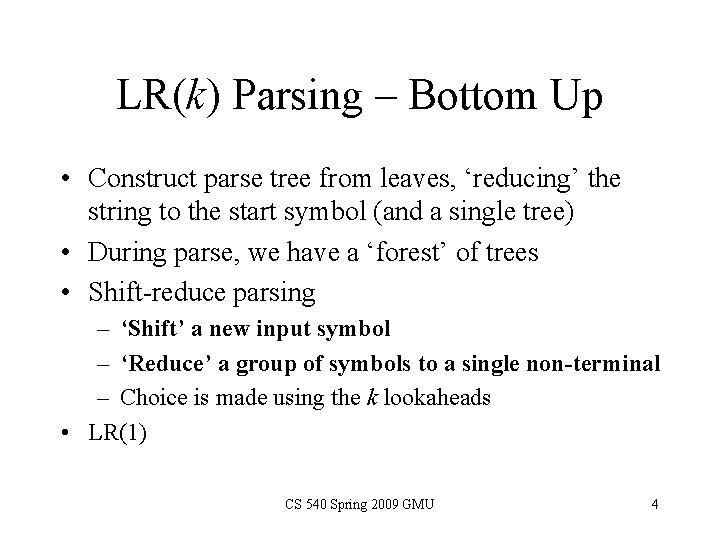
LR(k) Parsing – Bottom Up • Construct parse tree from leaves, ‘reducing’ the string to the start symbol (and a single tree) • During parse, we have a ‘forest’ of trees • Shift-reduce parsing – ‘Shift’ a new input symbol – ‘Reduce’ a group of symbols to a single non-terminal – Choice is made using the k lookaheads • LR(1) CS 540 Spring 2009 GMU 4
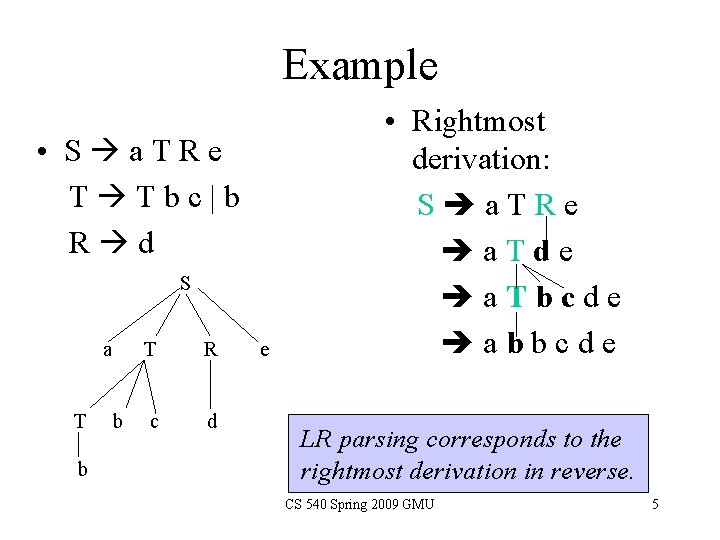
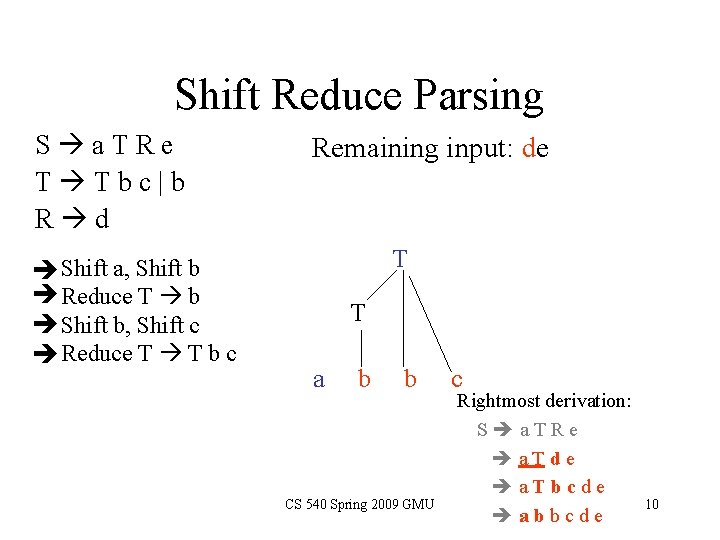
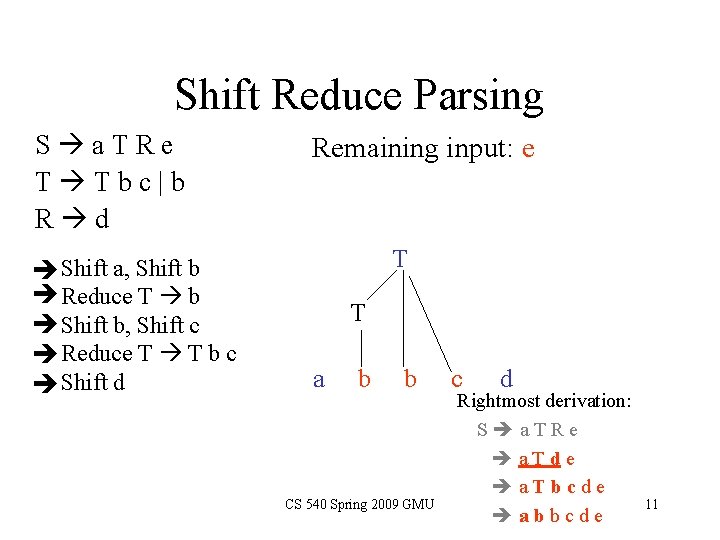
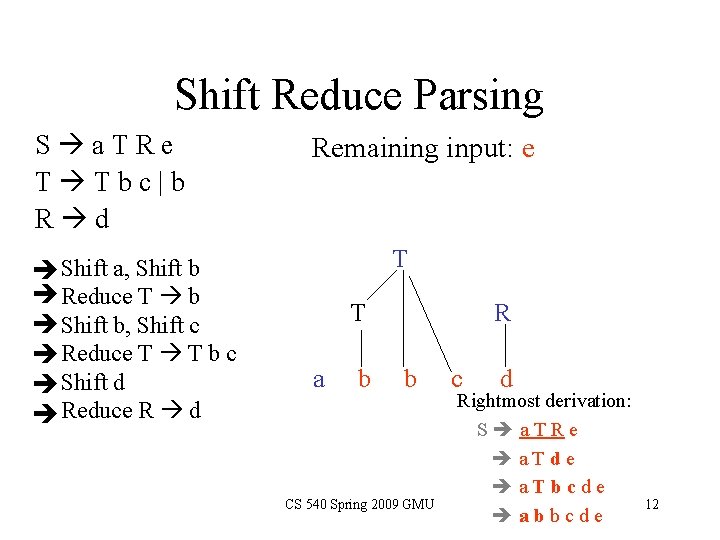
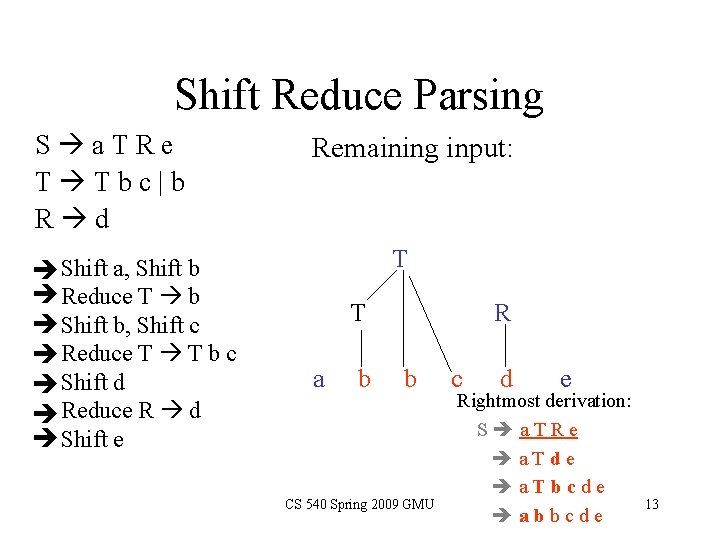
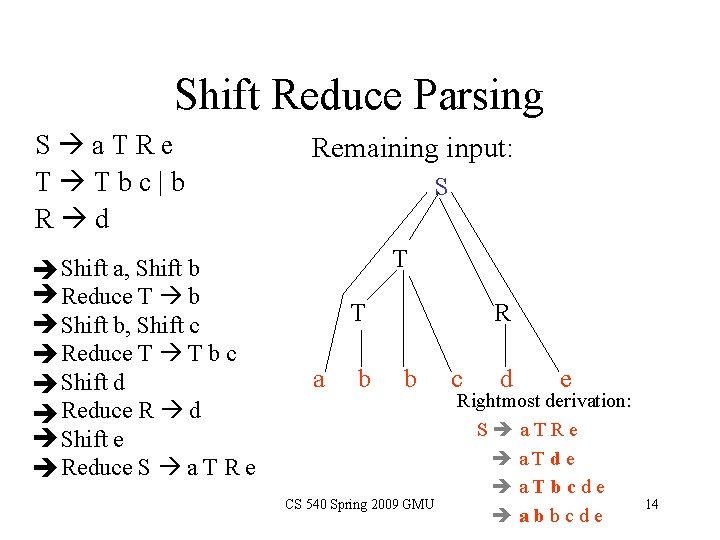
Example • S a. TRe T Tbc|b R d S a T b b T R c d e • Rightmost derivation: S a. TRe a. Tde a. Tbcde abbcde LR parsing corresponds to the rightmost derivation in reverse. CS 540 Spring 2009 GMU 5
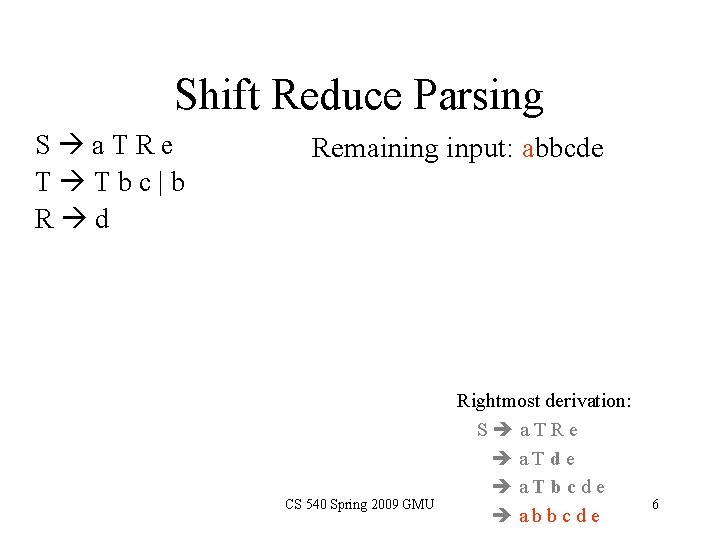
Shift Reduce Parsing S a. TRe T Tbc|b R d Remaining input: abbcde CS 540 Spring 2009 GMU Rightmost derivation: S a. TRe a. Tde a. Tbcde abbcde 6
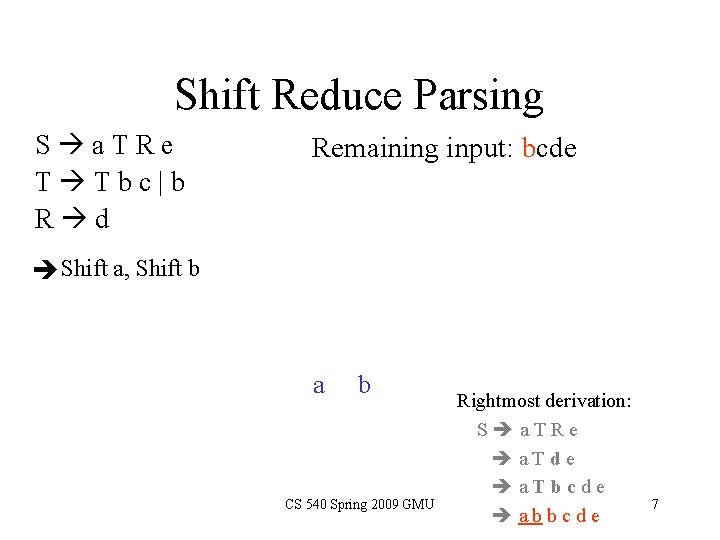
Shift Reduce Parsing S a. TRe T Tbc|b R d Remaining input: bcde Shift a, Shift b a b CS 540 Spring 2009 GMU Rightmost derivation: S a. TRe a. Tde a. Tbcde abbcde 7
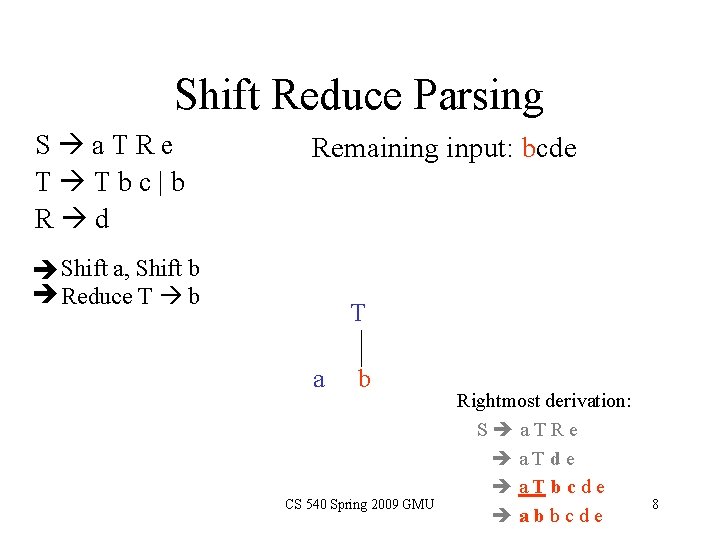
Shift Reduce Parsing S a. TRe T Tbc|b R d Remaining input: bcde Shift a, Shift b Reduce T b T a b CS 540 Spring 2009 GMU Rightmost derivation: S a. TRe a. Tde a. Tbcde abbcde 8
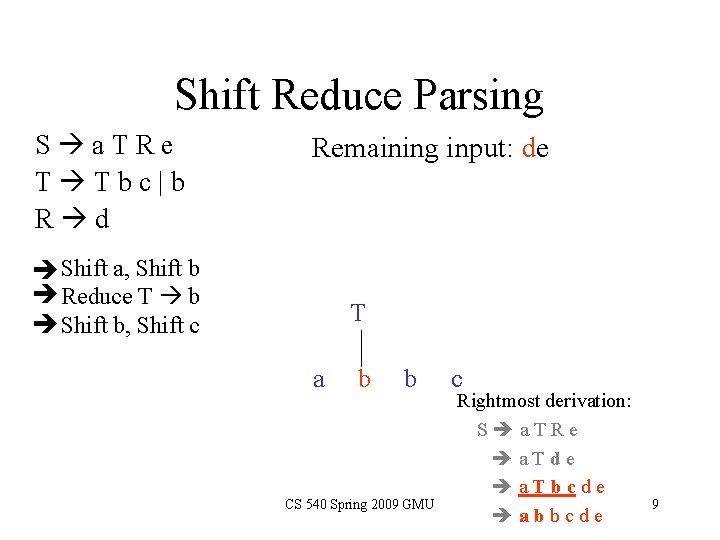
Shift Reduce Parsing S a. TRe T Tbc|b R d Remaining input: de Shift a, Shift b Reduce T b Shift b, Shift c T a b b CS 540 Spring 2009 GMU c Rightmost derivation: S a. TRe a. Tde a. Tbcde abbcde 9
Shift Reduce Parsing S a. TRe T Tbc|b R d Shift a, Shift b Reduce T b Shift b, Shift c Reduce T T b c Remaining input: de T T a b b CS 540 Spring 2009 GMU c Rightmost derivation: S a. TRe a. Tde a. Tbcde abbcde 10
Shift Reduce Parsing S a. TRe T Tbc|b R d Shift a, Shift b Reduce T b Shift b, Shift c Reduce T T b c Shift d Remaining input: e T T a b b CS 540 Spring 2009 GMU c d Rightmost derivation: S a. TRe a. Tde a. Tbcde abbcde 11
Shift Reduce Parsing S a. TRe T Tbc|b R d Shift a, Shift b Reduce T b Shift b, Shift c Reduce T T b c Shift d Reduce R d Remaining input: e T T a b R b CS 540 Spring 2009 GMU c d Rightmost derivation: S a. TRe a. Tde a. Tbcde abbcde 12
Shift Reduce Parsing S a. TRe T Tbc|b R d Shift a, Shift b Reduce T b Shift b, Shift c Reduce T T b c Shift d Reduce R d Shift e Remaining input: T T a b R b CS 540 Spring 2009 GMU c d e Rightmost derivation: S a. TRe a. Tde a. Tbcde abbcde 13
Shift Reduce Parsing S a. TRe T Tbc|b R d Shift a, Shift b Reduce T b Shift b, Shift c Reduce T T b c Shift d Reduce R d Shift e Reduce S a T R e Remaining input: S T T a b R b CS 540 Spring 2009 GMU c d e Rightmost derivation: S a. TRe a. Tde a. Tbcde abbcde 14
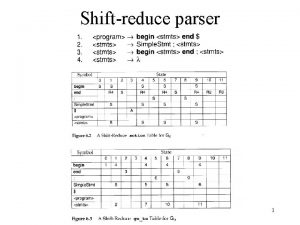
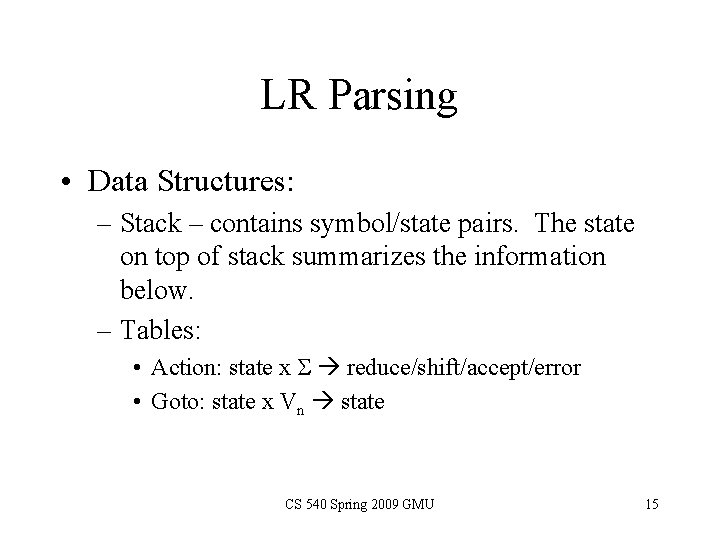
LR Parsing • Data Structures: – Stack – contains symbol/state pairs. The state on top of stack summarizes the information below. – Tables: • Action: state x S reduce/shift/accept/error • Goto: state x Vn state CS 540 Spring 2009 GMU 15
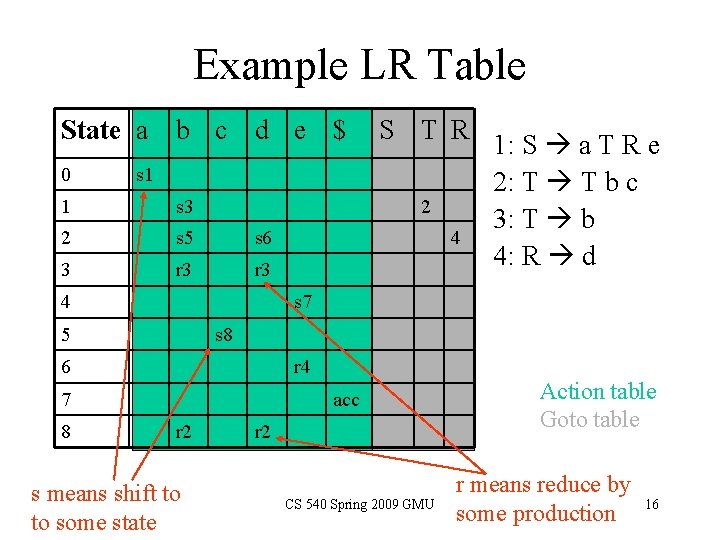
Example LR Table State a b c d e $ 0 s 1 1 s 3 2 s 5 s 6 3 r 3 2 4 4 1: S a T R e 2: T T b c 3: T b 4: R d s 7 5 s 8 6 r 4 7 8 S T R acc r 2 s means shift to to some state r 2 CS 540 Spring 2009 GMU Action table Goto table r means reduce by some production 16
Algorithm: LR(1) push($, 0); /* always pushing a symbol/state pair */ lookahead = yylex(); loop s = top(); /*always a state */ if action[s, lookahead] = shift s’ push(lookahead, s’); lookahead = yylex(); else if action[s, lookahead] = reduce A b pop size of b pairs s’ = state on top of stack push(A, goto[s’, A]); else if action[s, lookahead] = accept then return else error(); end loop; CS 540 Spring 2009 GMU 17
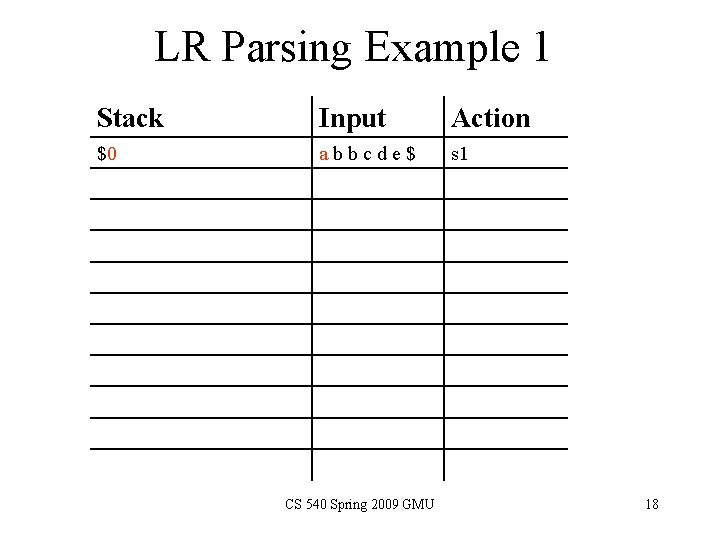
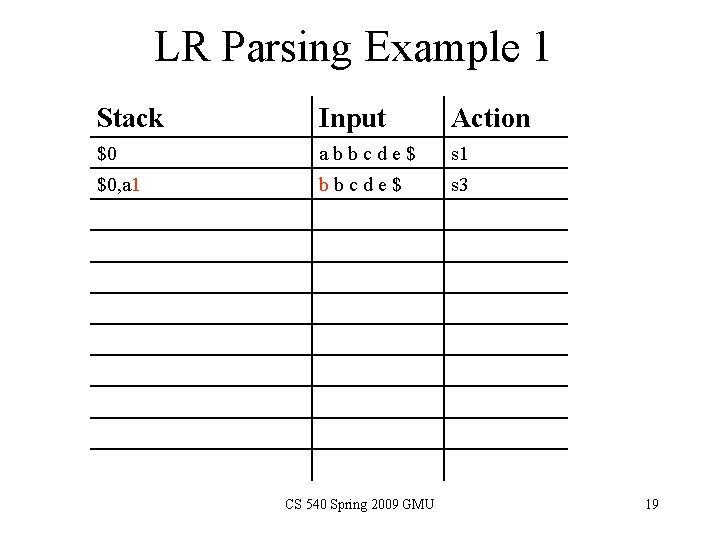
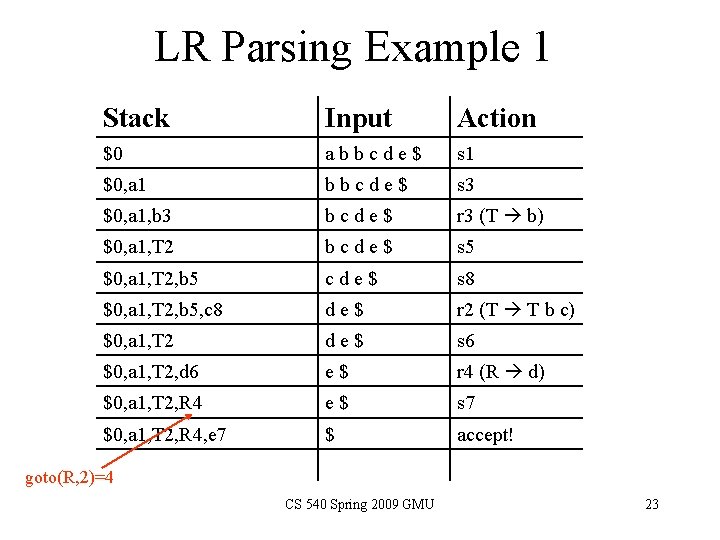
LR Parsing Example 1 Stack Input Action $0 abbcde$ s 1 CS 540 Spring 2009 GMU 18
LR Parsing Example 1 Stack Input Action $0 abbcde$ s 1 $0, a 1 bbcde$ s 3 CS 540 Spring 2009 GMU 19
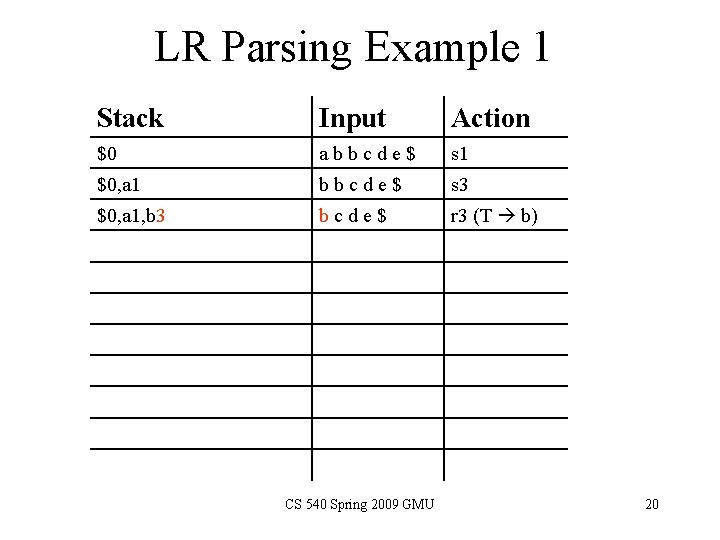
LR Parsing Example 1 Stack Input Action $0 abbcde$ s 1 $0, a 1 bbcde$ s 3 $0, a 1, b 3 bcde$ r 3 (T b) CS 540 Spring 2009 GMU 20
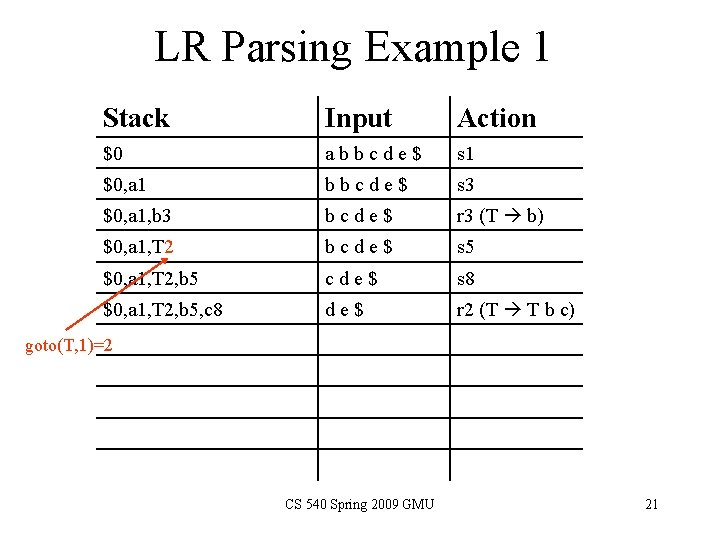
LR Parsing Example 1 Stack Input Action $0 abbcde$ s 1 $0, a 1 bbcde$ s 3 $0, a 1, b 3 bcde$ r 3 (T b) $0, a 1, T 2 bcde$ s 5 $0, a 1, T 2, b 5 cde$ s 8 $0, a 1, T 2, b 5, c 8 de$ r 2 (T T b c) goto(T, 1)=2 CS 540 Spring 2009 GMU 21
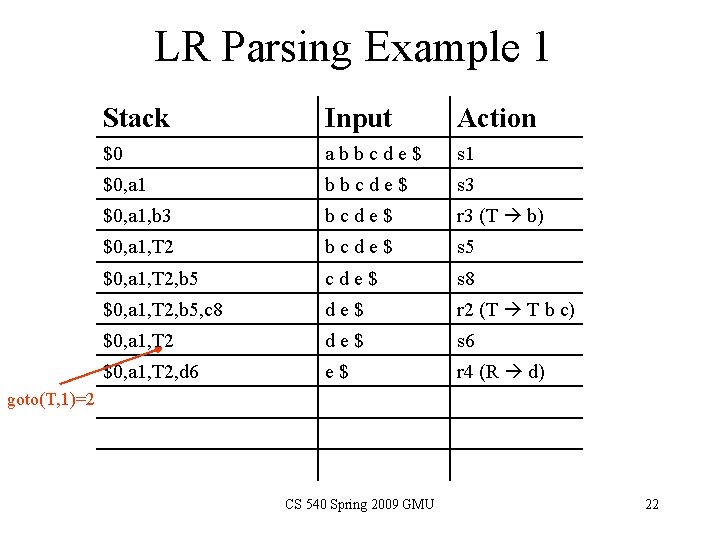
LR Parsing Example 1 Stack Input Action $0 abbcde$ s 1 $0, a 1 bbcde$ s 3 $0, a 1, b 3 bcde$ r 3 (T b) $0, a 1, T 2 bcde$ s 5 $0, a 1, T 2, b 5 cde$ s 8 $0, a 1, T 2, b 5, c 8 de$ r 2 (T T b c) $0, a 1, T 2 de$ s 6 $0, a 1, T 2, d 6 e$ r 4 (R d) goto(T, 1)=2 CS 540 Spring 2009 GMU 22
LR Parsing Example 1 Stack Input Action $0 abbcde$ s 1 $0, a 1 bbcde$ s 3 $0, a 1, b 3 bcde$ r 3 (T b) $0, a 1, T 2 bcde$ s 5 $0, a 1, T 2, b 5 cde$ s 8 $0, a 1, T 2, b 5, c 8 de$ r 2 (T T b c) $0, a 1, T 2 de$ s 6 $0, a 1, T 2, d 6 e$ r 4 (R d) $0, a 1, T 2, R 4 e$ s 7 $0, a 1, T 2, R 4, e 7 $ accept! goto(R, 2)=4 CS 540 Spring 2009 GMU 23
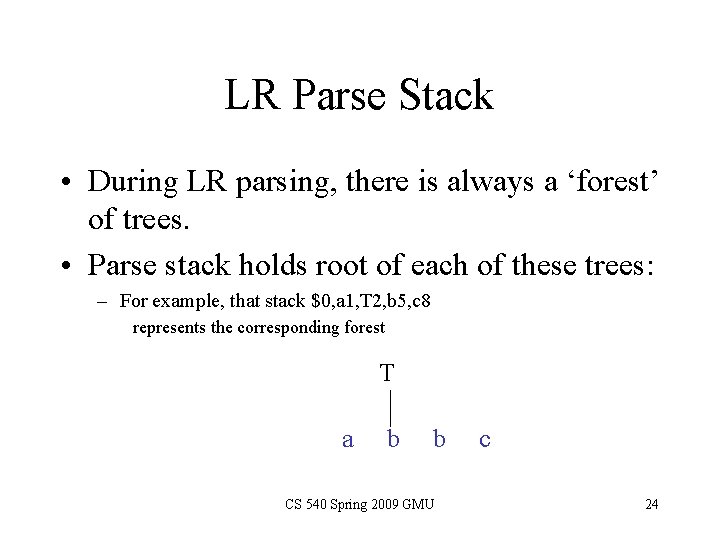
LR Parse Stack • During LR parsing, there is always a ‘forest’ of trees. • Parse stack holds root of each of these trees: – For example, that stack $0, a 1, T 2, b 5, c 8 represents the corresponding forest T a b b CS 540 Spring 2009 GMU c 24
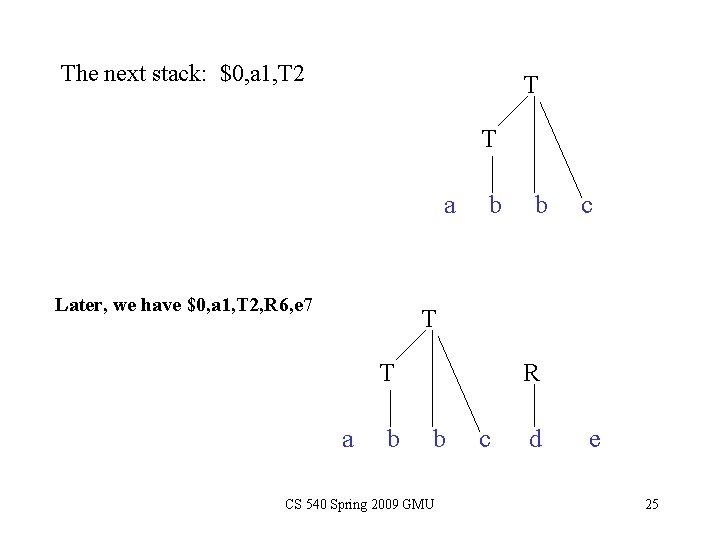
The next stack: $0, a 1, T 2 T T a Later, we have $0, a 1, T 2, R 6, e 7 b b c T T a b R b CS 540 Spring 2009 GMU c d e 25
Where does the table come from? Handle – “a substring that matches the right side of a production and whose reduction to the non-terminal represents one step along the reverse of a rightmost derivation” Using the grammar, want to create a DFA to find handles. CS 540 Spring 2009 GMU 26
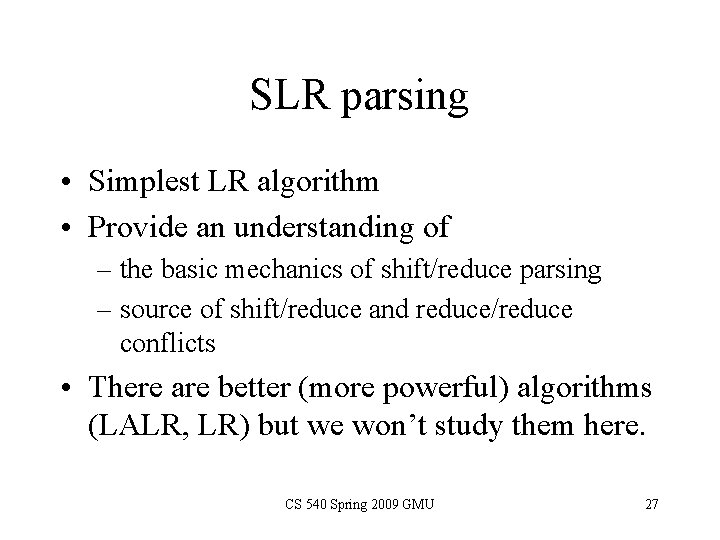
SLR parsing • Simplest LR algorithm • Provide an understanding of – the basic mechanics of shift/reduce parsing – source of shift/reduce and reduce/reduce conflicts • There are better (more powerful) algorithms (LALR, LR) but we won’t study them here. CS 540 Spring 2009 GMU 27
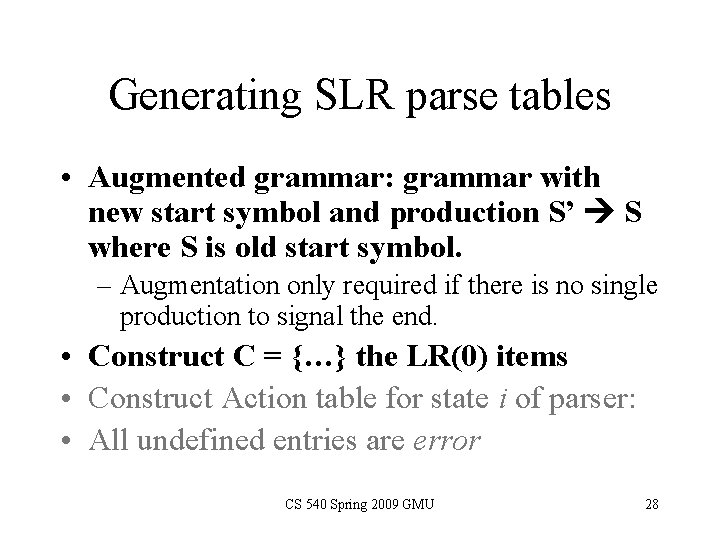
Generating SLR parse tables • Augmented grammar: grammar with new start symbol and production S’ S where S is old start symbol. – Augmentation only required if there is no single production to signal the end. • Construct C = {…} the LR(0) items • Construct Action table for state i of parser: • All undefined entries are error CS 540 Spring 2009 GMU 28
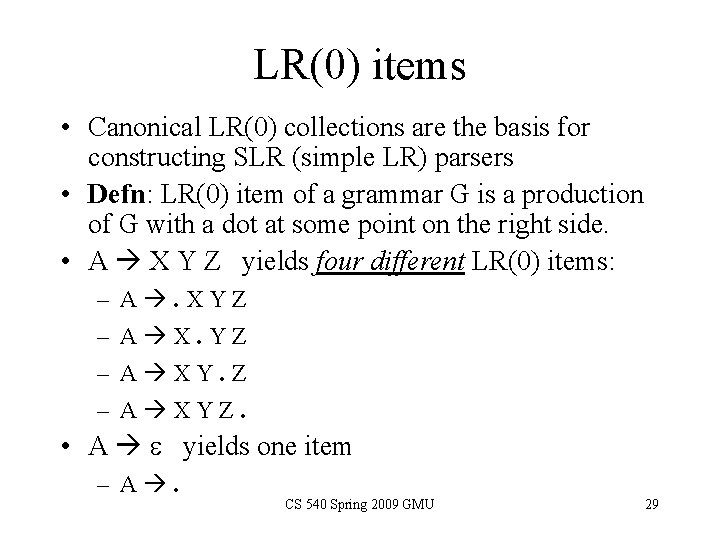
LR(0) items • Canonical LR(0) collections are the basis for constructing SLR (simple LR) parsers • Defn: LR(0) item of a grammar G is a production of G with a dot at some point on the right side. • A X Y Z yields four different LR(0) items: – A. XYZ – A XY. Z – A XYZ. • A e yields one item – A. CS 540 Spring 2009 GMU 29
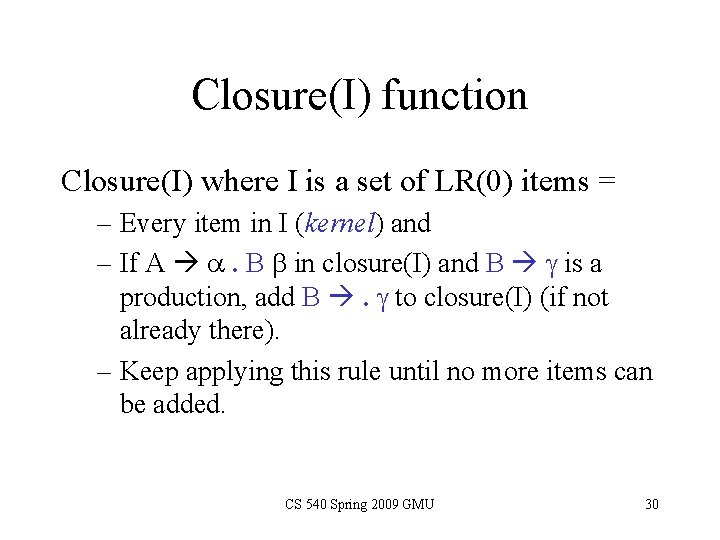
Closure(I) function Closure(I) where I is a set of LR(0) items = – Every item in I (kernel) and – If A a. B b in closure(I) and B g is a production, add B . g to closure(I) (if not already there). – Keep applying this rule until no more items can be added. CS 540 Spring 2009 GMU 30
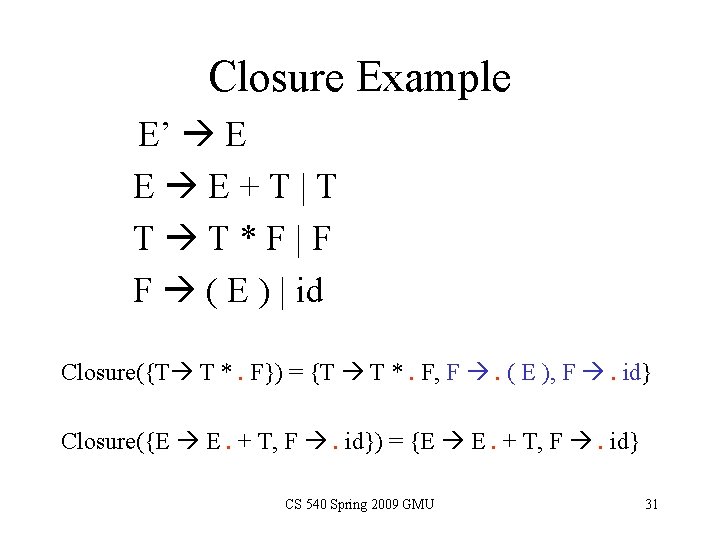
Closure Example E’ E E E+T|T T T*F|F F ( E ) | id Closure({T T *. F}) = {T T *. F, F . ( E ), F . id} Closure({E E. + T, F . id}) = {E E. + T, F . id} CS 540 Spring 2009 GMU 31
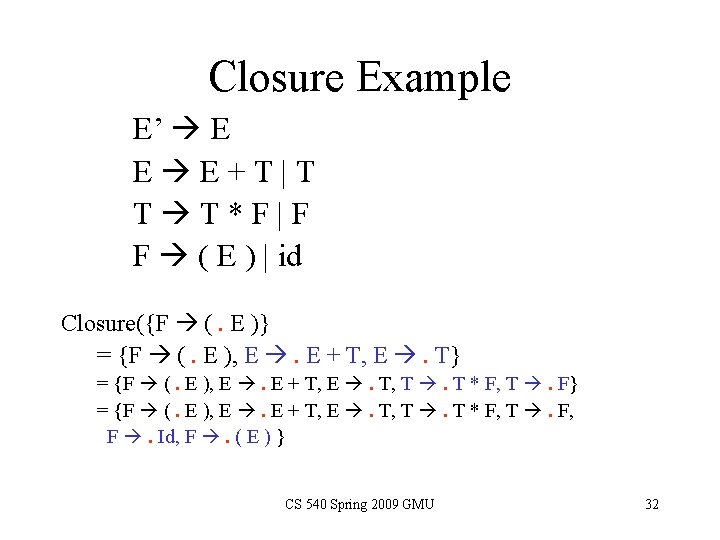
Closure Example E’ E E E+T|T T T*F|F F ( E ) | id Closure({F (. E )} = {F (. E ), E . E + T, E . T, T . T * F, T . F} = {F (. E ), E . E + T, E . T, T . T * F, T . F, F . Id, F . ( E ) } CS 540 Spring 2009 GMU 32
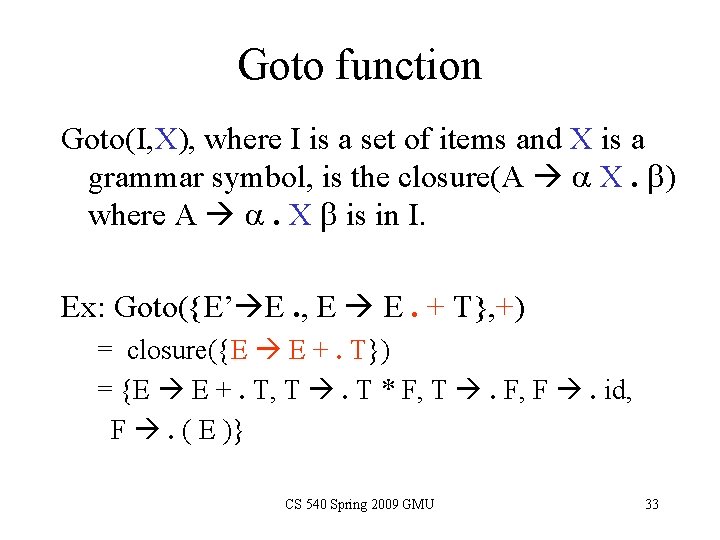
Goto function Goto(I, X), where I is a set of items and X is a grammar symbol, is the closure(A a X. b) where A a. X b is in I. Ex: Goto({E’ E. , E E. + T}, +) = closure({E E +. T}) = {E E +. T, T . T * F, T . F, F . id, F . ( E )} CS 540 Spring 2009 GMU 33
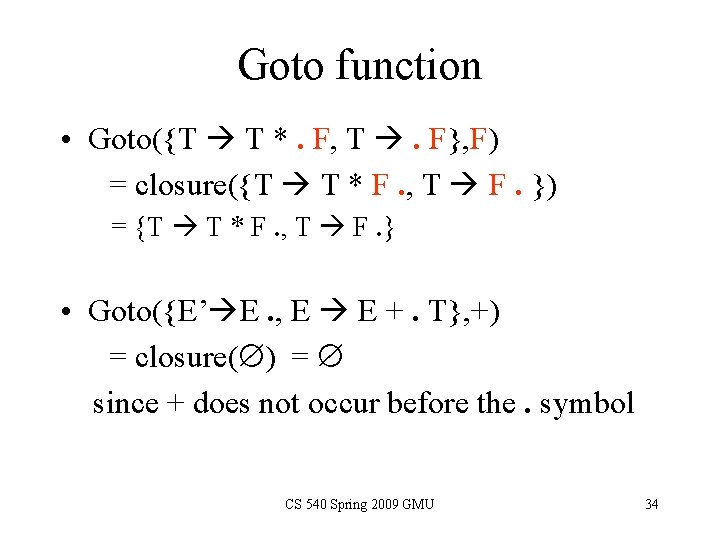
Goto function • Goto({T T *. F, T . F}, F) = closure({T T * F. , T F. }) = {T T * F. , T F. } • Goto({E’ E. , E E +. T}, +) = closure( ) = since + does not occur before the. symbol CS 540 Spring 2009 GMU 34
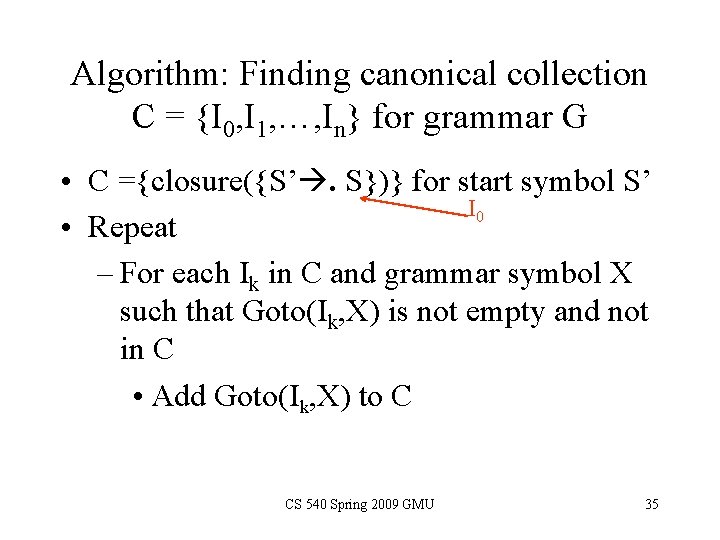
Algorithm: Finding canonical collection C = {I 0, I 1, …, In} for grammar G • C ={closure({S’. S})} for start symbol S’ I 0 • Repeat – For each Ik in C and grammar symbol X such that Goto(Ik, X) is not empty and not in C • Add Goto(Ik, X) to C CS 540 Spring 2009 GMU 35
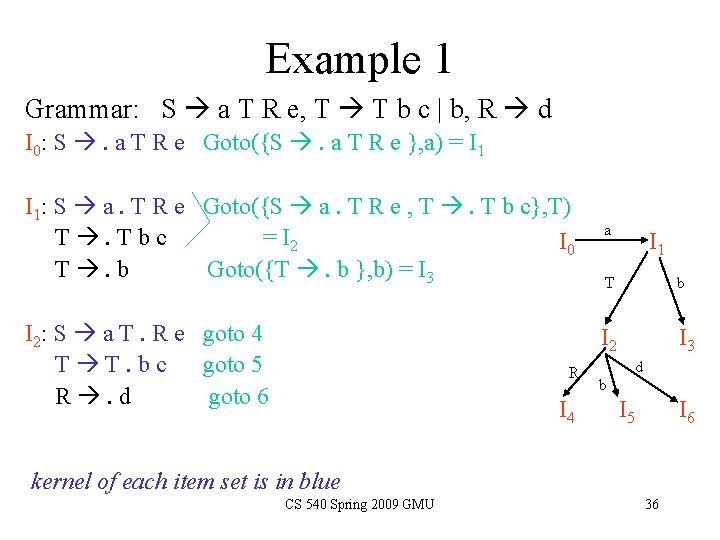
Example 1 Grammar: S a T R e, T T b c | b, R d I 0: S . a T R e Goto({S . a T R e }, a) = I 1: S a. T R e Goto({S a. T R e , T . T b c}, T) T. Tbc = I 2 I 0 T. b Goto({T . b }, b) = I 3 I 2: S a T. R e goto 4 T T. bc goto 5 R. d goto 6 R I 4 a I 1 T b I 2 I 3 d b I 5 I 6 kernel of each item set is in blue CS 540 Spring 2009 GMU 36
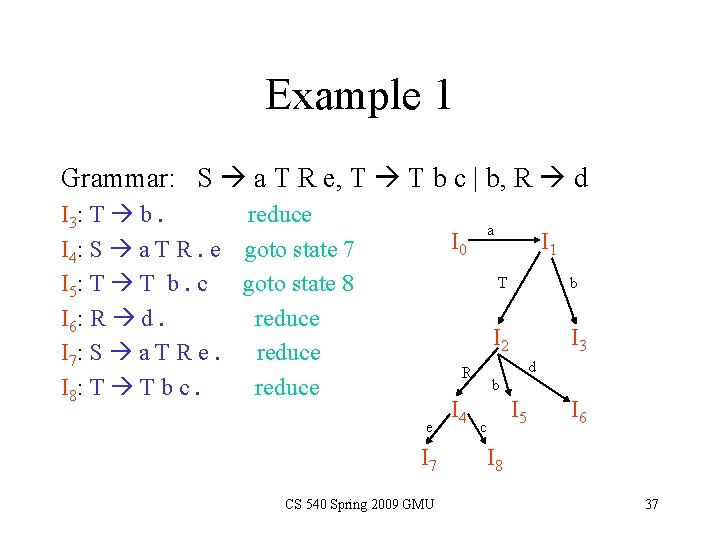
Example 1 Grammar: S a T R e, T T b c | b, R d I 3: T b. reduce I 4: S a T R. e goto state 7 I 5: T T b. c goto state 8 I 6: R d. reduce I 7: S a T R e. reduce I 8: T T b c. reduce a I 0 I 7 CS 540 Spring 2009 GMU I 4 T b I 2 I 3 d R e I 1 b I 5 c I 6 I 8 37
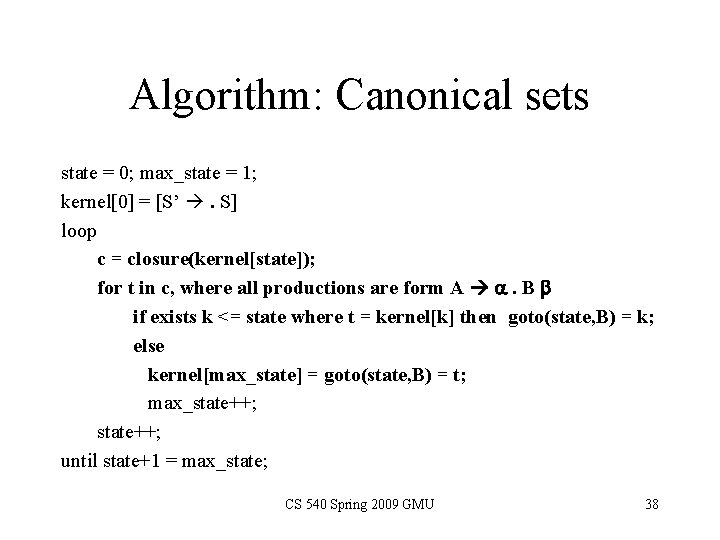
Algorithm: Canonical sets state = 0; max_state = 1; kernel[0] = [S’ . S] loop c = closure(kernel[state]); for t in c, where all productions are form A a. B b if exists k <= state where t = kernel[k] then goto(state, B) = k; else kernel[max_state] = goto(state, B) = t; max_state++; until state+1 = max_state; CS 540 Spring 2009 GMU 38
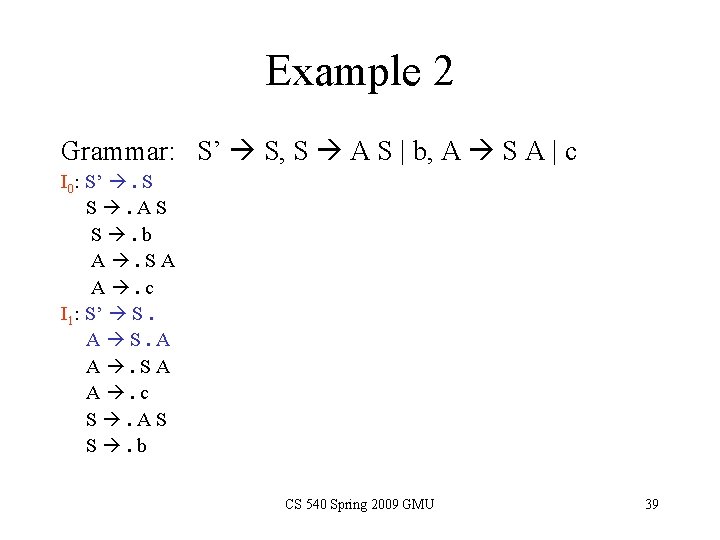
Example 2 Grammar: S’ S, S A S | b, A S A | c I 0: S’ . S S. AS S. b A. SA A. c I 1: S’ S. A A. SA A. c S. AS S. b CS 540 Spring 2009 GMU 39
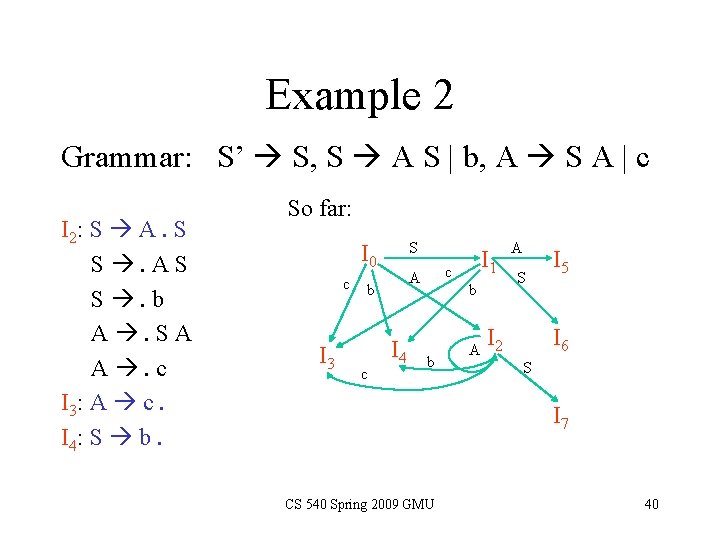
Example 2 Grammar: S’ S, S A S | b, A S A | c I 2: S A. S S. AS S. b A. SA A. c I 3: A c. I 4: S b. So far: S I 0 c I 3 c c A b I 4 I 1 b b A S I A 2 I 5 I 6 S I 7 CS 540 Spring 2009 GMU 40
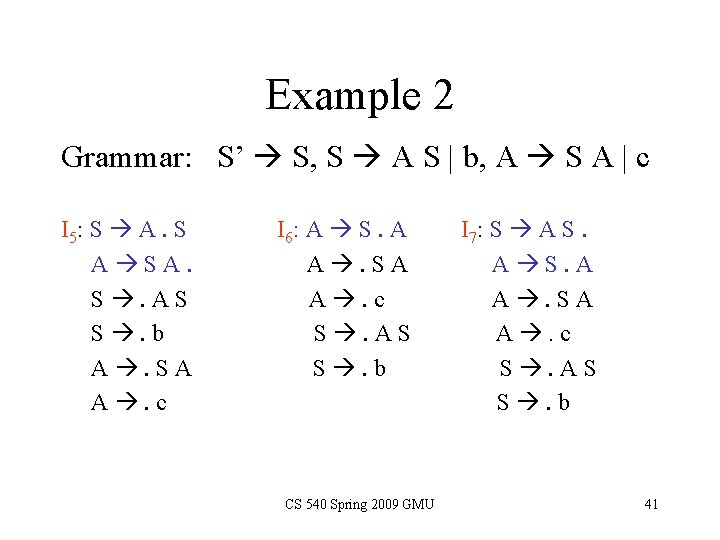
Example 2 Grammar: S’ S, S A S | b, A S A | c I 5: S A. S A SA. S. AS S. b A. SA A. c I 6: A S. A A. SA A. c S. AS S. b CS 540 Spring 2009 GMU I 7: S A S. A A. SA A. c S. AS S. b 41
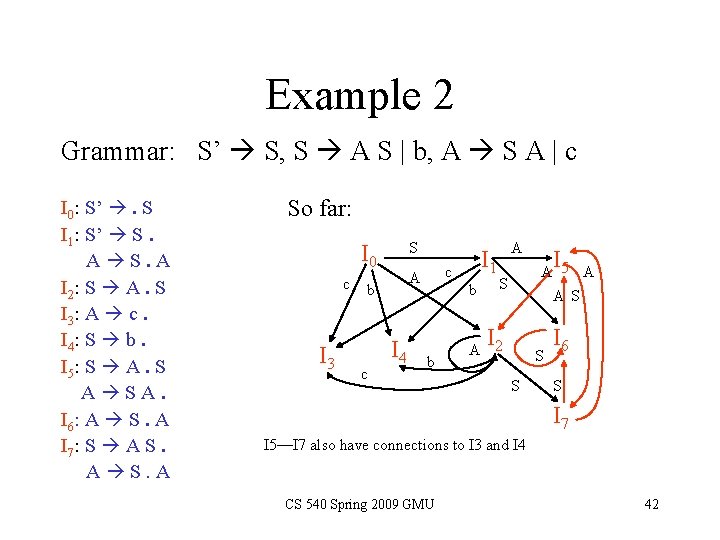
Example 2 Grammar: S’ S, S A S | b, A S A | c I 0: S’ . S I 1: S’ S. A I 2 : S A. S I 3 : A c. I 4 : S b. I 5 : S A. S A SA. I 6 : A S. A I 7 : S A So far: S I 0 c I 3 c c A b I 4 I 1 b b A S I A 5 A A S I A 2 S S I 6 S I 7 I 5—I 7 also have connections to I 3 and I 4 CS 540 Spring 2009 GMU 42
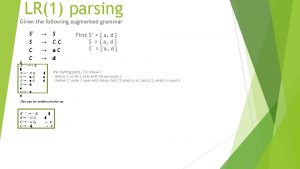
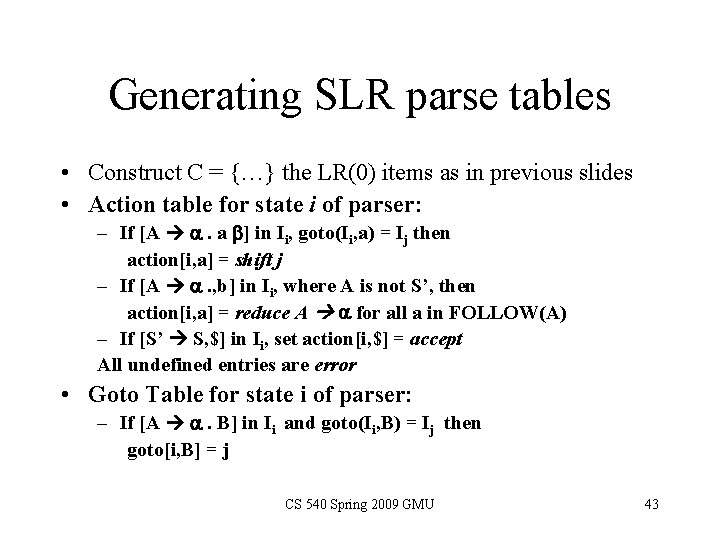
Generating SLR parse tables • Construct C = {…} the LR(0) items as in previous slides • Action table for state i of parser: – If [A a. a b] in Ii, goto(Ii, a) = Ij then action[i, a] = shift j – If [A a. , b] in Ii, where A is not S’, then action[i, a] = reduce A a for all a in FOLLOW(A) – If [S’ S, $] in Ii, set action[i, $] = accept All undefined entries are error • Goto Table for state i of parser: – If [A a. B] in Ii and goto(Ii, B) = Ij then goto[i, B] = j CS 540 Spring 2009 GMU 43
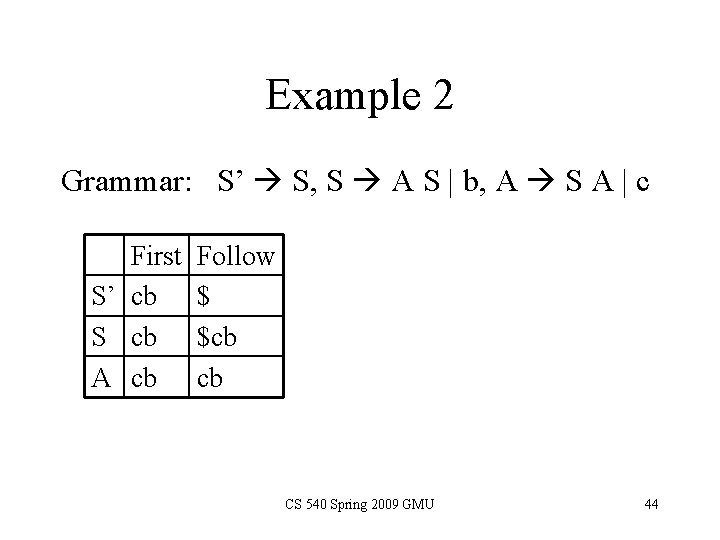
Example 2 Grammar: S’ S, S A S | b, A S A | c First S’ cb S cb A cb Follow $ $cb cb CS 540 Spring 2009 GMU 44
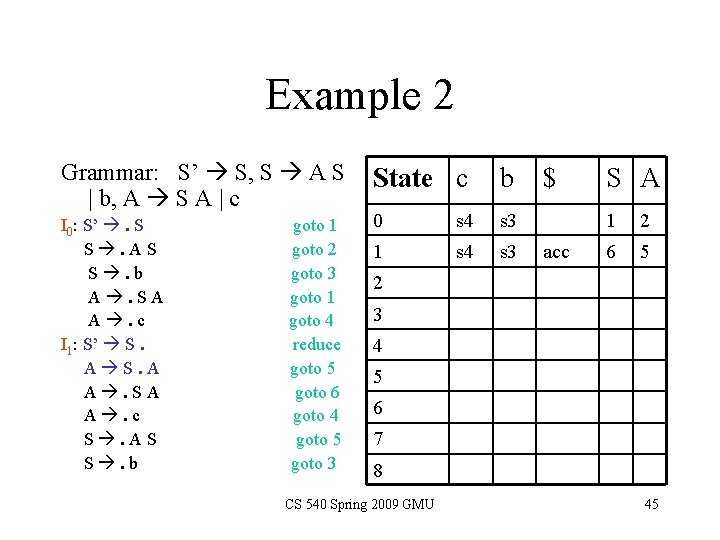
Example 2 Grammar: S’ S, S A S | b, A S A | c I 0: S’ . S S. AS S. b A. SA A. c I 1: S’ S. A A. SA A. c S. AS S. b goto 1 goto 2 goto 3 goto 1 goto 4 reduce goto 5 goto 6 goto 4 goto 5 goto 3 State c b 0 s 4 s 3 1 s 4 s 3 $ acc S A 1 2 6 5 2 3 4 5 6 7 8 CS 540 Spring 2009 GMU 45
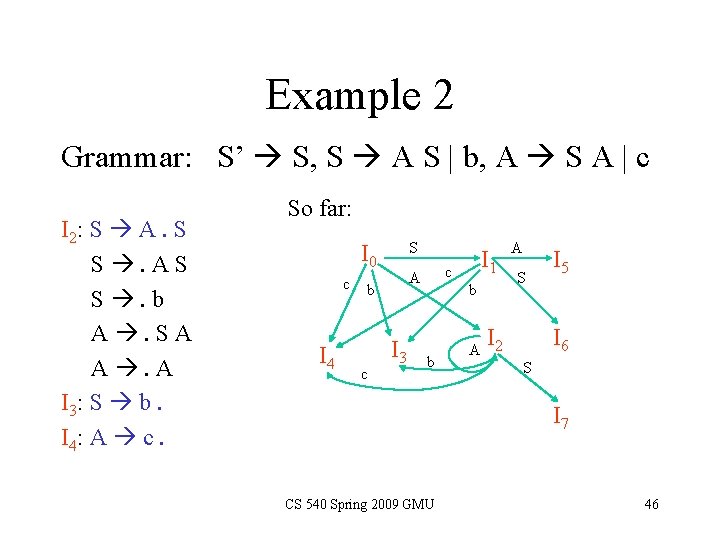
Example 2 Grammar: S’ S, S A S | b, A S A | c I 2: S A. S S. AS S. b A. SA A. A I 3: S b. I 4: A c. So far: S I 0 c I 4 c c A b I 3 I 1 b b A S I A 2 I 5 I 6 S I 7 CS 540 Spring 2009 GMU 46
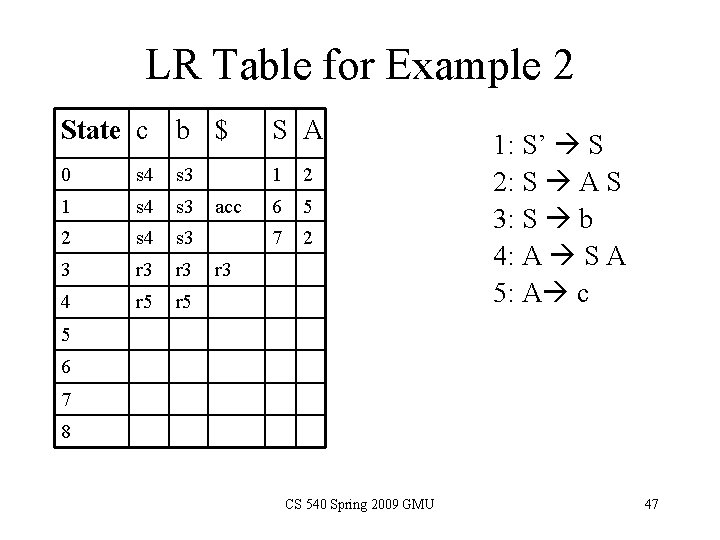
LR Table for Example 2 State c b $ S A 0 s 4 s 3 1 2 1 s 4 s 3 6 5 2 s 4 s 3 7 2 3 r 3 4 r 5 acc r 3 1: S’ S 2: S A S 3: S b 4: A S A 5: A c 5 6 7 8 CS 540 Spring 2009 GMU 47
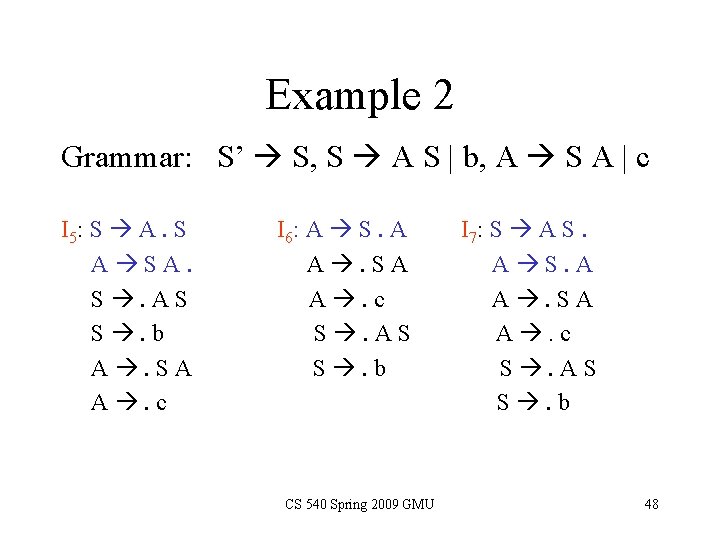
Example 2 Grammar: S’ S, S A S | b, A S A | c I 5: S A. S A SA. S. AS S. b A. SA A. c I 6: A S. A A. SA A. c S. AS S. b CS 540 Spring 2009 GMU I 7: S A S. A A. SA A. c S. AS S. b 48
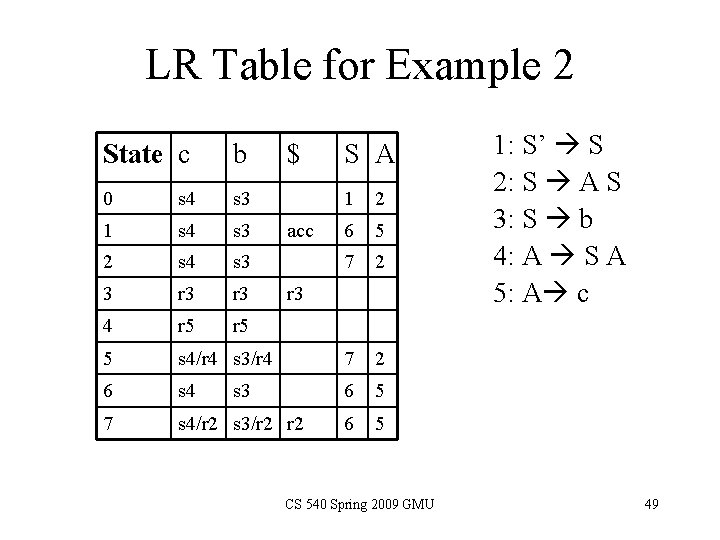
LR Table for Example 2 State c b 0 s 4 s 3 1 s 4 s 3 2 s 4 s 3 3 r 3 4 r 5 5 $ S A 1 2 6 5 7 2 s 4/r 4 s 3/r 4 7 2 6 s 4 s 3 6 5 7 s 4/r 2 s 3/r 2 6 5 acc r 3 CS 540 Spring 2009 GMU 1: S’ S 2: S A S 3: S b 4: A S A 5: A c 49
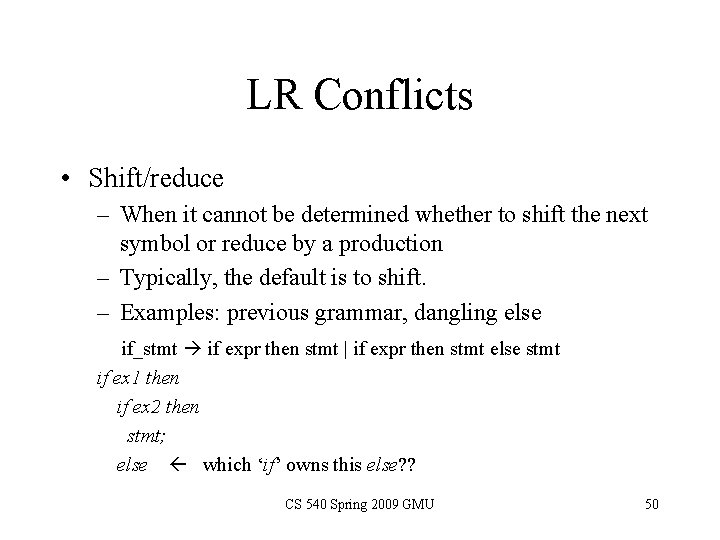
LR Conflicts • Shift/reduce – When it cannot be determined whether to shift the next symbol or reduce by a production – Typically, the default is to shift. – Examples: previous grammar, dangling else if_stmt if expr then stmt | if expr then stmt else stmt if ex 1 then if ex 2 then stmt; else which ‘if’ owns this else? ? CS 540 Spring 2009 GMU 50
LR Conflicts • Reduce/reduce – When it cannot be determined which production to reduce by – Example: stmt id ( expr_list ) function call expr id ( expr_list ) array (as in Ada) – Convention: use first production in grammar or use more powerful technique CS 540 Spring 2009 GMU 51
Error Recovery in LR parsing Just as with LL, we typically want to discard some part of the input and resume parsing from some ‘known’ point. – Search back in the stack for some non-terminal A (how to choose A? ) then process input until find token in Follow(A) – Can also decorate the LR table with error recovery routines tailored to the state and token – more complicated to get right. CS 540 Spring 2009 GMU 52