
Parsing III Probabilistic Parsing and Conclusions 1 Probabilistic
Parsing III Probabilistic Parsing and Conclusions 1
Probabilistic CFGs • also known as Stochastic Grammars • Date back to Booth (1969) • Have grown in popularity with the growth of Corpus Linguistics 2
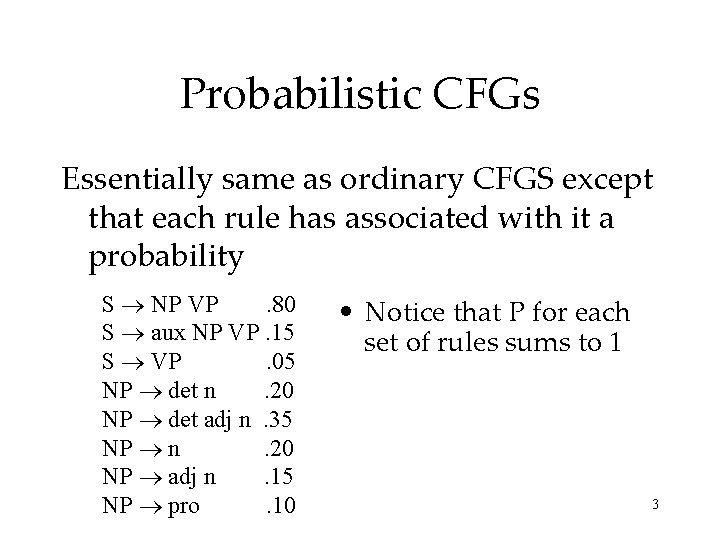
Probabilistic CFGs Essentially same as ordinary CFGS except that each rule has associated with it a probability S NP VP. 80 S aux NP VP. 15 S VP. 05 NP det n. 20 NP det adj n. 35 NP n. 20 NP adj n. 15 NP pro. 10 • Notice that P for each set of rules sums to 1 3
Probabilistic CFGs • Probabilities are used to calculate the probability of a given derivation – Defined as the product of the Ps of the rules used in the derivation • Can be used to choose between competing derivations – As the parse progresses (so, can determine which rules to try first) as an efficiency measure – Or at the end, as a way of disambiguating, or expressing confidence in the results 4
Where do the probabilities come from? 1) Use a corpus of already parsed sentences: a “treebank” – Best known example is the Penn Treebank • Marcus et al. 1993 • Available from Linguistic Data Consortium • Based on Brown corpus + 1 m words of Wall Street Journal + Switchboard corpus – Count all occurrences of each rule variation (e. g. NP) and divide by total number of NP rules – Very laborious, so of course is done automatically 5
Where do the probabilities come from? 2) Create your own treebank – Easy if all sentences are unambiguous: just count the (successful) rule applications – When there ambiguities, rules which contribute to the ambiguity have to be counted separately and weighted 6
Where do the probabilities come from? 3) Learn them as you go along – Again, assumes some way of identifying the correct parse in case of ambiguity – Each time a rule is successfully used, its probability is adjusted – You have to start with some estimated probabilities, e. g. all equal – Does need human intervention, otherwise rules become self-fulfilling prophecies 7
Problems with PCFGs • PCFGs assume that all rules are essentially independent – But, e. g. in English “NP pro” more likely when in subject position • Difficult to incorporate lexical information – Pre-terminal rules can inherit important information from words which help to make choices higher up the parse, e. g. lexical choice can help determine PP attachment 8
Probabilistic Lexicalised CFGs • One solution is to identify in each rule that one of the elements on the RHS (daughter) is more important: the “head” – This is quite intuitive, e. g. the n in an NP rule, though often controversial (from linguistic point of view) • Head must be a lexical item • Head value is percolated up the parse tree • Added advantage is that PS tree has the feel of a dependency tree 9
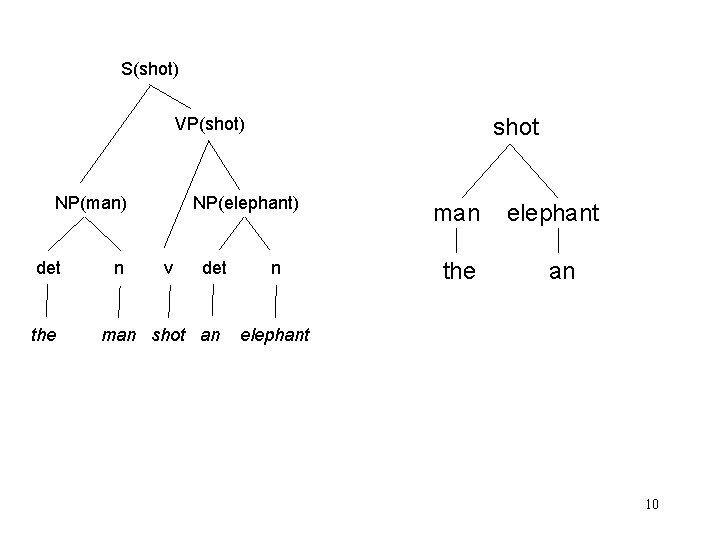
S(shot) S shot VP(shot) VP NP(man) NP det the n NP(elephant) NP v det man shot an n man the elephant an elephant 10
Dependency Parsing • Not much different from PSG parsing • Grammar rules still need to be stated as A B c – except that one daughter is identified as the head, e. g. A x h y – As structure is built, the trees are headed by “h” rather than “A” • Can be probabilistic or not 11
Conclusion 1 • Basic parsing approaches (without constraints) not practical in real applications • Whatever approach taken, bear in mind that the lexicon is the real bottleneck • There’s a real trade-off between coverage and efficiency, so it’s a good idea to sacrifice broad coverage (e. g. domain-specific parsers, controlled language), or use a scheme that minimizes the disadvantages (e. g. probabilistic parsing) 12
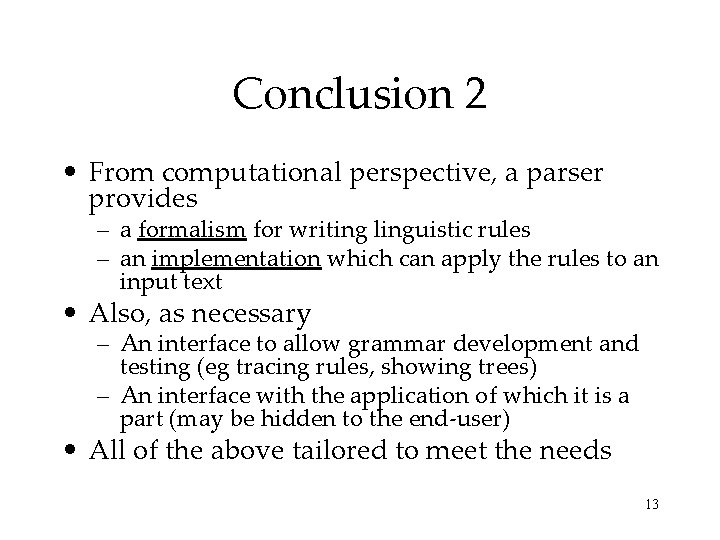
Conclusion 2 • From computational perspective, a parser provides – a formalism for writing linguistic rules – an implementation which can apply the rules to an input text • Also, as necessary – An interface to allow grammar development and testing (eg tracing rules, showing trees) – An interface with the application of which it is a part (may be hidden to the end-user) • All of the above tailored to meet the needs 13
- Slides: 13