
Should the Alaska National Wildlife Refuge ANWR be
Should the Alaska National Wildlife Refuge (ANWR) be opened for oil and gas development? By: Brittany Stanton, Sean Connelly, and Matthew Judge
History of the Alaska National Wildlife Refuge (Early-Mid 20 th Century) 1903: President Theodore Roosevelt established the National Wildlife Refuge System. 1954: The National Park Service recommended that the undisturbed lands in the northeastern corner of Alaska be preserved for their wildlife, wilderness, recreation, scientific, and cultural values. 1957: The Department of the Interior announced plans to ask Congress to establish an 8, 000 square-mile wildlife reserve in the area identified by the National Park Service study. Jan. 3, 1959: Alaska becomes a state. Dec. 6, 1960: Arctic National Wildlife Range Created (8. 9 million acres) Public Land Order (PLO) 2214
History of the Alaska National Wildlife Refuge (Mid-late 20 th Century) Dec. 2, 1980: Alaska National Interest Lands Conservation Act (ANILCA). The Act expanded the Arctic Range to approximately 18 million acres, renamed it the Arctic National Wildlife Refuge, designated eight million acres as Wilderness, designated three rivers as Wild, and called for wildlife studies and an oil and gas assessment of 1. 5 million acres of the ANWR Coastal Plain. 1988: Congress added 325, 000 acres to the south side of the Refuge, bringing the total area managed by the Refuge to approximately 19. 3 million acres and making ANWR the largest Refuge in the National Wildlife Refuge System. May 1998: U. S. Geological Survey released the Arctic National Wildlife Refuge, 1002 Area, Petroleum Assessment, 1998 containing the highest estimates ever for the region. The agency’s mid-range estimate of oil in place rose from 13. 8 billion barrels to 20. 7 billion barrels of oil.
History of the Alaska National Wildlife Refuge (21 st Century) The Tax Cuts and Jobs Act, which the Senate passed Saturday morning, will change federal law on a matter that has little to do with the tax code. The bill authorizes the sale of oil and gas leases in a section of the ANWR on Alaska’s North Slope, the coastal plain that faces the Arctic Ocean. Soon, energy companies will be able to search for and extract oil and gas from the frozen tundra. It brings a quiet end to the battle over whether to drill in the ANWR, one of the longest-running and most acrimonious battles in U. S. environmental history. The question has been embedded in federal law for 40 years, nearly as long as Alaska has been a state.
Oil Reserve Estimates ● ● ● In 1998, the USGS estimated that between 5. 7 and 16. 0 billion barrels of technically recoverable crude oil and natural gas liquids are in ANWR Between 4. 3 and 11. 8 billion barrels lie within the Federal portion of the ANWR 1002 Area. The estimated volume of undiscovered, technically recoverable oil in the rest of the United States is about 120 billion barrels.
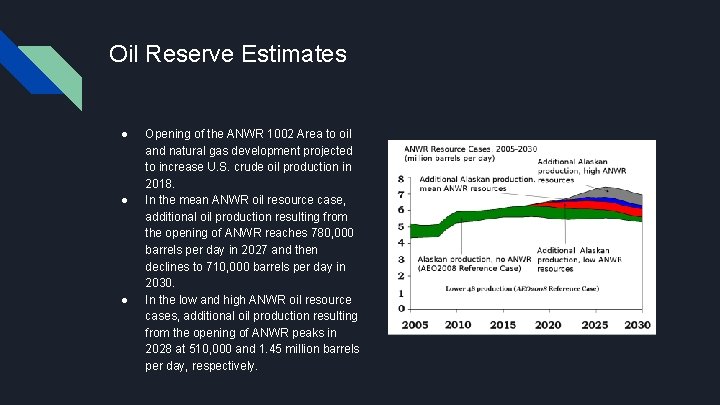
Oil Reserve Estimates ● ● ● Opening of the ANWR 1002 Area to oil and natural gas development projected to increase U. S. crude oil production in 2018. In the mean ANWR oil resource case, additional oil production resulting from the opening of ANWR reaches 780, 000 barrels per day in 2027 and then declines to 710, 000 barrels per day in 2030. In the low and high ANWR oil resource cases, additional oil production resulting from the opening of ANWR peaks in 2028 at 510, 000 and 1. 45 million barrels per day, respectively.
Projected impact on global oil price ● ● ● Additional oil production resulting from the opening of ANWR improves the U. S. balance of trade. Cumulative expenditures on foreign crude oil and liquid fuels between 2018 and 2030 are reduced by: ○ $202 billion (mean oil resource case) ○ $135 billion (low oil resource case) ○ $327 billion (high oil resource cases) The total production from ANWR would be between 0. 4 and 1. 2 percent of total world oil consumption in 2030. ANWR oil production is not projected to have any significant impact on world oil prices.
Pro’s Economic Gains ● Oil is a commodity that is highly sought after by many industries. ● Despite the rise of much advancement in “green” energy, oil continues to the primary raw material used to power machineries, planes, trucks, equipments, and cars. ● Oil is also the primary source for power of heating and cooling utilities to home and commercial buildings. ● The expansion of drilling for oil in ANWR can provide America with a safe source of energy in short term. Also, the expansion of drilling for oil can increase the employment opportunities for people living within and around the site.
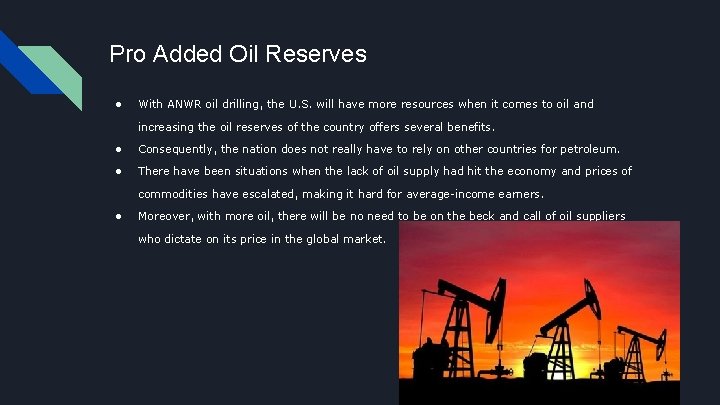
Pro Added Oil Reserves ● With ANWR oil drilling, the U. S. will have more resources when it comes to oil and increasing the oil reserves of the country offers several benefits. ● Consequently, the nation does not really have to rely on other countries for petroleum. ● There have been situations when the lack of oil supply had hit the economy and prices of commodities have escalated, making it hard for average-income earners. ● Moreover, with more oil, there will be no need to be on the beck and call of oil suppliers who dictate on its price in the global market.
Job Opportunities ● Just like other oil drilling methods, ANWR oil drilling offers numerous job placements for skilled workers, professionals and other people looking for work. ● There about hundreds of thousands of workers needed to perform different jobs, from engineers to drivers. ● With these opportunities, many American families who used to be struggling financially will be given the chance to improve their lives.
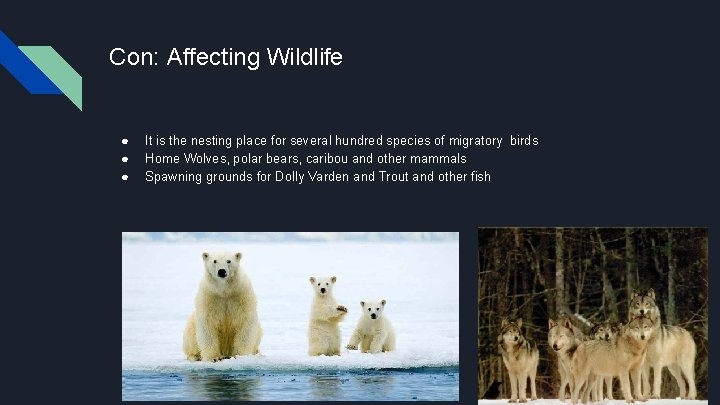
Con: Affecting Wildlife ● ● ● It is the nesting place for several hundred species of migratory birds Home Wolves, polar bears, caribou and other mammals Spawning grounds for Dolly Varden and Trout and other fish
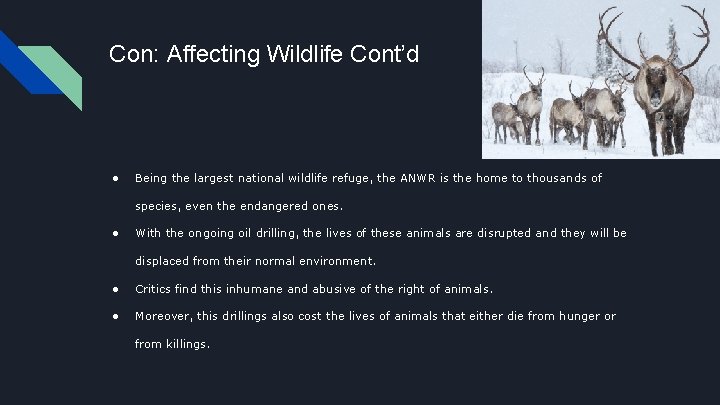
Con: Affecting Wildlife Cont’d ● Being the largest national wildlife refuge, the ANWR is the home to thousands of species, even the endangered ones. ● With the ongoing oil drilling, the lives of these animals are disrupted and they will be displaced from their normal environment. ● Critics find this inhumane and abusive of the right of animals. ● Moreover, this drillings also cost the lives of animals that either die from hunger or from killings.
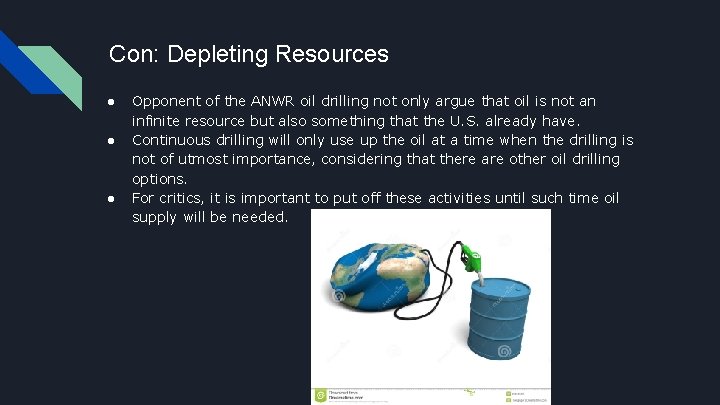
Con: Depleting Resources ● ● ● Opponent of the ANWR oil drilling not only argue that oil is not an infinite resource but also something that the U. S. already have. Continuous drilling will only use up the oil at a time when the drilling is not of utmost importance, considering that there are other oil drilling options. For critics, it is important to put off these activities until such time oil supply will be needed.
Con: Pollution ● Critics contend that just like other oil drilling techniques, ANWR oil drilling can cause pollution as a result of operating heavy equipment as well as the clearing process. ● Oil spills are also possible especially when it comes to transporting the product and these can be harmful to the people.

Work Cited Fountain, Henry, and Lisa Friedman. “Senate Takes Step to Approve Drilling in Arctic Wildlife Refuge. ” The New York Times, 13 Oct. 2017, www. nytimes. com/2017/10/13/climate/arctic-drilling. html. Gibbions , Sarah. “Stunning Photos Show the Alaska Refuge Under Threat. ” National Geographic, National Geographic Society, 19 Oct. 2017, news. nationalgeographic. com/2017/10/alaska-arctic-national-wildliferefuge-oil-drilling-spd/. “Pros and Cons of Drilling in ANWR. ” HRFnd, 6 Apr. 2015, healthresearchfunding. org/pros-and-cons-of-drilling-inanwr/. Lombardo, Crystal. “Pros and Cons of Arctic National Wildlife Refuge Oil Drilling. ” Vision Launch, 14 Jan. 2017, visionlaunch. com/pros-and-cons-of-arctic-national-wildlife-refuge-oil-drilling/#. U. S. Department of Energy. Analysis of Crude Oil Production in the Arctic National Wildlife Refuge. Office of Integrated Analysis and Forecasting, 2008 Bird, Kenneth J, and Daved W Houseknecht. Ysis Arctic National Wildlife Refuge, 1002 Area, Petroleum Assessment, 1998, Including Economic Analysis, USGS.
Work Cited for Images Tersigni, Dean. “Wolves. ” Wolves, www. thealmightyguru. com/Pointless/Wolves. html. Used photo from Website Radford , Tim. “No Safe Haven for Polar Bears in Warming Arctic. ” Eco. Watch, 25 Sept. 2016, www. ecowatch. com/polarbear-climate-change-2015949690. html. Took photograph from article Agency, Mehr News. “Japan's Oil Imports from Iran Rises by 200%. ” Mehr News Agency, 31 July 2016, en. mehrnews. com/news/118509/Japan-s-oil-imports-from-Iran-rises-by-200. Used Photo “Employment. ” The Salvation Army Fort Myers, 6 Apr. 2017, www. salvationarmyflorida. org/fortmyers/about-us/employment-2/. Used photo Griger, Tomas. “Oil Depleting Stock Illustration. Image of Consumption - 27950584. ”Dreamstime, www. dreamstime. com/stockimages-oil-depleting-image 27950584. Used photo “How Much Does the Price of Oil Affect the Cost of a New Roof. ” Roofing Tutor, 10 June 2012, roofingtutor. com/guides/how-much-does -the-price-of-oil-affect-the-cost-of-a-new-roof. html. “Oil Prices Fall, Focus Shifts to US Output. ” Financial Tribune, 27 Jan. 2017, financialtribune. com/articles/energy/58352/oil-prices-fallfocus-shifts-to-us-output. U. S. Department of Energy. Analysis of Crude Oil Production in the Arctic National Wildlife Refuge. Office of Integrated Analysis and Forecasting, 2008
- Slides: 16