ACCAHA Guidelines for the Management of Patients with

- Slides: 45
ACC/AHA Guidelines for the Management of Patients with Unstable Angina and Non-STSegment Elevation MI Published in JACC and Circulation September, 2000 Revisions Released in March, 2002 Guidelines Issues for Emergency Medicine: Pollack CV, Gibler WB. Ann Emerg Med 2001
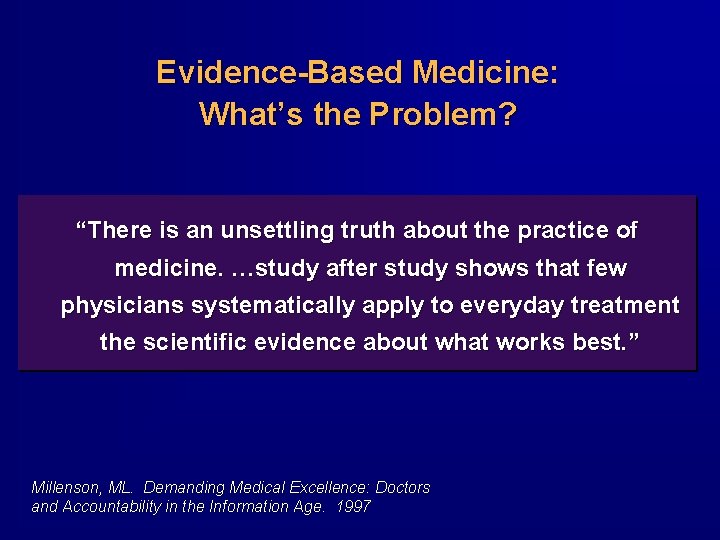
Evidence-Based Medicine: What’s the Problem? “There is an unsettling truth about the practice of medicine. …study after study shows that few physicians systematically apply to everyday treatment the scientific evidence about what works best. ” Millenson, ML. Demanding Medical Excellence: Doctors and Accountability in the Information Age. 1997
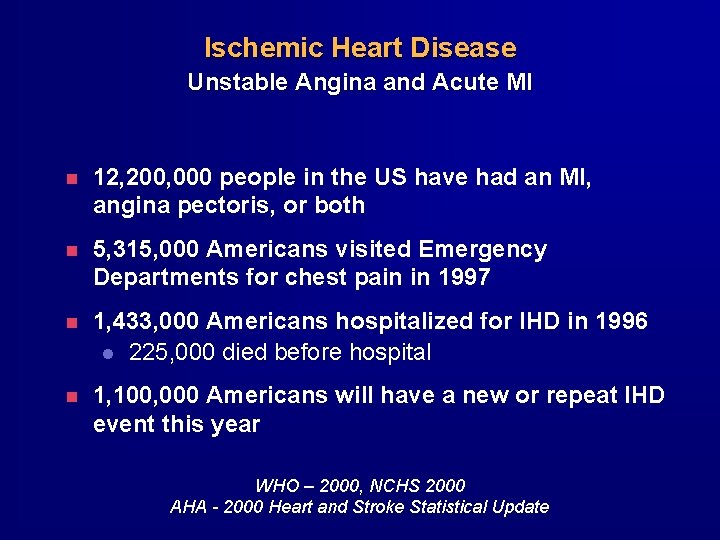
Ischemic Heart Disease Unstable Angina and Acute MI 12, 200, 000 people in the US have had an MI, angina pectoris, or both 5, 315, 000 Americans visited Emergency Departments for chest pain in 1997 1, 433, 000 Americans hospitalized for IHD in 1996 225, 000 died before hospital 1, 100, 000 Americans will have a new or repeat IHD event this year WHO – 2000, NCHS 2000 AHA - 2000 Heart and Stroke Statistical Update
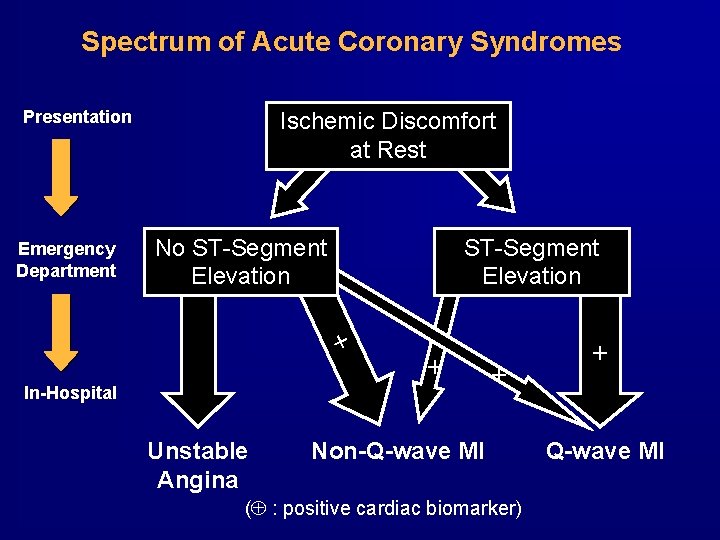
Spectrum of Acute Coronary Syndromes Presentation No ST-Segment Elevation + + In-Hospital Unstable Angina + Non-Q-wave MI ( : positive cardiac biomarker) + Emergency Department Ischemic Discomfort at Rest Q-wave MI
Participants in Updated Guidelines
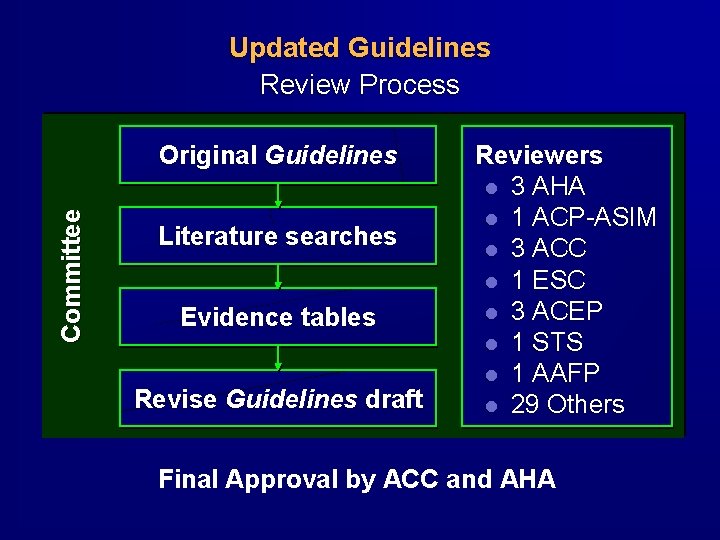
Updated Guidelines Review Process Committee Original Guidelines Literature searches Evidence tables Revise Guidelines draft Reviewers 3 AHA 1 ACP-ASIM 3 ACC 1 ESC 3 ACEP 1 STS 1 AAFP 29 Others Final Approval by ACC and AHA
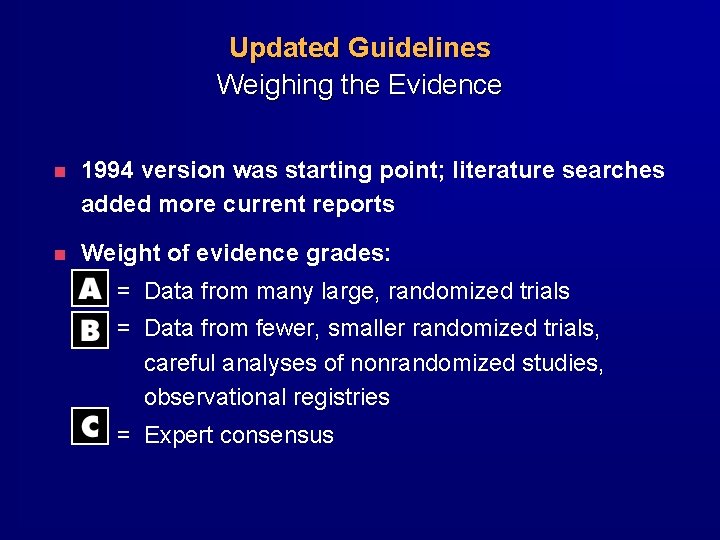
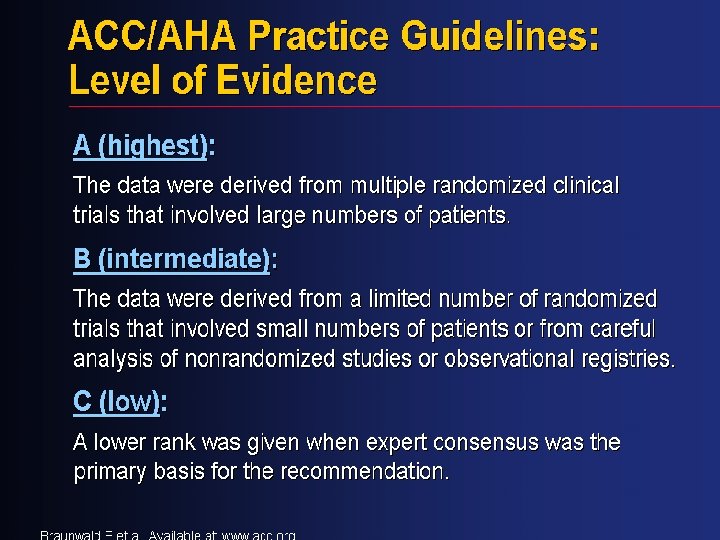
Updated Guidelines Weighing the Evidence 1994 version was starting point; literature searches added more current reports Weight of evidence grades: = Data from many large, randomized trials = Data from fewer, smaller randomized trials, careful analyses of nonrandomized studies, observational registries = Expert consensus
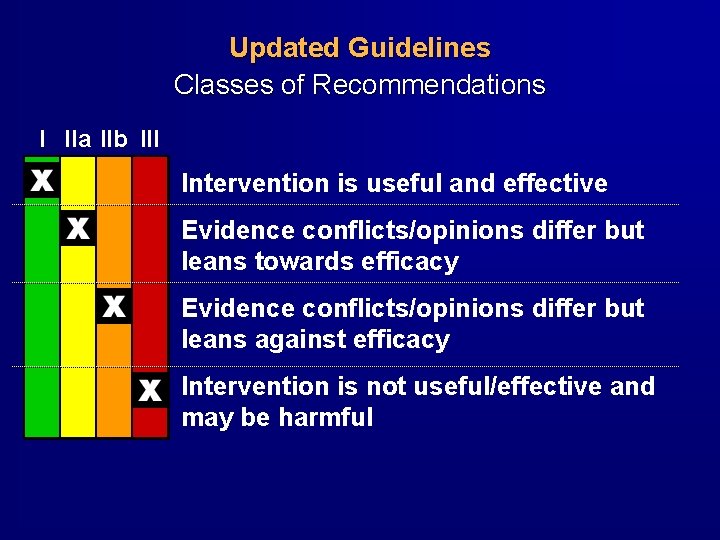
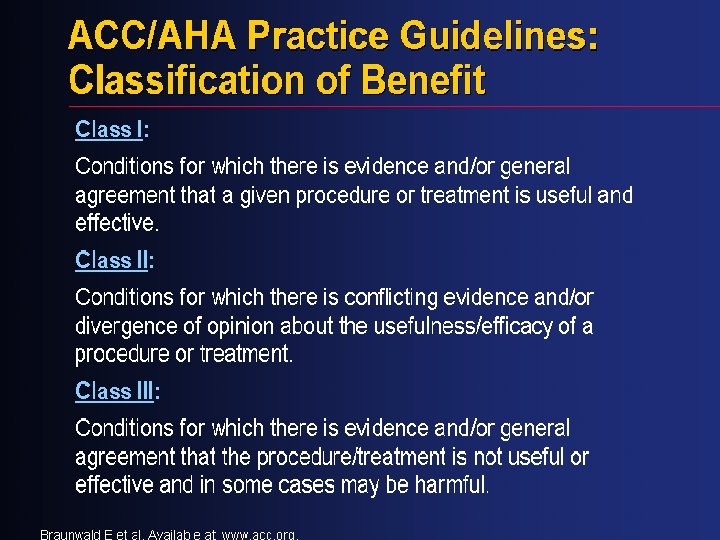
Updated Guidelines Classes of Recommendations I IIa IIb III Intervention is useful and effective Evidence conflicts/opinions differ but leans towards efficacy Evidence conflicts/opinions differ but leans against efficacy Intervention is not useful/effective and may be harmful
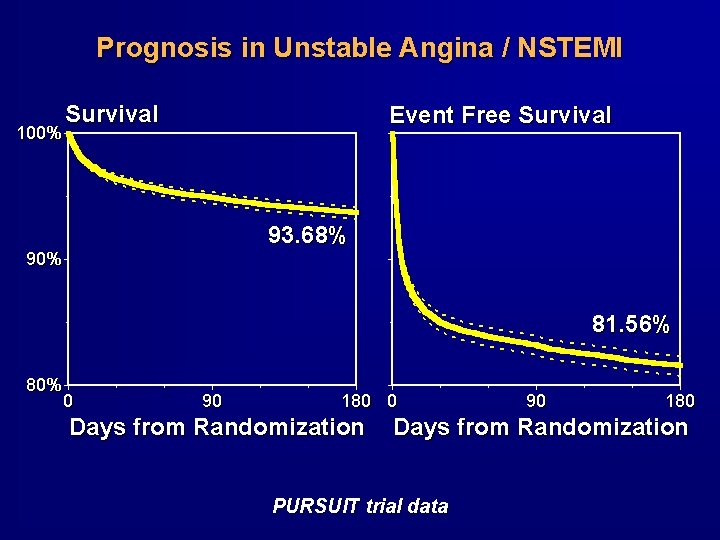
Prognosis in Unstable Angina / NSTEMI PURSUIT trial data
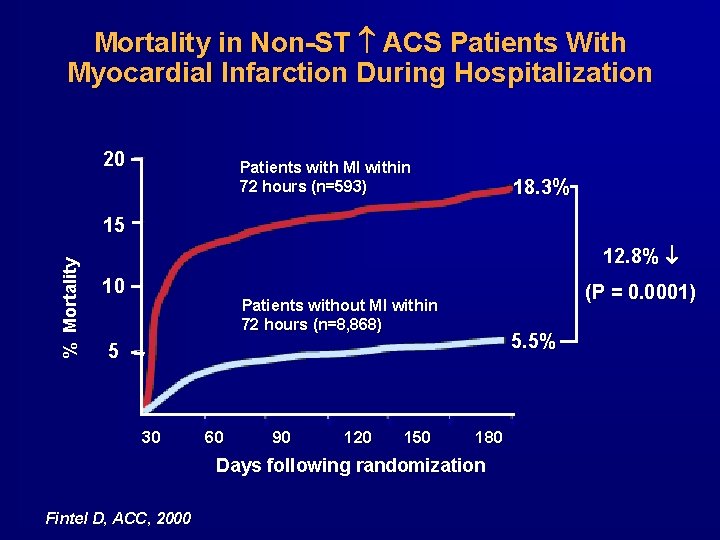
Mortality in Non-ST ACS Patients With Myocardial Infarction During Hospitalization 20 Patients with MI within 72 hours (n=593) 18. 3% % Mortality 15 12. 8% 10 (P = 0. 0001) Patients without MI within 72 hours (n=8, 868) 5. 5% 5 30 60 90 120 150 180 Days following randomization Fintel D, ACC, 2000
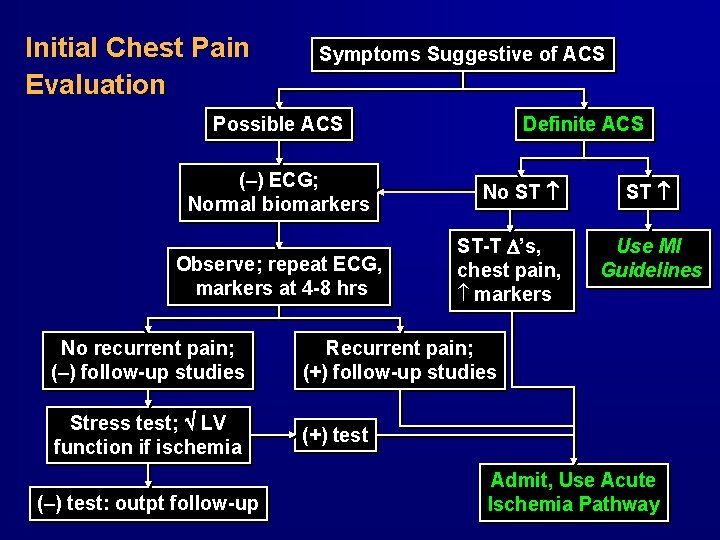
Initial Chest Pain Evaluation Symptoms Suggestive of ACS Possible ACS (–) ECG; Normal biomarkers Observe; repeat ECG, markers at 4 -8 hrs Definite ACS No ST ST-T ’s, chest pain, markers No recurrent pain; (–) follow-up studies Recurrent pain; (+) follow-up studies Stress test; LV function if ischemia (+) test (–) test: outpt follow-up ST Use MI Guidelines Admit, Use Acute Ischemia Pathway
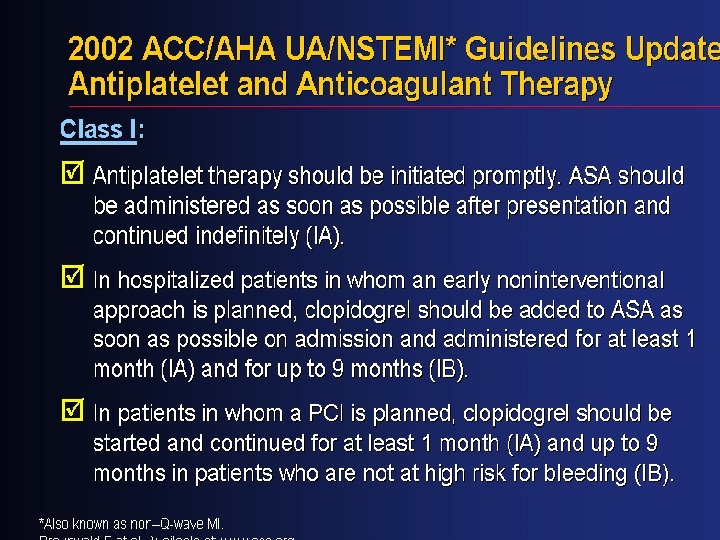
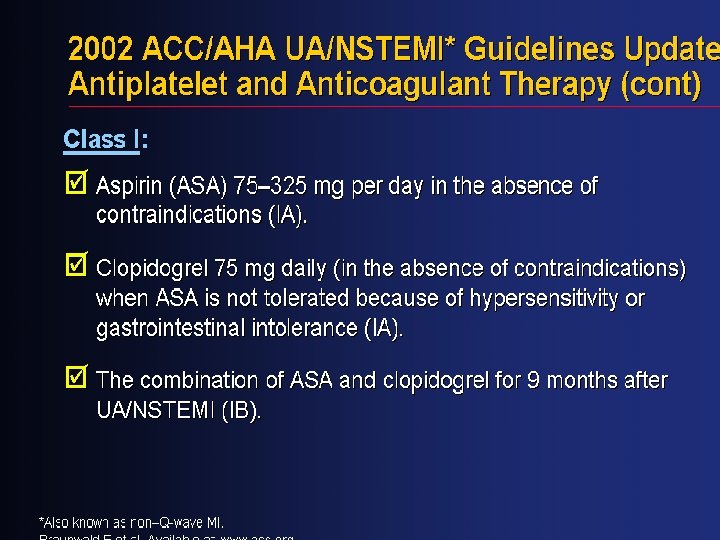
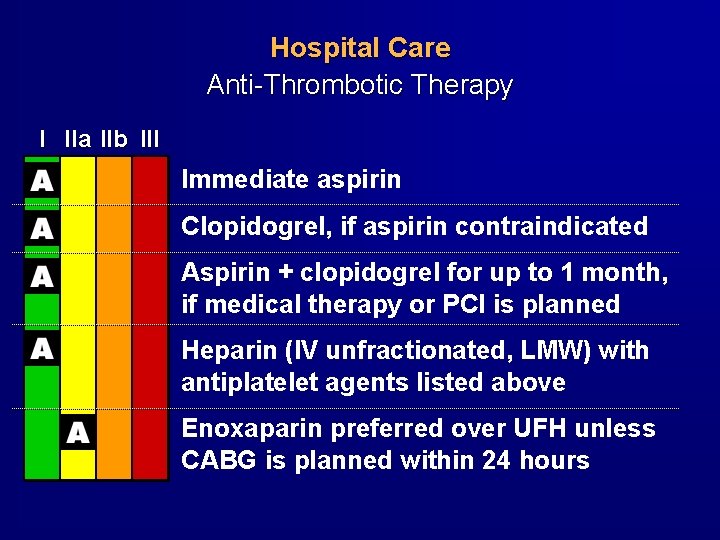
Hospital Care Anti-Thrombotic Therapy I IIa IIb III Immediate aspirin Clopidogrel, if aspirin contraindicated Aspirin + clopidogrel for up to 1 month, if medical therapy or PCI is planned Heparin (IV unfractionated, LMW) with antiplatelet agents listed above Enoxaparin preferred over UFH unless CABG is planned within 24 hours
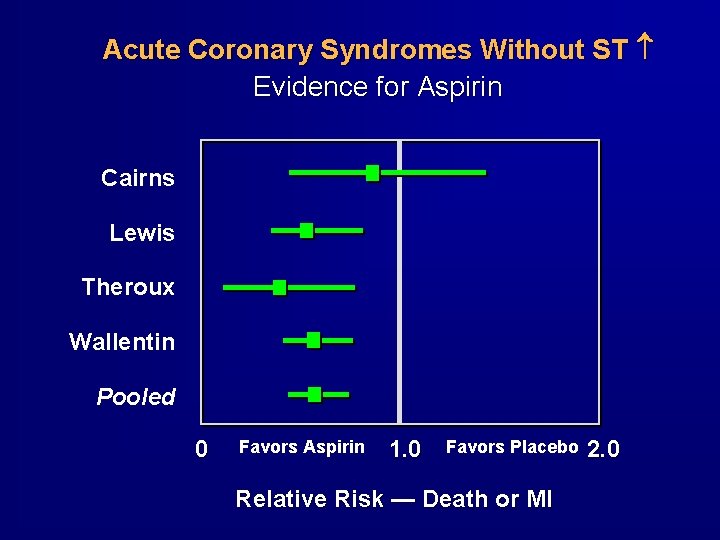
Acute Coronary Syndromes Without ST Evidence for Aspirin Cairns Lewis Theroux Wallentin Pooled 0 Favors Aspirin 1. 0 Favors Placebo Relative Risk — Death or MI 2. 0
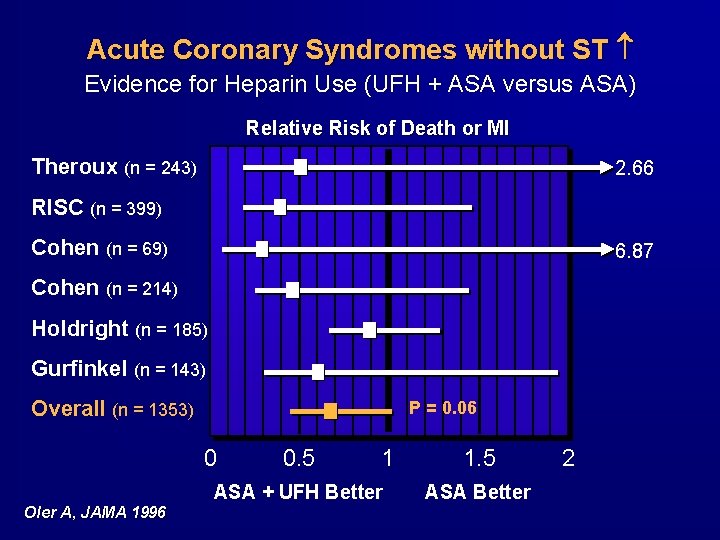
Acute Coronary Syndromes without ST Evidence for Heparin Use (UFH + ASA versus ASA) Relative Risk of Death or MI Theroux (n = 243) 2. 66 RISC (n = 399) Cohen (n = 69) 6. 87 Cohen (n = 214) Holdright (n = 185) Gurfinkel (n = 143) Overall (n = 1353) P = 0. 06 0 0. 5 1 ASA + UFH Better Oler A, JAMA 1996 1. 5 ASA Better 2
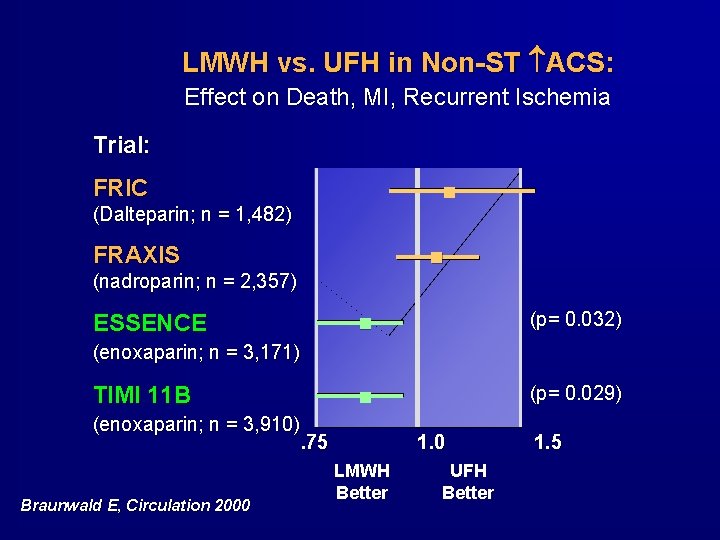
LMWH vs. UFH in Non-ST ACS: Effect on Death, MI, Recurrent Ischemia Trial: FRIC (Dalteparin; n = 1, 482) FRAXIS (nadroparin; n = 2, 357) ESSENCE (p= 0. 032) (p= 0. 029) (enoxaparin; n = 3, 171) TIMI 11 B (enoxaparin; n = 3, 910). 75 Braunwald E, Circulation 2000 1. 0 LMWH Better UFH Better 1. 5
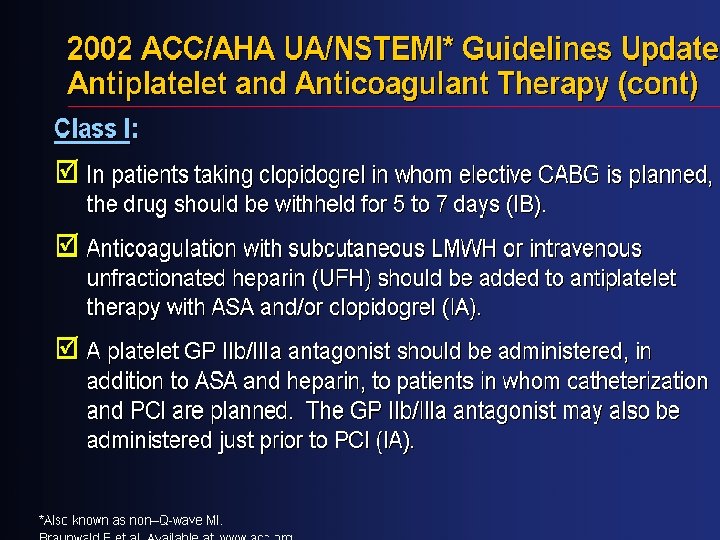
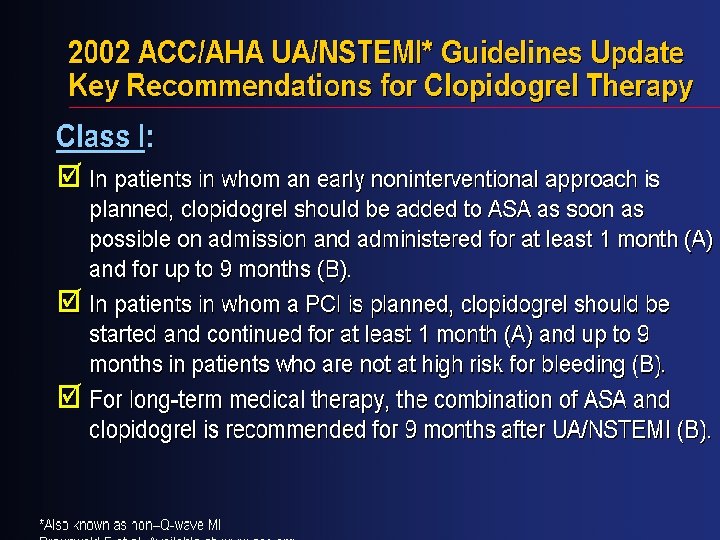
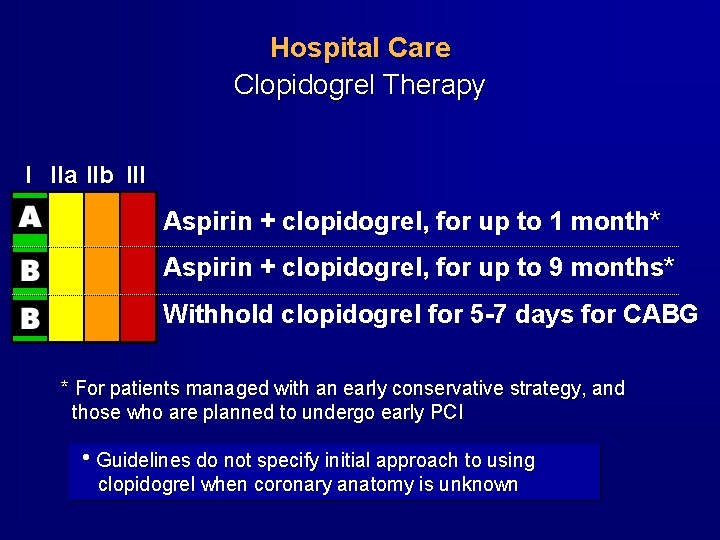
Hospital Care Clopidogrel Therapy I IIa IIb III Aspirin + clopidogrel, for up to 1 month* Aspirin + clopidogrel, for up to 9 months* Withhold clopidogrel for 5 -7 days for CABG * For patients managed with an early conservative strategy, and those who are planned to undergo early PCI Guidelines do not specify initial approach to using clopidogrel when coronary anatomy is unknown
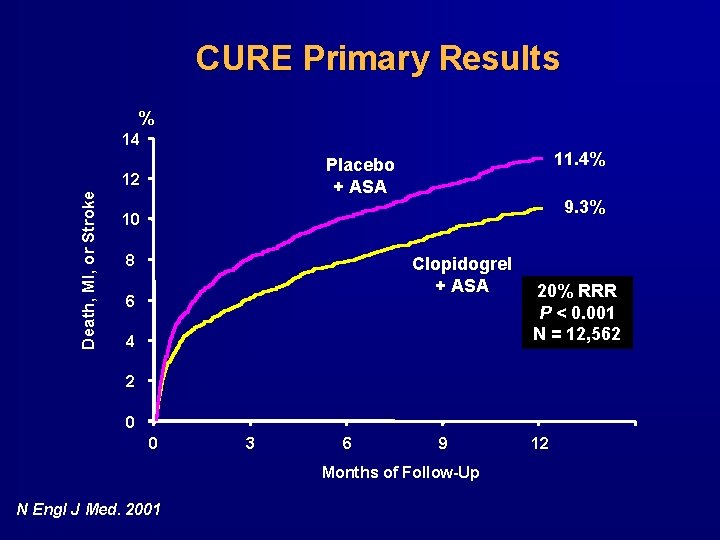
CURE Primary Results % 14 12 Death, MI, or Stroke 11. 4% Placebo + ASA 9. 3% 10 8 Clopidogrel + ASA 6 4 20% RRR P < 0. 001 N = 12, 562 2 0 0 3 6 9 Months of Follow-Up N Engl J Med. 2001 12
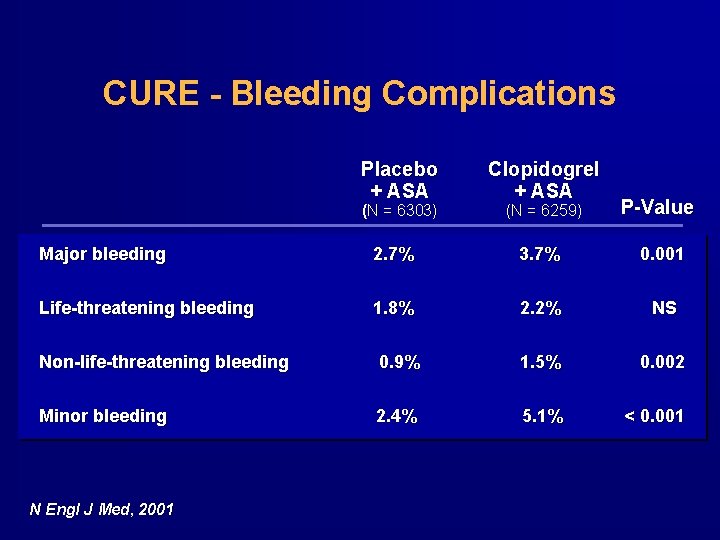
CURE - Bleeding Complications Placebo + ASA (N = 6303) Clopidogrel + ASA (N = 6259) P-Value Major bleeding 2. 7% 3. 7% 0. 001 Life-threatening bleeding 1. 8% 2. 2% NS Non-life-threatening bleeding 0. 9% 1. 5% 0. 002 Minor bleeding 2. 4% 5. 1% < 0. 001 N Engl J Med, 2001
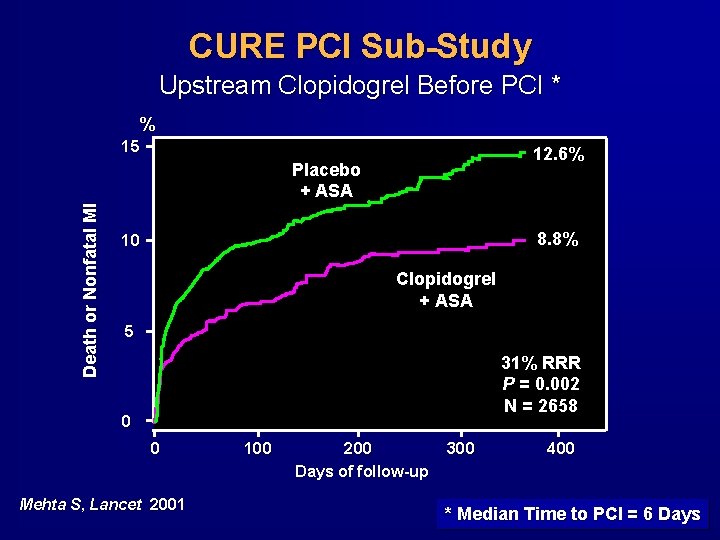
CURE PCI Sub-Study Upstream Clopidogrel Before PCI * % 15 12. 6% Death or Nonfatal MI Placebo + ASA 8. 8% 10 Clopidogrel + ASA 5 31% RRR P = 0. 002 N = 2658 0 0 100 200 300 400 Days of follow-up Mehta S, Lancet 2001 * Median Time to PCI = 6 Days
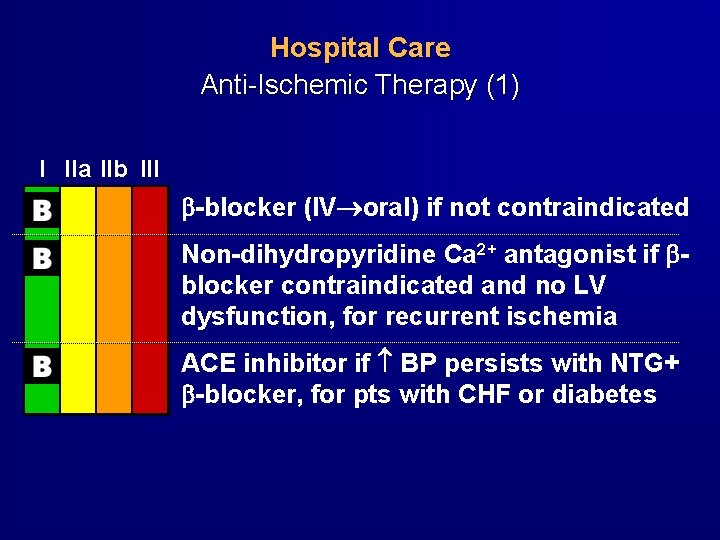
Hospital Care Anti-Ischemic Therapy (1) I IIa IIb III -blocker (IV oral) if not contraindicated Non-dihydropyridine Ca 2+ antagonist if blocker contraindicated and no LV dysfunction, for recurrent ischemia ACE inhibitor if BP persists with NTG+ -blocker, for pts with CHF or diabetes
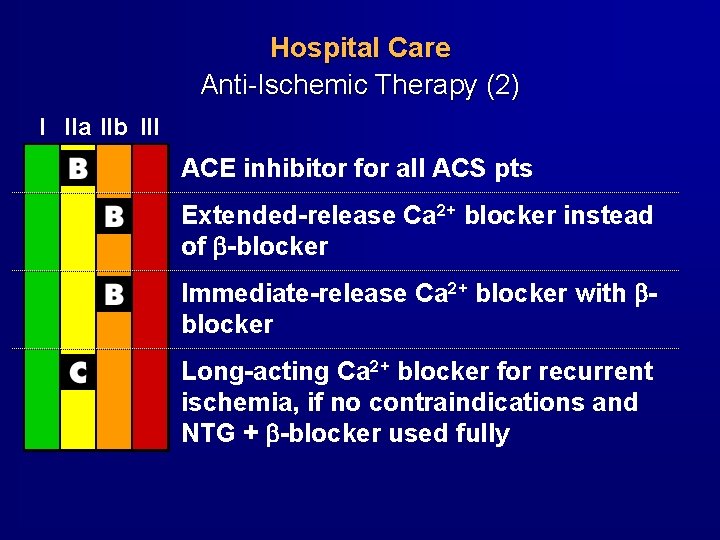
Hospital Care Anti-Ischemic Therapy (2) I IIa IIb III ACE inhibitor for all ACS pts Extended-release Ca 2+ blocker instead of -blocker Immediate-release Ca 2+ blocker with blocker Long-acting Ca 2+ blocker for recurrent ischemia, if no contraindications and NTG + -blocker used fully
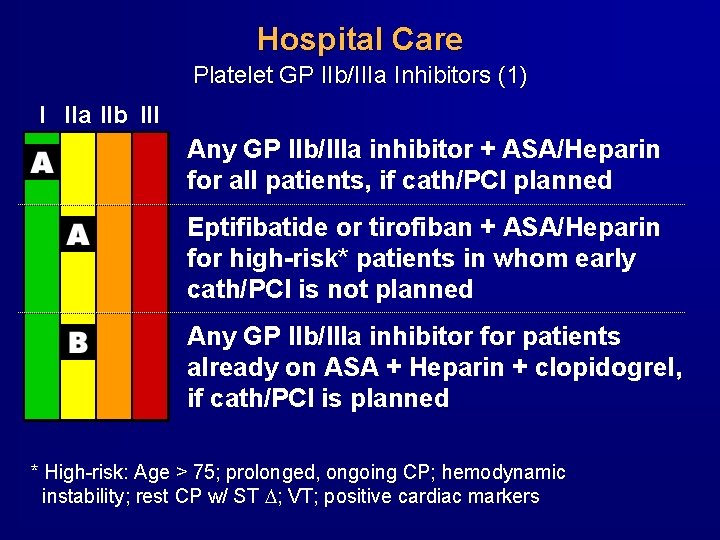
Hospital Care Platelet GP IIb/IIIa Inhibitors (1) I IIa IIb III Any GP IIb/IIIa inhibitor + ASA/Heparin for all patients, if cath/PCI planned Eptifibatide or tirofiban + ASA/Heparin for high-risk* patients in whom early cath/PCI is not planned Any GP IIb/IIIa inhibitor for patients already on ASA + Heparin + clopidogrel, if cath/PCI is planned * High-risk: Age > 75; prolonged, ongoing CP; hemodynamic instability; rest CP w/ ST ; VT; positive cardiac markers
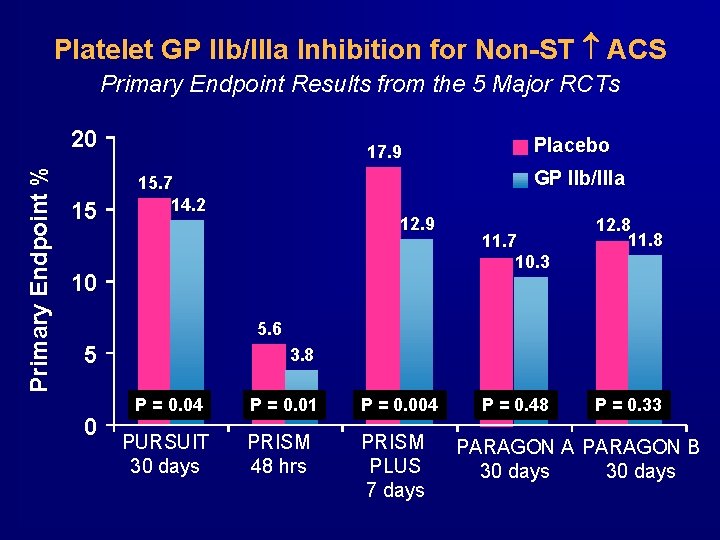
Platelet GP IIb/IIIa Inhibition for Non-ST ACS Primary Endpoint Results from the 5 Major RCTs Primary Endpoint % 20 15 17. 9 Placebo GP IIb/IIIa 15. 7 14. 2 12. 9 10 11. 7 10. 3 12. 8 11. 8 5. 6 5 0 3. 8 P = 0. 04 PURSUIT 30 days P = 0. 01 P = 0. 004 PRISM 48 hrs PRISM PLUS 7 days P = 0. 48 P = 0. 33 PARAGON A PARAGON B 30 days
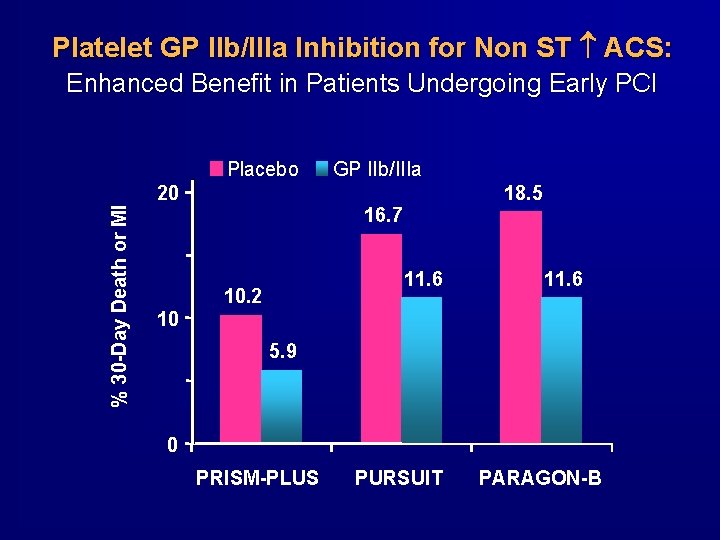
Platelet GP IIb/IIIa Inhibition for Non ST ACS: Enhanced Benefit in Patients Undergoing Early PCI % 30 -Day Death or MI Placebo GP IIb/IIIa 18. 5 20 16. 7 11. 6 10. 2 11. 6 10 5. 9 0 PRISM-PLUS PURSUIT PARAGON-B
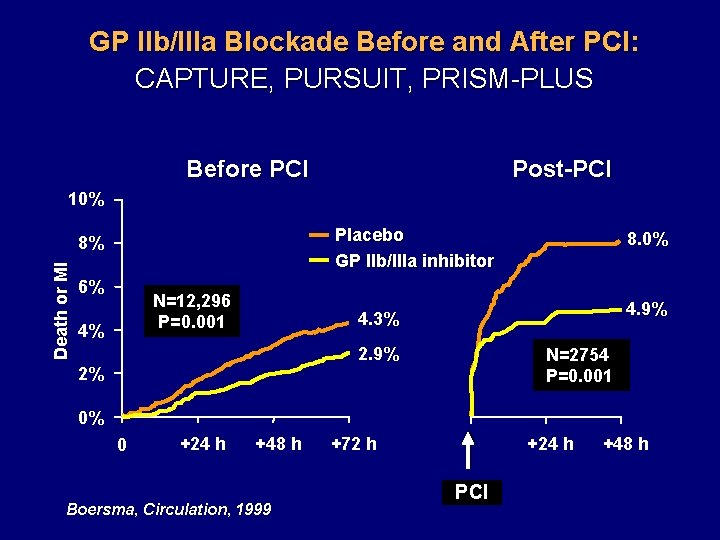
GP IIb/IIIa Blockade Before and After PCI: CAPTURE, PURSUIT, PRISM-PLUS Before PCI Post-PCI 10% Placebo GP IIb/IIIa inhibitor Death or MI 8% 6% N=12, 296 P=0. 001 4% 8. 0% 4. 9% 4. 3% 2. 9% 2% N=2754 P=0. 001 0% 0 +24 h +48 h Boersma, Circulation, 1999 +72 h +24 h PCI +48 h
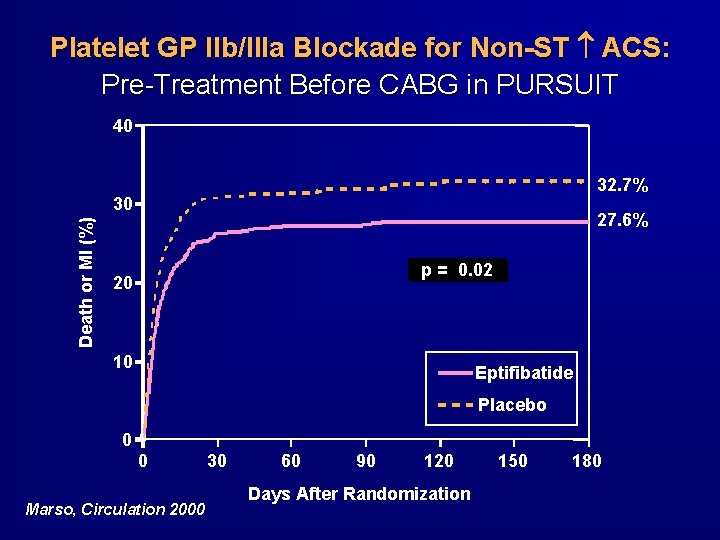
Platelet GP IIb/IIIa Blockade for Non-ST ACS: Pre-Treatment Before CABG in PURSUIT 40 32. 7% Death or MI (%) 30 27. 6% p = 0. 02 20 10 Eptifibatide Placebo 0 0 Marso, Circulation 2000 30 60 90 120 Days After Randomization 150 180
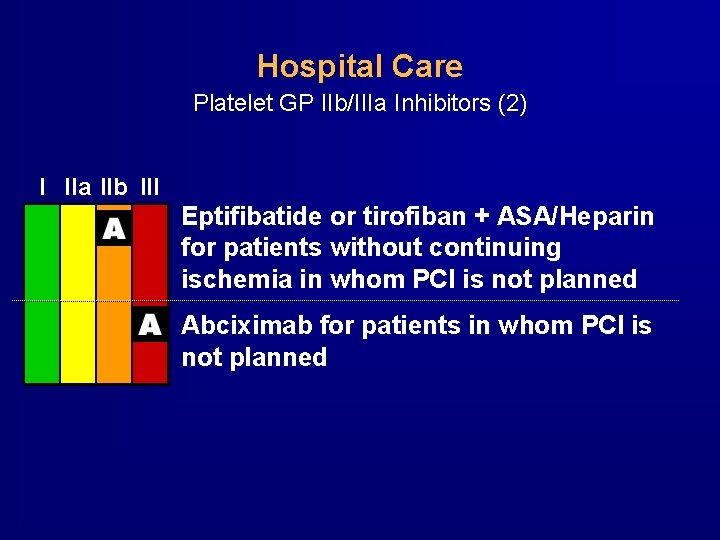
Hospital Care Platelet GP IIb/IIIa Inhibitors (2) I IIa IIb III Eptifibatide or tirofiban + ASA/Heparin for patients without continuing ischemia in whom PCI is not planned Abciximab for patients in whom PCI is not planned
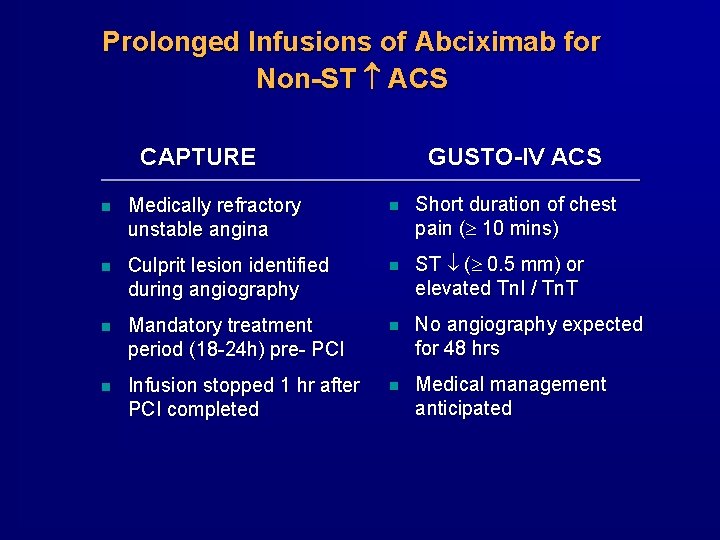
Prolonged Infusions of Abciximab for Non-ST ACS CAPTURE GUSTO-IV ACS Medically refractory unstable angina Short duration of chest pain ( 10 mins) Culprit lesion identified during angiography ST ( 0. 5 mm) or elevated Tn. I / Tn. T Mandatory treatment period (18 -24 h) pre- PCI No angiography expected for 48 hrs Infusion stopped 1 hr after PCI completed Medical management anticipated
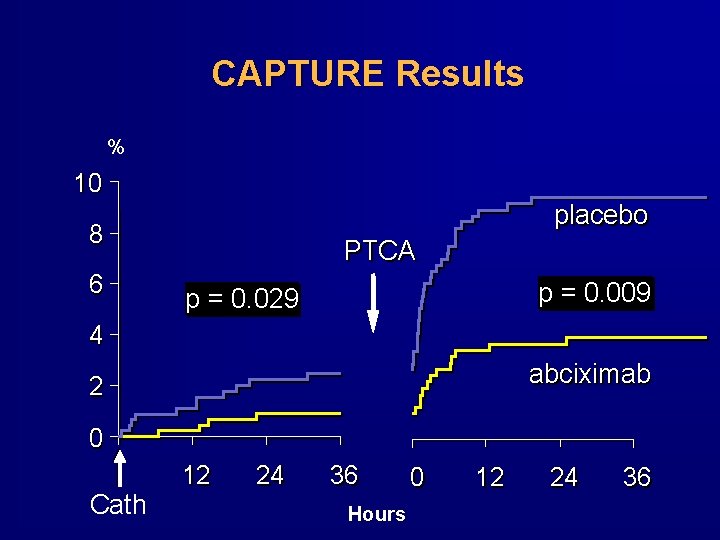
CAPTURE Results % 10 placebo 8 6 PTCA pp == 0. 009 p = 0. 029 4 abciximab 2 0 Cath 12 24 36 Hours 0 12 24 36
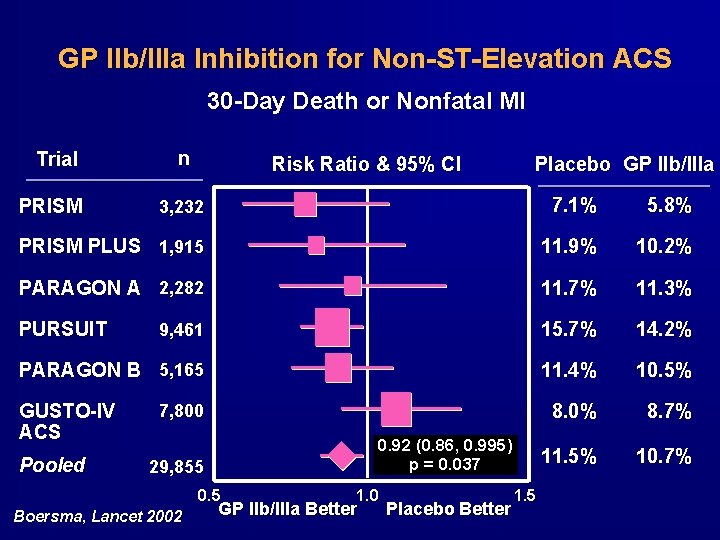
GP IIb/IIIa Inhibition for Non-ST-Elevation ACS 30 -Day Death or Nonfatal MI Trial n Risk Ratio & 95% CI Placebo GP IIb/IIIa 3, 232 7. 1% 5. 8% PRISM PLUS 1, 915 11. 9% 10. 2% PARAGON A 2, 282 11. 7% 11. 3% PURSUIT 9, 461 15. 7% 14. 2% PARAGON B 5, 165 11. 4% 10. 5% 8. 0% 8. 7% 11. 5% 10. 7% PRISM GUSTO-IV ACS Pooled 7, 800 0. 92 (0. 86, 0. 995) p = 0. 037 29, 855 0. 5 Boersma, Lancet 2002 1. 0 GP IIb/IIIa Better Placebo Better 1. 5
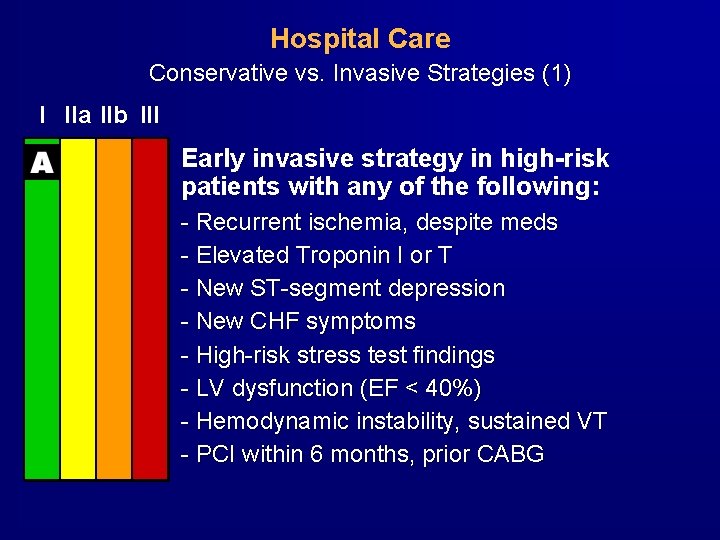
Hospital Care Conservative vs. Invasive Strategies (1) I IIa IIb III Early invasive strategy in high-risk patients with any of the following: - Recurrent ischemia, despite meds - Elevated Troponin I or T - New ST-segment depression - New CHF symptoms - High-risk stress test findings - LV dysfunction (EF < 40%) - Hemodynamic instability, sustained VT - PCI within 6 months, prior CABG
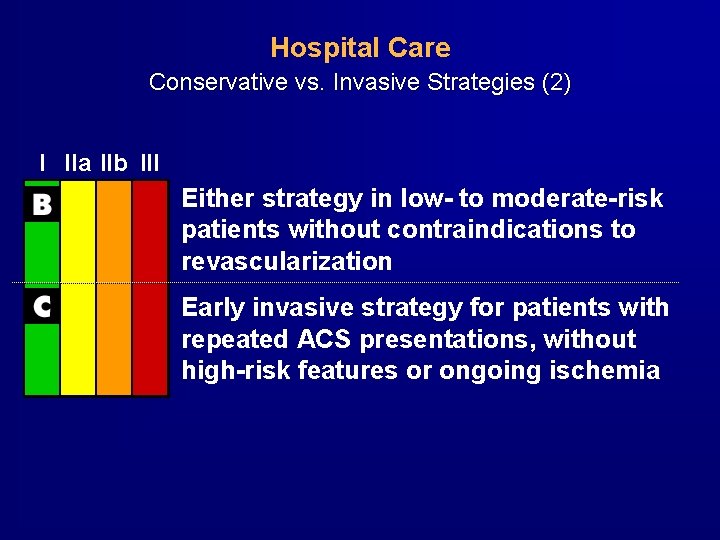
Hospital Care Conservative vs. Invasive Strategies (2) I IIa IIb III Either strategy in low- to moderate-risk patients without contraindications to revascularization Early invasive strategy for patients with repeated ACS presentations, without high-risk features or ongoing ischemia
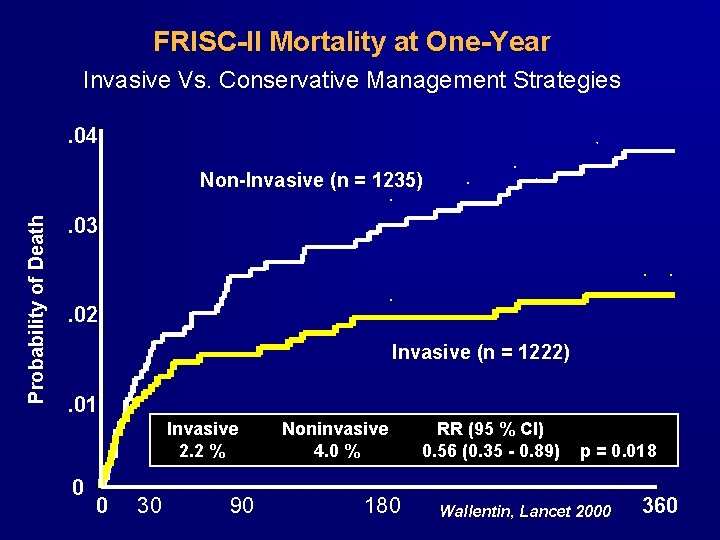
FRISC-II Mortality at One-Year Invasive Vs. Conservative Management Strategies. 04 Probability of Death Non-Invasive (n = 1235) . 03 . 02 Invasive (n = 1222) . 01 Invasive 2. 2 % 0 0 30 90 Noninvasive 4. 0 % 180 RR (95 % CI) 0. 56 (0. 35 - 0. 89) p = 0. 018 Wallentin, Lancet 2000 360
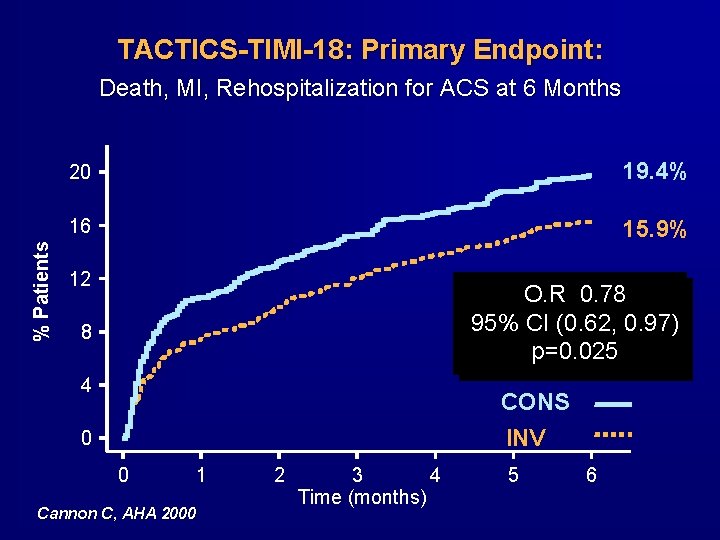
TACTICS-TIMI-18: Primary Endpoint: % Patients Death, MI, Rehospitalization for ACS at 6 Months 20 19. 4% 16 15. 9% 12 O. R 0. 78 95% CI (0. 62, 0. 97) p=0. 025 8 4 CONS INV 0 0 1 Cannon C, AHA 2000 2 3 4 Time (months) 5 6
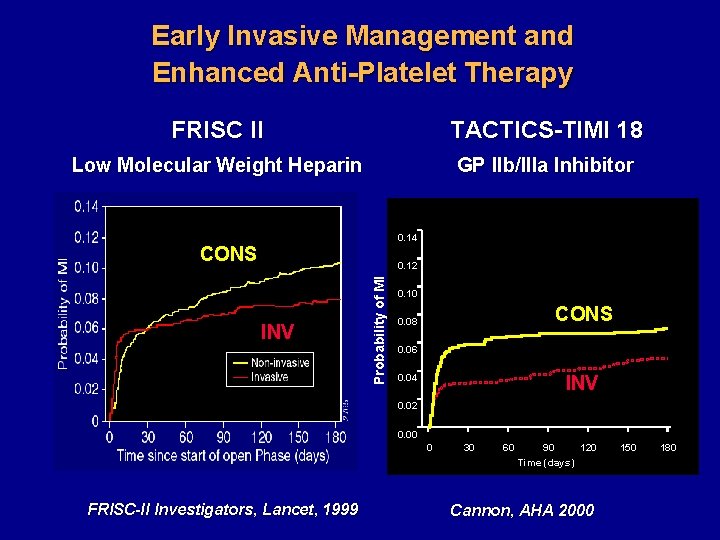
Early Invasive Management and Enhanced Anti-Platelet Therapy FRISC II TACTICS-TIMI 18 Low Molecular Weight Heparin GP IIb/IIIa Inhibitor 0. 14 CONS INV Probability of MI 0. 12 0. 10 CONS 0. 08 0. 06 INV 0. 04 0. 02 0. 00 0 FRISC-II Investigators, Lancet, 1999 30 60 90 120 Time (days) Cannon, AHA 2000 150 180
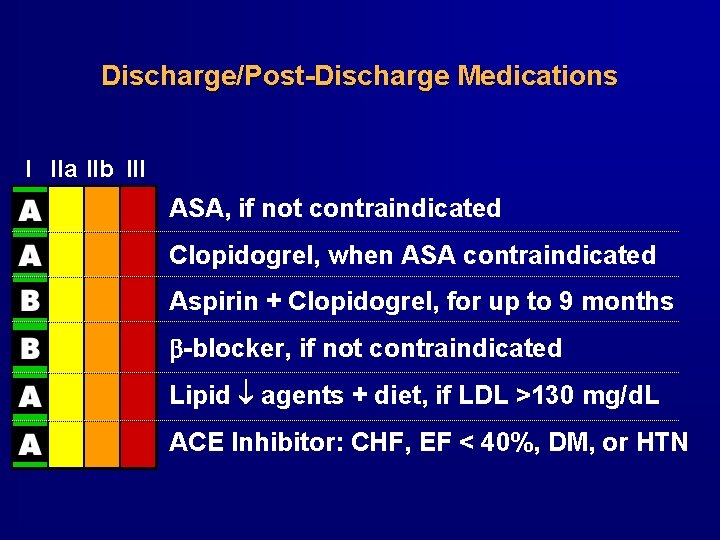
Discharge/Post-Discharge Medications I IIa IIb III ASA, if not contraindicated Clopidogrel, when ASA contraindicated Aspirin + Clopidogrel, for up to 9 months -blocker, if not contraindicated Lipid agents + diet, if LDL >130 mg/d. L ACE Inhibitor: CHF, EF < 40%, DM, or HTN
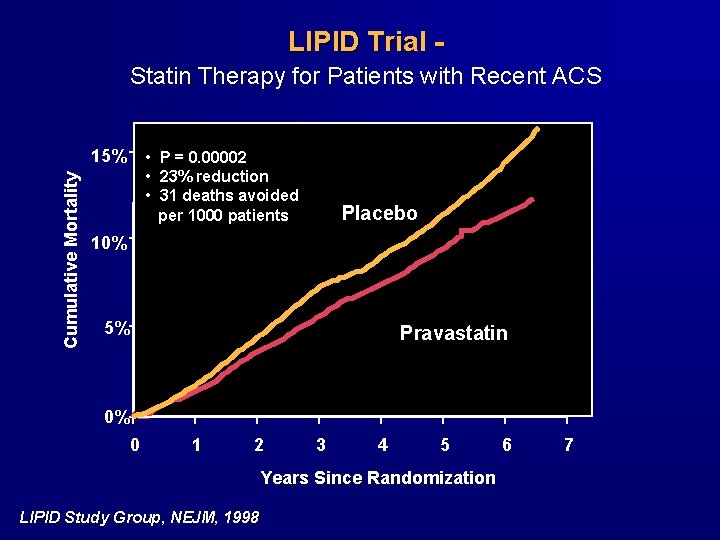
LIPID Trial Statin Therapy for Patients with Recent ACS Cumulative Mortality 15% • P = 0. 00002 • 23% reduction • 31 deaths avoided per 1000 patients Placebo 10% 5% Pravastatin 0% 0 1 2 3 4 5 Years Since Randomization LIPID Study Group, NEJM, 1998 6 7
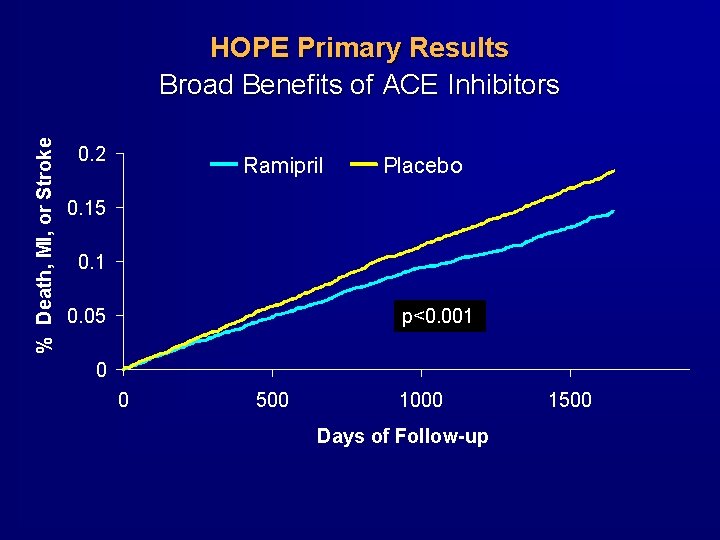
% Death, MI, or Stroke HOPE Primary Results Broad Benefits of ACE Inhibitors 0. 2 Ramipril Placebo 0. 15 0. 1 0. 05 p<0. 001 0 0 500 1000 Days of Follow-up 1500
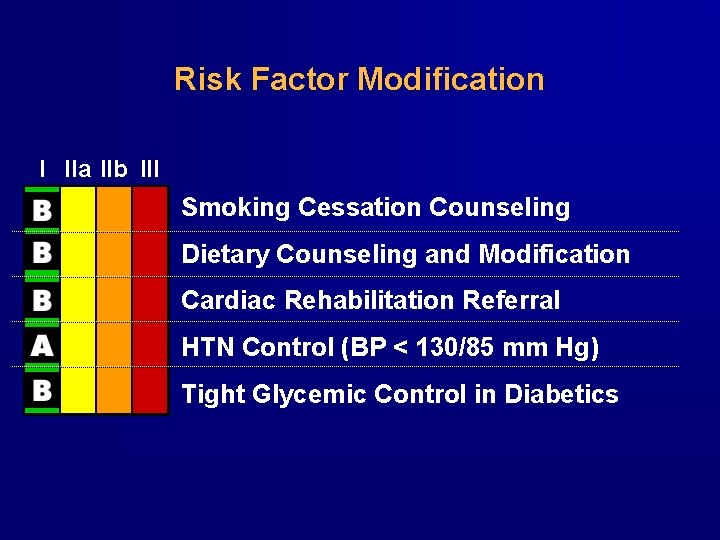
Risk Factor Modification I IIa IIb III Smoking Cessation Counseling Dietary Counseling and Modification Cardiac Rehabilitation Referral HTN Control (BP < 130/85 mm Hg) Tight Glycemic Control in Diabetics