Chapter 45 Nursing Management Patients With Neurologic Trauma


- Slides: 20
Chapter 45: Nursing Management: Patients With Neurologic Trauma
Head Injuries • The most common cause of death from trauma in the United States. • Primary injury is the initial damage to the brain. • Secondary injury is the damage from the sequelae of the primary injury (e. g. , increased intracranial pressure). Copyright © 2019 Wolters Kluwer · All Rights Reserved
Skull Fractures • A break in the continuity of the skull caused by forceful trauma • May occur with or without damage to the brain • Nondepressed skull fractures generally do not require surgical treatment • Depressed skull fractures usually require surgery Copyright © 2019 Wolters Kluwer · All Rights Reserved
Question • The nurse has observed that clear fluid is leaking from the nose of a patient who has just been admitted with a skull fracture. What conclusion should the nurse draw from this assessment finding? A. The patient is diuresing as a result of the injury. B. The patient is leaking cerebrospinal fluid. C. The patient is leaking blood plasma. D. The basement membrane of the patient’s mucous membranes has been damaged. Copyright © 2019 Wolters Kluwer · All Rights Reserved
Answer • B. The patient is leaking cerebrospinal fluid. • Rationale: Clear fluid that is draining from the nose or ears should be collected and tested for glucose. If the drainage is CSF, it will be positive for glucose. It is unlikely that the patient would be leaking plasma from his or her nose. Diuresis would not cause this phenomenon. Copyright © 2019 Wolters Kluwer · All Rights Reserved
Brain Injury • Concussion: An alteration in mental status that results from trauma, and may or may not involve loss of consciousness: – Treatment involves observing the patient for symptoms, including headache, dizziness, lethargy, irritability, anxiety, photophobia, phonophobia, difficulty concentrating, and memory difficulties • Contusion: A more severe injury, involving bruising of the brain, with possible surface hemorrhage • Diffuse axonal injury: Involves widespread damage to axons in the cerebral hemispheres Copyright © 2019 Wolters Kluwer · All Rights Reserved
Hematomas • Collections of blood that develop within the cranial vault; the most serious type of brain injury • Epidural hematoma: Collection of blood in the space between the skull and the dura • Subdural hematoma (SDH): Collection of blood between the dura and the brain: – May be acute or chronic • Intracerebral hemorrhage (ICH): Bleeding into the parenchyma of the brain • Treatment of all is directed toward preserving brain homeostasis and preventing secondary brain injury Copyright © 2019 Wolters Kluwer · All Rights Reserved
Altered Level of Consciousness • Exists when a patient is not oriented, does not follow commands, or needs persistent stimuli to achieve a state of alertness. • LOC exists on a continuum from a normal state of alertness to coma. • Altered LOC may have neurologic, metabolic, or toxicologic causes. • Often results from brain herniation and/or increased intracranial pressure. • Systematic, thorough assessment is necessary. Copyright © 2019 Wolters Kluwer · All Rights Reserved
Question • Is the following statement true or false? • When assessing a patient using the Glasgow Coma Scale, the nurse will assess the patient’s judgment and insight. Copyright © 2019 Wolters Kluwer · All Rights Reserved
Answer • False • Rationale: The assessment parameters of the GCS are best verbal response, best motor response, and eye opening. Copyright © 2019 Wolters Kluwer · All Rights Reserved
Monitoring Intracranial Pressure • The earliest sign of increasing ICP is a change in LOC: – Other early signs include headache, weakness, and pupillary changes • ICP can be monitored with the use of an intraventricular catheter (ventriculostomy) or a subarachnoid bolt or screw • The nurse must conduct frequent, focused neurologic assessments Copyright © 2019 Wolters Kluwer · All Rights Reserved
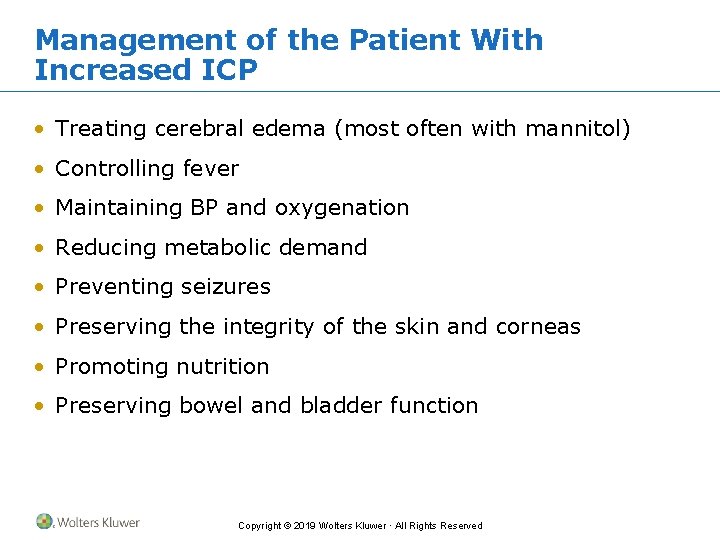
Management of the Patient With Increased ICP • Treating cerebral edema (most often with mannitol) • Controlling fever • Maintaining BP and oxygenation • Reducing metabolic demand • Preventing seizures • Preserving the integrity of the skin and corneas • Promoting nutrition • Preserving bowel and bladder function Copyright © 2019 Wolters Kluwer · All Rights Reserved
Question • Cerebral edema can often be prevented or treated in the brain-injured patient through which of the following interventions? A. Fluid restriction B. Administration of hypotonic IV solutions C. Prone positioning Copyright © 2019 Wolters Kluwer · All Rights Reserved
Answer • A. Fluid restriction • Rationale: Limiting overall fluid intake leads to dehydration and hemoconcentration, which draws fluid across the osmotic gradient and decreases cerebral edema. Hypotonic fluids should be avoided in patients with brain injury as they can cause an increase in cerebral edema. Similarly, prone positioning may exacerbate cerebral edema. Copyright © 2019 Wolters Kluwer · All Rights Reserved
Spinal Cord Injury (SCI) • An estimated 259, 000 people in the United States live each day with a disability from SCI. • Manifestations of SCI depend on the type and level of injury (e. g. , complete or incomplete spinal cord lesions) • Emergency management at the scene of the injury is critical • At the trauma center, treatment may be surgical or nonsurgical: – Goals are preservations, stabilization, and realignment of the spinal cord Copyright © 2019 Wolters Kluwer · All Rights Reserved
Monitoring and Managing Complications of SCI • Spinal and neurogenic shock • DVT • Orthostatic hypotension • Autonomic dysreflexia Copyright © 2019 Wolters Kluwer · All Rights Reserved
Nursing Management: The Patient With Acute SCI • The patient is assessed for: – Altered breathing – Changes in motor or sensory function – Spinal shock – Urinary retention – Overdistention of the bladder – Paralytic ileus Copyright © 2019 Wolters Kluwer · All Rights Reserved
Nursing Management: The Patient With Acute SCI (cont. ) • Goal and interventions address: – Improved breathing pattern and airway clearance – Improved mobility – Improved sensory and perceptual awareness – Maintenance of skin integrity – Relief of urinary retention – Improved bowel function – Promotion of comfort – Absence of complications Copyright © 2019 Wolters Kluwer · All Rights Reserved
Question • Is the following statement true or false? • The most common effect on bladder function that is caused by acute SCI is urinary incontinence. Copyright © 2019 Wolters Kluwer · All Rights Reserved
Answer • False • Rationale: Immediately after SCI, the urinary bladder may become atonic and is unable to contract by reflex activity. Urinary retention is typically the result of this. Copyright © 2019 Wolters Kluwer · All Rights Reserved