1 Population Health Assessment Engine 1 Population Health



- Slides: 70
1 Population Health Assessment Engine 1
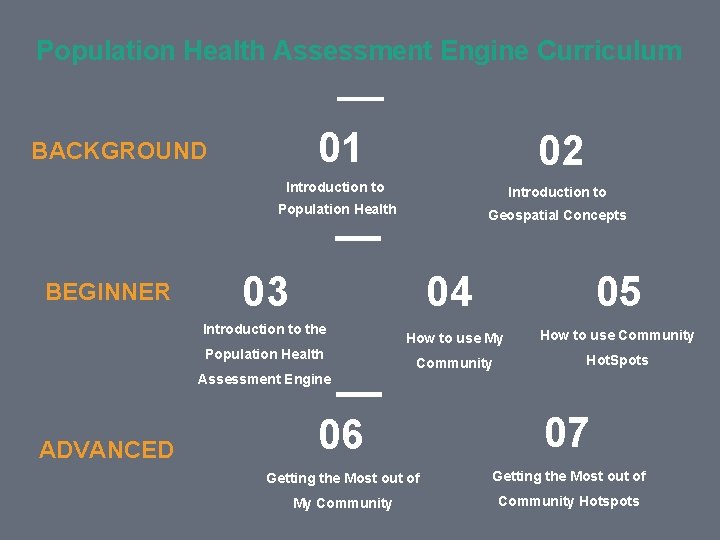
Population Health Assessment Engine Curriculum 01 BACKGROUND BEGINNER 02 Introduction to Population Health Geospatial Concepts 03 04 Introduction to the Population Health 05 How to use My How to use Community Hot. Spots Assessment Engine ADVANCED 2 06 07 Getting the Most out of My Community Hotspots
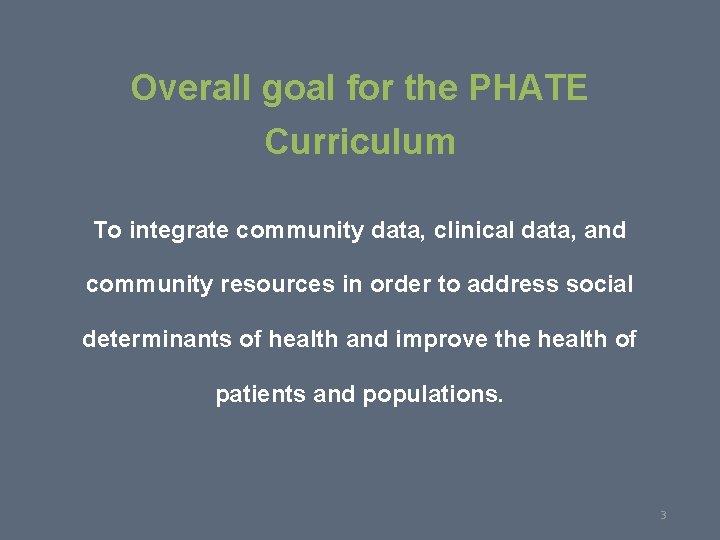
3 Overall goal for the PHATE Curriculum To integrate community data, clinical data, and community resources in order to address social determinants of health and improve the health of patients and populations. 3
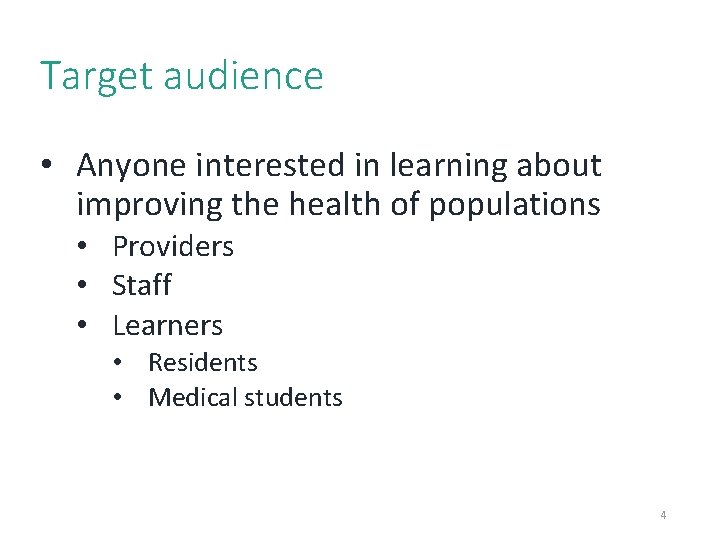
4 Target audience • Anyone interested in learning about improving the health of populations • Providers • Staff • Learners • Residents • Medical students 4
5 INTRODUCTION TO POPULATION HEALTH BACKGROUND 01
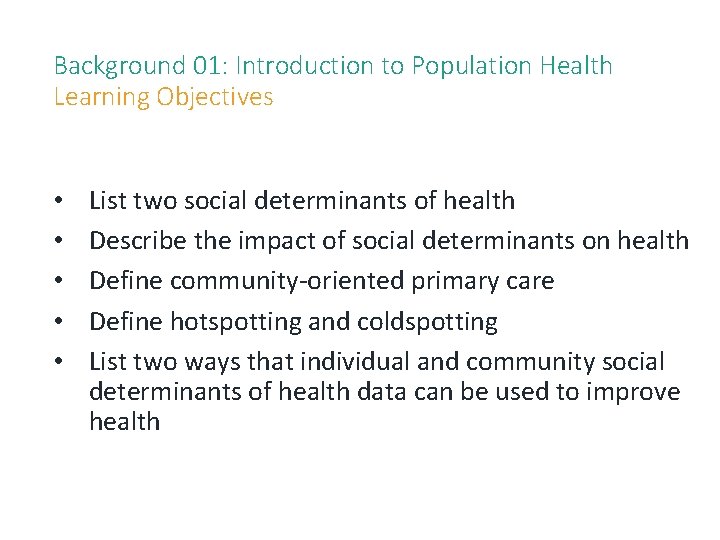
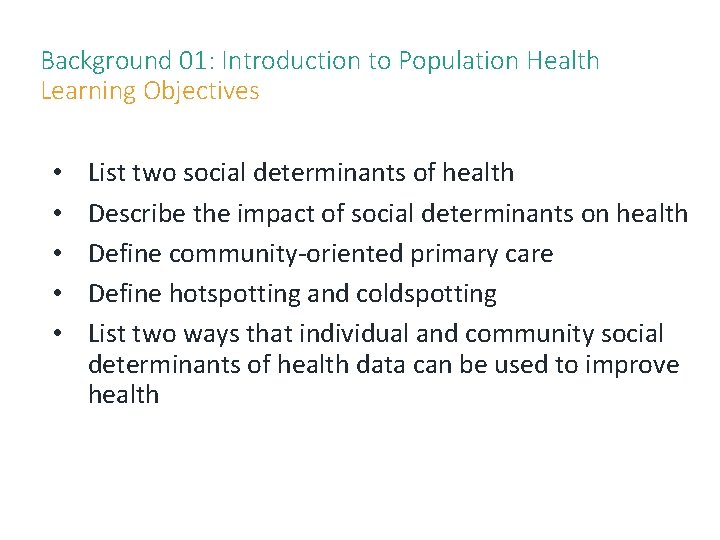
6 Background 01: Introduction to Population Health Learning Objectives • • • List two social determinants of health Describe the impact of social determinants on health Define community-oriented primary care Define hotspotting and coldspotting List two ways that individual and community social determinants of health data can be used to improve health
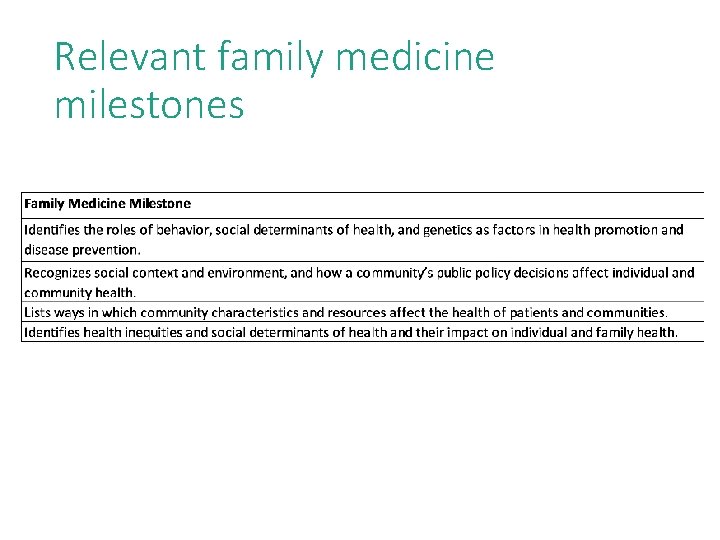
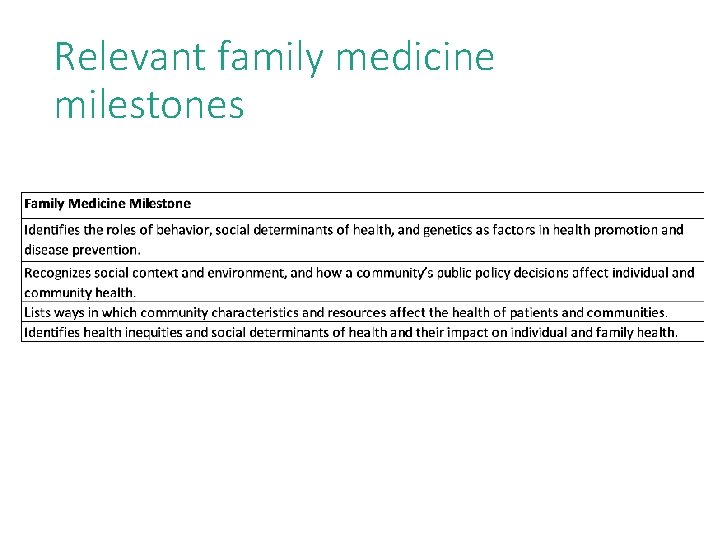
Relevant family medicine milestones 7
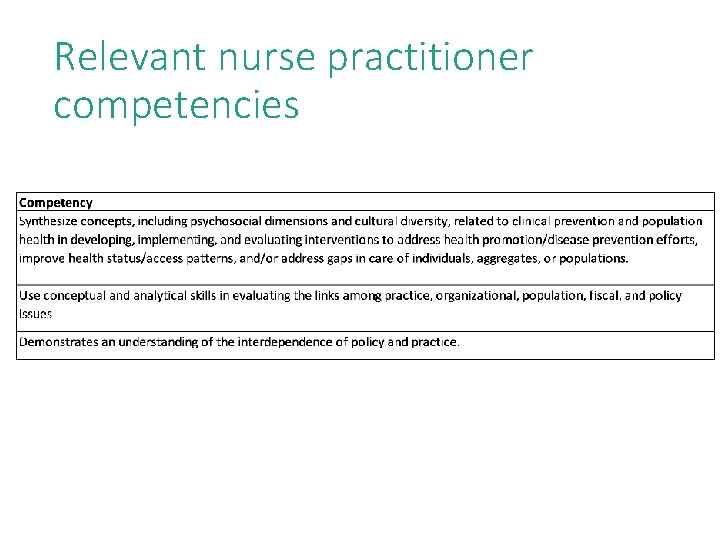
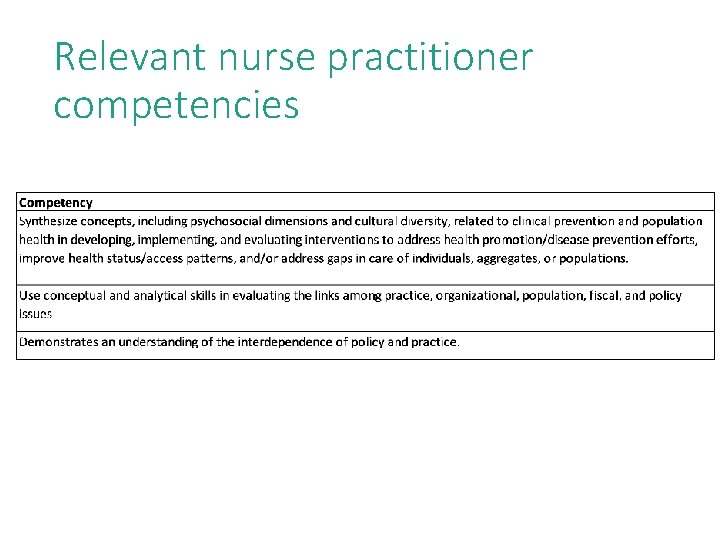
Relevant nurse practitioner competencies 8
9 Background 01: Introduction to Population Health Outline I. III. IV. Definitions Evidence Base Concepts & Frameworks Practical Tools & Action
10 I. DEFINITIONS BACKGROUND 01
11 How would you define population health?
12 How would you define social determinants of health?
13 How are population health and social determinants related?
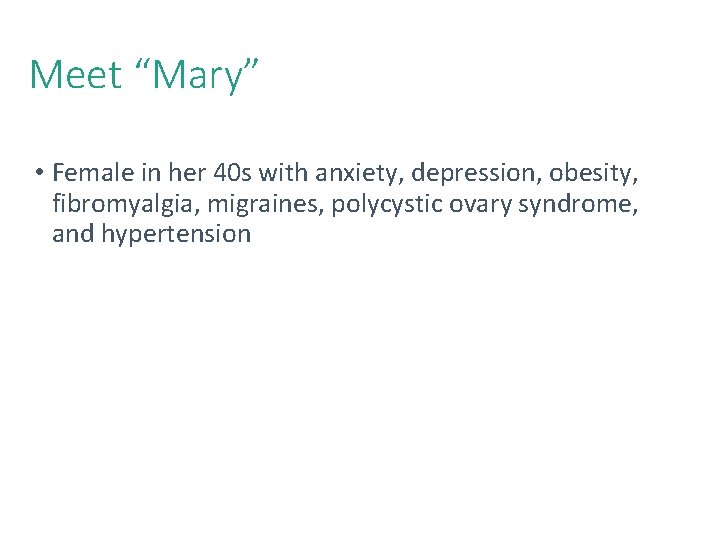
14 Meet “Mary” • Female in her 40 s with anxiety, depression, obesity, fibromyalgia, migraines, polycystic ovary syndrome, and hypertension
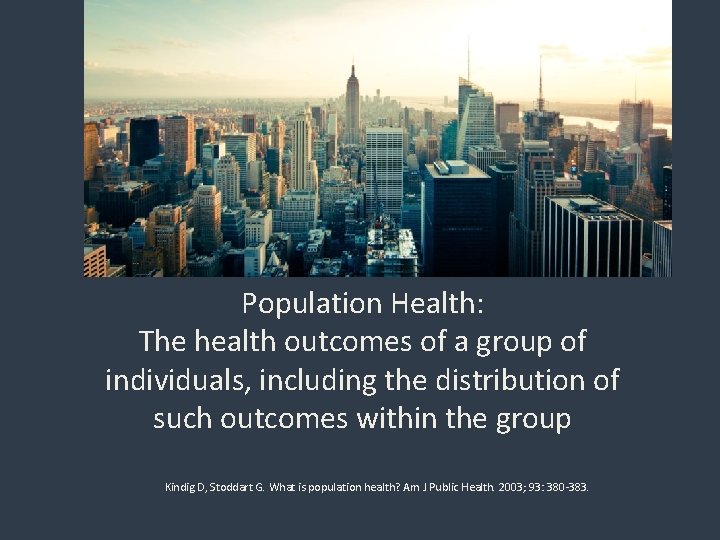
Population Health: The health outcomes of a group of individuals, including the distribution of such outcomes within the group Kindig D, Stoddart G. What is population health? Am J Public Health. 2003; 93: 380 -383.
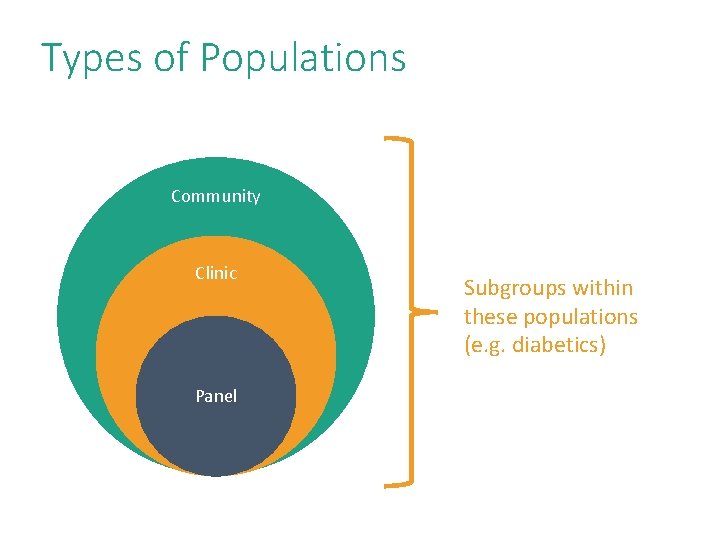
16 Types of Populations Community Clinic Panel Subgroups within these populations (e. g. diabetics)
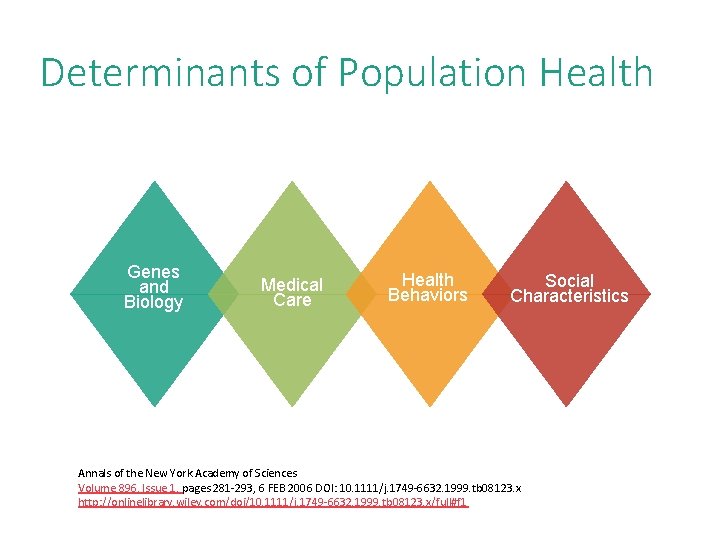
17 Determinants of Population Health Genes and Biology Medical Care Health Behaviors Social Characteristics Annals of the New York Academy of Sciences Volume 896, Issue 1, pages 281 -293, 6 FEB 2006 DOI: 10. 1111/j. 1749 -6632. 1999. tb 08123. x http: //onlinelibrary. wiley. com/doi/10. 1111/j. 1749 -6632. 1999. tb 08123. x/full#f 1
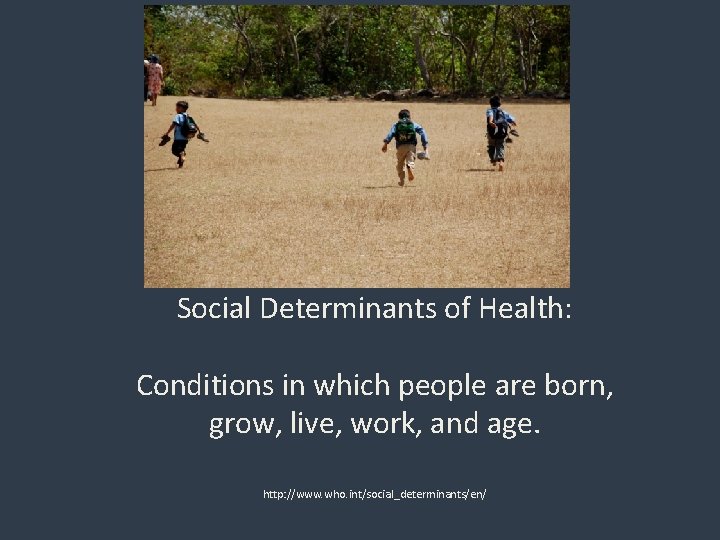
Social Determinants of Health: Conditions in which people are born, grow, live, work, and age. http: //www. who. int/social_determinants/en/
19 II. EVIDENCE BASE BACKGROUND 01
20 “Mary” • Mary’s zip code: 22041 • 36% earning less than 200% of the Federal Poverty Level
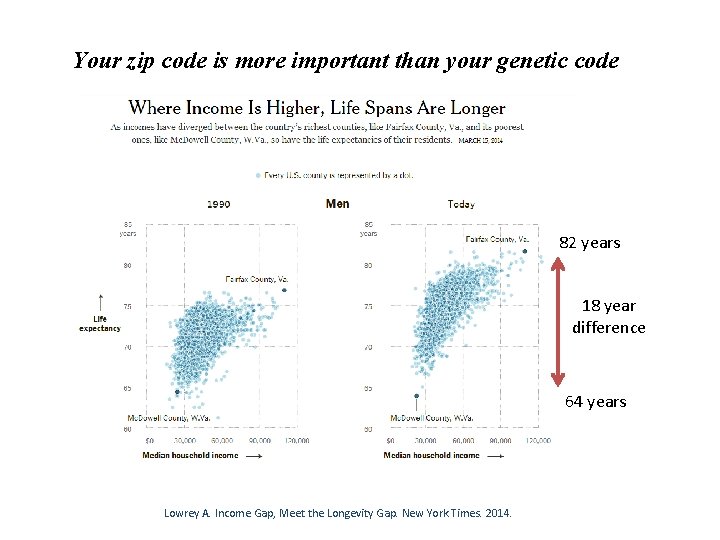
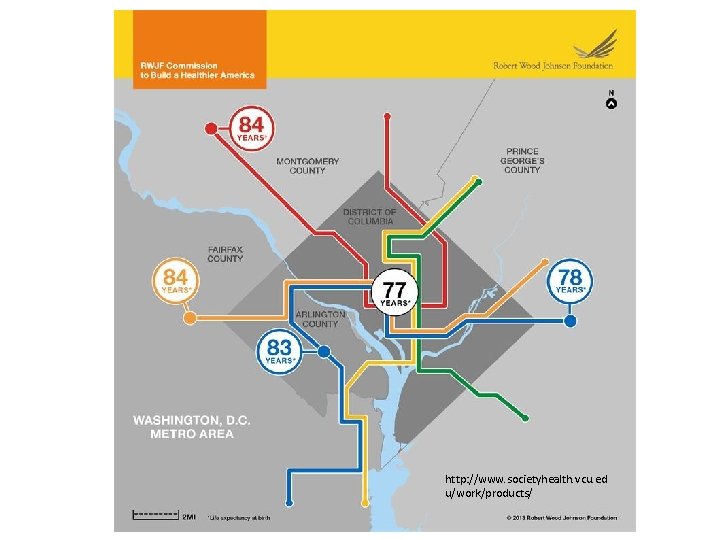
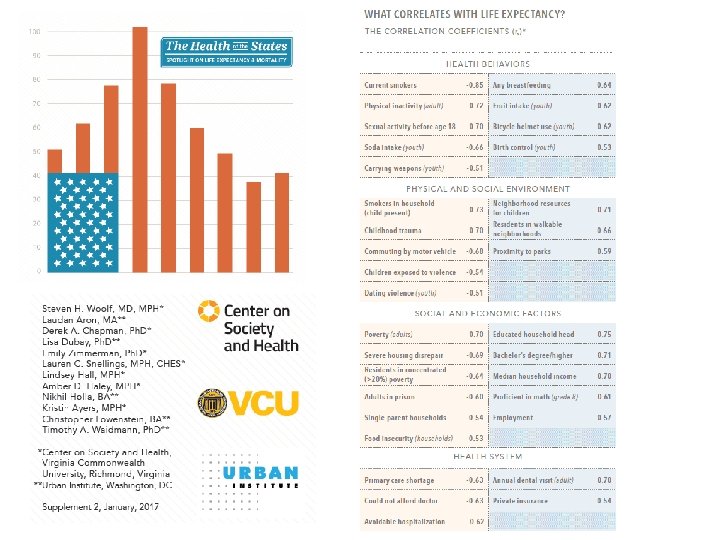
Your zip code is more important than your genetic code 82 years 18 year difference 64 years Lowrey A. Income Gap, Meet the Longevity Gap. New York Times. 2014.
http: //www. societyhealth. vcu. ed u/work/products/
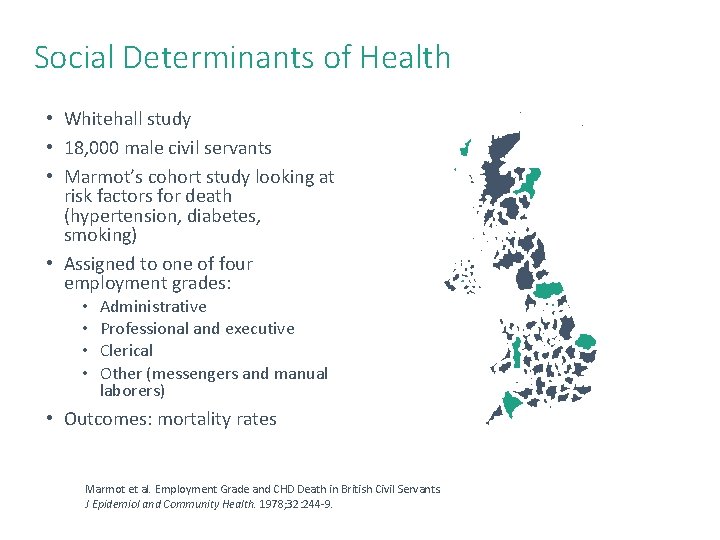
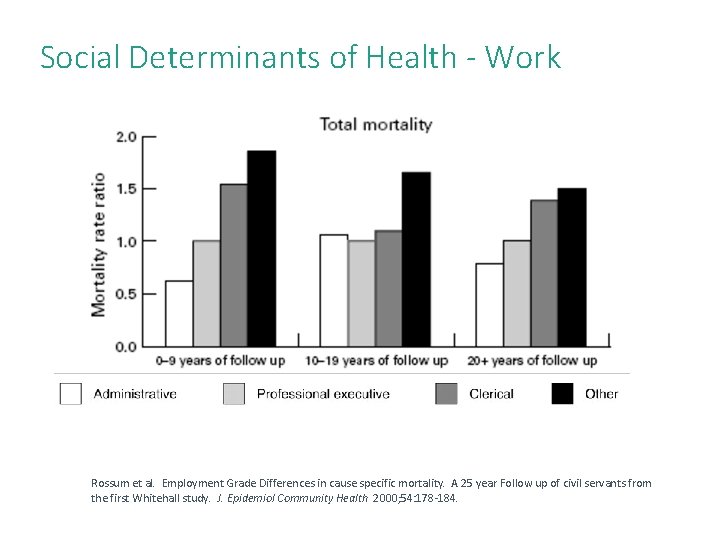
Social Determinants of Health • Whitehall study • 18, 000 male civil servants • Marmot’s cohort study looking at risk factors for death (hypertension, diabetes, smoking) • Assigned to one of four employment grades: • • Administrative Professional and executive Clerical Other (messengers and manual laborers) • Outcomes: mortality rates Marmot et al. Employment Grade and CHD Death in British Civil Servants. J Epidemiol and Community Health. 1978; 32: 244 -9. 24
Social Determinants of Health - Work Rossum et al. Employment Grade Differences in cause specific mortality. A 25 year Follow up of civil servants from the first Whitehall study. J. Epidemiol Community Health 2000; 54: 178 -184. 25
Why treat people and send them back to the conditions that make them sick? Michael Marmot 26
27 III. CONCEPTS & FRAMEWORKS BACKGROUND 01
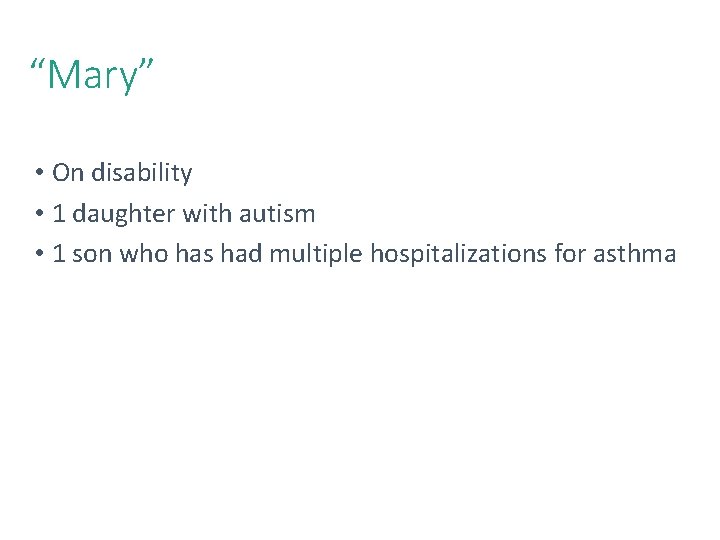
28 “Mary” • On disability • 1 daughter with autism • 1 son who has had multiple hospitalizations for asthma
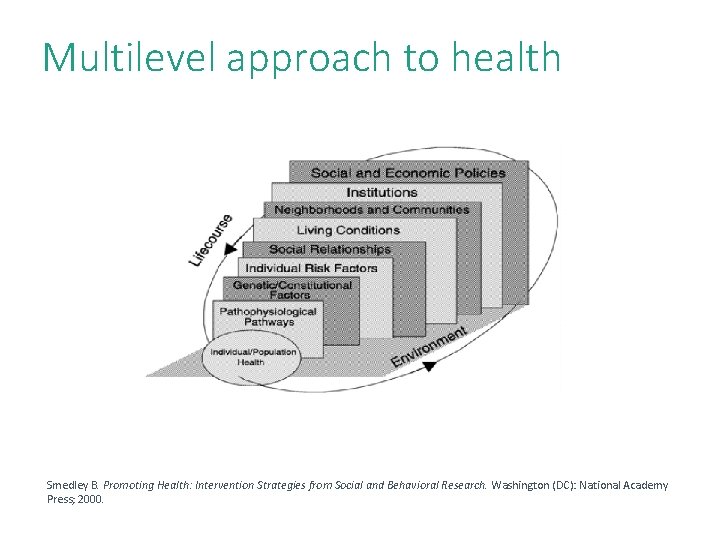
Multilevel approach to health Smedley B. Promoting Health: Intervention Strategies from Social and Behavioral Research. Washington (DC): National Academy Press; 2000. 29
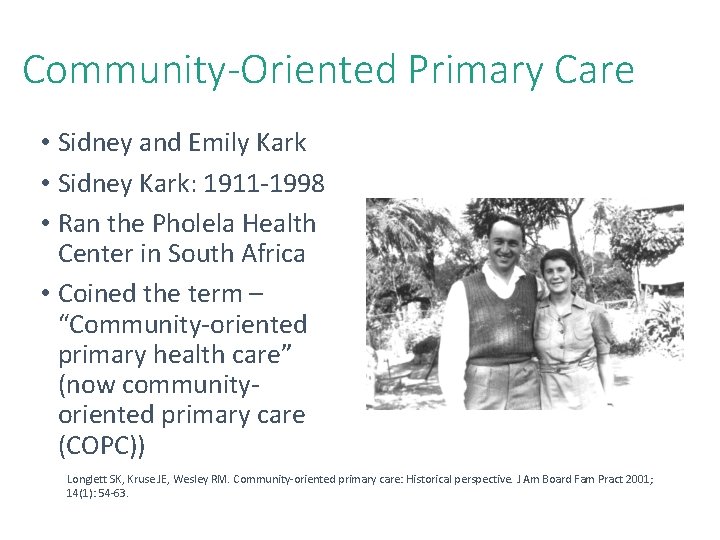
30 Community-Oriented Primary Care • Sidney and Emily Kark • Sidney Kark: 1911 -1998 • Ran the Pholela Health Center in South Africa • Coined the term – “Community-oriented primary health care” (now communityoriented primary care (COPC)) Longlett SK, Kruse JE, Wesley RM. Community-oriented primary care: Historical perspective. J Am Board Fam Pract 2001; 14(1): 54 -63.
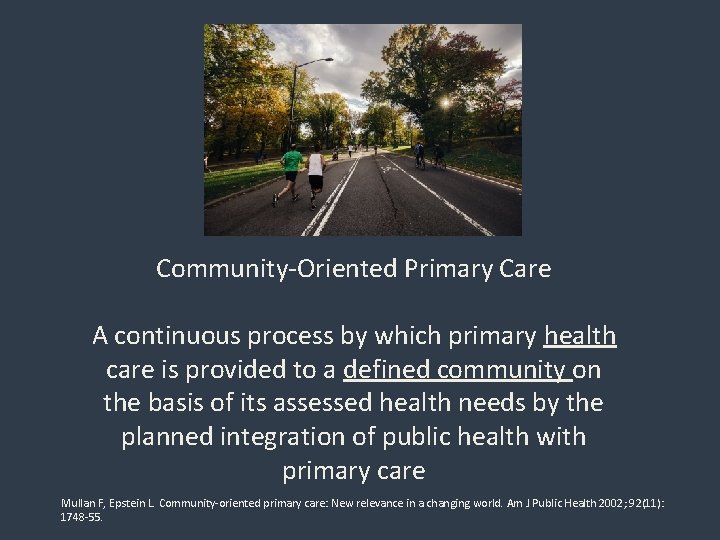
Community-Oriented Primary Care A continuous process by which primary health care is provided to a defined community on the basis of its assessed health needs by the planned integration of public health with primary care Mullan F, Epstein L. Community-oriented primary care: New relevance in a changing world. Am J Public Health 2002; 92(11): 1748 -55.
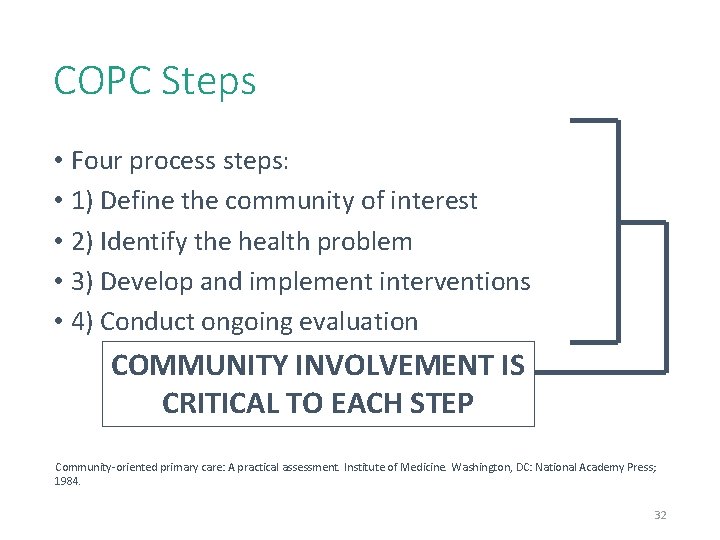
32 COPC Steps • Four process steps: • 1) Define the community of interest • 2) Identify the health problem • 3) Develop and implement interventions • 4) Conduct ongoing evaluation COMMUNITY INVOLVEMENT IS CRITICAL TO EACH STEP Community-oriented primary care: A practical assessment. Institute of Medicine. Washington, DC: National Academy Press; 1984. 32
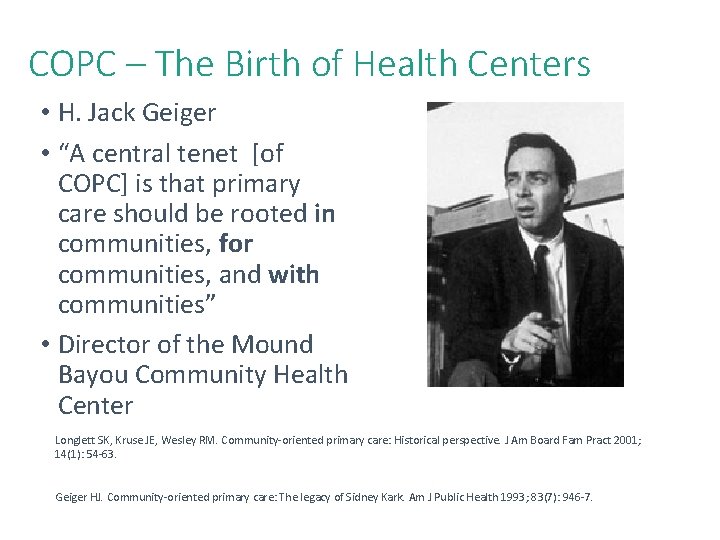
COPC – The Birth of Health Centers • H. Jack Geiger • “A central tenet [of COPC] is that primary care should be rooted in communities, for communities, and with communities” • Director of the Mound Bayou Community Health Center Longlett SK, Kruse JE, Wesley RM. Community-oriented primary care: Historical perspective. J Am Board Fam Pract 2001; 14(1): 54 -63. Geiger HJ. Community-oriented primary care: The legacy of Sidney Kark. Am J Public Health 1993; 83(7): 946 -7. 33
COPC Curriculum http: //www. graham-center. org/rgc/maps-data-tools/copc. html 34
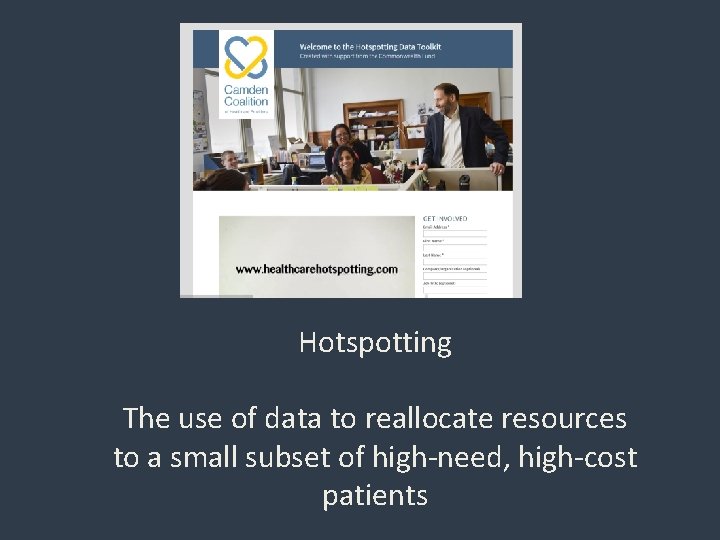
Hotspotting The use of data to reallocate resources to a small subset of high-need, high-cost patients
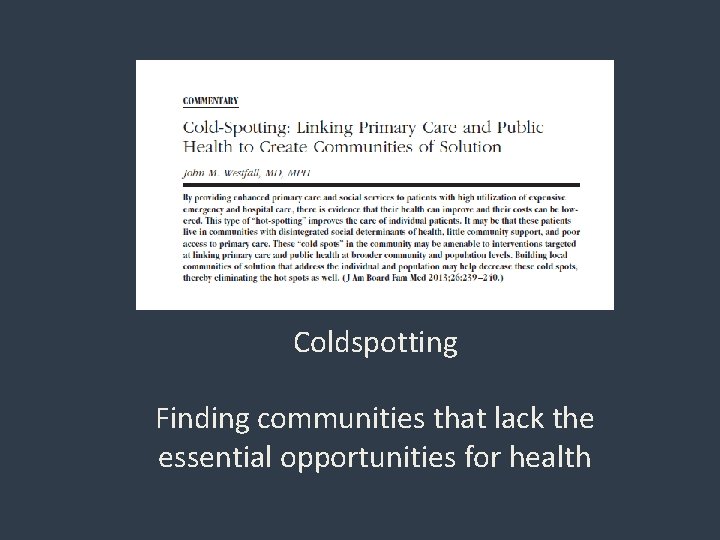
Coldspotting Finding communities that lack the essential opportunities for health
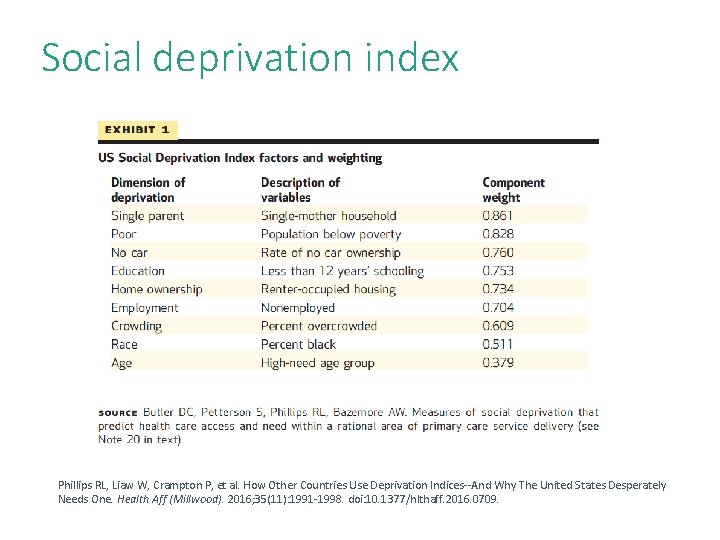
Social deprivation index Phillips RL, Liaw W, Crampton P, et al. How Other Countries Use Deprivation Indices--And Why The United States Desperately Needs One. Health Aff (Millwood). 2016; 35(11): 1991 -1998. doi: 10. 1377/hlthaff. 2016. 0709. 37
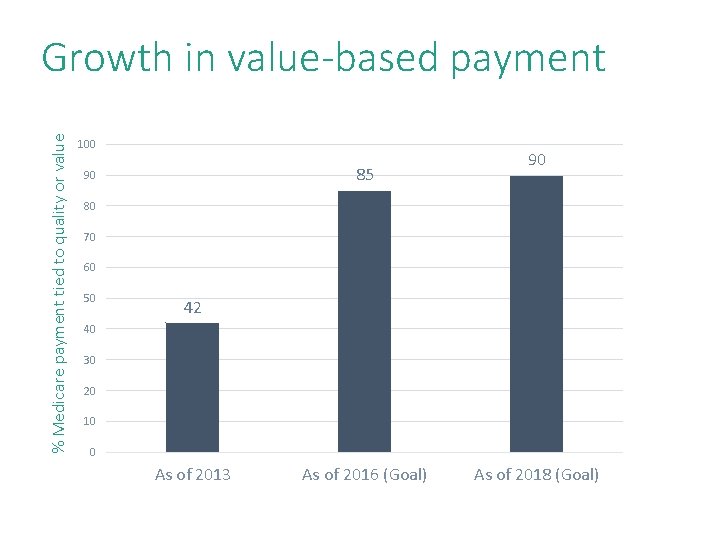
% Medicare payment tied to quality or value Growth in value-based payment 100 85 90 90 80 70 60 50 42 40 30 20 10 0 As of 2013 As of 2016 (Goal) As of 2018 (Goal) 38
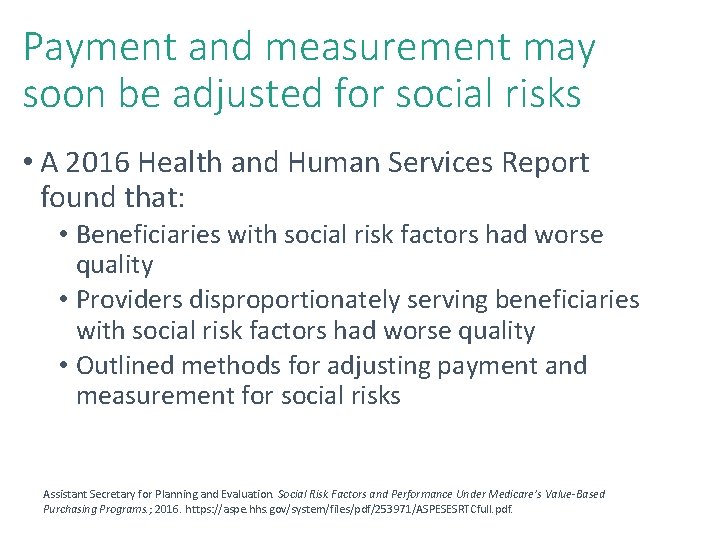
Payment and measurement may soon be adjusted for social risks • A 2016 Health and Human Services Report found that: • Beneficiaries with social risk factors had worse quality • Providers disproportionately serving beneficiaries with social risk factors had worse quality • Outlined methods for adjusting payment and measurement for social risks Assistant Secretary for Planning and Evaluation. Social Risk Factors and Performance Under Medicare’s Value-Based Purchasing Programs. ; 2016. https: //aspe. hhs. gov/system/files/pdf/253971/ASPESESRTCfull. pdf. 39
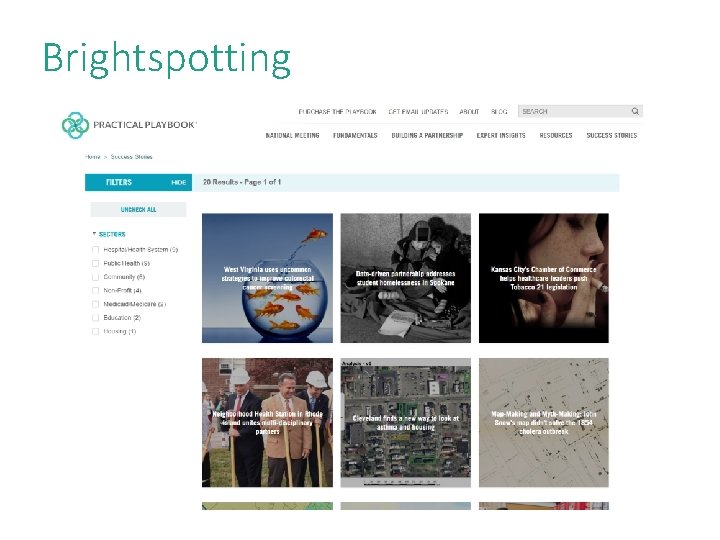
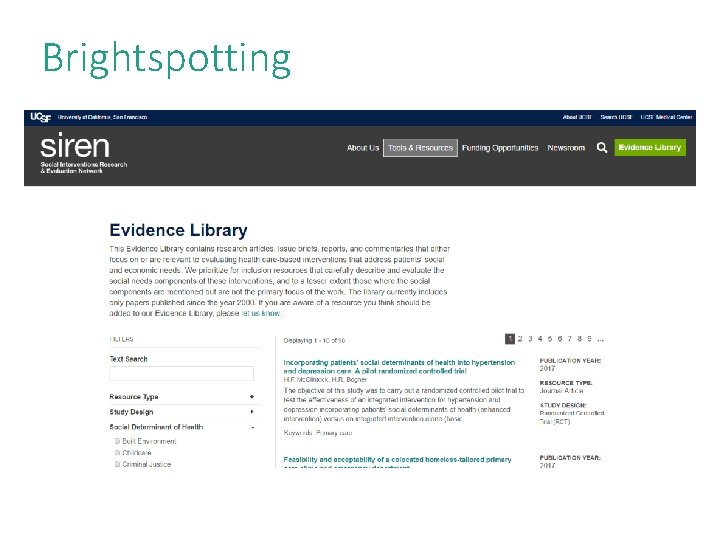
Brightspotting 40
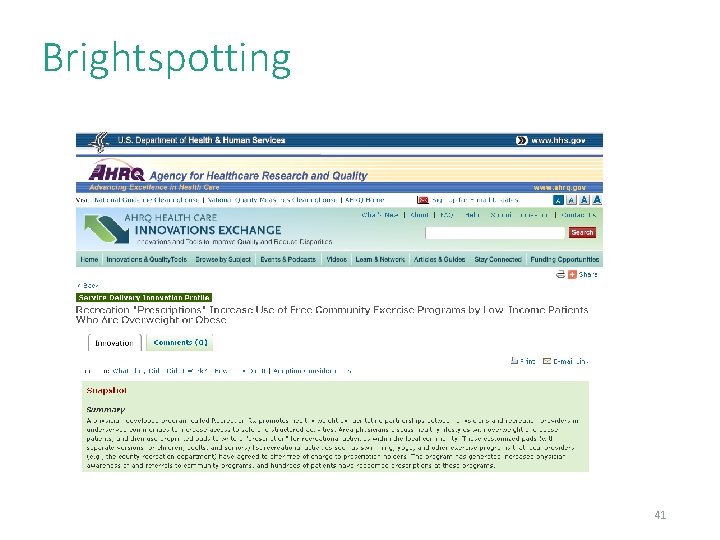
41 Brightspotting 41
Brightspotting 42
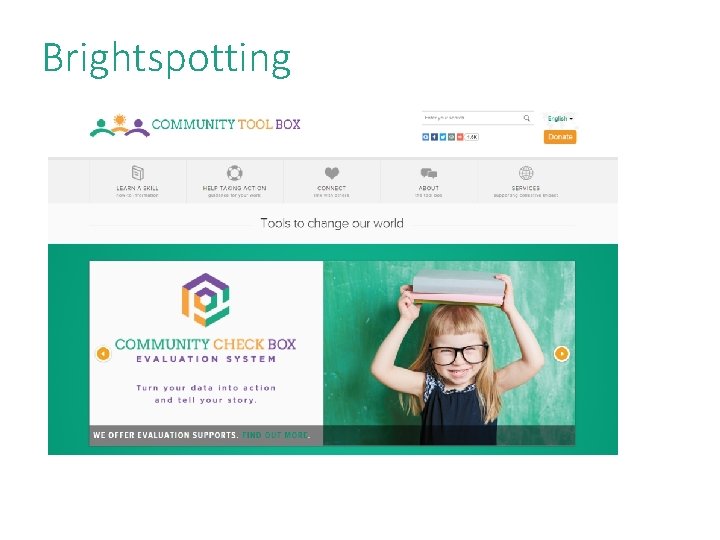
Brightspotting 43
44 IV. PRACTICAL TOOLS & ACTION BACKGROUND 01
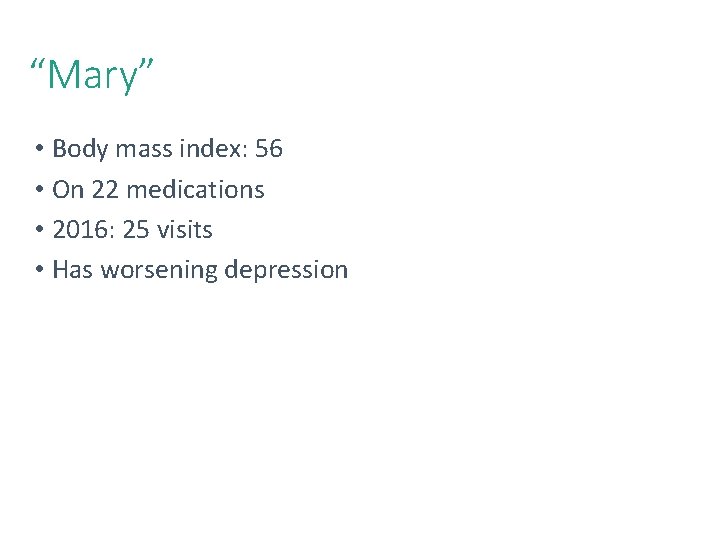
45 “Mary” • Body mass index: 56 • On 22 medications • 2016: 25 visits • Has worsening depression
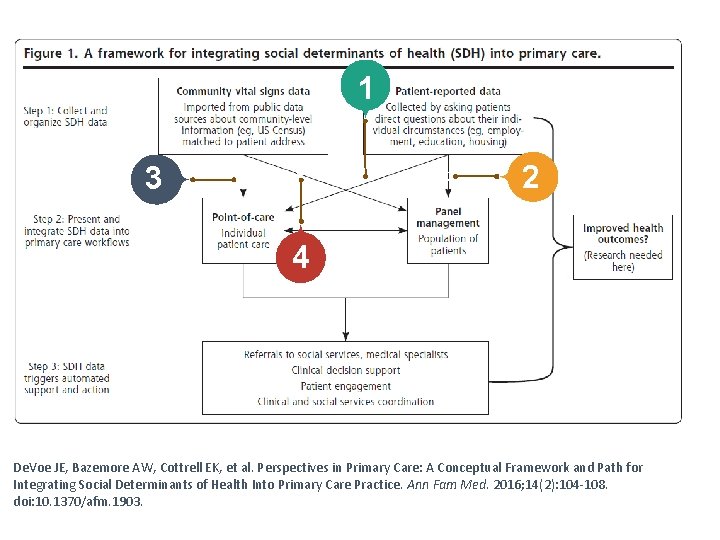
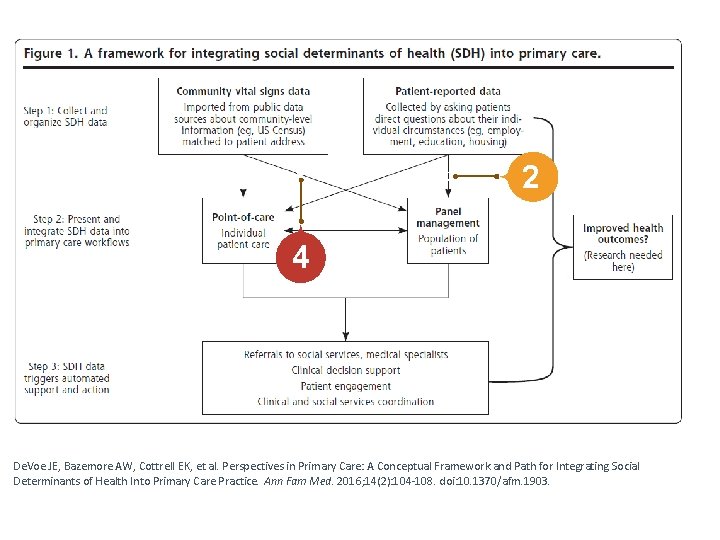
46 1 2 3 4 De. Voe JE, Bazemore AW, Cottrell EK, et al. Perspectives in Primary Care: A Conceptual Framework and Path for Integrating Social Determinants of Health Into Primary Care Practice. Ann Fam Med. 2016; 14(2): 104 -108. doi: 10. 1370/afm. 1903.
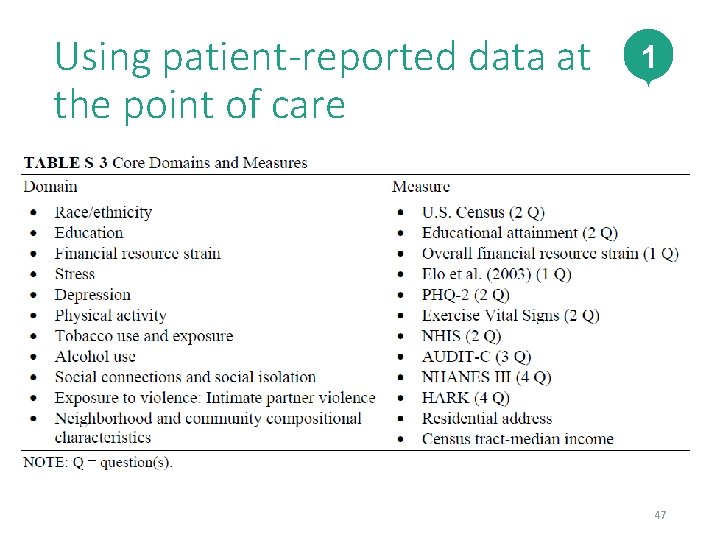
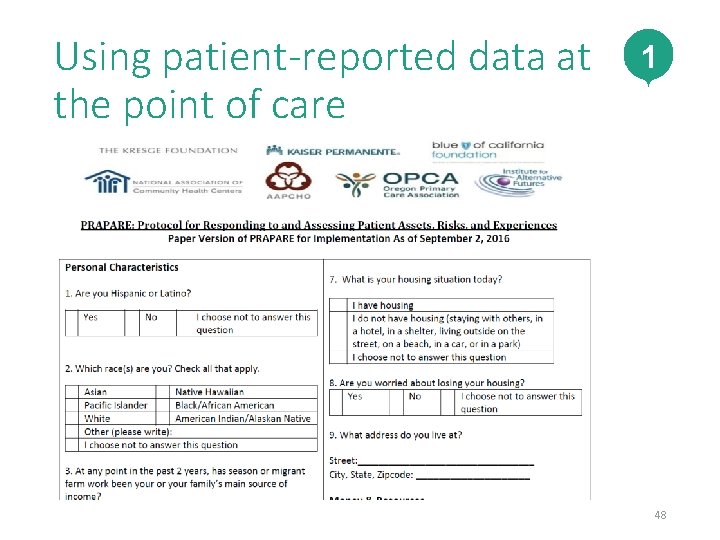
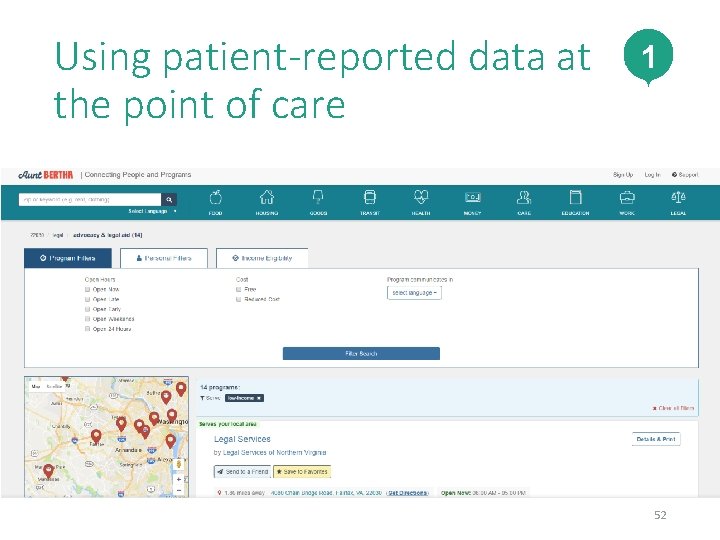
Using patient-reported data at the point of care 1 47 47
Using patient-reported data at the point of care 1 48 48
Using patient-reported data at the point of care 1 • Mary’s responses: • She is worried about losing her housing • She is receiving disability • In the past year, she has been unable to pay for food and medicine when they were really needed • Lack of transportation has kept her from medical appointments and from getting her medications 49 49
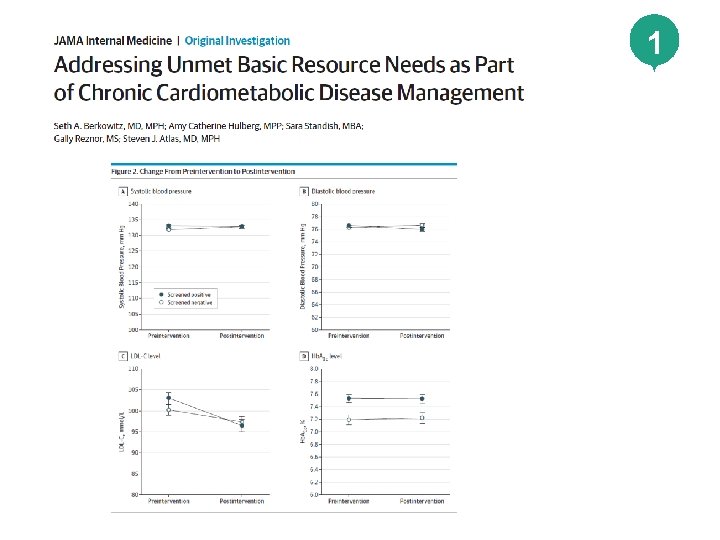
1 50
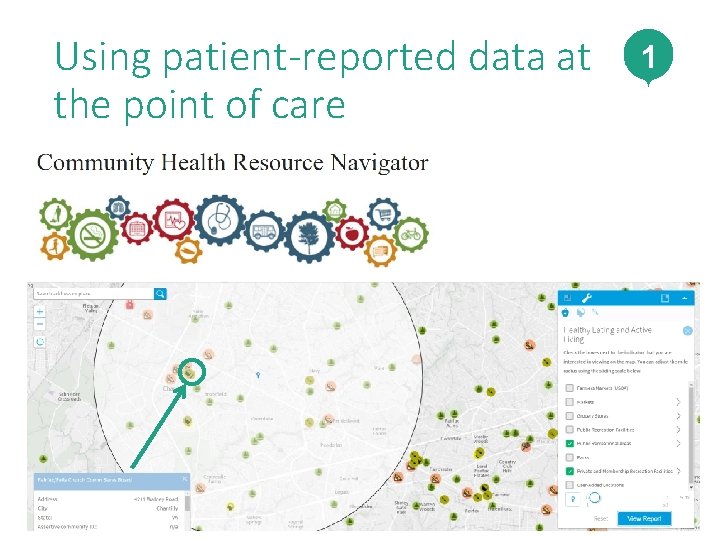
Using patient-reported data at the point of care 1 51 51
Using patient-reported data at the point of care 1 52 52
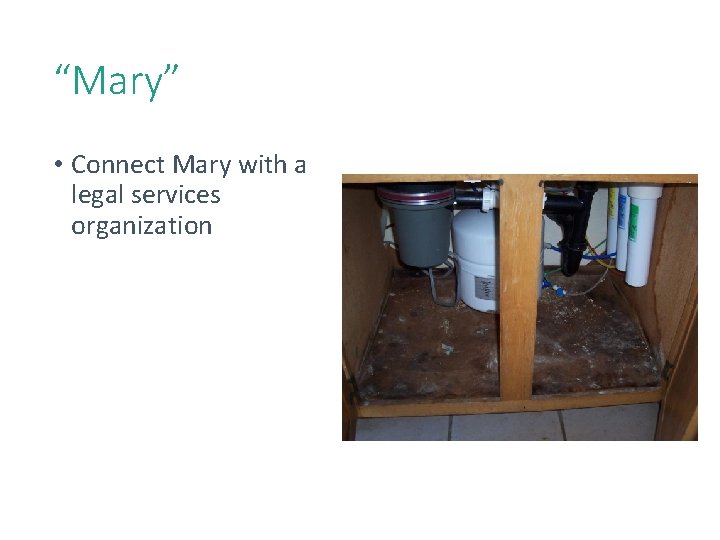
53 “Mary” • Connect Mary with a legal services organization
Using patient-reported data to 2 inform community interventions • Asking patients about housing insecurity • Mapping addresses of patients with housing insecurity • Developing interventions at the community-level, targeting communities with housing insecure patients 54 54
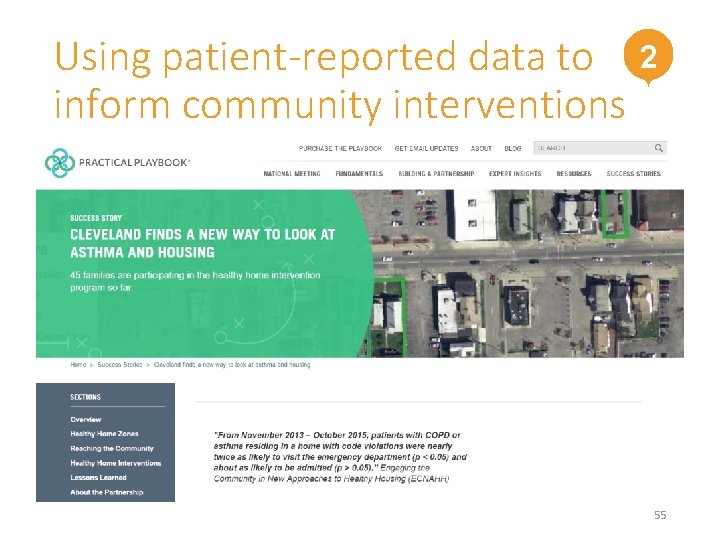
Using patient-reported data to 2 inform community interventions 55 55
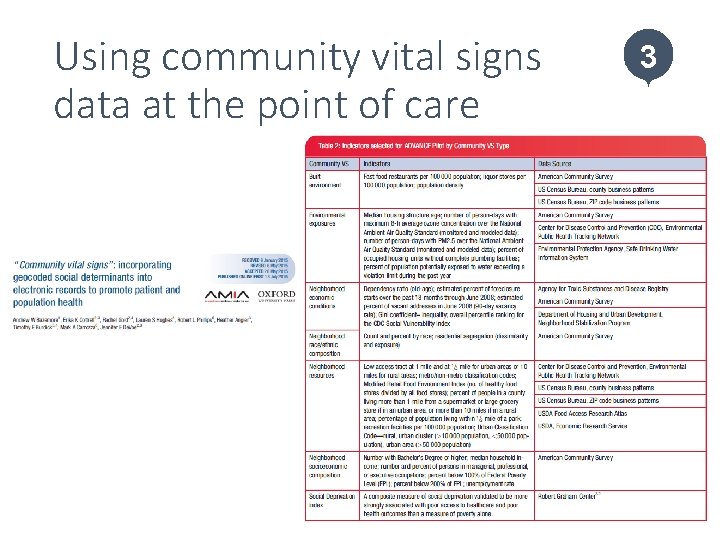
Using community vital signs data at the point of care 3 56 56
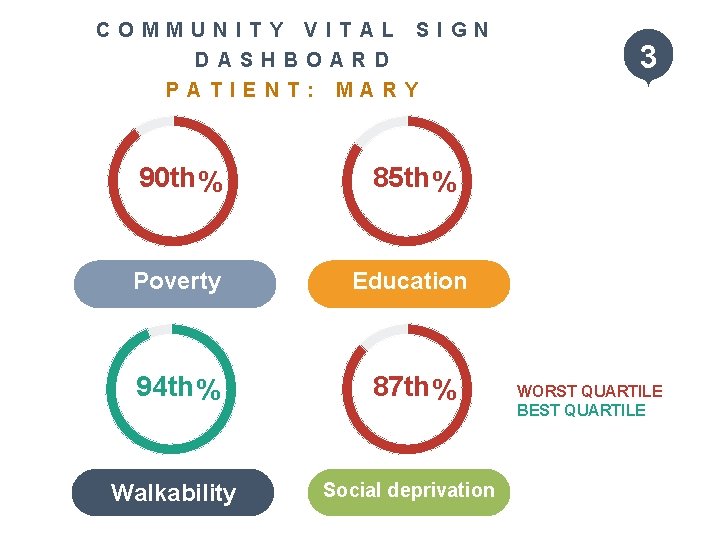
C O M M U N I TY V I T A L S I G N D A S H B O A R D P A T I EN T : M A R Y 90 th % 85 th % Poverty Education 94 th % 87 th % Walkability Social deprivation 3 WORST QUARTILE BEST QUARTILE 57
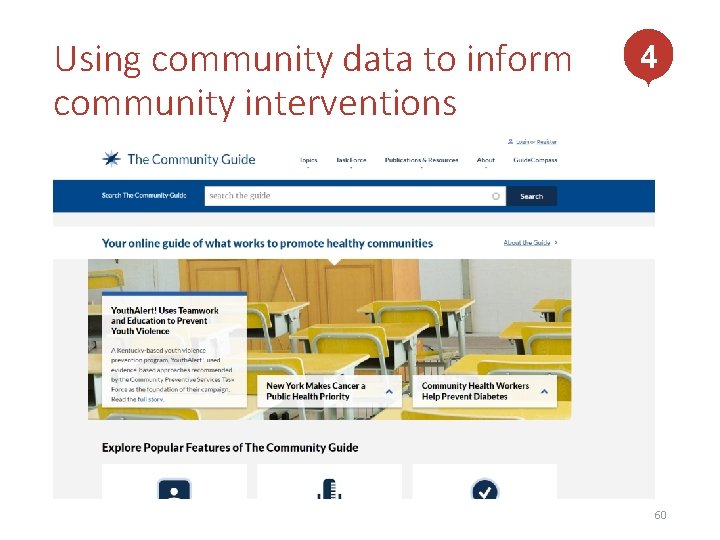
Using community data to inform community interventions 4 • Assessing housing insecurity at the census tract level • Developing a community-level intervention to address housing insecurity 58 58
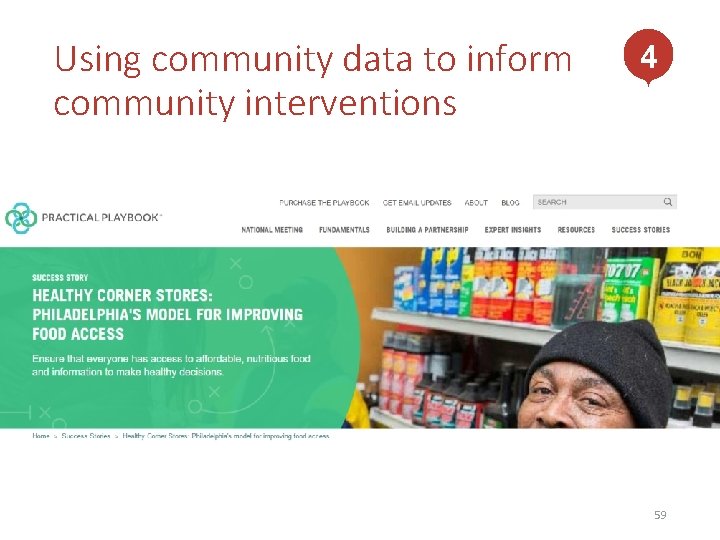
Using community data to inform community interventions 4 59 59
Using community data to inform community interventions 4 60 60
61 2 4 De. Voe JE, Bazemore AW, Cottrell EK, et al. Perspectives in Primary Care: A Conceptual Framework and Path for Integrating Social Determinants of Health Into Primary Care Practice. Ann Fam Med. 2016; 14(2): 104 -108. doi: 10. 1370/afm. 1903.
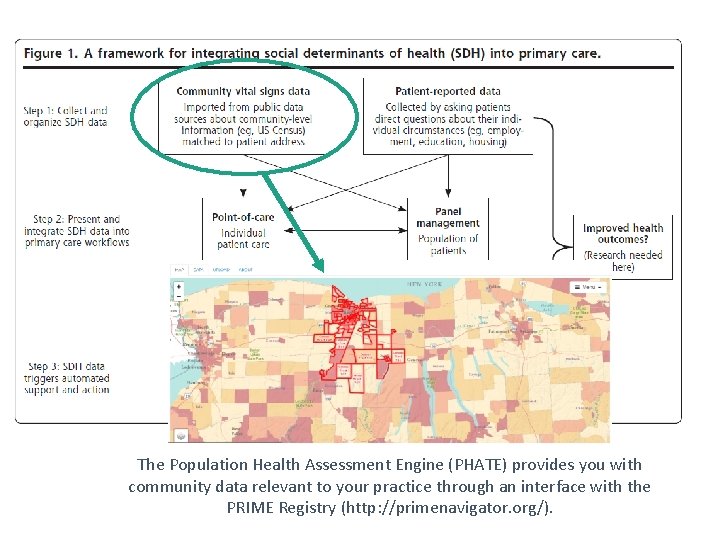
62 The Population Health Assessment Engine (PHATE) provides you with community data relevant to your practice through an interface with the PRIME Registry (http: //primenavigator. org/).
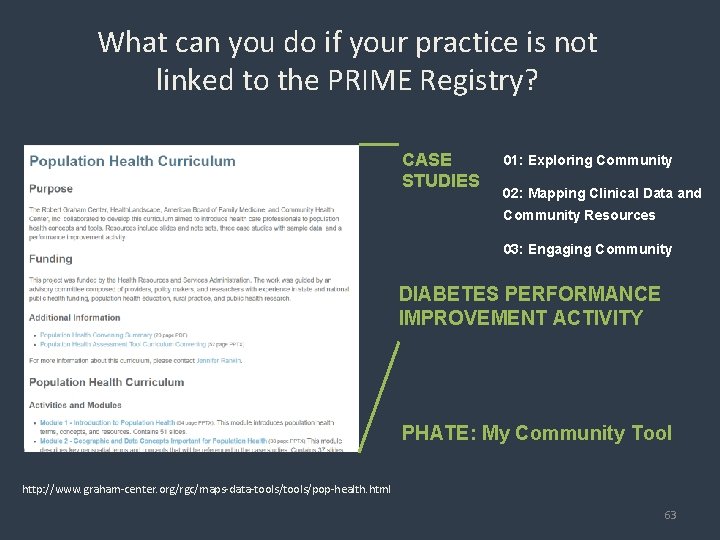
What can you do if your practice is not linked to the PRIME Registry? CASE STUDIES 01: Exploring Community 02: Mapping Clinical Data and Community Resources 03: Engaging Community DIABETES PERFORMANCE IMPROVEMENT ACTIVITY PHATE: My Community Tool http: //www. graham-center. org/rgc/maps-data-tools/pop-health. html 63
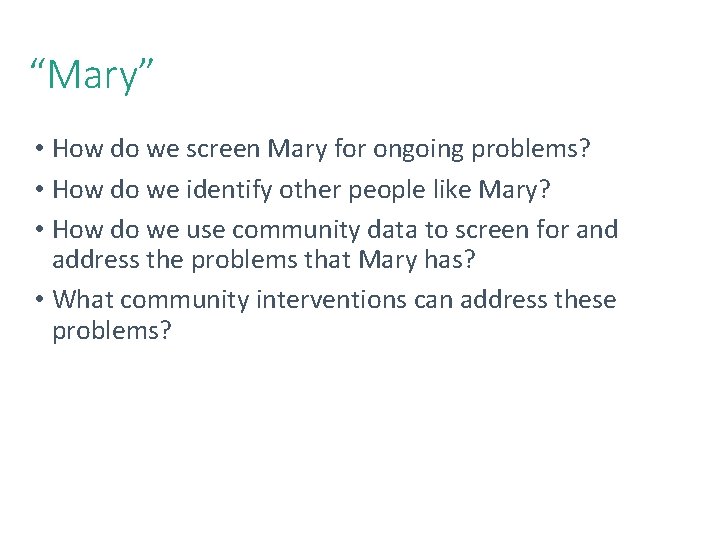
64 “Mary” • How do we screen Mary for ongoing problems? • How do we identify other people like Mary? • How do we use community data to screen for and address the problems that Mary has? • What community interventions can address these problems?
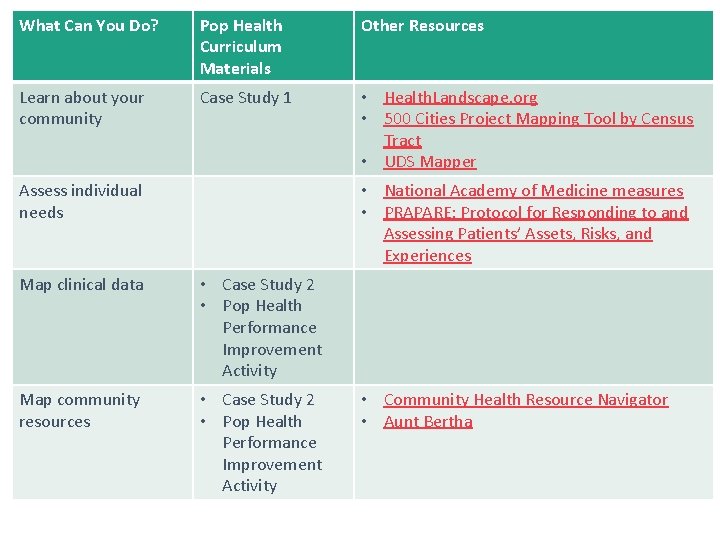
What Can You Do? Pop Health Curriculum Materials Other Resources Learn about your community Case Study 1 • Health. Landscape. org • 500 Cities Project Mapping Tool by Census Tract • UDS Mapper Assess individual needs • National Academy of Medicine measures • PRAPARE: Protocol for Responding to and Assessing Patients’ Assets, Risks, and Experiences Map clinical data • Case Study 2 • Pop Health Performance Improvement Activity Map community resources • Case Study 2 • Pop Health Performance Improvement Activity • Community Health Resource Navigator • Aunt Bertha 65
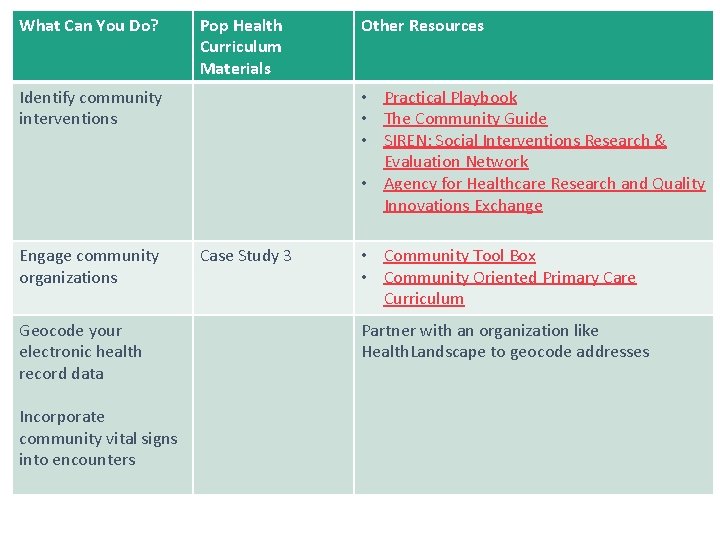
What Can You Do? Pop Health Curriculum Materials Identify community interventions Engage community organizations Geocode your electronic health record data Incorporate community vital signs into encounters Other Resources 66 • Practical Playbook • The Community Guide • SIREN: Social Interventions Research & Evaluation Network • Agency for Healthcare Research and Quality Innovations Exchange Case Study 3 • Community Tool Box • Community Oriented Primary Care Curriculum Partner with an organization like Health. Landscape to geocode addresses
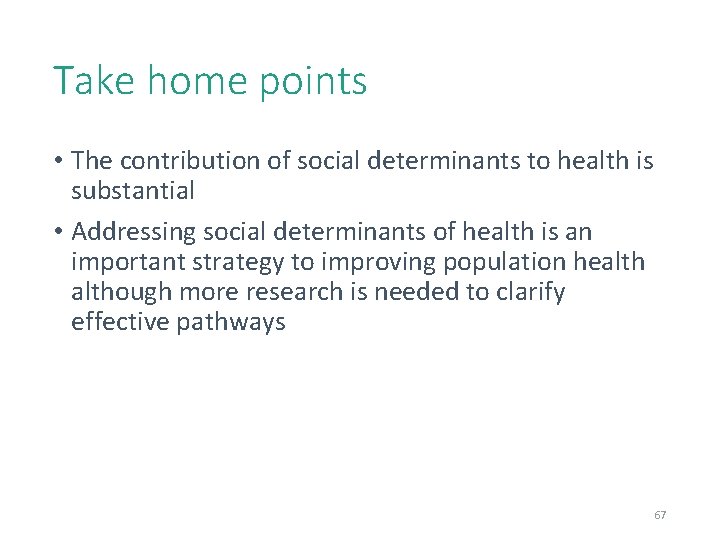
67 Take home points • The contribution of social determinants to health is substantial • Addressing social determinants of health is an important strategy to improving population healthough more research is needed to clarify effective pathways 67
68 Background 01: Introduction to Population Health Learning Objectives • • • List two social determinants of health Describe the impact of social determinants on health Define community-oriented primary care Define hotspotting and coldspotting List two ways that individual and community social determinants of health data can be used to improve health
Relevant family medicine milestones 69
Relevant nurse practitioner competencies 70