The Nurses Role in Health Assessment Chapter 1












- Slides: 33
The Nurse’s Role in Health Assessment Chapter 1 ADAPTED FROM LWW, JENSEN
Role of the Professional Nurse American Nurses Association (ANA) Four Broad Goals ◦ To promote health ◦ To prevent illness ◦ To treat human responses to health/illness ◦ To advocate for individuals, families, communities, and populations
Role of the Professional Nurse Nursing activities to promote health and prevent illness Appropriate nursing interventions include: implementing educational programs, coordinating community resources and patient/family teaching Nursing Scope and Standards of Practice and Code of Ethics from the ANA
Role of the Professional Nurse Care responsibilities ◦ Independent interventions ◦ Patient teaching ◦ Therapeutic communication ◦ Physical examinations Member of a Profession ◦ Scholarship/Research ◦ Advocacy/Nursing Values
Professional Nurse Registered and Advanced Practice Nurse (APRN) Roles BSN, MSN, Ph. D, DNP APRN ◦ Nurse Practitioner (NP) ◦ Certified Nurse Midwife (CNS) ◦ Certified Registered Nurse Anesthetist (CRNA) ◦ Clinical Nurse Specialist (CNS)
Introduction/Purpose to Health Assessment “Gathering information about the health status of the patient, analyzing and synthesizing the data, making judgements about nursing interventions based on the findings and evaluating patient care outcomes” (AACN, 2011) A Health Assessment includes a Health History, Physical Assessment and factors such as structure/function, lifestyle, economic, psychological, cultural, spiritual subjective/objective data, and abnormal findings
Clinical Reasoning Models Nursing Process Critical Thinking Diagnostic Reasoning
Nursing Process begins with a complete, accurate health assessment Systematic problem-solving approach, identifying and treating human responses to actual or potential health difficulties (ANA, 2013)
Assessment in the Nursing Process Nursing process components: Assessment Diagnosis Outcome identification Planning Implementation Evaluation
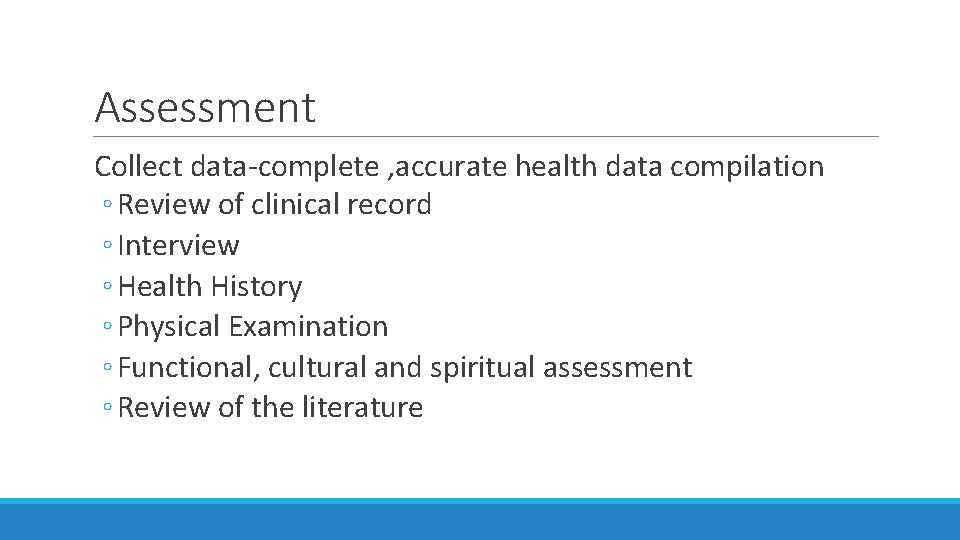
Assessment Collect data-complete , accurate health data compilation ◦ Review of clinical record ◦ Interview ◦ Health History ◦ Physical Examination ◦ Functional, cultural and spiritual assessment ◦ Review of the literature
Components of Assessment Observe patient’s verbal/nonverbal communication Subjective data- what patient says about self during history taking-patient is the primary source Objective data- what you observe during physical examination using techniques-measurable information- vital signs, auscultation, visual appearance, lab values
Diagnose Interpret data ◦ Identify clusters of cues ◦ Make inferences Validate inferences Data clustering to determine patient’s condition North American Nursing Diagnosis Association (NANDA-I)
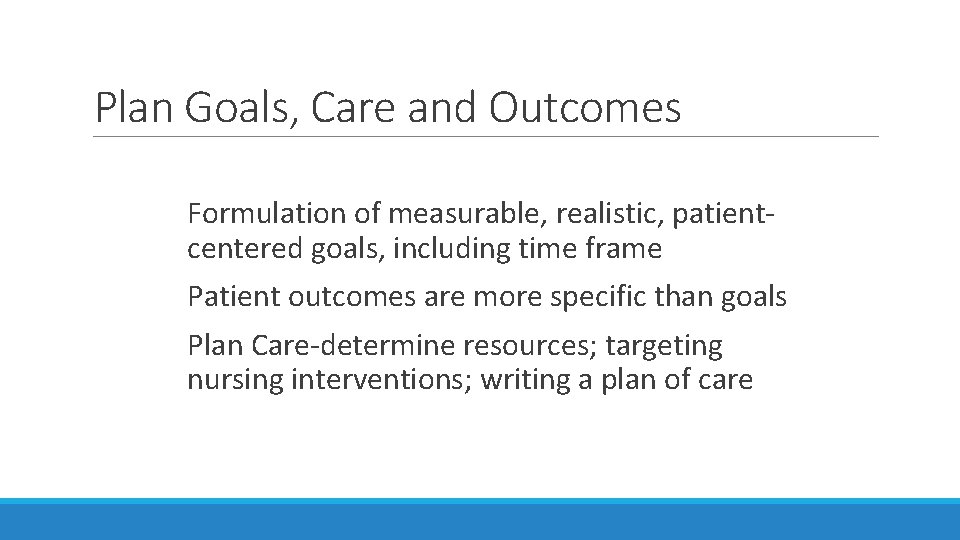
Plan Goals, Care and Outcomes Formulation of measurable, realistic, patientcentered goals, including time frame Patient outcomes are more specific than goals Plan Care-determine resources; targeting nursing interventions; writing a plan of care
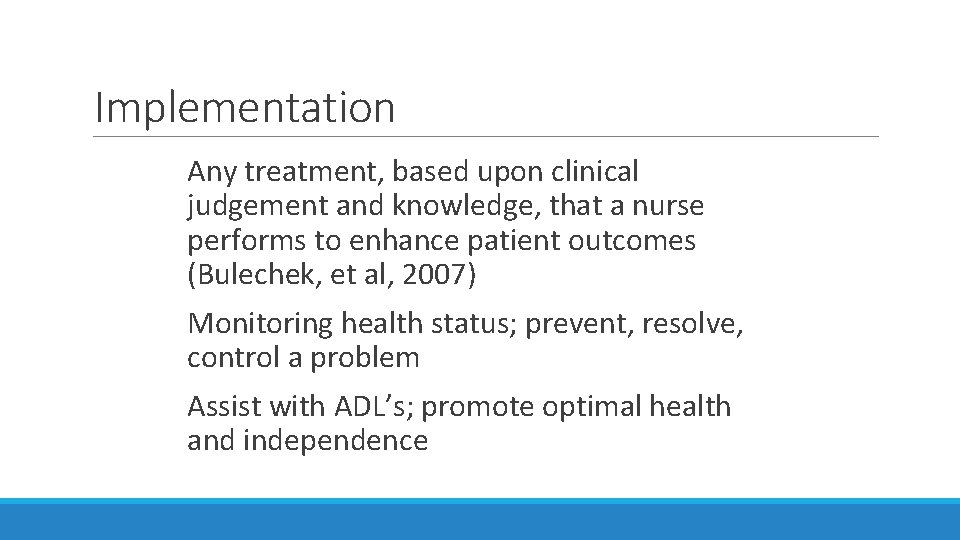
Implementation Any treatment, based upon clinical judgement and knowledge, that a nurse performs to enhance patient outcomes (Bulechek, et al, 2007) Monitoring health status; prevent, resolve, control a problem Assist with ADL’s; promote optimal health and independence
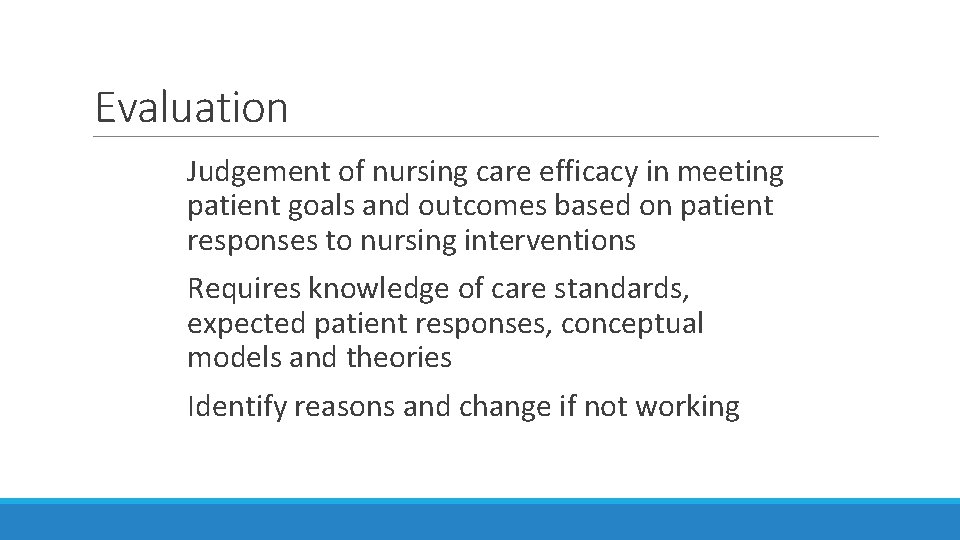
Evaluation Judgement of nursing care efficacy in meeting patient goals and outcomes based on patient responses to nursing interventions Requires knowledge of care standards, expected patient responses, conceptual models and theories Identify reasons and change if not working
Critical Thinking Purposeful, outcome-directed(result-oriented) thinking Driven by patient, family/community needs Based on nursing process, evidence-based thinking scientific method Requires specific knowledge, skills, experience Continually reevaluating, self-correcting, striving for improvement
Diagnostic Reasoning Gathering and clustering data to draw inference and propose diagnoses Based on nurse’s critical thinking Collaborative problems Seven-step process used within context of health assessment
Seven-Step Process Identify data: abnormal/strengths Cluster Data Draw inferences Propose nursing diagnoses Check for presence of defining characteristics Confirm or rule out nursing diagnosis Document conclusions
Other considerations Health as absence of disease Health and disease are opposite extremes on linear continuum Disease is caused by specific agents or pathogens Health promotion/disease prevention Wellness
Types of Assessments Complete health history ◦ Comprehensive, baseline ◦ Annually for outpatients ◦ Upon hospital/long-term care admission Focused ◦ Occurs in all settings, smaller in scope but increased depth for specific issues Emergency: life threatening or unstable situation swift and sure
Priority Setting Prioritize assessments and care upon the patient’s health care situation In determining priorities: use clinical experiences, knowledge, expertise and judgement Life-threatening situation is top priority ◦ ABC’s/ Maslow’s Hierarchy of Needs
Frequency of Assessment Varies with illness/wellness needs, patient needs, healthcare setting Health care setting ◦ Long term care ◦ Intensive care ◦ Focused assessment post treatment ◦ Outpatient setting
Frequency of Assessment Well visit assessment Most common screening/preventive services from Birth to 10 years ◦ Monitor growth and development 65 years and older ◦ Treatment of acute and chronic illnesses
Assessment through the Life Cycle Age specific periodic health exams are a positive approach to health assessment Health education, disease prevention, injury prevention and counseling Consider holistic model of health care assessment
Frameworks for Assessment Three major health assessment frameworks Functional Assessment ◦ Focuses on functional patterns all humans share Head-to-Toe Assessment ◦ Most organized Body Systems Approach ◦ Promotes critical thinking, organizational for documentation/communication
High Level Assessment Skills Assessment skills require hands on experience refined to a high level ◦ Nurses are the first and often the only health professional to see a patient ◦ Nurses are the only health professional continually present at the bedside in hospitals
Efforts at cost containment result in increased acuity, shorter hospital stays and earlier discharges Nurses must make faster more efficient assessments First rate assessment skills grounded in holistic approach and knowledge of age-specific problems are required All healthcare treatment and decisions are made based on data collected, it is paramount that it is factual and complete.
Cultural Considerations Knowledge of Cultural diversity is essential for competent nursing practice Assess importance of spirituality and religion on patient’s health Will discuss in upcoming weeks
Wellness and Health Promotion Nurses collaborate to promote higher levels of wellness Facilitate wellness with health promotion, teaching, Healthy People 2020 Interventions for promoting healthy change include three levels of prevention
Three Levels of Prevention Primary Prevention- strategies aimed at preventing problems Secondary Prevention-early diagnoses, prompt treatment Tertiary Prevention-preventing complications of existing disease, promoting highest health level possible
Documentation/Communication Documentation is essential ◦ Legally ◦ Communication with others/collaborative care ◦ Shift/departmental transfer report Confidentiality Computerized- various types
Evidenced Based Practice Relies on research findings, high-grade scientific support Minimizes intuition/personal experiences Should be practiced by all Nurses Uses four steps to solve common problems
Evidence Based Practice Clearly identify issue or difficulties based upon accurate analysis of current nursing knowledge and practice Search literature for relevant research Evaluate research evidence using established criteria regarding scientific method Chose interventions, justifying selection with most valid evidence