
Hospitalbased Health Technology Assessment at APHP in France
Hospital-based Health Technology Assessment at AP-HP, in France and in Europe (A tool for decision-making based on evidence) Central and Eastern European Society of Technology Assessment in Health Care 10 th International Symposium Evidence-Based Health Care Kracow, 15 December 2015 Dr. Alexandre Barna CEDIT / AP-HP 3, avenue Victoria 75004 Paris, France alexandre. barna@aphp. fr Direction
1. Background for HTA and hospital based HTA 2
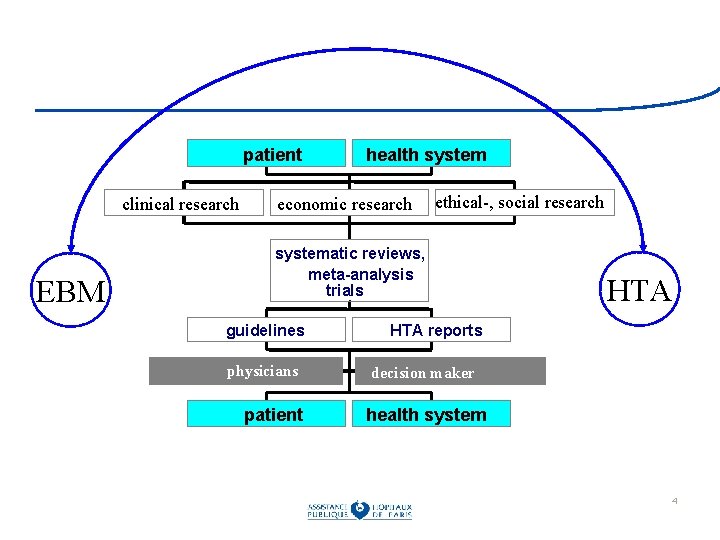
Background of the concept. Why engage in HTA? Context: l A decision in medicine has to be based on up-to-date scientific results l The scientific development is difficult to follow by the individual physician and policy maker Development of an integrated method. Ex: Cochrane Collaboration l Development of integrating concepts / philosophy : § For health care: « Evidence Based Medicine » (EBM) § For policy making: « Health Technology Assessment » (HTA) l Why doing HTA? l By indicating the preferable interventions, HTA allows the access for all to the best health care, in a environment of scarce resources l HTA, return on investment in terms of public health and in terms of economic development of a country (Mc. Kee, 2005). 3
patient clinical research EBM health system economic research ethical-, social research systematic reviews, meta-analysis trials guidelines physicians patient HTA reports decision maker health system 4
Why hospital based HTA? When no national HTA agency => some large hospitals would like to take evidence based decisions in regard with equipment, technologies, … Even if existence of a national HTA agency, not all technologies are evaluated at the national level (ex: medical devices) Even if evaluated at national level, l conclusions and recommendations quite global. Hospitals may not find all answers needed for the local context and their specific needs. l New and expensive technologies arrive mainly at University hospitals which have immediate pressure from manufacturers, physicians and patients to adopt them. Moreover, hospitals may have an interest (medical, economic, organisational) to accelerate the process of assessment and reimbursement at the national level (ex: medical procedures) 5
Models of hospital based HTA (HTAi, 2008) Ambassador model: clinicians - ‘opinion leaders’ play the role of ambassadors of the HTA “message”. They may not take part to assessments but play a key role in results diffusion within hospitals. Mini HTA : single professionals participate in the assessment process collecting data at organizational level to inform decision makers at an higher level. Internal Committee: multidisciplinary groups (called internal committees) representing different perspectives and taking the responsibility of reviewing evidences to issue recommendations useful hospital-wide. Documents are produced by professionals who rarely work full time on HTA Unit : formal organizational structure based on specialized HTA personnel working on a full time basis inside the Unit. This model represents the highest degree of structure for hospital HTA. Additional ref: Gagnon MP, Hospital-Based Health Technology Assessment: Developments to Date. Pharmaco. Economics (2014) 32: 819– 824 6
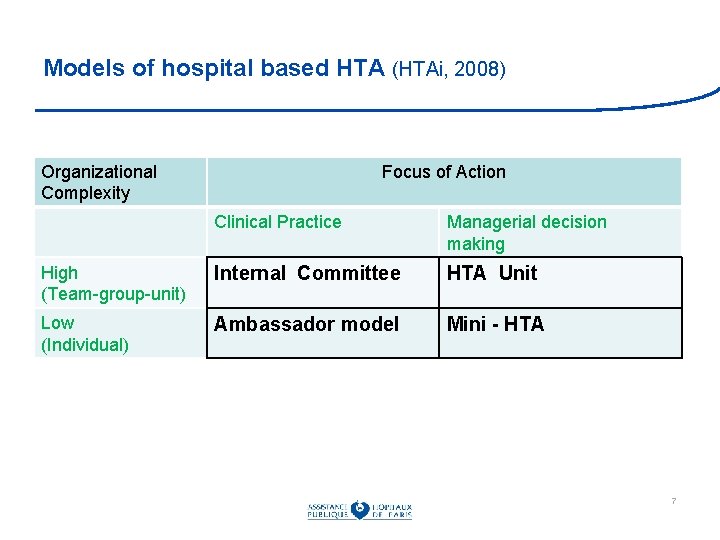
Models of hospital based HTA (HTAi, 2008) Organizational Complexity Focus of Action Clinical Practice Managerial decision making High (Team-group-unit) Internal Committee HTA Unit Low (Individual) Ambassador model Mini - HTA 7
HB-HTA models – current evidence and challenges (Gagnon MP, 2014) Objective: to review the effects and impact of HB-HTA on decision making and the perception of various stakeholders towards HTA activities Methods: literature search then inclusion criteria, data extraction, Results: 18 studies included (USA 7, Canada 5, Austria 2, Denmark 2, France 1) l Internal Committees: majority in US and Canada, based on financial assessment, used for purchasing decisions or cost control. l HTA Units: broad assessment of technologies, used for all types of questions (clinical practice and decision making), opinions followed, allowed an efficient allocation of resources l Mini-HTA: used at the local level, eased technology implementation to a fair degree, according to respondents l Ambassador model: increased awareness of the best evidence, 35% of participants reported practice changes. 8
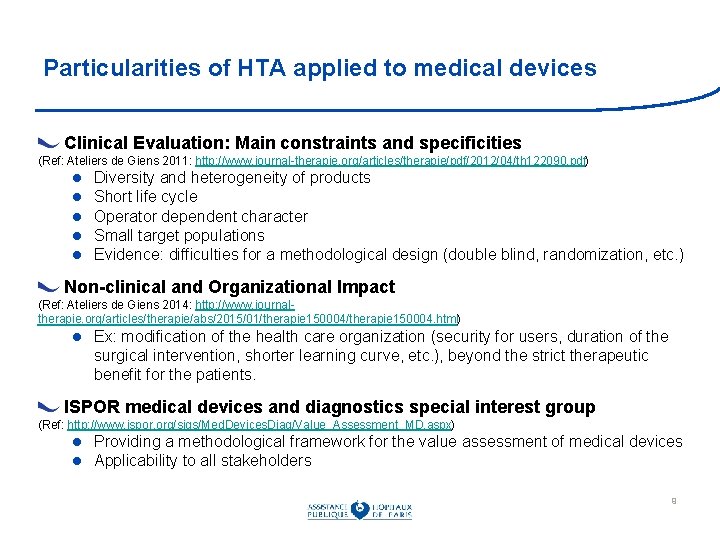
Particularities of HTA applied to medical devices Clinical Evaluation: Main constraints and specificities (Ref: Ateliers de Giens 2011: http: //www. journal-therapie. org/articles/therapie/pdf/2012/04/th 122090. pdf) l l l Diversity and heterogeneity of products Short life cycle Operator dependent character Small target populations Evidence: difficulties for a methodological design (double blind, randomization, etc. ) Non-clinical and Organizational Impact (Ref: Ateliers de Giens 2014: http: //www. journaltherapie. org/articles/therapie/abs/2015/01/therapie 150004. html) l Ex: modification of the health care organization (security for users, duration of the surgical intervention, shorter learning curve, etc. ), beyond the strict therapeutic benefit for the patients. ISPOR medical devices and diagnostics special interest group (Ref: http: //www. ispor. org/sigs/Med. Devices. Diag/Value_Assessment_MD. aspx) l l Providing a methodological framework for the value assessment of medical devices Applicability to all stakeholders 9
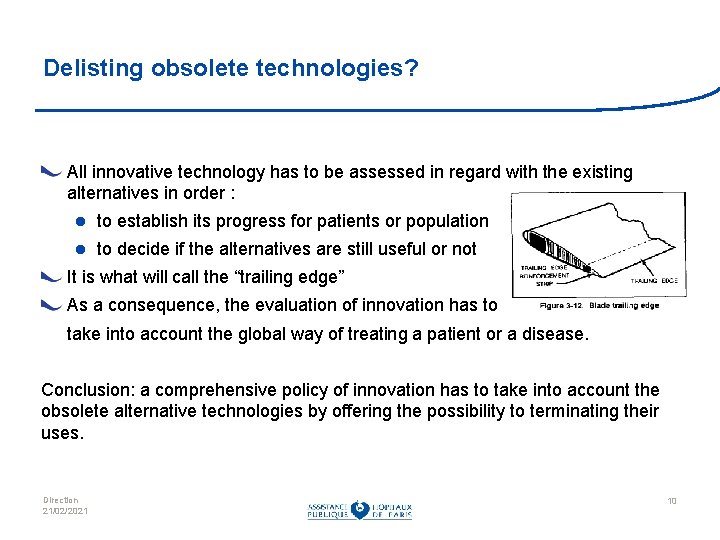
Delisting obsolete technologies? All innovative technology has to be assessed in regard with the existing alternatives in order : l to establish its progress for patients or population l to decide if the alternatives are still useful or not It is what will call the “trailing edge” As a consequence, the evaluation of innovation has to take into account the global way of treating a patient or a disease. Conclusion: a comprehensive policy of innovation has to take into account the obsolete alternative technologies by offering the possibility to terminating their uses. Direction 21/02/2021 10
2. HTA and hospital based HTA in France 11
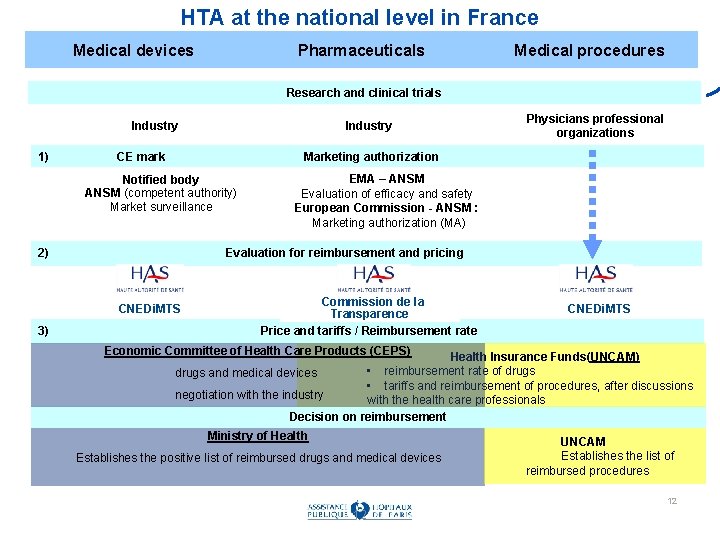
HTA at the national level in France Medical devices Pharmaceuticals Medical procedures Research and clinical trials Industry 1) Industry CE mark Marketing authorization Notified body ANSM (competent authority) Market surveillance 2) EMA – ANSM Evaluation of efficacy and safety European Commission - ANSM : Marketing authorization (MA) Evaluation for reimbursement and pricing CNEDi. MTS 3) Physicians professional organizations Commission de la Transparence Price and tariffs / Reimbursement rate CNEDi. MTS Economic Committee of Health Care Products (CEPS) Health Insurance Funds(UNCAM) • reimbursement rate of drugs and medical devices • tariffs and reimbursement of procedures, after discussions negotiation with the industry with the health care professionals Decision on reimbursement Ministry of Health UNCAM Establishes the positive list of reimbursed drugs and medical devices Establishes the list of reimbursed procedures 12 12
HTA at AP-HP: the CEDIT AP-HP: “Assistance Publique - Hôpitaux de Paris”: the University Hospital of the Paris region: 39 hospitals, 90, 000 employees including 22, 000 doctors, more than 7 million patients: http: //www. aphp. fr/ CEDIT: “Comité d’Evaluation et de Diffusion des Innovations Technologiques”, the hospital based HTA agency founded in 1982: http: //cedit. aphp. fr/ l Organisation: § The Committee (about 20 medical experts and representatives from the main administrative departments) § and its Scientific Secretariat (HTA unit) l Main missions: § HTA: advises the Director-General of AP-HP to support strategic decisions regarding health technologies ; assessment on technical, clinical, economic, organizational, legal and ethical aspects. § Horizon scanning: anticipating the technologies with an impact on hospital 13
How HTA is done at CEDIT? (1) What is assessed? Technical aspect: § Goal: to verify a technology is doing what it was designed for § To help the implementation of an equipment or device l Medical, clinical aspects: § Knowledge about the intrinsic benefit / risk balance of a technology § Knowledge about therapeutic progress (or relative effectiveness) in regard with alternatives l Economic aspects: § To help the decision makers allocate resources in an optimal way : mainly economic evaluations but also return on investment and budget impact analysis l « Social acceptability » aspect § The adoption and dissemination of technologies depends on the local context, on organizational, ethical, legal, “psychological” aspects l 14
(2) On what subjects? The request for assessment emanates from : l Practitioners of AP-HP (mostly physicians) l Decision makers of AP-HP l Self request (innovations mostly from horizon scanning) (3) How do we work? l Analysis, aggregation and synthesis of all data available § Literature (primary and secondary sources) § AP-HP specific data (from medical information system, research projects) § Expert opinions l Assessment (Scientific Secretariat) and then Appraisal (CEDIT) (4) HTA report following the 4 main aspects already described, mainly from the point of view of AP-HP. 15
The CEDIT’s recommendations Evaluations have become more timely and operational. Several types of conclusions by CEDIT: l Recommend or not the general use of a new technology l Recommend it, but under certain conditions: § Only into research or assessment programs § Recommended with necessity of follow-up studies § Restricted conditions of use (characteristics of patients, characteristics of illness, characteristics of physicians or local medical organization) l Further recommendation for diffusion § Equipment sharing § External collaboration § Medical reorganization: § … 16
How does the work of CEDIT influence decisions? HB-HTA makes only recommendations to decision makers (split between evaluation and decision making) HB-HTA can help policy makers to determine which services should be provided, but up to a certain point (ex: Goddart, 2006) HB-HTA answers specific questions in a specific context and is a useful tool for decision makers in large hospitals The recommendations of CEDIT are not binding but often followed Moreover the national HTA agencies could benefit from this early work realised in University Hospital HTA units. 17
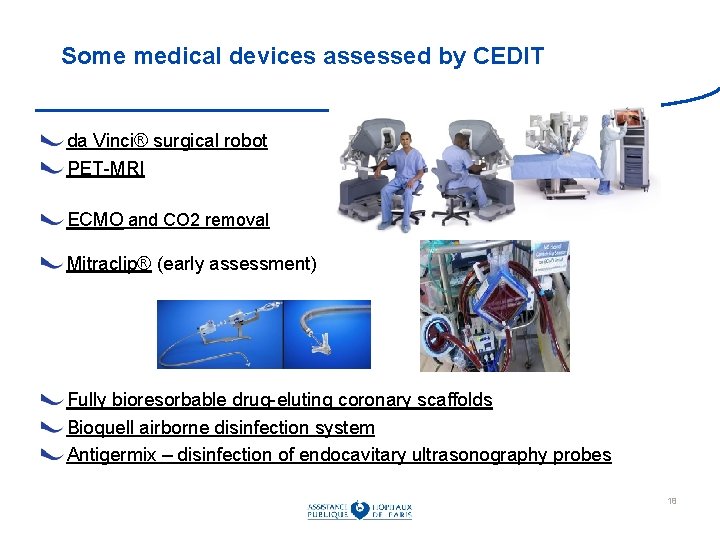
Some medical devices assessed by CEDIT da Vinci® surgical robot PET-MRI ECMO and CO 2 removal Mitraclip® (early assessment) Fully bioresorbable drug-eluting coronary scaffolds Bioquell airborne disinfection system Antigermix – disinfection of endocavitary ultrasonography probes 18
Developments of HB-HTA in France Besides AP-HP, several other university hospitals are adopting the concept and starting to organize HTA units (Lille, Bordeaux, Lyon, …) Co-operation on innovation within a national network of university hospitals: l The innovation network and the working group on innovation : meetings every 3 -4 months. l The working group organizes the “Journées Nationales des Innovations Hospitalières” (JNIH) § 2012: The assessment of innovation : Dijon § 2013: HB-HTA : Nantes § 2014: Economic evaluation: Bordeaux § 2015: The evaluation of medical devices (Lille, 26 June 2015) ! 19
3. Hospital based HTA at the international level 20
International developments of HB-HTA Europe Hospital based HTA efforts starting / on-going in several countries (Italy, Sweden, Spain, Denmark, Germany…) l Ad. Hop. HTA project : first European project on HB-HTA !!! l EUnet. HTA / HTA network: hospital stakeholders involved l Globally INAHTA: several HB-HTA agencies l HTAi Interest Sub-Group on Hospital Based HTA l Different countries (ex: Japan, Kazakhstan) are developing HTA, interest for hospital-based HTA l 21
4. Conclusions 22
Conclusions Hospital based HTA : recently adopted concept Allows for decisions made in accordance with scientific results, adapted at the local level (evidence based policy) May have a positive and large return on investment It represents a tool helping the decision making process but is not a substitute to this process Positive perspectives of development across Europe Different HB-HTA models, in different local contexts Interest of international collaborations: l Avoid duplication l Learn about / Learn from Hospital Based HTA answers specific questions in a specific context and is a useful tool for decision makers in large hospitals Moreover the national HTA agencies could benefit from this early work. 23
- Slides: 23