
Diploma in Population Health Risk Assessment and Management




- Slides: 28
Diploma in Population Health Risk Assessment and Management WELCOME Orientation 4 September 2018
Graduate Diploma in Population Health Risk Assessment and Risk Management Nicholas Birkett, MD, MSc, Interim Program Director School of Epidemiology and Public Health & Mc. Laughlin Centre for Population Health Risk Assessment
Today’s session • • • ‘Getting to know you’ introductions: What is risk about: The diploma programme requirements: Plagiarism, etc: Risk examples: PHR 5181 details: Birkett Raizenne Mc. Laughlin Center for Population Health Risk Assessment Session 1 – 3/31
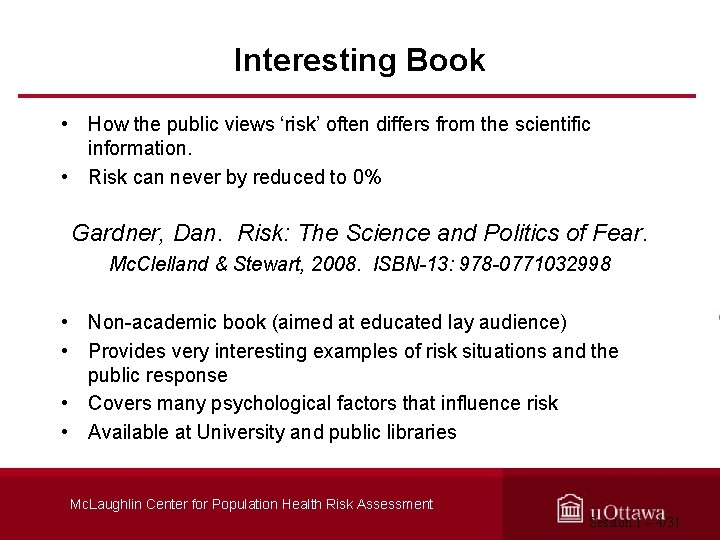
Interesting Book • How the public views ‘risk’ often differs from the scientific information. • Risk can never by reduced to 0% Gardner, Dan. Risk: The Science and Politics of Fear. Mc. Clelland & Stewart, 2008. ISBN-13: 978 -0771032998 • Non-academic book (aimed at educated lay audience) • Provides very interesting examples of risk situations and the public response • Covers many psychological factors that influence risk • Available at University and public libraries Mc. Laughlin Center for Population Health Risk Assessment Session 1 – 4/31
Graduate Diploma in Population Health Risk Assessment and Risk Management Nicholas Birkett, MD, MSc, Interim Program Director School of Epidemiology and Public Health & Mc. Laughlin Centre for Population Health Risk Assessment
People You Need to Know Melissa Brouwers SEPH Director 613 -562 -5800 x 8159 Melissa. Brouwers@uottawa. ca 101 F Nicholas Birkett 308 B Interim Director of Diploma 613 -562 -5800 x 8289 nbirkett@uottawa. ca Mc. Laughlin Center for Population Health Risk Assessment
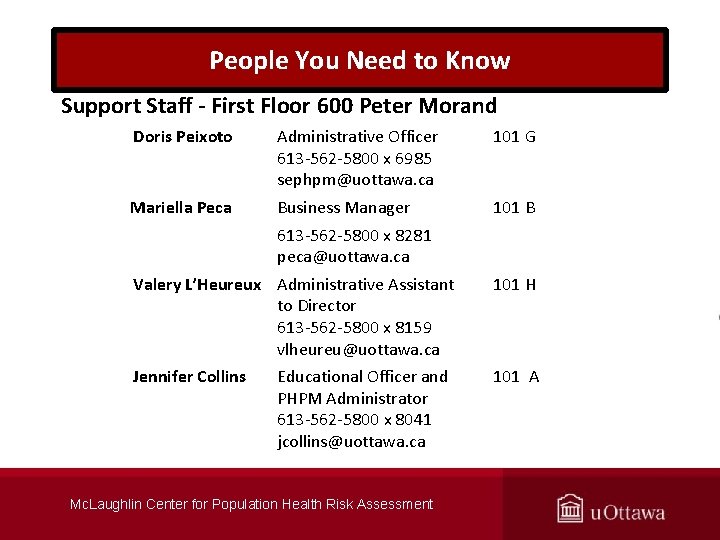
People You Need to Know Support Staff - First Floor 600 Peter Morand Doris Peixoto Administrative Officer 613 -562 -5800 x 6985 sephpm@uottawa. ca 101 G Mariella Peca Business Manager 101 B 613 -562 -5800 x 8281 peca@uottawa. ca Valery L’Heureux Administrative Assistant to Director 613 -562 -5800 x 8159 vlheureu@uottawa. ca 101 H Jennifer Collins 101 A Educational Officer and PHPM Administrator 613 -562 -5800 x 8041 jcollins@uottawa. ca Mc. Laughlin Center for Population Health Risk Assessment
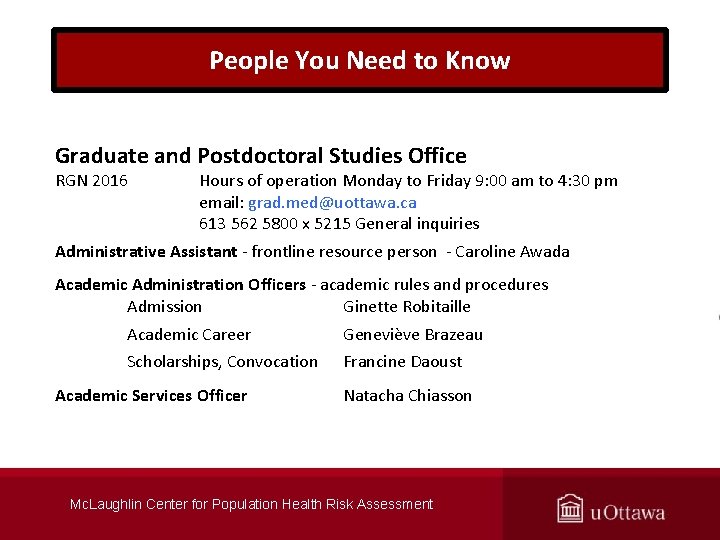
People You Need to Know Graduate and Postdoctoral Studies Office RGN 2016 Hours of operation Monday to Friday 9: 00 am to 4: 30 pm email: grad. med@uottawa. ca 613 562 5800 x 5215 General inquiries Administrative Assistant - frontline resource person - Caroline Awada Academic Administration Officers - academic rules and procedures Admission Ginette Robitaille Academic Career Geneviève Brazeau Scholarships, Convocation Francine Daoust Academic Services Officer Natacha Chiasson Mc. Laughlin Center for Population Health Risk Assessment
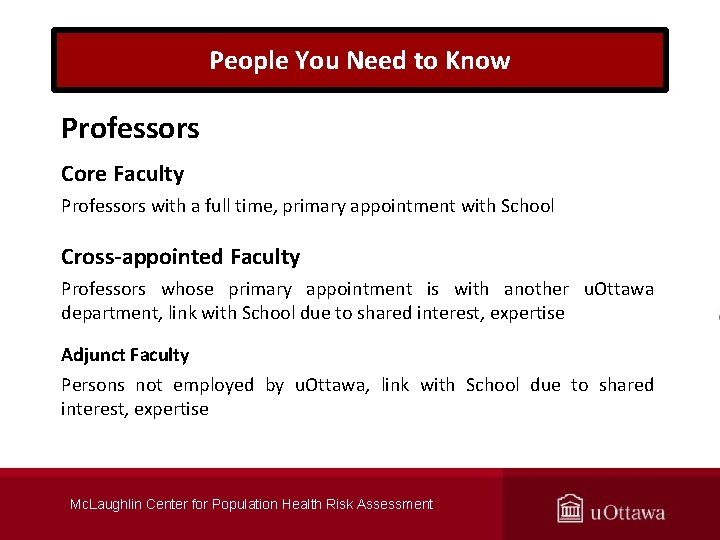
People You Need to Know Professors Core Faculty Professors with a full time, primary appointment with School Cross-appointed Faculty Professors whose primary appointment is with another u. Ottawa department, link with School due to shared interest, expertise Adjunct Faculty Persons not employed by u. Ottawa, link with School due to shared interest, expertise Mc. Laughlin Center for Population Health Risk Assessment
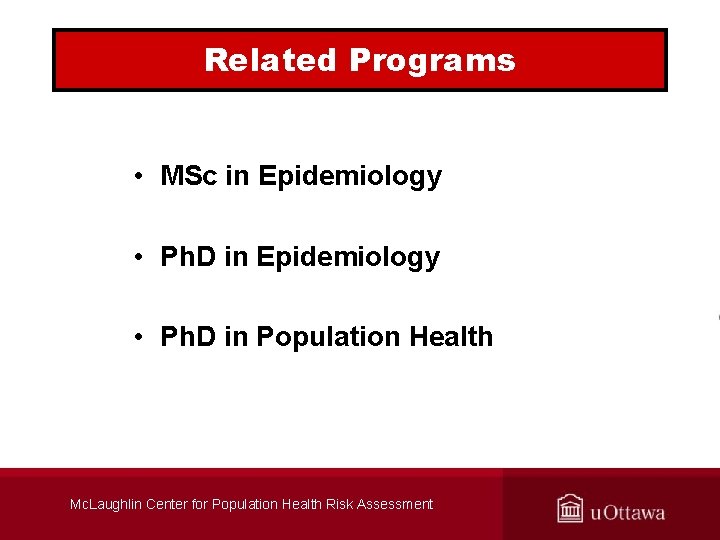
Related Programs • MSc in Epidemiology • Ph. D in Population Health Mc. Laughlin Center for Population Health Risk Assessment
Learning Objectives 1 A: Breadth and Depth of Knowledge • Scientific basis for risk assessment, with tools and techniques drawn from the fields of toxicology, epidemiology, and clinical science • Regulatory, economic, advisory, community based, and technological strategies for risk management, and guiding principles for choosing among those strategies • Effectively communicate risk information to diverse audiences Mc. Laughlin Center for Population Health Risk Assessment
Learning Objectives 1 B: Breadth and Depth of Knowledge • Application of the principles and practices of risk assessment and risk management in addressing risk issues of national and international concern • Understanding of the role of government in risk management • Additional depth in risk science through personalized training in areas of particular interest to individual students Mc. Laughlin Center for Population Health Risk Assessment
Learning Objectives 2: Research and Scholarship • Learn how to apply a range of qualitative and quantitative research methods drawn from different disciplines, including the use of scientific data to estimate population health risks • Learn how to evaluate alternative policy options to mitigate those risks, using fundamental principles of risk management making such as the precautionary principle, and methods of economic evaluation such as cost-benefit analysis • Learn how the public perceives different types of health risks, and how public concerns about risks should be considered in risk decision making Mc. Laughlin Center for Population Health Risk Assessment
Learning Objectives III: Application of Knowledge • Acquire the skills and abilities needed to assess and manage a wide range of population health risks, including those associated with environmental contaminants, diet, communicable and chronic disease, and natural and technological hazards. Mc. Laughlin Center for Population Health Risk Assessment
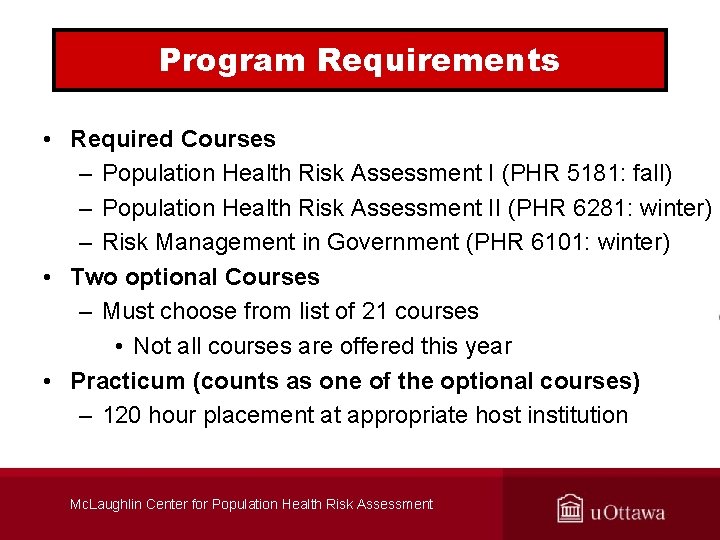
Program Requirements • Required Courses – Population Health Risk Assessment I (PHR 5181: fall) – Population Health Risk Assessment II (PHR 6281: winter) – Risk Management in Government (PHR 6101: winter) • Two optional Courses – Must choose from list of 21 courses • Not all courses are offered this year • Practicum (counts as one of the optional courses) – 120 hour placement at appropriate host institution Mc. Laughlin Center for Population Health Risk Assessment
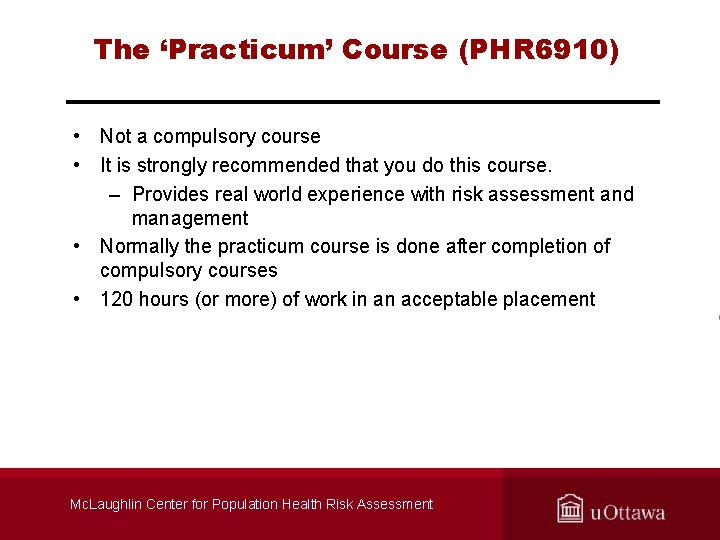
The ‘Practicum’ Course (PHR 6910) • Not a compulsory course • It is strongly recommended that you do this course. – Provides real world experience with risk assessment and management • Normally the practicum course is done after completion of compulsory courses • 120 hours (or more) of work in an acceptable placement Mc. Laughlin Center for Population Health Risk Assessment
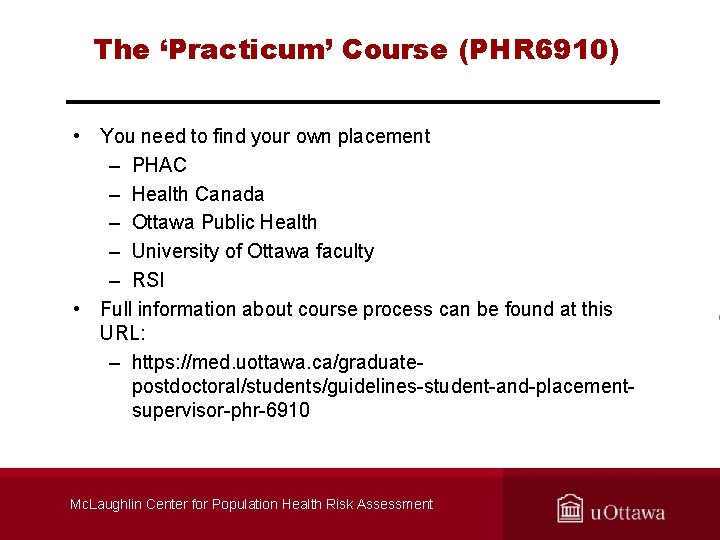
The ‘Practicum’ Course (PHR 6910) • You need to find your own placement – PHAC – Health Canada – Ottawa Public Health – University of Ottawa faculty – RSI • Full information about course process can be found at this URL: – https: //med. uottawa. ca/graduatepostdoctoral/students/guidelines-student-and-placementsupervisor-phr-6910 Mc. Laughlin Center for Population Health Risk Assessment
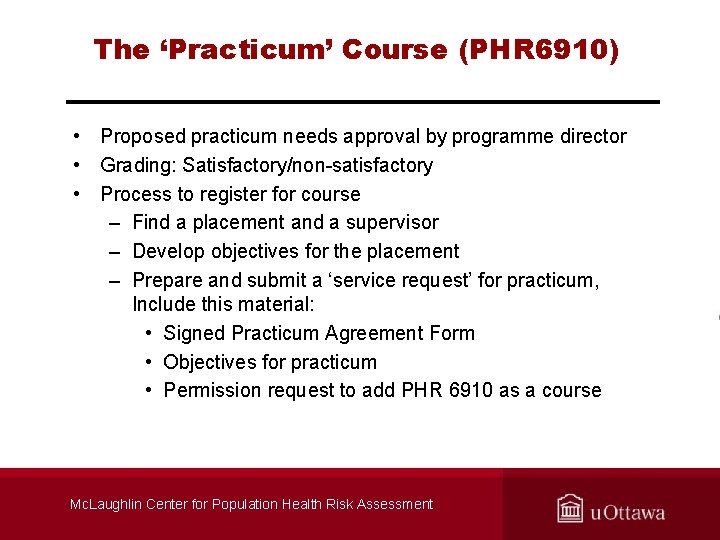
The ‘Practicum’ Course (PHR 6910) • Proposed practicum needs approval by programme director • Grading: Satisfactory/non-satisfactory • Process to register for course – Find a placement and a supervisor – Develop objectives for the placement – Prepare and submit a ‘service request’ for practicum, Include this material: • Signed Practicum Agreement Form • Objectives for practicum • Permission request to add PHR 6910 as a course Mc. Laughlin Center for Population Health Risk Assessment
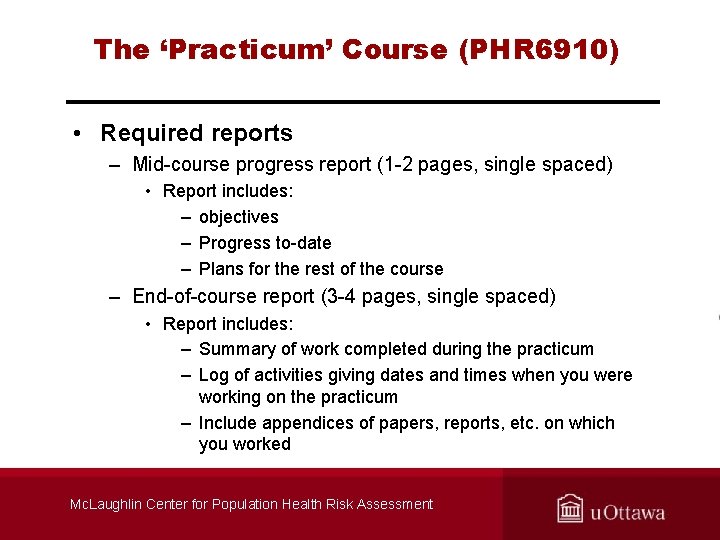
The ‘Practicum’ Course (PHR 6910) • Required reports – Mid-course progress report (1 -2 pages, single spaced) • Report includes: – objectives – Progress to-date – Plans for the rest of the course – End-of-course report (3 -4 pages, single spaced) • Report includes: – Summary of work completed during the practicum – Log of activities giving dates and times when you were working on the practicum – Include appendices of papers, reports, etc. on which you worked Mc. Laughlin Center for Population Health Risk Assessment
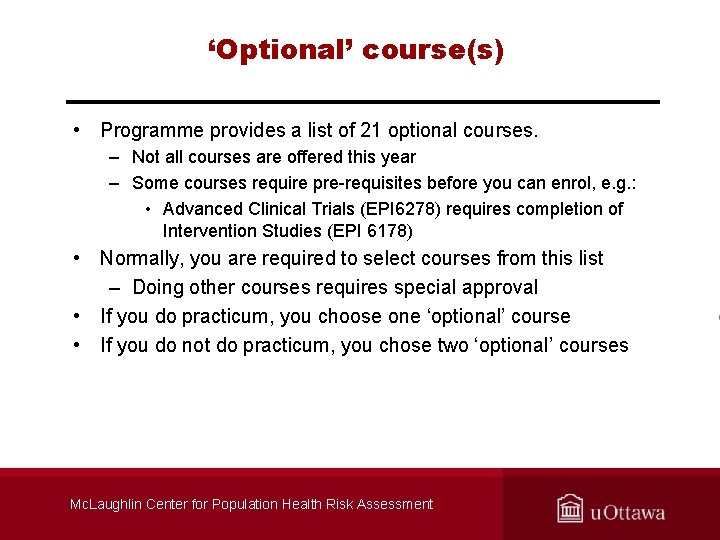
‘Optional’ course(s) • Programme provides a list of 21 optional courses. – Not all courses are offered this year – Some courses require pre-requisites before you can enrol, e. g. : • Advanced Clinical Trials (EPI 6278) requires completion of Intervention Studies (EPI 6178) • Normally, you are required to select courses from this list – Doing other courses requires special approval • If you do practicum, you choose one ‘optional’ course • If you do not do practicum, you chose two ‘optional’ courses Mc. Laughlin Center for Population Health Risk Assessment
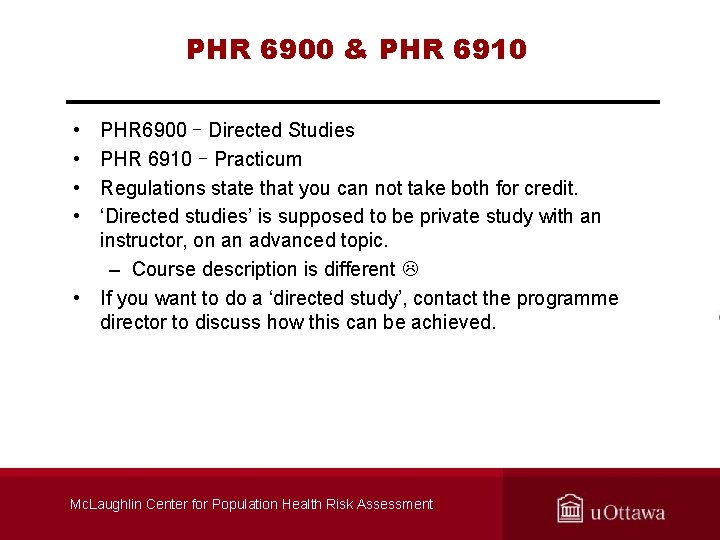
PHR 6900 & PHR 6910 • • PHR 6900 – Directed Studies PHR 6910 – Practicum Regulations state that you can not take both for credit. ‘Directed studies’ is supposed to be private study with an instructor, on an advanced topic. – Course description is different • If you want to do a ‘directed study’, contact the programme director to discuss how this can be achieved. Mc. Laughlin Center for Population Health Risk Assessment
Plagiarism: We Must Make This Clear Plagiarism of any kind is not acceptable Mc. Laughlin Center for Population Health Risk Assessment
Plagiarism: We Must Make This Clear Plagiarism of any kind is not acceptable Plagiarism is viewed and treated as academic fraud Do not get accidentally caught out because of ignorance. Review the university's definitions of, and policies on, plagiarism Any written submissions, including thesis proposal, research paper abstracts, theses, research papers, etc. will be examined for plagiarism Sanctions are tough, including expulsion from the university! Mc. Laughlin Center for Population Health Risk Assessment
Plagiarism: We Must Make This Clear Plagiarism of any kind is not acceptable Plagiarism involves copying any work that is not your own without providing appropriate citations. Includes: • Buying papers prepared by others • Copying and using any material found on the Internet; • Copying sections of books • Copying sections of articles • Copying material from research or other reports • Re-using your own assignments without permission for two or more courses is also a violation Mc. Laughlin Center for Population Health Risk Assessment
University Resources for Students Student Academic Success Services (SASS) SASS is a free network of services and programs designed to give you the tools and information you need to succeed from your first day on campus until you receive your diploma and go out into the world to pursue your dreams. Contact with SASS is confidential Services include: • Academic and Writing Help Centre • • – Many students have problem writing term papers. Worth talking with this group Counseling and Coaching Services Access Services – Provides support for special needs Mc. Laughlin Center for Population Health Risk Assessment
Meet and Greet Lunch The SCHOOL OF EPIDEMIOLOGY AND PUBLIC HEALTH invites you to a meet and greet light lunch! Tuesday, September 4 11: 30 a. m. to 1: 00 p. m. Back Patio and Room 103 600 Peter Morand A chance to meet faculty members and learn about their research and other interests School of Epidemiology and Public Health