The Unified Theory of Pseudorandomness Salil Vadhan Harvard






- Slides: 34
The Unified Theory of Pseudorandomness Salil Vadhan Harvard University See also paper and draft monograph http: //people. seas. harvard. edu/~salil/research/unified-abs. html http: //seas. harvard. edu/~salil/pseudorandomness
Pseudorandomness Theory of objects that “look random” despite being constructed with little or no randomness.
Motivation Computer Science – Derandomization: converting randomized algorithms into deterministic algorithms. – Cryptography: generating lots of unpredictable bits (e. g. for encryption) from a short key – Useful “Pseudorandom Objects” (e. g. error-correcting codes). Mathematics – Explicit Constructions matching Probabilistic Method (e. g. Ramsey graphs) – Analyzing mathematical structures: e. g. the primes are dense in a “pseudorandom” set of integers [Green-Tao 04]
“Pseudorandom Objects” • • Error-correcting codes: make data resilient to corruption Expander graphs: highly connected but sparse graphs Samplers: estimate avg with few samples & random bits Randomness extractors: convert biased & correlated bits to almost-uniform random bits. • Hardness amplifiers: convert worst-case hard functions into average-case hard ones. • Pseudorandom generators: stretch short seed to many bits that “look random” to efficient algorithms. For each, randomly chosen object achieves very good parameters. Goal is explicit constructions – ones that are efficient & deterministic.
“Pseudorandom Objects” • • Error-correcting codes: make data resilient to corruption Expander graphs: highly connected but sparse graphs Samplers: estimate avg with few samples & random bits Randomness extractors: convert biased & correlated bits to almost-uniform random bits. • Hardness amplifiers: convert worst-case hard functions into average-case hard ones. • Pseudorandom generators: stretch short seed to many bits that “look random” to efficient algorithms. For each, randomly chosen object achieves very good parameters. Goal is explicit constructions – ones that are efficient & deterministic.
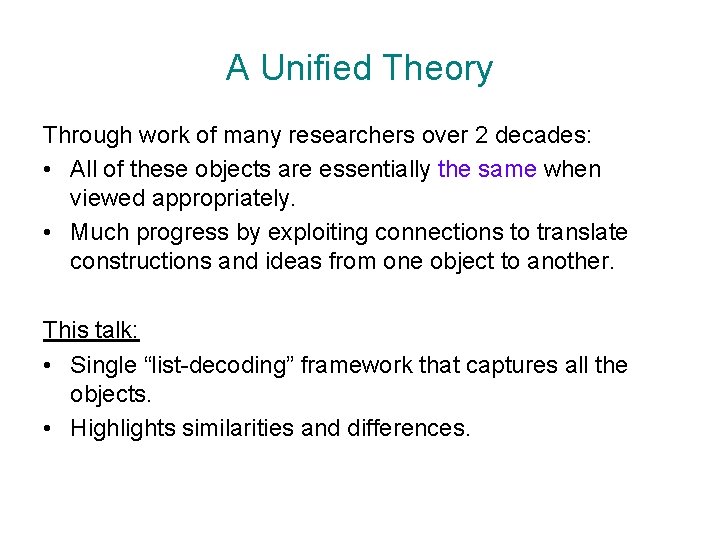
A Unified Theory Through work of many researchers over 2 decades: • All of these objects are essentially the same when viewed appropriately. • Much progress by exploiting connections to translate constructions and ideas from one object to another. This talk: • Single “list-decoding” framework that captures all the objects. • Highlights similarities and differences.
An Incomplete List of References • D. Zuckerman “Randomness-optimal oblivious sampling”, 1996. • L. Trevisan “Extractors and Pseudorandom Generators”, 1999. • M. Sudan, L. Trevisan, S. Vadhan “Pseudorandom Generators without the XOR Lemma”, 1999. • A. Ta-Shma, D. Zuckerman “Extractor codes”, 2001. • V. Guruswami, C. Umans, S. Vadhan “Unbalanced Expanders and Randomness Extractors from Parvaresh-Vardy Codes”, 2007. • See proceedings & monograph for more.
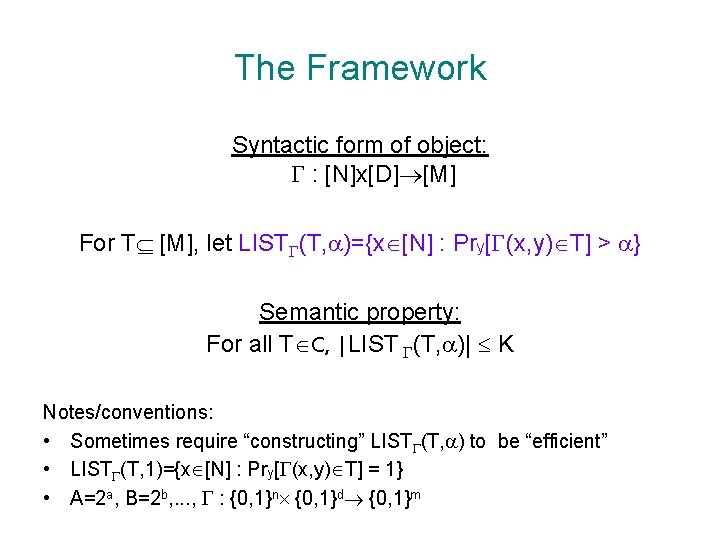
The Framework Syntactic form of object: : [N]x[D] [M] For T [M], let LIST (T, )={x [N] : Pry[ (x, y) T] > } Semantic property: For all T C, |LIST (T, )| K Notes/conventions: • Sometimes require “constructing” LIST (T, ) to be “efficient” • LIST (T, 1)={x [N] : Pry[ (x, y) T] = 1} • A=2 a, B=2 b, . . . , : {0, 1}n {0, 1}d {0, 1}m
LIST-DECODABLE CODES
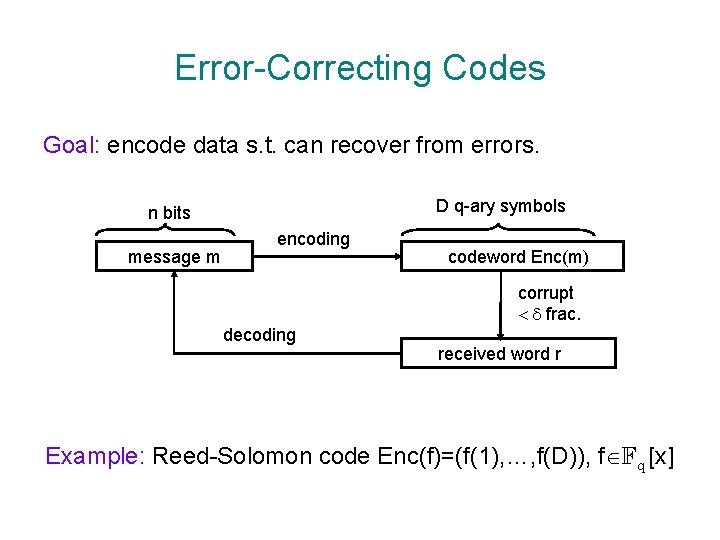
Error-Correcting Codes Goal: encode data s. t. can recover from errors. D q-ary symbols n bits message m encoding codeword Enc(m) corrupt < frac. decoding received word r Example: Reed-Solomon code Enc(f)=(f(1), …, f(D)), f Fq [x]
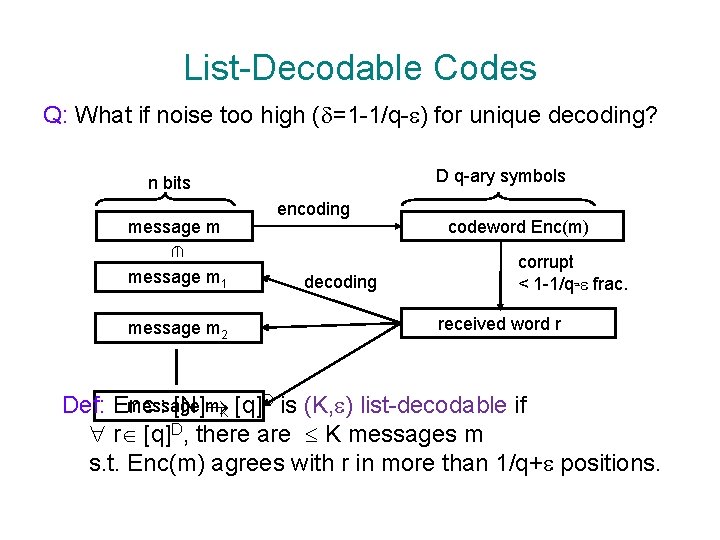
List-Decodable Codes Q: What if noise too high ( =1 -1/q- ) for unique decoding? D q-ary symbols n bits message m encoding message m 1 message m 2 decoding codeword Enc(m) corrupt < 1 -1/q- frac. received word r message m. K [q]D is (K, ) list-decodable if Def: Enc : [N] r [q]D, there are K messages m s. t. Enc(m) agrees with r in more than 1/q+ positions.
List-Decodable Codes Def: Enc : [N] [q]D is (K, ) list-decodable if r [q]D, there are K messages m s. t. Enc(m) agrees with r in more than 1/q+ positions. Goals • Minimize D (e. g. Dlog q=O(n)). • Minimize (e. g. small constant independent of n). • Minimize q (e. g. q=O(1) or q=poly(n)). • Minimize K (e. g. K=poly(n)).
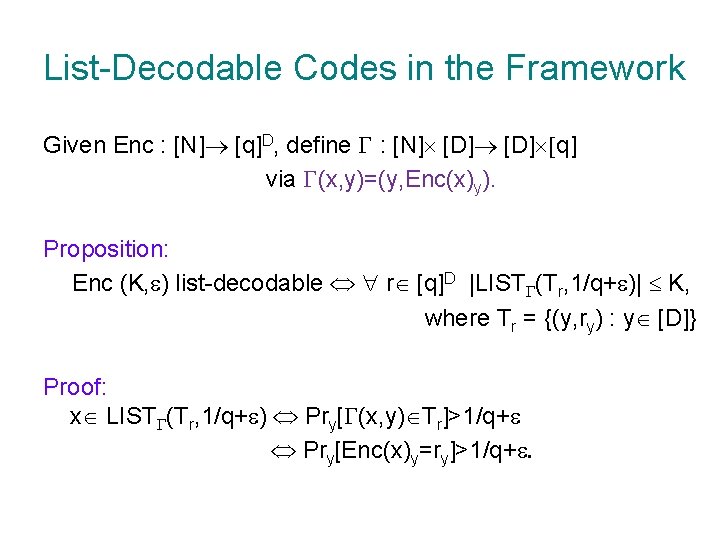
List-Decodable Codes in the Framework Given Enc : [N] [q]D, define : [N] [D] [q] via (x, y)=(y, Enc(x)y). Proposition: Enc (K, ) list-decodable r [q]D |LIST (Tr, 1/q+ )| K, where Tr = {(y, ry) : y [D]} Proof: x LIST (Tr, 1/q+ ) Pry[ (x, y) Tr]>1/q+ Pry[Enc(x)y=ry]>1/q+.
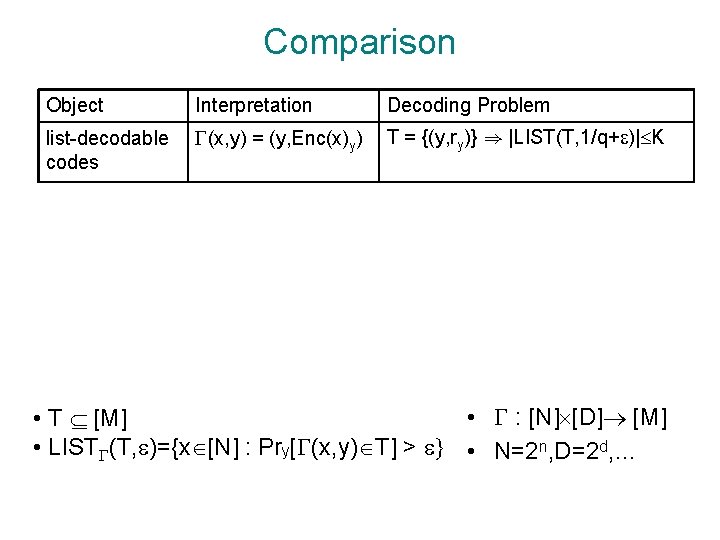
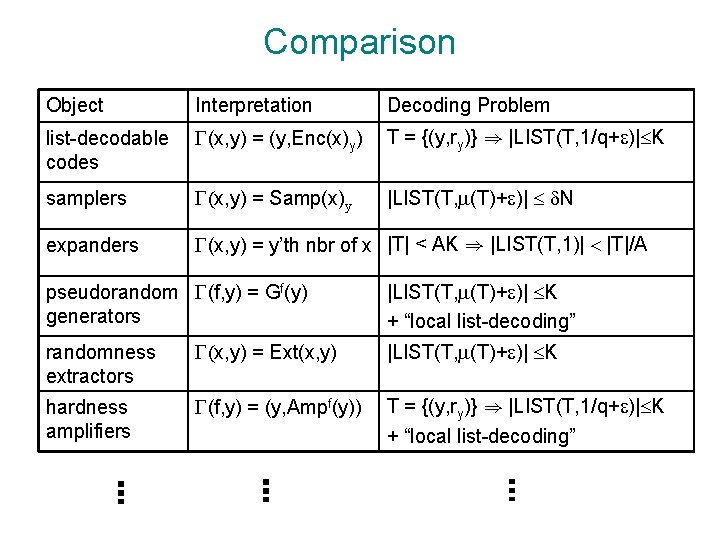
Comparison Object Interpretation Decoding Problem list-decodable codes (x, y) = (y, Enc(x)y) T = {(y, ry)} ) |LIST(T, 1/q+ )| K • : [N] [D] [M] • T [M] • LIST (T, )={x [N] : Pry[ (x, y) T] > } • N=2 n, D=2 d, …
AVERAGING SAMPLERS
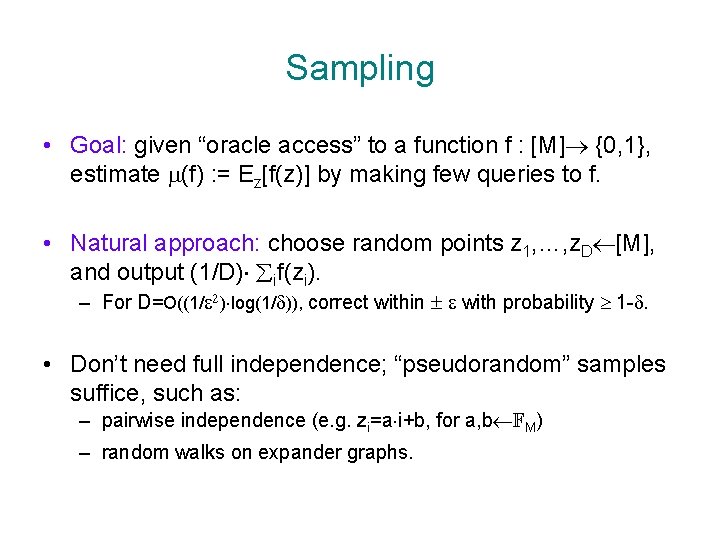
Sampling • Goal: given “oracle access” to a function f : [M] {0, 1}, estimate (f) : = Ez[f(z)] by making few queries to f. • Natural approach: choose random points z 1, …, z. D [M], and output (1/D) if(zi). – For D=O((1/ 2) log(1/ )), correct within with probability 1 -. • Don’t need full independence; “pseudorandom” samples suffice, such as: – pairwise independence (e. g. zi=a i+b, for a, b FM) – random walks on expander graphs.
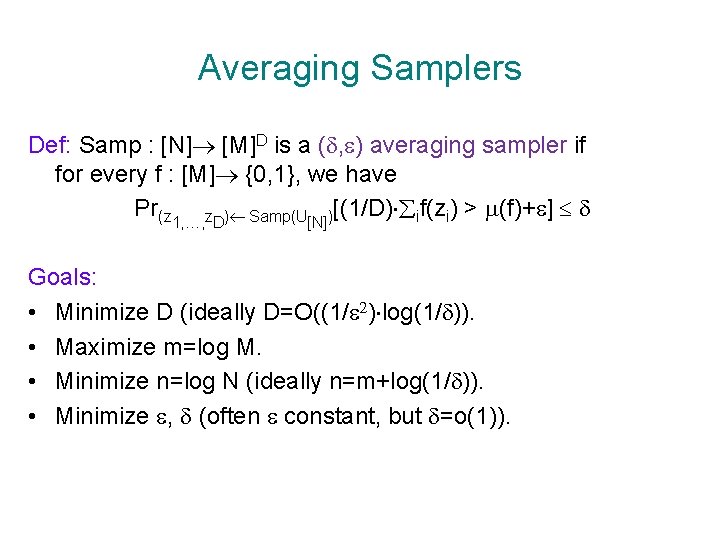
Averaging Samplers Def: Samp : [N] [M]D is a ( , ) averaging sampler if for every f : [M] {0, 1}, we have Pr(z 1, …, z. D) Samp(U[N])[(1/D) if(zi) > (f)+ ] Goals: • Minimize D (ideally D=O((1/ 2) log(1/ )). • Maximize m=log M. • Minimize n=log N (ideally n=m+log(1/ )). • Minimize , (often constant, but =o(1)).
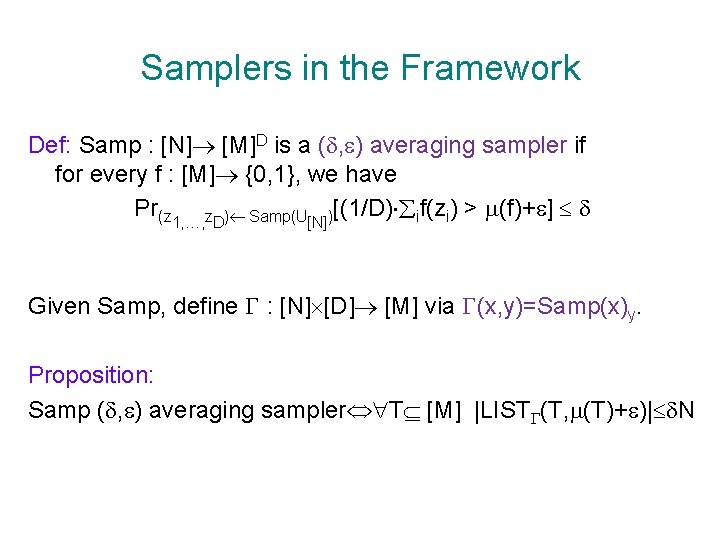
Samplers in the Framework Def: Samp : [N] [M]D is a ( , ) averaging sampler if for every f : [M] {0, 1}, we have Pr(z 1, …, z. D) Samp(U[N])[(1/D) if(zi) > (f)+ ] Given Samp, define : [N] [D] [M] via (x, y)=Samp(x)y. Proposition: Samp ( , ) averaging sampler T [M] |LIST (T, (T)+ )| N
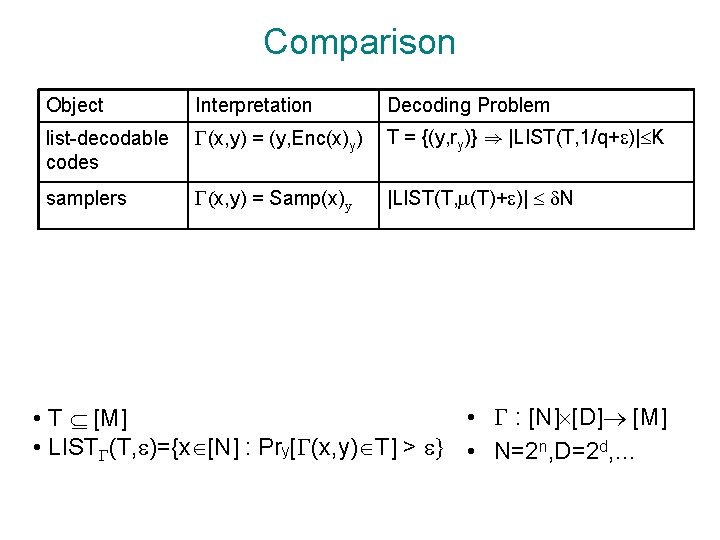
Comparison Object Interpretation Decoding Problem list-decodable codes (x, y) = (y, Enc(x)y) T = {(y, ry)} ) |LIST(T, 1/q+ )| K samplers (x, y) = Samp(x)y |LIST(T, (T)+ )| N • : [N] [D] [M] • T [M] • LIST (T, )={x [N] : Pry[ (x, y) T] > } • N=2 n, D=2 d, …
EXPANDER GRAPHS
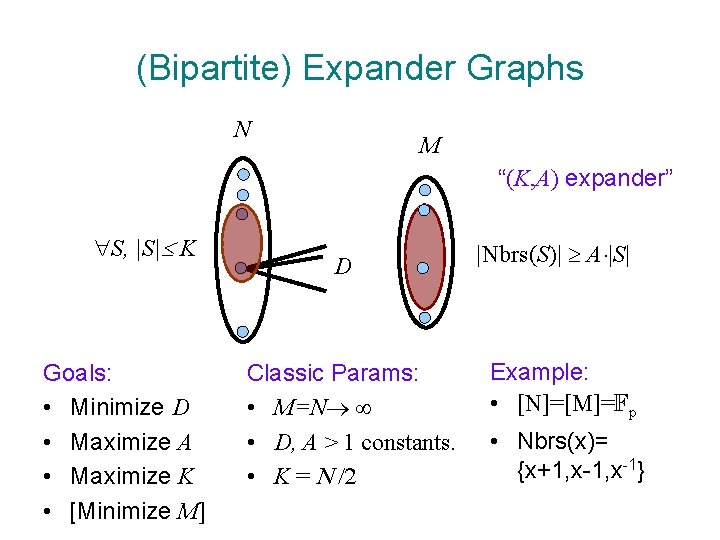
(Bipartite) Expander Graphs N M “(K, A) expander” S, |S| K Goals: • Minimize D • Maximize A • Maximize K • [Minimize M] D Classic Params: • M=N • D, A > 1 constants. • K = N /2 |Nbrs(S)| A¢|S| Example: • [N]=[M]=Fp • Nbrs(x)= {x+1, x-1}
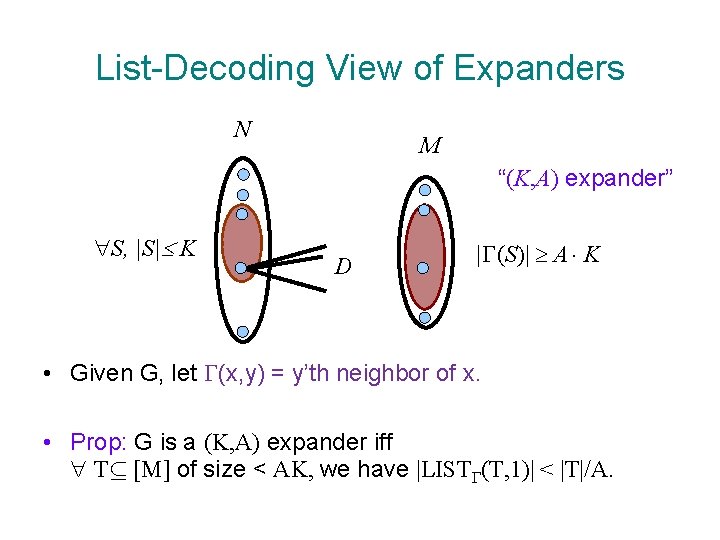
List-Decoding View of Expanders N M “(K, A) expander” S, |S| K D | (S)| A¢ K • Given G, let (x, y) = y’th neighbor of x. • Prop: G is a (K, A) expander iff Tµ [M] of size < AK, we have |LIST (T, 1)| < |T|/A.
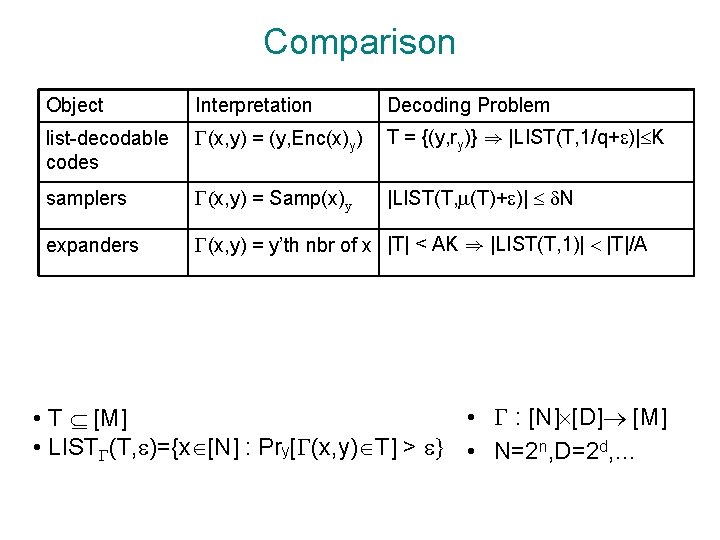
Comparison Object Interpretation Decoding Problem list-decodable codes (x, y) = (y, Enc(x)y) T = {(y, ry)} ) |LIST(T, 1/q+ )| K samplers (x, y) = Samp(x)y |LIST(T, (T)+ )| N expanders (x, y) = y’th nbr of x |T| < AK ) |LIST(T, 1)| < |T|/A • : [N] [D] [M] • T [M] • LIST (T, )={x [N] : Pry[ (x, y) T] > } • N=2 n, D=2 d, …
PSEUDORANDOM GENERATORS
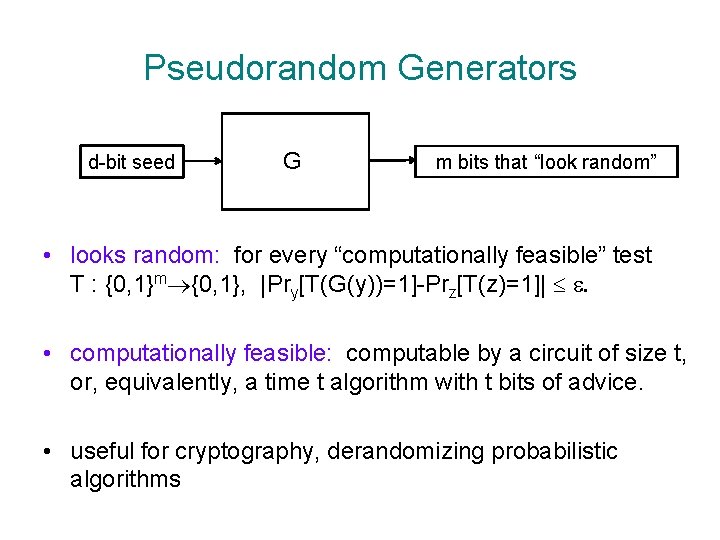
Pseudorandom Generators d-bit seed G m bits that “look random” • looks random: for every “computationally feasible” test T : {0, 1}m {0, 1}, |Pry[T(G(y))=1]-Prz[T(z)=1]| . • computationally feasible: computable by a circuit of size t, or, equivalently, a time t algorithm with t bits of advice. • useful for cryptography, derandomizing probabilistic algorithms
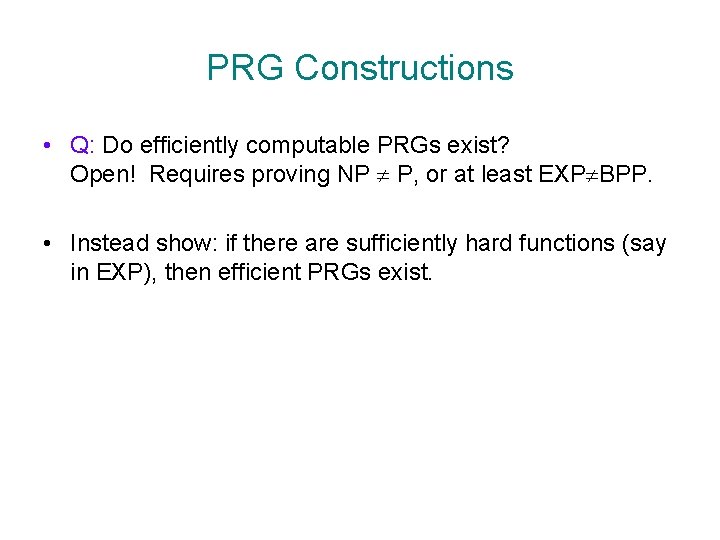
PRG Constructions • Q: Do efficiently computable PRGs exist? Open! Requires proving NP P, or at least EXP BPP. • Instead show: if there are sufficiently hard functions (say in EXP), then efficient PRGs exist.
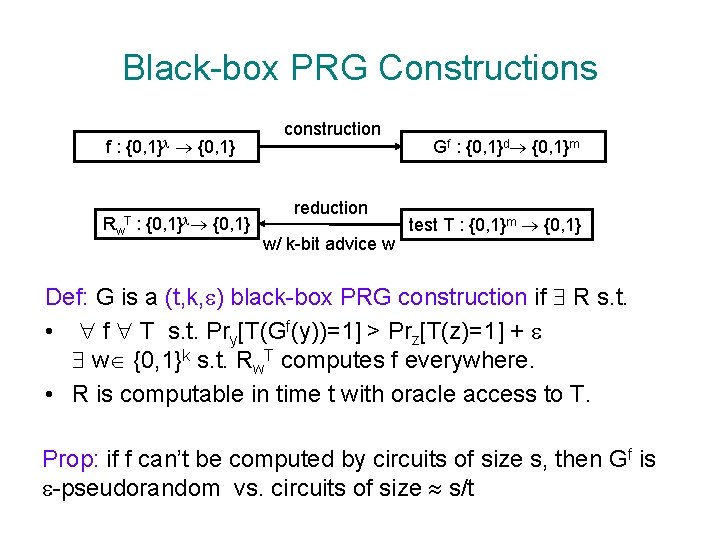
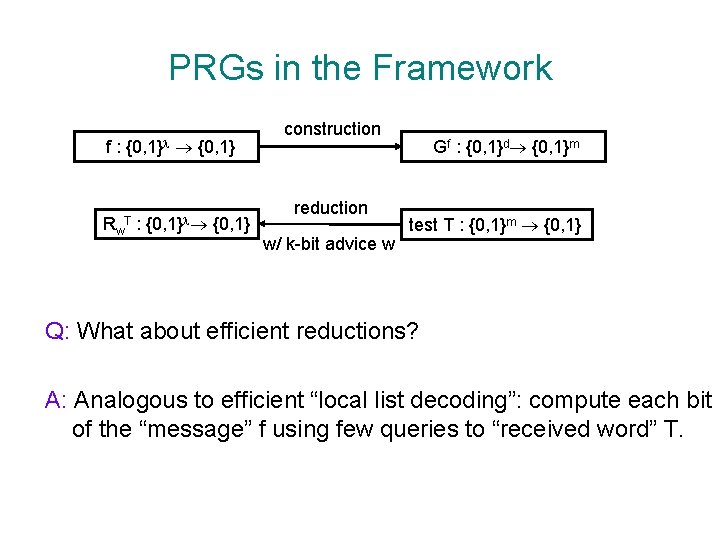
Black-box PRG Constructions f: {0, 1} Rw : T {0, 1} construction reduction w/ k-bit advice w Gf : {0, 1}d {0, 1}m test T : {0, 1}m {0, 1} Def: G is a (t, k, ) black-box PRG construction if R s. t. • f T s. t. Pry[T(Gf(y))=1] > Prz[T(z)=1] + w {0, 1}k s. t. Rw. T computes f everywhere. • R is computable in time t with oracle access to T. Prop: if f can’t be computed by circuits of size s, then Gf is -pseudorandom vs. circuits of size s/t
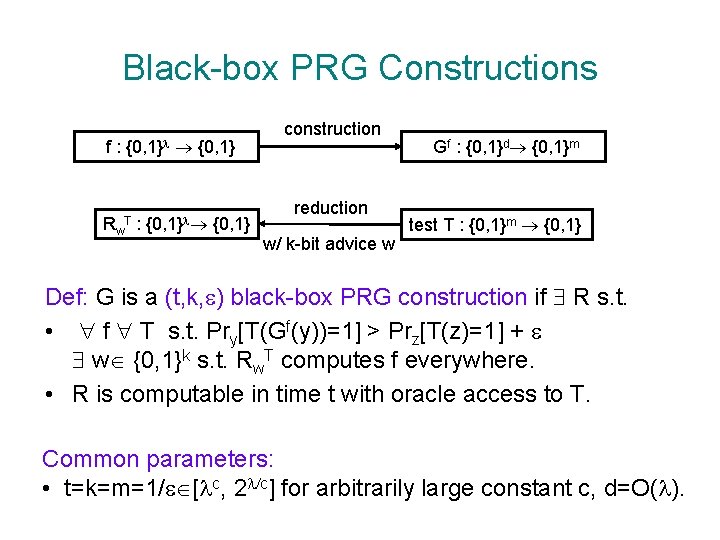
Black-box PRG Constructions f: {0, 1} Rw : T {0, 1} construction reduction w/ k-bit advice w Gf : {0, 1}d {0, 1}m test T : {0, 1}m {0, 1} Def: G is a (t, k, ) black-box PRG construction if R s. t. • f T s. t. Pry[T(Gf(y))=1] > Prz[T(z)=1] + w {0, 1}k s. t. Rw. T computes f everywhere. • R is computable in time t with oracle access to T. Common parameters: • t=k=m=1/ [ c, 2 /c] for arbitrarily large constant c, d=O( ).
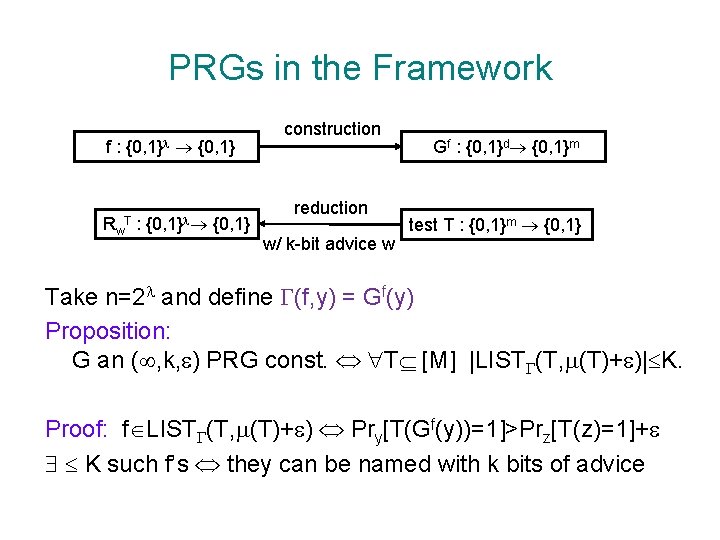
PRGs in the Framework f: {0, 1} Rw : T {0, 1} construction reduction w/ k-bit advice w Gf : {0, 1}d {0, 1}m test T : {0, 1}m {0, 1} Take n=2 and define (f, y) = Gf(y) Proposition: G an ( , k, ) PRG const. T [M] |LIST (T, (T)+ )| K. Proof: f LIST (T, (T)+ ) Pry[T(Gf(y))=1]>Prz[T(z)=1]+ K such f’s they can be named with k bits of advice
PRGs in the Framework f: {0, 1} Rw : T {0, 1} construction reduction w/ k-bit advice w Gf : {0, 1}d {0, 1}m test T : {0, 1}m {0, 1} Q: What about efficient reductions? A: Analogous to efficient “local list decoding”: compute each bit of the “message” f using few queries to “received word” T.
Comparison Object Interpretation Decoding Problem list-decodable codes (x, y) = (y, Enc(x)y) T = {(y, ry)} ) |LIST(T, 1/q+ )| K samplers (x, y) = Samp(x)y |LIST(T, (T)+ )| N expanders (x, y) = y’th nbr of x |T| < AK ) |LIST(T, 1)| < |T|/A pseudorandom (f, y) = Gf(y) generators |LIST(T, (T)+ )| K + “local list-decoding” • : [N] [D] [M] • T [M] • LIST (T, )={x [N] : Pry[ (x, y) T] > } • N=2 n, D=2 d, …
Comparison Object Interpretation Decoding Problem list-decodable codes (x, y) = (y, Enc(x)y) T = {(y, ry)} ) |LIST(T, 1/q+ )| K samplers (x, y) = Samp(x)y |LIST(T, (T)+ )| N expanders (x, y) = y’th nbr of x |T| < AK ) |LIST(T, 1)| < |T|/A pseudorandom (f, y) = Gf(y) generators |LIST(T, (T)+ )| K + “local list-decoding” randomness extractors (x, y) = Ext(x, y) |LIST(T, (T)+ )| K hardness amplifiers (f, y) = (y, Ampf(y)) T = {(y, ry)} ) |LIST(T, 1/q+ )| K + “local list-decoding”
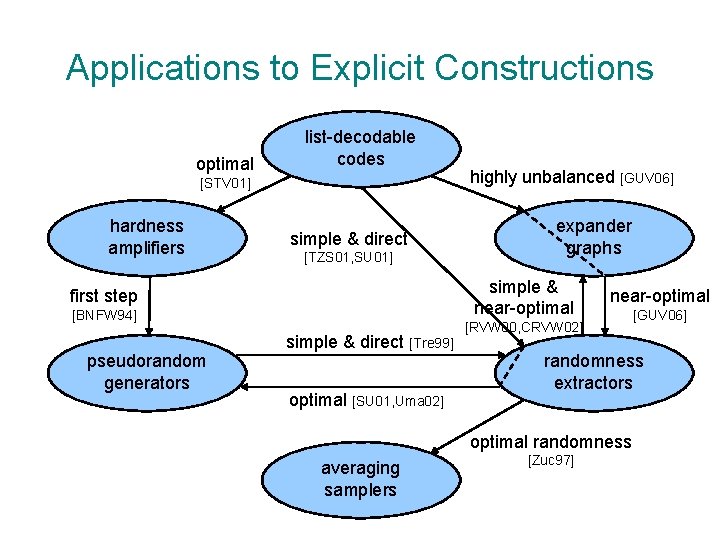
Applications to Explicit Constructions optimal list-decodable codes [STV 01] hardness amplifiers simple & direct [TZS 01, SU 01] expander graphs simple & near-optimal first step [BNFW 94] pseudorandom generators highly unbalanced [GUV 06] simple & direct [Tre 99] optimal [SU 01, Uma 02] near-optimal [RVW 00, CRVW 02] randomness extractors optimal randomness averaging samplers [GUV 06] [Zuc 97]
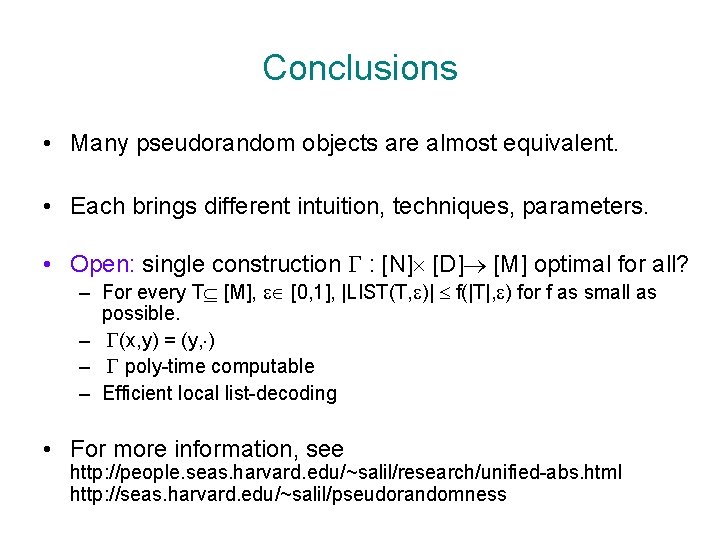
Conclusions • Many pseudorandom objects are almost equivalent. • Each brings different intuition, techniques, parameters. • Open: single construction : [N] [D] [M] optimal for all? – For every T [M], [0, 1], |LIST(T, )| f(|T|, ) for f as small as possible. – (x, y) = (y, ) – poly-time computable – Efficient local list-decoding • For more information, see http: //people. seas. harvard. edu/~salil/research/unified-abs. html http: //seas. harvard. edu/~salil/pseudorandomness