Dr Salil Singh Lecturer School of Studies in
- Slides: 6
Dr. Salil Singh (Lecturer) School of Studies in Zoology & Biotechnology Vikram University, Ujjain Lecture for M. Sc. Biotechnology, Semester IInd students Paper Ist- Enzyme technology
Active sites and substrate specificity To catalyze a reaction, an enzyme will grab on (bind) to one or more reactant molecules. These molecules are the enzyme's substrates.
In some reactions, one substrate is broken down into multiple products. In others, two substrates come together to create one larger molecule or to swap pieces. In fact, whatever type of biological reaction you can think of, there is probably an enzyme to speed it up! The part of the enzyme where the substrate binds is called the active site (since that’s where the catalytic “action” happens).
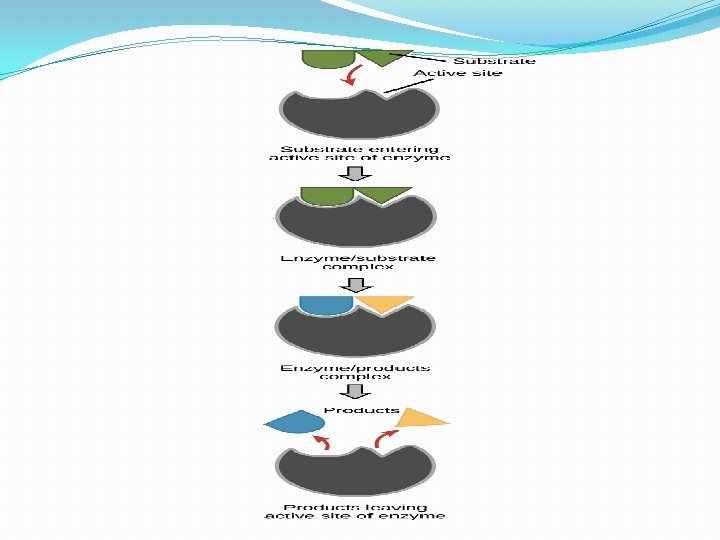
A substrate enters the active site of the enzyme. This forms the enzyme-substrate complex. The reaction then occurs, converting the substrate into products and forming an enzyme products complex. The products then leave the active site of the enzyme. Proteins are made of units called amino acids, and in enzymes that are proteins, the active site gets its properties from the amino acids it's built out of. These amino acids may have side chains that are large or small, acidic or basic, hydrophilic or hydrophobic.
The set of amino acids found in the active site, along with their positions in 3 D space, give the active site a very specific size, shape, and chemical behavior. Thanks to these amino acids, an enzyme's active site is uniquely suited to bind to a particular target the enzyme's substrate or substrates and help them undergo a chemical reaction.