The Road to Wellness Exploring Work Engagement and
- Slides: 38
The Road to Wellness: Exploring Work Engagement and Burnout Among CRNAs JOSHUA LEA, CRNA, MBA MASSACHUSETTS GENERAL HOSPITAL
Acknowledgements Christine Brown-Mahoney, Ph. D • Minnesota State University, Mankato • Co-Investigator Paul Schumann, Ph. D • Minnesota State University, Mankato
Disclaimer I have no actual or potential conflict of interest in relation to this presentation. The following research is funded by the AANA Foundation.
Objectives ◦ to define burnout and work engagement ◦ to describe the relationship between burnout and work engagement ◦ to identify correlates of CRNA burnout and work engagement ◦ to discuss interventions to decrease burnout and increase work engagement
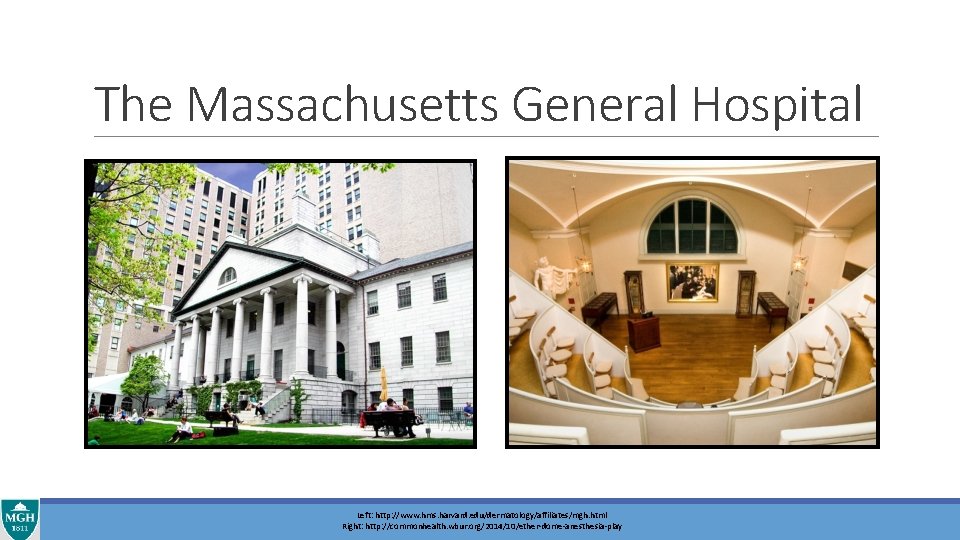
The Massachusetts General Hospital Left: http: //www. hms. harvard. edu/dermatology/affiliates/mgh. html Right: http: //commonhealth. wbur. org/2014/10/ether-dome-anesthesia-play
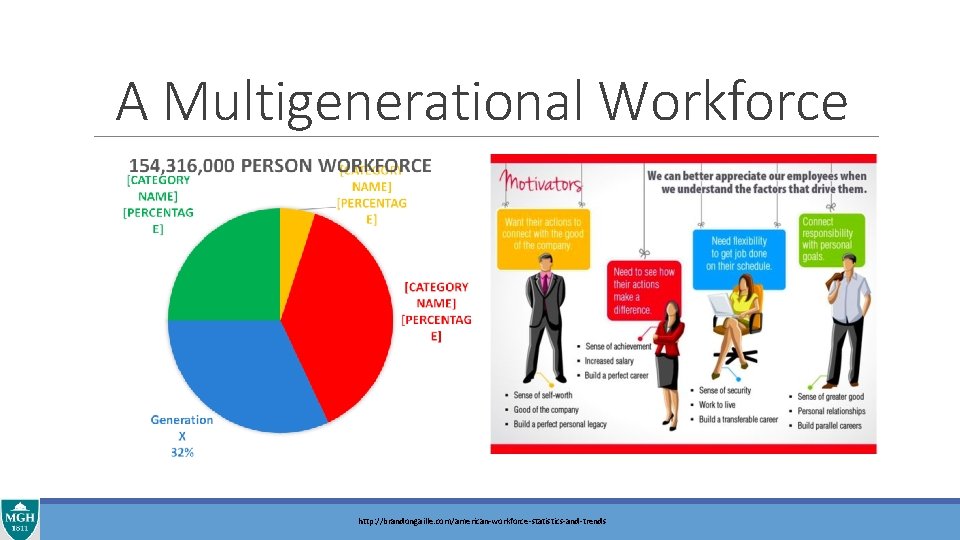
A Multigenerational Workforce http: //brandongaille. com/american-workforce-statistics-and-trends
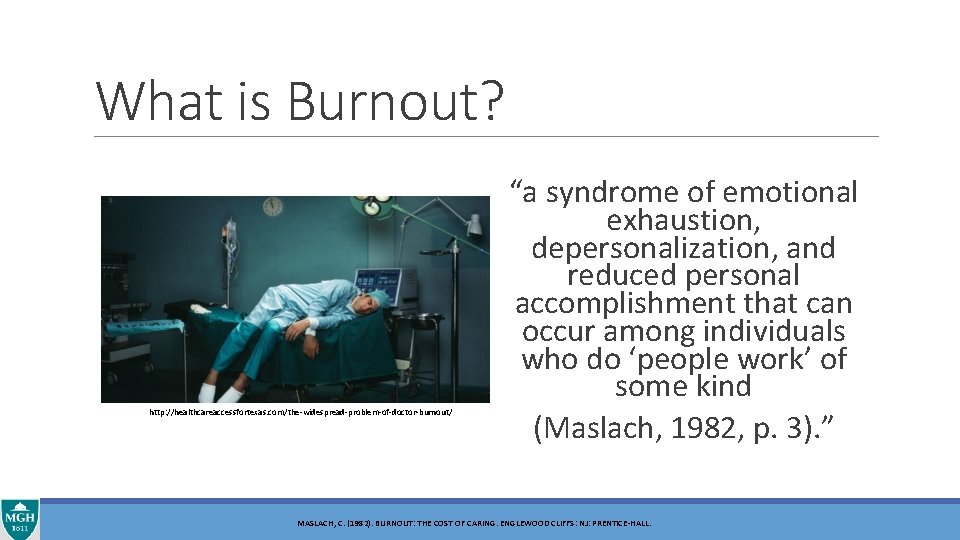
What is Burnout? http: //healthcareaccessfortexas. com/the-widespread-problem-of-doctor-burnout/ “a syndrome of emotional exhaustion, depersonalization, and reduced personal accomplishment that can occur among individuals who do ‘people work’ of some kind (Maslach, 1982, p. 3). ” MASLACH, C. (1982). BURNOUT: THE COST OF CARING. ENGLEWOOD CLIFFS: NJ: PRENTICE-HALL.
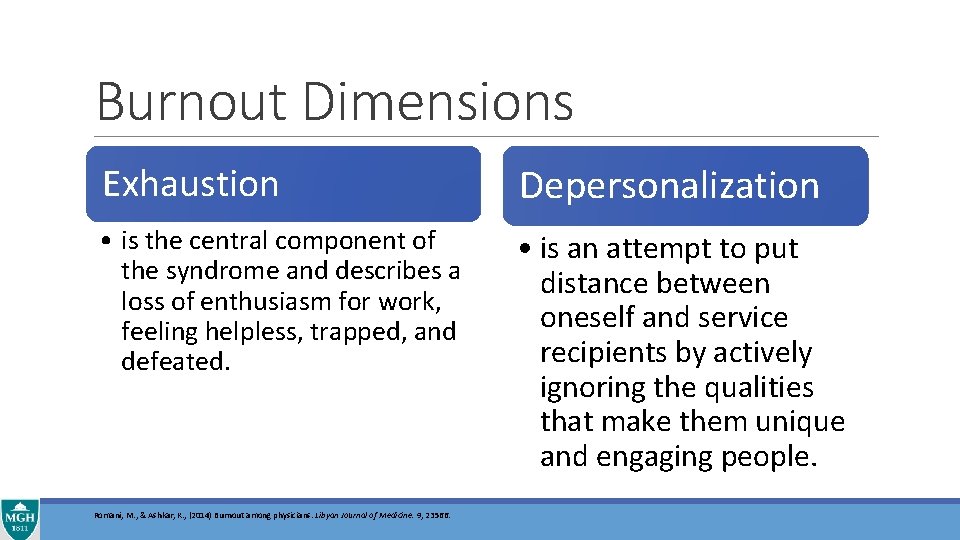
Burnout Dimensions Exhaustion Depersonalization • is the central component of the syndrome and describes a loss of enthusiasm for work, feeling helpless, trapped, and defeated. • is an attempt to put distance between oneself and service recipients by actively ignoring the qualities that make them unique and engaging people. Romani, M. , & Ashkar, K. , (2014) Burnout among physicians. Libyan Journal of Medicine. 9, 23566.
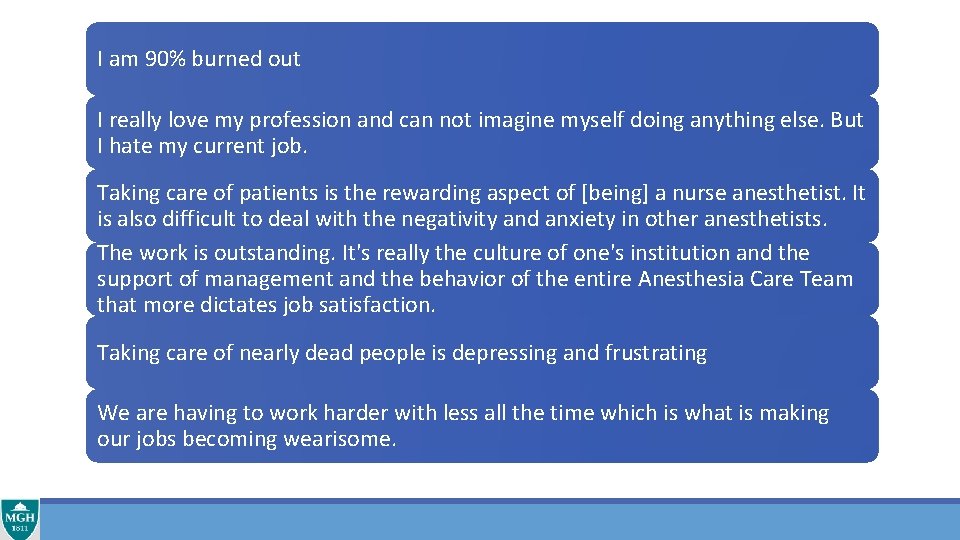
I am 90% burned out I really love my profession and can not imagine myself doing anything else. But I hate my current job. Taking care of patients is the rewarding aspect of [being] a nurse anesthetist. It is also difficult to deal with the negativity and anxiety in other anesthetists. The work is outstanding. It's really the culture of one's institution and the support of management and the behavior of the entire Anesthesia Care Team that more dictates job satisfaction. Taking care of nearly dead people is depressing and frustrating We are having to work harder with less all the time which is what is making our jobs becoming wearisome.
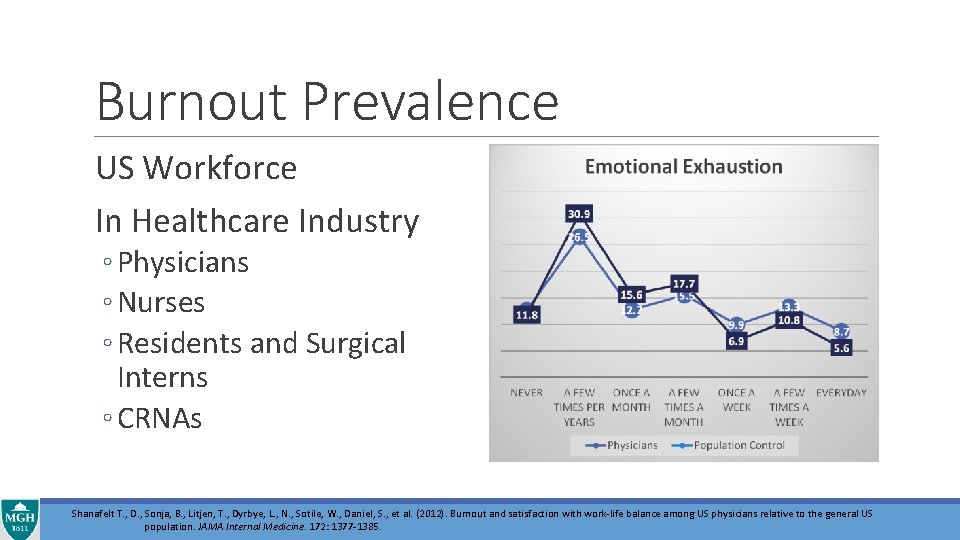
Burnout Prevalence US Workforce In Healthcare Industry ◦ Physicians ◦ Nurses ◦ Residents and Surgical Interns ◦ CRNAs Shanafelt T. , D. , Sonja, B. , Litjen, T. , Dyrbye, L. , N. , Sotile, W. , Daniel, S. , et al. (2012). Burnout and satisfaction with work-life balance among US physicians relative to the general US population. JAMA Internal Medicine. 172: 1377 -1385.
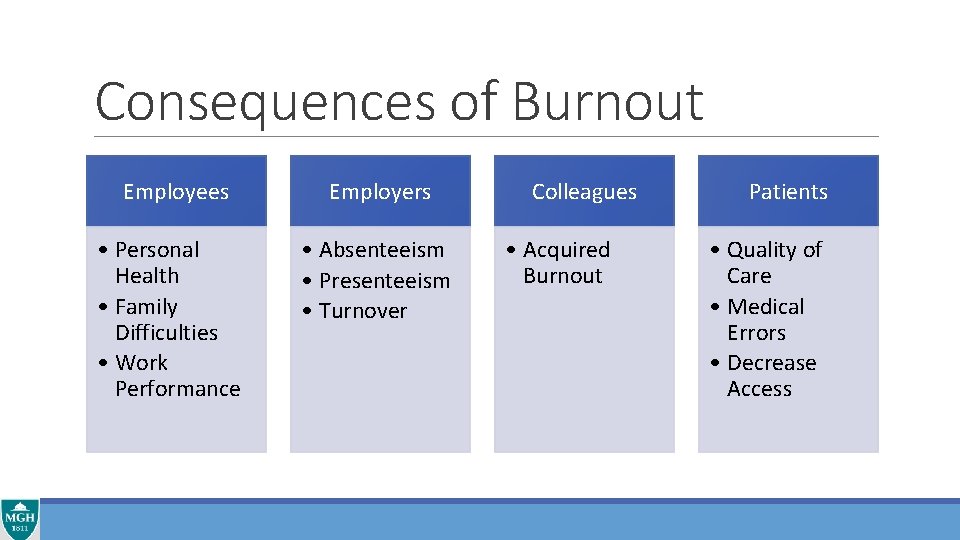
Consequences of Burnout Employees • Personal Health • Family Difficulties • Work Performance Employers • Absenteeism • Presenteeism • Turnover Colleagues • Acquired Burnout Patients • Quality of Care • Medical Errors • Decrease Access
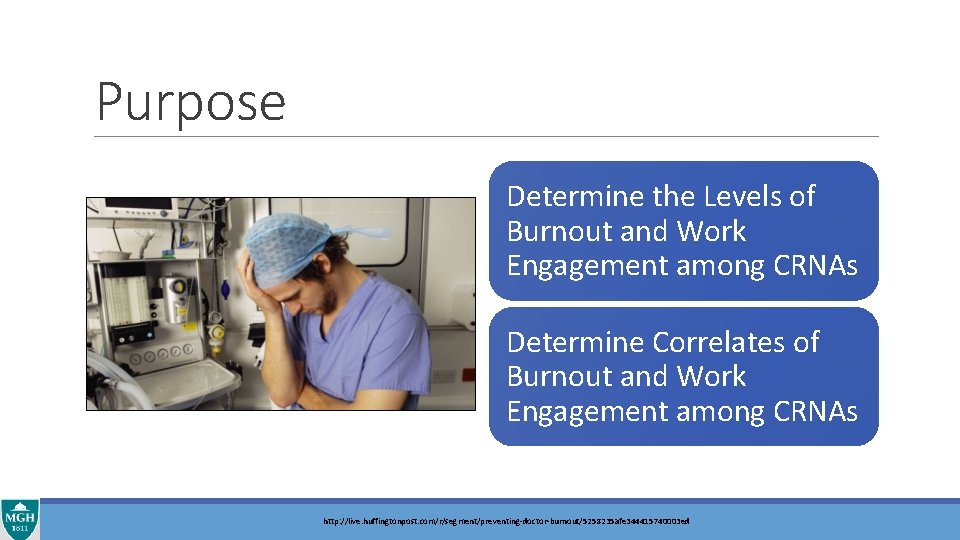
Purpose Determine the Levels of Burnout and Work Engagement among CRNAs Determine Correlates of Burnout and Work Engagement among CRNAs http: //live. huffingtonpost. com/r/segment/preventing-doctor-burnout/5258235 afe 344415740003 ed
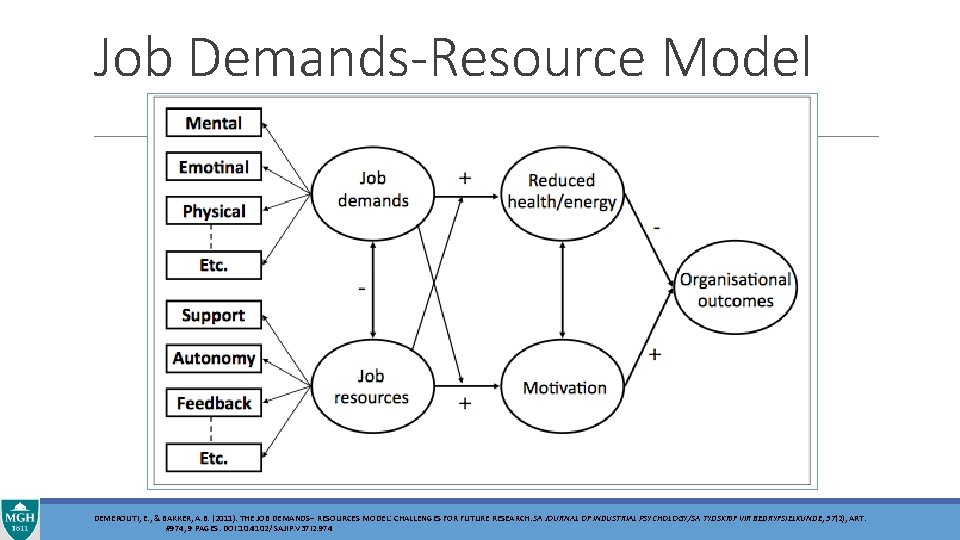
Job Demands-Resource Model DEMEROUTI, E. , & BAKKER, A. B. (2011). THE JOB DEMANDS– RESOURCES MODEL: CHALLENGES FOR FUTURE RESEARCH. SA JOURNAL OF INDUSTRIAL PSYCHOLOGY/SA TYDSKRIF VIR BEDRYFSIELKUNDE, 37(2), ART. #974, 9 PAGES. DOI: 10. 4102/ SAJIP. V 37 I 2. 974
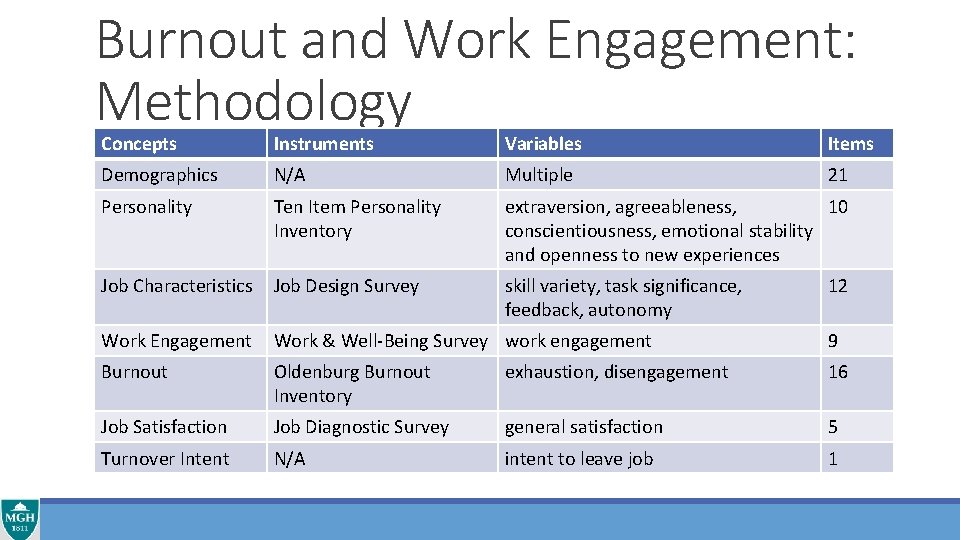
Burnout and Work Engagement: Methodology Concepts Instruments Variables Items Demographics N/A Multiple 21 Personality Ten Item Personality Inventory extraversion, agreeableness, 10 conscientiousness, emotional stability and openness to new experiences Job Characteristics Job Design Survey skill variety, task significance, feedback, autonomy Work Engagement Work & Well-Being Survey work engagement 9 Burnout Oldenburg Burnout Inventory exhaustion, disengagement 16 Job Satisfaction Job Diagnostic Survey general satisfaction 5 Turnover Intent N/A intent to leave job 1 12
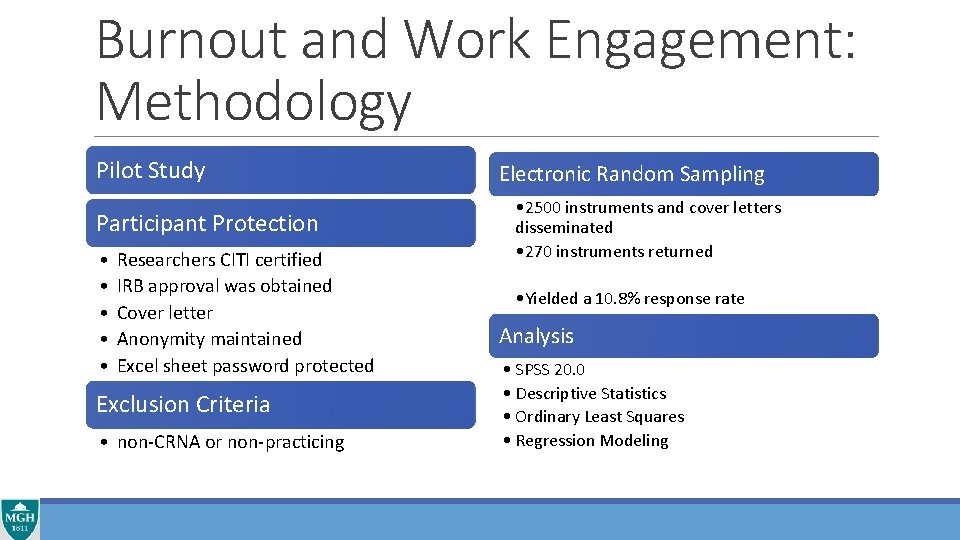
Burnout and Work Engagement: Methodology Pilot Study Participant Protection • • • Researchers CITI certified IRB approval was obtained Cover letter Anonymity maintained Excel sheet password protected Exclusion Criteria • non-CRNA or non-practicing Electronic Random Sampling • 2500 instruments and cover letters disseminated • 270 instruments returned • Yielded a 10. 8% response rate Analysis • SPSS 20. 0 • Descriptive Statistics • Ordinary Least Squares • Regression Modeling
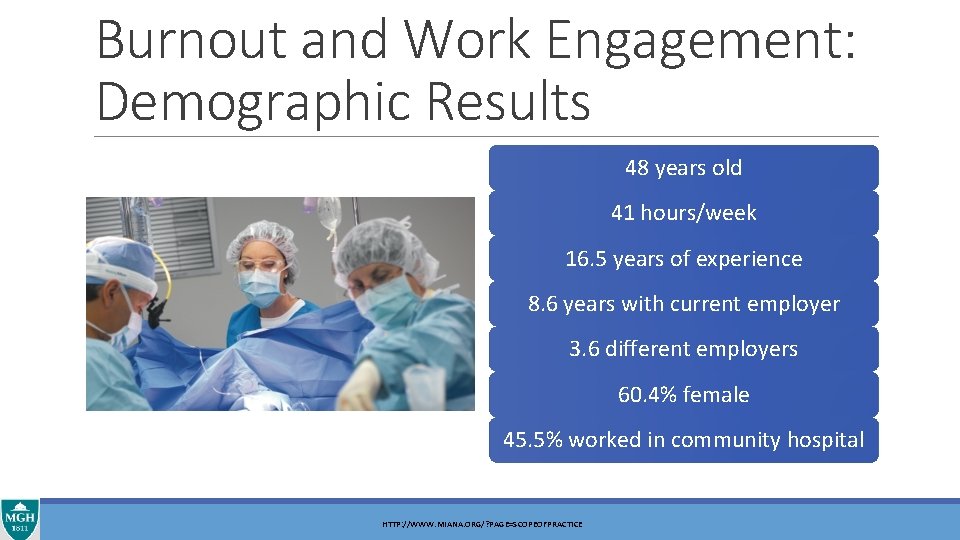
Burnout and Work Engagement: Demographic Results 48 years old 41 hours/week 16. 5 years of experience 8. 6 years with current employer 3. 6 different employers 60. 4% female 45. 5% worked in community hospital HTTP: //WWW. MIANA. ORG/? PAGE=SCOPEOFPRACTICE
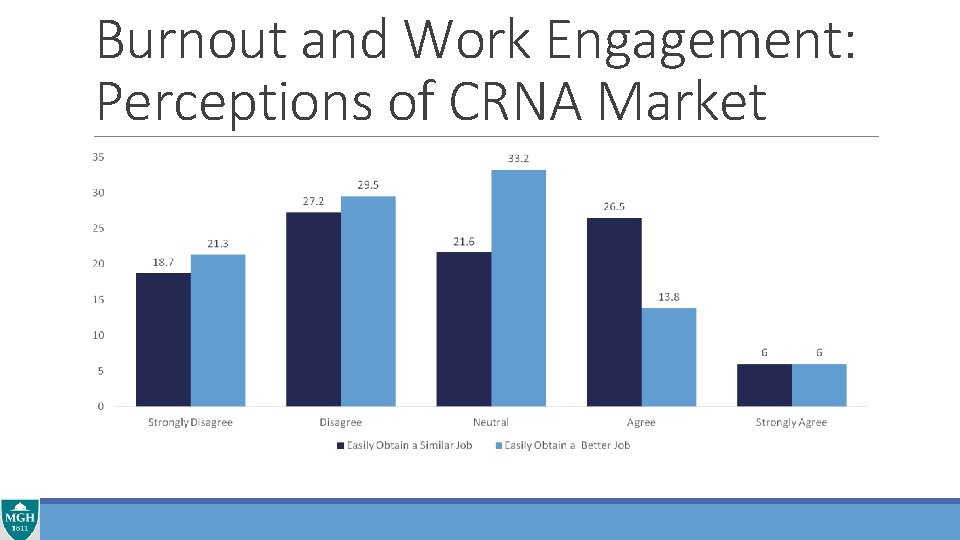
Burnout and Work Engagement: Perceptions of CRNA Market
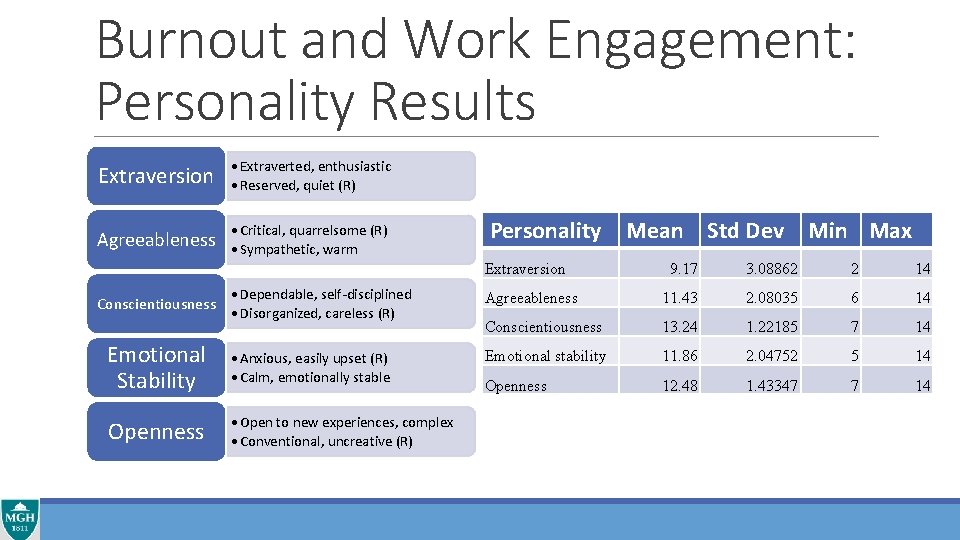
Burnout and Work Engagement: Personality Results Extraversion • Extraverted, enthusiastic • Reserved, quiet (R) Agreeableness • Critical, quarrelsome (R) • Sympathetic, warm Personality Extraversion Mean Std Dev Min Max 9. 17 3. 08862 2 14 • Dependable, self-disciplined • Disorganized, careless (R) Agreeableness 11. 43 2. 08035 6 14 Conscientiousness 13. 24 1. 22185 7 14 Emotional Stability • Anxious, easily upset (R) • Calm, emotionally stable Emotional stability 11. 86 2. 04752 5 14 Openness 12. 48 1. 43347 7 14 Openness • Open to new experiences, complex • Conventional, uncreative (R) Conscientiousness
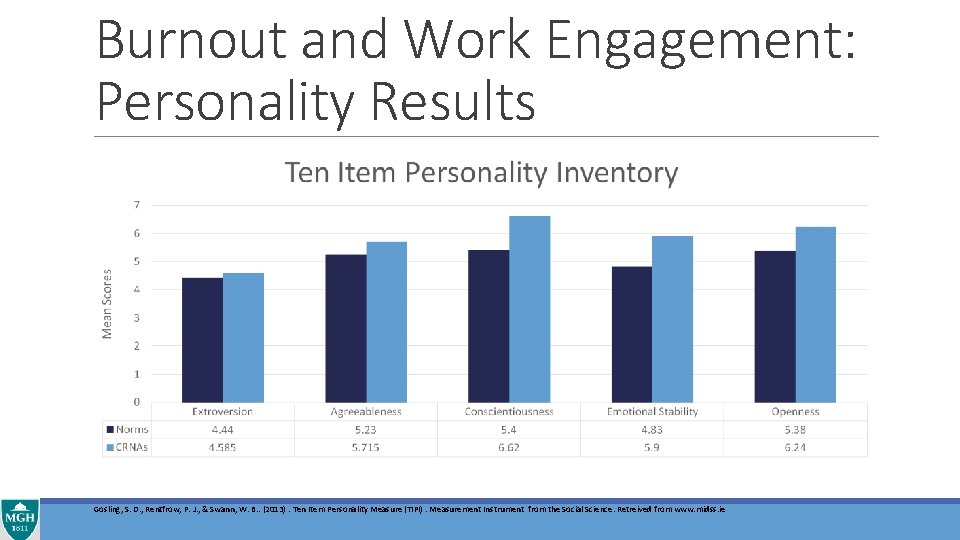
Burnout and Work Engagement: Personality Results Gosling, S. D. , Rentfrow, P. J. , & Swann, W. B. . (2013). Ten Item Personality Measure (TIPI). Measurement Instrument from the Social Science. Retreived from www. midss. ie
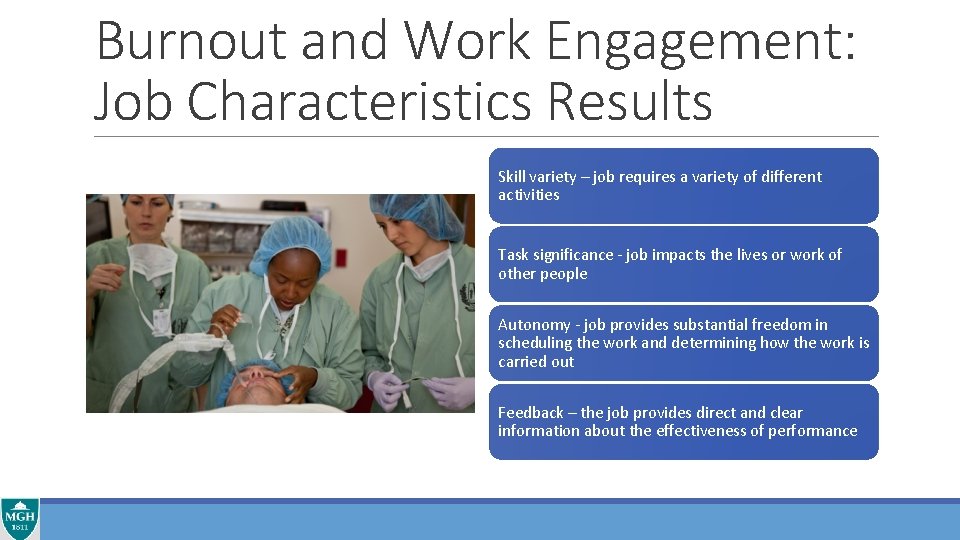
Burnout and Work Engagement: Job Characteristics Results Skill variety – job requires a variety of different activities Task significance - job impacts the lives or work of other people Autonomy - job provides substantial freedom in scheduling the work and determining how the work is carried out Feedback – the job provides direct and clear information about the effectiveness of performance
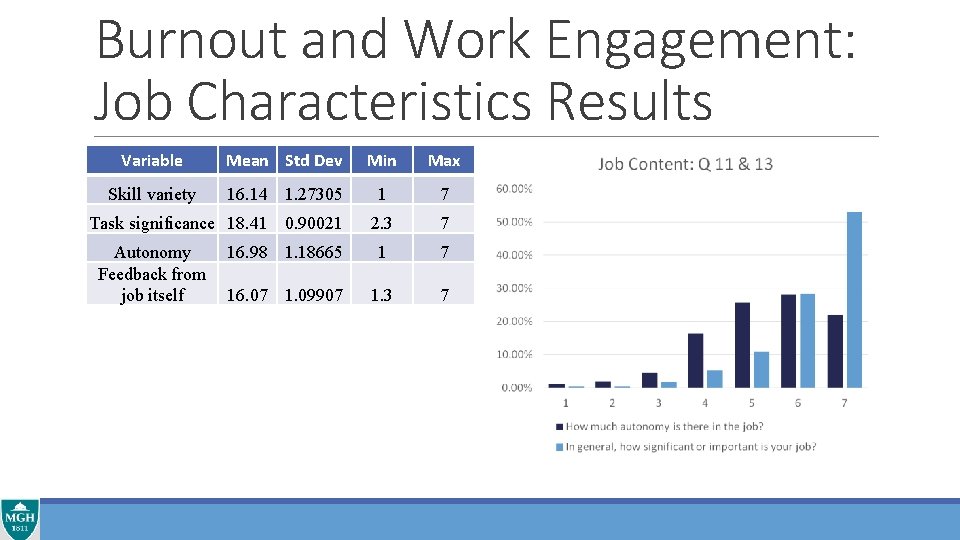
Burnout and Work Engagement: Job Characteristics Results Variable Mean Std Dev Min Max Skill variety 16. 14 1. 27305 1 7 Task significance 18. 41 0. 90021 2. 3 7 Autonomy 16. 98 1. 18665 Feedback from job itself 16. 07 1. 09907 1 7 1. 3 7
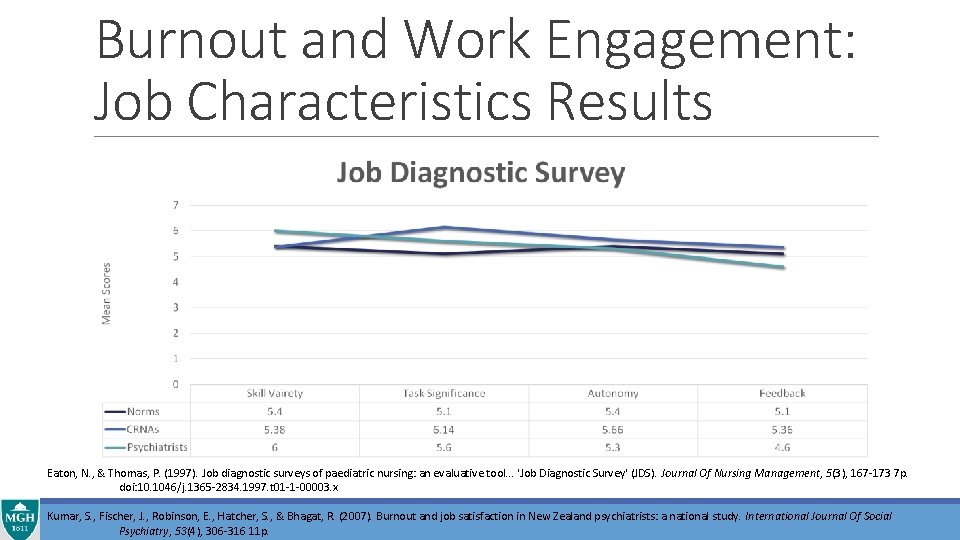
Burnout and Work Engagement: Job Characteristics Results Eaton, N. , & Thomas, P. (1997). Job diagnostic surveys of paediatric nursing: an evaluative tool. . . 'Job Diagnostic Survey' (JDS). Journal Of Nursing Management, 5(3), 167 -173 7 p. doi: 10. 1046/j. 1365 -2834. 1997. t 01 -1 -00003. x Kumar, S. , Fischer, J. , Robinson, E. , Hatcher, S. , & Bhagat, R. (2007). Burnout and job satisfaction in New Zealand psychiatrists: a national study. International Journal Of Social Psychiatry, 53(4), 306 -316 11 p.
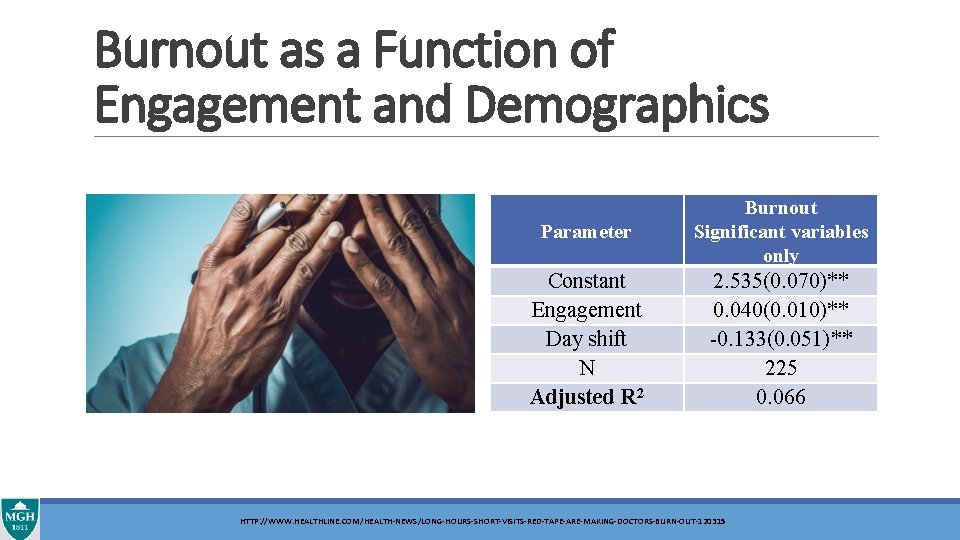
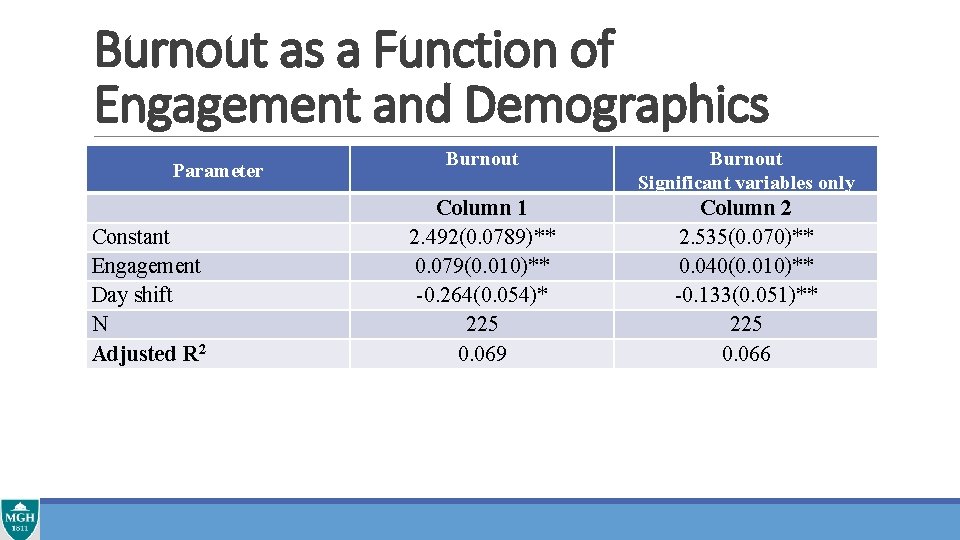
Burnout as a Function of Engagement and Demographics Parameter Burnout Significant variables only Constant Engagement Day shift N Adjusted R 2 2. 535(0. 070)** 0. 040(0. 010)** -0. 133(0. 051)** 225 0. 066 HTTP: //WWW. HEALTHLINE. COM/HEALTH-NEWS/LONG-HOURS-SHORT-VISITS-RED-TAPE-ARE-MAKING-DOCTORS-BURN-OUT-120315
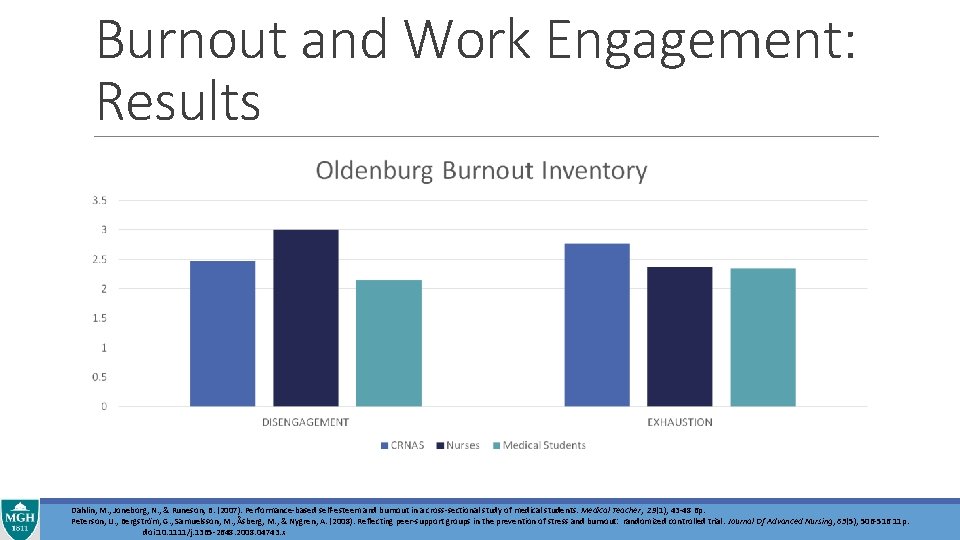
Burnout and Work Engagement: Results Dahlin, M. , Joneborg, N. , & Runeson, B. (2007). Performance-based self-esteem and burnout in a cross-sectional study of medical students. Medical Teacher, 29(1), 43 -48 6 p. Peterson, U. , Bergström, G. , Samuelsson, M. , Åsberg, M. , & Nygren, A. (2008). Reflecting peer-support groups in the prevention of stress and burnout: randomized controlled trial. Journal Of Advanced Nursing, 63(5), 506 -516 11 p. doi: 10. 1111/j. 1365 -2648. 2008. 04743. x
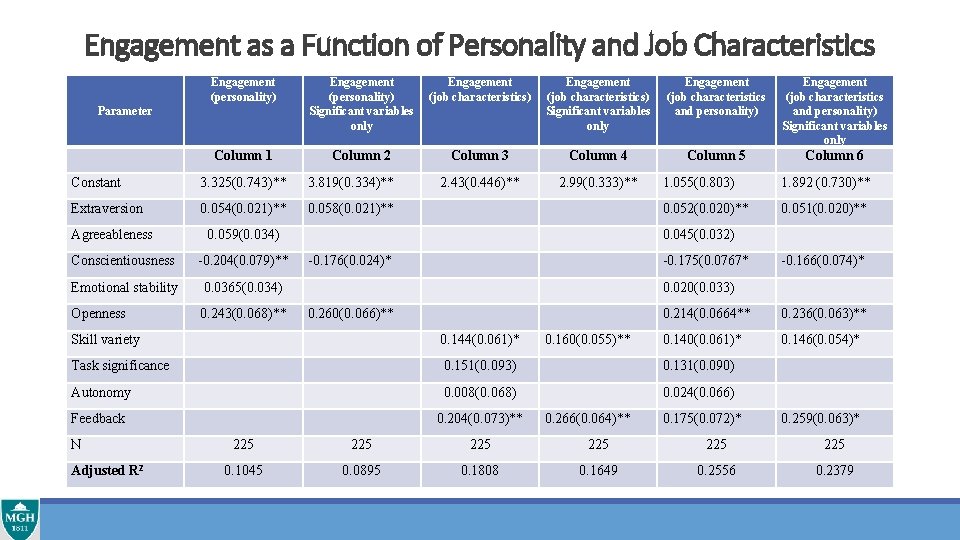
Engagement as a Function of Personality and Job Characteristics Parameter Engagement (personality) (job characteristics) Significant variables only Column 1 Column 2 Engagement (job characteristics) Significant variables only Engagement (job characteristics and personality) Significant variables only Column 3 Column 4 Column 5 Column 6 Constant 3. 325(0. 743)** 3. 819(0. 334)** 2. 43(0. 446)** 2. 99(0. 333)** Extraversion 0. 054(0. 021)** 0. 058(0. 021)** Agreeableness 0. 059(0. 034) 1. 055(0. 803) 1. 892 (0. 730)** 0. 052(0. 020)** 0. 051(0. 020)** 0. 045(0. 032) -0. 176(0. 024)* -0. 175(0. 0767* -0. 166(0. 074)* Conscientiousness -0. 204(0. 079)** Emotional stability 0. 0365(0. 034) 0. 020(0. 033) Openness 0. 243(0. 068)** 0. 260(0. 066)** 0. 214(0. 0664** 0. 236(0. 063)** Skill variety 0. 144(0. 061)* 0. 160(0. 055)** 0. 140(0. 061)* 0. 146(0. 054)* Task significance 0. 151(0. 093) 0. 131(0. 090) Autonomy 0. 008(0. 068) 0. 024(0. 066) Feedback 0. 204(0. 073)** 0. 266(0. 064)** 0. 175(0. 072)* 0. 259(0. 063)* 225 225 225 0. 1045 0. 0895 0. 1808 0. 1649 0. 2556 0. 2379 N Adjusted R 2
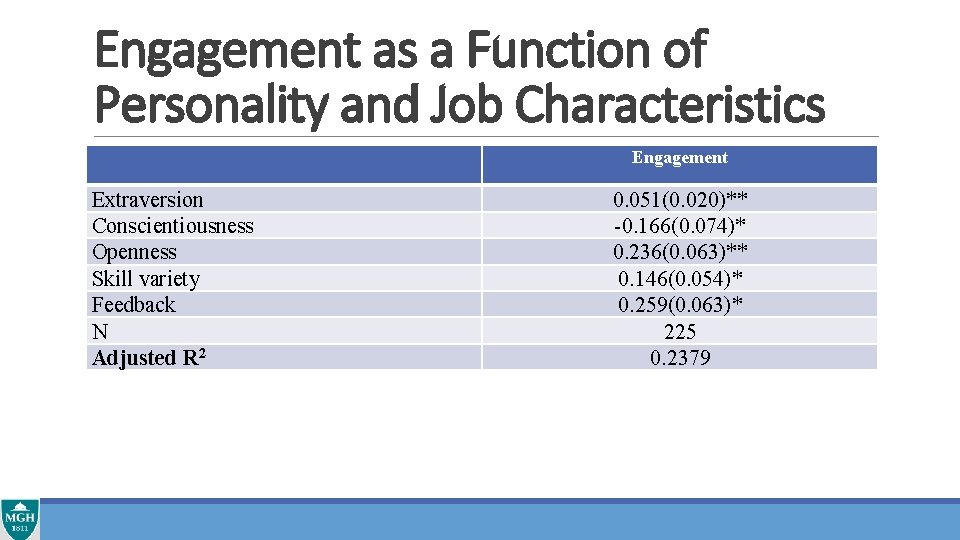
Engagement as a Function of Personality and Job Characteristics Engagement Extraversion Conscientiousness Openness Skill variety Feedback N Adjusted R 2 0. 051(0. 020)** -0. 166(0. 074)* 0. 236(0. 063)** 0. 146(0. 054)* 0. 259(0. 063)* 225 0. 2379
Burnout as a Function of Engagement and Demographics Parameter Constant Engagement Day shift N Adjusted R 2 Burnout Significant variables only Column 1 2. 492(0. 0789)** 0. 079(0. 010)** -0. 264(0. 054)* 225 0. 069 Column 2 2. 535(0. 070)** 0. 040(0. 010)** -0. 133(0. 051)** 225 0. 066
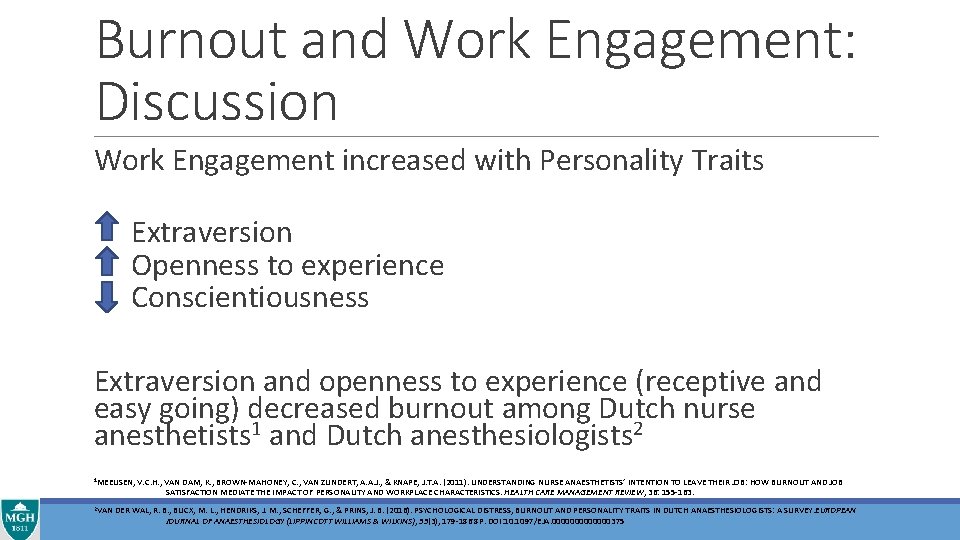
Burnout and Work Engagement: Discussion Work Engagement increased with Personality Traits Extraversion Openness to experience Conscientiousness Extraversion and openness to experience (receptive and easy going) decreased burnout among Dutch nurse anesthetists 1 and Dutch anesthesiologists 2 1 MEEUSEN, 2 VAN V. C. H. , VAN DAM, K. , BROWN-MAHONEY, C. , VAN ZUNDERT, A. A. J. , & KNAPE, J. T. A. (2011). UNDERSTANDING NURSE ANAESTHETISTS’ INTENTION TO LEAVE THEIR JOB: HOW BURNOUT AND JOB SATISFACTION MEDIATE THE IMPACT OF PERSONALITY AND WORKPLACE CHARACTERISTICS. HEALTH CARE MANAGEMENT REVIEW, 36: 155 -163. DER WAL, R. B. , BUCX, M. L. , HENDRIKS, J. M. , SCHEFFER, G. , & PRINS, J. B. (2016). PSYCHOLOGICAL DISTRESS, BURNOUT AND PERSONALITY TRAITS IN DUTCH ANAESTHESIOLOGISTS: A SURVEY. EUROPEAN JOURNAL OF ANAESTHESIOLOGY (LIPPINCOTT WILLIAMS & WILKINS), 33(3), 179 -186 8 P. DOI: 10. 1097/EJA. 0000000375
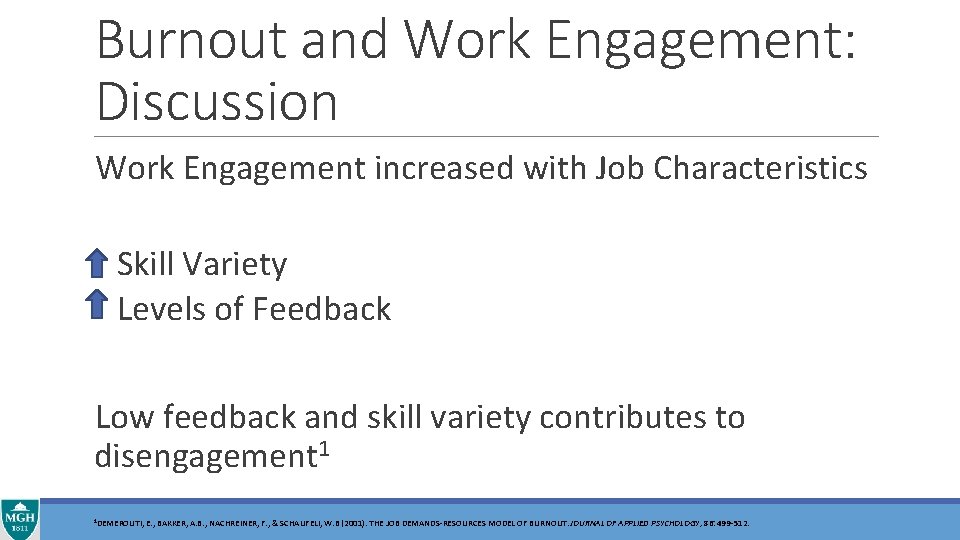
Burnout and Work Engagement: Discussion Work Engagement increased with Job Characteristics Skill Variety Levels of Feedback Low feedback and skill variety contributes to disengagement 1 1 DEMEROUTI, E. , BAKKER, A. B. , NACHREINER, F. , & SCHAUFELI, W. B (2001). THE JOB DEMANDS-RESOURCES MODEL OF BURNOUT. JOURNAL OF APPLIED PSYCHOLOGY, 86: 499 -512.
Burnout and Work Engagement: Discussion Work Engagement and Burnout are negatively correlated ◦ Higher levels of employee engagement are associated with lower levels of employee burnout 1 Primary shift worked is a significant determinant of burnout ◦ If some shifts feature more work demands than other shifts, then our results are consistent with the literature that finds that work demands is a determinant of burnout 2, 3 1 BAKKER, A. B. , DEMEROUTI, E. , & SCHAUFELI, W. B. (2005). THE CROSS-OVER OF BURNOUT AND WORK ENGAGEMENT AMONG WORKING COUPLES. HUMAN RELATIONS, 58: 661 -689. J. J. , BAKKER, A. B. , & SCHAUFELI, W. B. (2006). BURNOUT AND WORK ENGAGEMENT AMONG TEACHERS. JOURNAL OF SCHOOL PSYCHOLOGY, 43: 495 -513. 3 SCHAUFELI, W. B. , BAKKER, A. B. , & VAN RHENEN, W. (2009). HOW CHANGES IN JOB DEMANDS AND RESOURCES PREDICT BURNOUT, WORK ENGAGEMENT, AND SICKNESS ABSENTEEISM. JOURNAL OF ORGANIZATIONAL BEHAVIOR, 30: 893 -917. 2 HAKANEN,
Burnout and Work Engagement: Future Research and Limitations Future Research Limitations
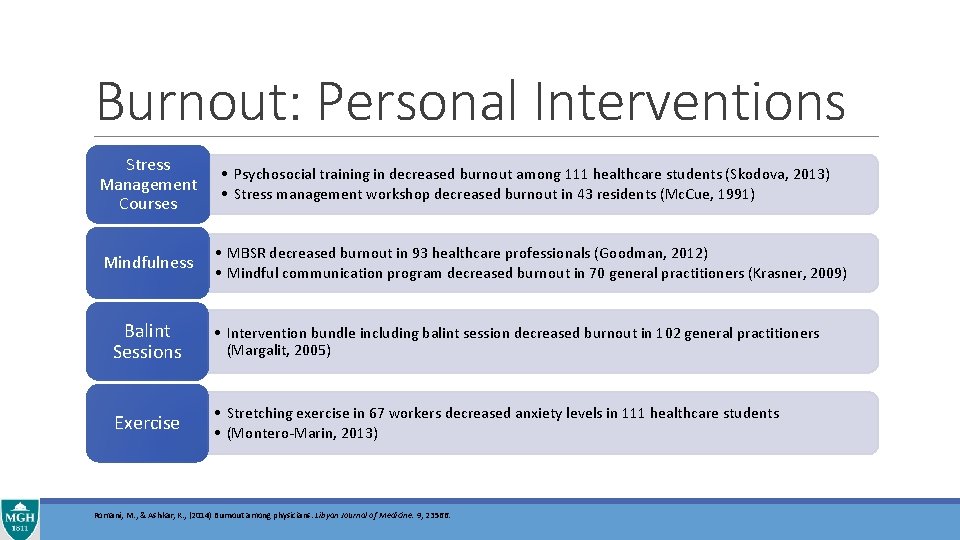
Burnout: Personal Interventions Stress Management Courses Mindfulness • Psychosocial training in decreased burnout among 111 healthcare students (Skodova, 2013) • Stress management workshop decreased burnout in 43 residents (Mc. Cue, 1991) • MBSR decreased burnout in 93 healthcare professionals (Goodman, 2012) • Mindful communication program decreased burnout in 70 general practitioners (Krasner, 2009) Balint Sessions • Intervention bundle including balint session decreased burnout in 102 general practitioners (Margalit, 2005) Exercise • Stretching exercise in 67 workers decreased anxiety levels in 111 healthcare students • (Montero-Marin, 2013) Romani, M. , & Ashkar, K. , (2014) Burnout among physicians. Libyan Journal of Medicine. 9, 23566.
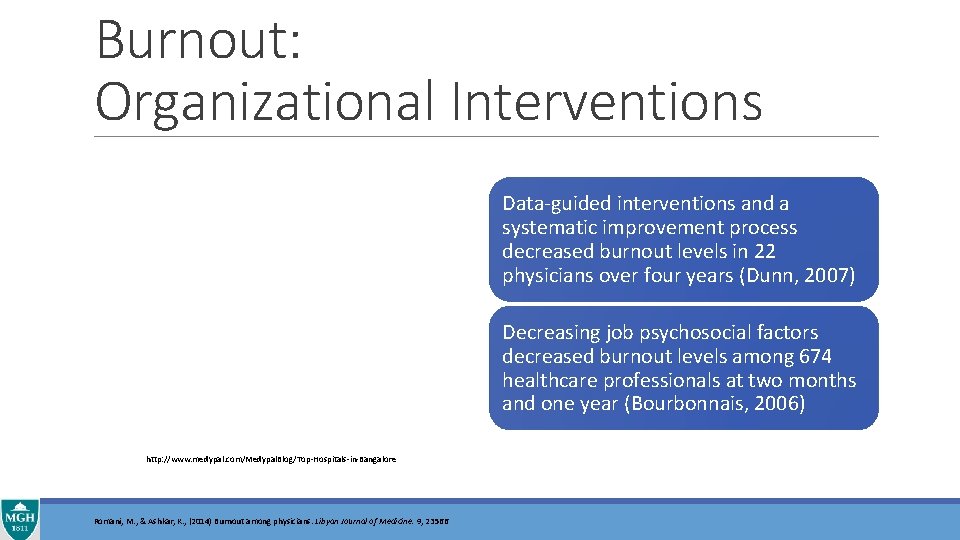
Burnout: Organizational Interventions Data-guided interventions and a systematic improvement process decreased burnout levels in 22 physicians over four years (Dunn, 2007) Decreasing job psychosocial factors decreased burnout levels among 674 healthcare professionals at two months and one year (Bourbonnais, 2006) http: //www. medypal. com/Medypal. Blog/Top-Hospitals-in-Bangalore Romani, M. , & Ashkar, K. , (2014) Burnout among physicians. Libyan Journal of Medicine. 9, 23566
Massachusetts General Hospital: Wellness Committee
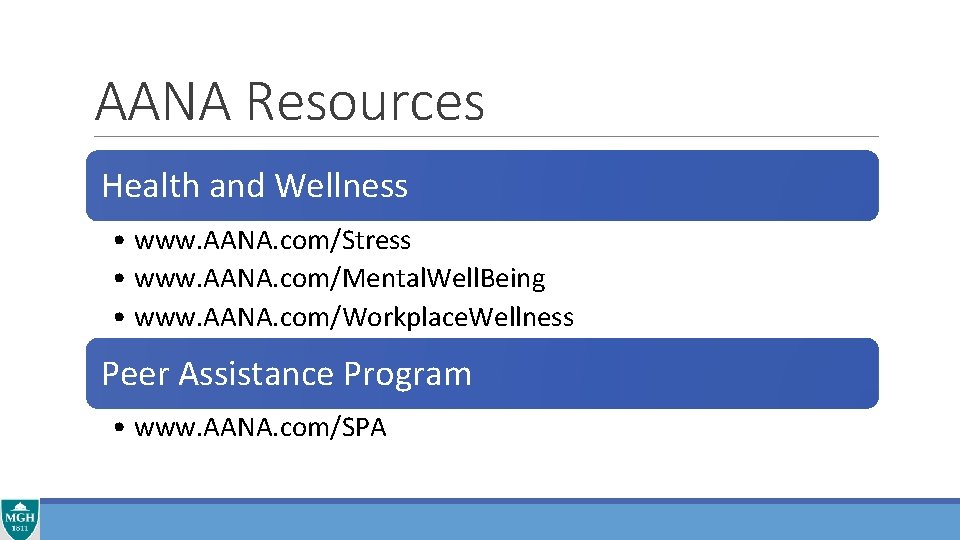
AANA Resources Health and Wellness • www. AANA. com/Stress • www. AANA. com/Mental. Well. Being • www. AANA. com/Workplace. Wellness Peer Assistance Program • www. AANA. com/SPA
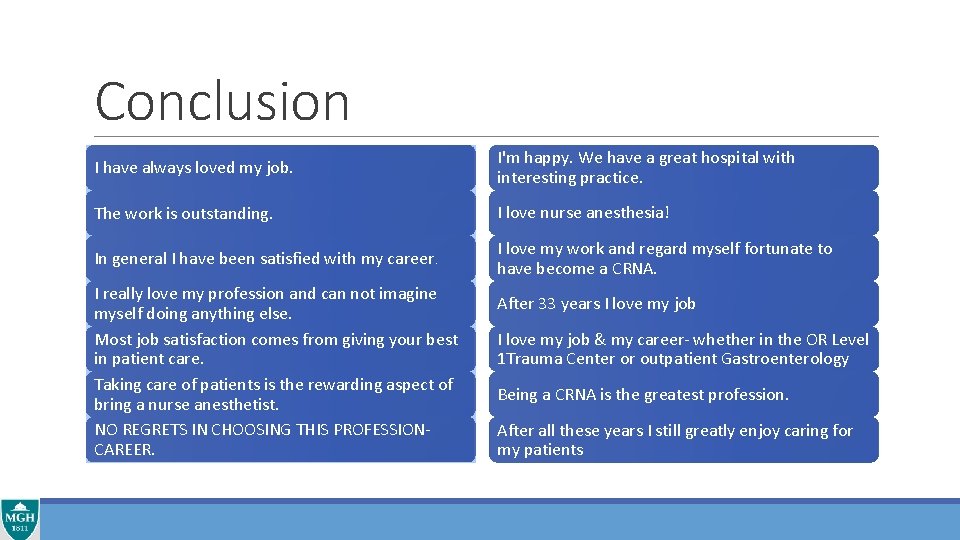
Conclusion I have always loved my job. I'm happy. We have a great hospital with interesting practice. The work is outstanding. I love nurse anesthesia! In general I have been satisfied with my career. I love my work and regard myself fortunate to have become a CRNA. I really love my profession and can not imagine myself doing anything else. Most job satisfaction comes from giving your best in patient care. Taking care of patients is the rewarding aspect of bring a nurse anesthetist. NO REGRETS IN CHOOSING THIS PROFESSIONCAREER. After 33 years I love my job & my career- whether in the OR Level 1 Trauma Center or outpatient Gastroenterology Being a CRNA is the greatest profession. After all these years I still greatly enjoy caring for my patients
Questions?
Josh Lea jlea 1@mgh. harvard. edu