The Heap Data Structure Cutler Overview Usage of
- Slides: 50
The Heap Data Structure Cutler
Overview • Usage of a heap – Priority queue – Heap. Sort • Definitions: height, depth, full binary tree, complete binary tree • Definition of a heap • Methods of a heap 12/4/2020 Cutler 2
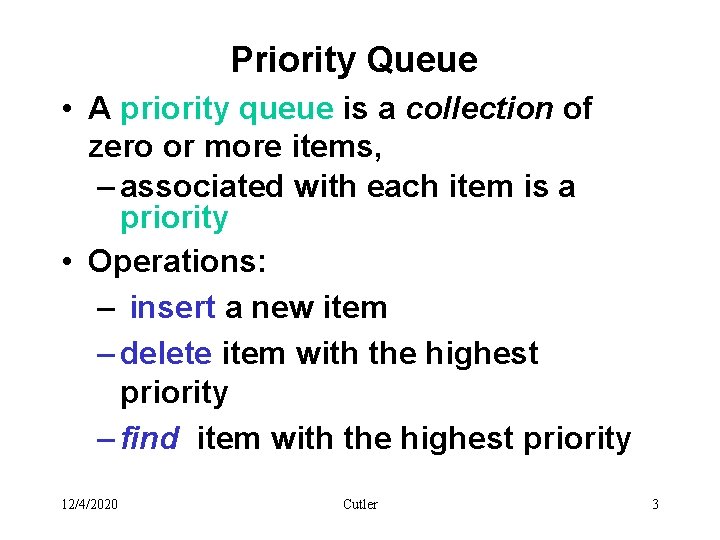
Priority Queue • A priority queue is a collection of zero or more items, – associated with each item is a priority • Operations: – insert a new item – delete item with the highest priority – find item with the highest priority 12/4/2020 Cutler 3
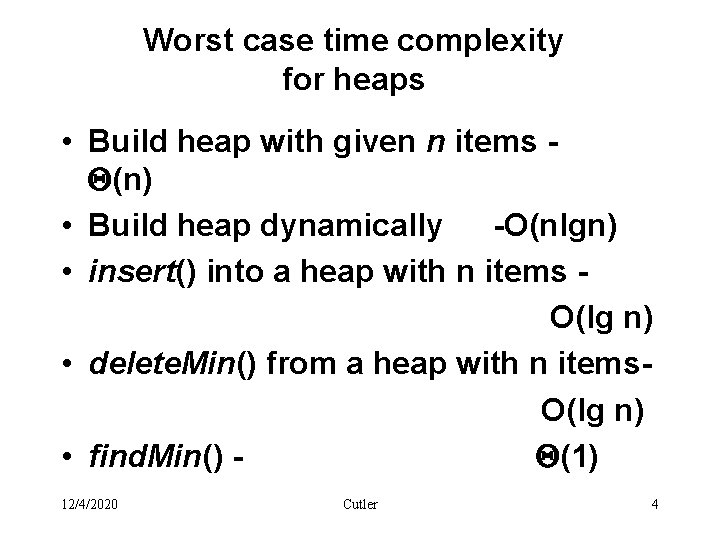
Worst case time complexity for heaps • Build heap with given n items (n) • Build heap dynamically -O(nlgn) • insert() into a heap with n items O(lg n) • delete. Min() from a heap with n items. O(lg n) • find. Min() (1) 12/4/2020 Cutler 4
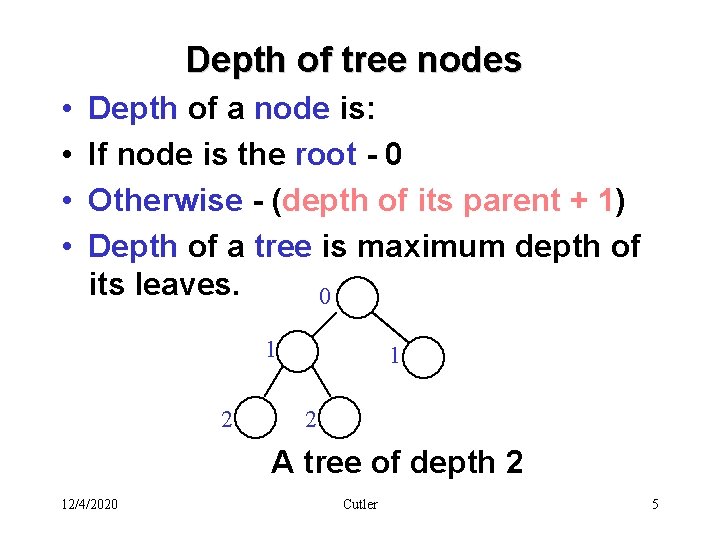
Depth of tree nodes • • Depth of a node is: If node is the root - 0 Otherwise - (depth of its parent + 1) Depth of a tree is maximum depth of its leaves. 0 1 2 A tree of depth 2 12/4/2020 Cutler 5
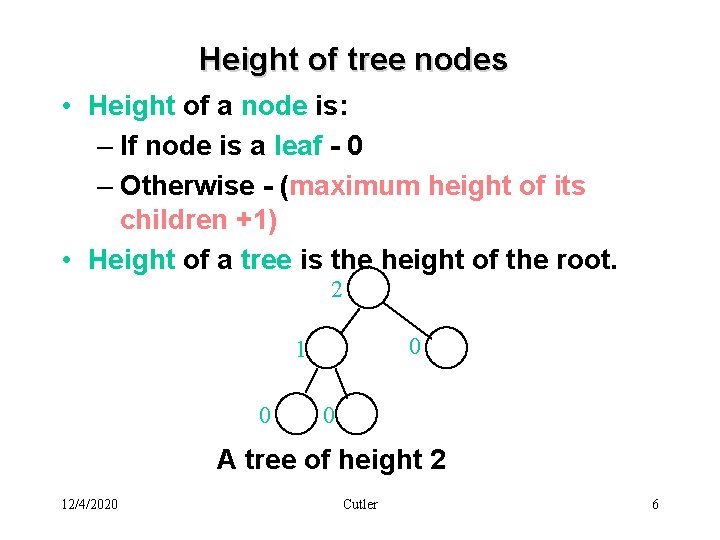
Height of tree nodes • Height of a node is: – If node is a leaf - 0 – Otherwise - (maximum height of its children +1) • Height of a tree is the height of the root. 2 0 1 0 0 A tree of height 2 12/4/2020 Cutler 6
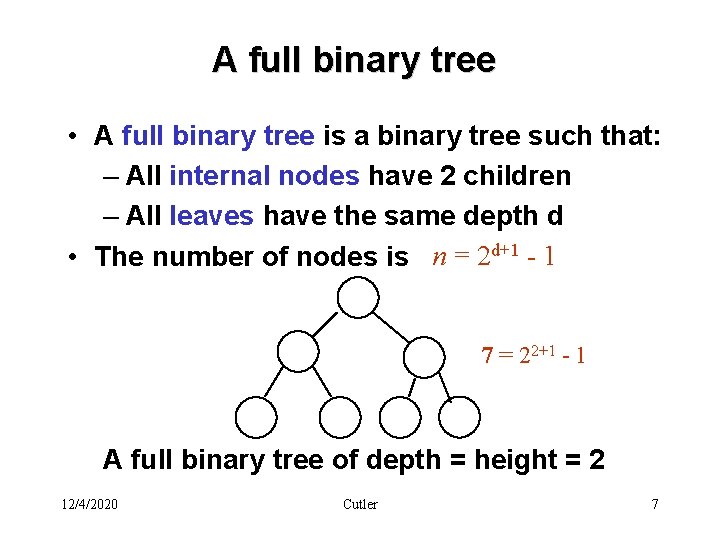
A full binary tree • A full binary tree is a binary tree such that: – All internal nodes have 2 children – All leaves have the same depth d • The number of nodes is n = 2 d+1 - 1 7 = 22+1 - 1 A full binary tree of depth = height = 2 12/4/2020 Cutler 7
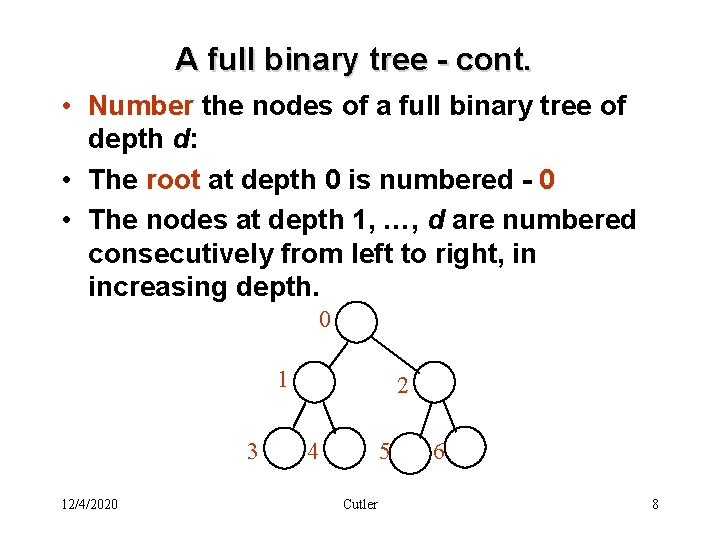
A full binary tree - cont. • Number the nodes of a full binary tree of depth d: • The root at depth 0 is numbered - 0 • The nodes at depth 1, …, d are numbered consecutively from left to right, in increasing depth. 0 1 3 12/4/2020 2 4 5 Cutler 6 8
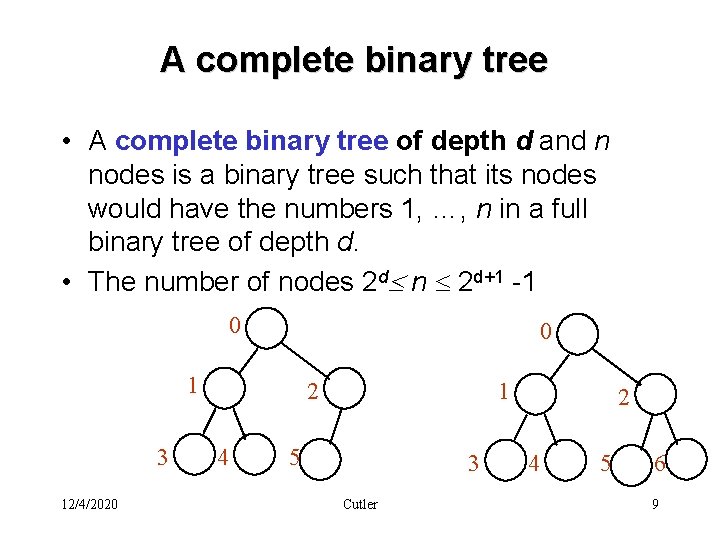
A complete binary tree • A complete binary tree of depth d and n nodes is a binary tree such that its nodes would have the numbers 1, …, n in a full binary tree of depth d. • The number of nodes 2 d n 2 d+1 -1 0 0 1 3 12/4/2020 2 4 1 5 3 Cutler 2 4 5 6 9
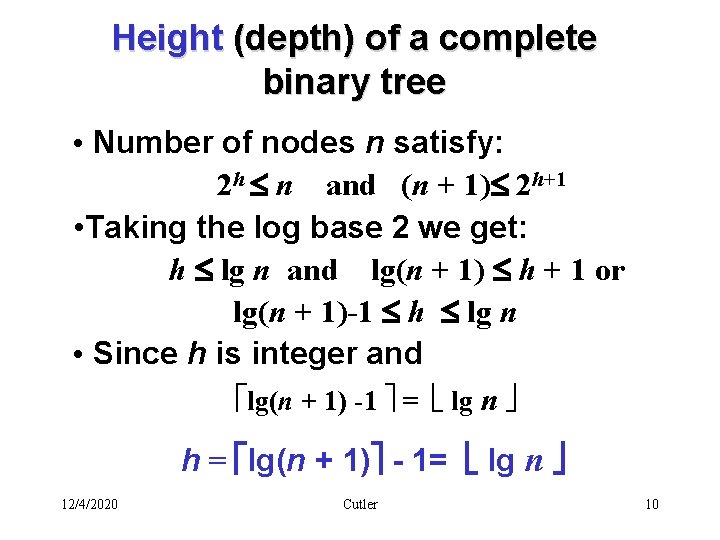
Height (depth) of a complete binary tree • Number of nodes n satisfy: 2 h n and (n + 1) 2 h+1 • Taking the log base 2 we get: h lg n and lg(n + 1) h + 1 or lg(n + 1)-1 h lg n • Since h is integer and lg(n + 1) -1 = lg n h = lg(n + 1) - 1= lg n 12/4/2020 Cutler 10
Definition of a heap • A heap is a complete binary tree that satisfies the heap property. • Minimum Heap Property: The value stored at each node is less than or equal to the values stored at its children. – OR Maximum Heap Property: greater 12/4/2020 Cutler 11
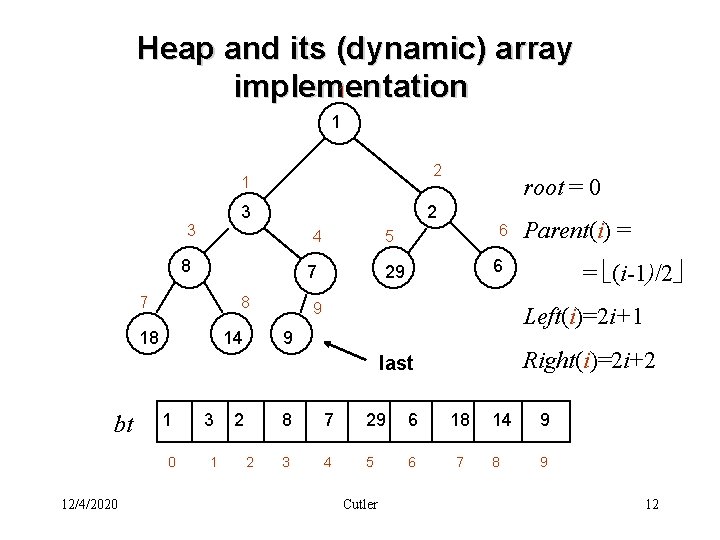
Heap and its (dynamic) array implementation 1 1 2 1 3 3 2 4 8 8 18 14 6 5 7 7 root = 0 6 29 9 12/4/2020 1 3 9 0 1 2 2 = (i-1)/2 Left(i)=2 i+1 Right(i)=2 i+2 last bt Parent(i) = 8 7 29 6 18 3 4 5 6 7 Cutler 14 9 8 9 12
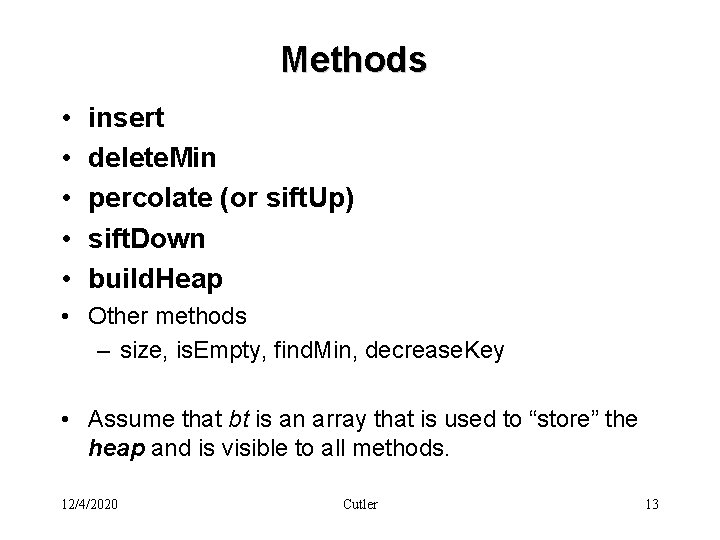
Methods • • • insert delete. Min percolate (or sift. Up) sift. Down build. Heap • Other methods – size, is. Empty, find. Min, decrease. Key • Assume that bt is an array that is used to “store” the heap and is visible to all methods. 12/4/2020 Cutler 13
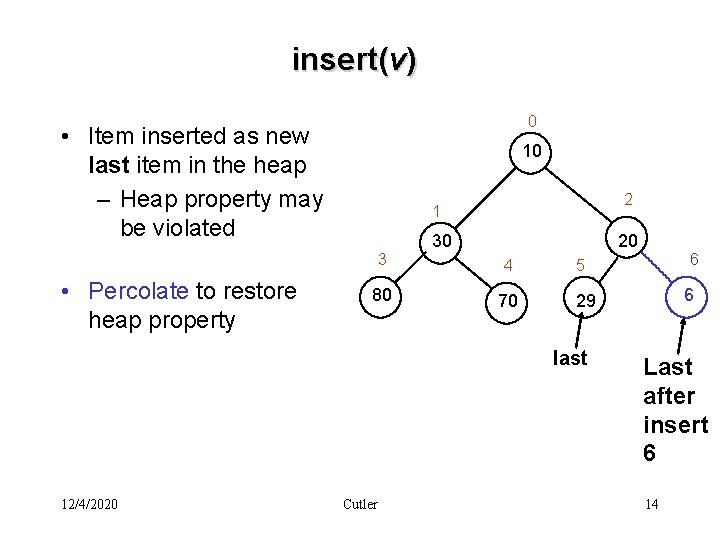
insert(v) 0 • Item inserted as new last item in the heap – Heap property may be violated 10 3 • Percolate to restore heap property 2 1 80 30 20 4 70 Cutler 6 29 last 12/4/2020 6 5 Last after insert 6 14
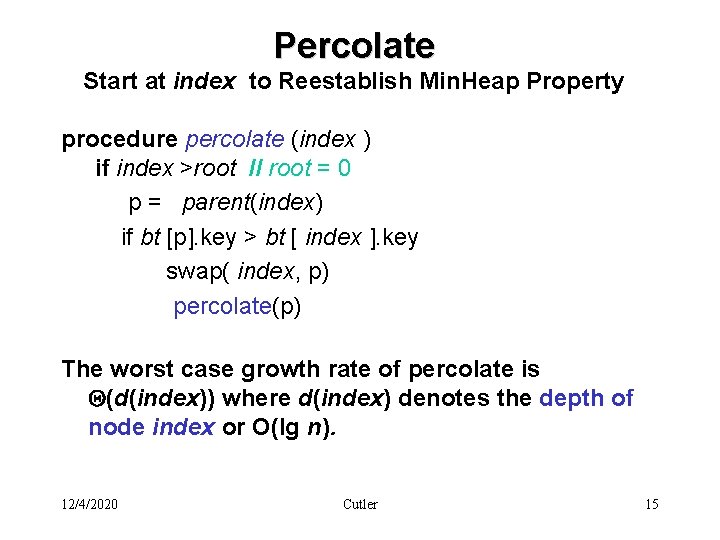
Percolate Start at index to Reestablish Min. Heap Property procedure percolate (index ) if index >root // root = 0 p = parent(index) if bt [p]. key > bt [ index ]. key swap( index, p) percolate(p) The worst case growth rate of percolate is (d(index)) where d(index) denotes the depth of node index or O(lg n). 12/4/2020 Cutler 15
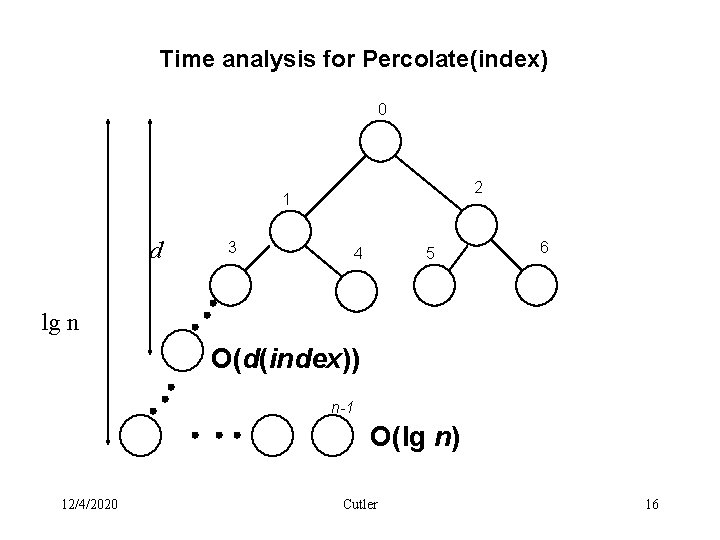
Time analysis for Percolate(index) 0 2 1 d 3 4 5 6 lg n O(d(index)) n-1 O(lg n) 12/4/2020 Cutler 16
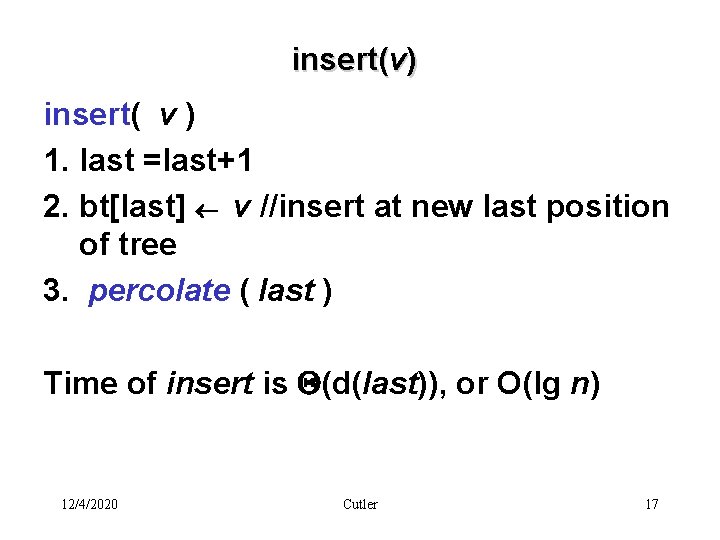
insert(v) insert( v ) 1. last =last+1 2. bt[last] ¬ v //insert at new last position of tree 3. percolate ( last ) Time of insert is (d(last)), or O(lg n) 12/4/2020 Cutler 17
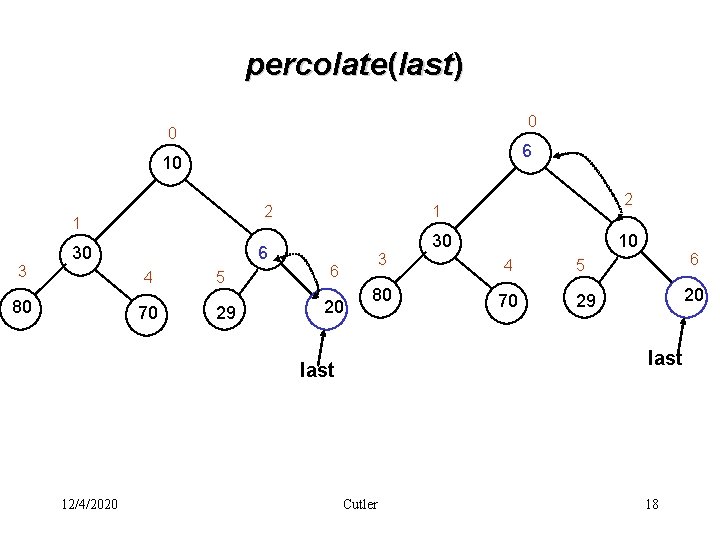
percolate(last) 0 0 6 10 2 1 3 30 6 4 80 70 5 29 3 6 20 80 30 10 4 70 6 5 20 29 last 12/4/2020 2 1 Cutler 18
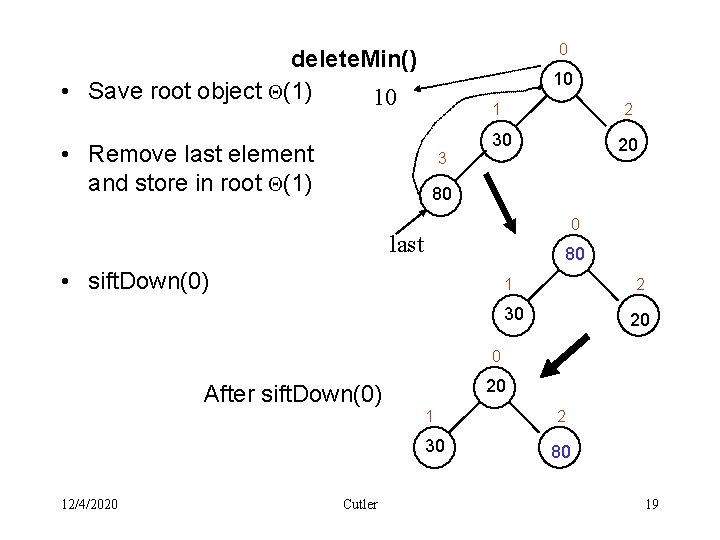
0 delete. Min() • Save root object (1) 10 • Remove last element and store in root (1) 10 1 3 2 30 20 80 0 last 80 • sift. Down(0) 1 2 30 20 0 After sift. Down(0) 20 1 30 12/4/2020 Cutler 2 80 19
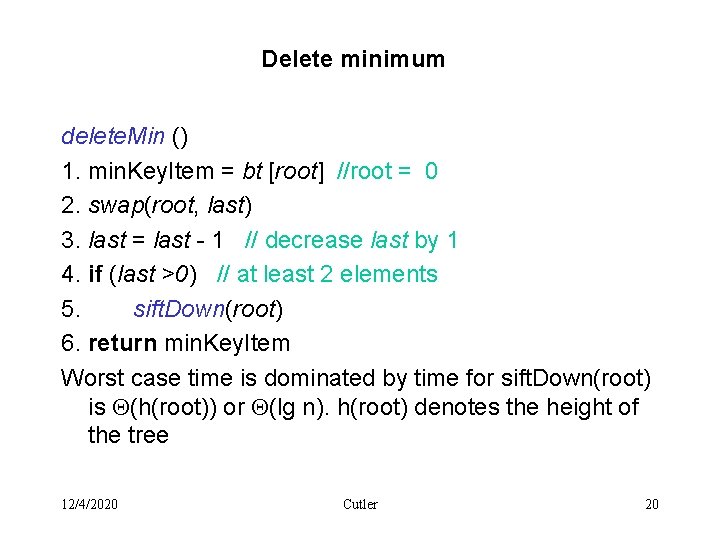
Delete minimum delete. Min () 1. min. Key. Item = bt [root] //root = 0 2. swap(root, last) 3. last = last - 1 // decrease last by 1 4. if (last >0) // at least 2 elements 5. sift. Down(root) 6. return min. Key. Item Worst case time is dominated by time for sift. Down(root) is (h(root)) or (lg n). h(root) denotes the height of the tree 12/4/2020 Cutler 20
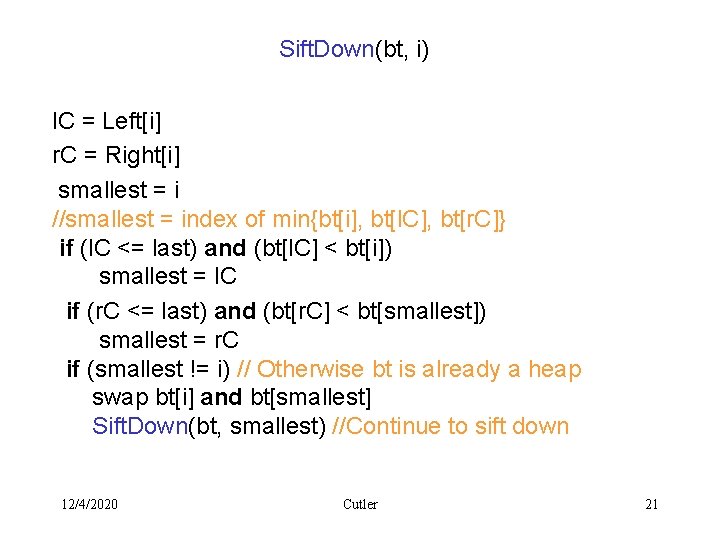
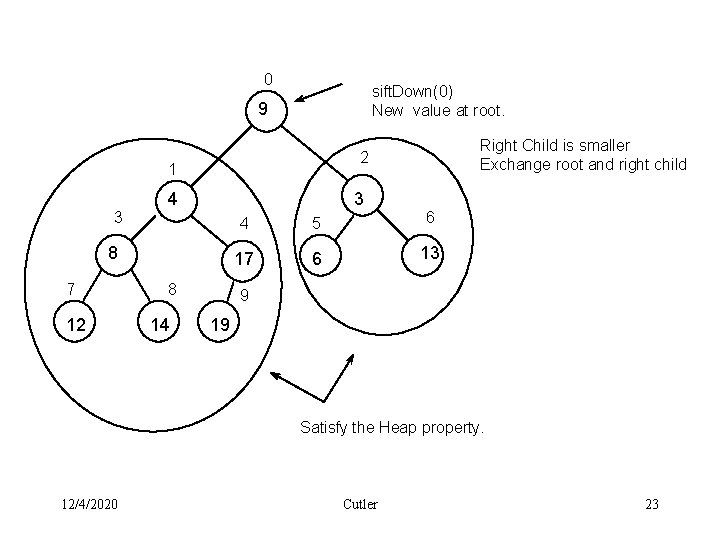
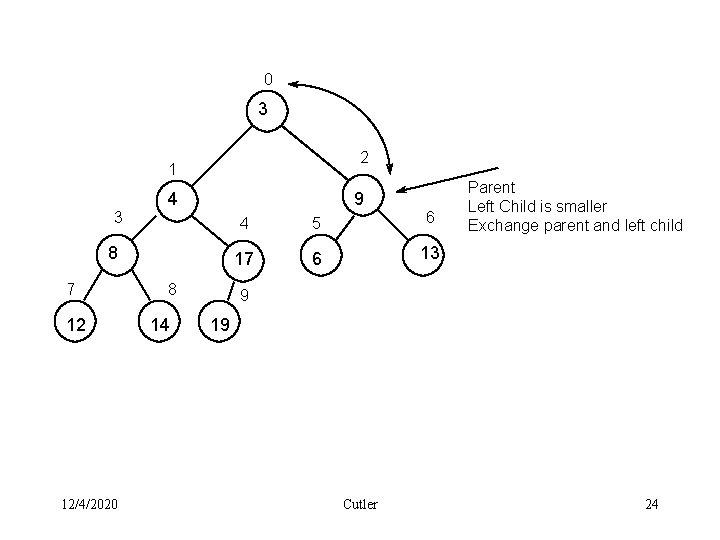
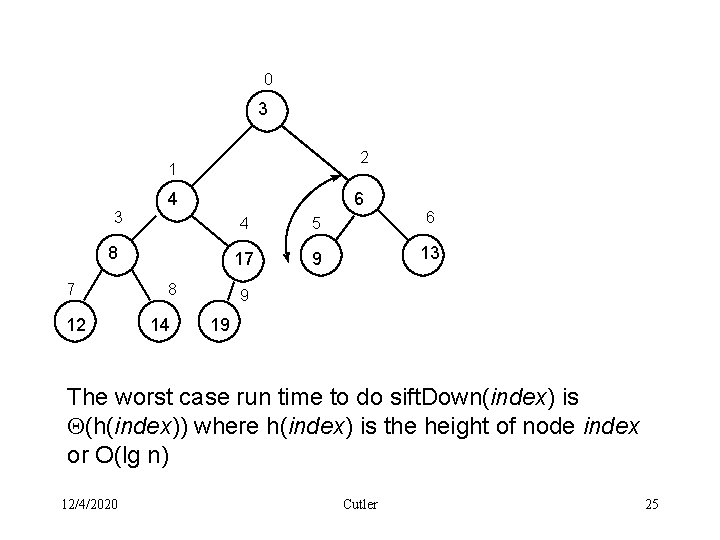
Sift. Down(bt, i) l. C = Left[i] r. C = Right[i] smallest = i //smallest = index of min{bt[i], bt[l. C], bt[r. C]} if (l. C <= last) and (bt[l. C] < bt[i]) smallest = l. C if (r. C <= last) and (bt[r. C] < bt[smallest]) smallest = r. C if (smallest != i) // Otherwise bt is already a heap swap bt[i] and bt[smallest] Sift. Down(bt, smallest) //Continue to sift down 12/4/2020 Cutler 21
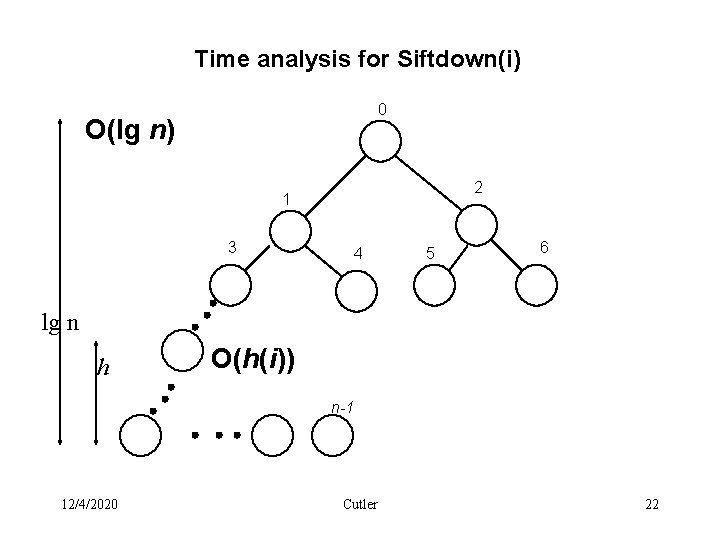
Time analysis for Siftdown(i) 0 O(lg n) 2 1 3 4 5 6 lg n h O(h(i)) n-1 12/4/2020 Cutler 22
0 sift. Down(0) New value at root. 9 1 3 4 3 8 7 12 8 14 Right Child is smaller Exchange root and right child 2 4 5 6 17 6 13 9 19 Satisfy the Heap property. 12/4/2020 Cutler 23
0 3 2 1 3 4 9 8 7 12 12/4/2020 8 14 4 5 6 17 6 13 Parent Left Child is smaller Exchange parent and left child 9 19 Cutler 24
0 3 2 1 3 4 6 8 7 12 8 14 4 5 6 17 9 13 9 19 The worst case run time to do sift. Down(index) is (h(index)) where h(index) is the height of node index or O(lg n) 12/4/2020 Cutler 25
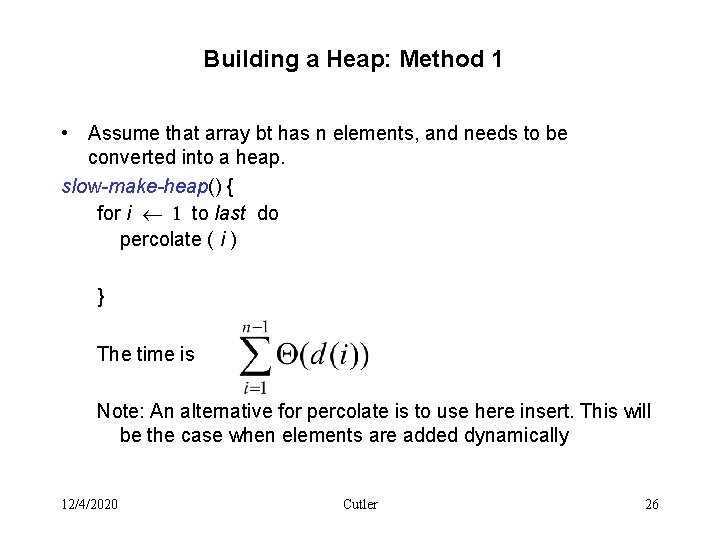
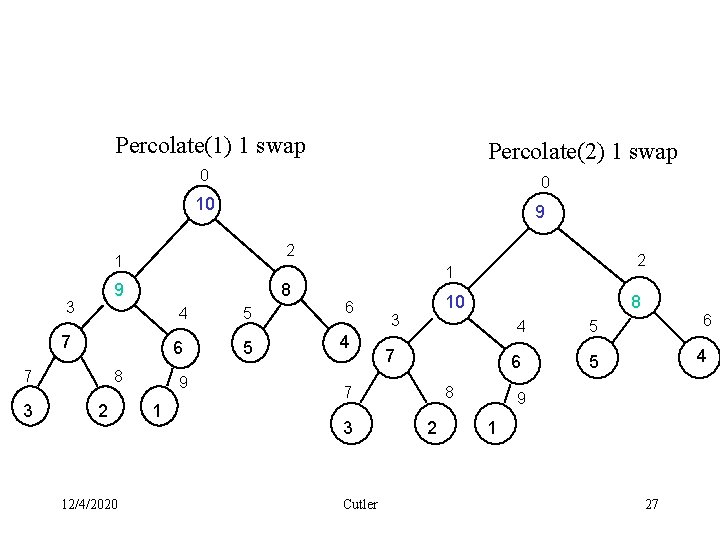
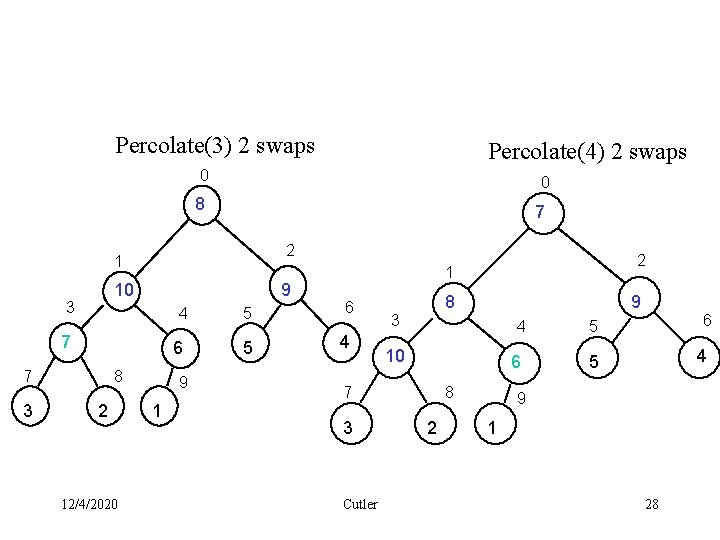
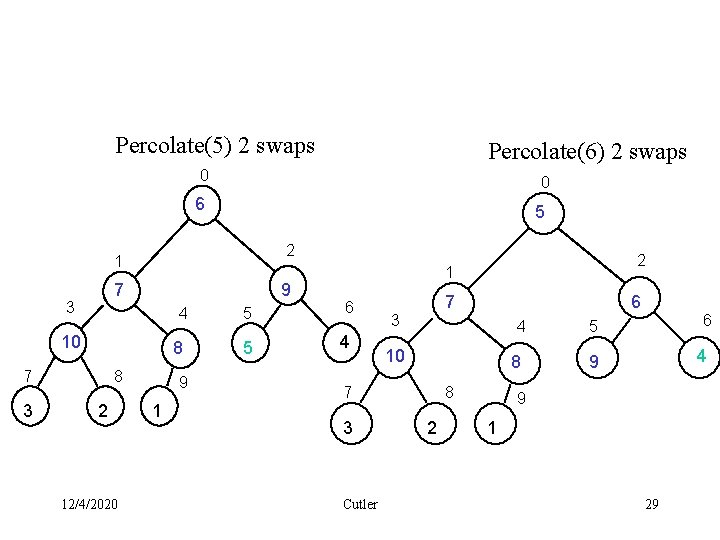
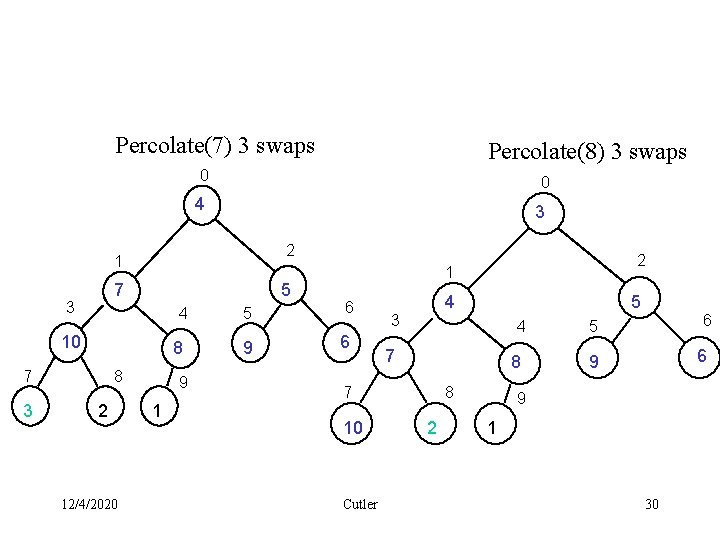
Building a Heap: Method 1 • Assume that array bt has n elements, and needs to be converted into a heap. slow-make-heap() { for i ¬ 1 to last do percolate ( i ) } The time is Note: An alternative for percolate is to use here insert. This will be the case when elements are added dynamically 12/4/2020 Cutler 26
Percolate(1) 1 swap Percolate(2) 1 swap 0 0 10 9 2 1 9 3 8 7 7 3 8 2 12/4/2020 4 5 6 6 5 4 9 1 2 1 10 3 4 7 6 7 3 Cutler 8 8 2 6 5 4 5 9 1 27
Percolate(3) 2 swaps Percolate(4) 2 swaps 0 0 8 7 2 1 10 3 9 7 7 3 8 2 12/4/2020 4 5 6 6 5 4 9 1 2 1 8 3 4 10 6 7 3 Cutler 9 8 2 6 5 4 5 9 1 28
Percolate(5) 2 swaps Percolate(6) 2 swaps 0 0 6 5 2 1 7 3 9 10 7 3 8 2 12/4/2020 4 5 6 8 5 4 9 1 2 1 7 3 4 10 8 7 3 Cutler 6 8 2 6 5 4 9 9 1 29
Percolate(7) 3 swaps Percolate(8) 3 swaps 0 0 4 3 2 1 7 3 5 10 7 3 8 2 12/4/2020 4 5 6 8 9 6 9 1 2 1 4 3 4 7 8 7 10 Cutler 5 8 2 6 5 6 9 9 1 30
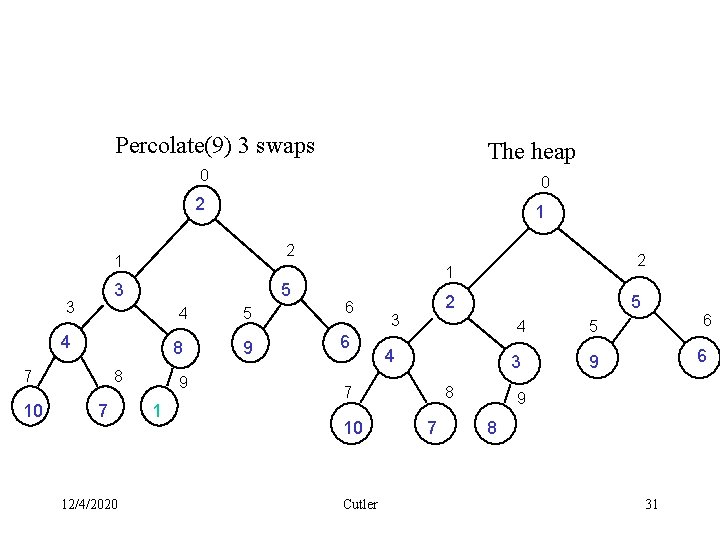
Percolate(9) 3 swaps The heap 0 0 2 1 3 3 5 4 7 10 8 7 12/4/2020 4 5 6 8 9 6 9 1 2 3 4 4 3 7 10 Cutler 5 8 7 6 5 6 9 9 8 31
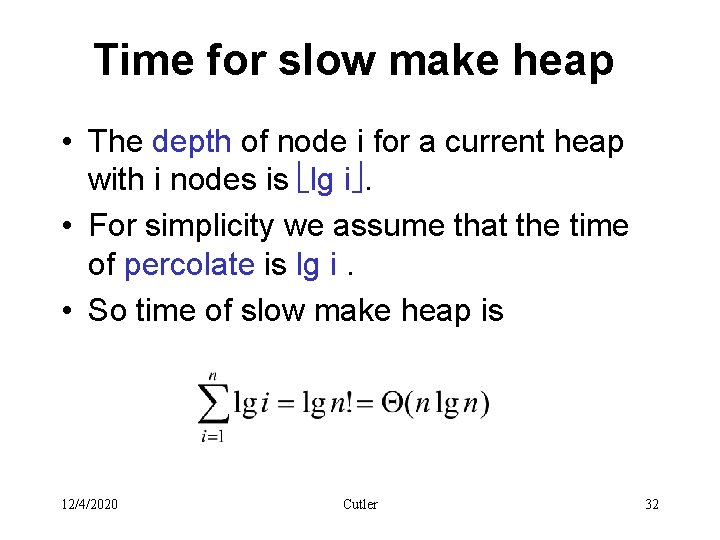
Time for slow make heap • The depth of node i for a current heap with i nodes is lg i. • For simplicity we assume that the time of percolate is lg i. • So time of slow make heap is 12/4/2020 Cutler 32
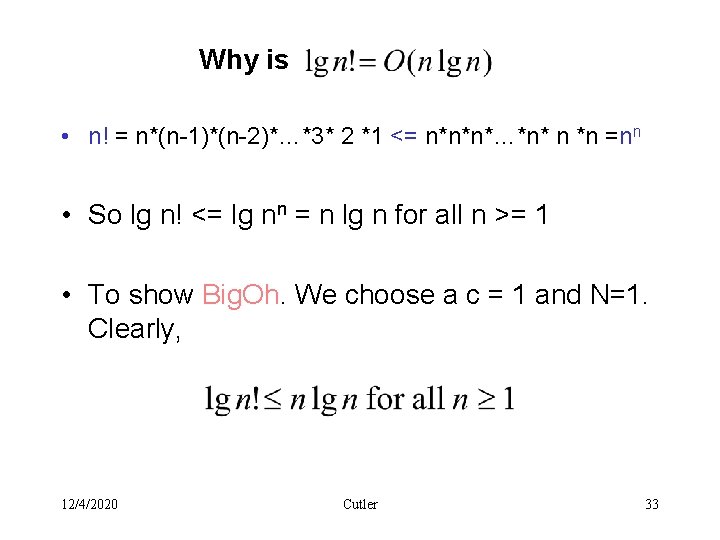
Why is • n! = n*(n-1)*(n-2)*…*3* 2 *1 <= n*n*n*…*n* n *n =nn • So lg n! <= lg nn = n lg n for all n >= 1 • To show Big. Oh. We choose a c = 1 and N=1. Clearly, 12/4/2020 Cutler 33
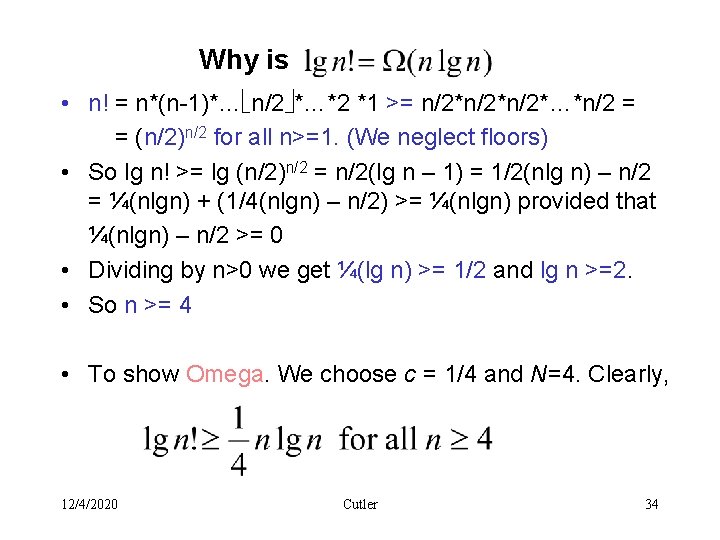
Why is • n! = n*(n-1)*… n/2 *…*2 *1 >= n/2*n/2*…*n/2 = = (n/2)n/2 for all n>=1. (We neglect floors) • So lg n! >= lg (n/2)n/2 = n/2(lg n – 1) = 1/2(nlg n) – n/2 = ¼(nlgn) + (1/4(nlgn) – n/2) >= ¼(nlgn) provided that ¼(nlgn) – n/2 >= 0 • Dividing by n>0 we get ¼(lg n) >= 1/2 and lg n >=2. • So n >= 4 • To show Omega. We choose c = 1/4 and N=4. Clearly, 12/4/2020 Cutler 34
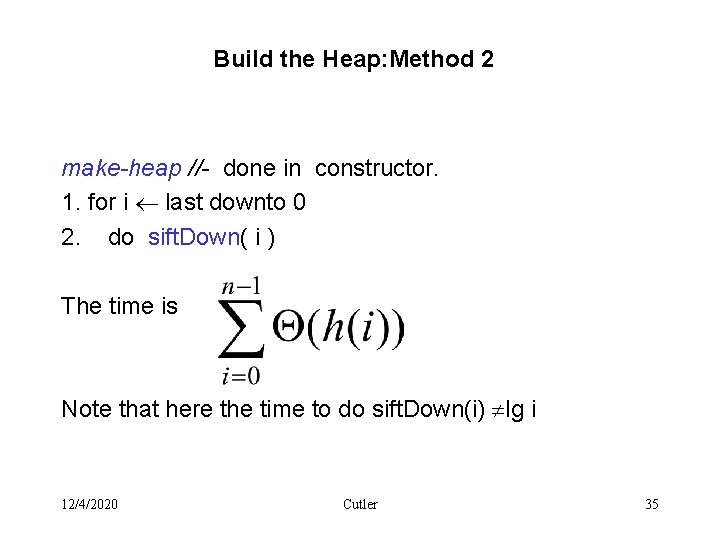
Build the Heap: Method 2 make-heap //- done in constructor. 1. for i ¬ last downto 0 2. do sift. Down( i ) The time is Note that here the time to do sift. Down(i) lg i 12/4/2020 Cutler 35
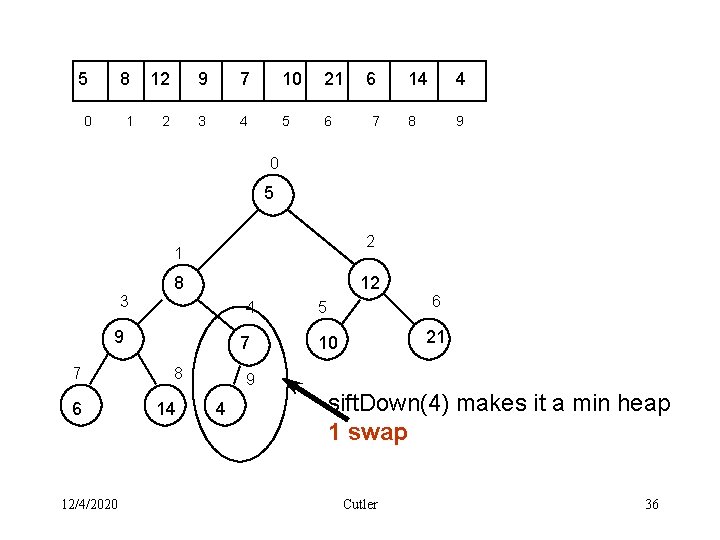
5 8 12 9 7 10 21 0 1 2 3 4 5 6 6 7 14 4 8 9 0 5 2 1 3 8 12 4 9 7 6 12/4/2020 7 8 14 5 6 21 10 9 4 sift. Down(4) makes it a min heap 1 swap Cutler 36
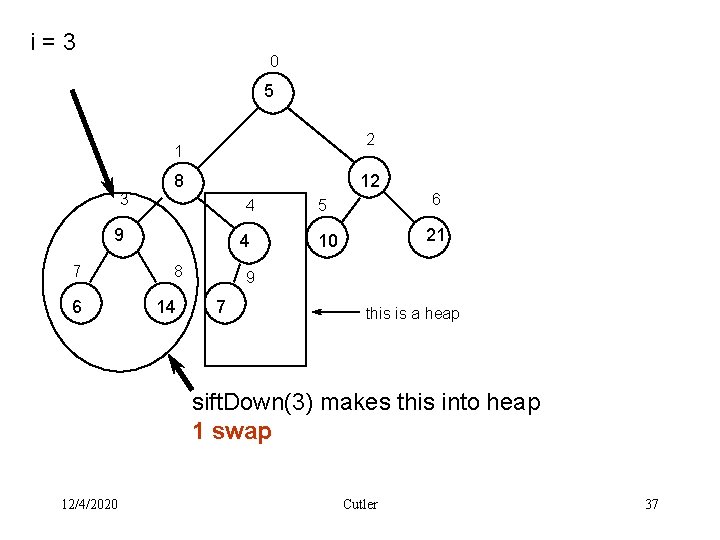
i=3 0 5 2 1 3 8 12 4 9 7 6 4 8 14 5 6 21 10 9 7 this is a heap sift. Down(3) makes this into heap 1 swap 12/4/2020 Cutler 37
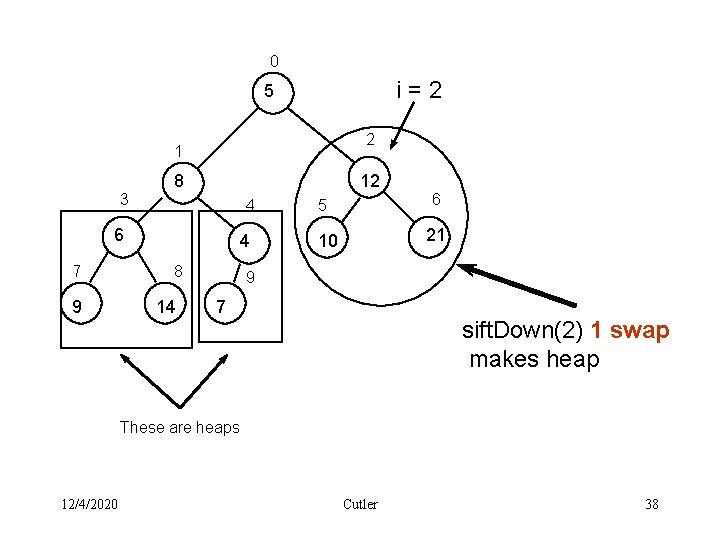
0 i=2 5 2 1 3 8 12 4 6 7 9 4 8 14 5 6 21 10 9 7 sift. Down(2) 1 swap makes heap These are heaps 12/4/2020 Cutler 38
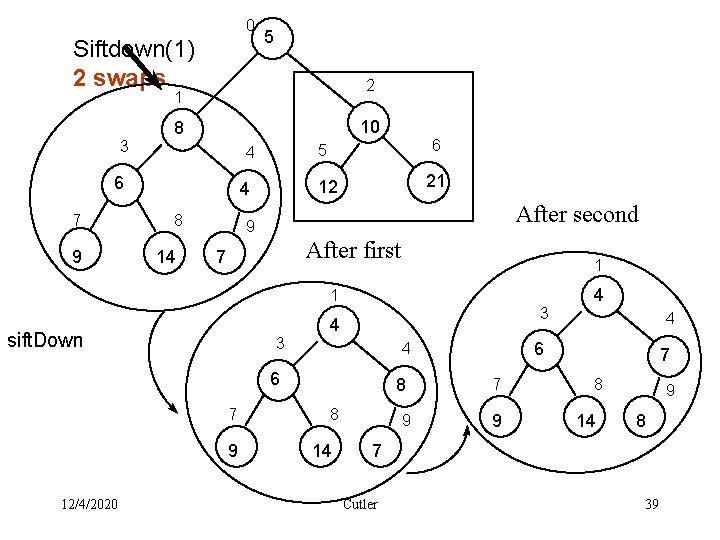
0 Siftdown(1) 2 swaps 5 2 1 10 8 3 6 7 9 14 21 12 4 8 6 5 4 After second 9 After first 7 1 1 sift. Down 3 3 4 7 9 12/4/2020 8 8 14 9 4 6 4 7 9 7 8 14 9 8 7 Cutler 39
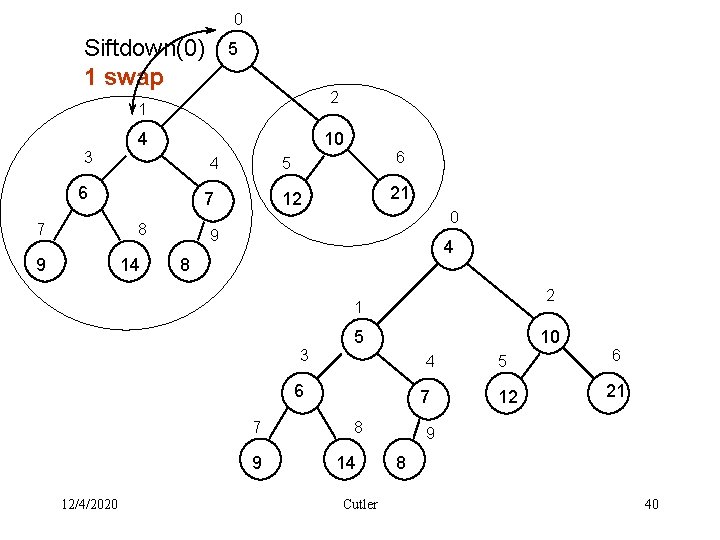
0 Siftdown(0) 1 swap 5 2 1 3 4 10 4 6 7 7 8 9 14 6 5 21 12 0 9 4 8 2 1 3 5 10 4 6 7 9 12/4/2020 7 8 14 Cutler 5 12 6 21 9 8 40
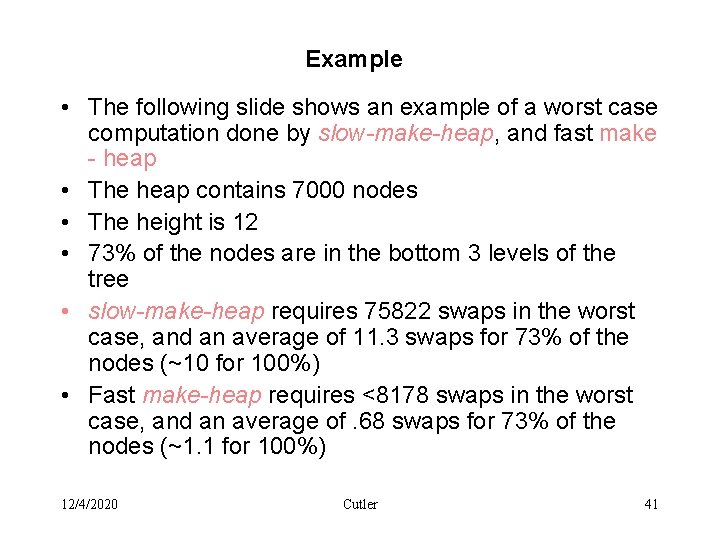
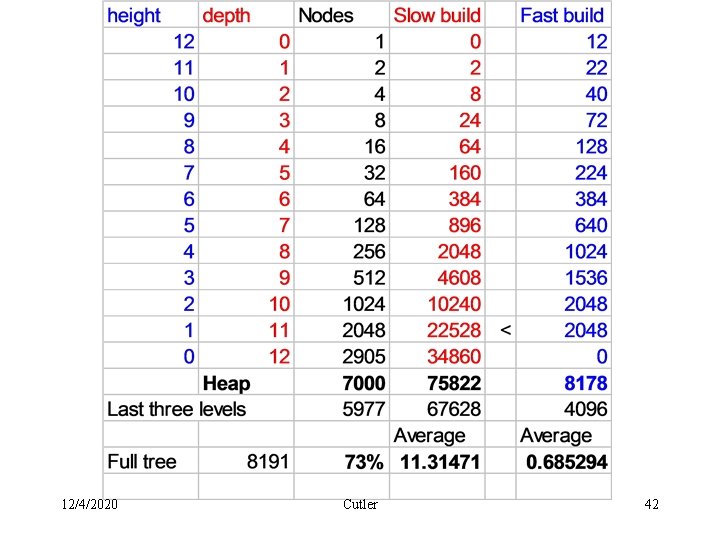
Example • The following slide shows an example of a worst case computation done by slow-make-heap, and fast make - heap • The heap contains 7000 nodes • The height is 12 • 73% of the nodes are in the bottom 3 levels of the tree • slow-make-heap requires 75822 swaps in the worst case, and an average of 11. 3 swaps for 73% of the nodes (~10 for 100%) • Fast make-heap requires <8178 swaps in the worst case, and an average of. 68 swaps for 73% of the nodes (~1. 1 for 100%) 12/4/2020 Cutler 41
12/4/2020 Cutler 42
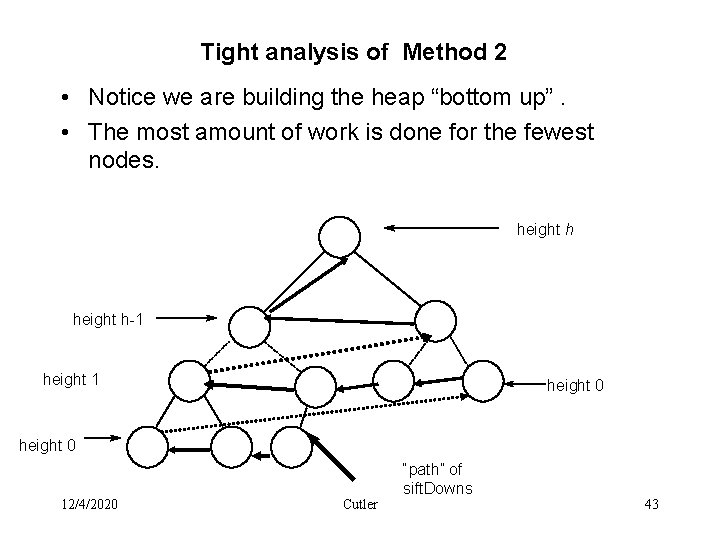
Tight analysis of Method 2 • Notice we are building the heap “bottom up”. • The most amount of work is done for the fewest nodes. height h-1 height 0 12/4/2020 Cutler “path” of sift. Downs 43
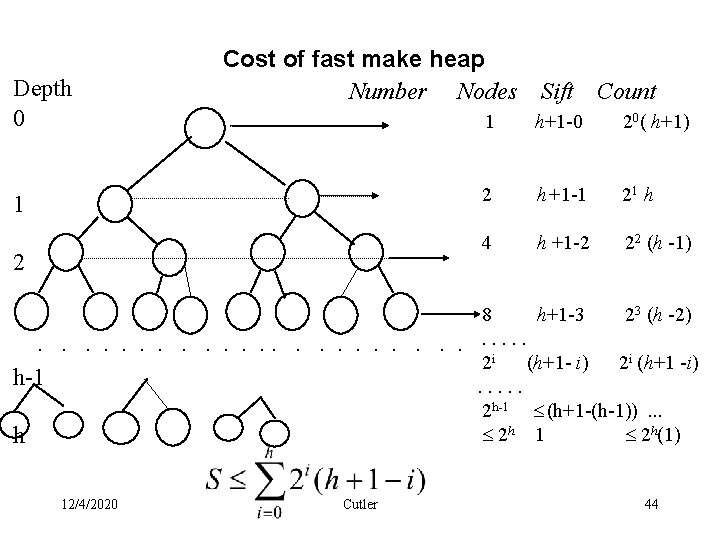
Depth 0 Cost of fast make heap Number Nodes 1 2. . . . . h-1 h 12/4/2020 Cutler Sift Count 1 h+1 -0 20( h+1) 2 h+1 -1 21 h 4 h +1 -2 22 (h -1) 8 h+1 -3 23 (h -2). . . 2 i (h+1 - i) 2 i (h+1 -i). . . 2 h-1 (h+1 -(h-1)). . . 2 h 1 2 h(1) 44
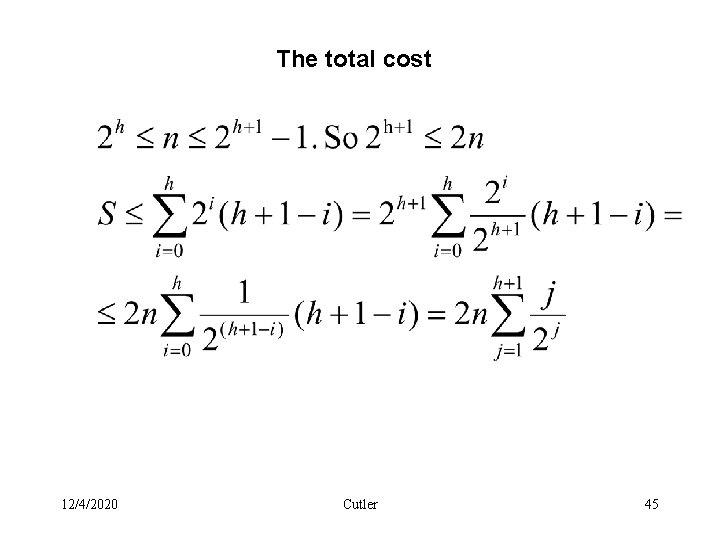
The total cost 12/4/2020 Cutler 45
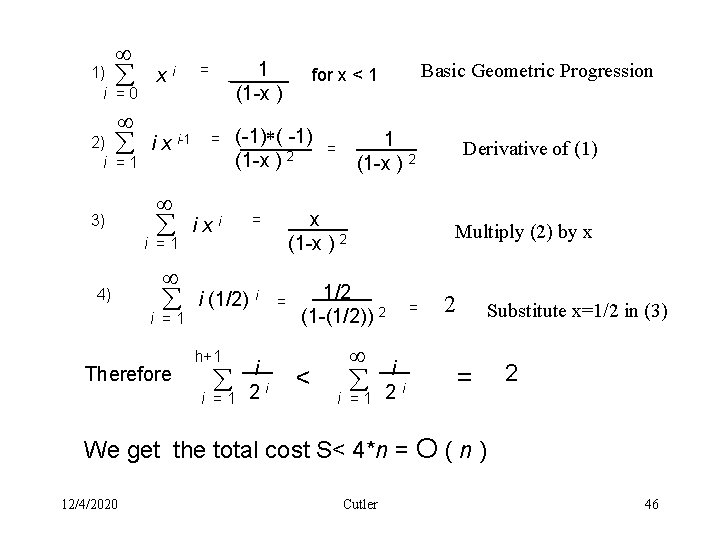
¥ å 1) i =0 ¥ å 2) i =1 3) xi i x i-1 ¥ å i =1 4) ¥ å i =1 Therefore 1 (1 -x ) = = (-1) (1 -x ) 2 ixi h+1 å i =1 i 2 i 1 (1 -x ) 2 = x (1 -x ) 2 = i (1/2) i Basic Geometric Progression for x < 1 = Multiply (2) by x 1/2 (1 -(1/2)) 2 < Derivative of (1) ¥ å i =1 i 2 i = 2 Substitute x=1/2 in (3) = 2 We get the total cost S< 4*n = O ( n ) 12/4/2020 Cutler 46
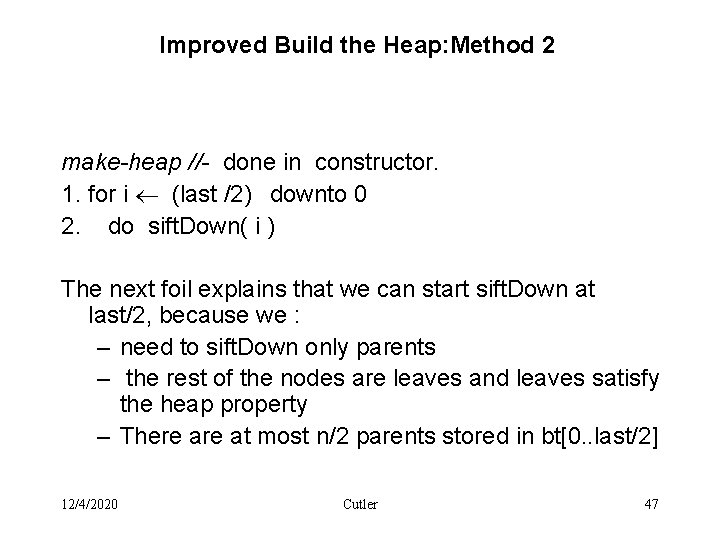
Improved Build the Heap: Method 2 make-heap //- done in constructor. 1. for i ¬ (last /2) downto 0 2. do sift. Down( i ) The next foil explains that we can start sift. Down at last/2, because we : – need to sift. Down only parents – the rest of the nodes are leaves and leaves satisfy the heap property – There at most n/2 parents stored in bt[0. . last/2] 12/4/2020 Cutler 47
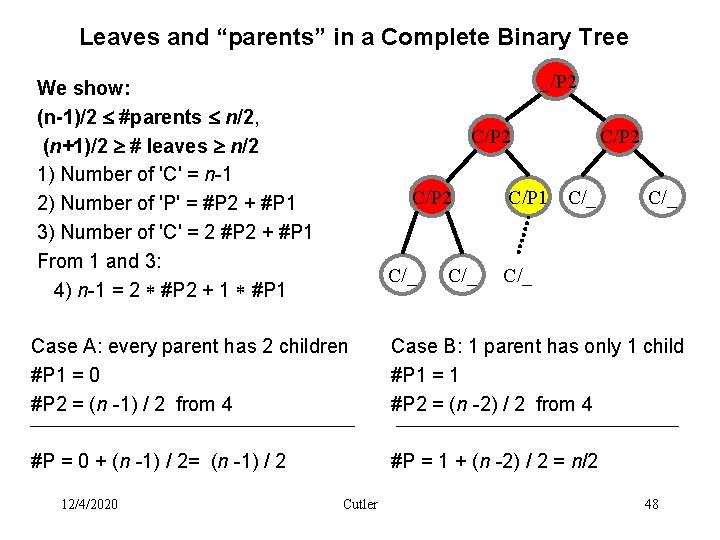
Leaves and “parents” in a Complete Binary Tree _/P 2 We show: (n-1)/2 #parents n/2, (n+1)/2 # leaves n/2 1) Number of 'C' = n-1 2) Number of 'P' = #P 2 + #P 1 3) Number of 'C' = 2 #P 2 + #P 1 From 1 and 3: 4) n-1 = 2 #P 2 + 1 #P 1 C/P 2 C/_ C/P 1 C/_ C/P 2 C/_ Case A: every parent has 2 children #P 1 = 0 #P 2 = (n -1) / 2 from 4 Case B: 1 parent has only 1 child #P 1 = 1 #P 2 = (n -2) / 2 from 4 #P = 0 + (n -1) / 2= (n -1) / 2 #P = 1 + (n -2) / 2 = n/2 12/4/2020 Cutler 48
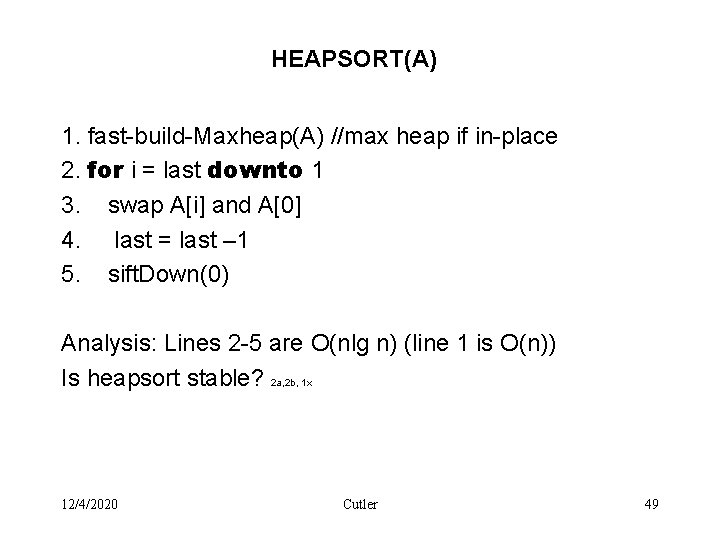
HEAPSORT(A) 1. fast-build-Maxheap(A) //max heap if in-place 2. for i = last downto 1 3. swap A[i] and A[0] 4. last = last – 1 5. sift. Down(0) Analysis: Lines 2 -5 are O(nlg n) (line 1 is O(n)) Is heapsort stable? 2 a, 2 b, 1 x 12/4/2020 Cutler 49
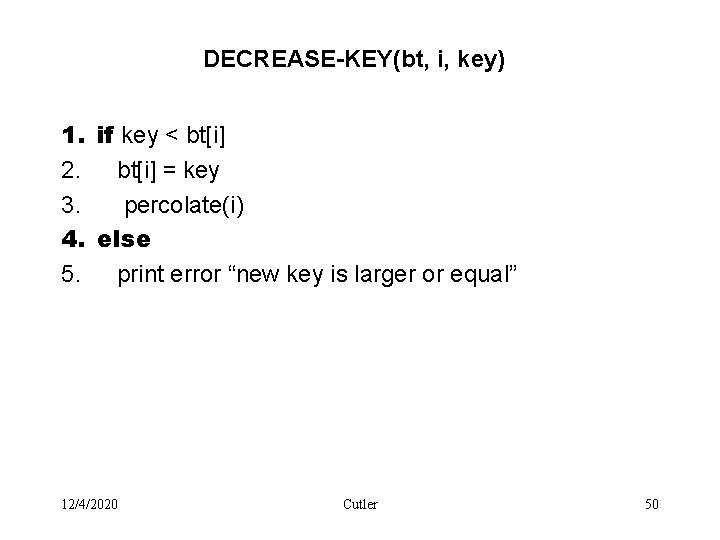
DECREASE-KEY(bt, i, key) 1. if key < bt[i] 2. bt[i] = key 3. percolate(i) 4. else 5. print error “new key is larger or equal” 12/4/2020 Cutler 50