
AStudy on the Viability of Hadoop Usage on
AStudy on the Viability of Hadoop Usage on the Umfort Cluster for the Processing and Storage of CRe. SIS Polar Data Mentor: Je’aime Powell, Dr. Mohammad Hasan Members: Jer. Nettie Burney, Jean Bevins, Cedric Hall, Glenn M. Koch
Abstract The primary focus of this research was to explore the capabilities of Hadoop as a software package to process, store and manage CRe. SIS polar data in a clustered environment. The investigation involved Hadoop functionality and usage through reviewed publications. The team’s research was aimed at determining if Hadoop was a viable software package to implement on the Elizabeth City State University (ECSU) Umfort computing cluster. Utilizing case studies; processing, storage, management, and job distribution methods were compared. A final determination of the benefits of Hadoop for the storing and processing of data on the Umfort cluster was then made.
INTRODUCTION • Hadoop is a set of open source technologies • Hadooporiginated from the open source web search engine, Apache Nutch. • Hadoopwas adopted by over 100 different companies
Hadoop Functionality • Hadoopis broken down into different parts • Some of the more imperative components of Hadoop include Map. Reduce, Zookeeper, HDFS, Hive, Jobtracker, Namenode, and HBase. • Hadoop’sadaptive functionalities allow various organizations’ needs to be met.
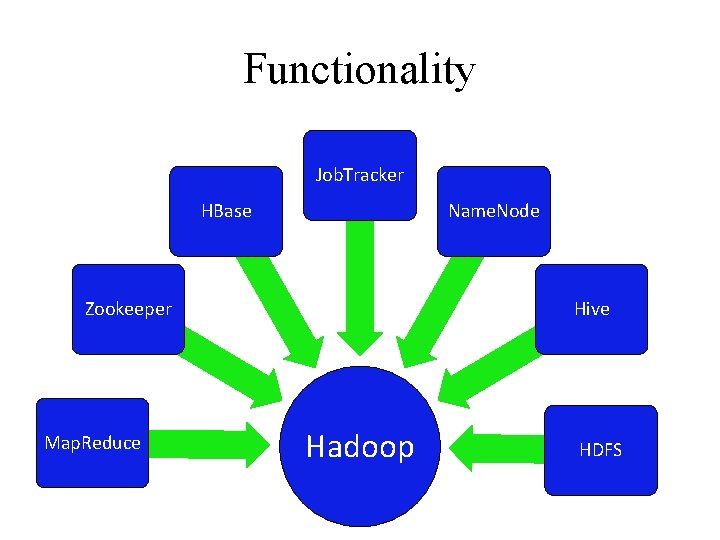
Functionality Job. Tracker HBase Name. Node Zookeeper Map. Reduce Hive Hadoop HDFS
Map. Reduce • Framework that processes large datasets • Map. Reduce is broken down into two steps • Maps out operation to servers and reduces the results into a single result set
Hive • Data warehouse infrastructure • Goal is to provide acceptable wait times for data browsing, and queries over small data sets or test queries
Zookeeper • Used to maintain configuration information, manage computer naming schemes, provide distributed synchronization, and provide group services
HDFS • Distributed storage system used by Hadoop • Designed to work and run on low-cost hardware • Works on operations even when the system fails
Name. Node • Essential piece of the HDFS file system • Keeps a directory tree of all files in the file system • Name. Nodewas considered a single point of failure for a HDFS Cluster; when the Name. Nodefails, the file system goes offline
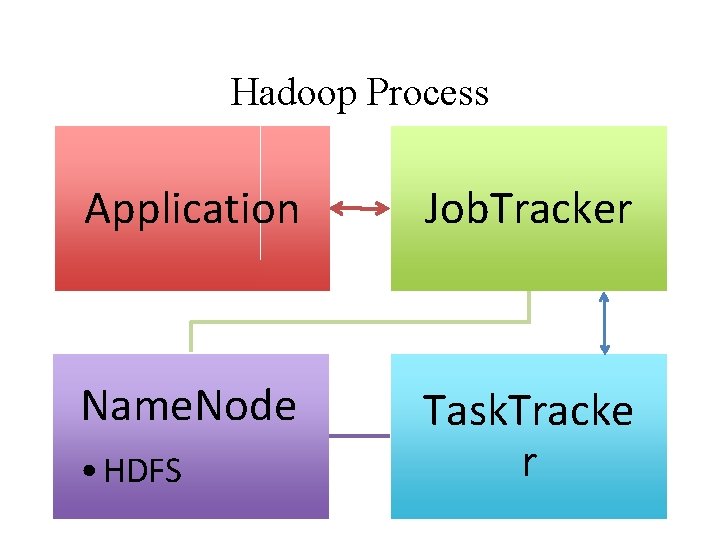
Hadoop Process Application Job. Tracker Name. Node Task. Tracke r • HDFS
HBase • Hadoop Base (HBase) is the Hadoopdatabase • The goal of HBase is to host very large tables, with billions of rows by millions of columns • In order to accomplish this HBase uses tables including cascading, Hive and Pig source modules
Case Studies • Many institutions and companies utilize Hadoop • Using the Services: Facebook Ebay Google San Diego Supercomputing Center
Google • Google first created Map. Reduce
Google • Distributed File System
Facebook • Hadoop Hive system
EBay Fair Scheduler Name. Node Zookeeper Job. Tracker HBase

The San Diego Supercomputer Center • Map. Reduce
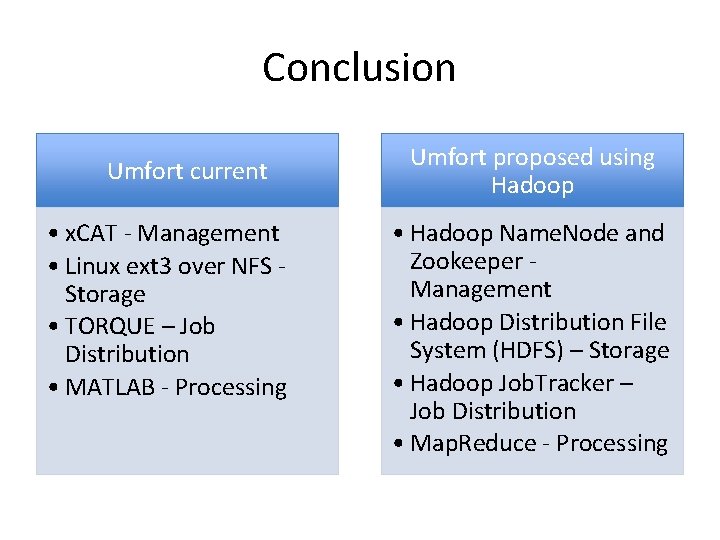
Conclusion Umfort current • x. CAT - Management • Linux ext 3 over NFS - Storage • TORQUE – Job Distribution • MATLAB - Processing Umfort proposed using Hadoop • Hadoop Name. Node and Zookeeper - Management • Hadoop Distribution File System (HDFS) – Storage • Hadoop Job. Tracker – Job Distribution • Map. Reduce - Processing
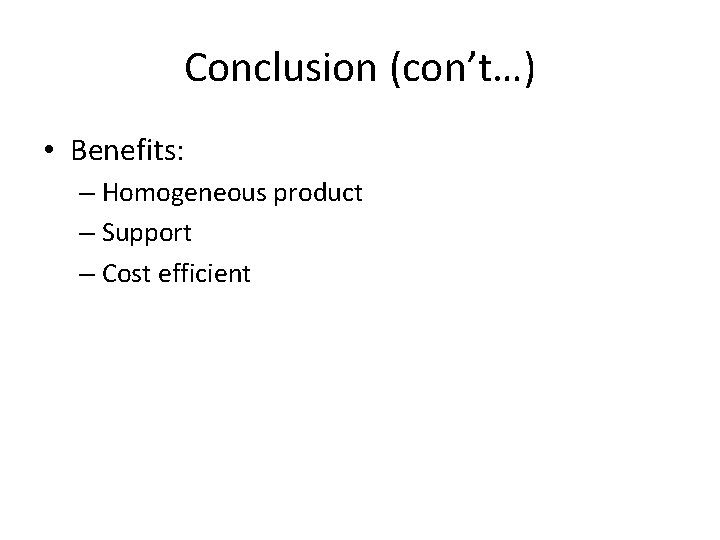
Conclusion (con’t…) • Benefits: – Homogeneous product – Support – Cost efficient
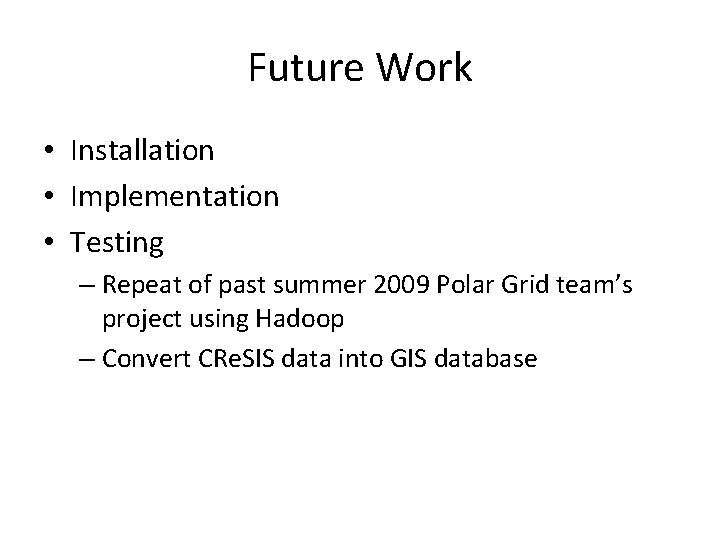
Future Work • Installation • Implementation • Testing – Repeat of past summer 2009 Polar Grid team’s project using Hadoop – Convert CRe. SIS data into GIS database
- Slides: 21