The characteristics and enlightenments of Smallworld effect in

- Slides: 35
The characteristics and enlightenments of "Small-world effect" in Met. education and training JI Wenbin, HOU Jinfang China Meteorological Administration Training Centre (CMATC) Sep. 2015
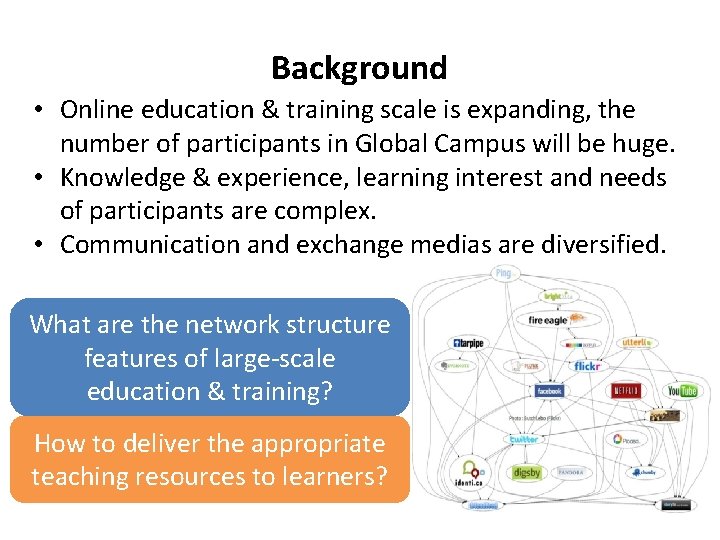
Background • Online education & training scale is expanding, the number of participants in Global Campus will be huge. • Knowledge & experience, learning interest and needs of participants are complex. • Communication and exchange medias are diversified. What are the network structure features of large-scale education & training? How to deliver the appropriate teaching resources to learners?
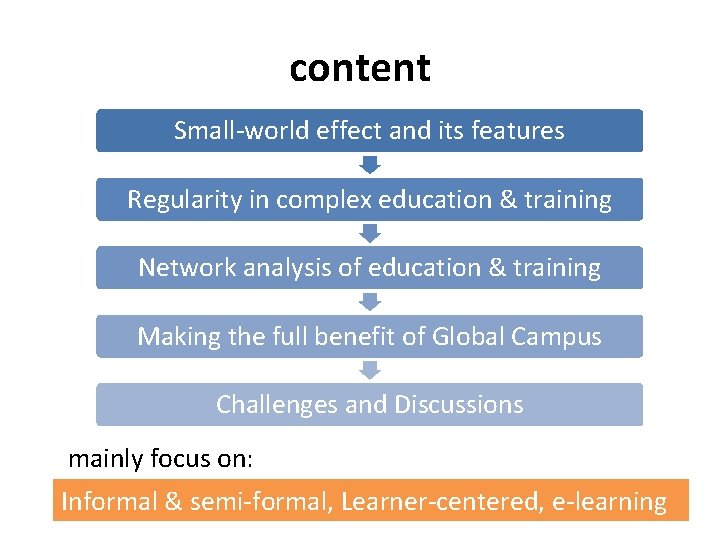
content Small-world effect and its features Regularity in complex education & training Network analysis of education & training Making the full benefit of Global Campus Challenges and Discussions mainly focus on: Informal & semi-formal, Learner-centered, e-learning
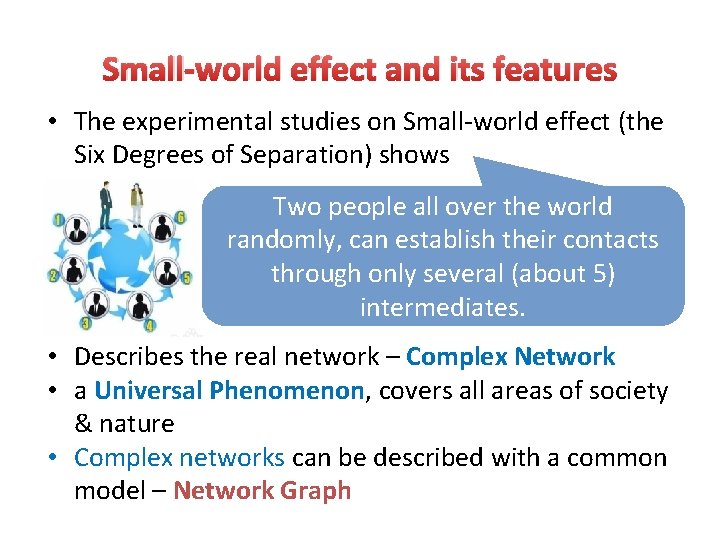
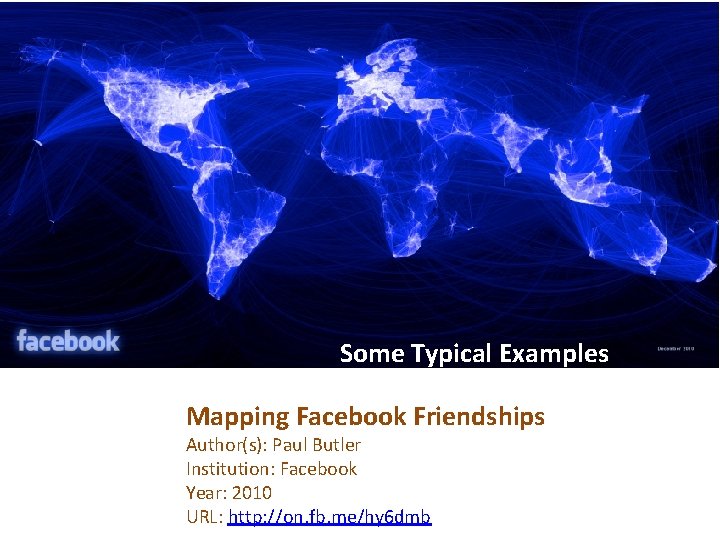
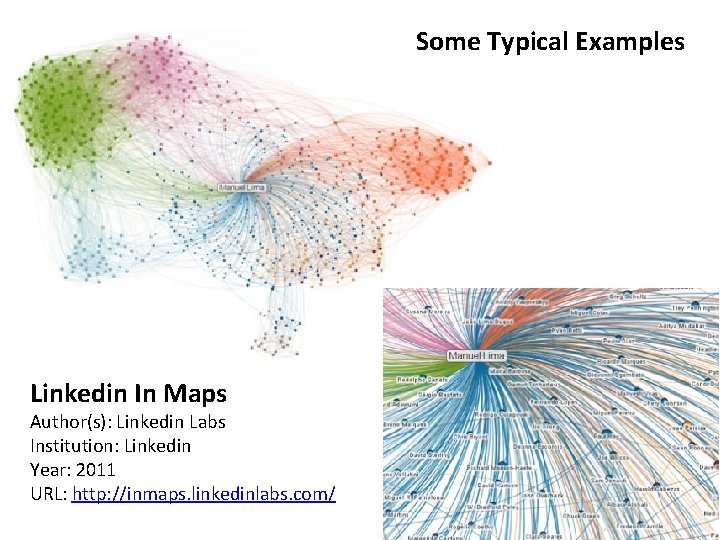
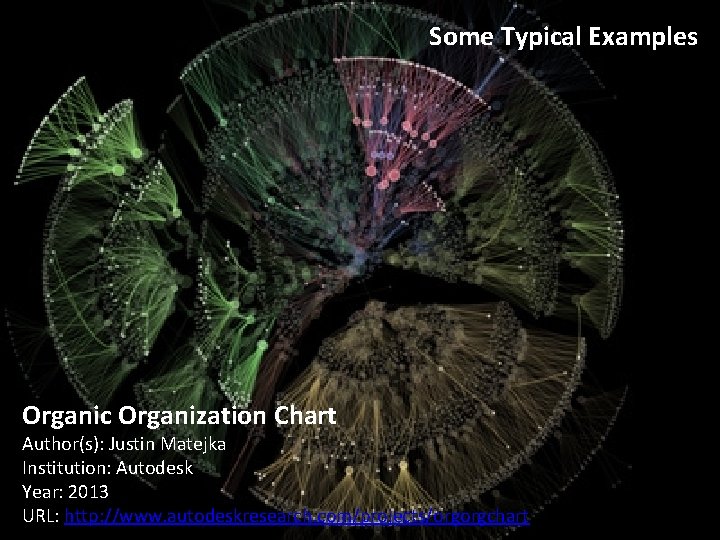
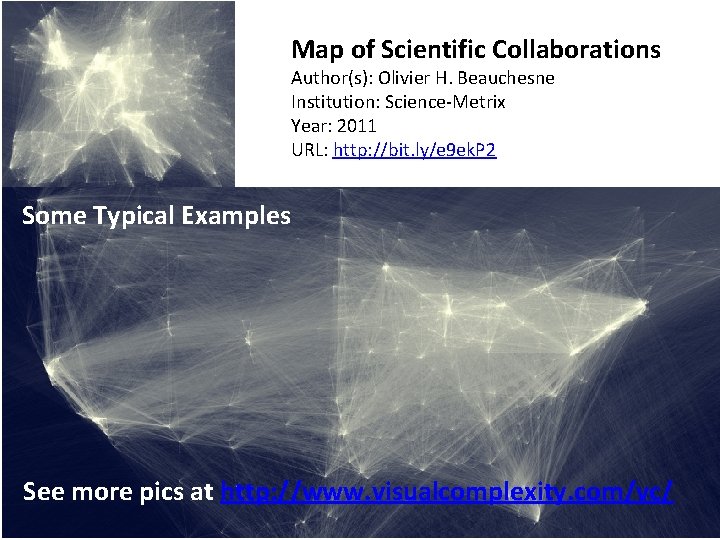
Small-world effect and its features • The experimental studies on Small-world effect (the Six Degrees of Separation) shows Two people all over the world randomly, can establish their contacts through only several (about 5) intermediates. • Describes the real network – Complex Network • a Universal Phenomenon, covers all areas of society & nature • Complex networks can be described with a common model – Network Graph
Some Typical Examples Mapping Facebook Friendships Author(s): Paul Butler Institution: Facebook Year: 2010 URL: http: //on. fb. me/hy 6 dmb
Some Typical Examples Linkedin In Maps Author(s): Linkedin Labs Institution: Linkedin Year: 2011 URL: http: //inmaps. linkedinlabs. com/
Some Typical Examples Organic Organization Chart Author(s): Justin Matejka Institution: Autodesk Year: 2013 URL: http: //www. autodeskresearch. com/projects/orgorgchart
Map of Scientific Collaborations Author(s): Olivier H. Beauchesne Institution: Science-Metrix Year: 2011 URL: http: //bit. ly/e 9 ek. P 2 Some Typical Examples See more pics at http: //www. visualcomplexity. com/vc/
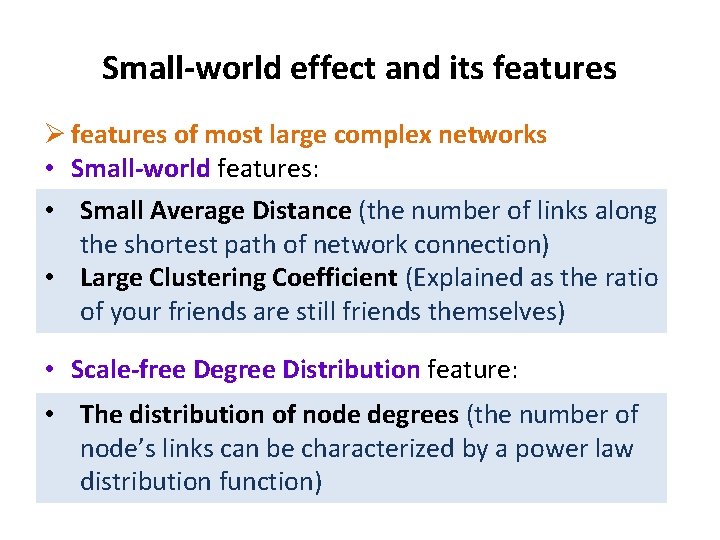
Small-world effect and its features Ø features of most large complex networks • Small-world features: • Small Average Distance (the number of links along the shortest path of network connection) • Large Clustering Coefficient (Explained as the ratio of your friends are still friends themselves) • Scale-free Degree Distribution feature: • The distribution of node degrees (the number of node’s links can be characterized by a power law distribution function)
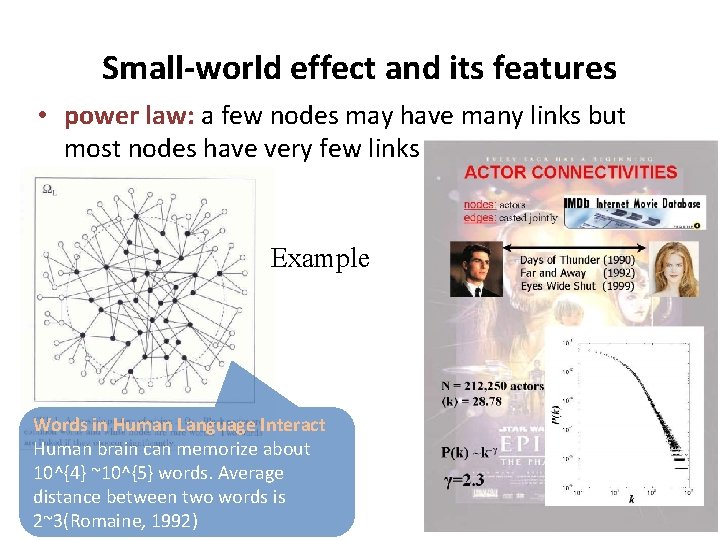
Small-world effect and its features • power law: a few nodes may have many links but most nodes have very few links Example Words in Human Language Interact Human brain can memorize about 10^{4} ~10^{5} words. Average distance between two words is 2~3(Romaine, 1992)
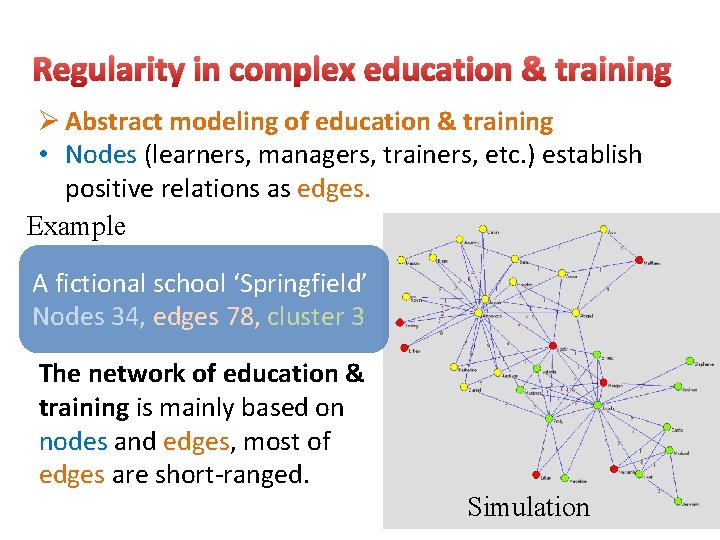
Regularity in complex education & training Ø Abstract modeling of education & training • Nodes (learners, managers, trainers, etc. ) establish positive relations as edges. Example A fictional school ‘Springfield’ Nodes 34, edges 78, cluster 3 The network of education & training is mainly based on nodes and edges, most of edges are short-ranged. Simulation
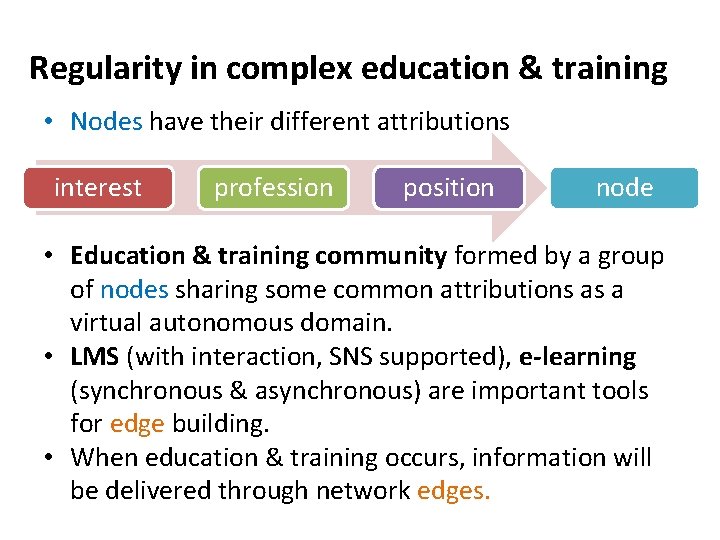
Regularity in complex education & training • Nodes have their different attributions interest profession position node • Education & training community formed by a group of nodes sharing some common attributions as a virtual autonomous domain. • LMS (with interaction, SNS supported), e-learning (synchronous & asynchronous) are important tools for edge building. • When education & training occurs, information will be delivered through network edges.
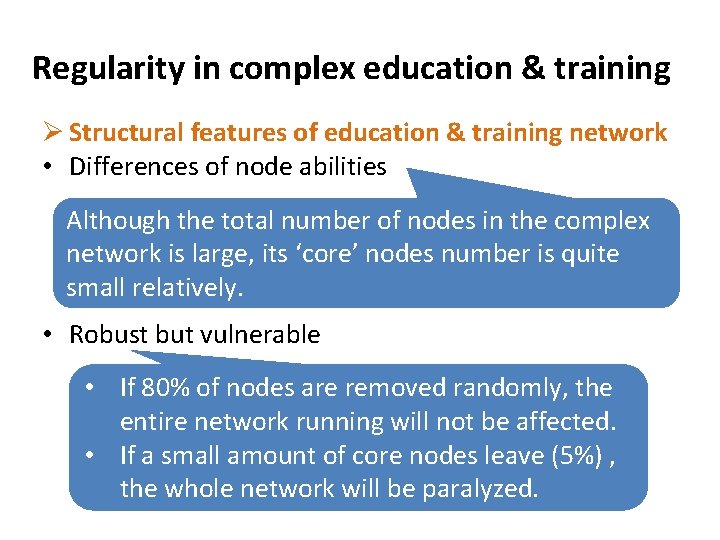
Regularity in complex education & training Ø Structural features of education & training network • Differences of node abilities Although the total number of nodes in the complex network is large, its ‘core’ nodes number is quite small relatively. • Robust but vulnerable • If 80% of nodes are removed randomly, the entire network running will not be affected. • If a small amount of core nodes leave (5%) , the whole network will be paralyzed.
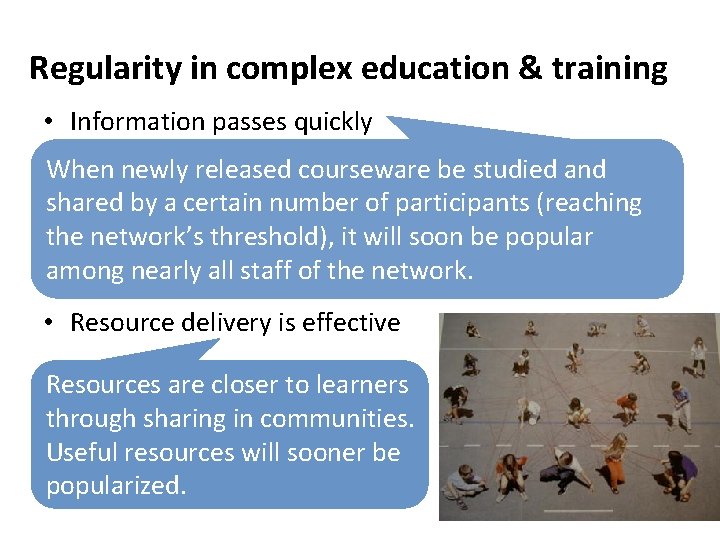
Regularity in complex education & training • Information passes quickly When newly released courseware be studied and shared by a certain number of participants (reaching the network’s threshold), it will soon be popular among nearly all staff of the network. • Resource delivery is effective Resources are closer to learners through sharing in communities. Useful resources will sooner be popularized.
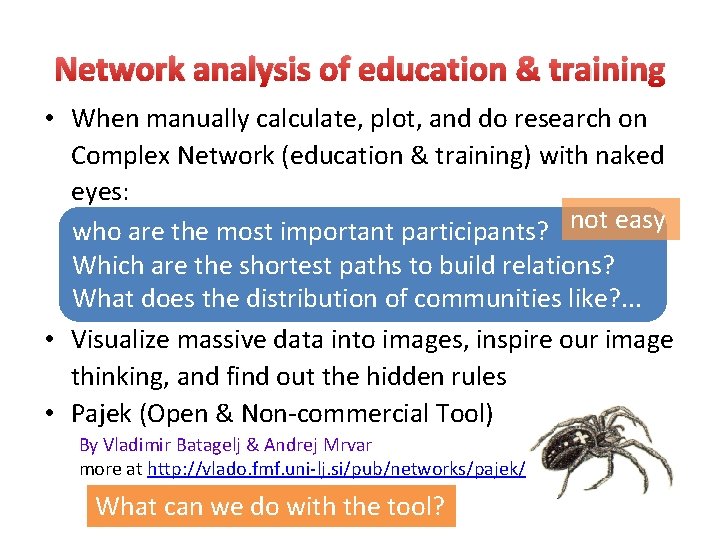
Network analysis of education & training • When manually calculate, plot, and do research on Complex Network (education & training) with naked eyes: who are the most important participants? not easy Which are the shortest paths to build relations? What does the distribution of communities like? . . . • Visualize massive data into images, inspire our image thinking, and find out the hidden rules • Pajek (Open & Non-commercial Tool) By Vladimir Batagelj & Andrej Mrvar more at http: //vlado. fmf. uni-lj. si/pub/networks/pajek/ What can we do with the tool?
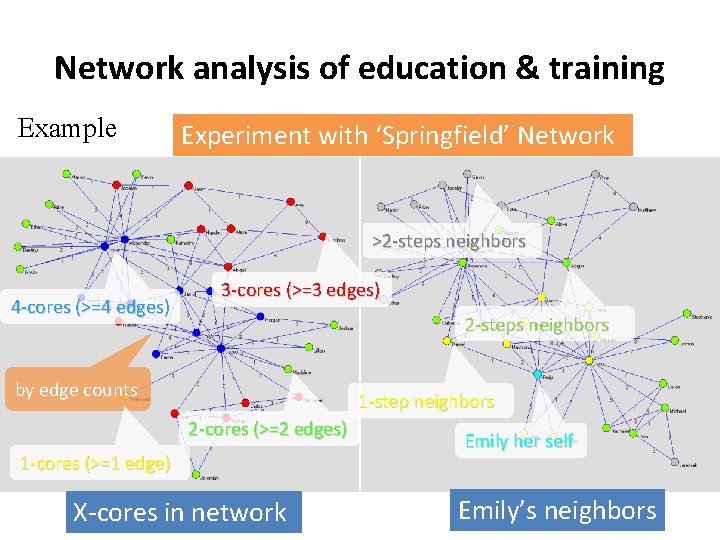
Network analysis of education & training Example Experiment with ‘Springfield’ Network >2 -steps neighbors 4 -cores (>=4 edges) 3 -cores (>=3 edges) 2 -steps neighbors by edge counts 1 -step neighbors 2 -cores (>=2 edges) 1 -cores (>=1 edge) X-cores in network Emily her self Emily’s neighbors
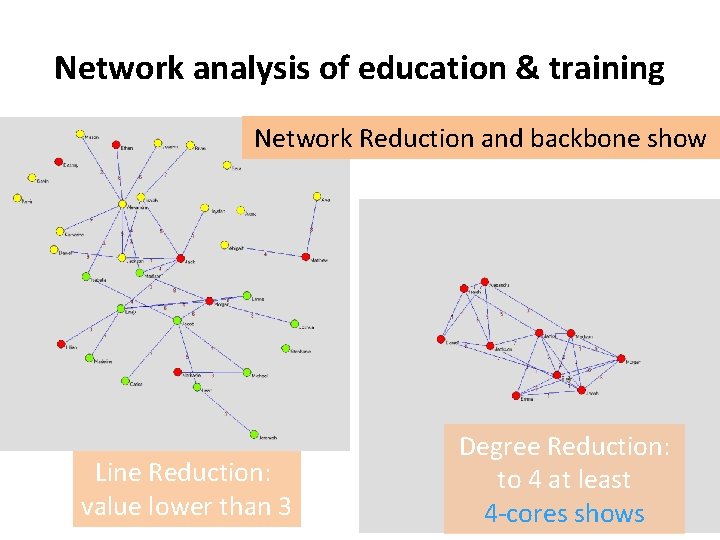
Network analysis of education & training Network Reduction and backbone show Line Reduction: value lower than 3 Degree Reduction: to 4 at least 4 -cores shows
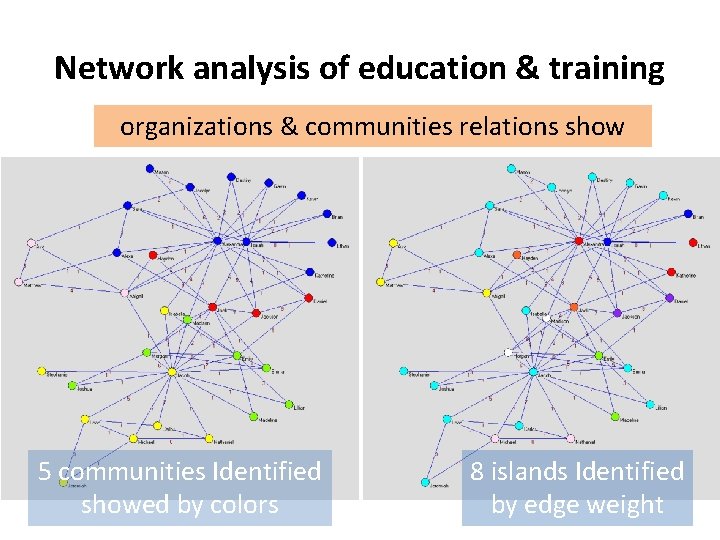
Network analysis of education & training organizations & communities relations show 5 communities Identified showed by colors 8 islands Identified by edge weight
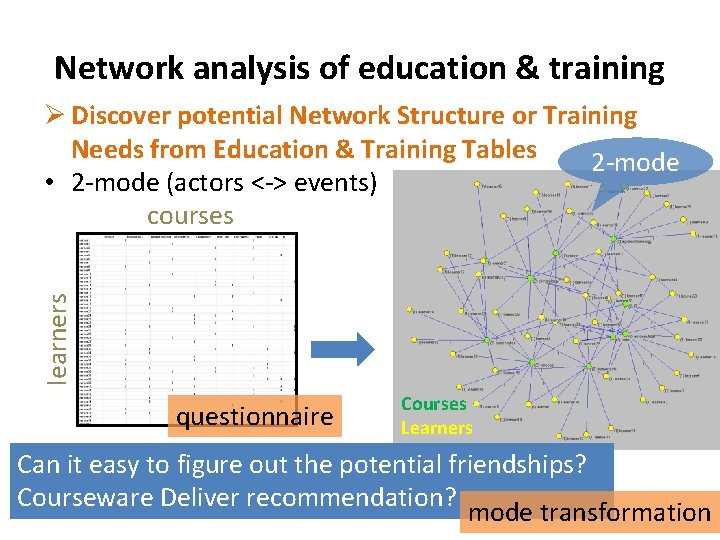
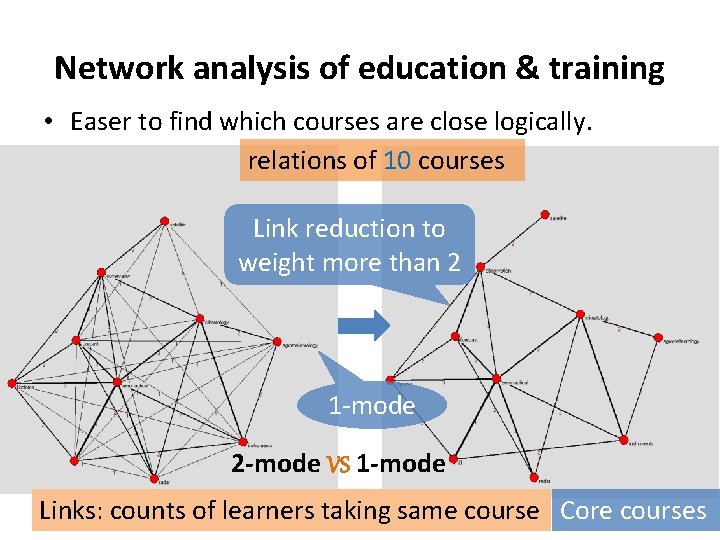
Network analysis of education & training learners Ø Discover potential Network Structure or Training Needs from Education & Training Tables 2 -mode • 2 -mode (actors <-> events) courses questionnaire Courses Learners Can it easy to figure out the potential friendships? Courseware Deliver recommendation? mode transformation
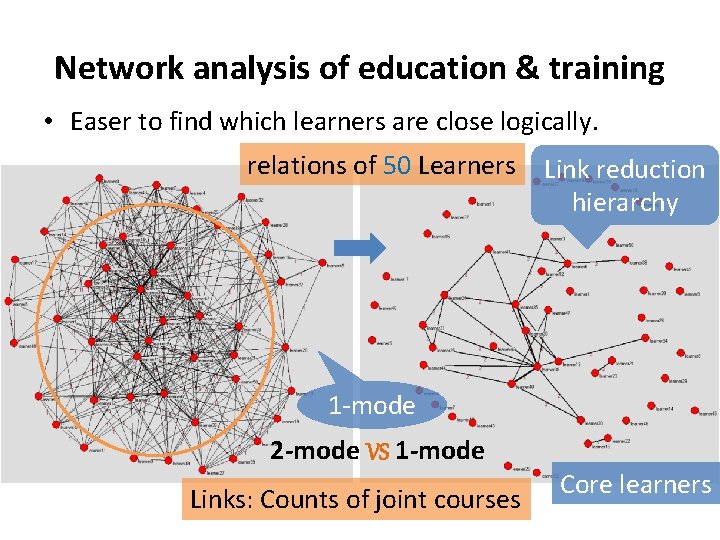
Network analysis of education & training • Easer to find which learners are close logically. relations of 50 Learners Link reduction hierarchy 1 -mode 2 -mode VS 1 -mode Links: Counts of joint courses Core learners
Network analysis of education & training • Easer to find which courses are close logically. relations of 10 courses Link reduction to weight more than 2 1 -mode 2 -mode VS 1 -mode Links: counts of learners taking same course Core courses
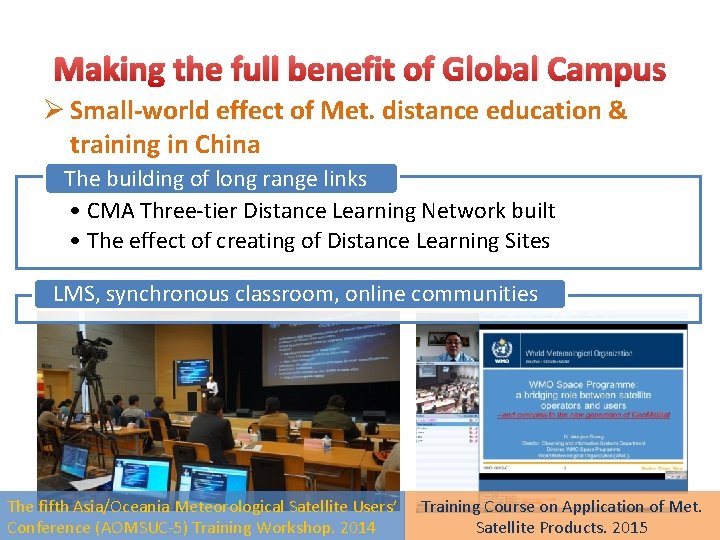
Making the full benefit of Global Campus Ø Small-world effect of Met. distance education & training in China The building of long range links • CMA Three-tier Distance Learning Network built • The effect of creating of Distance Learning Sites LMS, synchronous classroom, online communities The fifth Asia/Oceania Meteorological Satellite Users’ Conference (AOMSUC-5) Training Workshop. 2014 Training Course on Application of Met. Satellite Products. 2015
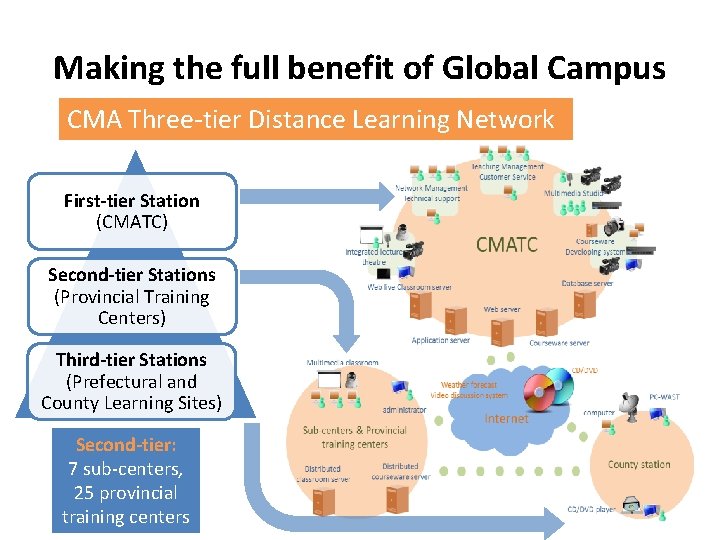
Making the full benefit of Global Campus CMA Three-tier Distance Learning Network First-tier Station (CMATC) Second-tier Stations (Provincial Training Centers) Third-tier Stations (Prefectural and County Learning Sites) Second-tier: 7 sub-centers, 25 provincial training centers
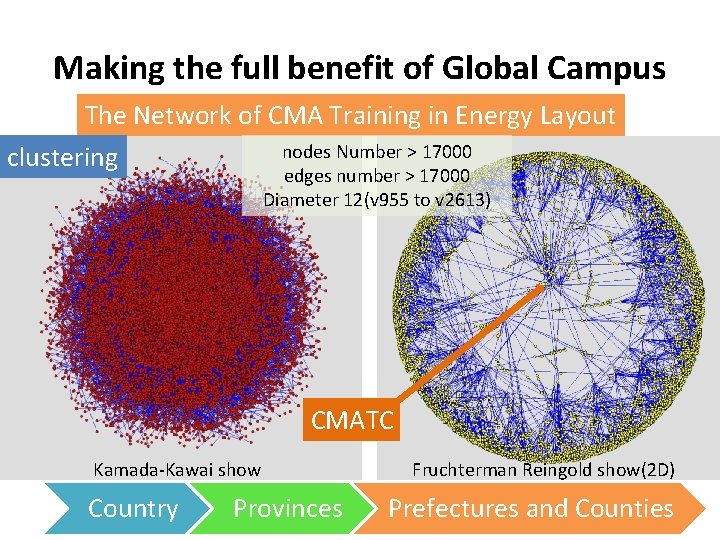
Making the full benefit of Global Campus The Network of CMA Training in Energy Layout nodes Number > 17000 clustering edges number > 17000 Diameter 12(v 955 to v 2613) CMATC Kamada-Kawai show Country Provinces Fruchterman Reingold show(2 D) Prefectures and Counties
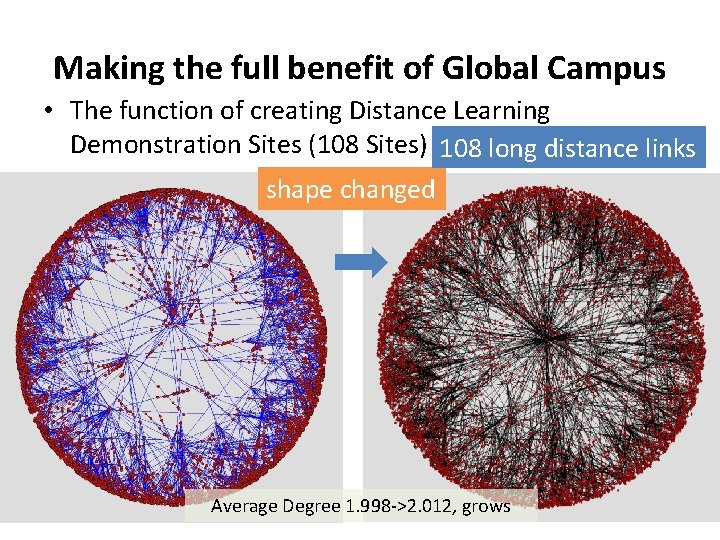
Making the full benefit of Global Campus • The function of creating Distance Learning Demonstration Sites (108 Sites) 108 long distance links shape changed Average Degree 1. 998 ->2. 012, grows
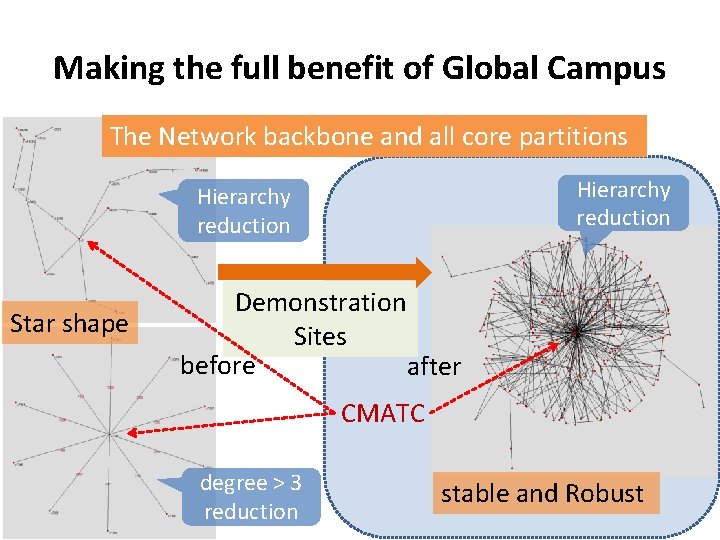
Making the full benefit of Global Campus The Network backbone and all core partitions Hierarchy reduction Star shape Demonstration Sites before after CMATC degree > 3 reduction stable and Robust
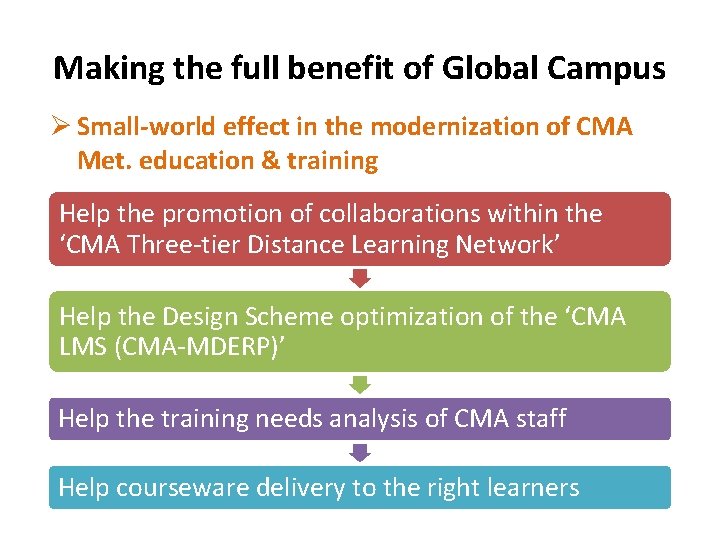
Making the full benefit of Global Campus Ø Small-world effect in the modernization of CMA Met. education & training Help the promotion of collaborations within the ‘CMA Three-tier Distance Learning Network’ Help the Design Scheme optimization of the ‘CMA LMS (CMA-MDERP)’ Help the training needs analysis of CMA staff Help courseware delivery to the right learners
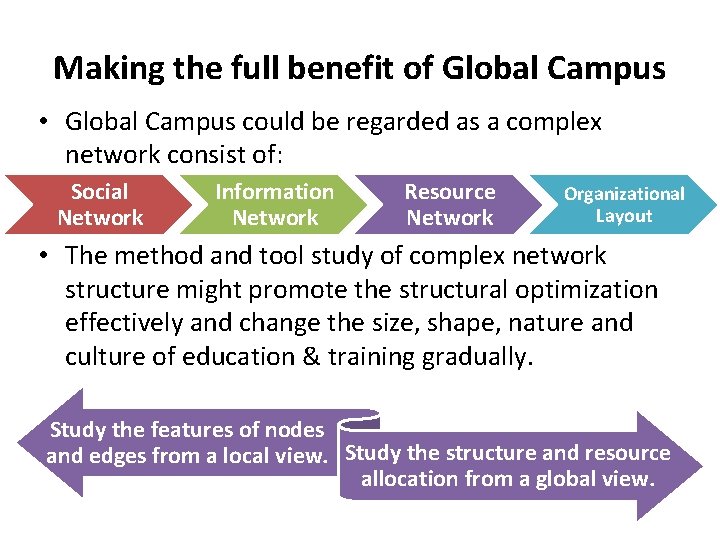
Making the full benefit of Global Campus • Global Campus could be regarded as a complex network consist of: Social Network Information Network Resource Network Organizational Layout • The method and tool study of complex network structure might promote the structural optimization effectively and change the size, shape, nature and culture of education & training gradually. Study the features of nodes and edges from a local view. Study the structure and resource allocation from a global view.
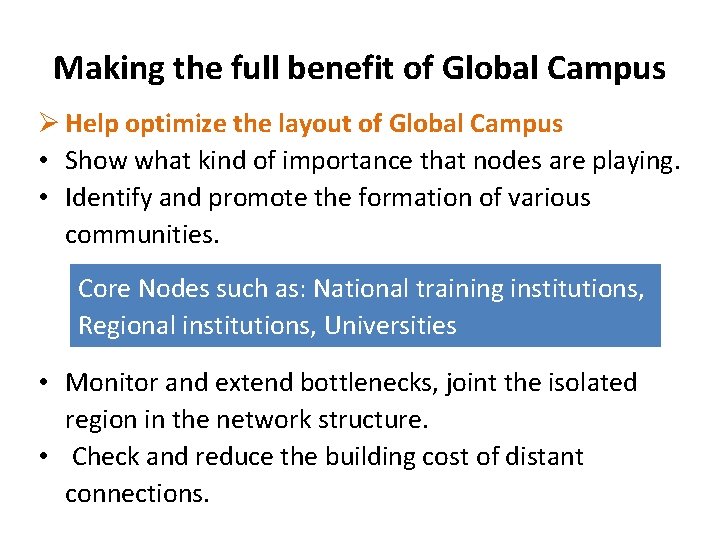
Making the full benefit of Global Campus Ø Help optimize the layout of Global Campus • Show what kind of importance that nodes are playing. • Identify and promote the formation of various communities. Core Nodes such as: National training institutions, Regional institutions, Universities • Monitor and extend bottlenecks, joint the isolated region in the network structure. • Check and reduce the building cost of distant connections.
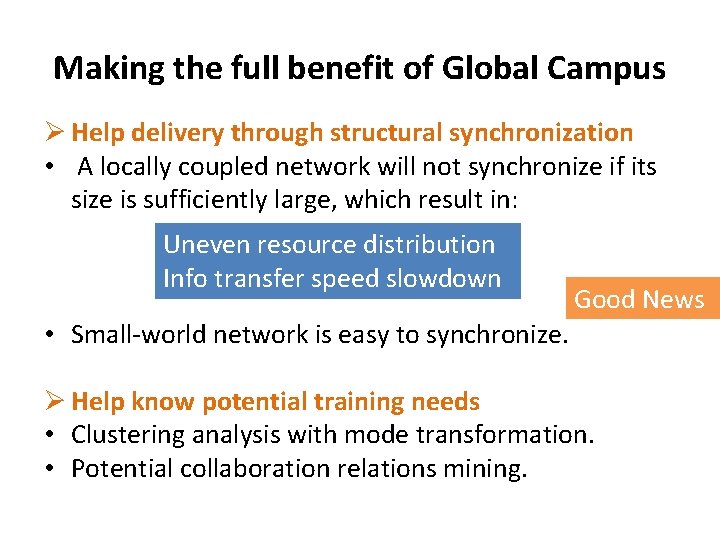
Making the full benefit of Global Campus Ø Help delivery through structural synchronization • A locally coupled network will not synchronize if its size is sufficiently large, which result in: Uneven resource distribution Info transfer speed slowdown Good News • Small-world network is easy to synchronize. Ø Help know potential training needs • Clustering analysis with mode transformation. • Potential collaboration relations mining.
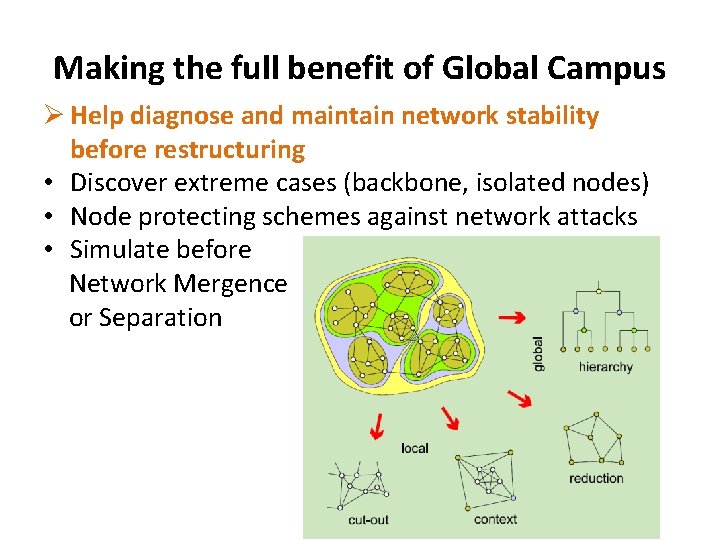
Making the full benefit of Global Campus Ø Help diagnose and maintain network stability before restructuring • Discover extreme cases (backbone, isolated nodes) • Node protecting schemes against network attacks • Simulate before Network Mergence or Separation
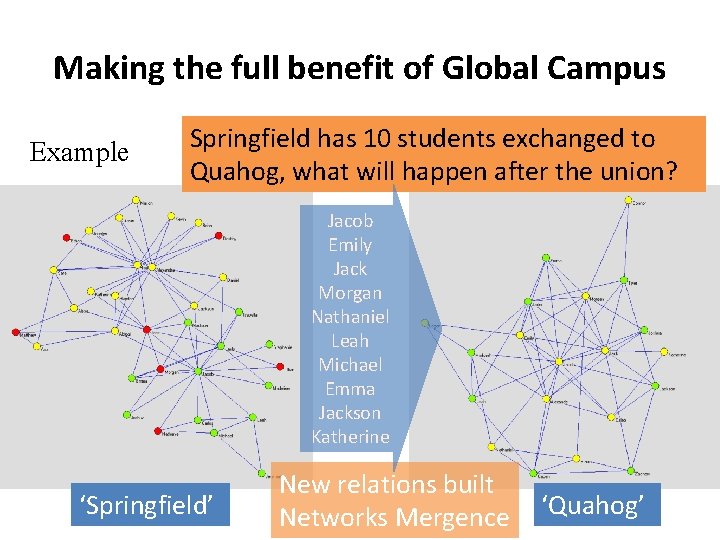
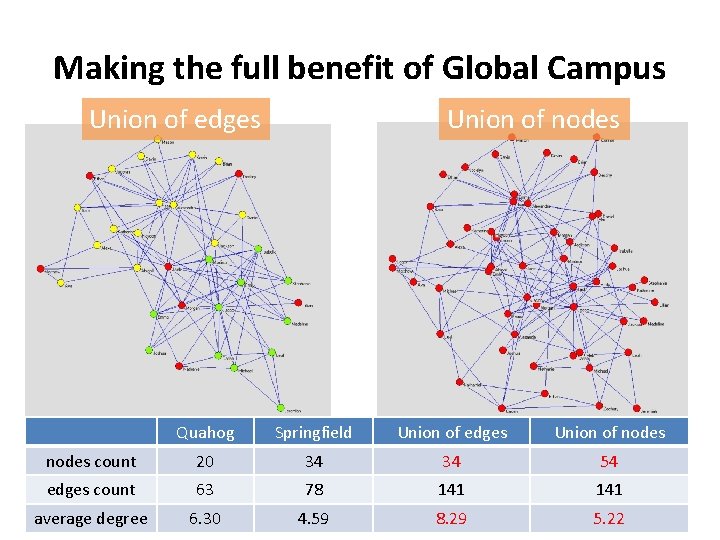
Making the full benefit of Global Campus Example Springfield has 10 students exchanged to Quahog, what will happen after the union? Jacob Emily Jack Morgan Nathaniel Leah Michael Emma Jackson Katherine ‘Springfield’ New relations built Networks Mergence ‘Quahog’
Making the full benefit of Global Campus Union of edges Union of nodes Quahog Springfield Union of edges Union of nodes count 20 34 34 54 edges count 63 78 141 average degree 6. 30 4. 59 8. 29 5. 22
Challenges and Discussions Ø Data collection defects affect the structural presents? • Data is large, not complete, error, inaccurate, etc. Ø Any resistance to the establishment of long range connections? • Geographical range, time zone, technical barriers, intellectual property, etc. Ø How to reduce vulnerable risks of structure? • sudden disappearance of some key nodes and paths, would resulting in wide range disasters
Thank you!