Teaching Child Psychiatric Assessment Skills Using Mental Health


















- Slides: 120
Teaching Child Psychiatric Assessment Skills: Using Mental Health Screening Instruments Part I Terri Hargrave, MD, MPH SUNY Upstate Medical University
Disclosures Dr. Hargrave has no disclosures to make. All screening tools to be discussed are in the public domain.
Questionnaire and Scenarios with Screens Packet Does everybody have one?
Today’s Goals Practice using screening tools for common pediatric mental health problems Brainstorm how to integrate these tools into participants’ teaching practices
Where are these Tools? http: //www. capp cny. org
Public Health Crisis
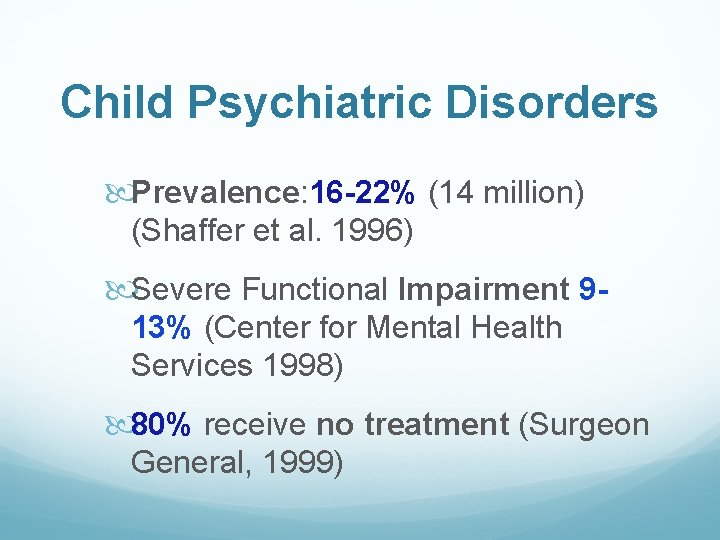
Child Psychiatric Disorders Prevalence: 16 -22% (14 million) (Shaffer et al. 1996) Severe Functional Impairment 913% (Center for Mental Health Services 1998) 80% receive no treatment (Surgeon General, 1999)
Public Health Crisis
Risks (Costello et al. 1999) Adult psychiatric disorders Substance abuse School drop out Impaired peer relationships Difficulties adjusting to work
Public Health Crisis
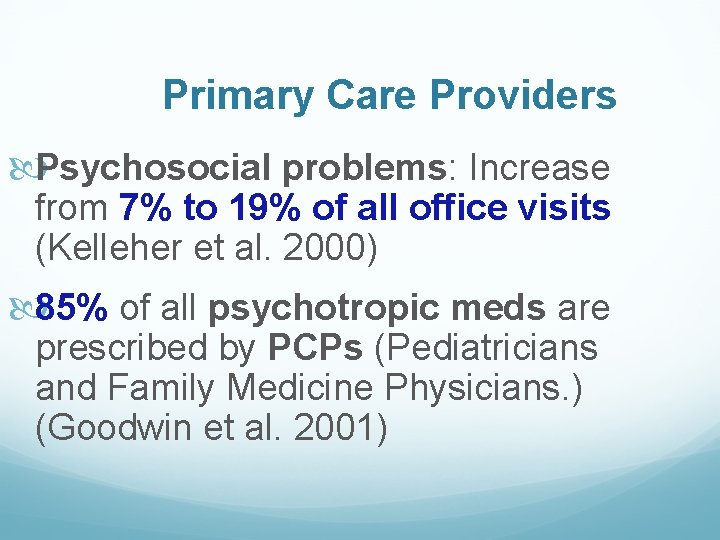
Primary Care Providers Psychosocial problems: Increase from 7% to 19% of all office visits (Kelleher et al. 2000) 85% of all psychotropic meds are prescribed by PCPs (Pediatricians and Family Medicine Physicians. ) (Goodwin et al. 2001)
Public Health Crisis
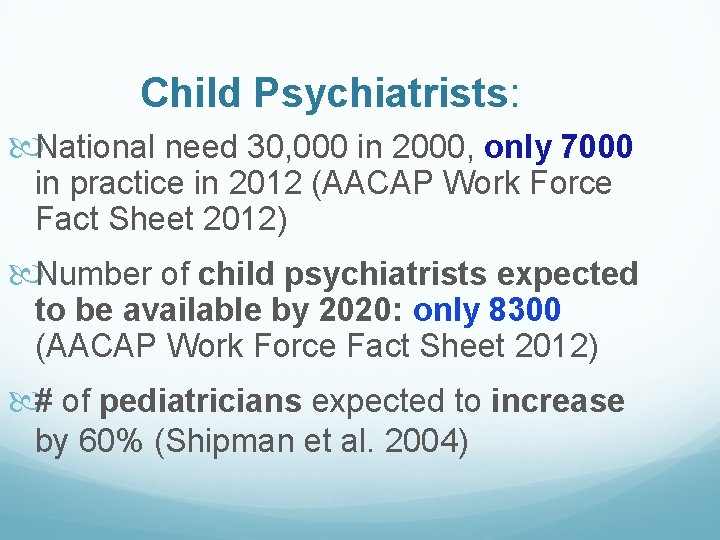
Child Psychiatrists: National need 30, 000 in 2000, only 7000 in practice in 2012 (AACAP Work Force Fact Sheet 2012) Number of child psychiatrists expected to be available by 2020: only 8300 (AACAP Work Force Fact Sheet 2012) # of pediatricians expected to increase by 60% (Shipman et al. 2004)
Public Health Crisis
Crisis Approaches Child Psychiatry Access Programs, e. g. CAPPC Improve training of Primary Care Clinicians in detecting/managing Mental Health Issues in Pediatric age group Collocate/Integrate Primary Care and MH
CAPPC, a “CPAP” Child Psychiatry Access Program Consult line Help with referrals Face-to-Face assessments Website CME
CAPPC, a “CPAP” Child Psychiatry Access Program Consult line 1 -855 -227 -7272 M-F, 9 -5 (except holidays) Liaison Coordinator baseline info Return call from CAP < 2 hrs. Follow-up calls encouraged
CAPPC, a “CPAP” Child Psychiatry Access Program Consult line Help with referrals Liaison coordinators lists Suggestions for you Follow-up encouraged
CAPPC, a “CPAP” Child Psychiatry Access Program Consult line Help with referrals Face-to-Face assessments One time only Your charts prior to FTF Call back to you same day Written report 5 business days
CAPPC, a “CPAP” Child Psychiatry Access Program Consult line Help with referrals Face-to-Face assessments Website: Google “CAPPCNY” Screening tools Links – other websites, handouts Relevant articles
CAPPC, a “CPAP” Child Psychiatry Access Program Consult line Help with referrals Face-to-Face assessments Website CME
CAPPC, a “CPAP” Child Psychiatry Access Program CME: REACH training – 3 d course CORE training – 4 hours basics Evening webinars - 2 hrs “extras” Lunch-and-learns – on request
CAPPC, a “CPAP” Child Psychiatry Access Program Homework #1 Signing up: Fill out the “ATP” Making that first call: Business card: 1 -855 -CAPPC 72 Cheat Sheet
Homework #2 – Sign up for at least one CAPPC CME REACH: Google “CAPPC” website Evening webinar: Google CAPPC CORE Training: contact email hargravt@upstate. edu Lunch and learn: contact email hargravt@upstate. edu
Today’s Focus: Screening for the “Four Horses” of Pediatric Mental Health Anxiety ADHD Depression Behavioral Problems
Timeliness: the Medical Home Initiative Screen for MHI at each WCC : PSC-17 Adolescents: Screen for Depression : PHQ 9 t
Screen “Flavors” General, e. g. PSC 17, PSC 35, SDQ, NOCHSI Adolescent Problem Specific, e. g. Vanderbilt, SCARED, PHQ 9, MOAS,
Where are these Tools? http: //www. cappc ny. org
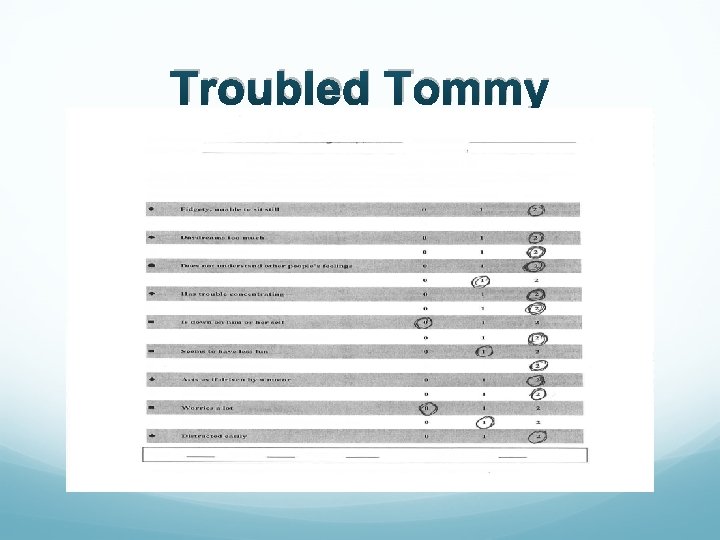
General Rule Marks on the right mean trouble.
Troubled Tommy
Scenario #1 Johnny Smith is here for his 5 year WCC. When Ms. Smith checks in, the receptionist hands her a clipboard with the PSC-17 to complete in the waiting room. The nurse puts it in the room with her other paperwork.
Where are these Tools? http: //www. cappc ny. org
The PSC-17 Valid ages 4 -18, Available in many languages Easy to read Quick to fill out
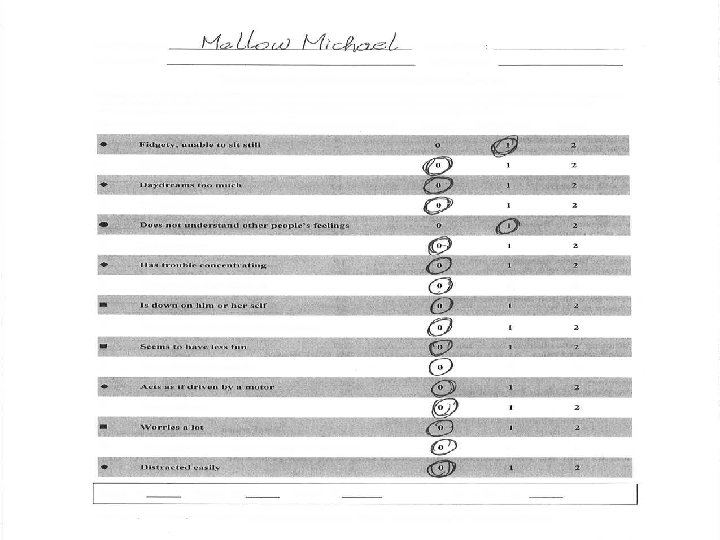
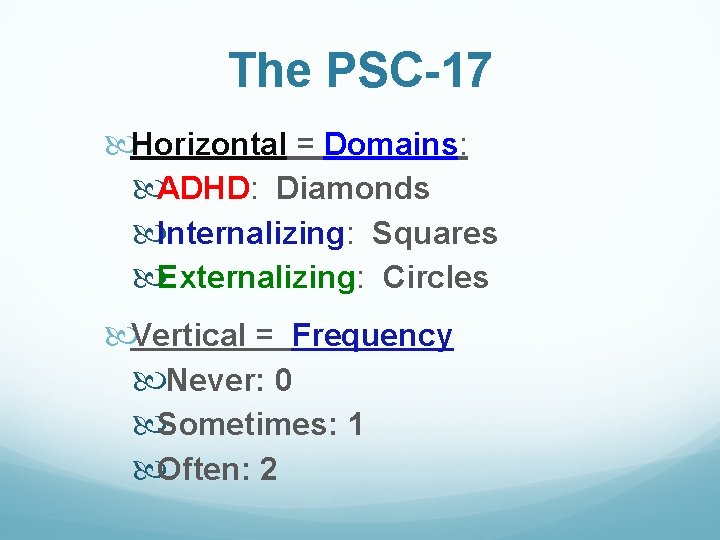
The PSC-17 Horizontal = Domains: ADHD: Diamonds Internalizing: Squares Externalizing: Circles Vertical = Frequency Never: 0 Sometimes: 1 Often: 2
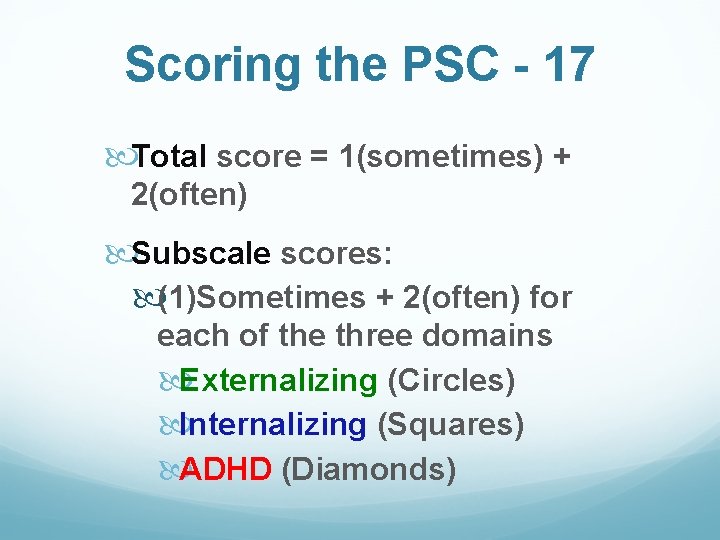
Scoring the PSC - 17 Total score = 1(sometimes) + 2(often) Subscale scores: (1)Sometimes + 2(often) for each of the three domains Externalizing (Circles) Internalizing (Squares) ADHD (Diamonds)
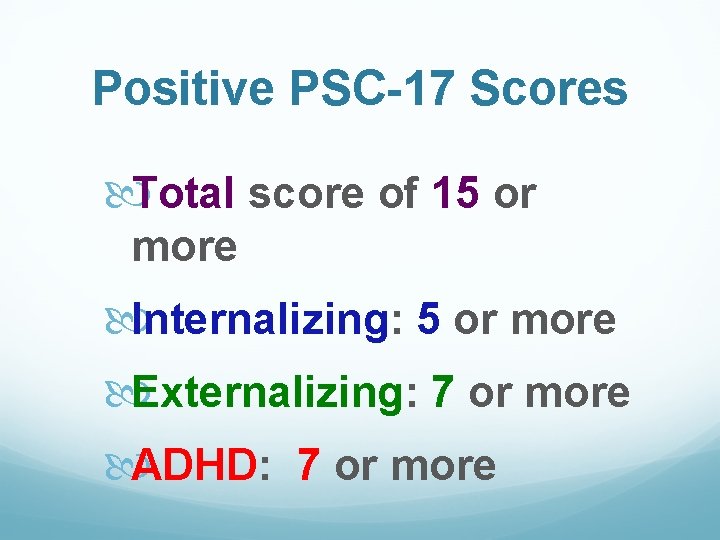
Positive PSC-17 Scores Total score of 15 or more Internalizing: 5 or more Externalizing: 7 or more ADHD: 7 or more
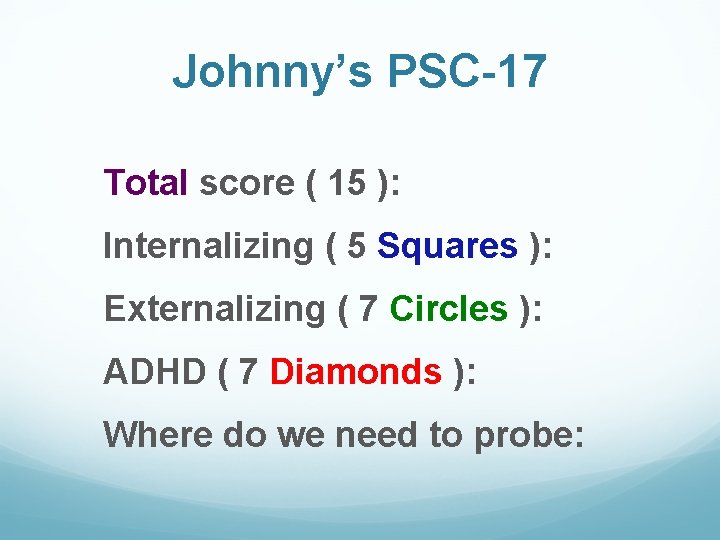
Johnny’s PSC-17 Total score ( 15 ): Internalizing ( 5 Squares ): Externalizing ( 7 Circles ): ADHD ( 7 Diamonds ): Where do we need to probe:
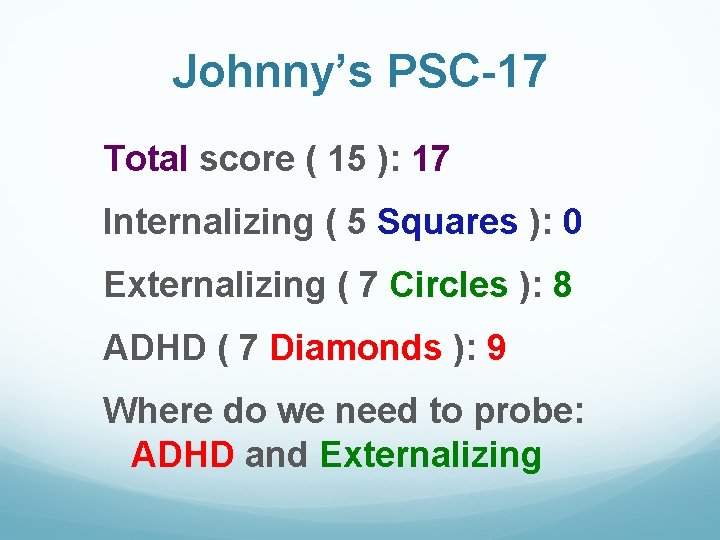
Johnny’s PSC-17 Total score ( 15 ): 17 Internalizing ( 5 Squares ): 0 Externalizing ( 7 Circles ): 8 ADHD ( 7 Diamonds ): 9 Where do we need to probe: ADHD and Externalizing
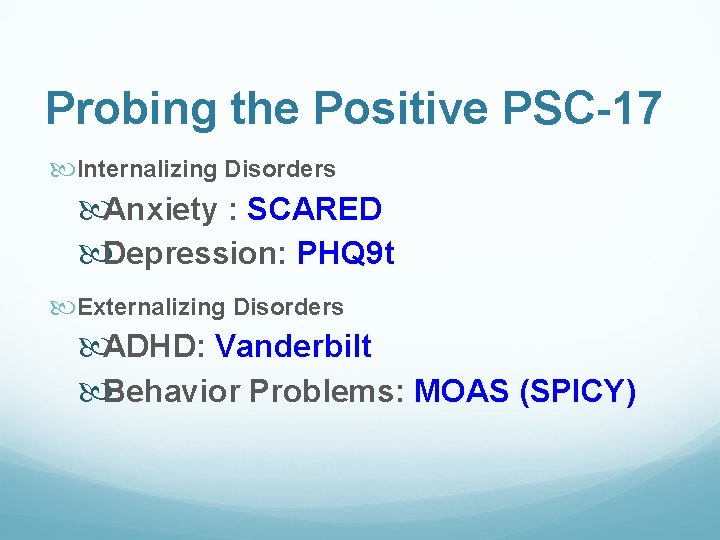
Probing the Positive PSC-17 Internalizing Disorders Anxiety : SCARED Depression: PHQ 9 t Externalizing Disorders ADHD: Vanderbilt Behavior Problems: MOAS (SPICY)
Where to Get These Screening Tools: http: //www. cappcny. o rg
Scenario 2 - Amanda
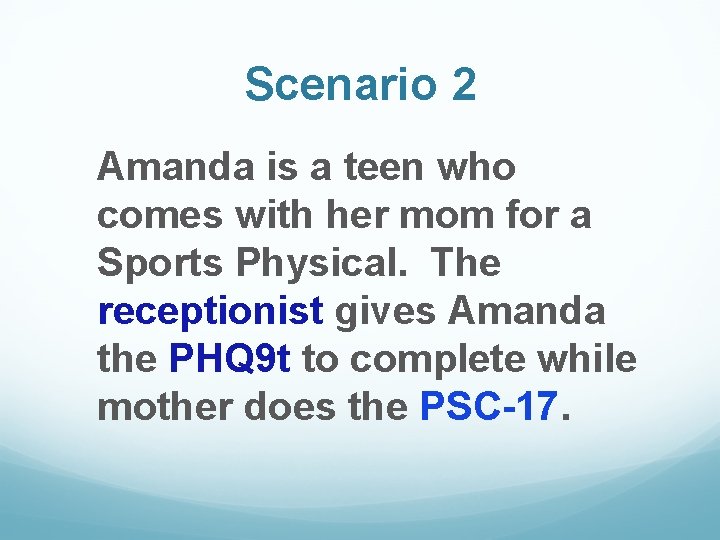
Scenario 2 Amanda is a teen who comes with her mom for a Sports Physical. The receptionist gives Amanda the PHQ 9 t to complete while mother does the PSC-17.
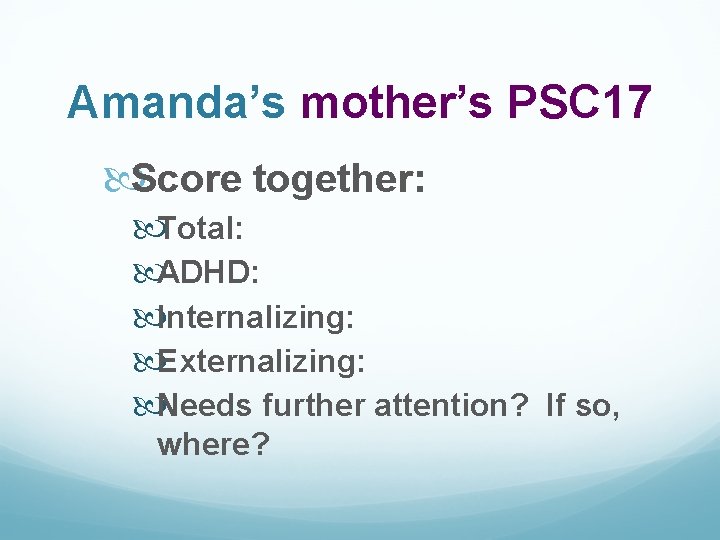
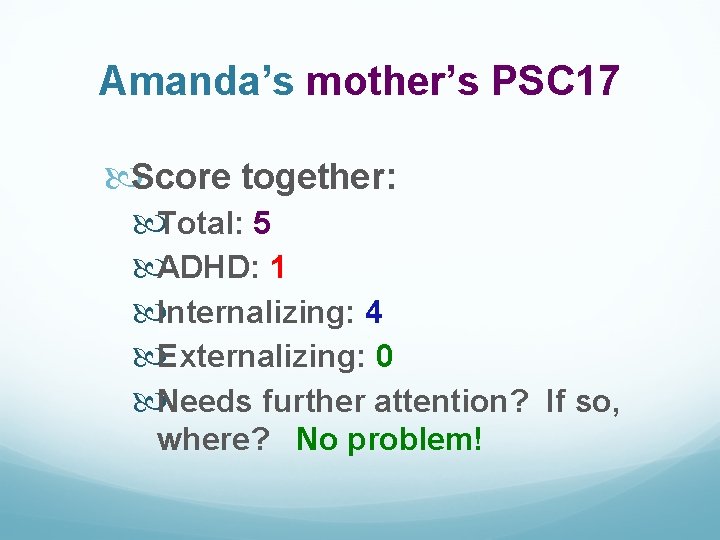
Amanda’s mother’s PSC 17 Score together: Total: ADHD: Internalizing: Externalizing: Needs further attention? If so, where?
Amanda’s mother’s PSC 17 Score together: Total: 5 ADHD: 1 Internalizing: 4 Externalizing: 0 Needs further attention? If so, where? No problem!
The PHQ 9 t http: //www. cappcny. org
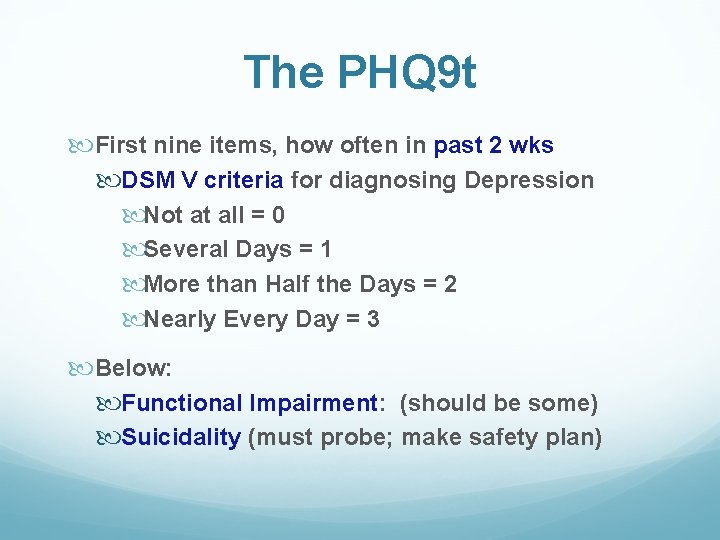
The PHQ 9 t First nine items, how often in past 2 wks DSM V criteria for diagnosing Depression Not at all = 0 Several Days = 1 More than Half the Days = 2 Nearly Every Day = 3 Below: Functional Impairment: (should be some) Suicidality (must probe; make safety plan)
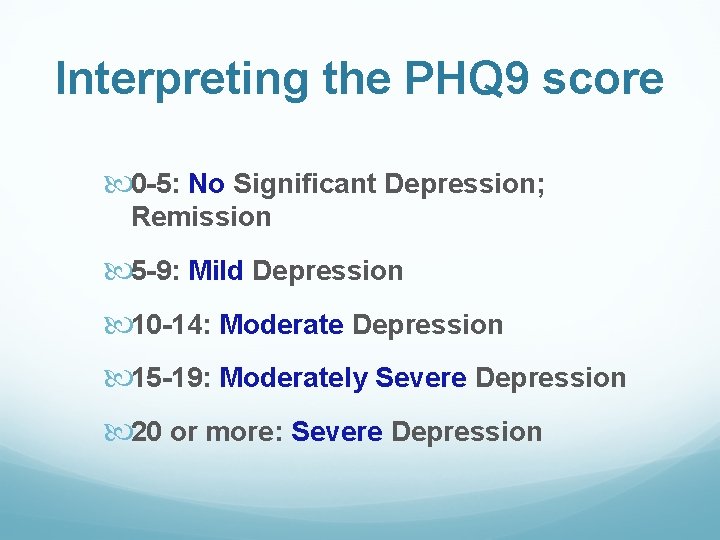
Interpreting the PHQ 9 score 0 -5: No Significant Depression; Remission 5 -9: Mild Depression 10 -14: Moderate Depression 15 -19: Moderately Severe Depression 20 or more: Severe Depression
Amanda’s PHQ 9 t #1 Score: Functional Impairment: Suicidality: Interpretation:
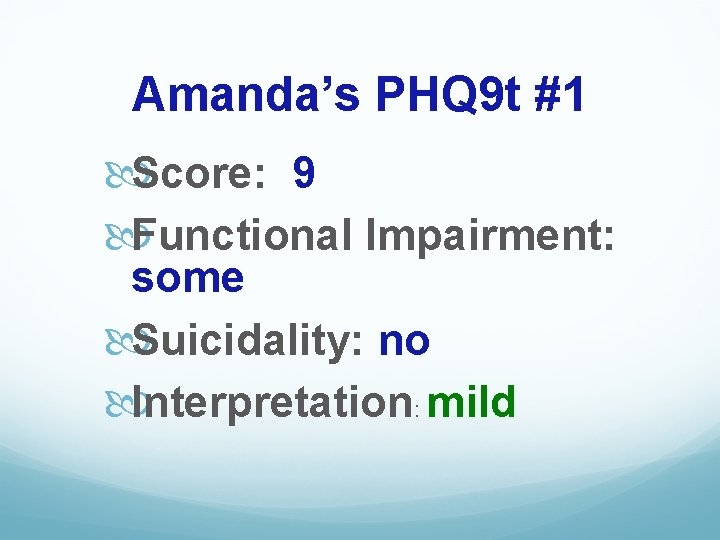
Amanda’s PHQ 9 t #1 Score: 9 Functional Impairment: some Suicidality: no Interpretation: mild
Amanda’s Interview
Group Exercise Score Mom’s PHQ 9 t
Mother’s PHQ 9 t Score: Functional Impairment: Suicidality: Interpretation:
Mother’s PHQ 9 t Score: 3 Functional Impairment: no Suicidality: no Interpretation: negative
Thinking Through Amanda To treat or not to treat? Treatment options: Counsel and make return visit soon Therapy referral Med management Both therapy and meds
Amanda comes back and does another PHQ 9 t What is her score now? Is she feeling functionally impaired? Is she suicidal? Is she in remission?
Amanda comes back and does another PHQ 9 t What is her score now? 1 Is she feeling functionally impaired? no Is she suicidal? no Is she in remission? yes
Meet Molly
Your Next Patient, Molly 7 yo Molly is here for a WCC. Mother fills out the PSC – 17 in the waiting room and gives it to the receptionist. The receptionist scores it and lets you know that there is a positive screen for ADHD. You probe mom’s concerns for ADHD and ask mom to complete a Vanderbilt-parent questionnaire while you do Molly’s physical exam.
ADHD: The Vanderbilt http: //www. cappcny. o rg
The Vanderbilt ADHD Diagnostic Rating Scale Flavors: Parent Initial Follow-up Teacher Initial Follow-up
Vanderbilt Initial Parent Rating Scale Horizontal: 47 Symptoms in 5 Clusters: Attention Deficit Hyperactivity Oppositionality Conduct Problems Internalizing Symptoms
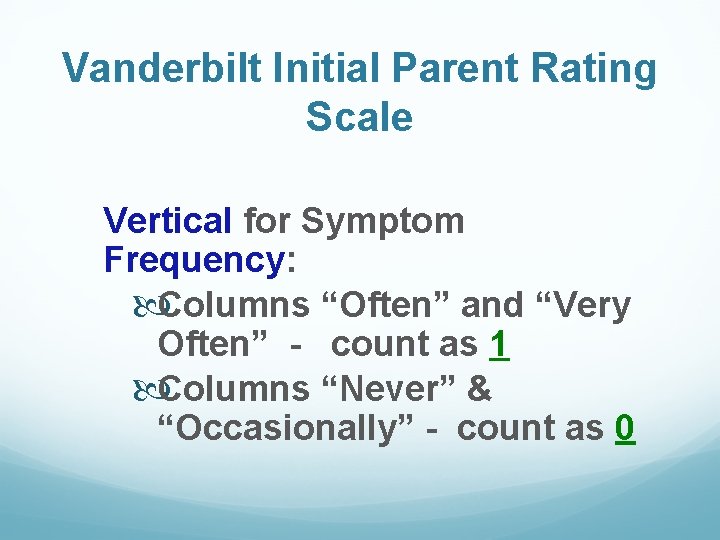
Vanderbilt Initial Parent Rating Scale Vertical for Symptom Frequency: Columns “Often” and “Very Often” - count as 1 Columns “Never” & “Occasionally” - count as 0
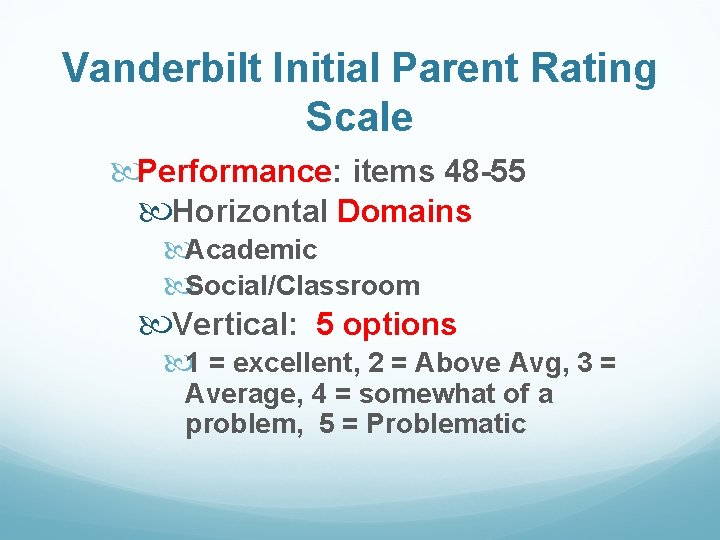
Vanderbilt Initial Parent Rating Scale Performance: items 48 -55 Horizontal Domains Academic Social/Classroom Vertical: 5 options 1 = excellent, 2 = Above Avg, 3 = Average, 4 = somewhat of a problem, 5 = Problematic
Interpreting the Vanderbilt http: //www. cappcny. org
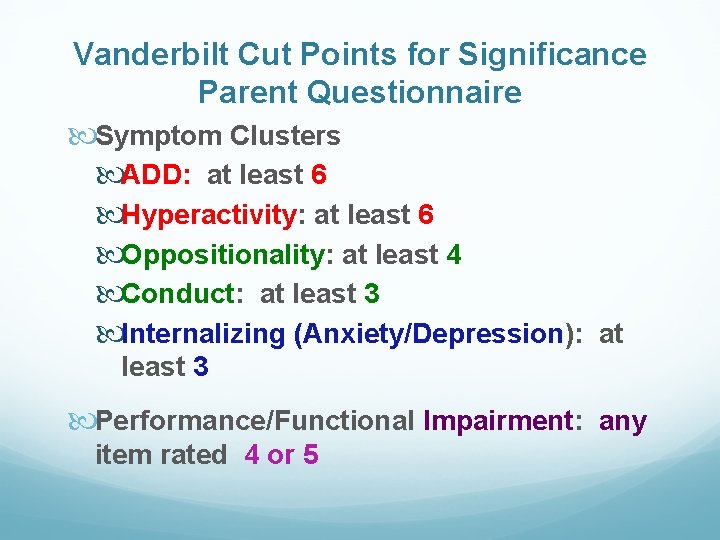
Vanderbilt Cut Points for Significance Parent Questionnaire Symptom Clusters ADD: at least 6 Hyperactivity: at least 6 Oppositionality: at least 4 Conduct: at least 3 Internalizing (Anxiety/Depression): at least 3 Performance/Functional Impairment: any item rated 4 or 5
More Molly’s mother and grandmother and school are all concerned Molly can’t sit still while you talk with mom Mom hands you the completed Parent’s Initial Vanderbilt as you finish Molly’s exam. You score the Vanderbilt and then discuss it with mom.
Molly’s Initial Parent Vanderbilt Domain scores: ADD: Hyperactivity: Oppositionality: Conduct: Internalizing: Performance score – any 4’s or 5’s?
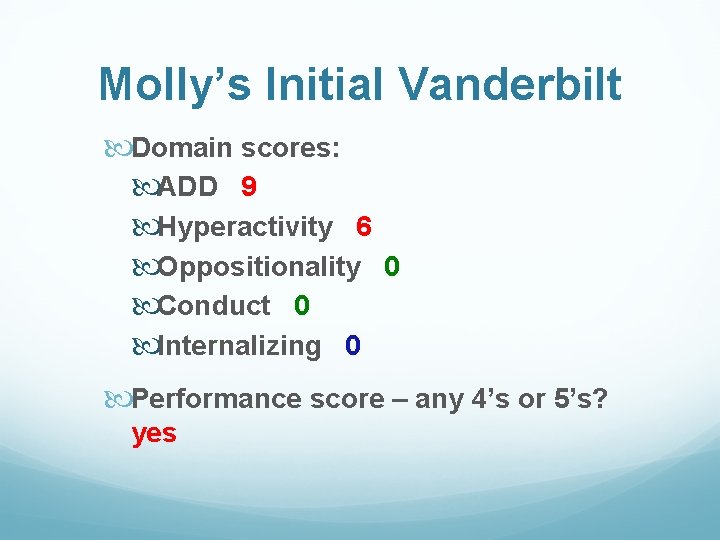
Molly’s Initial Vanderbilt Domain scores: ADD 9 Hyperactivity 6 Oppositionality 0 Conduct 0 Internalizing 0 Performance score – any 4’s or 5’s? yes
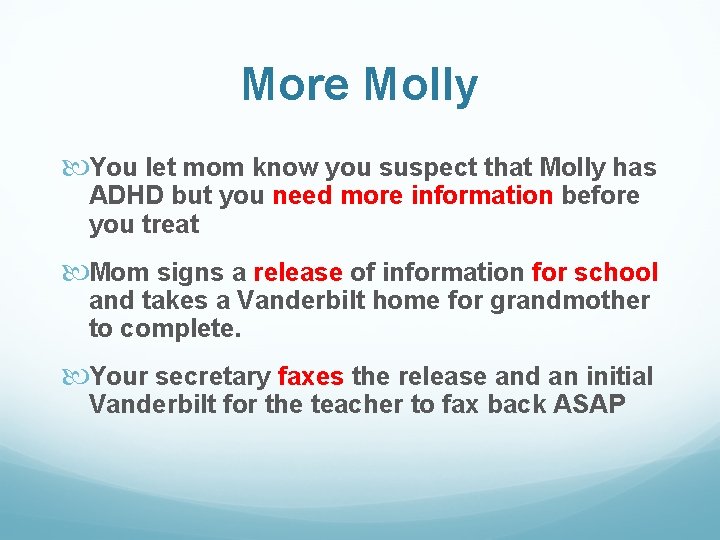
More Molly You let mom know you suspect that Molly has ADHD but you need more information before you treat Mom signs a release of information for school and takes a Vanderbilt home for grandmother to complete. Your secretary faxes the release and an initial Vanderbilt for the teacher to fax back ASAP
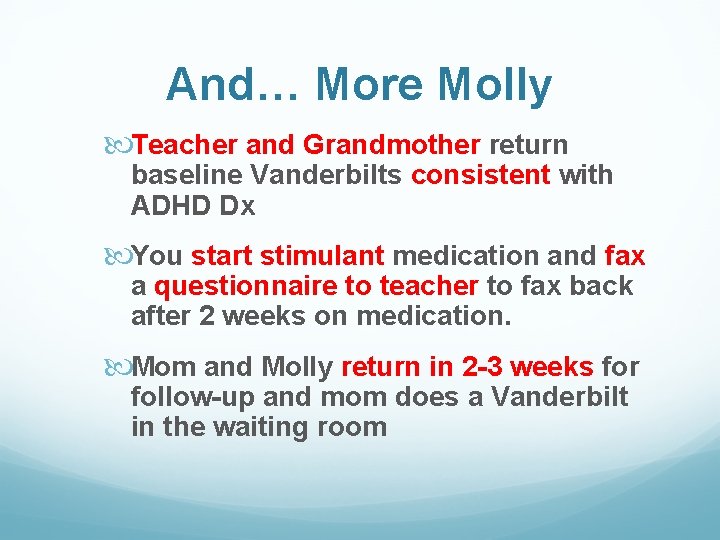
And… More Molly Teacher and Grandmother return baseline Vanderbilts consistent with ADHD Dx You start stimulant medication and fax a questionnaire to teacher to fax back after 2 weeks on medication. Mom and Molly return in 2 -3 weeks for follow-up and mom does a Vanderbilt in the waiting room
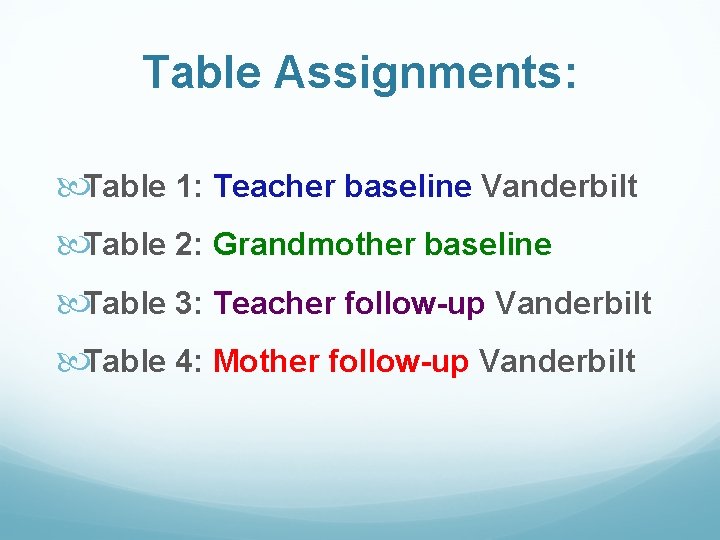
Table Assignments: Table 1: Teacher baseline Vanderbilt Table 2: Grandmother baseline Table 3: Teacher follow-up Vanderbilt Table 4: Mother follow-up Vanderbilt
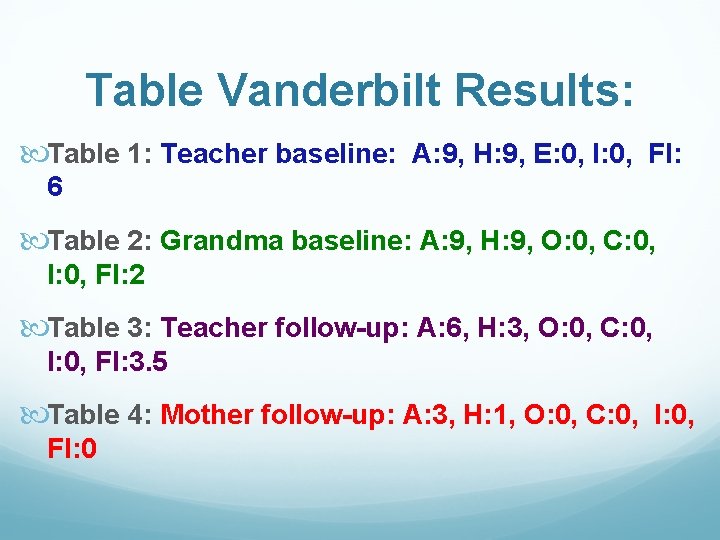
Table Vanderbilt Results: Table 1: Teacher baseline: A: 9, H: 9, E: 0, I: 0, FI: 6 Table 2: Grandma baseline: A: 9, H: 9, O: 0, C: 0, I: 0, FI: 2 Table 3: Teacher follow-up: A: 6, H: 3, O: 0, C: 0, I: 0, FI: 3. 5 Table 4: Mother follow-up: A: 3, H: 1, O: 0, C: 0, I: 0, FI: 0
Anxiety: the SCARED
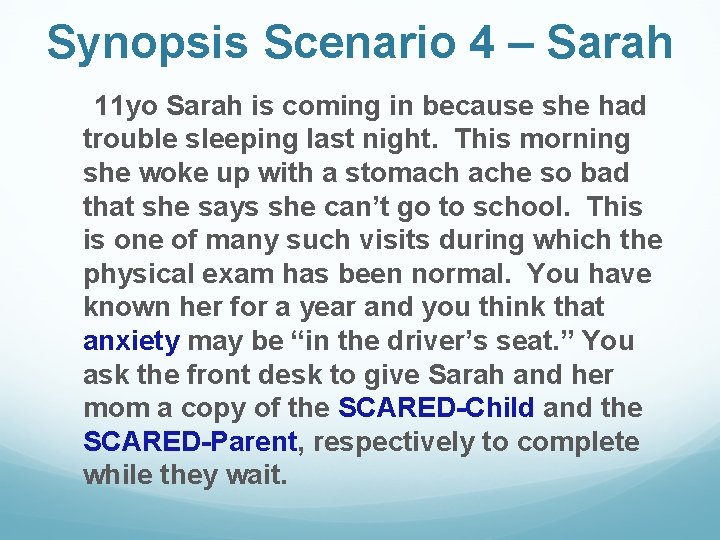
Synopsis Scenario 4 – Sarah 11 yo Sarah is coming in because she had trouble sleeping last night. This morning she woke up with a stomach ache so bad that she says she can’t go to school. This is one of many such visits during which the physical exam has been normal. You have known her for a year and you think that anxiety may be “in the driver’s seat. ” You ask the front desk to give Sarah and her mom a copy of the SCARED-Child and the SCARED-Parent, respectively to complete while they wait.
Scenario 4: Meet Sarah
Anxiety – the SCARED http: //www. cappcny. org
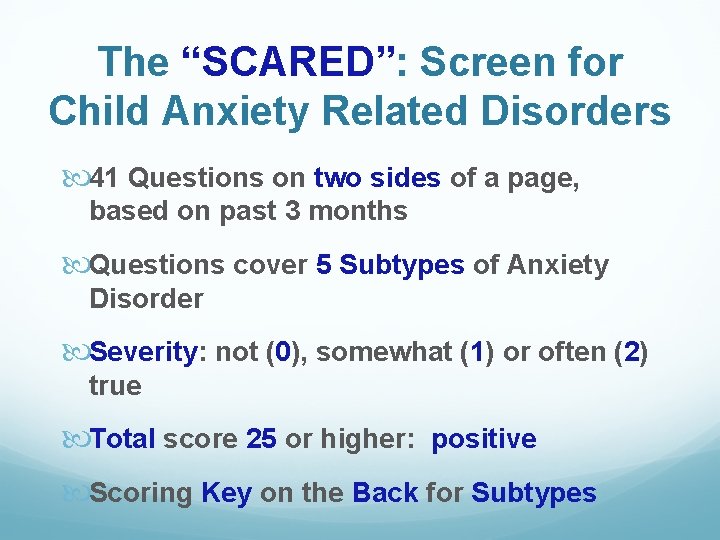
The “SCARED”: Screen for Child Anxiety Related Disorders 41 Questions on two sides of a page, based on past 3 months Questions cover 5 Subtypes of Anxiety Disorder Severity: not (0), somewhat (1) or often (2) true Total score 25 or higher: positive Scoring Key on the Back for Subtypes
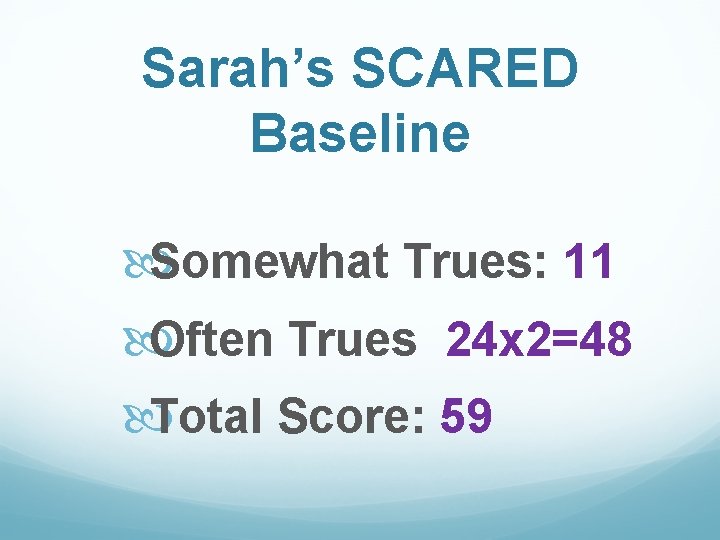
Sarah’s SCARED Baseline Somewhat Trues: Often Trues: Total Score:
Sarah’s SCARED Baseline Somewhat Trues: 11 Often Trues 24 x 2=48 Total Score: 59
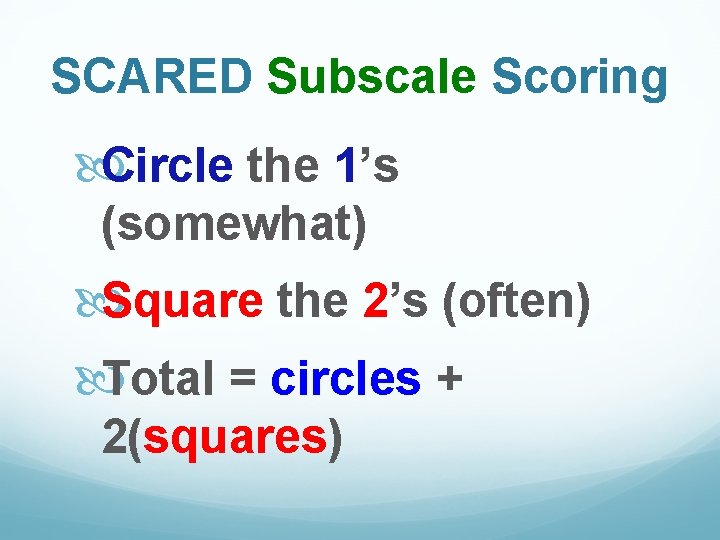
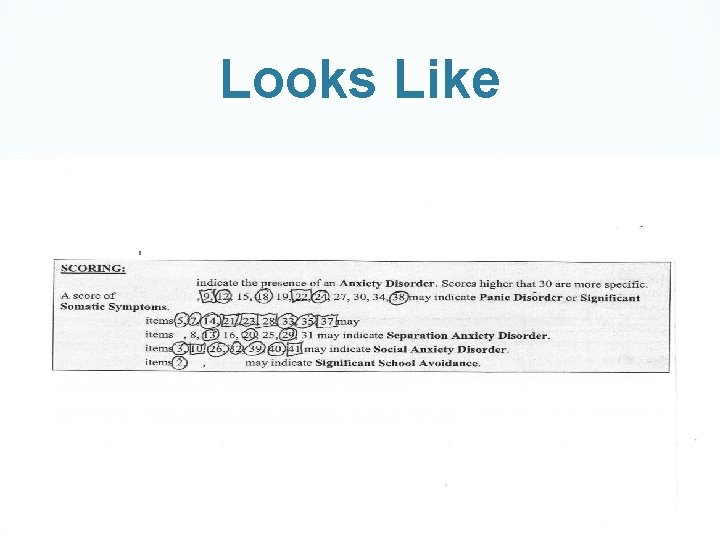
SCARED Subscale Scoring Circle the 1’s (somewhat) Square the 2’s (often) Total = circles + 2(squares)
Looks Like
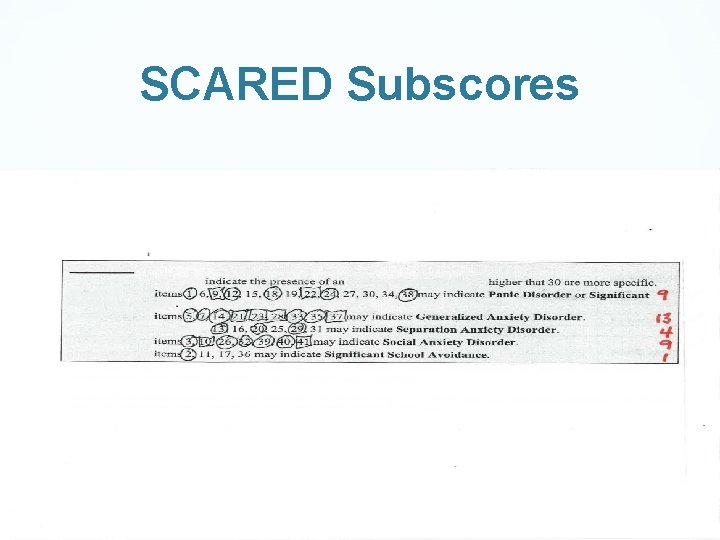
SCARED Subscores
Sarah’s SCARED Baseline con’t Panic/Somaticizing: Generalized Anxiety Disorder: Separation Anxiety Disorder: Social Anxiety Disorder: Significant School Avoidance:
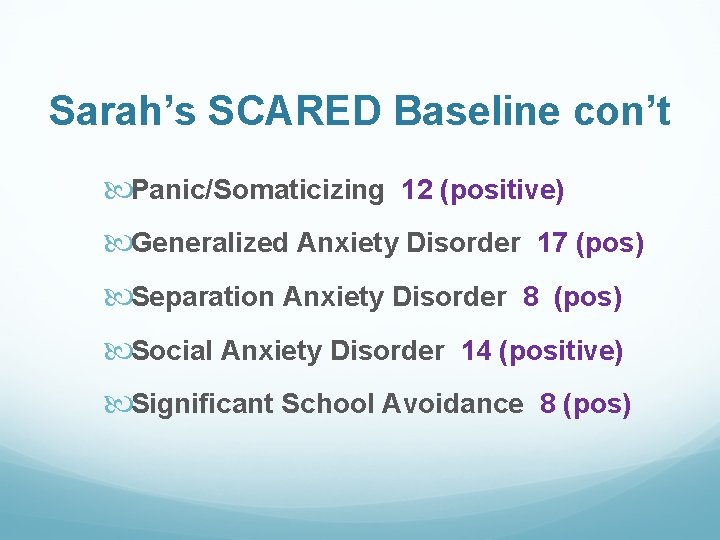
Sarah’s SCARED Baseline con’t Panic/Somaticizing 12 (positive) Generalized Anxiety Disorder 17 (pos) Separation Anxiety Disorder 8 (pos) Social Anxiety Disorder 14 (positive) Significant School Avoidance 8 (pos)
Sarah’s return 3 months of therapy with no change You start Sarah on sertraline Sarah has now been on med for a month.
Table Exercise: (1) Total (2) Subscales Table 1: Sarah’s SCARED pre meds Table 2: Mother’s SCARED pre meds Table 3: Sarah’s SCARED on med Table 4: Mother’s SCARED on med
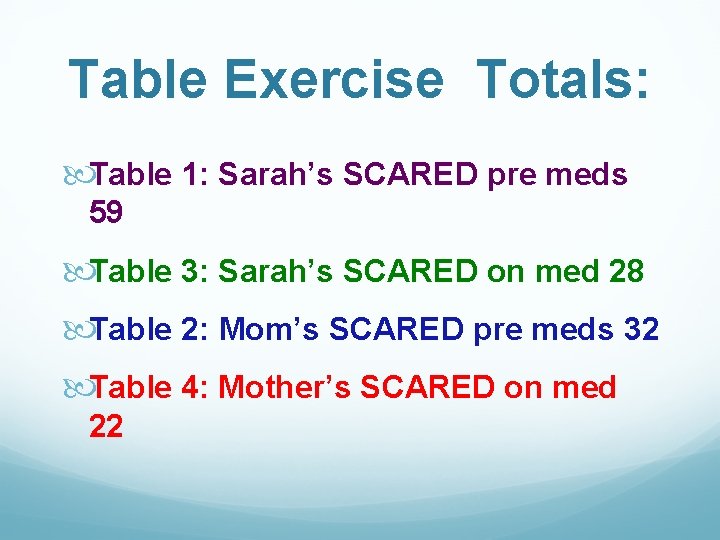
Table Exercise Totals: Table 1: Sarah’s SCARED pre meds 59 Table 3: Sarah’s SCARED on med 28 Table 2: Mom’s SCARED pre meds 32 Table 4: Mother’s SCARED on med 22
Table Exercise: (2) Subscale a. ) Scores b. ) Which meet cutoff Table 1: Sarah’s SCARED pre meds Table 2: Mother’s SCARED pre meds Table 3: Sarah’s SCARED on med Table 4: Mother’s SCARED on med
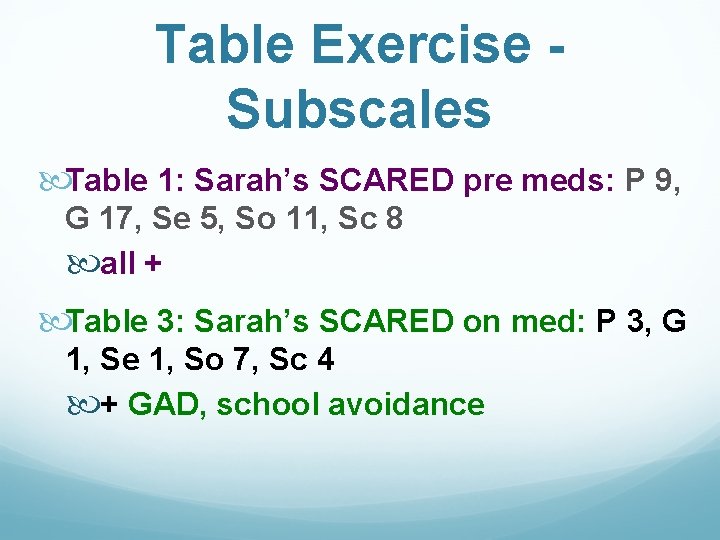
Table Exercise Subscales Table 1: Sarah’s SCARED pre meds: P 9, G 17, Se 5, So 11, Sc 8 all + Table 3: Sarah’s SCARED on med: P 3, G 1, Se 1, So 7, Sc 4 + GAD, school avoidance
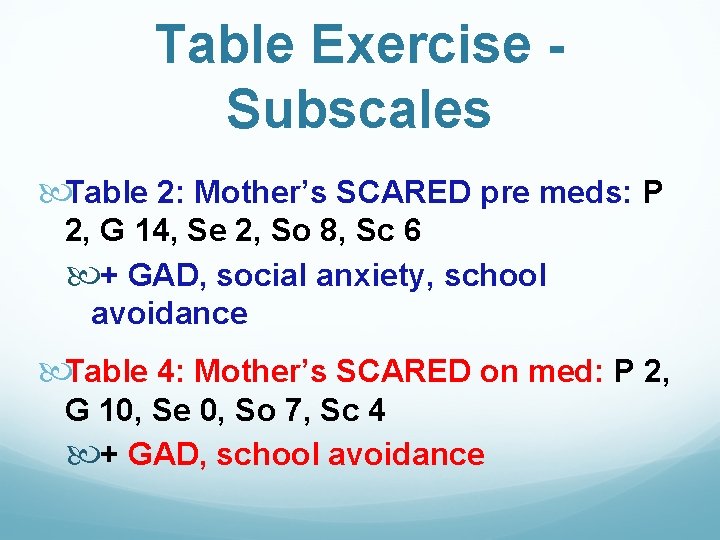
Table Exercise Subscales Table 2: Mother’s SCARED pre meds: P 2, G 14, Se 2, So 8, Sc 6 + GAD, social anxiety, school avoidance Table 4: Mother’s SCARED on med: P 2, G 10, Se 0, So 7, Sc 4 + GAD, school avoidance
Aggression – Meet Harry
Scenario 5: Harry 4 yo Harry is here for his Pre. K physical. Mother filled out his PSC 17 in the waiting room in between having to keep Harry from making his 1 yo sister scream.
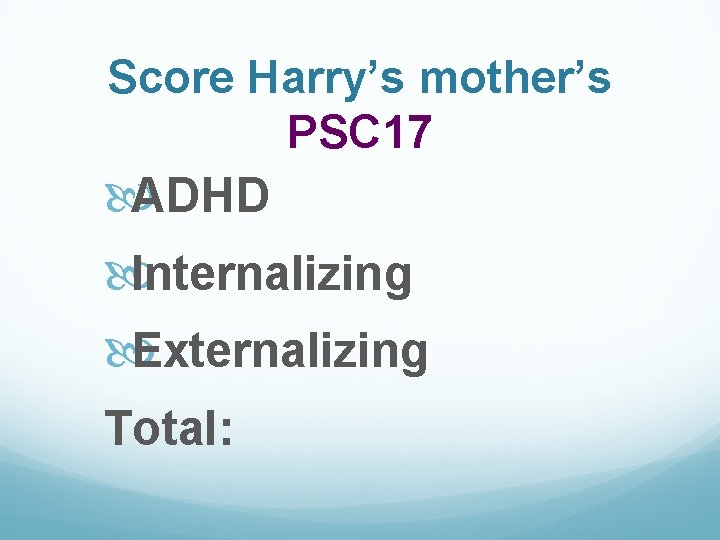
Score Harry’s mother’s PSC 17 ADHD Internalizing Externalizing Total:
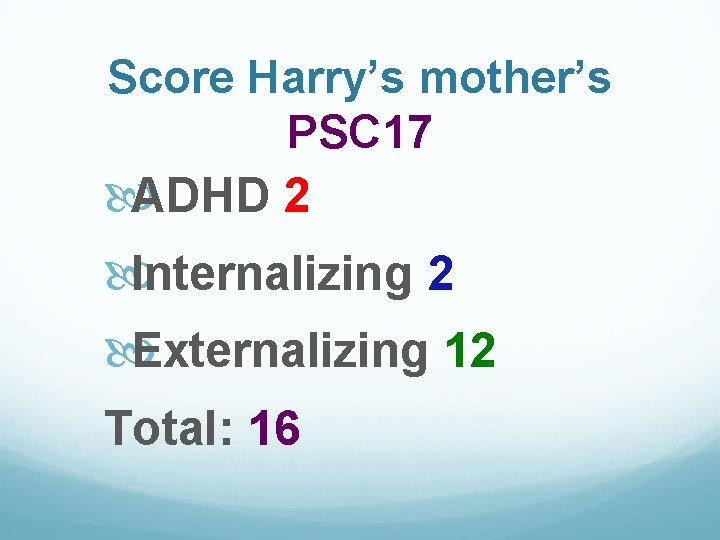
Score Harry’s mother’s PSC 17 ADHD 2 Internalizing 2 Externalizing 12 Total: 16
More Harry This is the “megashot” visit and Harry continues to take his anxiety out on his sister. You discover the mom and dad don’t agree on discipline for Harry You opt to bring mom back with dad (if possible) and without the kids. On the return visit, mom fills out the R-MOAS
Aggression – R-MOAS (SPICY) http: //www. cappcny. org
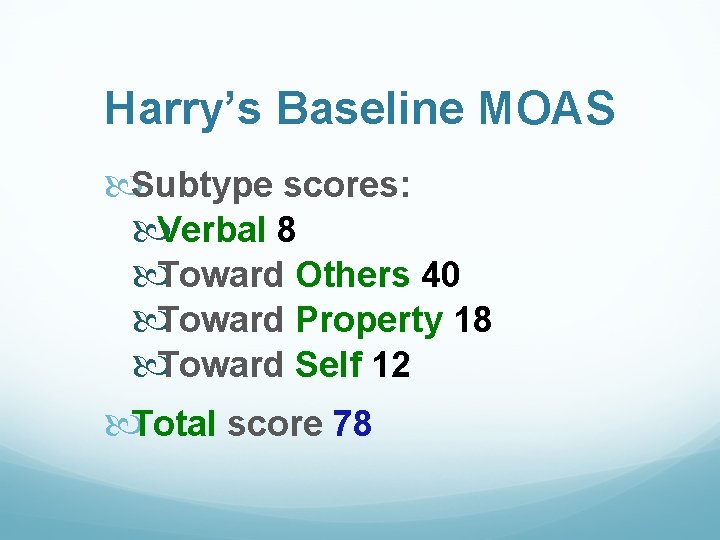
The MOAS: Retrospective Modified Overt Aggression Scale (SPICY version) Monitoring, not diagnostic, tool 4 subtypes of aggression: verbal, property Self others
The MOAS: Retrospective Modified Overt Aggression Scale (SPICY version) Frequency of behaviors during past week Scores in boxes already weighted by both frequency and severity of subtype
Harry’s Baseline MOAS Subtype scores Verbal: Toward Others: Toward Property: Toward Self: Total score:
Harry’s Baseline MOAS Subtype scores: Verbal 8 Toward Others 40 Toward Property 18 Toward Self 12 Total score 78
Harry’s MOAS after Intervention Subtype scores: Verbal Toward Others Toward Property Toward Self Total score
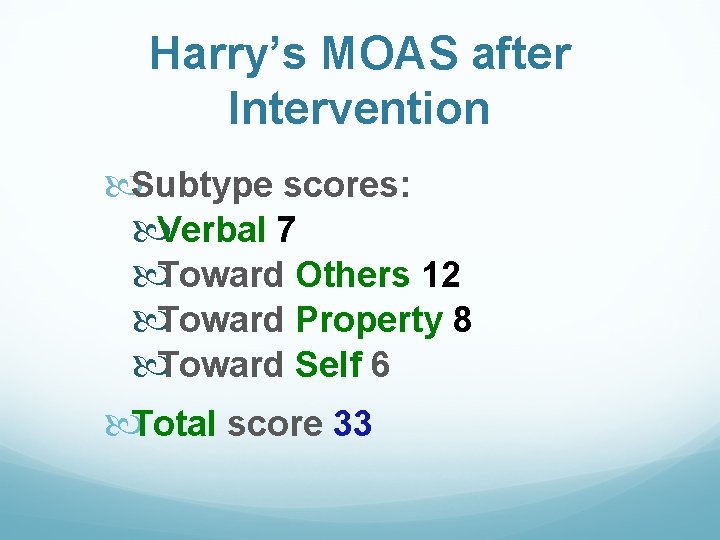
Harry’s MOAS after Intervention Subtype scores: Verbal 7 Toward Others 12 Toward Property 8 Toward Self 6 Total score 33
10 minute BREAK Complete Questionnaire and Working Document page 1
Part II Incorporating Screens in Your Practice
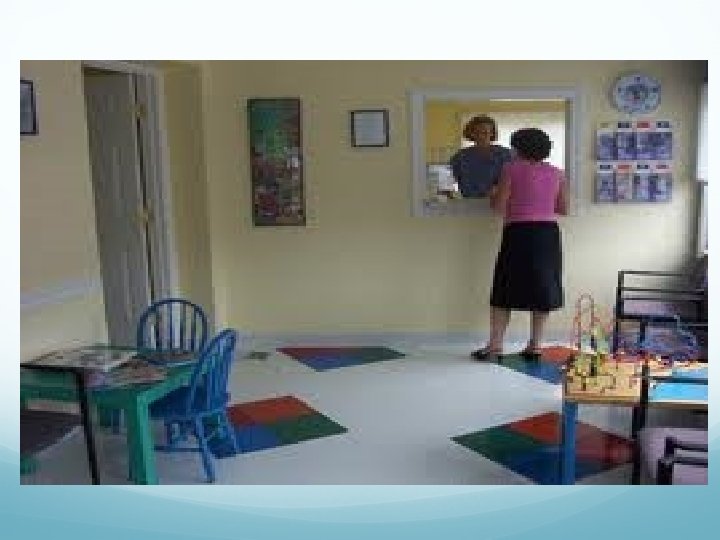
Reflecting on the Vignettes Who took charge of the screening?
Reflecting on the Vignettes: Who gives out the Screen(s) Receptionist on arrival Nurse after vitals Doctor during encounter Receptionist at exit Doctor, nurse, receptionist mails/faxes to school Combination
Reflecting on the Vignettes – Who Scores the Screen(s)? Receptionist Computer Nurse Doctor Co-Located Mental Health Clinician
Whole Group Sharing of Experiences What barriers have you encountered in introducing screening tools into your practices? How did you overcome the barriers
Table Exercise Questionnaire/Worksheet p. 2 Each person first steps for your practice Each person shares with others at table while scribe records Spokesperson shares table ideas
Final Assignment In light of whole group report, make any adjustments to your individual plan Turn in Questionnaires, Work Document and Consent Form. We will email them back to you within the week.
Summary Slide - We: Practiced using screening tools for common pediatric mental health problems Brainstormed how to integrate these tools into participants’ practices
Questions?
Thank you!