
PSYCHIATRIC REHABILITATION Achieving successful community living for adults
PSYCHIATRIC REHABILITATION Achieving successful community living for adults with psychiatric disabilities (Left Click on Audio Symbol for each slide and spacebar to advance)
Defining psychiatric disability � � Individuals who as a result of their mental disorder are unable to achieve commonly accepted age-appropriate milestones and major life domains Diagnoses frequently resulting in psychiatric disability are generally those considered to be severe mental illnesses such as schizophrenia spectrum disorders, and major affective disorders Social Security definition of disability SMI Prevalence, 5. 4% at some time during year
Defining psychiatric rehabilitation � � Increasing the individual's ability to function effectively with life satisfaction in the environments of their own choosing and with the least amount of continuing intervention by professionals Domains include independent living, education and employment, personal relationships, health, criminal justice, spiritual life and recreation
Development of psychiatric rehabilitation � � � 18 th-century introduction of moral treatment 19 th century mental hygiene movement 20 th century deinstitutionalization movement 1960 s Community Support Program, CSP Consumer Centered, Empowering, Culturally Appropriate, Inclusion of Natural Supports and Accountable.

General Principles of Psychiatric Rehabilitation � � � Emphasis is on the strengths of the individual rather than their deficits Active involvement of the consumer in their recovery process Services need to be normalizing - offering experiences that are not different from those without disabilities The treatment is an ongoing process not a one time intervention Services are integrated in the community
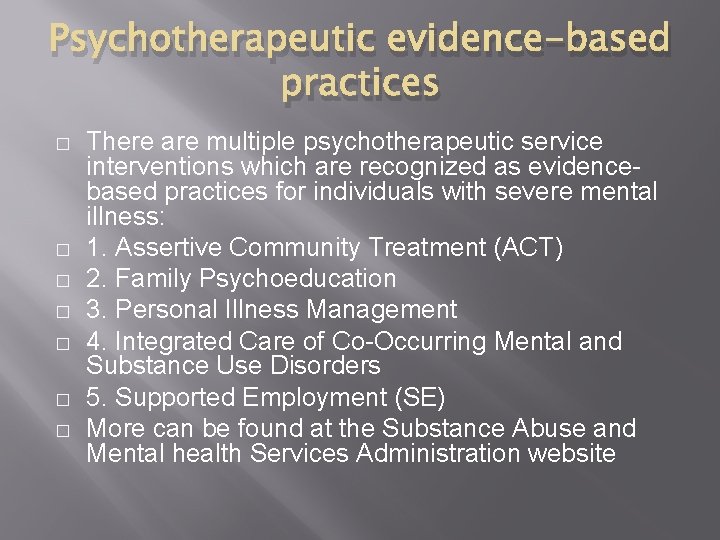
Psychotherapeutic evidence-based practices � � � � There are multiple psychotherapeutic service interventions which are recognized as evidencebased practices for individuals with severe mental illness: 1. Assertive Community Treatment (ACT) 2. Family Psychoeducation 3. Personal Illness Management 4. Integrated Care of Co-Occurring Mental and Substance Use Disorders 5. Supported Employment (SE) More can be found at the Substance Abuse and Mental health Services Administration website
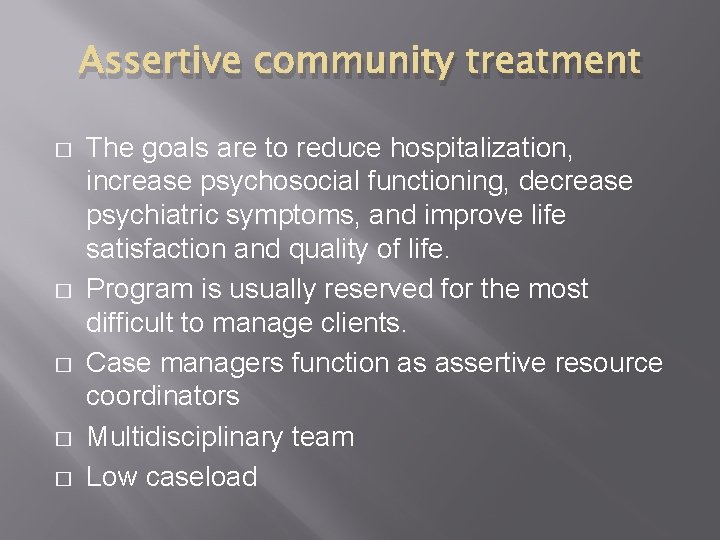
Assertive community treatment � � � The goals are to reduce hospitalization, increase psychosocial functioning, decrease psychiatric symptoms, and improve life satisfaction and quality of life. Program is usually reserved for the most difficult to manage clients. Case managers function as assertive resource coordinators Multidisciplinary team Low caseload
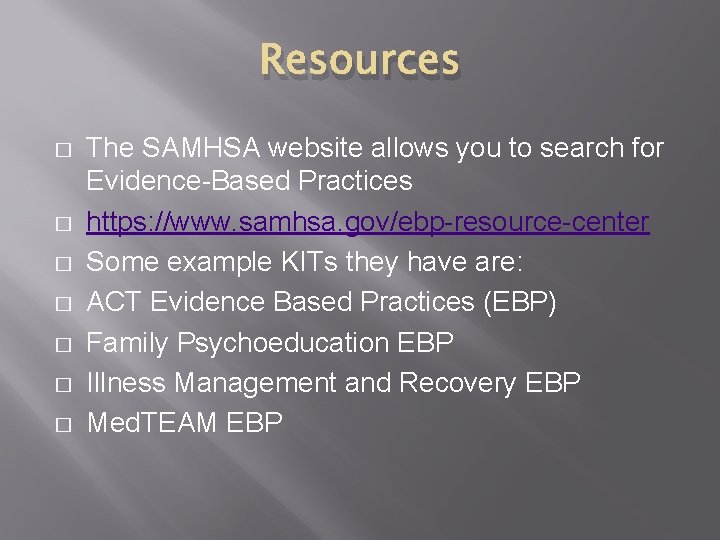
Resources � � � � The SAMHSA website allows you to search for Evidence-Based Practices https: //www. samhsa. gov/ebp-resource-center Some example KITs they have are: ACT Evidence Based Practices (EBP) Family Psychoeducation EBP Illness Management and Recovery EBP Med. TEAM EBP
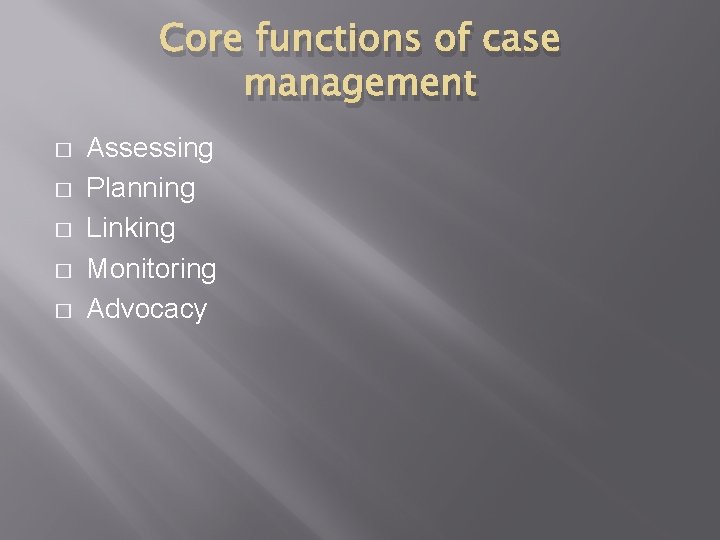
Core functions of case management � � � Assessing Planning Linking Monitoring Advocacy
- Slides: 9