
Reach Associates Culturally Responsive Classroom To copy or

- Slides: 23
Reach Associates: Culturally Responsive Classroom To copy or adapt this material, see Opportunity. Culture. org/terms-of-use 2019 |
Do Now How do you incorporate students’ interests, backgrounds, and experiences into your classroom (or computer lab, small groups, etc. )? Time for this activity: 2 minutes 2019 | 2
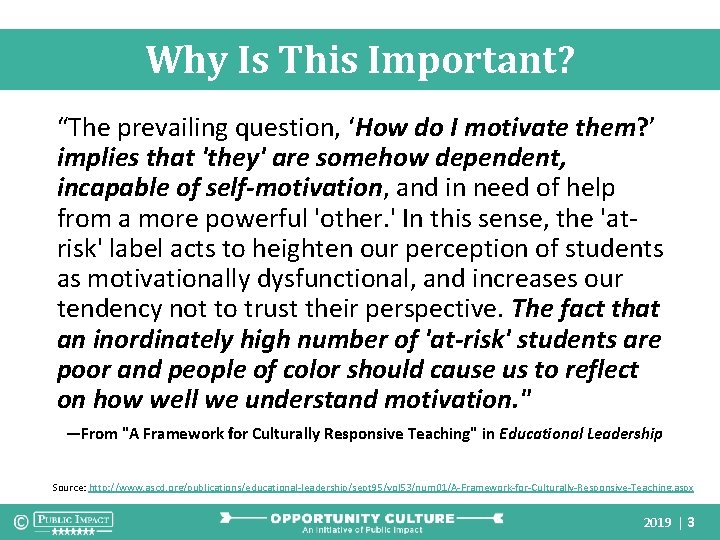
Why Is This Important? “The prevailing question, ‘How do I motivate them? ’ implies that 'they' are somehow dependent, incapable of self-motivation, and in need of help from a more powerful 'other. ' In this sense, the 'atrisk' label acts to heighten our perception of students as motivationally dysfunctional, and increases our tendency not to trust their perspective. The fact that an inordinately high number of 'at-risk' students are poor and people of color should cause us to reflect on how well we understand motivation. " —From "A Framework for Culturally Responsive Teaching" in Educational Leadership Source: http: //www. ascd. org/publications/educational-leadership/sept 95/vol 53/num 01/A-Framework-for-Culturally-Responsive-Teaching. aspx 2019 | 3
Session Objectives • Define the components of culture • Understand what is and is not cultural responsiveness • Learn strategies for creating and/or supporting a culturally responsive classroom • Create a plan for next steps 2019 | 4
Discussion How do you incorporate students’ interests, backgrounds, and experiences into your classroom (or computer lab, small groups, etc. )? 2019 | 5
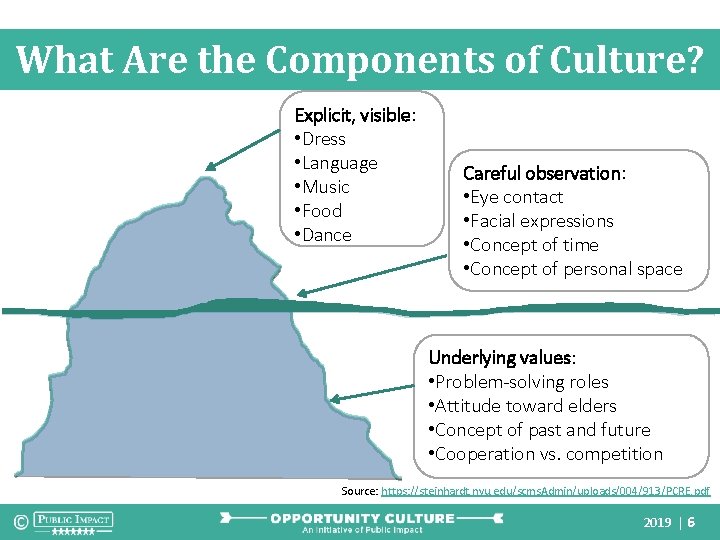
What Are the Components of Culture? Explicit, visible: • Dress • Language • Music • Food • Dance Careful observation: • Eye contact • Facial expressions • Concept of time • Concept of personal space Underlying values: • Problem-solving roles • Attitude toward elders • Concept of past and future • Cooperation vs. competition Source: https: //steinhardt. nyu. edu/scms. Admin/uploads/004/913/PCRE. pdf 2019 | 6
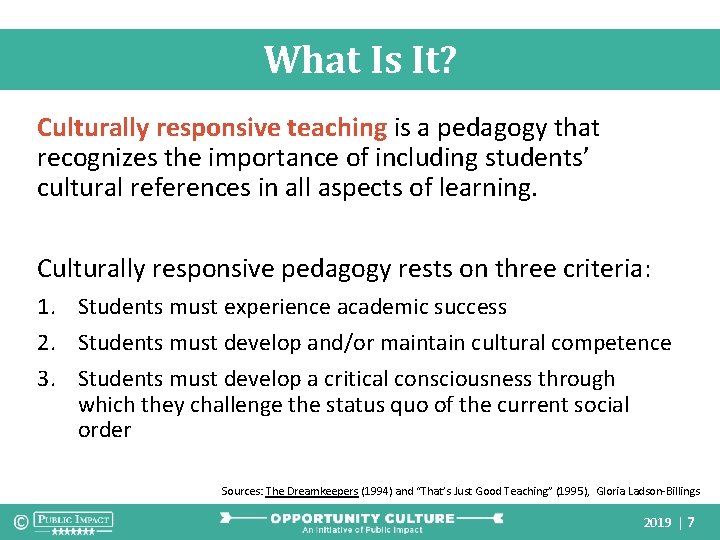
What Is It? Culturally responsive teaching is a pedagogy that recognizes the importance of including students’ cultural references in all aspects of learning. Culturally responsive pedagogy rests on three criteria: 1. Students must experience academic success 2. Students must develop and/or maintain cultural competence 3. Students must develop a critical consciousness through which they challenge the status quo of the current social order Sources: The Dreamkeepers (1994) and “That’s Just Good Teaching” (1995), Gloria Ladson-Billings 2019 | 7
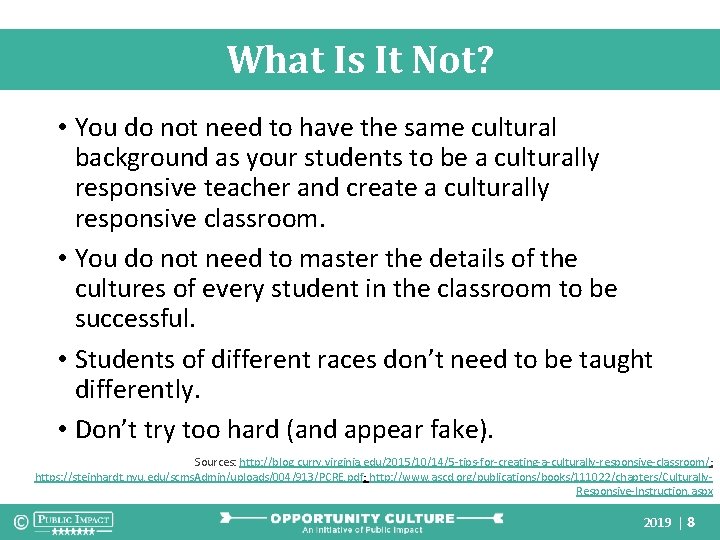
What Is It Not? • You do not need to have the same cultural background as your students to be a culturally responsive teacher and create a culturally responsive classroom. • You do not need to master the details of the cultures of every student in the classroom to be successful. • Students of different races don’t need to be taught differently. • Don’t try too hard (and appear fake). Sources: http: //blog. curry. virginia. edu/2015/10/14/5 -tips-for-creating-a-culturally-responsive-classroom/; https: //steinhardt. nyu. edu/scms. Admin/uploads/004/913/PCRE. pdf; http: //www. ascd. org/publications/books/111022/chapters/Culturally. Responsive-Instruction. aspx 2019 | 8
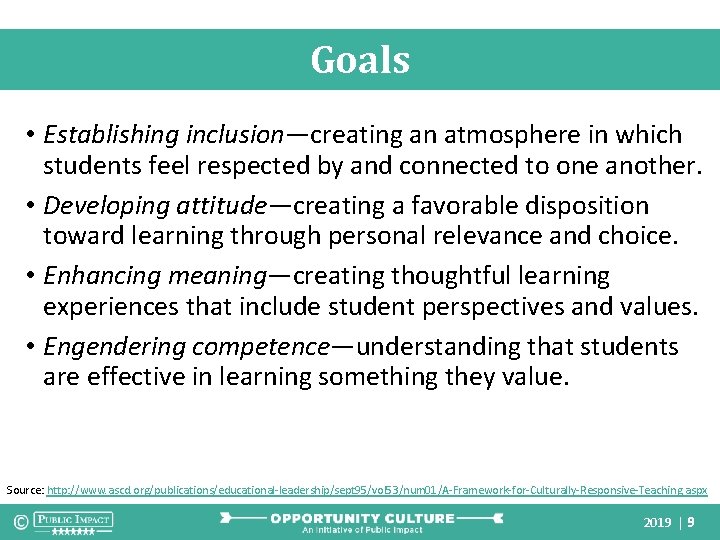
Goals • Establishing inclusion—creating an atmosphere in which students feel respected by and connected to one another. • Developing attitude—creating a favorable disposition toward learning through personal relevance and choice. • Enhancing meaning—creating thoughtful learning experiences that include student perspectives and values. • Engendering competence—understanding that students are effective in learning something they value. Source: http: //www. ascd. org/publications/educational-leadership/sept 95/vol 53/num 01/A-Framework-for-Culturally-Responsive-Teaching. aspx 2019 | 9
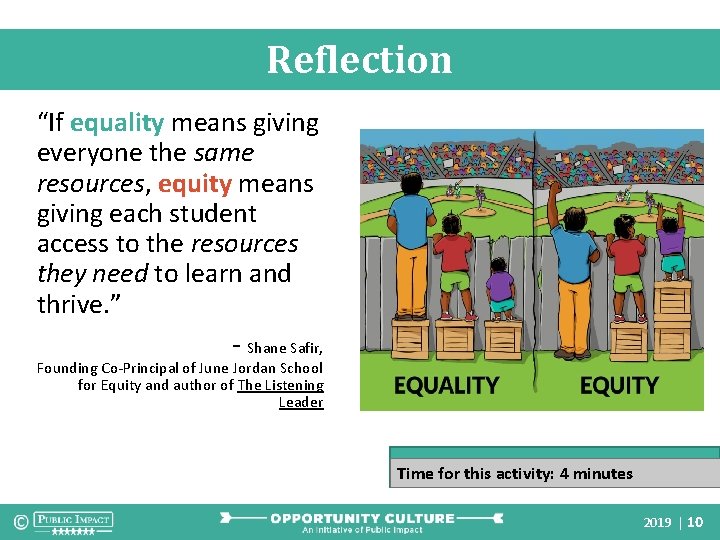
Reflection “If equality means giving everyone the same resources, equity means giving each student access to the resources they need to learn and thrive. ” - Shane Safir, Founding Co-Principal of June Jordan School for Equity and author of The Listening Leader Time for this activity: 4 minutes 2019 | 10
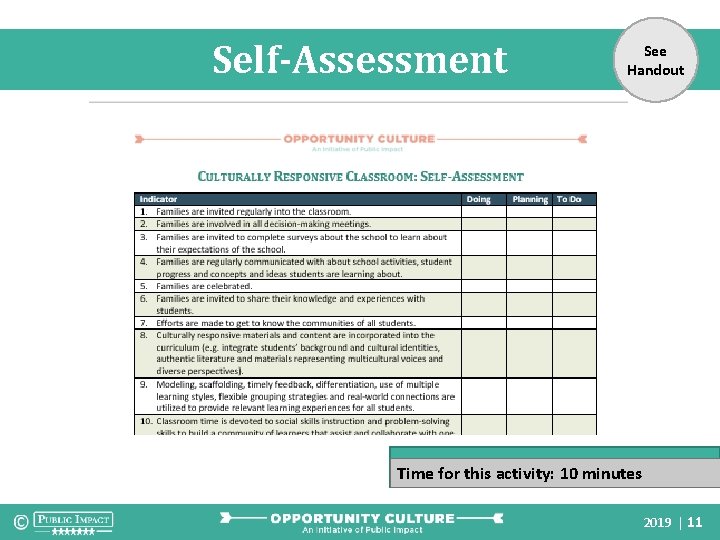
Self-Assessment See Handout Time for this activity: 10 minutes 2019 | 11
Why Reach Associates? 2019 | 12
Strategies to Be Culturally Responsive 1. 2. 3. 4. 5. 6. 7. See Handout Have positive perspectives on parents and families Communicate high expectations Learn within the context of culture Provide student-centered instruction Provide culturally mediated instruction Reshape the curriculum Teach as a facilitator Adapted from: https: //www. brown. edu/academics/education-alliance/teaching-diverse-learners/strategies-0/culturally-responsive-teaching 0 2019 | 13
1. Positive perspectives on parents & families • Why? • School staff can learn more about the students’ background knowledge and abilities, and how they learn best • How? • Seek to understand • Keep families appraised • Gain cross-cultural skills 2019 | 14
2. Communication of high expectations • Why? • Effective and consistent communication of high expectations helps students develop a healthy self-concept, provides the structure for intrinsic motivation, and fosters an environment in which students can be successful. • How? • Communicate clear expectations • Create an environment in which there is genuine respect for students and a belief in their capability 2019 | 15
3. Learning within the context of culture • Why? • Students from minority cultures may feel pressured to disavow themselves of their cultural beliefs and norms to assimilate into the majority culture. • How? • Vary classroom strategies • Bridge cultural differences 2019 | 16
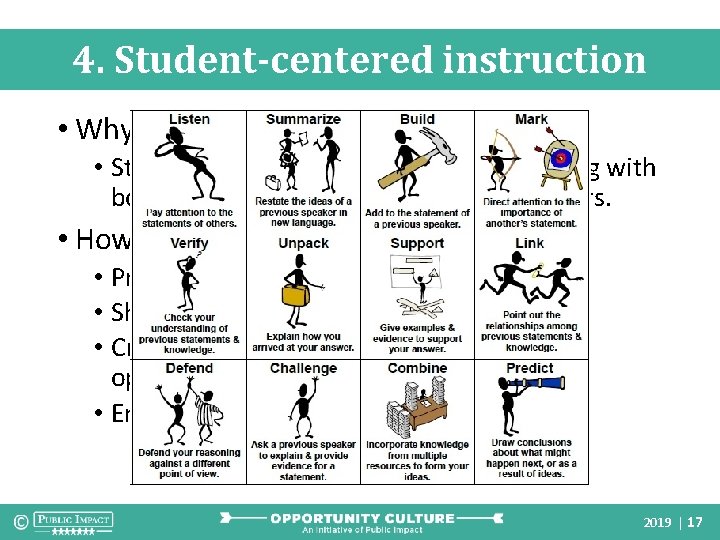
4. Student-centered instruction • Why? • Students develop cognitively by interacting with both adults and more knowledgeable peers. • How? • Promote student engagement • Share responsibility of instruction • Create inquiry-based/discovery-oriented opportunities • Encourage a community of learners 2019 | 17
5. Culturally mediated instruction • Why? • Students need to understand that there is more than one way to interpret a statement, event, or action. • How? • Understand student learning style preferences • Involve students in their own goal-setting • Create an environment that encourages and embraces culture 2019 | 18
6. Reshaping the curriculum • Why? • By using students’ personal experiences to develop new skills and knowledge, teachers make meaningful connections between school and real-life situations • How? • Use resources other than textbooks • Develop learning opportunities that are more reflective of student backgrounds 2019 | 19
7. Teacher (and RA) as facilitator • Why should you do this? • Using students’ home cultural experiences as a foundation upon which to develop knowledge and skills allows the content learned to be more significant to students and facilitates the transfer of what is learned from school to reallife situations • How? • Encourage learning about students’ cultures • Use resources in the community 2019 | 20
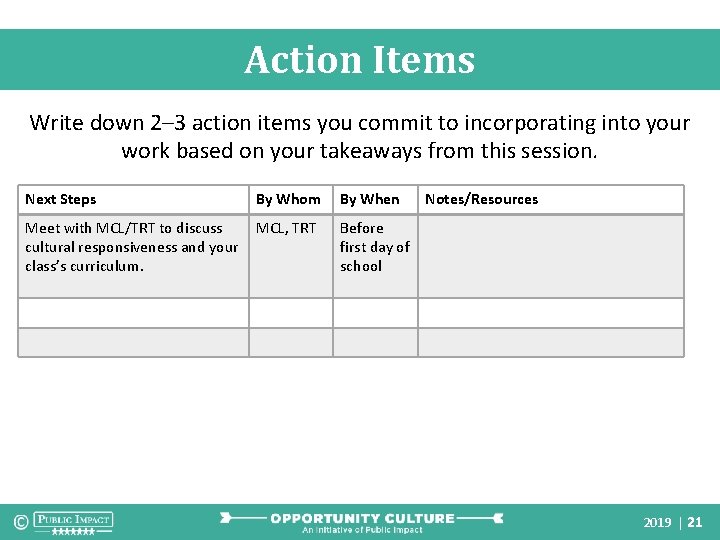
Action Items Write down 2– 3 action items you commit to incorporating into your work based on your takeaways from this session. Next Steps By Whom Meet with MCL/TRT to discuss MCL, TRT cultural responsiveness and your class’s curriculum. By When Notes/Resources Before first day of school 2019 | 21
Resources for Additional Learning • The Dreamkeepers: Successful Teachers of African American Children, by Gloria Ladson-Billings • Culturally Responsive Teaching, by Geneva Gay • “But That’s Just Good Teaching! The Case for Culturally Relevant Pedagogy”, by Gloria Ladson. Billings • Create Success! By Kadhir Rajagopal 2019 | 22
Follow Us! Keep up to date on Opportunity Culture with resources and research from Public Impact by following: @Public. Impact @Opp. Culture Facebook. com/Public. Impact Facebook. com/Opportunity. Culture Linked. In. com/company/public-impact---chapel-hill-nc Subscribe to the quarterly Opportunity Culture newsletters, with content by and for Opportunity Culture educators, and sign up to get Remind messages for them: Opportunity. Culture. org/mailing-list/ Remind. com/join/ocnew 2019 | 23