
Child Development Physical Development Human Development Development tends
- Slides: 32
Child Development Physical Development
Human Development • Development tends to be referred to in terms of areas or domains. • Physical, intellectual, social, language & emotional. • Development is also referred to in terms of periods. • Prenatal, infancy, childhood, adolescence, adulthood, old age.
General Development • • • Infant/toddler years (birth– 2 years): sees rapid physical development. By six months, birth-weight doubles, and it can triple by end of the first year. Early childhood years (2– 6 years): children’s physical and cognitive capabilities extend. They discover what their bodies are capable of. Middle and late childhood years (6– 11 years): physical growth slows down. A time to consolidate the movement skills acquired in the early years and to prepare the body for the tumult of puberty.
Introduction to Physical Development Understanding physical development is essential when studying holistic development.
Introduction to Physical Development Children’s growth and development enables them to: • • • Explore their environment To make sense of their world To achieve new skills To change the ways others perceive them Helps their development of self
Introduction to Physical Development • Child who successfully carries out various tasks • Develops new skills and can achieve a positive self image • Child who constantly fails or is given the impression that he is a failure • Has difficulty in developing a positive sense of self
Physical Development • Growth and development are continuous and proceed in a typical or expected pattern. • Normal – describes a child of average height and weight who is developing typical characteristics for his age.
Growth and Physical Development • Growth and physical development are closely linked. • Growth is when cells divide to increase the size, weight and length of the body. • Physical development is the ability of children to perform more complex activities involving their gross motor skills, fine motor skills and coordination. Skills are developed through muscle control. • Maturation is the development of systems which form the human body i. e. nervous system, circulatory system and endocrine system.
The characteristics and capabilities of newborns • Babies are well equipped for surviving close to their mother in their new life outside the womb. • They arrive with a range of reflexes, psychological and behavioural capabilities, and a voracious appetite to do and to know. • In many ways they are ready to meet the challenges ahead in new and very different surroundings. • The basic five senses enable babies to make sense of and to react to the world around them.
Sensory Capabilities • Touch – The newborn’s sense of touch is well developed at birth. – Touch is an important way for a baby to communicate in the new surroundings. – Sensitive areas on the palms, soles of the feet and in the mouth are linked to certain reflexes. – Sensations against the skin provide comfort and security. – Touch informs about temperature. – Responses to pain are similar, there is some evidence that babies feel pain more than adults.
Sensory Capabilities • Smell – It is believed that some preferences for smell are innate. – Smell and taste preferences are connected (Mennella, 2007 in Doherty & Hughes, 2009). – Babies can identify pleasant smells; turn away from unpleasant ones. – Mother’s milk; early bonding.
Sensory Capabilities • Taste – Newborns have the capacity to experience all four taste sensations: salty, sour, bitter and sweet. – They show a preference for sweet taste by licking and smiling. – This may be important for their early survival as they respond well to the sweetness present in the mother’s milk.
Sensory Capabilities • Vision – A newborn’s vision is poor – approximately 20/400 – yet able to fulfil its functions. – Slowly improves to 20/20 by age two years. – Visual acuity: sharpness of vision limited to 20 cm and remains at that level for about three months. – visual accommodation: brings objects into focus but is poor; it improves over the first two months.
Sensory Capabilities • Hearing – Associated systems function well at birth. – Newborns can distinguish the mother’s voice from that of others (Barker & Newman, 2004 in Doherty & Hughes 2009). – Newborns can distinguish between sound patterns, and are able to differentiate between different intonations. – They prefer female voices because of their high pitch. – They respond quickly to sounds around them by turning their heads. – The ability to locate sound improves quickly.
Reflexes • • Primitive reflexes are automatic responses to stimulation. No conscious thinking is involved and they are not learned. Controlled by the lowest and most primitive part of the human brain, the brain stem. Survival reflexes are related to the baby’s survival and further assists with mother–child attachment , e. g. sucking/swallowing and rooting. Reflexes are important indicators of normal development and health of the child’s nervous system. Most disappear in the first 12 months. • Retention can indicate a variety of problems. • • (Doherty and Hughes, 2009)
Examples of Primitive Reflexes • Asymmetrical Tonic Neck Reflex (ATNR) – plays a role in the • Tonic Labyrinth Reflex (TLR) – involves the sense of balance and • Symmetrical Tonic Neck Reflex (STNR) – retention shows a development of hand–eye–object coordination and distance perception. position in space. Retention results in difficulties in judging distance, speed and space. tendency to slump when sitting at a desk or table; poorly developed muscle tone and the inability to sit still and concentrate. (Doherty and Hughes, 2009)
Motor Development Reflexes • Built-in reactions to stimuli which help the infant relate to environment. – Sucking Reflex - enables infants to get nourishment before they have associated a nipple with food. – Rooting Reflex - is when infant turns head toward side touched, again to gain nourishment. Both rooting and sucking reflexes disappear at 3 to 4 months of age. – Moro Reflex - neonatal startle response that occurs at sudden noise or movement, believed to be vestige from primate ancestry for survival value. – Grasping Reflex - is when infant responds to being touched on palms; it, too, disappears at end of the third month.
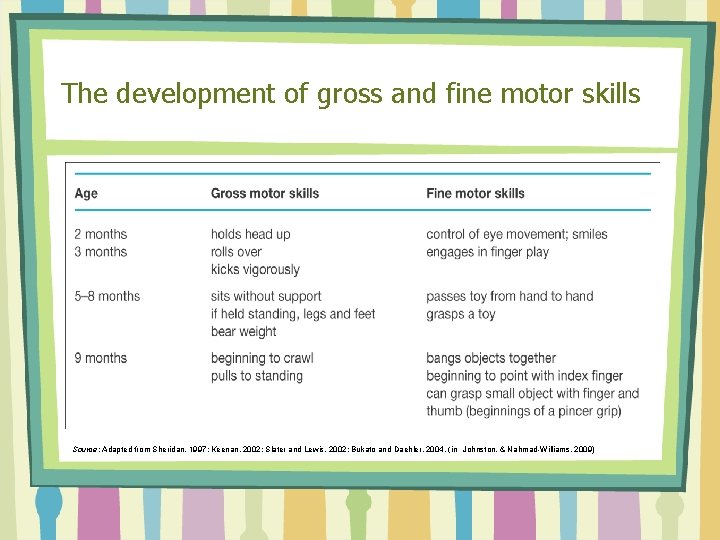
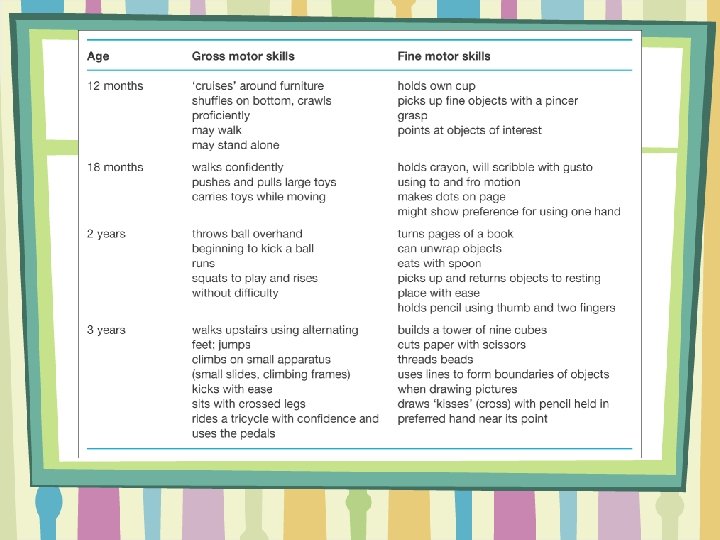
Physical Development • Gross motor skills • Fine motor or fine manipulative skills • Ability to move using whole body movements utilizing large muscles. • Ability to perform finer skills that require hand eye co-ordination.
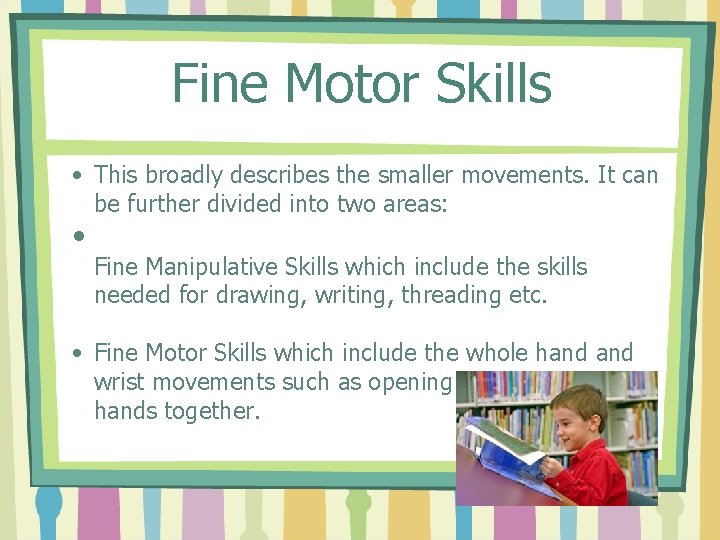
Fine Motor Skills • This broadly describes the smaller movements. It can be further divided into two areas: • Fine Manipulative Skills which include the skills needed for drawing, writing, threading etc. • Fine Motor Skills which include the whole hand wrist movements such as opening a jar or rubbing hands together.
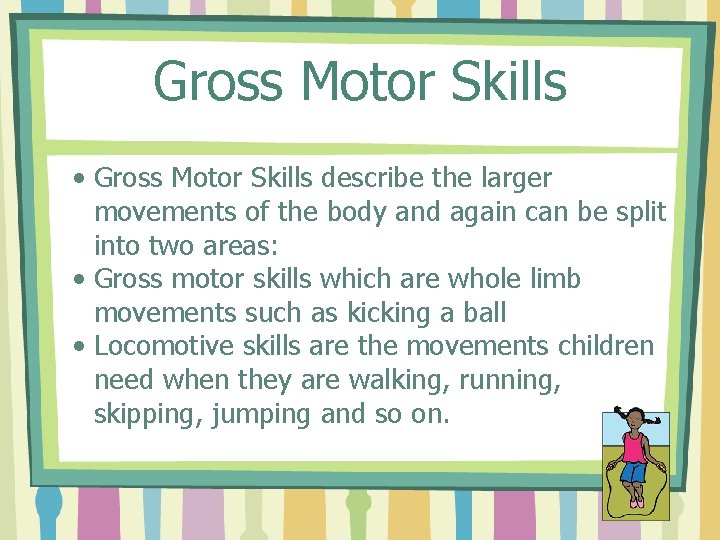
Gross Motor Skills • Gross Motor Skills describe the larger movements of the body and again can be split into two areas: • Gross motor skills which are whole limb movements such as kicking a ball • Locomotive skills are the movements children need when they are walking, running, skipping, jumping and so on.
Co-ordination • This aspect of physical development involves the coordination of more than one type of movement or skill. • As with the previous physical developmental areas, there a number of different areas within coordination: – Hand-eye co-ordination (striking or catching a ball, writing, threading, fastening clothing), – Foot-eye co-ordination (climbing stairs, kicking a ball) and balance).
The development of gross and fine motor skills Source: Adapted from Sheridan, 1997; Keenan, 2002; Slater and Lewis, 2002; Bukato and Daehler, 2004, (in Johnston, & Nahmad-Williams, 2009)
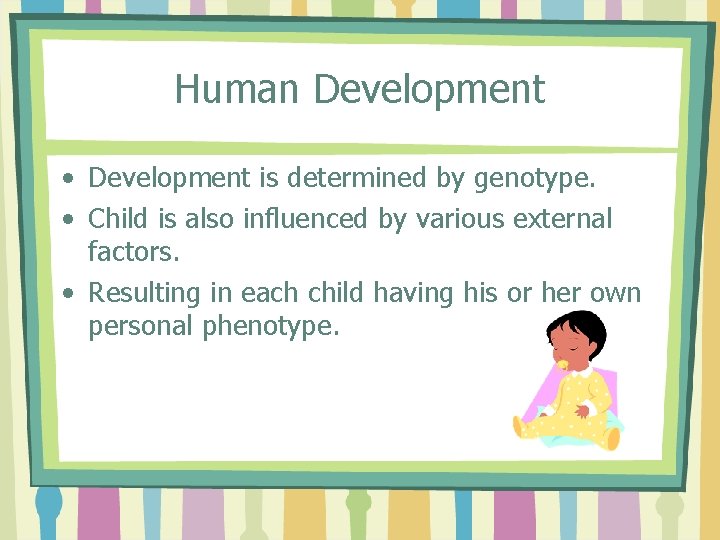
Human Development • Development is determined by genotype. • Child is also influenced by various external factors. • Resulting in each child having his or her own personal phenotype.
Human Development • Genotype • Refers to child’s genetic make up which is hereditary • Phenotype • Refers to various external factors influencing a child’s development, enabling them to develop into a unique person
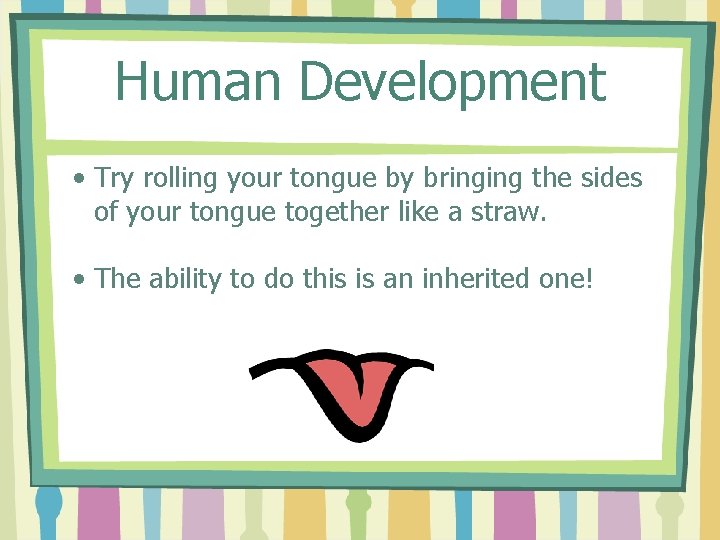
Human Development • Try rolling your tongue by bringing the sides of your tongue together like a straw. • The ability to do this is an inherited one!
Human Development • In the past this has been studied from a compartmentalised perspective. • This tends to lead to an unbalanced idea of the developmental process.
Human Development • Students tend to concentrate on only one area of development to the detriment of the others. • Each area of development impacts on the others, and each stage of development leads to the following one.
Holistic Development “A holistic or whole child approach stresses the importance of thinking about and behaving towards children as entire individuals, that all their skills are important and support their whole development. ” (Lindon, 2005: 10)
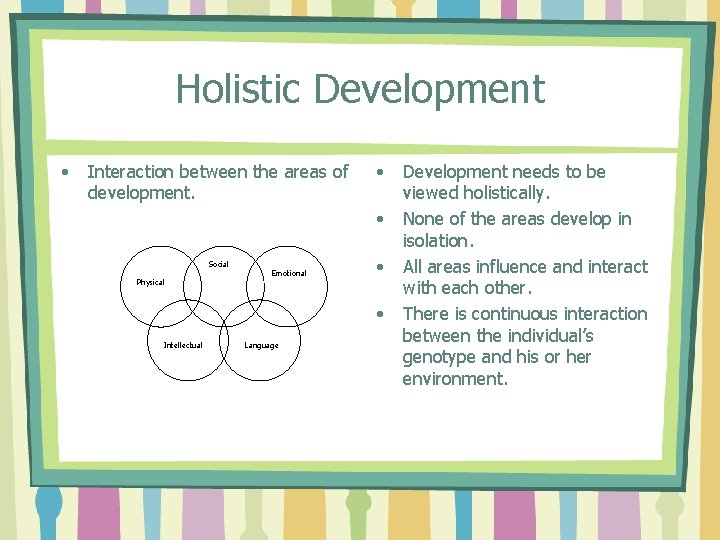
Holistic Development • Interaction between the areas of development. • • Social Physical Emotional • • Intellectual Language Development needs to be viewed holistically. None of the areas develop in isolation. All areas influence and interact with each other. There is continuous interaction between the individual’s genotype and his or her environment.
Human Development is continuous, beginning at conception and only ceases when a person dies. (Mac. Leod-Brudenell, I, 2004, Chapter 3)
References • Doherty, J. & Hughes, M. , (2009) Child Development: Theory and Practice 0 -11 Harlow: Pearson Education Ltd. • Johnston, J. & Nahmad-Williams, L. (2009) Early Childhood Studies, London: Pearson Education Ltd • Lindon, J. (2005), Understanding Child Development: Linking Theory and Practice, London: Hodder Arnold. • Mac. Leod-Brudenell I (2004) Advanced Early Years Care and Education for Levels 4 & 5, Oxford: Heinemann.