
First Aid to Staff Northeast Florida State Hospital









- Slides: 30
First Aid to Staff Northeast Florida State Hospital Staff Debriefing Southern States Psychiatric Hospital Association and the National Association of State Mental Health Program Directors Forensic Division Joint Conference Wednesday October 5, 2016 JENNIFER SLUSARZ-CONROY, PSY. D. , ASSISTANT HOSPITAL ADMINISTRATOR – RECOVERY SERVICES CIANA MICKOLUS, PSY. D. , PSYCHOLOGIST
Outline History Definition of a “critical incident” Reactions to a “critical incident” Mitchell Model: Critical Incident Stress Debriefing Theory Research NEFSH process Preliminary NEFSH results
History WWI and WWII Israeli Dr. Defense Forces- 1967 war Jeffery Mitchell- 1974 Critical Incident Stress Debriefings (1983) Everly, Flannery & Mitchell (2000); Everly & Mitchell (1995)
History High risk occupational groups Firefighters Law enforcement officers Emergency medical workers Disaster response personnel Emergency dispatchers Public safety personnel Everly & Mitchell (1995)
History Expansion Military Clergy School systems Banking industry Mining Oil discovery and refining operations Lifeguard services Employee assistance programs
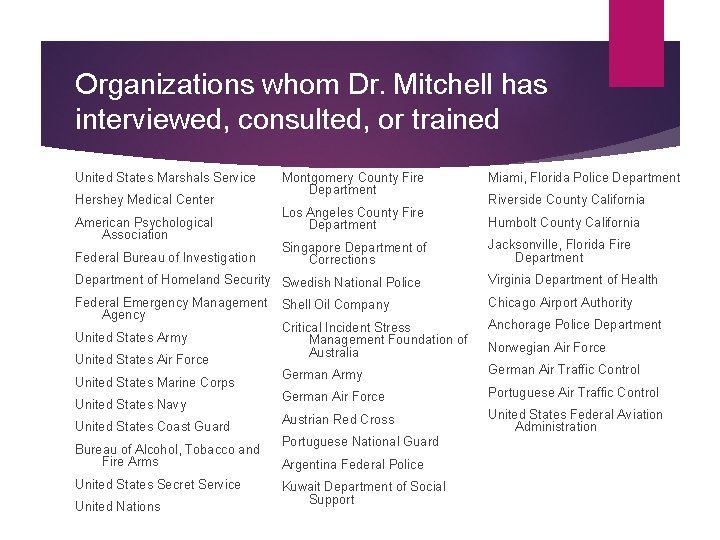
Organizations whom Dr. Mitchell has interviewed, consulted, or trained United States Marshals Service Hershey Medical Center American Psychological Association Federal Bureau of Investigation Montgomery County Fire Department Miami, Florida Police Department Los Angeles County Fire Department Humbolt County California Singapore Department of Corrections Riverside County California Jacksonville, Florida Fire Department of Homeland Security Swedish National Police Virginia Department of Health Federal Emergency Management Agency Shell Oil Company Chicago Airport Authority Critical Incident Stress Management Foundation of Australia Anchorage Police Department German Army German Air Traffic Control German Air Force Portuguese Air Traffic Control Austrian Red Cross United States Federal Aviation Administration United States Army United States Air Force United States Marine Corps United States Navy United States Coast Guard Bureau of Alcohol, Tobacco and Fire Arms United States Secret Service United Nations Portuguese National Guard Argentina Federal Police Kuwait Department of Social Support Norwegian Air Force
Organizations (continued) Staff Care, Belfast, Northern Ireland Downtown Hospital of New York American College of Emergency Physicians Arkansas State Police International Association of Fire Fighters International Association of Fire Chiefs International Association of Chiefs of Police Kansas State Police European Society for Traumatic Stress Studies Center for Crisis Psychology, Bergen, Norway International Society for Traumatic Stress Studies Alberta Safety Services American Airlines Boston Emergency Medical Services Delta Air Lines European Psychological Society Southwest Airlines Victory Memorial Hospital, Waukegan Illinois United Airlines Air Alaska Zero to Three, Washington, DC Sedgewick County Police Department New York State Fire Chiefs Association Canadian Armed Forces National Association of Search and Rescue Aloha Airlines Texas Department of Public Safety http: //www. nc-cm. org/biojeffreymitchell. htm
Critical Incident Stress Management “A comprehensive, systematic and integrated multi-tactic crisis intervention approach” Pre-crisis preparation Individual counseling Demobilization (brief large-group discussions; mass disasters) Defusing (brief small-group discussions) Debriefing (group discussion) Family support interventions Follow up and referrals for psychological assessment/treatment Everly, Flannery & Mitchell (2000); Mitchell (2004)
Definition: Critical Incident “Traumatic, unexpected, and a serious threat to the individual’s well-being; contains an element of loss; and involves disruption of the individuals values or assumptions about the environment. ” Should be defined “not in terms of the event, but rather in terms of the impact it has on the individual. ” Nielsen (1986) and Gentz (1991) in Bohl (1995)
NEFSH Definition: Critical Incident A significant traumatic event: “exposure to actual or threatened death, serious injury, or sexual violence” through directly experiencing the event, witnessing the event, learning that the event occurred to someone close, or experiencing repeated/extreme exposure to details of the event. Examples include: resident death, assault on an employee or resident, extreme self-injurious behavior by a resident, etc. Examples may also include unusual or critical events, as defined by OP 09 -00 -03, Unusual Incident Reporting, Prevention, and Investigation.
What happens after someone experiences a critical incident? Immediate Responses Muscular tremors Nausea Hyperventilation Faintness Sweating Perceptual Distortions Minutes or Hours Later Shock Fear Denial Anger Numbing General feeling of unreality Bohl (1995)
What happens after someone experiences a critical incident? Delayed Reactions Grief Intrusive thoughts Flashbacks Nightmares Poor sleep Depression Emotional withdrawal Anxiety Guilt Paranoia Sexual dysfunction Headaches Stomach aches Bohl (1995)
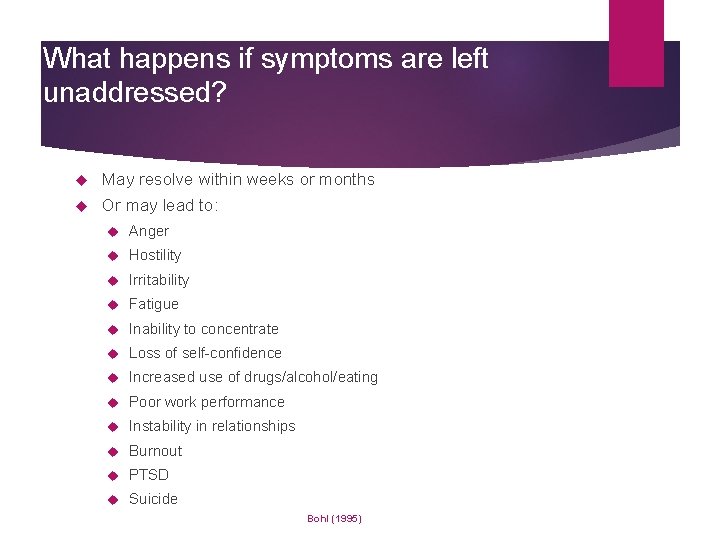
What happens if symptoms are left unaddressed? May resolve within weeks or months Or may lead to: Anger Hostility Irritability Fatigue Inability to concentrate Loss of self-confidence Increased use of drugs/alcohol/eating Poor work performance Instability in relationships Burnout PTSD Suicide Bohl (1995)
CISD “A specific, seven-phase, small group, supportive crisis intervention process…a crisis-focused discussion of a traumatic event” “Psychological first aid” Objectives: Decrease the impact of a traumatic event Aid in normal recovery from the traumatic event Screen employees who may benefit from further professional care Mitchell 2014
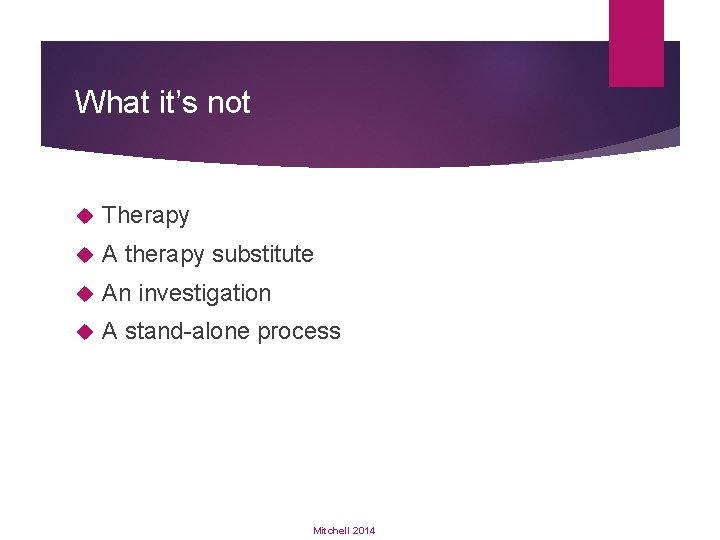
What it’s not Therapy A therapy substitute An investigation A stand-alone process Mitchell 2014
Videos https: //www. youtube. com/watch? v=515 za. Aii. EOk Navy: https: //www. youtube. com/watch? v=Vx. Gn. DPM 0 In. Y
The Mitchell Model of CISD 24 to 72 hours post-incident 1 to 3 hours long Group members Must not be currently involved in the incident About the same level of exposure Psychologically ready to participate 7 -phase discussion Led by a team of 2 -4 people, depending on the group size (one team member for every 5 to 7 people) One mental health professional One “peer support personnel” Mitchell 2014
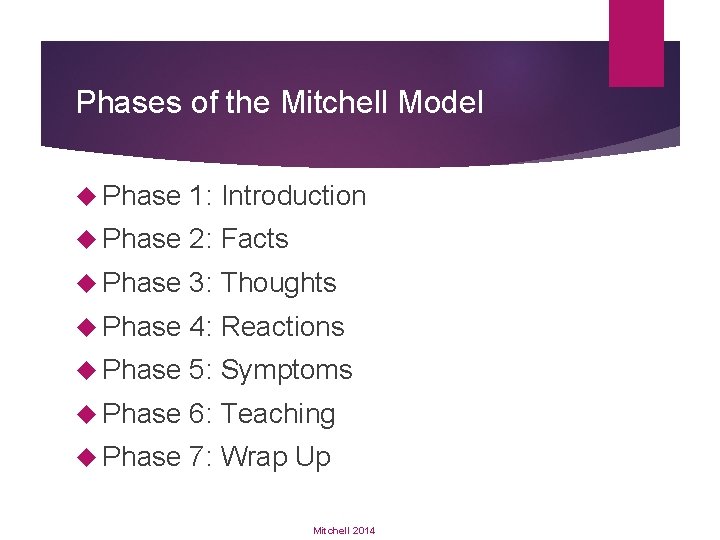
Phases of the Mitchell Model Phase 1: Introduction Phase 2: Facts Phase 3: Thoughts Phase 4: Reactions Phase 5: Symptoms Phase 6: Teaching Phase 7: Wrap Up Mitchell 2014
Example: the ER https: //www. youtube. com/watch? v=m 0 a-KR 4 p. Kik
Theory: Mechanisms of Action Early intervention Catharsis and verbalization Structure Group support (Yalom) Peer support Allows for follow up Everly, Flannery & Mitchell (2000); Mitchell & Everly (1995); Yalom (2005)
Supporting Research Decrease in severity and number of PTSD symptoms Decrease in anxiety and depression symptoms Reduction in sick leave, turnover, and early retirement Decreased suicide rate Reduction in alcohol abuse Decrease in stress Decrease in anger Enhanced self-esteem, emotional well-being Staff reported better coping skills Bohl (1995); Everly, Flannery & Mitchell (2000); Flannery & Everly (2004); Mitchell (2004)
Contrary Views Neutral or Negative No preventative effect No reduction in symptoms Possible Higher postponing of symptoms levels of stress Mitchell (2004)
Why NEFSH? Why now? Assaults Resident Low death morale
At NEFSH: Before a critical incident Pre-crisis Preparation (New Employee Orientation) Training on general stress management and the CISD process
At NEFSH: After a critical incident Within one business day, UTRDs (or designee) will e-mail or call the Director of Psychology Describe the incident Provide a list of staff involved All staff members involved/affected by the incident will meet Within 24 to 48 hours post-incident With the Director or Psychology or designee Other staff who were directly or indirectly impacted by the event may attend with the permission of the Director of Psychology Treatment team members Unit directors Supervisors
At NEFSH: After the debriefing Follow-up and Referrals Anonymous evaluation form of the debriefing Evaluations are maintained by the Psychology Department Data is compiled analyzed
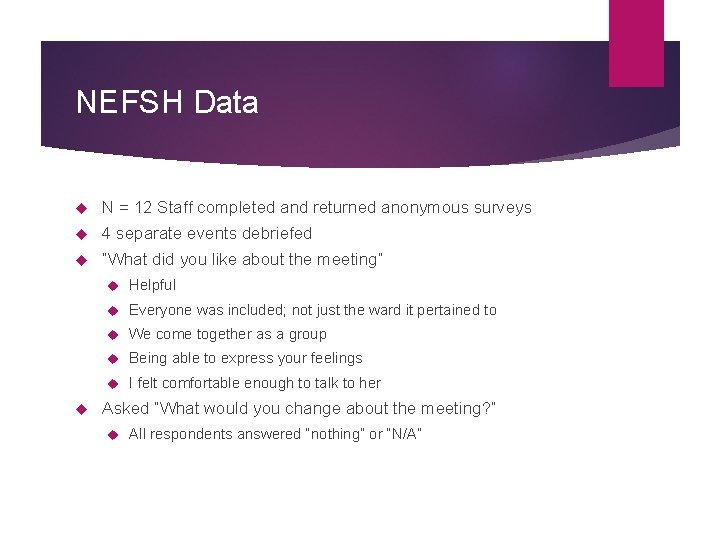
NEFSH Data N = 12 Staff completed and returned anonymous surveys 4 separate events debriefed “What did you like about the meeting” Helpful Everyone was included; not just the ward it pertained to We come together as a group Being able to express your feelings I felt comfortable enough to talk to her Asked “What would you change about the meeting? ” All respondents answered “nothing” or “N/A”
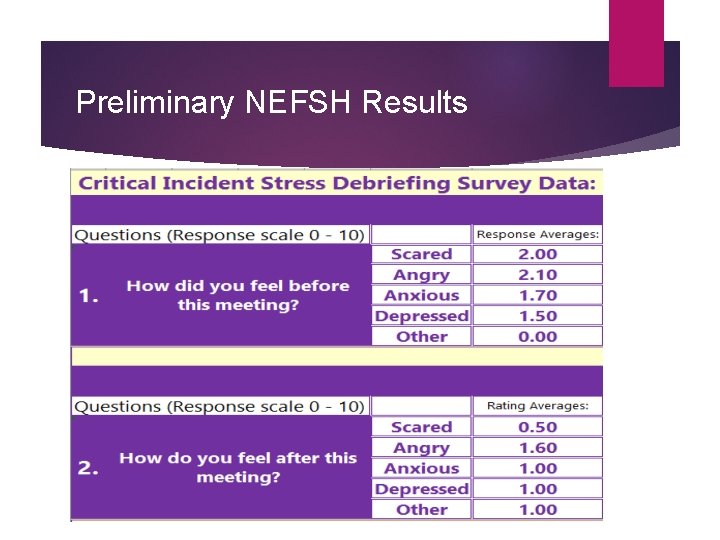
Preliminary NEFSH Results
Conclusions Preliminary data suggests staff feel the process is helpful Early in the process, unclear if the debriefings will lead to less staff turnover and/or illness Desired outcome: Staff feel supported and validated Staff recover quickly from the impact of a traumatic event Reduction in turnover and increase in morale
References American Psychiatric Association. (2013). Diagnostic and statistical manual of mental disorders (5 th ed. ). Washington, DC Bohl, N. (1995). Professionally administered critical incident debriefing for police officers. In M. Kurke & E. Scrivner (Eds. ), Police psychology into the 21 st century (pp. 169 -188). New Jersey: Lawrence Erlbaum Associates, Inc. Everly, G. , Flannery R. , & Mitchell, J. (2000). Critical incident stress management (CISM): A review of the literature. Aggression and Violent Behavior, 5(1), pp. 23 -40. Everly, G. & Mithcell, J. (1995). Critical incident stress debriefing (CISD) and the prevention of work-related traumatic stress among high risk occupational groups. Everly, G. , & Lating, M. (Eds. ), Psychotraumatology (pp. 267 -279). New York: Plenum Press. Everly, G. & Mitchell, J. (1995). Prevention of work-related posttraumatic stress: The critical incident stress debriefing process. Murphy, L. , Hurrell, J. , Sauter, S. , & Keita, G. (Eds. ), Job stress interventions (pp. 173 -183). Washington, DC: American Psychological Association. Gentz, D. (1991). The psychological impact of critical incidents on police officers. In J. T. Reese, J. M Horn, & C. Dunning (Eds. ), Critical incidents in policing (rev. ed. ; pp. 119 -121). Washington, DC: U. S. Government Printing Office. Flannery, R. & Everly G. (2004). Critical incident stress management (CISM): Updated review of findings, 1998 -2002. Aggression and Violent Behavior, 9 (2004), pp. 319 -329. Mitchell, J. (2014). Critical incident stress debriefing (CISD). Retrieved from: http: //www. info-trauma. org/ Mitchell, J. (2004). Crisis intervention and critical incident stress management: A defense of the field. Retrieved from: http: //www. icisf. org Nielsen, E. (1986). Understanding and assessing traumatic stress reactions. In J. T. Reese & H. A. Goldstein (Eds. ), Psychological services for law enforcement (pp. 369 -374). Washington, DC: U. S. Government Printing Office. Yalom, I. (2005). The theory and practice of group psychotherapy. New York, New York: Basic Books.