SATISH PRADHAN DNYANASADHANA COLLEGE THANE400604 DEPARTMENT OF CHEMISTRY


- Slides: 78
SATISH PRADHAN DNYANASADHANA COLLEGE- THANE-400604 DEPARTMENT OF CHEMISTRY INTRODUCTION TO FOOD CHEMISTRY by Dr. G. R. Bhagure 2/19/2021 1
Contents • Introduction to food chemistry (10 L) • 2. 1. 1 Food processing and preservation: Introduction, need • Methods of food processing and preservation • Chemical methods : • 1)Use of chemicals as preservatives(volatile fatty acids in Bakery products, Benzoic acid in jam and jellies, Acetic acid in pickles, Lactic acid in poultry, sulfite in fruits) • 2)Role of p. H on the preservation of foods • Physical methods : 1) Pasteurization 2) Irradiation 2/19/2021 2
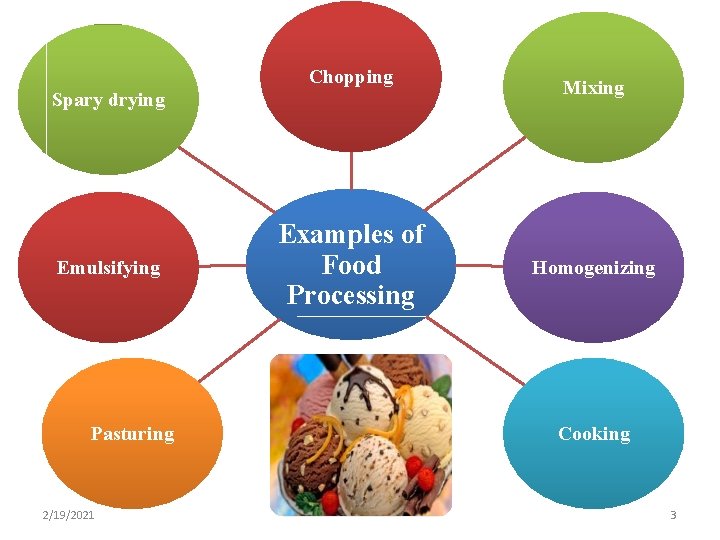
Chopping Spary drying Emulsifying Pasturing 2/19/2021 Examples of Food Processing Mixing Homogenizing Cooking 3
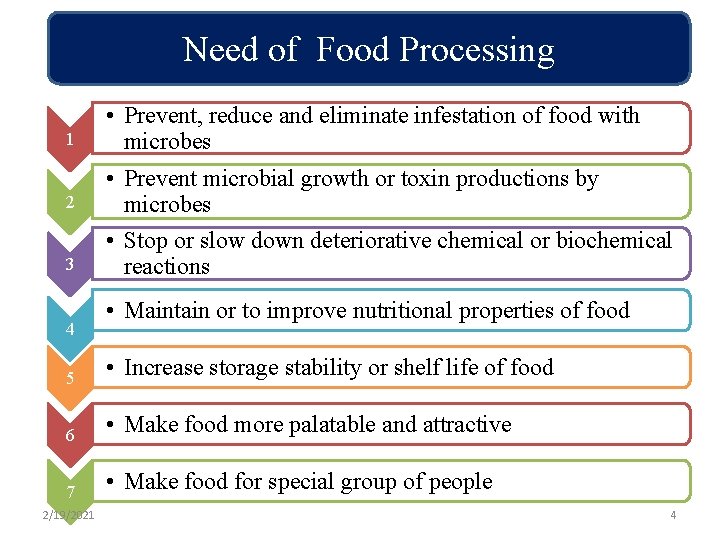
Need of Food Processing 1 2 3 4 • Prevent, reduce and eliminate infestation of food with microbes • Prevent microbial growth or toxin productions by microbes • Stop or slow down deteriorative chemical or biochemical reactions • Maintain or to improve nutritional properties of food 5 • Increase storage stability or shelf life of food 6 • Make food more palatable and attractive 7 • Make food for special group of people 2/19/2021 4
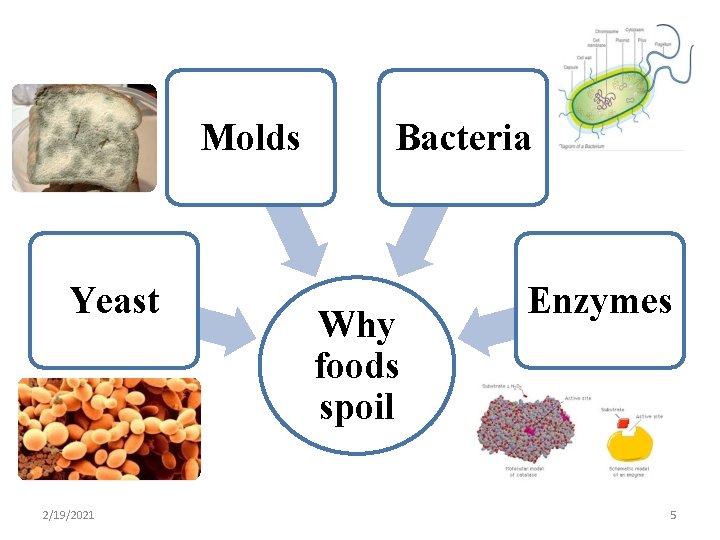
Molds Yeast 2/19/2021 Bacteria Why foods spoil Enzymes 5
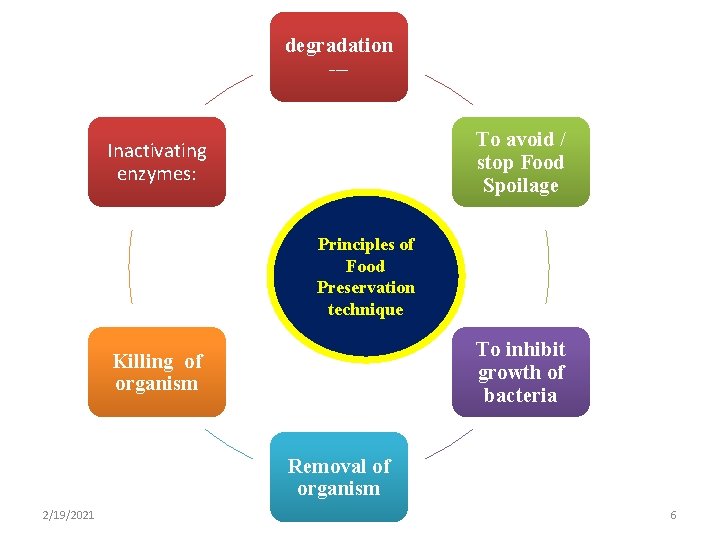
degradation --To avoid / stop Food Spoilage Inactivating enzymes: Principles of Food Preservation technique To inhibit growth of bacteria Killing of organism Removal of organism 2/19/2021 6
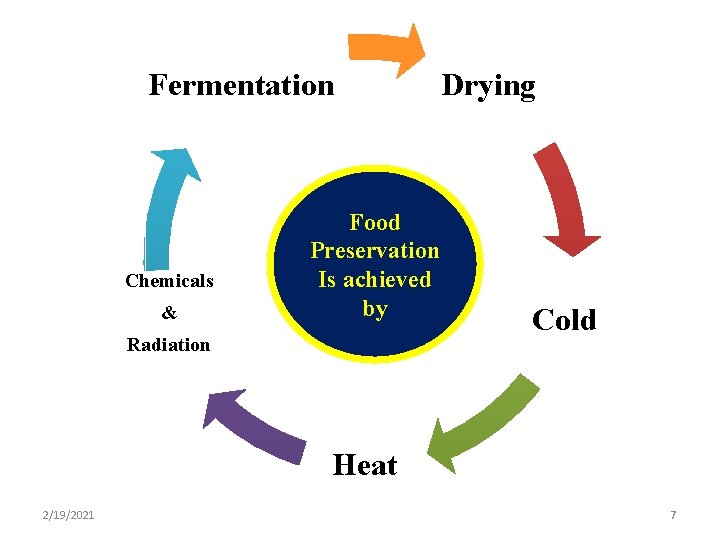
Fermentation Chemicals & Food Preservation Is achieved by Radiation Drying Cold Heat 2/19/2021 7
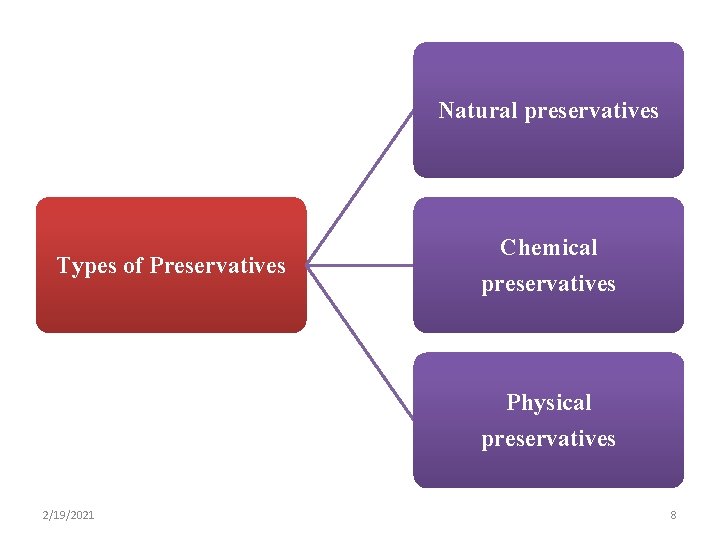
Natural preservatives Types of Preservatives Chemical preservatives Physical preservatives 2/19/2021 8
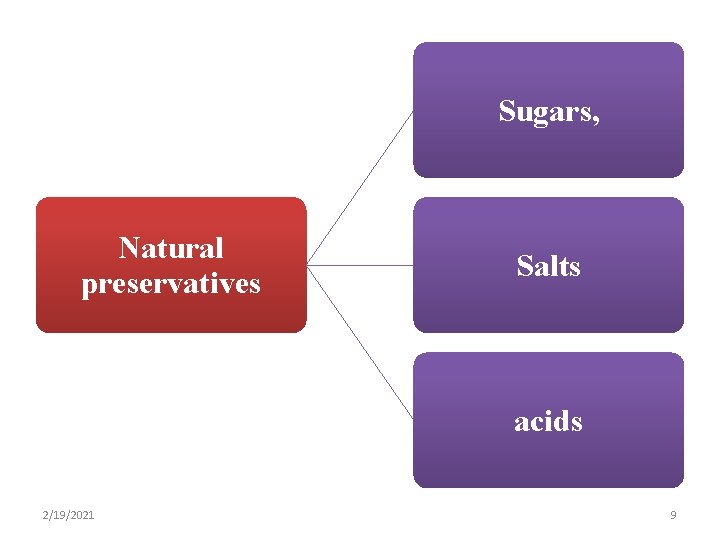
Sugars, Natural preservatives Salts acids 2/19/2021 9
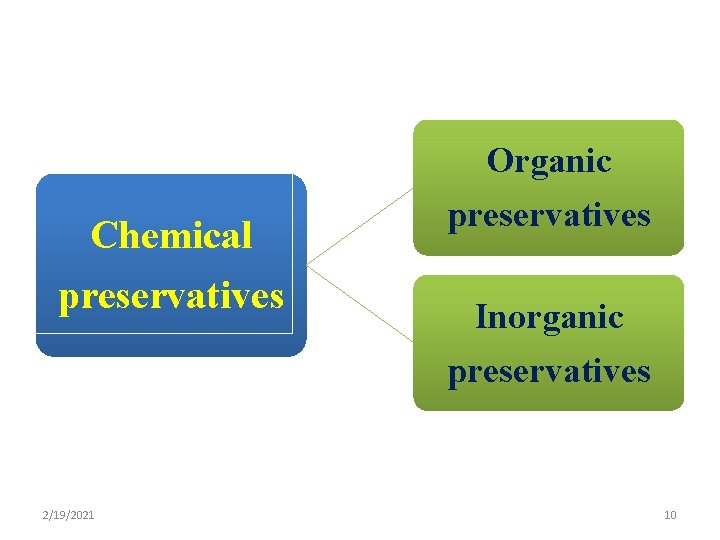
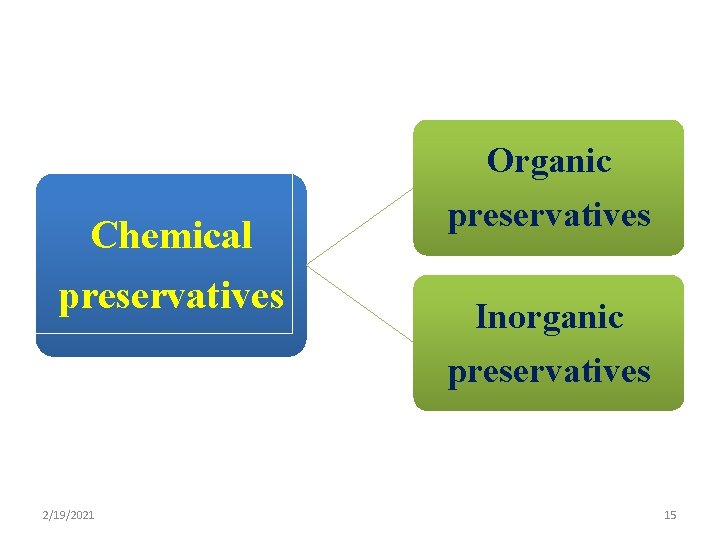
Organic Chemical preservatives Inorganic preservatives 2/19/2021 10
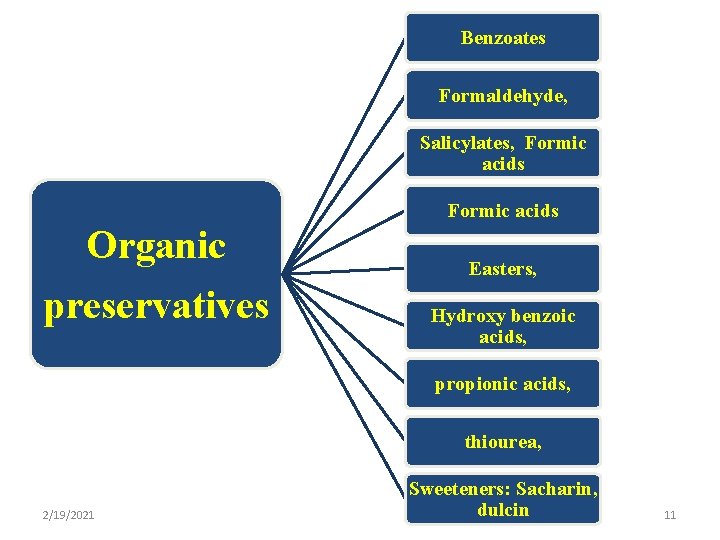
Benzoates Formaldehyde, Salicylates, Formic acids Organic preservatives Easters, Hydroxy benzoic acids, propionic acids, thiourea, 2/19/2021 Sweeteners: Sacharin, dulcin 11
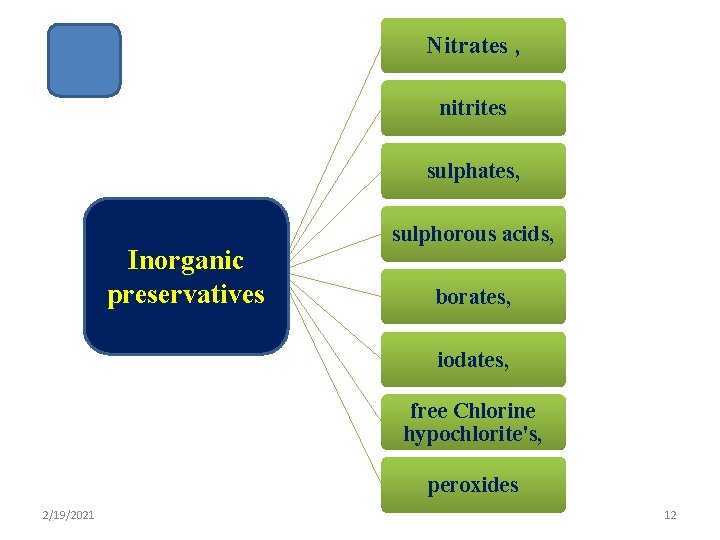
Nitrates , nitrites sulphates, Inorganic preservatives sulphorous acids, borates, iodates, free Chlorine hypochlorite's, peroxides 2/19/2021 12
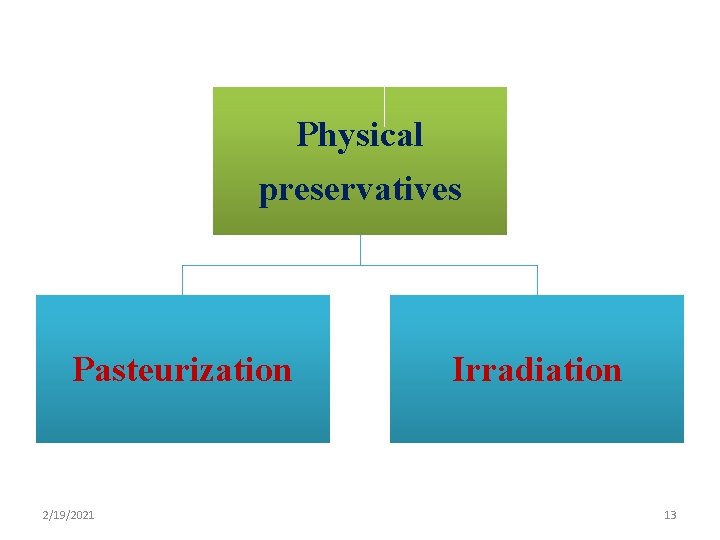
Physical preservatives Pasteurization 2/19/2021 Irradiation 13
1 2/19/2021 • Chemicals as preservatives 14
Organic Chemical preservatives Inorganic preservatives 2/19/2021 15
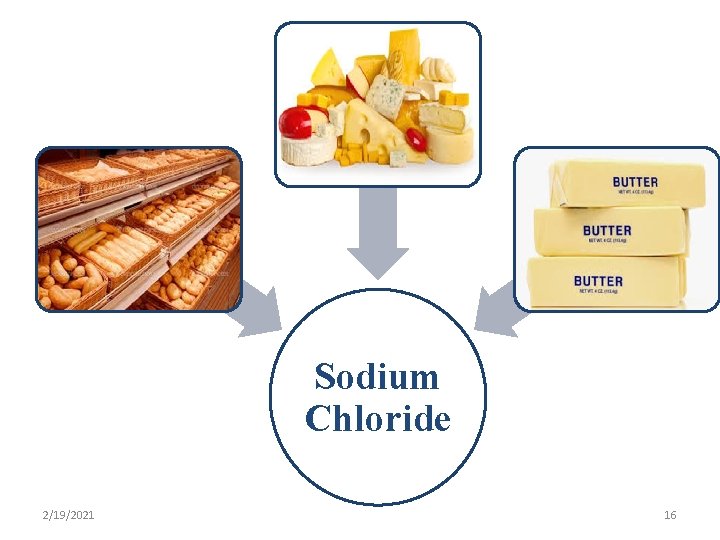
Sodium Chloride 2/19/2021 16
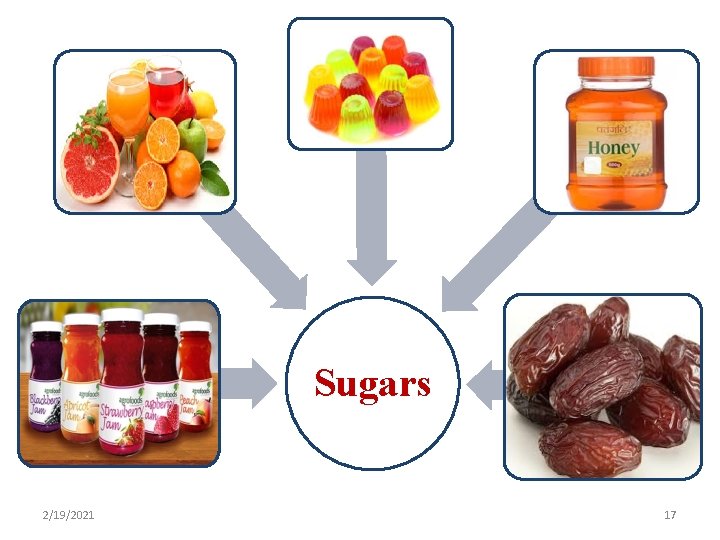
Sugars 2/19/2021 17
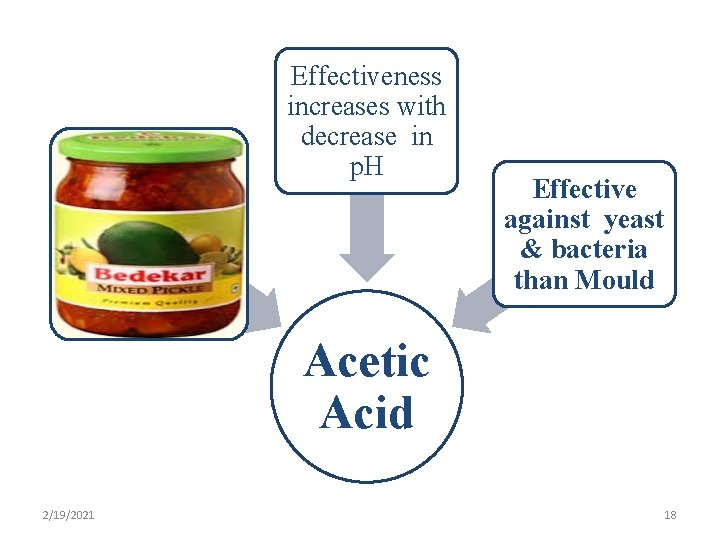
Effectiveness increases with decrease in p. H Effective against yeast & bacteria than Mould Acetic Acid 2/19/2021 18
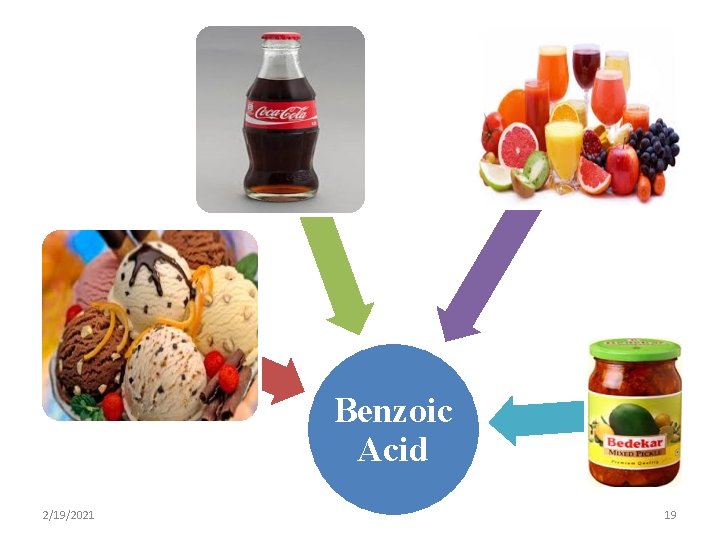
Benzoic Acid 2/19/2021 19
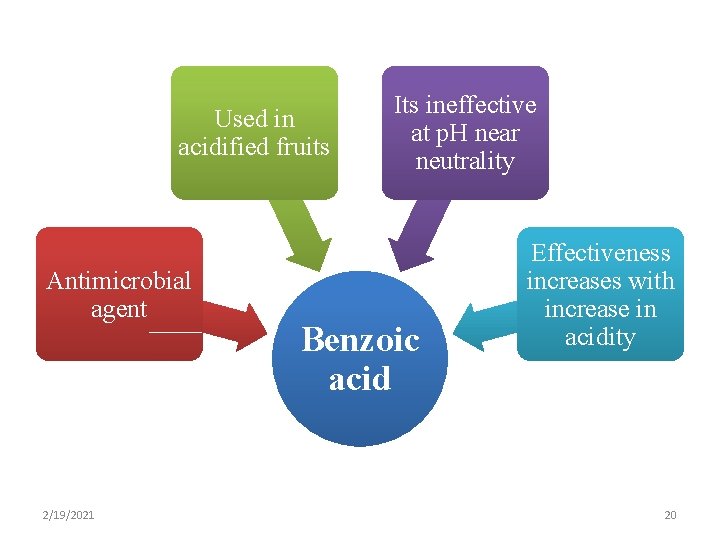
Used in acidified fruits Antimicrobial agent 2/19/2021 Its ineffective at p. H near neutrality Benzoic acid Effectiveness increases with increase in acidity 20
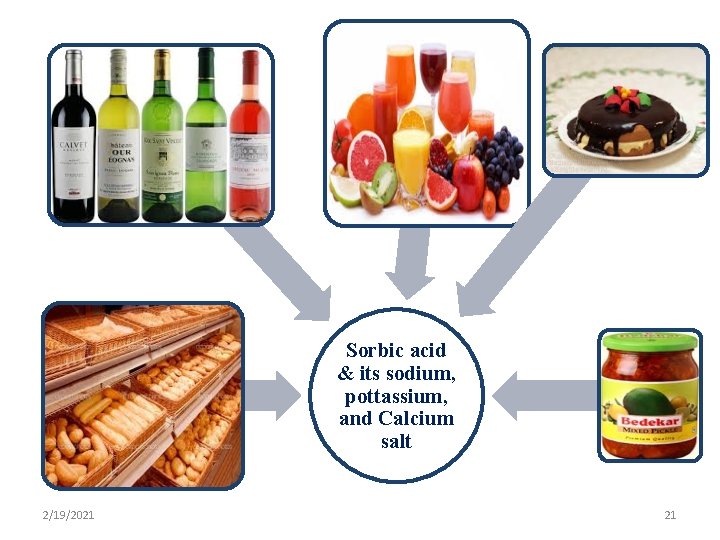
Sorbic acid & its sodium, pottassium, and Calcium salt 2/19/2021 21
Most effective at low p. H up to p. H 6. 5 Its preferred because of its stability, easy preparation, and water solubility Mould & yeast inhibition Sorbic acid & its sodium, pottassium, and Calcium salt 2/19/2021 22
Meat & meat Products Nitrate & Nitrite 2/19/2021 23
Carbon dioxide Use as solid (dry ice) to maintain low temperature storage and transportation of food products 2/19/2021 Inhibition of growth of microorganism & prevents the spoilage of fruits and vegatables. 24
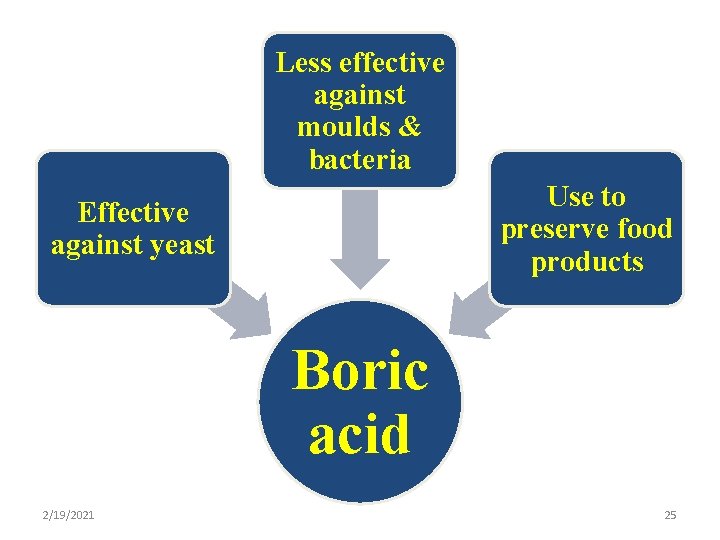
Less effective against moulds & bacteria Use to preserve food products Effective against yeast Boric acid 2/19/2021 25
2 2/19/2021 • p. H control 26
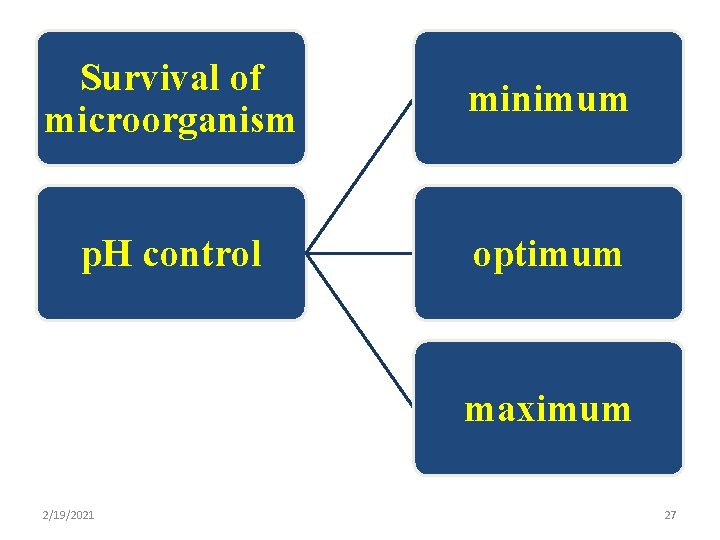
Survival of microorganism minimum p. H control optimum maximum 2/19/2021 27
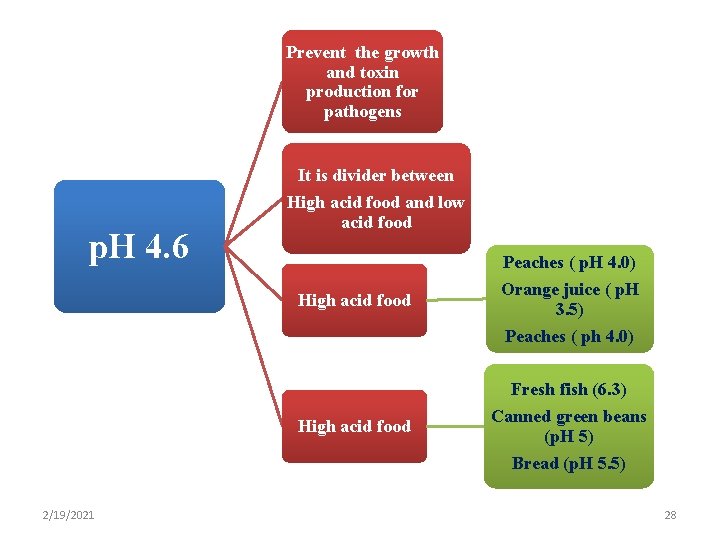
Prevent the growth and toxin production for pathogens It is divider between p. H 4. 6 High acid food and low acid food Peaches ( p. H 4. 0) High acid food Orange juice ( p. H 3. 5) Peaches ( ph 4. 0) Fresh fish (6. 3) High acid food 2/19/2021 Canned green beans (p. H 5) Bread (p. H 5. 5) 28
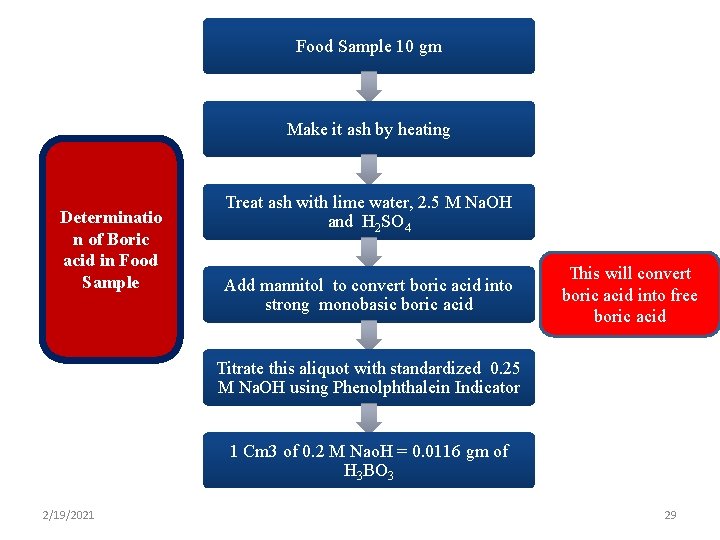
Food Sample 10 gm Make it ash by heating Determinatio n of Boric acid in Food Sample Treat ash with lime water, 2. 5 M Na. OH and H 2 SO 4 Add mannitol to convert boric acid into strong monobasic boric acid This will convert boric acid into free boric acid Titrate this aliquot with standardized 0. 25 M Na. OH using Phenolphthalein Indicator 1 Cm 3 of 0. 2 M Nao. H = 0. 0116 gm of H 3 BO 3 2/19/2021 29
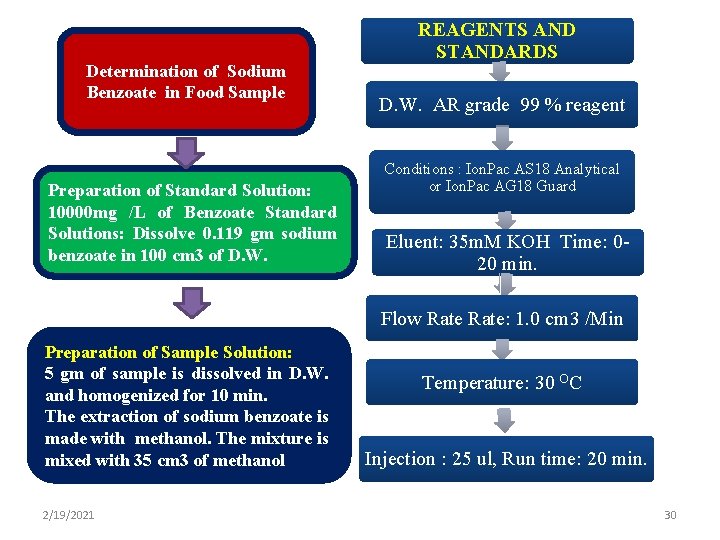
Determination of Sodium Benzoate in Food Sample Preparation of Standard Solution: 10000 mg /L of Benzoate Standard Solutions: Dissolve 0. 119 gm sodium benzoate in 100 cm 3 of D. W. REAGENTS AND STANDARDS D. W. AR grade 99 % reagent Conditions : Ion. Pac AS 18 Analytical or Ion. Pac AG 18 Guard Eluent: 35 m. M KOH Time: 020 min. Flow Rate: 1. 0 cm 3 /Min Preparation of Sample Solution: 5 gm of sample is dissolved in D. W. and homogenized for 10 min. The extraction of sodium benzoate is made with methanol. The mixture is mixed with 35 cm 3 of methanol 2/19/2021 Temperature: 30 OC Injection : 25 ul, Run time: 20 min. 30
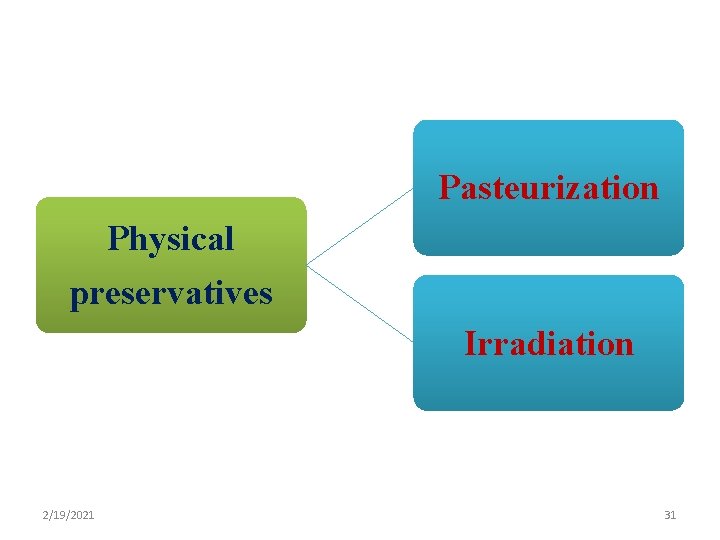
Pasteurization Physical preservatives Irradiation 2/19/2021 31
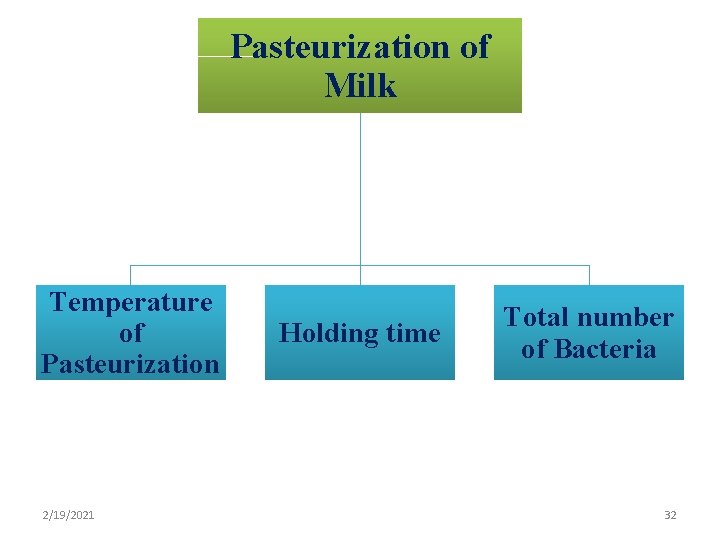
Pasteurization of Milk Temperature of Pasteurization 2/19/2021 Holding time Total number of Bacteria 32
I and Vegetables Irradiation of Fruits • In 1991 the Atomic Energy Act was amended and Atomic Energy (Control of Irradiation of Food) rules were notified. In 1994, Government of India amended Prevention of Food Adulteration Act (1954) Rules and approved irradiation of onion, potato and spices for domestic market. Additional items were approved by notifications published in 1998 and 2001 2/19/2021 33
Irradiation of Fruits and Vegetables • • Beef and Pork. Crustaceans (e. g. , lobster, shrimp, and crab) Fresh Fruits and Vegetables. Lettuce and Spinach. Poultry. Seeds for Sprouting Shell Eggs. Shellfish - Molluscan. 2/19/2021 34
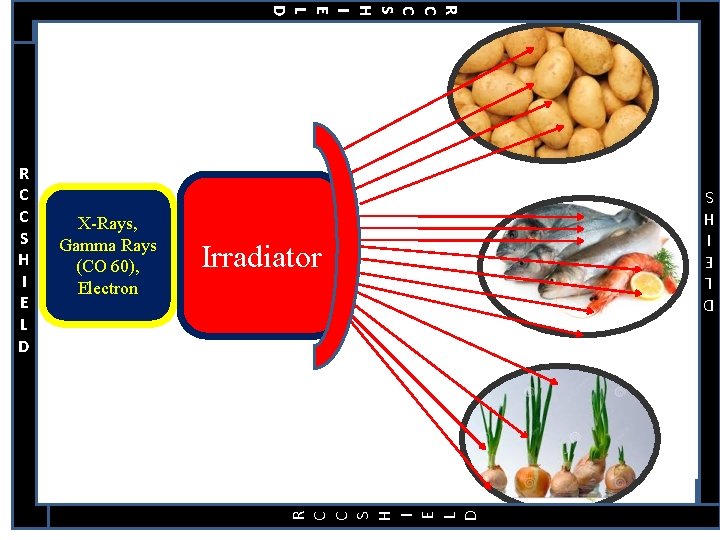
R C C S H I E L D 2/19/2021 Irradiator R C C S H I E L D X-Rays, Gamma Rays (CO 60), Electron D L E I H S R C C S H I E L D 35
Irradiation of Fruits and Vegetables • Disinfestations of insect pests in stored products • Disinfestations of quarantine pests to overcome international trade barriers • Delay in ripening and senescence in fruits and vegetables • Inhibition of sprouting in tubers, bulbs and rhizomes • Destruction of microbes responsible for food spoilage • Elimination of parasites and pathogens of public health importance in food 2/19/2021 36
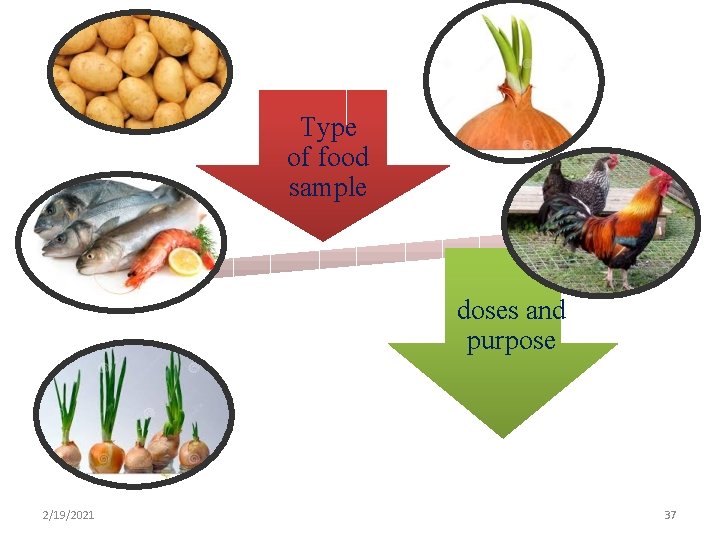
Type of food sample doses and purpose 2/19/2021 37
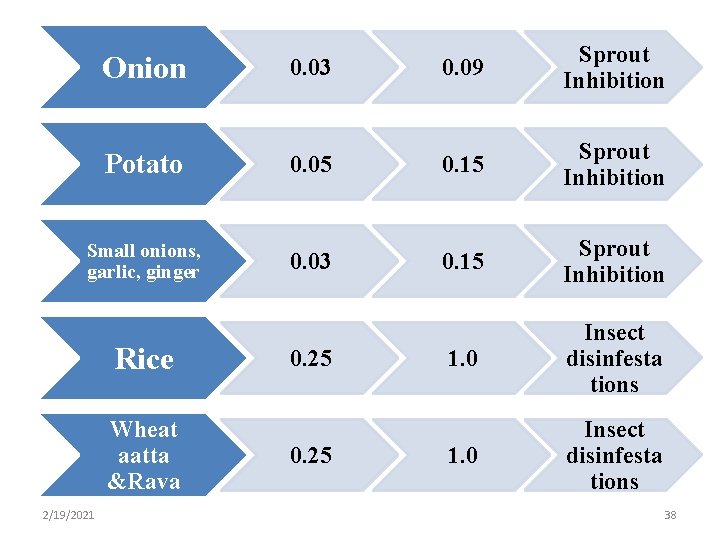
Onion 0. 03 0. 09 Sprout Inhibition Potato 0. 05 0. 15 Sprout Inhibition 1. 0 Insect disinfesta tions Small onions, garlic, ginger Rice Wheat aatta &Rava 2/19/2021 0. 03 0. 25 38
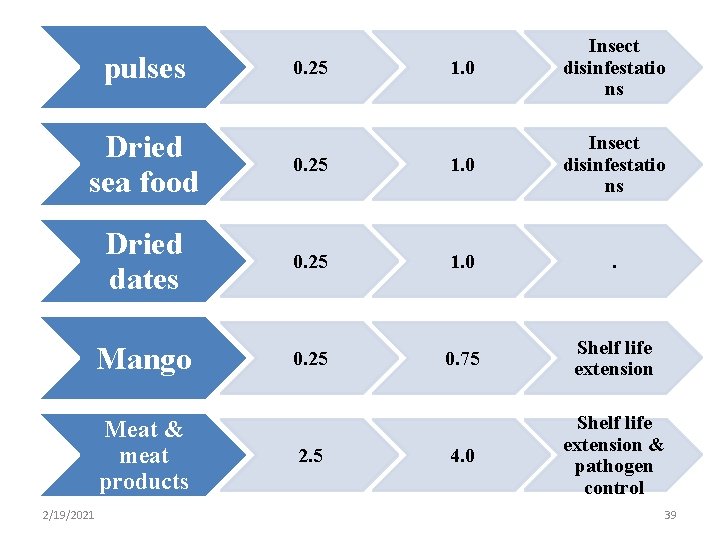
pulses 0. 25 1. 0 Insect disinfestatio ns Dried sea food 0. 25 1. 0 Insect disinfestatio ns Dried dates 0. 25 1. 0 . Mango 0. 25 0. 75 Shelf life extension 4. 0 Shelf life extension & pathogen control Meat & meat products 2/19/2021 2. 5 39
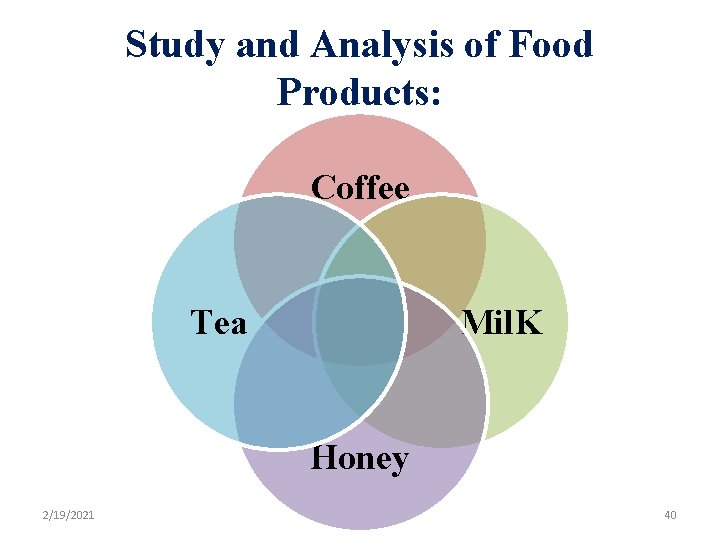
Study and Analysis of Food Products: Coffee Tea Mil. K Honey 2/19/2021 40
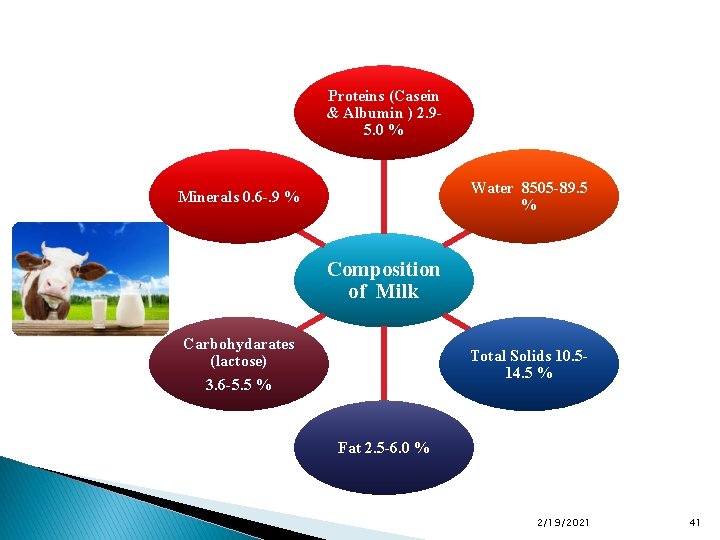
Proteins (Casein & Albumin ) 2. 95. 0 % Water 8505 -89. 5 % Minerals 0. 6 -. 9 % Composition of Milk Carbohydarates (lactose) Total Solids 10. 514. 5 % 3. 6 -5. 5 % Fat 2. 5 -6. 0 % 2/19/2021 41
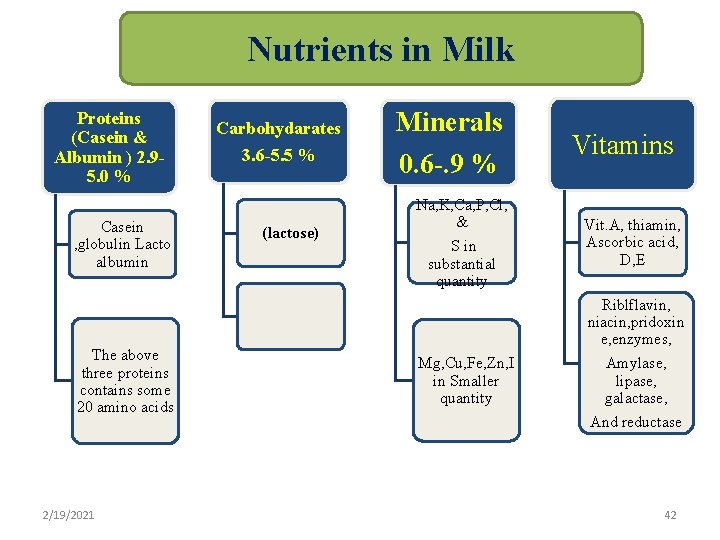
Nutrients in Milk Proteins (Casein & Albumin ) 2. 95. 0 % Casein , globulin Lacto albumin The above three proteins contains some 20 amino acids 2/19/2021 Carbohydarates Minerals 3. 6 -5. 5 % 0. 6 -. 9 % (lactose) Na, K, Ca, P, Cl, & S in substantial quantity Vitamins Vit. A, thiamin, Ascorbic acid, D, E Riblflavin, niacin, pridoxin e, enzymes, Mg, Cu, Fe, Zn, I in Smaller quantity Amylase, lipase, galactase, And reductase 42
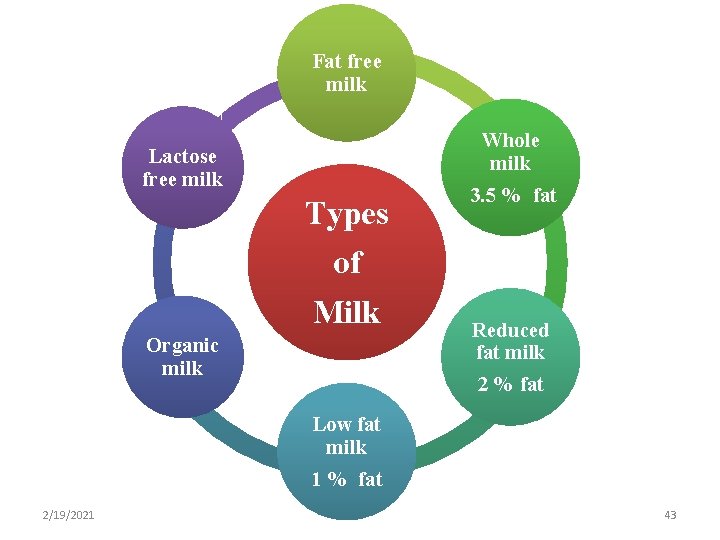
Fat free milk Whole milk Lactose free milk Types of Milk Organic milk 3. 5 % fat Reduced fat milk 2 % fat Low fat milk 1 % fat 2/19/2021 43
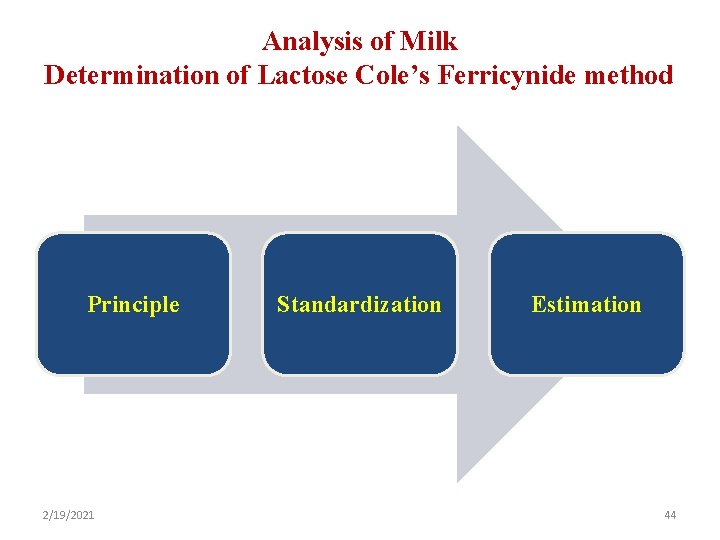
Analysis of Milk Determination of Lactose Cole’s Ferricynide method Principle 2/19/2021 Standardization Estimation 44
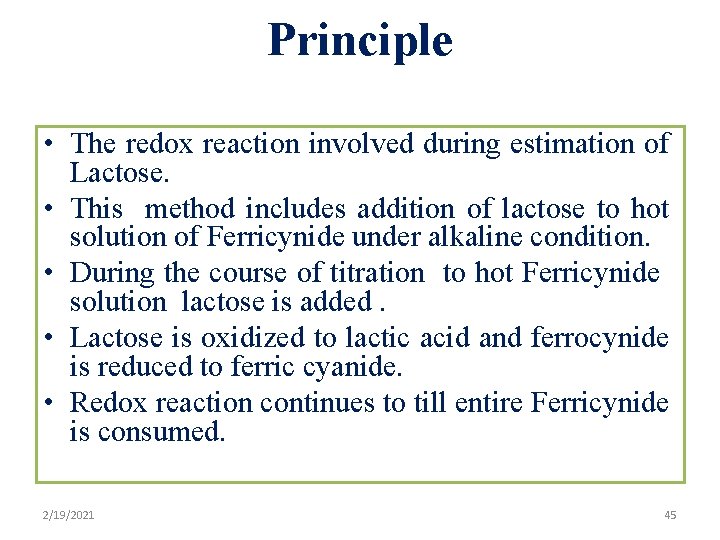
Principle • The redox reaction involved during estimation of Lactose. • This method includes addition of lactose to hot solution of Ferricynide under alkaline condition. • During the course of titration to hot Ferricynide solution lactose is added. • Lactose is oxidized to lactic acid and ferrocynide is reduced to ferric cyanide. • Redox reaction continues to till entire Ferricynide is consumed. 2/19/2021 45
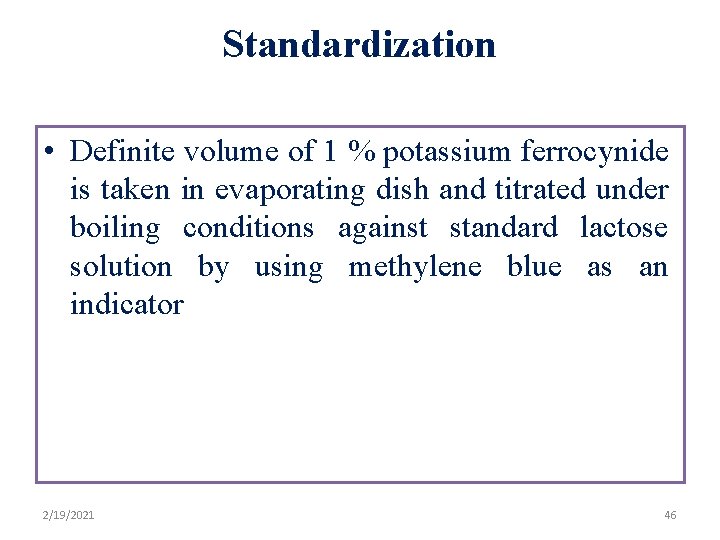
Standardization • Definite volume of 1 % potassium ferrocynide is taken in evaporating dish and titrated under boiling conditions against standard lactose solution by using methylene blue as an indicator 2/19/2021 46
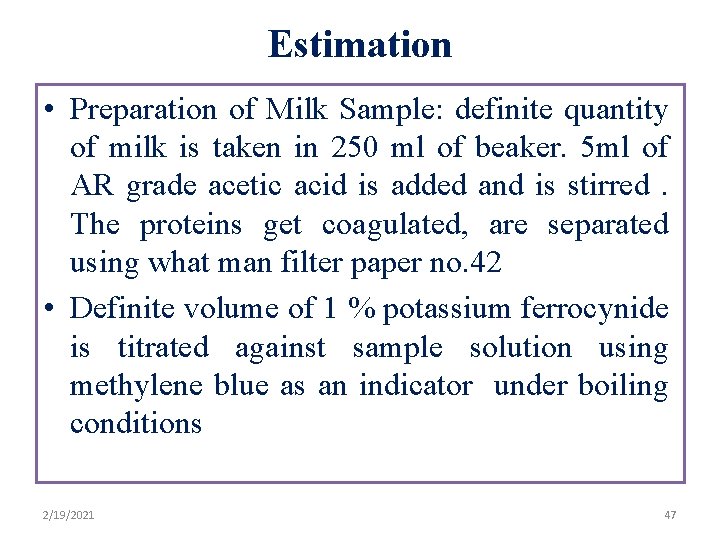
Estimation • Preparation of Milk Sample: definite quantity of milk is taken in 250 ml of beaker. 5 ml of AR grade acetic acid is added and is stirred. The proteins get coagulated, are separated using what man filter paper no. 42 • Definite volume of 1 % potassium ferrocynide is titrated against sample solution using methylene blue as an indicator under boiling conditions 2/19/2021 47
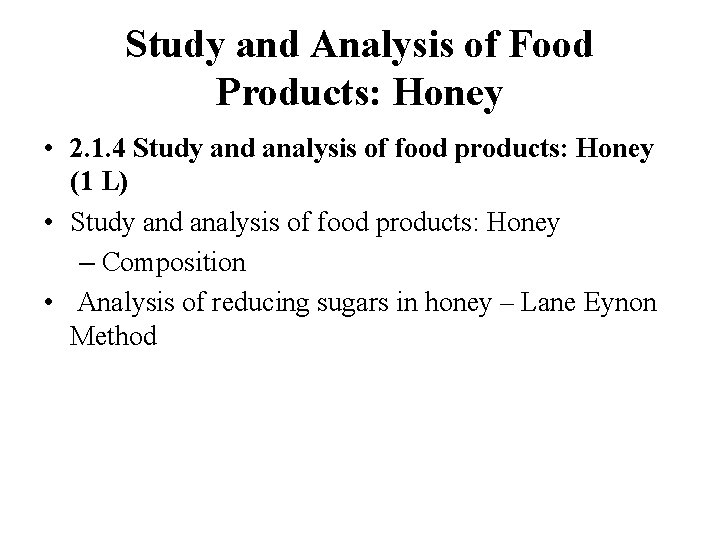
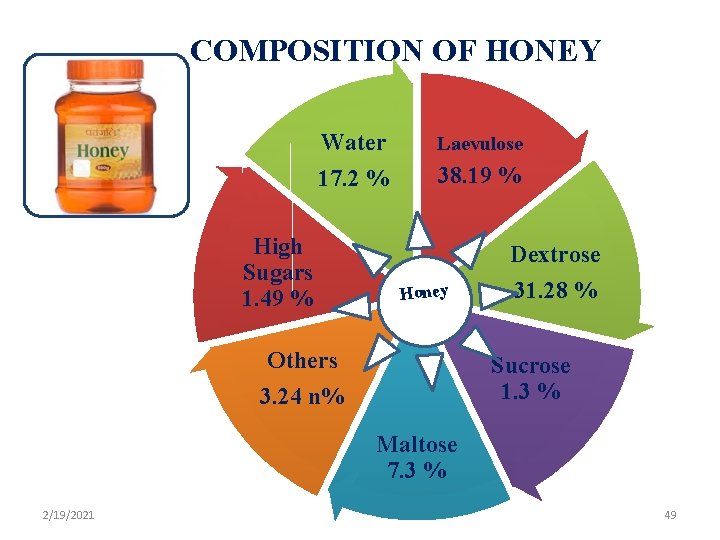
Study and Analysis of Food Products: Honey • 2. 1. 4 Study and analysis of food products: Honey (1 L) • Study and analysis of food products: Honey – Composition • Analysis of reducing sugars in honey – Lane Eynon Method
COMPOSITION OF HONEY Water Laevulose 17. 2 % 38. 19 % High Sugars 1. 49 % Dextrose Honey Others 31. 28 % Sucrose 1. 3 % 3. 24 n% Maltose 7. 3 % 2/19/2021 49
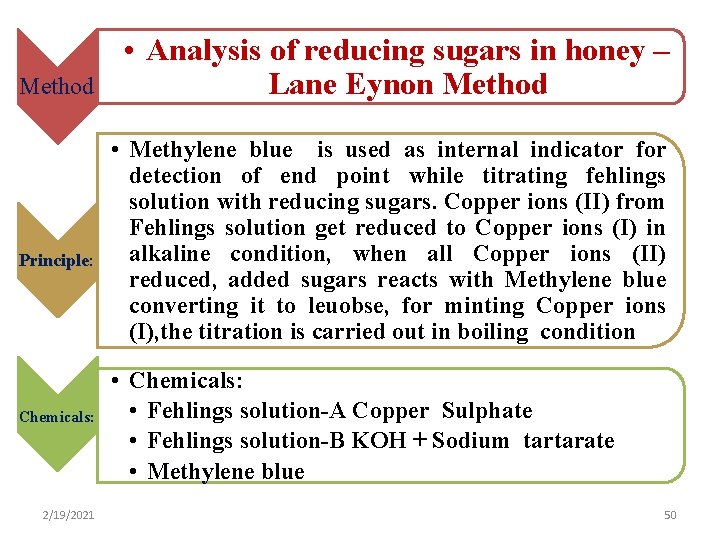
Method Principle: Chemicals: 2/19/2021 • Analysis of reducing sugars in honey – Lane Eynon Method • Methylene blue is used as internal indicator for detection of end point while titrating fehlings solution with reducing sugars. Copper ions (II) from Fehlings solution get reduced to Copper ions (I) in alkaline condition, when all Copper ions (II) reduced, added sugars reacts with Methylene blue converting it to leuobse, for minting Copper ions (I), the titration is carried out in boiling condition • Chemicals: • Fehlings solution-A Copper Sulphate • Fehlings solution-B KOH + Sodium tartarate • Methylene blue 50
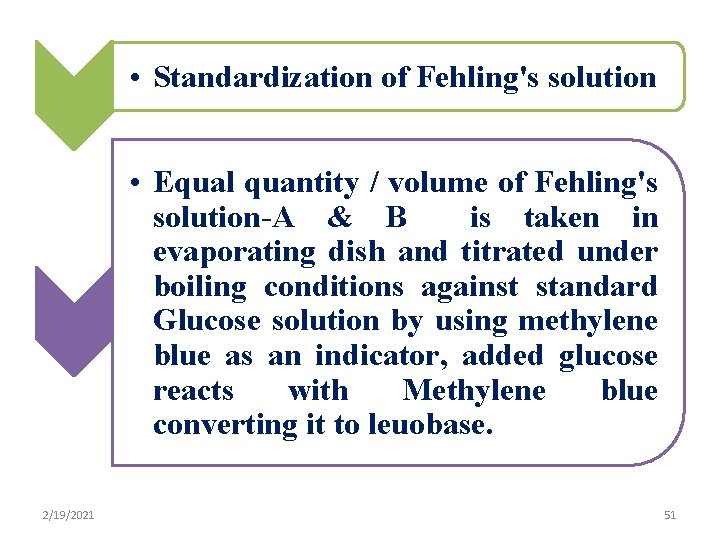
• Standardization of Fehling's solution • Equal quantity / volume of Fehling's solution-A & B is taken in evaporating dish and titrated under boiling conditions against standard Glucose solution by using methylene blue as an indicator, added glucose reacts with Methylene blue converting it to leuobase. 2/19/2021 51
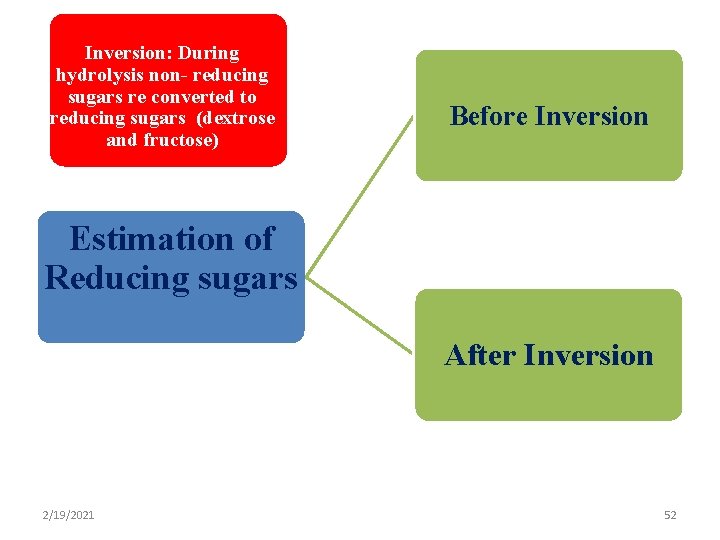
Inversion: During hydrolysis non- reducing sugars re converted to reducing sugars (dextrose and fructose) Before Inversion Estimation of Reducing sugars After Inversion 2/19/2021 52
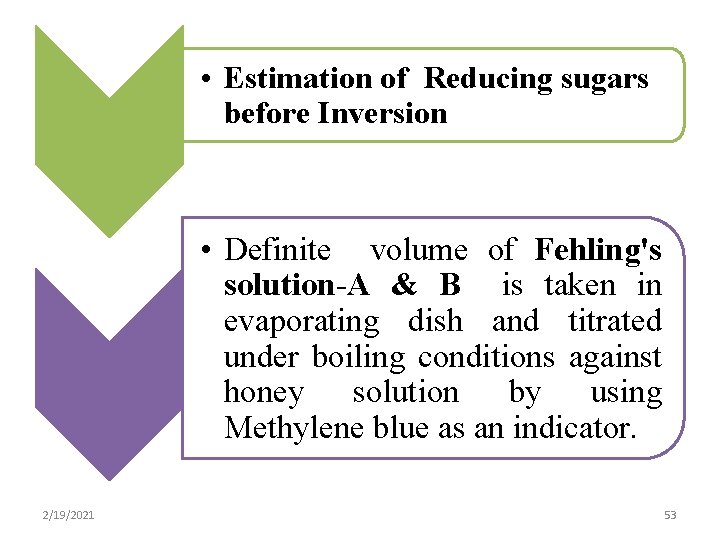
• Estimation of Reducing sugars before Inversion • Definite volume of Fehling's solution-A & B is taken in evaporating dish and titrated under boiling conditions against honey solution by using Methylene blue as an indicator. 2/19/2021 53
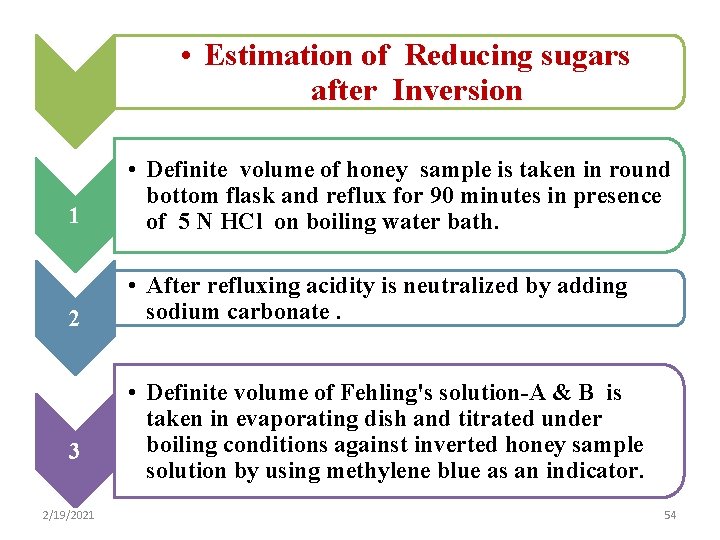
• Estimation of Reducing sugars after Inversion 1 • Definite volume of honey sample is taken in round bottom flask and reflux for 90 minutes in presence of 5 N HCl on boiling water bath. 2 • After refluxing acidity is neutralized by adding sodium carbonate. 3 2/19/2021 • Definite volume of Fehling's solution-A & B is taken in evaporating dish and titrated under boiling conditions against inverted honey sample solution by using methylene blue as an indicator. 54
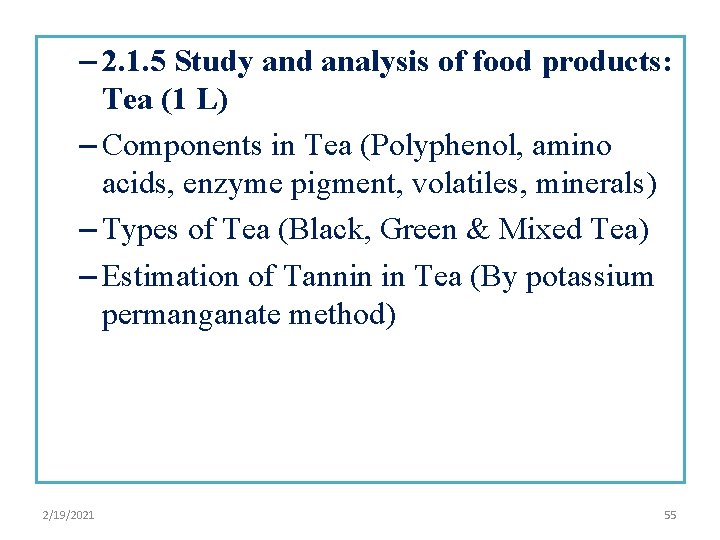
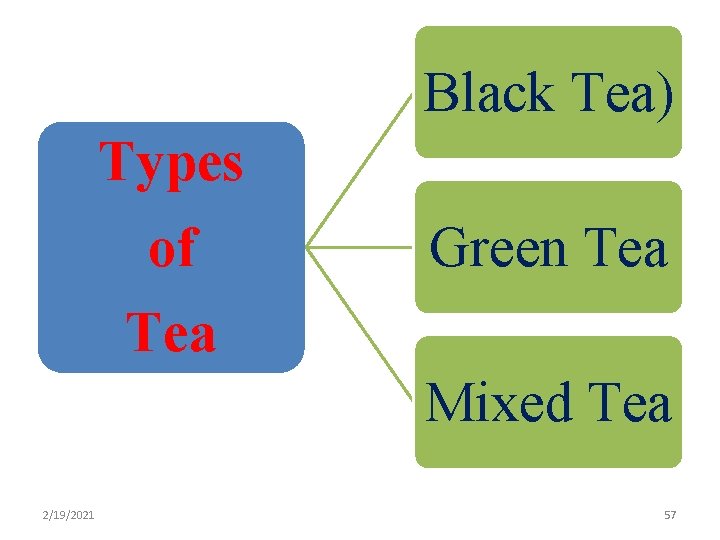
– 2. 1. 5 Study and analysis of food products: Tea (1 L) – Components in Tea (Polyphenol, amino acids, enzyme pigment, volatiles, minerals) – Types of Tea (Black, Green & Mixed Tea) – Estimation of Tannin in Tea (By potassium permanganate method) 2/19/2021 55
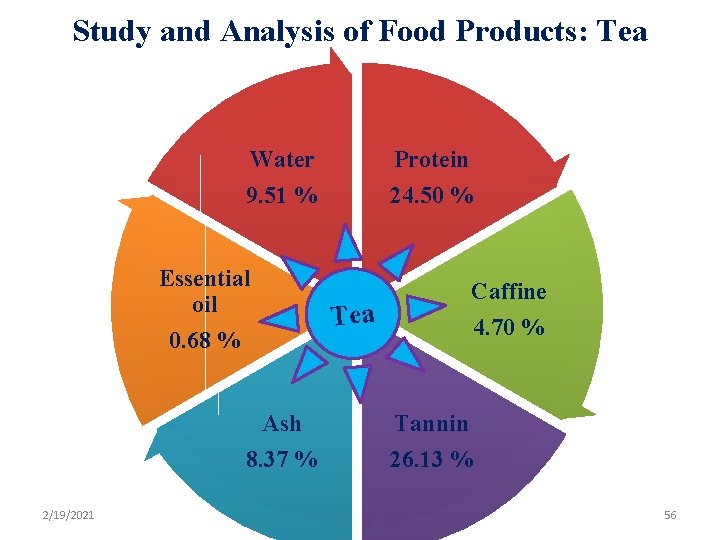
Study and Analysis of Food Products: Tea Water Protein 9. 51 % 24. 50 % Essential oil Tea 0. 68 % 2/19/2021 Caffine 4. 70 % Ash Tannin 8. 37 % 26. 13 % 56
Black Tea) Types of Green Tea Mixed Tea 2/19/2021 57
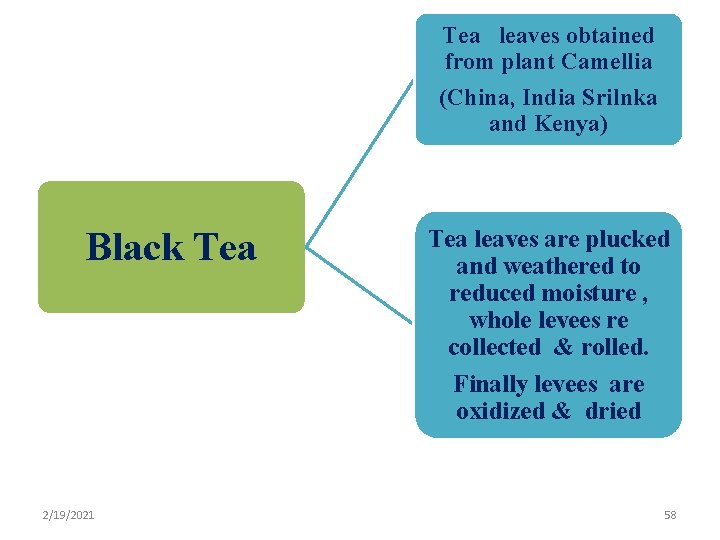
Tea leaves obtained from plant Camellia (China, India Srilnka and Kenya) Black Tea 2/19/2021 Tea leaves are plucked and weathered to reduced moisture , whole levees re collected & rolled. Finally levees are oxidized & dried 58
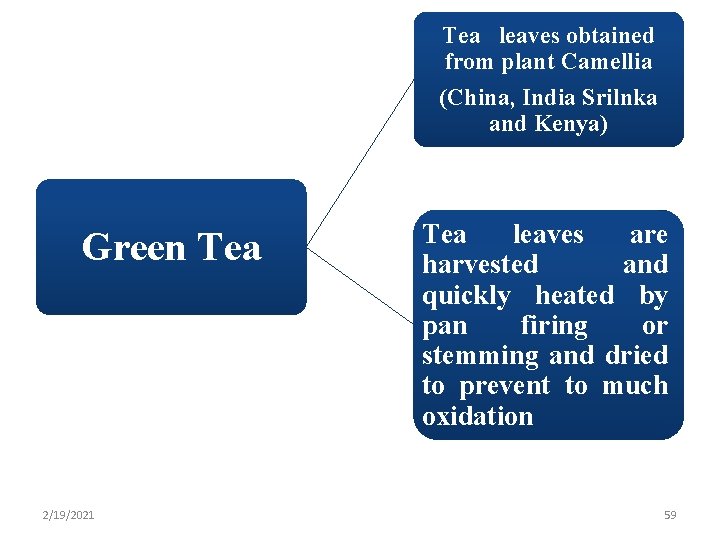
Tea leaves obtained from plant Camellia (China, India Srilnka and Kenya) Green Tea 2/19/2021 Tea leaves are harvested and quickly heated by pan firing or stemming and dried to prevent to much oxidation 59
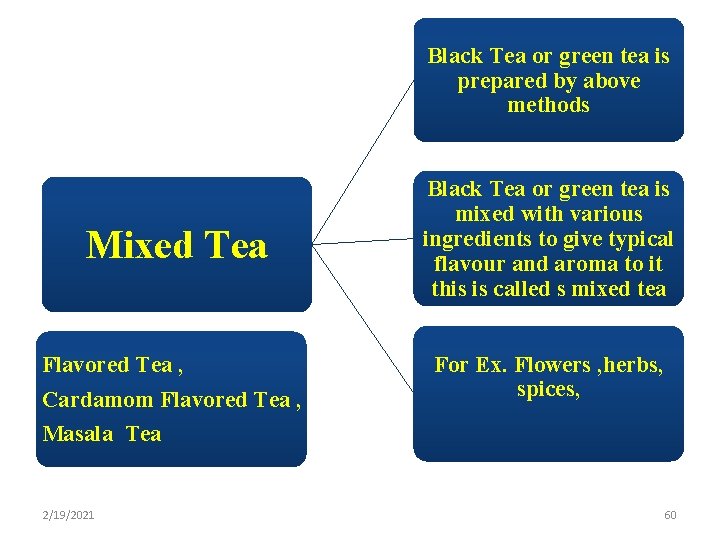
Black Tea or green tea is prepared by above methods Mixed Tea Flavored Tea , Cardamom Flavored Tea , Masala Tea 2/19/2021 Black Tea or green tea is mixed with various ingredients to give typical flavour and aroma to it this is called s mixed tea For Ex. Flowers , herbs, spices, 60
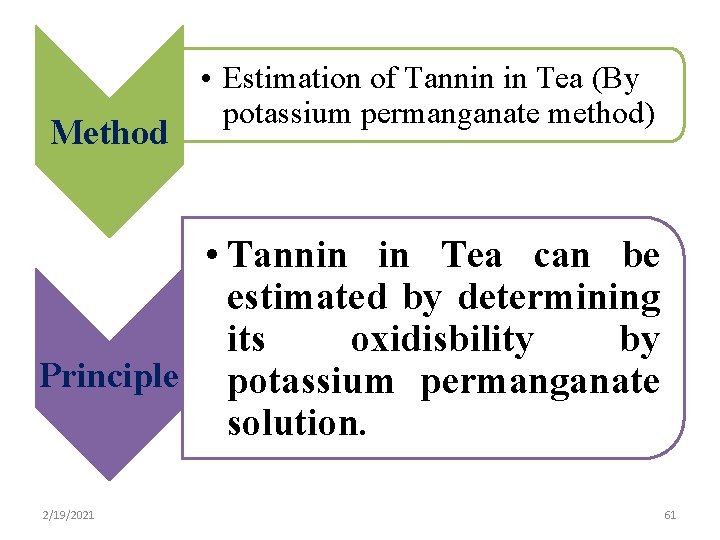
Method • Estimation of Tannin in Tea (By potassium permanganate method) • Tannin in Tea can be estimated by determining its oxidisbility by Principle potassium permanganate solution. 2/19/2021 61
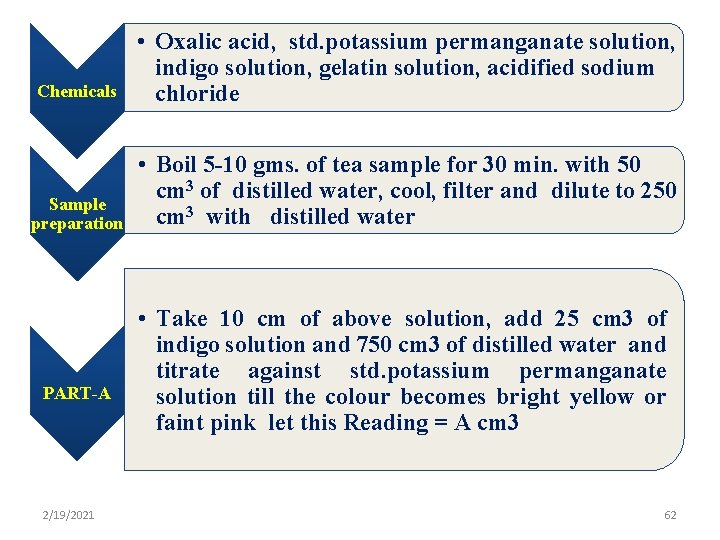
Chemicals • Oxalic acid, std. potassium permanganate solution, indigo solution, gelatin solution, acidified sodium chloride Sample preparation • Boil 5 -10 gms. of tea sample for 30 min. with 50 cm 3 of distilled water, cool, filter and dilute to 250 cm 3 with distilled water PART-A 2/19/2021 • Take 10 cm of above solution, add 25 cm 3 of indigo solution and 750 cm 3 of distilled water and titrate against std. potassium permanganate solution till the colour becomes bright yellow or faint pink let this Reading = A cm 3 62
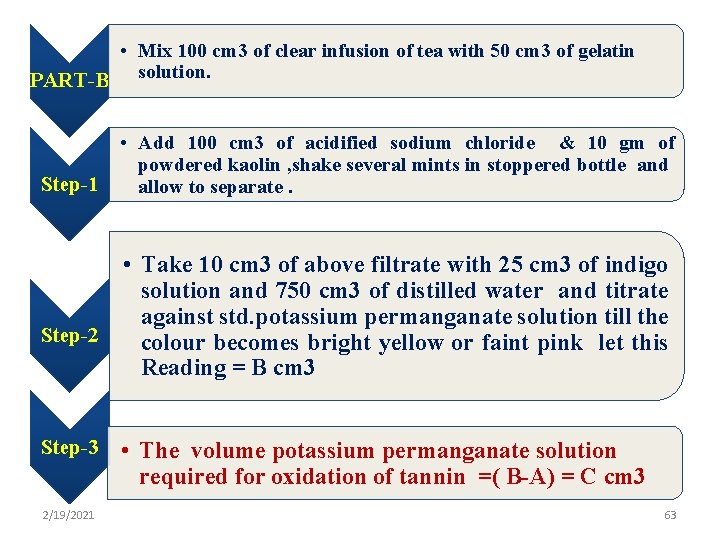
• Mix 100 cm 3 of clear infusion of tea with 50 cm 3 of gelatin PART-B solution. Step-1 • Add 100 cm 3 of acidified sodium chloride & 10 gm of powdered kaolin , shake several mints in stoppered bottle and allow to separate. • Take 10 cm 3 of above filtrate with 25 cm 3 of indigo solution and 750 cm 3 of distilled water and titrate against std. potassium permanganate solution till the Step-2 colour becomes bright yellow or faint pink let this Reading = B cm 3 Step-3 2/19/2021 • The volume potassium permanganate solution required for oxidation of tannin =( B-A) = C cm 3 63
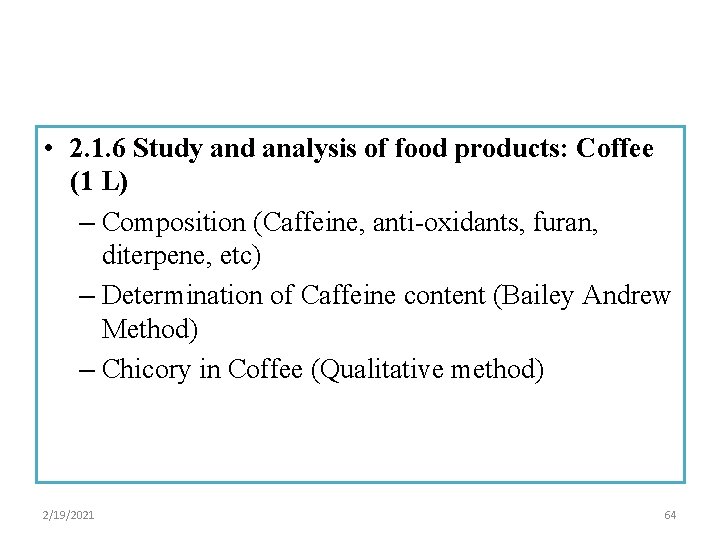
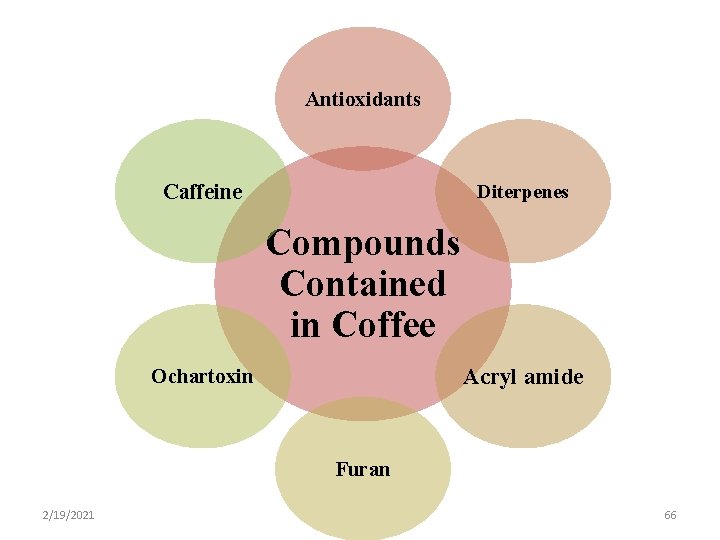
• 2. 1. 6 Study and analysis of food products: Coffee (1 L) – Composition (Caffeine, anti-oxidants, furan, diterpene, etc) – Determination of Caffeine content (Bailey Andrew Method) – Chicory in Coffee (Qualitative method) 2/19/2021 64
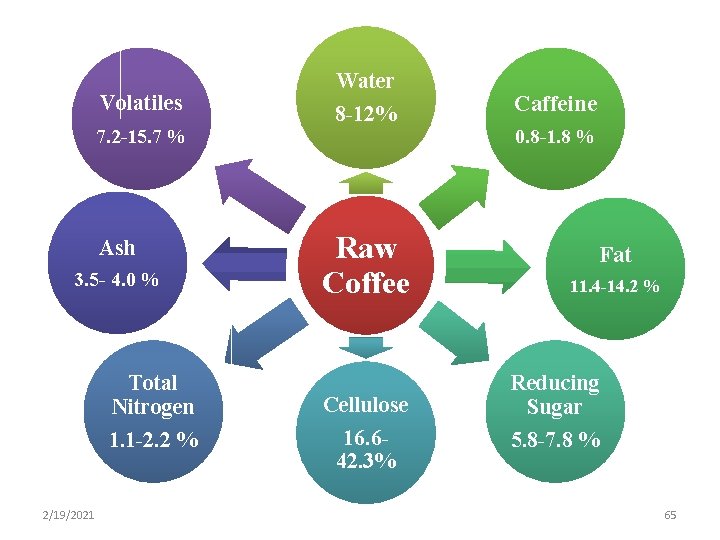
Volatiles 7. 2 -15. 7 % Ash 3. 5 - 4. 0 % Total Nitrogen 1. 1 -2. 2 % 2/19/2021 Water 8 -12% Raw Coffee Cellulose 16. 642. 3% Caffeine 0. 8 -1. 8 % Fat 11. 4 -14. 2 % Reducing Sugar 5. 8 -7. 8 % 65
Antioxidants Caffeine Diterpenes Compounds Contained in Coffee Acryl amide Ochartoxin Furan 2/19/2021 66
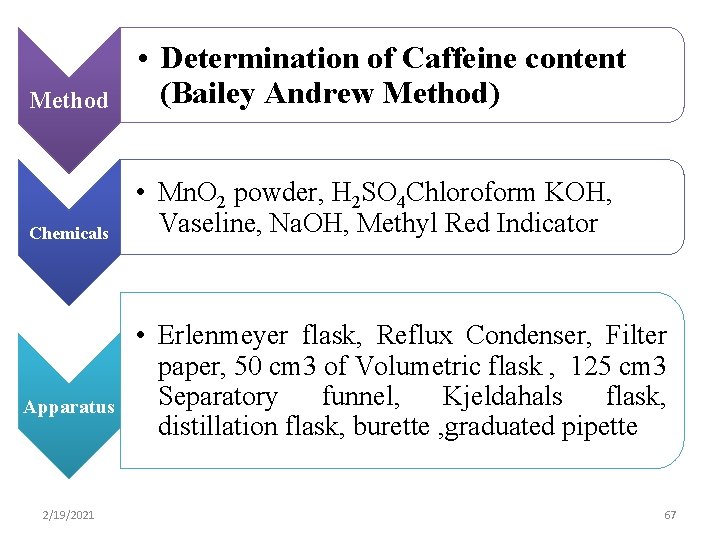
Method • Determination of Caffeine content (Bailey Andrew Method) Chemicals • Mn. O 2 powder, H 2 SO 4 Chloroform KOH, Vaseline, Na. OH, Methyl Red Indicator Apparatus 2/19/2021 • Erlenmeyer flask, Reflux Condenser, Filter paper, 50 cm 3 of Volumetric flask , 125 cm 3 Separatory funnel, Kjeldahals flask, distillation flask, burette , graduated pipette 67
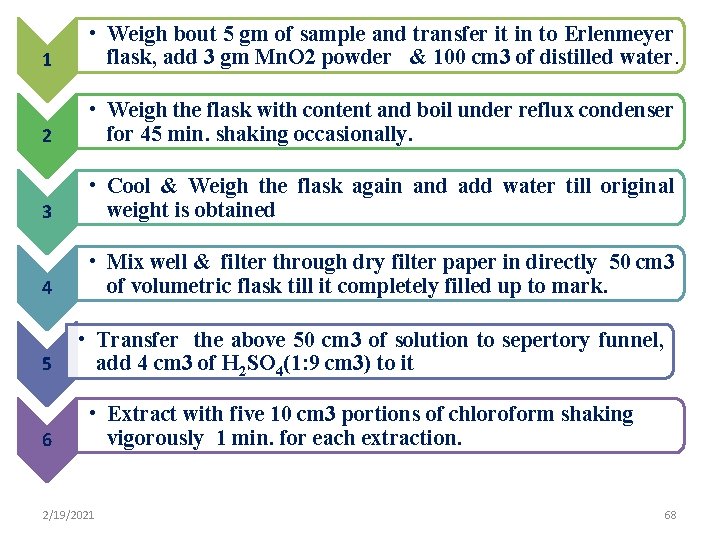
1 • Weigh bout 5 gm of sample and transfer it in to Erlenmeyer flask, add 3 gm Mn. O 2 powder & 100 cm 3 of distilled water. 2 • Weigh the flask with content and boil under reflux condenser for 45 min. shaking occasionally. 3 • Cool & Weigh the flask again and add water till original weight is obtained 4 • Mix well & filter through dry filter paper in directly 50 cm 3 of volumetric flask till it completely filled up to mark. 5 6 • Transfer the above 50 cm 3 of solution to sepertory funnel, add 4 cm 3 of H 2 SO 4(1: 9 cm 3) to it • Extract with five 10 cm 3 portions of chloroform shaking vigorously 1 min. for each extraction. 2/19/2021 68
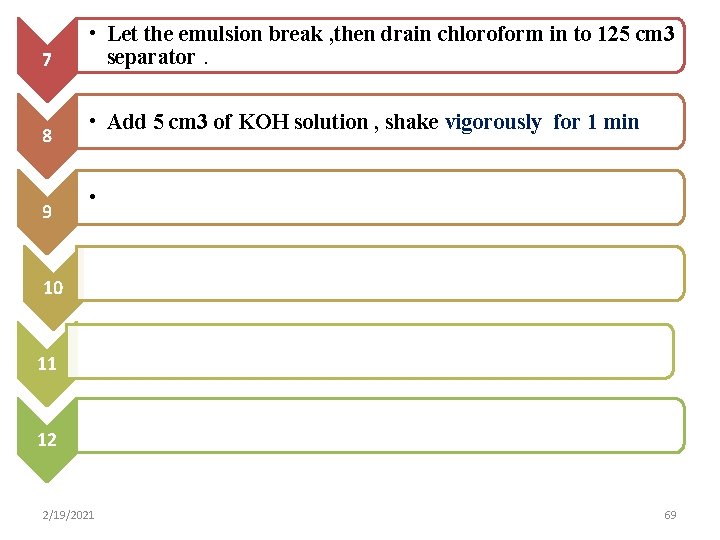
7 8 9 • Let the emulsion break , then drain chloroform in to 125 cm 3 separator. • Add 5 cm 3 of KOH solution , shake vigorously for 1 min • 10 11 12 2/19/2021 69
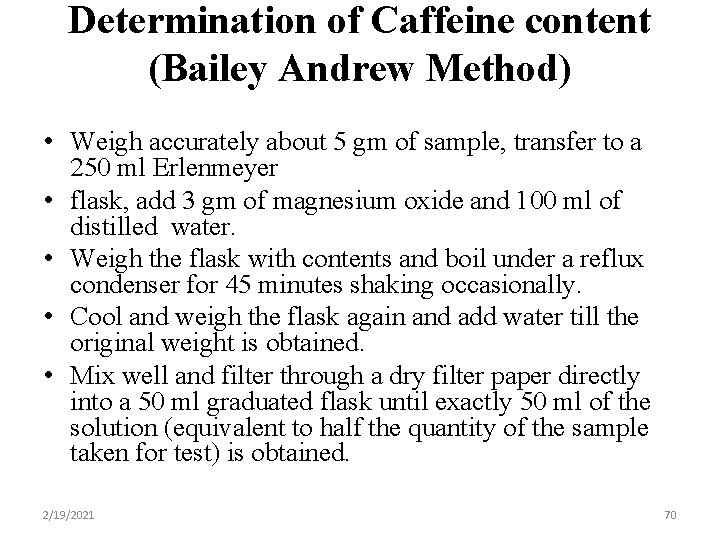
Determination of Caffeine content (Bailey Andrew Method) • Weigh accurately about 5 gm of sample, transfer to a 250 ml Erlenmeyer • flask, add 3 gm of magnesium oxide and 100 ml of distilled water. • Weigh the flask with contents and boil under a reflux condenser for 45 minutes shaking occasionally. • Cool and weigh the flask again and add water till the original weight is obtained. • Mix well and filter through a dry filter paper directly into a 50 ml graduated flask until exactly 50 ml of the solution (equivalent to half the quantity of the sample taken for test) is obtained. 2/19/2021 70
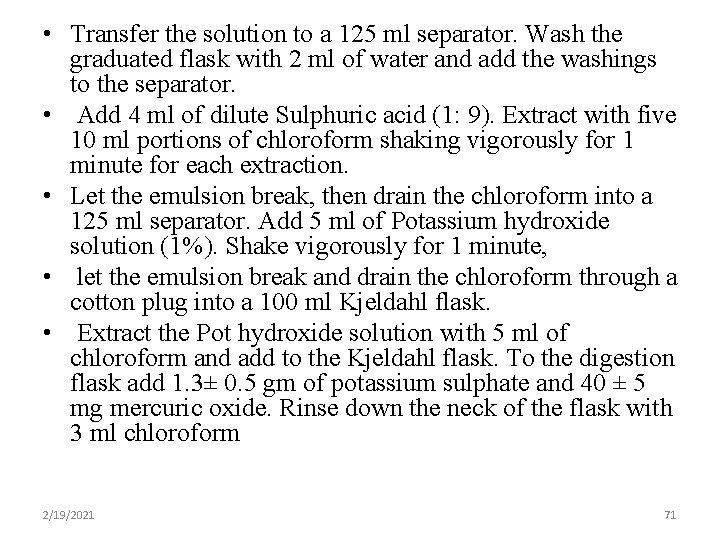
• Transfer the solution to a 125 ml separator. Wash the graduated flask with 2 ml of water and add the washings to the separator. • Add 4 ml of dilute Sulphuric acid (1: 9). Extract with five 10 ml portions of chloroform shaking vigorously for 1 minute for each extraction. • Let the emulsion break, then drain the chloroform into a 125 ml separator. Add 5 ml of Potassium hydroxide solution (1%). Shake vigorously for 1 minute, • let the emulsion break and drain the chloroform through a cotton plug into a 100 ml Kjeldahl flask. • Extract the Pot hydroxide solution with 5 ml of chloroform and add to the Kjeldahl flask. To the digestion flask add 1. 3± 0. 5 gm of potassium sulphate and 40 ± 5 mg mercuric oxide. Rinse down the neck of the flask with 3 ml chloroform 2/19/2021 71
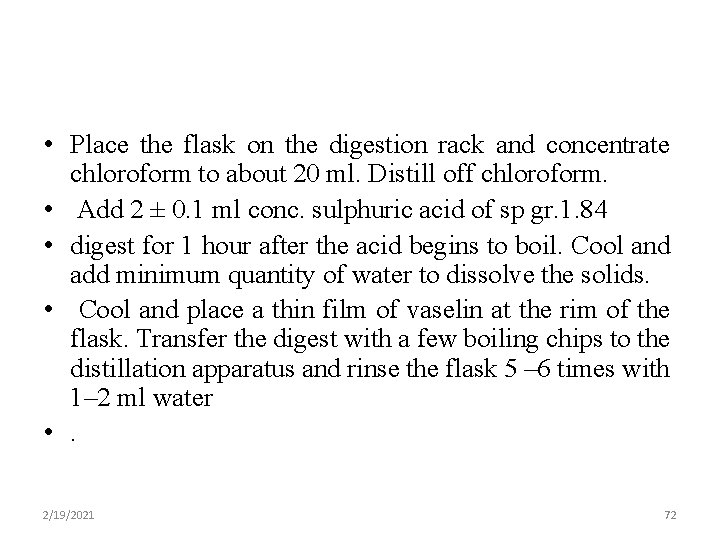
• Place the flask on the digestion rack and concentrate chloroform to about 20 ml. Distill off chloroform. • Add 2 ± 0. 1 ml conc. sulphuric acid of sp gr. 1. 84 • digest for 1 hour after the acid begins to boil. Cool and add minimum quantity of water to dissolve the solids. • Cool and place a thin film of vaselin at the rim of the flask. Transfer the digest with a few boiling chips to the distillation apparatus and rinse the flask 5 – 6 times with 1– 2 ml water • . 2/19/2021 72
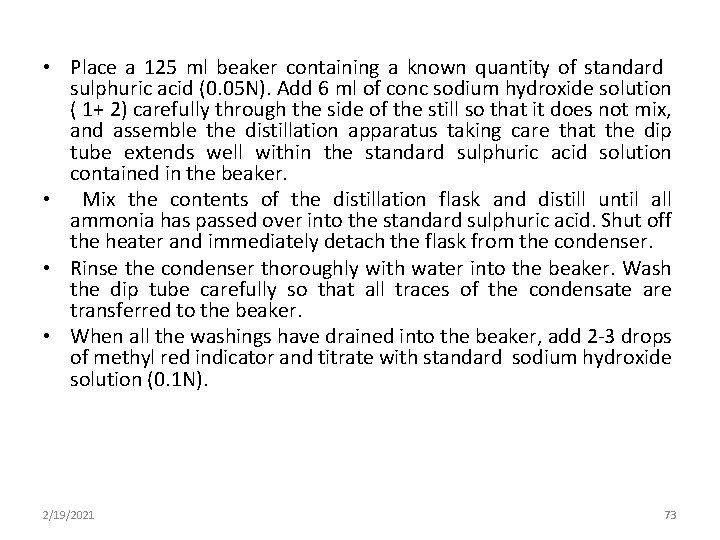
• Place a 125 ml beaker containing a known quantity of standard sulphuric acid (0. 05 N). Add 6 ml of conc sodium hydroxide solution ( 1+ 2) carefully through the side of the still so that it does not mix, and assemble the distillation apparatus taking care that the dip tube extends well within the standard sulphuric acid solution contained in the beaker. • Mix the contents of the distillation flask and distill until all ammonia has passed over into the standard sulphuric acid. Shut off the heater and immediately detach the flask from the condenser. • Rinse the condenser thoroughly with water into the beaker. Wash the dip tube carefully so that all traces of the condensate are transferred to the beaker. • When all the washings have drained into the beaker, add 2 -3 drops of methyl red indicator and titrate with standard sodium hydroxide solution (0. 1 N). 2/19/2021 73
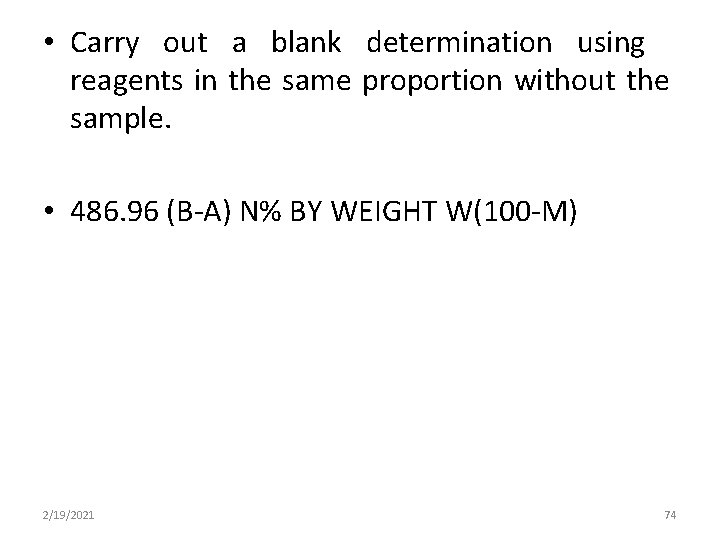
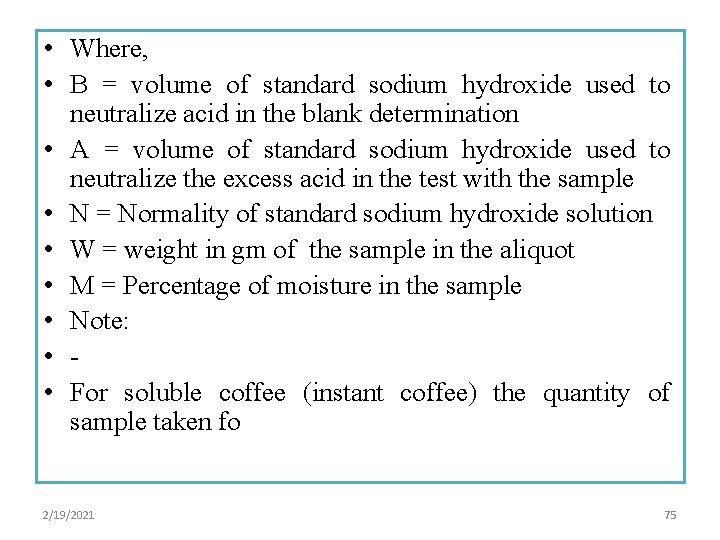
• Carry out a blank determination using reagents in the same proportion without the sample. • 486. 96 (B-A) N% BY WEIGHT W(100 -M) 2/19/2021 74
• Where, • B = volume of standard sodium hydroxide used to neutralize acid in the blank determination • A = volume of standard sodium hydroxide used to neutralize the excess acid in the test with the sample • N = Normality of standard sodium hydroxide solution • W = weight in gm of the sample in the aliquot • M = Percentage of moisture in the sample • Note: • • For soluble coffee (instant coffee) the quantity of sample taken fo 2/19/2021 75
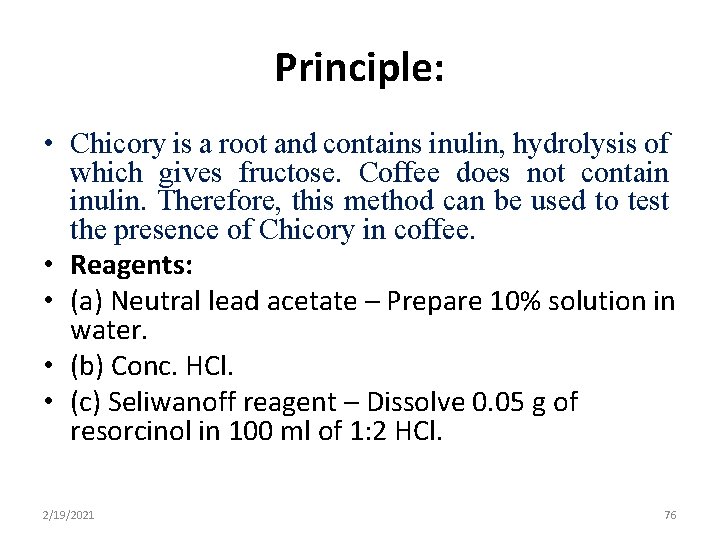
Principle: • Chicory is a root and contains inulin, hydrolysis of which gives fructose. Coffee does not contain inulin. Therefore, this method can be used to test the presence of Chicory in coffee. • Reagents: • (a) Neutral lead acetate – Prepare 10% solution in water. • (b) Conc. HCl. • (c) Seliwanoff reagent – Dissolve 0. 05 g of resorcinol in 100 ml of 1: 2 HCl. 2/19/2021 76
Procedure: • Clarify 25 ml of 2% aqueous extract of the sample with neutral lead acetate and filter. To 5 ml of filtrate add 5 ml of Seliwanoff reagent and 1 ml of conc. HCl. Boil for 2 minutes. Appearance of distinct red colour on standing shows the presence of Chicory in coffee. 2/19/2021 77
Thank you 2/19/2021 78