Lean With MEAN 1 Speaker Mayuresh Phadke Technology
- Slides: 43
Lean With MEAN 1
Speaker Mayuresh Phadke Technology Enthusiast & Entrepreneur Synerzip www. synerzip. com Webinar Series 2015 2
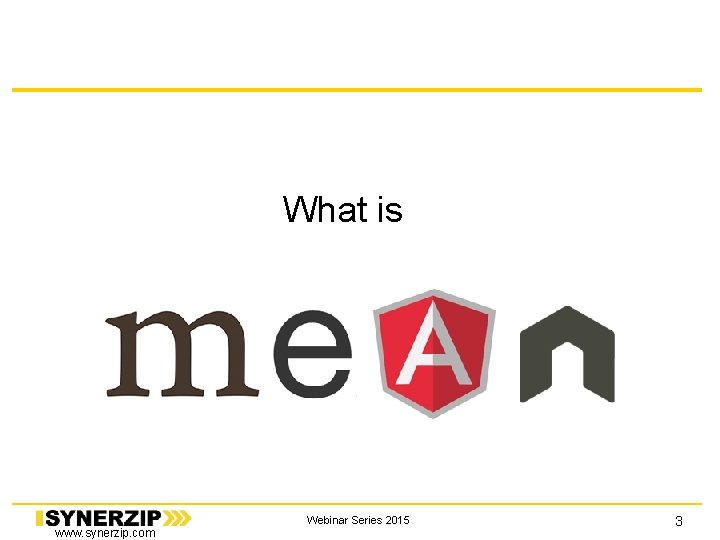
What is www. synerzip. com Webinar Series 2015 3
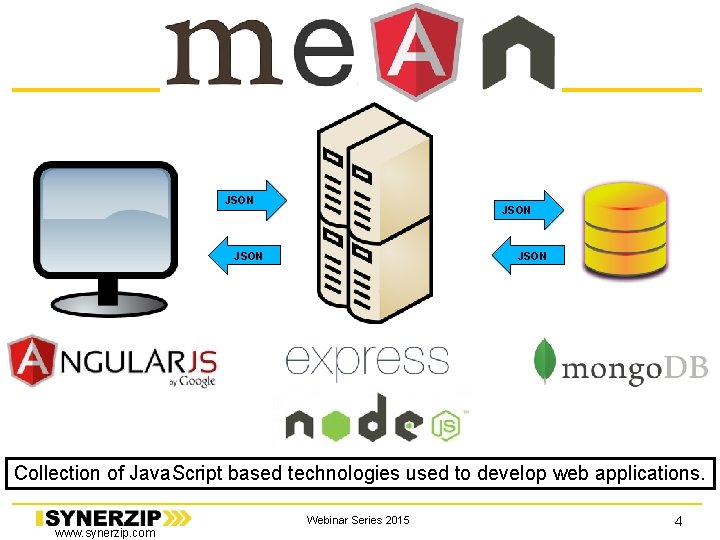
JSON Collection of Java. Script based technologies used to develop web applications. www. synerzip. com Webinar Series 2015 4
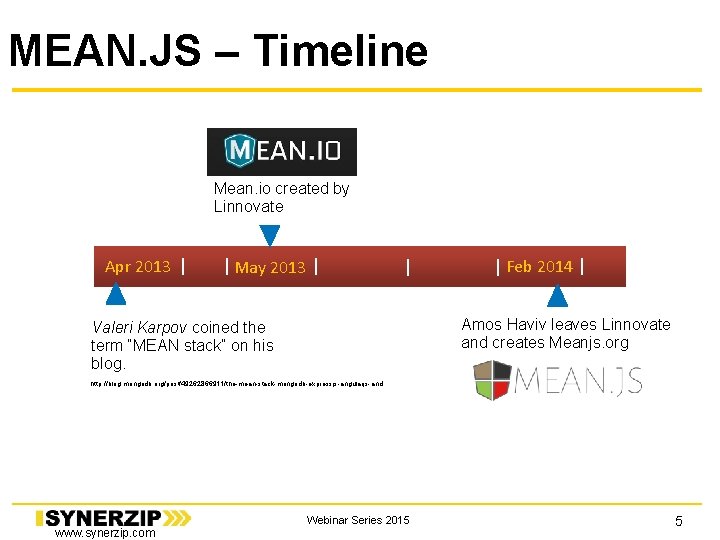
MEAN. JS – Timeline Mean. io created by Linnovate Apr 2013 Feb 2014 May 2013 Amos Haviv leaves Linnovate and creates Meanjs. org Valeri Karpov coined the term. Stanford “MEAN stack” on his University blog. http: //blog. mongodb. org/post/49262866911/the-mean-stack-mongodb-expressjs-angularjs-and www. synerzip. com Webinar Series 2015 5
What is • MEAN. JS is a full-stack Java. Script solution that helps you build fast, robust, and maintainable production web applications using Mongo. DB, Express, Angular. JS, and Node. js. • MEAN. JS helps to get started and avoid useless grunt work and common pitfalls, while keeping the application organized. www. synerzip. com Webinar Series 2015 6
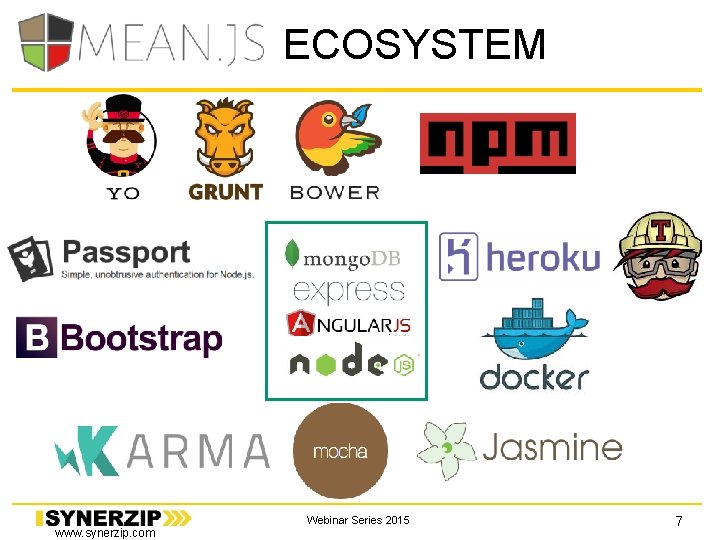
ECOSYSTEM www. synerzip. com Webinar Series 2015 7
LEAN STARTUP www. synerzip. com Webinar Series 2015 8
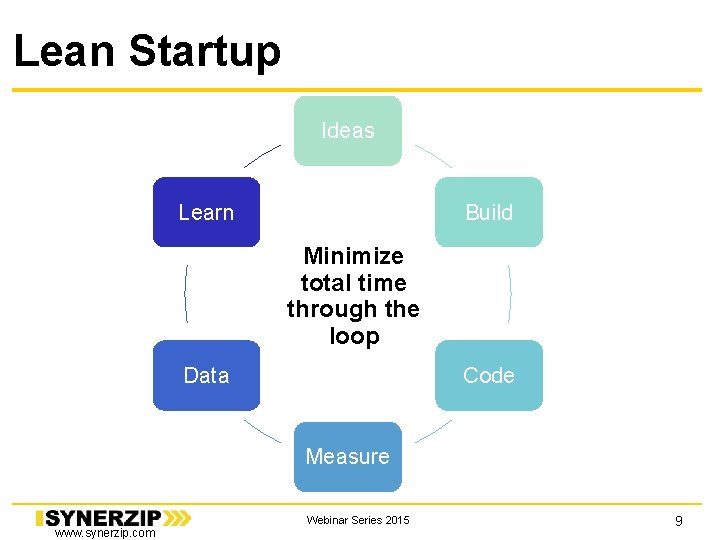
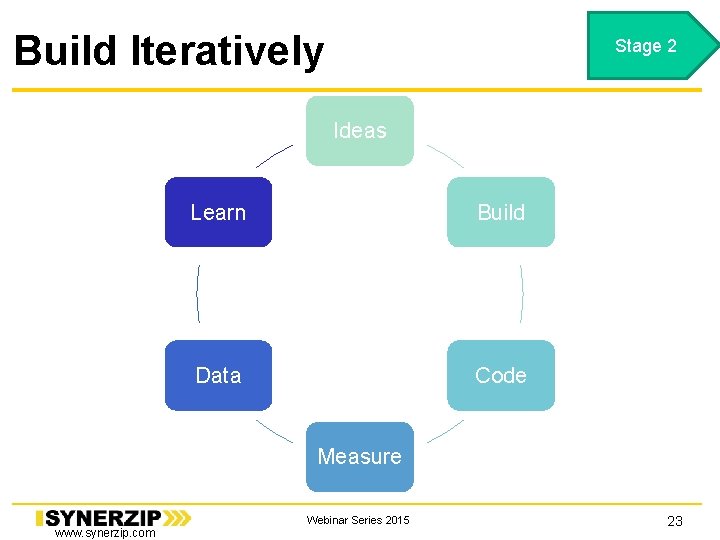
Lean Startup Ideas Learn Build Minimize total time through the loop Data Code Measure www. synerzip. com Webinar Series 2015 9
Typical Lifecycle of Lean startups and how MEAN fits in www. synerzip. com Webinar Series 2015 10
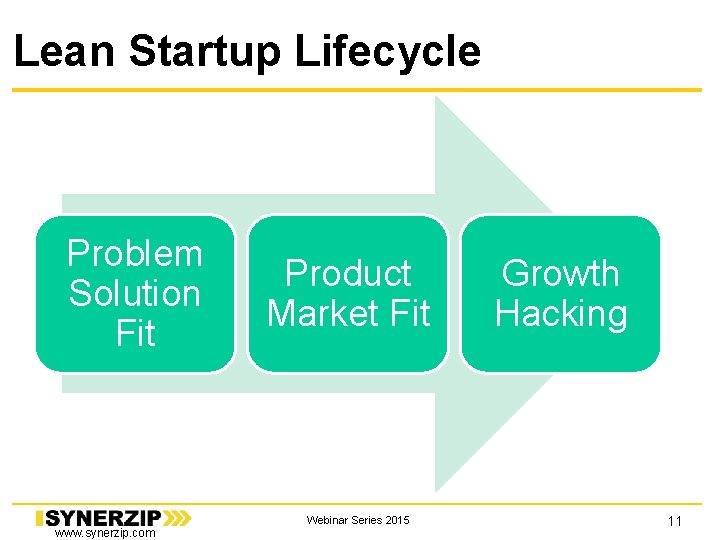
Lean Startup Lifecycle Problem Solution Fit www. synerzip. com Product Market Fit Webinar Series 2015 Growth Hacking 11
Example - Restaurant Discovery Startup which helps people discover great restaurants www. synerzip. com Webinar Series 2015 12
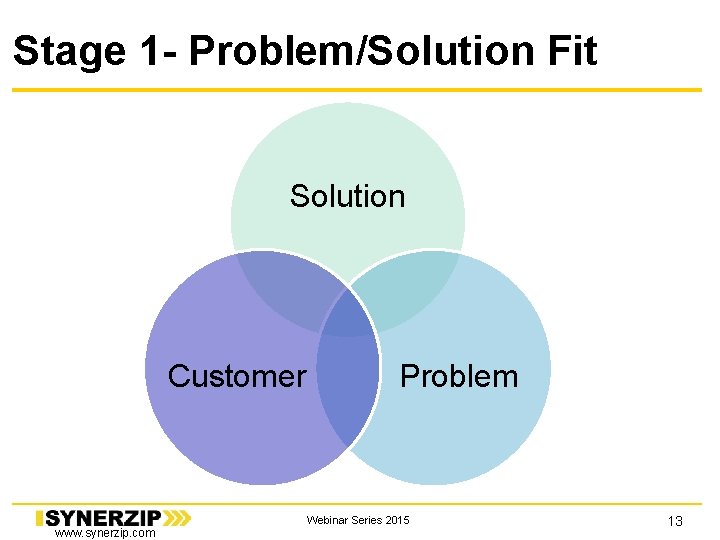
Stage 1 - Problem/Solution Fit Solution Customer www. synerzip. com Problem Webinar Series 2015 13
Starting Out Stage 1 • Uncertainty • Inability to commit resources • Need to release quickly and get buy-in from customers www. synerzip. com Webinar Series 2015 14
Define MVP Stage 1 Build a Restaurant rating and discovery web app • Logged in users can add restaurants • Logged in users can rate restaurants • Users can search for restaurants by rating • Get started with 1 full stack JS developer www. synerzip. com Webinar Series 2015 15
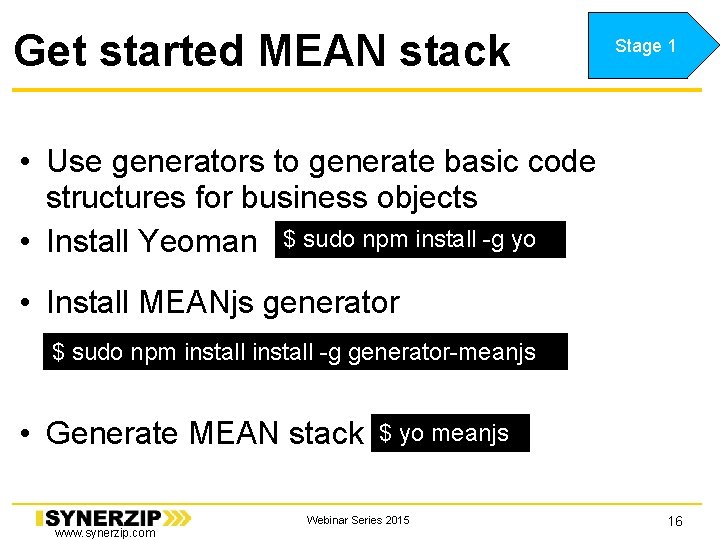
Get started MEAN stack Stage 1 • Use generators to generate basic code structures for business objects • Install Yeoman $ sudo npm install -g yo • Install MEANjs generator $ sudo npm install -g generator-meanjs • Generate MEAN stack www. synerzip. com $ yo meanjs Webinar Series 2015 16
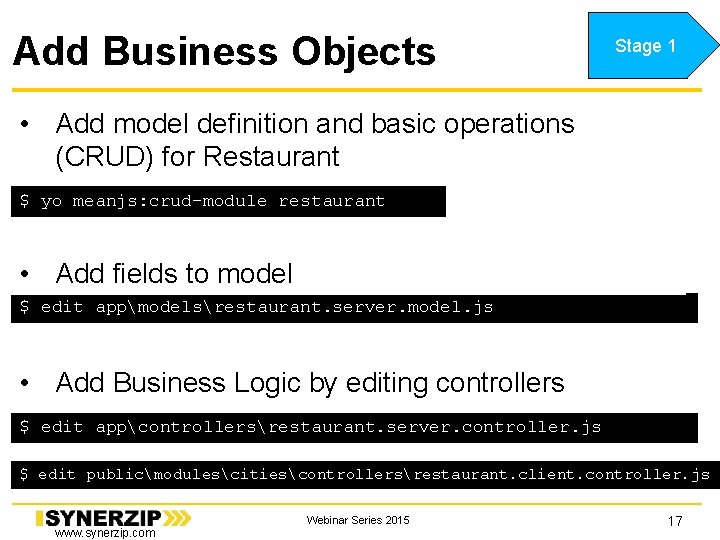
Add Business Objects Stage 1 • Add model definition and basic operations (CRUD) for Restaurant $ yo meanjs: crud-module restaurant • Add fields to model $ edit appmodelsrestaurant. server. model. js • Add Business Logic by editing controllers $ edit appcontrollersrestaurant. server. controller. js $ edit publicmodulescitiescontrollersrestaurant. client. controller. js www. synerzip. com Webinar Series 2015 17
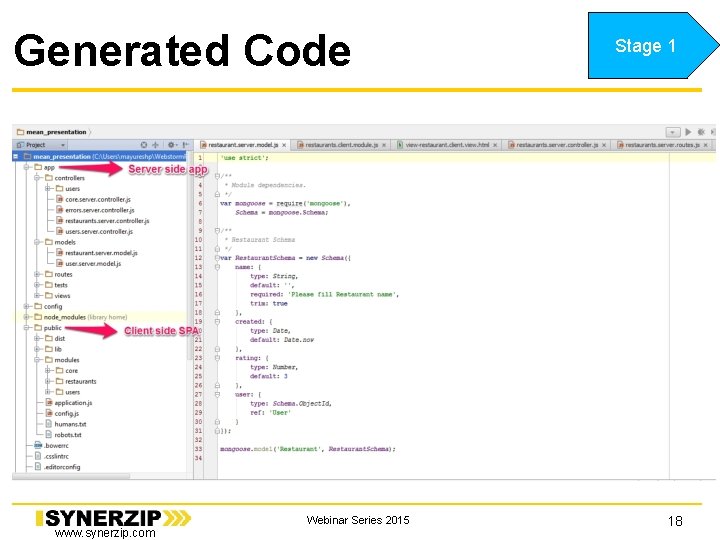
Generated Code www. synerzip. com Webinar Series 2015 Stage 1 18
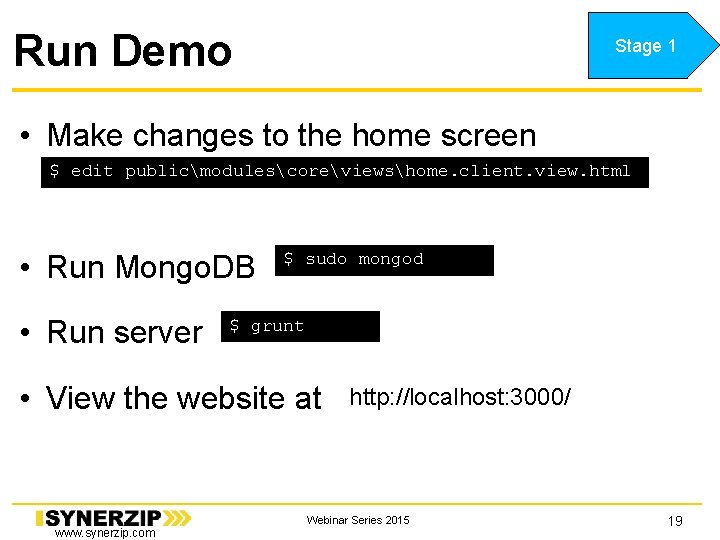
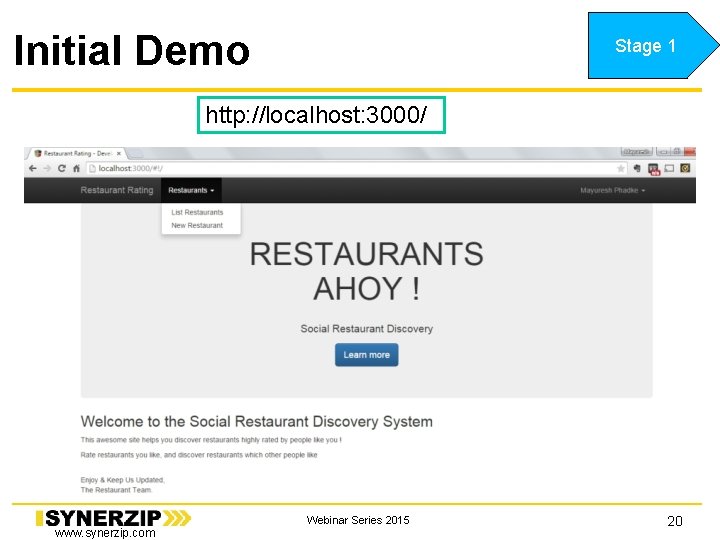
Run Demo Stage 1 • Make changes to the home screen $ edit publicmodulescoreviewshome. client. view. html • Run Mongo. DB • Run server $ sudo mongod $ grunt • View the website at www. synerzip. com http: //localhost: 3000/ Webinar Series 2015 19
Initial Demo Stage 1 http: //localhost: 3000/ www. synerzip. com Webinar Series 2015 20
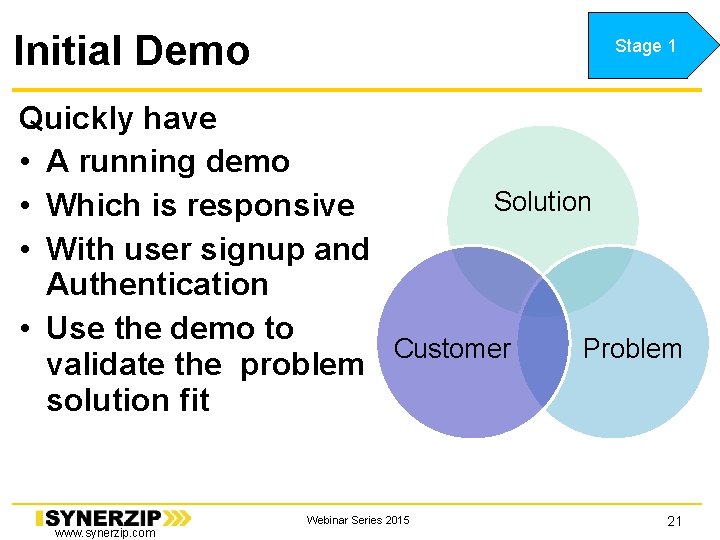
Initial Demo Stage 1 Quickly have • A running demo Solution • Which is responsive • With user signup and Authentication • Use the demo to Customer Problem validate the problem solution fit www. synerzip. com Webinar Series 2015 21
Stage 2 – Product Market Fit • Do metrics based quantitative research by exposing a minimum viable product to determine a set of features that delivers value to a set of customers • Change product features depending on customer feedback and take the modified product to customers quickly www. synerzip. com Webinar Series 2015 22
Build Iteratively Stage 2 Ideas Learn Build Data Code Measure www. synerzip. com Webinar Series 2015 23
Changes from Feedback Stage 2 • Customers like the concept • Users want to discover restaurants in close vicinity • Feedback from demos indicate that geolocation should be added to restaurants, to be able to find nearestaurants www. synerzip. com Webinar Series 2015 24
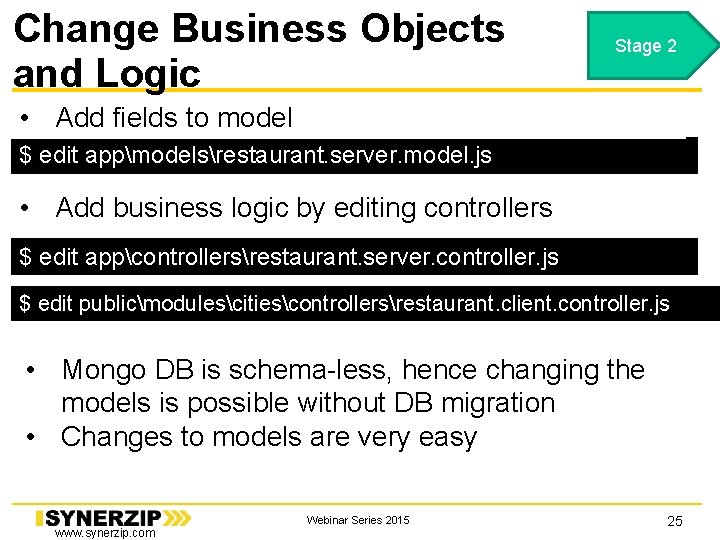
Change Business Objects and Logic Stage 2 • Add fields to model $ edit appmodelsrestaurant. server. model. js • Add business logic by editing controllers $ edit appcontrollersrestaurant. server. controller. js $ edit publicmodulescitiescontrollersrestaurant. client. controller. js • Mongo DB is schema-less, hence changing the models is possible without DB migration • Changes to models are very easy www. synerzip. com Webinar Series 2015 25
Changes from Feedback Stage 2 • Geolocation could be easily added • The business logic around geolocation is updated • The time and effort to integrate feedback and to iterate through the Build – Demo – Feedback loop is minimal www. synerzip. com Webinar Series 2015 26
Iterate Stage 2 • Keep building new features • Change features • Remove unrequired Get to a set of features which deliver value to a set of customers www. synerzip. com Webinar Series 2015 27
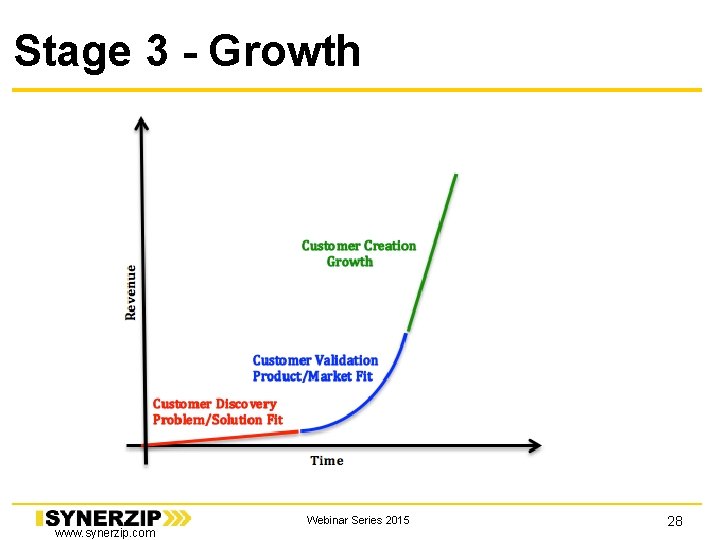
Stage 3 - Growth Minimize total time through the loop www. synerzip. com Webinar Series 2015 28
Readying for Growth Stage 3 • Once a product market fit is achieved, the aim would be to grow the customer base through various means • Growing the customer base means the tech stack needs to be ready to handle the growth • This includes automated tests, continuous integration, easy deployments, and scaling the server www. synerzip. com Webinar Series 2015 29
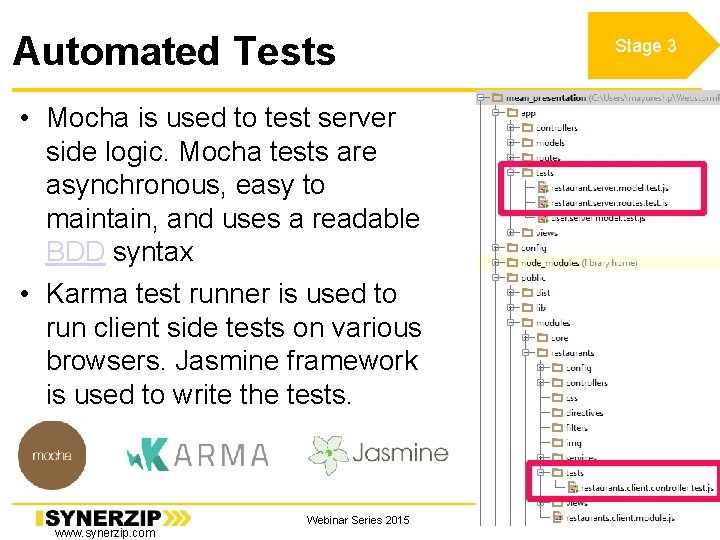
Automated Tests Stage 3 • Mocha is used to test server side logic. Mocha tests are asynchronous, easy to maintain, and uses a readable BDD syntax • Karma test runner is used to run client side tests on various browsers. Jasmine framework is used to write the tests. www. synerzip. com Webinar Series 2015 30
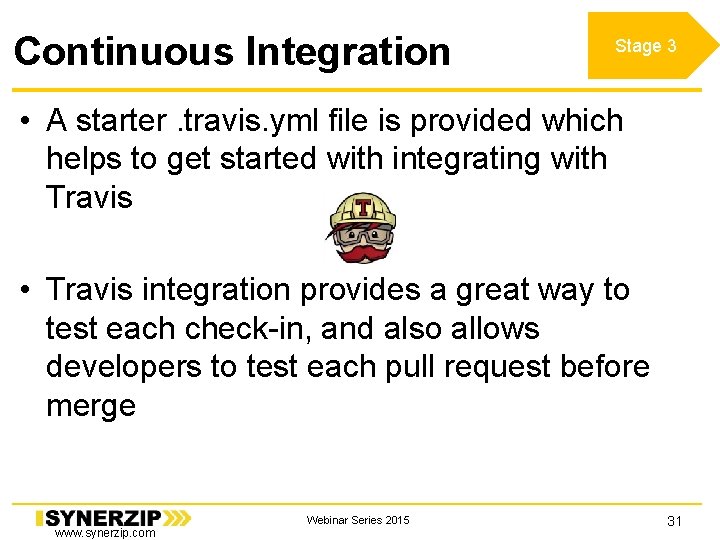
Continuous Integration Stage 3 • A starter. travis. yml file is provided which helps to get started with integrating with Travis • Travis integration provides a great way to test each check-in, and also allows developers to test each pull request before merge www. synerzip. com Webinar Series 2015 31
Deployment Stage 3 • Meanjs provides starter files to deploy on – Dockerfile, fig. yml – Heroku – Procfile • These can be used to deploy on a public facing server, enabling to get to customers faster www. synerzip. com Webinar Series 2015 32
Code Maintainability Stage 3 As the code base grows, separation of concerns between functionality as follows – Client • Controllers • Services – Server • Models • Controllers allows different set of developers to work on separate directories and allows parallel development. www. synerzip. com Webinar Series 2015 33
Scaling the server Stage 3 • Node. js provides asynchronous, nonblocking I/O. This allows node to serve a large number of simultaneous requests to the server • Mongo. DB is proven to scale for large size of data as well as large number of I/O operations • Both these technologies help the MEAN stack to scale with the user growth www. synerzip. com Webinar Series 2015 34
MEAN Drawbacks • Opinionated stack – directory structure and technology choices are pre-decided. • If any component is changed, the advantage of auto-generating code and using the standard config files is lost. • Server side code in Node. js can become very complex if not written properly leading to callback hell. www. synerzip. com Webinar Series 2015 35
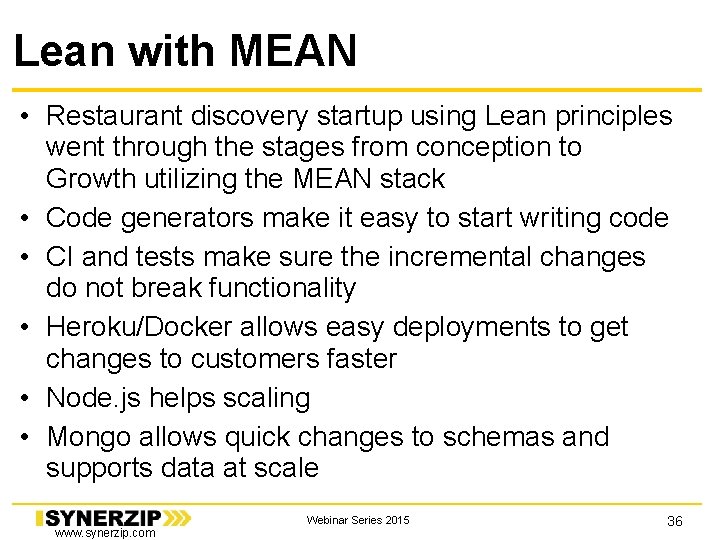
Lean with MEAN • Restaurant discovery startup using Lean principles went through the stages from conception to Growth utilizing the MEAN stack • Code generators make it easy to start writing code • CI and tests make sure the incremental changes do not break functionality • Heroku/Docker allows easy deployments to get changes to customers faster • Node. js helps scaling • Mongo allows quick changes to schemas and supports data at scale www. synerzip. com Webinar Series 2015 36
Lean with MEAN stack is a good candidate as a tech stack for a Lean startup www. synerzip. com Webinar Series 2015 37
Q&A www. synerzip. com Webinar Series 2015 38
www. synerzip. com Hemant Elhence hemant@synerzip. com 469. 374. 0500 www. synerzip. com Webinar Series 2015 39 84 39 •
Synerzip in a Nutshell • Software product development partner for small/mid-sized technology companies – – – • Dedicated team of high caliber software professionals for each client – – – • Seamlessly extends client’s local team, offering full transparency Stable teams with very low turn-over NOT just “staff augmentation”, but provide full mgmt support Actually reduces risk of development/delivery – – • • Exclusive focus on small/mid-sized technology companies, typically venturebacked companies in growth phase By definition, all Synerzip work is the IP of its respective clients Deep experience in full SDLC – design, dev, QA/testing, deployment Experienced team - uses appropriate level of engineering discipline Practices Agile development – responsive, yet disciplined Reduces cost – dual-shore team, 50% cost advantage Offers long term flexibility – allows (facilitates) taking offshore team captive – aka “BOT” option www. synerzip. com Webinar Series 2015 40
Our Clients www. synerzip. com Webinar Series 2015 41
Next Webinar Team Ownership: How Do We Make It Happen Complimentary Webinar: Wednesday, June 17, 2015 @ Noon CST Presented by: Pollyanna Pixton Author and Principal, Accelinnova www. synerzip. com Webinar Series 2015 42
Thanks! Call for a Free Consultation! Ashish Shanker ashish. shanker@synerzip. com 469. 374. 0500 linkedin. com/company/synerzip @Synerzip_Agile facebook. com/Synerzip www. synerzip. com Webinar Series 2015 43