P 3 Power Point Topic 1 Radiation in



- Slides: 144
P 3 Power. Point
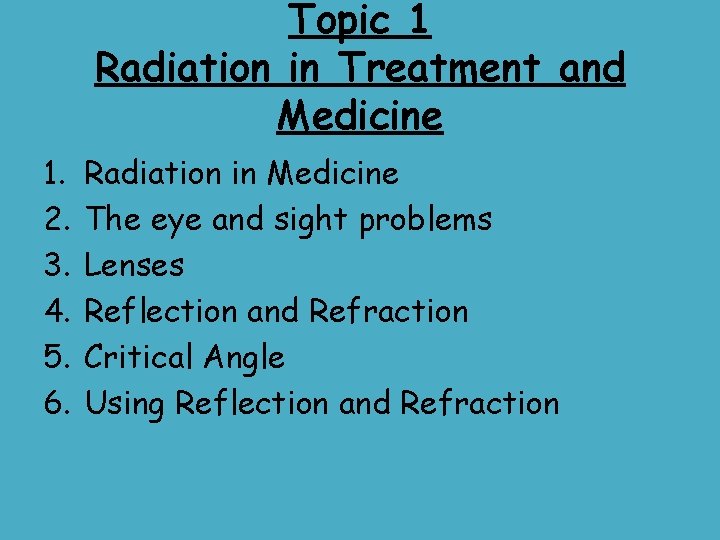
Topic 1 Radiation in Treatment and Medicine 1. 2. 3. 4. 5. 6. Radiation in Medicine The eye and sight problems Lenses Reflection and Refraction Critical Angle Using Reflection and Refraction
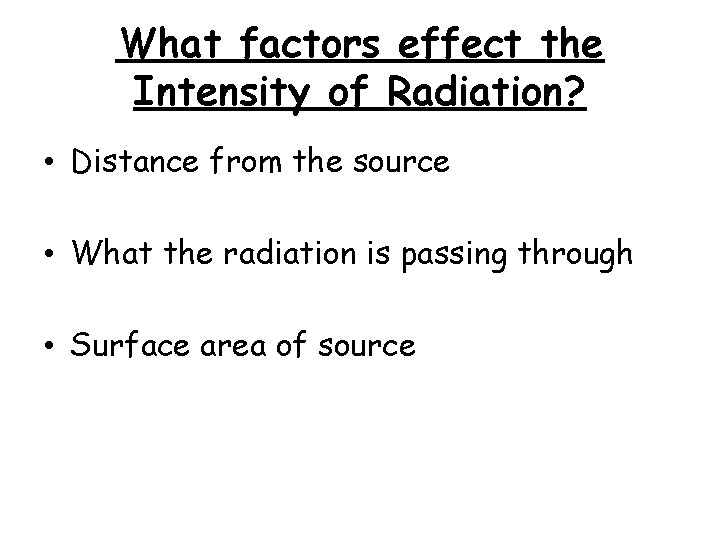
What factors effect the Intensity of Radiation? • Distance from the source • What the radiation is passing through • Surface area of source
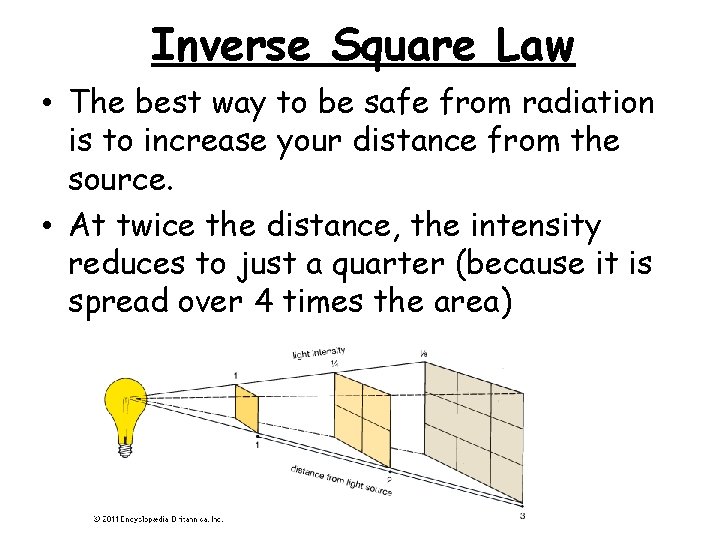
Inverse Square Law • The best way to be safe from radiation is to increase your distance from the source. • At twice the distance, the intensity reduces to just a quarter (because it is spread over 4 times the area)
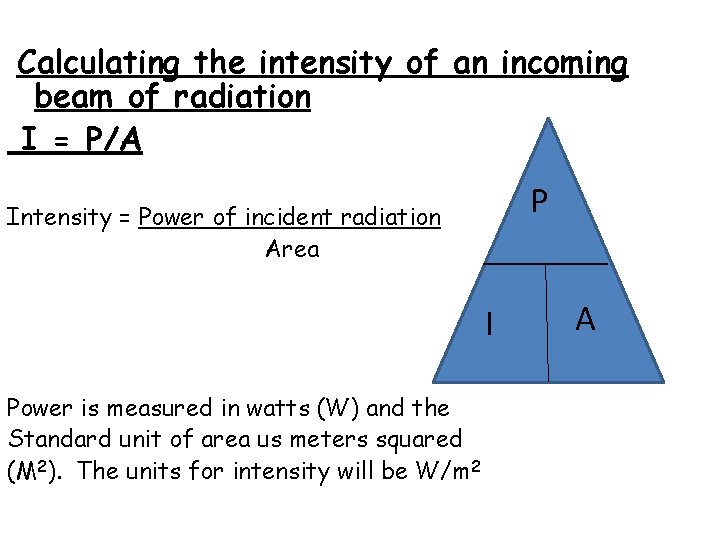
Calculating the intensity of an incoming beam of radiation I = P/A P Intensity = Power of incident radiation Area I Power is measured in watts (W) and the Standard unit of area us meters squared (M 2). The units for intensity will be W/m 2 A
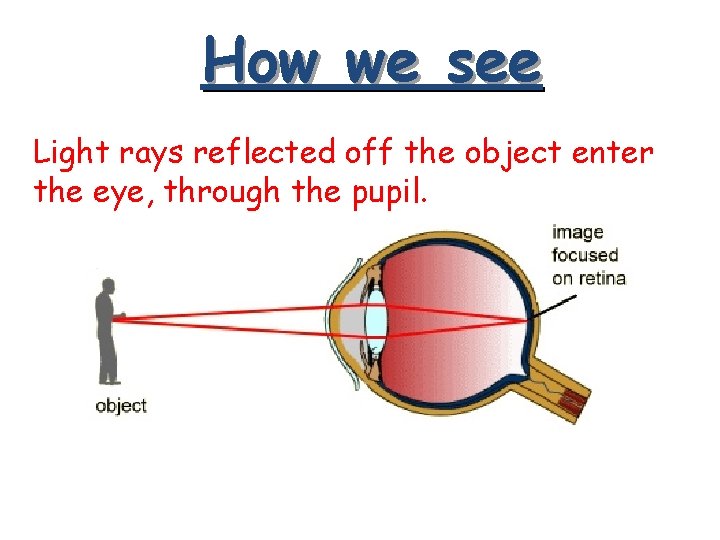
How we see Light rays reflected off the object enter the eye, through the pupil. The light rays are refracted (bent) by the lens and the image is focused on the retina.
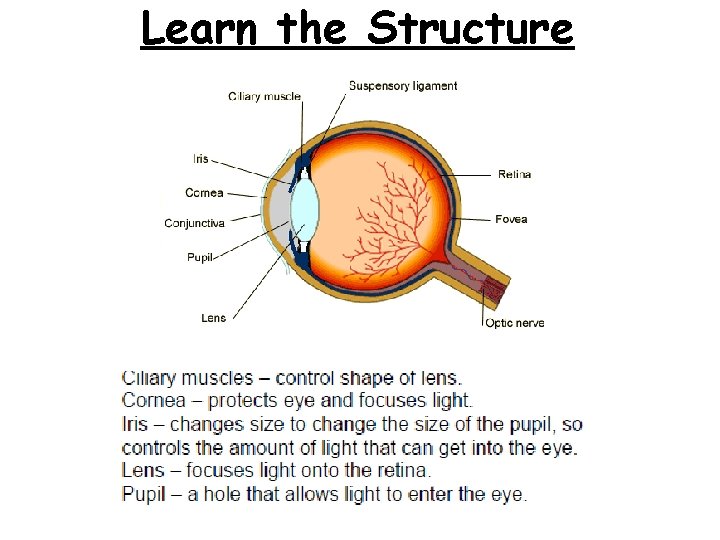
Learn the Structure
Near and Far Points • The far point is the furthest distance that the eye can focus comfortably (infinity). • The near point is the closest distance that they eye can focus on (about 25 cm)
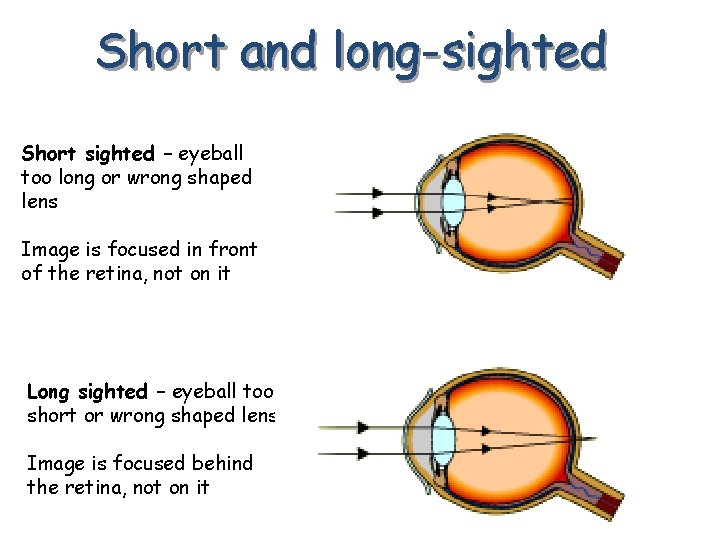
Eye Defects • Short sighted people cant focus on distant objects. Draw a diagram to demonstrate this. Extra- Explain what causes this defect. • Long sighted people can’t focus on things close up. Draw a diagram to demonstrate this. Extra- Explain what causes this defect.
Short and long-sighted Short sighted – eyeball too long or wrong shaped lens Image is focused in front of the retina, not on it Long sighted – eyeball too short or wrong shaped lens Image is focused behind the retina, not on it
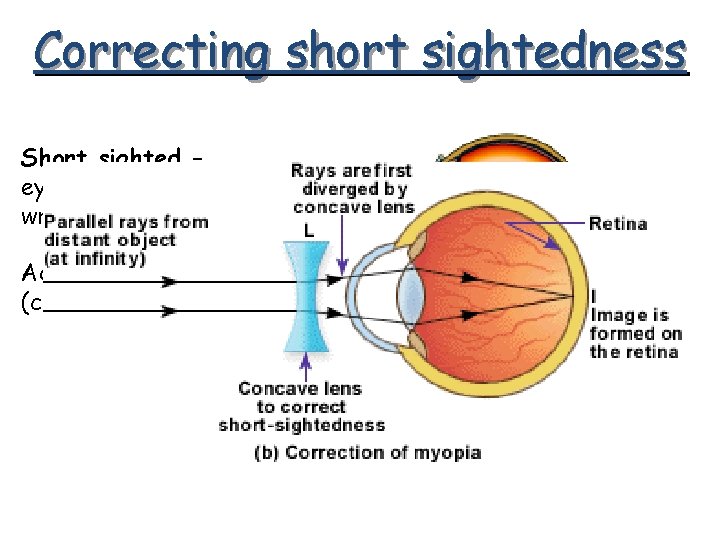
Correcting short sightedness Short sighted – eyeball too long or wrong shaped lens Add a concave lens (caved inwards)
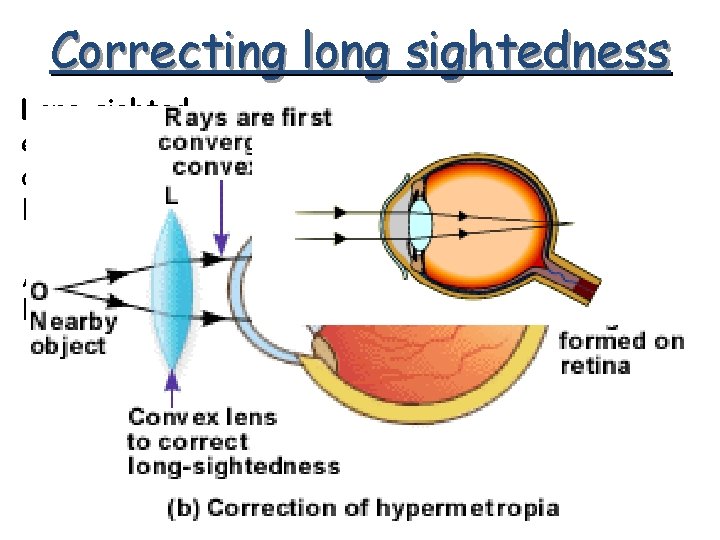
Correcting long sightedness Long sighted – eyeball too short or wrong shaped lens Add a convex lens
Correcting Eye Problems Summary • Short Sightedness- Concave (diverging lens) • Long Sightedness- Convex (converging lens) • Laser eye surgery can be used as a permanent alternative to wearing glasses or contact lenses. • However it can be painful for a few days, and there is a possibility of infection. • Laser eye surgery changes the shape of the cornea, which can correct mild eye defects.
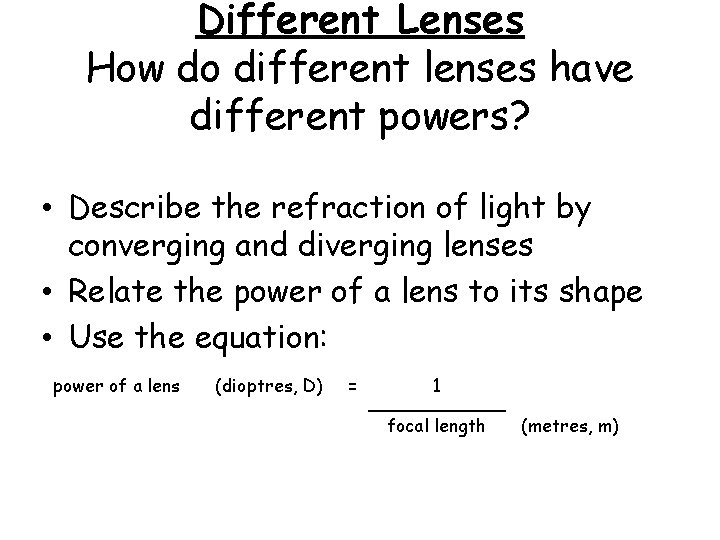
Different Lenses How do different lenses have different powers? • Describe the refraction of light by converging and diverging lenses • Relate the power of a lens to its shape • Use the equation: power of a lens (dioptres, D) = 1 focal length (metres, m)
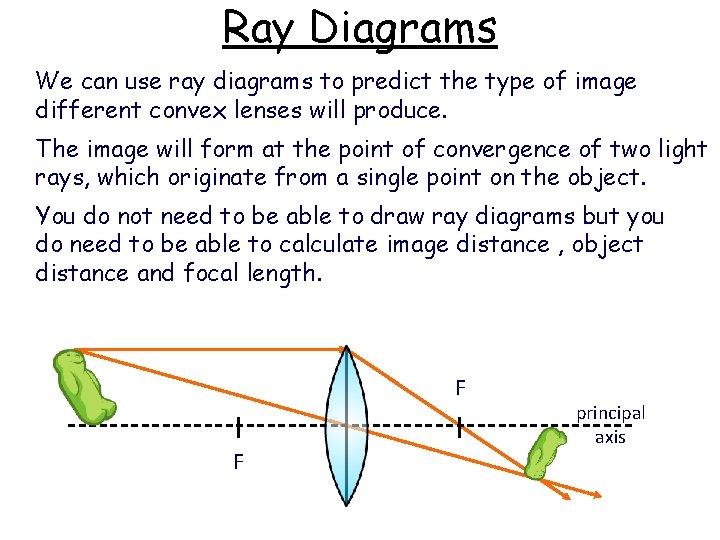
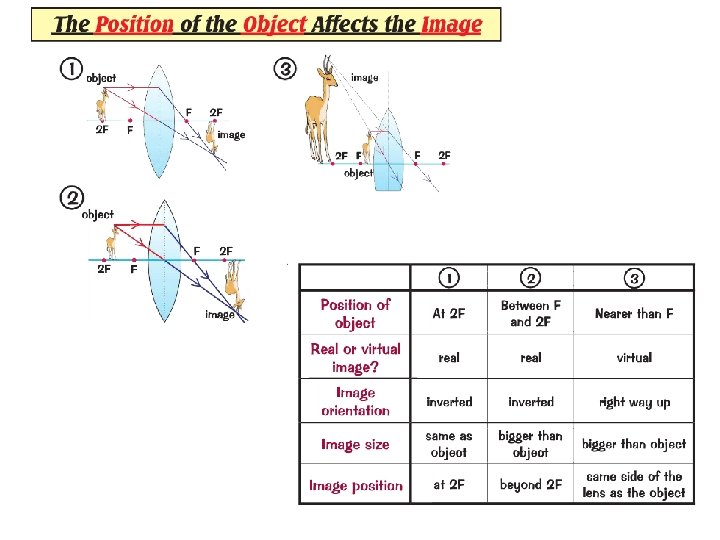
Ray Diagrams We can use ray diagrams to predict the type of image different convex lenses will produce. The image will form at the point of convergence of two light rays, which originate from a single point on the object. You do not need to be able to draw ray diagrams but you do need to be able to calculate image distance , object distance and focal length. F F principal axis
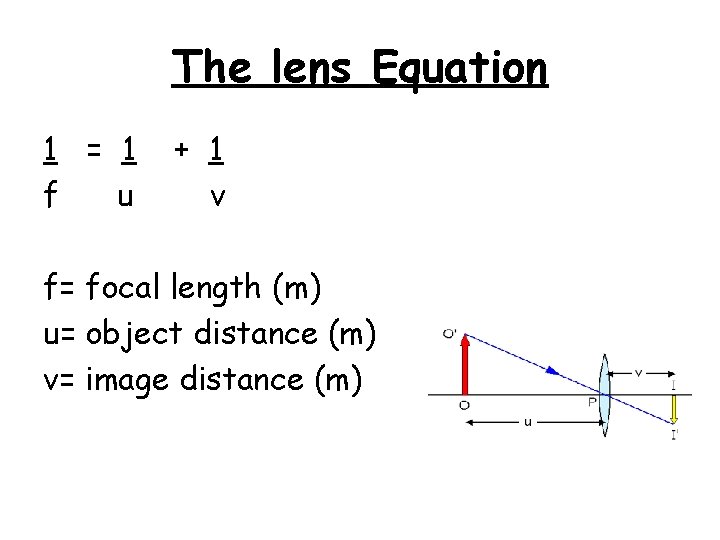
The lens Equation 1 = 1 f u + 1 v f= focal length (m) u= object distance (m) v= image distance (m)
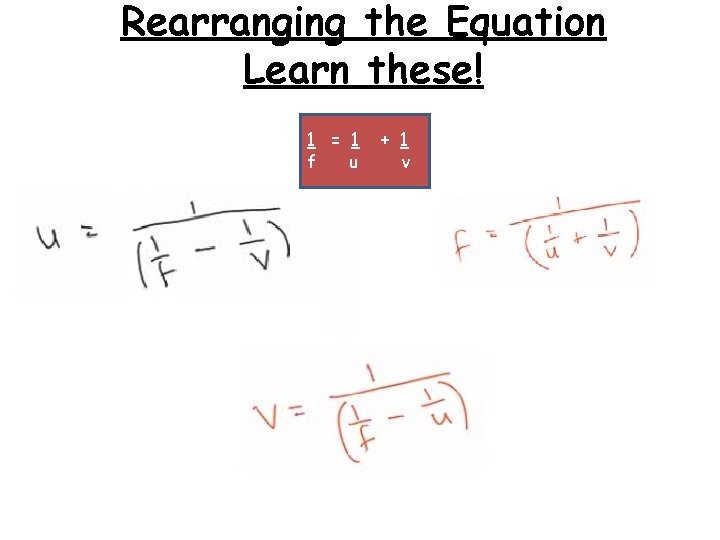
Rearranging the Equation Learn these! 1 = 1 f u + 1 v
Image distance. . Positive or negative? • A real image will have a positive value (converging image). • A virtual image will have a negative value (diverging and can also be a converging lens). • How can a converging lens produce a virtual image?
Focal Length • The focal length can also be a positive or negative value. • Converging lenses- positive focal length • Diverging lenses- negative focal length
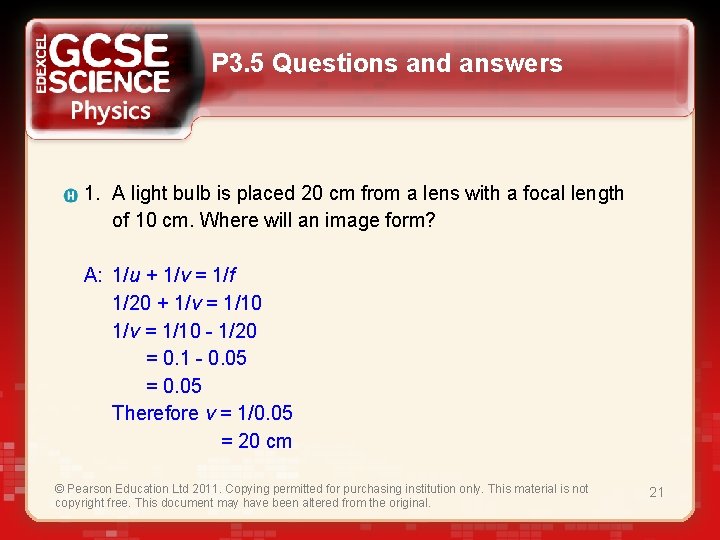
P 3. 5 Questions and answers 1. A light bulb is placed 20 cm from a lens with a focal length of 10 cm. Where will an image form? A: 1/u + 1/v = 1/f 1/20 + 1/v = 1/10 - 1/20 = 0. 1 - 0. 05 = 0. 05 Therefore v = 1/0. 05 = 20 cm © Pearson Education Ltd 2011. Copying permitted for purchasing institution only. This material is not copyright free. This document may have been altered from the original. 21
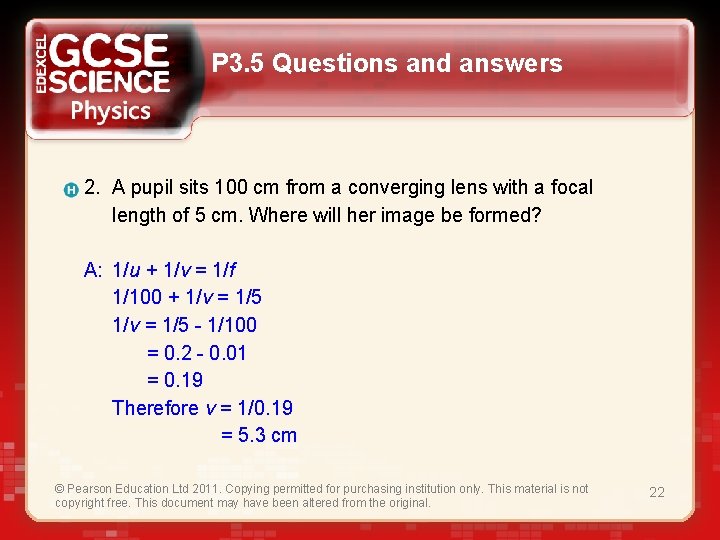
P 3. 5 Questions and answers 2. A pupil sits 100 cm from a converging lens with a focal length of 5 cm. Where will her image be formed? A: 1/u + 1/v = 1/f 1/100 + 1/v = 1/5 - 1/100 = 0. 2 - 0. 01 = 0. 19 Therefore v = 1/0. 19 = 5. 3 cm © Pearson Education Ltd 2011. Copying permitted for purchasing institution only. This material is not copyright free. This document may have been altered from the original. 22
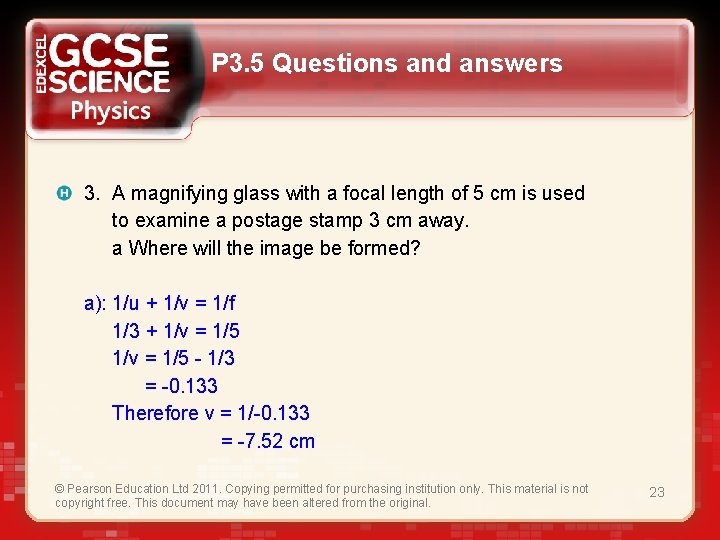
P 3. 5 Questions and answers 3. A magnifying glass with a focal length of 5 cm is used to examine a postage stamp 3 cm away. a Where will the image be formed? a): 1/u + 1/v = 1/f 1/3 + 1/v = 1/5 - 1/3 = -0. 133 Therefore v = 1/-0. 133 = -7. 52 cm © Pearson Education Ltd 2011. Copying permitted for purchasing institution only. This material is not copyright free. This document may have been altered from the original. 23
P 3. 5 Questions and answers b) What indicates the image is virtual? A: it has a negative value © Pearson Education Ltd 2011. Copying permitted for purchasing institution only. This material is not copyright free. This document may have been altered from the original. 24
P 3. 5 Questions and answers 4. A converging lens can be used on a sunny day to focus the Sun’s rays onto paper. Explain how this is possible. A: The lens makes the parallel rays from the sun converge. If the paper is at the focal point of the lens the energy will be concentrated here. © Pearson Education Ltd 2011. Copying permitted for purchasing institution only. This material is not copyright free. This document may have been altered from the original. 25
Reflection and Refraction • Before looking at the P 3 content it is worth reminding your self P 1 reflection and refraction. 26
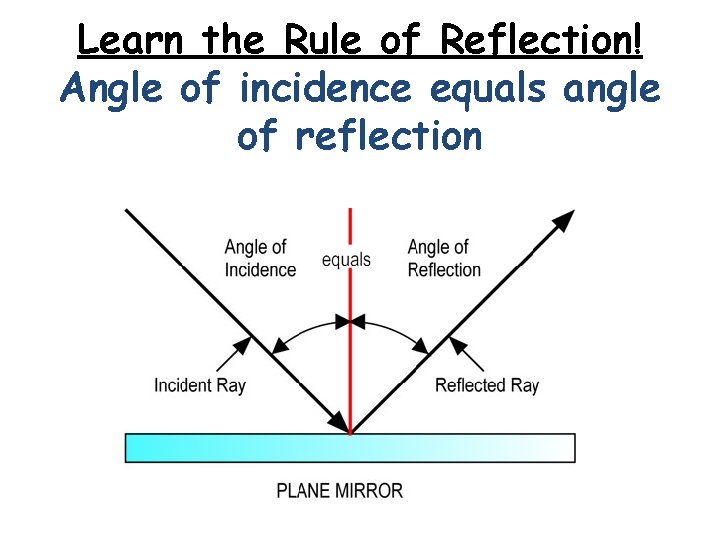
Learn the Rule of Reflection! Angle of incidence equals angle of reflection
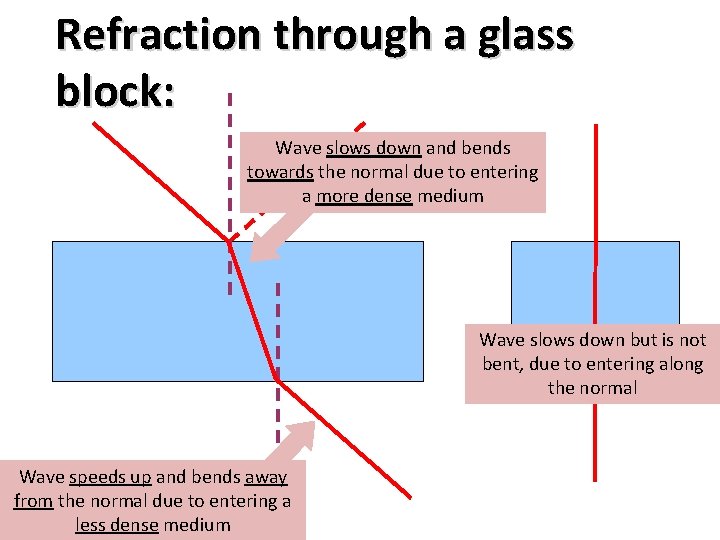
Refraction through a glass block: Wave slows down and bends towards the normal due to entering a more dense medium Wave slows down but is not bent, due to entering along the normal Wave speeds up and bends away from the normal due to entering a 27/02/2021 less dense medium
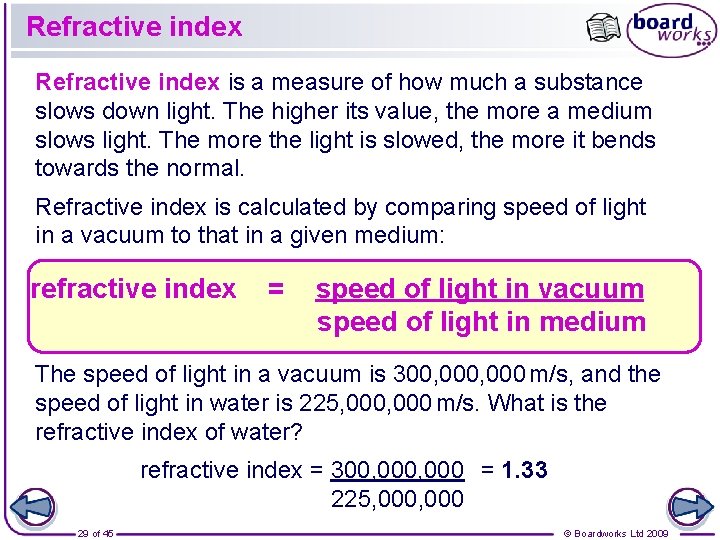
Refractive index is a measure of how much a substance slows down light. The higher its value, the more a medium slows light. The more the light is slowed, the more it bends towards the normal. Refractive index is calculated by comparing speed of light in a vacuum to that in a given medium: refractive index = speed of light in vacuum speed of light in medium The speed of light in a vacuum is 300, 000 m/s, and the speed of light in water is 225, 000 m/s. What is the refractive index of water? refractive index = 300, 000 = 1. 33 225, 000 29 of 45 © Boardworks Ltd 2009
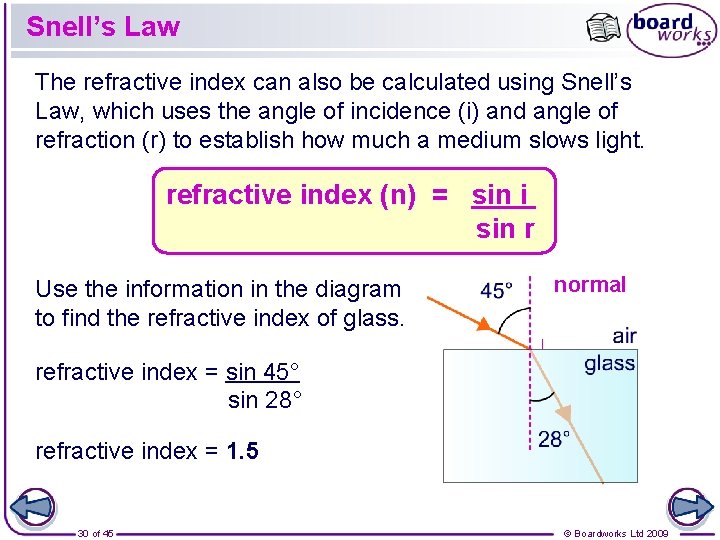
Snell’s Law The refractive index can also be calculated using Snell’s Law, which uses the angle of incidence (i) and angle of refraction (r) to establish how much a medium slows light. refractive index (n) = sin i sin r Use the information in the diagram to find the refractive index of glass. normal refractive index = sin 45° sin 28° refractive index = 1. 5 30 of 45 © Boardworks Ltd 2009
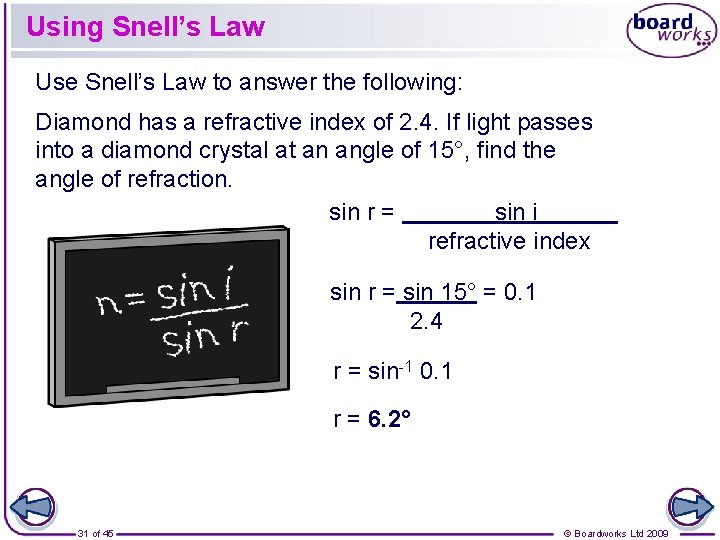
Using Snell’s Law Use Snell’s Law to answer the following: Diamond has a refractive index of 2. 4. If light passes into a diamond crystal at an angle of 15°, find the angle of refraction. sin r = sin i refractive index sin r = sin 15° = 0. 1 2. 4 r = sin-1 0. 1 r = 6. 2° 31 of 45 © Boardworks Ltd 2009
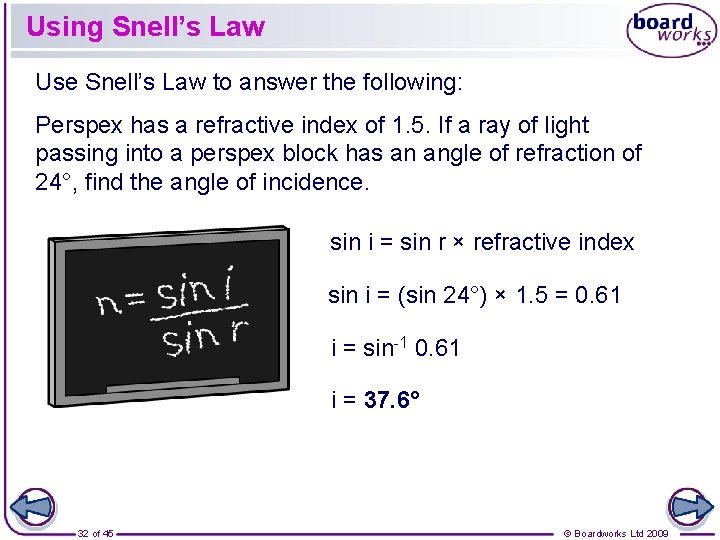
Using Snell’s Law Use Snell’s Law to answer the following: Perspex has a refractive index of 1. 5. If a ray of light passing into a perspex block has an angle of refraction of 24°, find the angle of incidence. sin i = sin r × refractive index sin i = (sin 24°) × 1. 5 = 0. 61 i = sin-1 0. 61 i = 37. 6° 32 of 45 © Boardworks Ltd 2009
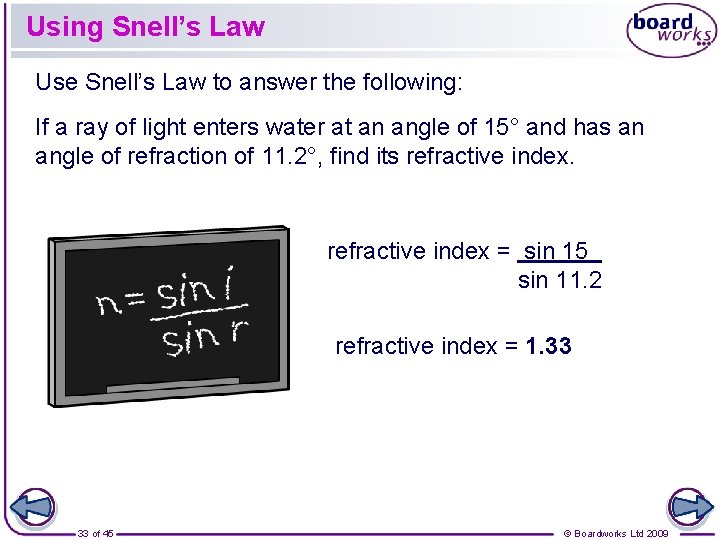
Using Snell’s Law Use Snell’s Law to answer the following: If a ray of light enters water at an angle of 15° and has an angle of refraction of 11. 2°, find its refractive index = sin 15 sin 11. 2 refractive index = 1. 33 33 of 45 © Boardworks Ltd 2009
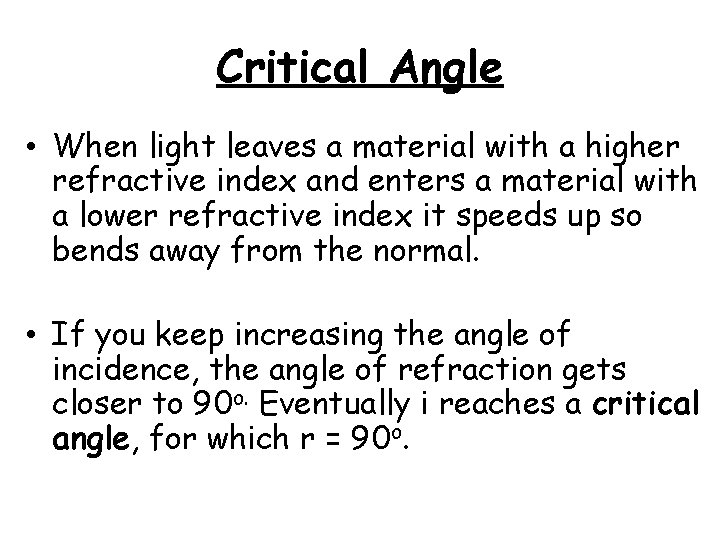
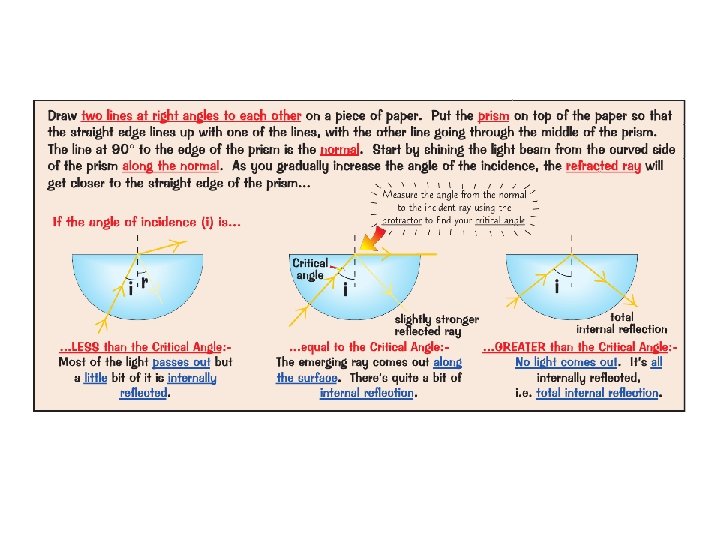
Critical Angle • When light leaves a material with a higher refractive index and enters a material with a lower refractive index it speeds up so bends away from the normal. • If you keep increasing the angle of incidence, the angle of refraction gets closer to 90 o. Eventually i reaches a critical angle, for which r = 90 o.
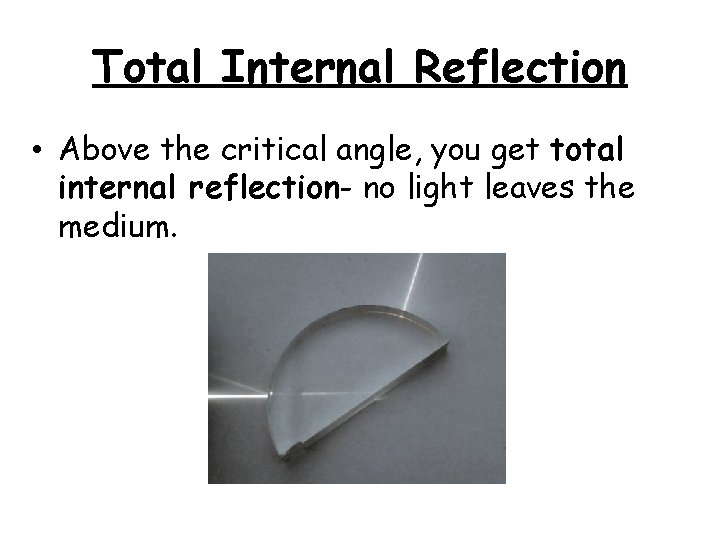
Total Internal Reflection • Above the critical angle, you get total internal reflection- no light leaves the medium.
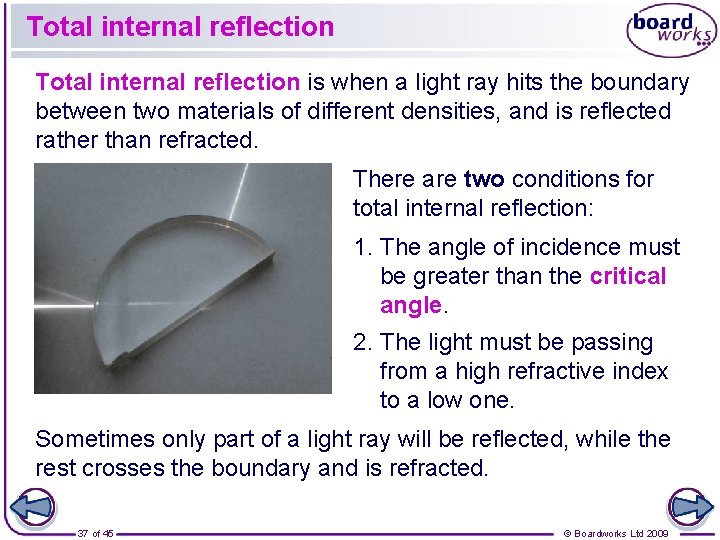
Total internal reflection is when a light ray hits the boundary between two materials of different densities, and is reflected rather than refracted. There are two conditions for total internal reflection: 1. The angle of incidence must be greater than the critical angle. 2. The light must be passing from a high refractive index to a low one. Sometimes only part of a light ray will be reflected, while the rest crosses the boundary and is refracted. 37 of 45 © Boardworks Ltd 2009
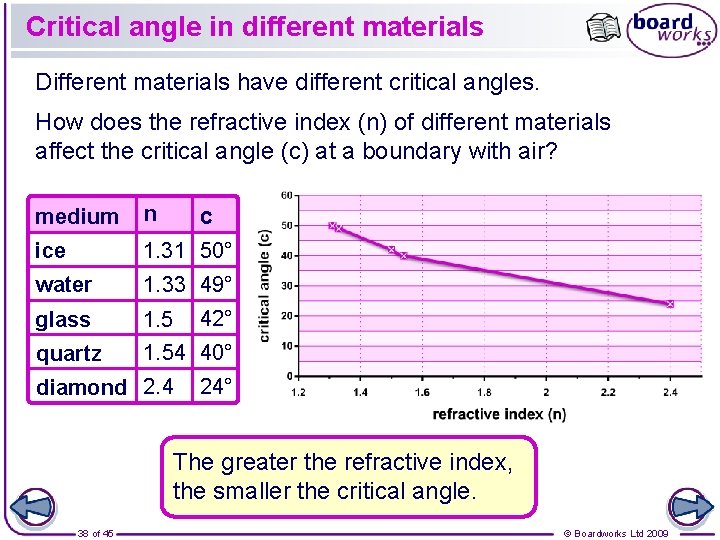
Critical angle in different materials Different materials have different critical angles. How does the refractive index (n) of different materials affect the critical angle (c) at a boundary with air? medium n ice 1. 31 50° water 1. 33 49° glass 1. 5 quartz 1. 54 40° c 42° diamond 2. 4 24° The greater the refractive index, the smaller the critical angle. 38 of 45 © Boardworks Ltd 2009
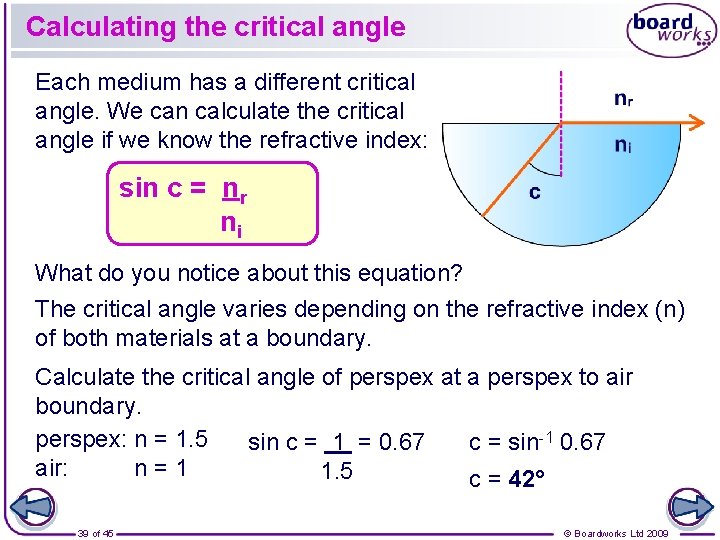
Calculating the critical angle Each medium has a different critical angle. We can calculate the critical angle if we know the refractive index: sin c = nr ni What do you notice about this equation? The critical angle varies depending on the refractive index (n) of both materials at a boundary. Calculate the critical angle of perspex at a perspex to air boundary. perspex: n = 1. 5 sin c = 1 = 0. 67 c = sin-1 0. 67 air: n=1 1. 5 c = 42° 39 of 45 © Boardworks Ltd 2009
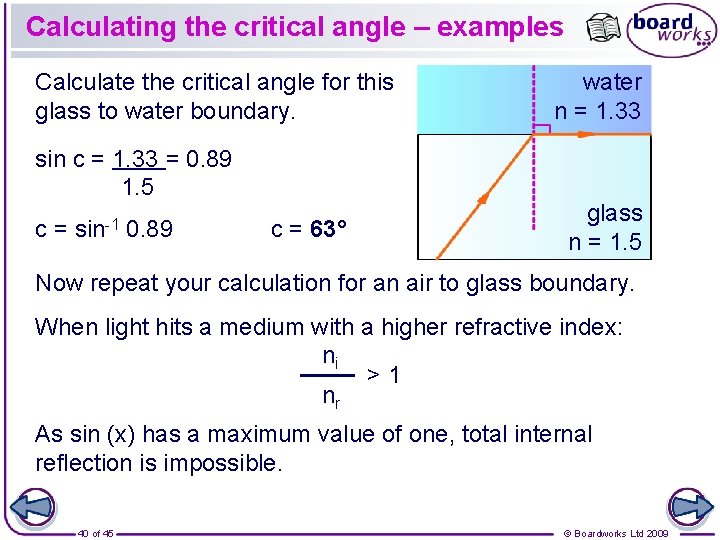
Calculating the critical angle – examples Calculate the critical angle for this glass to water boundary. sin c = 1. 33 = 0. 89 1. 5 c= sin-1 0. 89 c = 63° water n = 1. 33 glass n = 1. 5 Now repeat your calculation for an air to glass boundary. When light hits a medium with a higher refractive index: ni >1 nr As sin (x) has a maximum value of one, total internal reflection is impossible. 40 of 45 © Boardworks Ltd 2009
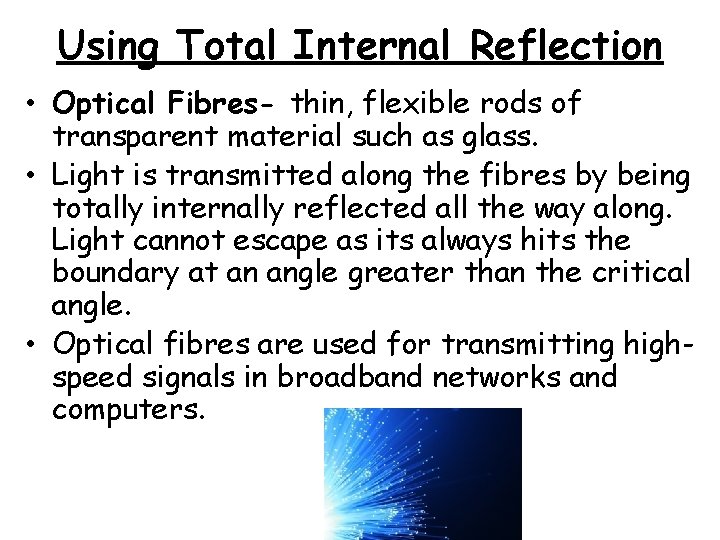
Using Total Internal Reflection • Optical Fibres- thin, flexible rods of transparent material such as glass. • Light is transmitted along the fibres by being totally internally reflected all the way along. Light cannot escape as its always hits the boundary at an angle greater than the critical angle. • Optical fibres are used for transmitting highspeed signals in broadband networks and computers.
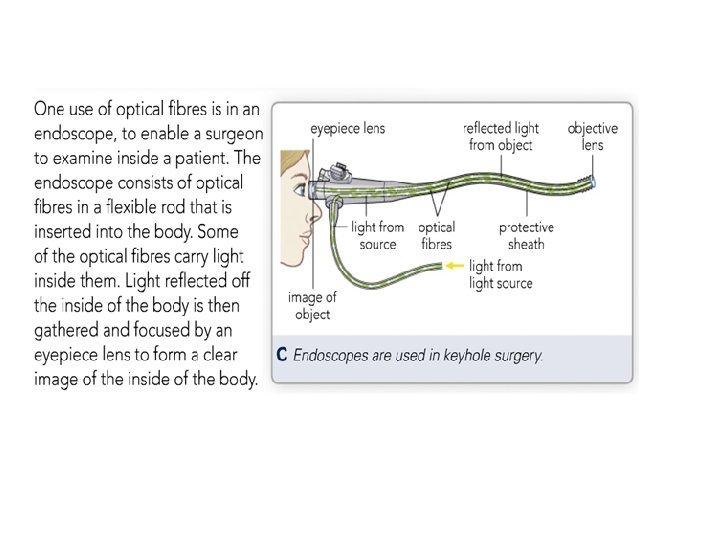
Endoscopes • Medical instrument used to see inside the human body. It uses optical fibres and can be equipped with other surgical instruments to carry out keyhole surgery. • An endoscope uses two separate bundles of optical fibres: one to illuminate the inside of the patient and one to reflect the image back to an eyepiece or camera.
Ultrasound • Ultrasound can be linked to computers to produce 3 -d images. • Ultrasound is known ionising so its safer then xrays. • Inside out bodies the ultrasound will be reflected and refracted at boundaries between different types of tissue. • Ultrasound can be used to diagnose: cysts, tumours, blocked arteries, kidney stones, foetal abnormalities.
Ultrasound Treatment Removing Kidney and Bladder Stones • They are hard miner deposits which can cause blockages and severe pain. • Can be destroyed by using high frequency ultrasound • Pulses of ultrasound are focused onto the stones, and this high frequency vibration causes the stones to break up into smaller fragments which can easily pass out of the body naturally in the urine Physiotherapy • High frequency ultrasound in human tissue causes fluctuations in pressure, which leads to heating in the body • In physiotherapy ultrasound can be used to produce localised heating in damaged muscle tissue, increasing the rate of healing Risks • Very intense ultrasound can causes dissolved gases to form tiny bubbles in the blood. • When the bubbles collapse they can damage tissue in the body. • Medical uses of ultrasound always use low-intensity ultrasound.
Topic 2 X-rays and ECGs 1. X-rays 2. Using X-rays 3. ECGs and Pulse Oximetry
X- Rays/Thermionic Emission • Ionising radiation turns atoms into ions by removing some of their outer electrons. X-rays are a type of ionising radiation. • The ability of X-rays to ionise materials depends on their energy. This is related to their frequency. The higher the frequency, the higher the energy.
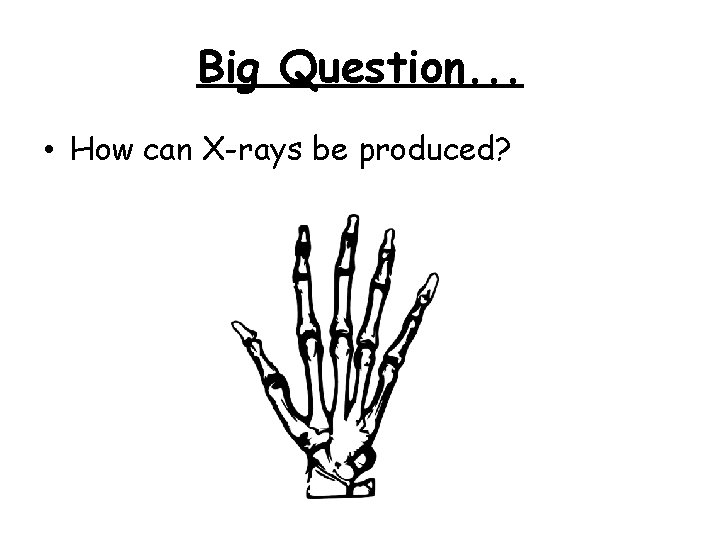
Big Question. . . • How can X-rays be produced?
Thermionic Emission https: //www. youtube. com/watch? v=Qh. G 7 u 9 PXG 88 Key terms- • Cathode -Negatively charged electrode • Anode -Positively charged electrode
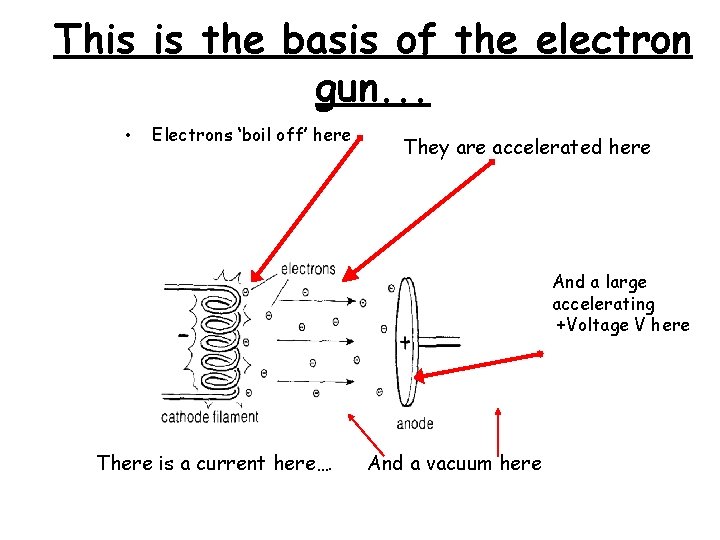
Thermionic Emission • A filament acts as a cathode. • When the filament is heated it gives more energy to the electrons. • Once they have enough energy they ‘boil off’
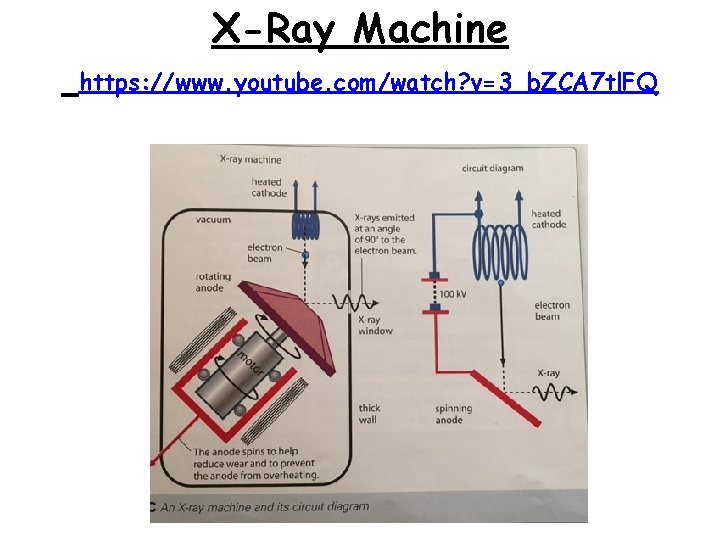
This is the basis of the electron gun. . . • Electrons ‘boil off’ here They are accelerated here And a large accelerating +Voltage V here There is a current here…. And a vacuum here
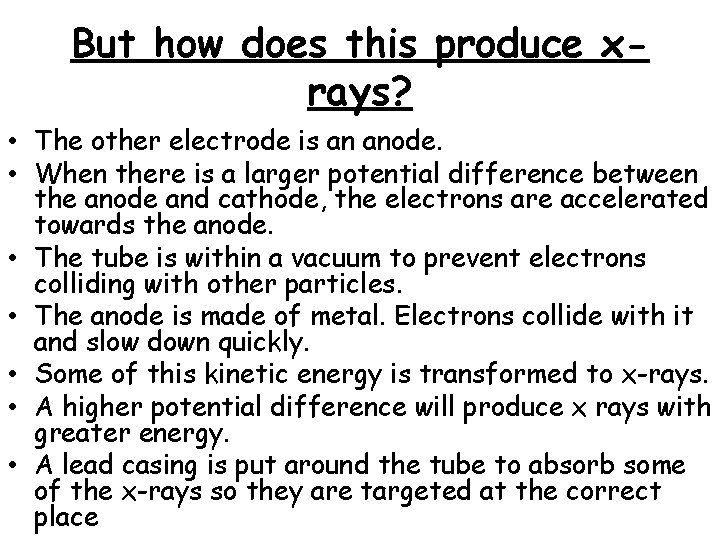
X-Ray Machine https: //www. youtube. com/watch? v=3_b. ZCA 7 tl. FQ
But how does this produce xrays? • The other electrode is an anode. • When there is a larger potential difference between the anode and cathode, the electrons are accelerated towards the anode. • The tube is within a vacuum to prevent electrons colliding with other particles. • The anode is made of metal. Electrons collide with it and slow down quickly. • Some of this kinetic energy is transformed to x-rays. • A higher potential difference will produce x rays with greater energy. • A lead casing is put around the tube to absorb some of the x-rays so they are targeted at the correct place
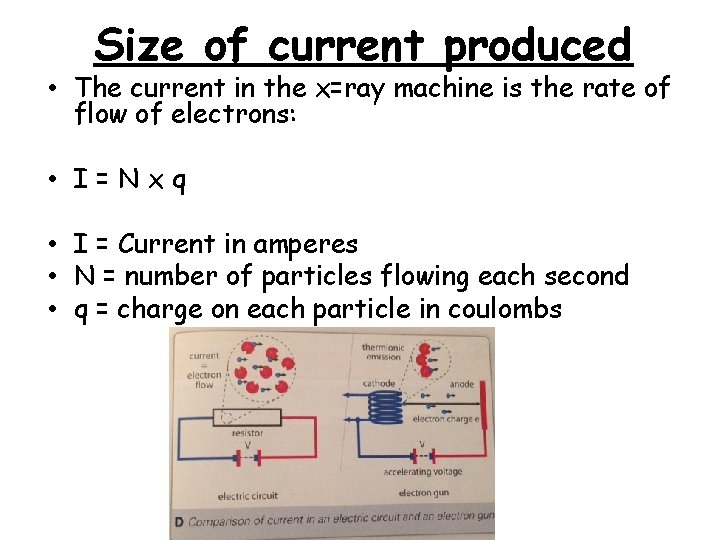
Size of current produced • The current in the x=ray machine is the rate of flow of electrons: • I=Nxq • I = Current in amperes • N = number of particles flowing each second • q = charge on each particle in coulombs
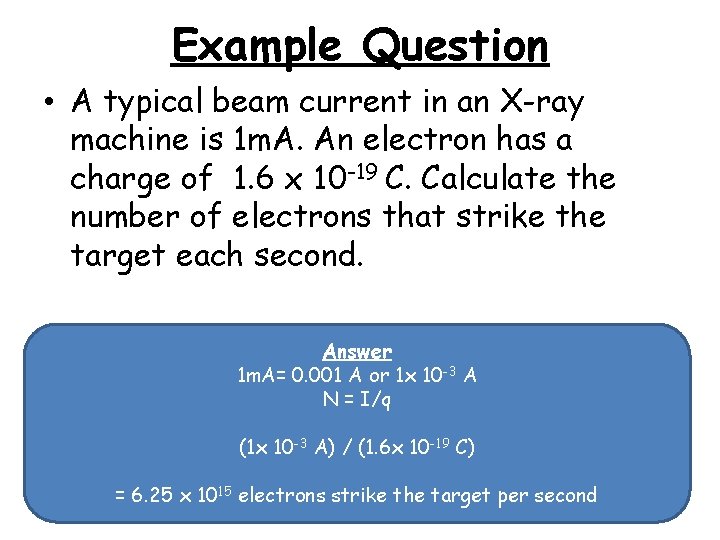
Example Question • A typical beam current in an X-ray machine is 1 m. A. An electron has a charge of 1. 6 x 10 -19 C. Calculate the number of electrons that strike the target each second. Answer 1 m. A= 0. 001 A or 1 x 10 -3 A N = I/q (1 x 10 -3 A) / (1. 6 x 10 -19 C) = 6. 25 x 1015 electrons strike the target per second
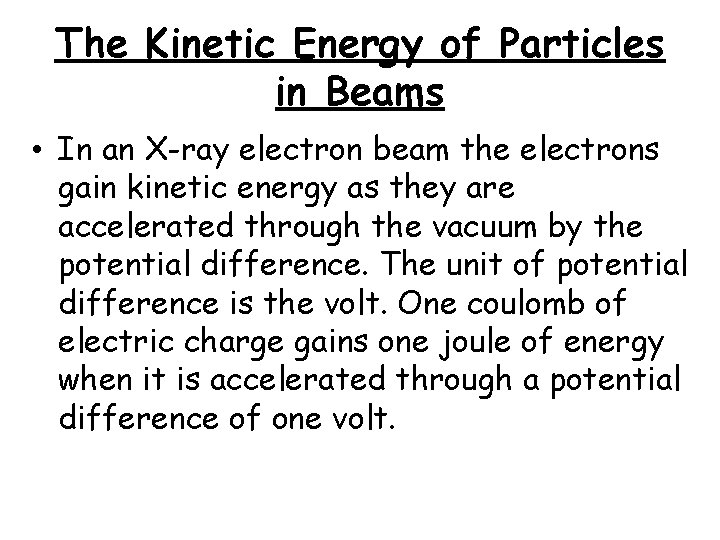
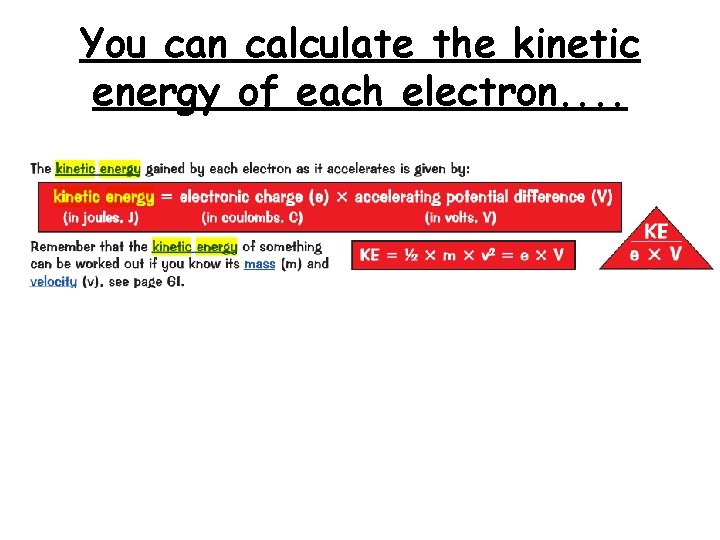
The Kinetic Energy of Particles in Beams • In an X-ray electron beam the electrons gain kinetic energy as they are accelerated through the vacuum by the potential difference. The unit of potential difference is the volt. One coulomb of electric charge gains one joule of energy when it is accelerated through a potential difference of one volt.
You can calculate the kinetic energy of each electron. .
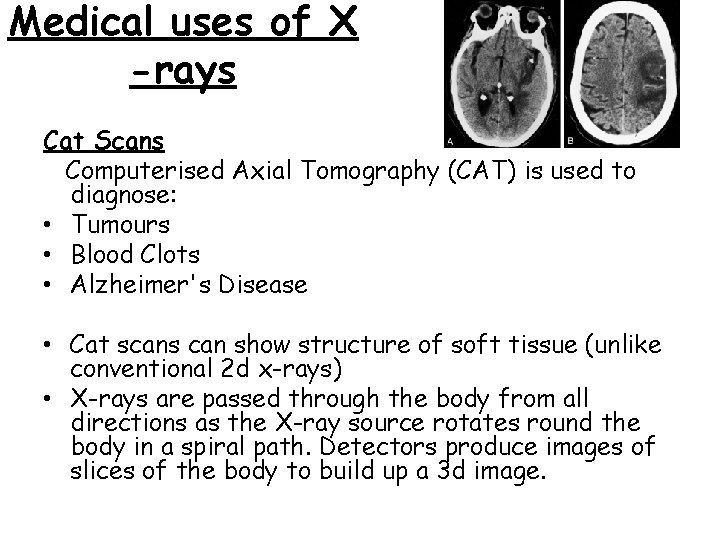
Medical uses of X -rays Cat Scans Computerised Axial Tomography (CAT) is used to diagnose: • Tumours • Blood Clots • Alzheimer's Disease • Cat scans can show structure of soft tissue (unlike conventional 2 d x-rays) • X-rays are passed through the body from all directions as the X-ray source rotates round the body in a spiral path. Detectors produce images of slices of the body to build up a 3 d image.
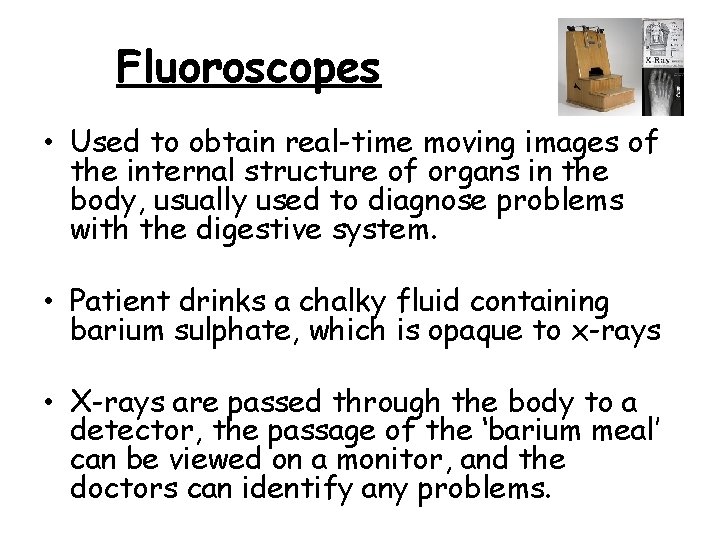
Fluoroscopes • Used to obtain real-time moving images of the internal structure of organs in the body, usually used to diagnose problems with the digestive system. • Patient drinks a chalky fluid containing barium sulphate, which is opaque to x-rays • X-rays are passed through the body to a detector, the passage of the ‘barium meal’ can be viewed on a monitor, and the doctors can identify any problems.
Using X-rays for treatment. . . • Radiotherapy is used for the treatment of cancer. • Intense x-ray or gamma radiation is directed at a tumour to destroy cancerous cells.
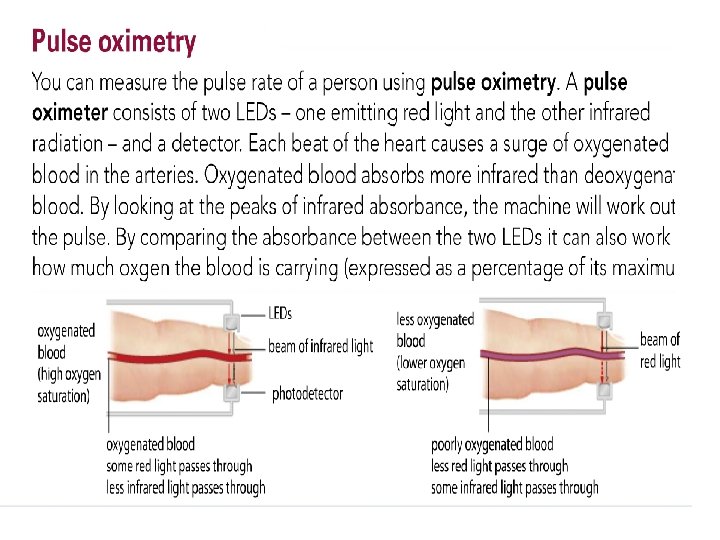
ECG’s and Pulse Oximetry
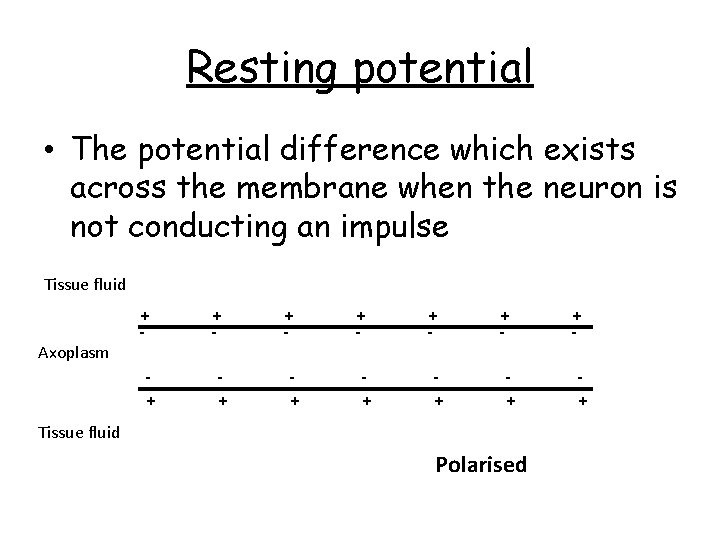
Resting potential • The potential difference which exists across the membrane when the neuron is not conducting an impulse Tissue fluid Axoplasm + + + Tissue fluid Polarised + +
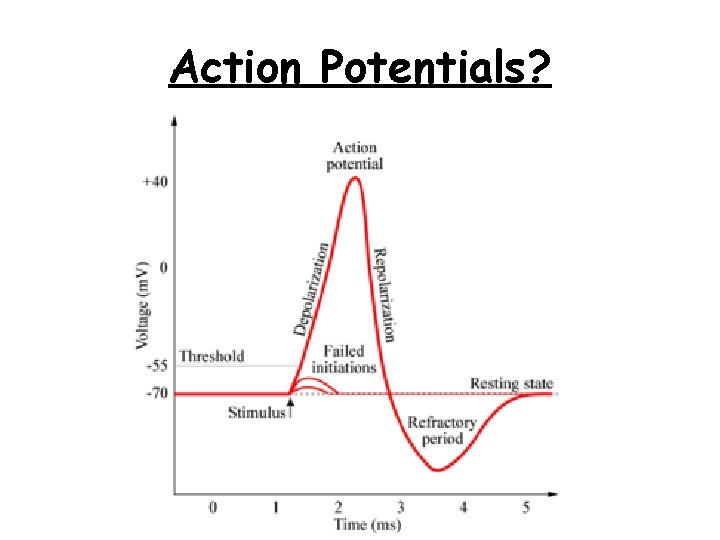
Action Potentials? • When a muscle cell is stimulated an electrical signal, the potential difference changes from -70 m. V to about +40 m. V. This increased potential is called an action potential. The action potential passes down the length of a cell, making the muscle cell contract.
Action Potentials?
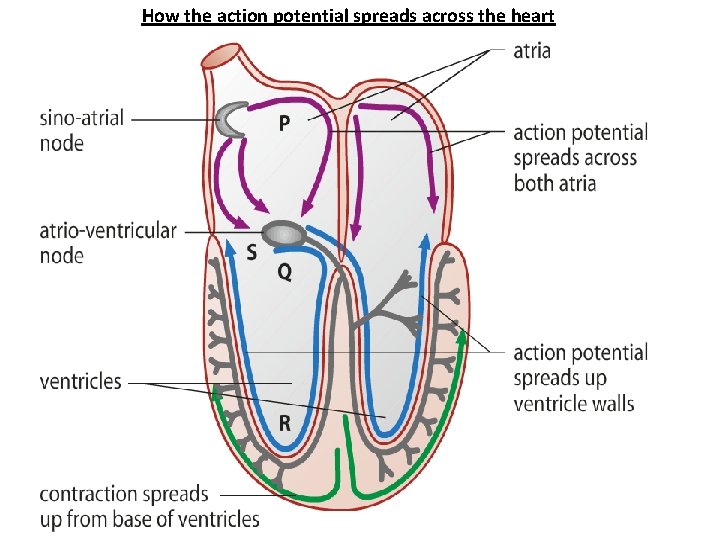
• When a heart beats, each muscle cell must contract at exactly the right moment in order to push the blood out of the heart. An action potential is sent to each muscle cell to tell it when to contract. The electrical signal starts in the atria causes the muscles in the atria to contract.
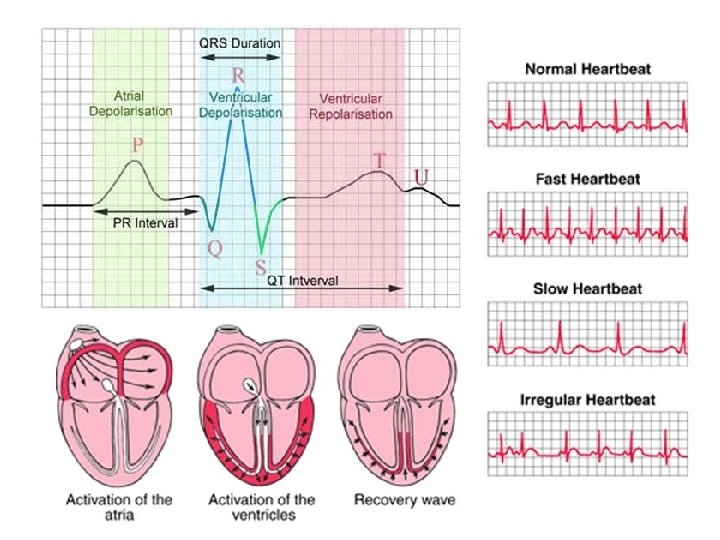
• The human body contains a high proportion of water with salt dissolved in it, which means that it will conduct electricity. The action potentials are conducted through the body to the skin, where they can be detected to produce an electrocardiogram or ECG. An ECG is a picture of the heart electrical signals.
The Heart • When the heart beats. An Acton potential passes though the atria, making them contract. A fraction of a second later, another action potential passes through the ventricles making them contract too. • One the action potential has passes the muscle relaxes. • These action potentials produce weak electrical signals on the skin. • Electrodes placed one the skin can produce a graph on a screen, which represent the action of the heart (ECG).
An electrocardiogram (ECG) shows the action potentials produced by the heart. These are electrical signals that tell the heart muscles when to contract. If the heart is not beating properly because the action potentials are not spreading across it correctly, a pacemaker can be used. This detects the action potentials, amplifies them and transmits them to other parts of the heart.
How the action potential spreads across the heart
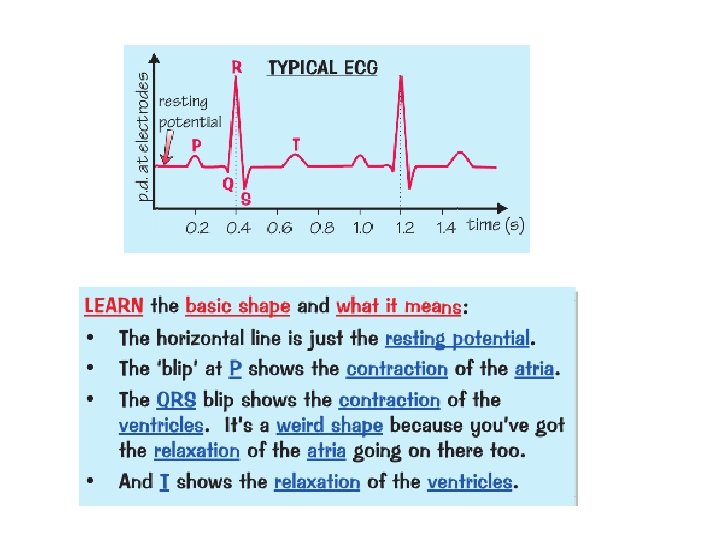
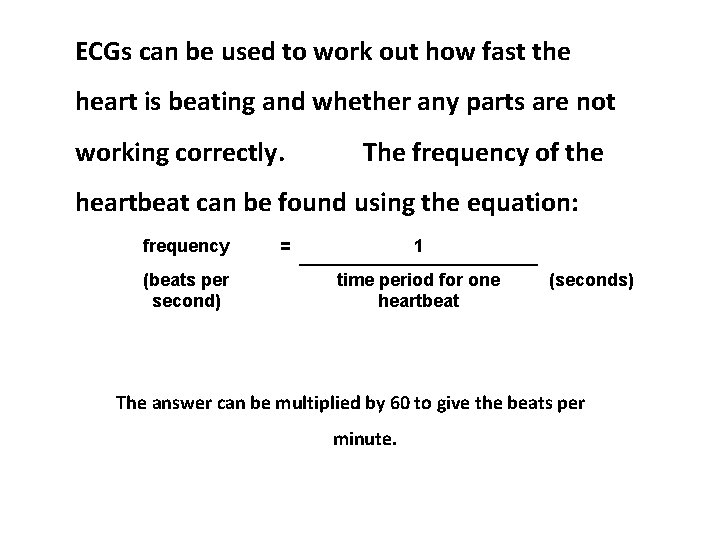
ECGs can be used to work out how fast the heart is beating and whether any parts are not working correctly. The frequency of the heartbeat can be found using the equation: frequency (beats per second) = 1 time period for one heartbeat (seconds) The answer can be multiplied by 60 to give the beats per minute.
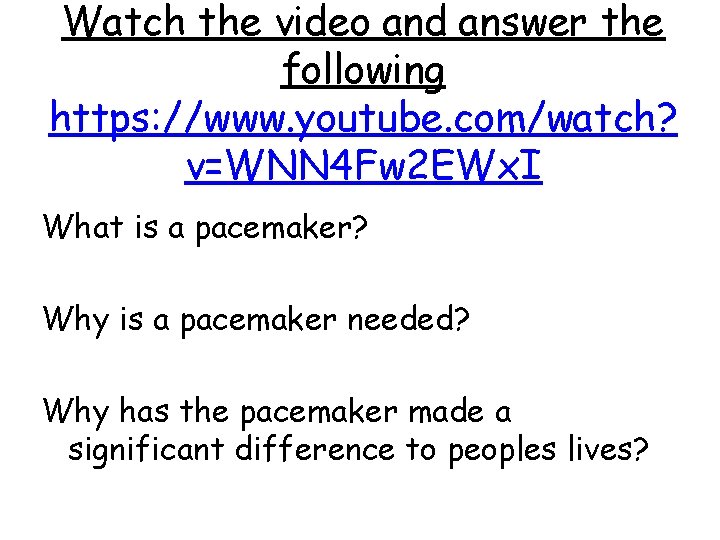
Watch the video and answer the following https: //www. youtube. com/watch? v=WNN 4 Fw 2 EWx. I What is a pacemaker? Why is a pacemaker needed? Why has the pacemaker made a significant difference to peoples lives?
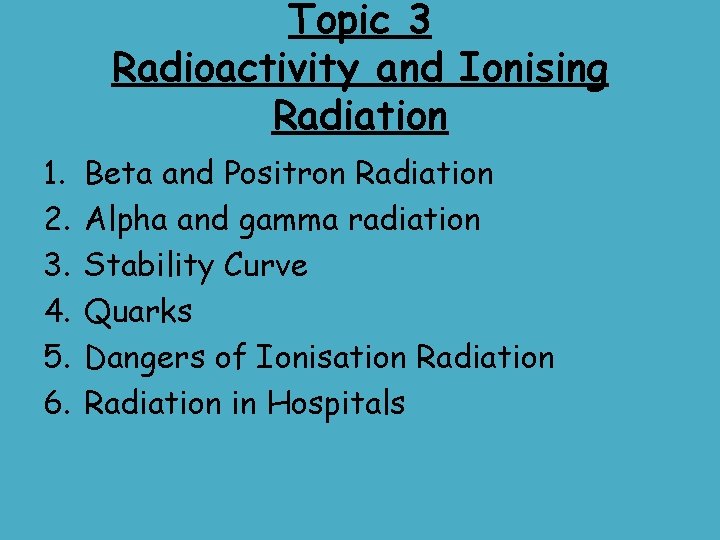
Topic 3 Radioactivity and Ionising Radiation 1. 2. 3. 4. 5. 6. Beta and Positron Radiation Alpha and gamma radiation Stability Curve Quarks Dangers of Ionisation Radiation in Hospitals
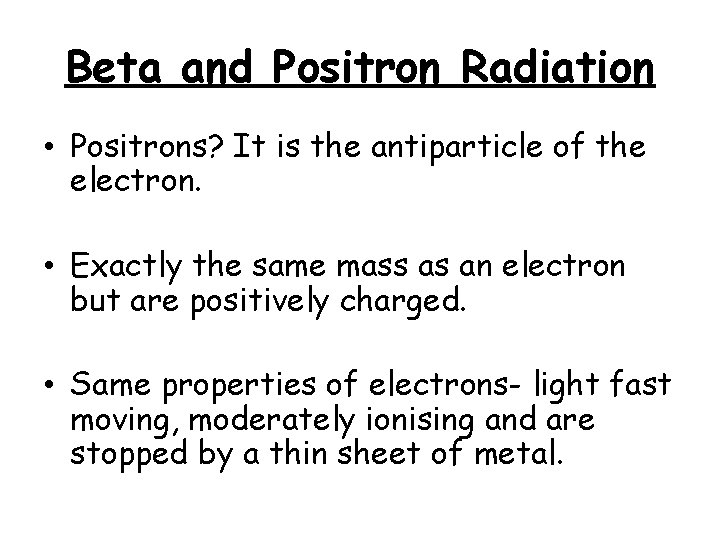
Beta and Positron Radiation • Positrons? It is the antiparticle of the electron. • Exactly the same mass as an electron but are positively charged. • Same properties of electrons- light fast moving, moderately ionising and are stopped by a thin sheet of metal.
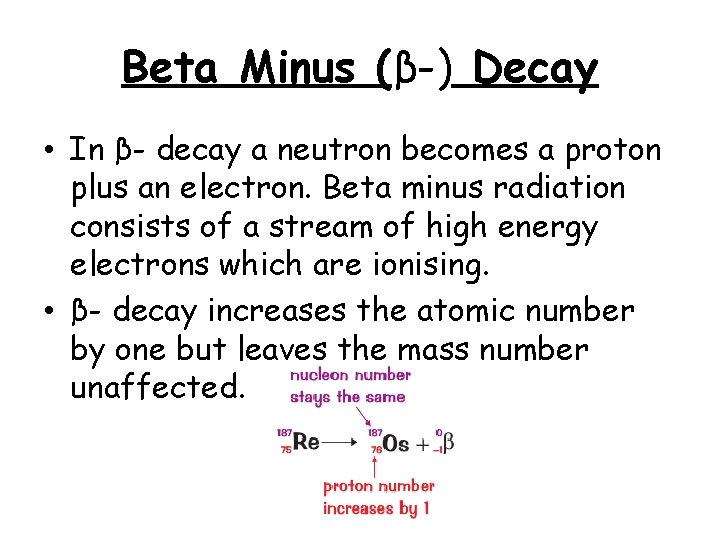
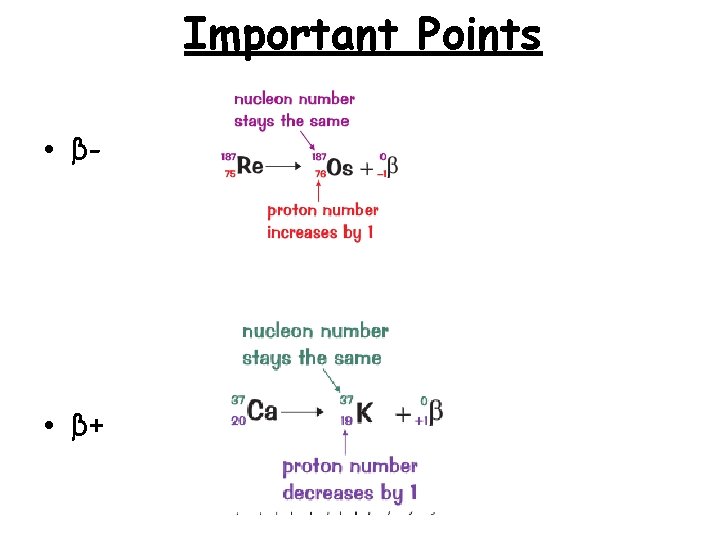
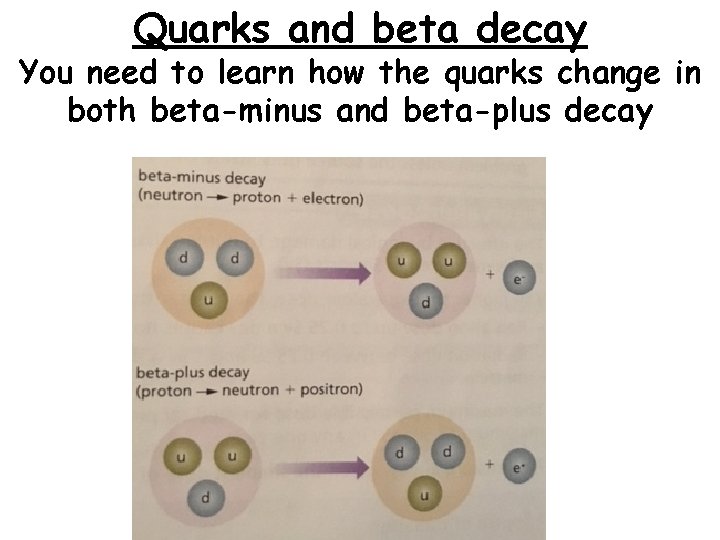
Beta Minus (β-) Decay • In β- decay a neutron becomes a proton plus an electron. Beta minus radiation consists of a stream of high energy electrons which are ionising. • β- decay increases the atomic number by one but leaves the mass number unaffected.
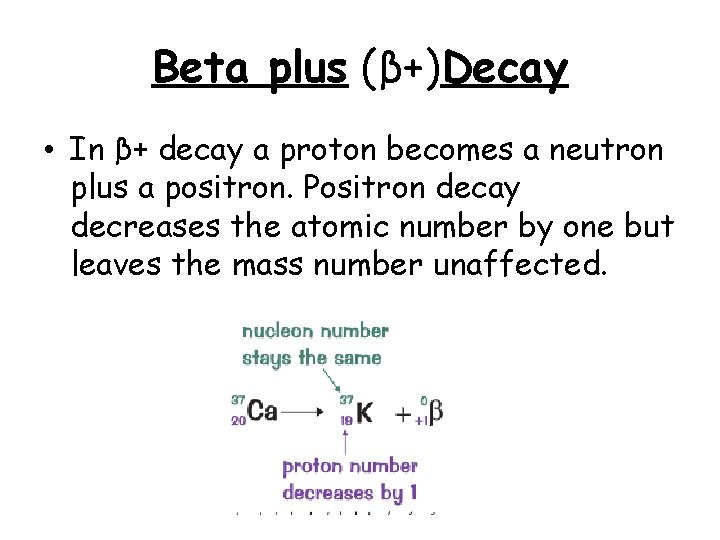
Beta plus (β+)Decay • In β+ decay a proton becomes a neutron plus a positron. Positron decay decreases the atomic number by one but leaves the mass number unaffected.
Alpha, Gamma and Neutron Radiation • Radioactive decay sometimes results in a neutron being ejected. Neutrons have no charge so are not directly ionising but they are as penetrating as gamma rays. • They are absorbed by nucleus. Which can make the nucleus radioactive. • Absorbed best by light nuclei.
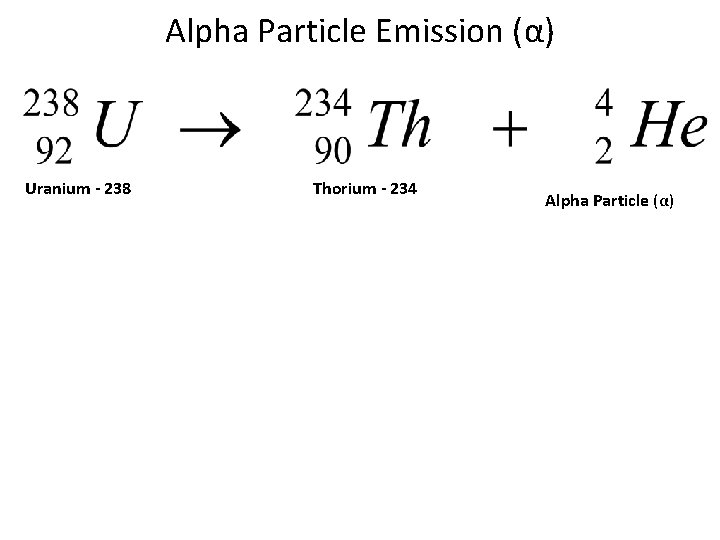
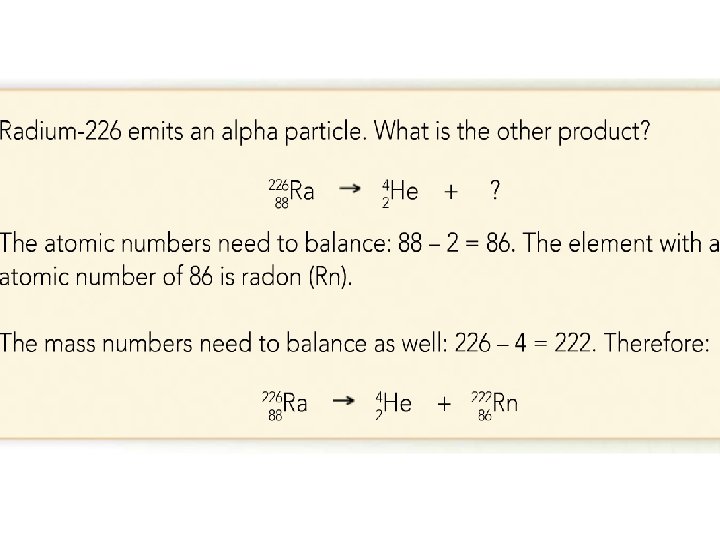
Alpha Particle Emission (α) Uranium - 238 Thorium - 234 Alpha Particle (α)
Gamma Radiation • Some radioactive materials decay but releasing gamma rays instead of particles. • Gamma rays are very penetrating but not as ionising as alpha or beta radiation. • Has no mass, so does not change the atomic number or mass number. • Nucleus losses energy and becomes more stable.
Important Points • β- • β+
• What determines what type of radiation is given off? • How do can we work out what types of isotopes are radioactive? • Stability Curve!
Stability Curve
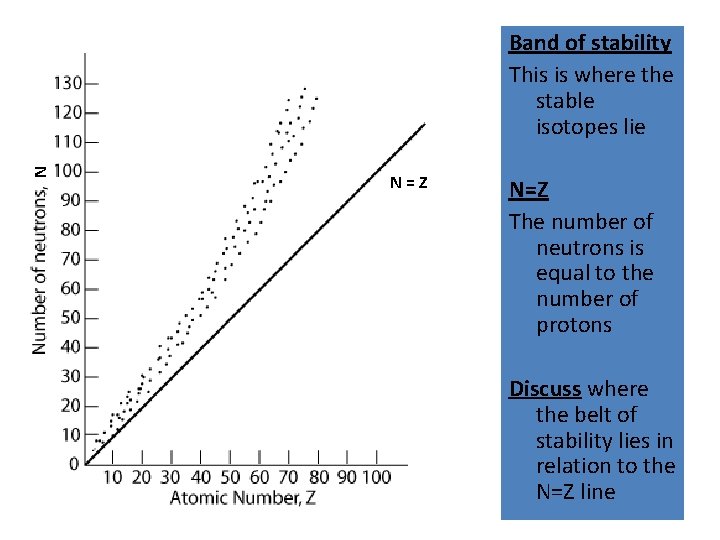
Stability of Isotopes • Some isotopes are stable and will stay in that arrangement indefinitely; others are unstable and will decay. • When all the isotopes of different elements are compared a pattern emerges.
N Band of stability This is where the stable isotopes lie N=Z The number of neutrons is equal to the number of protons Discuss where the belt of stability lies in relation to the N=Z line
-The graph shows the neutron number against proton number for stable isotopes. Stable nuclei with a lighter mass have about the same number of neutrons as protons (where N = Z, near the origin). - However in a nucleus with a larger mass, with more protons, the repulsion between the protons is stronger, so these nuclei have more neutrons. This reduces the force of repulsion and holds the particles together more firmly. These stable nuclei lie above the N = Z line.
Questions • What is the N=Z line? • What is the N=Z curve (stability curve)? • The stability curve stops at Z=82. why do you think this is? What type of decay will they undergo? • Why are isotopes above the N=Z curve unstable? What type of decay will they undergo? • Why are isotopes below the N=Z curve unstable? What type of decay will they undergo?
Answers • Same number of protons plotted against same number of neutrons. • Curve which shows the stable isotopes. • All the elements above 82 are unstable and usually undergo alpha decay. • Too many neutrons and undergo beta minus decay. • Too many protons and undergo beta positive decay.
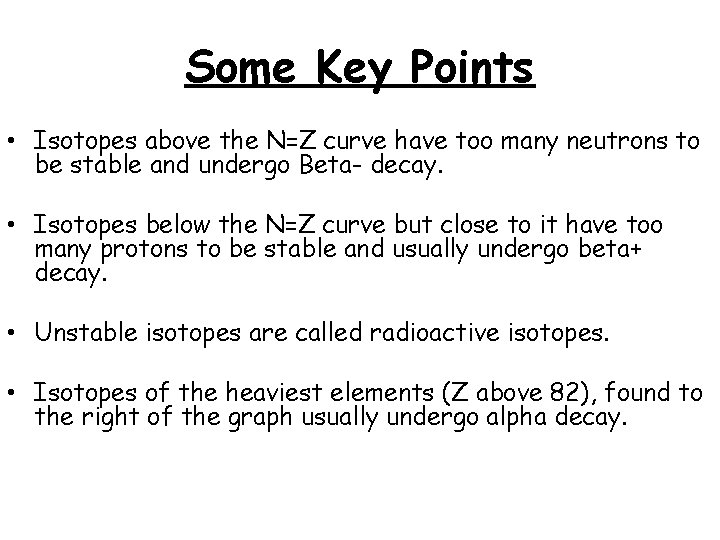
Some Key Points • Isotopes above the N=Z curve have too many neutrons to be stable and undergo Beta- decay. • Isotopes below the N=Z curve but close to it have too many protons to be stable and usually undergo beta+ decay. • Unstable isotopes are called radioactive isotopes. • Isotopes of the heaviest elements (Z above 82), found to the right of the graph usually undergo alpha decay.
Fundamental Particles. . • Have no internal structure. . . • Is this piece of iron a fundamental particle?
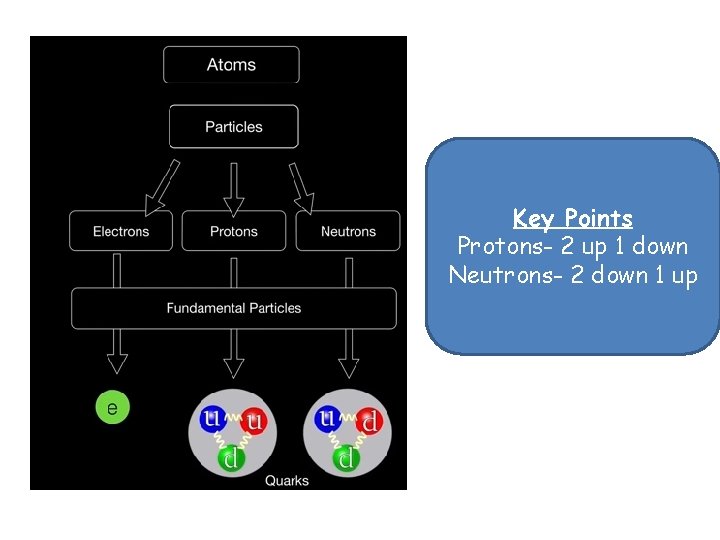
https: //www. youtube. com/watch ? v=JZh 5 kd. Lg. Op. M Quarks? ? • Protons and neutrons are made up of quarks. The two types of quarks we need to consider are ‘up’ and ‘down’ quarks.
Key Points Protons- 2 up 1 down Neutrons- 2 down 1 up
Quarks and beta decay You need to learn how the quarks change in both beta-minus and beta-plus decay
Dangers of Ionising Radiations
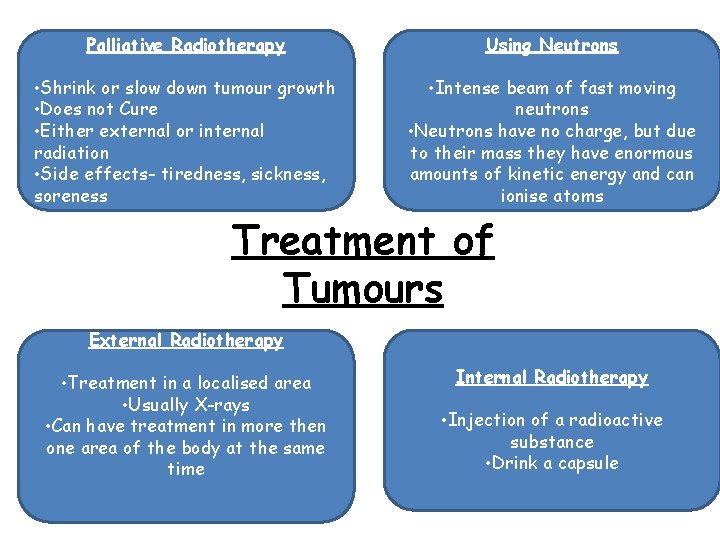
Palliative Radiotherapy Using Neutrons • Shrink or slow down tumour growth • Does not Cure • Either external or internal radiation • Side effects- tiredness, sickness, soreness • Intense beam of fast moving neutrons • Neutrons have no charge, but due to their mass they have enormous amounts of kinetic energy and can ionise atoms Treatment of Tumours External Radiotherapy • Treatment in a localised area • Usually X-rays • Can have treatment in more then one area of the body at the same time Internal Radiotherapy • Injection of a radioactive substance • Drink a capsule
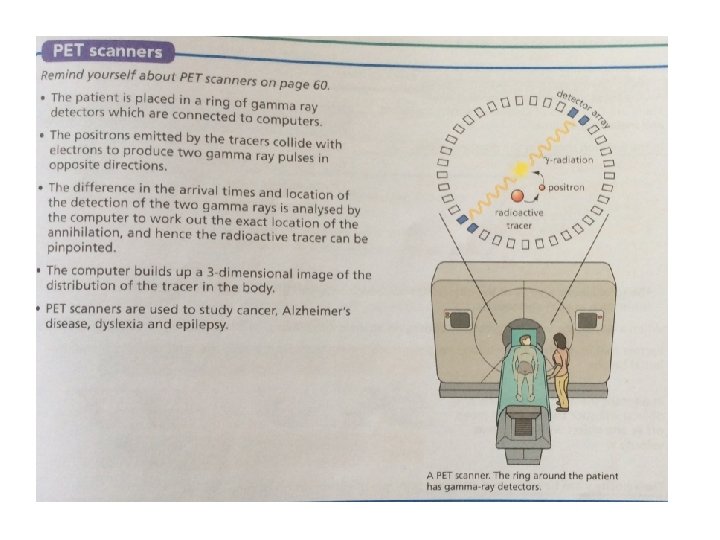
PET Scanners
Topic 4 Motion of Particles 1. Collaboration and Circular Motion 2. Collisions 3. PET Scanners
Circular Motion and Cyclotrons
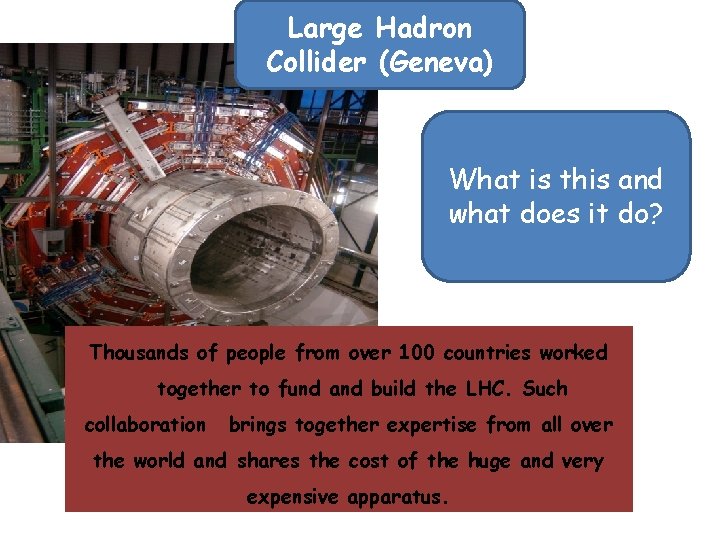
Large Hadron Collider (Geneva) What is this and what does it do? Thousands of people from over 100 countries worked together to fund and build the LHC. Such collaboration brings together expertise from all over the world and shares the cost of the huge and very expensive apparatus.
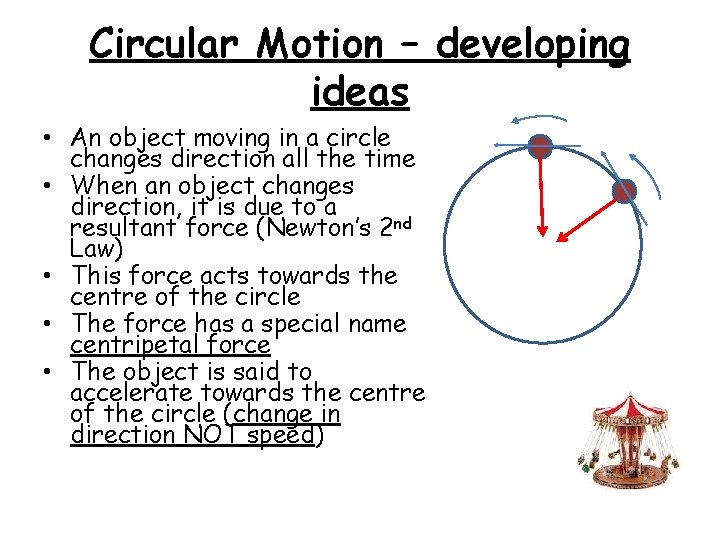
Circular Motion – developing ideas • An object moving in a circle changes direction all the time • When an object changes direction, it is due to a resultant force (Newton’s 2 nd Law) • This force acts towards the centre of the circle • The force has a special name centripetal force • The object is said to accelerate towards the centre of the circle (change in direction NOT speed)
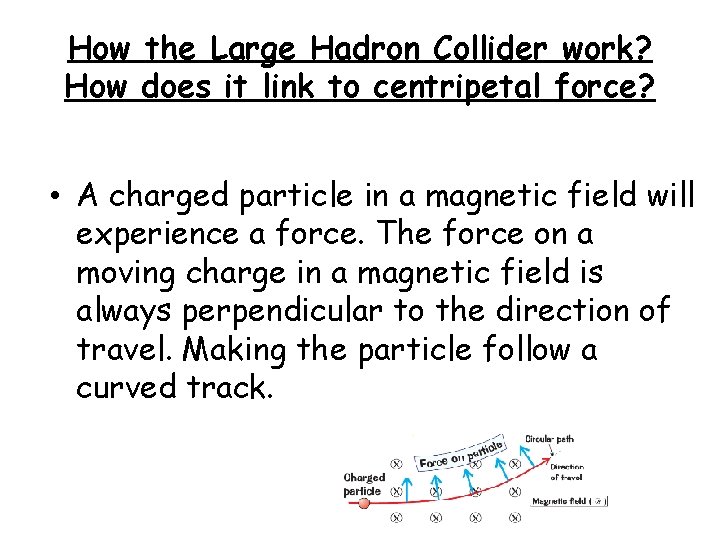
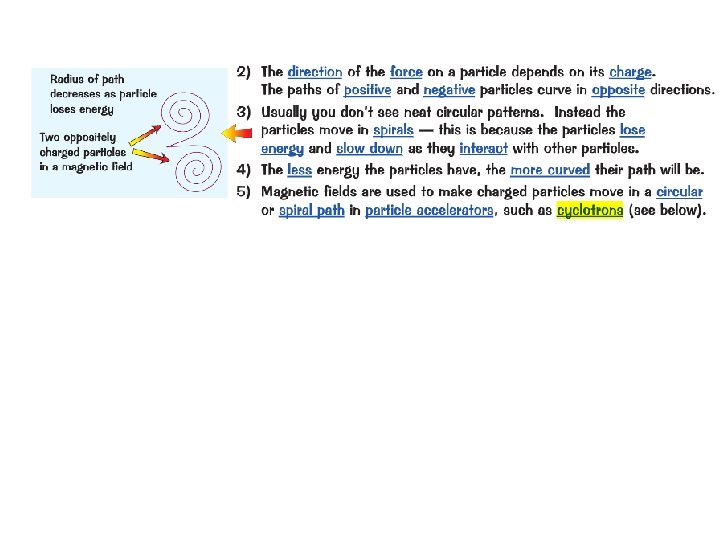
How the Large Hadron Collider work? How does it link to centripetal force? • A charged particle in a magnetic field will experience a force. The force on a moving charge in a magnetic field is always perpendicular to the direction of travel. Making the particle follow a curved track.
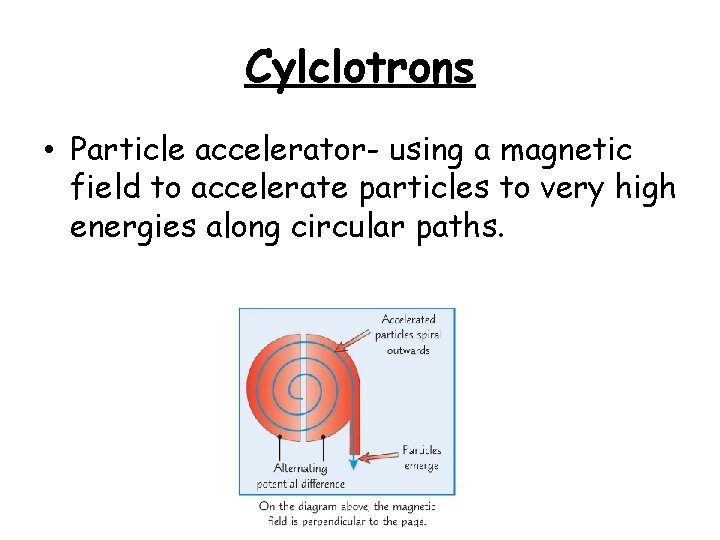
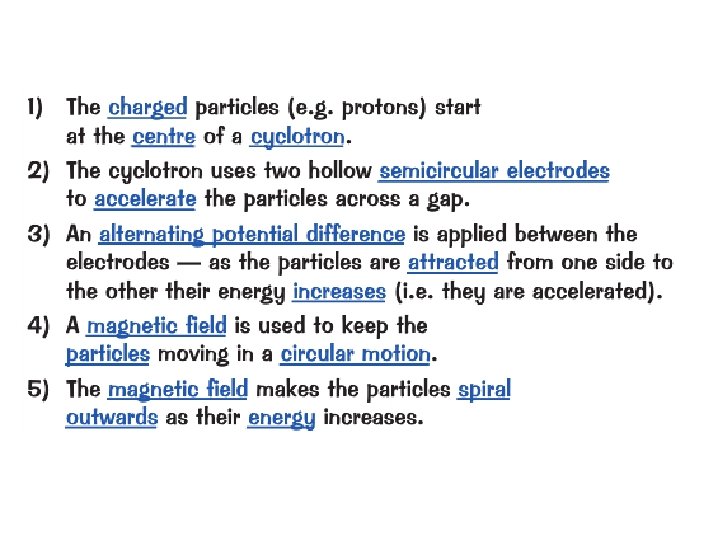
Cylclotrons • Particle accelerator- using a magnetic field to accelerate particles to very high energies along circular paths.
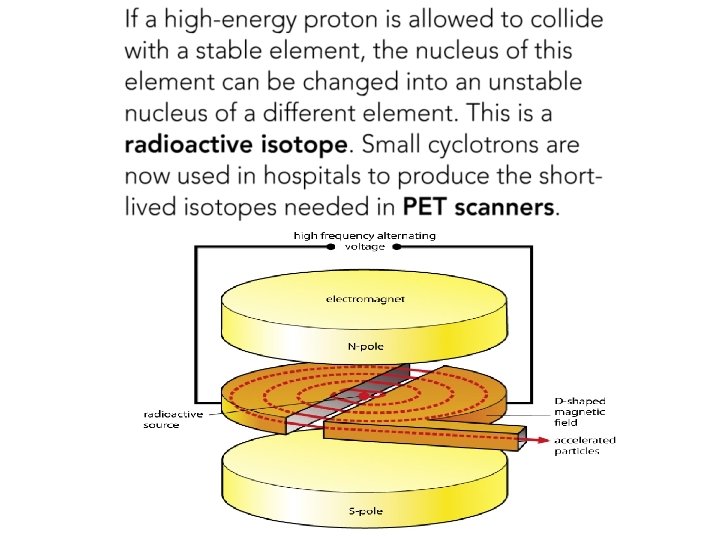
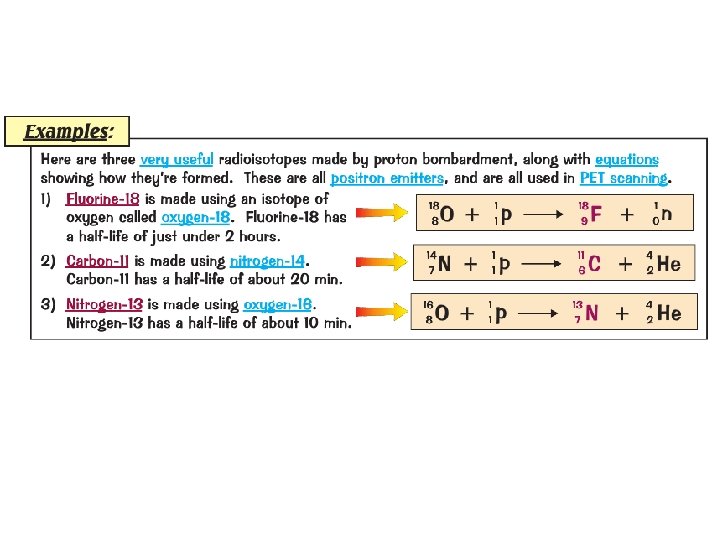
Cyclotrons are used in Hospitals • Isotopes used in PET scans are made using cyclotrons. • A proton needs a lot of energy to be absorbed into the nucleus, so they happens in particle accelerators. • Bombarding stable isotopes with protons creates an unstable isotope that emits positrons( this will be important when we look at annihilation)
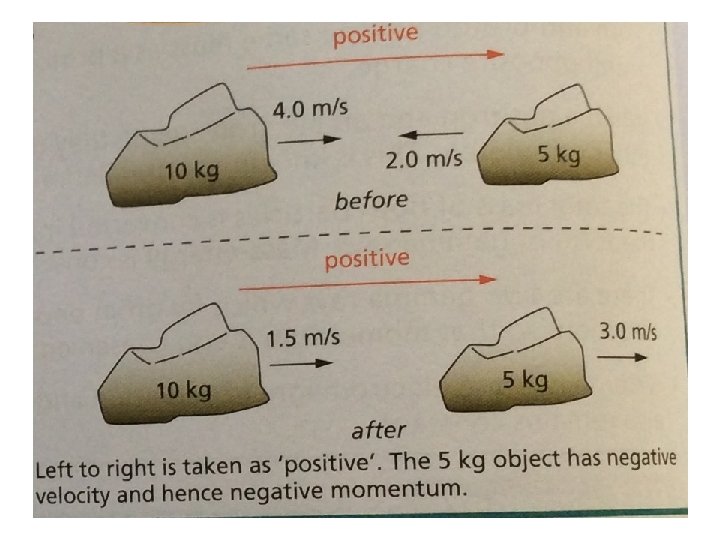
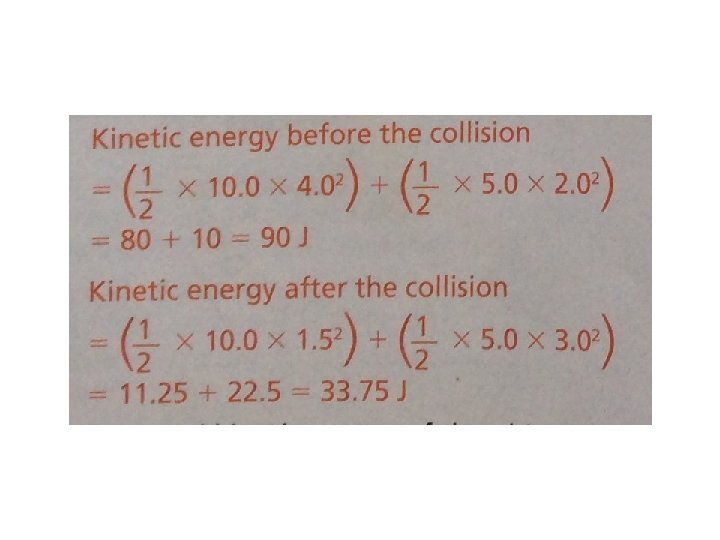
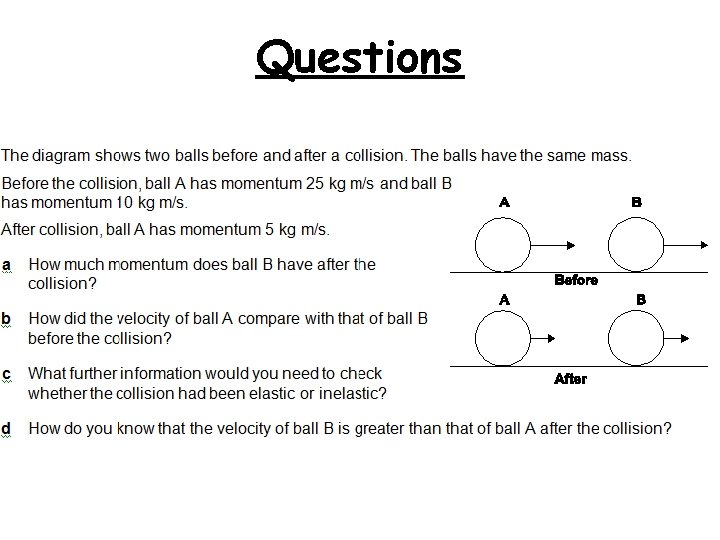
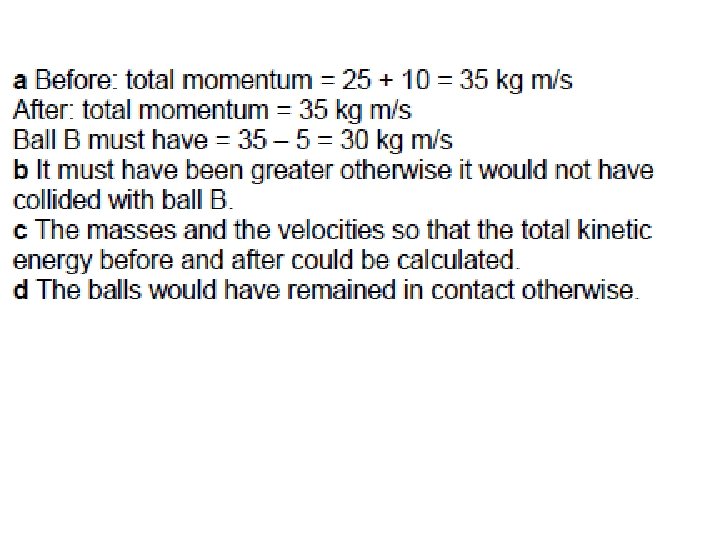
P 3 Collisions • Colliding objects have kinetic energy and momentum, which is a measure of the strength of movement (momentum = mass x velocity). Momentum is conserved in all collisions. • In an inelastic collision kinetic energy is not conserved but it an elastic collision it is conserved.
• https: //www. youtube. com/watch? v=Xe 2 r 6 we y 26 E
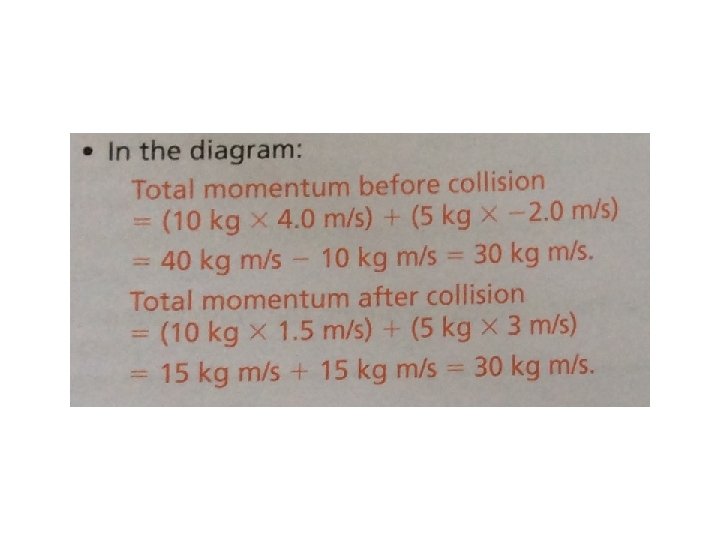
Conservation of Momentum • Momentum (kg m/s) = mass (kg) x Velocity (m/s) • The principle of conservation of momentum can be applied to all collisions (where there are no external forces acting on the objects). • Total momentum of the objects before the collision = Total momentum of the objects after the collision.
Questions
P 3 Collisions • Many scientists believe that 90% of the universe is made out of ‘dark matter’ but so far, no experiment has detected it. In proton-proton collisions at the Large Hadron Collider, detectors measure the total momentum of the particles before and after collision. If those do not balance, this is evidence that dark matter particles have been produced.
Matter, Antimatter and Annihilation • Ordinary matter consists of protons, neutrons and electrons. • Particles of antimatter have the opposite charge of the particles of matter. • An anti-proton has the same mass a proton, but equal and opposite charge.
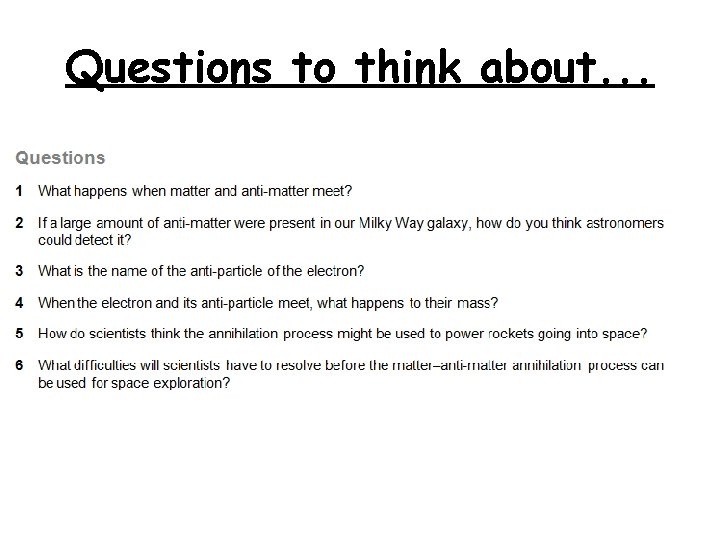
Questions to think about. . .
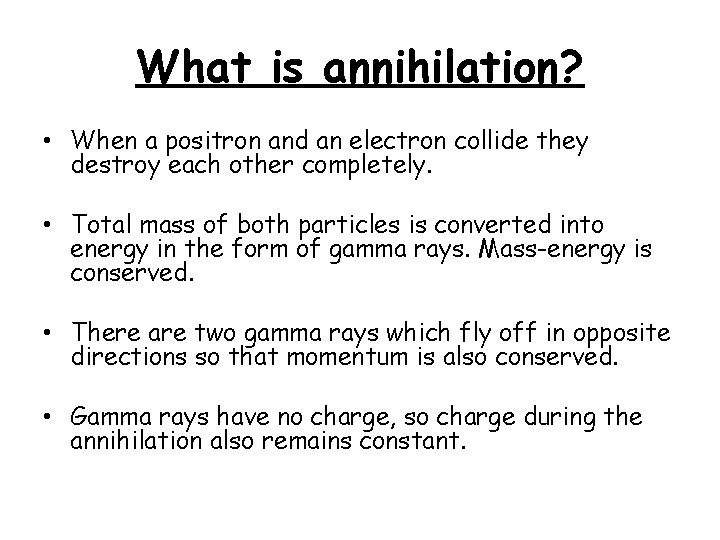
What is annihilation? • When a positron and an electron collide they destroy each other completely. • Total mass of both particles is converted into energy in the form of gamma rays. Mass-energy is conserved. • There are two gamma rays which fly off in opposite directions so that momentum is also conserved. • Gamma rays have no charge, so charge during the annihilation also remains constant.
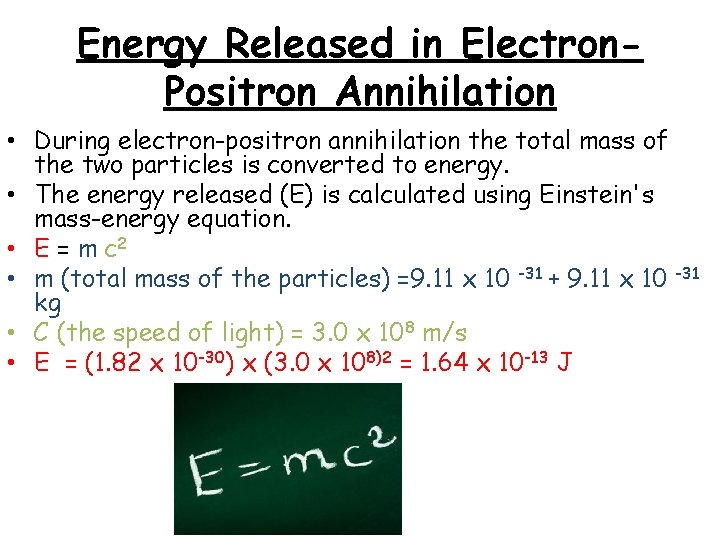
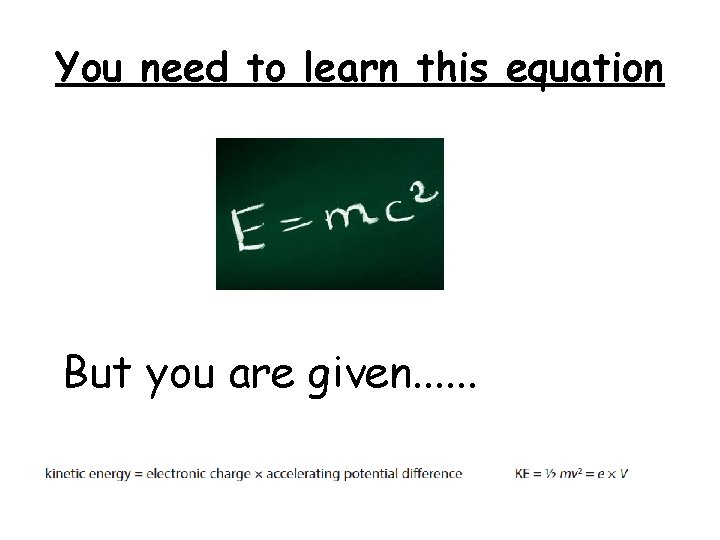
Energy Released in Electron. Positron Annihilation • During electron-positron annihilation the total mass of the two particles is converted to energy. • The energy released (E) is calculated using Einstein's mass-energy equation. • E = m c 2 • m (total mass of the particles) =9. 11 x 10 -31 + 9. 11 x 10 -31 kg • C (the speed of light) = 3. 0 x 108 m/s • E = (1. 82 x 10 -30) x (3. 0 x 108)2 = 1. 64 x 10 -13 J
You need to learn this equation But you are given. . .
Topic 5 Kinetic Theory and Gases 1. Kinetic Theory 2. Calculating Volumes and Pressures
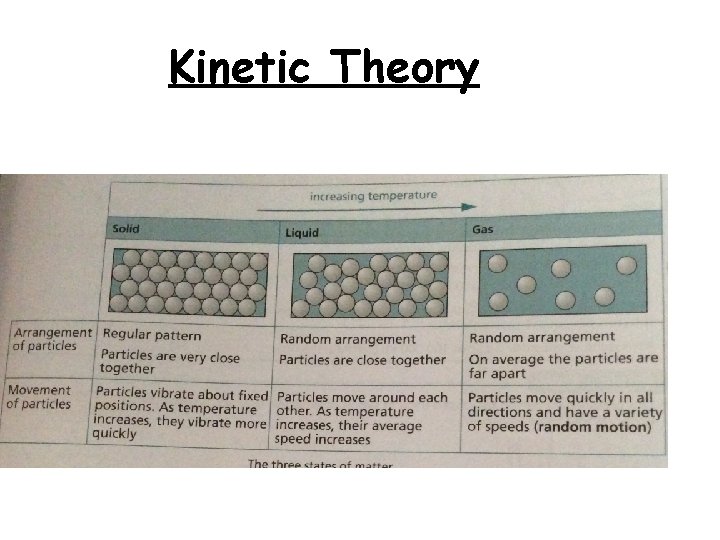
Kinetic Theory
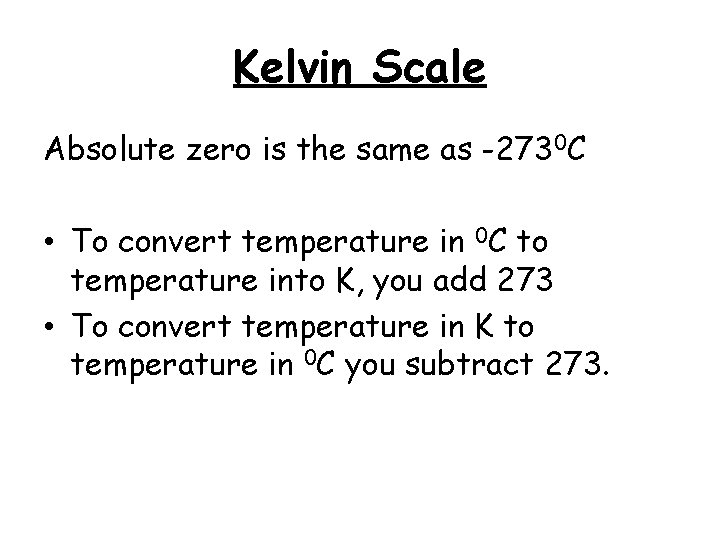
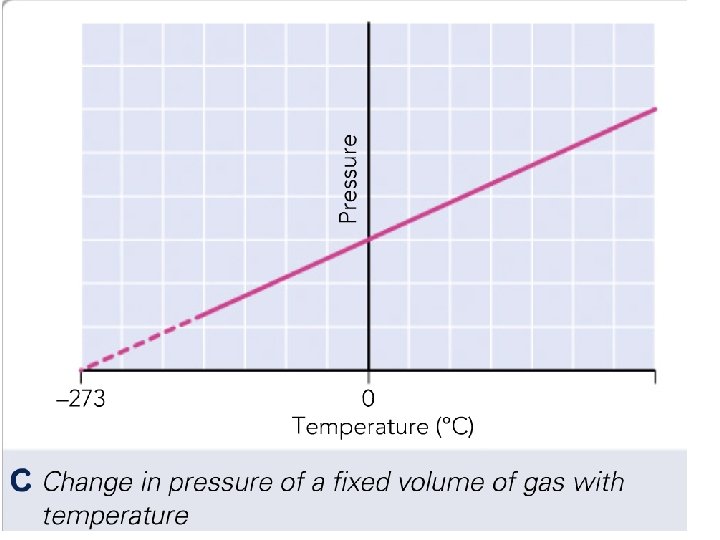
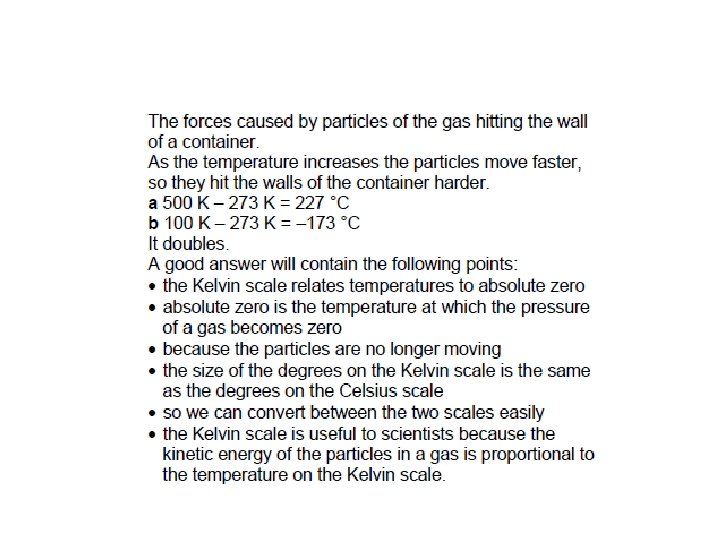
Kelvin Scale Absolute zero is the same as -2730 C • To convert temperature in 0 C to temperature into K, you add 273 • To convert temperature in K to temperature in 0 C you subtract 273.
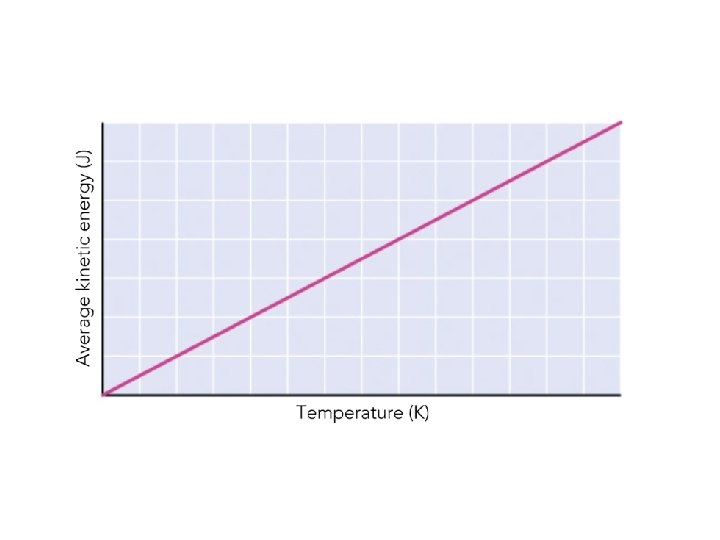
Temperature Scales Key Points • At absolute zero (0 K) all particles of a substance stop moving and have zero kinetic energy. • Kelvin scale starts at absolute zero, a temperature change of 10 C is the same as a temperature change of 1 K, • More heat energy means particles move faster, collide more often. • Temperature (T) is proportional to the average kinetic energy (E).
Pressure. . Things to think about • What is pressure? • Pressure of a gas is caused by the forces exerted as the moving particles hit the walls of a container. • Pressure is measured in pascals (Pa) where 1 Pa = N/M 2
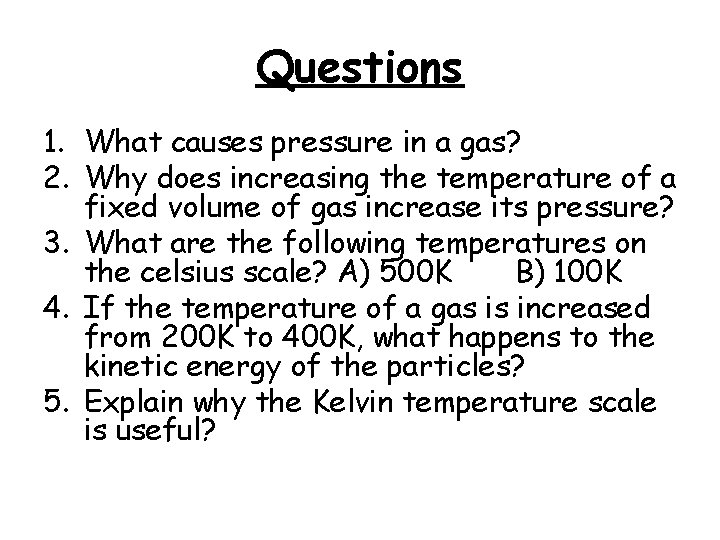
Questions 1. What causes pressure in a gas? 2. Why does increasing the temperature of a fixed volume of gas increase its pressure? 3. What are the following temperatures on the celsius scale? A) 500 K B) 100 K 4. If the temperature of a gas is increased from 200 K to 400 K, what happens to the kinetic energy of the particles? 5. Explain why the Kelvin temperature scale is useful?
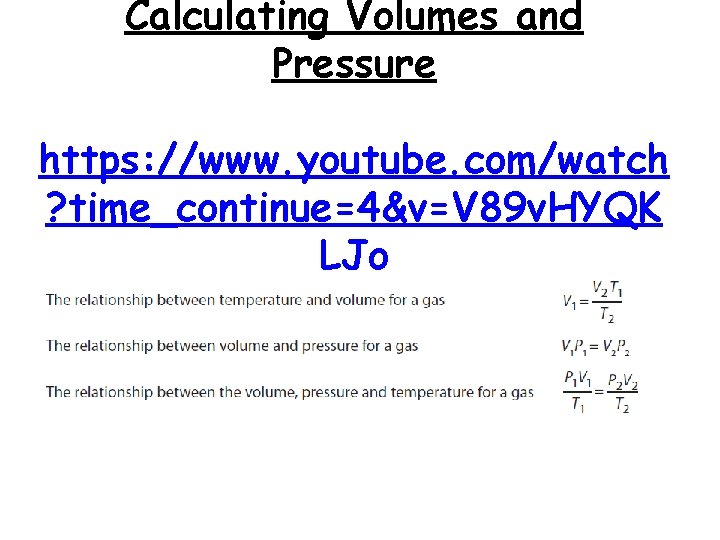
Calculating Volumes and Pressure https: //www. youtube. com/watch ? time_continue=4&v=V 89 v. HYQK LJo
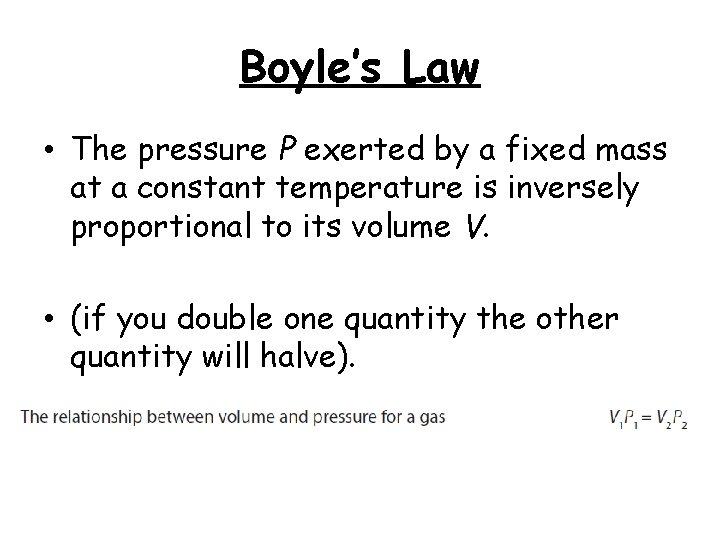
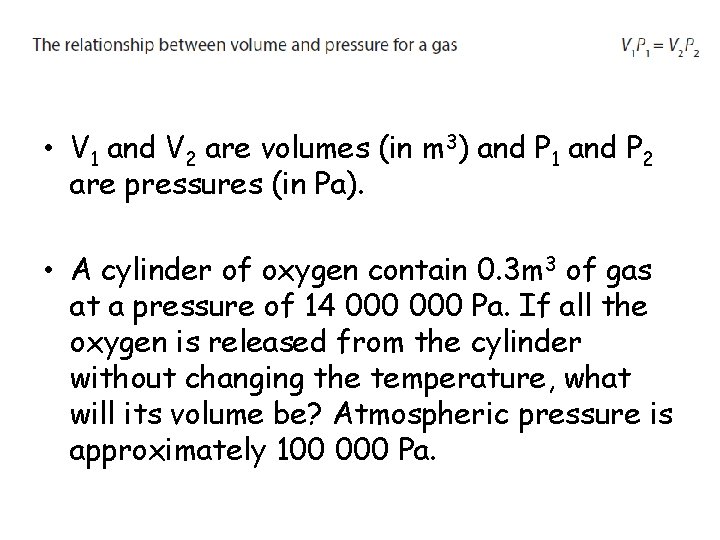
Boyle’s Law • The pressure P exerted by a fixed mass at a constant temperature is inversely proportional to its volume V. • (if you double one quantity the other quantity will halve).
• V 1 and V 2 are volumes (in m 3) and P 1 and P 2 are pressures (in Pa). • A cylinder of oxygen contain 0. 3 m 3 of gas at a pressure of 14 000 Pa. If all the oxygen is released from the cylinder without changing the temperature, what will its volume be? Atmospheric pressure is approximately 100 000 Pa.
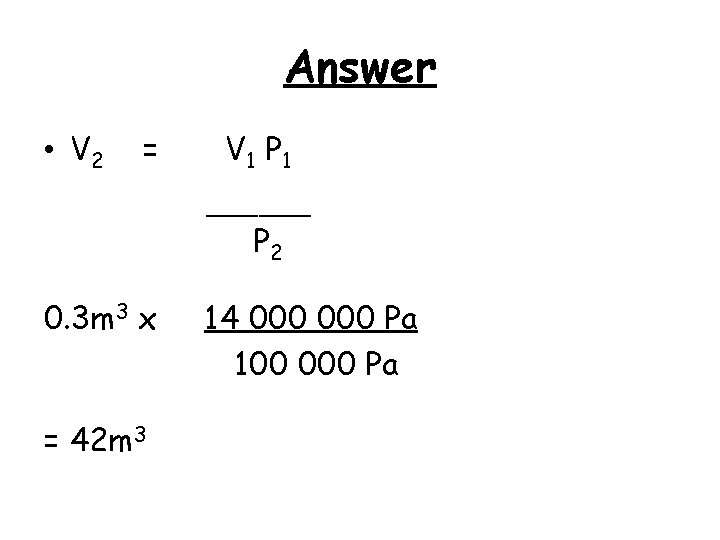
Answer • V 2 = V 1 P 1 ____ P 2 0. 3 m 3 x = 42 m 3 14 000 Pa 100 000 Pa
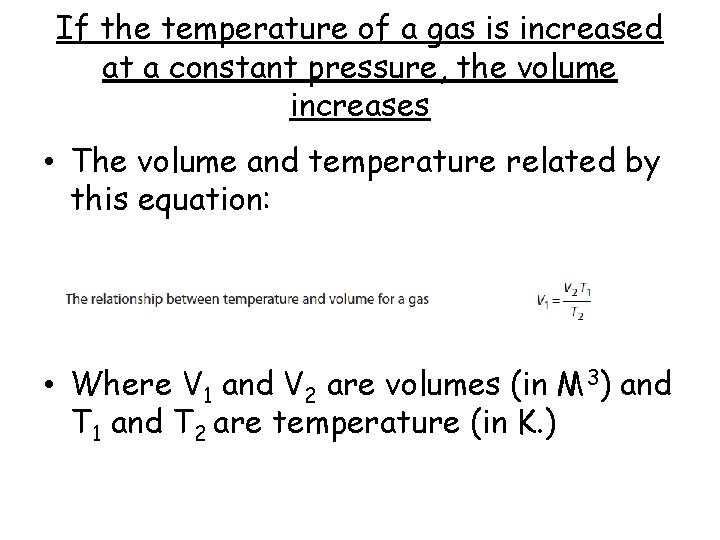
If the temperature of a gas is increased at a constant pressure, the volume increases • The volume and temperature related by this equation: • Where V 1 and V 2 are volumes (in M 3) and T 1 and T 2 are temperature (in K. )
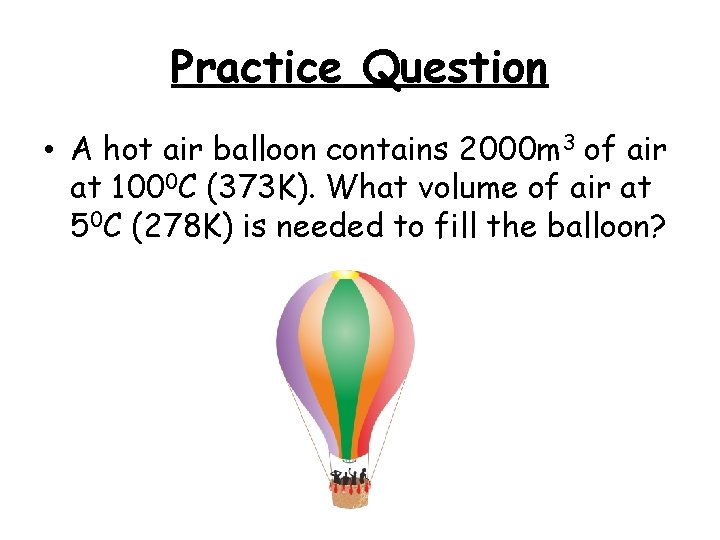
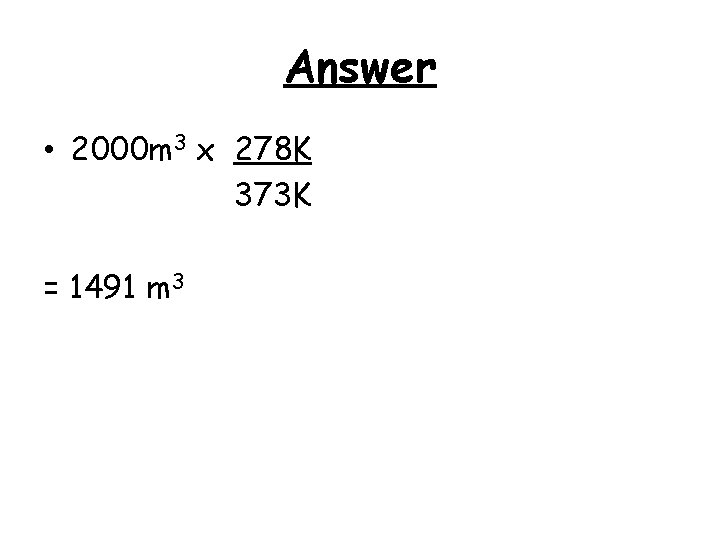
Practice Question • A hot air balloon contains 2000 m 3 of air at 1000 C (373 K). What volume of air at 50 C (278 K) is needed to fill the balloon?
Answer • 2000 m 3 x 278 K 373 K = 1491 m 3
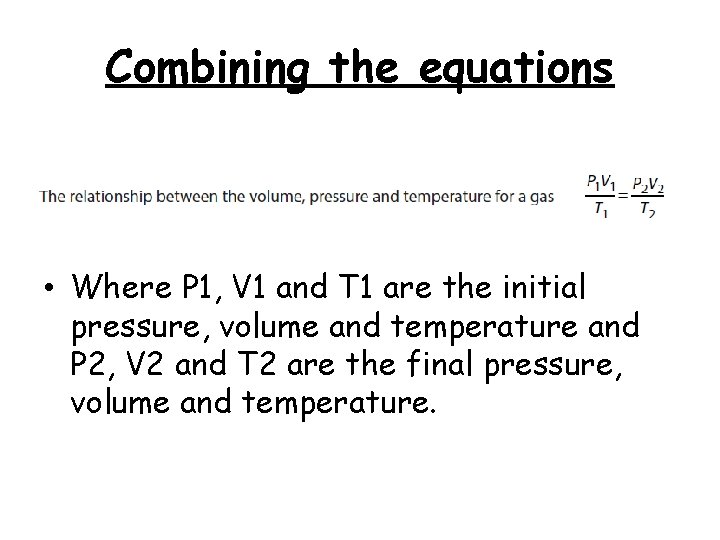
Combining the equations • Where P 1, V 1 and T 1 are the initial pressure, volume and temperature and P 2, V 2 and T 2 are the final pressure, volume and temperature.
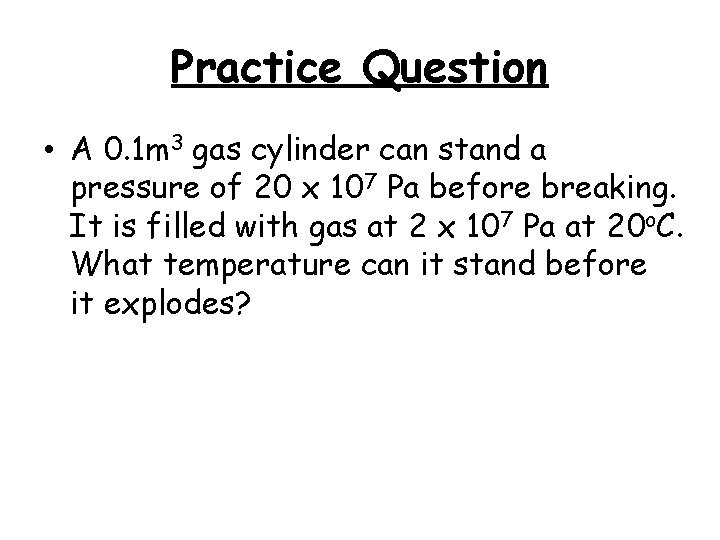
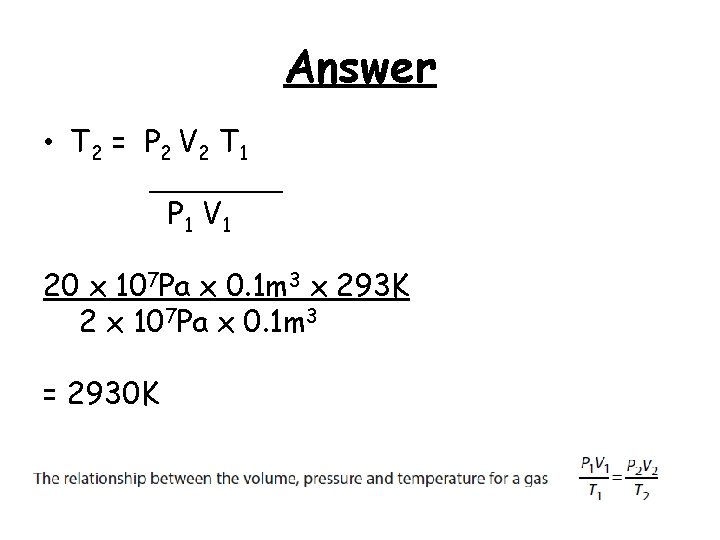
Practice Question • A 0. 1 m 3 gas cylinder can stand a pressure of 20 x 107 Pa before breaking. It is filled with gas at 2 x 10⁷ Pa at 20 o. C. What temperature can it stand before it explodes?
Answer • T 2 = P 2 V 2 T 1 _______ P 1 V 1 20 x 107 Pa x 0. 1 m 3 x 293 K 2 x 107 Pa x 0. 1 m 3 = 2930 K