Montana Dental Association May 2 2013 2012 American


- Slides: 158
Montana Dental Association May 2, 2013 © 2012 American Dental Association, All Rights Reserved 1
Optimize your Practice: Understanding the CDT Code v. 2013 (and More) Prepared for you by the Council on Dental Benefit Programs 2
Brought to you by… ADA’s Council on Dental Benefit Programs CDBP has responsibility for > Maintaining and promoting use of dental coding taxonomies > Addressing third-party payer actions that intrude on the dentist-patient relationship >Providing dentists with educational and reference material that supports day to day practice administation © 2012 American Dental Association, All Rights Reserved 3
Learning Objectives- to understand… The Code’s structure and recent changes Ways the Code supports documenting procedures of varied complexity and one or more dates of service Basic dental and medical claim submission How to identify and address problems with payer claims adjudication Payer cost containment and risk management © 2012 American Dental Association, All Rights Reserved 4
Disclaimer • Not b…. session • Not a course on how play the insurance game or bend the code • Not particularly about “why 3 rd party payers won’t pay for this or that” • It is about how to code for what you do . . and • Better prepare your office for the transition to electronic records © 2012 American Dental Association, All Rights Reserved 5
© 2012 American Dental Association, All Rights Reserved 6
© 2012 American Dental Association, All Rights Reserved 7
© 2012 American Dental Association, All Rights Reserved 8
What is the CDT Code Shorthand for the ADA’s Code on Dental Procedures and Nomenclature © 2012 American Dental Association, All Rights Reserved 9
The Code and “ CDT” are not the same thing Code = Code on Dental Procedures and Nomenclature CDT = Current Dental Terminology > The ADA publication containing the Code > And more © 2012 American Dental Association, All Rights Reserved 10
Why a CDT Code? • Purpose – – Provide uniformity, consistency and specificity in accurately reporting (i. e. , documenting) dental treatment • Use – – Populate patient health record – electronic and paper – Provide for the efficient processing of dental claims © 2012 American Dental Association, All Rights Reserved 11
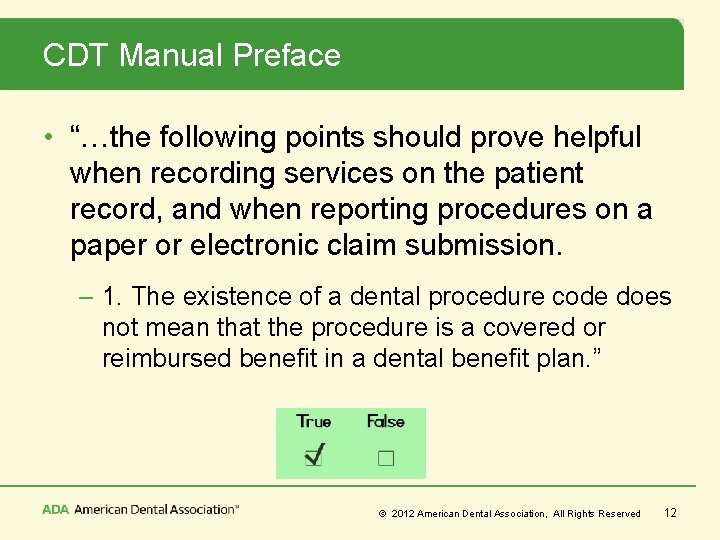
CDT Manual Preface • “…the following points should prove helpful when recording services on the patient record, and when reporting procedures on a paper or electronic claim submission. – 1. The existence of a dental procedure code does not mean that the procedure is a covered or reimbursed benefit in a dental benefit plan. ” © 2012 American Dental Association, All Rights Reserved 12
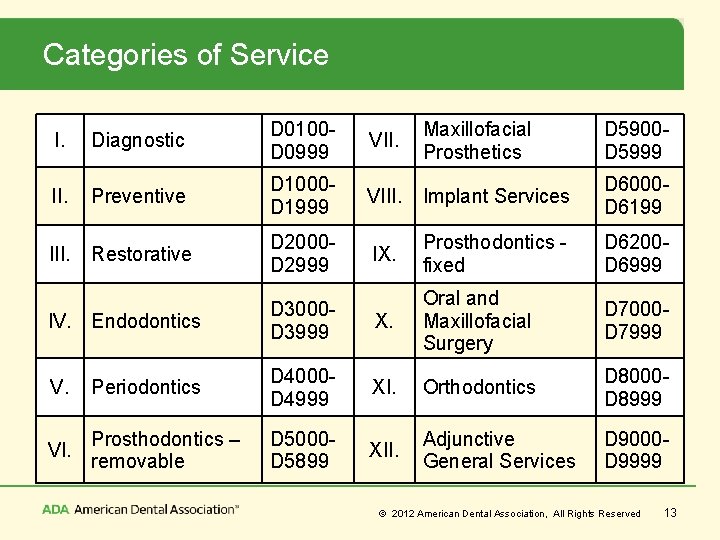
Categories of Service I. Diagnostic D 0100 D 0999 VII. Maxillofacial Prosthetics D 5900 D 5999 II. Preventive D 1000 D 1999 VIII. Implant Services D 6000 D 6199 III. Restorative D 2000 D 2999 IX. Prosthodontics - fixed D 6200 D 6999 IV. Endodontics D 3000 D 3999 X. Oral and Maxillofacial Surgery D 7000 D 7999 V. Periodontics D 4000 D 4999 XI. Orthodontics D 8000 D 8999 VI. Prosthodontics – removable D 5000 D 5899 XII. Adjunctive General Services D 9000 D 9999 © 2012 American Dental Association, All Rights Reserved 13
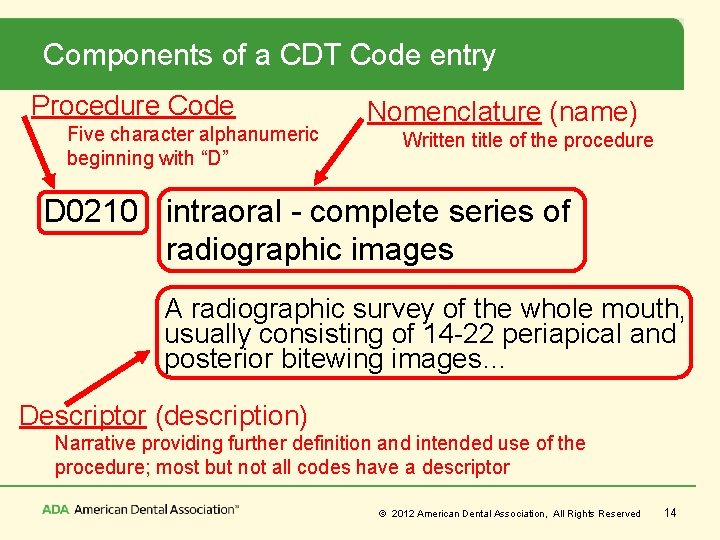
Components of a CDT Code entry Procedure Code Five character alphanumeric beginning with “D” Nomenclature (name) Written title of the procedure D 0210 intraoral - complete series of radiographic images A radiographic survey of the whole mouth, usually consisting of 14 -22 periapical and posterior bitewing images… Descriptor (description) Narrative providing further definition and intended use of the procedure; most but not all codes have a descriptor © 2012 American Dental Association, All Rights Reserved 14
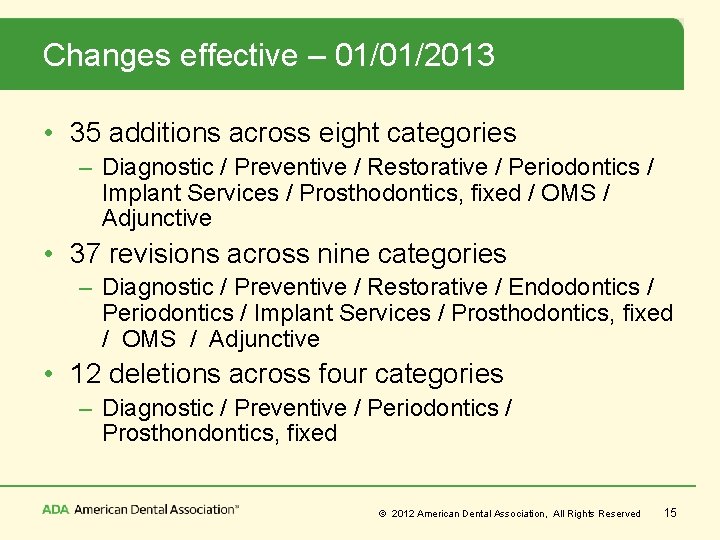
Changes effective – 01/01/2013 • 35 additions across eight categories – Diagnostic / Preventive / Restorative / Periodontics / Implant Services / Prosthodontics, fixed / OMS / Adjunctive • 37 revisions across nine categories – Diagnostic / Preventive / Restorative / Endodontics / Periodontics / Implant Services / Prosthodontics, fixed / OMS / Adjunctive • 12 deletions across four categories – Diagnostic / Preventive / Periodontics / Prosthondontics, fixed © 2012 American Dental Association, All Rights Reserved 15
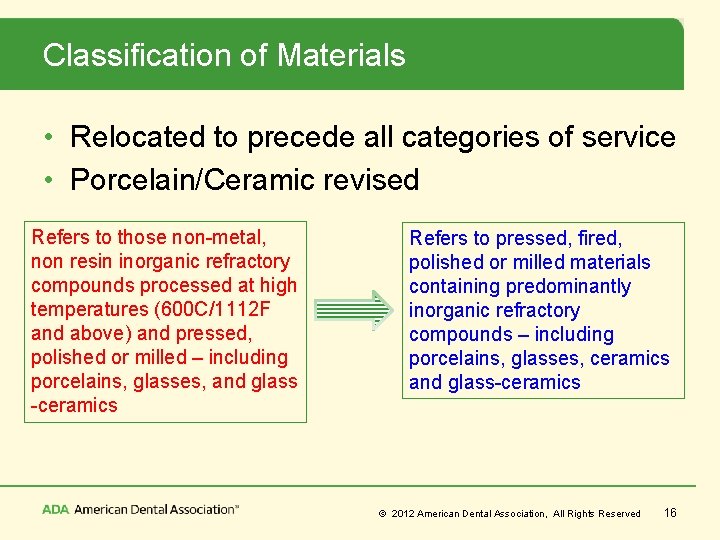
Classification of Materials • Relocated to precede all categories of service • Porcelain/Ceramic revised Refers to those non-metal, non resin inorganic refractory compounds processed at high temperatures (600 C/1112 F and above) and pressed, polished or milled – including porcelains, glasses, and glass -ceramics Refers to pressed, fired, polished or milled materials containing predominantly inorganic refractory compounds – including porcelains, glasses, ceramics and glass-ceramics © 2012 American Dental Association, All Rights Reserved 16
Diagnostics – Major Actions • Revision and expansion of Diagnostic Imaging subcategory – Evolutionary changes to imaging modalities • New Subcategory for “Pre-diagnostic Services – Regulatory changes for increased patient access to care © 2012 American Dental Association, All Rights Reserved 17
Diagnostic Imaging – 3 Sub-subcategories • Image capture with interpretation – Continuing image capture and interpretation (e. g. , FMX; BW) within the dentist’s office • Image capture only – Separate facilities for MRI, Ultrasound and other special imaging • Interpretation and report only – Practitioners who specialize in analyzing diagnostic images © 2012 American Dental Association, All Rights Reserved 18
Change “film” to “radiographic image” • “Film” is out-of-date term • All nomenclatures with “film” revised • Example – – Before change: • D 0270 bitewing – single film – As revised: • D 0270 bitewing – single radiographic image © 2012 American Dental Association, All Rights Reserved 19
Pre-diagnostic Services D 0190 screening of a patient A screening, including state or federally mandated screenings, to determine an individual’s need to be seen by a dentist for diagnosis. D 0191 assessment of a patient A limited clinical inspection that is performed to identify possible signs of oral or systemic disease, malformation, or injury, and the potential need for referral for diagnosis and treatment. © 2012 American Dental Association, All Rights Reserved 20
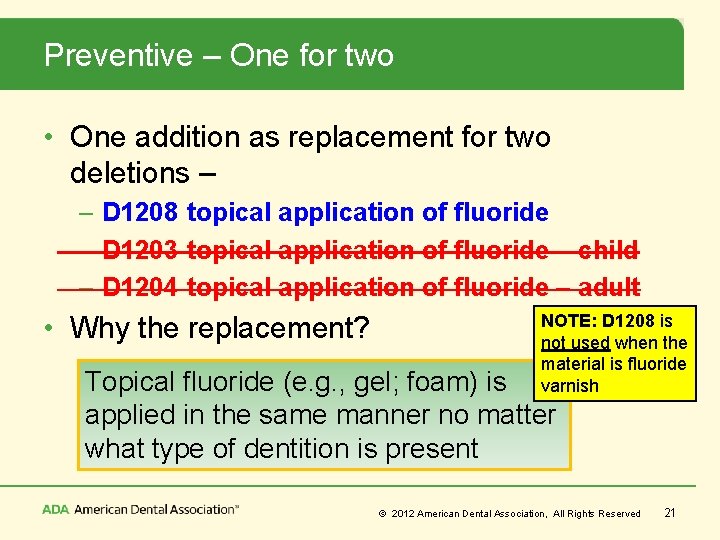
Preventive – One for two • One addition as replacement for two deletions – – D 1208 topical application of fluoride – D 1203 topical application of fluoride – child – D 1204 topical application of fluoride – adult • Why the replacement? NOTE: D 1208 is not used when the material is fluoride varnish Topical fluoride (e. g. , gel; foam) is applied in the same manner no matter what type of dentition is present © 2012 American Dental Association, All Rights Reserved 21
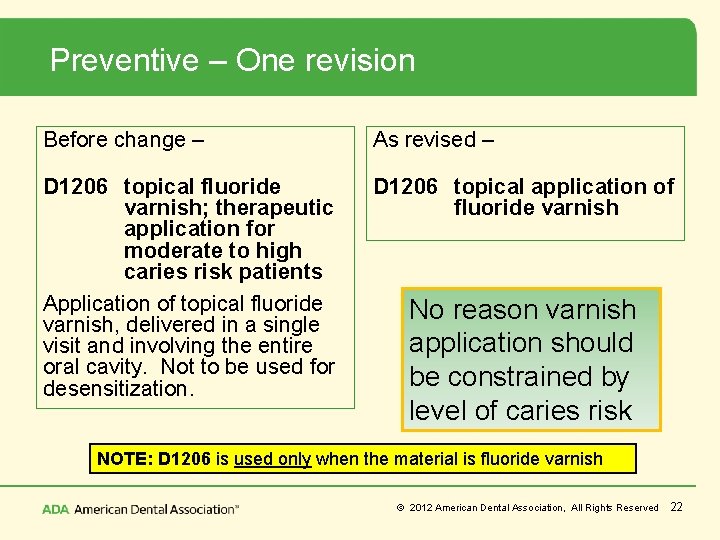
Preventive – One revision Before change – As revised – D 1206 topical fluoride varnish; therapeutic application for moderate to high caries risk patients Application of topical fluoride varnish, delivered in a single visit and involving the entire oral cavity. Not to be used for desensitization. D 1206 topical application of fluoride varnish No reason varnish application should be constrained by level of caries risk NOTE: D 1206 is used only when the material is fluoride varnish © 2012 American Dental Association, All Rights Reserved 22
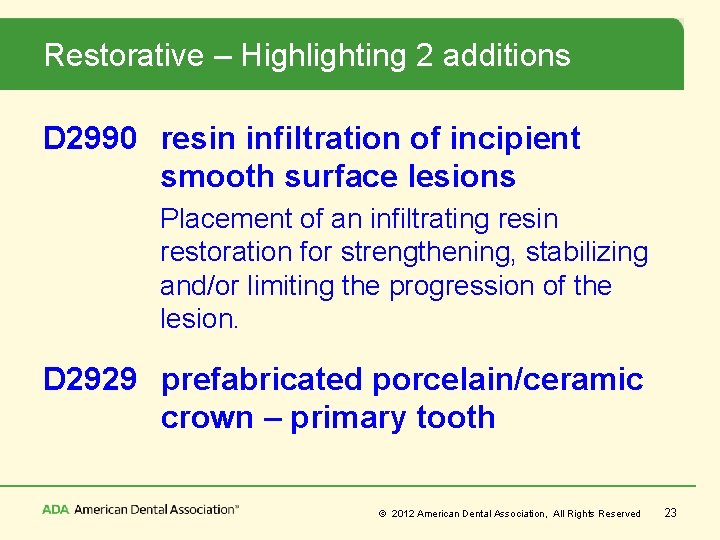
Restorative – Highlighting 2 additions D 2990 resin infiltration of incipient smooth surface lesions Placement of an infiltrating resin restoration for strengthening, stabilizing and/or limiting the progression of the lesion. D 2929 prefabricated porcelain/ceramic crown – primary tooth © 2012 American Dental Association, All Rights Reserved 23
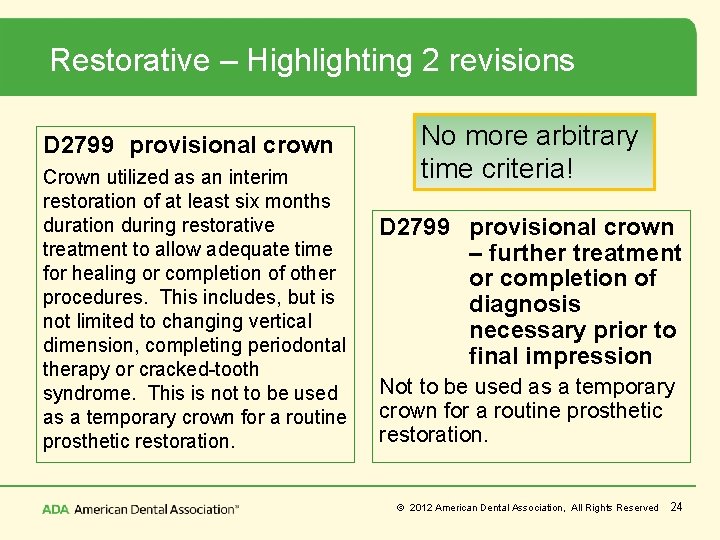
Restorative – Highlighting 2 revisions D 2799 provisional crown Crown utilized as an interim restoration of at least six months duration during restorative treatment to allow adequate time for healing or completion of other procedures. This includes, but is not limited to changing vertical dimension, completing periodontal therapy or cracked-tooth syndrome. This is not to be used as a temporary crown for a routine prosthetic restoration. No more arbitrary time criteria! D 2799 provisional crown – further treatment or completion of diagnosis necessary prior to final impression Not to be used as a temporary crown for a routine prosthetic restoration. © 2012 American Dental Association, All Rights Reserved 24
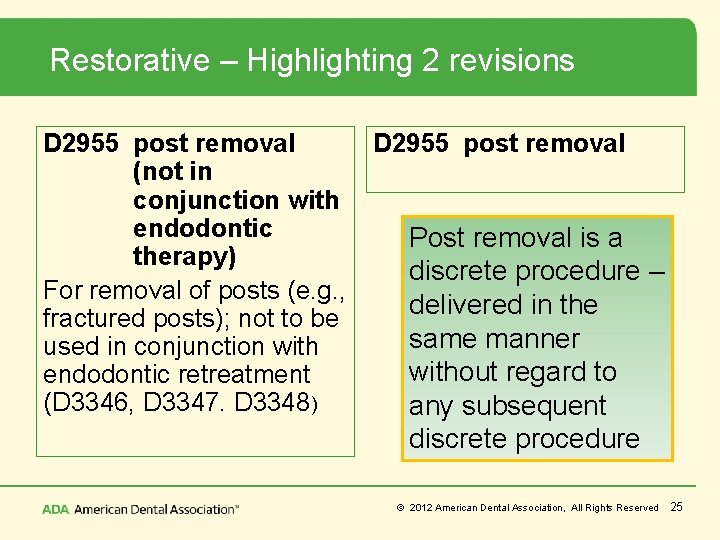
Restorative – Highlighting 2 revisions D 2955 post removal (not in conjunction with endodontic Post removal is a therapy) discrete procedure – For removal of posts (e. g. , delivered in the fractured posts); not to be same manner used in conjunction without regard to endodontic retreatment (D 3346, D 3347. D 3348) any subsequent discrete procedure © 2012 American Dental Association, All Rights Reserved 25
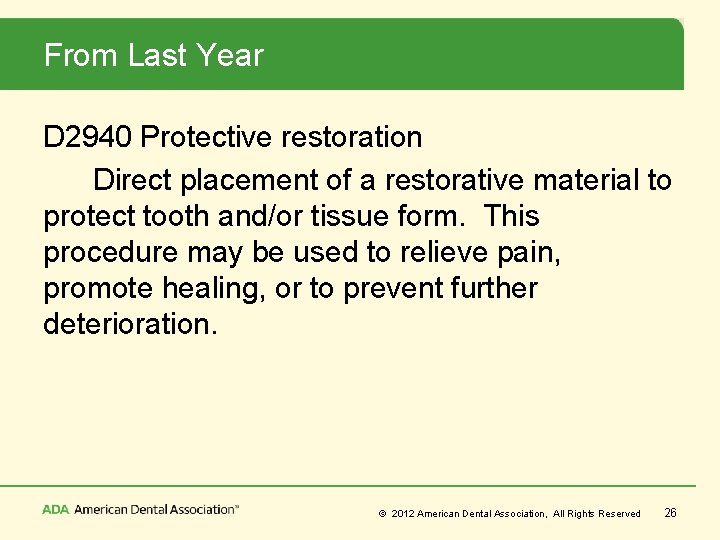
From Last Year D 2940 Protective restoration Direct placement of a restorative material to protect tooth and/or tissue form. This procedure may be used to relieve pain, promote healing, or to prevent further deterioration. © 2012 American Dental Association, All Rights Reserved 26
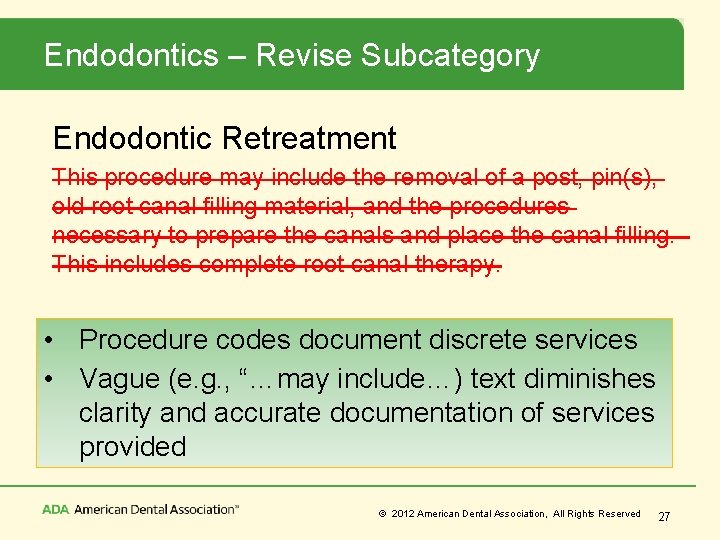
Endodontics – Revise Subcategory Endodontic Retreatment This procedure may include the removal of a post, pin(s), old root canal filling material, and the procedures necessary to prepare the canals and place the canal filling. This includes complete root canal therapy. • Procedure codes document discrete services • Vague (e. g. , “…may include…) text diminishes clarity and accurate documentation of services provided © 2012 American Dental Association, All Rights Reserved 27
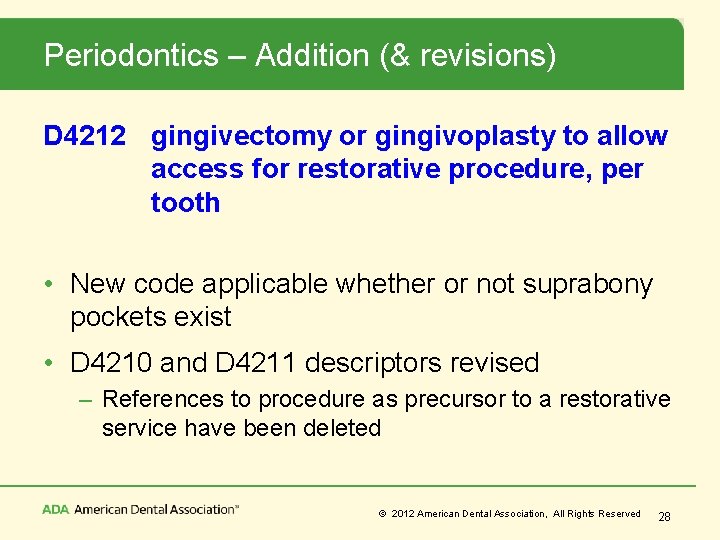
Periodontics – Addition (& revisions) D 4212 gingivectomy or gingivoplasty to allow access for restorative procedure, per tooth • New code applicable whether or not suprabony pockets exist • D 4210 and D 4211 descriptors revised – References to procedure as precursor to a restorative service have been deleted © 2012 American Dental Association, All Rights Reserved 28
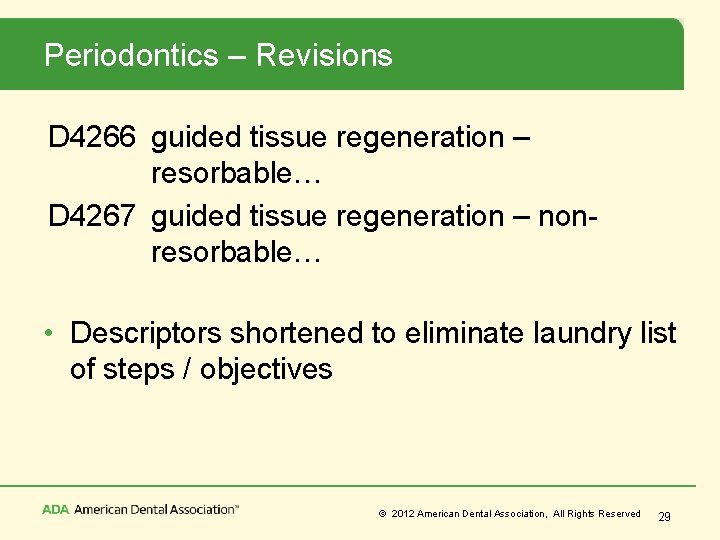
Periodontics – Revisions D 4266 guided tissue regeneration – resorbable… D 4267 guided tissue regeneration – nonresorbable… • Descriptors shortened to eliminate laundry list of steps / objectives © 2012 American Dental Association, All Rights Reserved 29
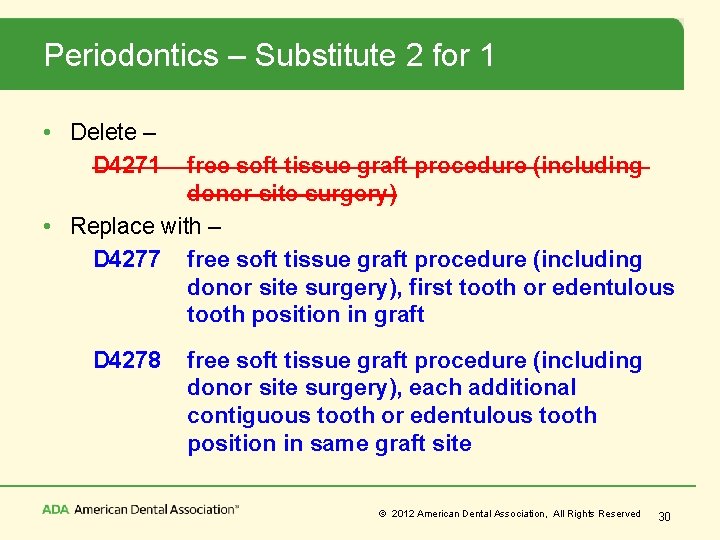
Periodontics – Substitute 2 for 1 • Delete – D 4271 free soft tissue graft procedure (including donor site surgery) • Replace with – D 4277 free soft tissue graft procedure (including donor site surgery), first tooth or edentulous tooth position in graft D 4278 free soft tissue graft procedure (including donor site surgery), each additional contiguous tooth or edentulous tooth position in same graft site © 2012 American Dental Association, All Rights Reserved 30
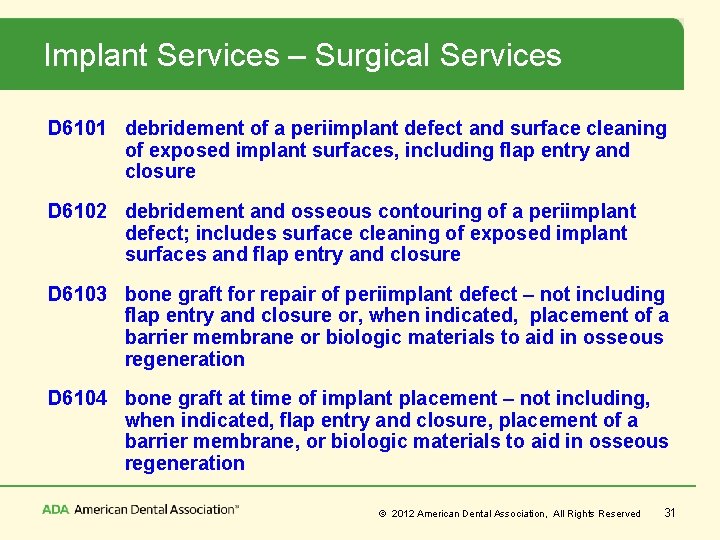
Implant Services – Surgical Services D 6101 debridement of a periimplant defect and surface cleaning of exposed implant surfaces, including flap entry and closure D 6102 debridement and osseous contouring of a periimplant defect; includes surface cleaning of exposed implant surfaces and flap entry and closure D 6103 bone graft for repair of periimplant defect – not including flap entry and closure or, when indicated, placement of a barrier membrane or biologic materials to aid in osseous regeneration D 6104 bone graft at time of implant placement – not including, when indicated, flap entry and closure, placement of a barrier membrane, or biologic materials to aid in osseous regeneration © 2012 American Dental Association, All Rights Reserved 31
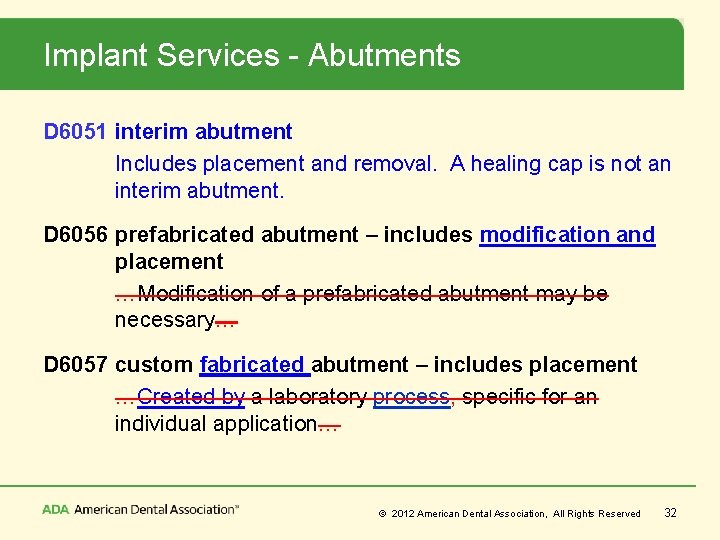
Implant Services - Abutments D 6051 interim abutment Includes placement and removal. A healing cap is not an interim abutment. D 6056 prefabricated abutment – includes modification and placement …Modification of a prefabricated abutment may be necessary… D 6057 custom fabricated abutment – includes placement …Created by a laboratory process, specific for an individual application… © 2012 American Dental Association, All Rights Reserved 32
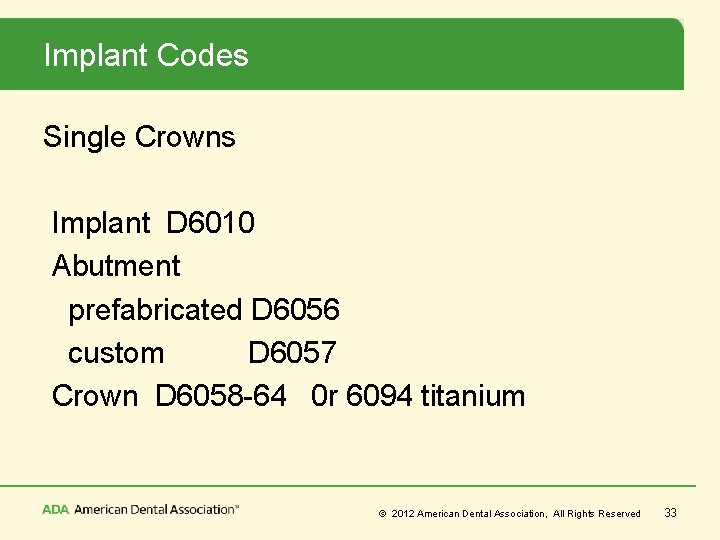
Implant Codes Single Crowns Implant D 6010 Abutment prefabricated D 6056 custom D 6057 Crown D 6058 -64 0 r 6094 titanium © 2012 American Dental Association, All Rights Reserved 33
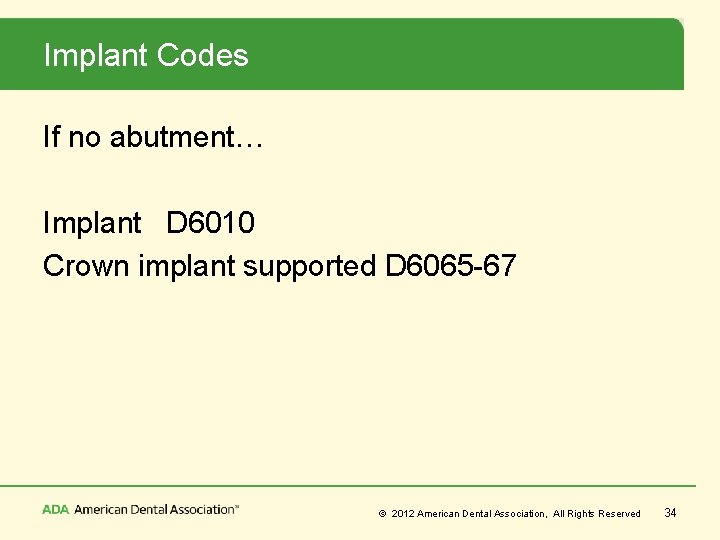
Implant Codes If no abutment… Implant D 6010 Crown implant supported D 6065 -67 © 2012 American Dental Association, All Rights Reserved 34
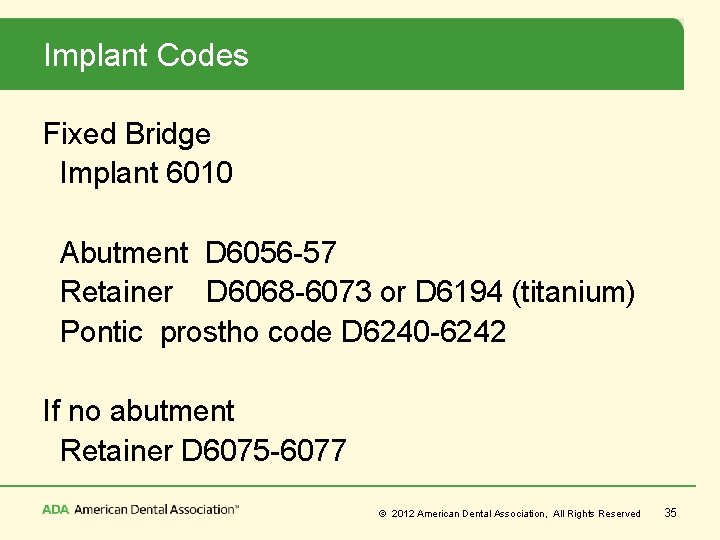
Implant Codes Fixed Bridge Implant 6010 Abutment D 6056 -57 Retainer D 6068 -6073 or D 6194 (titanium) Pontic prostho code D 6240 -6242 If no abutment Retainer D 6075 -6077 © 2012 American Dental Association, All Rights Reserved 35
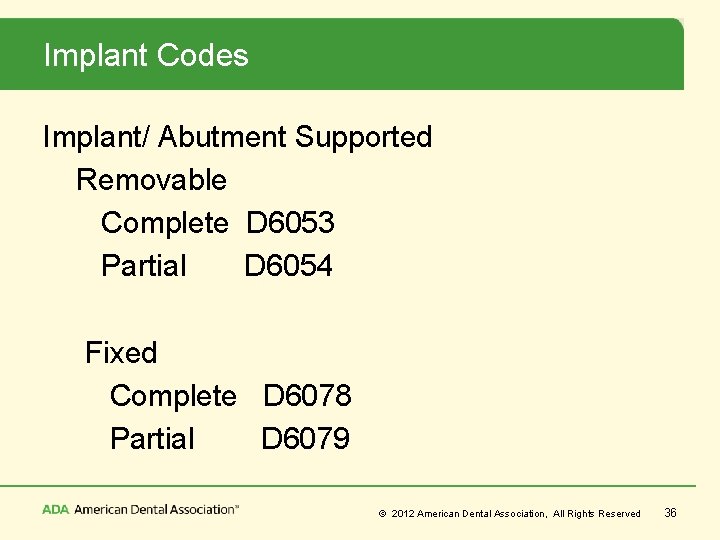
Implant Codes Implant/ Abutment Supported Removable Complete D 6053 Partial D 6054 Fixed Complete D 6078 Partial D 6079 © 2012 American Dental Association, All Rights Reserved 36
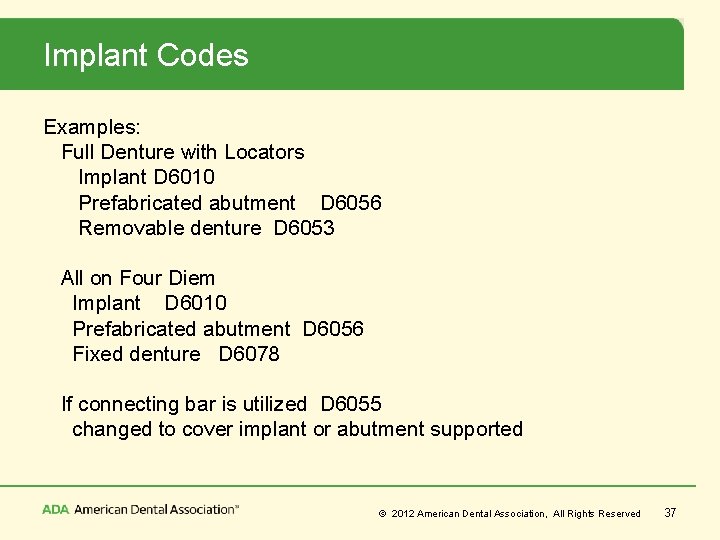
Implant Codes Examples: Full Denture with Locators Implant D 6010 Prefabricated abutment D 6056 Removable denture D 6053 All on Four Diem Implant D 6010 Prefabricated abutment D 6056 Fixed denture D 6078 If connecting bar is utilized D 6055 changed to cover implant or abutment supported © 2012 American Dental Association, All Rights Reserved 37
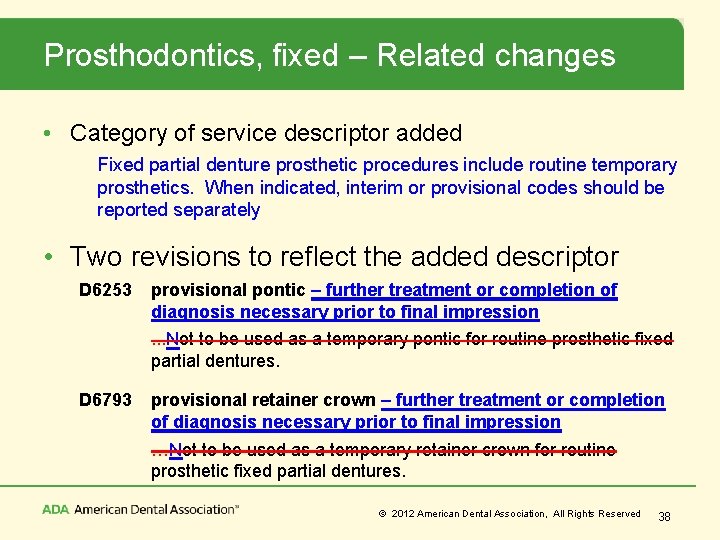
Prosthodontics, fixed – Related changes • Category of service descriptor added Fixed partial denture prosthetic procedures include routine temporary prosthetics. When indicated, interim or provisional codes should be reported separately • Two revisions to reflect the added descriptor D 6253 provisional pontic – further treatment or completion of diagnosis necessary prior to final impression. . . Not to be used as a temporary pontic for routine prosthetic fixed partial dentures. D 6793 provisional retainer crown – further treatment or completion of diagnosis necessary prior to final impression …Not to be used as a temporary retainer crown for routine prosthetic fixed partial dentures. © 2012 American Dental Association, All Rights Reserved 38
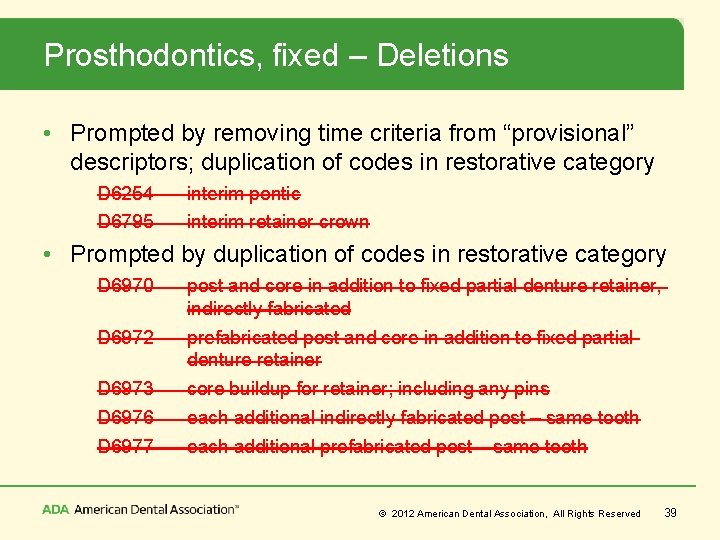
Prosthodontics, fixed – Deletions • Prompted by removing time criteria from “provisional” descriptors; duplication of codes in restorative category D 6254 interim pontic D 6795 interim retainer crown • Prompted by duplication of codes in restorative category D 6970 post and core in addition to fixed partial denture retainer, indirectly fabricated D 6972 prefabricated post and core in addition to fixed partial denture retainer D 6973 core buildup for retainer; including any pins D 6976 each additional indirectly fabricated post – same tooth D 6977 each additional prefabricated post – same tooth © 2012 American Dental Association, All Rights Reserved 39
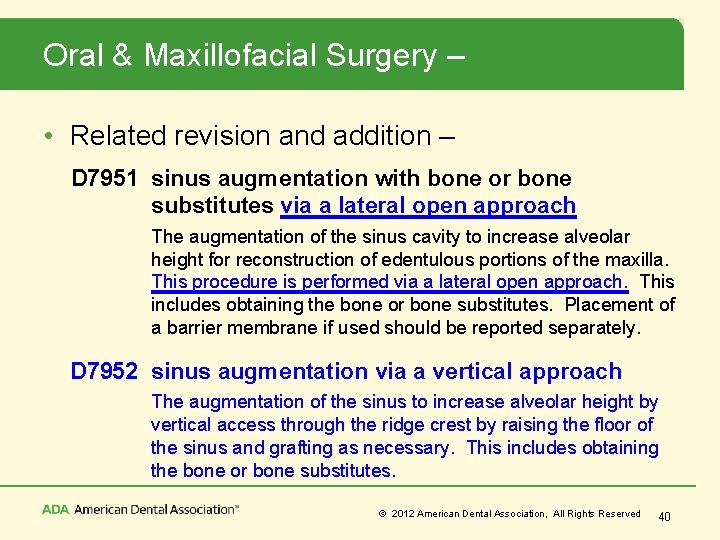
Oral & Maxillofacial Surgery – • Related revision and addition – D 7951 sinus augmentation with bone or bone substitutes via a lateral open approach The augmentation of the sinus cavity to increase alveolar height for reconstruction of edentulous portions of the maxilla. This procedure is performed via a lateral open approach. This includes obtaining the bone or bone substitutes. Placement of a barrier membrane if used should be reported separately. D 7952 sinus augmentation via a vertical approach The augmentation of the sinus to increase alveolar height by vertical access through the ridge crest by raising the floor of the sinus and grafting as necessary. This includes obtaining the bone or bone substitutes. © 2012 American Dental Association, All Rights Reserved 40
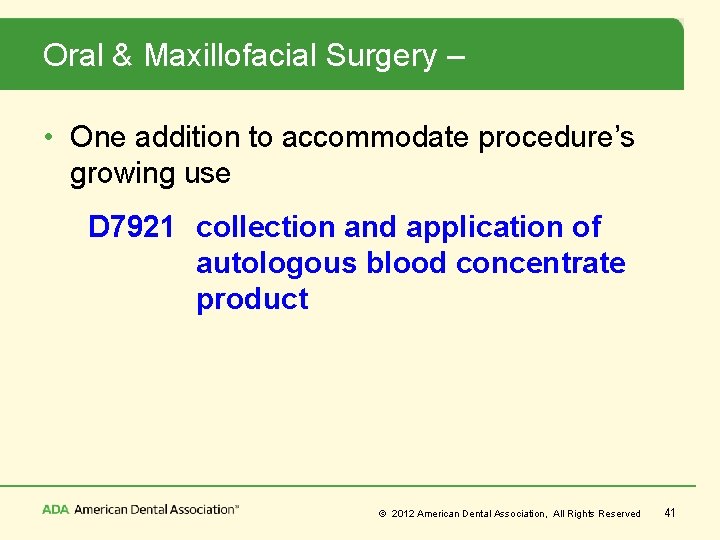
Oral & Maxillofacial Surgery – • One addition to accommodate procedure’s growing use D 7921 collection and application of autologous blood concentrate product © 2012 American Dental Association, All Rights Reserved 41
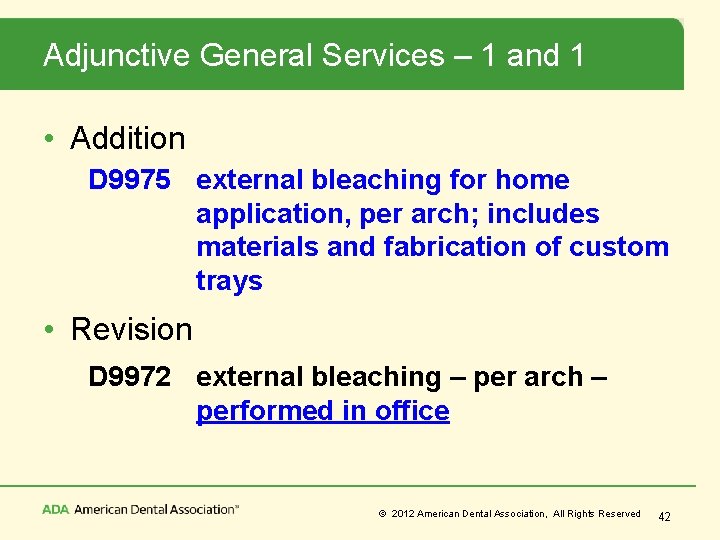
Adjunctive General Services – 1 and 1 • Addition D 9975 external bleaching for home application, per arch; includes materials and fabrication of custom trays • Revision D 9972 external bleaching – per arch – performed in office © 2012 American Dental Association, All Rights Reserved 42
Preventing Claim Form Errors How to prevent various types of claim coding errors Unintended errors are most often caused by misunderstanding or misinformation > Situations that can be avoided with knowledge © 2012 American Dental Association. All Rights Reserved 43
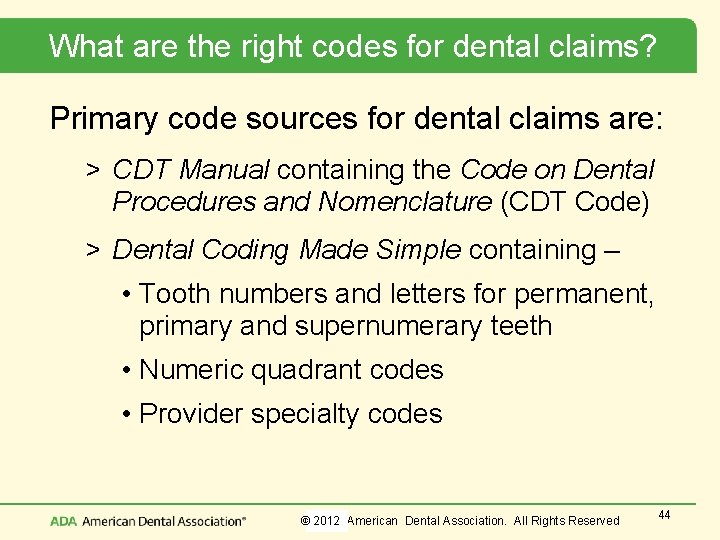
What are the right codes for dental claims? Primary code sources for dental claims are: > CDT Manual containing the Code on Dental Procedures and Nomenclature (CDT Code) > Dental Coding Made Simple containing – • Tooth numbers and letters for permanent, primary and supernumerary teeth • Numeric quadrant codes • Provider specialty codes © 2012 American Dental Association. All Rights Reserved 44
Avoiding procedure code errors The first question to ask – Am I using the current version of the CDT Code? HIPAA says use the version of the CDT Code in effect on the date of service. > For example, if the service is provided on July 1, 2013 use the version of the CDT Code published in CDT 2013. © 2012 American Dental Association. All Rights Reserved 45
Avoiding procedure code errors The second question to ask is – Have I selected the appropriate code for the service provided? When determining what procedure code to use please consider the complete entry – nomenclature and descriptor – printed in the current CDT manual. Some software and publications truncate nomenclatures and exclude descriptors. © 2012 American Dental Association. All Rights Reserved 46
No code describing a procedure? “unspecified… procedure by report” (Dnn 99) codes are: • For those situations where, in the opinion of the dentist none of the entries in the CDT Code accurately describe the services provided the patient • In each category of dental services except Preventive. © 2012 American Dental Association. All Rights Reserved 47
Avoiding procedure code errors Suppose you reported either (or both) of the following procedures on a claim: D 0160 detailed and extensive oral evaluation – problem focused, by report D 2999 unspecified restorative procedure, by report The question to ask is – I used a “by report” code, have I included a narrative? © 2012 American Dental Association. All Rights Reserved 48
“…by report” – What to say A clear and concise narrative that includes: >Clinical condition of the oral cavity >Description of the procedure performed >Specific reasons why extra time or material was needed >How new technology enabled procedure delivery >Any specific information required under a participating provider contract © 2012 American Dental Association. All Rights Reserved 49
“…by report” – What to say A third-party payer is likely to return the entire claim if the narrative is missing. Even when the narrative is present you may be asked for additional information. © 2012 American Dental Association. All Rights Reserved 50
New codified data – starting in 2012 Diagnosis – up to four may be reported for each procedure on a claim > Reporting is discretionary > May be reported on the HIPAA standard electronic dental claim and the ADA’s paper claim form Codes used are in the public domain > ICD-9 -CM (now) > ICD-10 -CM (later - 2014) © 2012 American Dental Association. All Rights Reserved 51
Coding for Reimbursement Question – What procedure codes have the best chance of reimbursement? Answer – Codes for procedures that are covered by the patient’s dental benefit plan BUT Your treatment plan should be based on the patient’s clinical needs, not on covered procedures © 2012 American Dental Association. All Rights Reserved 52
Coding for Reimbursement Facts of Life – > Not all procedures are covered > Some have annual or lifetime limitations > Limitations and exclusions can vary between different plans offered by the same company > HIPAA only requires that a payer accept a valid procedure code for processing > HIPAA does not require that there be a payment for every procedure in the CDT Code © 2012 American Dental Association. All Rights Reserved 53
Determining the date of service When there is a single code for a procedure that requires multiple appointments (e. g. , an immediate denture) how do I determine what the date of service should be? > ADA policy for fixed and removable prosthetic cases encourages third party payers to use date of impression as date of service > Some state laws & third party processing policies and contract provisions specify completion date as the date of service © 2012 American Dental Association. All Rights Reserved 54
Determining the date of service • Weigh all these factors when determining date of service reported for the procedure code – Be consistent and compliant with policy, regulations and contract provisions – Remember, ADA policy is aspirational, but requires inclusion in legislation or regulation to have any authority in a given jurisdiction © 2012 American Dental Association, All Rights Reserved 55
Claim Coding Confusion © 2012 American Dental Association. All Rights Reserved 56
Examples of confusion – There are many reasons why a dentist or practice staff may be unsure about the procedure code to use – e. g. , > Infrequent delivery of the procedure > Conflicting information from peers or third-party payers Examples that follow are based on questions posed to ADA staff Guidance is based on the published procedure code nomenclatures and descriptors © 2012 American Dental Association. All Rights Reserved 57
Consultation – or – Oral Evaluation? When is it appropriate to report a consultation (D 9310) instead of an evaluation (e. g. , D 0140)? A consultation occurs when Dentist A refers a patient to Dentist B for an opinion or advice on a particular problem > Dentist A would report the appropriate oral evaluation code > Dentist B would report the consultation code D 9130. © 2012 American Dental Association. All Rights Reserved 58
Periodic and Periodontal Evaluations During a periodic oral evaluation the patient showed signs and symptoms of periodontal disease - and received a complete periodontal evaluation. May both evaluations be reported? > Only the D 0180 is reported > It includes all components of a periodic evaluation, and adds additional requirements for periodontal charting and the evaluation of periodontal conditions © 2012 American Dental Association. All Rights Reserved 59
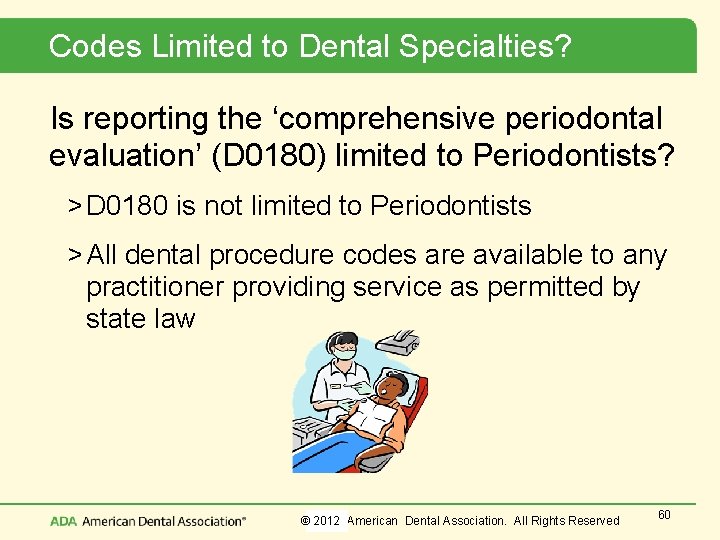
Codes Limited to Dental Specialties? Is reporting the ‘comprehensive periodontal evaluation’ (D 0180) limited to Periodontists? > D 0180 is not limited to Periodontists > All dental procedure codes are available to any practitioner providing service as permitted by state law © 2012 American Dental Association. All Rights Reserved 60
Panoramic + Bitewings = “FMX? ” Are a panoramic film and bitewings considered a full mouth series of radiographs? > No – a full mouth series (aka FMX) is defined in the descriptor of “D 0210 intraoral, complete series…” > “A set of intraoral radiographs usually consisting of 14 to 22 periapical and posterior bitewing images intended to display the crowns and roots of all teeth, periapical areas and alveolar bone crest. ” © 2012 American Dental Association. All Rights Reserved 61
Panoramic + Bitewings = “FMX? ” Third-party payers sometimes bundle claims for panoramic and bitewing (or periapical) images and calculate reimbursement using D 0210 fees The ADA considers this a potentially fraudulent practice that should be appealed because: > D 0210 reimbursement is likely to be less than amounts paid for panoramic and other images > Bundled payment could lead to denial of a later D 0210 claim due to plan limitations/exclusions > Records of services rendered will be inaccurate © 2012 American Dental Association. All Rights Reserved 62
Product vs. Procedure Our office recently purchased a Vel. Scope – what procedure code applies to its use? > Procedure codes are not product or brandname specific > Devices such as the Vel. Scope may be used in the delivery of procedures such as: D 0431 adjunctive pre-diagnostic test that aids in detection of mucosal abnormalities including premalignant and malignant lesions, not to include cytology or biopsy procedures © 2012 American Dental Association. All Rights Reserved 63
More difficult & time consuming What code is used to document a difficult prophylaxis, or any procedure that requires more time than usual? > There are no separate procedure codes that reflect the degree of difficulty or additional time required for operative dental procedures > Existing procedure codes (e. g. , D 1110 prophylaxis – adult) are used to document the service © 2012 American Dental Association. All Rights Reserved 64
Occlusal pits and fissures When mechanical enlargement of occlusal pits and fissures is performed in conjunction with placement of a dental sealant, this preparation step is not reported separately > The reason is the “D 1351 sealant – per tooth” descriptor includes the preparation step – Mechanically and/or chemically prepared enamel surface sealed to prevent decay. Sealants are usually applied when there is no decay © 2012 American Dental Association. All Rights Reserved 65
Occlusal pits and fissures with decay - 1 There is a continuum of procedures related to pits and fissures When decay that does not extend into the dentin is present another procedure code is appropriate D 1352 preventive resin restoration in a moderate to high caries risk patient – permanent tooth Conservative restoration of an active cavitated lesion in a pit or fissure that does not extend into dentin; includes placement of a sealant in any radiating non-carious fissures or pits. © 2012 American Dental Association. All Rights Reserved 66
Occlusal pits and fissures with decay - 2 The continuum ends with a third procedure code that is appropriate when decay extends into the dentin D 2391 resin-based composite – one surface, posterior Used to restore a carious lesion into the dentin or a deeply eroded area into the dentin. Not a preventive procedure. © 2012 American Dental Association. All Rights Reserved 67
Prophylaxis + Scaling & Root Planing (SRP) Can D 1110 (adult prophylaxis) and D 4342 (scaling and root planing one to three teeth) be reported on the same date of service? > There is nothing in either codes’ nomenclature or descriptor that says these two cannot be delivered to the patient on the same day > However, provisions of many benefit plans do not allow payment of benefits for these procedures when reported on the same date of service © 2012 American Dental Association. All Rights Reserved 68
Local anesthesia How may I report local anesthesia as a separate procedure? > “D 9215 local anesthesia in conjunction with operative or surgical procedures” is the procedure code for separate reporting > Benefit plan limitations and exclusions may preclude separate reimbursement for local anesthesia > Participating providers are likely unable to bill patients when anesthesia is not reimbursed © 2012 American Dental Association. All Rights Reserved 69
Two 2 -Surface Restorations on Same Tooth How do I report two separate 2 -surface restorations on the same tooth? Carriers advise me to report a MO amalgam and a DO amalgam as a MOD restoration > Report the procedures as performed, using D 2150 twice – once for the MO and the second for the DO – on the same tooth > Some plans limit coverage when the same surface is involved more than once on the same date, and may apply an alternate benefit based on the fee for a single restoration © 2012 American Dental Association. All Rights Reserved 70
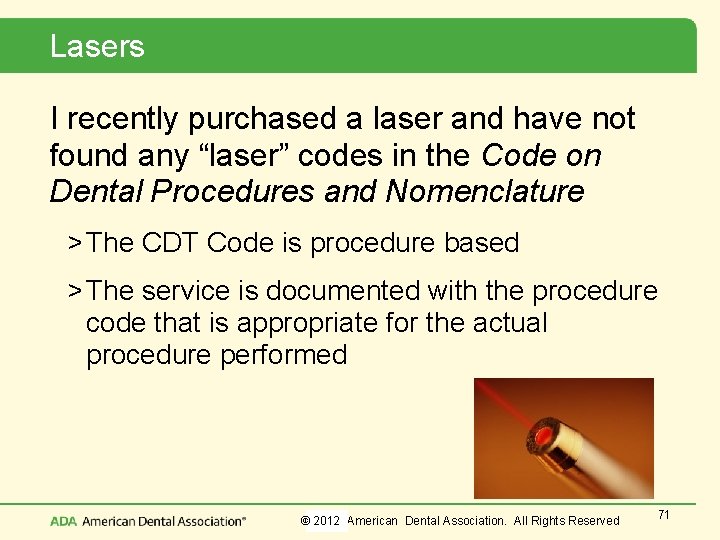
Lasers I recently purchased a laser and have not found any “laser” codes in the Code on Dental Procedures and Nomenclature > The CDT Code is procedure based > The service is documented with the procedure code that is appropriate for the actual procedure performed © 2012 American Dental Association. All Rights Reserved 71
Crown materials What procedure code is used to document a porcelain fused to zirconium crown? > The available procedure code is “D 2740 crown – porcelain/ceramic substrate. ” How is a porcelain fused to titanium crown reported as the only code is “D 2794 crown – titanium” > D 2794 is the only titanium crown procedure code available and should be used for all varieties of titanium crowns © 2012 American Dental Association. All Rights Reserved 72
IRM – Sedative or Palliative? Is placement of IRM (Intermediate Restorative Material) a protective restoration, or a palliative, procedure? > Either procedure is applicable depending on the clinical condition – D 2940 (protective restoration) is used for multiple reasons, including pain relief – D 9110 (palliative treatment) is only for emergency treatment of dental pain > Only one of the two codes is used to document placement when the patient presents © 2012 American Dental Association. All Rights Reserved 73
Unfinished procedures How is the doctor to report a situation where a restorative (or any other) procedure is started but not finished? > The current version of the CDT Code does not contain codes for procedures that are started but not completed – One exception – D 3332 incomplete endodontic therapy; inoperable, unrestorable or fractured tooth > For other situations an unspecified procedure, by report code (e. g. , "D 2999 unspecified restorative procedure, by report") may be used © 2012 American Dental Association. All Rights Reserved 74
Endodontic access restoration An access cavity was made through a crown for endodontic treatment. What procedure code is appropriate to report sealing an endodontic access cavity? > There is no code that specifically refers to placement of a restoration to seal an endodontic access cavity > Appropriate restorative codes may be used to report the final sealing of an access cavity – Or, an “unspecified…procedure, by report” code may be considered (e. g. , D 2999 unspecified restorative procedure, by report) © 2012 American Dental Association. All Rights Reserved 75
Debridement and Evaluations Can I report a full mouth debridement – D 4355 – on the same day as a comprehensive oral or periodontal evaluation? > Yes, as there is no language in the D 4355 descriptor that precludes the reporting of any other procedures on the same date of service > However, dental benefit plans may exclude or limit reimbursement for the other services (e. g. , D 0150; D 0180) when performed on the same day © 2012 American Dental Association. All Rights Reserved 76
Implant Pontics When reporting a fixed partial denture placed on implants, how do I report a pontic? There are no pontic codes in the CDT Code’s Implant Services category > Pontic codes in the Prosthodontics, fixed category are used for both fixed partial and implant supported dentures > All pontic codes begin with D 62 xx and are used with the appropriate Implant or FPD retainer codes © 2012 American Dental Association. All Rights Reserved 77
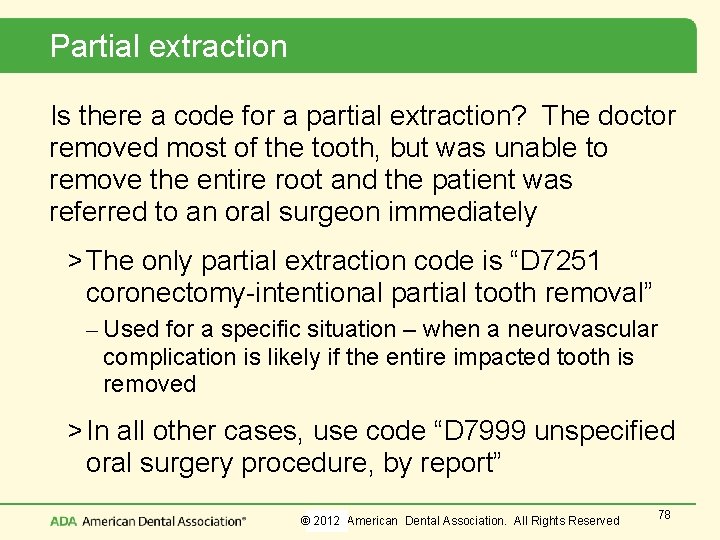
Partial extraction Is there a code for a partial extraction? The doctor removed most of the tooth, but was unable to remove the entire root and the patient was referred to an oral surgeon immediately > The only partial extraction code is “D 7251 coronectomy-intentional partial tooth removal” – Used for a specific situation – when a neurovascular complication is likely if the entire impacted tooth is removed > In all other cases, use code “D 7999 unspecified oral surgery procedure, by report” © 2012 American Dental Association. All Rights Reserved 78
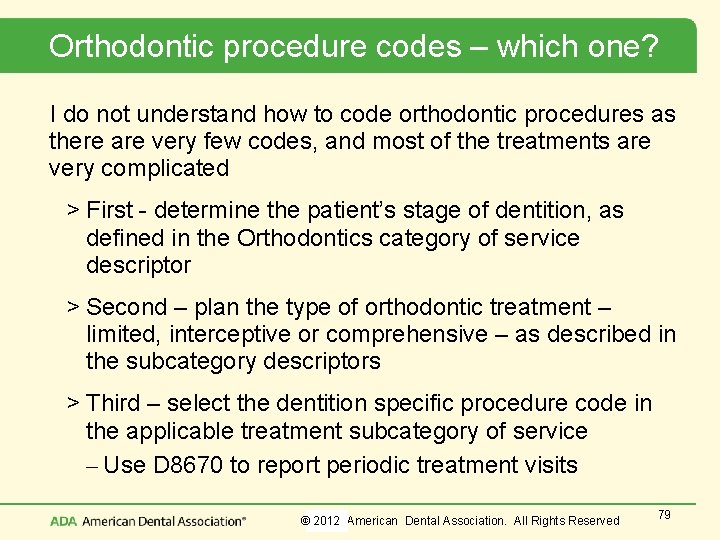
Orthodontic procedure codes – which one? I do not understand how to code orthodontic procedures as there are very few codes, and most of the treatments are very complicated > First - determine the patient’s stage of dentition, as defined in the Orthodontics category of service descriptor > Second – plan the type of orthodontic treatment – limited, interceptive or comprehensive – as described in the subcategory descriptors > Third – select the dentition specific procedure code in the applicable treatment subcategory of service – Use D 8670 to report periodic treatment visits © 2012 American Dental Association. All Rights Reserved 79
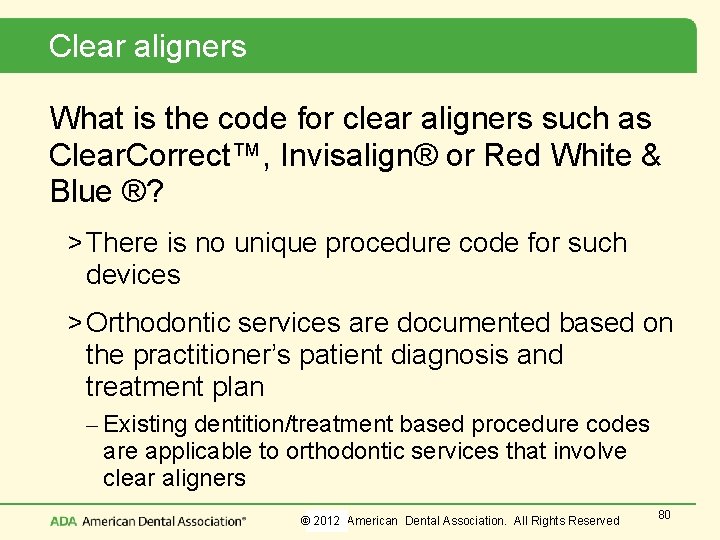
Clear aligners What is the code for clear aligners such as Clear. Correct™, Invisalign® or Red White & Blue ®? > There is no unique procedure code for such devices > Orthodontic services are documented based on the practitioner’s patient diagnosis and treatment plan – Existing dentition/treatment based procedure codes are applicable to orthodontic services that involve clear aligners © 2012 American Dental Association. All Rights Reserved 80
When a claim is denied or rejected © 2012 American Dental Association. All Rights Reserved 81
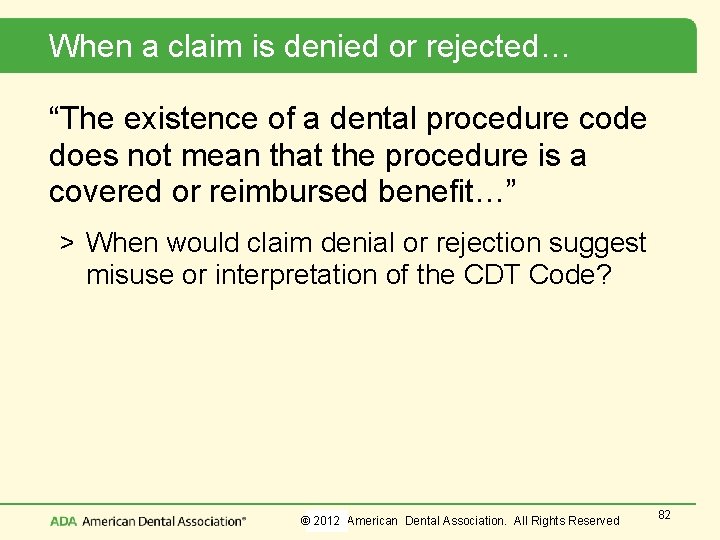
When a claim is denied or rejected… “The existence of a dental procedure code does not mean that the procedure is a covered or reimbursed benefit…” > When would claim denial or rejection suggest misuse or interpretation of the CDT Code? © 2012 American Dental Association. All Rights Reserved 82
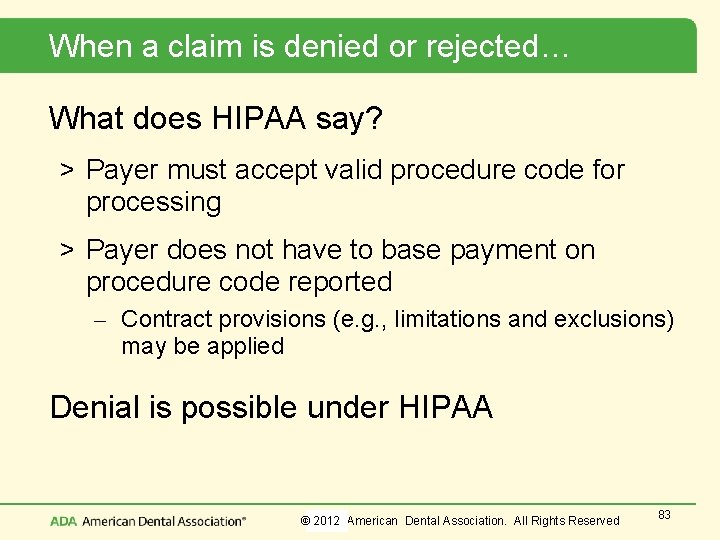
When a claim is denied or rejected… What does HIPAA say? > Payer must accept valid procedure code for processing > Payer does not have to base payment on procedure code reported – Contract provisions (e. g. , limitations and exclusions) may be applied Denial is possible under HIPAA © 2012 American Dental Association. All Rights Reserved 83
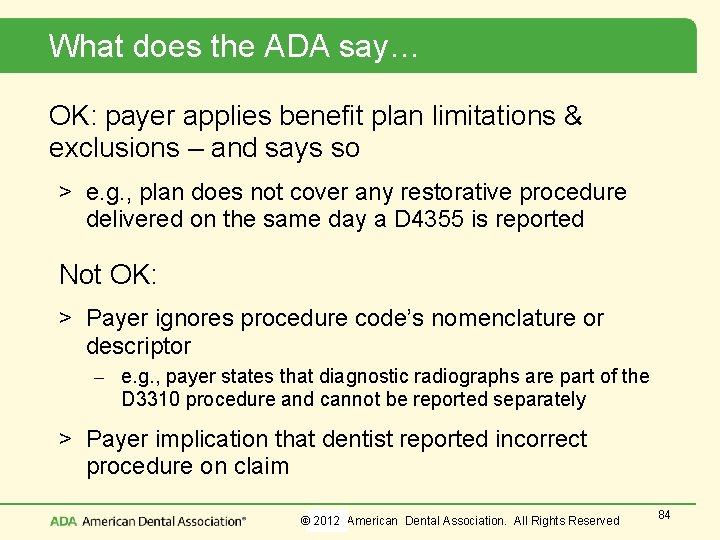
What does the ADA say… OK: payer applies benefit plan limitations & exclusions – and says so > e. g. , plan does not cover any restorative procedure delivered on the same day a D 4355 is reported Not OK: > Payer ignores procedure code’s nomenclature or descriptor – e. g. , payer states that diagnostic radiographs are part of the D 3310 procedure and cannot be reported separately > Payer implication that dentist reported incorrect procedure on claim © 2012 American Dental Association. All Rights Reserved 84
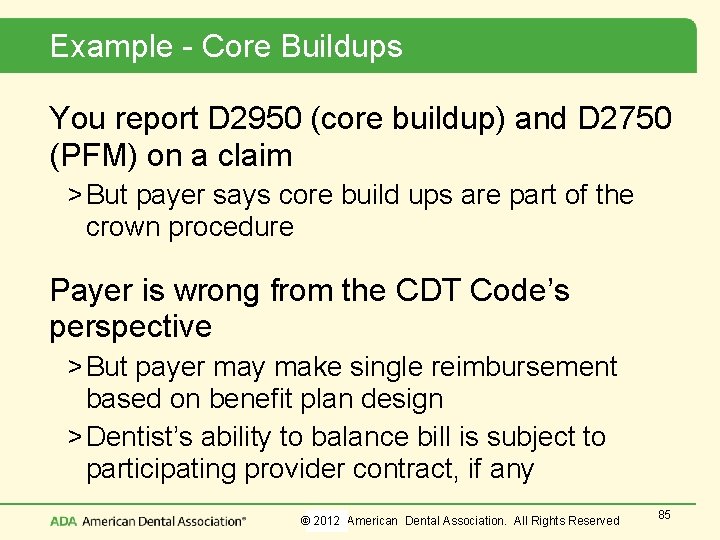
Example - Core Buildups You report D 2950 (core buildup) and D 2750 (PFM) on a claim > But payer says core build ups are part of the crown procedure Payer is wrong from the CDT Code’s perspective > But payer may make single reimbursement based on benefit plan design > Dentist’s ability to balance bill is subject to participating provider contract, if any © 2012 American Dental Association. All Rights Reserved 85
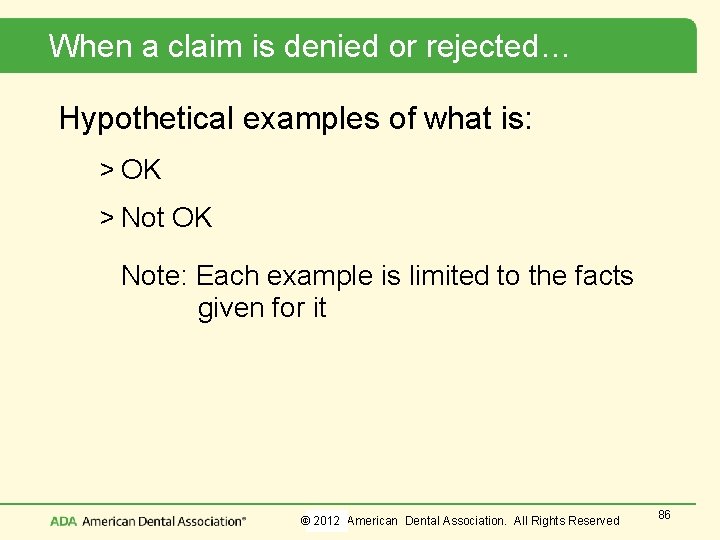
When a claim is denied or rejected… Hypothetical examples of what is: > OK > Not OK Note: Each example is limited to the facts given for it © 2012 American Dental Association. All Rights Reserved 86
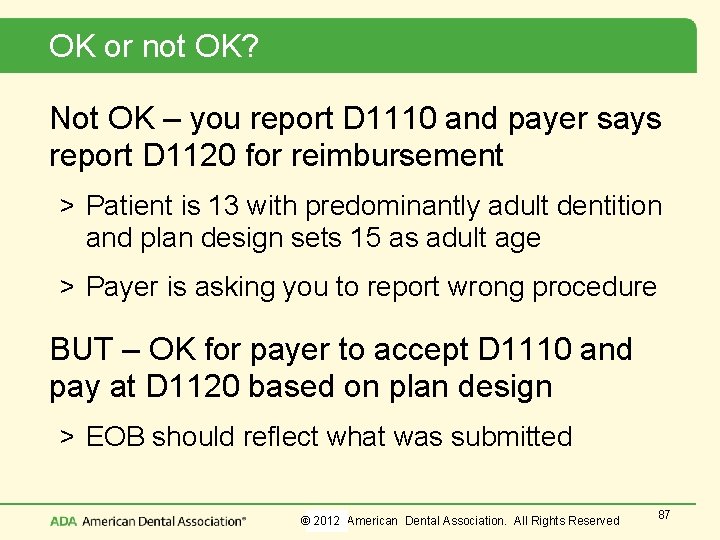
OK or not OK? Not OK – you report D 1110 and payer says report D 1120 for reimbursement > Patient is 13 with predominantly adult dentition and plan design sets 15 as adult age > Payer is asking you to report wrong procedure BUT – OK for payer to accept D 1110 and pay at D 1120 based on plan design > EOB should reflect what was submitted © 2012 American Dental Association. All Rights Reserved 87
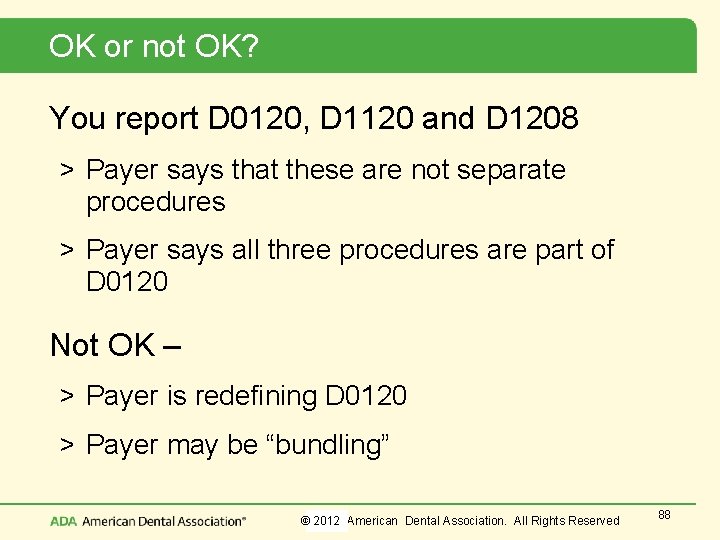
OK or not OK? You report D 0120, D 1120 and D 1208 > Payer says that these are not separate procedures > Payer says all three procedures are part of D 0120 Not OK – > Payer is redefining D 0120 > Payer may be “bundling” © 2012 American Dental Association. All Rights Reserved 88
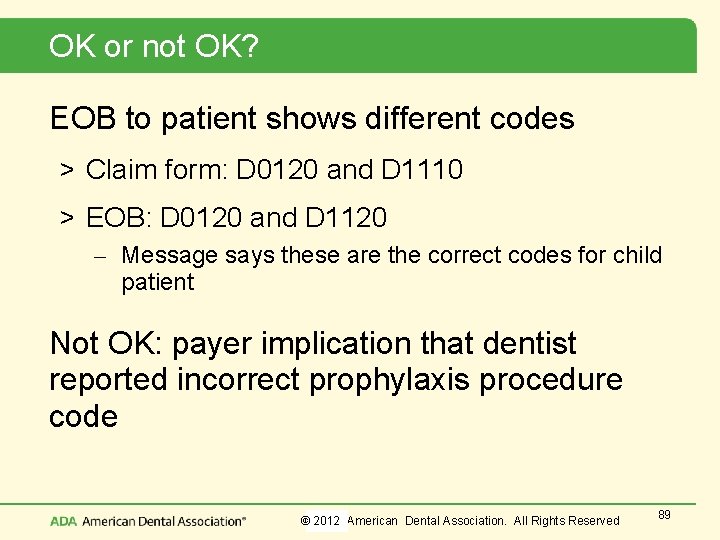
OK or not OK? EOB to patient shows different codes > Claim form: D 0120 and D 1110 > EOB: D 0120 and D 1120 – Message says these are the correct codes for child patient Not OK: payer implication that dentist reported incorrect prophylaxis procedure code © 2012 American Dental Association. All Rights Reserved 89
What can you do? Contact ADA Member Service Center (MSC) to report problems > Payers using the CDT Code must be licensed > License does not dictate how a code is paid Arbitrary payer action is ADA concern > Reports enable ADA staff to address recurring issues with payers © 2012 American Dental Association. All Rights Reserved 90
Preventing and Resolving Errors © 2012 American Dental Association. All Rights Reserved 91
Preventing and resolving CDT Code errors Prevention is the best practice, which means – >Any questions concerning proper coding should be addressed as the claim is being prepared >There should be a quality review before submission Otherwise, procedure code errors are usually revealed when – >The payer rejects a claim >Or asks for additional information before processing © 2012 American Dental Association. All Rights Reserved 92
Error prevention If there is any question about the correct code when staff is preparing the claim – The first source of procedure coding guidance is information in the office: > The current CDT Manual* > The dentist’s knowledge and experience. (* To determine if a code is applicable to the service provided read the complete entry, code nomenclature and descriptor, plus any category or subcategory descriptor) © 2012 American Dental Association. All Rights Reserved 93
Error prevention The second source of procedure coding guidance is the ADA. • By telephone to the Member Service Center – (800) 621 -8099 • By email to dentalcode@ada. org © 2012 American Dental Association. All Rights Reserved 94
Error resolution Review returned or denied claims to ensure that the procedure codes reported are correct If there is a coding error, prepare and submit a corrected claim > Errors should always be corrected, but will not always eliminate an accusation of fraud When there is no coding error, prepare an appeal if there are grounds to do so, as in the following two examples © 2012 American Dental Association. All Rights Reserved 95
Payer error that should be appealed - 1 The patient is age 13 with predominantly adult dentition and you report D 1110 The payer says report D 1120 for reimbursement because the benefit plan says an adult is age 15 or more > Here the payer is ignoring the D 1110 descriptor and asking that you report the wrong procedure code > Coding for what you do is the only proper action, regardless of payer policies or reimbursement © 2012 American Dental Association. All Rights Reserved 96
Payer error that should be appealed - 2 You report D 0120, D 1120 and D 1203 on a claim, but the payer says these are not separate procedures, they are all part of the D 0120 > The payer is ignoring the nomenclatures and descriptors of these discrete codes, and is redefining procedure code D 0120 – such redefinition is a copyright violation > The payer may also be “bundling” – a potentially fraudulent act – Payers may benefit procedures in combination with others as part of their payment policies – But they cannot claim that discrete procedures are actually part of others © 2012 American Dental Association. All Rights Reserved 97
What do the contracts say? • What are your patient’s benefit plan limitations and exclusions – e. g. , – “Child prophy” reimbursement through patient age 15 – No more than two D 4910 s per calendar year © 2012 American Dental Association, All Rights Reserved 98
What do the contracts say? • What are your participating provider contract provisions – e. g. , dentist agrees to: – Least expensive alternative treatment “LEAT” reimbursement – Reimbursement based on Payer guidelines v. specific codes reported on claim • Dentist who signs a participating provider contract is generally bound to its legally sound provisions – Know what you are agreeing to before signing – ADA Contract Analysis Service © 2012 American Dental Association, All Rights Reserved 99
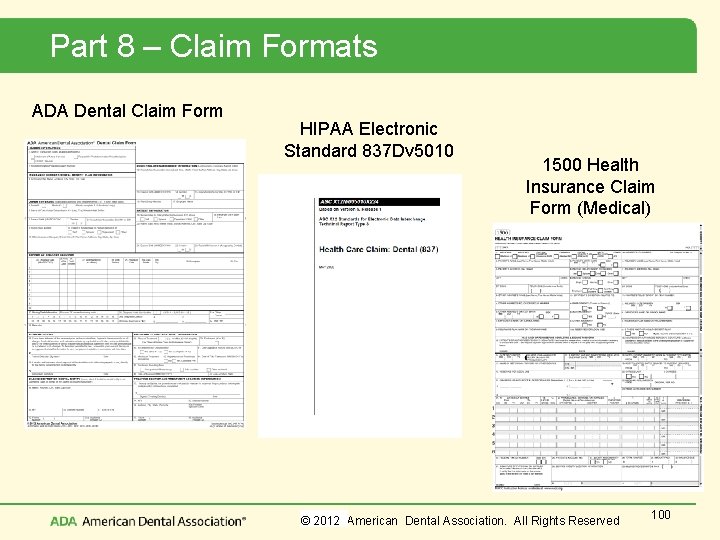
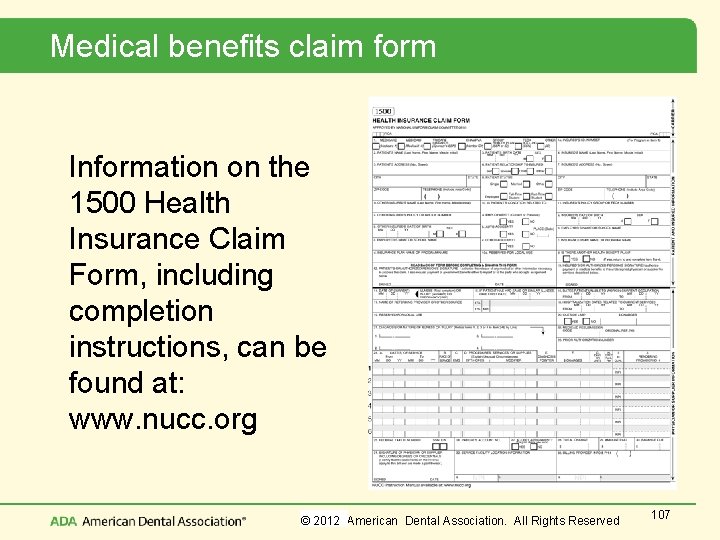
Part 8 – Claim Formats ADA Dental Claim Form HIPAA Electronic Standard 837 Dv 5010 1500 Health Insurance Claim Form (Medical) © 2012 American Dental Association. All Rights Reserved 100
ADA Dental Claim Form 2001 – HOD adopts resolution that ADA paper claim form data content mirror the HIPAA standard electronic dental claim, as much as possible > First revisions when HIPAA standard became effective in 2003 > Additional changes when National Provider Identifier (NPI) implemented in 2006 > Latest changes with implementation of revised HIPAA standard in 2012 © 2012 American Dental Association. All Rights Reserved 101
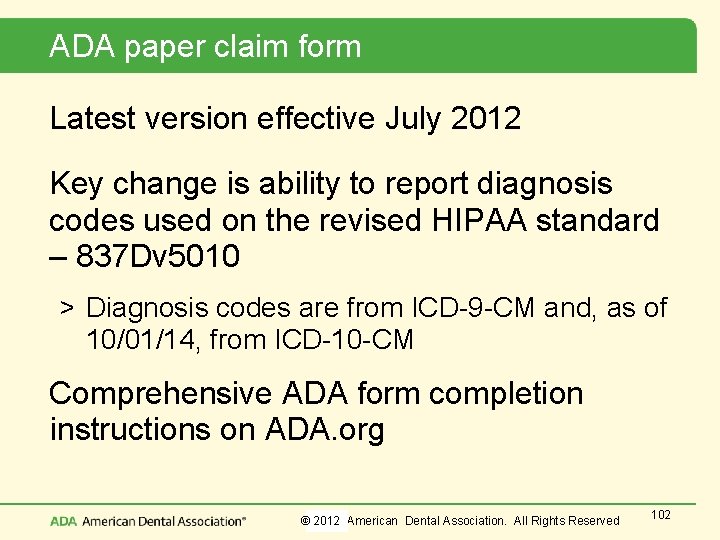
ADA paper claim form Latest version effective July 2012 Key change is ability to report diagnosis codes used on the revised HIPAA standard – 837 Dv 5010 > Diagnosis codes are from ICD-9 -CM and, as of 10/01/14, from ICD-10 -CM Comprehensive ADA form completion instructions on ADA. org © 2012 American Dental Association. All Rights Reserved 102
ADA claim form – Diagnosis Codes Diagnosis Code Pointer ICD-9 -CM Diagnosis Code (at least one) © 2012 American Dental Association. All Rights Reserved 103
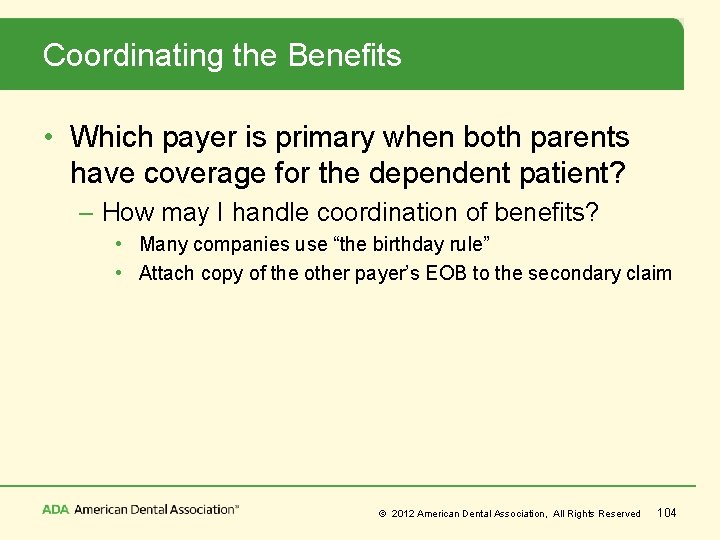
Coordinating the Benefits • Which payer is primary when both parents have coverage for the dependent patient? – How may I handle coordination of benefits? • Many companies use “the birthday rule” • Attach copy of the other payer’s EOB to the secondary claim © 2012 American Dental Association, All Rights Reserved 104
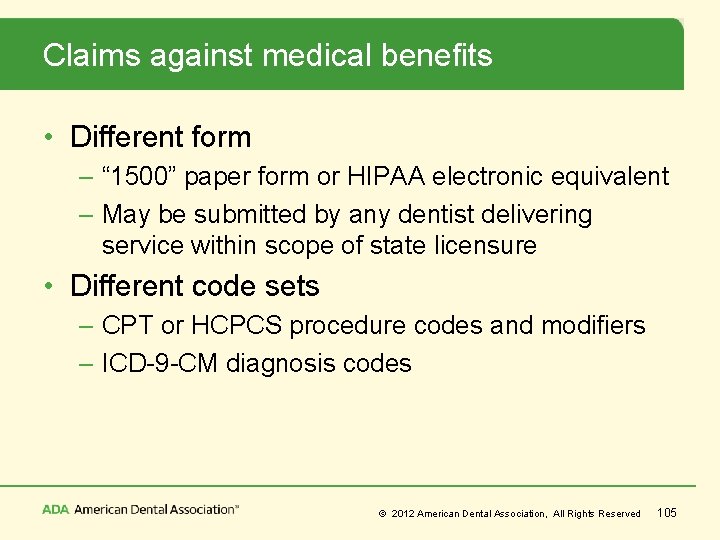
Claims against medical benefits • Different form – “ 1500” paper form or HIPAA electronic equivalent – May be submitted by any dentist delivering service within scope of state licensure • Different code sets – CPT or HCPCS procedure codes and modifiers – ICD-9 -CM diagnosis codes © 2012 American Dental Association, All Rights Reserved 105
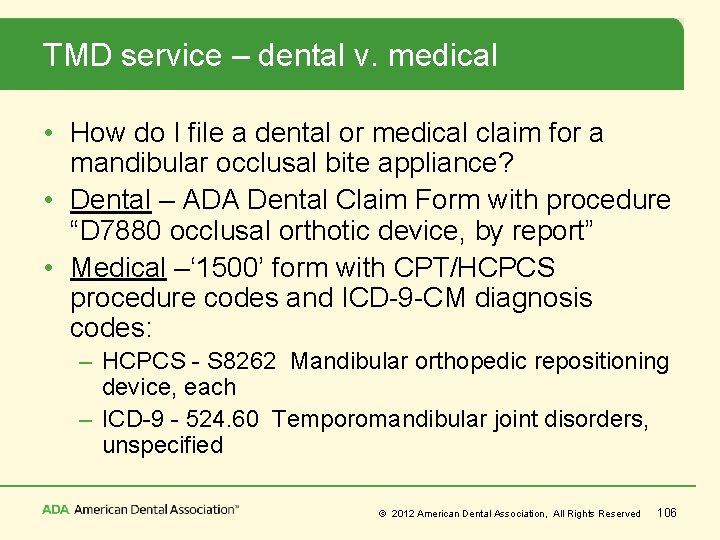
TMD service – dental v. medical • How do I file a dental or medical claim for a mandibular occlusal bite appliance? • Dental – ADA Dental Claim Form with procedure “D 7880 occlusal orthotic device, by report” • Medical –‘ 1500’ form with CPT/HCPCS procedure codes and ICD-9 -CM diagnosis codes: – HCPCS - S 8262 Mandibular orthopedic repositioning device, each – ICD-9 - 524. 60 Temporomandibular joint disorders, unspecified © 2012 American Dental Association, All Rights Reserved 106
Medical benefits claim form Information on the 1500 Health Insurance Claim Form, including completion instructions, can be found at: www. nucc. org © 2012 American Dental Association. All Rights Reserved 107
Medical claims for dental services • Not always an exact match between dental and medical procedure codes – One or more medical procedure code modifiers may be necessary – One primary ICD-9 -CM diagnosis code required • Additional ICD-9 -CM codes as needed • Tooth # and oral cavity area reported using codes published in Dental Coding Made Simple manual © 2012 American Dental Association, All Rights Reserved 108
Medical coding sources • Procedures (CPT & HCPCS) – National Dental Advisory Service - www. ndas. com OR 800 -669 -3337 – Webb Dental - www. webbdental. com OR 877 -628 -3366 • Diagnosis codes (ICD-9 -CM) – icd 9 cm. chrisendres. com – www. icd 9 coding. com © 2012 American Dental Association, All Rights Reserved 109
Other Cross Coding Sources • Dr. Charles Blair & Associates – http: //www. drcharlesblair. com/ – 866. 858. 7596 • Warschaw Learning Institute (ADA CERP Recognized Provider) – http: //www. warschawlearninginstitute. com/show. Page. php? pg=Dentalto. Medical. Cross. Coding. Course • Nierman Practice Management - Cross Code Module – http: //www. dentalcrosscode. com/ © 2012 American Dental Association, All Rights Reserved 110
“What if / How do I” Coding Scenarios • Illustrates how the CDT Code is your tool for documentation • Key principles: NOTE: Please do not consider the exercises to be legal advice or a guarantee that individual payer contracts will follow the examples. – Dentist who treats the patient can best determine what procedures were performed. – Use the procedure code that best reflects what you do. – A dental benefit plan may not provide coverage for every procedure code. © 2012 American Dental Association, All Rights Reserved 111
Monitoring the patient’s condition • Two weeks ago - initial visit – Patient with traumatically loosened teeth – No treatment; return to monitor healing • Today – return visit where dentist: – Looked for any remaining mobility or bleeding – Determined that clinical condition had improved – Suggested patient use an athletic mouthguard © 2012 American Dental Association, All Rights Reserved 112
Monitoring the patient’s condition • Consider: D 0170 re-evaluation - limited, problem focused (established patient; not post-operative visit) – For patients who require assessment or monitoring of an identified condition © 2012 American Dental Association, All Rights Reserved 113
Topical Fluoride Treatments Three friends visit the dentist All have Topical Fluoride applied Each has it coded differently Can you match the procedure to the patient’s condition? 0? 0 0 D 0 cal … i Top ication l App © 2012 American Dental Association. All Rights Reserved 114
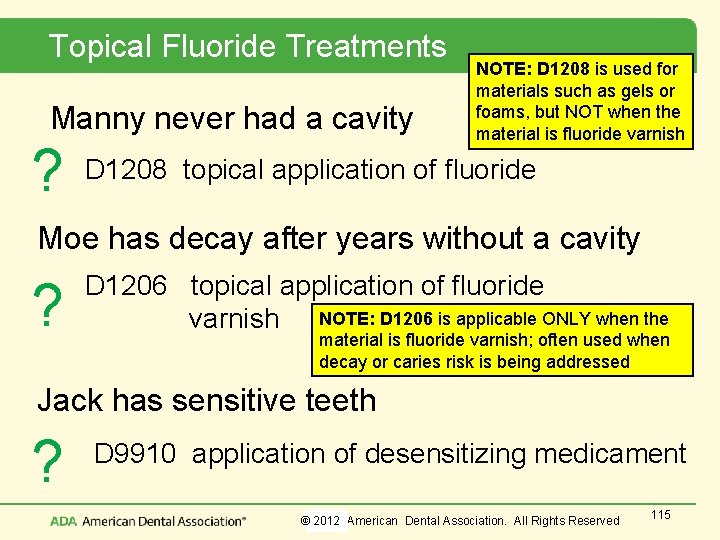
Topical Fluoride Treatments Manny never had a cavity ? NOTE: D 1208 is used for materials such as gels or foams, but NOT when the material is fluoride varnish D 1208 topical application of fluoride Moe has decay after years without a cavity ? D 1206 topical application of fluoride varnish NOTE: D 1206 is applicable ONLY when the material is fluoride varnish; often used when decay or caries risk is being addressed Jack has sensitive teeth ? D 9910 application of desensitizing medicament © 2012 American Dental Association. All Rights Reserved 115
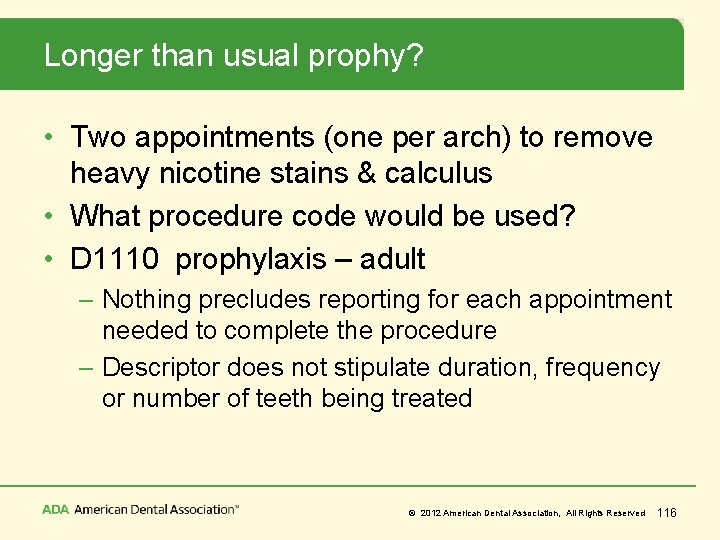
Longer than usual prophy? • Two appointments (one per arch) to remove heavy nicotine stains & calculus • What procedure code would be used? • D 1110 prophylaxis – adult – Nothing precludes reporting for each appointment needed to complete the procedure – Descriptor does not stipulate duration, frequency or number of teeth being treated © 2012 American Dental Association, All Rights Reserved 116
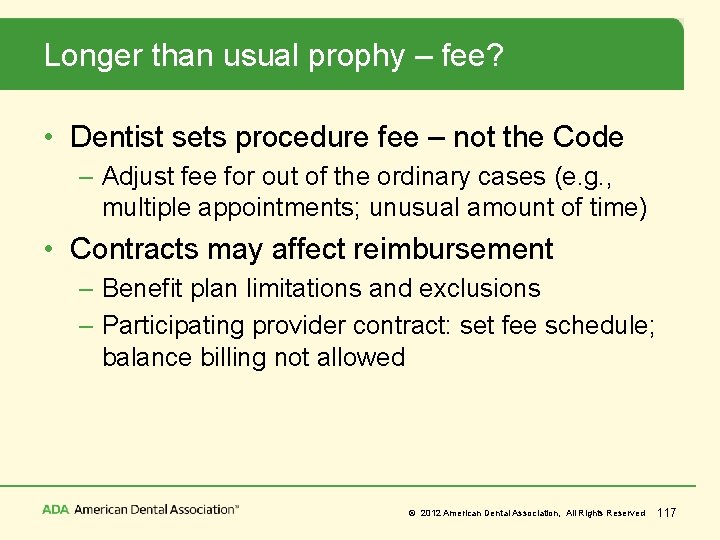
Longer than usual prophy – fee? • Dentist sets procedure fee – not the Code – Adjust fee for out of the ordinary cases (e. g. , multiple appointments; unusual amount of time) • Contracts may affect reimbursement – Benefit plan limitations and exclusions – Participating provider contract: set fee schedule; balance billing not allowed © 2012 American Dental Association, All Rights Reserved 117
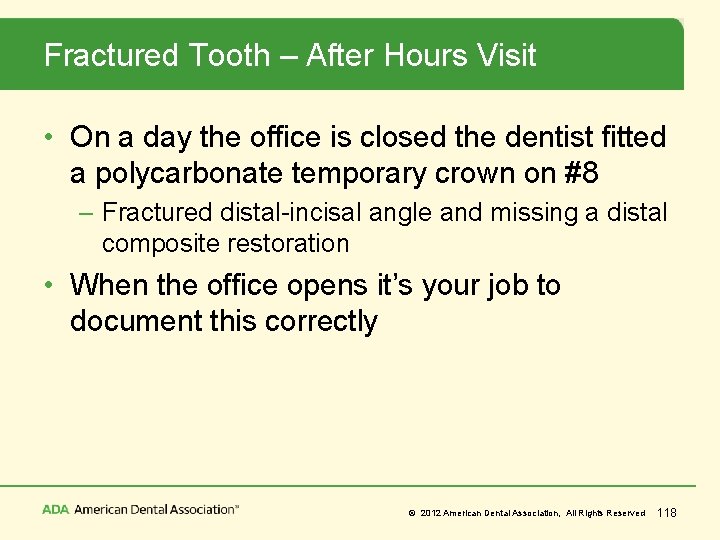
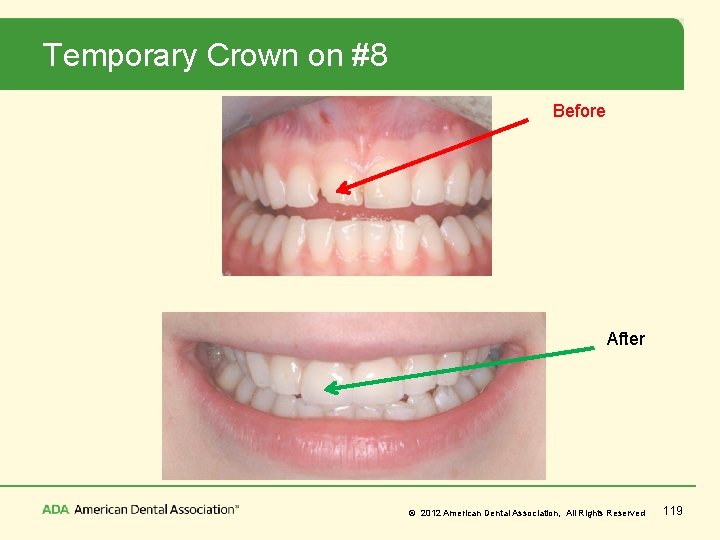
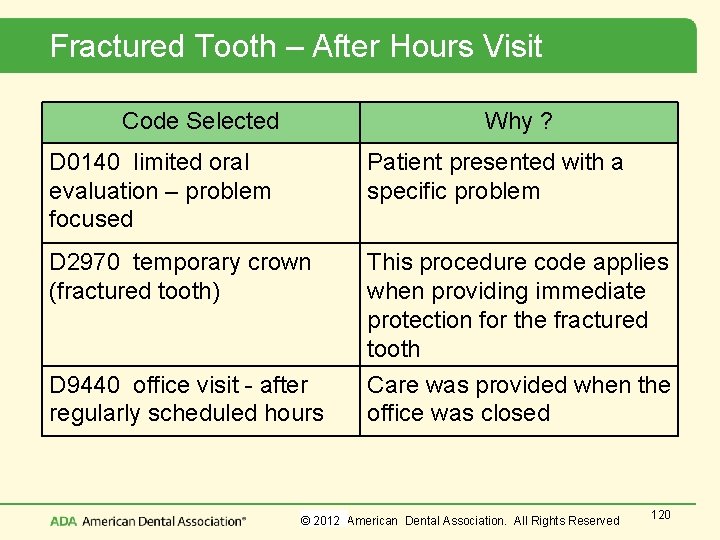
Fractured Tooth – After Hours Visit • On a day the office is closed the dentist fitted a polycarbonate temporary crown on #8 – Fractured distal-incisal angle and missing a distal composite restoration • When the office opens it’s your job to document this correctly © 2012 American Dental Association, All Rights Reserved 118
Temporary Crown on #8 Before After © 2012 American Dental Association, All Rights Reserved 119
Fractured Tooth – After Hours Visit Code Selected Why ? D 0140 limited oral evaluation – problem focused Patient presented with a specific problem D 2970 temporary crown (fractured tooth) This procedure code applies when providing immediate protection for the fractured tooth Care was provided when the office was closed D 9440 office visit - after regularly scheduled hours © 2012 American Dental Association. All Rights Reserved 120
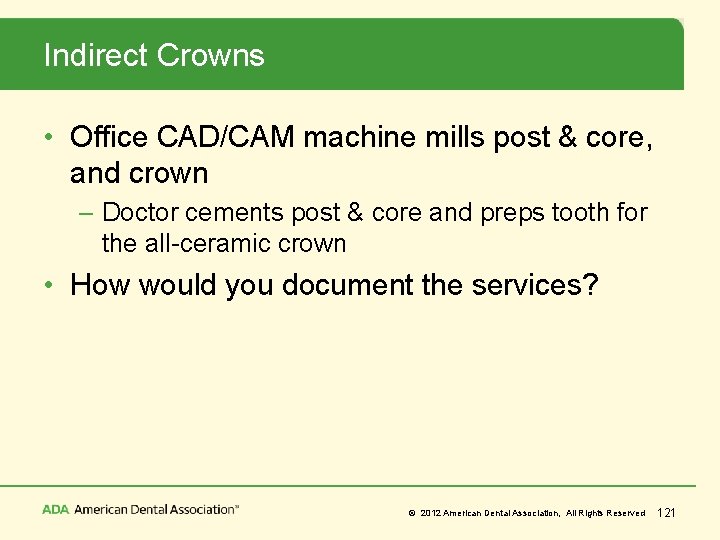
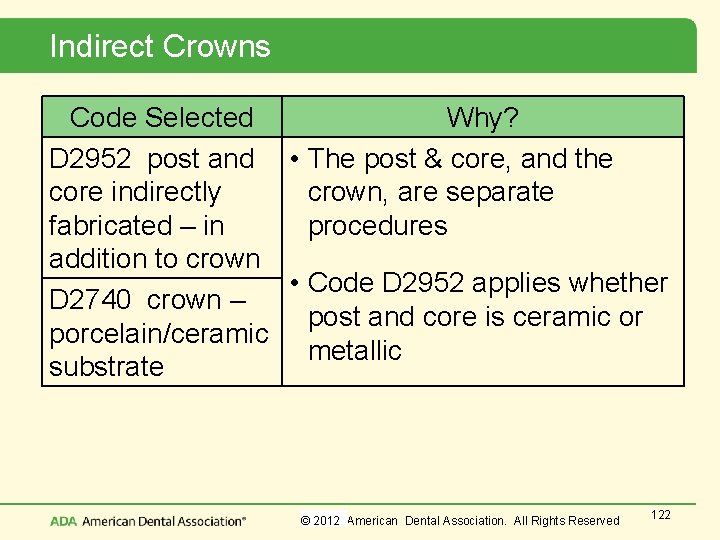
Indirect Crowns • Office CAD/CAM machine mills post & core, and crown – Doctor cements post & core and preps tooth for the all-ceramic crown • How would you document the services? © 2012 American Dental Association, All Rights Reserved 121
Indirect Crowns Code Selected Why? D 2952 post and • The post & core, and the core indirectly crown, are separate fabricated – in procedures addition to crown • Code D 2952 applies whether D 2740 crown – post and core is ceramic or porcelain/ceramic metallic substrate © 2012 American Dental Association. All Rights Reserved 122
Indirect Crowns – Office CAD/CAM v. Lab What would be different? Instead of milling these items in your office you contacted a dental lab to prepare a cast gold post and all-porcelain crown for you © 2012 American Dental Association, All Rights Reserved 123
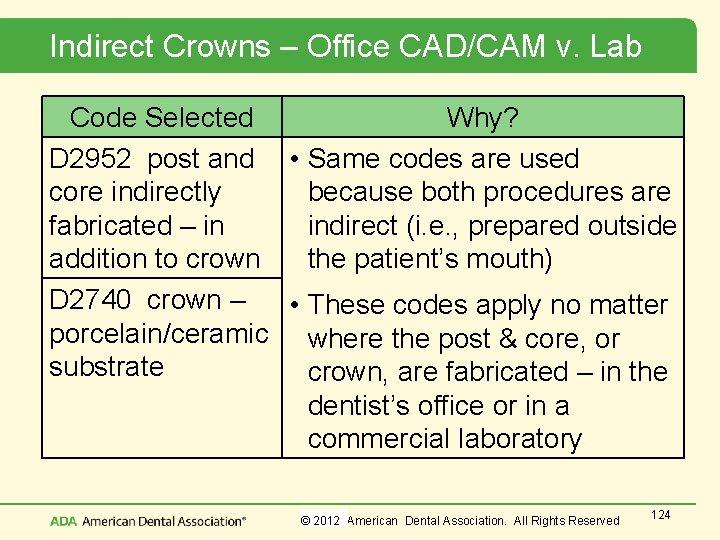
Indirect Crowns – Office CAD/CAM v. Lab Code Selected Why? D 2952 post and • Same codes are used core indirectly because both procedures are fabricated – in indirect (i. e. , prepared outside addition to crown the patient’s mouth) D 2740 crown – • These codes apply no matter porcelain/ceramic where the post & core, or substrate crown, are fabricated – in the dentist’s office or in a commercial laboratory © 2012 American Dental Association. All Rights Reserved 124
D 4910 vs D 1110 on follow-up visit • Patient is on a three month recall schedule after periodontal therapy – but dental plan limits D 4910 reimbursement to twice a year • The dentist wonders how to legitimately secure reimbursement for services delivered to a patient © 2012 American Dental Association, All Rights Reserved 125
D 4910 vs D 1110 on follow-up visit • If the treating dentist determines that a patient’s periodontal health: – Requires a D 4910 procedure every three months • Deliver procedure with the patient understanding that the plan will only provide coverage for two per year – Can be maintained with a D 4910 every six months, and be augmented with a periodic routine prophylaxis (D 1110) in between • Deliver and report those procedures © 2012 American Dental Association, All Rights Reserved 126
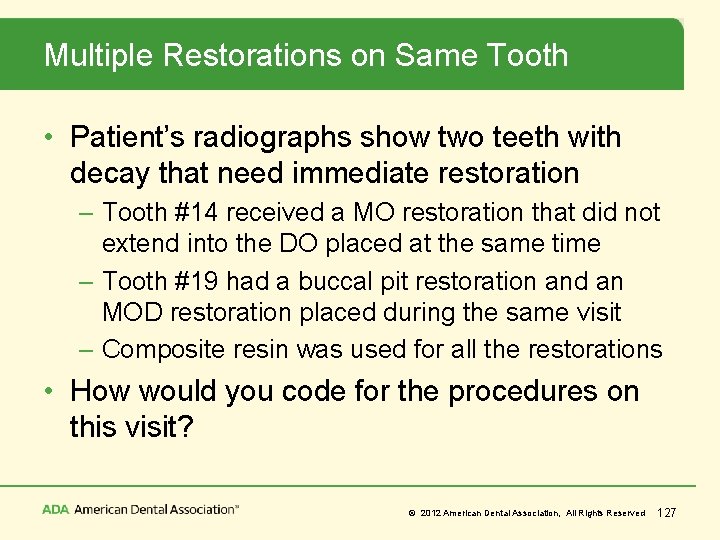
Multiple Restorations on Same Tooth • Patient’s radiographs show two teeth with decay that need immediate restoration – Tooth #14 received a MO restoration that did not extend into the DO placed at the same time – Tooth #19 had a buccal pit restoration and an MOD restoration placed during the same visit – Composite resin was used for all the restorations • How would you code for the procedures on this visit? © 2012 American Dental Association, All Rights Reserved 127
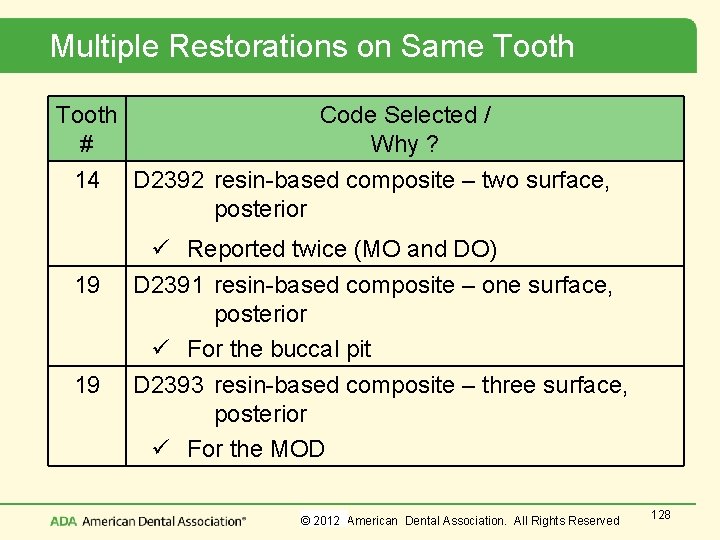
Multiple Restorations on Same Tooth Code Selected / # Why ? 14 D 2392 resin-based composite – two surface, posterior 19 19 ü Reported twice (MO and DO) D 2391 resin-based composite – one surface, posterior ü For the buccal pit D 2393 resin-based composite – three surface, posterior ü For the MOD © 2012 American Dental Association. All Rights Reserved 128
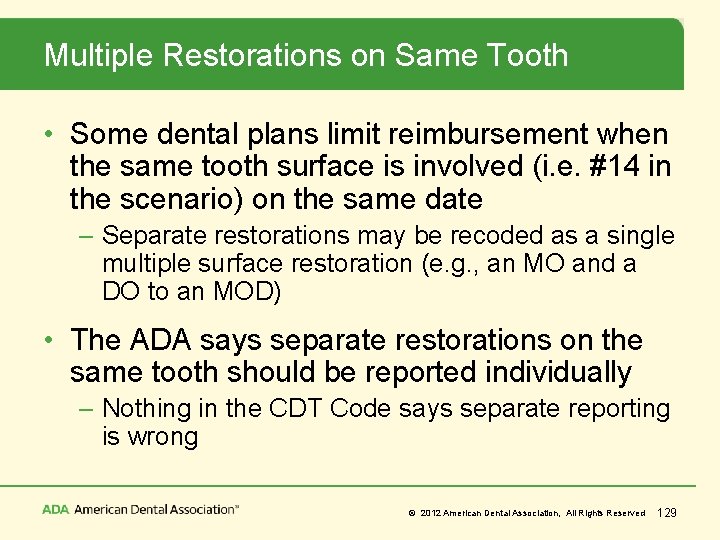
Multiple Restorations on Same Tooth • Some dental plans limit reimbursement when the same tooth surface is involved (i. e. #14 in the scenario) on the same date – Separate restorations may be recoded as a single multiple surface restoration (e. g. , an MO and a DO to an MOD) • The ADA says separate restorations on the same tooth should be reported individually – Nothing in the CDT Code says separate reporting is wrong © 2012 American Dental Association, All Rights Reserved 129
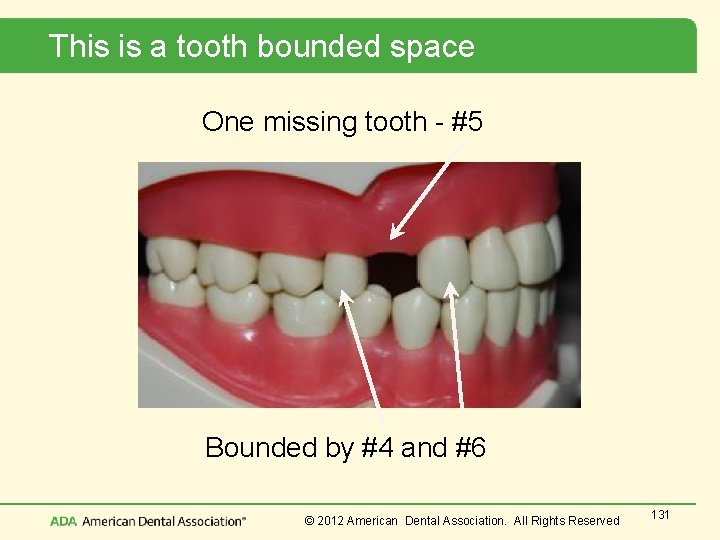
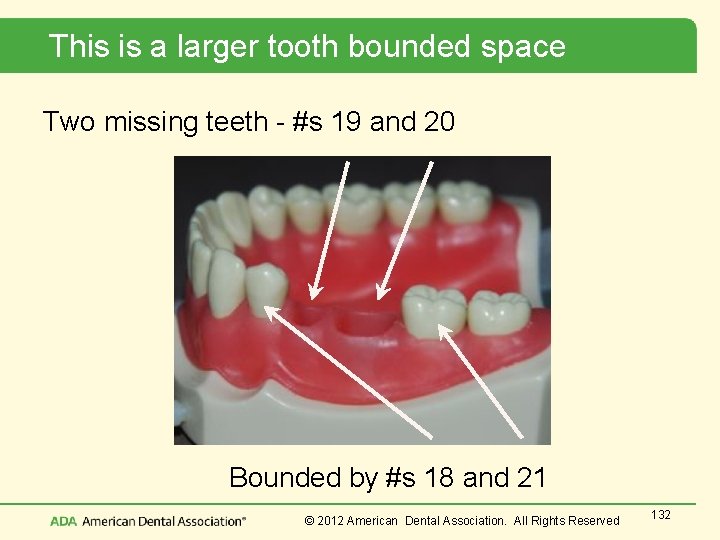
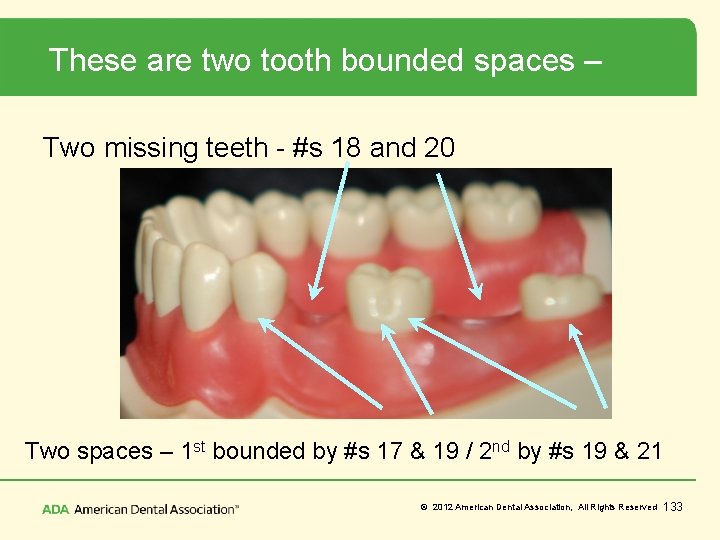
What does “tooth bounded space” mean? • This term is used in the nomenclature of codes: – D 4210 and D 4211 (gingivectomy/gingivoplasty) – D 4240 and D 4241 (gingival flap) – D 4260 and D 4261 (osseous surgery) • Illustrations follow © 2012 American Dental Association, All Rights Reserved 130
This is a tooth bounded space One missing tooth - #5 Bounded by #4 and #6 © 2012 American Dental Association. All Rights Reserved 131
This is a larger tooth bounded space Two missing teeth - #s 19 and 20 Bounded by #s 18 and 21 © 2012 American Dental Association. All Rights Reserved 132
These are two tooth bounded spaces – Two missing teeth - #s 18 and 20 Two spaces – 1 st bounded by #s 17 & 19 / 2 nd by #s 19 & 21 © 2012 American Dental Association, All Rights Reserved 133
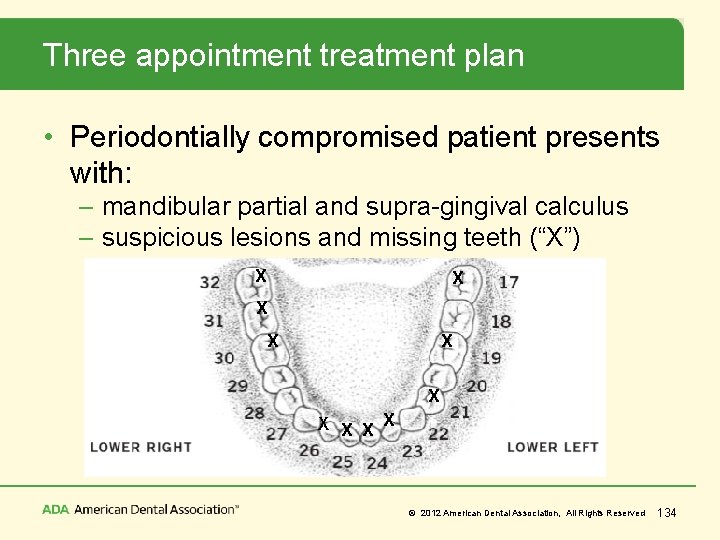
Three appointment treatment plan • Periodontially compromised patient presents with: – mandibular partial and supra-gingival calculus – suspicious lesions and missing teeth (“X”) X X X X X © 2012 American Dental Association, All Rights Reserved 134
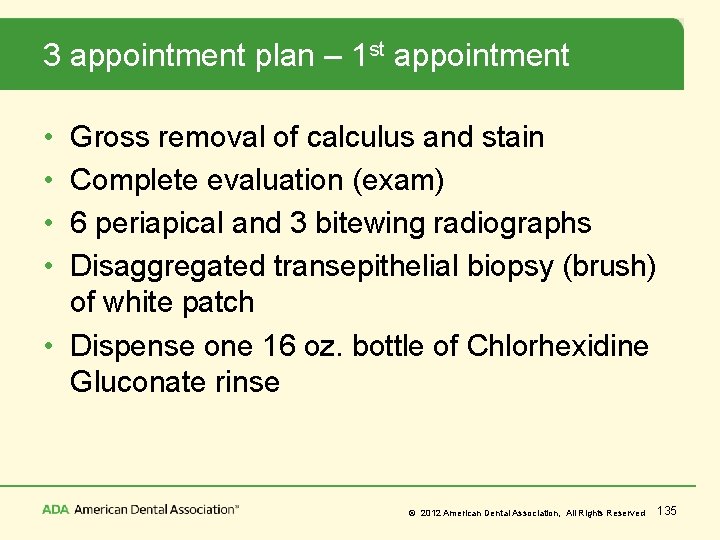
3 appointment plan – 1 st appointment • • Gross removal of calculus and stain Complete evaluation (exam) 6 periapical and 3 bitewing radiographs Disaggregated transepithelial biopsy (brush) of white patch • Dispense one 16 oz. bottle of Chlorhexidine Gluconate rinse © 2012 American Dental Association, All Rights Reserved 135
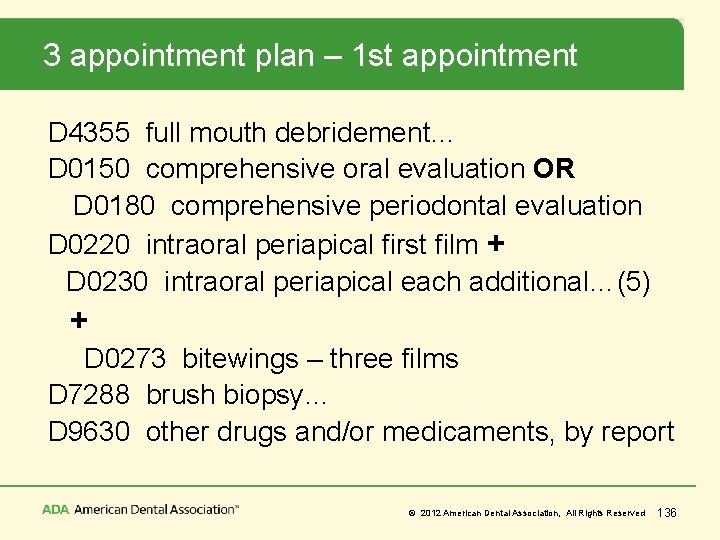
3 appointment plan – 1 st appointment D 4355 full mouth debridement… D 0150 comprehensive oral evaluation OR D 0180 comprehensive periodontal evaluation D 0220 intraoral periapical first film + D 0230 intraoral periapical each additional…(5) + D 0273 bitewings – three films D 7288 brush biopsy… D 9630 other drugs and/or medicaments, by report © 2012 American Dental Association, All Rights Reserved 136
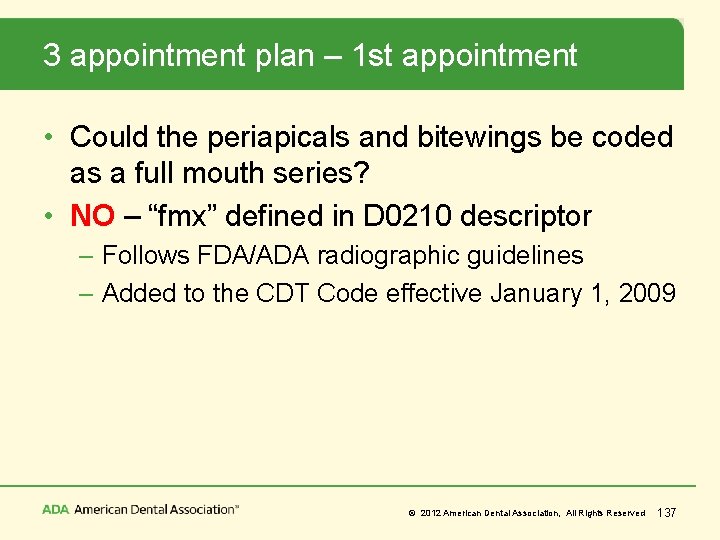
3 appointment plan – 1 st appointment • Could the periapicals and bitewings be coded as a full mouth series? • NO – “fmx” defined in D 0210 descriptor – Follows FDA/ADA radiographic guidelines – Added to the CDT Code effective January 1, 2009 © 2012 American Dental Association, All Rights Reserved 137
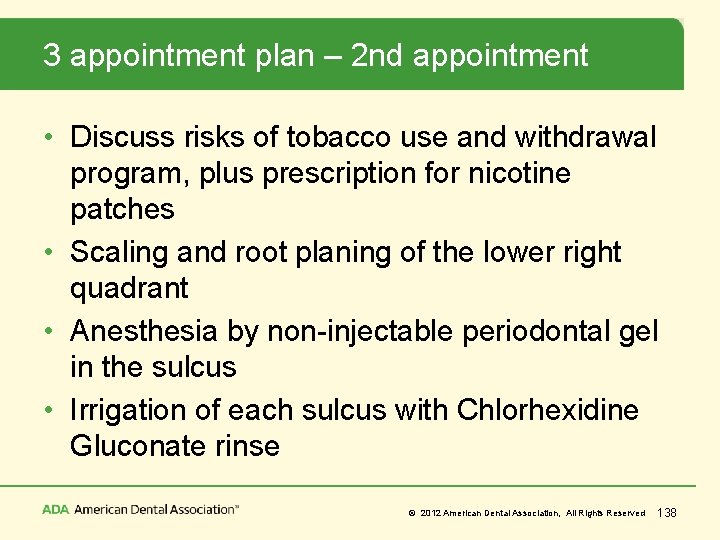
3 appointment plan – 2 nd appointment • Discuss risks of tobacco use and withdrawal program, plus prescription for nicotine patches • Scaling and root planing of the lower right quadrant • Anesthesia by non-injectable periodontal gel in the sulcus • Irrigation of each sulcus with Chlorhexidine Gluconate rinse © 2012 American Dental Association, All Rights Reserved 138
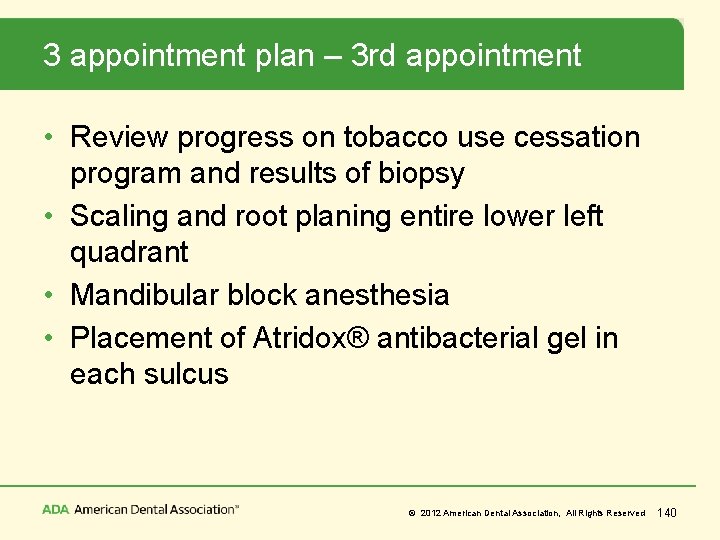
3 appointment plan – 3 rd appointment • Review progress on tobacco use cessation program and results of biopsy • Scaling and root planing entire lower left quadrant • Mandibular block anesthesia • Placement of Atridox® antibacterial gel in each sulcus © 2012 American Dental Association, All Rights Reserved 140
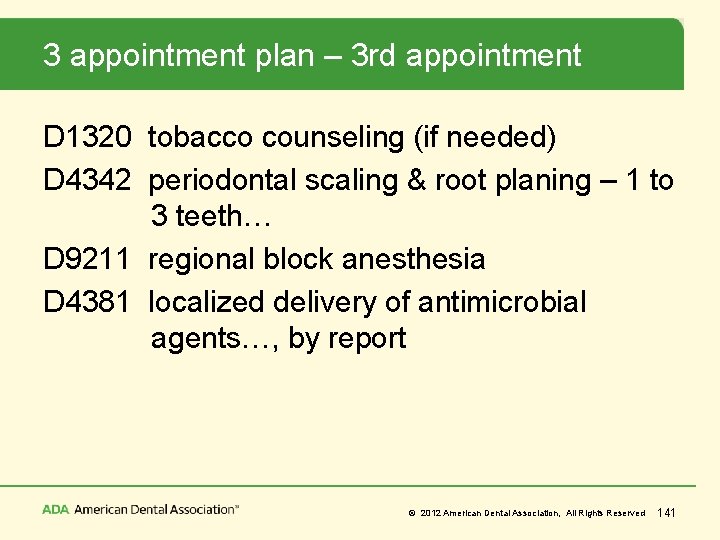
3 appointment plan – 3 rd appointment D 1320 tobacco counseling (if needed) D 4342 periodontal scaling & root planing – 1 to 3 teeth… D 9211 regional block anesthesia D 4381 localized delivery of antimicrobial agents…, by report © 2012 American Dental Association, All Rights Reserved 141
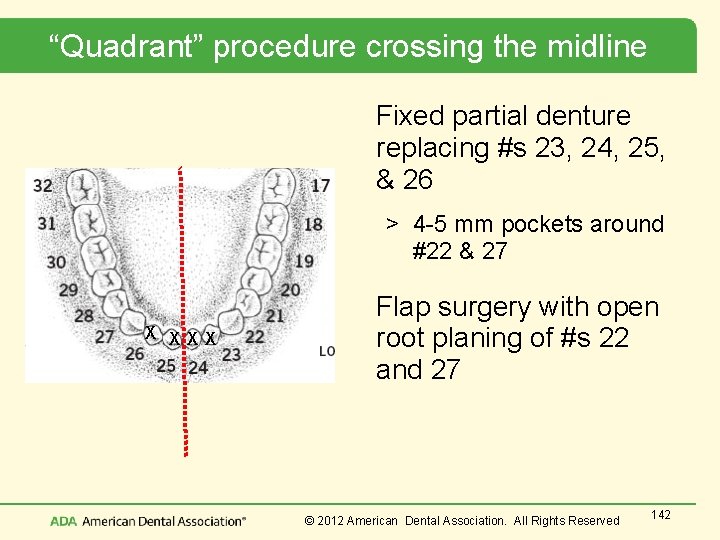
“Quadrant” procedure crossing the midline Fixed partial denture replacing #s 23, 24, 25, & 26 > 4 -5 mm pockets around #22 & 27 X XXX Flap surgery with open root planing of #s 22 and 27 © 2012 American Dental Association. All Rights Reserved 142
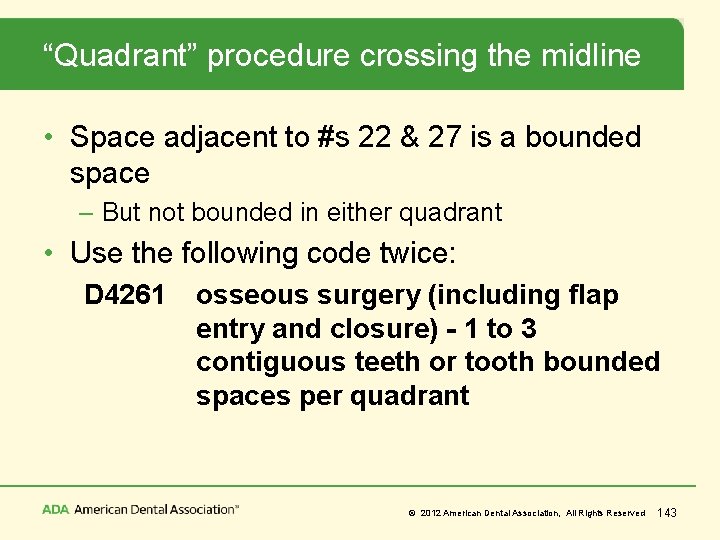
“Quadrant” procedure crossing the midline • Space adjacent to #s 22 & 27 is a bounded space – But not bounded in either quadrant • Use the following code twice: D 4261 osseous surgery (including flap entry and closure) - 1 to 3 contiguous teeth or tooth bounded spaces per quadrant © 2012 American Dental Association, All Rights Reserved 143
Partial denture repair and extension • Existing maxillary partial denture – #s 12 & 13 missing, and #14 broken • 3 -part treatment plan – Add prosthesis for 12 & 13 to the partial – Full cast noble metal survey crown for 14 • Must fit an existing clasp – Additional clasp for retention on tooth 11 © 2012 American Dental Association, All Rights Reserved 144
Partial denture repair and extension • Part 1 – D 5650 add tooth to existing partial denture • Report twice: once for #12 and again for #13 – D 2790 crown – full cast high noble metal • Part 2 – D 2971 additional procedures to construct new crown under existing partial denture framework • Part 3 – D 5660 add clasp to existing partial denture © 2012 American Dental Association, All Rights Reserved 145
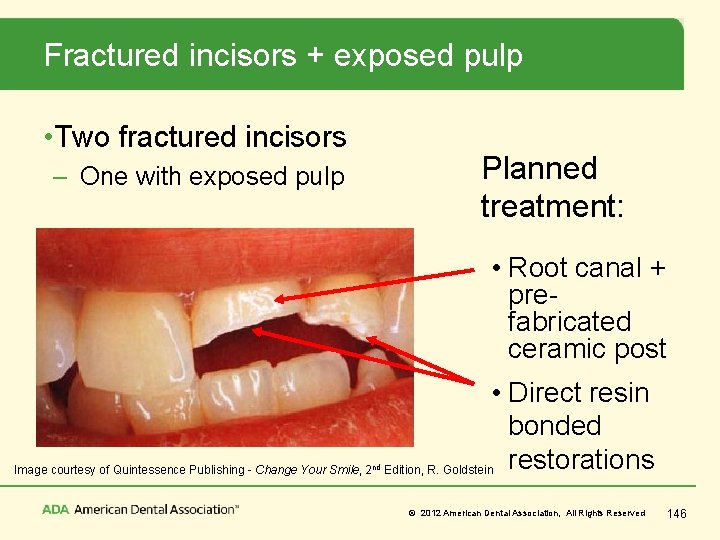
Fractured incisors + exposed pulp • Two fractured incisors Planned treatment: – One with exposed pulp • Root canal + prefabricated ceramic post • Direct resin bonded Edition, R. Goldstein restorations Image courtesy of Quintessence Publishing - Change Your Smile, 2 nd © 2012 American Dental Association, All Rights Reserved 146
Fractured incisors + exposed pulp • D 3310 anterior (excluding final restoration) • D 2999 unspecified restorative… – For the prefabricated ceramic post • D 2335 resin-based composite - 4 or more surfaces or involving incisal angle (anterior) – Report twice - two teeth are restored © 2012 American Dental Association, All Rights Reserved 147
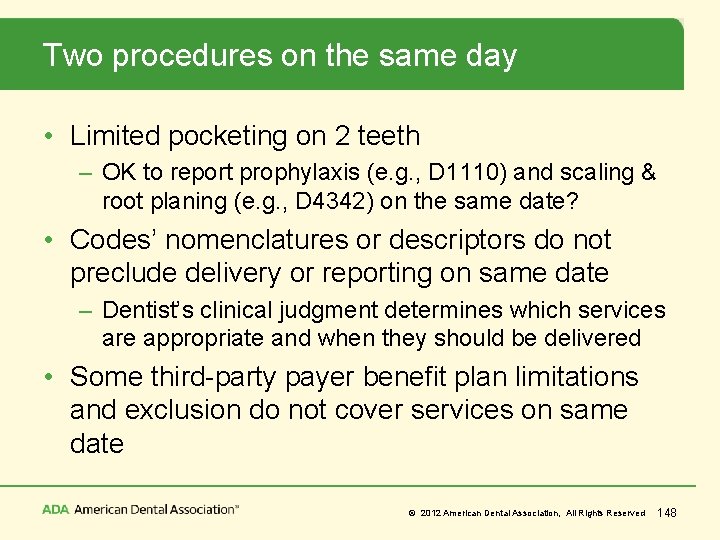
Two procedures on the same day • Limited pocketing on 2 teeth – OK to report prophylaxis (e. g. , D 1110) and scaling & root planing (e. g. , D 4342) on the same date? • Codes’ nomenclatures or descriptors do not preclude delivery or reporting on same date – Dentist’s clinical judgment determines which services are appropriate and when they should be delivered • Some third-party payer benefit plan limitations and exclusion do not cover services on same date © 2012 American Dental Association, All Rights Reserved 148
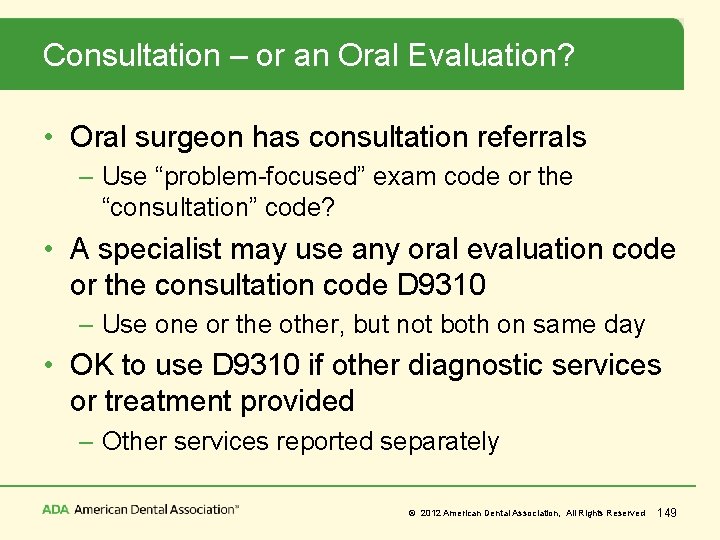
Consultation – or an Oral Evaluation? • Oral surgeon has consultation referrals – Use “problem-focused” exam code or the “consultation” code? • A specialist may use any oral evaluation code or the consultation code D 9310 – Use one or the other, but not both on same day • OK to use D 9310 if other diagnostic services or treatment provided – Other services reported separately © 2012 American Dental Association, All Rights Reserved 149
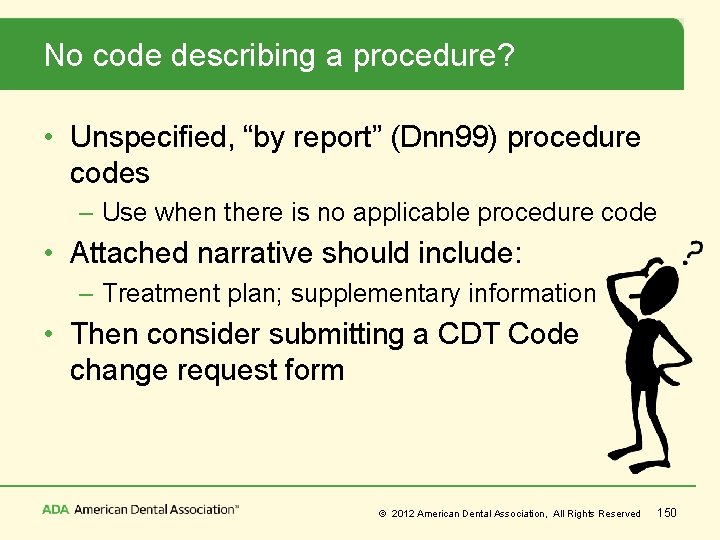
No code describing a procedure? • Unspecified, “by report” (Dnn 99) procedure codes – Use when there is no applicable procedure code • Attached narrative should include: – Treatment plan; supplementary information • Then consider submitting a CDT Code change request form © 2012 American Dental Association, All Rights Reserved 150
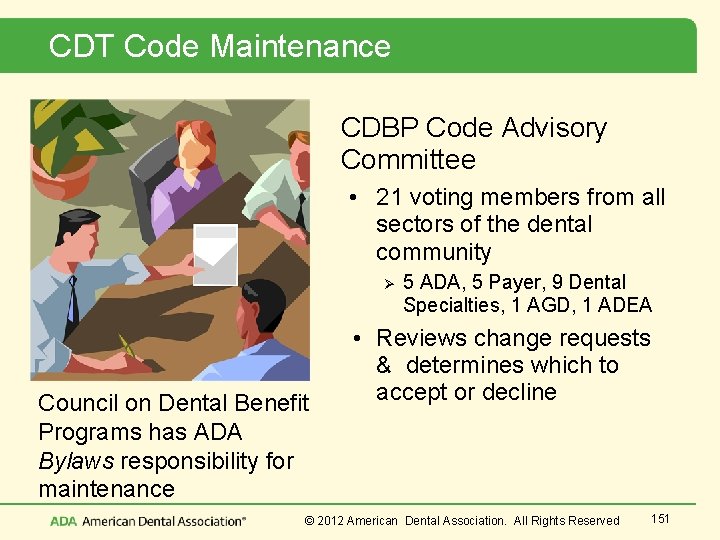
CDT Code Maintenance CDBP Code Advisory Committee • 21 voting members from all sectors of the dental community Ø Council on Dental Benefit Programs has ADA Bylaws responsibility for maintenance 5 ADA, 5 Payer, 9 Dental Specialties, 1 AGD, 1 ADEA • Reviews change requests & determines which to accept or decline © 2012 American Dental Association. All Rights Reserved 151
CDT Code Maintenance • Process open to any interested party – Requests from dentists as well as ADA, payers, etc. – Information about the process on-line • http: //www. ada. org/3827. aspx • Questions? – Council on Dental Benefit Programs (CDBP) • dentalcode@ada. org • ADA member toll-free number or 312 -440 -2500 © 2012 American Dental Association, All Rights Reserved 152
? ? ? Your Questions ? ? ? before some closing comments © 2012 American Dental Association, All Rights Reserved 153
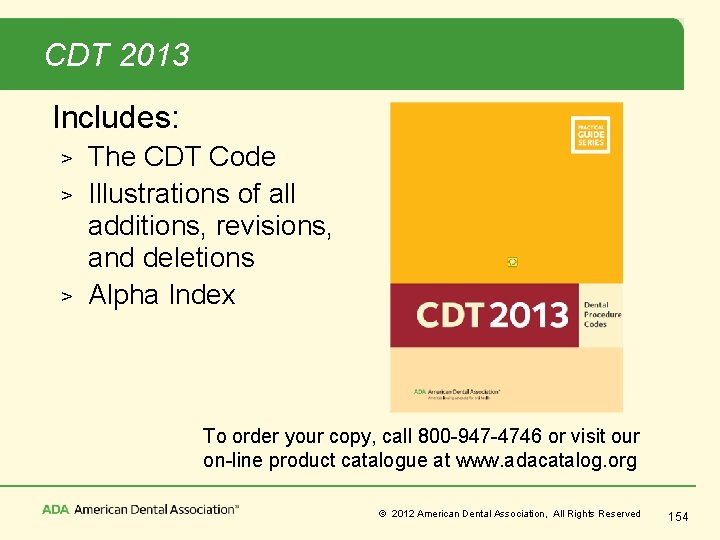
CDT 2013 Includes: > > > The CDT Code Illustrations of all additions, revisions, and deletions Alpha Index To order your copy, call 800 -947 -4746 or visit our on-line product catalogue at www. adacatalog. org © 2012 American Dental Association, All Rights Reserved 154
CDT Code Check • “App” for your i. Phone, i. Pad or Android device – Portable resource for dentists and practice staff – Contains every code in the CDT Manual To purchase – visit Apple i. Tunes store or Android Market and search “CDT Code Check” © 2012 American Dental Association, All Rights Reserved 155
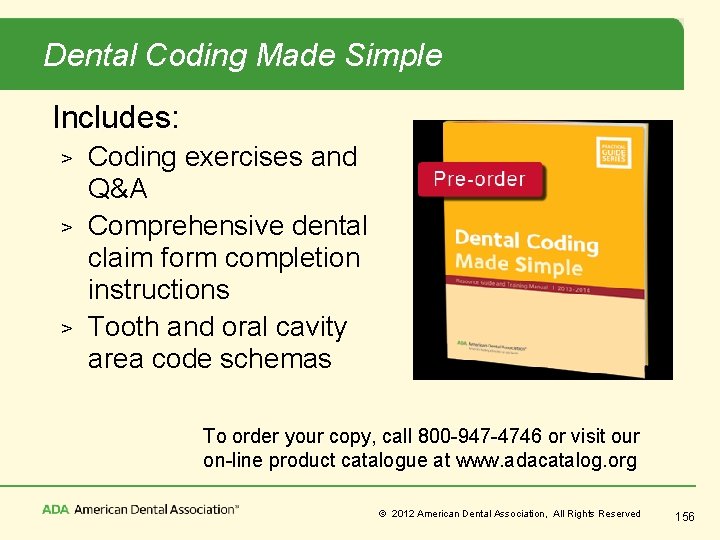
Dental Coding Made Simple Includes: > > > Coding exercises and Q&A Comprehensive dental claim form completion instructions Tooth and oral cavity area code schemas To order your copy, call 800 -947 -4746 or visit our on-line product catalogue at www. adacatalog. org © 2012 American Dental Association, All Rights Reserved 156
ADA Seal of Acceptance Surveys show patients trust you – and use what you recommend © 2012 American Dental Association, All Rights Reserved 157
ADA Seal of Acceptance • Designed to help consumers make informed decisions about safe and effective consumer products – Product must undergo rigorous scientific review to ensure it meets ADA safety and effectiveness criteria • For detailed information – Professionals: ADA. org at http: //www. ada. org/seal – Consumers: Mouth. Healthy. org at http: //www. mouthhealthy. org/en/ada-seal-products/ © 2012 American Dental Association, All Rights Reserved 158
ADA membership To join - call 1 -800 -232 -1382 Learn about member benefits at www. ada. org Member Service Center 312 -440 -2500 © 2012 American Dental Association. All Rights Reserved 159