
Presented by the American Statistical Association What Is
Presented by the American Statistical Association
What Is Statistics? • American Heritage® Dictionary: “The mathematics of the collection, organization, and interpretation of numerical data, especially the analysis of population characteristics by inference from sampling. ” • Statisticians collect and analyze data, then calculate results using a specific design. They draw conclusions and make decisions in the face of uncertainty.
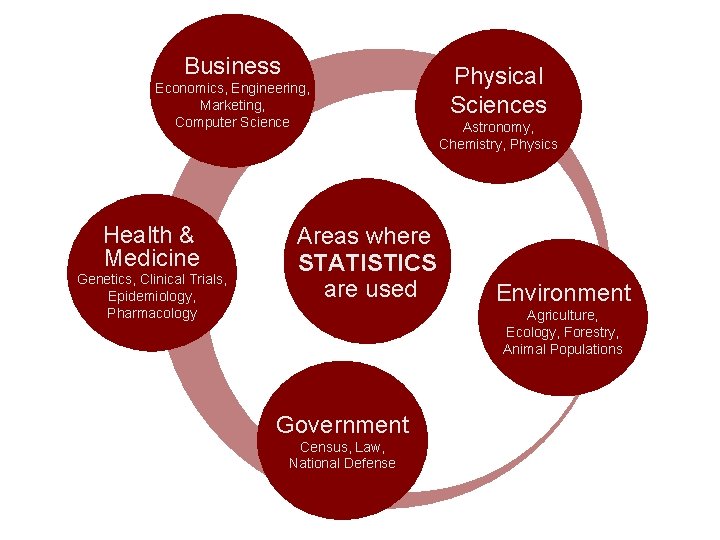
Business Economics, Engineering, Marketing, Computer Science Health & Medicine Genetics, Clinical Trials, Epidemiology, Pharmacology Areas where STATISTICS are used Physical Sciences Astronomy, Chemistry, Physics Environment Agriculture, Ecology, Forestry, Animal Populations Government Census, Law, National Defense
Why Study Statistics? • Collecting data on subsets of the population (samples) can give valid information about the whole population. • Knowing what has happened in the past can help answer questions about the present and future. • Knowledge helps plan future tests, determines resource allocation, and improves quality.
What Do Statisticians Do? • Study the safety of nuclear power plants • Evaluate the environmental impact of pollution • Determine the effectiveness of new drugs • Estimate the U. S. unemployment rate • Analyze consumer demand for products • Plan and analyze agricultural experiments
What Can I Do With A Degree in Statistics?

Business and Industry • Manufacturing – Build products and deliver services that satisfy consumers and increase the corporation’s profit margin
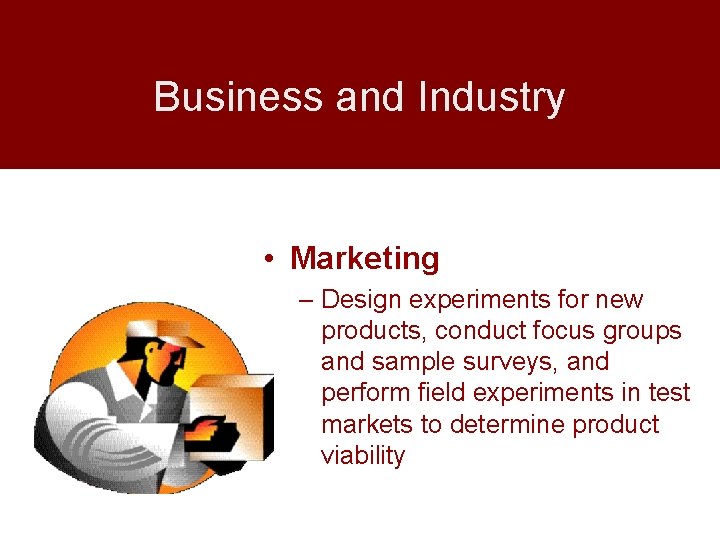
Business and Industry • Marketing – Design experiments for new products, conduct focus groups and sample surveys, and perform field experiments in test markets to determine product viability
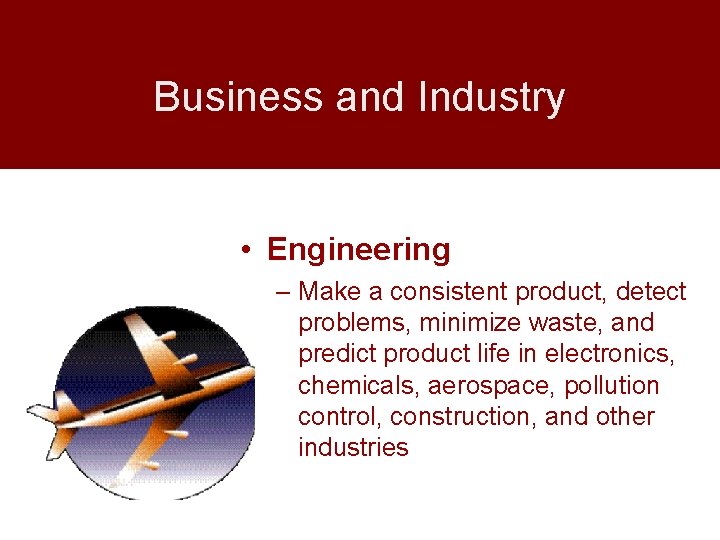
Business and Industry • Engineering – Make a consistent product, detect problems, minimize waste, and predict product life in electronics, chemicals, aerospace, pollution control, construction, and other industries
Business and Industry • Statistical Computing – Work in software design and development, testing, quality assurance, technical support, education, marketing, and sales to develop code that is both userfriendly and sufficiently complex
“ I love that statistics is very multidisciplinary. It involves problem solving in a group environment and it involves many skills and talents. I love the ability to be a mathematician, computer scientist, teacher, quizmaster, sleuth, and devil’s advocate all rolled into one. ” Linda Quinn, Private Industrial Consultant
Health and Medicine • Epidemiology – Work on calculating cancer incidence rates, monitor disease outbreaks, and monitor changes in health-related behaviors such as smoking and physical activity
Health and Medicine • Public Health – Prevent disease, prolong life, and promote health through organized community efforts, including sanitation, hygiene education, diagnoses, and preventative treatment
Health and Medicine • Pharmacology – Work in drug discovery, development, approval, and marketing, to ensure the validity and accuracy of findings at all stages of the process
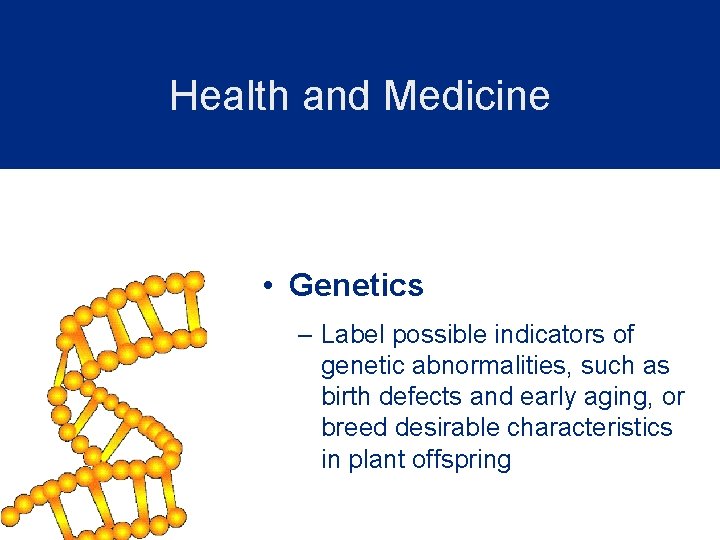
Health and Medicine • Genetics – Label possible indicators of genetic abnormalities, such as birth defects and early aging, or breed desirable characteristics in plant offspring
“ Last year when I began applying to medical schools, the fact that I majored in statistics was always a good conversation point in interviews and made me more unique as an applicant. ” Amy Elise Derrow, Medical Student
Learning • Education – Teach K-12 through postgraduate students, assess teacher effectiveness, or develop statistical models to represent student learning
Learning • Science Writing & Journalism – Work with mass media, universities, and corporations to produce news briefs, articles, news releases, and other reports
Research • Government – Work in regulations for stock trading, pollution, and drug approvals, or testify in court proceedings, congressional hearings, and lobbying arguments
Research • Survey Methods – Collect data in the social sciences, education, law, forestry, agriculture, biology, medicine, business, and e-commerce, and for the government
“ I found that statistics used more reasoning and logic skills than the mathematics courses I had previously taken. The more I did statistics, the more I liked the “alternative” application of mathematics that it provided. I especially liked being able to use a lot of data and a little common sense to figure out problems. ” Tiffany T. Sundelin, Quality Control Engineer
Social Statistics • Law – Analyze data in court cases, including DNA evidence, salary discrepancies, discrimination law suits, and disease clusters
Social Statistics • Consulting – Work on a temporary basis on a variety of projects including quality improvement, pharmaceuticals, ecology, and engineering
Natural Resources • Agriculture – Study chemical pesticides, hydrogeology, veterinary sciences, genetics, and crop management in order to ensure optimal yield
Natural Resources • Ecology – Address questions about the earth’s natural environment, including animal populations, agricultural protections, and fertilizer and pesticide safety
“ I became involved with statistics because mathematics did not provide the avenue to cross into other areas of science and continue to learn about topics that interested me. I have stayed in statistics because of the diversity that it offers and because of the rational approach it provides to seek solutions to problems. ” Dan Mowrey, Senior Research Scientist
How Do I Become A Statistician?
Education • High School – Study statistics, mathematics, science, computer science, and English • College – Major in statistics, applied mathematics, or a closely related field (i. e. epidemiology, engineering) • Post-Graduate – Many career fields require a Master’s degree or Ph. D in a specialized statistical field
Skills • Quantitative Skills – Statistics, Mathematics, Science • Problem Solving Skills – Analysis, Teamwork • Communication Skills – Verbal, Written • Computer Programming Languages • Foundation in Field of Application
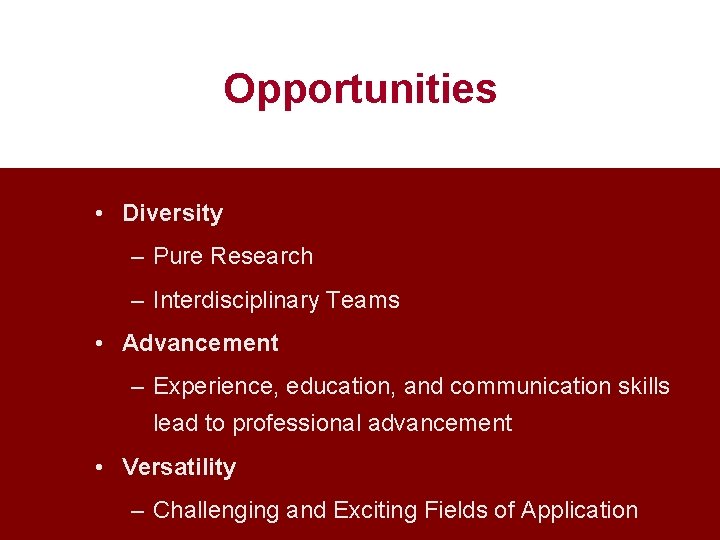
Opportunities • Diversity – Pure Research – Interdisciplinary Teams • Advancement – Experience, education, and communication skills lead to professional advancement • Versatility – Challenging and Exciting Fields of Application
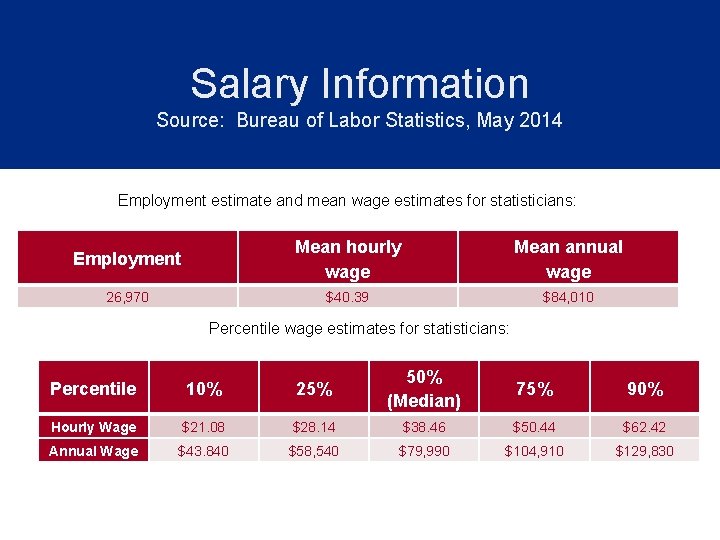
Salary Information Source: Bureau of Labor Statistics, May 2014 Employment estimate and mean wage estimates for statisticians: Employment Mean hourly wage Mean annual wage 26, 970 $40. 39 $84, 010 Percentile wage estimates for statisticians: Percentile 10% 25% 50% (Median) 75% 90% Hourly Wage $21. 08 $28. 14 $38. 46 $50. 44 $62. 42 Annual Wage $43. 840 $58, 540 $79, 990 $104, 910 $129, 830
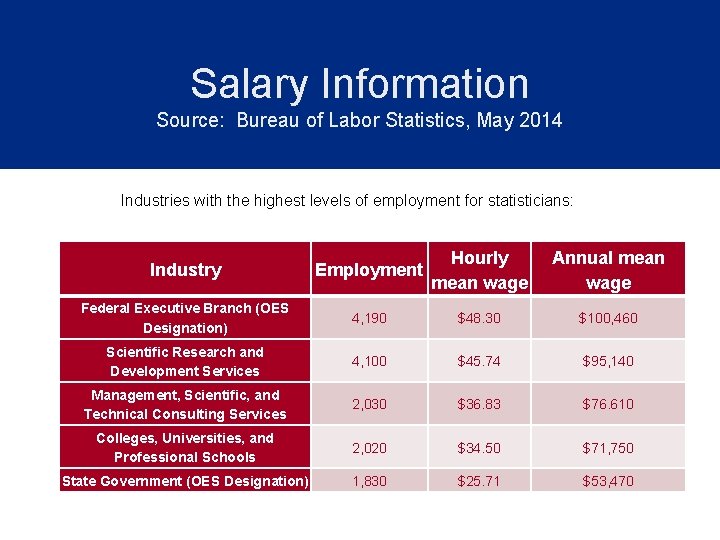
Salary Information Source: Bureau of Labor Statistics, May 2014 Industries with the highest levels of employment for statisticians: Industry Hourly Employment mean wage Annual mean wage Federal Executive Branch (OES Designation) 4, 190 $48. 30 $100, 460 Scientific Research and Development Services 4, 100 $45. 74 $95, 140 Management, Scientific, and Technical Consulting Services 2, 030 $36. 83 $76. 610 Colleges, Universities, and Professional Schools 2, 020 $34. 50 $71, 750 State Government (OES Designation) 1, 830 $25. 71 $53, 470
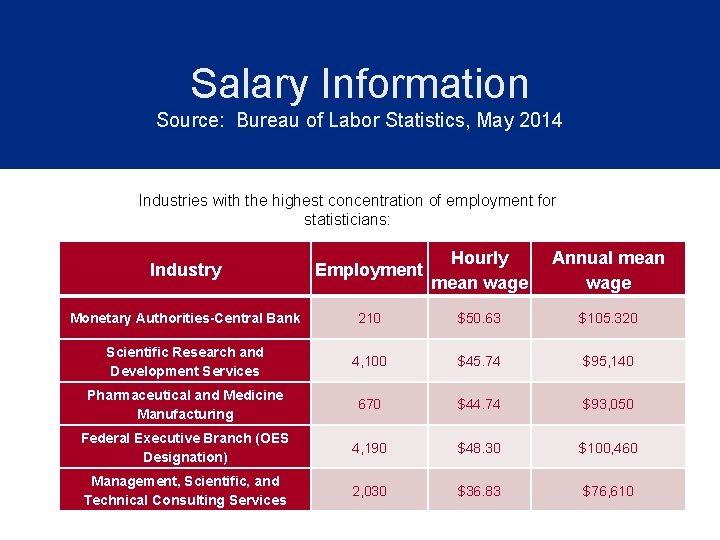
Salary Information Source: Bureau of Labor Statistics, May 2014 Industries with the highest concentration of employment for statisticians: Industry Hourly Employment mean wage Annual mean wage Monetary Authorities-Central Bank 210 $50. 63 $105. 320 Scientific Research and Development Services 4, 100 $45. 74 $95, 140 Pharmaceutical and Medicine Manufacturing 670 $44. 74 $93, 050 Federal Executive Branch (OES Designation) 4, 190 $48. 30 $100, 460 Management, Scientific, and Technical Consulting Services 2, 030 $36. 83 $76, 610
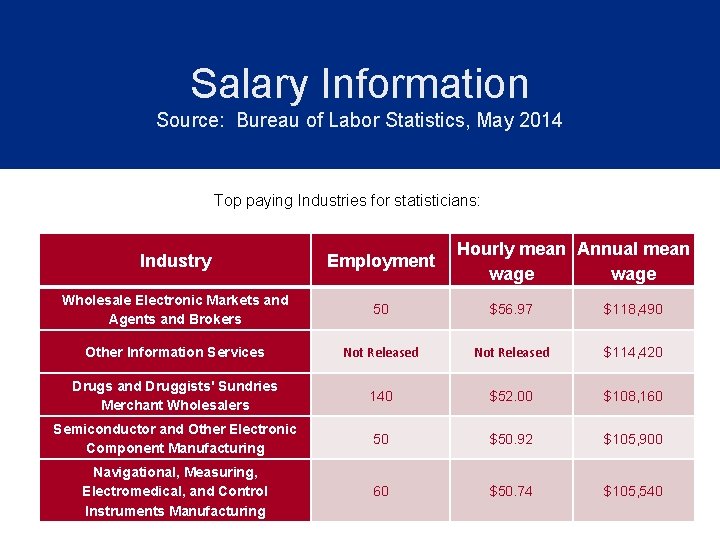
Salary Information Source: Bureau of Labor Statistics, May 2014 Top paying Industries for statisticians: Hourly mean Annual mean wage Industry Employment Wholesale Electronic Markets and Agents and Brokers 50 $56. 97 $118, 490 Other Information Services Not Released $114, 420 Drugs and Druggists' Sundries Merchant Wholesalers 140 $52. 00 $108, 160 Semiconductor and Other Electronic Component Manufacturing 50 $50. 92 $105, 900 Navigational, Measuring, Electromedical, and Control Instruments Manufacturing 60 $50. 74 $105, 540
About the ASA • Career Services – Salary Reports, Job Ads, Articles • Education – Continuing Education, Workshops, Seminars • Awards and Honors – Scholarships, Fellowships • Meetings – Joint Statistical Meetings, Local Meetings • Publications – Journals, Magazines, Research Guides
Contact the ASA for more information: ATTN: Customer Service 732 North Washington Street Alexandria, VA 22314 Phone: (703) 684 -1221 FAX: (703) 684 -2037 Email: asainfo@amstat. org Web: www. amstat. org
- Slides: 36