How to Get Your Career Going as a
- Slides: 26
How to Get Your Career Going as a Clinician-Educator Patricia Thomas, MD Associate Professor of Medicine Associate Dean of Curriculum
With apologies to Dr. Susan Mac. Donald “Navigating the Promotion Process”
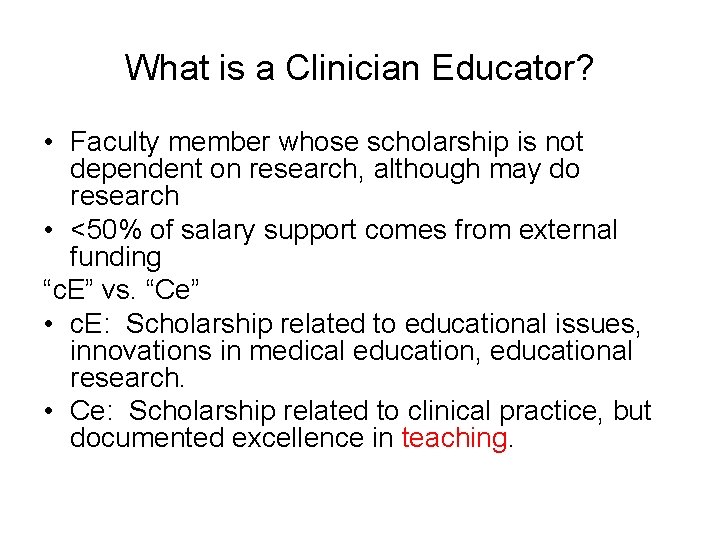
What is a Clinician Educator? • Faculty member whose scholarship is not dependent on research, although may do research • <50% of salary support comes from external funding “c. E” vs. “Ce” • c. E: Scholarship related to educational issues, innovations in medical education, educational research. • Ce: Scholarship related to clinical practice, but documented excellence in teaching.
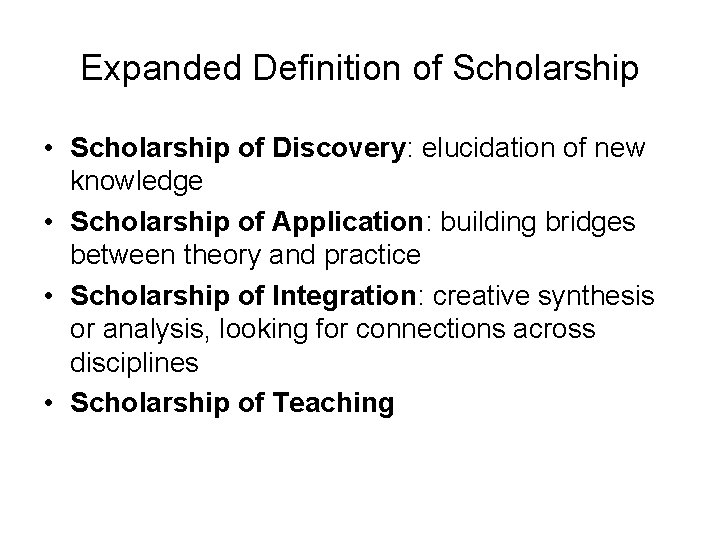
Expanded Definition of Scholarship • Scholarship of Discovery: elucidation of new knowledge • Scholarship of Application: building bridges between theory and practice • Scholarship of Integration: creative synthesis or analysis, looking for connections across disciplines • Scholarship of Teaching
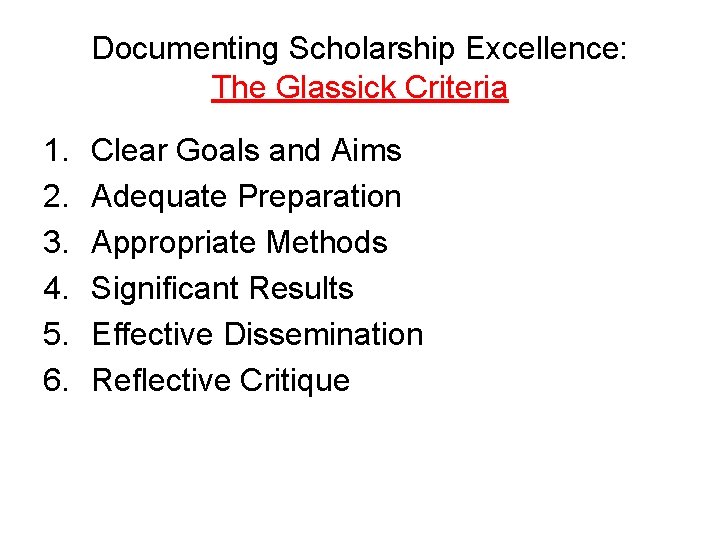
Documenting Scholarship Excellence: The Glassick Criteria 1. 2. 3. 4. 5. 6. Clear Goals and Aims Adequate Preparation Appropriate Methods Significant Results Effective Dissemination Reflective Critique
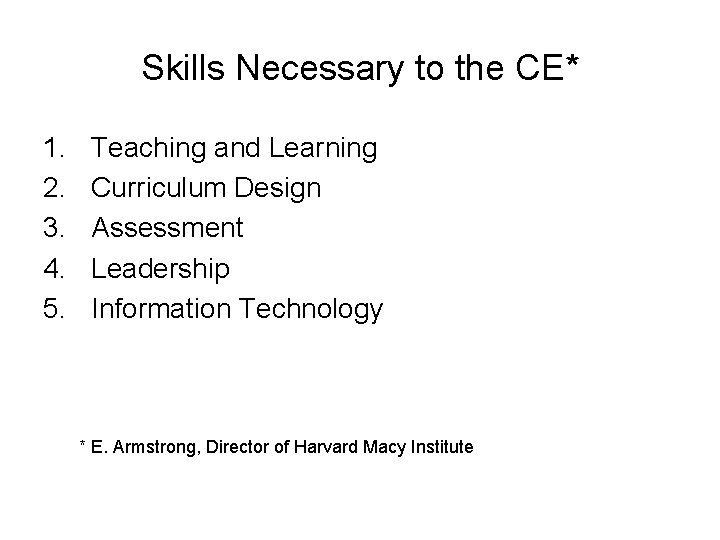
Skills Necessary to the CE* 1. 2. 3. 4. 5. Teaching and Learning Curriculum Design Assessment Leadership Information Technology * E. Armstrong, Director of Harvard Macy Institute
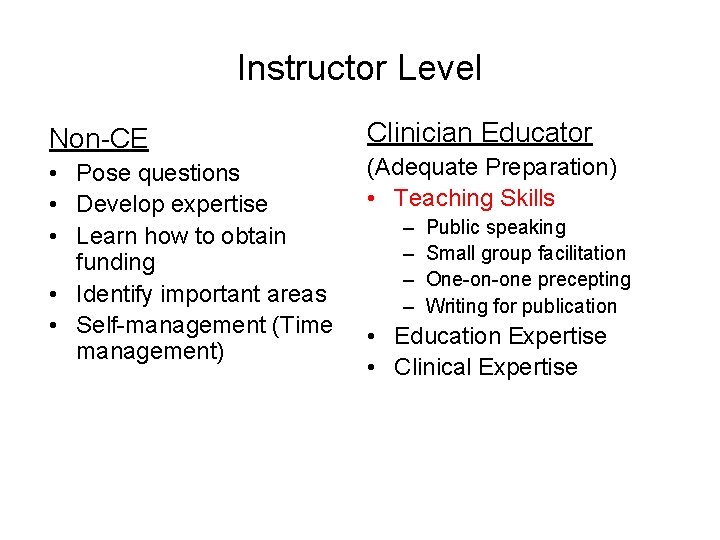
Instructor Level Non-CE • Pose questions • Develop expertise • Learn how to obtain funding • Identify important areas • Self-management (Time management) Clinician Educator (Adequate Preparation) • Teaching Skills – – Public speaking Small group facilitation One-on-one precepting Writing for publication • Education Expertise • Clinical Expertise
Teaching Skills Courses Locally: – JHU Faculty Development Program (K. Cole)* • Teaching Skills • Curriculum Development – Office of Faculty Development* (flier) • “Speak Like a Pro” – Homewood: Center for Educational Resources – JHU Graduate School of Education *www. hopkinsmedicine. org/fac_development
Teaching Skills Courses Regional/National – Evidence-based Medicine (Mc. Masters) – Teaching Geriatrics (UCSF) – Healthcare Communication (Bayer Institute) – Professional societies: Surgeons as Educators Course (American College of Surgeons) – Harvard Macy Institute (2 week courses)
Fellowship Training (c. E) • • Medical Education Fellowship (GIM) Stanford Fellowship in Medical Education Rabkin Fellowship in Medical Education Surgical Research Education Fellowship (American College of Surgeons)
Additional Degrees (c. E) • Masters in Education (M. Ed. ) • Masters in Medical Education (M. Ed. ) – – – Univ. of Pittsburgh Univ. of Cincinnati Univ. of Michigan Univ. of Southern California Univ. of Southern Illinois (online or residential) • Masters of Science – Masters of Science in Education with a concentration in Technology in Education
Clinician Educator: Instructor Level 1. 2. (Adequate Preparation) Start your Educator (Teaching) Portfolio (Significant Results & Reflective Critique) 3. Identify mentor(s) – (Hint: May not be in your division) 4. Volunteer to teach! (Impact)
Contents of the Educator Portfolio • Evidence of quantity of teaching effort • Evidence of impact • Evidence of scholarship – Scholarly teaching: using best practice – Teaching scholarship: discovering best practice
Resources • The Silver Book • “Advancing Educators and Education: Defining the Components and Evidence of Educational Scholarship” – Summary Report and Findings From the AAMC Group on Educational Affairs Consensus Conference on Educational Scholarship – Available at www. aamc. org
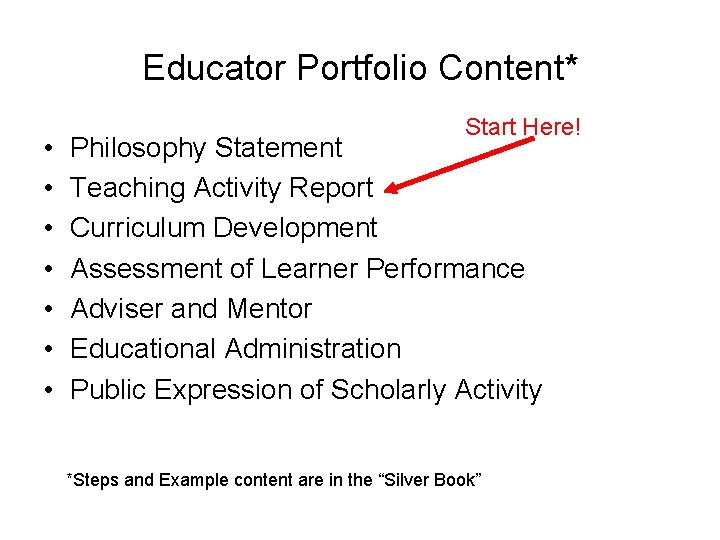
Educator Portfolio Content* • • Start Here! Philosophy Statement Teaching Activity Report Curriculum Development Assessment of Learner Performance Adviser and Mentor Educational Administration Public Expression of Scholarly Activity *Steps and Example content are in the “Silver Book”
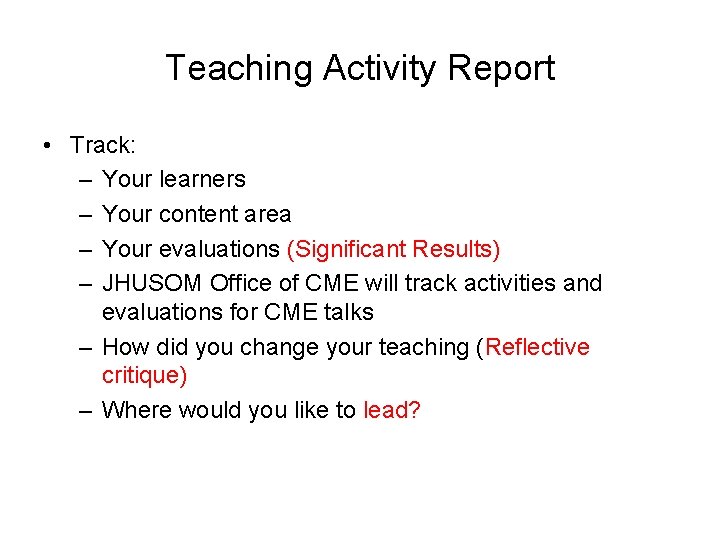
Teaching Activity Report • Track: – Your learners – Your content area – Your evaluations (Significant Results) – JHUSOM Office of CME will track activities and evaluations for CME talks – How did you change your teaching (Reflective critique) – Where would you like to lead?
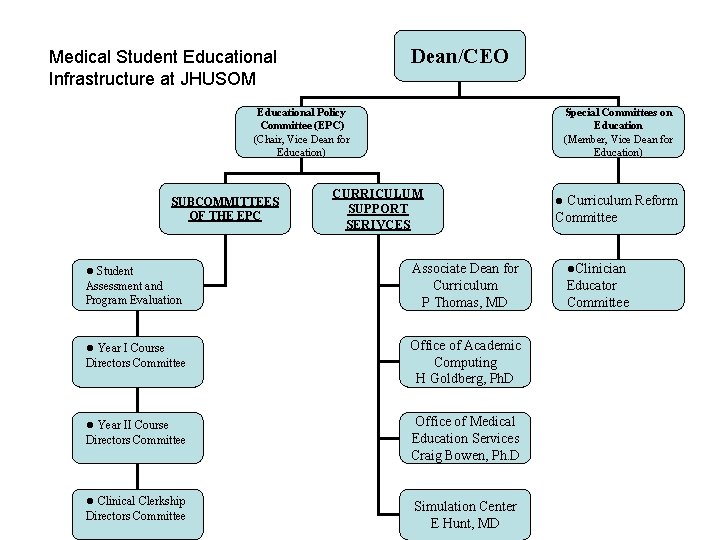
Dean/CEO Medical Student Educational Infrastructure at JHUSOM Educational Policy Committee (EPC) (Chair, Vice Dean for Education) SUBCOMMITTEES OF THE EPC ● Student Assessment and Program Evaluation ● Year I Course Directors Committee ● Year II Course Directors Committee ● Clinical Clerkship Directors Committee Special Committees on Education (Member, Vice Dean for Education) CURRICULUM SUPPORT SERIVCES Associate Dean for Curriculum P Thomas, MD Office of Academic Computing H Goldberg, Ph. D Office of Medical Education Services Craig Bowen, Ph. D Simulation Center E Hunt, MD ● Curriculum Reform Committee ●Clinician Educator Committee
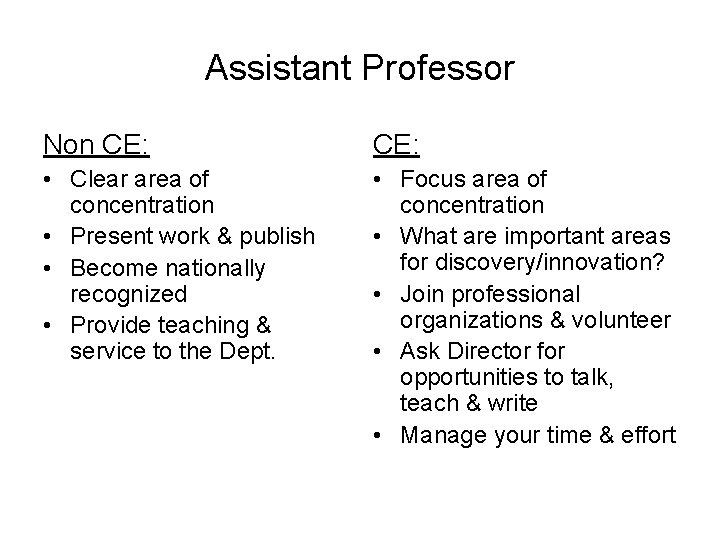
Assistant Professor Non CE: • Clear area of concentration • Present work & publish • Become nationally recognized • Provide teaching & service to the Dept. • Focus area of concentration • What are important areas for discovery/innovation? • Join professional organizations & volunteer • Ask Director for opportunities to talk, teach & write • Manage your time & effort
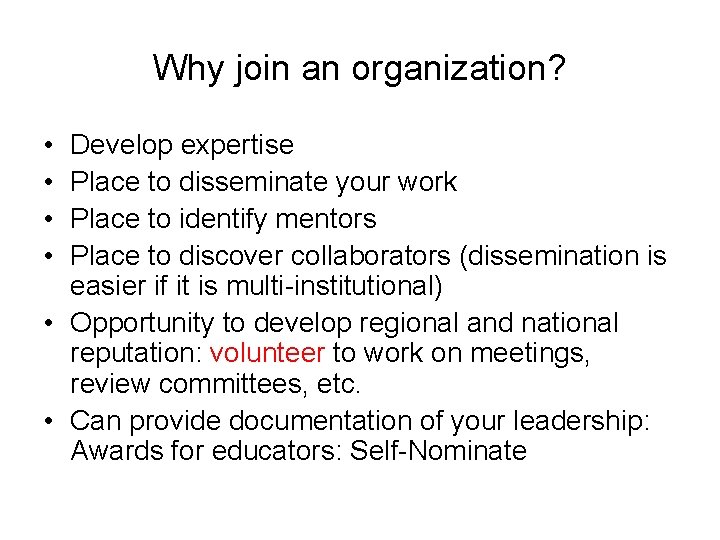
Why join an organization? • • Develop expertise Place to disseminate your work Place to identify mentors Place to discover collaborators (dissemination is easier if it is multi-institutional) • Opportunity to develop regional and national reputation: volunteer to work on meetings, review committees, etc. • Can provide documentation of your leadership: Awards for educators: Self-Nominate
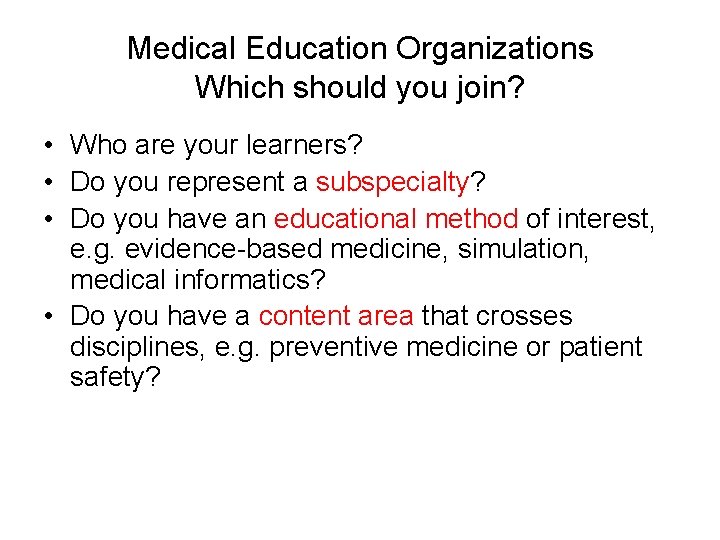
Medical Education Organizations Which should you join? • Who are your learners? • Do you represent a subspecialty? • Do you have an educational method of interest, e. g. evidence-based medicine, simulation, medical informatics? • Do you have a content area that crosses disciplines, e. g. preventive medicine or patient safety?
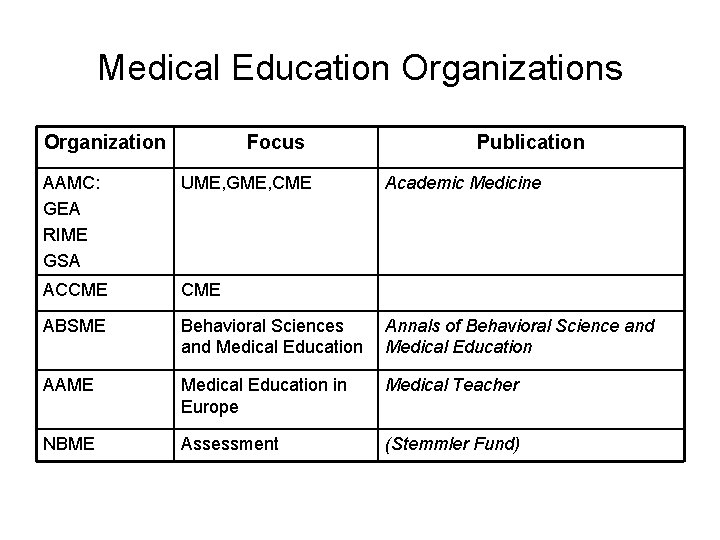
Medical Education Organizations Organization Focus Publication AAMC: GEA RIME GSA UME, GME, CME Academic Medicine ACCME ABSME Behavioral Sciences and Medical Education Annals of Behavioral Science and Medical Education AAME Medical Education in Europe Medical Teacher NBME Assessment (Stemmler Fund)
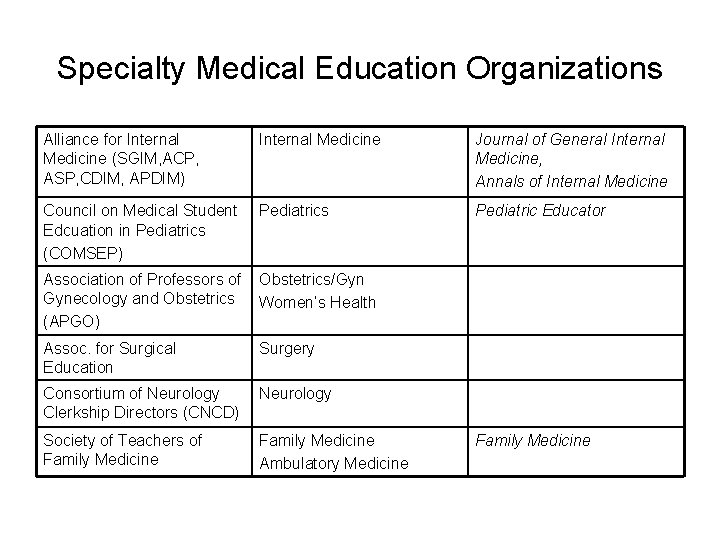
Specialty Medical Education Organizations Alliance for Internal Medicine (SGIM, ACP, ASP, CDIM, APDIM) Internal Medicine Journal of General Internal Medicine, Annals of Internal Medicine Council on Medical Student Edcuation in Pediatrics (COMSEP) Pediatrics Pediatric Educator Association of Professors of Gynecology and Obstetrics (APGO) Obstetrics/Gyn Women’s Health Assoc. for Surgical Education Surgery Consortium of Neurology Clerkship Directors (CNCD) Neurology Society of Teachers of Family Medicine Ambulatory Medicine Family Medicine
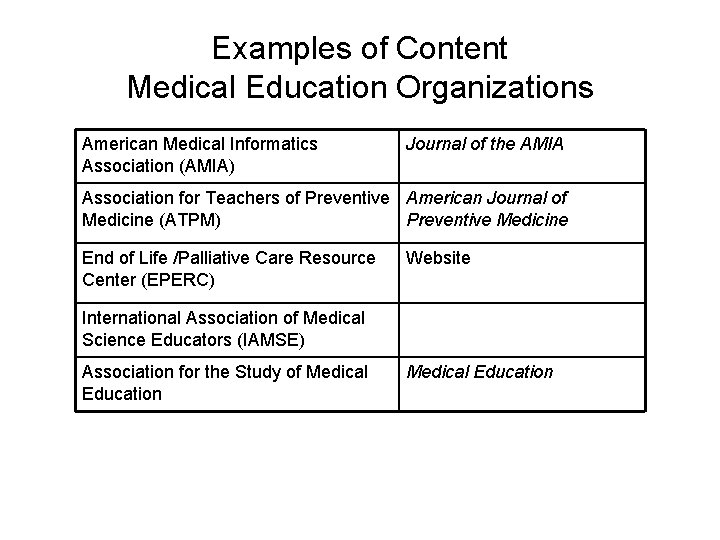
Examples of Content Medical Education Organizations American Medical Informatics Association (AMIA) Journal of the AMIA Association for Teachers of Preventive American Journal of Medicine (ATPM) Preventive Medicine End of Life /Palliative Care Resource Center (EPERC) Website International Association of Medical Science Educators (IAMSE) Association for the Study of Medical Education
Other Ways to Network • Volunteer to be a reviewer for a journal • Host a colleague at your institution, and volunteer to be invited to theirs • Volunteer to be a peer-reviewer: – HRSA Bureau of Health Professions Grants – Med. Ed. PORTAL
Effective Dissemination • • • Publish in Medical Education Journal Publish in Specialty Journal Publish in Higher Education Journal Workshops at Professional Meetings Med. Ed. PORTAL (www. aamc. org/mededportal)
Summary: How to Get Started • Keep Glassick Criteria in mind • Balance volunteerism with need for protected time to develop your enduring materials • Seek preparation • Reach outside of institution for mentors • Ask for recognition: Departmental or SOM awards, opportunities to speak, etc. • Document your career in an Educator Portfolio