Monitoring for High Risk Pests What is a




- Slides: 48
Monitoring for High Risk Pests
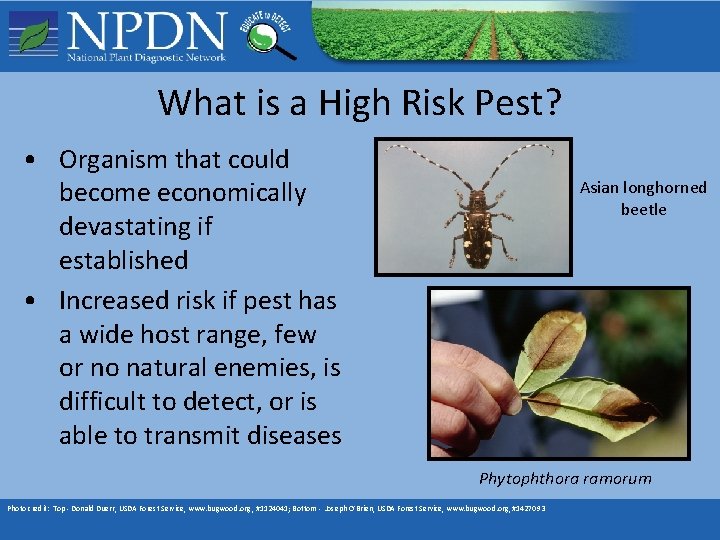
What is a High Risk Pest? • Organism that could become economically devastating if established • Increased risk if pest has a wide host range, few or no natural enemies, is difficult to detect, or is able to transmit diseases Asian longhorned beetle Phytophthora ramorum Photo credit: Top - Donald Duerr, USDA Forest Service, www. bugwood. org , #1124041; Bottom - Joseph O'Brien, USDA Forest Service, www. bugwood. org, #1427093
Why Do Invasive Pests Have High Risk Potential? • • • Few or no natural enemies Abundant suitable habitat and food resources Delay in detection and identification Lack of natural history information Lack of control recommendations Can threaten agricultural, ornamental, forestry, or floriculture crops • Can also threaten native species which can affect the overall habitat or ecosystem
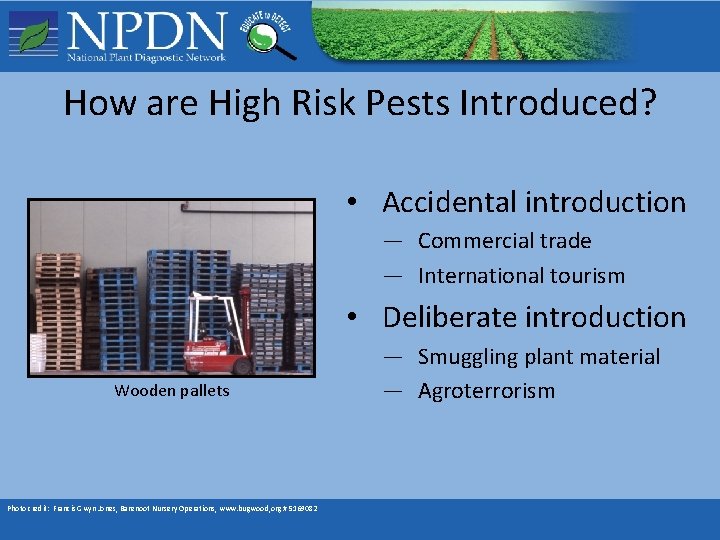
How are High Risk Pests Introduced? • Accidental introduction — Commercial trade — International tourism • Deliberate introduction Wooden pallets Photo credit: Francis Gwyn Jones, Barenoot Nursery Operations, www. bugwood, org # 5169082 — Smuggling plant material — Agroterrorism
What is a USDA Select Agent? • Defined by the Agricultural Bioterrorism Act of 2002 — Agents deemed a threat to public or plant health — Chosen based on method of dispersal, our ability to control or prevent the disease, virulence of the pathogen • Requires entities that possess, use or transfer these agents to register with the appropriate Federal Department
USDA PPQ Select Agents and Toxins List • Peronosclerospora philippinensis and P. sacchari • Phoma glycinicola — Philippine downy mildew — Red leaf blotch • Ralstonia solanacearum, race 3, biovar 2 — Southern wilt, bacterial wilt, or brown rot • Rathayibacter toxicus • Sclerophthora rayssiae var. zeae — Gumming disease — Brown stripe downy mildew • Synchytrium endobioticum — Potato wart disease • Xanthomonas oryzae pv. Oryzicola and pv. Oryzae — Bacterial leaf streak and bacterial blight
High Risk Pests • • Emerald ash borer Asian longhorned beetle Plum pox Sirex woodwasp Brown marmorated stink bug Bagrada bug Thousand cankers disease
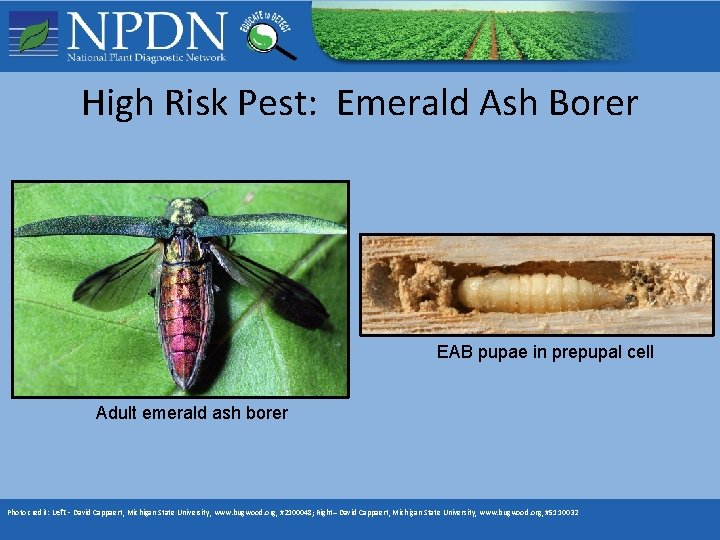
High Risk Pest: Emerald Ash Borer EAB pupae in prepupal cell Adult emerald ash borer Photo credit: Left - David Cappaert, Michigan State University, www. bugwood. org, #2100048; Right– David Cappaert, Michigan State University, www. bugwood. org, #5110032
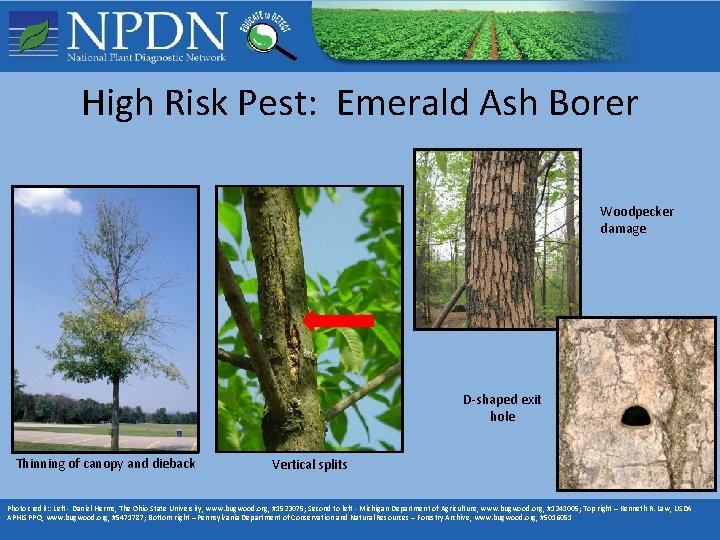
High Risk Pest: Emerald Ash Borer Woodpecker damage D-shaped exit hole Thinning of canopy and dieback Vertical splits Photo credit: : Left - Daniel Herms, The Ohio State University, www. bugwood. org, #1523075; Second to left - Michigan Department of Agriculture, www. bugwood. org, #1241005; Top right – Kenneth R. Law, USDA APHIS PPQ, www. bugwood. org, #5471787; Bottom right – Pennsylvania Department of Conservation and Natural Resources – Forestry Archive, www. bugwood. org, #5016051
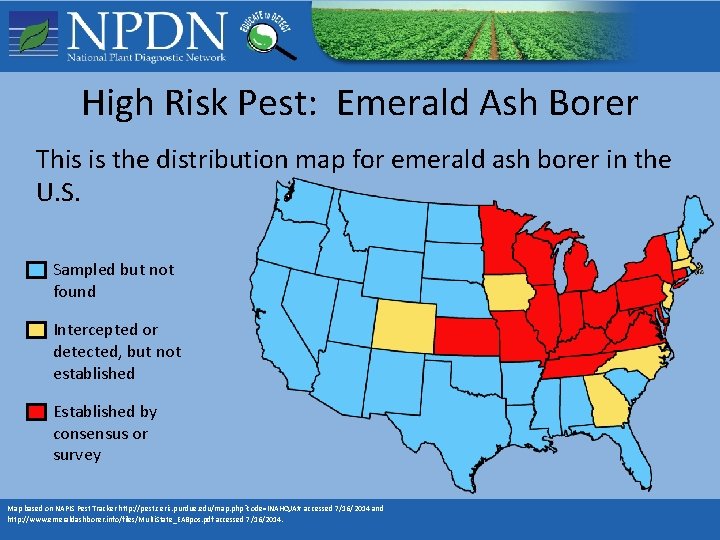
High Risk Pest: Emerald Ash Borer This is the distribution map for emerald ash borer in the U. S. Sampled but not found Intercepted or detected, but not established Established by consensus or survey Map based on NAPIS Pest Tracker http: //pest. ceris. purdue. edu/map. php? code=INAHQJA# accessed 7/16/2014 and http: //www. emeraldashborer. info/files/Multi. State_EABpos. pdf accessed 7/16/2014.
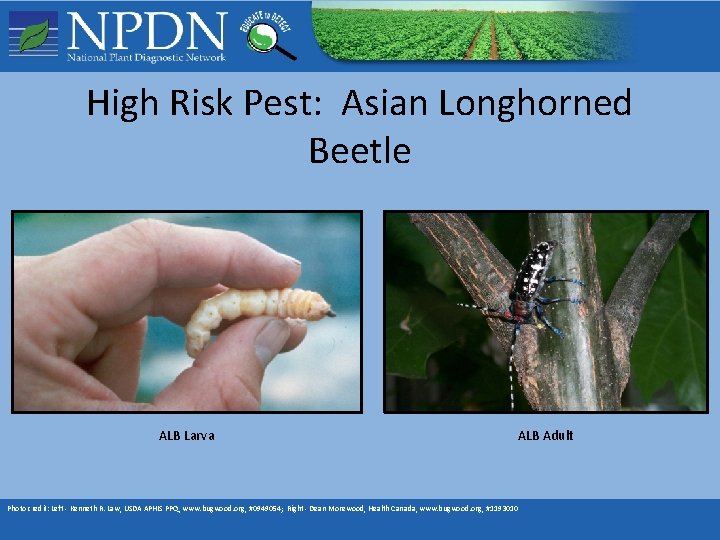
High Risk Pest: Asian Longhorned Beetle ALB Larva ALB Adult Photo credit: Left - Kenneth R. Law, USDA APHIS PPQ, www. bugwood. org, #0949054; Right - Dean Morewood, Health Canada, www. bugwood. org, #1193010
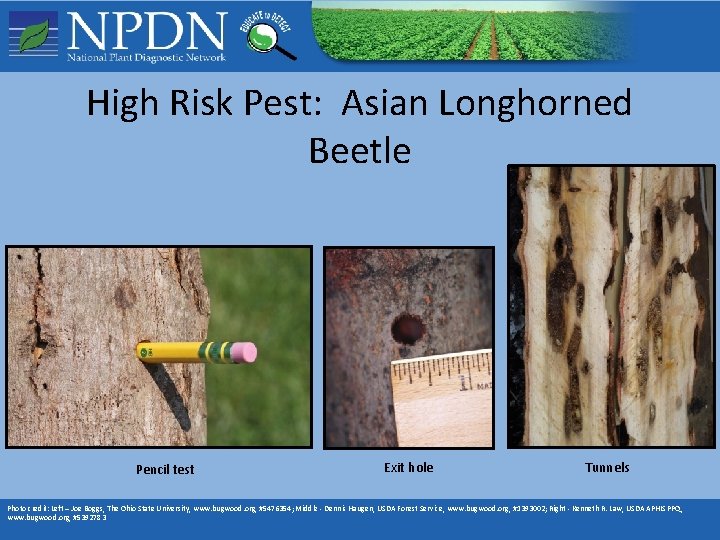
High Risk Pest: Asian Longhorned Beetle Pencil test Exit hole Tunnels Photo credit: Left – Joe Boggs, The Ohio State University, www. bugwood. org, #5476354; Middle - Dennis Haugen, USDA Forest Service, www. bugwood. org, #1393002; Right - Kenneth R. Law, USDA APHIS PPQ, www. bugwood. org, #5392783
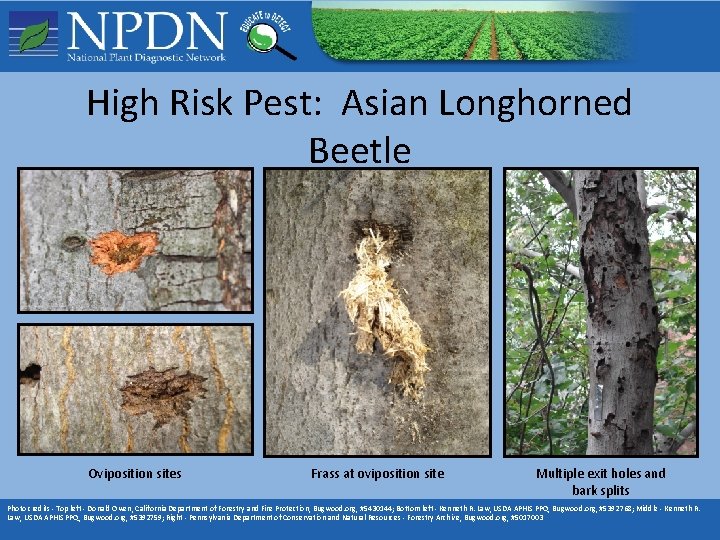
High Risk Pest: Asian Longhorned Beetle Oviposition sites Frass at oviposition site Multiple exit holes and bark splits Photo credits - Top left - Donald Owen, California Department of Forestry and Fire Protection, Bugwood. org, #5430144; Bottom left - Kenneth R. Law, USDA APHIS PPQ, Bugwood. org, #5392768; Middle - Kenneth R. Law, USDA APHIS PPQ, Bugwood. org, #5392759; Right - Pennsylvania Department of Conservation and Natural Resources - Forestry Archive, Bugwood. org, #5017003
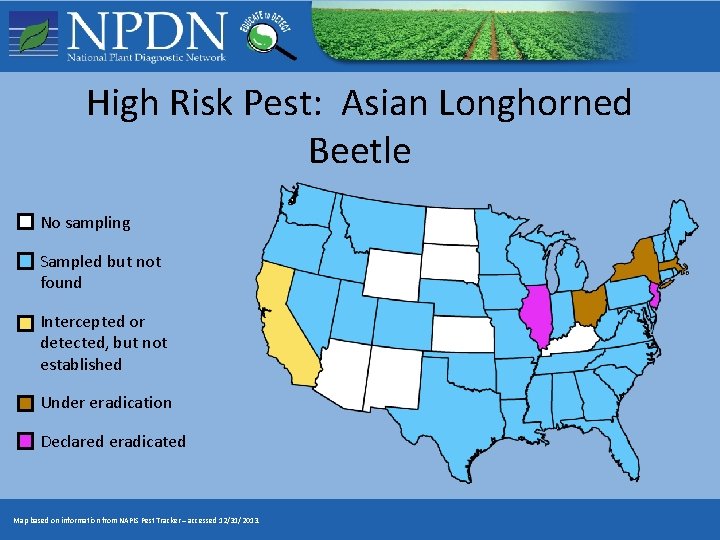
High Risk Pest: Asian Longhorned Beetle No sampling Sampled but not found Intercepted or detected, but not established Under eradication Declared eradicated Map based on information from NAPIS Pest Tracker – accessed 12/31/2013.
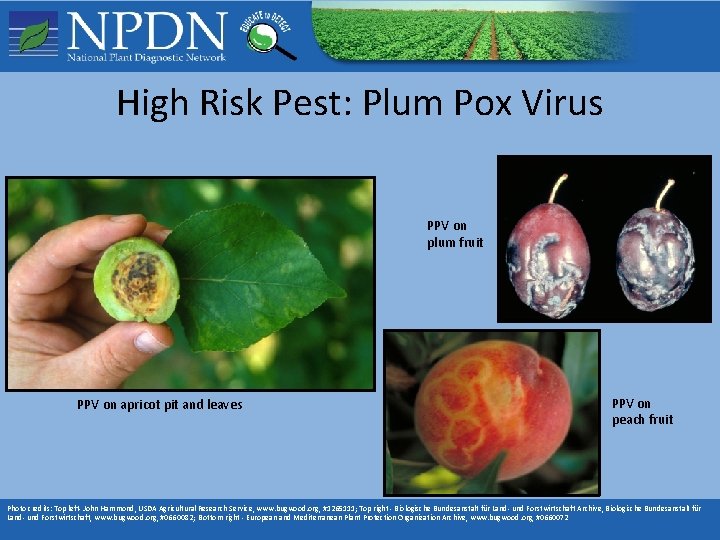
High Risk Pest: Plum Pox Virus PPV on plum fruit PPV on apricot pit and leaves PPV on peach fruit Photo credits: Top left- John Hammond, USDA Agricultural Research Service, www. bugwood. org, #1265111; Top right - Biologische Bundesanstalt für Land- und Forstwirtschaft Archive, Biologische Bundesanstalt für Land- und Forstwirtschaft, www. bugwood. org, #0660082; Bottom right - European and Mediterranean Plant Protection Organization Archive, www. bugwood. org, #0660072
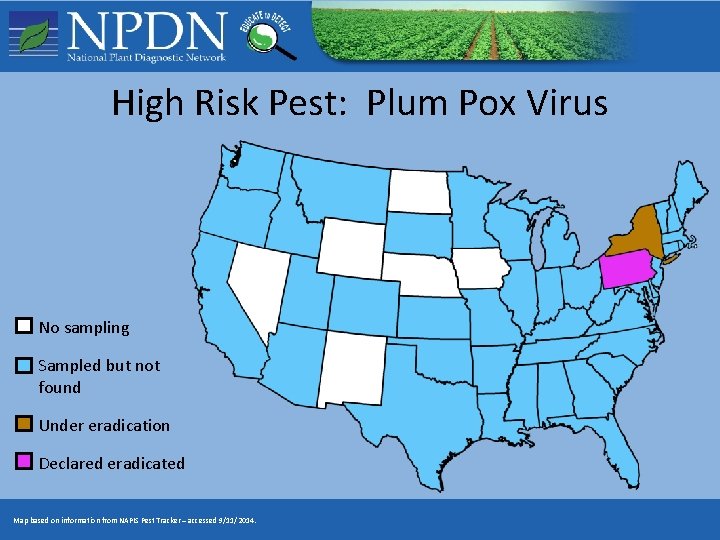
High Risk Pest: Plum Pox Virus No sampling Sampled but not found Under eradication Declared eradicated Map based on information from NAPIS Pest Tracker – accessed 9/11/2014.
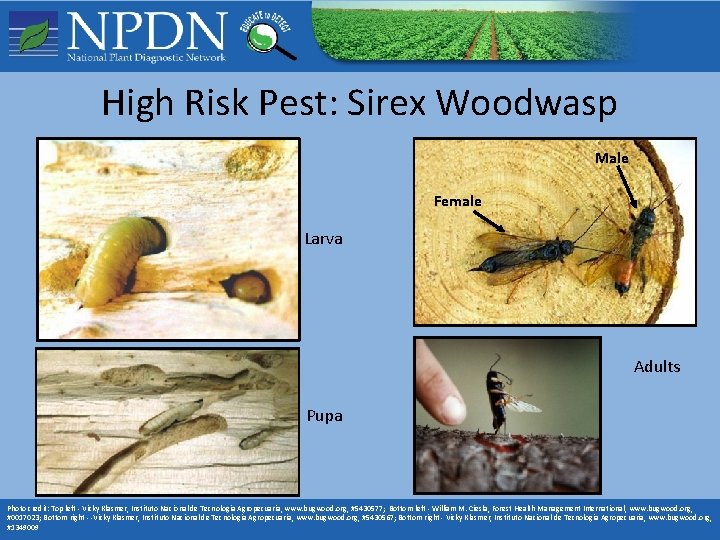
High Risk Pest: Sirex Woodwasp Male Female Larva Adults Pupa Photo credit: Top left - Vicky Klasmer, Instituto Nacional de Tecnologia Agropecuaria, www. bugwood. org, #5430577; Bottom left - William M. Ciesla, Forest Health Management International, www. bugwood. org, #0017023; Bottom right - -Vicky Klasmer, Instituto Nacional de Tecnologia Agropecuaria, www. bugwood. org, #5430567; Bottom right - Vicky Klasmer, Instituto Nacional de Tecnologia Agropecuaria, www. bugwood. org, #1349009
High Risk Pest: Sirex Woodwasp Exit holes Resin oozing from egg deposition sites Dieback Photo credit : Left - Dennis Haugen, www. bugwood. org, #1393019; Middle - Dennis Haugen, www. bugwood. org, #1393029; Right - Vicky Klasmer, Instituto Nacional de Tecnologia Agropecuaria, www. bugwood. org, #1349007
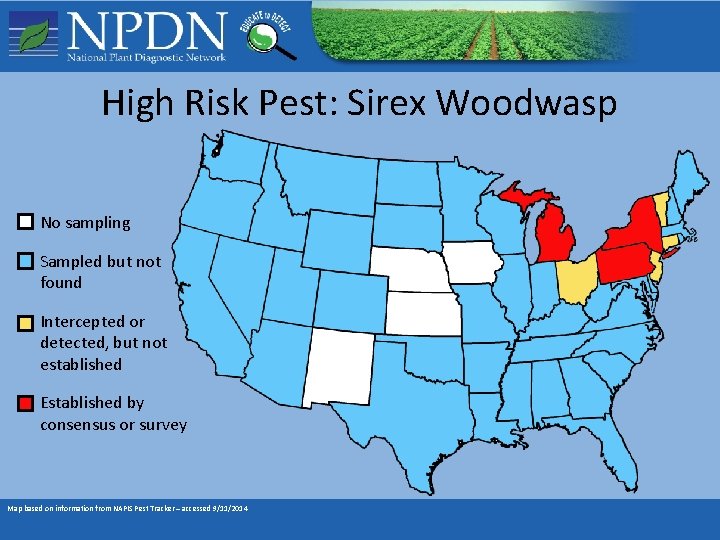
High Risk Pest: Sirex Woodwasp No sampling Sampled but not found Intercepted or detected, but not established Established by consensus or survey Map based on information from NAPIS Pest Tracker – accessed 9/11/2014
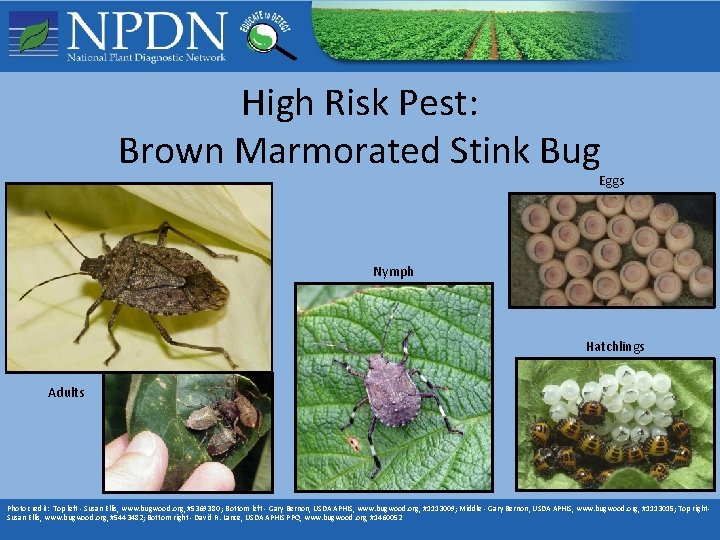
High Risk Pest: Brown Marmorated Stink Bug Eggs Nymph Hatchlings Adults Photo credit: Top left - Susan Ellis, www. bugwood. org, #5369380 ; Bottom left - Gary Bernon, USDA APHIS, www. bugwood. org, #1113009; Middle - Gary Bernon, USDA APHIS, www. bugwood. org, #1113015; Top right- Susan Ellis, www. bugwood. org, #5443482; Bottom right - David R. Lance, USDA APHIS PPQ, www. bugwood. org, #1460052
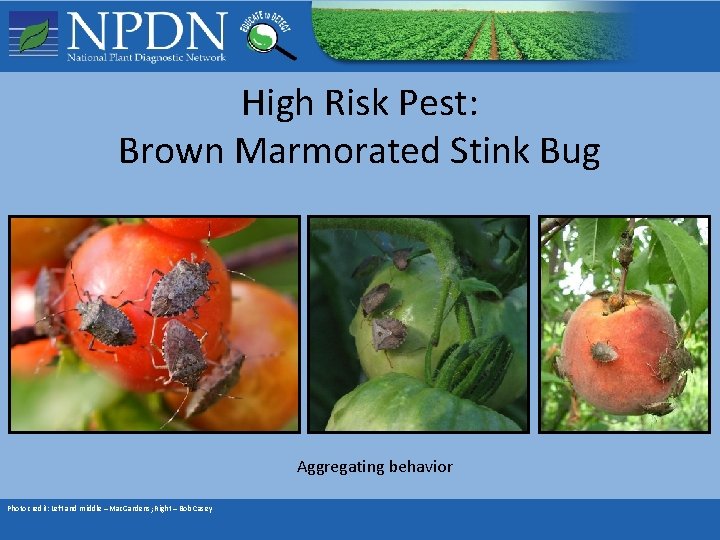
High Risk Pest: Brown Marmorated Stink Bug Aggregating behavior Photo credit: Left and middle – Mac. Gardens; Right – Bob Casey
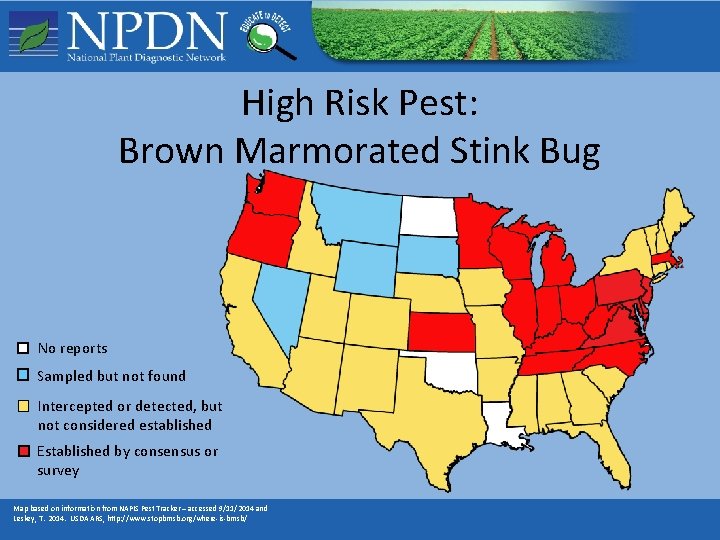
High Risk Pest: Brown Marmorated Stink Bug No reports Sampled but not found Intercepted or detected, but not considered established Established by consensus or survey Map based on information from NAPIS Pest Tracker – accessed 9/11/2014 and Leskey, T. 2014. USDA ARS, http: //www. stopbmsb. org/where-is-bmsb/
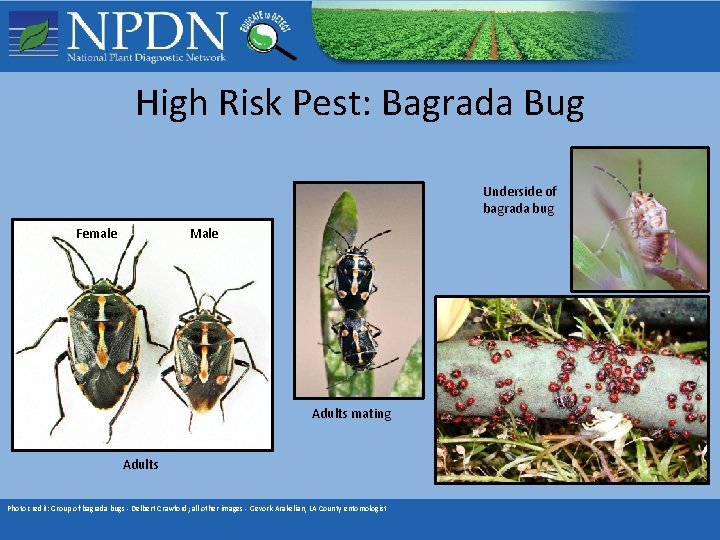
High Risk Pest: Bagrada Bug Underside of bagrada bug Female Male Adults mating Adults Photo credit: Group of bagrada bugs - Delbert Crawford; all other images - Gevork Arakelian, LA County entomologist
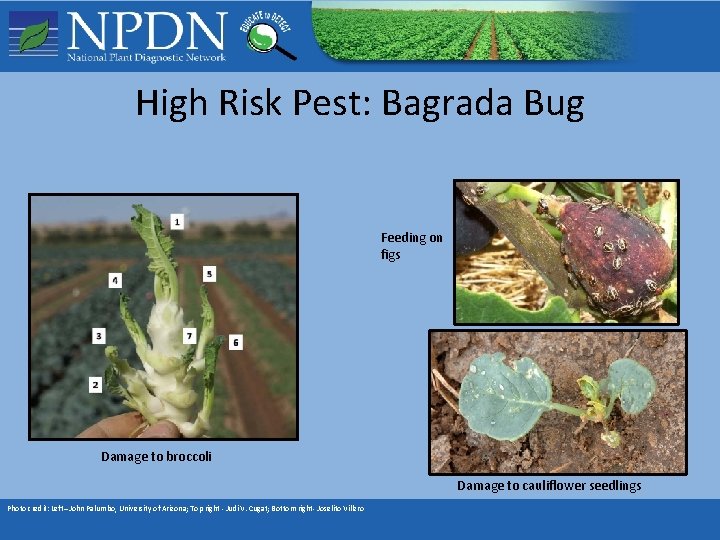
High Risk Pest: Bagrada Bug Feeding on figs Damage to broccoli Damage to cauliflower seedlings Photo credit: Left– John Palumbo, University of Arizona; Top right - Judi V. Cugat; Bottom right- Joselito Villero
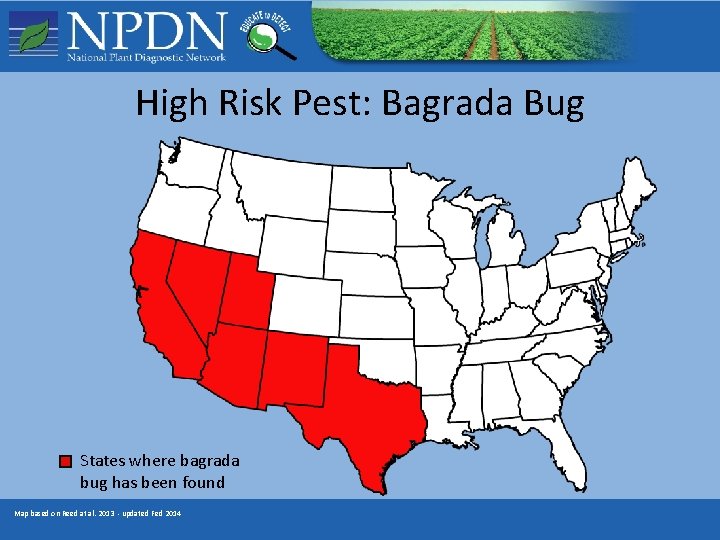
High Risk Pest: Bagrada Bug States where bagrada bug has been found Map based on Reed at al. 2013 - updated Fed 2014
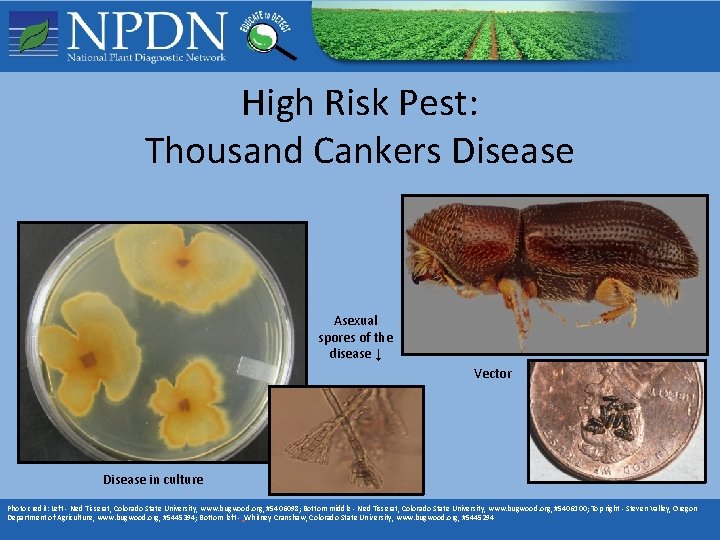
High Risk Pest: Thousand Cankers Disease Asexual spores of the disease ↓ Vector Disease in culture Photo credit: Left - Ned Tisserat, Colorado State University, www. bugwood. org, #5406098; Bottom middle - Ned Tisserat, Colorado State University, www. bugwood. org, #5406100; Top right - Steven Valley, Oregon Department of Agriculture, www. bugwood. org, #5445394; Bottom left - Whitney Cranshaw, Colorado State University, www. bugwood. org, #5445294
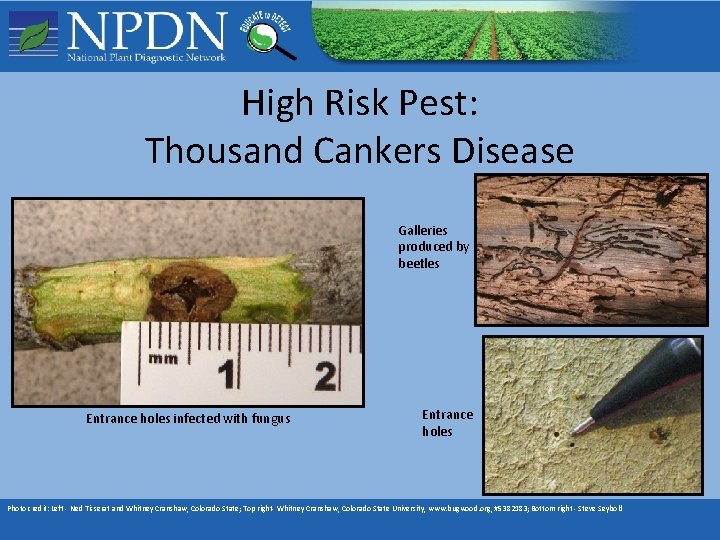
High Risk Pest: Thousand Cankers Disease Galleries produced by beetles Entrance holes infected with fungus Entrance holes Photo credit: Left - Ned Tisserat and Whitney Cranshaw, Colorado State; Top right- Whitney Cranshaw, Colorado State University, www. bugwood. org, #5382183; Bottom right - Steve Seybold
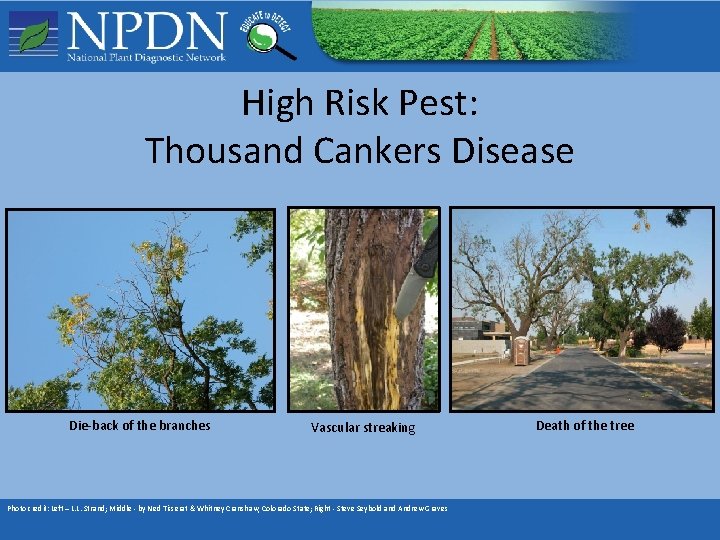
High Risk Pest: Thousand Cankers Disease Die-back of the branches Vascular streaking Photo credit: Left – L. L. Strand; Middle - by Ned Tisserat & Whitney Cranshaw, Colorado State; Right - Steve Seybold and Andrew Graves Death of the tree
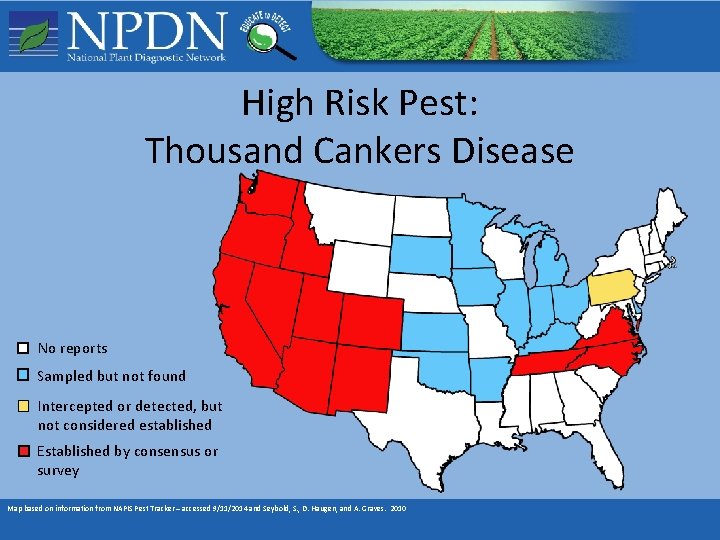
High Risk Pest: Thousand Cankers Disease No reports Sampled but not found Intercepted or detected, but not considered established Established by consensus or survey Map based on information from NAPIS Pest Tracker – accessed 9/11/2014 and Seybold, S. , D. Haugen, and A. Graves. 2010
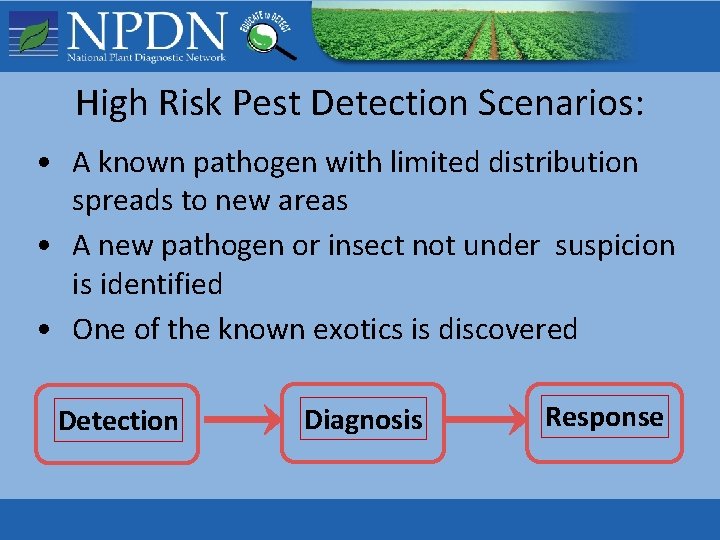
High Risk Pest Detection Scenarios: • A known pathogen with limited distribution spreads to new areas • A new pathogen or insect not under suspicion is identified • One of the known exotics is discovered Detection Diagnosis Response
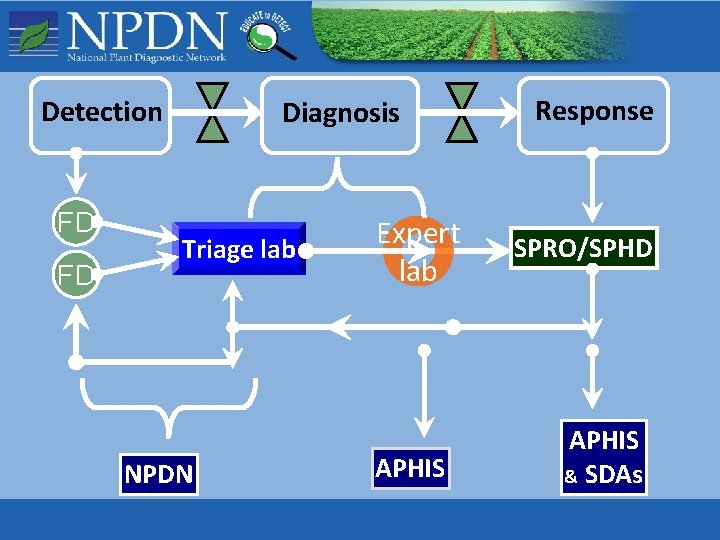
Detection FD FD Diagnosis Triage lab NPDN Expert lab APHIS Response SPRO/SPHD APHIS & SDAs
Monitoring for High Risk Pests • General Awareness: — No high risk pests have been reported — General, normal awareness • Heightened Awareness: — High risk pest reported — Determine distribution and spread
What can you do? • Be familiar with what pests you would normally find in your crop, natural area, or yard • Know seasonal pest patterns • Know typical weather patterns
Be aware of other resources that are available to you • Protect U. S. — www. protectingusnow. org • IPM Regional Centers — www. ipmcenters. org • e. Xtension — www. extension. org • Pest Tracker — http: //pest. ceris. purdue. edu/ • EDEN — http: //eden. lsu. edu
Be aware of other resources that are available to you • National Invasive Species Information Center — www. invasivespeciesinfo. gov/ • Center for Invasive Species Research — http: //cisr. ucr. edu/ • North American Plant Protection Organization’s Phytosanitary Alert System — http: //www. nappo. org/ — http: //www. pestalert. org/ • Center for Invasive Species and Ecosystem Health — www. bugwood. org
Questions? • Contact: — Gail Ruhl, Plant & Pest Diagnostic Lab, Purdue University, ruhlg@purdue. edu • http: //www. ppdl. purdue. edu/PPDL/physical. html#plant_disease • To find your local NPDN lab or for more information on the NPDN or your regional NPDN — www. npdn. org • NPDN First Detector Training Website — www. firstdetector. org
Authors • Mary Mc. Kellar Ph. D. , Education and Training Coordinator, NEPDN, Cornell University • Updated by: — Richard Hoenisch M. S. , WPDN, Department of Plant Pathology, University of California, Davis — Eric Le. Veen, B. S. , Plant Medicine Program, University of Florida — Stephanie Stocks, M. S. , Department of Entomology and Nematology, University of Florida
Reviewers • Rachel L. Mc. Carthy, NEPDN Education and Training Coordinator, Department of Plant Pathology and Plant-Microbe Biology, Cornell University • Amy Peterson Dunfee, NCPDN Teaching and Education Coordinator Dept. of Plant Pathology Michigan State University • Gail Ruhl, M. S. , Department of Plant Pathology, Purdue University • Sharon Dobesh, M. S. , Associate Director, GPDN, Kansas State University
Publication Details • This publication can be used for non-profit, educational use only purposes. Photographers retain copyright to photographs or other images contained in this publication as cited. This material was developed as part of the NPDN First Detector Training Course. Authors and the website should be properly cited. Images or photographs should also be properly cited and credited to the original source. • Publication Date: December 2006 • Edited September 2014
NPDN Partners • • • United States Department of Agriculture Animal and Plant Health Inspection Service Plant Protection and Quarantine (USDA APHIS PPQ) Local and Regional Integrated Pest Management Programs Cooperative Agriculture Pest Survey Program (CAPS) National Plant board and State Departments of Agriculture Extension Disaster Education Network (EDEN) Center for Invasive Species and Ecosystem Health (Bugwood)
References • Arakelian, G. Bagrada hilaris factsheet. University of California Riverside, Center for Invasive Species Research. Accessed 1/31/2013 — • Emerald ash borer. Where is EAB? . Accessed 7/16/2014. — • http: //water. epa. gov/type/oceb/habitat/pathways. cfm Evans-Goldner, L. 2008. Proposed program for the control of the woodwasp Sirex noctilio F. (Hymenoptera: Siricidae) in the Northeastern United States. USDA, APHIS. Accessed 12/8/2012 — • http: //www. emeraldashborer. info/surveyinfo. cfm#sthash. zhj. R 8 u. G 1. dpbs Environmental Protection Agency. Pathways for invasive species introduction. Accessed 12/8/2012 — • http: //cisr. ucr. edu/bagrada_bug. html http: //www. aphis. usda. gov/plant_health/ea/downloads/Sirex. EA-final-northeast. pdf Evans-Goldner, L. 2012. Plum pox factsheet. USDA, APHIS. Accessed 12/8/2012 — http: //www. aphis. usda. gov/plant_health/plant_pest_info/plum_pox/downloads/2012 Pl um. Pox. Fact. Sheet. pdf
References • Gyeltshen, J. , Bernon, G. , and Hodges, A. 2010. Brown marmorated stink bug, Halyomorpha halys Stal (Insecta: Hemiptera: Pentatomidae). University of Florida Institute of Food and Agricultural Sciences. EDIS publication EENY 346. Accessed 1/6/2013 — • Kansas Department of Agriculture. Thousand cankers disease of Walnut quarantine factsheet. Accessed 12/9/2012 — • http: //www. ksda. gov/includes/document_center/plant_protection/Plant_Disease_Fact_ Sheets/TCDQuarantine. Fact. Sheet. pdf Leskey, T. 2014. USDA ARS, accessed 9/11/20014 — • http: //edis. ifas. ufl. edu/pdffiles/IN/IN 62300. pdf http: //www. stopbmsb. org/where-is-bmsb/ Lichtenberg, E. and Olson, L. J. 2010. Risk factors for invasive pest introductions in commodity imports: Theory and empirical evidence. Agricultural and Applied Economics Association’s 2010 Joint Annual Meeting. 12/8/2012 — http: //ageconsearch. umn. edu/bitstream/61706/2/Risk%20 Factors%20 for%20 Invasive%2 0 Pest%20 Introductions%20 AAEA%202010. pdf
References • Mannion, C. 2003. High risk insect pests: Monitoring and diagnosis. Proceedings of the Florida State Horticultural Society. 116: 78 -79. Accessed 12/8/2012 — • Meyer, D. A. , 1998. Asian longhorned beetle – Anoplophora glabripennis. Cornell University. Hardwood Research Bulletin. Number 500. Accessed 12/5/2012 — • http: //counties. cce. cornell. edu/wyoming/agriculture/resources/ipd/longhorn_beetle. ht m National Agricultural Pest Information System (NAPIS) – Pest Tracker. Asian longhorned beetle. Accessed 31 December 2013. — • http: //fshs. org/proceedings-o/2003 -vol-116/078 -79. pdf http: //pest. ceris. purdue. edu/map. php? code=INALQCA# National Agricultural Pest Information System (NAPIS) – Pest Tracker. Emerald ash borer. Accessed 7/16/2014 — http: //pest. ceris. purdue. edu/map. php? code=INAHQJA#
References • National Agricultural Pest Information System (NAPIS) – Pest Tracker. Halyomorpha halys. Accessed 9/11/20014 — • National Agricultural Pest Information System (NAPIS) – Pest Tracker. Plum Pox Virus. Accessed 9/11/2014 — • http: //pest. ceris. purdue. edu/map. php? code=ISBBADA National Agricultural Pest Information System (NAPIS) – Pest Tracker. Thousand Cankers Disease. Accessed 9/11/2014. — • http: //pest. ceris. purdue. edu/map. php? code=FVPPVBE# National Agricultural Pest Information System (NAPIS) – Pest Tracker. Sirex noctilio. Accessed 9/11/2014 — • http: //pest. ceris. purdue. edu/map. php? code=IQAQQKA# http: //pest. ceris. purdue. edu/map. php? code=FDAAGFL# National Select Agent Registry. Select Agents and Toxins List. Accessed 9/10/2014 — http: //www. selectagents. gov/Select%20 Agents%20 and%20 Toxins%20 List. html
References • North American Plant Protection Organization – Phytosanitary Alert System. Anoplophora glabripennis. Accessed 31 December 2013. — • North American Plant Protection Organization – Phytosanitary Alert System. Plum Pox Virus. Accessed 9/11/2014 — — • http: //www. pestalert. org/opr. Detail. cfm? opr. ID=404&keyword=plum%20 pox http: //www. pestalert. org/opr. Detail. cfm? opr. ID=308&keyword=sirex%20 noctilio Palumbo. J. C. 2010. The bagrada bug, a new invasive pest of cole crops in Arizona. University of Arizona, Yuma Agricultural Center. Accessed 1/31/2013 — • http: //www. pestalert. org/opr. Detail. cfm? opr. ID=433&keyword=plum%20 pox and North American Plant Protection Organization – Phytosanitary Alert System. Sirex noctilio. Accessed 9/11/2014 — • http: //www. pestalert. org/opr. Detail. cfm? opr. ID=499&keyword=Anoplophora%20 glabripennis http: //ag. arizona. edu/crops/vegetables/advisories/docs/Bagrad_bug_2010_Palumbo. pdf Reed, D. A. , Palumbo, J. C. , Perring, T. M. , May, C. , 2013. Bagrada hilaris (Burmeister), a new stink bug attacking cole crops in the southwestern United States. Journal of Integrated Pest Management, 4(3) 2003, DOI: http: //dx. doi. org/ 10. 1603/ IPM 13007
References • Seybold, S. , D. Haugen, and A. Graves. 2010 (revised February 2013). Pest alert: Thousand cankers disease. United States Department of Agriculture, Forest Service, Northeastern Area State and Private Forestry. accessed 3/25/2013 – — • Spence, D. and Smith, J. 2011. Emerald ash borer: A potential future threat to ash trees in Florida. University of Florida, Institute of Food and Agricultural Sciences. EDIS publication # FR-346. Accessed 12/9/2012 — • http: //edis. ifas. ufl. edu/fr 346 University of Vermont. Asian longhorned beetle. Accessed 9/29/2012 — • http: //na. fs. fed. us/pubs/palerts/cankers_disease/thousand_cankers_disease_screen_re s. pdf http: //www. uvm. edu/albeetle/index. html USDA APHIS. Agricultural bioterrorism protection act of 2002; Biennial review and republication of the select agent and toxin list; Amendments to the select agent and toxin regulations. Accessed 12/9/2012 — http: //www. selectagents. gov/resources/USDA%20 APHIS%20 Select%20 Agent%20 Final% 20 Rule%2010%2005%202012. pdf
References • USDA APHIS. Asian longhorned beetle. Accessed 12/8/2012 — • USDA APHIS. Asian longhorned beetle. Accessed 9/29/2012 — • http: //www. aphis. usda. gov/plant_health/plant_pest_info/pram/ USDA APHIS PPQ. Questions and answers: New risk-based sampling protocol and propagative monitoring and release program at plant inspection stations. Accessed 12/8/2012 — • http: //www. aphis. usda. gov/plant_health/plant_pest_info/asian_lhb/background. shtml USDA APHIS. Phytophthora ramorum/Sudden oak death. Accessed 12/8/2012 — • http: //www. aphis. usda. gov/plant_health/plant_pest_info/asian_lhb/index. shtml http: //www. aphis. usda. gov/publications/plant_health/2012/risk_based_sampling. pdf USDA National Invasive Species Information Center. What is an invasive species? Accessed 8/18/2014 — http: //www. invasivespeciesinfo. gov/whatis. shtml
References • • Yang, Z. -Q. , Yao, Y. -X. , Qiu, L. -F. , and Li, Z. -X. 2009. A new species of Trissolcus (Hymenoptera: Scelionidae) parasitizing eggs of Halyomorpha halys (Heteroptera: Pentatomidae) in China with comments on its biology. Annals of the Entomological Society of America, 102(1): 39 -47. Yu, G. , and Zhang, J. 2007. The brown-marmorated stink bug, Halyomorpha halys (Heteroptera: Pentatomidae) in P. R. China. International Workshop on Biological Control of Invasive Species of Forests. 1: 70 -74.