Improving Generative Adversarial Network GAN Hungyi Lee Generation


- Slides: 71
Improving Generative Adversarial Network (GAN) Hung-yi Lee
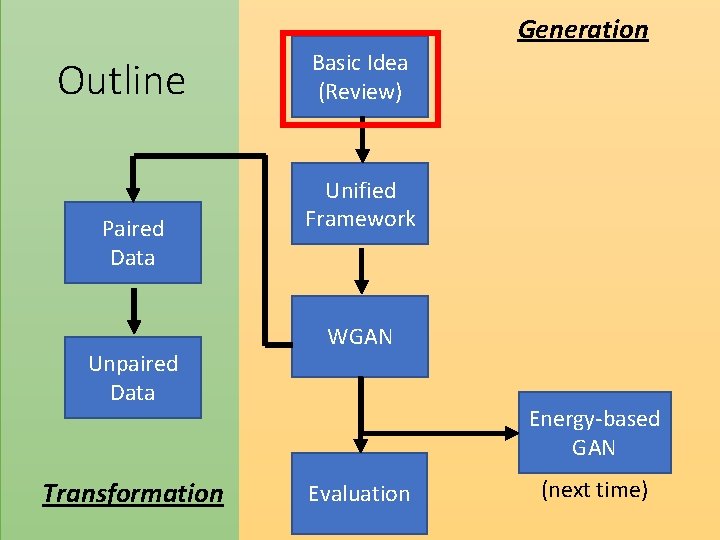
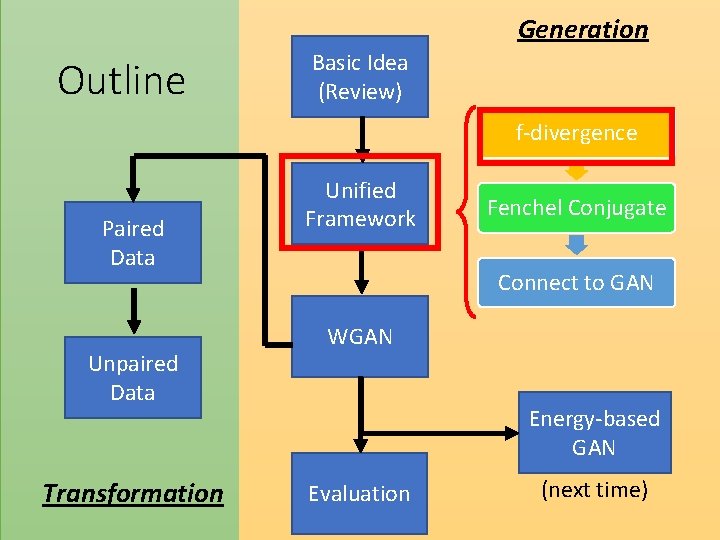
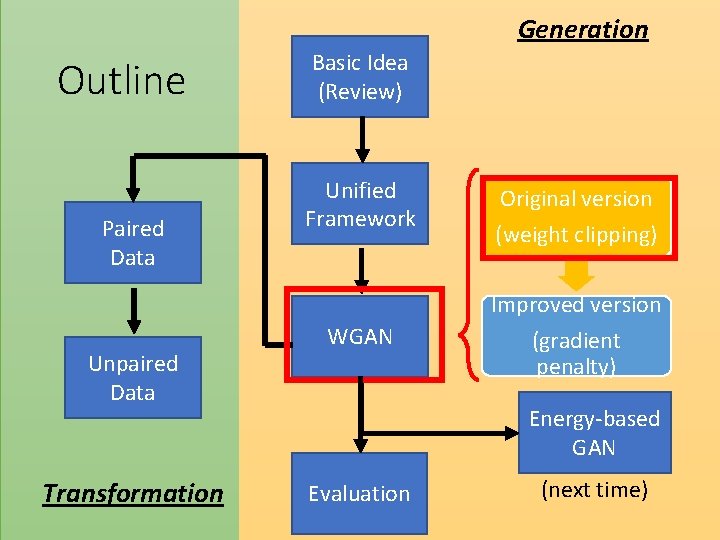
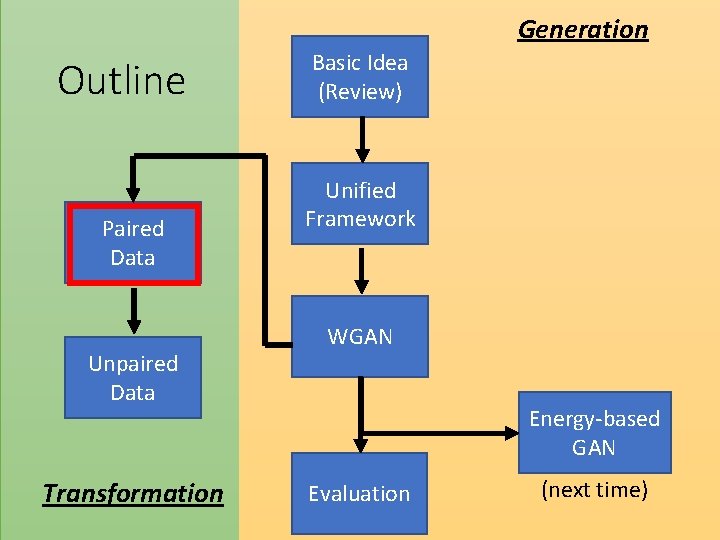
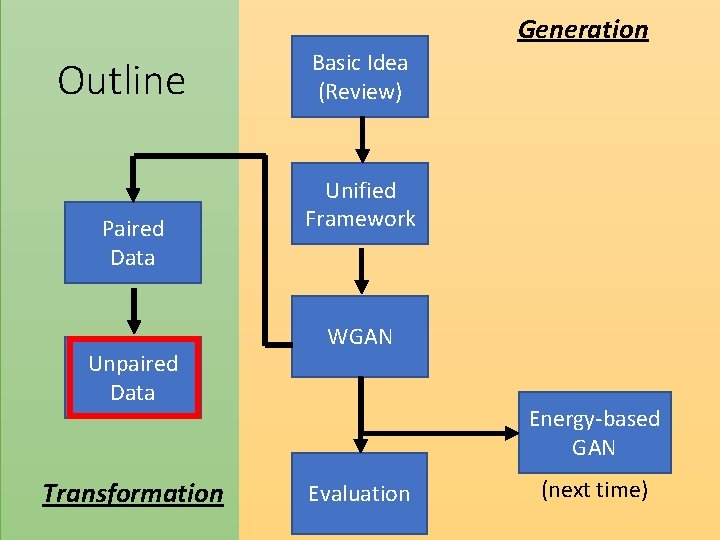
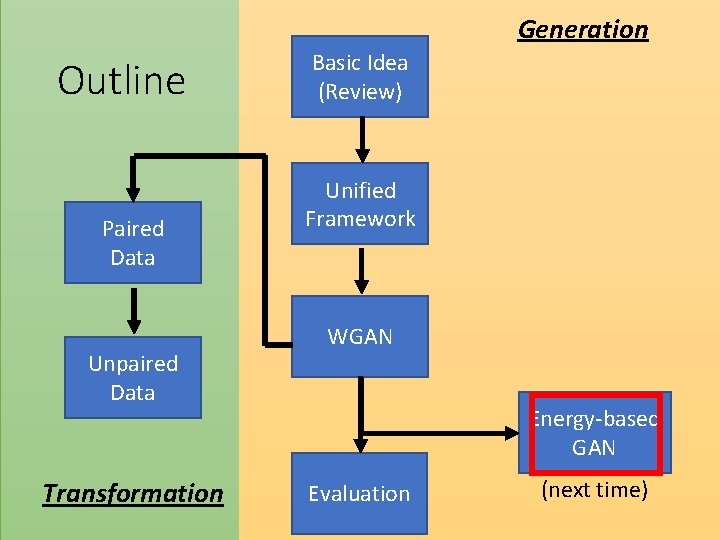
Generation Outline Paired Data Unpaired Data Transformation Basic Idea (Review) Unified Framework WGAN Energy-based GAN Evaluation (next time)
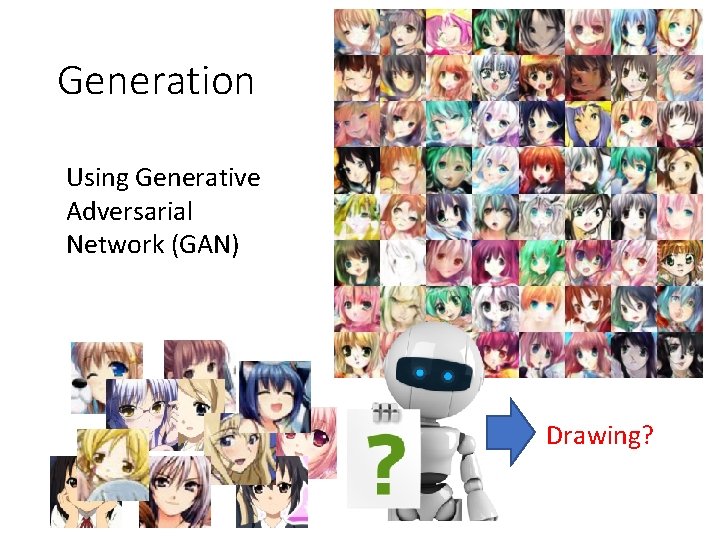
Generation Using Generative Adversarial Network (GAN) Drawing?
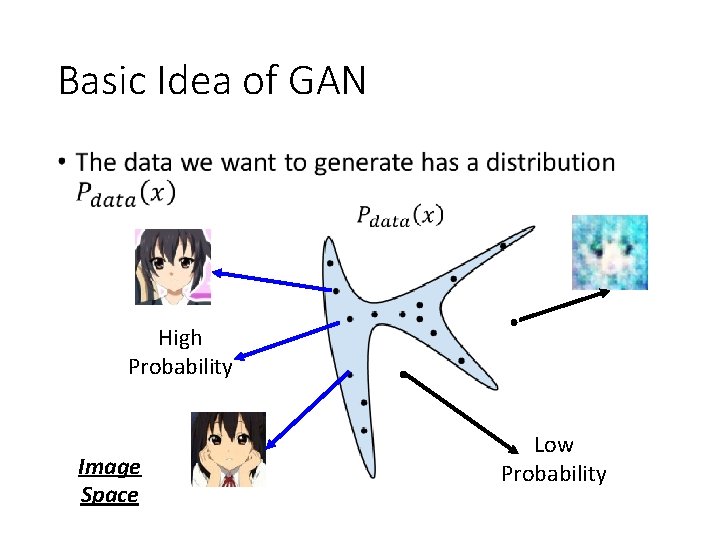
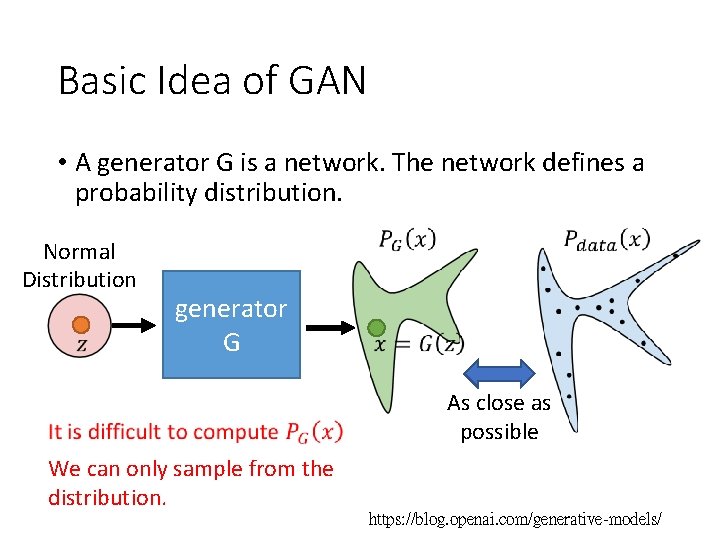
Basic Idea of GAN • High Probability Image Space Low Probability
Basic Idea of GAN • A generator G is a network. The network defines a probability distribution. Normal Distribution generator G As close as possible We can only sample from the distribution. https: //blog. openai. com/generative-models/
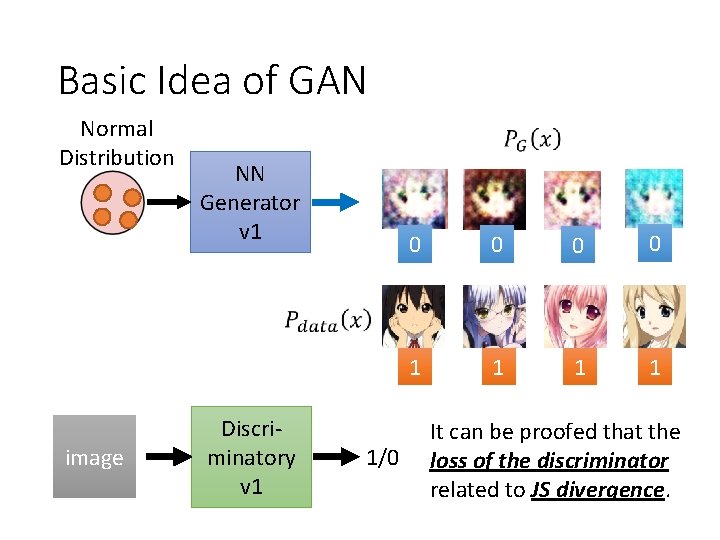
Basic Idea of GAN Normal Distribution image NN Generator v 1 Discriminatory v 1 1/0 0 0 1 1 It can be proofed that the loss of the discriminator related to JS divergence.
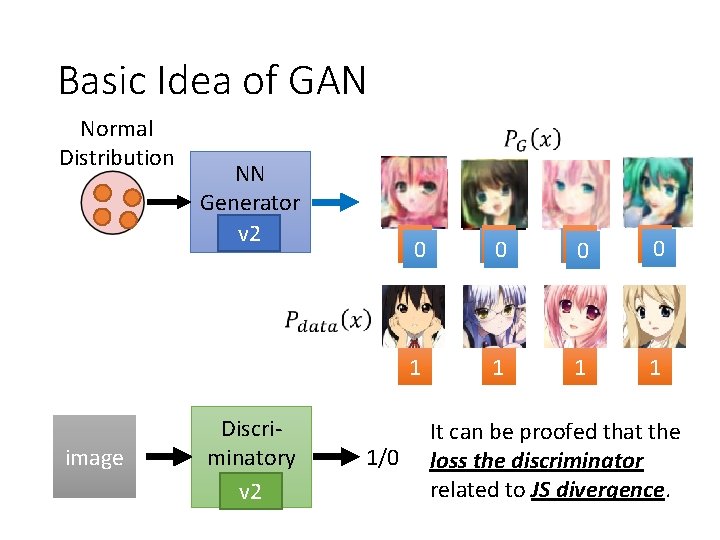
Basic Idea of GAN Normal Distribution image NN Generator v 1 v 2 Discriminatory v 1 v 2 1/0 010 010 00 1 1 1 It can be proofed that the loss the discriminator related to JS divergence.
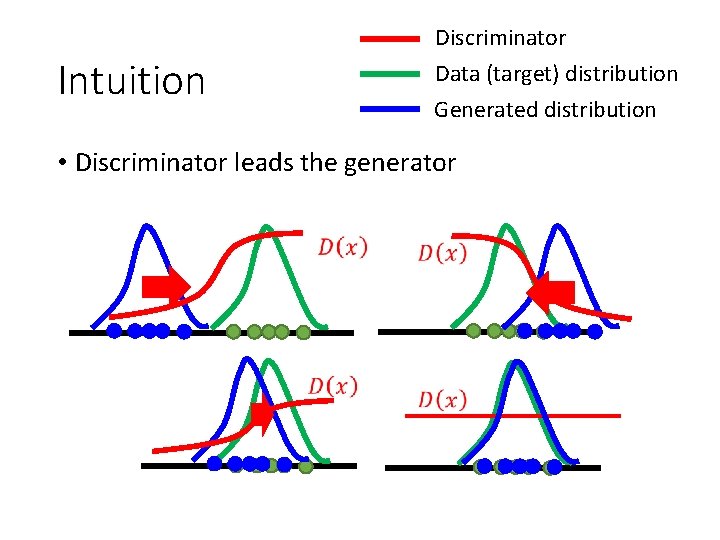
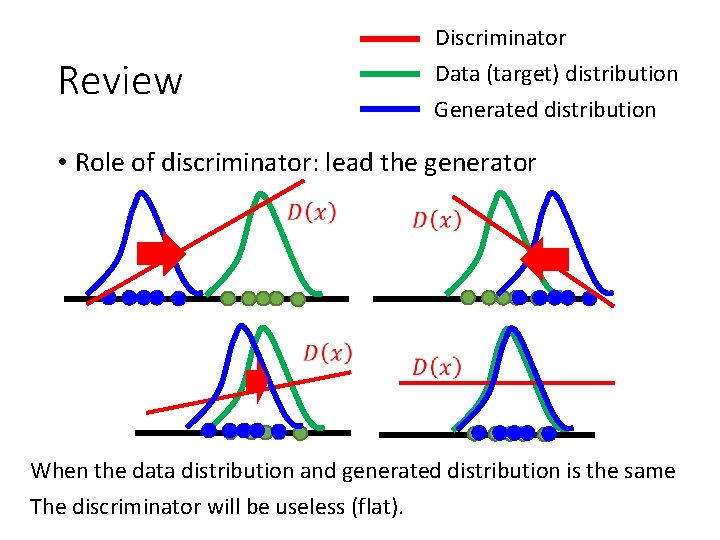
Intuition Discriminator Data (target) distribution Generated distribution • Discriminator leads the generator
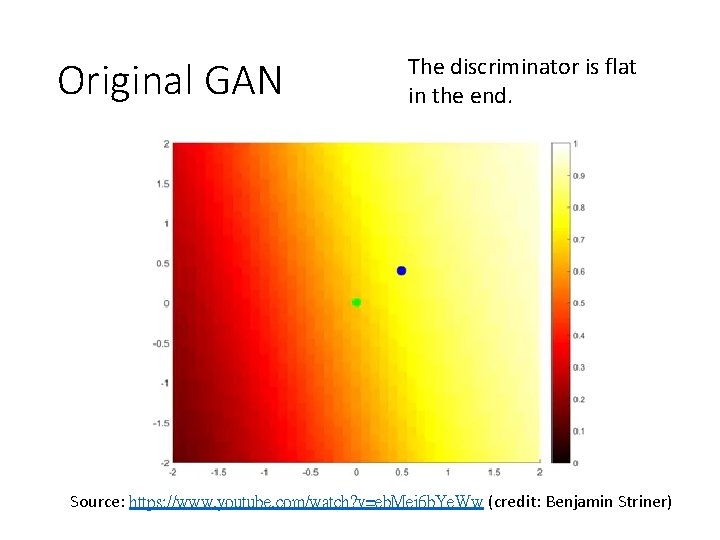
Original GAN The discriminator is flat in the end. Source: https: //www. youtube. com/watch? v=eb. Mei 6 b. Ye. Ww (credit: Benjamin Striner)
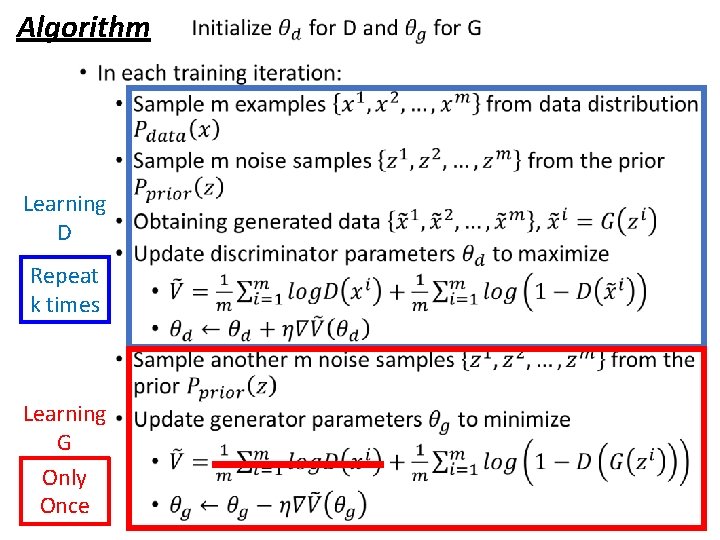
Algorithm • Learning D Repeat k times Learning G Only Once
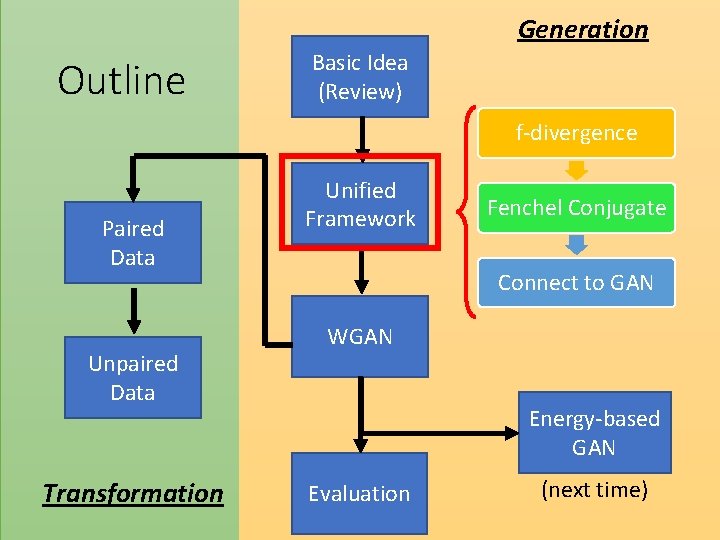
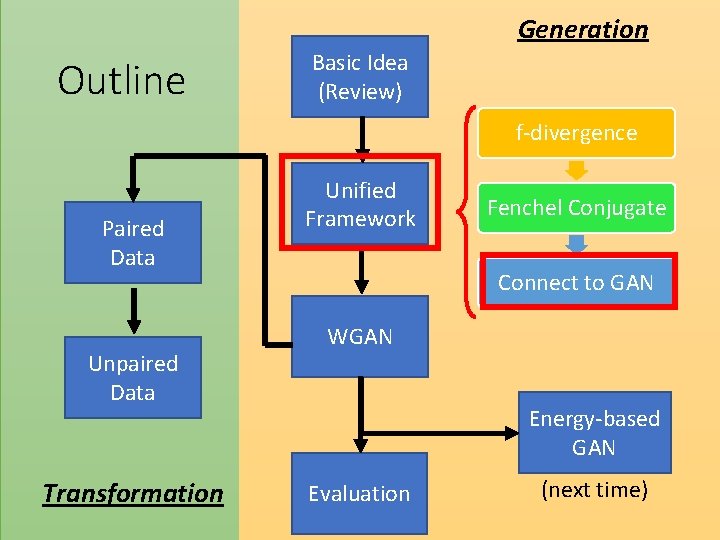
Generation Outline Basic Idea (Review) f-divergence Paired Data Unpaired Data Transformation Unified Framework Fenchel Conjugate Connect to GAN WGAN Energy-based GAN Evaluation (next time)
Reference • Sebastian Nowozin, Botond Cseke, Ryota Tomioka, “f-GAN: Training Generative Neural Samplers using Variational Divergence Minimization”, NIPS, 2016 • One sentence: you can use any f-divergence
Generation Outline Basic Idea (Review) f-divergence Paired Data Unpaired Data Transformation Unified Framework Fenchel Conjugate Connect to GAN WGAN Energy-based GAN Evaluation (next time)
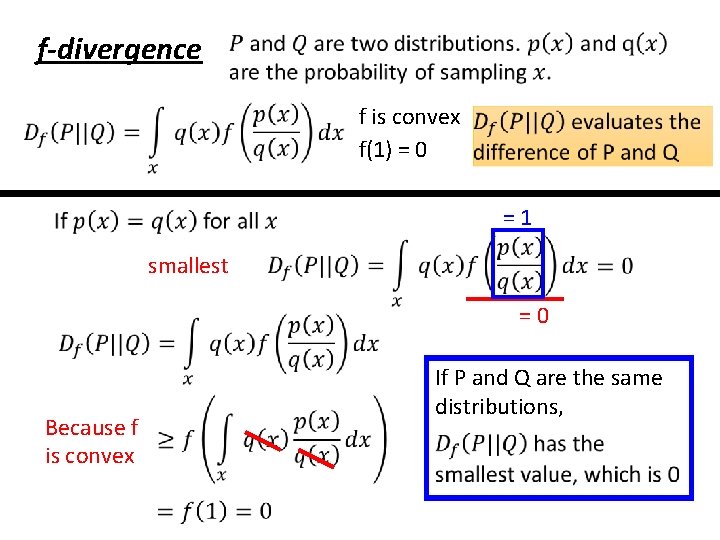
f-divergence f is convex f(1) = 0 =1 smallest =0 Because f is convex If P and Q are the same distributions,
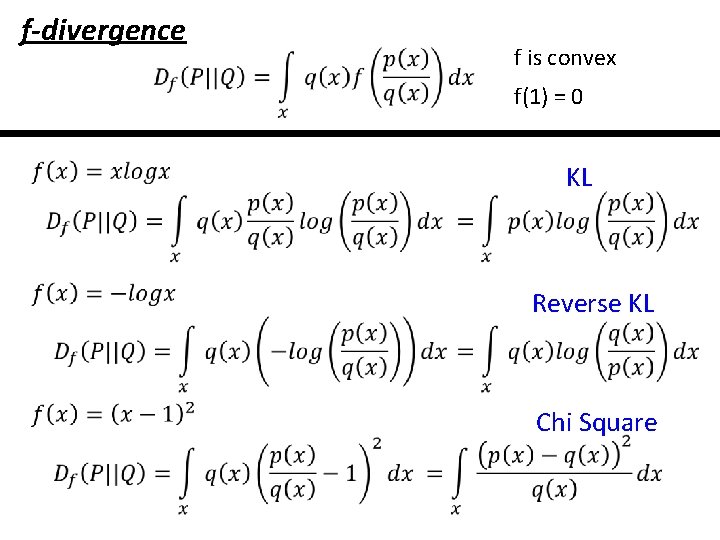
f-divergence f is convex f(1) = 0 KL Reverse KL Chi Square
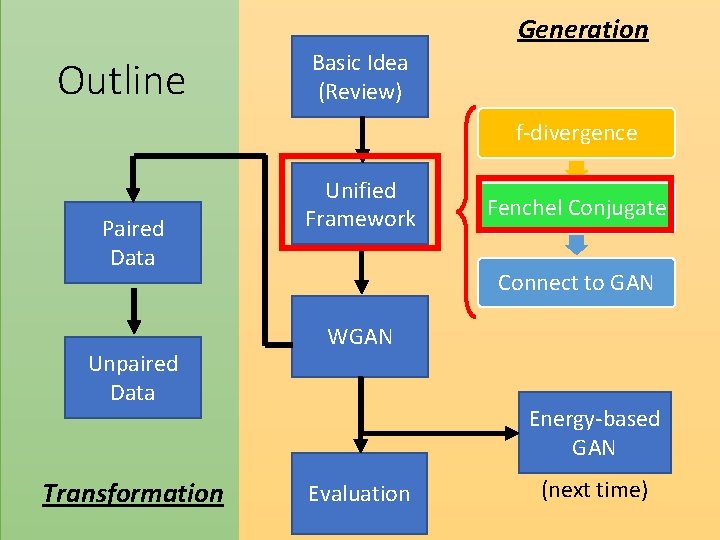
Generation Outline Basic Idea (Review) f-divergence Paired Data Unpaired Data Transformation Unified Framework Fenchel Conjugate Connect to GAN WGAN Energy-based GAN Evaluation (next time)
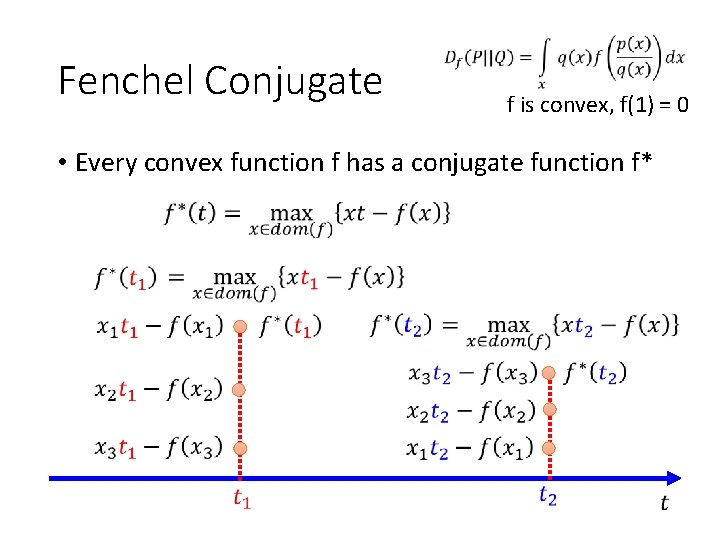
Fenchel Conjugate f is convex, f(1) = 0 • Every convex function f has a conjugate function f*
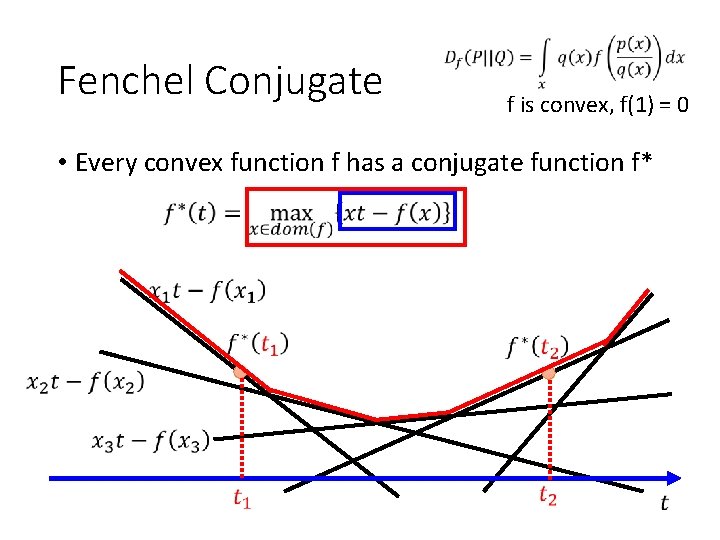
Fenchel Conjugate f is convex, f(1) = 0 • Every convex function f has a conjugate function f*
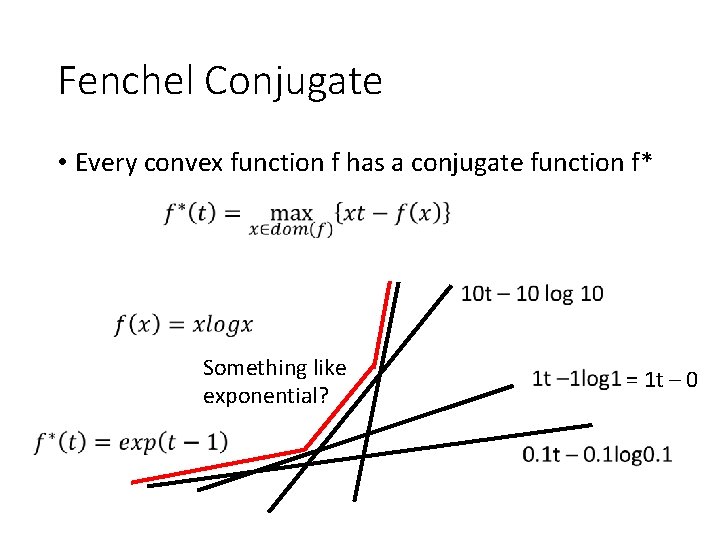
Fenchel Conjugate • Every convex function f has a conjugate function f* Something like exponential? = 1 t – 0
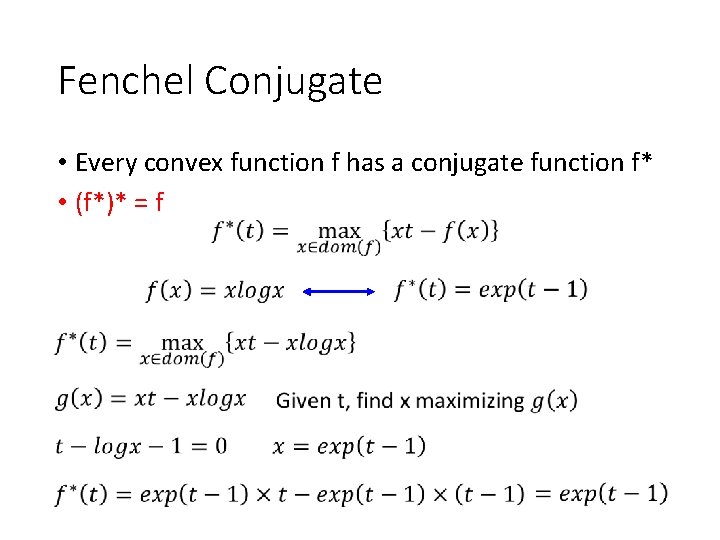
Fenchel Conjugate • Every convex function f has a conjugate function f* • (f*)* = f
Generation Outline Basic Idea (Review) f-divergence Paired Data Unpaired Data Transformation Unified Framework Fenchel Conjugate Connect to GAN WGAN Energy-based GAN Evaluation (next time)
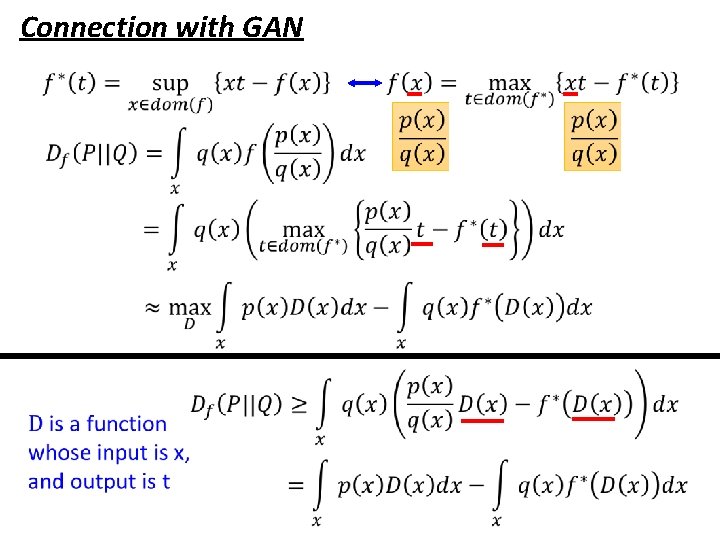
Connection with GAN
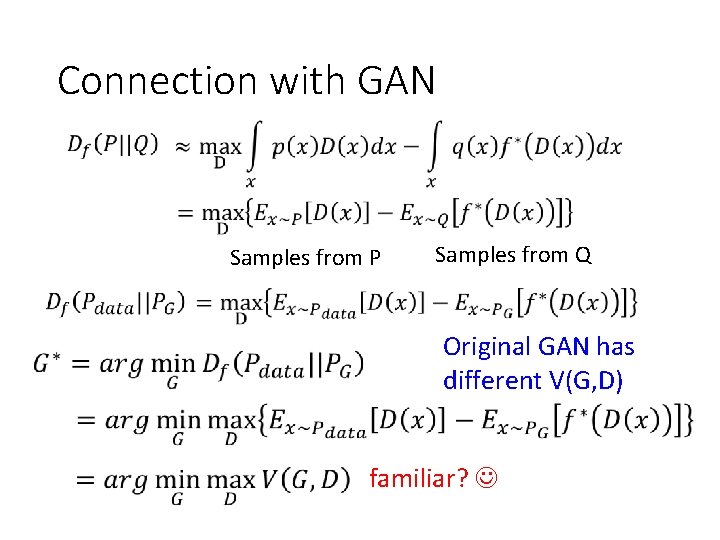
Connection with GAN Samples from P Samples from Q Original GAN has different V(G, D) familiar?
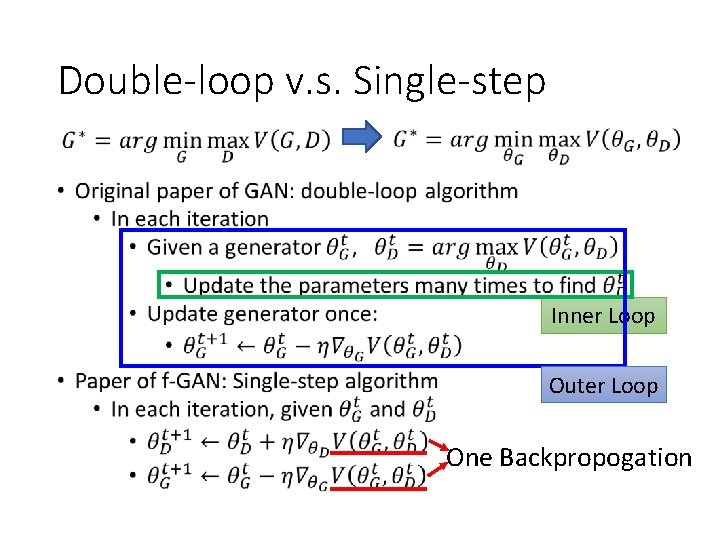
Double-loop v. s. Single-step • Inner Loop Outer Loop One Backpropogation
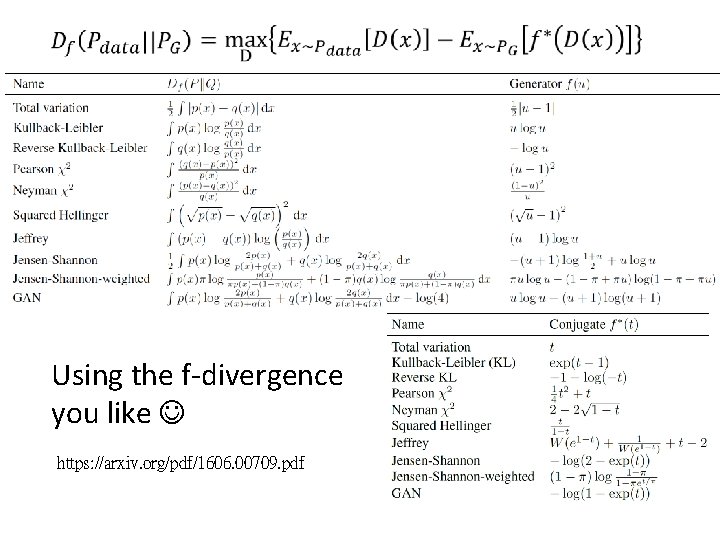
Using the f-divergence you like https: //arxiv. org/pdf/1606. 00709. pdf
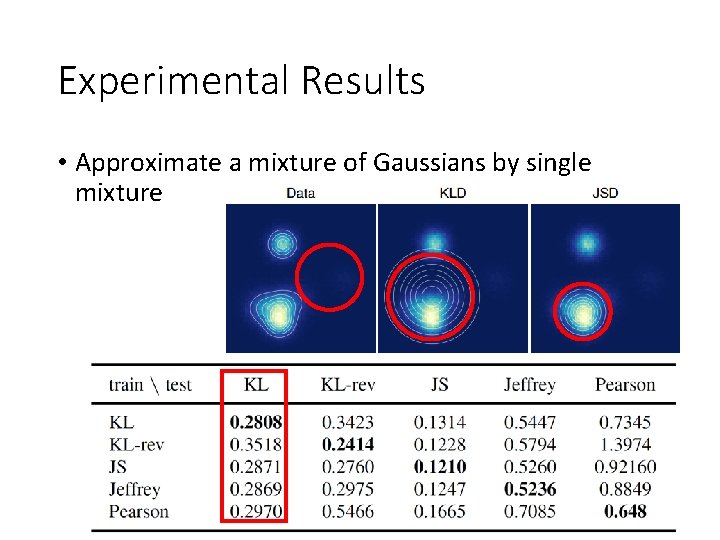
Experimental Results • Approximate a mixture of Gaussians by single mixture
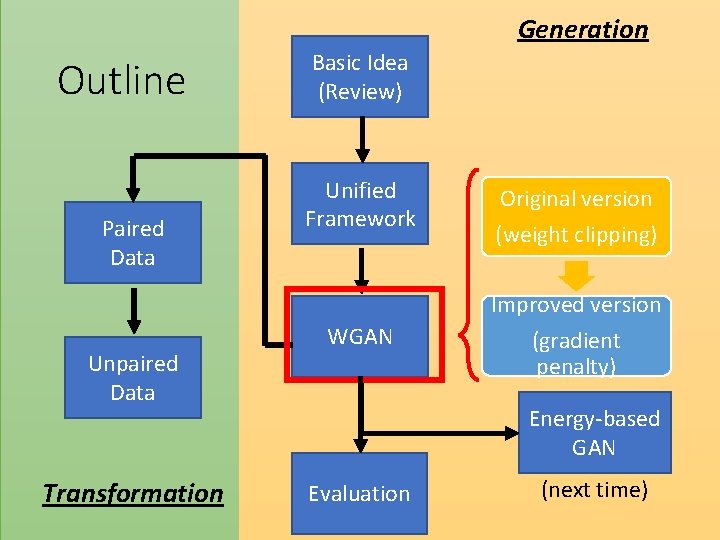
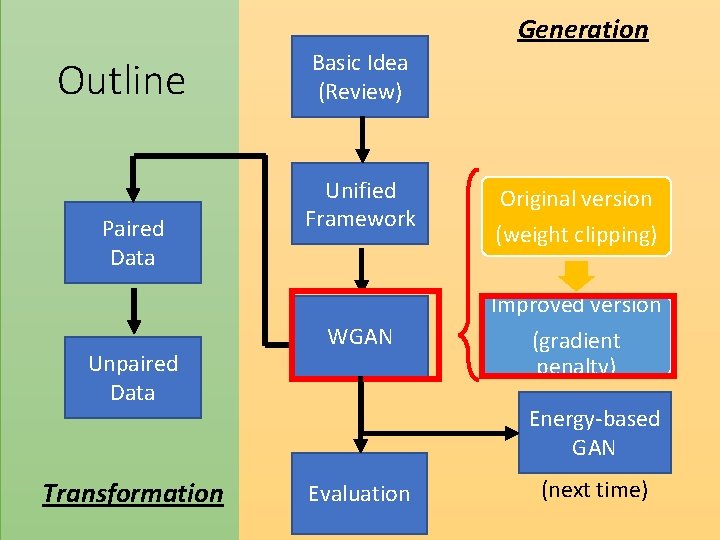
Generation Outline Paired Data Unpaired Data Transformation Basic Idea (Review) Unified Framework Original version (weight clipping) WGAN Improved version (gradient penalty) Energy-based GAN Evaluation (next time)
Reference • Martin Arjovsky, Soumith Chintala, Léon Bottou, Wasserstein GAN, ar. Xiv prepring, 2017 • Ishaan Gulrajani, Faruk Ahmed, Martin Arjovsky, Vincent Dumoulin, Aaron Courville, “Improved Training of Wasserstein GANs”, ar. Xiv prepring, 2017 • One sentence for WGAN: Using Earth Mover’s Distance to evaluate two distributions • Earth Mover’s Distance = Wasserstein Distance
Generation Outline Paired Data Unpaired Data Transformation Basic Idea (Review) Unified Framework Original version (weight clipping) WGAN Improved version (gradient penalty) Energy-based GAN Evaluation (next time)
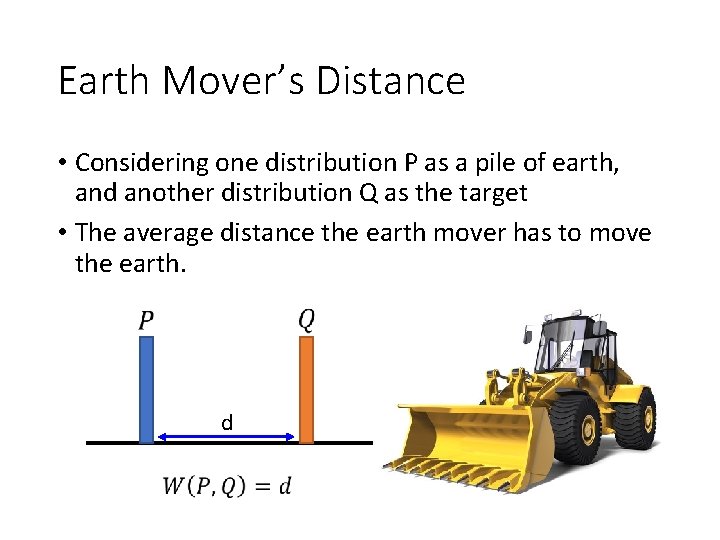
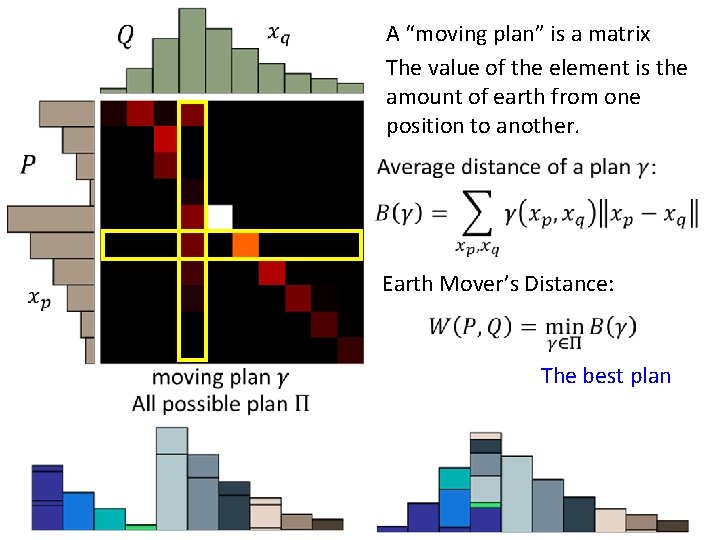
Earth Mover’s Distance • Considering one distribution P as a pile of earth, and another distribution Q as the target • The average distance the earth mover has to move the earth. d
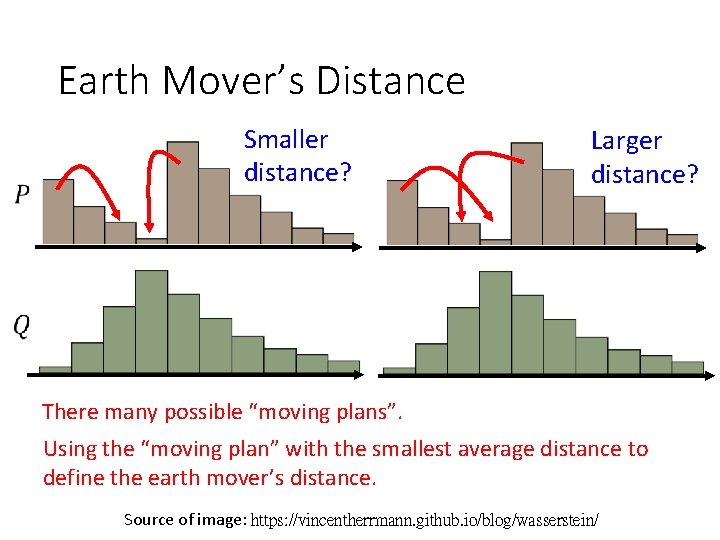
Earth Mover’s Distance Smaller distance? Larger distance? There many possible “moving plans”. Using the “moving plan” with the smallest average distance to define the earth mover’s distance. Source of image: https: //vincentherrmann. github. io/blog/wasserstein/
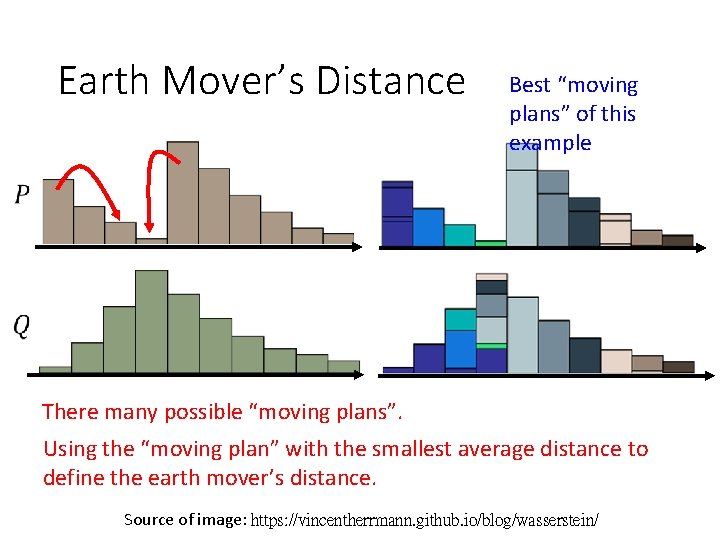
Earth Mover’s Distance Best “moving plans” of this example There many possible “moving plans”. Using the “moving plan” with the smallest average distance to define the earth mover’s distance. Source of image: https: //vincentherrmann. github. io/blog/wasserstein/
A “moving plan” is a matrix The value of the element is the amount of earth from one position to another. Earth Mover’s Distance: The best plan
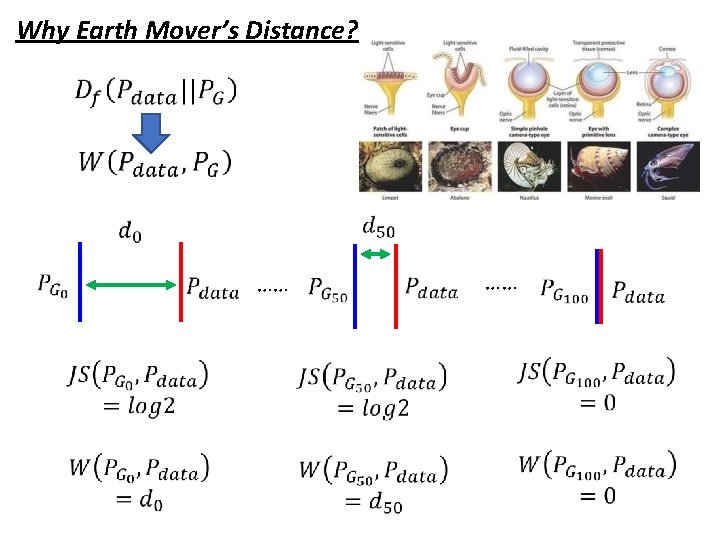
Why Earth Mover’s Distance? …… ……
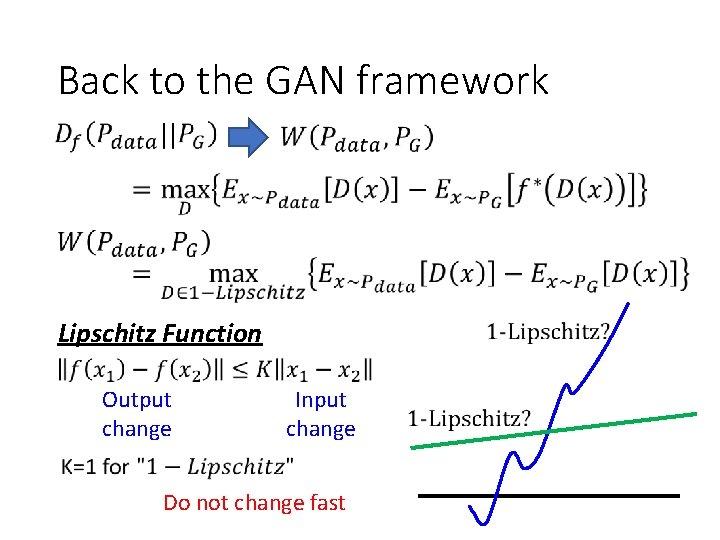
Back to the GAN framework Lipschitz Function Output change Input change Do not change fast
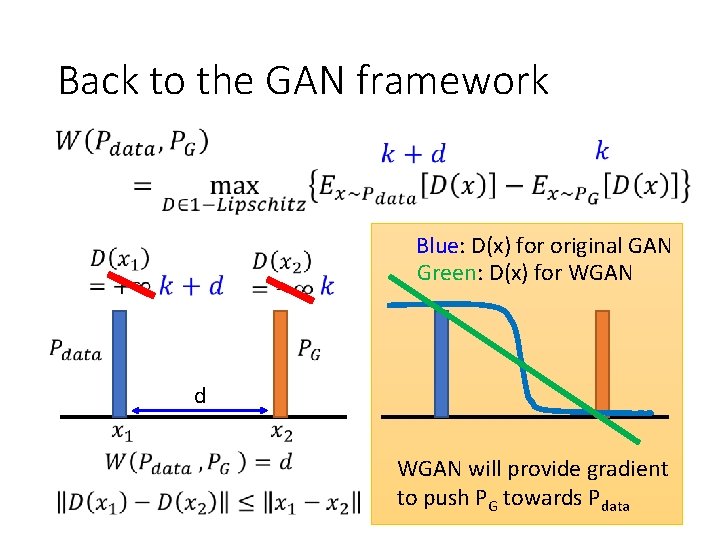
Back to the GAN framework Blue: D(x) for original GAN Green: D(x) for WGAN d WGAN will provide gradient to push PG towards Pdata
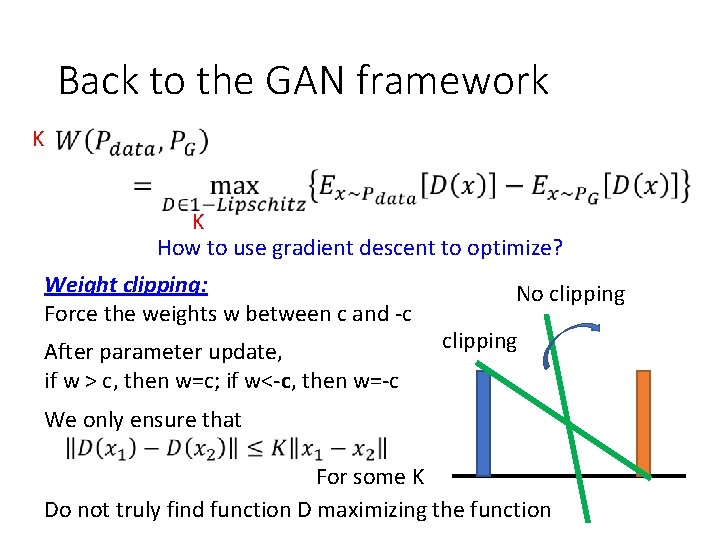
Back to the GAN framework K K How to use gradient descent to optimize? Weight clipping: Force the weights w between c and -c After parameter update, if w > c, then w=c; if w<-c, then w=-c No clipping We only ensure that For some K Do not truly find function D maximizing the function
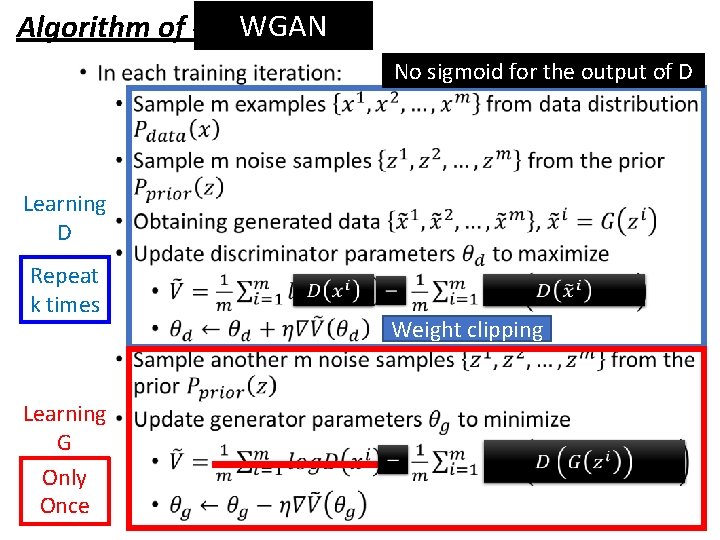
WGAN Algorithm of Original GAN • No sigmoid for the output of D Learning D Repeat k times Learning G Only Once Weight clipping
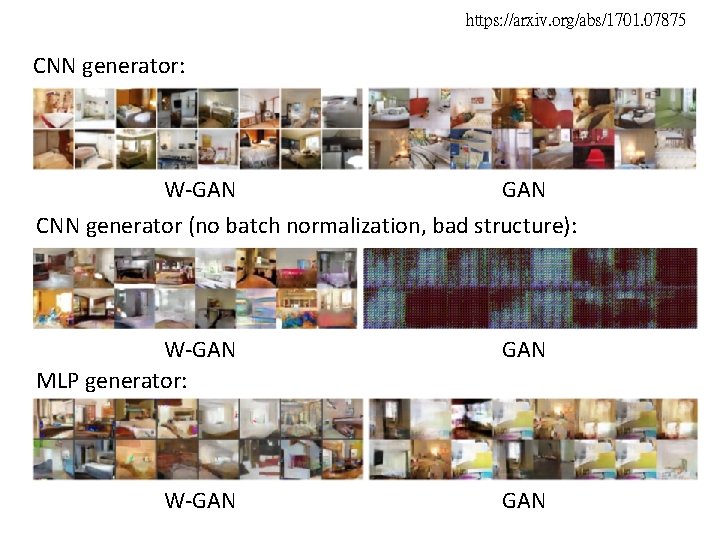
https: //arxiv. org/abs/1701. 07875 CNN generator: W-GAN CNN generator (no batch normalization, bad structure): W-GAN MLP generator: GAN W-GAN
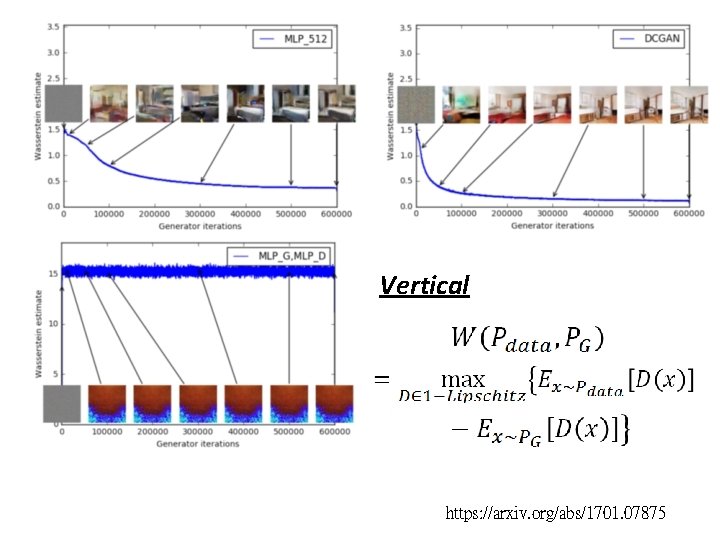
Vertical https: //arxiv. org/abs/1701. 07875
Generation Outline Paired Data Unpaired Data Transformation Basic Idea (Review) Unified Framework Original version (weight clipping) WGAN Improved version (gradient penalty) Energy-based GAN Evaluation (next time)
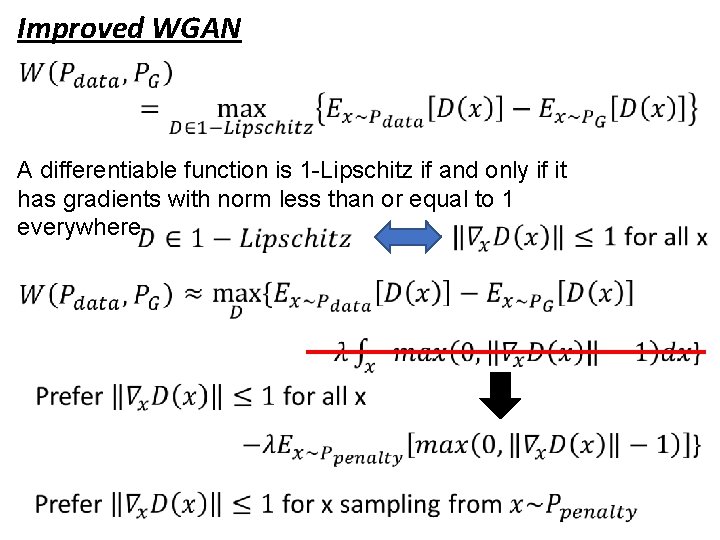
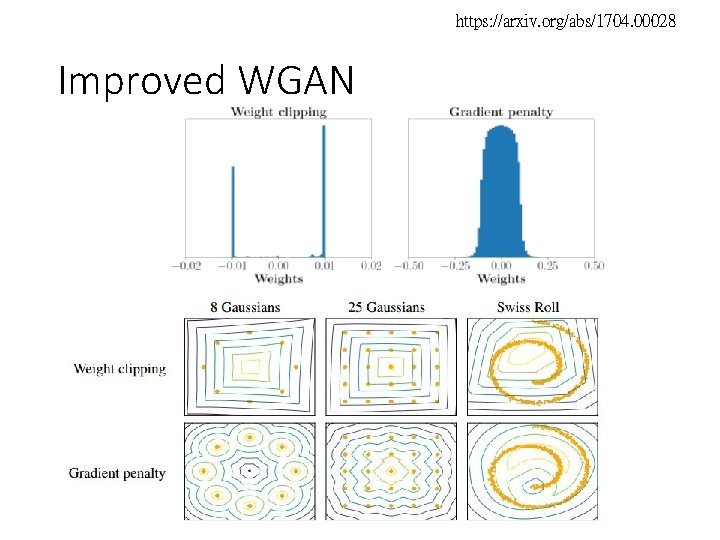
Improved WGAN A differentiable function is 1 -Lipschitz if and only if it has gradients with norm less than or equal to 1 everywhere.
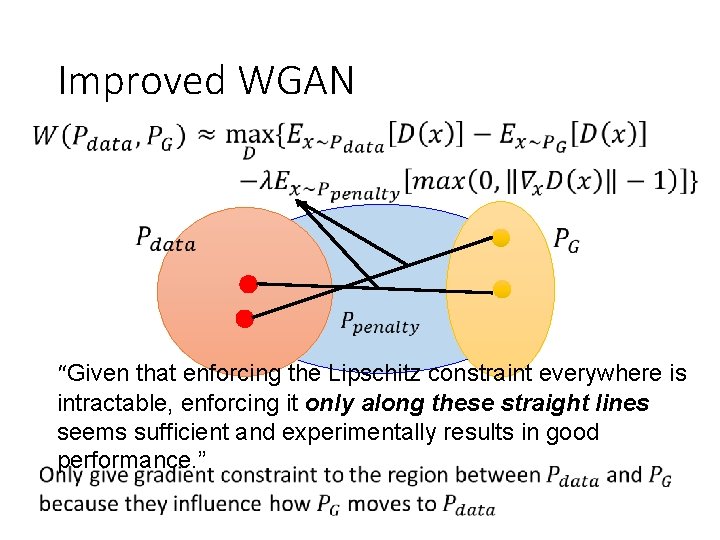
Improved WGAN “Given that enforcing the Lipschitz constraint everywhere is intractable, enforcing it only along these straight lines seems sufficient and experimentally results in good performance. ”
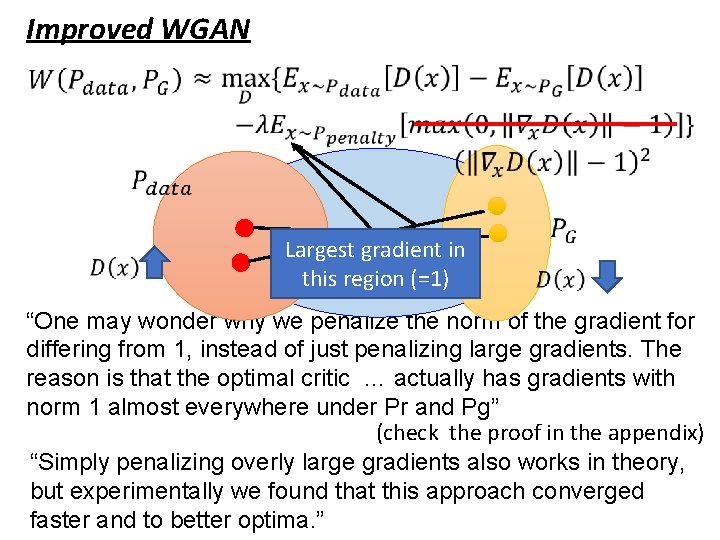
Improved WGAN Largest gradient in this region (=1) “One may wonder why we penalize the norm of the gradient for differing from 1, instead of just penalizing large gradients. The reason is that the optimal critic … actually has gradients with norm 1 almost everywhere under Pr and Pg” (check the proof in the appendix) “Simply penalizing overly large gradients also works in theory, but experimentally we found that this approach converged faster and to better optima. ”
https: //arxiv. org/abs/1704. 00028 Improved WGAN
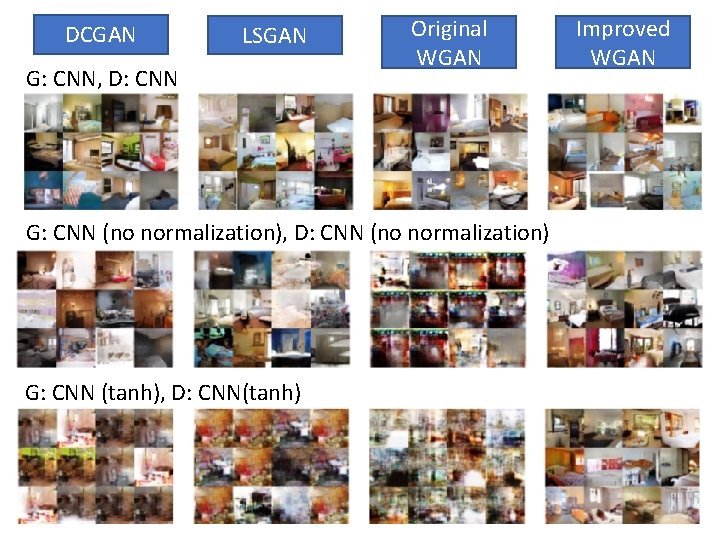
DCGAN LSGAN G: CNN, D: CNN Original WGAN G: CNN (no normalization), D: CNN (no normalization) G: CNN (tanh), D: CNN(tanh) Improved WGAN
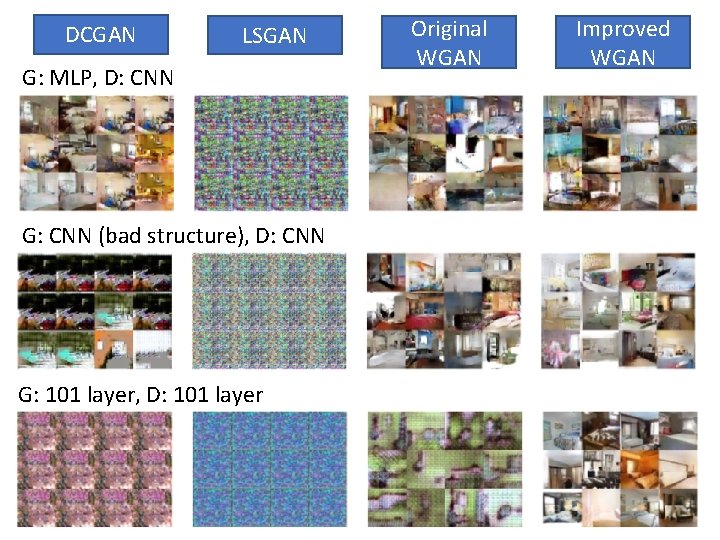
DCGAN LSGAN G: MLP, D: CNN G: CNN (bad structure), D: CNN G: 101 layer, D: 101 layer Original WGAN Improved WGAN
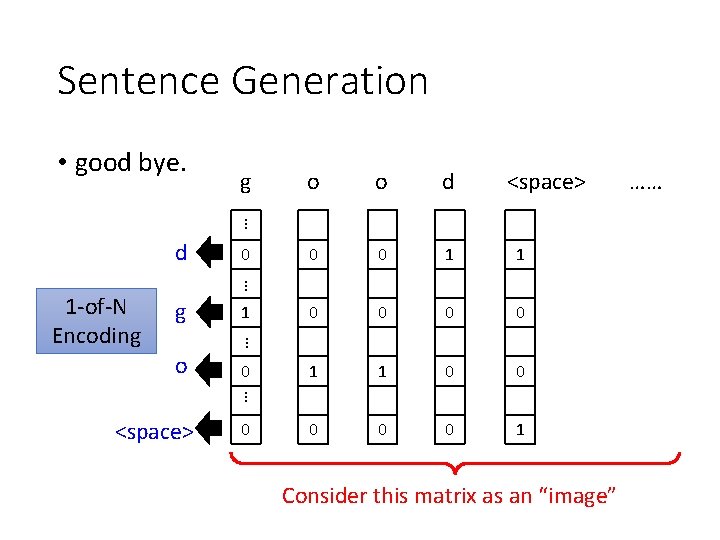
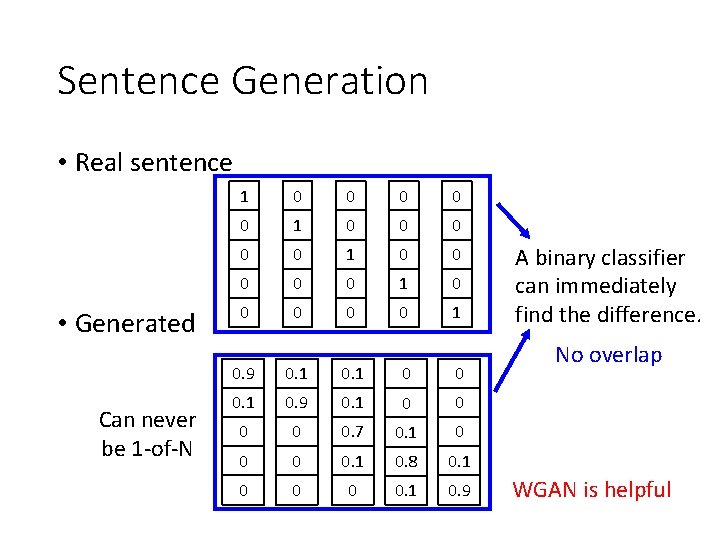
Sentence Generation • good bye. g o d <space> 0 0 1 1 0 0 0 0 0 1 … o d … g 1 … 1 -of-N Encoding 0 o 0 … <space> 0 Consider this matrix as an “image” ……
Sentence Generation • Real sentence • Generated Can never be 1 -of-N 1 0 0 0 0 0 1 0. 9 0. 1 0 0 0. 7 0. 1 0. 8 0. 1 0. 9 A binary classifier can immediately find the difference. No overlap WGAN is helpful
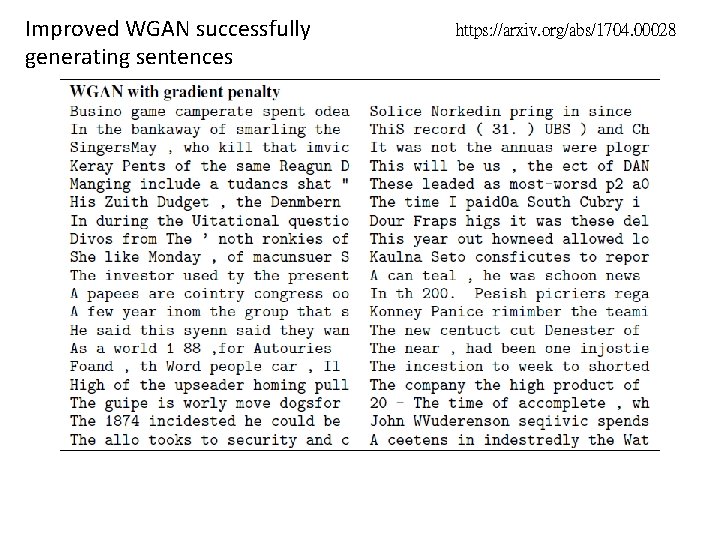
Improved WGAN successfully generating sentences https: //arxiv. org/abs/1704. 00028
More about Discrete Output • Seq. GAN • Lantao Yu, Weinan Zhang, Jun Wang, Yong Yu, Seq. GAN: Sequence Generative Adversarial Nets with Policy Gradient, AAAI, 2017 • Jiwei Li, Will Monroe, Tianlin Shi, Sébastien Jean, Alan Ritter, Dan Jurafsky, Adversarial Learning for Neural Dialogue Generation, ar. Xiv preprint, 2017 • Boundary seeking GAN • R Devon Hjelm, Athul Paul Jacob, Tong Che, Kyunghyun Cho, Yoshua Bengio, “Boundary-Seeking Generative Adversarial Networks”, ar. Xiv preprint, 2017 • Gumbel-Softmax • Matt J. Kusner, José Miguel Hernández-Lobato, GANS for Sequences of Discrete Elements with the Gumbel-softmax Distribution, ar. Xiv preprint, 2016 • Tong Che, Yanran Li, Ruixiang Zhang, R Devon Hjelm, Wenjie Li, Yangqiu Song, Yoshua Bengio, Maximum-Likelihood Augmented Discrete Generative Adversarial Networks, ar. Xiv preprint, 2017
Generation Outline Paired Data Unpaired Data Transformation Basic Idea (Review) Unified Framework WGAN Energy-based GAN Evaluation (next time)
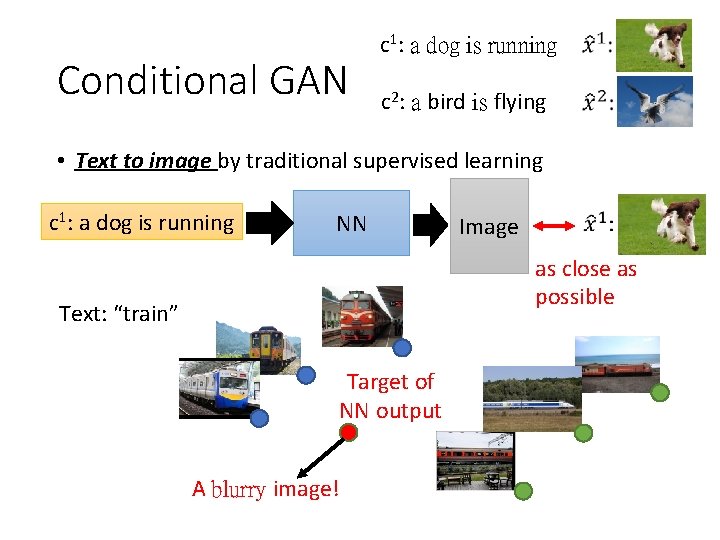
Conditional GAN c 1: a dog is running c 2: a bird is flying • Text to image by traditional supervised learning c 1: a dog is running NN Image as close as possible Text: “train” Target of NN output A blurry image!
Conditional GAN c: train G Prior distribution Image x = G(c, z) It is a distribution. Approximate the distribution below Text: “train” Target of NN output A blurry image!
Conditional GAN c: train G Image x = G(c, z) Prior distribution x is realistic or not D (type 1) Positive example: Negative example: x is realistic or not + c and x are matched or not D (type 2) scalar Positive (train , example: Negative (train , ) (cat , scalar ) )
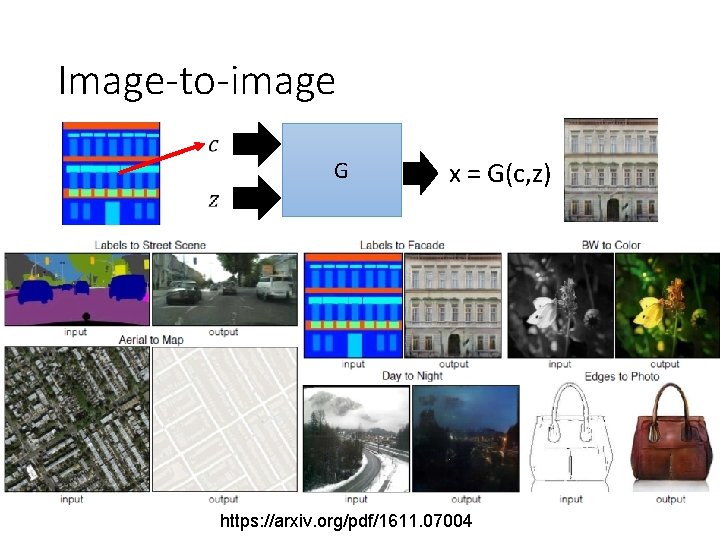
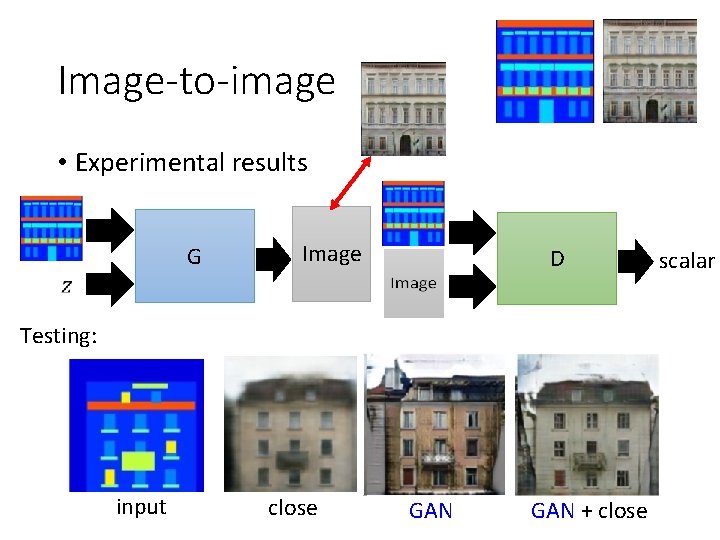
Image-to-image G x = G(c, z) https: //arxiv. org/pdf/1611. 07004
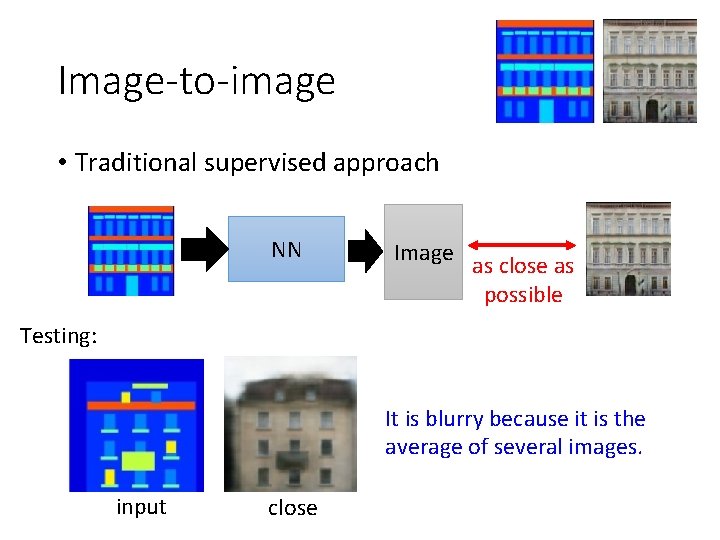
Image-to-image • Traditional supervised approach NN Image as close as possible Testing: It is blurry because it is the average of several images. input close
Image-to-image • Experimental results G Image D Testing: input close GAN + close scalar
Generation Outline Paired Data Unpaired Data Transformation Basic Idea (Review) Unified Framework WGAN Energy-based GAN Evaluation (next time)
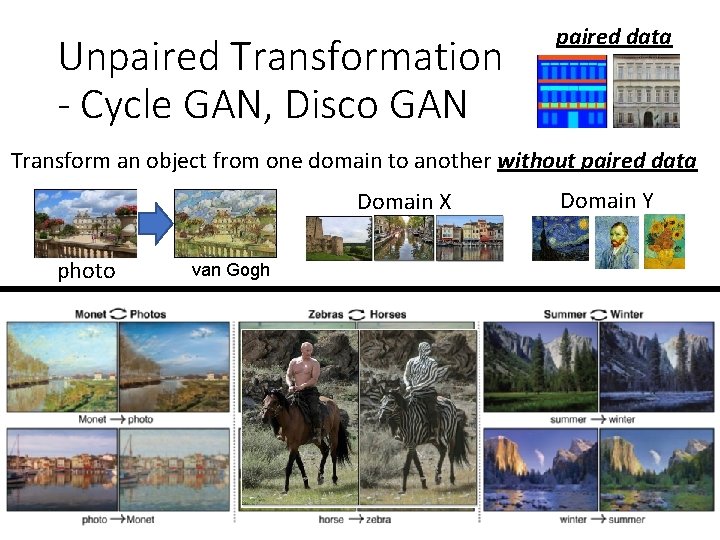
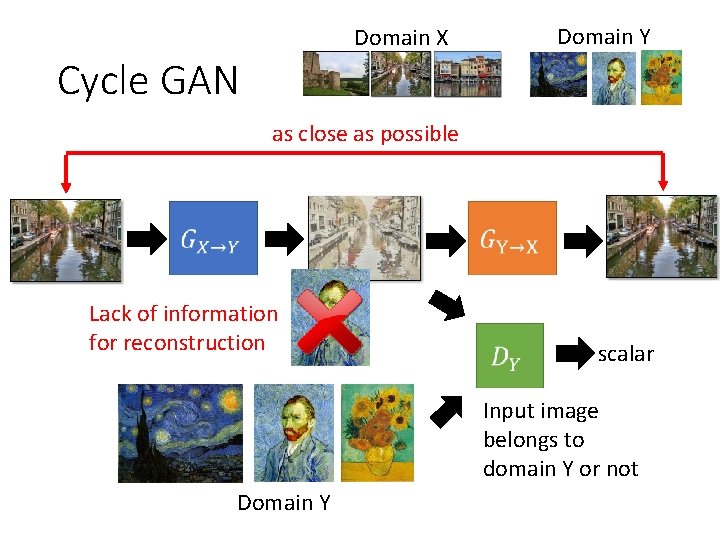
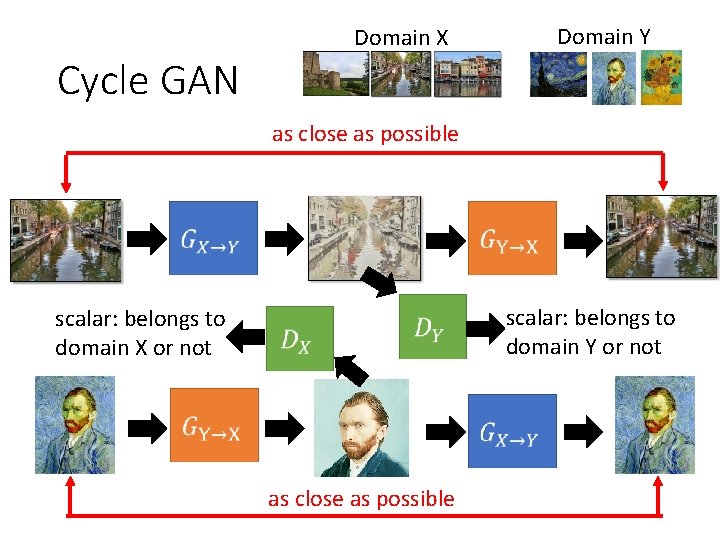
Unpaired Transformation - Cycle GAN, Disco GAN paired data Transform an object from one domain to another without paired data Domain X photo van Gogh Domain Y
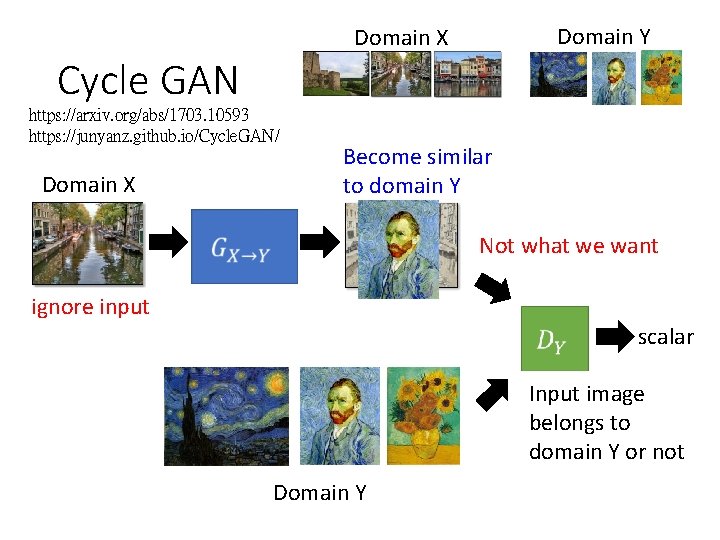
Domain Y Domain X Cycle GAN https: //arxiv. org/abs/1703. 10593 https: //junyanz. github. io/Cycle. GAN/ Domain X Become similar to domain Y Not what we want ignore input scalar Input image belongs to domain Y or not Domain Y
Domain X Domain Y Cycle GAN as close as possible Lack of information for reconstruction scalar Input image belongs to domain Y or not Domain Y
Domain X Domain Y Cycle GAN as close as possible scalar: belongs to domain Y or not scalar: belongs to domain X or not as close as possible
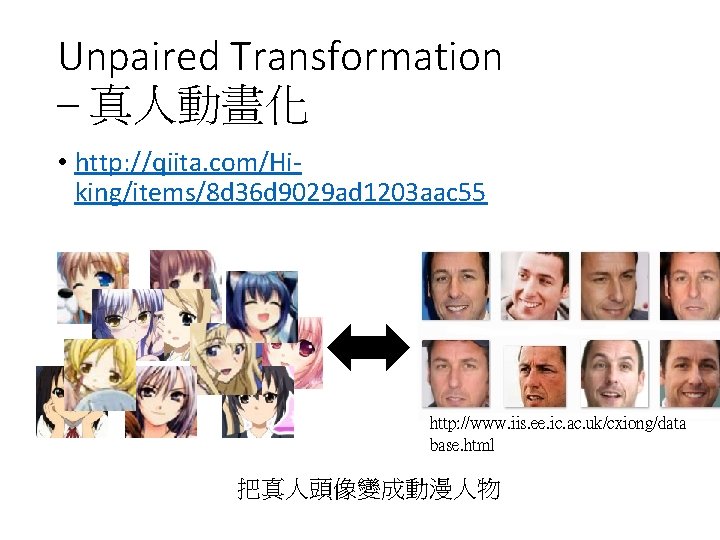
Unpaired Transformation – 真人動畫化 • http: //qiita. com/Hiking/items/8 d 36 d 9029 ad 1203 aac 55 http: //www. iis. ee. ic. ac. uk/cxiong/data base. html 把真人頭像變成動漫人物
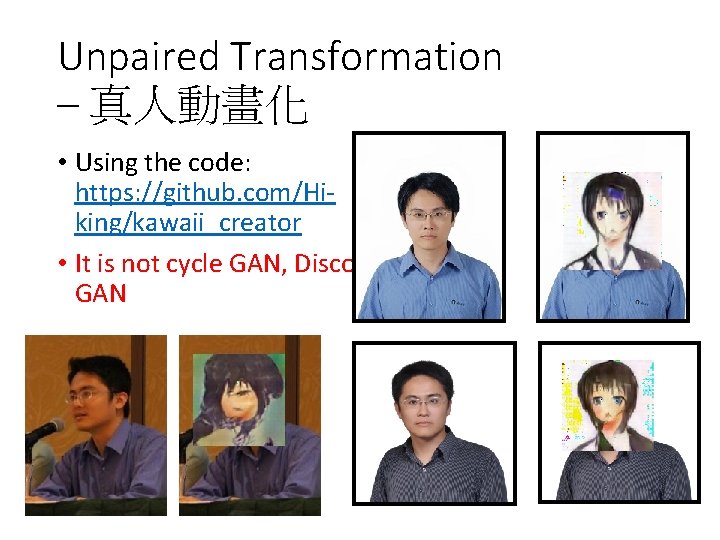
Unpaired Transformation – 真人動畫化 • Using the code: https: //github. com/Hiking/kawaii_creator • It is not cycle GAN, Disco GAN
Generation Outline Paired Data Unpaired Data Transformation Basic Idea (Review) Unified Framework WGAN Energy-based GAN Evaluation (next time)
Review Discriminator Data (target) distribution Generated distribution • Role of discriminator: lead the generator When the data distribution and generated distribution is the same The discriminator will be useless (flat).
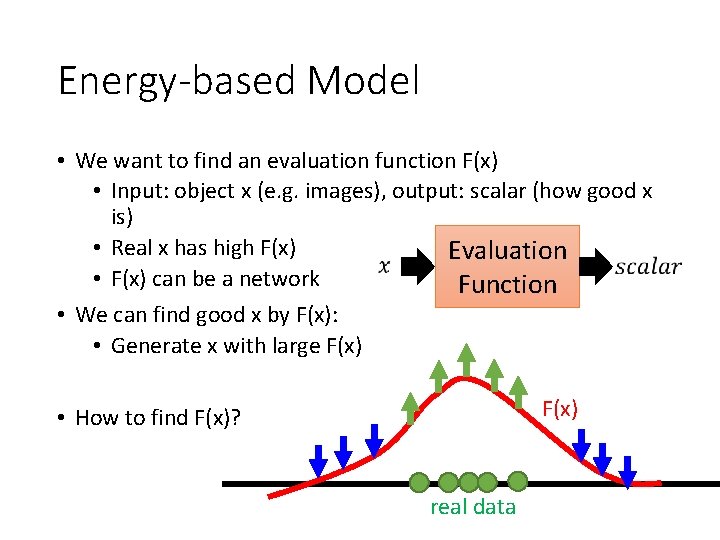
Energy-based Model • We want to find an evaluation function F(x) • Input: object x (e. g. images), output: scalar (how good x is) • Real x has high F(x) Evaluation • F(x) can be a network Function • We can find good x by F(x): • Generate x with large F(x) • How to find F(x)? real data
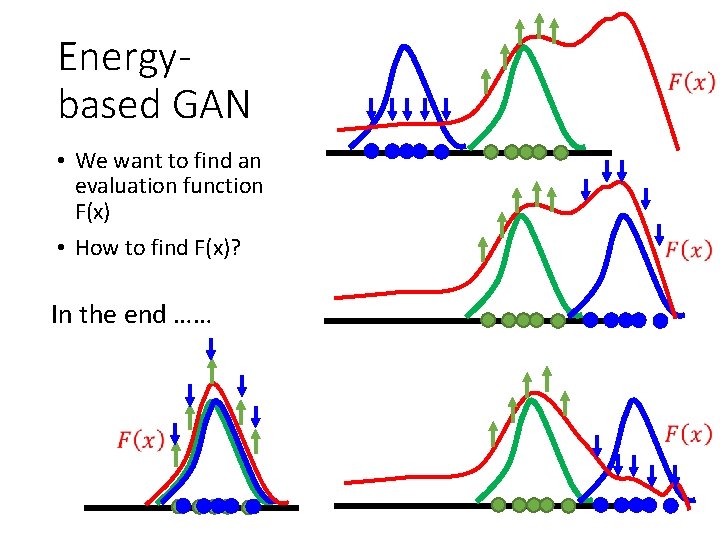
Energybased GAN • We want to find an evaluation function F(x) • How to find F(x)? In the end ……
Energy-based Model • Preview: Framework of structured learning (Energy-based Model) • ML Lecture 21: Structured Learning - Introduction • https: //www. youtube. com/watch? v=5 OYu 0 vx. XEv 8 • ML Lecture 22: Structured Learning - Linear Model • https: //www. youtube. com/watch? v=Hf. Pw 40 JPays • ML Lecture 23: Structured Learning - Structured SVM • https: //www. youtube. com/watch? v=Yjv. GVVr. Crh. Q • ML Lecture 24: Structured Learning - Sequence Labeling • https: //www. youtube. com/watch? v=o 9 FPSqob. Mys