
Energybased GAN Hungyi Lee Original Idea Discriminator Data
Energy-based GAN Hung-yi Lee
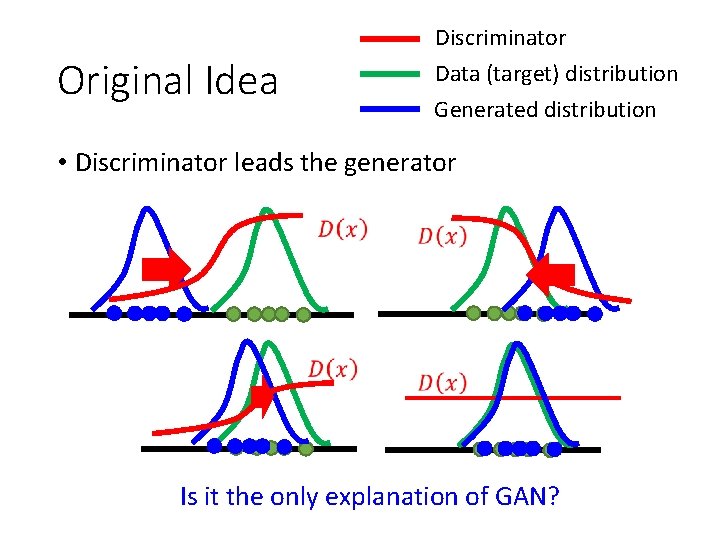
Original Idea Discriminator Data (target) distribution Generated distribution • Discriminator leads the generator Is it the only explanation of GAN?

Original GAN The discriminator is flat in the end. Source: https: //www. youtube. com/watch? v=eb. Mei 6 b. Ye. Ww (credit: Benjamin Striner)
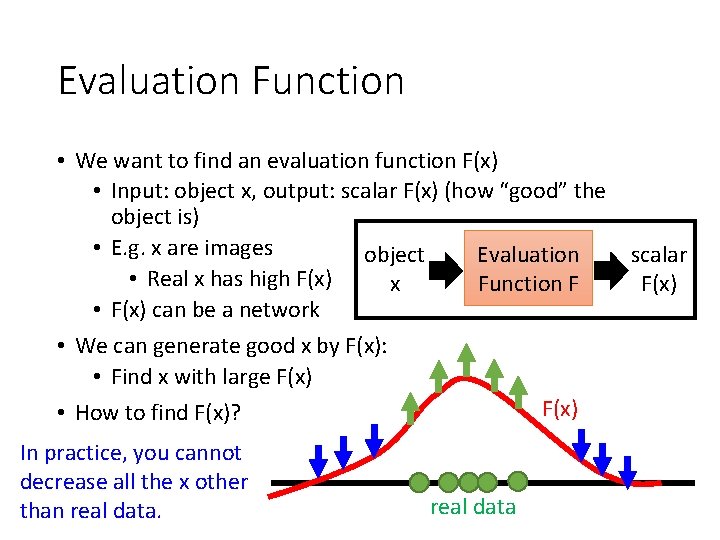
Evaluation Function • We want to find an evaluation function F(x) • Input: object x, output: scalar F(x) (how “good” the object is) • E. g. x are images Evaluation object scalar • Real x has high F(x) Function F x F(x) • F(x) can be a network • We can generate good x by F(x): • Find x with large F(x) • How to find F(x)? In practice, you cannot decrease all the x other than real data
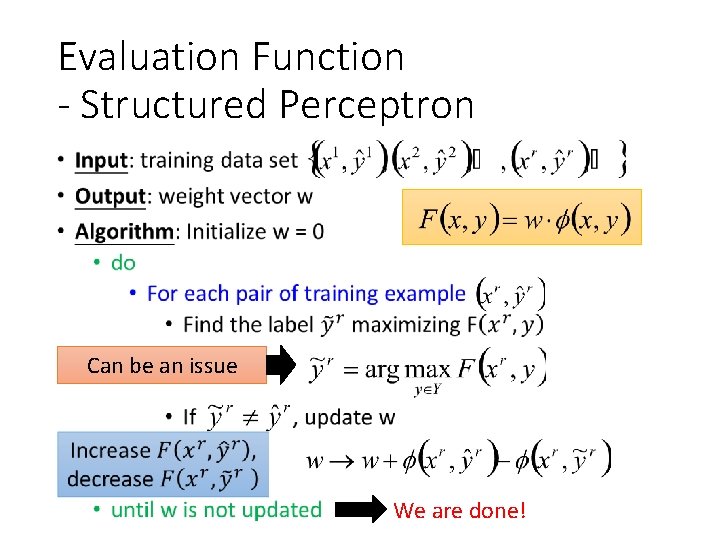
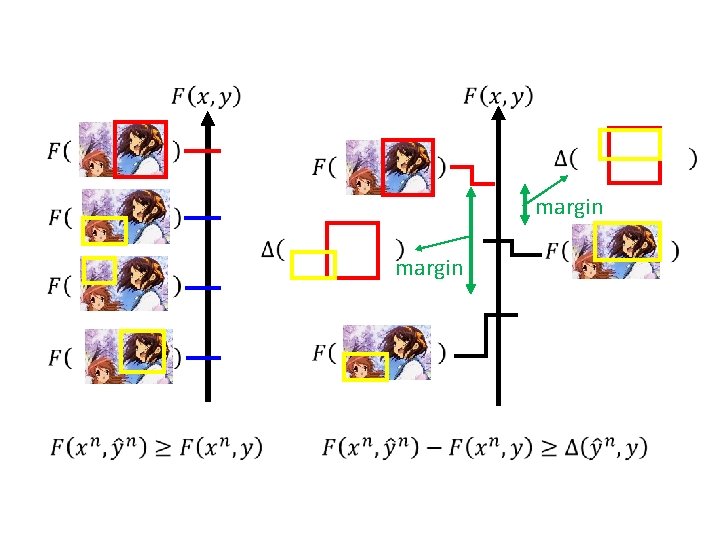
Evaluation Function - Structured Perceptron • Can be an issue We are done!
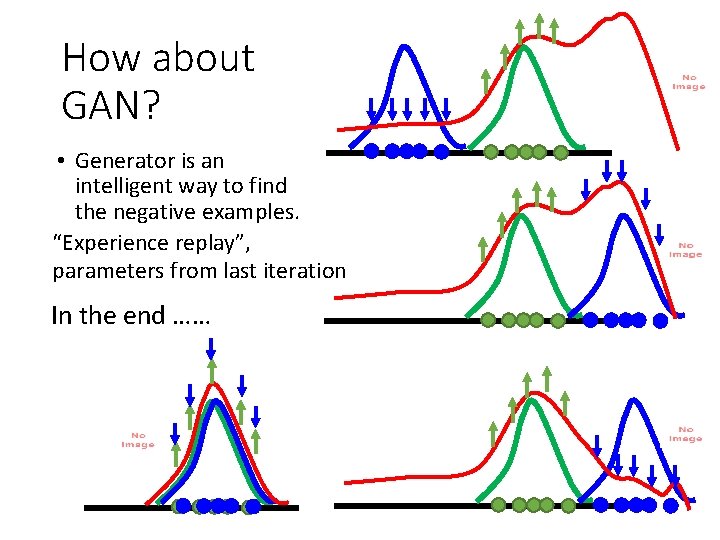
How about GAN? • Generator is an intelligent way to find the negative examples. “Experience replay”, parameters from last iteration In the end ……
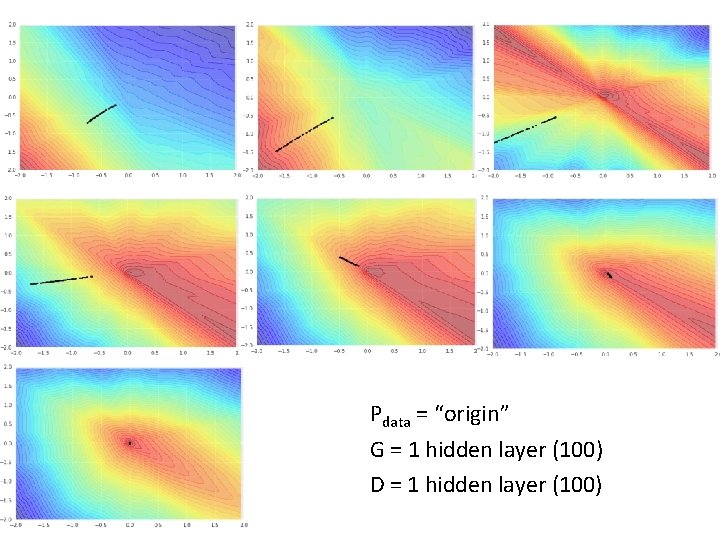
Pdata = “origin” G = 1 hidden layer (100) D = 1 hidden layer (100)
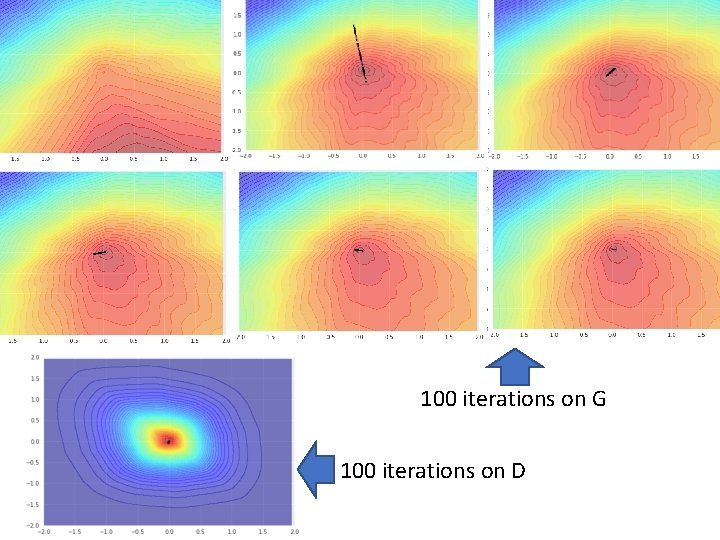
100 iterations on G 100 iterations on D
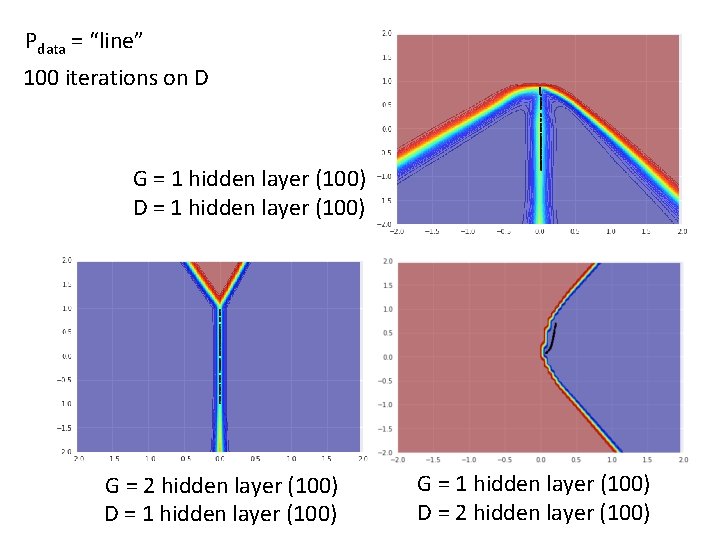
Pdata = “line” 100 iterations on D G = 1 hidden layer (100) D = 1 hidden layer (100) G = 2 hidden layer (100) D = 1 hidden layer (100) G = 1 hidden layer (100) D = 2 hidden layer (100)
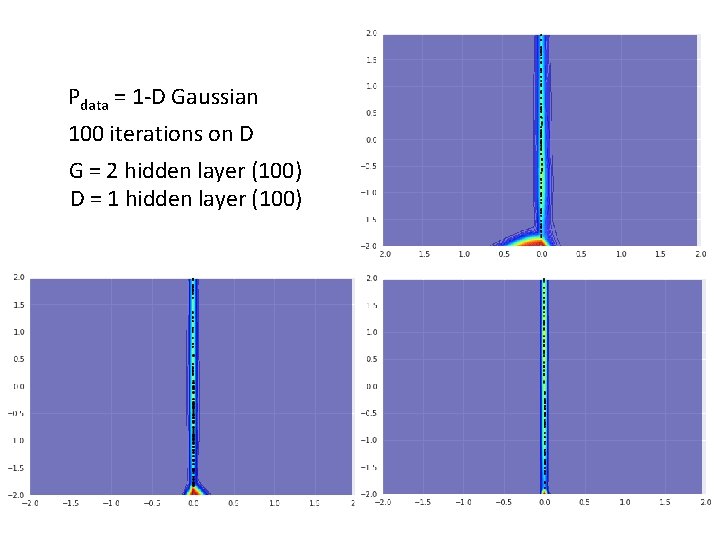
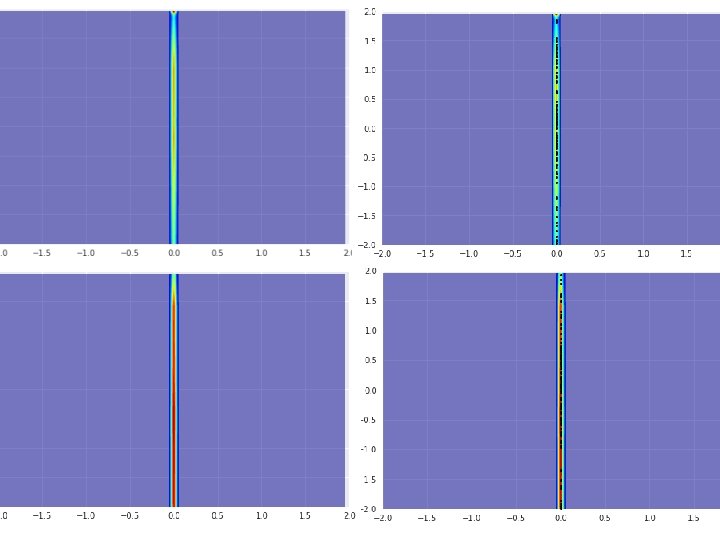
Pdata = 1 -D Gaussian 100 iterations on D G = 2 hidden layer (100) D = 1 hidden layer (100)
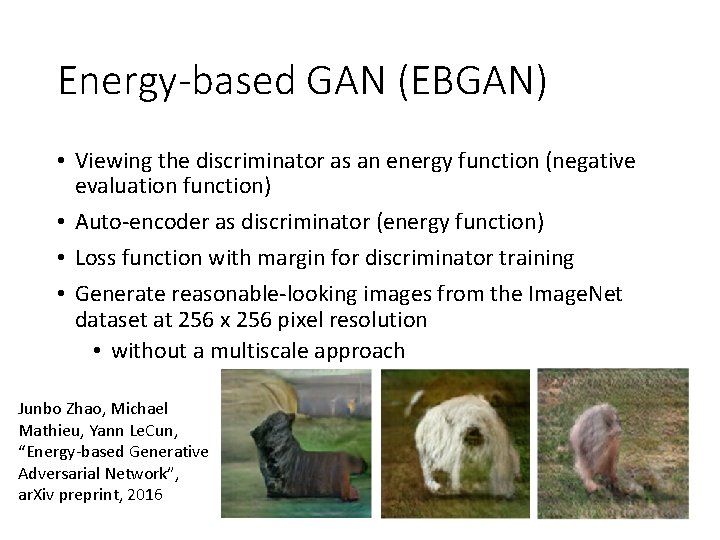
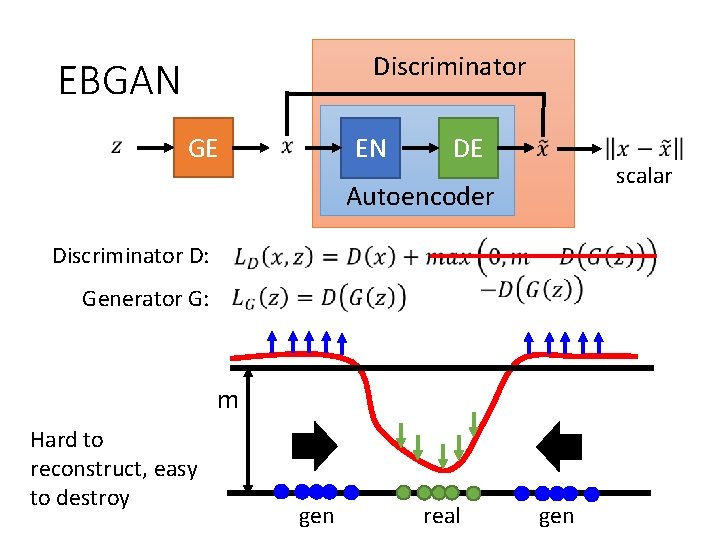
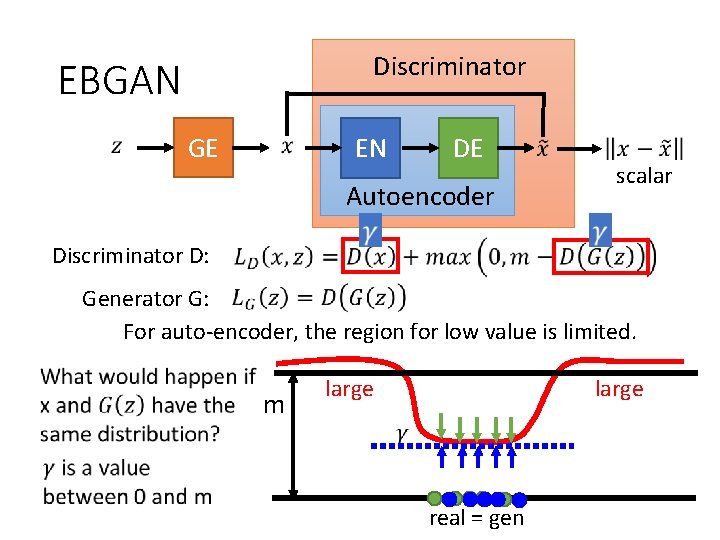
Energy-based GAN (EBGAN) • Viewing the discriminator as an energy function (negative evaluation function) • Auto-encoder as discriminator (energy function) • Loss function with margin for discriminator training • Generate reasonable-looking images from the Image. Net dataset at 256 x 256 pixel resolution • without a multiscale approach Junbo Zhao, Michael Mathieu, Yann Le. Cun, “Energy-based Generative Adversarial Network”, ar. Xiv preprint, 2016
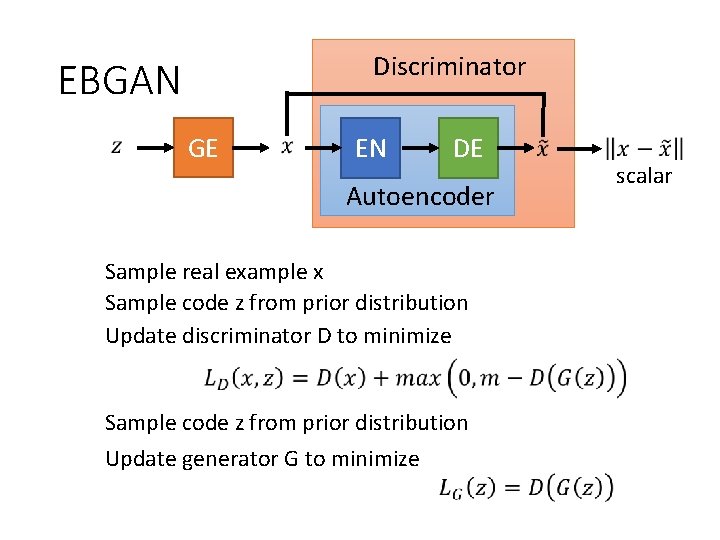
Discriminator EBGAN GE EN DE Autoencoder Sample real example x Sample code z from prior distribution Update discriminator D to minimize Sample code z from prior distribution Update generator G to minimize scalar
Discriminator EBGAN GE EN DE scalar Autoencoder Discriminator D: Generator G: m Hard to reconstruct, easy to destroy gen real gen
Discriminator EBGAN GE EN DE Autoencoder scalar Discriminator D: Generator G: For auto-encoder, the region for low value is limited. m large real = gen
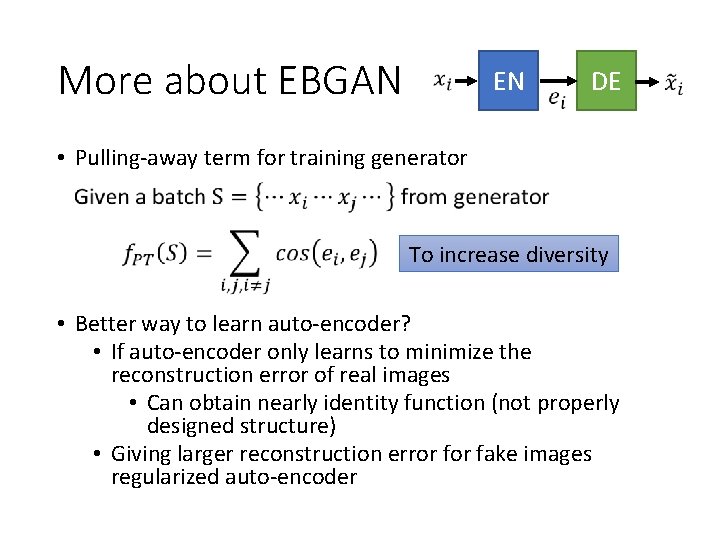
More about EBGAN EN DE • Pulling-away term for training generator To increase diversity • Better way to learn auto-encoder? • If auto-encoder only learns to minimize the reconstruction error of real images • Can obtain nearly identity function (not properly designed structure) • Giving larger reconstruction error fake images regularized auto-encoder
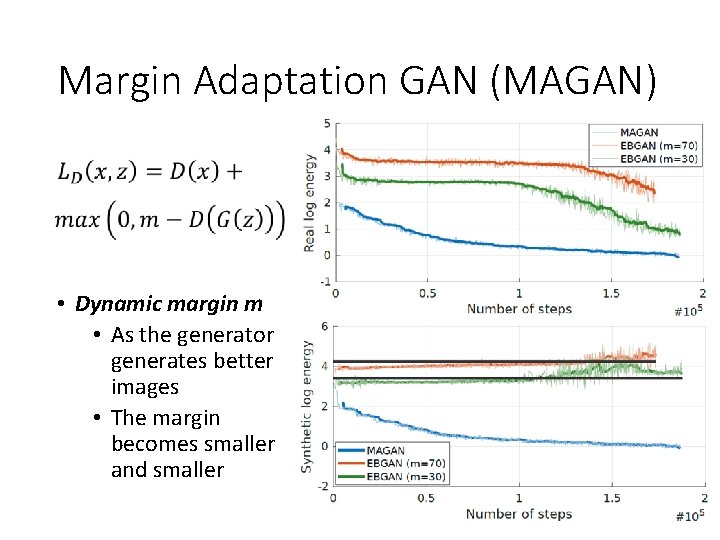
Margin Adaptation GAN (MAGAN) • Dynamic margin m • As the generator generates better images • The margin becomes smaller and smaller
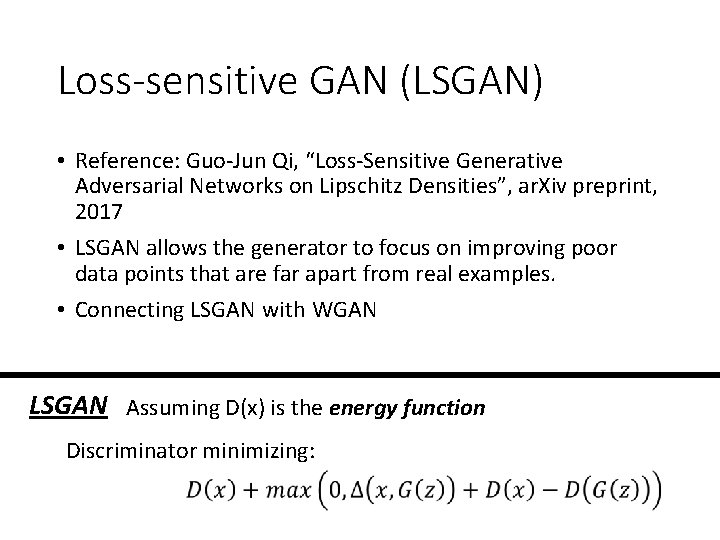
Loss-sensitive GAN (LSGAN) • Reference: Guo-Jun Qi, “Loss-Sensitive Generative Adversarial Networks on Lipschitz Densities”, ar. Xiv preprint, 2017 • LSGAN allows the generator to focus on improving poor data points that are far apart from real examples. • Connecting LSGAN with WGAN LSGAN Assuming D(x) is the energy function Discriminator minimizing:
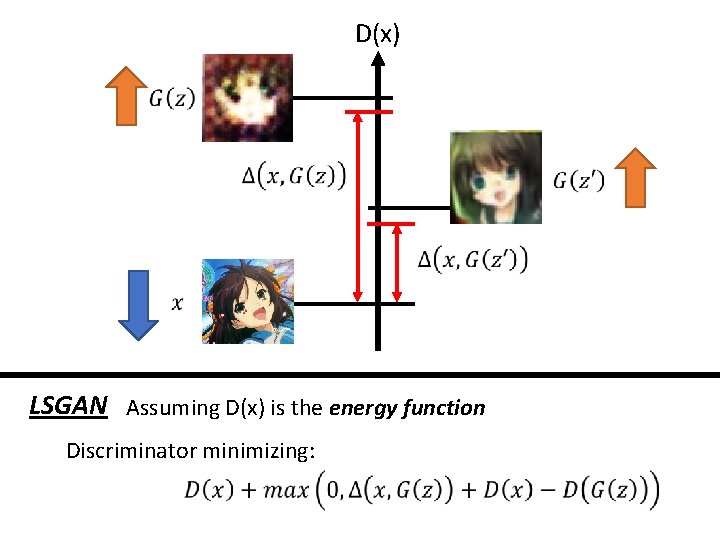
D(x) LSGAN Assuming D(x) is the energy function Discriminator minimizing:
margin
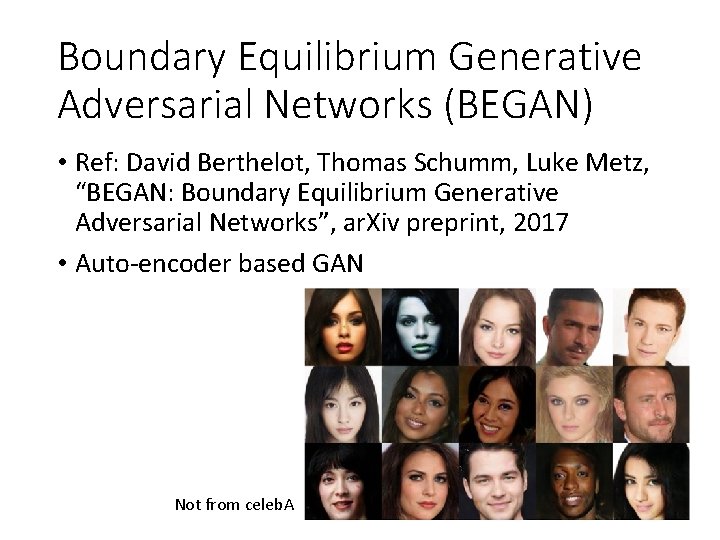
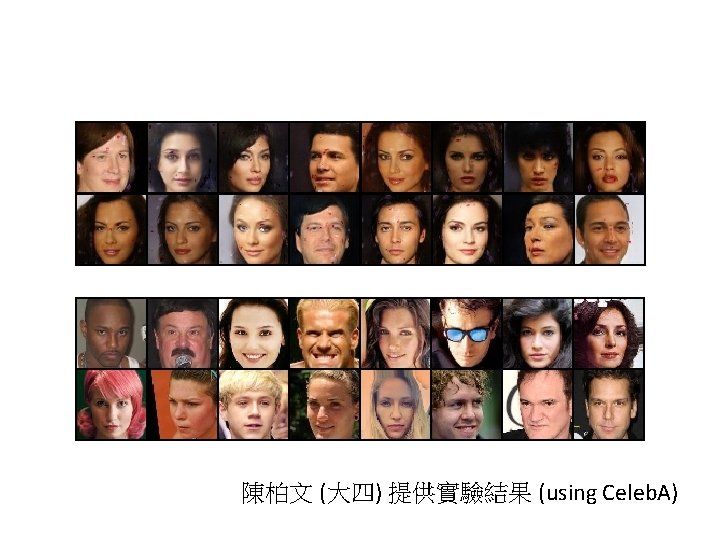
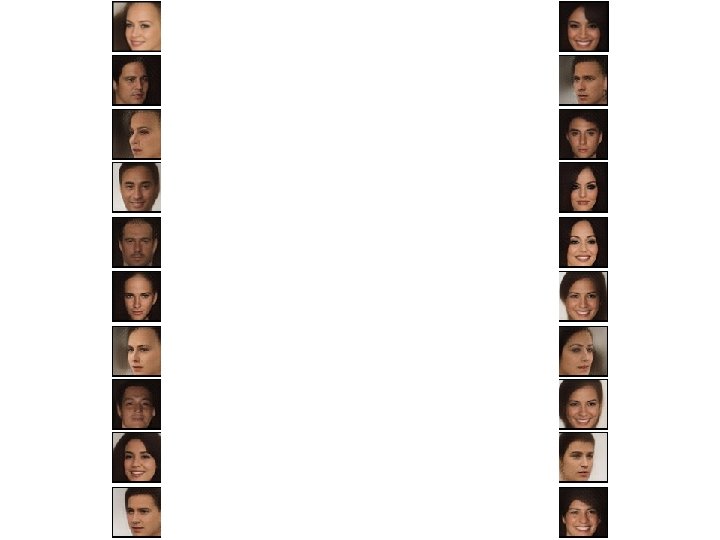
Boundary Equilibrium Generative Adversarial Networks (BEGAN) • Ref: David Berthelot, Thomas Schumm, Luke Metz, “BEGAN: Boundary Equilibrium Generative Adversarial Networks”, ar. Xiv preprint, 2017 • Auto-encoder based GAN Not from celeb. A
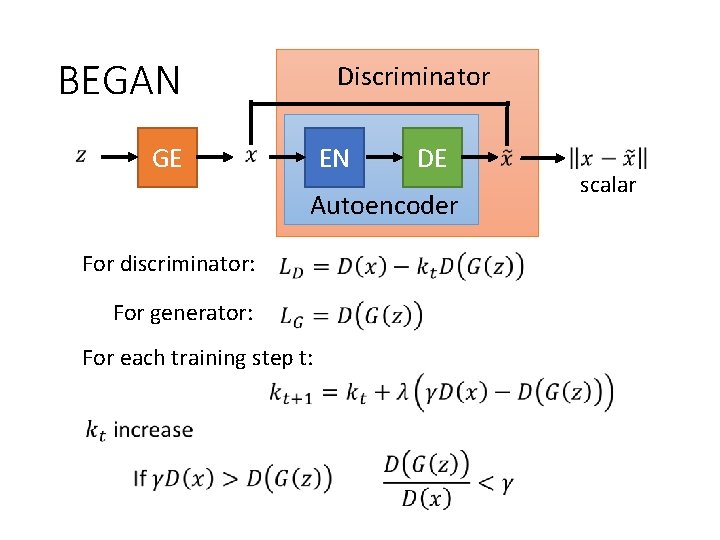
BEGAN Discriminator GE EN DE Autoencoder For discriminator: For generator: For each training step t: scalar
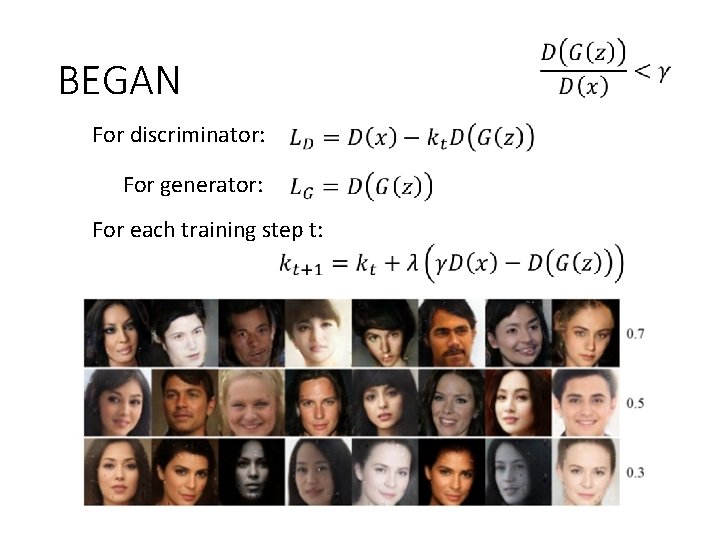
BEGAN For discriminator: For generator: For each training step t:
- Slides: 25