
Catheter Directed Thrombolysis Gan Dunnington M D Stanford
Catheter Directed Thrombolysis Gan Dunnington M. D. Stanford Vascular Conference 9/12/05
Catheter Directed Thrombolysis • • • Background Patient selection Clinical Trials Techniques Adjuncts Future Directions
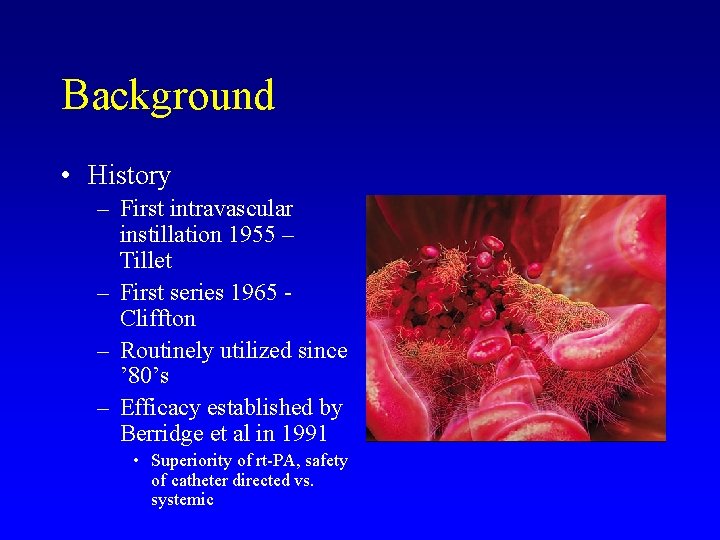
Background • History – First intravascular instillation 1955 – Tillet – First series 1965 Cliffton – Routinely utilized since ’ 80’s – Efficacy established by Berridge et al in 1991 • Superiority of rt-PA, safety of catheter directed vs. systemic
Background • Thrombolytic agents – Plasminogen activators • Cleave peptide bond to convert plasminogen to plasmin • Plasminogen delivered into thrombus – Lyses clot – breakdown of fibrinogen – Protected from inhibitors
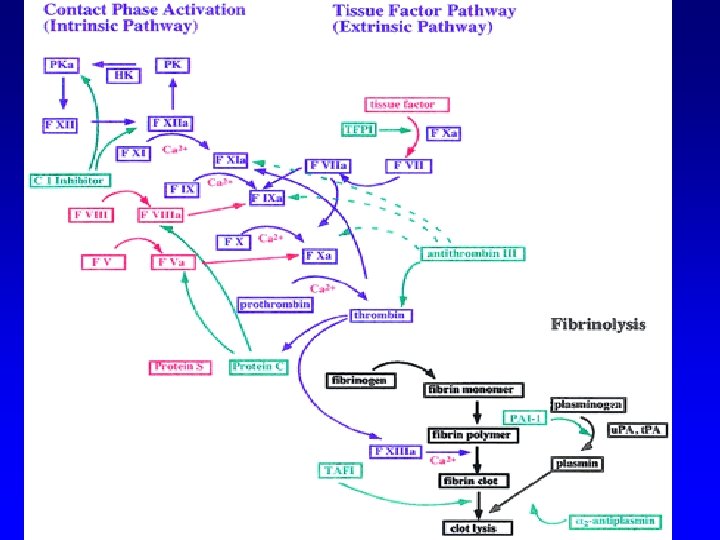
Thrombolytics
Background • Thrombolytic Agents – Streptokinase • • First described Derived from Streptococcus Antigenic potential – allergic reactions Must bind with plasmin or plasminogen to activate and be able to convert second plasminogen to plasmin
Background • Thrombolytic Agents – Urokinase • • Derived from human urine, kidney cells Directly activates plasminogen Non-antigenic Recombinant form available – Prourokinase • Activated by plasmin to form urokinase • Amplification • Fibrin specific – Preferentially binds fibrin bound plasminogen in thrombus
Background • Thrombolytic Agents – Tissue plasminogen activator (t-PA) • Naturally produced by endothelial cells • Fibrin specific • Has been bioengineered to lengthen half-life – alteplase, reteplase
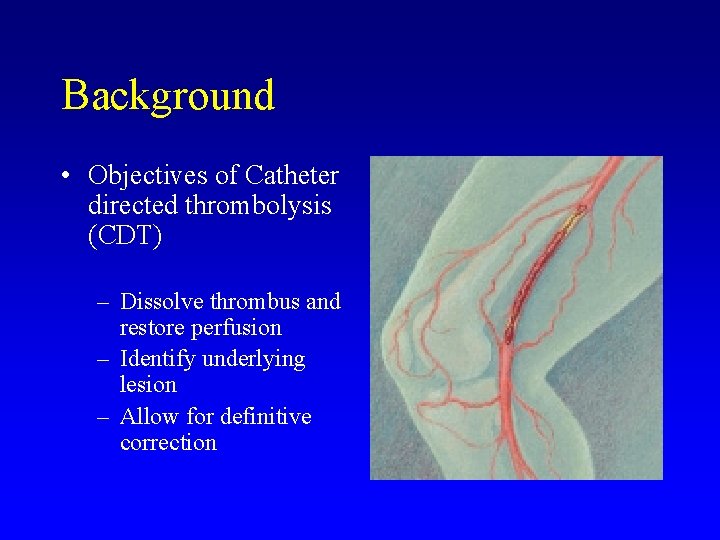
Background • Objectives of Catheter directed thrombolysis (CDT) – Dissolve thrombus and restore perfusion – Identify underlying lesion – Allow for definitive correction
Background Secondary benefits – Urgent to elective – Re-establish inflow/outflow for bypass – Convert major operation to less extensive – Avoid intimal injury from balloon thrombectomy – Establish patency for inaccessible small vessels – Reduce level of amputation
Patient selection • Good candidates – Acute occlusion of relatively inaccessible vessels – Wound complications – Popliteal aneurysm acute thrombosis – Acute thrombosis in proximal arteries – Thrombosed SVG grafts (>1 yr old)
Patient selection • Poor Candidates – Acute embolus of large artery, easily accessible – Acute post-op bypass thrombosis – “modest ischemia” – Severe ischemia with limb viability imminently threatened
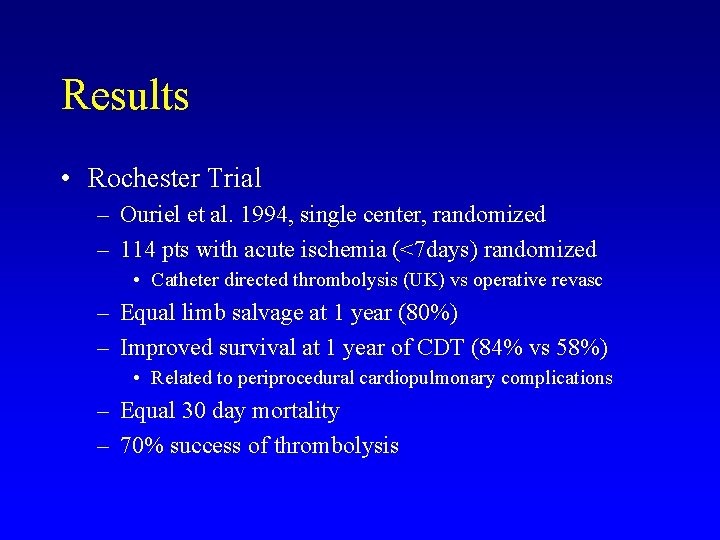
Results • Rochester Trial – Ouriel et al. 1994, single center, randomized – 114 pts with acute ischemia (<7 days) randomized • Catheter directed thrombolysis (UK) vs operative revasc – Equal limb salvage at 1 year (80%) – Improved survival at 1 year of CDT (84% vs 58%) • Related to periprocedural cardiopulmonary complications – Equal 30 day mortality – 70% success of thrombolysis
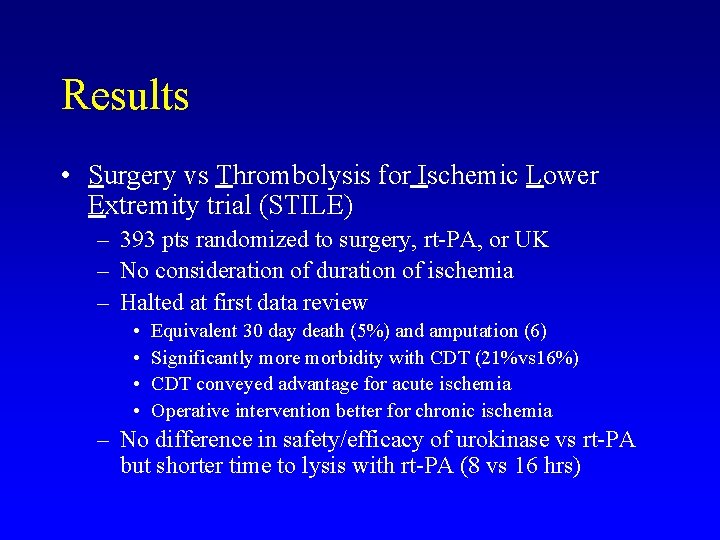
Results • Surgery vs Thrombolysis for Ischemic Lower Extremity trial (STILE) – 393 pts randomized to surgery, rt-PA, or UK – No consideration of duration of ischemia – Halted at first data review • • Equivalent 30 day death (5%) and amputation (6) Significantly more morbidity with CDT (21%vs 16%) CDT conveyed advantage for acute ischemia Operative intervention better for chronic ischemia – No difference in safety/efficacy of urokinase vs rt-PA but shorter time to lysis with rt-PA (8 vs 16 hrs)
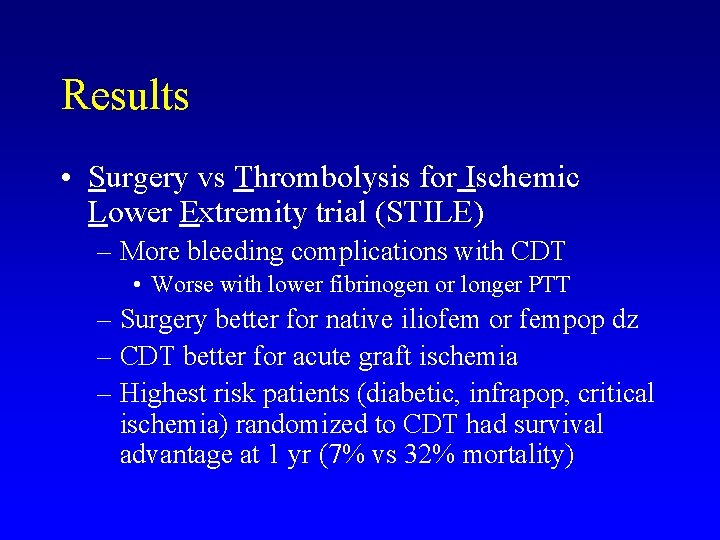
Results • Surgery vs Thrombolysis for Ischemic Lower Extremity trial (STILE) – More bleeding complications with CDT • Worse with lower fibrinogen or longer PTT – Surgery better for native iliofem or fempop dz – CDT better for acute graft ischemia – Highest risk patients (diabetic, infrapop, critical ischemia) randomized to CDT had survival advantage at 1 yr (7% vs 32% mortality)
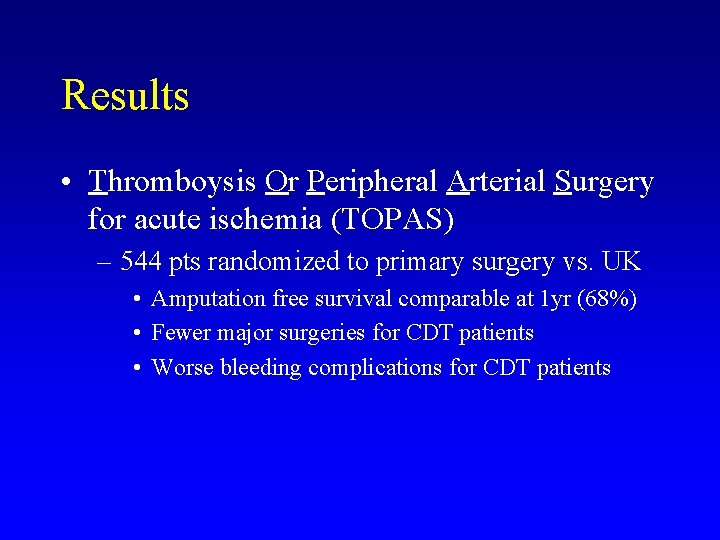
Results • Thromboysis Or Peripheral Arterial Surgery for acute ischemia (TOPAS) – 544 pts randomized to primary surgery vs. UK • Amputation free survival comparable at 1 yr (68%) • Fewer major surgeries for CDT patients • Worse bleeding complications for CDT patients
Results • Consistent findings from STILE and TOPAS – 1 -year mortality for acute limb ischemia 10 -20% – Treatment of occluded grafts better outcome than treatment of native arteries – Risk of bleeding higher with CDT • Worse in proportion to induced coagulopathy – Risk of intracranial bleed 1 -2% with CDT – CDT patients require fewer open surgical procedures
Results (comparing CDT agents) • PURPOSE Trial (Recombinant prourokinase vs. urokinase) – Bleeding dose dependent – Rate of in-hospital amputation or death worsened for distal embolization during CDT • Rt-PA vs Urokinase for fem-pop dz–Mahler et al. – Integrated mechanical techniques – Rt-PA better for pure lysis – Results better with mechanical techniques as adjunct • C/w STILE trial • Dosing iniquity • Better lysis with higher dose, bolus dosing
Techniques • Consensus Document for CDT in lower limb arterial occlusion - 1998 • Guide wire traversal test – Higher success if can traverse entire occluded vessel • “thrombus lacing” – Higher success with intrathrombus bolus
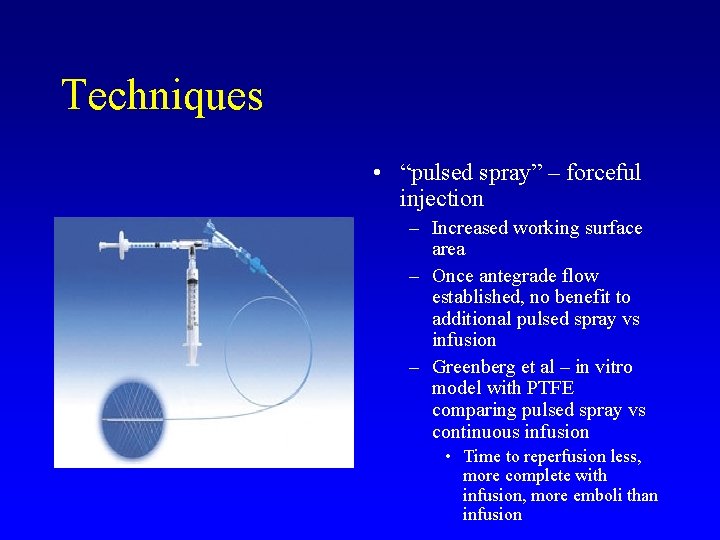
Techniques • “pulsed spray” – forceful injection – Increased working surface area – Once antegrade flow established, no benefit to additional pulsed spray vs infusion – Greenberg et al – in vitro model with PTFE comparing pulsed spray vs continuous infusion • Time to reperfusion less, more complete with infusion, more emboli than infusion
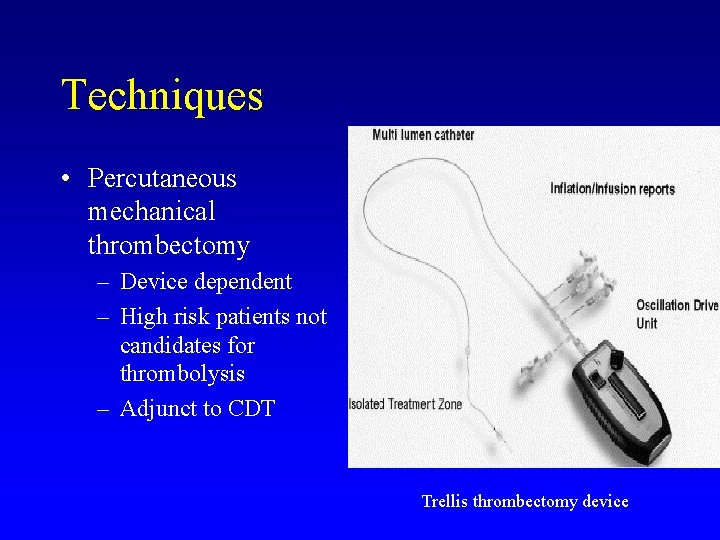
Techniques • Percutaneous mechanical thrombectomy – Device dependent – High risk patients not candidates for thrombolysis – Adjunct to CDT Trellis thrombectomy device
Adjuncts • Platelet inhibitors – ASA – Plavix – GIIb. IIIa inhibitors • Abciximab – fewer embolic episodes • Heparin – Worsens bleeding if given systemically – No benefit if subtherapeutic – Intra-arterial use might lessen bleeding risk and deliver more beneficial dose
Intra-operative CDT • High degree of residual thrombus after balloon thrombectomy – Bolus and or infusion of thrombolytics is effective • 20 -30 min – Isolated limb perfusion technique – Extra-corporeal pump
Summary • CDT is good first line therapy for appropriate patients • CDT increases bleeding risk – 2% intracranial hemorrhage • Acute limb ischemia is associated with significant morbidity/mortality • Further device and agent investigation needed • Intraoperative therapy can be valuable adjunct to surgery
References: • • • 1. Comerota Anthony. Intra-Arterial Catheter Directed Thrombolysis. Vascular Surgery. Rutherford. 2. Oriel K. Current Status of Thrombolysis for Peripheral Arterial Occlusive Disease. Ann Vasc Surg; 2002: 16: 797 -804. 3. Sarac T, Hilleman D, Arko F, et al. Clincal and economic evaluation of the trellis thrombectomy device for arterial occlusions: preliminary analysis. Soc for Vasc Surg; 2004: 39: 556 -9. 4. Working Party. Thrombolysis in the management of lower limb peripheral arterial occlusion – a consensus Document. Am J Cardiol. 1998; 81: 207 -18. 5. Marty B, Wicky S Ris H. Success of thrombolysis as a predictor of outcome in acute thrombosis of popliteal aneurysms. J Vasc Surg. 2002; 35: 487 -93.
- Slides: 25