
Generative Adversarial Network and its Applications to Signal
![Speech Enhancement • Speech enhancement GAN (SEGAN) [Pascual et al. , Interspeech 2017] z](https://slidetodoc.com/presentation_image_h/d0994b86c7695d11ee1cd8a8ac2ba1e7/image-7.jpg "Speech Enhancement • Speech enhancement GAN (SEGAN) [Pascual et al. , Interspeech 2017] z")
![Speech Enhancement • Pix 2 Pix [Michelsanti et al. , Interpsech 2017] Noisy Output](https://slidetodoc.com/presentation_image_h/d0994b86c7695d11ee1cd8a8ac2ba1e7/image-9.jpg "Speech Enhancement • Pix 2 Pix [Michelsanti et al. , Interpsech 2017] Noisy Output")
![Speech Enhancement • Frequency-domain SEGAN (FSEGAN) [Donahue et al. , ICASSP 2018] Noisy Output](https://slidetodoc.com/presentation_image_h/d0994b86c7695d11ee1cd8a8ac2ba1e7/image-12.jpg "Speech Enhancement • Frequency-domain SEGAN (FSEGAN) [Donahue et al. , ICASSP 2018] Noisy Output")
![Postfilter • GAN postfilter [Kaneko et al. , ICASSP 2017] Natural Mel cepst. coef.](https://slidetodoc.com/presentation_image_h/d0994b86c7695d11ee1cd8a8ac2ba1e7/image-23.jpg "Postfilter • GAN postfilter [Kaneko et al. , ICASSP 2017] Natural Mel cepst. coef.")
![Postfilter (GAN-postfilter-SFTF) • GAN post-filter for STFT spectrograms [Kaneko et al. , Interspeech 2017]](https://slidetodoc.com/presentation_image_h/d0994b86c7695d11ee1cd8a8ac2ba1e7/image-27.jpg "Postfilter (GAN-postfilter-SFTF) • GAN post-filter for STFT spectrograms [Kaneko et al. , Interspeech 2017]")
![Speech Synthesis • Speech synthesis with GAN (SS-GAN) [Saito et al. , TASLP 2018]](https://slidetodoc.com/presentation_image_h/d0994b86c7695d11ee1cd8a8ac2ba1e7/image-31.jpg "Speech Synthesis • Speech synthesis with GAN (SS-GAN) [Saito et al. , TASLP 2018]")
![Voice Conversion • VAW-GAN [Hsu et al. , Interspeech 2017] Target speaker Source speaker](https://slidetodoc.com/presentation_image_h/d0994b86c7695d11ee1cd8a8ac2ba1e7/image-39.jpg "Voice Conversion • VAW-GAN [Hsu et al. , Interspeech 2017] Target speaker Source speaker")
![Voice Conversion • Cycle. GAN-VC [Kaneko et al. , ar. Xiv 2017] as close](https://slidetodoc.com/presentation_image_h/d0994b86c7695d11ee1cd8a8ac2ba1e7/image-44.jpg "Voice Conversion • Cycle. GAN-VC [Kaneko et al. , ar. Xiv 2017] as close")
![Voice Conversion • Multi-target VC [Chou et al. , arxiv 2018] Ø Stage-1 C](https://slidetodoc.com/presentation_image_h/d0994b86c7695d11ee1cd8a8ac2ba1e7/image-46.jpg "Voice Conversion • Multi-target VC [Chou et al. , arxiv 2018] Ø Stage-1 C")
![Speech Recognition • Adversarial multi-task learning (AMT) [Shinohara Interspeech 2016] Output 2 Domain Output](https://slidetodoc.com/presentation_image_h/d0994b86c7695d11ee1cd8a8ac2ba1e7/image-50.jpg "Speech Recognition • Adversarial multi-task learning (AMT) [Shinohara Interspeech 2016] Output 2 Domain Output")
![Speaker Recognition • Domain adversarial neural network (DANN) [Wang et al. , ICASSP 2018]](https://slidetodoc.com/presentation_image_h/d0994b86c7695d11ee1cd8a8ac2ba1e7/image-57.jpg "Speaker Recognition • Domain adversarial neural network (DANN) [Wang et al. , ICASSP 2018]")
- Slides: 75
Generative Adversarial Network and its Applications to Signal Processing and Natural Language Processing Part II: Speech Signal Processing
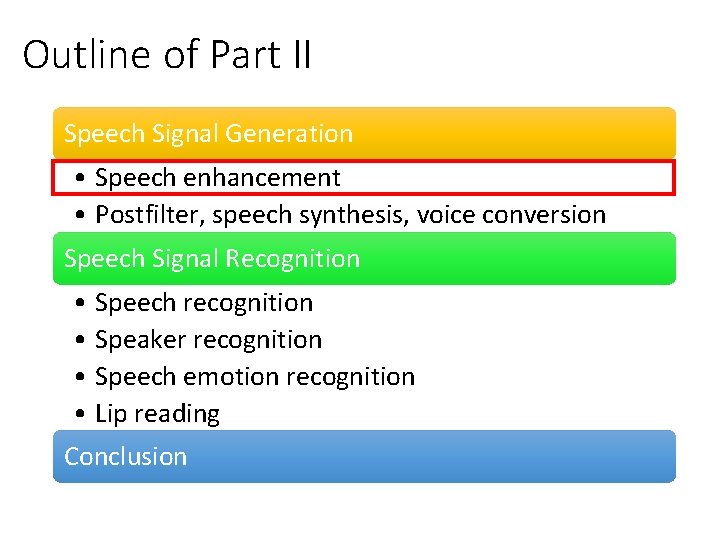
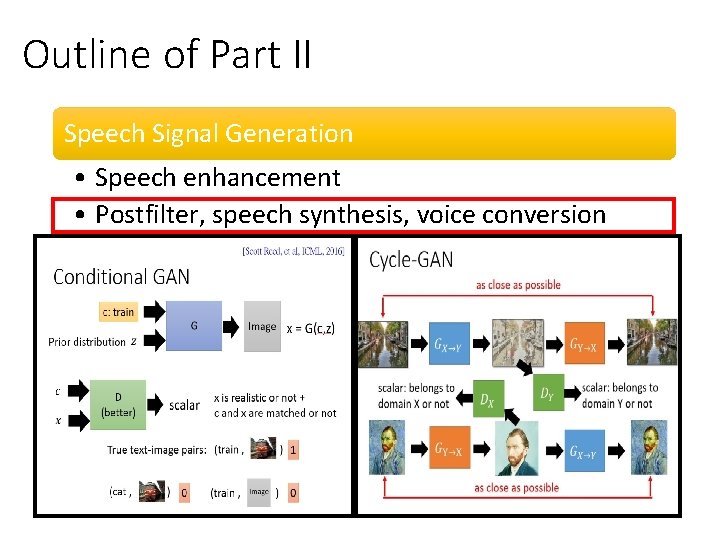
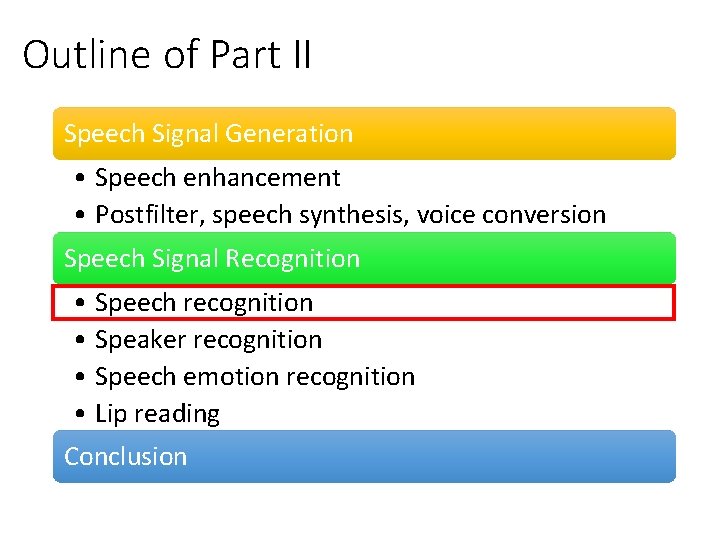
Outline of Part II Speech Signal Generation • Speech enhancement • Postfilter, speech synthesis, voice conversion Speech Signal Recognition • Speech recognition • Speaker recognition • Speech emotion recognition • Lip reading Conclusion
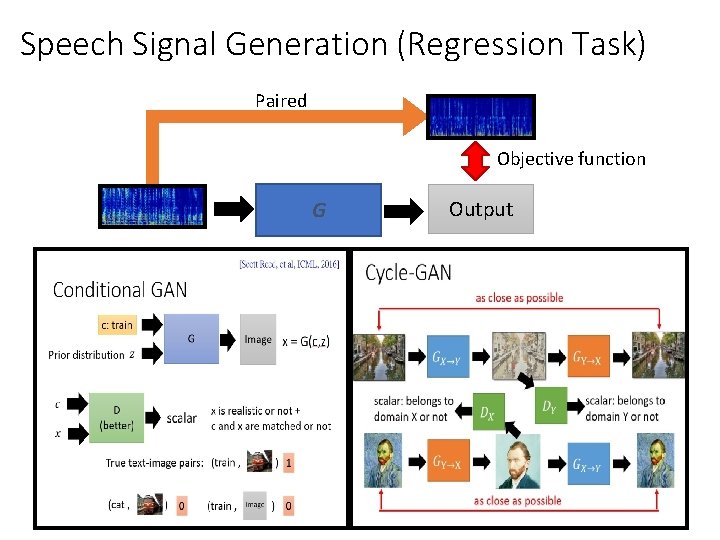
Speech Signal Generation (Regression Task) Paired Objective function G Output
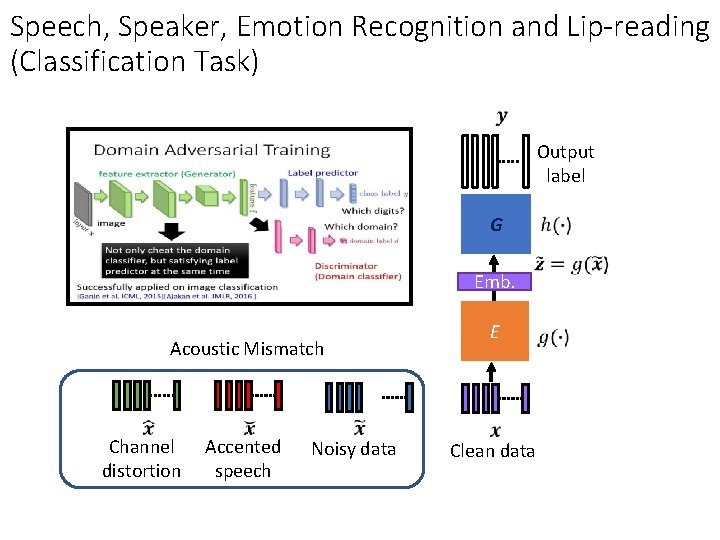
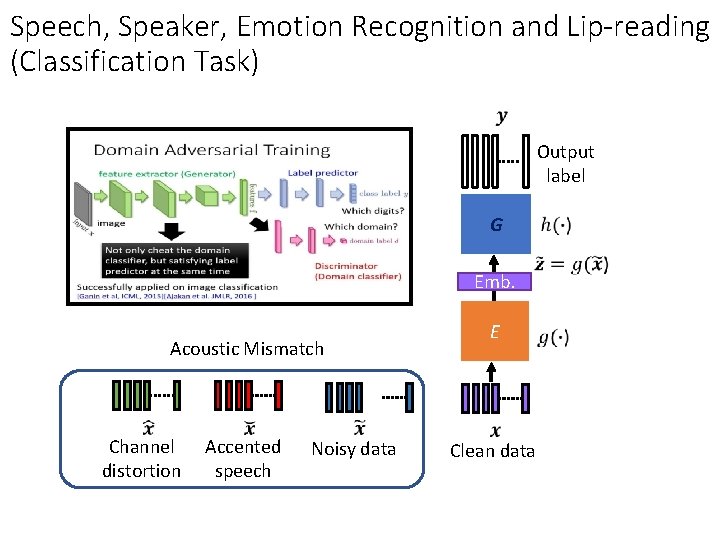
Speech, Speaker, Emotion Recognition and Lip-reading (Classification Task) Output label G Emb. Acoustic Mismatch Channel distortion Accented speech Noisy data E Clean data
Outline of Part II Speech Signal Generation • Speech enhancement • Postfilter, speech synthesis, voice conversion Speech Signal Recognition • Speech recognition • Speaker recognition • Speech emotion recognition • Lip reading Conclusion
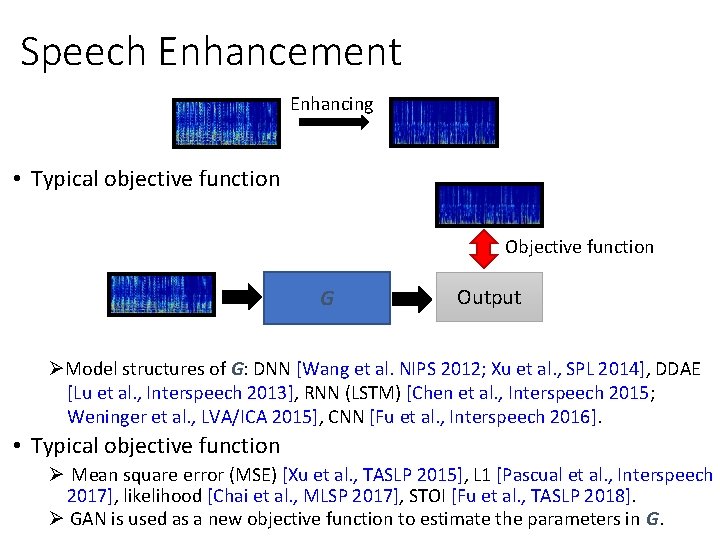
Speech Enhancement Enhancing • Typical objective function Objective function G Output ØModel structures of G: DNN [Wang et al. NIPS 2012; Xu et al. , SPL 2014], DDAE [Lu et al. , Interspeech 2013], RNN (LSTM) [Chen et al. , Interspeech 2015; Weninger et al. , LVA/ICA 2015], CNN [Fu et al. , Interspeech 2016]. • Typical objective function Ø Mean square error (MSE) [Xu et al. , TASLP 2015], L 1 [Pascual et al. , Interspeech 2017], likelihood [Chai et al. , MLSP 2017], STOI [Fu et al. , TASLP 2018]. Ø GAN is used as a new objective function to estimate the parameters in G.
Speech Enhancement • Speech enhancement GAN (SEGAN) [Pascual et al. , Interspeech 2017] z
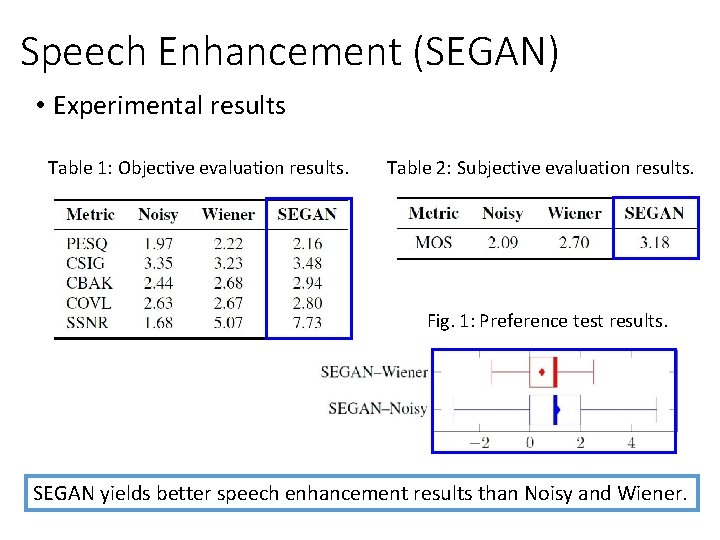
Speech Enhancement (SEGAN) • Experimental results Table 1: Objective evaluation results. Table 2: Subjective evaluation results. Fig. 1: Preference test results. SEGAN yields better speech enhancement results than Noisy and Wiener.
Speech Enhancement • Pix 2 Pix [Michelsanti et al. , Interpsech 2017] Noisy Output Clean G Output Clean D Noisy Scalar (Fake/Real)
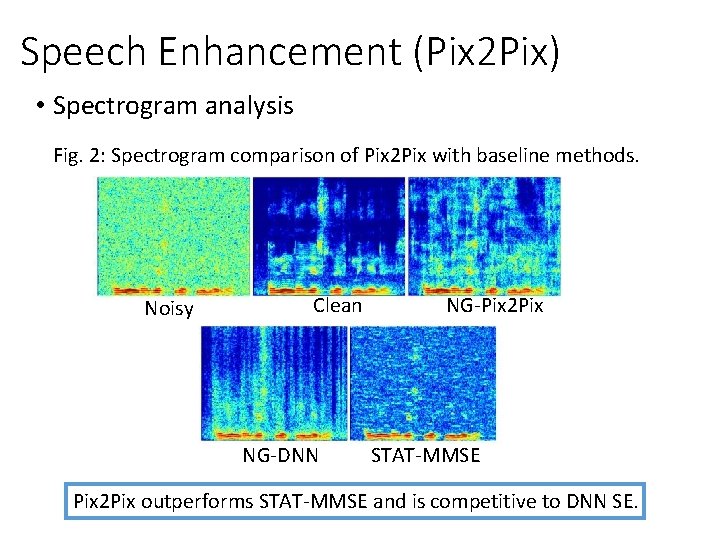
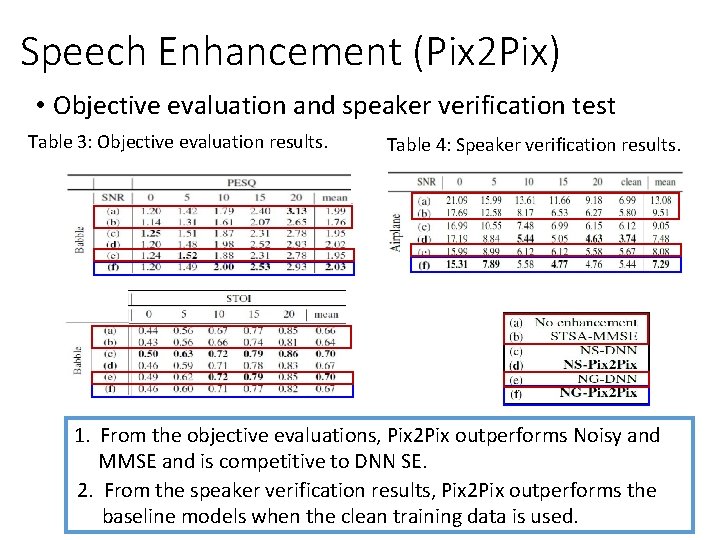
Speech Enhancement (Pix 2 Pix) • Spectrogram analysis Fig. 2: Spectrogram comparison of Pix 2 Pix with baseline methods. Noisy Clean NG-DNN NG-Pix 2 Pix STAT-MMSE Pix 2 Pix outperforms STAT-MMSE and is competitive to DNN SE.
Speech Enhancement (Pix 2 Pix) • Objective evaluation and speaker verification test Table 3: Objective evaluation results. Table 4: Speaker verification results. 1. From the objective evaluations, Pix 2 Pix outperforms Noisy and MMSE and is competitive to DNN SE. 2. From the speaker verification results, Pix 2 Pix outperforms the baseline models when the clean training data is used.
Speech Enhancement • Frequency-domain SEGAN (FSEGAN) [Donahue et al. , ICASSP 2018] Noisy Output Clean G Output Clean D Noisy Scalar (Fake/Real)
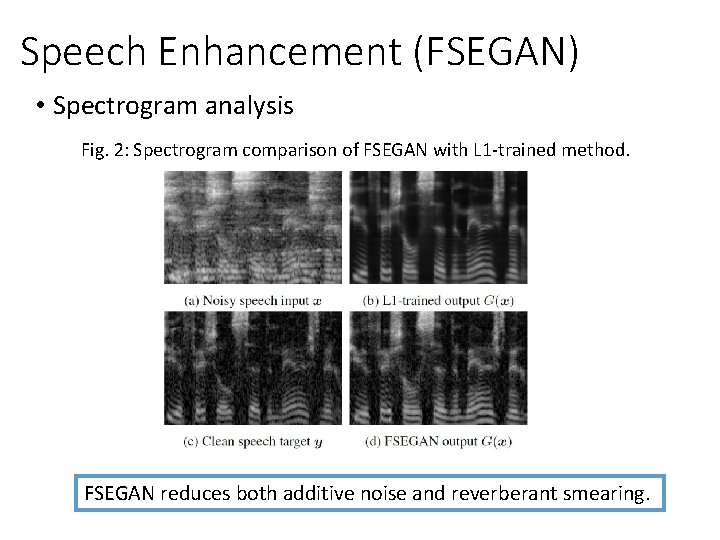
Speech Enhancement (FSEGAN) • Spectrogram analysis Fig. 2: Spectrogram comparison of FSEGAN with L 1 -trained method. FSEGAN reduces both additive noise and reverberant smearing.
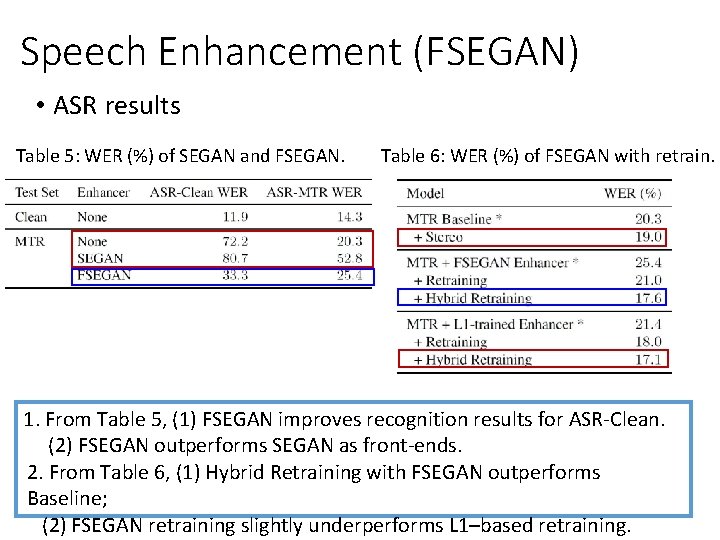
Speech Enhancement (FSEGAN) • ASR results Table 5: WER (%) of SEGAN and FSEGAN. Table 6: WER (%) of FSEGAN with retrain. 1. From Table 5, (1) FSEGAN improves recognition results for ASR-Clean. (2) FSEGAN outperforms SEGAN as front-ends. 2. From Table 6, (1) Hybrid Retraining with FSEGAN outperforms Baseline; (2) FSEGAN retraining slightly underperforms L 1–based retraining.
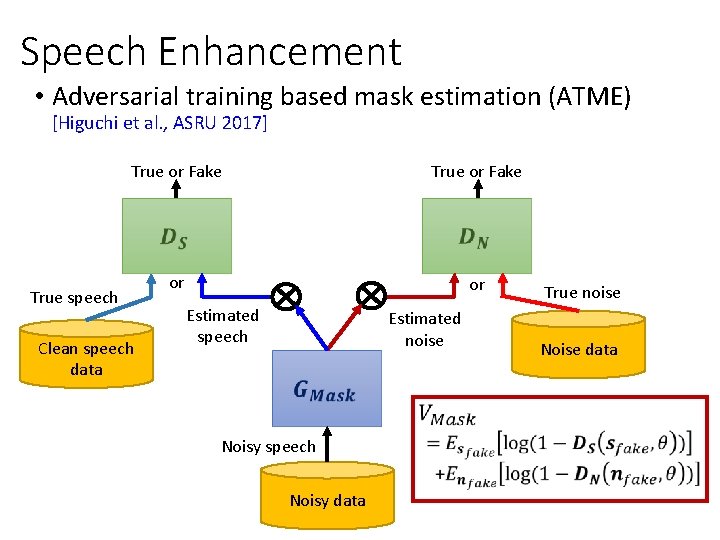
Speech Enhancement • Adversarial training based mask estimation (ATME) [Higuchi et al. , ASRU 2017] True or Fake or True speech Clean speech data Estimated speech Estimated noise Noisy speech Noisy data True noise Noise data
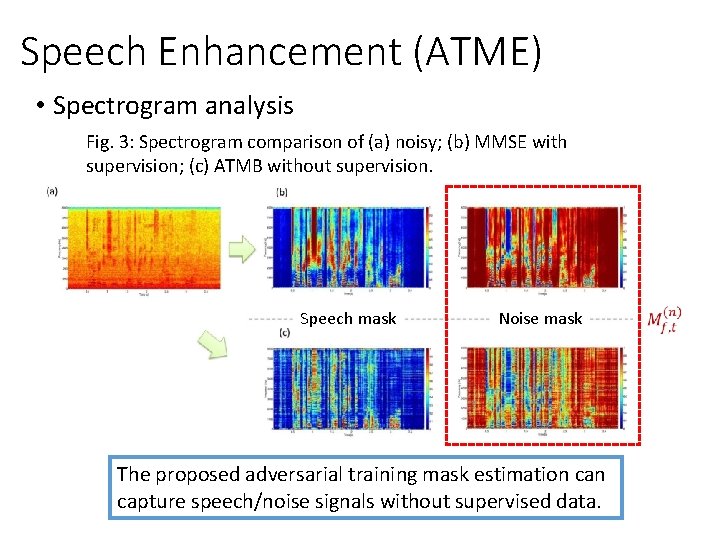
Speech Enhancement (ATME) • Spectrogram analysis Fig. 3: Spectrogram comparison of (a) noisy; (b) MMSE with supervision; (c) ATMB without supervision. Speech mask Noise mask The proposed adversarial training mask estimation capture speech/noise signals without supervised data.
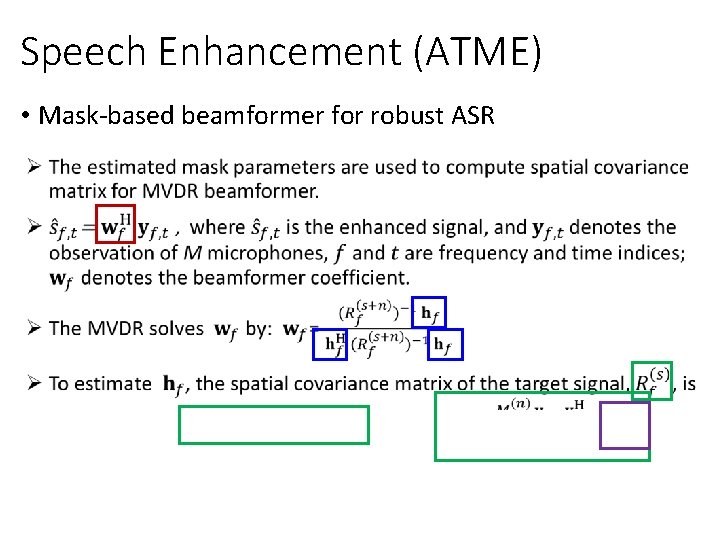
Speech Enhancement (ATME) • Mask-based beamformer for robust ASR •
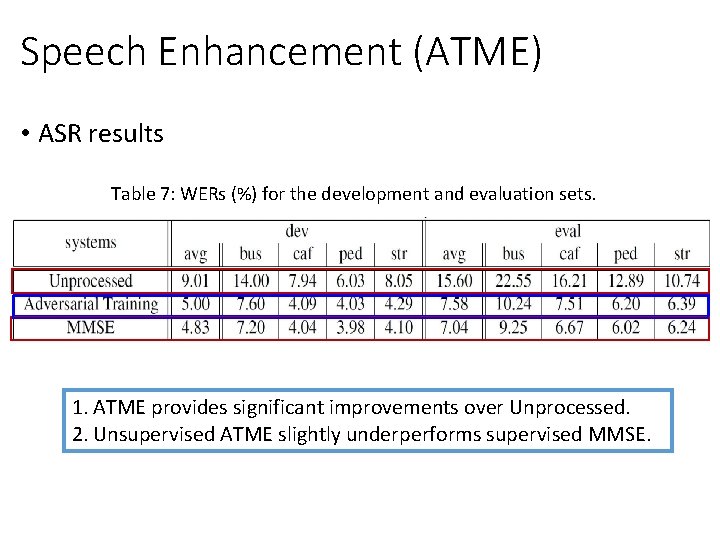
Speech Enhancement (ATME) • ASR results Table 7: WERs (%) for the development and evaluation sets. 1. ATME provides significant improvements over Unprocessed. 2. Unsupervised ATME slightly underperforms supervised MMSE.
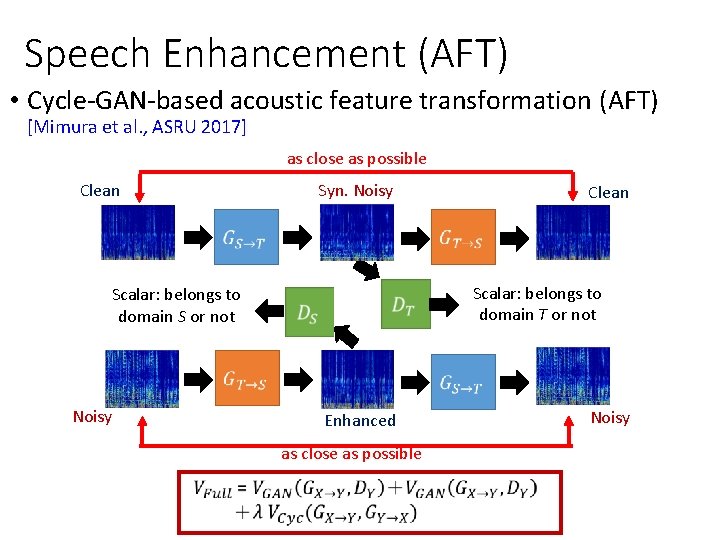
Speech Enhancement (AFT) • Cycle-GAN-based acoustic feature transformation (AFT) [Mimura et al. , ASRU 2017] as close as possible Clean Syn. Noisy Scalar: belongs to domain T or not Scalar: belongs to domain S or not Noisy Clean Enhanced as close as possible Noisy
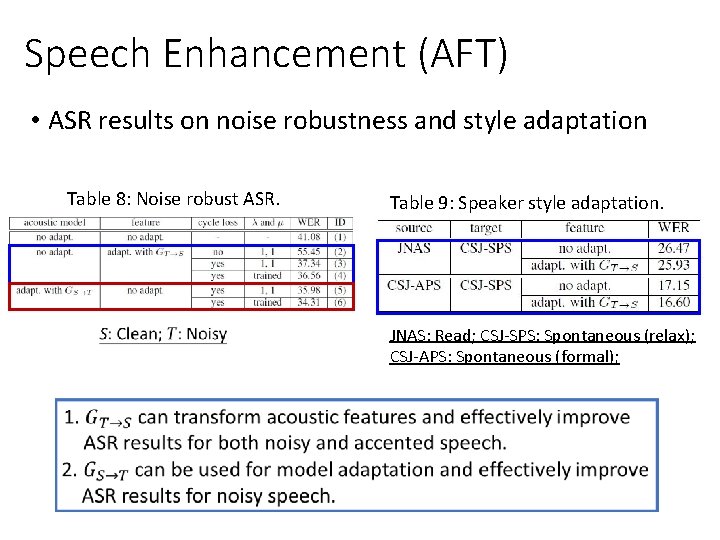
Speech Enhancement (AFT) • ASR results on noise robustness and style adaptation Table 8: Noise robust ASR. Table 9: Speaker style adaptation. JNAS: Read; CSJ-SPS: Spontaneous (relax); CSJ-APS: Spontaneous (formal);
Outline of Part II Speech Signal Generation • Speech enhancement • Postfilter, speech synthesis, voice conversion Speech Signal Recognition • Speech recognition • Speaker recognition • Speech emotion recognition • Lip reading Conclusion
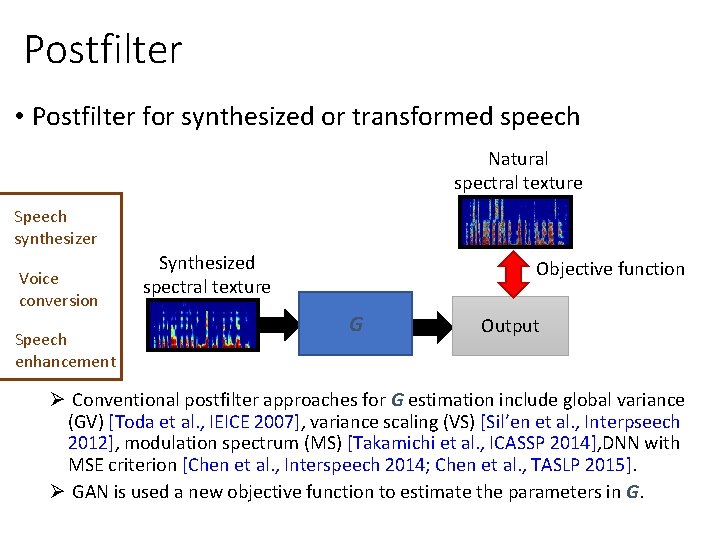
Postfilter • Postfilter for synthesized or transformed speech Natural spectral texture Speech synthesizer Voice conversion Speech enhancement Synthesized spectral texture Objective function G Output Ø Conventional postfilter approaches for G estimation include global variance (GV) [Toda et al. , IEICE 2007], variance scaling (VS) [Sil’en et al. , Interpseech 2012], modulation spectrum (MS) [Takamichi et al. , ICASSP 2014], DNN with MSE criterion [Chen et al. , Interspeech 2014; Chen et al. , TASLP 2015]. Ø GAN is used a new objective function to estimate the parameters in G.
Postfilter • GAN postfilter [Kaneko et al. , ICASSP 2017] Natural Mel cepst. coef. Synthesized Mel cepst. coef. Generated Mel cepst. coef. G D Nature or Generated Ø Traditional MMSE criterion results in statistical averaging. Ø GAN is used as a new objective function to estimate the parameters in G. Ø The proposed work intends to further improve the naturalness of synthesized speech or parameters from a synthesizer.
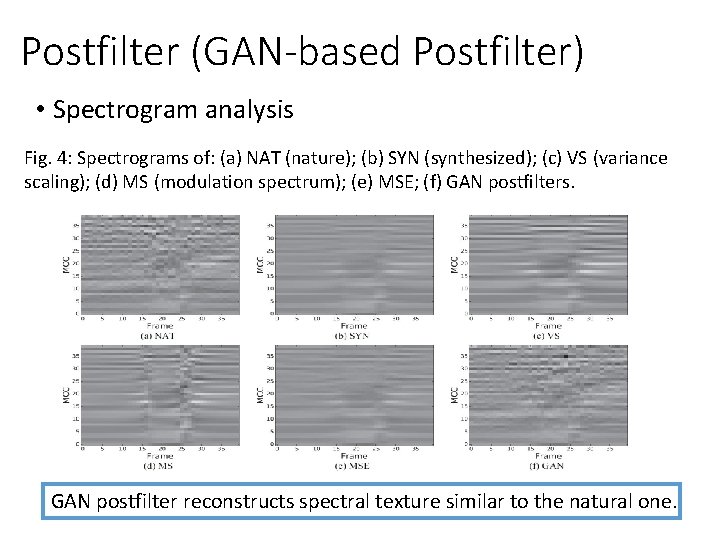
Postfilter (GAN-based Postfilter) • Spectrogram analysis Fig. 4: Spectrograms of: (a) NAT (nature); (b) SYN (synthesized); (c) VS (variance scaling); (d) MS (modulation spectrum); (e) MSE; (f) GAN postfilters. GAN postfilter reconstructs spectral texture similar to the natural one.
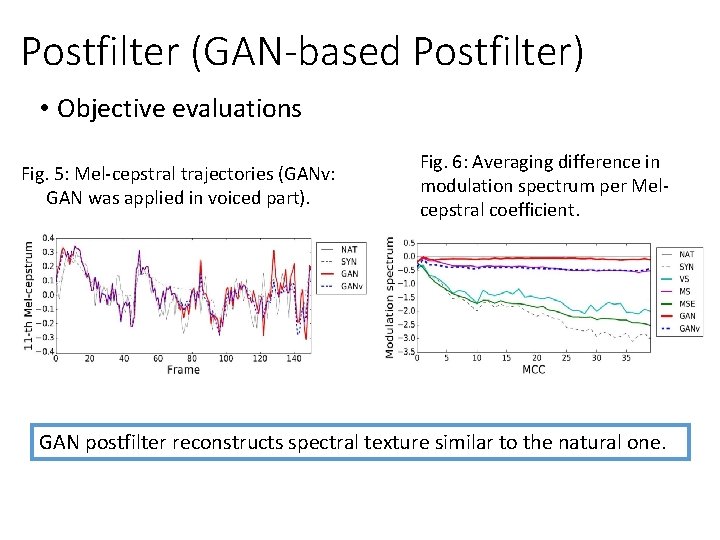
Postfilter (GAN-based Postfilter) • Objective evaluations Fig. 5: Mel-cepstral trajectories (GANv: GAN was applied in voiced part). Fig. 6: Averaging difference in modulation spectrum per Melcepstral coefficient. GAN postfilter reconstructs spectral texture similar to the natural one.
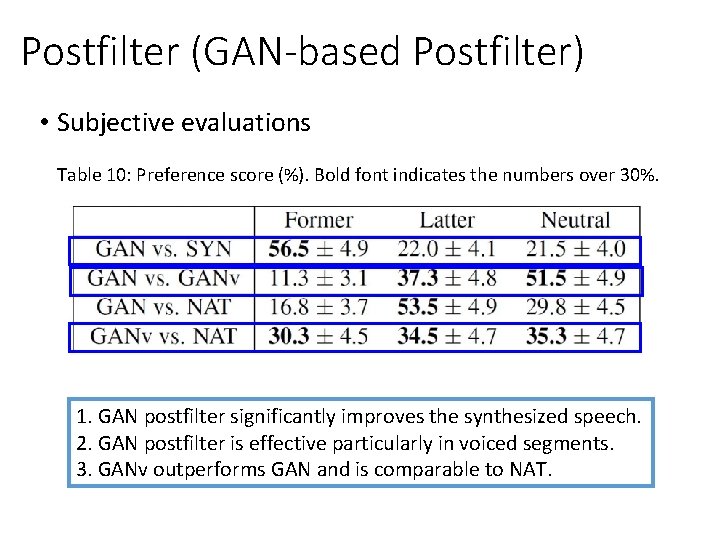
Postfilter (GAN-based Postfilter) • Subjective evaluations Table 10: Preference score (%). Bold font indicates the numbers over 30%. 1. GAN postfilter significantly improves the synthesized speech. 2. GAN postfilter is effective particularly in voiced segments. 3. GANv outperforms GAN and is comparable to NAT.
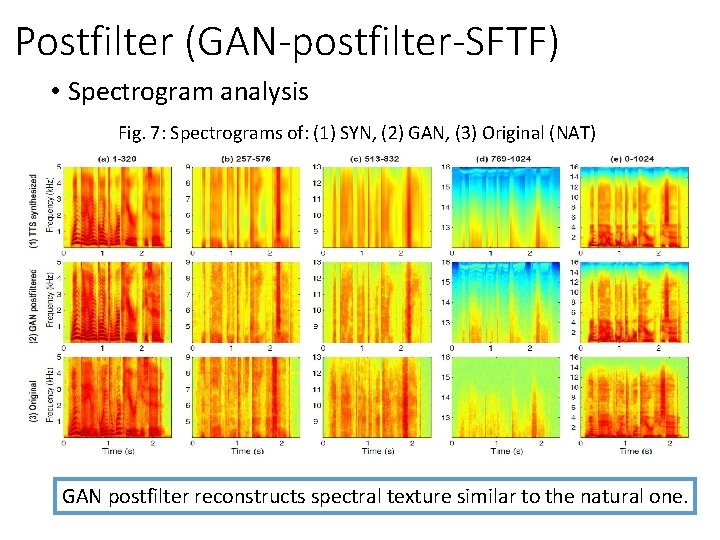
Postfilter (GAN-postfilter-SFTF) • GAN post-filter for STFT spectrograms [Kaneko et al. , Interspeech 2017] Ø GAN postfilter was applied on high-dimensional STFT spectrograms. Ø The spectrogram was partitioned into N bands (each band overlaps its neighboring bands). Ø The GAN-based postfilter was trained for each band. Ø The reconstructed spectrogram from each band was smoothly connected.
Postfilter (GAN-postfilter-SFTF) • Spectrogram analysis Fig. 7: Spectrograms of: (1) SYN, (2) GAN, (3) Original (NAT) GAN postfilter reconstructs spectral texture similar to the natural one.
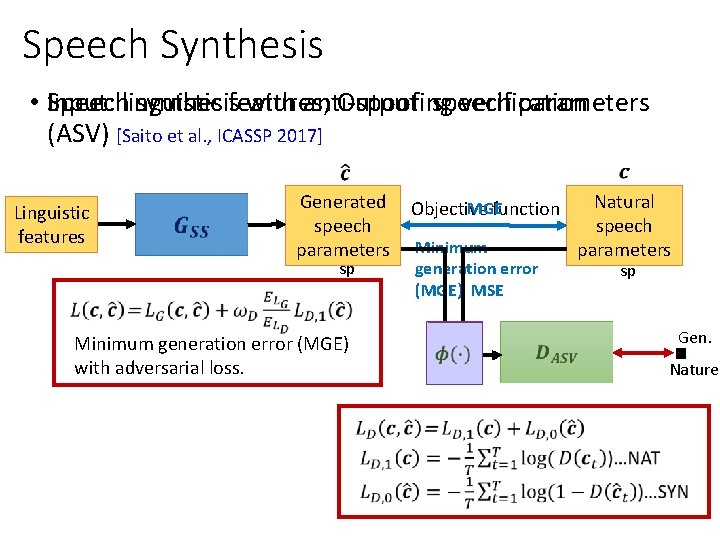
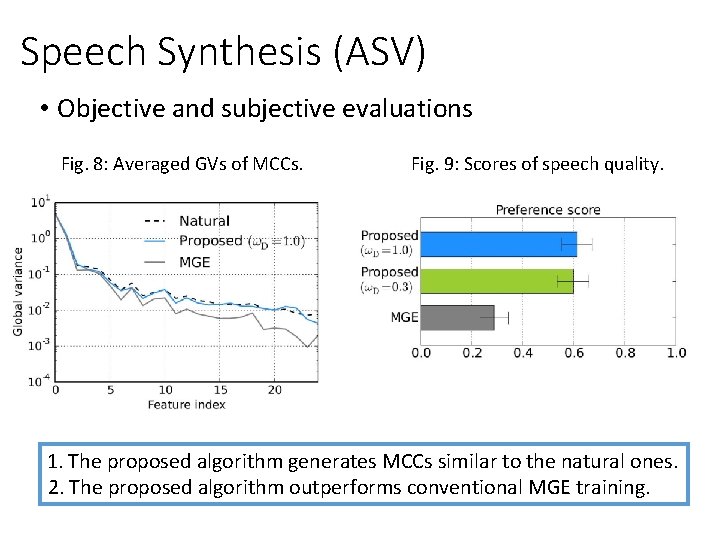
Speech Synthesis • Speech synthesis with anti-spoofing verification Input: linguistic features; Output: speech parameters (ASV) [Saito et al. , ICASSP 2017] Linguistic features Generated speech parameters sp Minimum generation error (MGE) with adversarial loss. MGE Objective function Minimum generation error (MGE), MSE Natural speech parameters sp Gen. Nature
Speech Synthesis (ASV) • Objective and subjective evaluations Fig. 8: Averaged GVs of MCCs. Fig. 9: Scores of speech quality. 1. The proposed algorithm generates MCCs similar to the natural ones. 2. The proposed algorithm outperforms conventional MGE training.
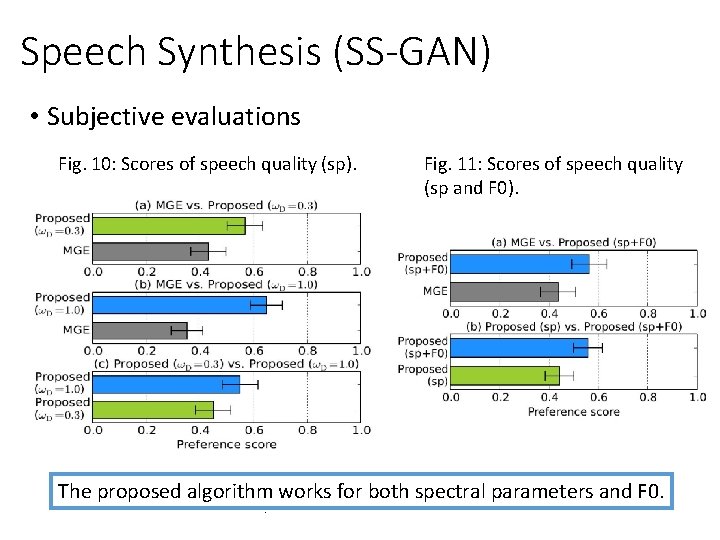
Speech Synthesis • Speech synthesis with GAN (SS-GAN) [Saito et al. , TASLP 2018] Linguistic features Generated speech parameters sp, f 0, duration Minimum generation error (MGE) with adversarial loss. MGE Natural speech parameters sp, f 0, duration Gen. Nature
Speech Synthesis (SS-GAN) • Subjective evaluations Fig. 10: Scores of speech quality (sp). Fig. 11: Scores of speech quality (sp and F 0). The proposed algorithm works for both spectral parameters and F 0. .
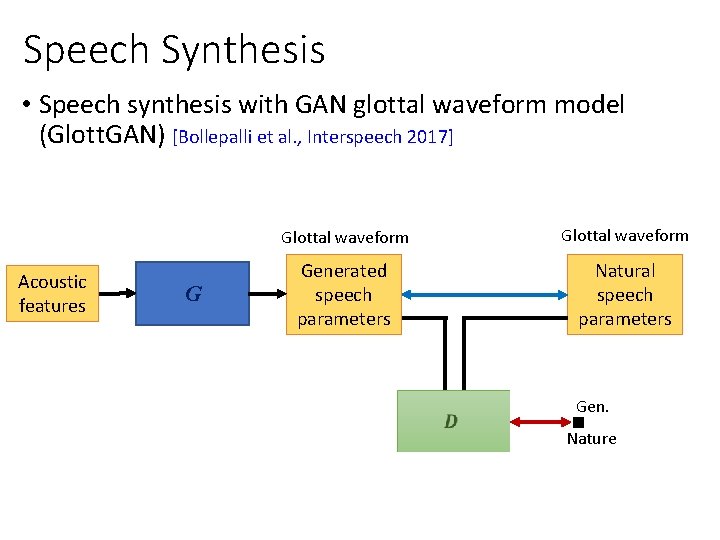
Speech Synthesis • Speech synthesis with GAN glottal waveform model (Glott. GAN) [Bollepalli et al. , Interspeech 2017] Acoustic features G Glottal waveform Generated speech parameters Natural speech parameters Gen. Nature
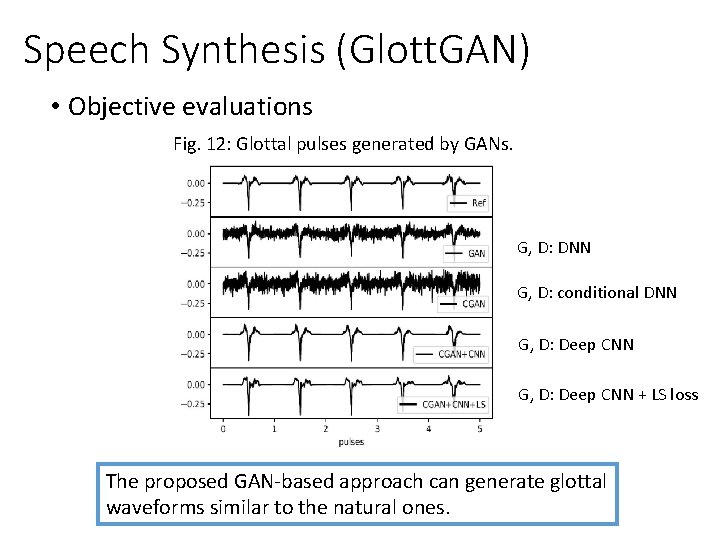
Speech Synthesis (Glott. GAN) • Objective evaluations Fig. 12: Glottal pulses generated by GANs. G, D: DNN G, D: conditional DNN G, D: Deep CNN + LS loss The proposed GAN-based approach can generate glottal waveforms similar to the natural ones.
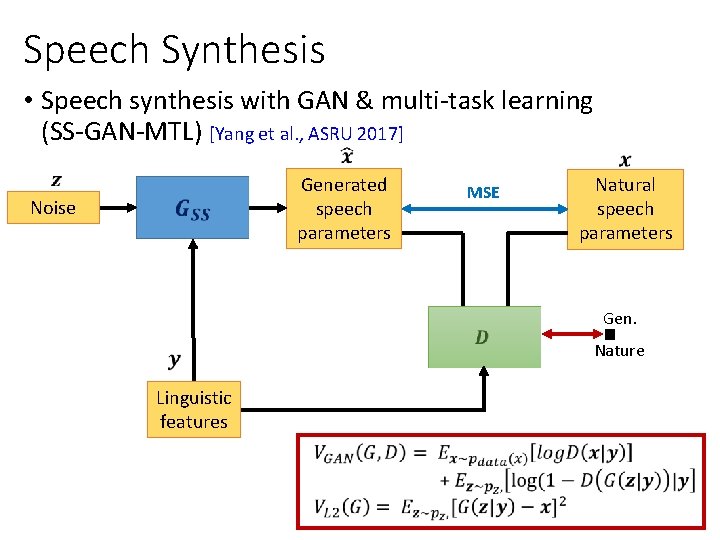
Speech Synthesis • Speech synthesis with GAN & multi-task learning (SS-GAN-MTL) [Yang et al. , ASRU 2017] Generated speech parameters Noise MSE Natural speech parameters Gen. Nature Linguistic features
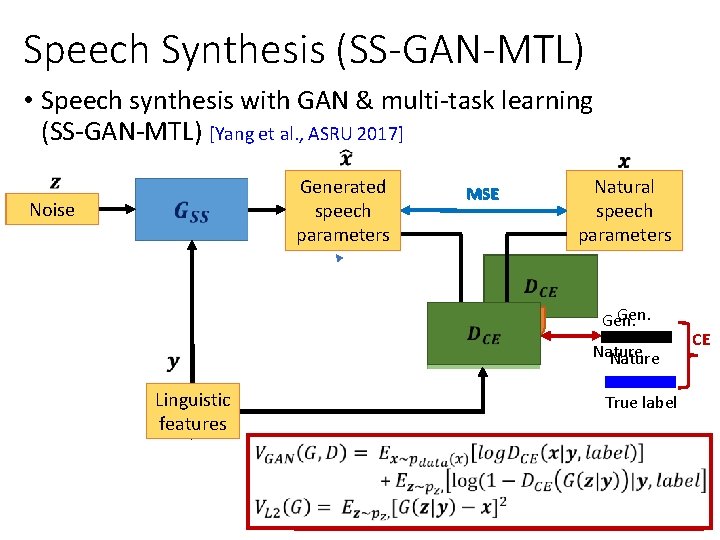
Speech Synthesis (SS-GAN-MTL) • Speech synthesis with GAN & multi-task learning (SS-GAN-MTL) [Yang et al. , ASRU 2017] Generated speech parameters Noise MSE Natural speech parameters Gen. Nature Linguistic features True label CE
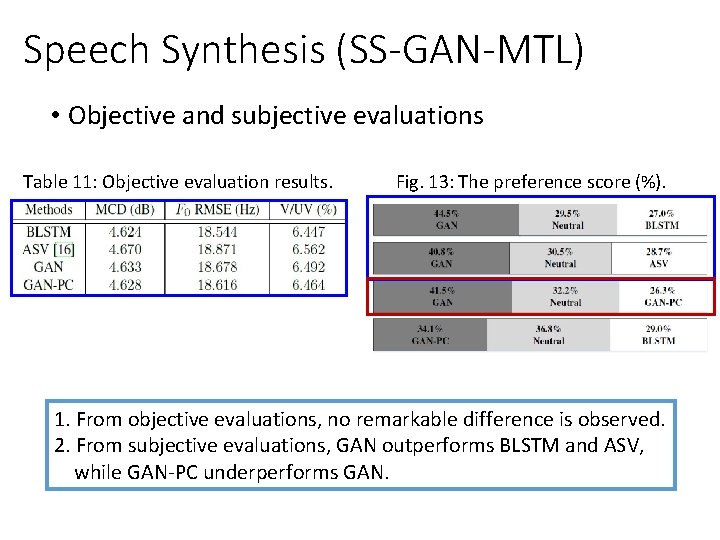
Speech Synthesis (SS-GAN-MTL) • Objective and subjective evaluations Table 11: Objective evaluation results. Fig. 13: The preference score (%). 1. From objective evaluations, no remarkable difference is observed. 2. From subjective evaluations, GAN outperforms BLSTM and ASV, while GAN-PC underperforms GAN.
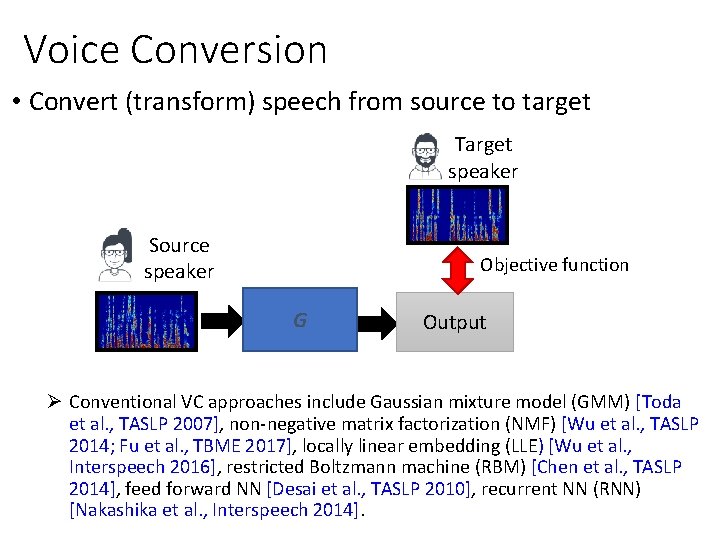
Voice Conversion • Convert (transform) speech from source to target Target speaker Source speaker Objective function G Output Ø Conventional VC approaches include Gaussian mixture model (GMM) [Toda et al. , TASLP 2007], non-negative matrix factorization (NMF) [Wu et al. , TASLP 2014; Fu et al. , TBME 2017], locally linear embedding (LLE) [Wu et al. , Interspeech 2016], restricted Boltzmann machine (RBM) [Chen et al. , TASLP 2014], feed forward NN [Desai et al. , TASLP 2010], recurrent NN (RNN) [Nakashika et al. , Interspeech 2014].
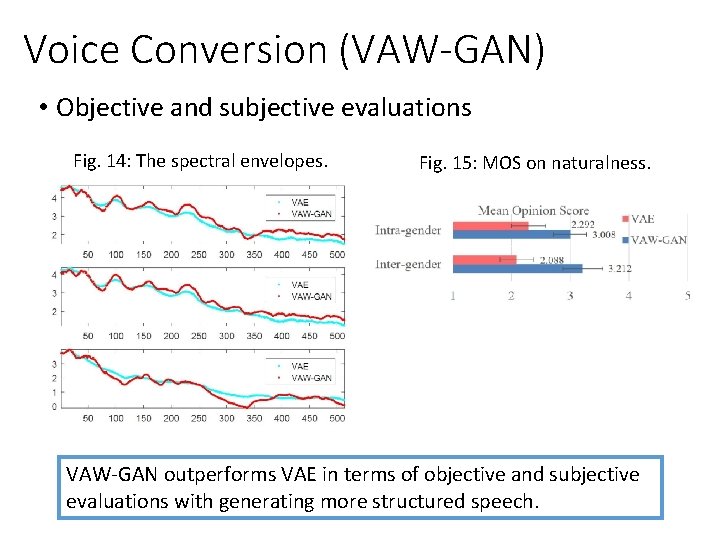
Voice Conversion • VAW-GAN [Hsu et al. , Interspeech 2017] Target speaker Source speaker G D Real or Fake Ø Conventional MMSE approaches often encounter the “over-smoothing” issue. Ø GAN is used a new objective function to estimate G. Ø The goal is to increase the naturalness, clarity, similarity of converted speech.
Voice Conversion (VAW-GAN) • Objective and subjective evaluations Fig. 14: The spectral envelopes. Fig. 15: MOS on naturalness. VAW-GAN outperforms VAE in terms of objective and subjective evaluations with generating more structured speech.
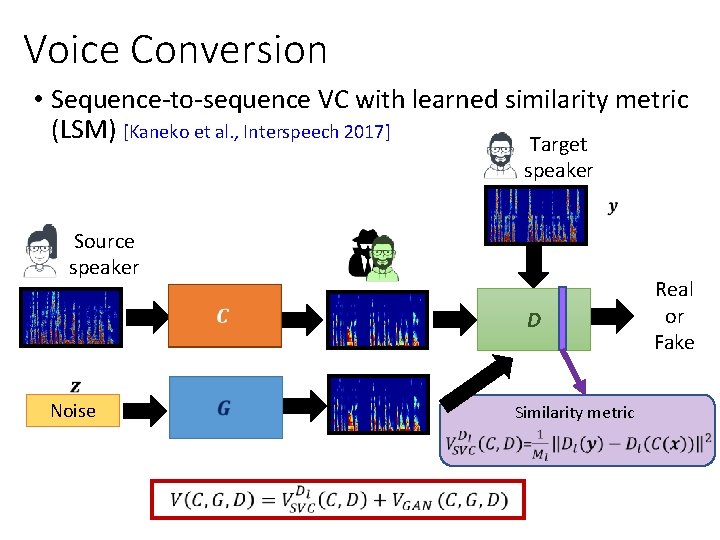
Voice Conversion • Sequence-to-sequence VC with learned similarity metric (LSM) [Kaneko et al. , Interspeech 2017] Target speaker Source speaker D Noise Similarity metric Real or Fake
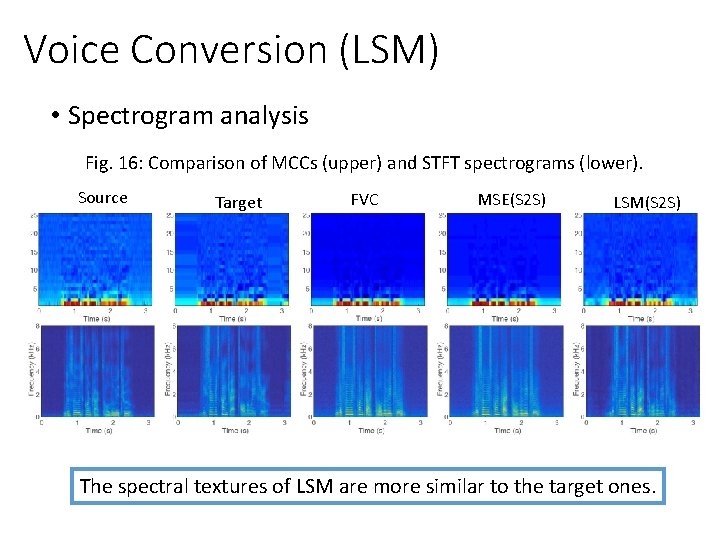
Voice Conversion (LSM) • Spectrogram analysis Fig. 16: Comparison of MCCs (upper) and STFT spectrograms (lower). Source Target FVC MSE(S 2 S) LSM(S 2 S) The spectral textures of LSM are more similar to the target ones.
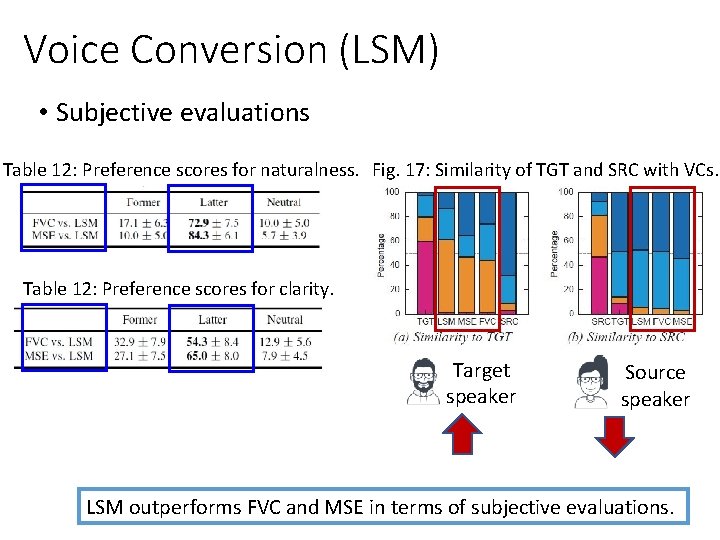
Voice Conversion (LSM) • Subjective evaluations Table 12: Preference scores for naturalness. Fig. 17: Similarity of TGT and SRC with VCs. Table 12: Preference scores for clarity. Target speaker Source speaker LSM outperforms FVC and MSE in terms of subjective evaluations.
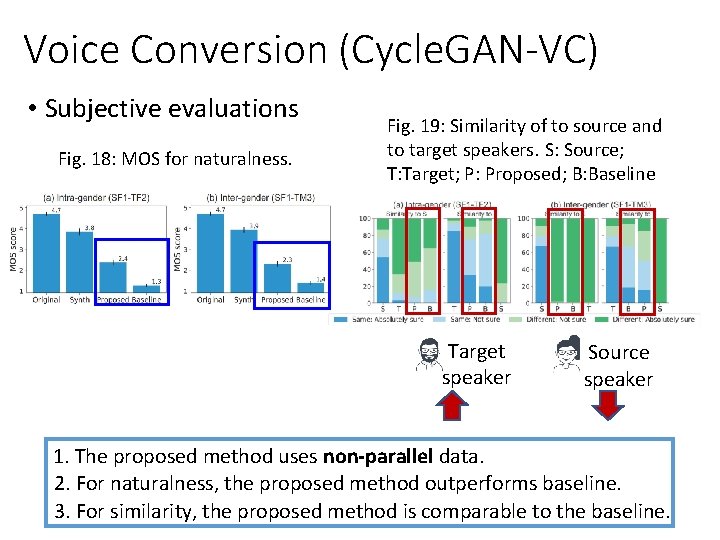
Voice Conversion • Cycle. GAN-VC [Kaneko et al. , ar. Xiv 2017] as close as possible Source Syn. Target • used a new objective function to estimate G Scalar: belongs to domain S or not Target Scalar: belongs to domain T or not Syn. Source as close as possible Target
Voice Conversion (Cycle. GAN-VC) • Subjective evaluations Fig. 18: MOS for naturalness. Fig. 19: Similarity of to source and to target speakers. S: Source; T: Target; P: Proposed; B: Baseline Target speaker Source speaker 1. The proposed method uses non-parallel data. 2. For naturalness, the proposed method outperforms baseline. 3. For similarity, the proposed method is comparable to the baseline.
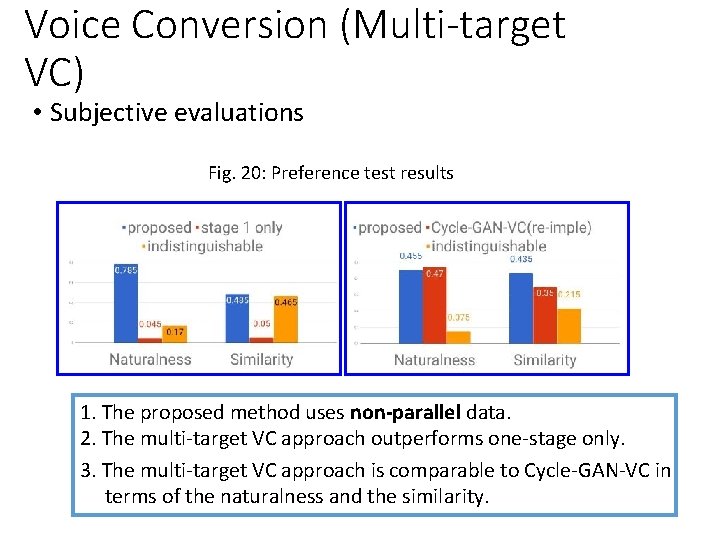
Voice Conversion • Multi-target VC [Chou et al. , arxiv 2018] Ø Stage-1 C Dec ··· Ø Stage-2 Dec D+C Real data F/R ID
Voice Conversion (Multi-target VC) • Subjective evaluations Fig. 20: Preference test results 1. The proposed method uses non-parallel data. 2. The multi-target VC approach outperforms one-stage only. 3. The multi-target VC approach is comparable to Cycle-GAN-VC in terms of the naturalness and the similarity.
Outline of Part II Speech Signal Generation • Speech enhancement • Postfilter, speech synthesis, voice conversion Speech Signal Recognition • Speech recognition • Speaker recognition • Speech emotion recognition • Lip reading Conclusion
Speech, Speaker, Emotion Recognition and Lip-reading (Classification Task) Output label G Emb. Acoustic Mismatch Channel distortion Accented speech Noisy data E Clean data
Speech Recognition • Adversarial multi-task learning (AMT) [Shinohara Interspeech 2016] Output 2 Domain Output 1 Senone G D GRL Objective function Model update Max classification accuracy Max domain accuracy E Input Acoustic feature Max classification accuracy and Min domain accuracy
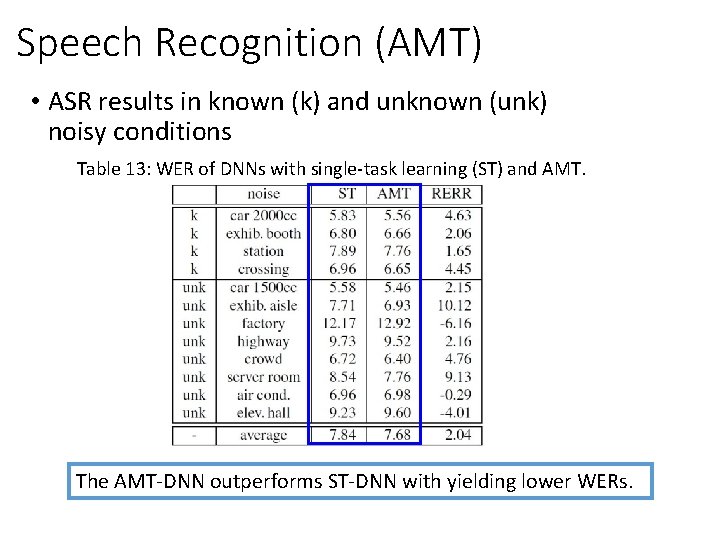
Speech Recognition (AMT) • ASR results in known (k) and unknown (unk) noisy conditions Table 13: WER of DNNs with single-task learning (ST) and AMT. The AMT-DNN outperforms ST-DNN with yielding lower WERs.
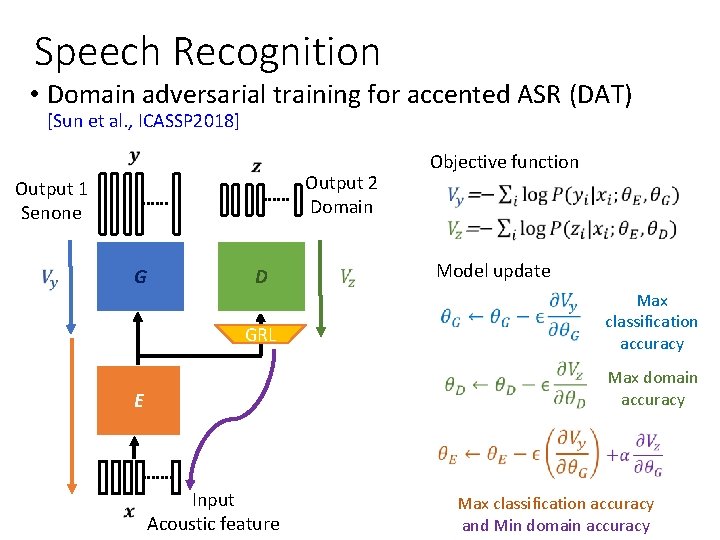
Speech Recognition • Domain adversarial training for accented ASR (DAT) [Sun et al. , ICASSP 2018] Output 2 Domain Output 1 Senone G D GRL Objective function Model update Max classification accuracy Max domain accuracy E Input Acoustic feature Max classification accuracy and Min domain accuracy
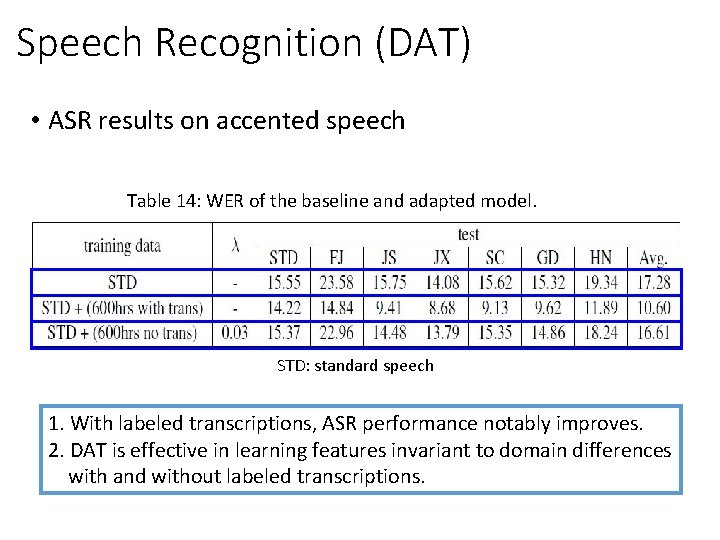
Speech Recognition (DAT) • ASR results on accented speech Table 14: WER of the baseline and adapted model. STD: standard speech 1. With labeled transcriptions, ASR performance notably improves. 2. DAT is effective in learning features invariant to domain differences with and without labeled transcriptions.
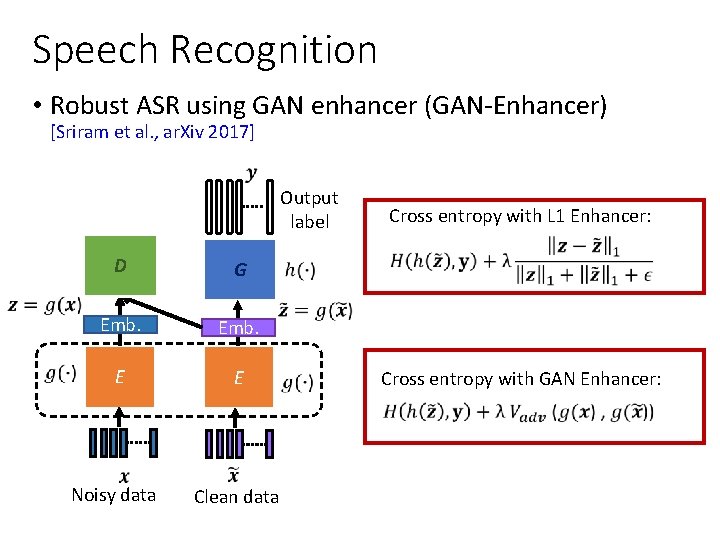
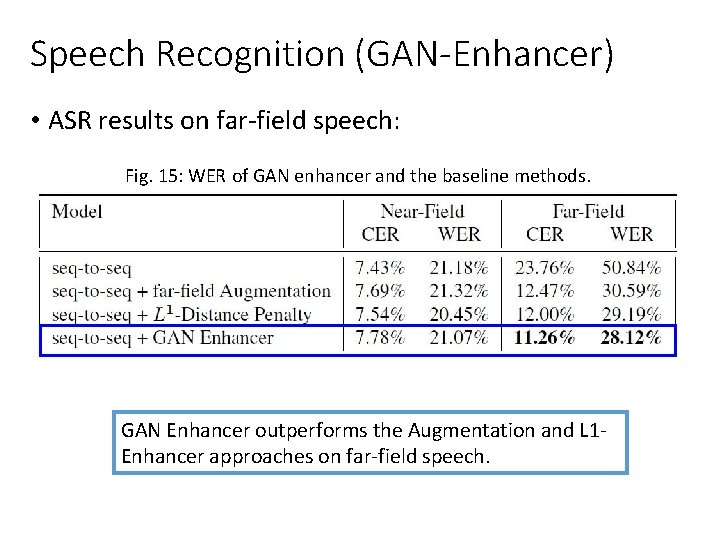
Speech Recognition • Robust ASR using GAN enhancer (GAN-Enhancer) [Sriram et al. , ar. Xiv 2017] Output label L 1 D G Emb. E E Noisy data Clean data Cross entropy with L 1 Enhancer: Cross entropy with GAN Enhancer:
Speech Recognition (GAN-Enhancer) • ASR results on far-field speech: Fig. 15: WER of GAN enhancer and the baseline methods. GAN Enhancer outperforms the Augmentation and L 1 Enhancer approaches on far-field speech.
Outline of Part II Speech Signal Generation • Speech enhancement • Postfilter, speech synthesis, voice conversion Speech Signal Recognition • Speech recognition • Speaker recognition • Speech emotion recognition • Lip reading Conclusion
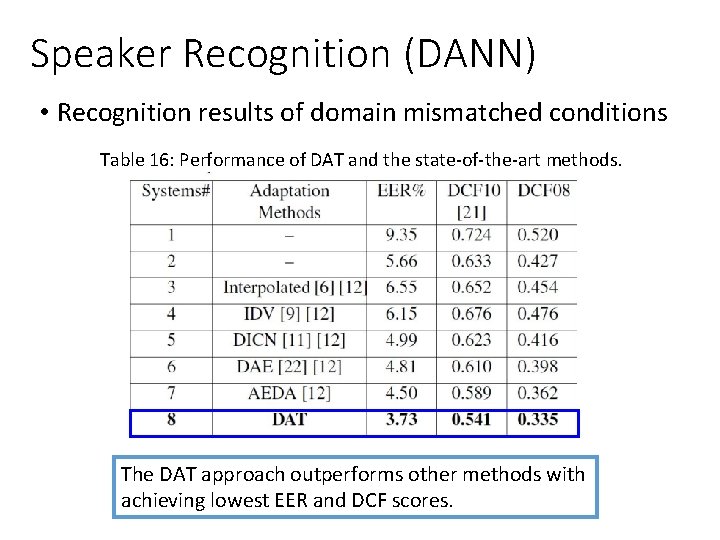
Speaker Recognition • Domain adversarial neural network (DANN) [Wang et al. , ICASSP 2018] Output 1 Speaker ID Output 2 Domain G D GRL Enroll i-vector DANN Preprocessing E Scoring Test i-vector Input Acoustic feature DANN Preprocessing
Speaker Recognition (DANN) • Recognition results of domain mismatched conditions Table 16: Performance of DAT and the state-of-the-art methods. The DAT approach outperforms other methods with achieving lowest EER and DCF scores.
Outline of Part II Speech Signal Generation • Speech enhancement • Postfilter, speech synthesis, voice conversion Speech Signal Recognition • Speech recognition • Speaker recognition • Speech emotion recognition • Lip reading Conclusion
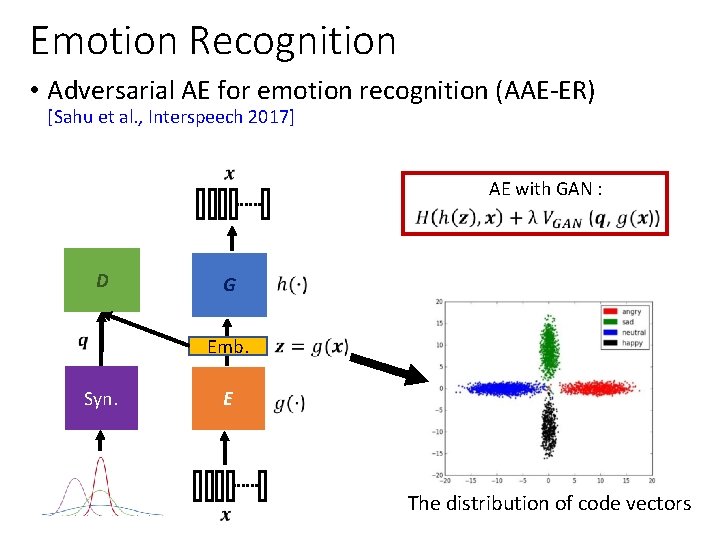
Emotion Recognition • Adversarial AE for emotion recognition (AAE-ER) [Sahu et al. , Interspeech 2017] AE with GAN : D G Emb. Syn. E The distribution of code vectors
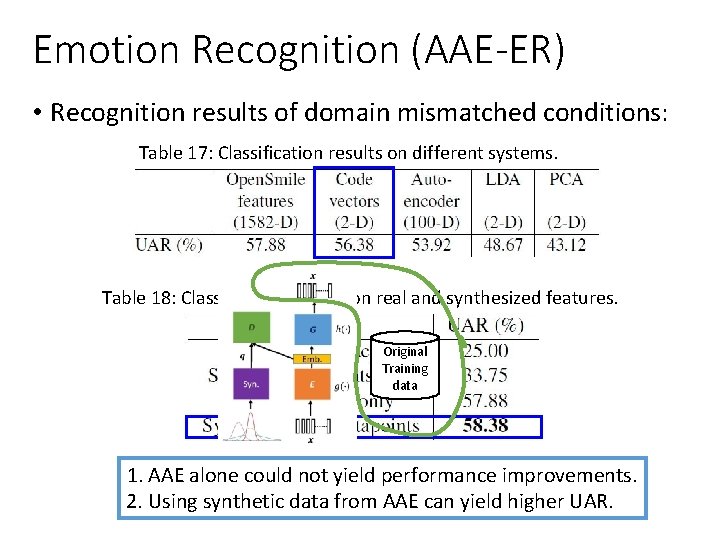
Emotion Recognition (AAE-ER) • Recognition results of domain mismatched conditions: Table 17: Classification results on different systems. Table 18: Classification results on real and synthesized features. Original Training data 1. AAE alone could not yield performance improvements. 2. Using synthetic data from AAE can yield higher UAR.
Outline of Part II Speech Signal Generation • Speech enhancement • Postfilter, speech synthesis, voice conversion Speech Signal Recognition • Speech recognition • Speaker recognition • Speech emotion recognition • Lip reading Conclusion
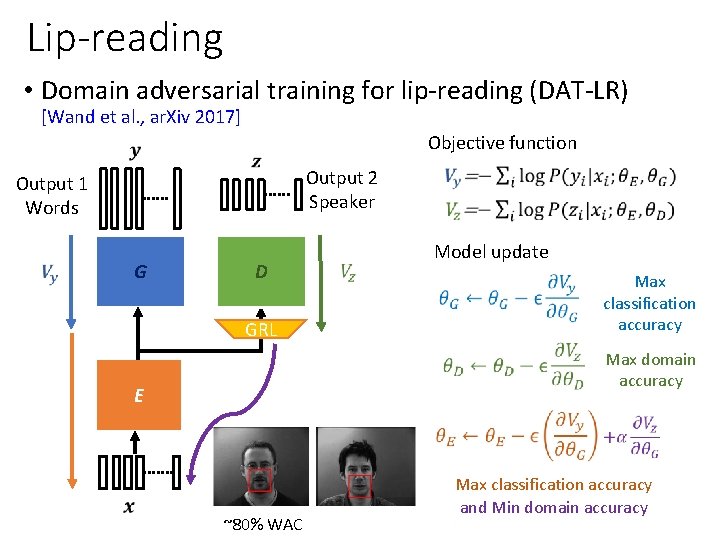
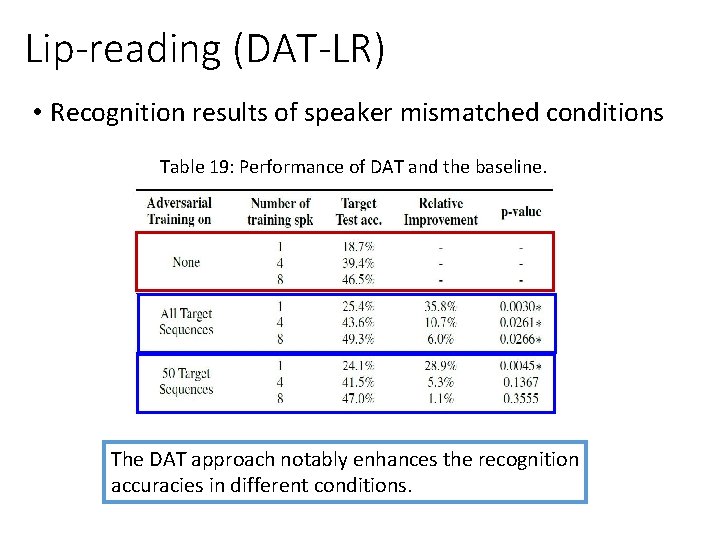
Lip-reading • Domain adversarial training for lip-reading (DAT-LR) [Wand et al. , ar. Xiv 2017] Objective function Output 2 Speaker Output 1 Words G D GRL Model update Max classification accuracy Max domain accuracy E ~80% WAC Max classification accuracy and Min domain accuracy
Lip-reading (DAT-LR) • Recognition results of speaker mismatched conditions Table 19: Performance of DAT and the baseline. The DAT approach notably enhances the recognition accuracies in different conditions.
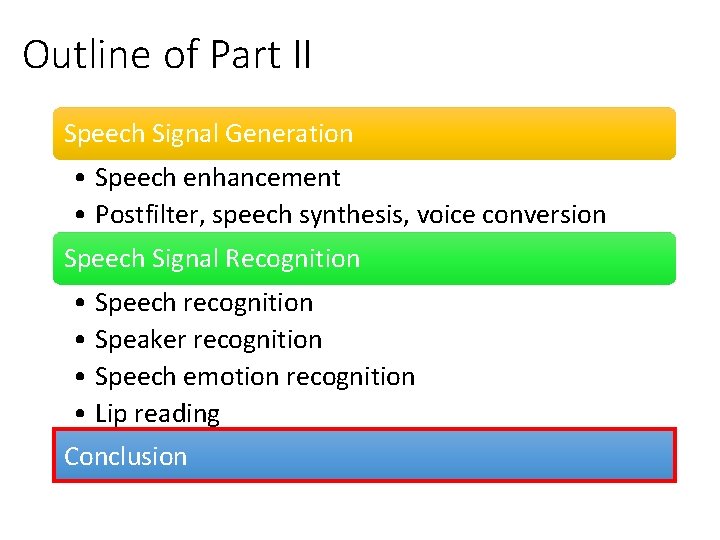
Outline of Part II Speech Signal Generation • Speech enhancement • Postfilter, speech synthesis, voice conversion Speech Signal Recognition • Speech recognition • Speaker recognition • Speech emotion recognition • Lip reading Conclusion
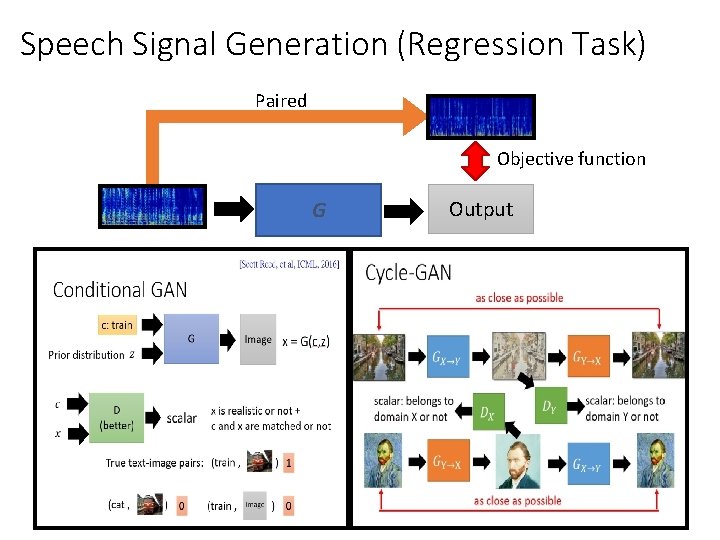
Speech Signal Generation (Regression Task) Paired Objective function G Output
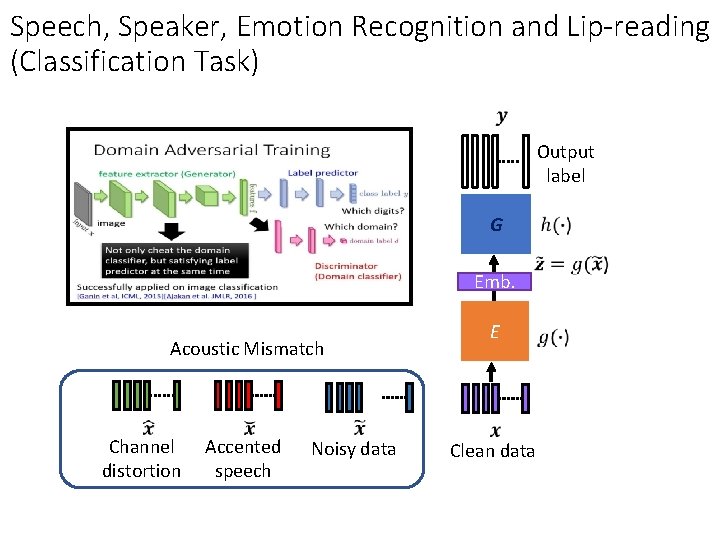
Speech, Speaker, Emotion Recognition and Lip-reading (Classification Task) Output label G Emb. Acoustic Mismatch Channel distortion Accented speech Noisy data E Clean data
More GANs in Speech Diagnosis of autism spectrum Jun Deng, Nicholas Cummins, Maximilian Schmitt, Kun Qian, Fabien Ringeval, and Björn Schuller, Speech-based Diagnosis of Autism Spectrum Condition by Generative Adversarial Network Representations, ACM DH, 2017. Emotion recognition Jonathan Chang, and Stefan Scherer, Learning Representations of Emotional Speech with Deep Convolutional Generative Adversarial Networks, ICASSP, 2017. Robust ASR Dmitriy Serdyuk, Kartik Audhkhasi, Philémon Brakel, Bhuvana Ramabhadran, Samuel Thomas, and Yoshua Bengio, Invariant Representations for Noisy Speech Recognition, ar. Xiv, 2016. Speaker verification Hong Yu, Zheng-Hua Tan, Zhanyu Ma, and Jun Guo, Adversarial Network Bottleneck Features for Noise Robust Speaker Verification, ar. Xiv, 2017.
References Speech enhancement (conventional methods) • Yuxuan Wang and Deliang Wang, Cocktail Party Processing via Structured Prediction, NIPS 2012. • Yong Xu, Jun Du, Li-Rong Dai, and Chin-Hui Lee, An Experimental Study on Speech Enhancement Based on Deep Neural Networks, " IEEE SPL, 2014. • Yong Xu, Jun Du, Li-Rong Dai, and Chin-Hui Lee, A Regression Approach to Speech Enhancement Based on Deep Neural Networks, IEEE/ACM TASLP, 2015. • Xugang Lu, Yu Tsao, Shigeki Matsuda, Chiori Hori, Speech Enhancement Based on Deep Denoising Autoencoder, Interspeech 2012. • Zhuo Chen, Shinji Watanabe, Hakan Erdogan, John R. Hershey, Integration of Speech Enhancement and Recognition Using Long-short term Memory Recurrent Neural Network, Interspeech 2015. • Felix Weninger, Hakan Erdogan, Shinji Watanabe, Emmanuel Vincent, Jonathan Le Roux, John R. Hershey, and Bjorn Schuller, Speech Enhancement with LSTM Recurrent Neural Networks and Its Application to Noise-robust ASR, LVA/ICA, 2015. • Szu-Wei Fu, Yu Tsao, and Xugang Lu, SNR-aware Convolutional Neural Network Modeling for Speech Enhancement, Interspeech, 2016. • Szu-Wei Fu, Yu Tsao, Xugang Lu, and Hisashi Kawai, End-to-end Waveform Utterance Enhancement for Direct Evaluation Metrics Optimization by Fully Convolutional Neural Networks, ar. Xiv, IEEE/ACM TASLP, 2018. Speech enhancement (GAN-based methods) • Pascual Santiago, Bonafonte Antonio, and Serra Joan, SEGAN: Speech Enhancement Generative Adversarial Network, Interspeech, 2017. • Michelsanti Daniel, and Zheng-Hua Tan, Conditional Generative Adversarial Networks for Speech Enhancement and Noise-robust Speaker Verification, Interspeech, 2017. • Donahue Chris, Li Bo, and Prabhavalkar Rohit, Exploring Speech Enhancement with Generative Adversarial Networks for Robust Speech Recognition, ICASPP, 2018. • Higuchi Takuya, Kinoshita Keisuke, Delcroix Marc, and Nakatani Tomohiro, Adversarial Training for Data-driven Speech Enhancement without Parallel Corpus, ASRU, 2017.
References Postfilter (conventional methods) • Toda Tomoki, and Tokuda Keiichi, A Speech Parameter Generation Algorithm Considering Global Variance for HMM-based Speech Synthesis, IEICE Trans. Inf. Syst. , 2007. • Sil’en Hanna, Helander Elina, Nurminen Jani, and Gabbouj Moncef, Ways to Implement Global Variance in Statistical Speech Synthesis, Interspeech, 2012. • Takamichi Shinnosuke, Toda Tomoki, Neubig Graham, Sakti Sakriani, and Nakamura Satoshi, A Postfilter to Modify the Modulation Spectrum in HMM-based Speech Synthesis, ICASSP, 2014. • Ling-Hui Chen, Tuomo Raitio, Cassia Valentini-Botinhao, Junichi Yamagishi, and Zhen-Hua Ling, DNN-based Stochastic Postfilter for HMM-based Speech Synthesis, Interspeech, 2014. • Ling-Hui Chen, Tuomo Raitio, Cassia Valentini-Botinhao, Zhen-Hua Ling, and Junichi Yamagishi, A Deep Generative Architecture for Postfiltering in Statistical Parametric Speech Synthesis, IEEE/ACM TASLP, 2015. Postfilter (GAN-based methods) • Kaneko Takuhiro, Kameoka Hirokazu, Hojo Nobukatsu, Ijima Yusuke, Hiramatsu Kaoru, and Kashino Kunio, Generative Adversarial Network-based Postfilter for Statistical Parametric Speech Synthesis, ICASSP, 2017. • Kaneko Takuhiro, Takaki Shinji, Kameoka Hirokazu, and Yamagishi Junichi, Generative Adversarial Network. Based Postfilter for STFT Spectrograms, Interspeech, 2017. • Saito Yuki, Takamichi Shinnosuke, and Saruwatari Hiroshi, Training Algorithm to Deceive Anti-spoofing Verification for DNN-based Speech Synthesis, ICASSP, 2017. • Saito Yuki, Takamichi Shinnosuke, Saruwatari Hiroshi, Saito Yuki, Takamichi Shinnosuke, and Saruwatari Hiroshi, Statistical Parametric Speech Synthesis Incorporating Generative Adversarial Networks, IEEE/ACM TASLP, 2018. • Bajibabu Bollepalli, Lauri Juvela, and Alku Paavo, Generative Adversarial Network-based Glottal Waveform Model for Statistical Parametric Speech Synthesis, Interspeech, 2017. • Yang Shan, Xie Lei, Chen Xiao, Lou Xiaoyan, Zhu Xuan, Huang Dongyan, and Li Haizhou, Statistical Parametric Speech Synthesis Using Generative Adversarial Networks Under a Multi-task Learning Framework, ASRU, 2017.
References VC (conventional methods) • Toda Tomoki, Black Alan W, and Tokuda Keiichi, Voice Conversion Based on Maximum Likelihood Estimation of Spectral Parameter Trajectory, IEEE/ACM TASLP, 2007. • Ling-Hui Chen, Zhen-Hua Ling, Li-Juan Liu, and Li-Rong Dai, Voice Conversion Using Deep Neural Networks with Layer-wise Generative Training, IEEE/ACM TASLP, 2014. • Srinivas Desai, Alan W Black, B. Yegnanarayana, and Kishore Prahallad, Spectral mapping Using artificial Neural Networks for Voice Conversion, IEEE/ACM TASLP, 2010. • Nakashika Toru, Takiguchi Tetsuya, Ariki Yasuo, High-order Sequence Modeling Using Speaker-dependent Recurrent Temporal Restricted Boltzmann Machines for Voice Conversion, Interspeech, 2014. • Takuhiro Kaneko, Hirokazu Kameoka, Kaoru Hiramatsu, and Kunio Kashino, Sequence-to-sequence Voice Conversion with Similarity Metric Learned Using Generative Adversarial Networks, Interspeech, 2017. • Zhizheng Wu, Tuomas Virtanen, Eng-Siong Chng, and Haizhou Li, Exemplar-based Sparse Representation with Residual Compensation for Voice Conversion, IEEE/ACM TASLP, 2014. • Szu-Wei Fu, Pei-Chun Li, Ying-Hui Lai, Cheng-Chien Yang, Li-Chun Hsieh, and Yu Tsao, Joint Dictionary Learningbased Non-negative Matrix Factorization for Voice Conversion to Improve Speech Intelligibility After Oral Surgery, IEEE TBME, 2017. • Yi-Chiao Wu, Hsin-Te Hwang, Chin-Cheng Hsu, Yu Tsao, and Hsin-Min Wang, Locally Linear Embedding for Exemplar-based Spectral Conversion, Interspeech, 2016. VC (GAN-based methods) • Chin-Cheng Hsu, Hsin-Te Hwang, Yi-Chiao Wu, Yu Tsao, and Hsin-Min Wang Voice Conversion from Unaligned Corpora Using Variational Autoencoding Wasserstein Generative Adversarial Networks, ar. Xiv, 2017. • Takuhiro Kaneko, Hirokazu Kameoka, Kaoru Hiramatsu, and Kunio Kashino, Sequence-to-sequence Voice Conversion with Similarity Metric Learned Using Generative Adversarial Networks, Interspeech, 2017. • Takuhiro Kaneko, and Hirokazu Kameoka. Parallel-Data-Free Voice Conversion Using Cycle-Consistent Adversarial Networks, ar. Xiv, 2017.
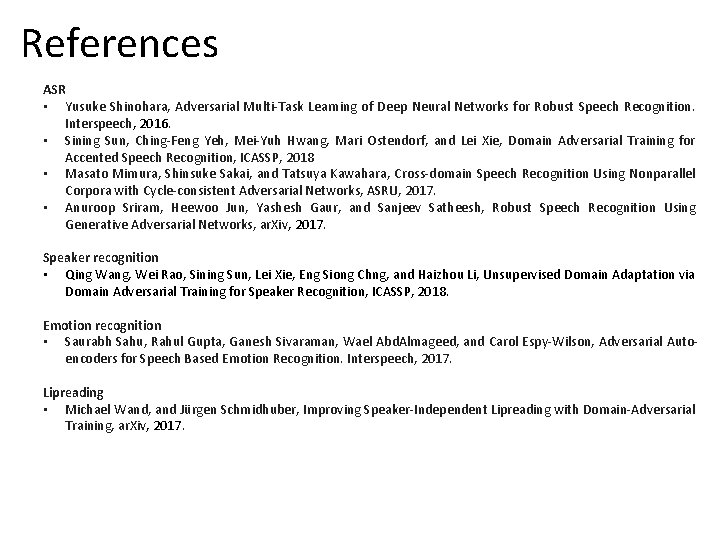
References ASR • Yusuke Shinohara, Adversarial Multi-Task Learning of Deep Neural Networks for Robust Speech Recognition. Interspeech, 2016. • Sining Sun, Ching-Feng Yeh, Mei-Yuh Hwang, Mari Ostendorf, and Lei Xie, Domain Adversarial Training for Accented Speech Recognition, ICASSP, 2018 • Masato Mimura, Shinsuke Sakai, and Tatsuya Kawahara, Cross-domain Speech Recognition Using Nonparallel Corpora with Cycle-consistent Adversarial Networks, ASRU, 2017. • Anuroop Sriram, Heewoo Jun, Yashesh Gaur, and Sanjeev Satheesh, Robust Speech Recognition Using Generative Adversarial Networks, ar. Xiv, 2017. Speaker recognition • Qing Wang, Wei Rao, Sining Sun, Lei Xie, Eng Siong Chng, and Haizhou Li, Unsupervised Domain Adaptation via Domain Adversarial Training for Speaker Recognition, ICASSP, 2018. Emotion recognition • Saurabh Sahu, Rahul Gupta, Ganesh Sivaraman, Wael Abd. Almageed, and Carol Espy-Wilson, Adversarial Autoencoders for Speech Based Emotion Recognition. Interspeech, 2017. Lipreading • Michael Wand, and Jürgen Schmidhuber, Improving Speaker-Independent Lipreading with Domain-Adversarial Training, ar. Xiv, 2017.
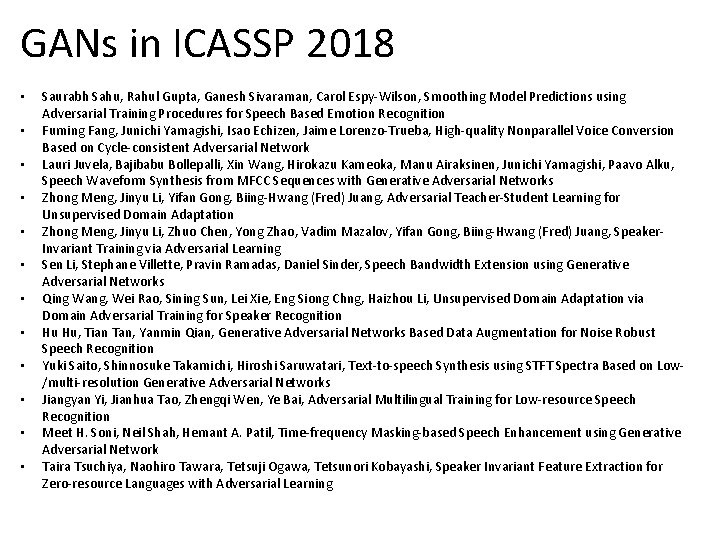
GANs in ICASSP 2018 • • • Saurabh Sahu, Rahul Gupta, Ganesh Sivaraman, Carol Espy-Wilson, Smoothing Model Predictions using Adversarial Training Procedures for Speech Based Emotion Recognition Fuming Fang, Junichi Yamagishi, Isao Echizen, Jaime Lorenzo-Trueba, High-quality Nonparallel Voice Conversion Based on Cycle-consistent Adversarial Network Lauri Juvela, Bajibabu Bollepalli, Xin Wang, Hirokazu Kameoka, Manu Airaksinen, Junichi Yamagishi, Paavo Alku, Speech Waveform Synthesis from MFCC Sequences with Generative Adversarial Networks Zhong Meng, Jinyu Li, Yifan Gong, Biing-Hwang (Fred) Juang, Adversarial Teacher-Student Learning for Unsupervised Domain Adaptation Zhong Meng, Jinyu Li, Zhuo Chen, Yong Zhao, Vadim Mazalov, Yifan Gong, Biing-Hwang (Fred) Juang, Speaker. Invariant Training via Adversarial Learning Sen Li, Stephane Villette, Pravin Ramadas, Daniel Sinder, Speech Bandwidth Extension using Generative Adversarial Networks Qing Wang, Wei Rao, Sining Sun, Lei Xie, Eng Siong Chng, Haizhou Li, Unsupervised Domain Adaptation via Domain Adversarial Training for Speaker Recognition Hu Hu, Tian Tan, Yanmin Qian, Generative Adversarial Networks Based Data Augmentation for Noise Robust Speech Recognition Yuki Saito, Shinnosuke Takamichi, Hiroshi Saruwatari, Text-to-speech Synthesis using STFT Spectra Based on Low/multi-resolution Generative Adversarial Networks Jiangyan Yi, Jianhua Tao, Zhengqi Wen, Ye Bai, Adversarial Multilingual Training for Low-resource Speech Recognition Meet H. Soni, Neil Shah, Hemant A. Patil, Time-frequency Masking-based Speech Enhancement using Generative Adversarial Network Taira Tsuchiya, Naohiro Tawara, Tetsuji Ogawa, Tetsunori Kobayashi, Speaker Invariant Feature Extraction for Zero-resource Languages with Adversarial Learning
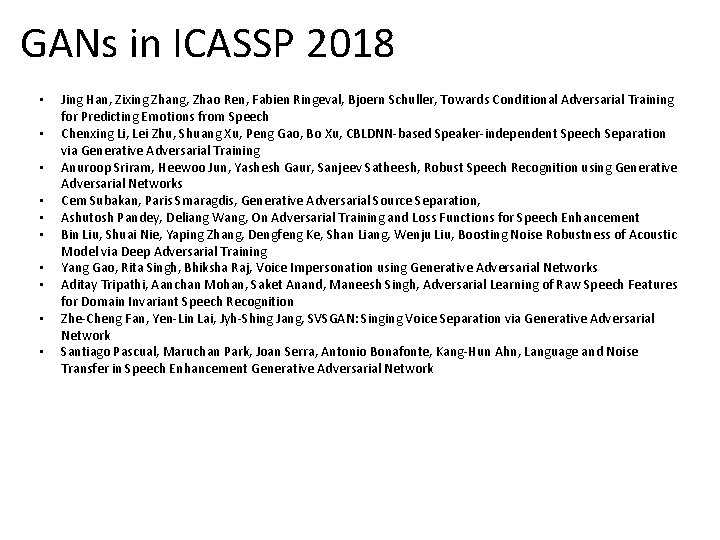
GANs in ICASSP 2018 • • • Jing Han, Zixing Zhang, Zhao Ren, Fabien Ringeval, Bjoern Schuller, Towards Conditional Adversarial Training for Predicting Emotions from Speech Chenxing Li, Lei Zhu, Shuang Xu, Peng Gao, Bo Xu, CBLDNN-based Speaker-independent Speech Separation via Generative Adversarial Training Anuroop Sriram, Heewoo Jun, Yashesh Gaur, Sanjeev Satheesh, Robust Speech Recognition using Generative Adversarial Networks Cem Subakan, Paris Smaragdis, Generative Adversarial Source Separation, Ashutosh Pandey, Deliang Wang, On Adversarial Training and Loss Functions for Speech Enhancement Bin Liu, Shuai Nie, Yaping Zhang, Dengfeng Ke, Shan Liang, Wenju Liu, Boosting Noise Robustness of Acoustic Model via Deep Adversarial Training Yang Gao, Rita Singh, Bhiksha Raj, Voice Impersonation using Generative Adversarial Networks Aditay Tripathi, Aanchan Mohan, Saket Anand, Maneesh Singh, Adversarial Learning of Raw Speech Features for Domain Invariant Speech Recognition Zhe-Cheng Fan, Yen-Lin Lai, Jyh-Shing Jang, SVSGAN: Singing Voice Separation via Generative Adversarial Network Santiago Pascual, Maruchan Park, Joan Serra, Antonio Bonafonte, Kang-Hun Ahn, Language and Noise Transfer in Speech Enhancement Generative Adversarial Network
A promising research direction and still has room for further improvements in the speech signal processing domain Thank You Very Much Tsao, Yu Ph. D. yu. tsao@citi. sinica. edu. tw https: //www. citi. sinica. edu. tw/pages/yu. tsao/contact_zh. html