Hough transform http www cs cmu edu16385 16


- Slides: 108
Hough transform http: //www. cs. cmu. edu/~16385/ 16 -385 Computer Vision Spring 2019, Lecture 4
Course announcements • Homework 1 is now due on Monday February 11 th! - Any questions about the homework? - How many of you have looked at/started/finished homework 1? • Some changes to office hours for this week only: - Tuesday’s office hours will be 5: 30 -7: 30 pm and will be covered by Yannis. - Friday’s 3 -5 pm office hours will be covered by Anshuman. - There will be an extra set of office hours this week to make up for the change.
Overview of today’s lecture Leftover from Lecture 3: • Frequency-domain filtering. • Revisiting sampling. New in lecture 4: • Finding boundaries. • Line fitting. • Line parameterizations. • Hough transform. • Hough circles. • Some applications.
Slide credits Most of these slides were adapted from: • Kris Kitani (15 -463, Fall 2016). Some slides were inspired or taken from: • Fredo Durand (MIT). • James Hays (Georgia Tech).
Finding boundaries
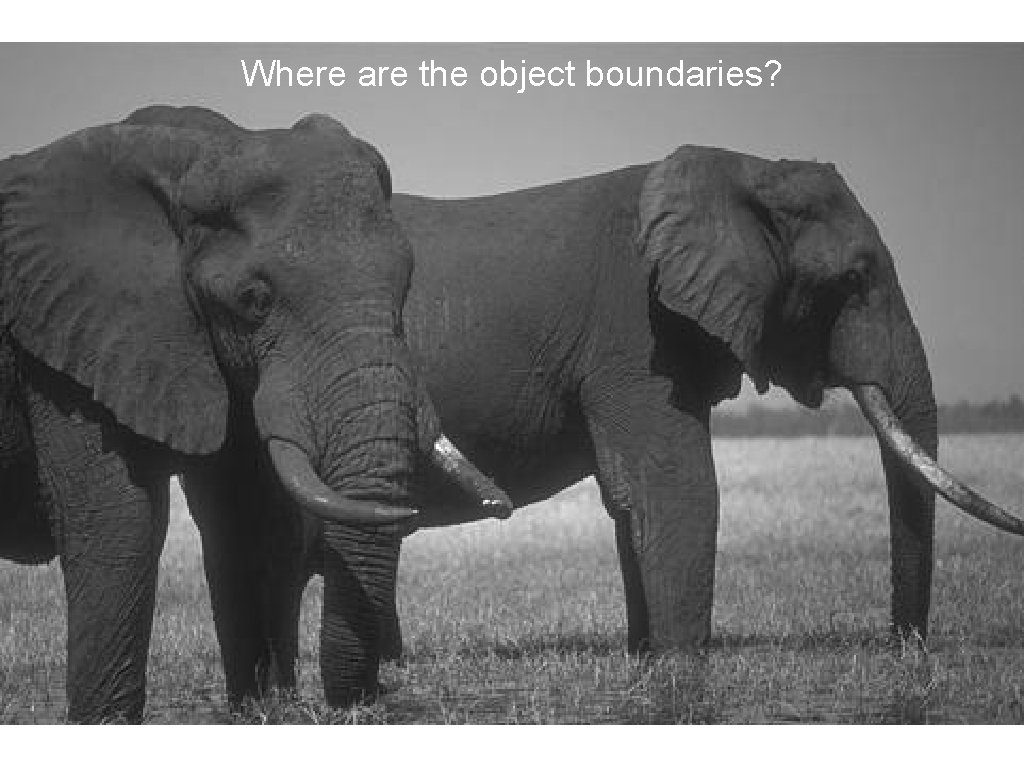
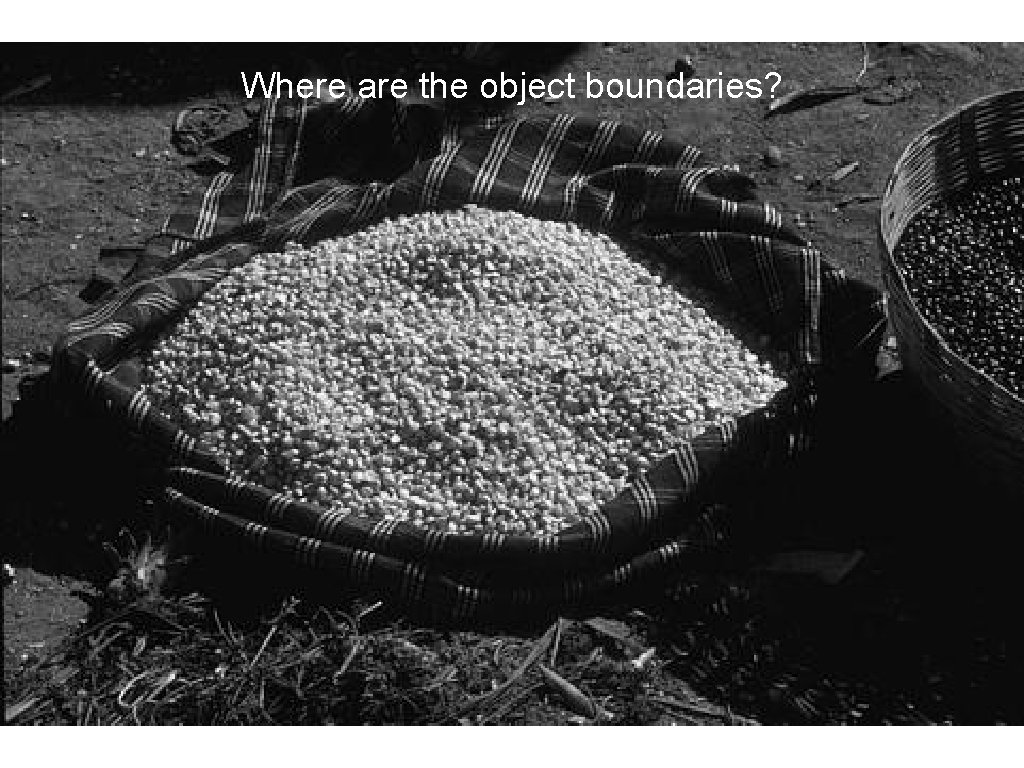
Where are the object boundaries?
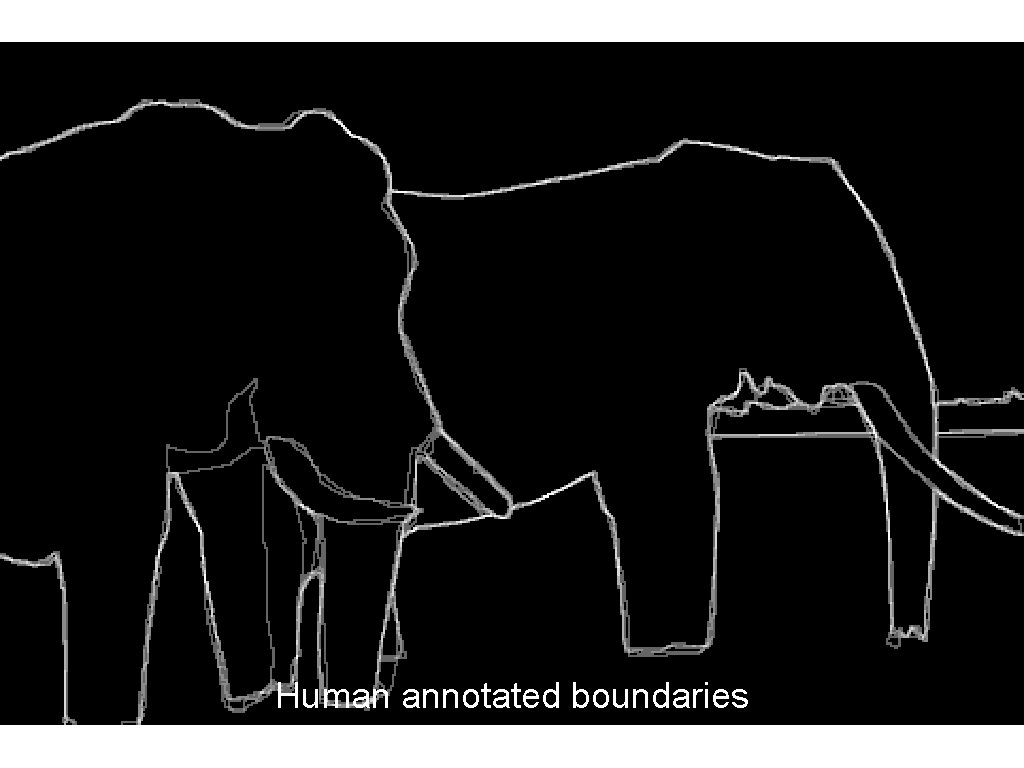
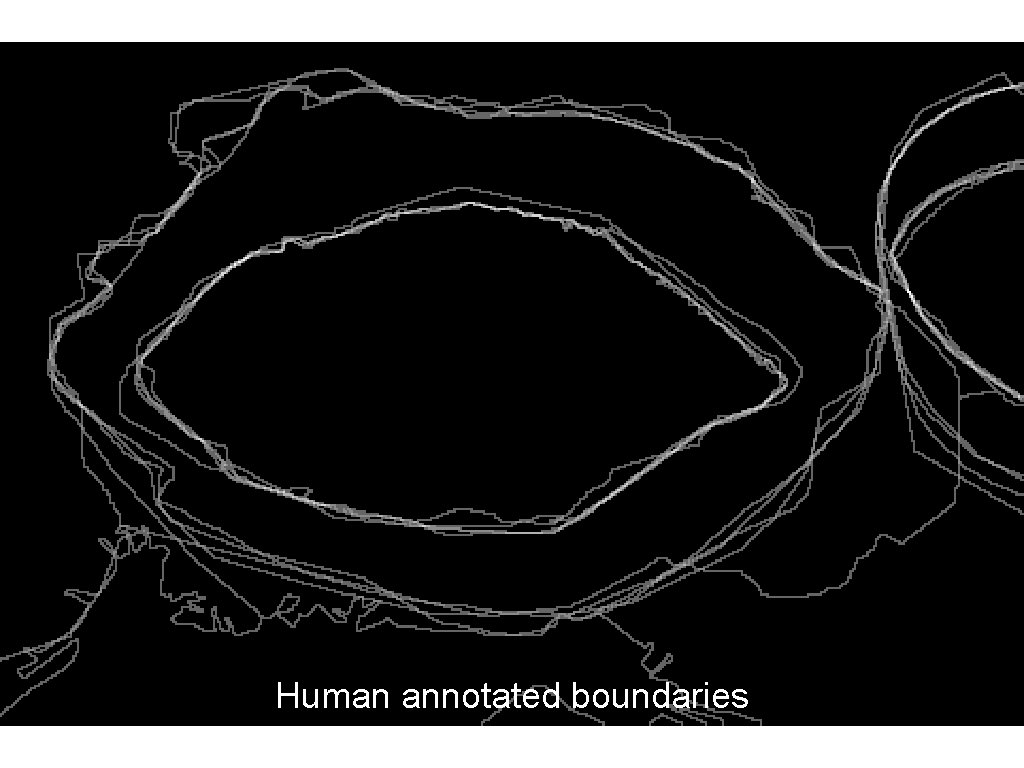
Human annotated boundaries
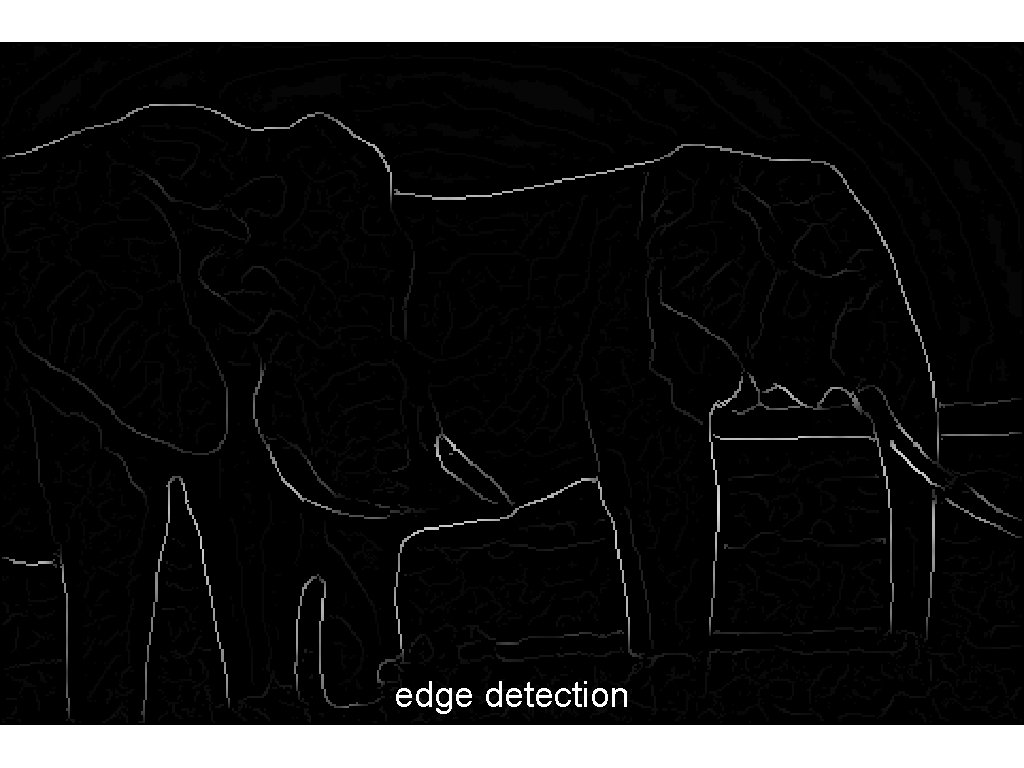
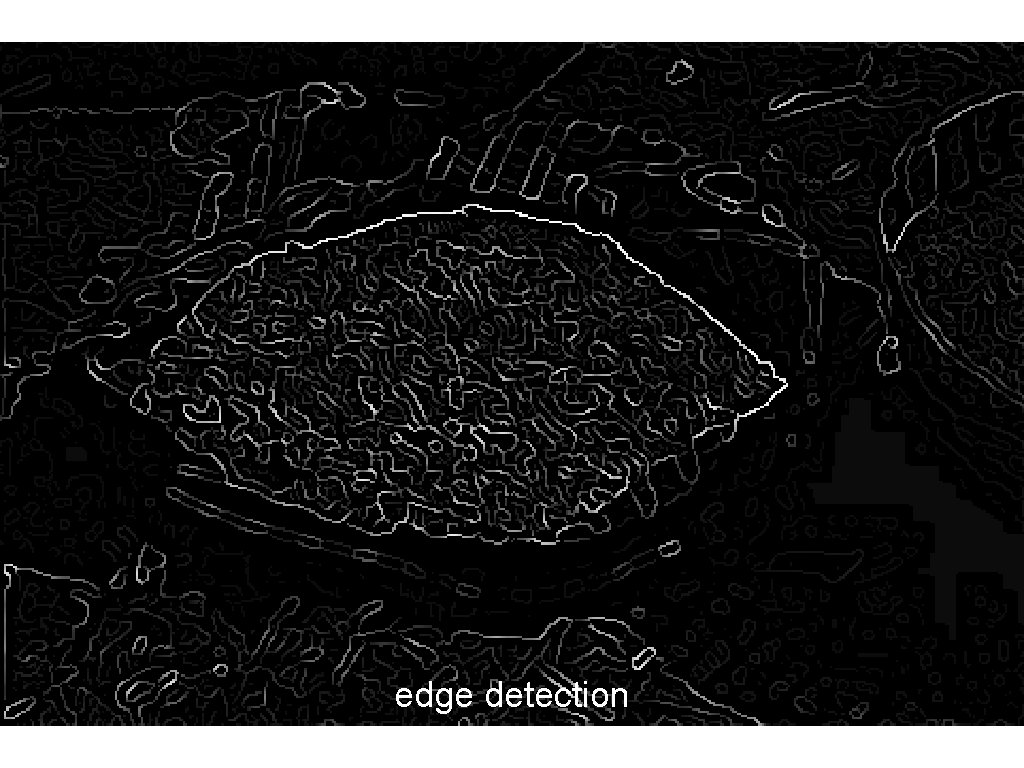
edge detection
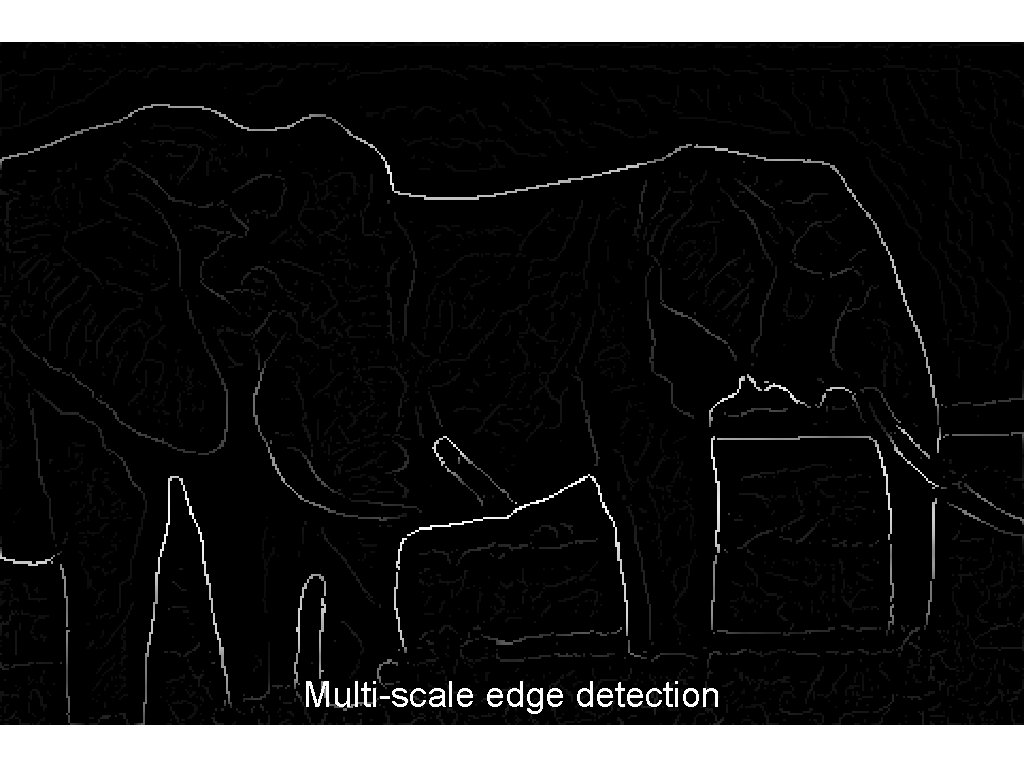
Multi-scale edge detection
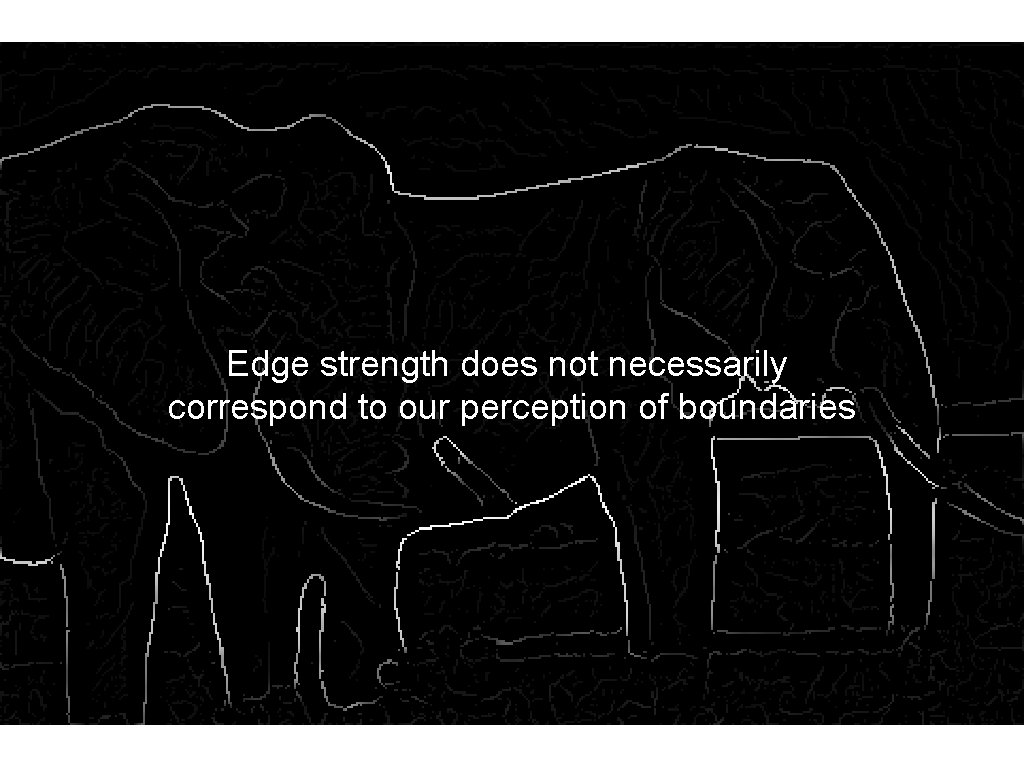
Edge strength does not necessarily correspond to our perception of boundaries
Where are the object boundaries?
Human annotated boundaries
edge detection
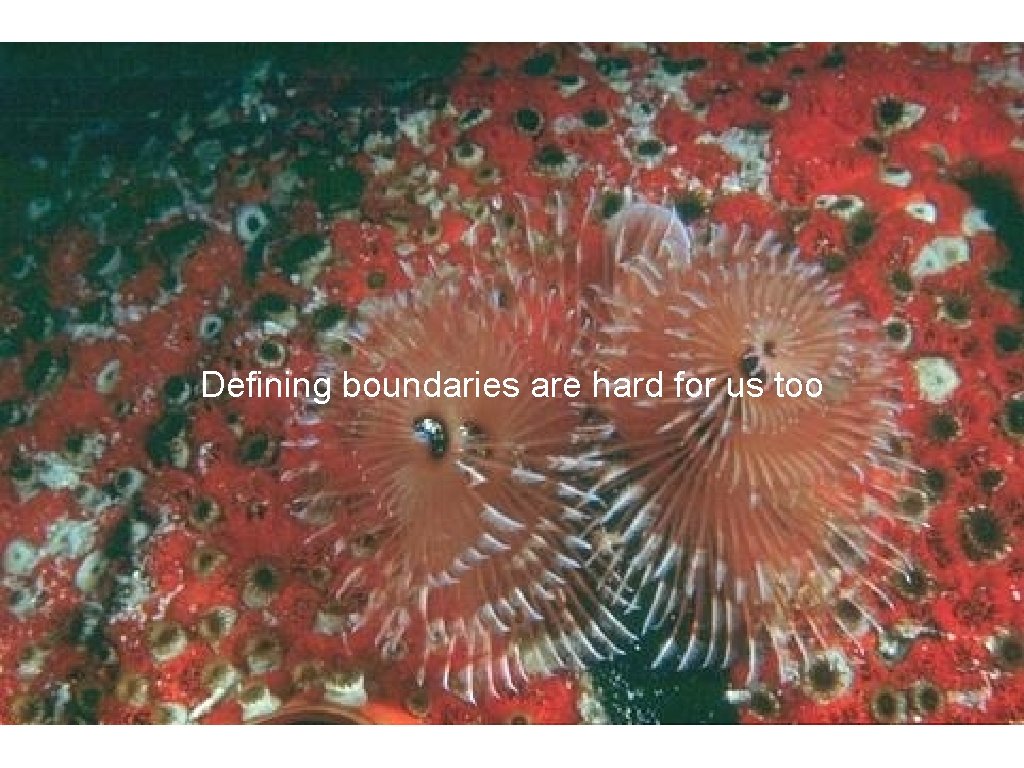
Defining boundaries are hard for us too
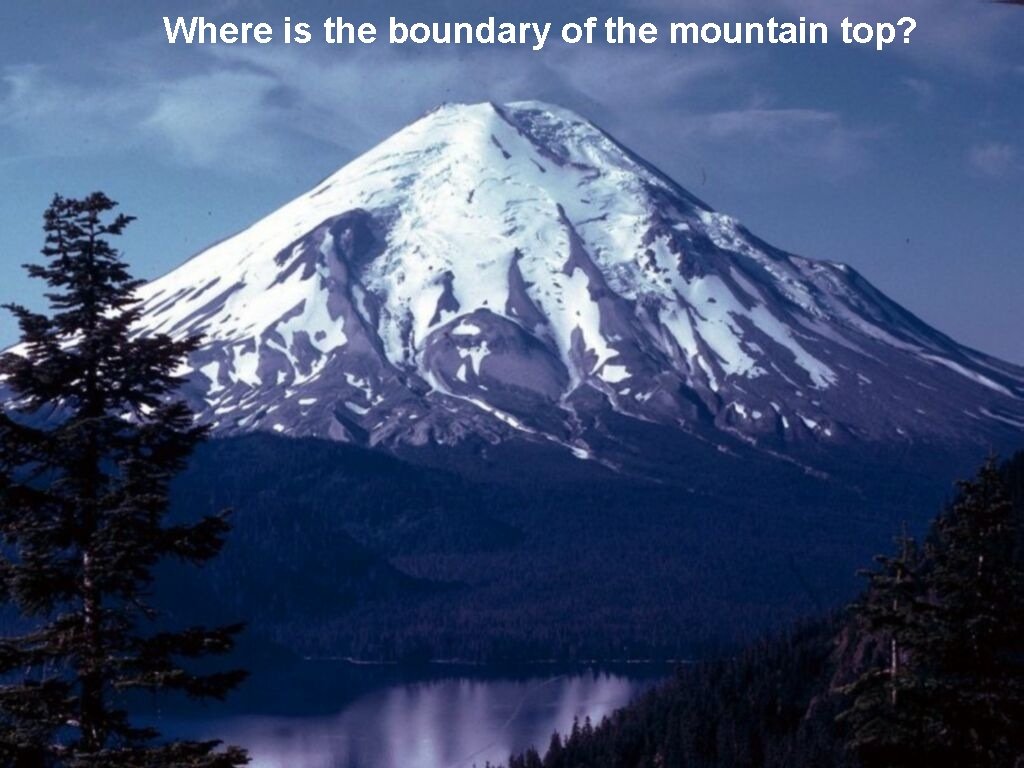
Where is the boundary of the mountain top?
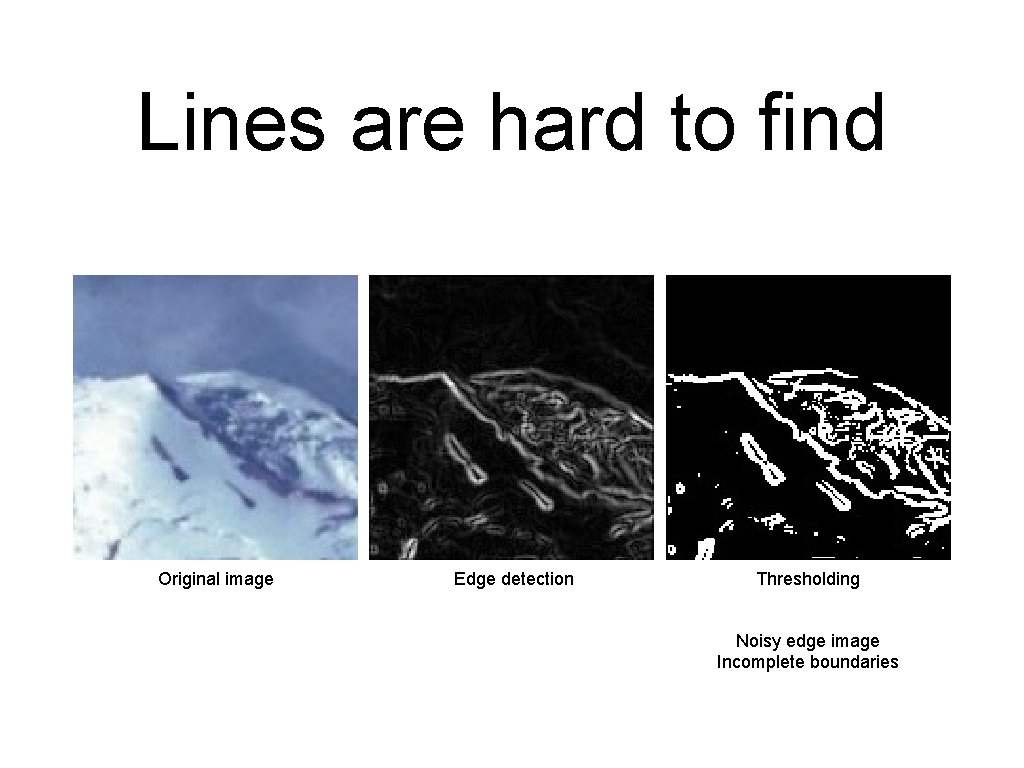
Lines are hard to find Original image Edge detection Thresholding Noisy edge image Incomplete boundaries
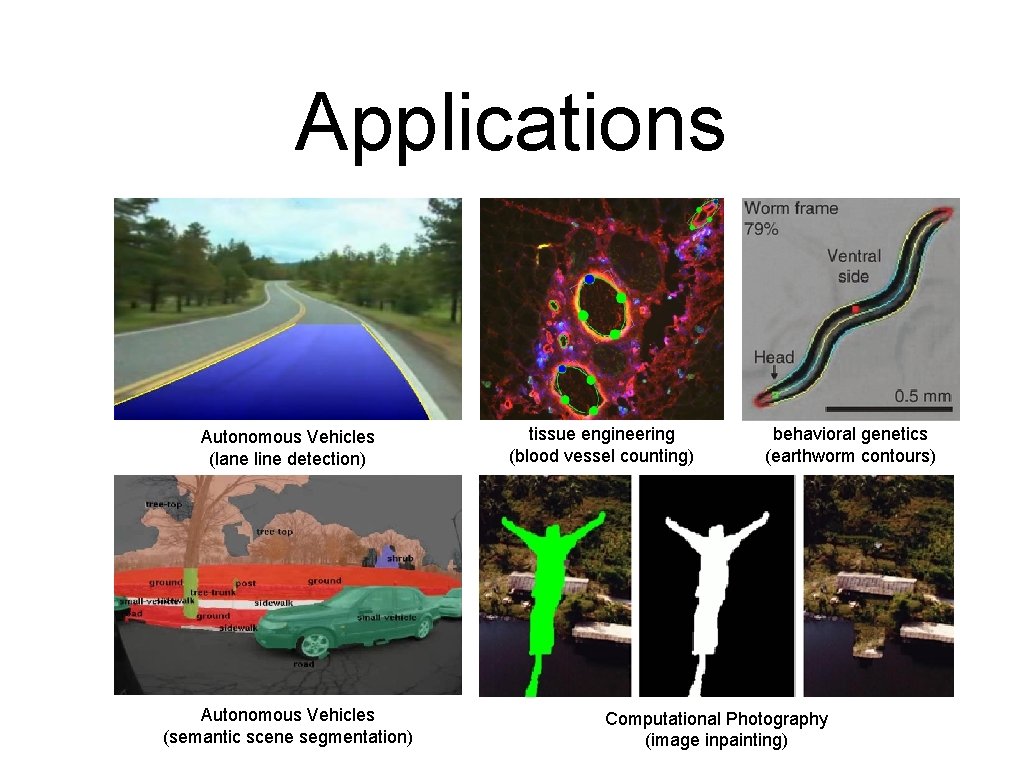
Applications Autonomous Vehicles (lane line detection) Autonomous Vehicles (semantic scene segmentation) tissue engineering (blood vessel counting) behavioral genetics (earthworm contours) Computational Photography (image inpainting)
Line fitting
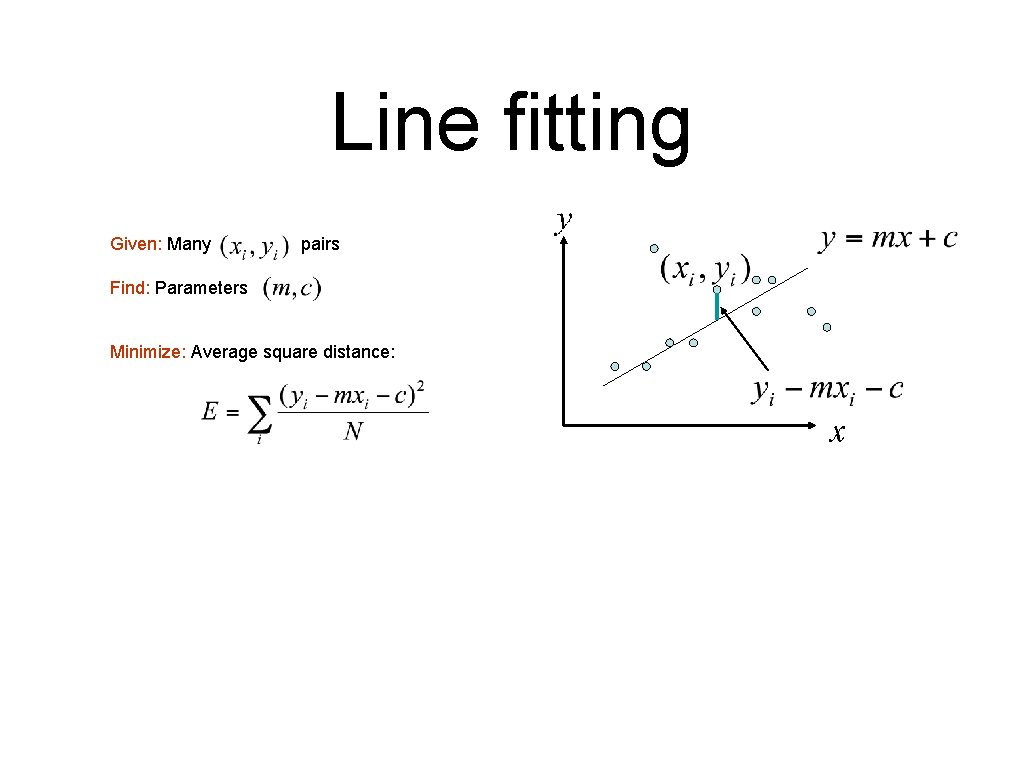
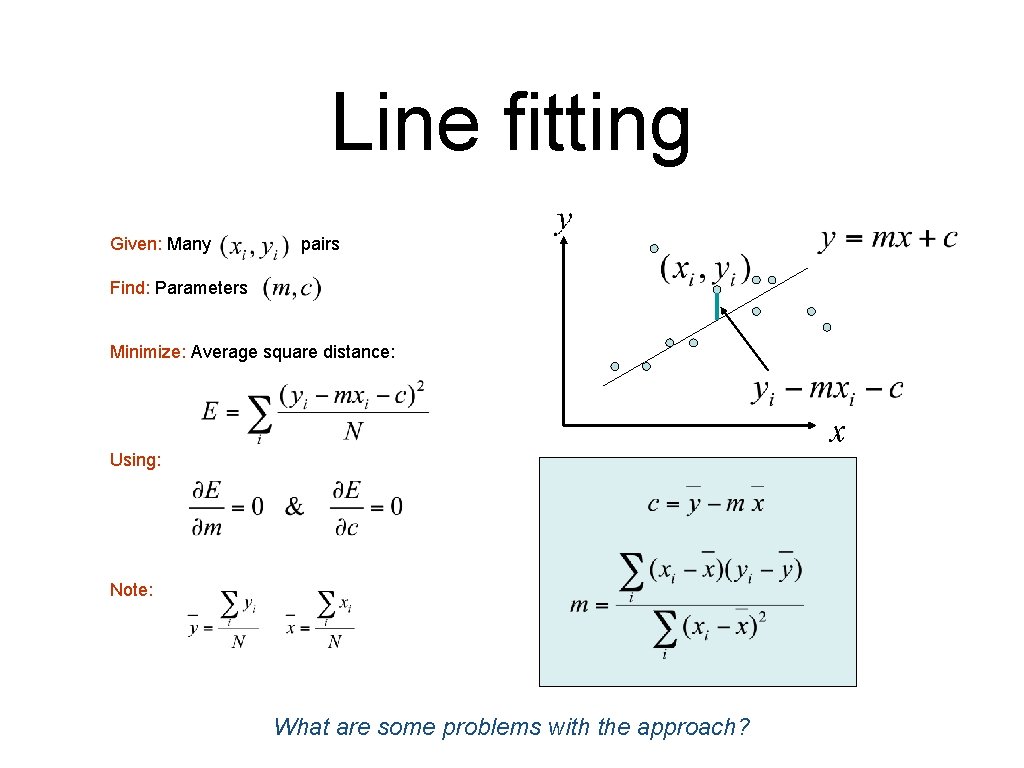
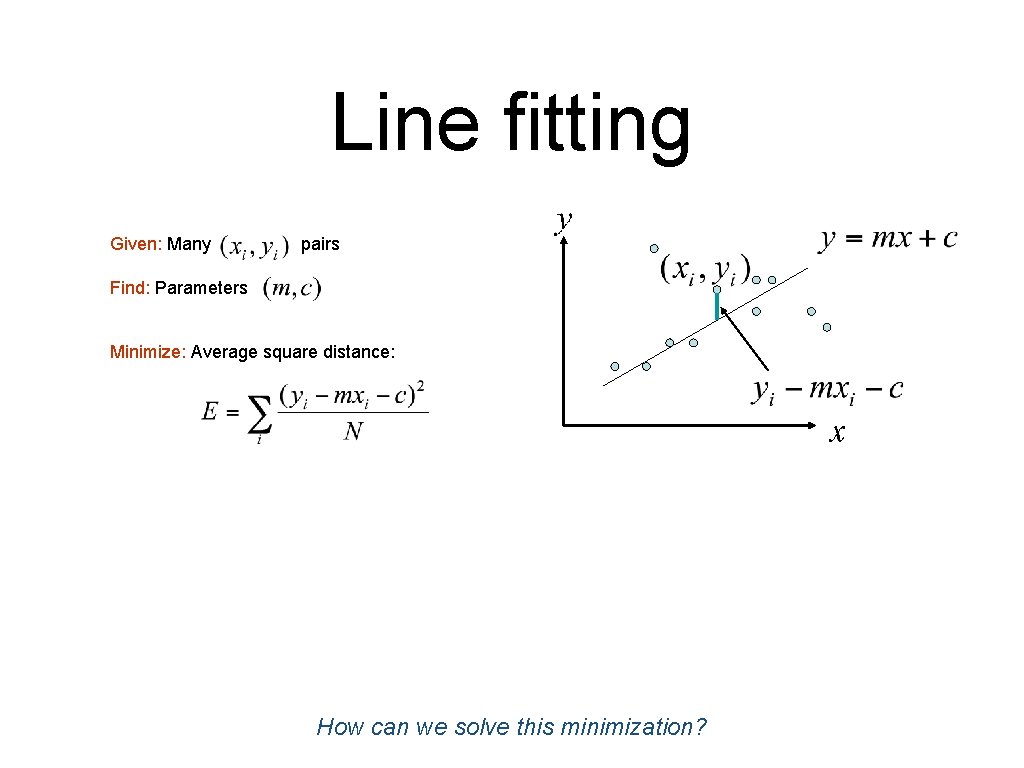
Line fitting Given: Many pairs Find: Parameters Minimize: Average square distance: Using: Note:
Line fitting Given: Many pairs Find: Parameters Minimize: Average square distance: Using: Note: What are some problems with the approach?
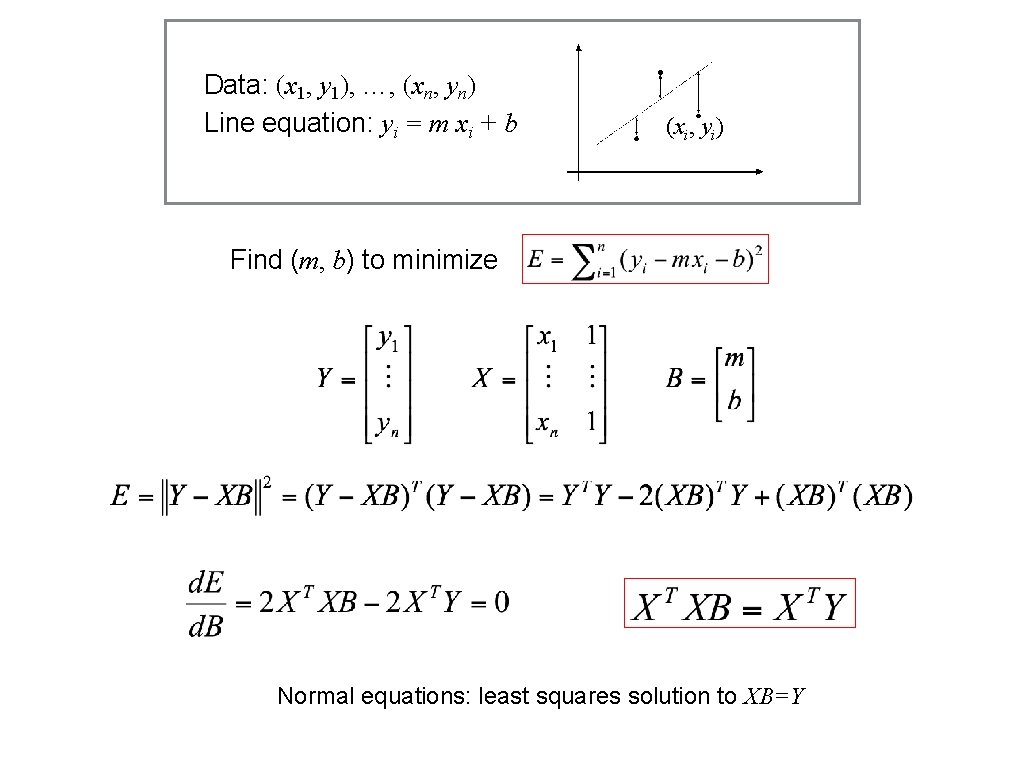
Data: (x 1, y 1), …, (xn, yn) Line equation: yi = m xi + b (xi, yi) Find (m, b) to minimize Normal equations: least squares solution to XB=Y
Line fitting Given: Many pairs Find: Parameters Minimize: Average square distance: Using: Note: How can we solve this minimization?
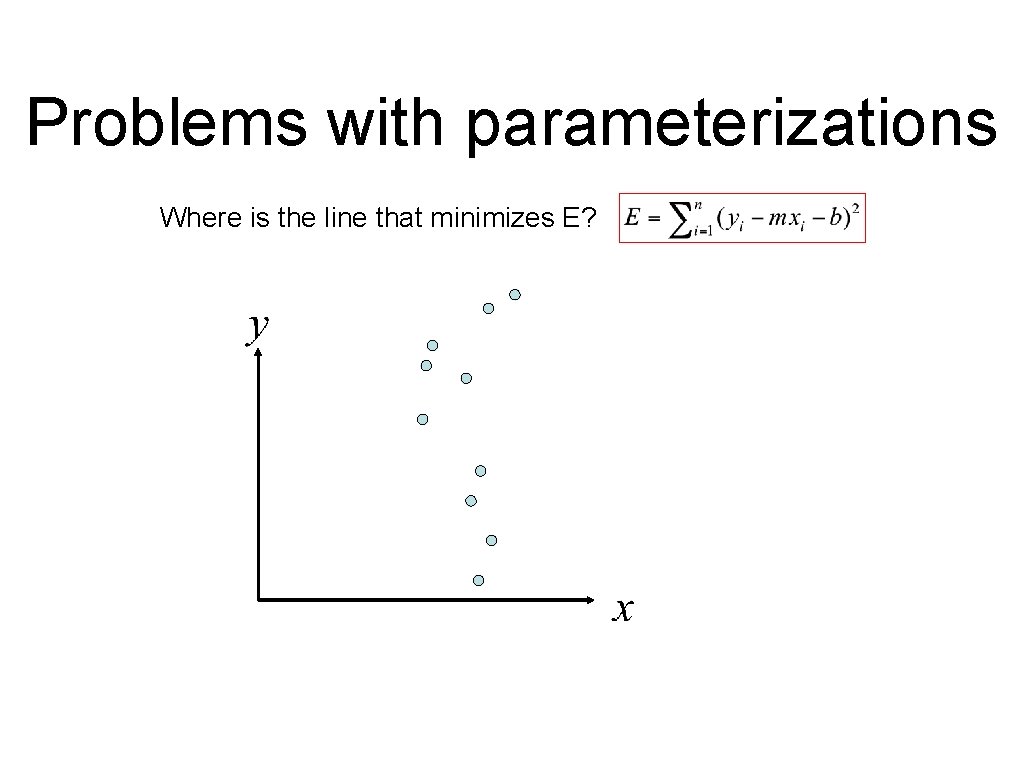
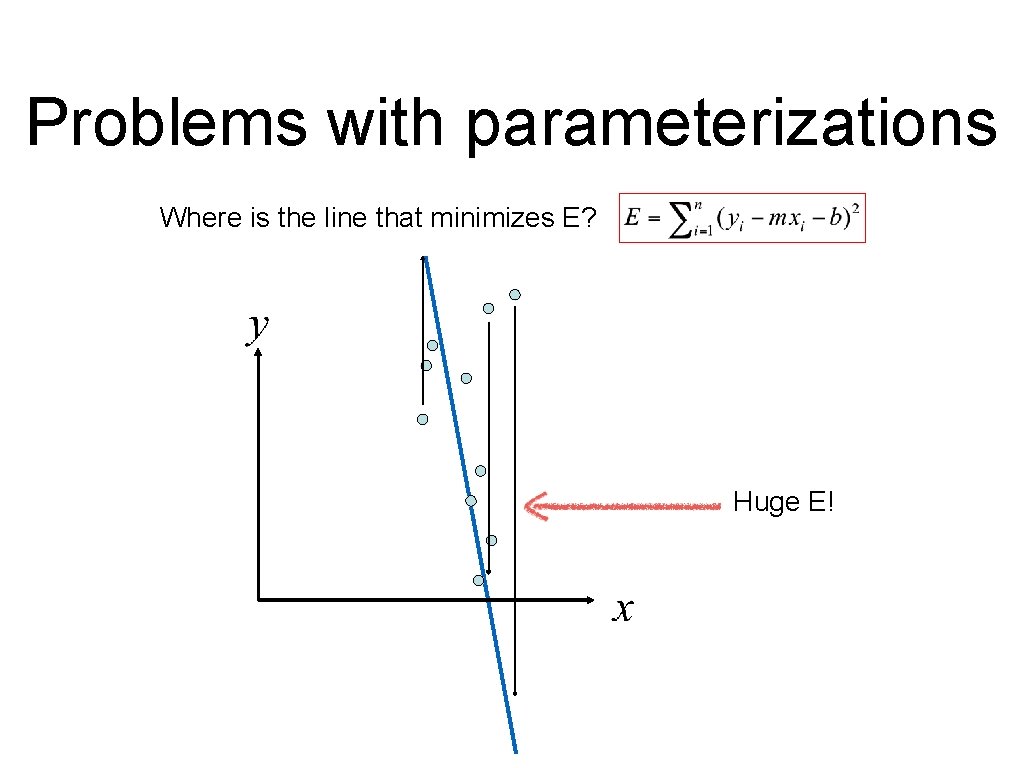
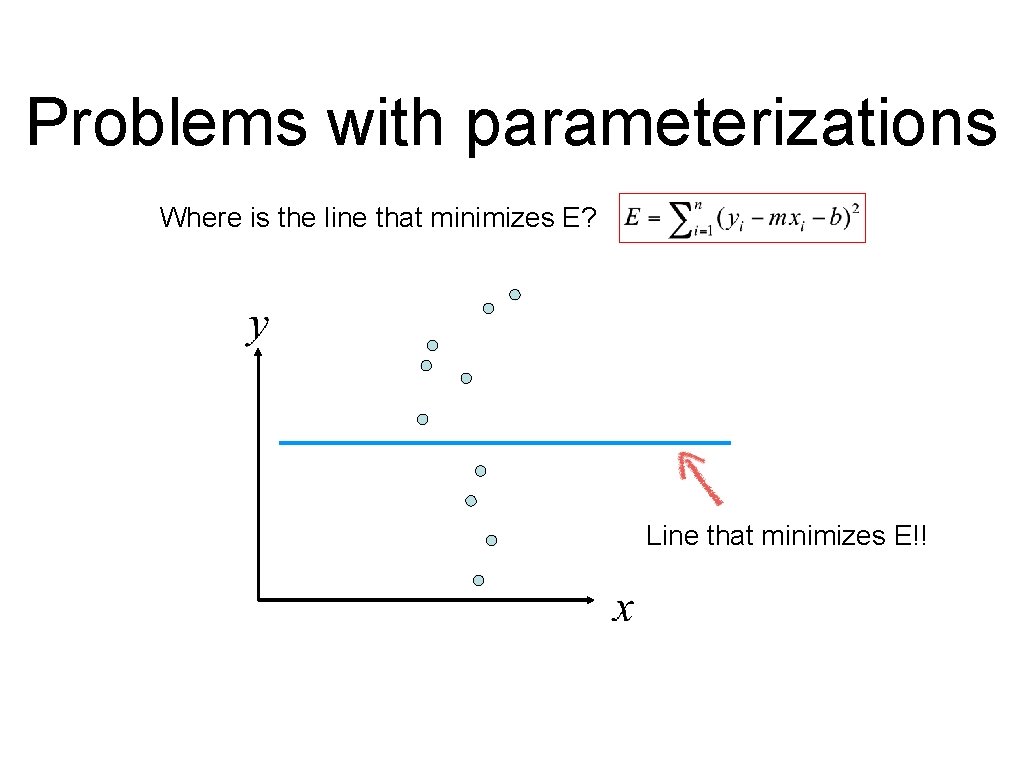
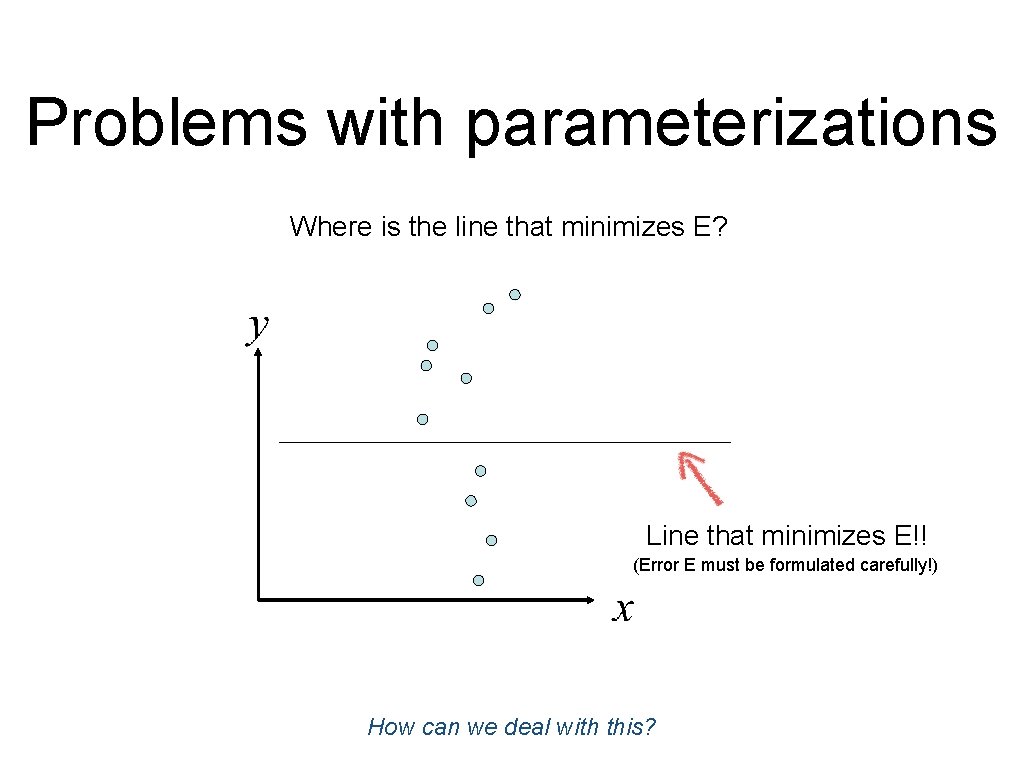
Problems with parameterizations Where is the line that minimizes E?
Problems with parameterizations Where is the line that minimizes E? Huge E!
Problems with parameterizations Where is the line that minimizes E? Line that minimizes E!!
Problems with parameterizations Where is the line that minimizes E? Line that minimizes E!! (Error E must be formulated carefully!) How can we deal with this?
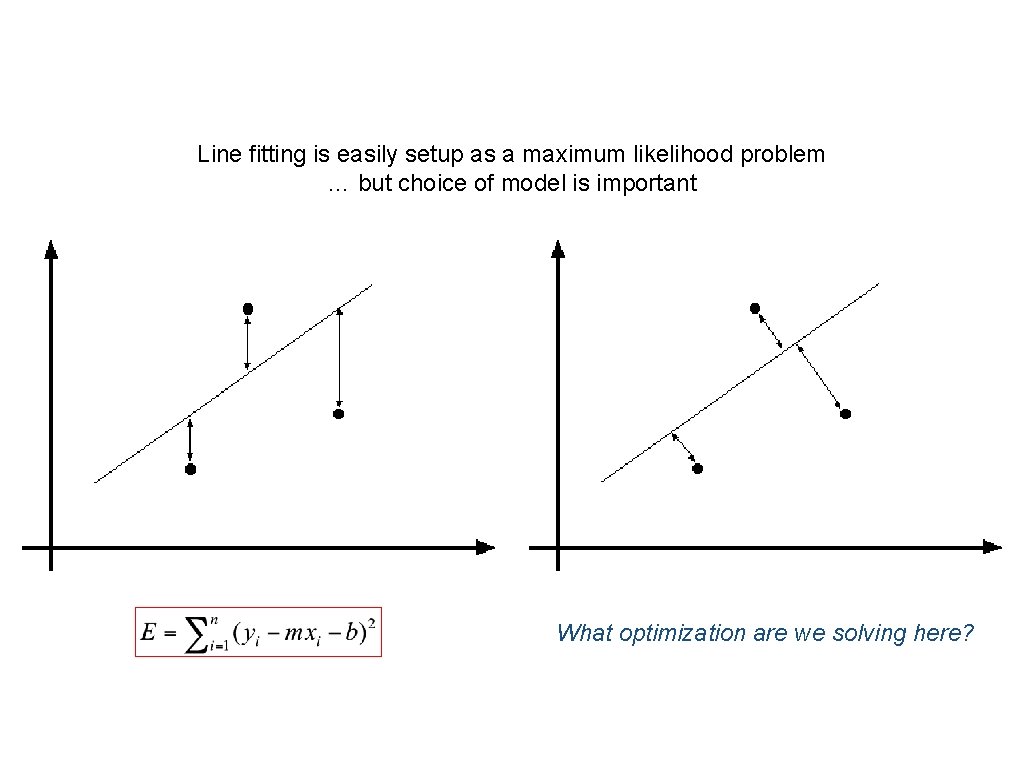
Line fitting is easily setup as a maximum likelihood problem … but choice of model is important What optimization are we solving here?
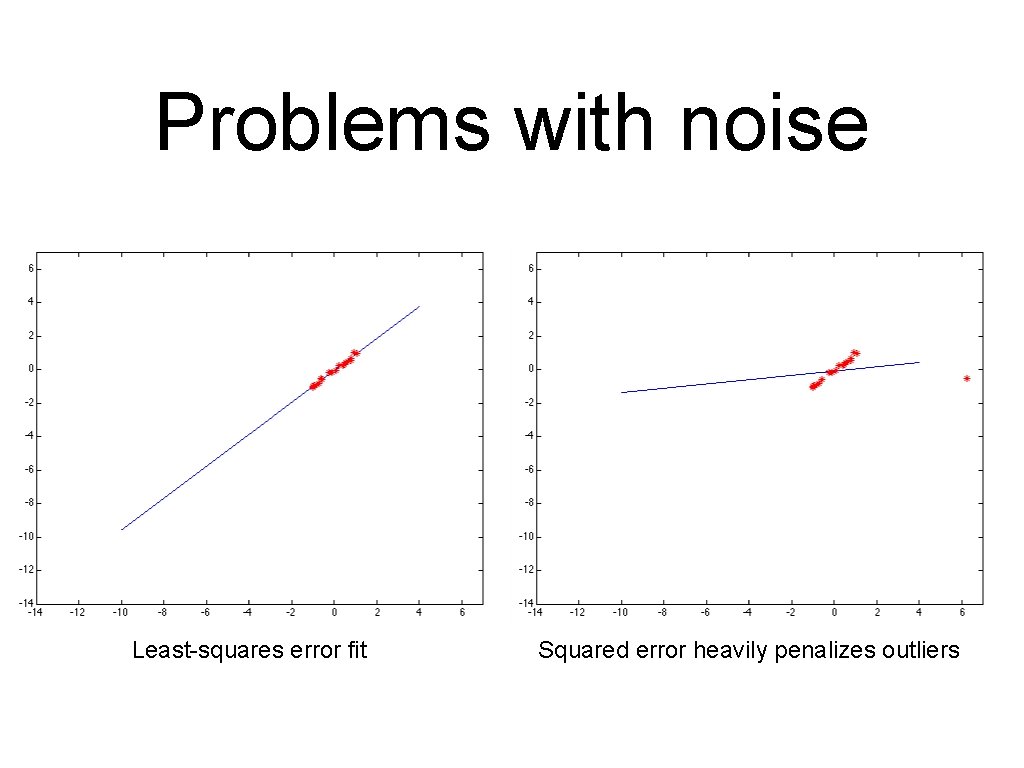
Problems with noise Least-squares error fit Squared error heavily penalizes outliers
Model fitting is difficult because… • Extraneous data: clutter or multiple models – We do not know what is part of the model? – Can we pull out models with a few parts from much larger amounts of background clutter? • Missing data: only some parts of model are present • Noise • Cost: – It is not feasible to check all combinations of features by fitting a model to each possible subset So what can we do?
Line parameterizations
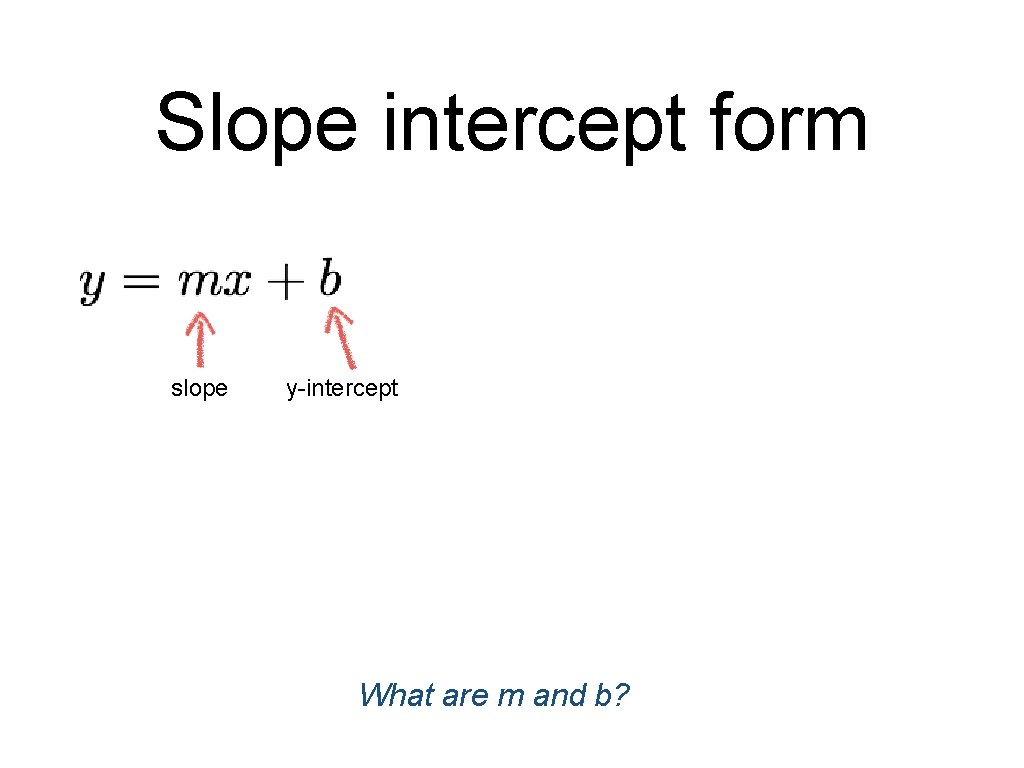
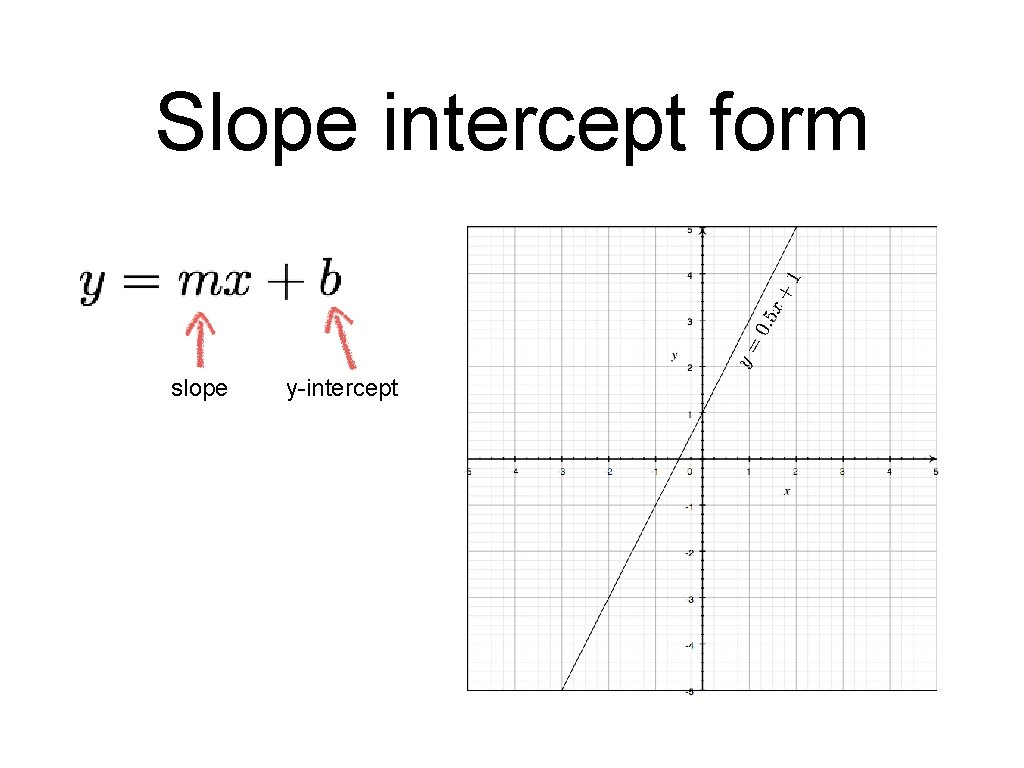
Slope intercept form slope y-intercept What are m and b?
Slope intercept form slope y-intercept
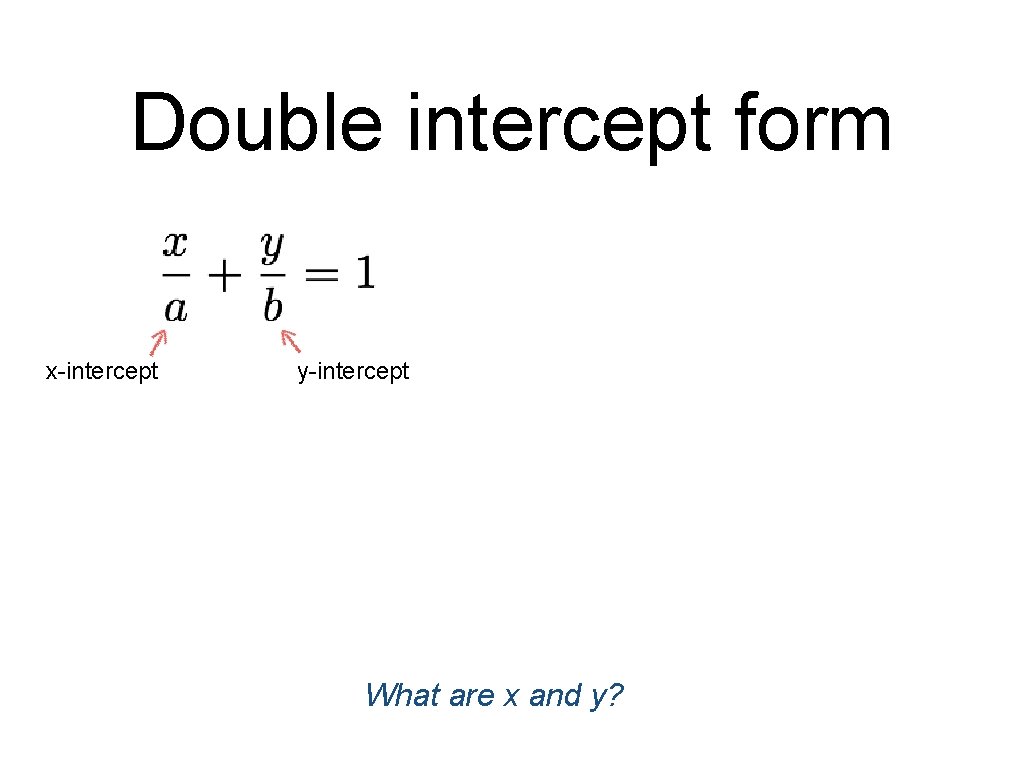
Double intercept form x-intercept y-intercept What are x and y?
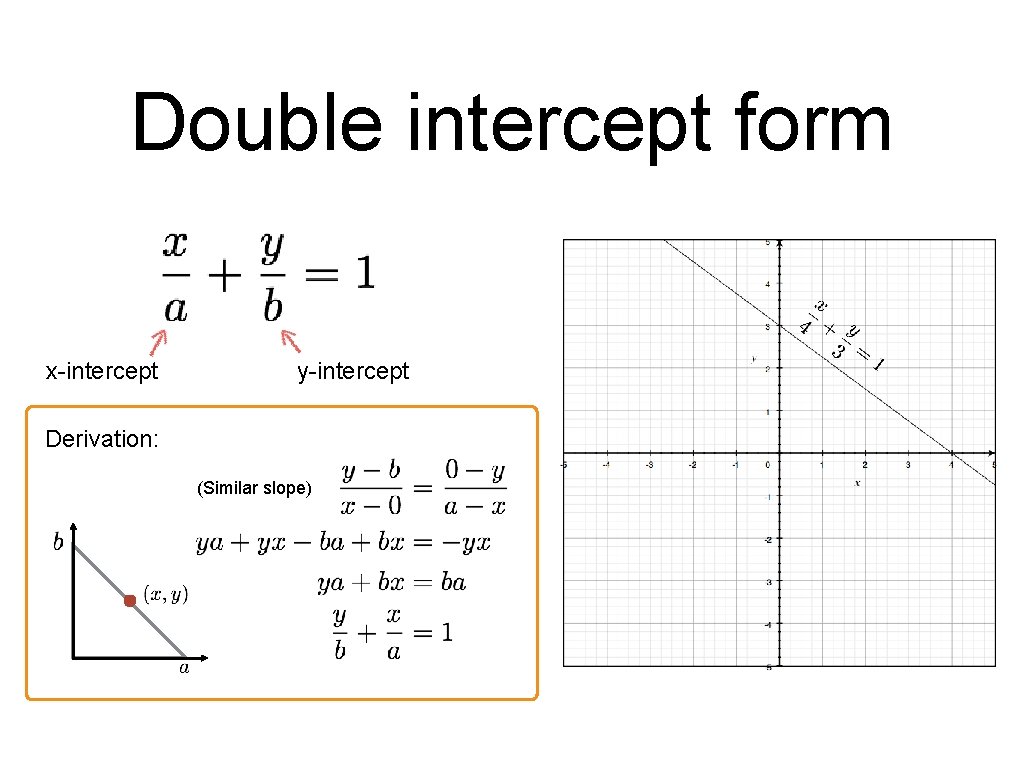
Double intercept form x-intercept y-intercept Derivation: (Similar slope)
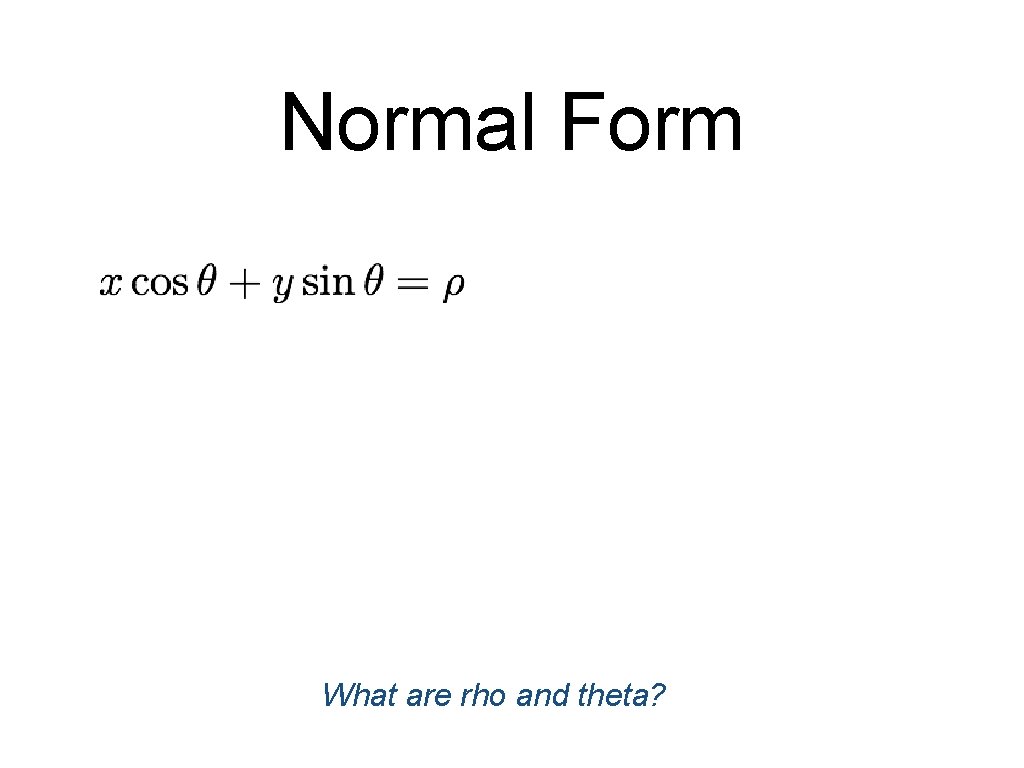
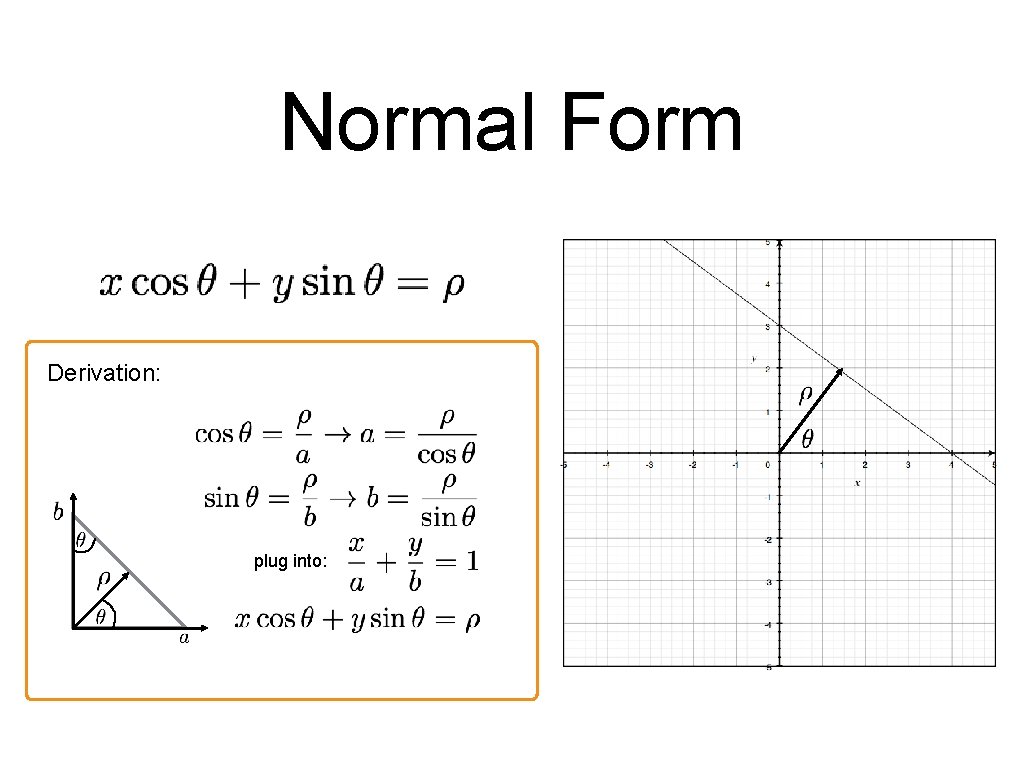
Normal Form What are rho and theta?
Normal Form Derivation: plug into:
Hough transform
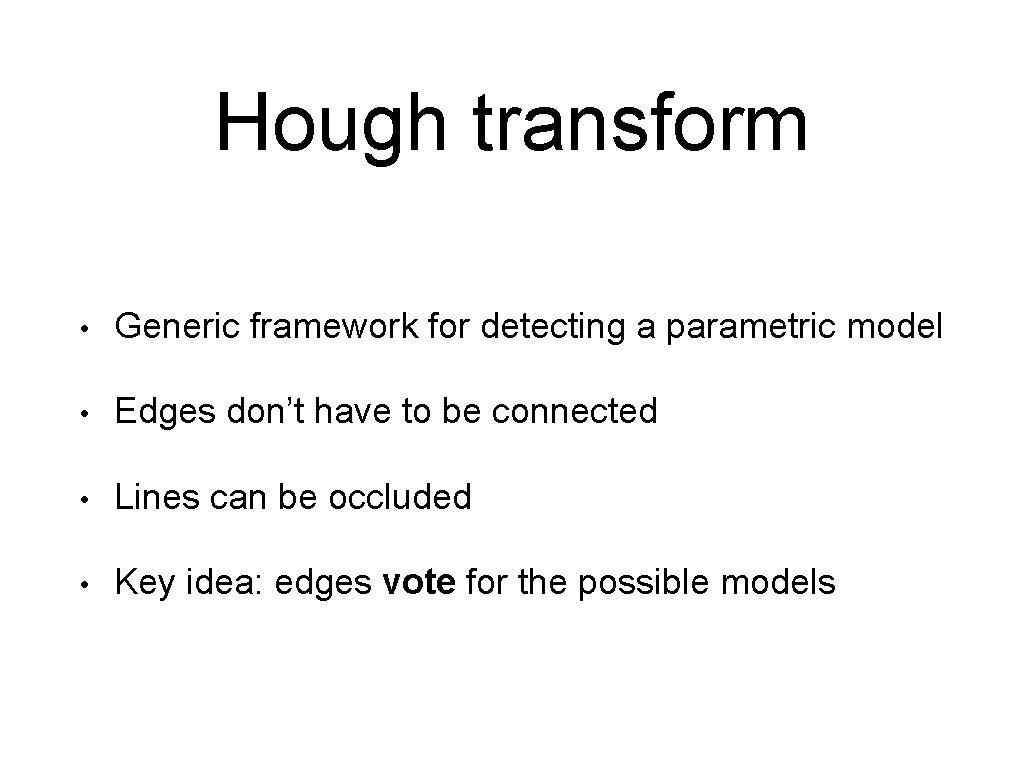
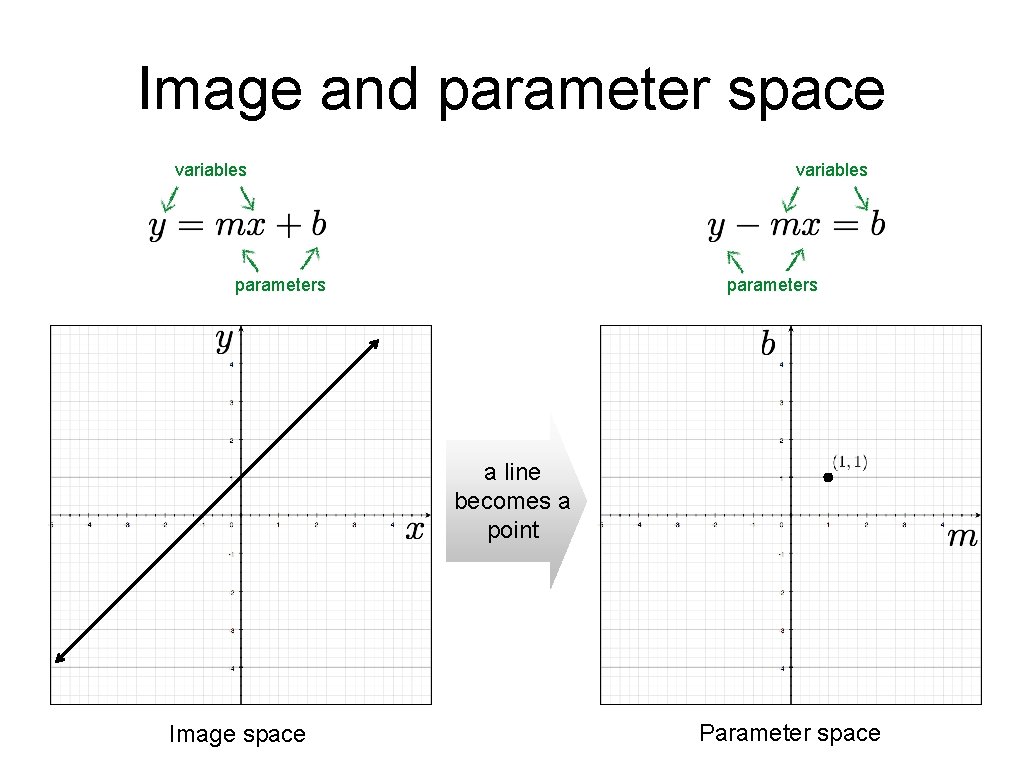
Hough transform • Generic framework for detecting a parametric model • Edges don’t have to be connected • Lines can be occluded • Key idea: edges vote for the possible models
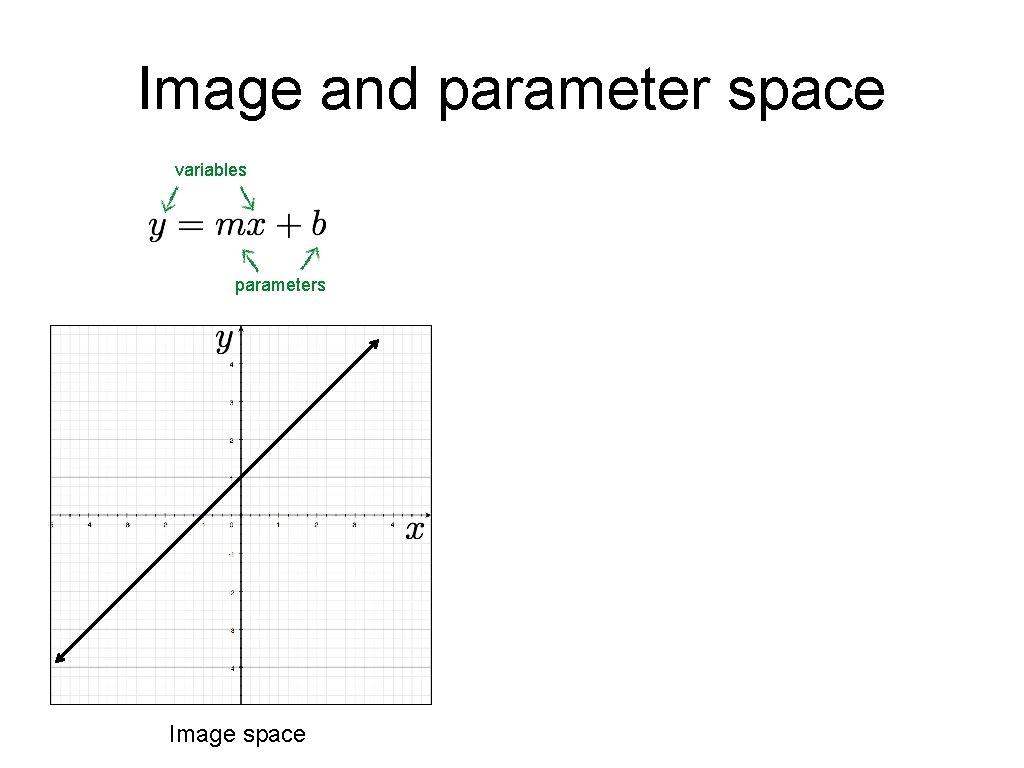
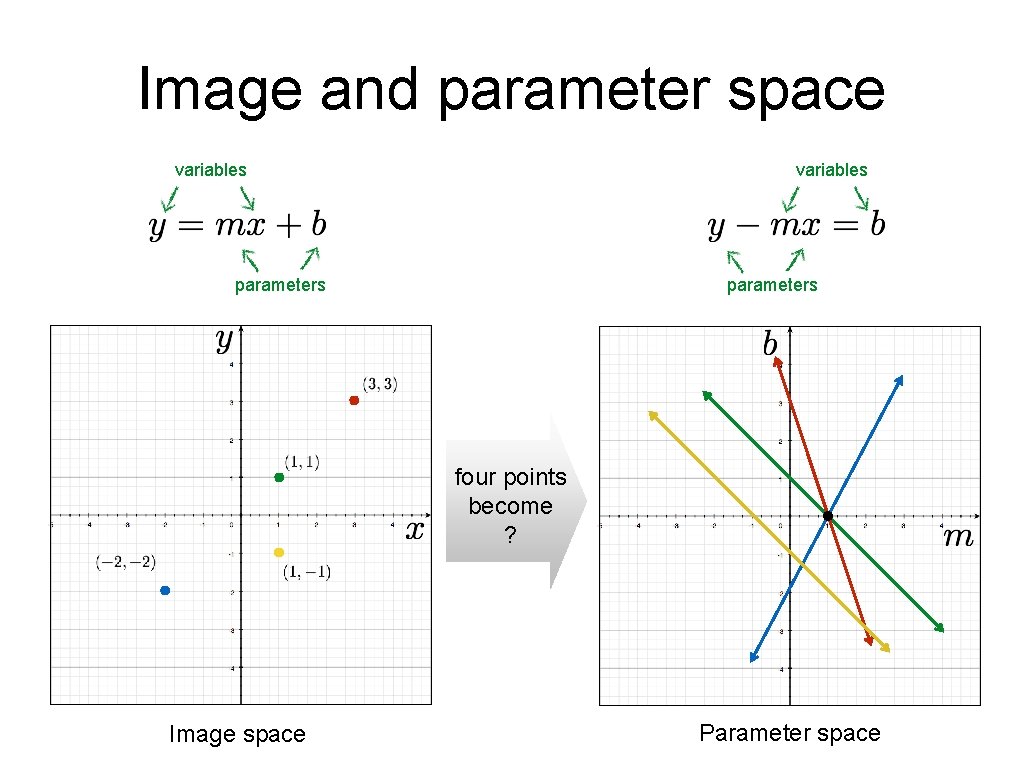
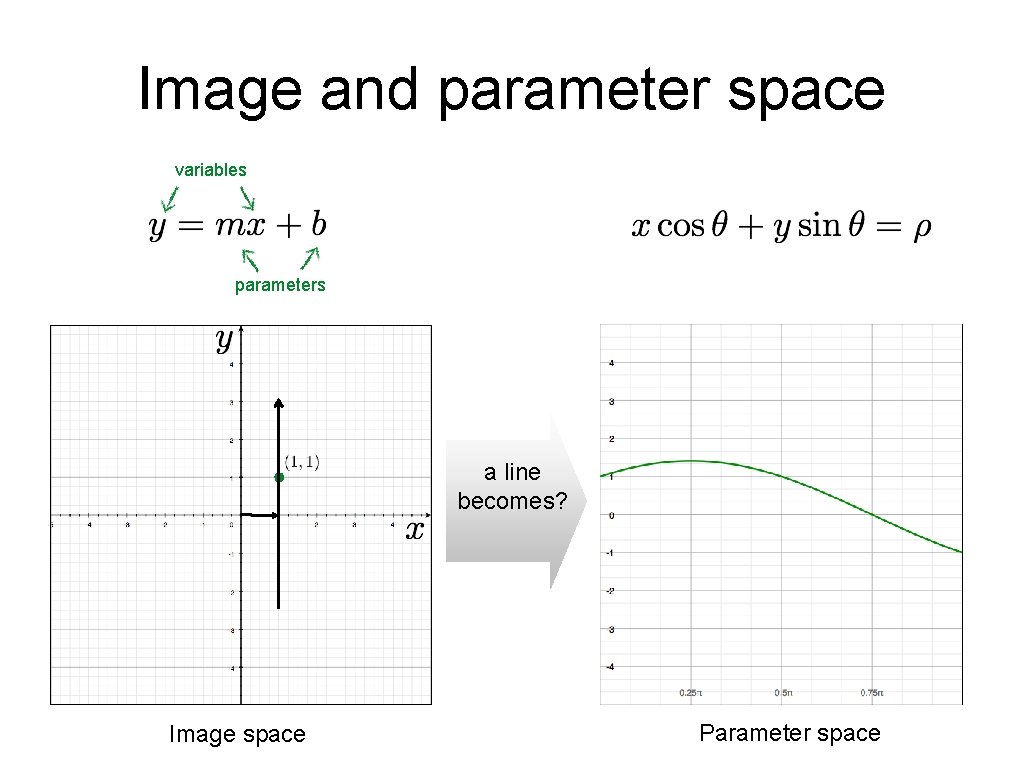
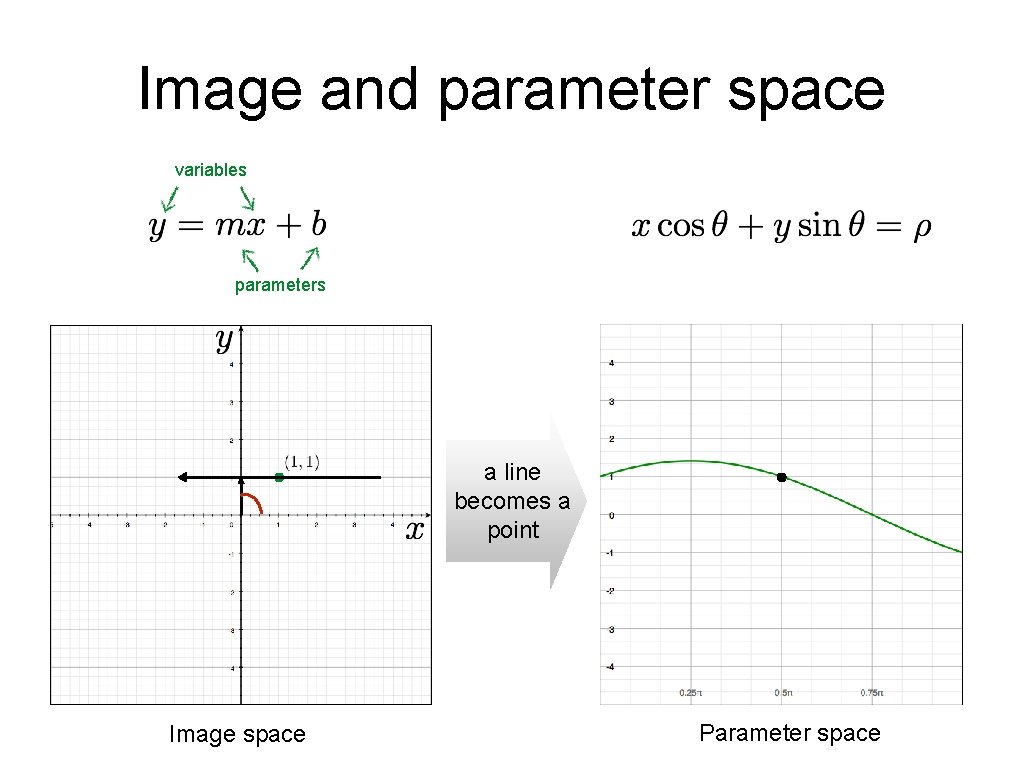
Image and parameter space variables parameters Image space
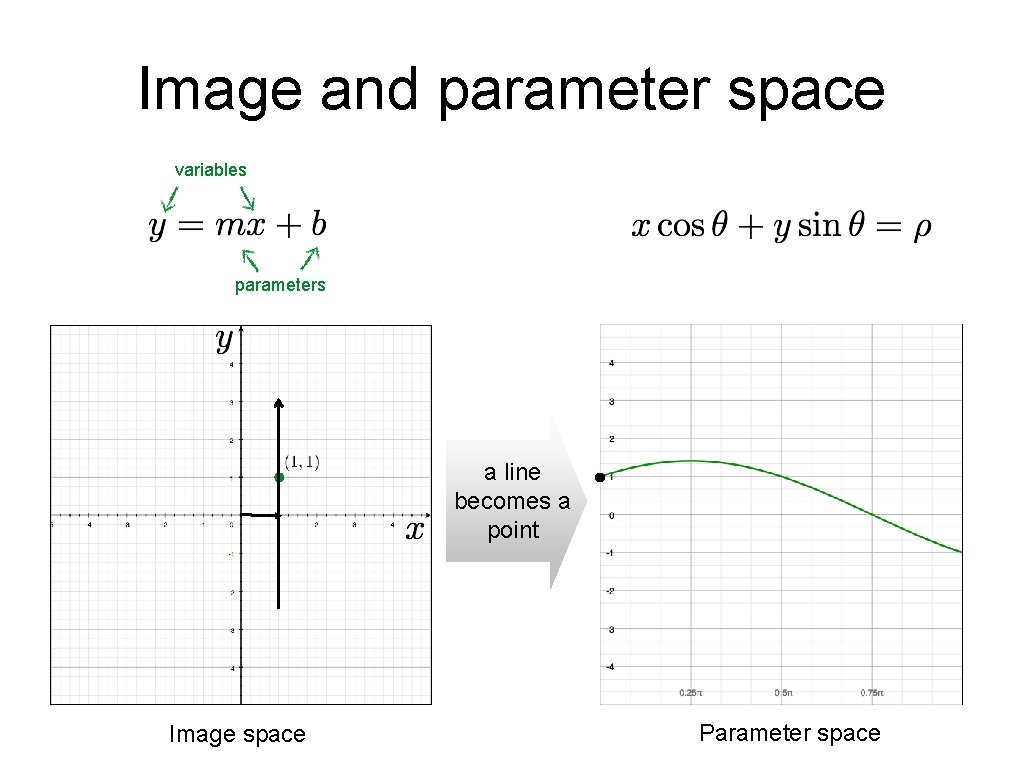
Image and parameter space variables parameters a line becomes a point Image space Parameter space
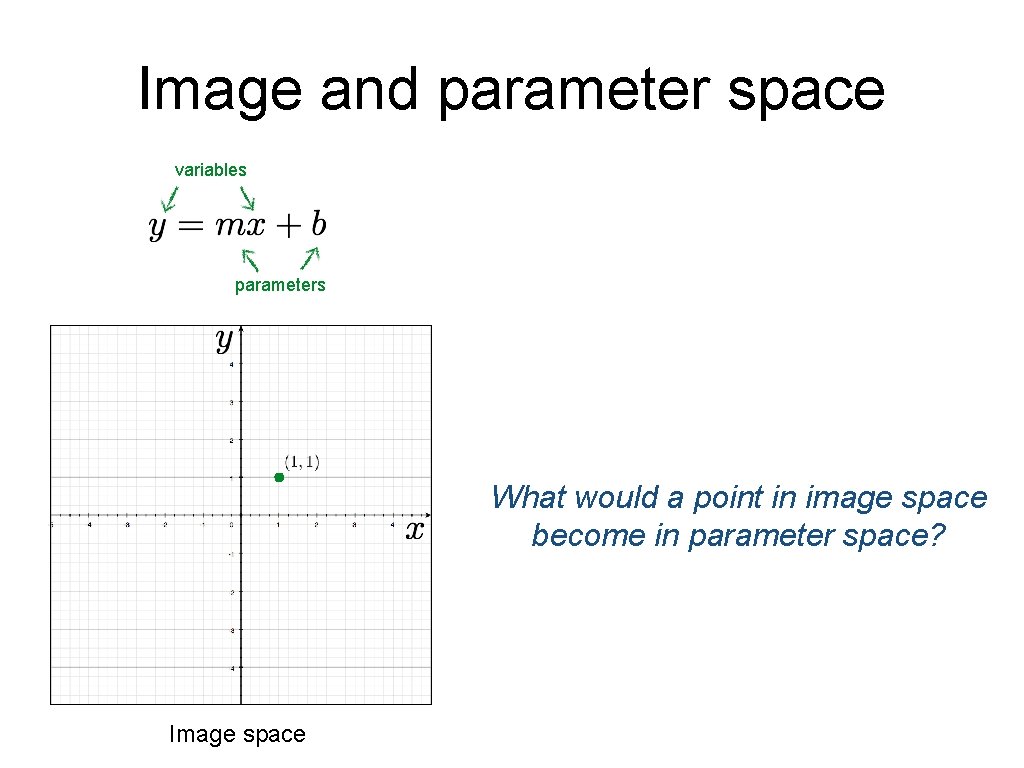
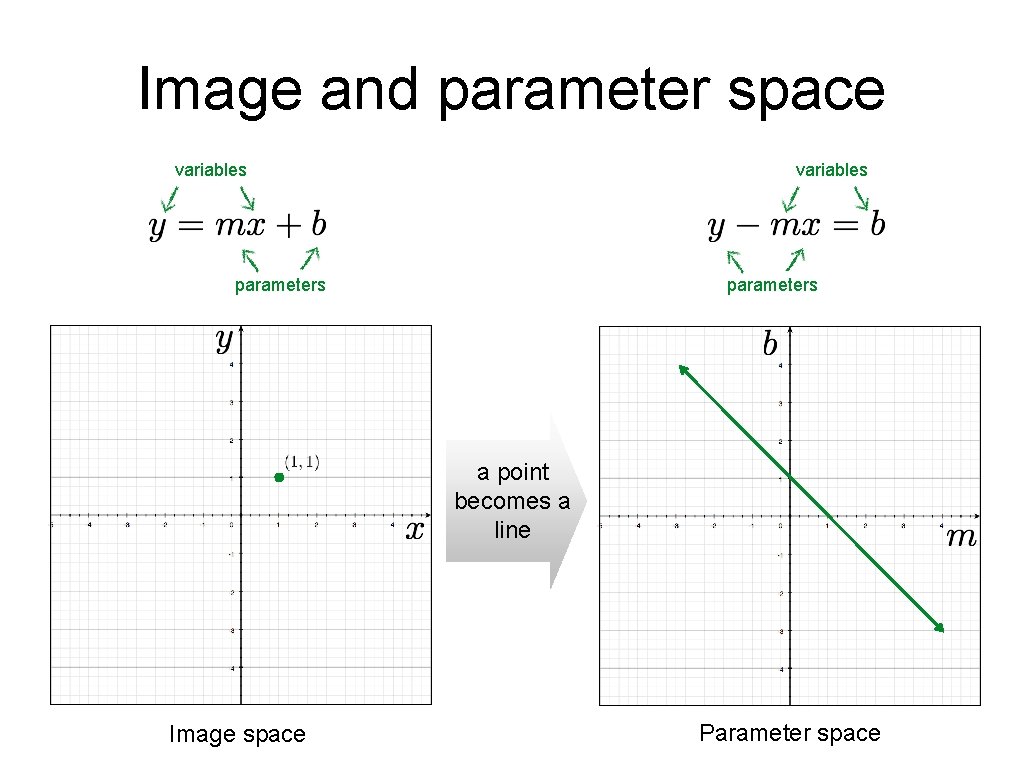
Image and parameter space variables parameters What would a point in image space become in parameter space? Image space
Image and parameter space variables parameters a point becomes a line Image space Parameter space
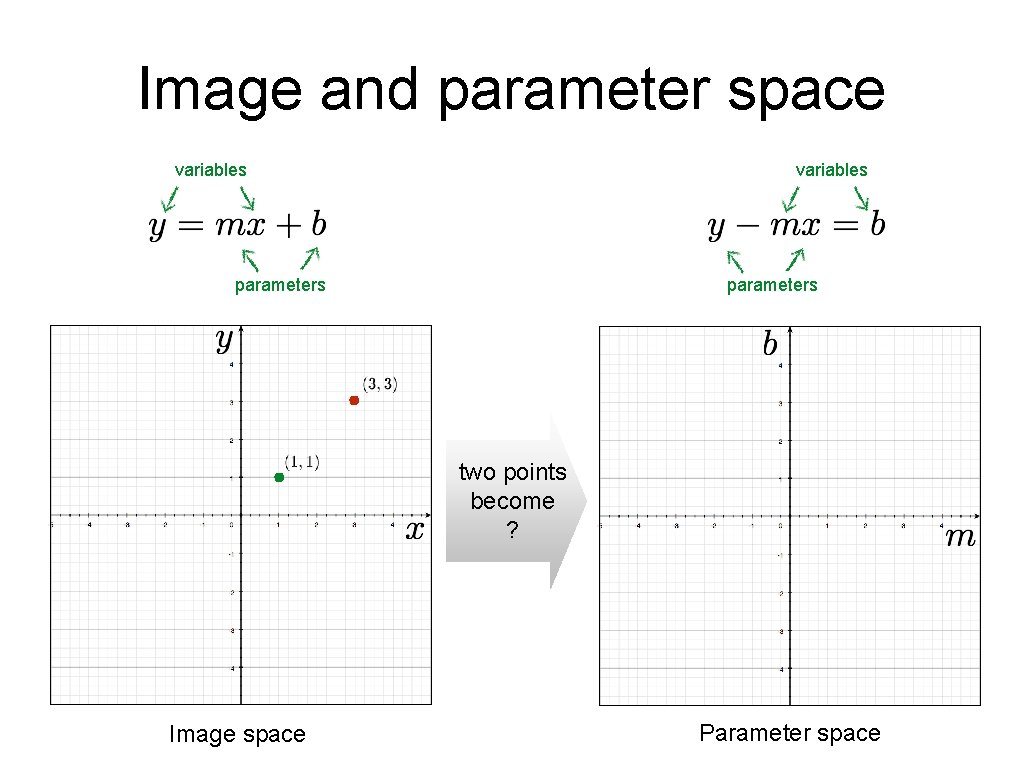
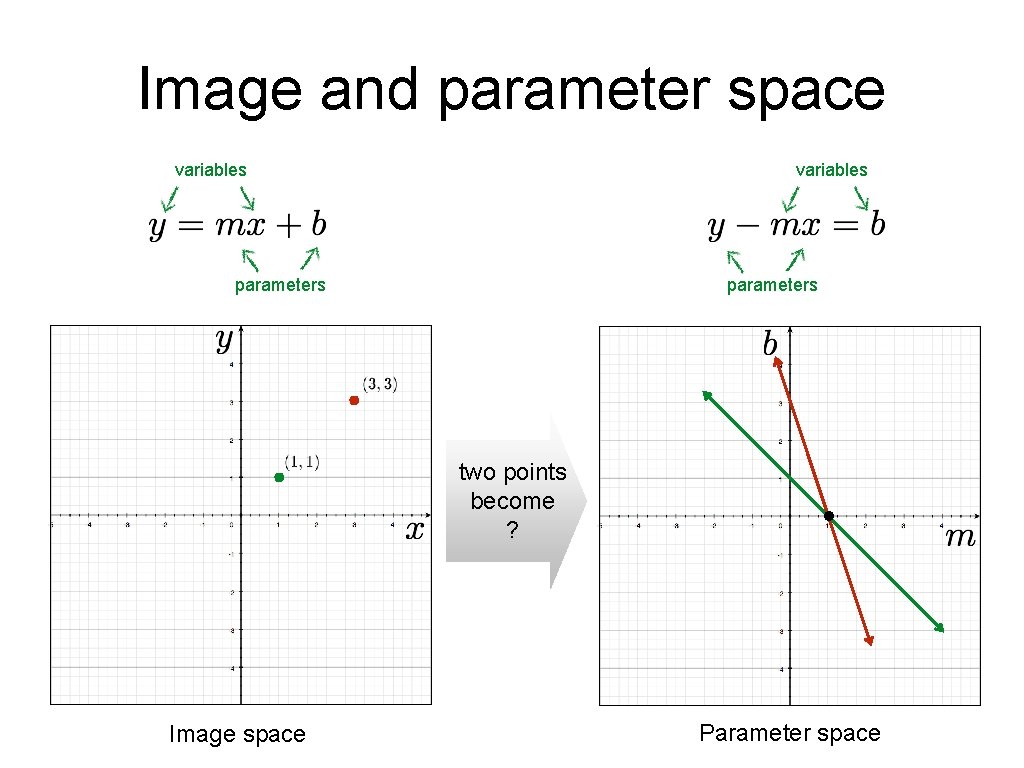
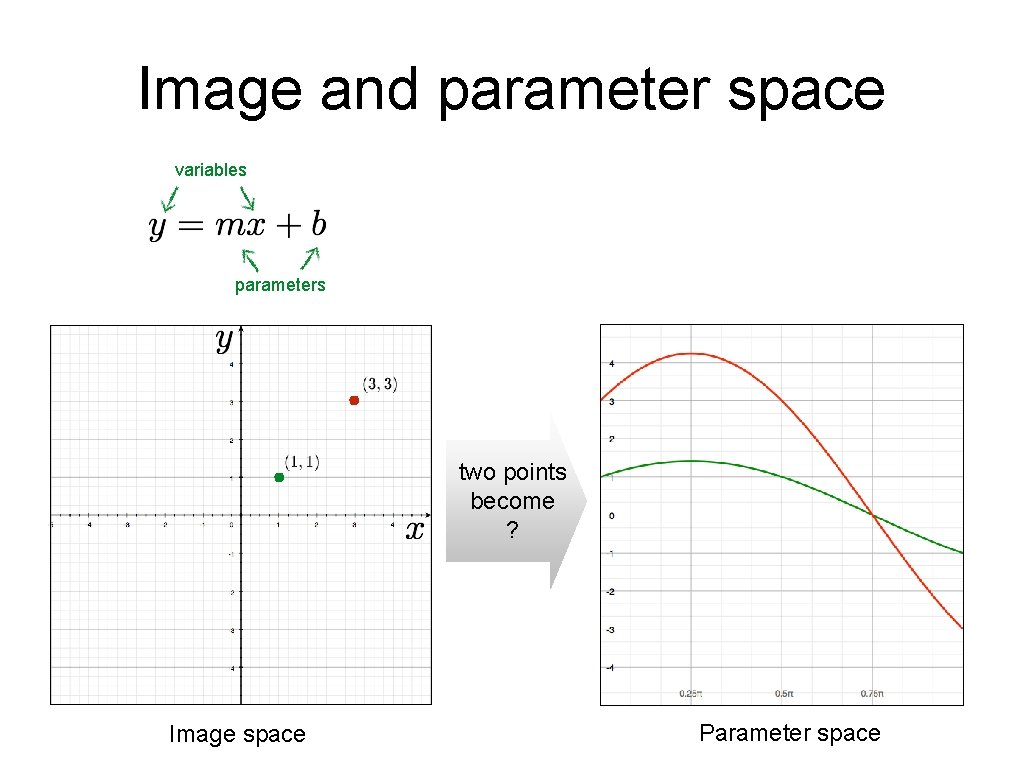
Image and parameter space variables parameters two points become ? Image space Parameter space
Image and parameter space variables parameters two points become ? Image space Parameter space
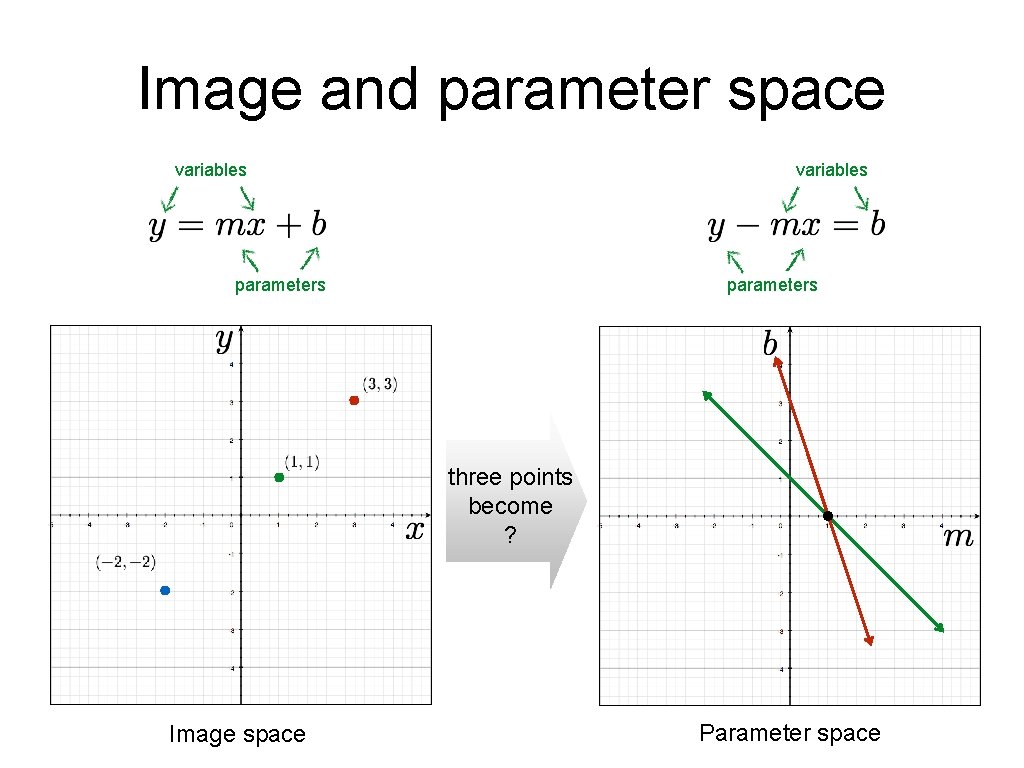
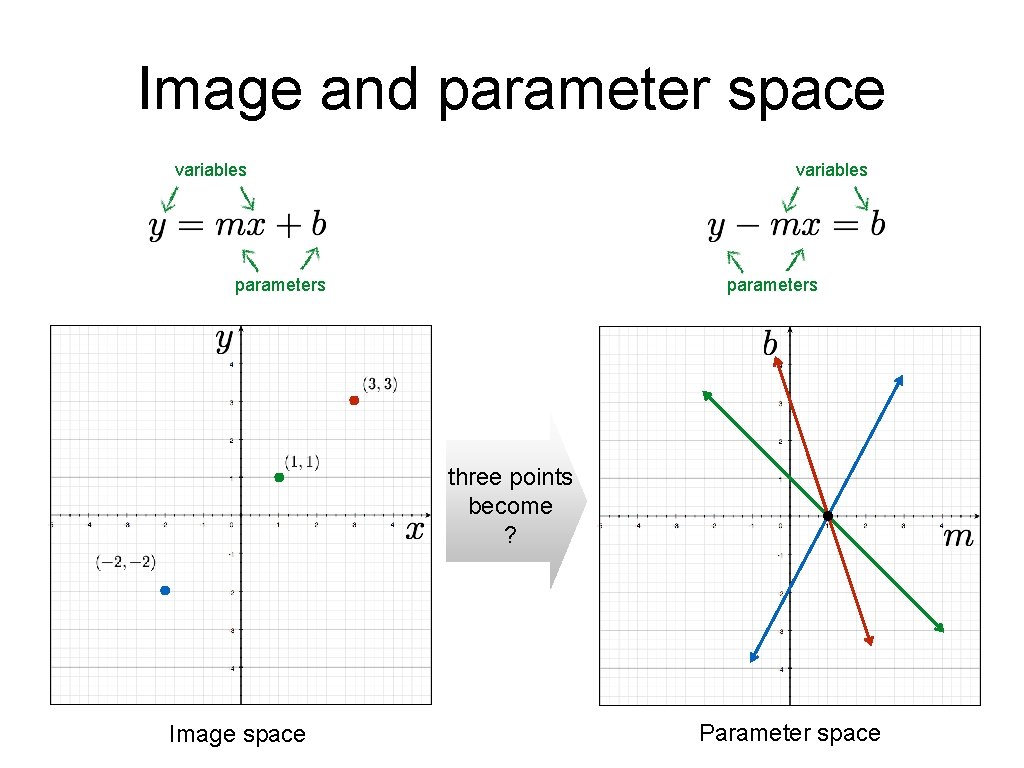
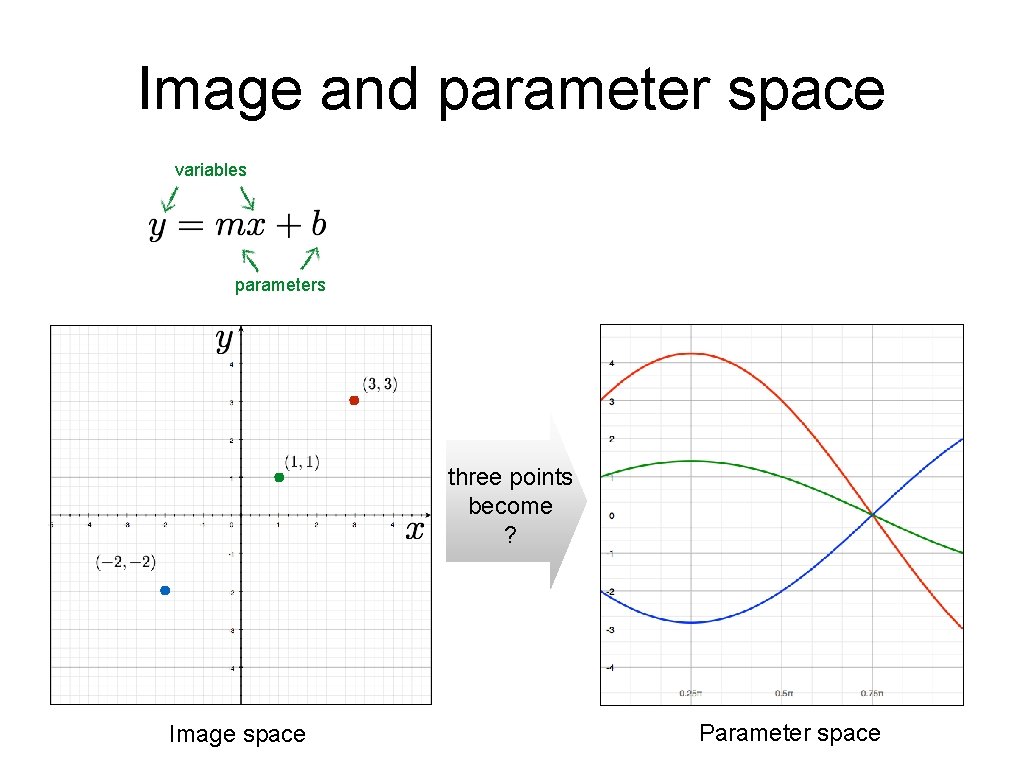
Image and parameter space variables parameters three points become ? Image space Parameter space
Image and parameter space variables parameters three points become ? Image space Parameter space
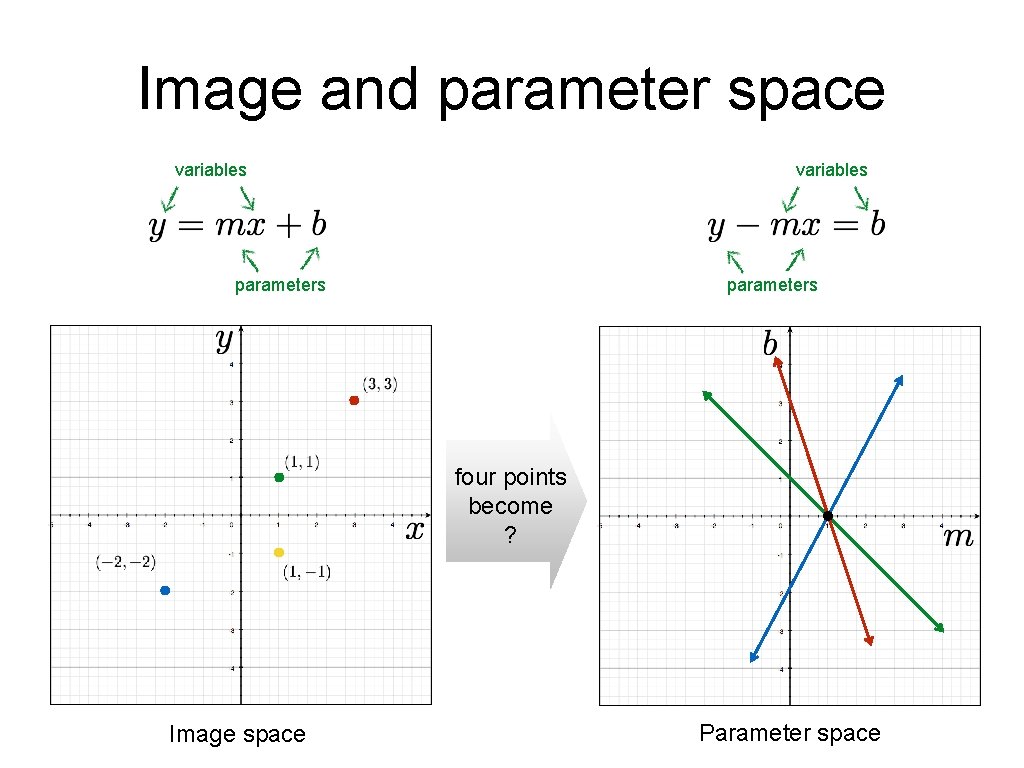
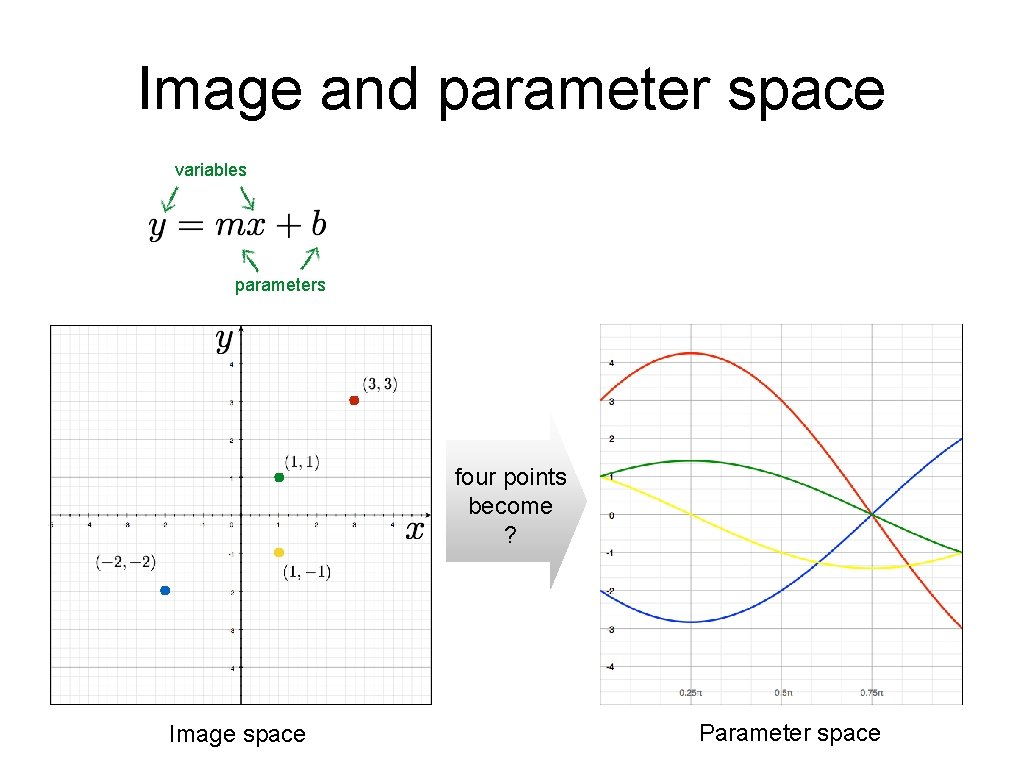
Image and parameter space variables parameters four points become ? Image space Parameter space
Image and parameter space variables parameters four points become ? Image space Parameter space
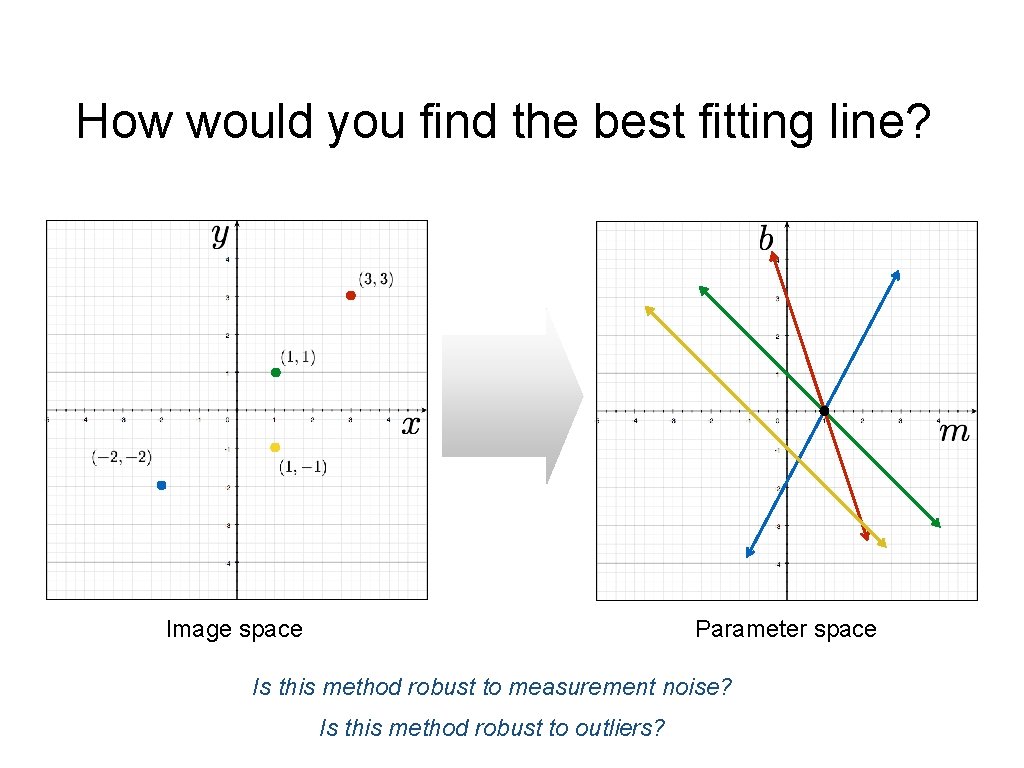
How would you find the best fitting line? Image space Parameter space Is this method robust to measurement noise? Is this method robust to outliers?
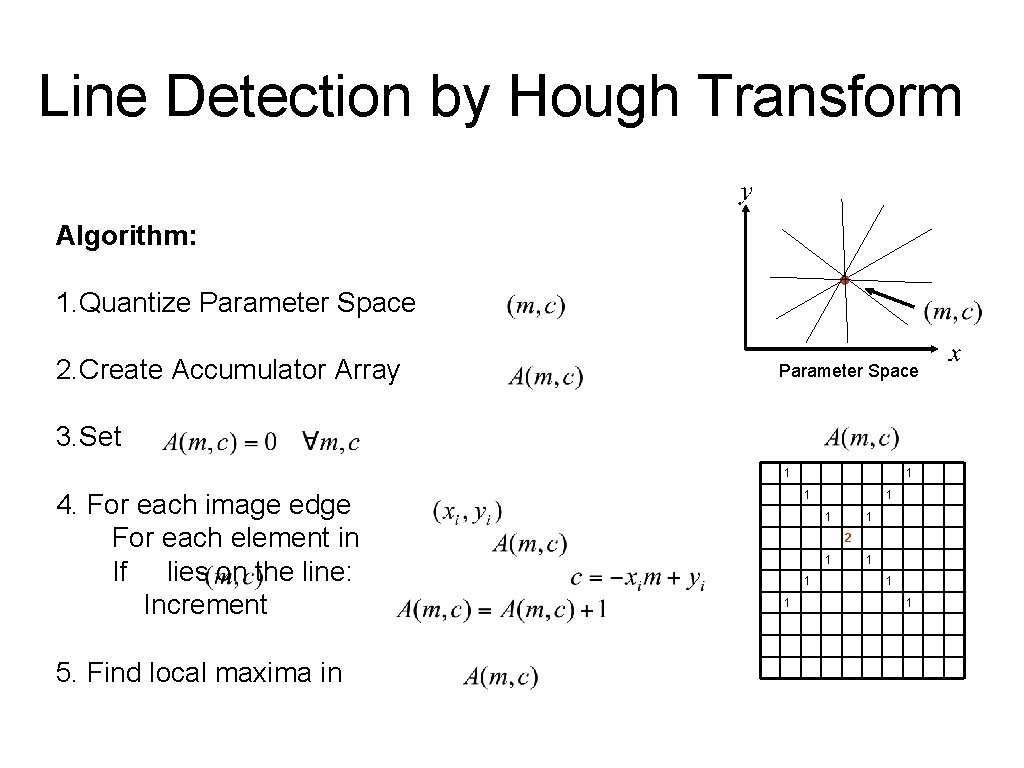
Line Detection by Hough Transform Algorithm: 1. Quantize Parameter Space 2. Create Accumulator Array Parameter Space 3. Set 1 4. For each image edge For each element in If lies on the line: Increment 5. Find local maxima in 1 1 1 2 1 1 1
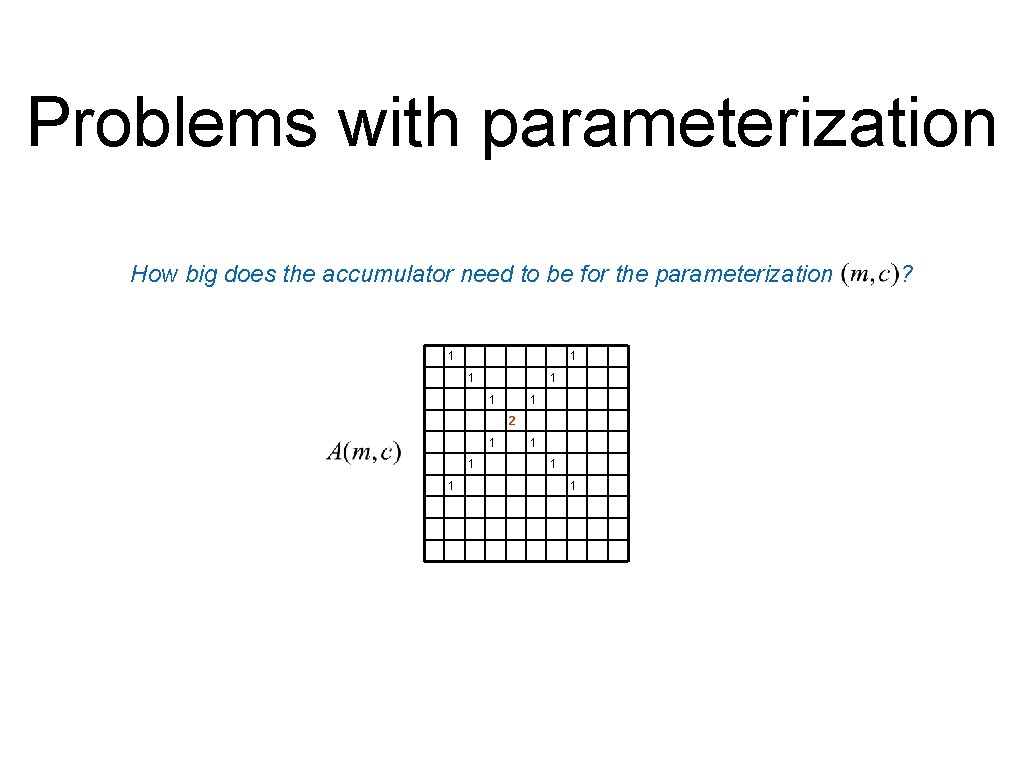
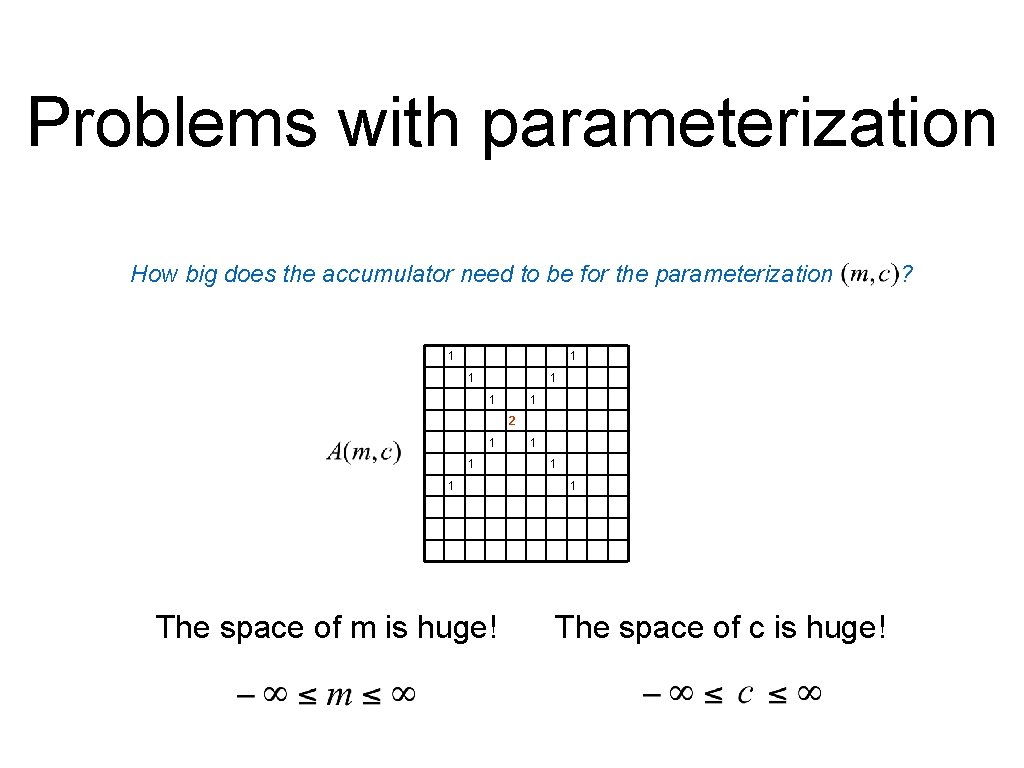
Problems with parameterization How big does the accumulator need to be for the parameterization 1 1 1 2 1 1 1 ?
Problems with parameterization How big does the accumulator need to be for the parameterization 1 1 1 2 1 1 1 The space of m is huge! 1 1 1 The space of c is huge! ?
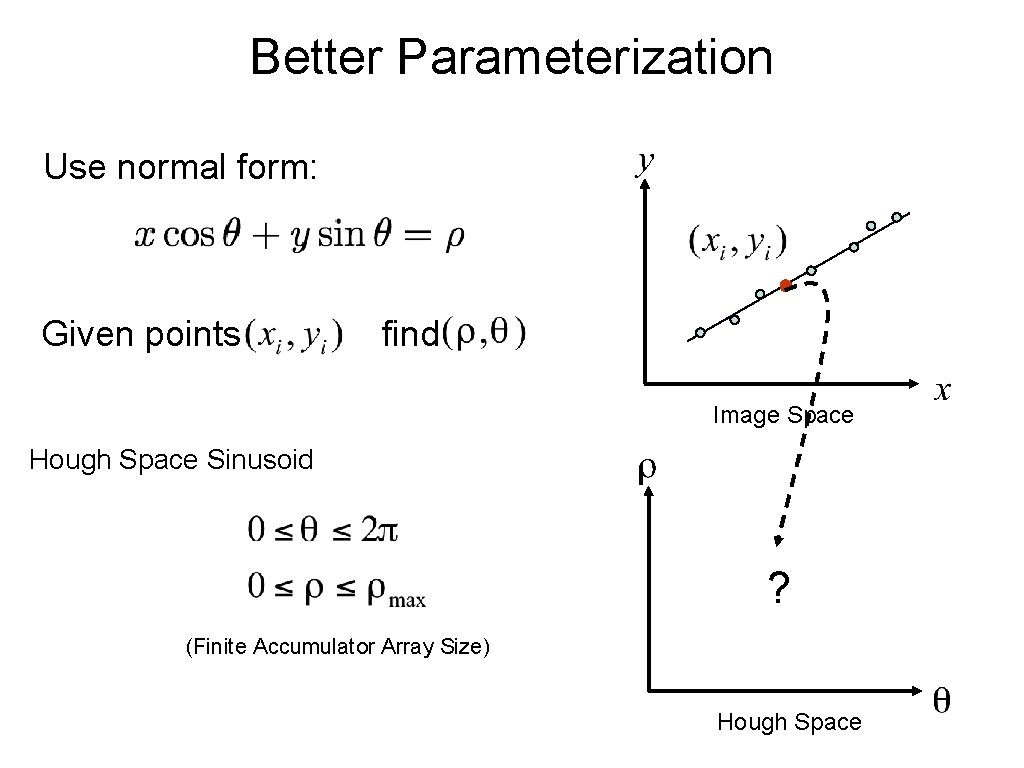
Better Parameterization Use normal form: Given points find Image Space Hough Space Sinusoid ? (Finite Accumulator Array Size) Hough Space
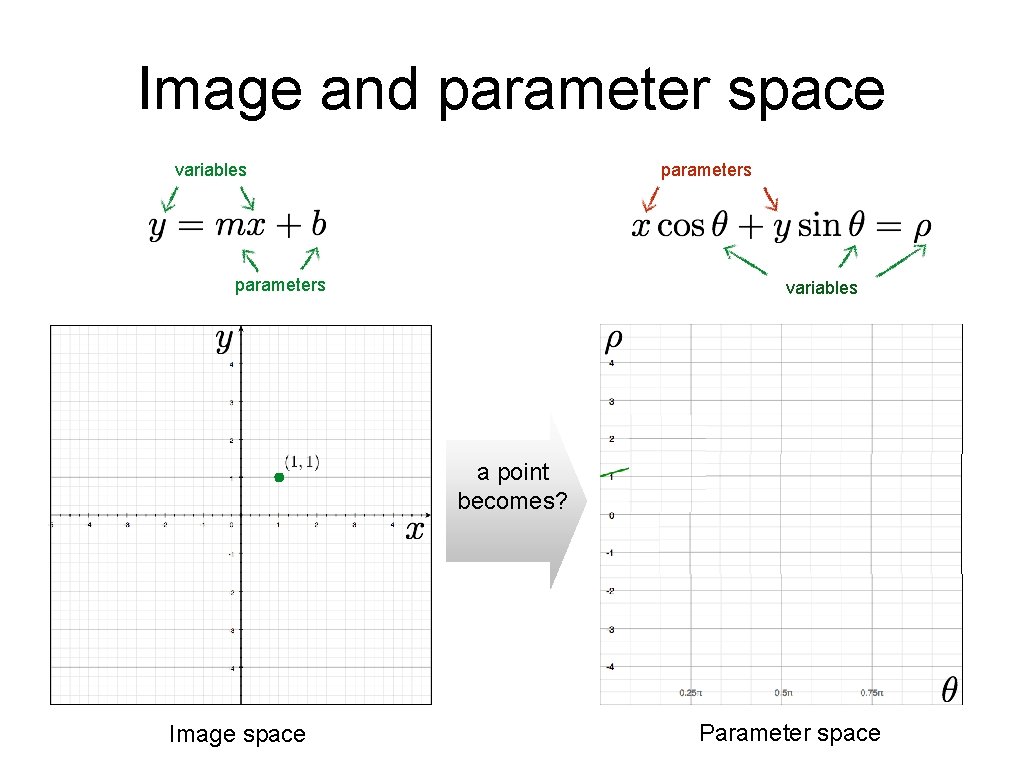
Image and parameter space parameters variables a point becomes? Image space Parameter space
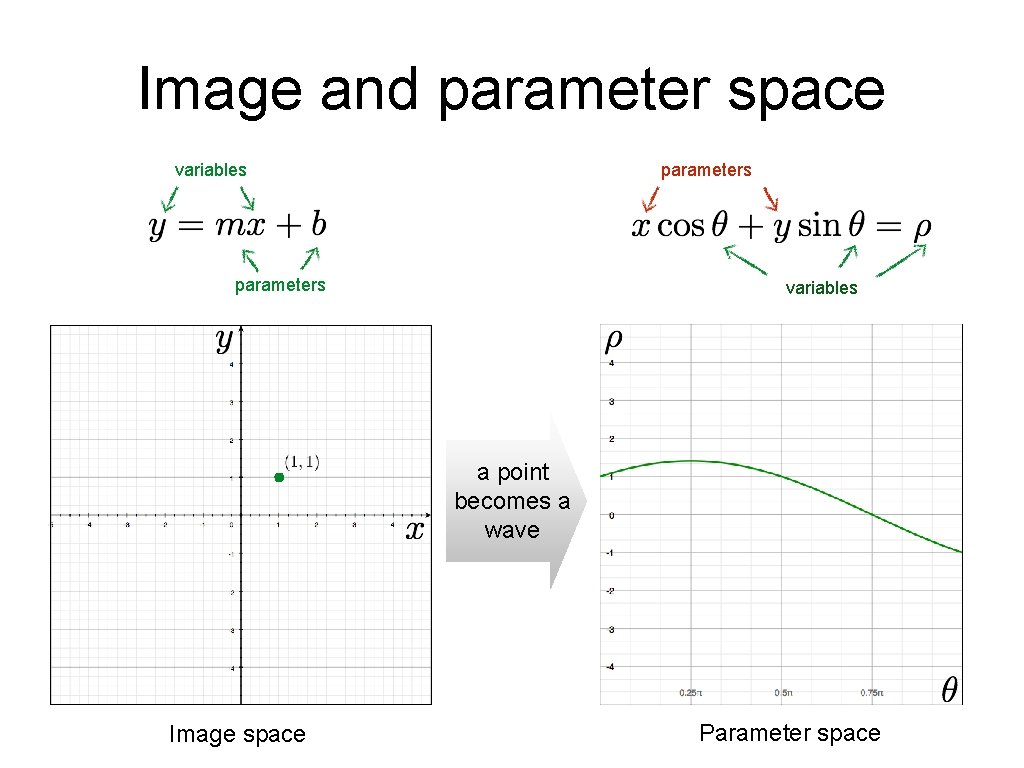
Image and parameter space parameters variables a point becomes a wave Image space Parameter space
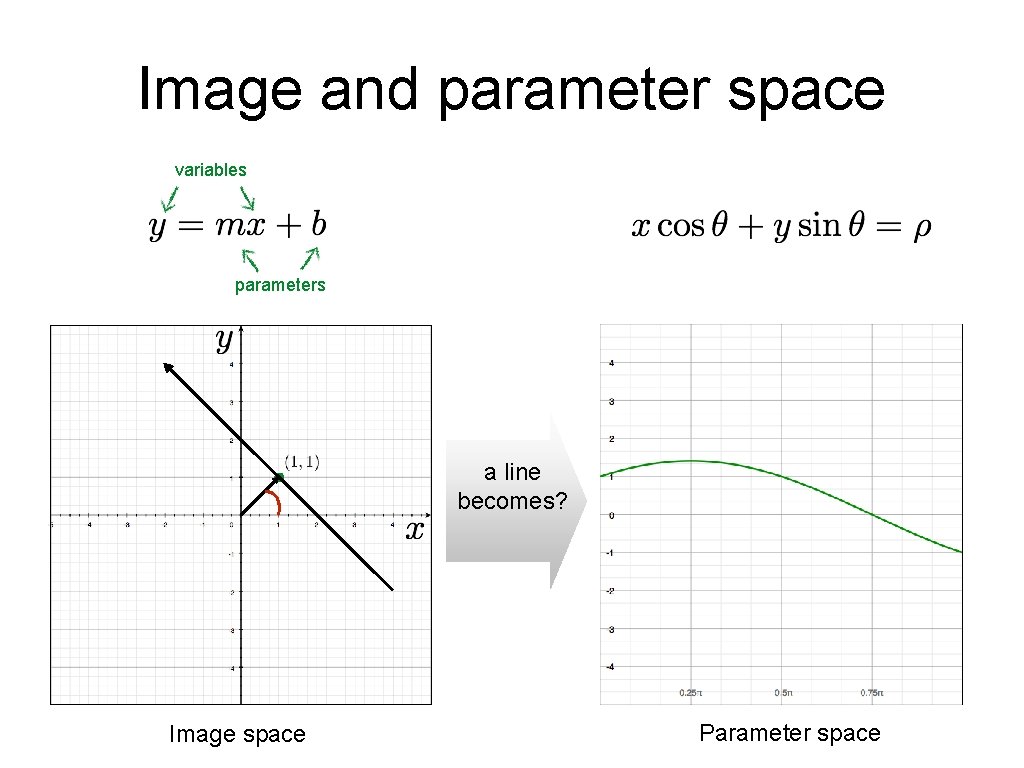
Image and parameter space variables parameters a line becomes? Image space Parameter space
Image and parameter space variables parameters a line becomes a point Image space Parameter space
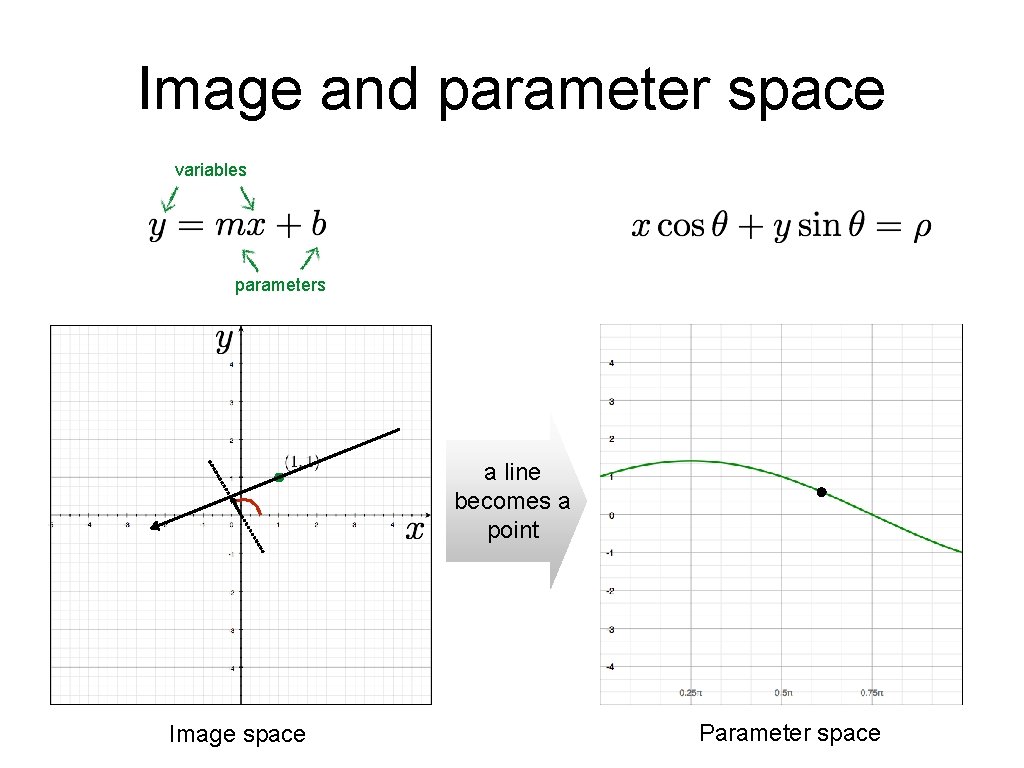
Image and parameter space variables parameters a line becomes? Image space Parameter space
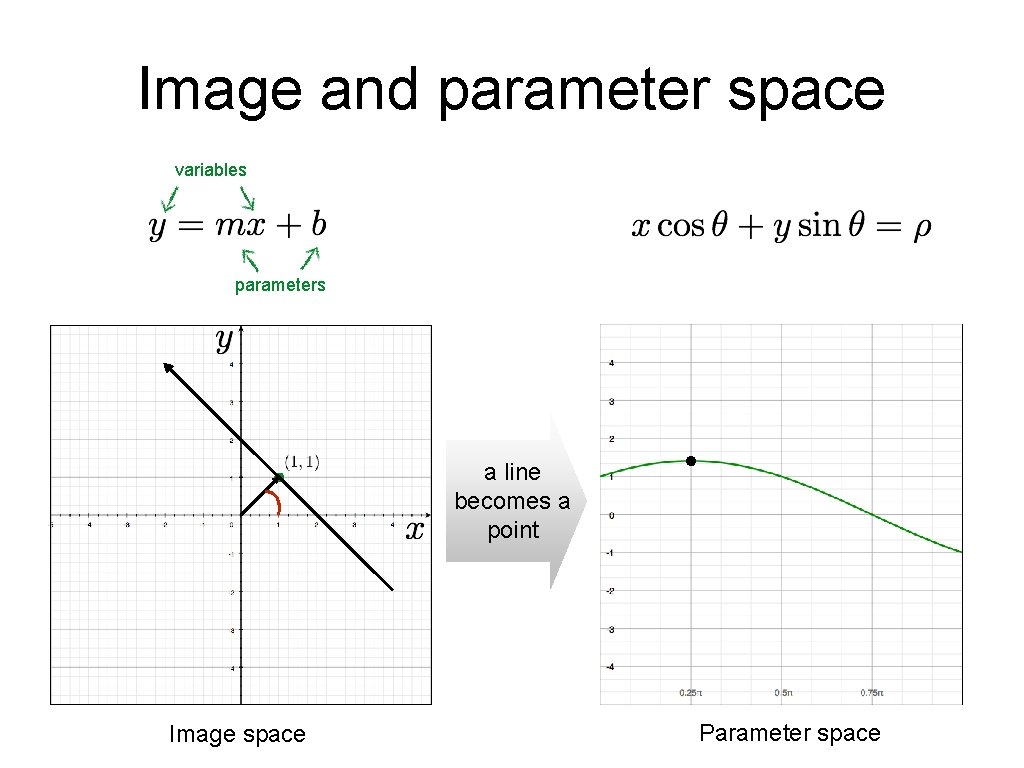
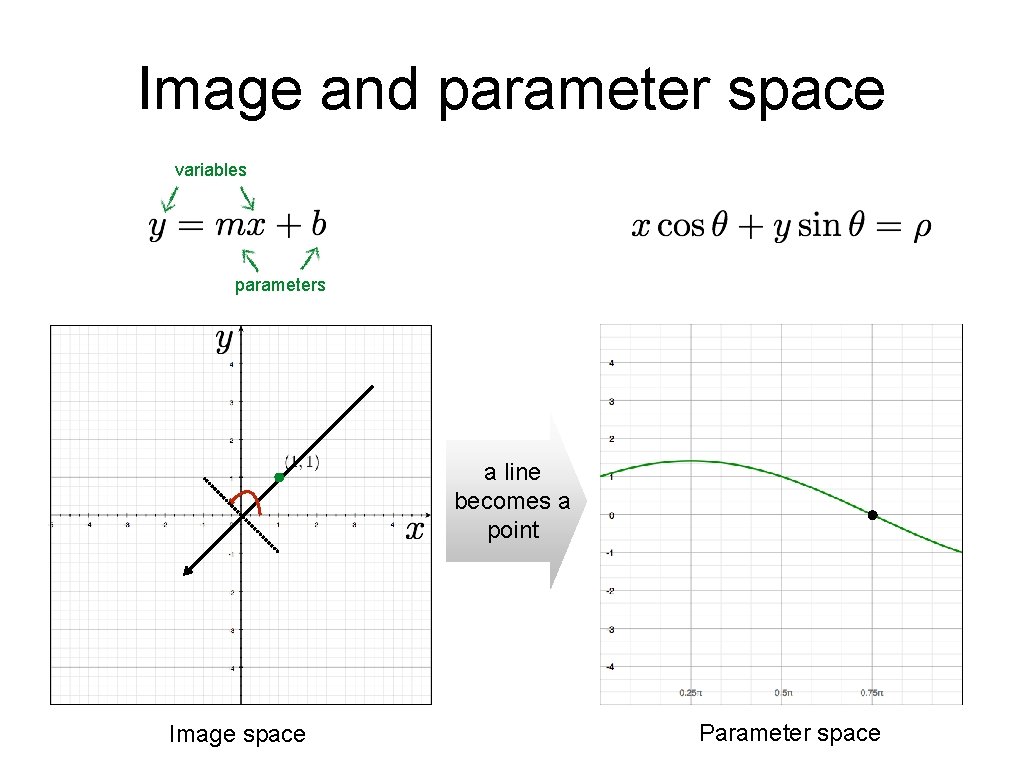
Image and parameter space variables parameters a line becomes a point Image space Parameter space
Image and parameter space variables parameters a line becomes a point Image space Parameter space
Image and parameter space variables parameters a line becomes a point Image space Parameter space
Image and parameter space variables parameters a line becomes a point Image space Parameter space
Image and parameter space variables parameters a line becomes a point Image space Parameter space
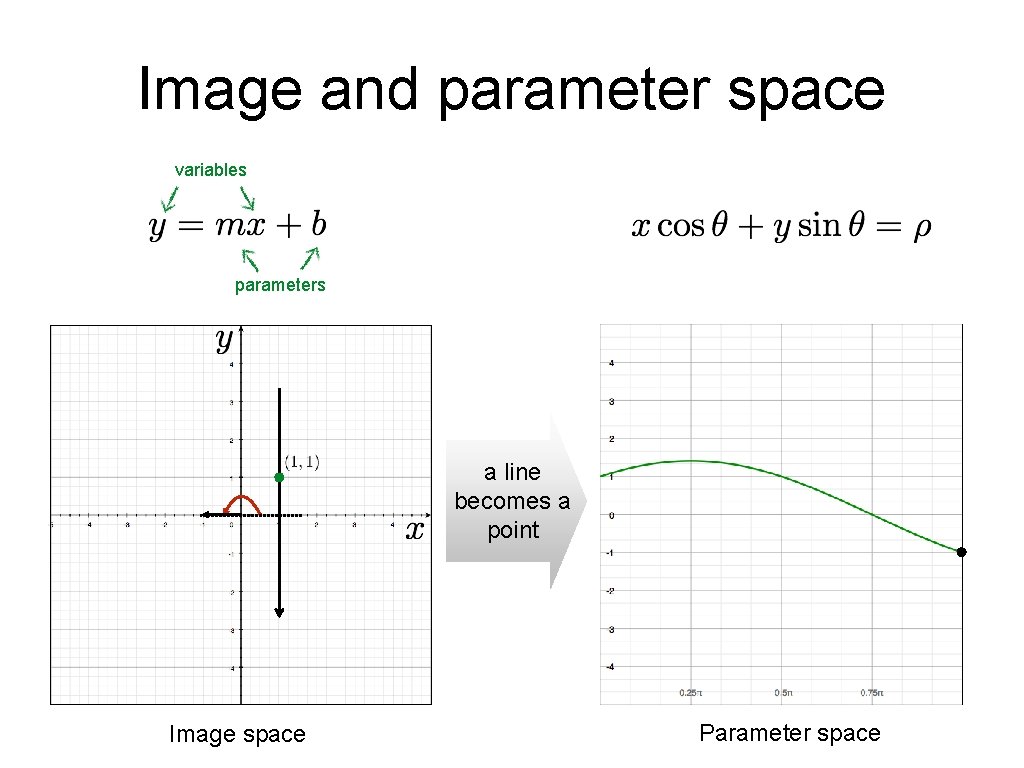
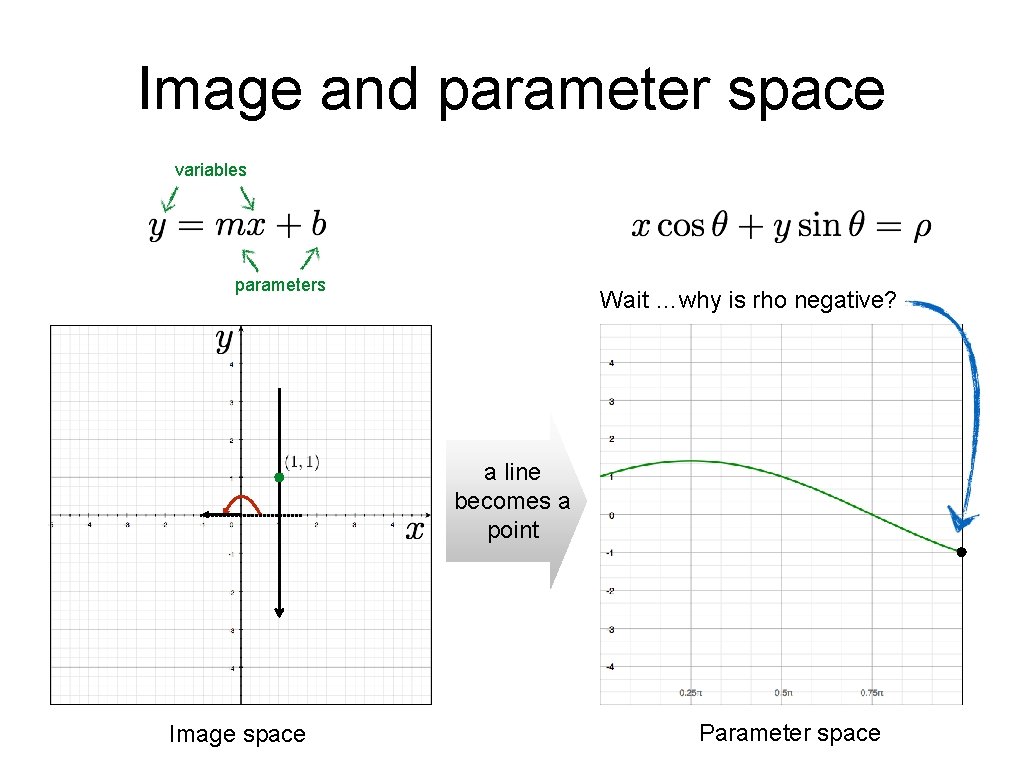
Image and parameter space variables parameters Wait …why is rho negative? a line becomes a point Image space Parameter space
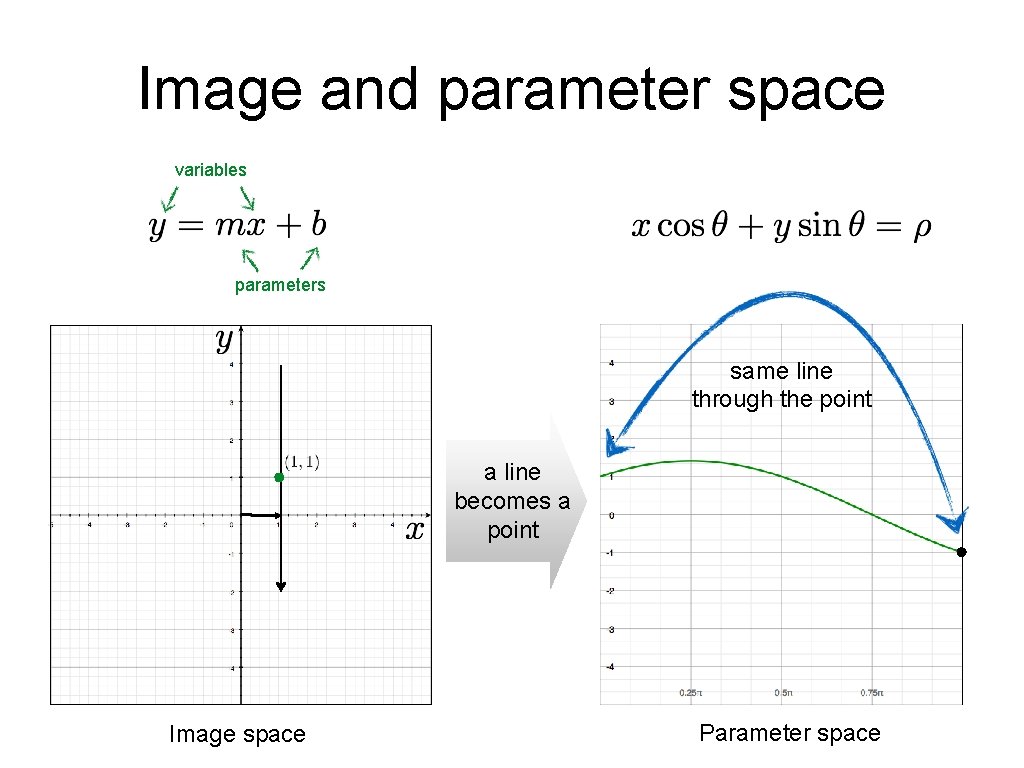
Image and parameter space variables parameters same line through the point a line becomes a point Image space Parameter space
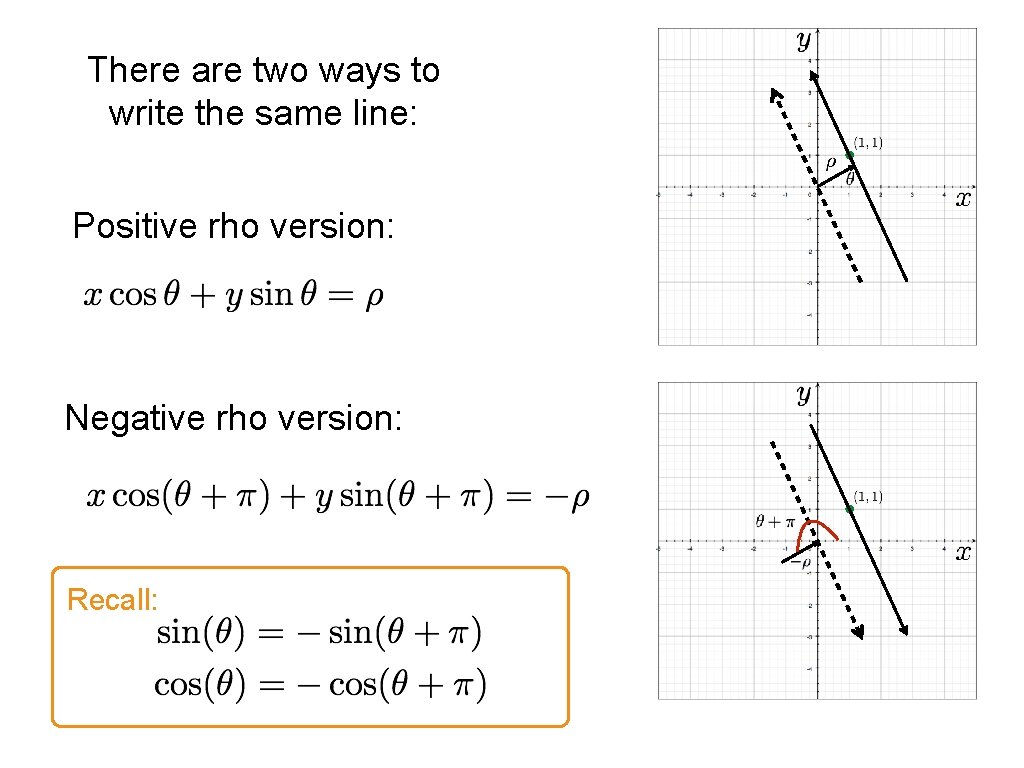
There are two ways to write the same line: Positive rho version: Negative rho version: Recall:
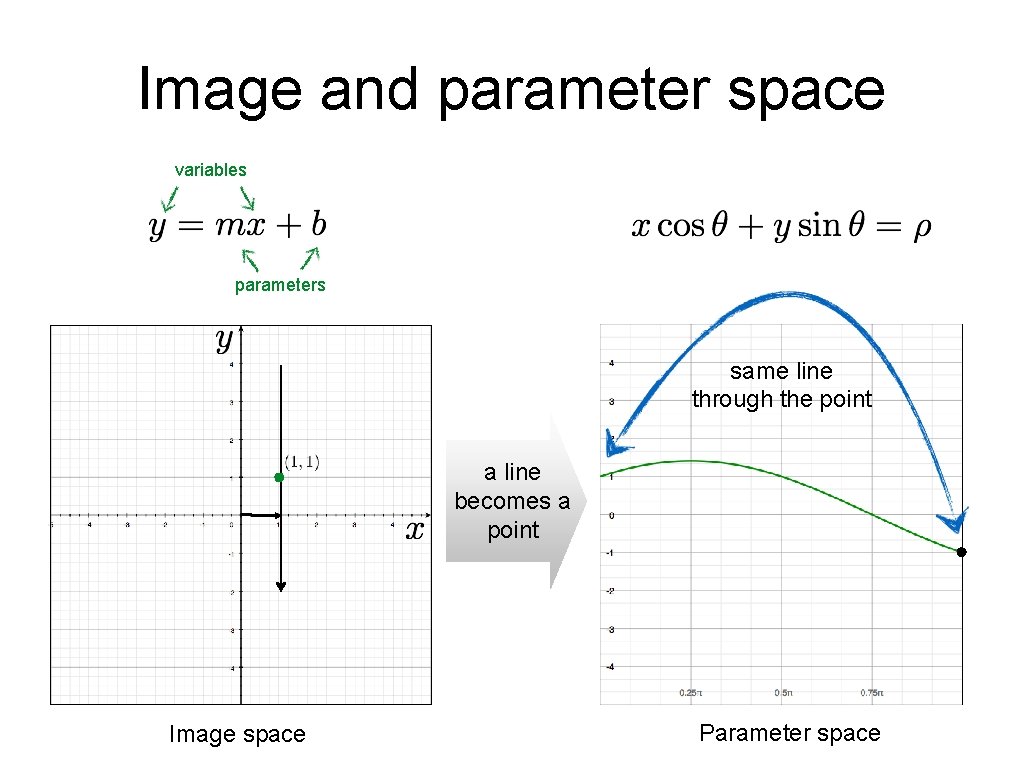
Image and parameter space variables parameters same line through the point a line becomes a point Image space Parameter space
Image and parameter space variables parameters two points become ? Image space Parameter space
Image and parameter space variables parameters three points become ? Image space Parameter space
Image and parameter space variables parameters four points become ? Image space Parameter space
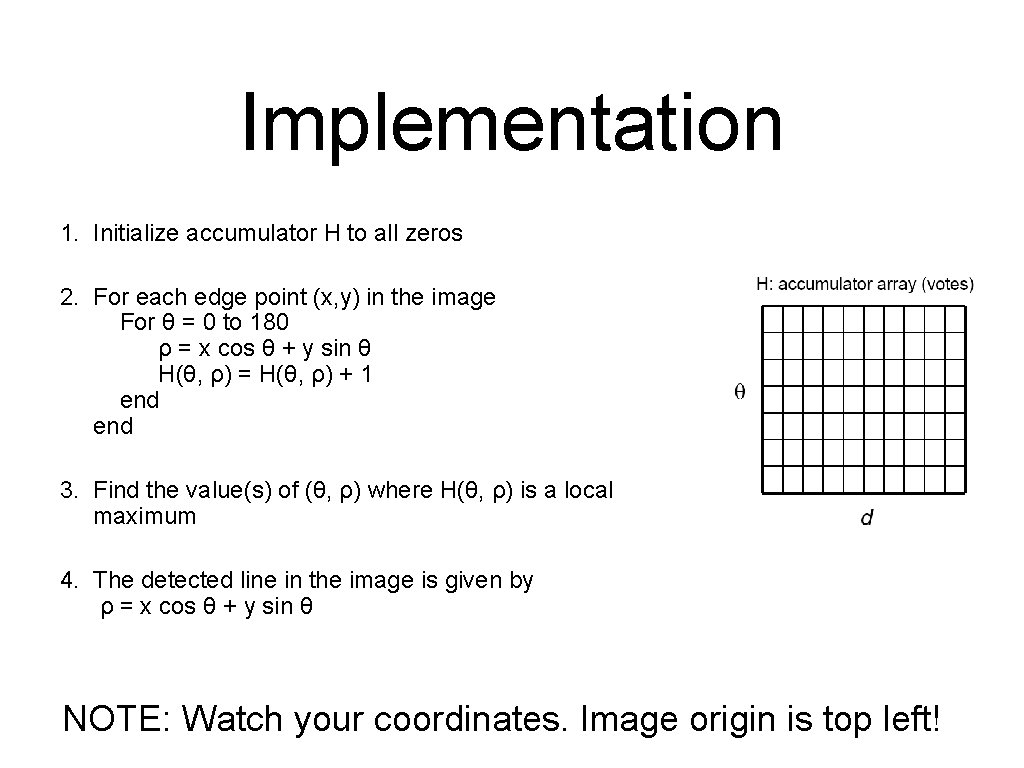
Implementation 1. Initialize accumulator H to all zeros 2. For each edge point (x, y) in the image For θ = 0 to 180 ρ = x cos θ + y sin θ H(θ, ρ) = H(θ, ρ) + 1 end 3. Find the value(s) of (θ, ρ) where H(θ, ρ) is a local maximum 4. The detected line in the image is given by ρ = x cos θ + y sin θ NOTE: Watch your coordinates. Image origin is top left!
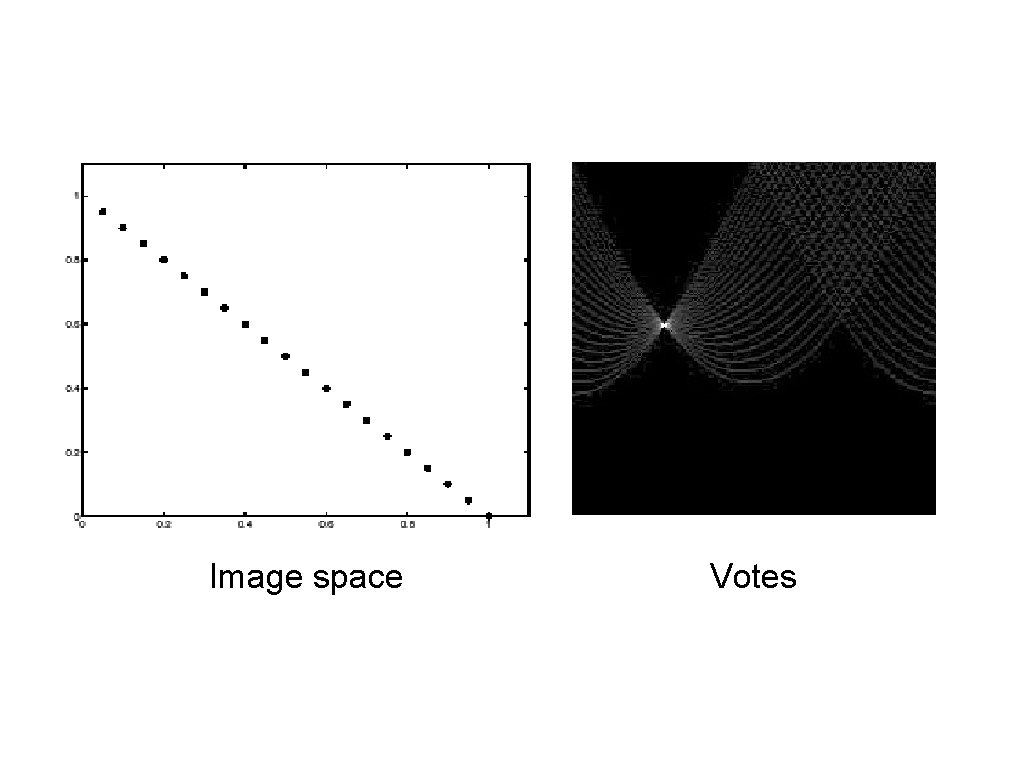
Image space Votes
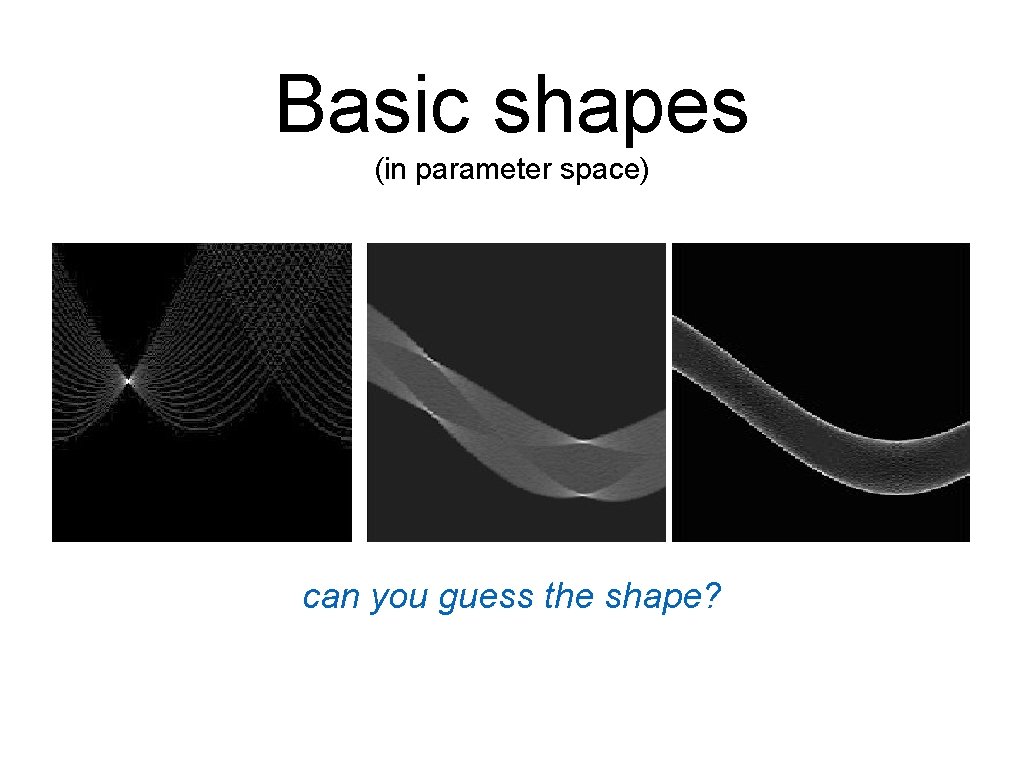
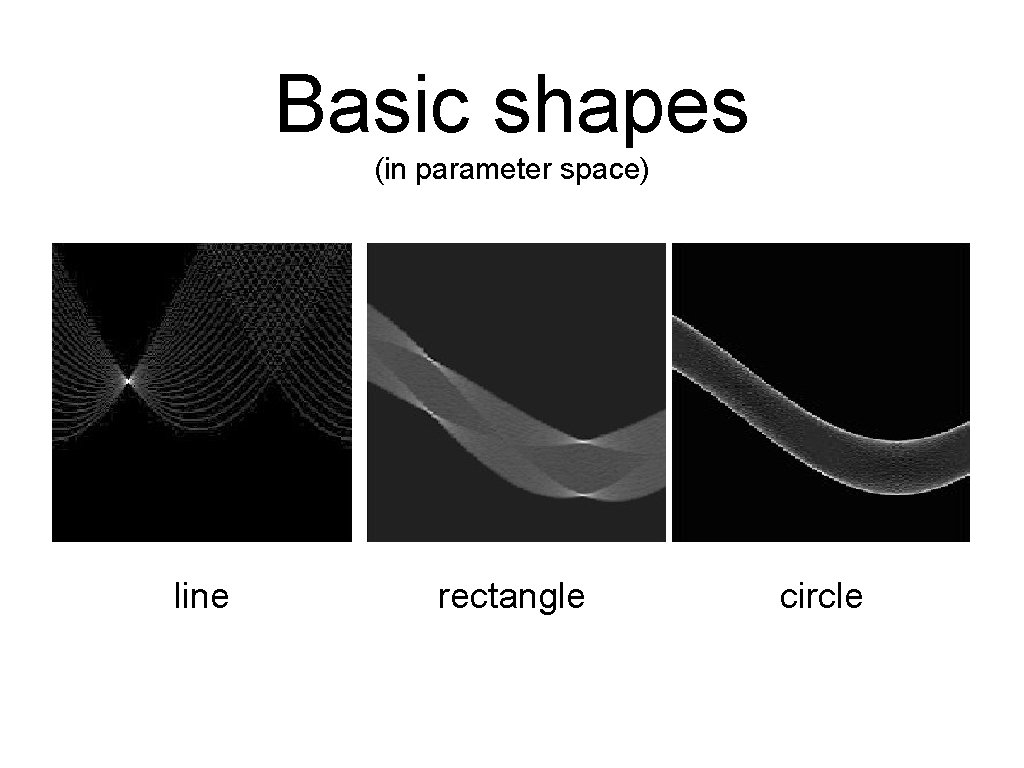
Basic shapes (in parameter space) can you guess the shape?
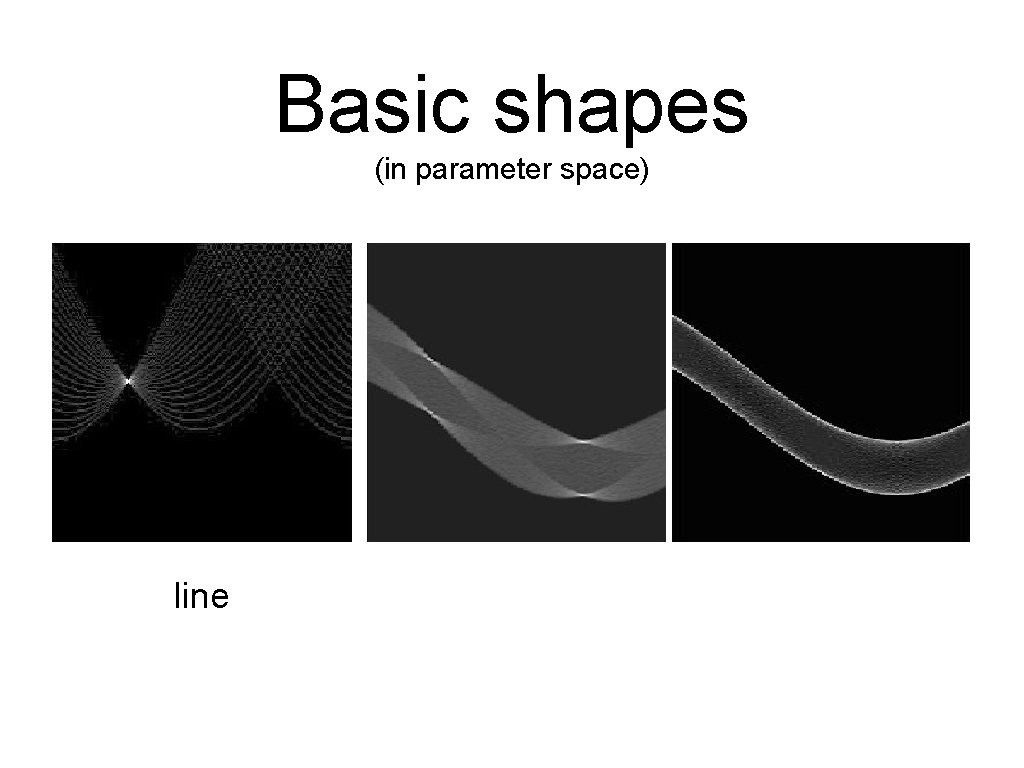
Basic shapes (in parameter space) line
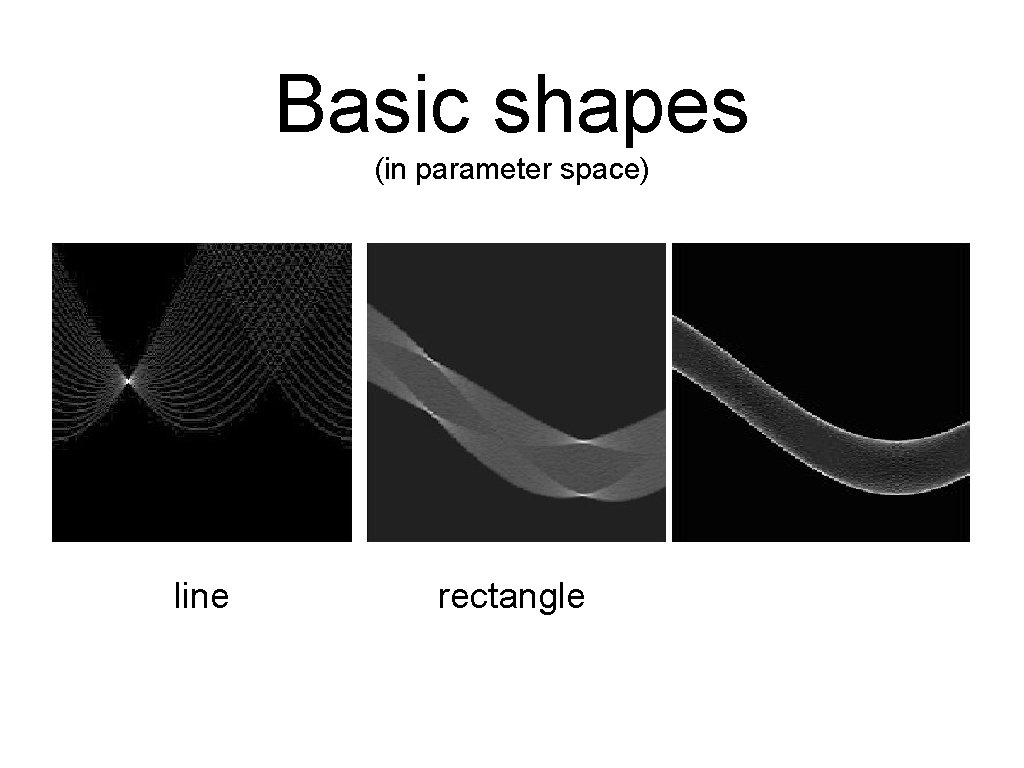
Basic shapes (in parameter space) line rectangle
Basic shapes (in parameter space) line rectangle circle
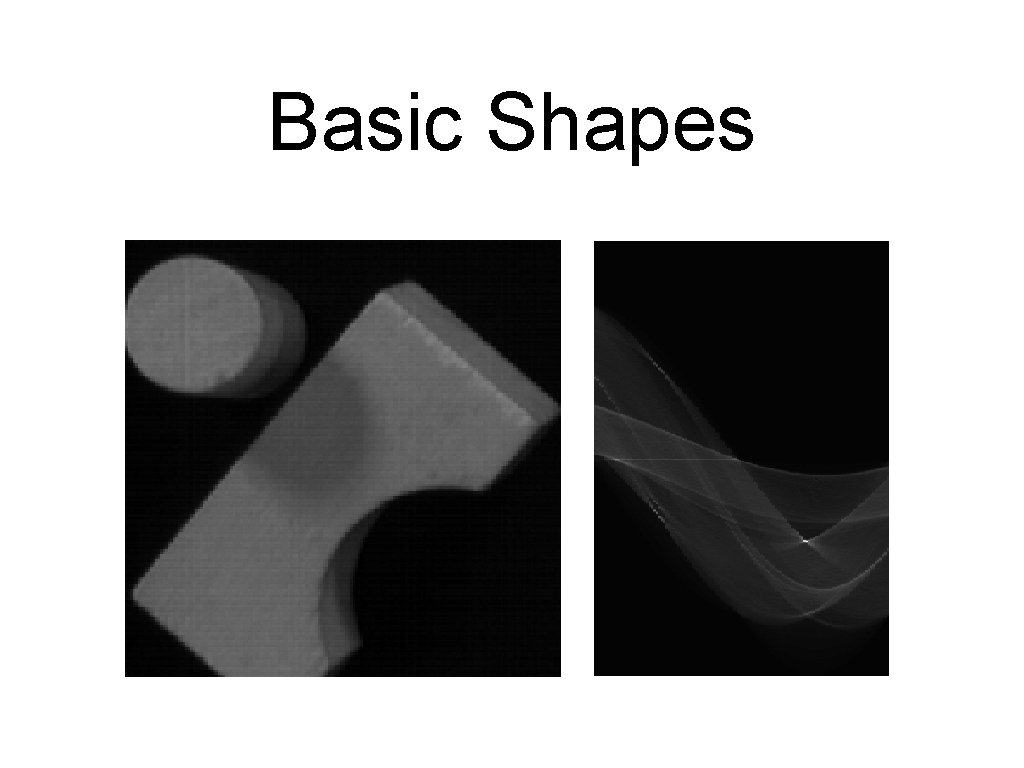
Basic Shapes
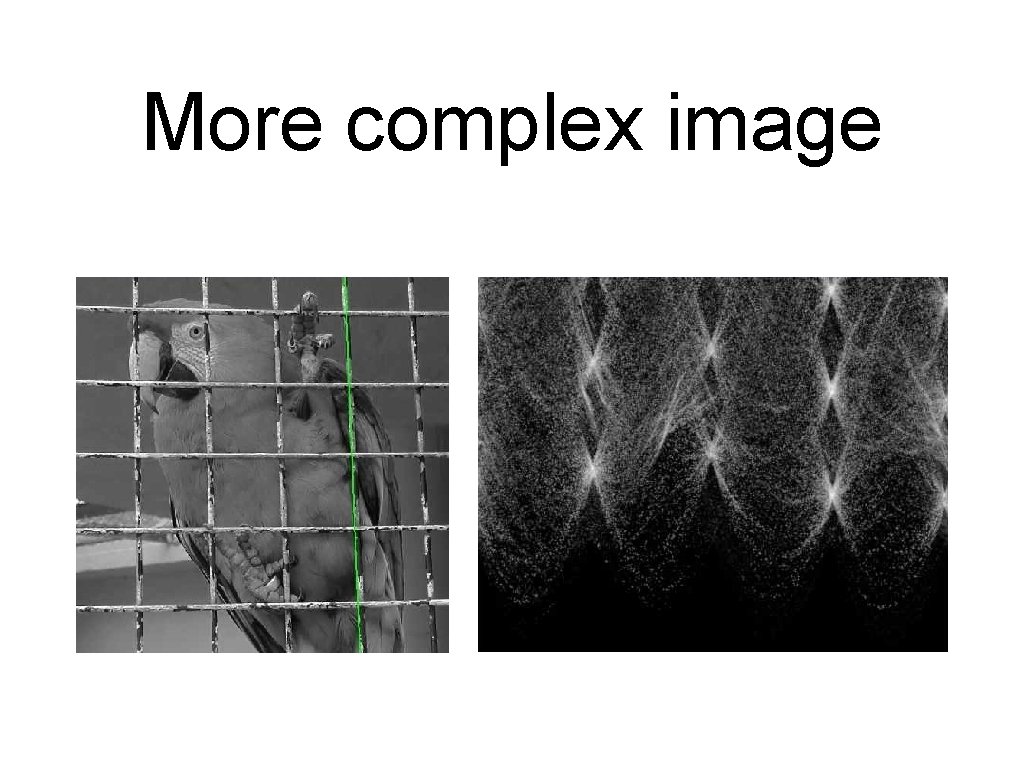
More complex image
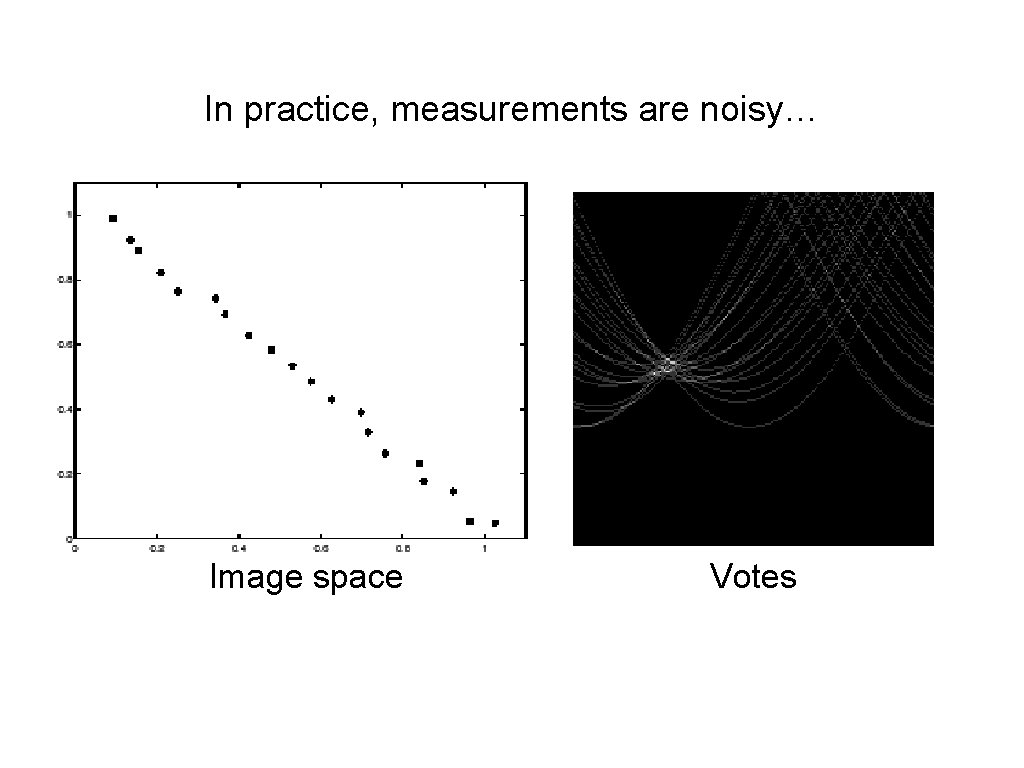
In practice, measurements are noisy… Image space Votes
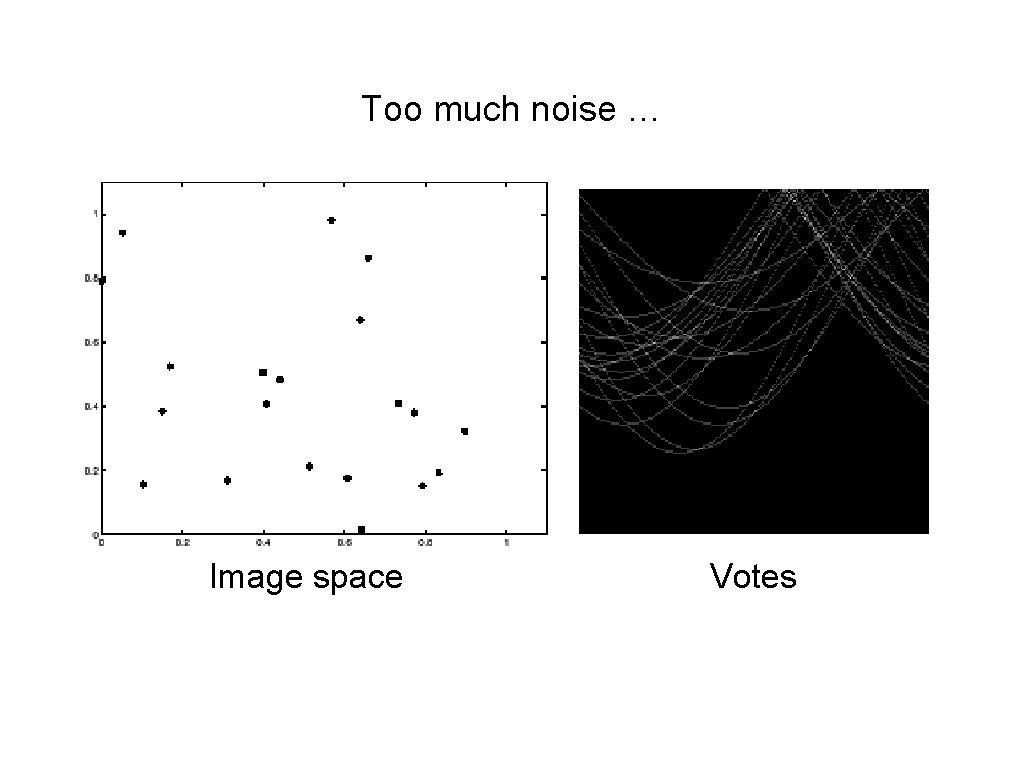
Too much noise … Image space Votes
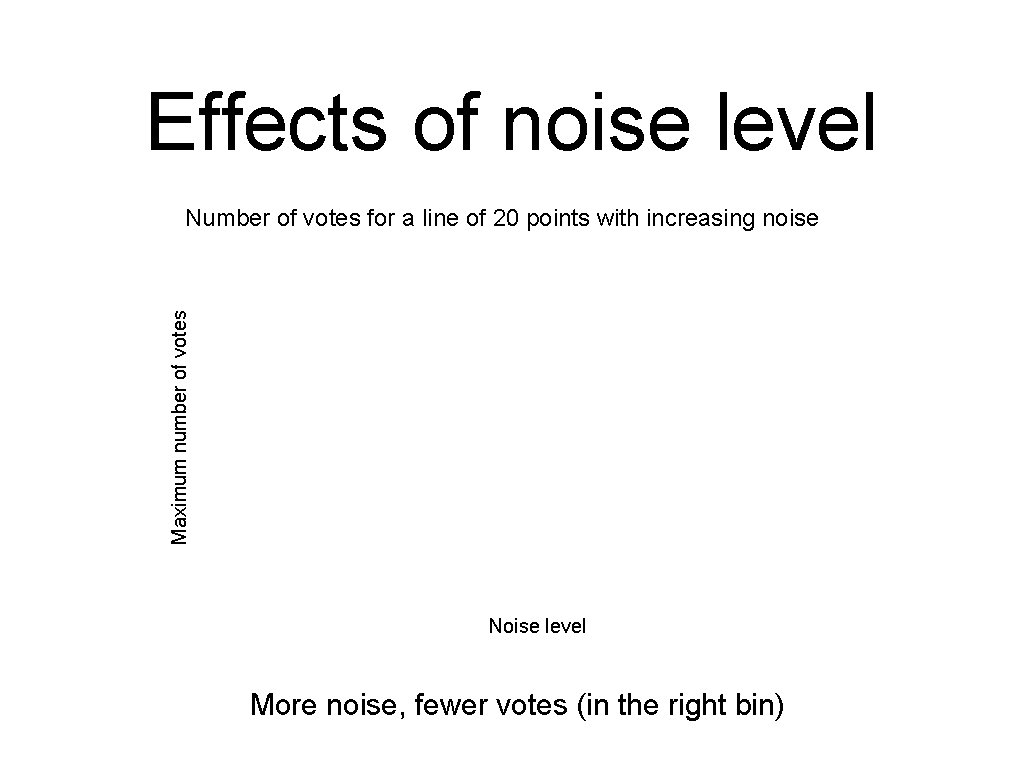
Effects of noise level Maximum number of votes Number of votes for a line of 20 points with increasing noise Noise level More noise, fewer votes (in the right bin)
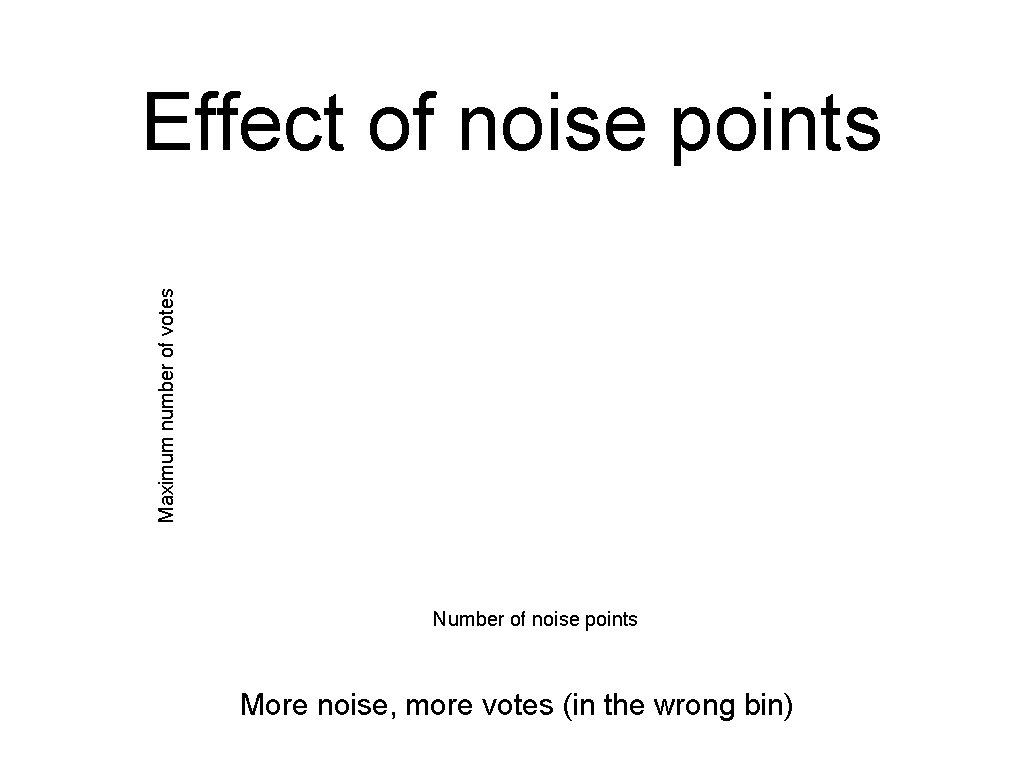
Maximum number of votes Effect of noise points Number of noise points More noise, more votes (in the wrong bin)
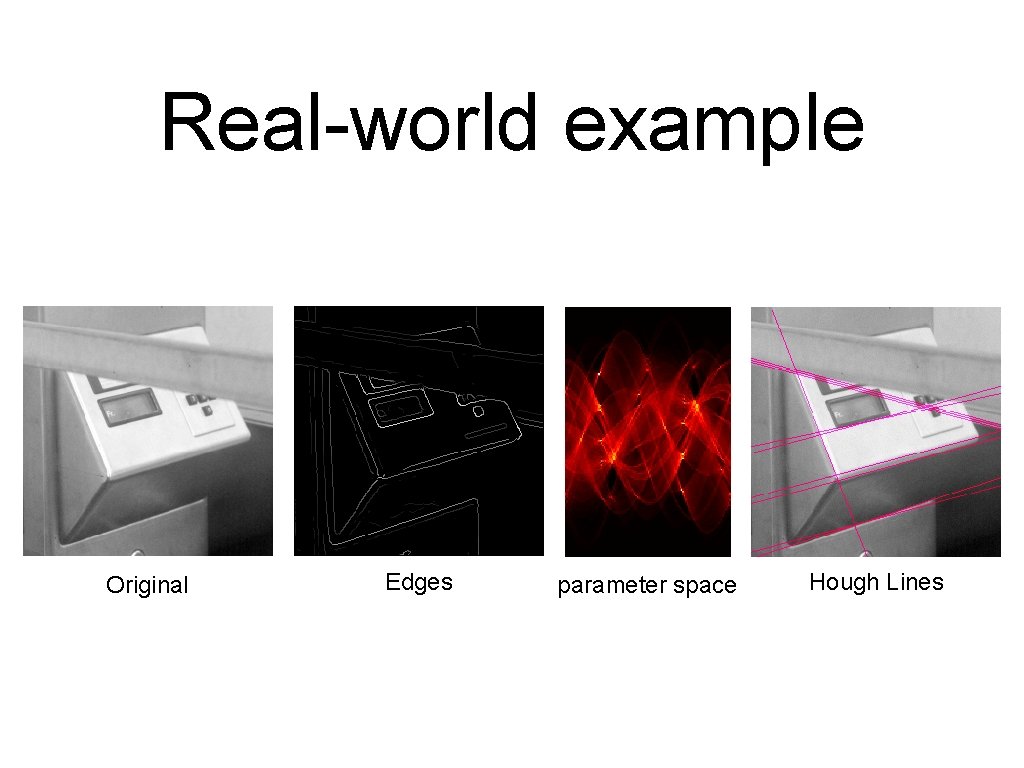
Real-world example Original Edges parameter space Hough Lines
Hough Circles
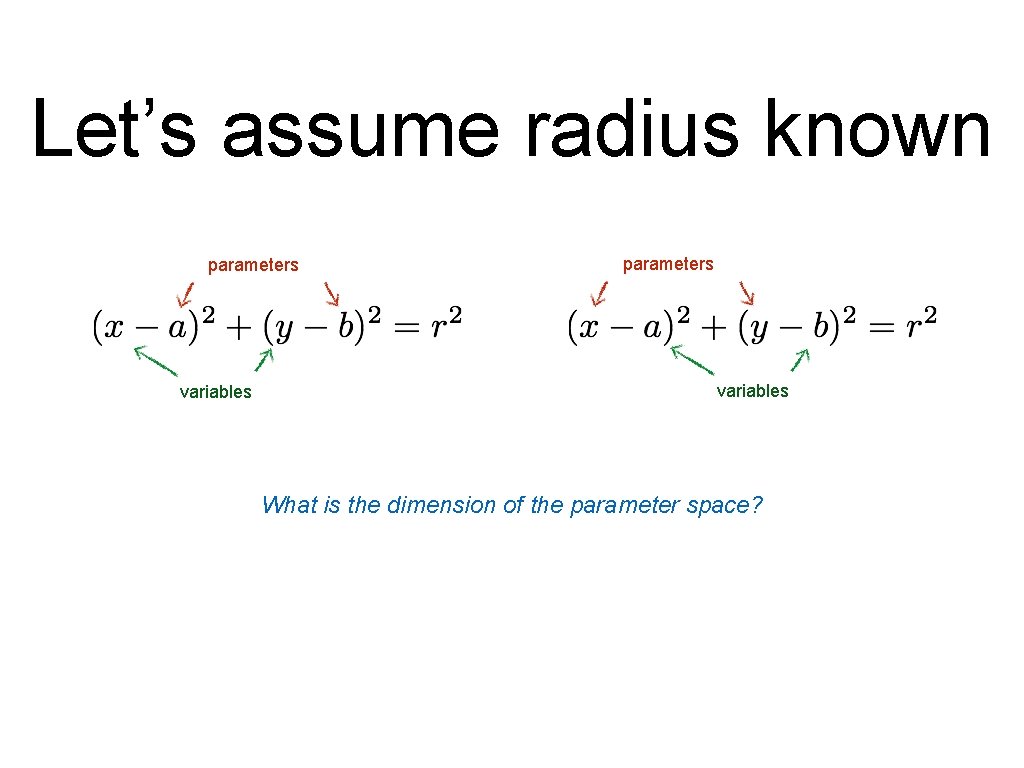
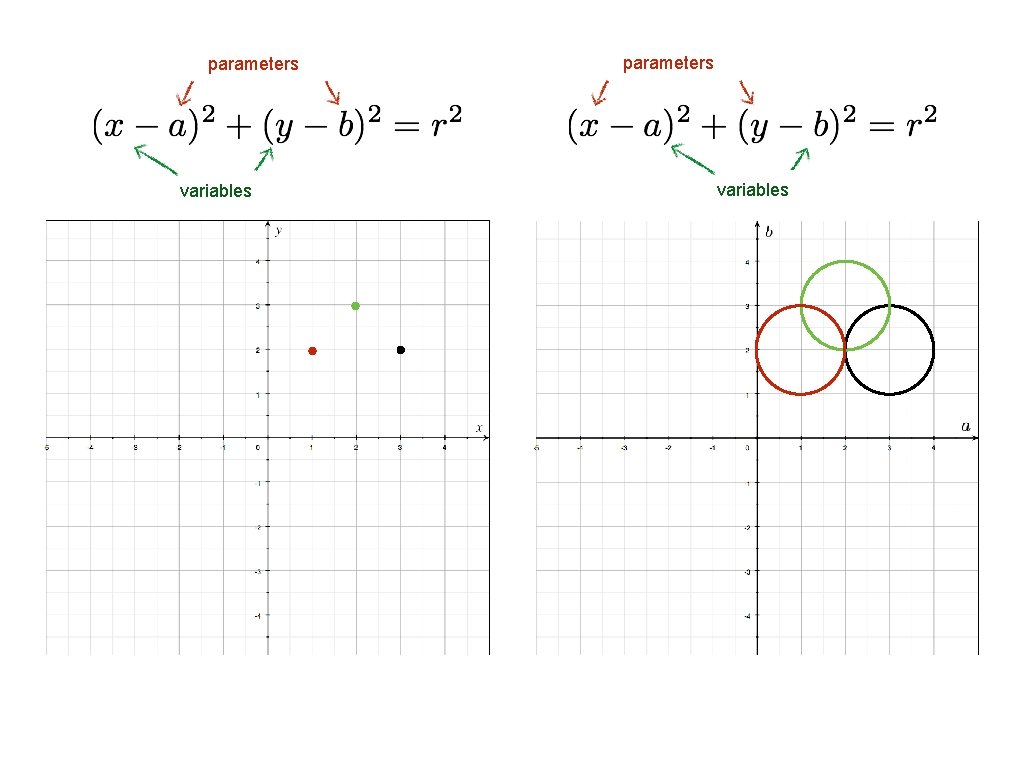
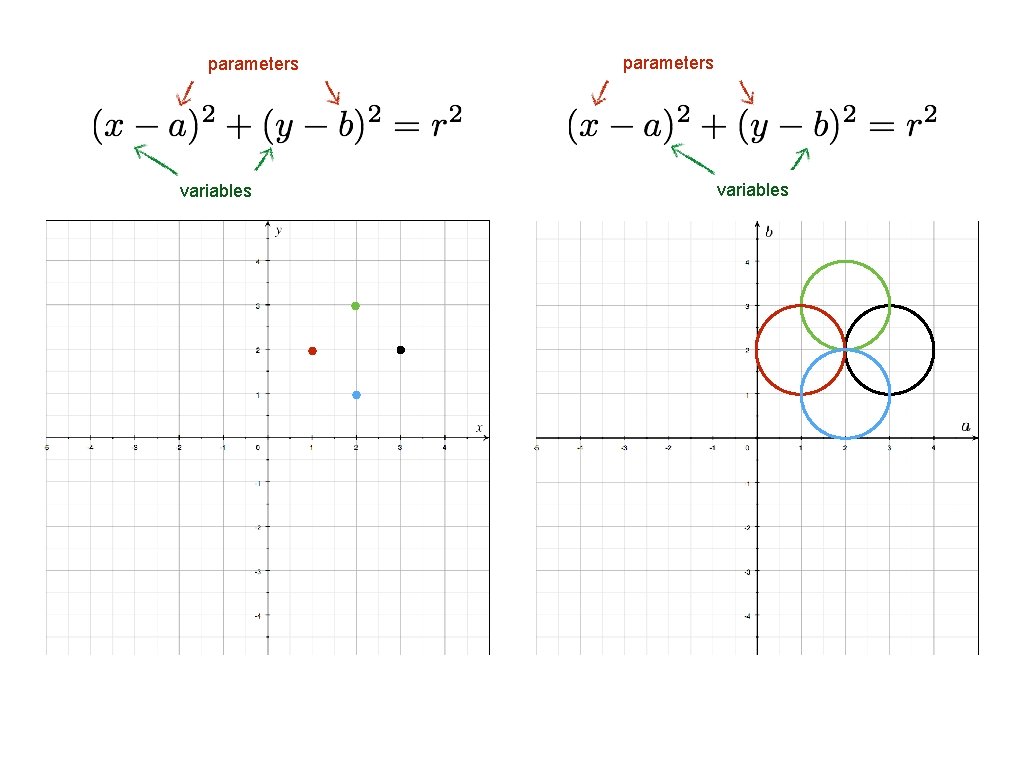
Let’s assume radius known parameters variables What is the dimension of the parameter space?
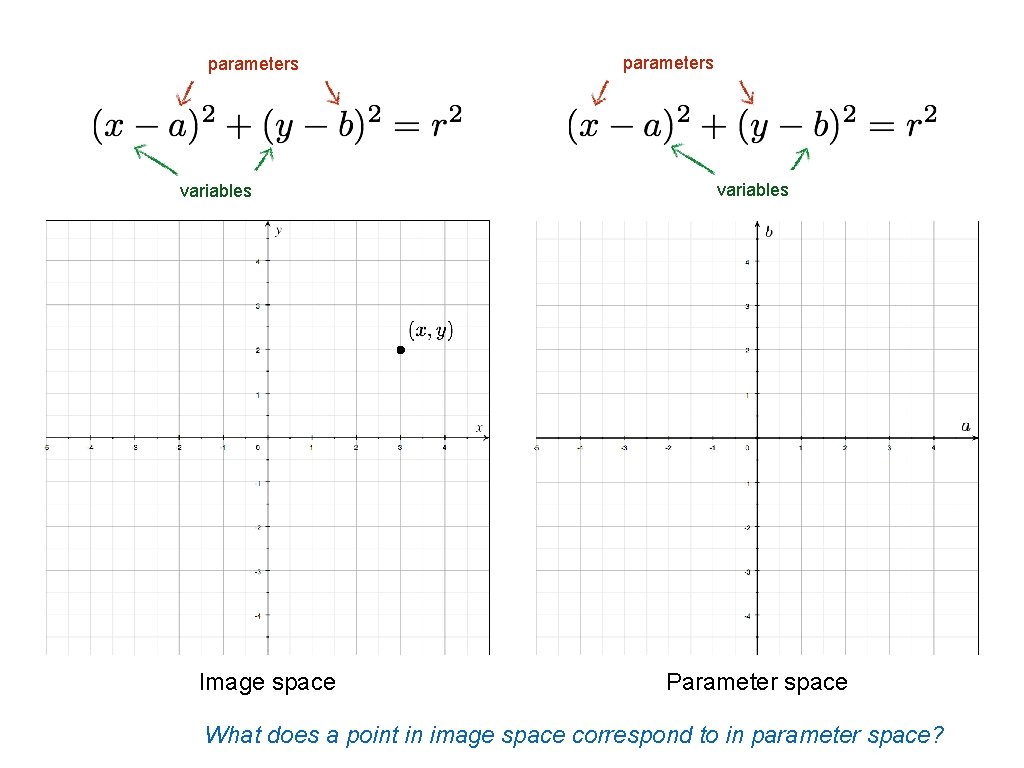
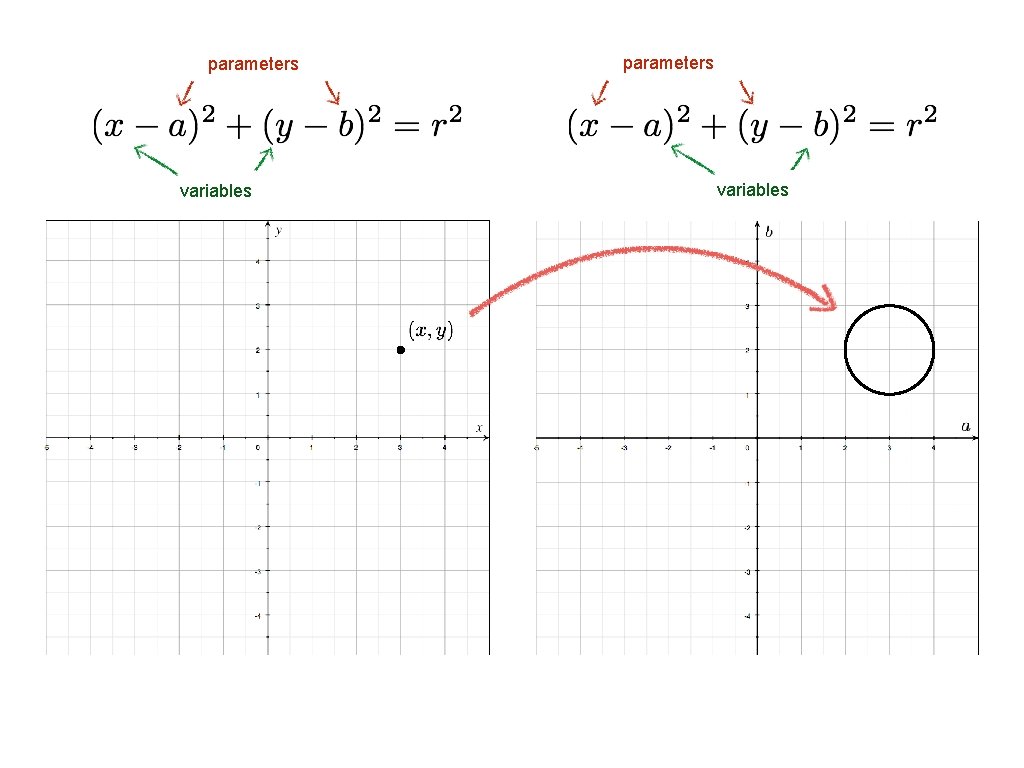
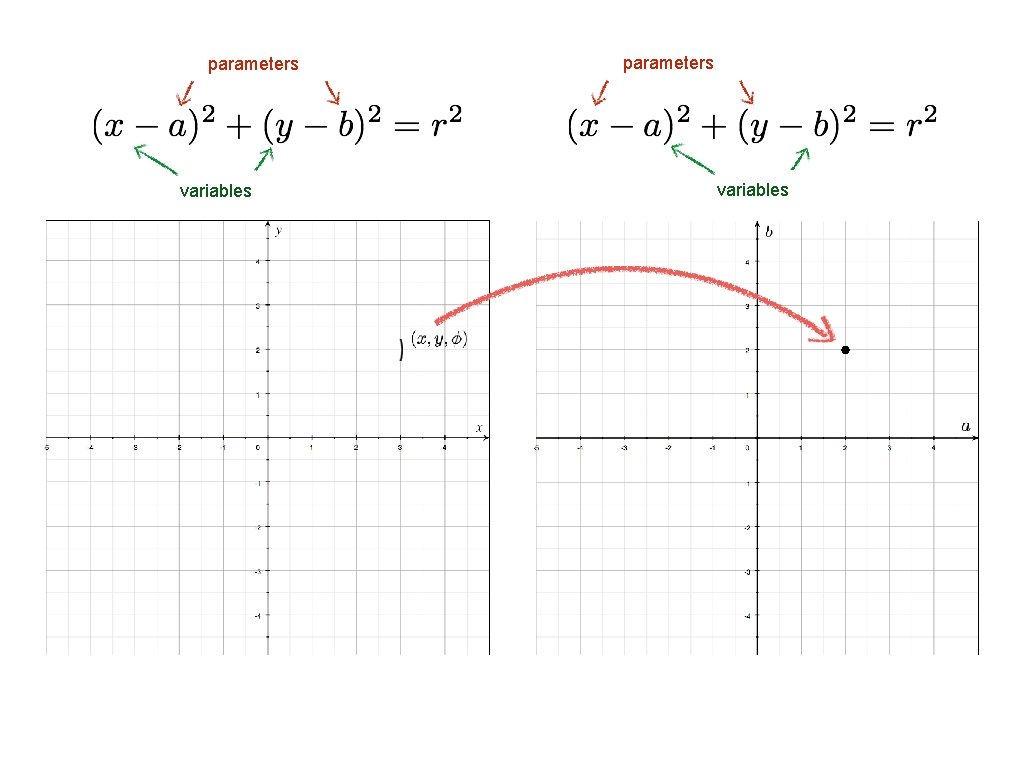
parameters variables Image space parameters variables Parameter space What does a point in image space correspond to in parameter space?
parameters variables
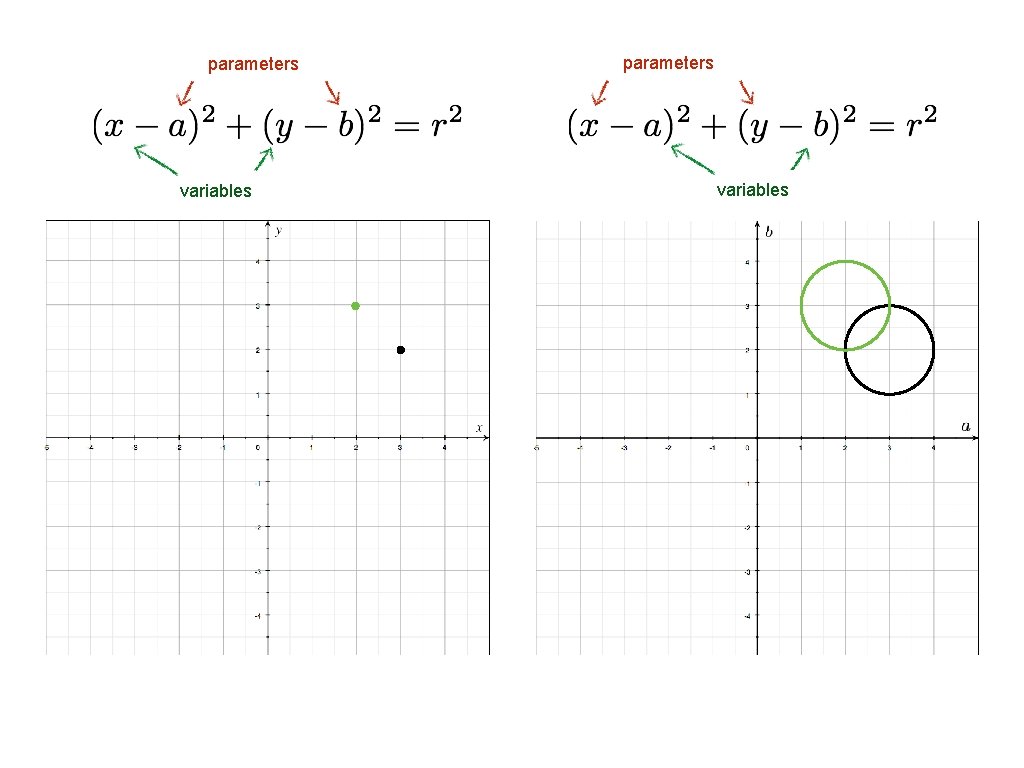
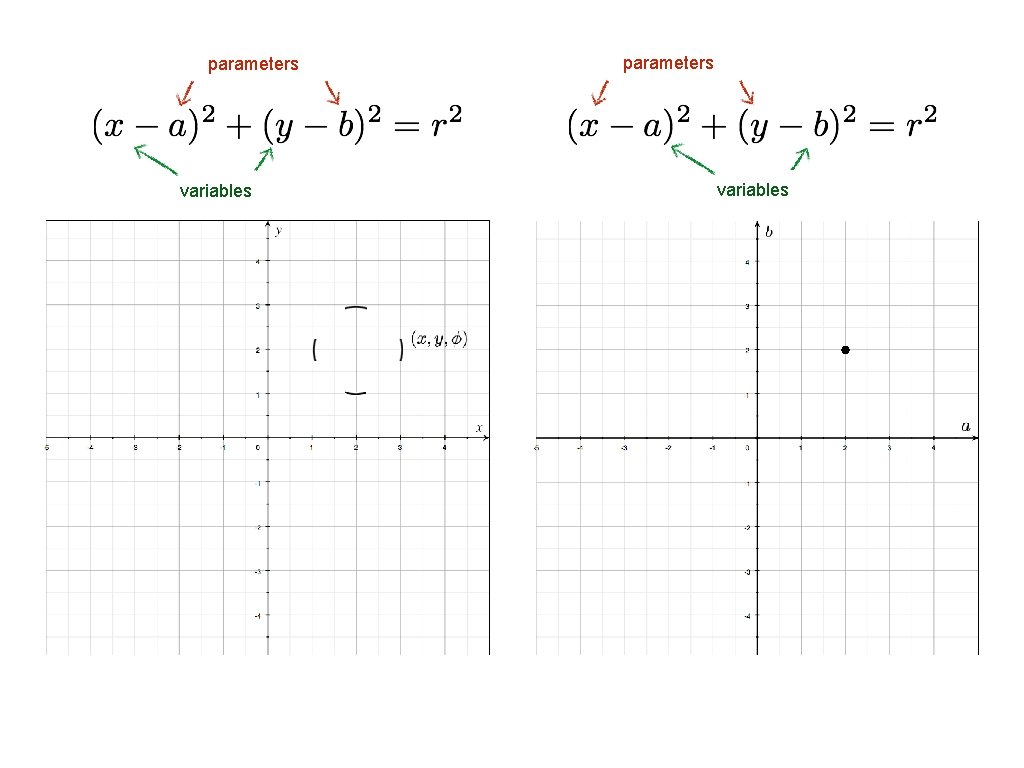
parameters variables
parameters variables
parameters variables
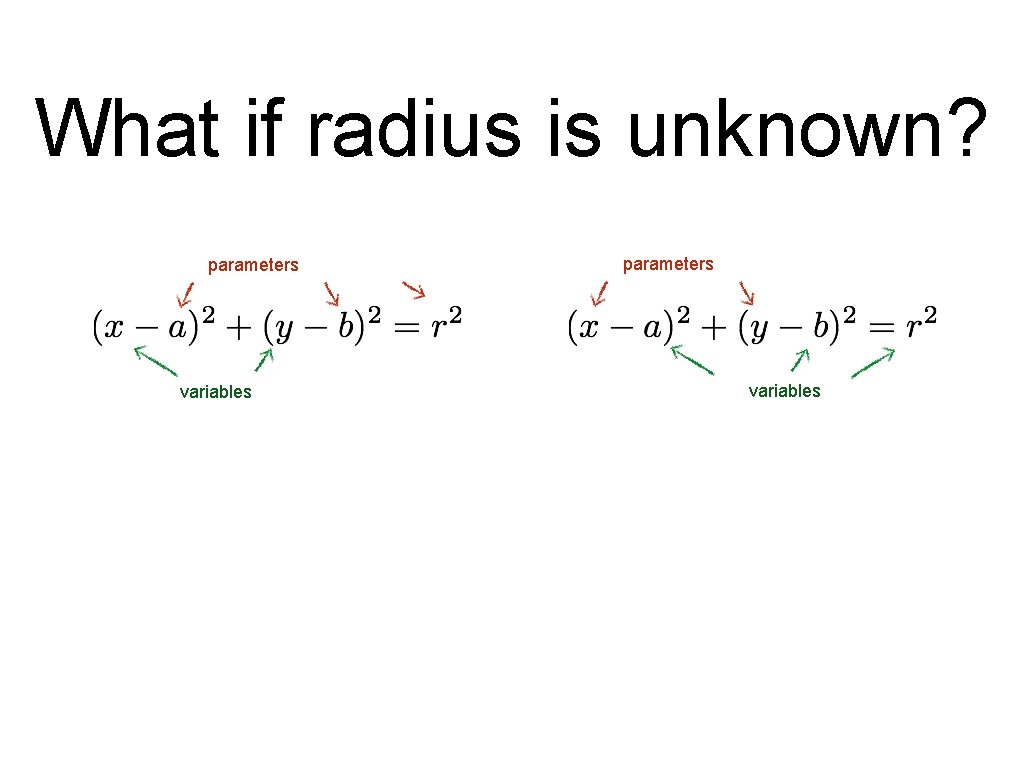
What if radius is unknown? parameters variables
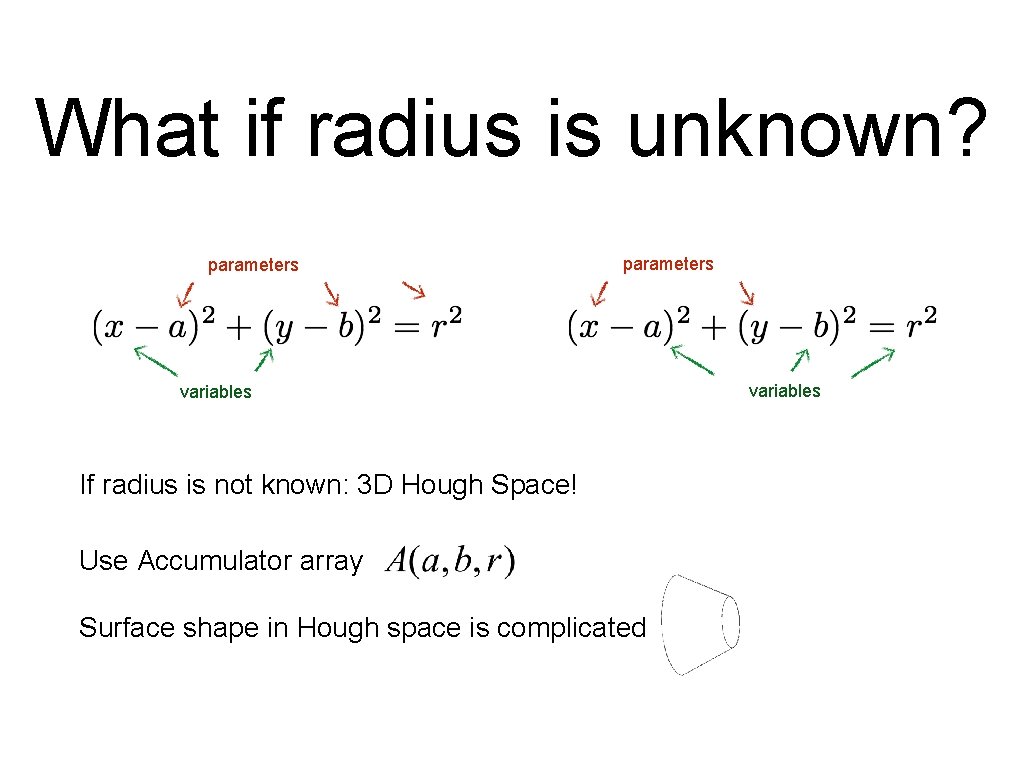
What if radius is unknown? parameters variables If radius is not known: 3 D Hough Space! Use Accumulator array Surface shape in Hough space is complicated variables
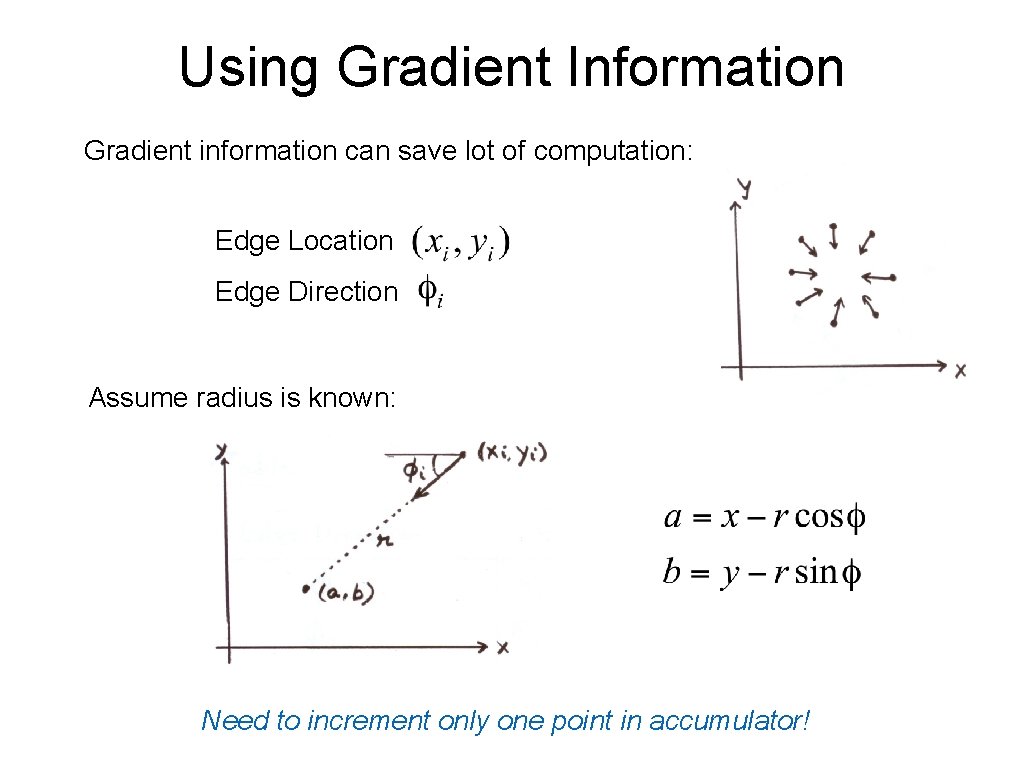
Using Gradient Information Gradient information can save lot of computation: Edge Location Edge Direction Assume radius is known: Need to increment only one point in accumulator!
parameters variables
parameters variables
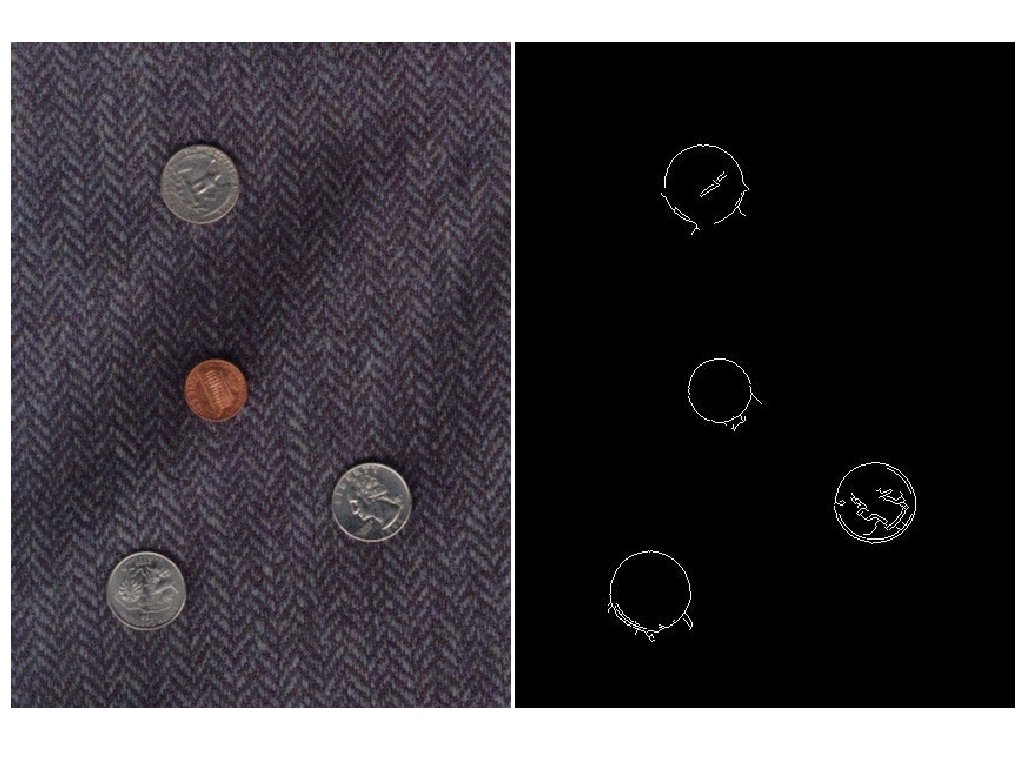
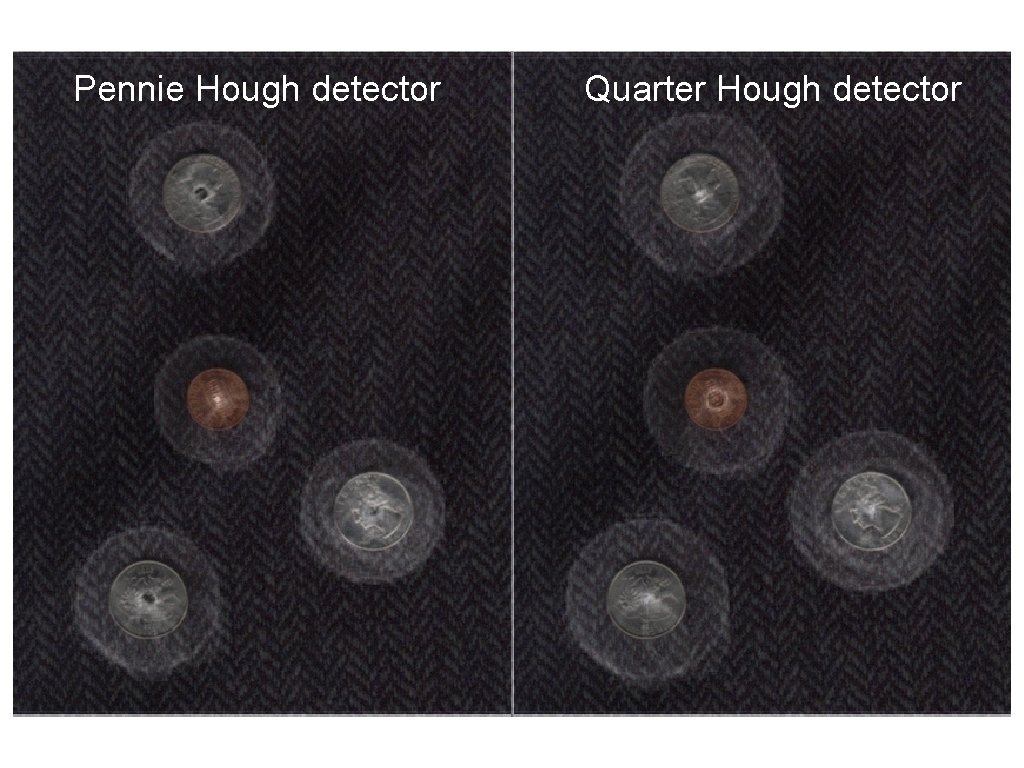
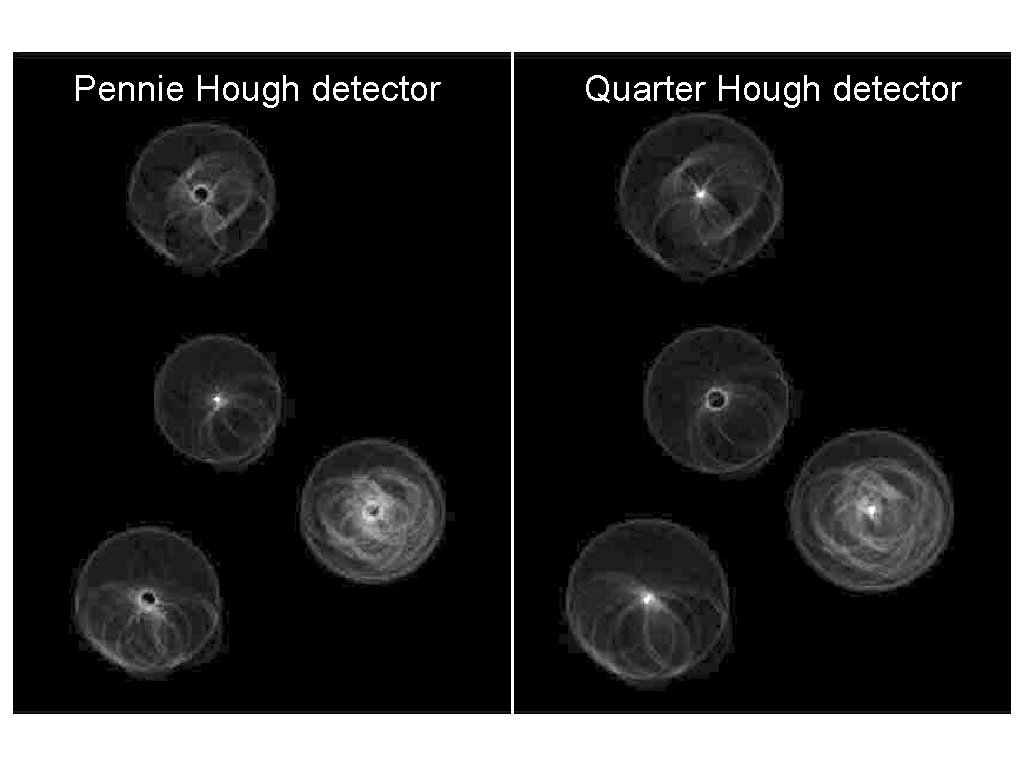
Pennie Hough detector Quarter Hough detector
Pennie Hough detector Quarter Hough detector
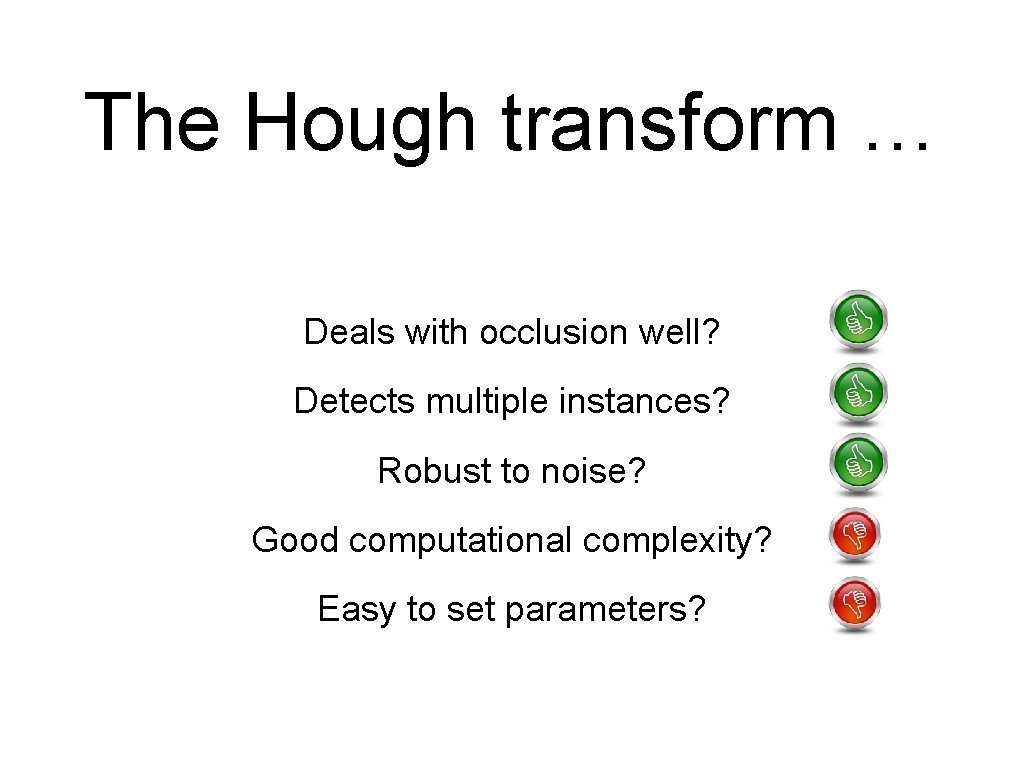
The Hough transform … Deals with occlusion well? Detects multiple instances? Robust to noise? Good computational complexity? Easy to set parameters?
Can you use Hough Transforms for other objects, beyond lines and circles? Do you have to use edge detectors to vote in Hough Space?
Application of Hough transforms
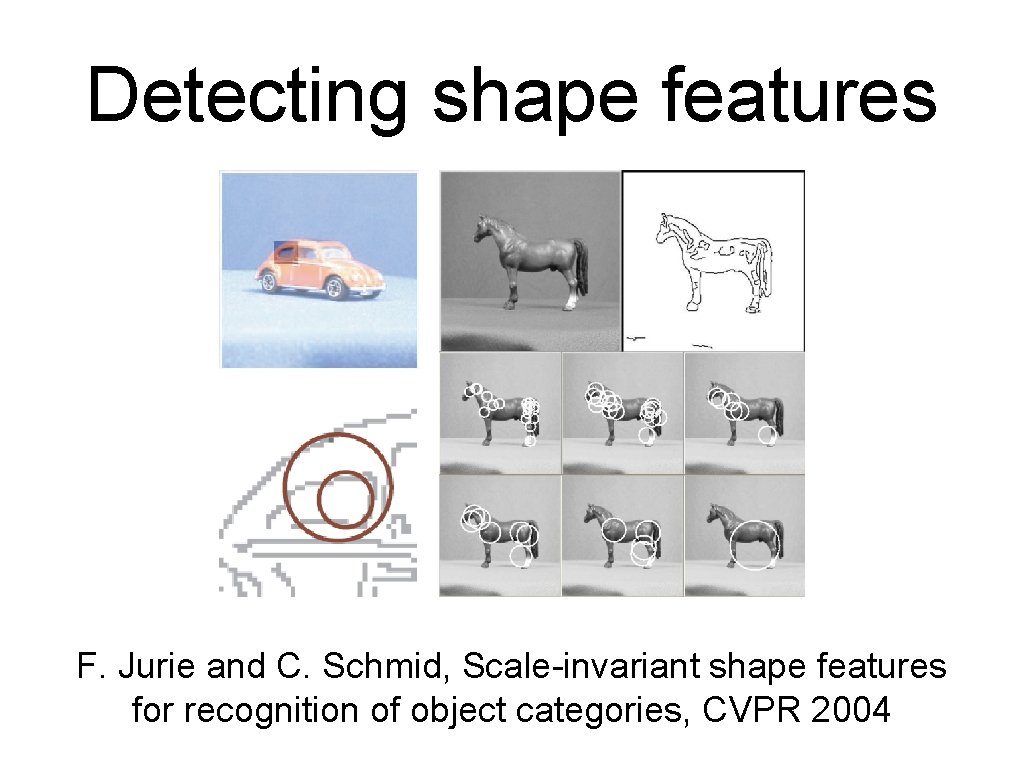
Detecting shape features F. Jurie and C. Schmid, Scale-invariant shape features for recognition of object categories, CVPR 2004
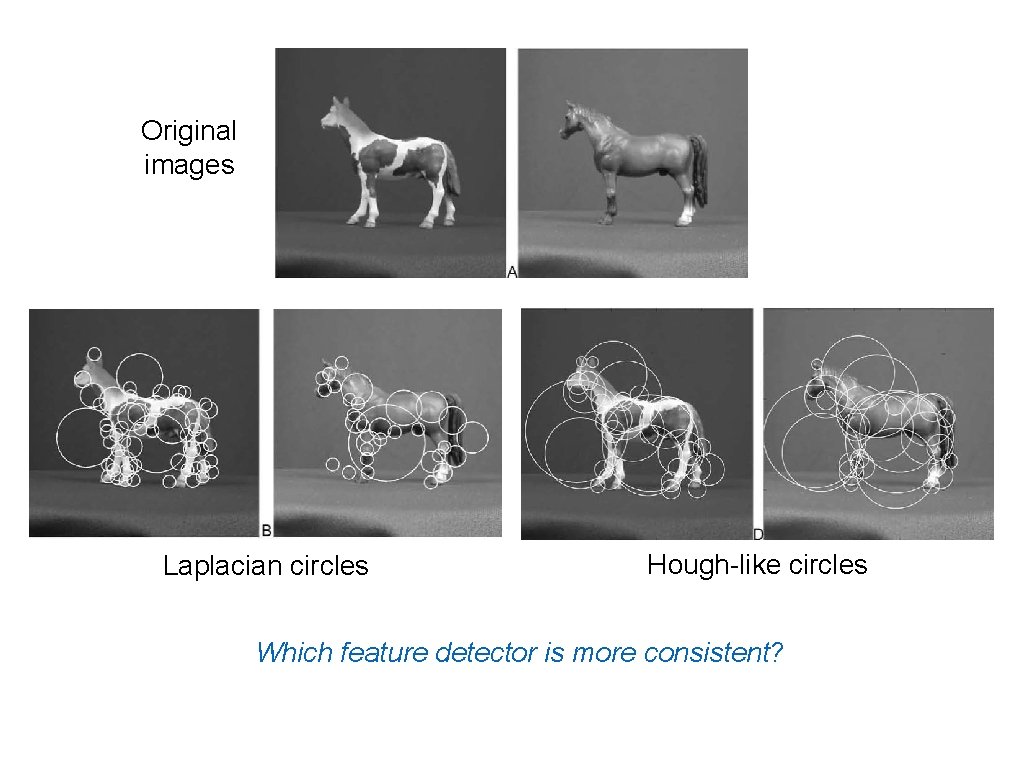
Original images Laplacian circles Hough-like circles Which feature detector is more consistent?
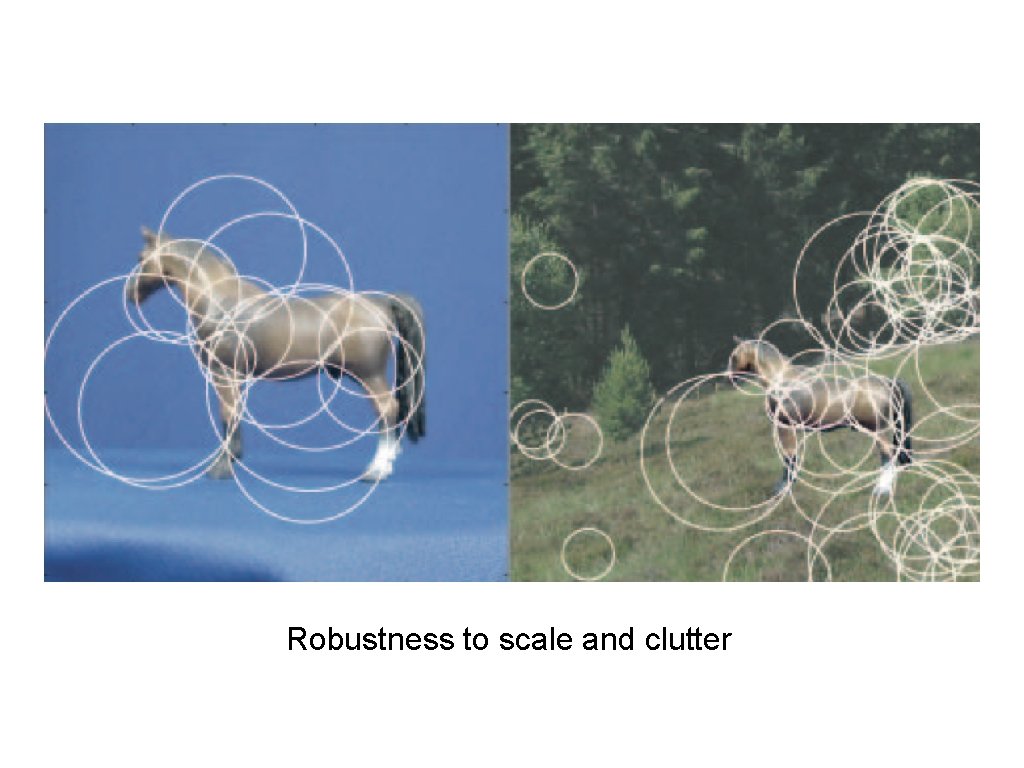
Robustness to scale and clutter
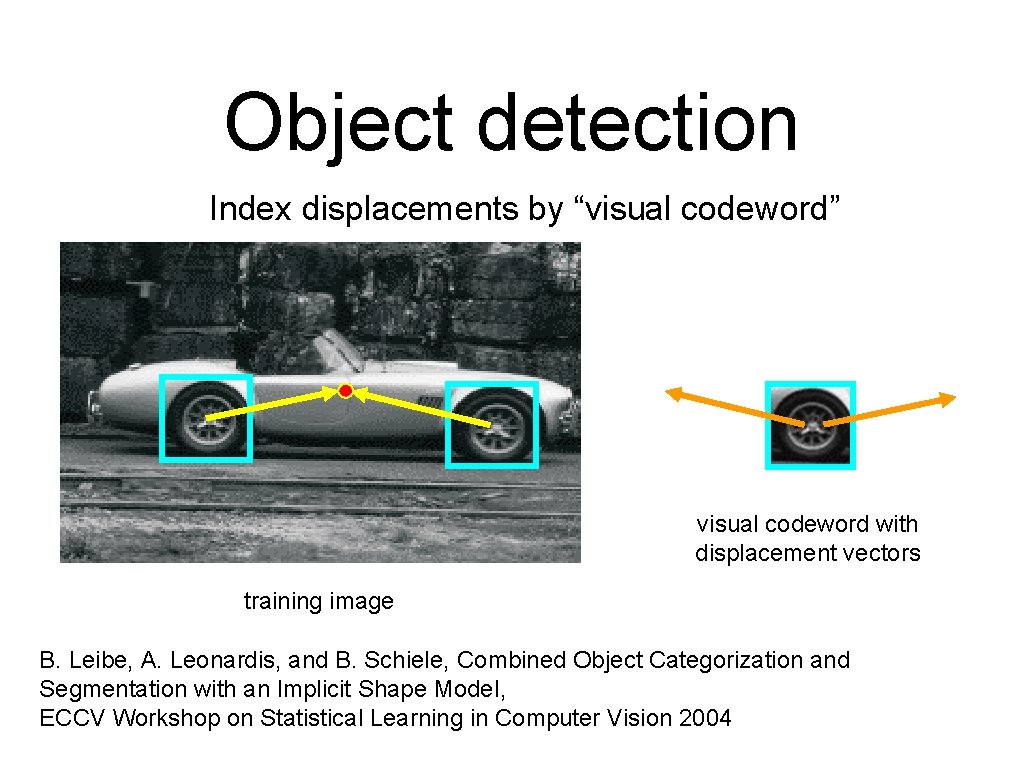
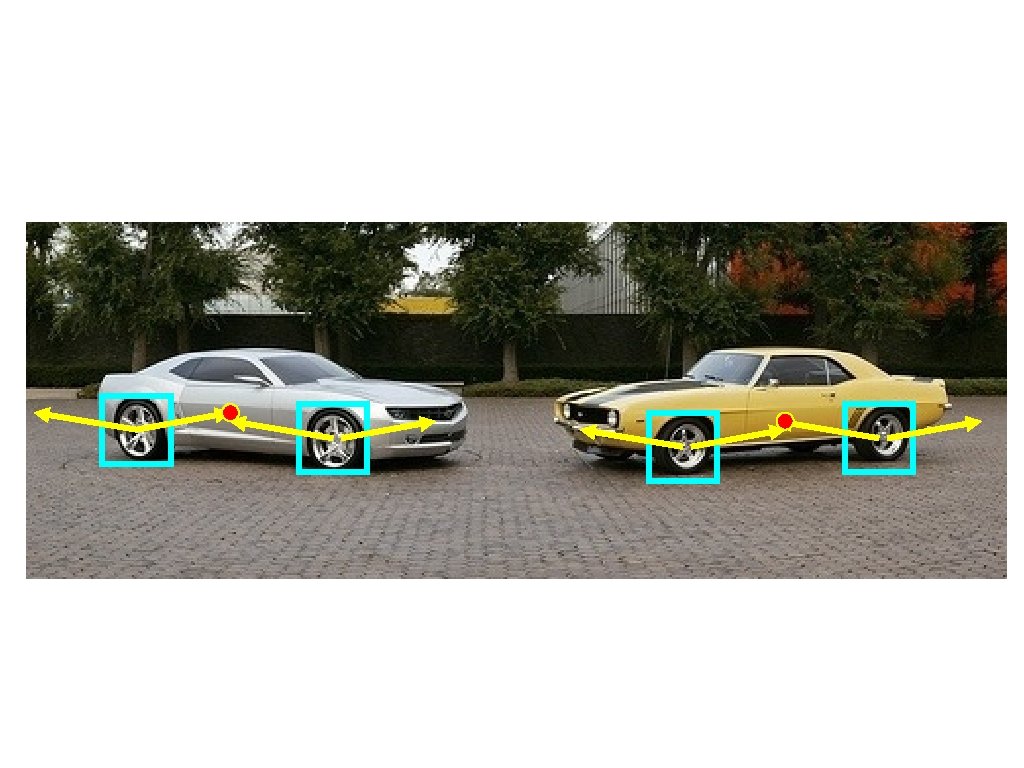
Object detection Index displacements by “visual codeword” visual codeword with displacement vectors training image B. Leibe, A. Leonardis, and B. Schiele, Combined Object Categorization and Segmentation with an Implicit Shape Model, ECCV Workshop on Statistical Learning in Computer Vision 2004
References Basic reading: • Szeliski textbook, Sections 4. 2, 4. 3.