
Lecture 1 Introduction Hui Zhang School of Computer





- Slides: 25
Lecture 1 Introduction Hui Zhang School of Computer Science Carnegie Mellon University 15 -441 Networking, Fall 2007 http: //www. cs. cmu. edu/~srini/15 -441/F 07/ 1
Today’s Lecture l l Course outline and goals. History and overview 2
Course Staff l Instructors » Hui Zhang – <hzhang@cs. cmu. edu> , Wean Hall 7126 » Srini Seshan – <srini+@cs. cmu. edu>, Wean Hall 8113 l Teaching assistants: » Daniel Spangenberger dspangen@gmail. com » Albert Sheu asheu@andrew. cmu. edu » One more TA to confirm soon 3
Course Goals l Become familiar with the principles and practice of computer networking » Protocols, resource sharing » Routing, transport protocols, naming, . . . l Learn how to write networked applications: » An IRC server » A peer-to-peer file transfer program l Get some understanding about network internals in a hands on way. » You’ll implement a routing protocol for your IRC server » TCP-style congestion control 4
Course Format l ~30 lectures » Cover the “principles and practice” » Readings are posted beforehand l l l 4 homework assignments Mid-term and final. 3 programming projects. » How to use and build networks / networked applications » Application layer; include key ideas from kernel » Larger, open-ended group projects. Start early! 5
Recitation Sections l Key 441 objective » systems and distributed programming l Different from what you’ve done before! » » » l Low level ( C ) Often designed to run indefinitely. Handle all errors! Must be secure Interfaces specified by documented protocols Concurrency involved (inter and intra-machine) Must have good test methods Recitations address this » “A system hackers’ view of software engineering” » Practical techniques designed to save you time & pain! 6
Waiting List l l l Currently 58 people are enrolled, and 28 people are on the waiting list. If you are enrolled and do not plan to take the course, please drop it within a reasonable amount of time If you are on the waiting list » Please come to lectures for the time being » Please sign in for each lecture » We expect to sort out waiting list issue within the next couple of weeks 7
Administrative Stuff l Watch the course web page. » Handouts, readings, . . l Read courses bboards. » “Announce” for official announcements » “General” for questions/answers l l Office hours posted on web page. Course secretary » Barbara Grandillo, Wean Hall 8018 l Office hours this week by email / appointment » Final office hours posted Thursday l Books – have people gone to the bookstore? How many copies? Should be there… 8
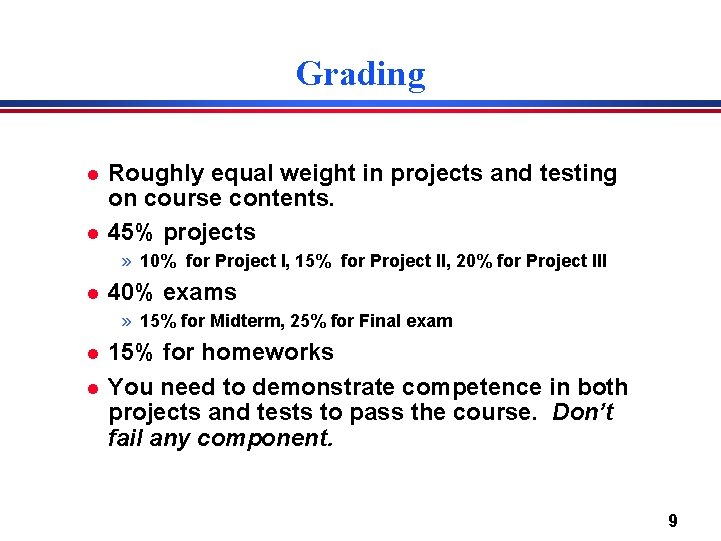
Grading l l Roughly equal weight in projects and testing on course contents. 45% projects » 10% for Project I, 15% for Project II, 20% for Project III l 40% exams » 15% for Midterm, 25% for Final exam l l 15% for homeworks You need to demonstrate competence in both projects and tests to pass the course. Don’t fail any component. 9
Policy on Collaboration l Working together is important. » Discuss course material in general terms » Work together on program debugging, . . l Parts must be your own work » Homework, midterm, final l Projects: Teams of two » Collaboration, group project skills » Both students should understand the entire project l Web page has details. 10
Policy on Late Work and Regrading l No assignments with a “short fuse”. » Homeworks: ~1 week » Projects: ~5 weeks l Late work will receive a 10% penalty/day. » No penalty for a limited number of handins - see web page » No assignment can be more than 2 days late l l Only exception is documented illness and family emergencies Start on time! » Every year some students discover that a 4 week project cannot be completed in a week l Requests for regrading must be submitted in writing with course secretary within 2 weeks. » Regrading will be done by original grader 11
This Week l Intro – what’s this all about? Applications and Network programming review. l Course outline: l » Low-level (physical, link, circuits, etc. ) » Internet core concepts (addressing, routing, DNS) » Advanced topics l On to the good stuff… 12
History of Computer Networks l l l Communication Telecommunication network Computer network Convergence network 13
Early Communication over Long Distance l l Between human beings Letter and messenger » Information carried by physical objects » Speed limited by transportation means: horse, bird, train, car » Bandwidth? distance? security? l Fire » Early optical communication » Speed of light » Bandwidth? distance? security? 14
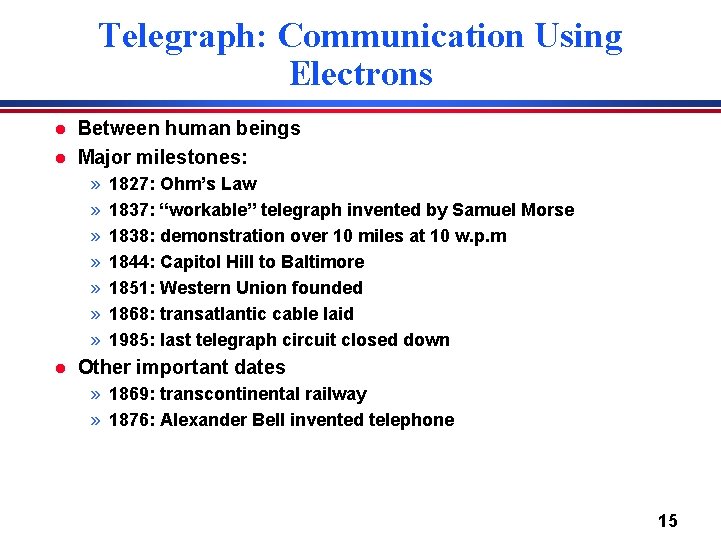
Telegraph: Communication Using Electrons l l Between human beings Major milestones: » » » » l 1827: Ohm’s Law 1837: “workable” telegraph invented by Samuel Morse 1838: demonstration over 10 miles at 10 w. p. m 1844: Capitol Hill to Baltimore 1851: Western Union founded 1868: transatlantic cable laid 1985: last telegraph circuit closed down Other important dates » 1869: transcontinental railway » 1876: Alexander Bell invented telephone 15
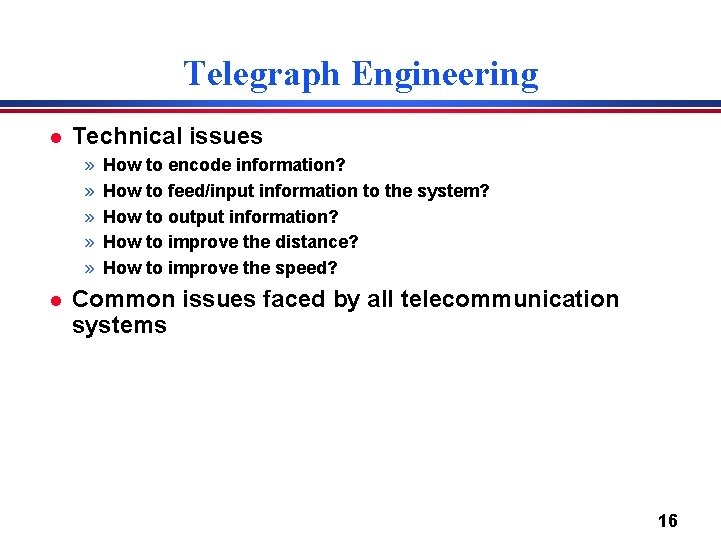
Telegraph Engineering l Technical issues » » » l How to encode information? How to feed/input information to the system? How to output information? How to improve the distance? How to improve the speed? Common issues faced by all telecommunication systems 16
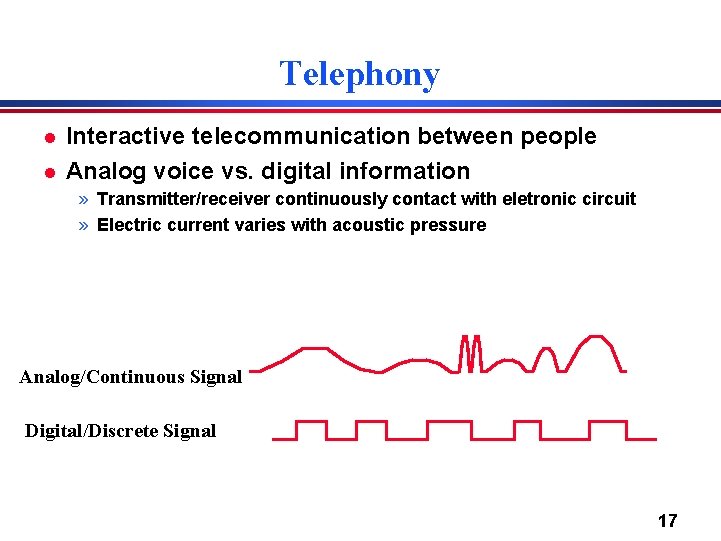
Telephony l l Interactive telecommunication between people Analog voice vs. digital information » Transmitter/receiver continuously contact with eletronic circuit » Electric current varies with acoustic pressure Analog/Continuous Signal Digital/Discrete Signal 17
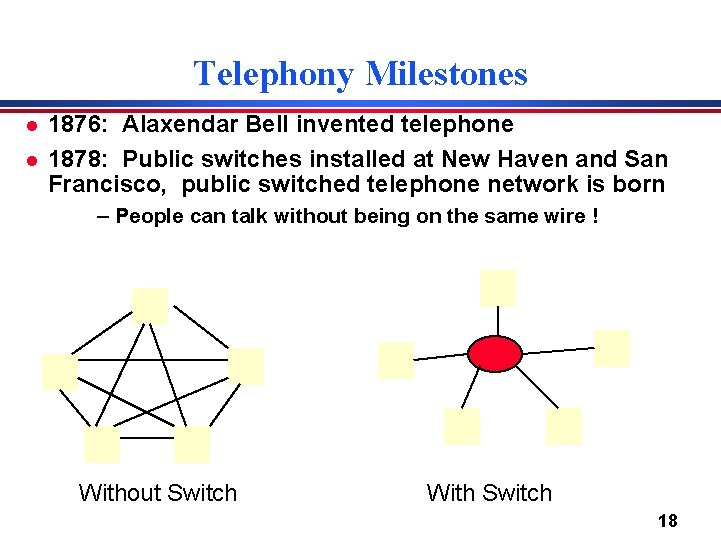
Telephony Milestones l l 1876: Alaxendar Bell invented telephone 1878: Public switches installed at New Haven and San Francisco, public switched telephone network is born – People can talk without being on the same wire ! Without Switch With Switch 18
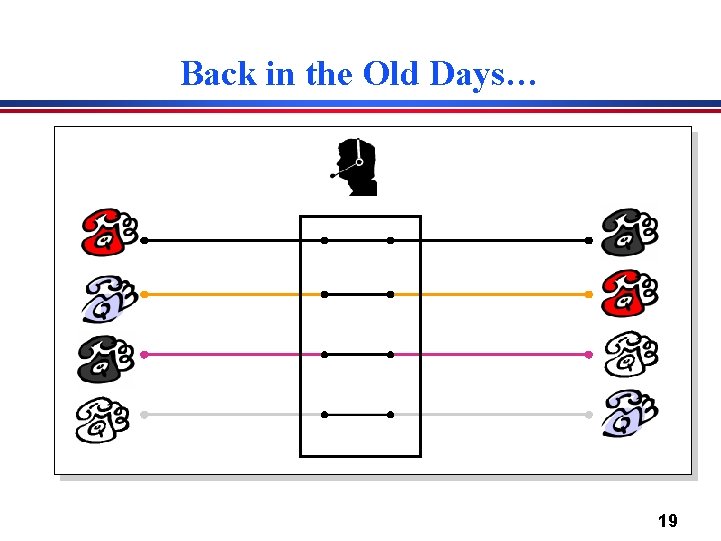
Back in the Old Days… 19
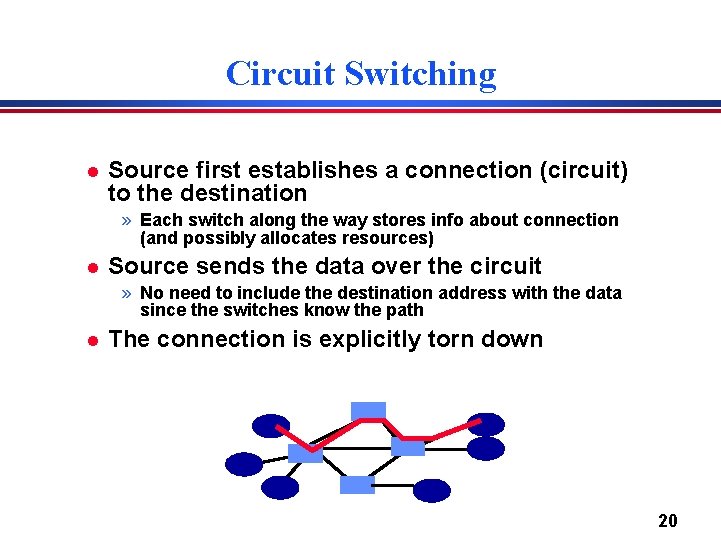
Circuit Switching l Source first establishes a connection (circuit) to the destination » Each switch along the way stores info about connection (and possibly allocates resources) l Source sends the data over the circuit » No need to include the destination address with the data since the switches know the path l The connection is explicitly torn down 20
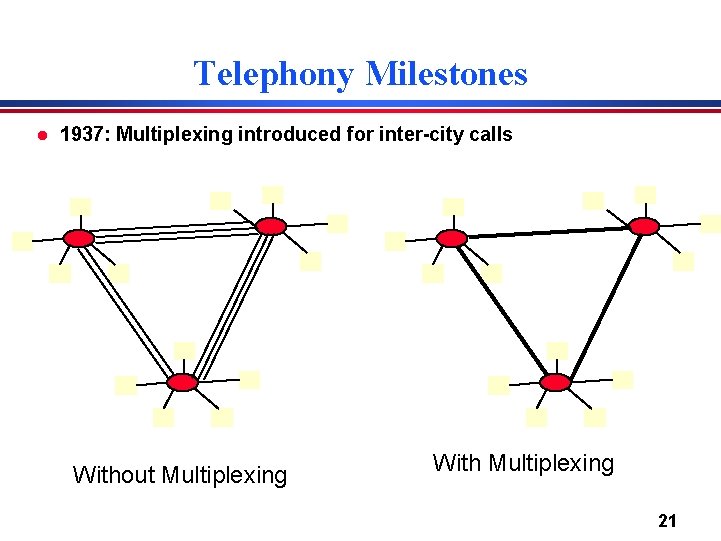
Telephony Milestones l 1937: Multiplexing introduced for inter-city calls Without Multiplexing With Multiplexing 21
Telephony Milestones l l l l 1878: First telephone directory; white house line 1881: Insulated, balanced twisted pair as local loop 1885: AT&T formed 1892: First automatic commercial telephone switch 1903: 3 million telephones in U. S. 1915: First transcontinental telephone line 1927: First commercial transatlantic commercial service 22
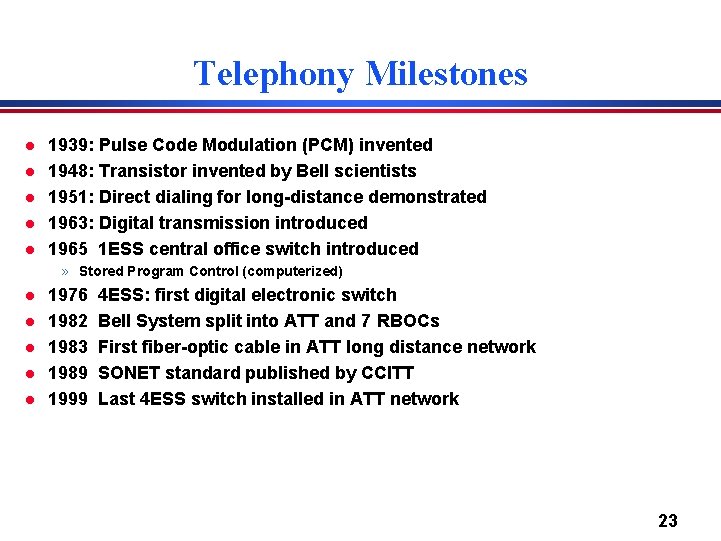
Telephony Milestones l l l 1939: Pulse Code Modulation (PCM) invented 1948: Transistor invented by Bell scientists 1951: Direct dialing for long-distance demonstrated 1963: Digital transmission introduced 1965 1 ESS central office switch introduced » Stored Program Control (computerized) l l l 1976 1982 1983 1989 1999 4 ESS: first digital electronic switch Bell System split into ATT and 7 RBOCs First fiber-optic cable in ATT long distance network SONET standard published by CCITT Last 4 ESS switch installed in ATT network 23
Summary l l l Communication long before computer Evolutions of modern communication and computer intertwined Important concepts » Switching » Multiplexing » Analog vs. digital 24
Data or Computer Networks l Networks designed for computers to computers or devices » vs. communication between human beings l Digital information » vs. analog voice 25