
Mobile Device Security Zachary Weinberg zackwcmu edu Carnegie
Mobile Device Security Zachary Weinberg zackw@cmu. edu Carnegie Mellon University
Researchers discussed • • Ravishankar Borgaonkar Manuel Egele Adrienne Porter Felt Nico Golde Karsten Nohl Wu Zhou the grugq 2
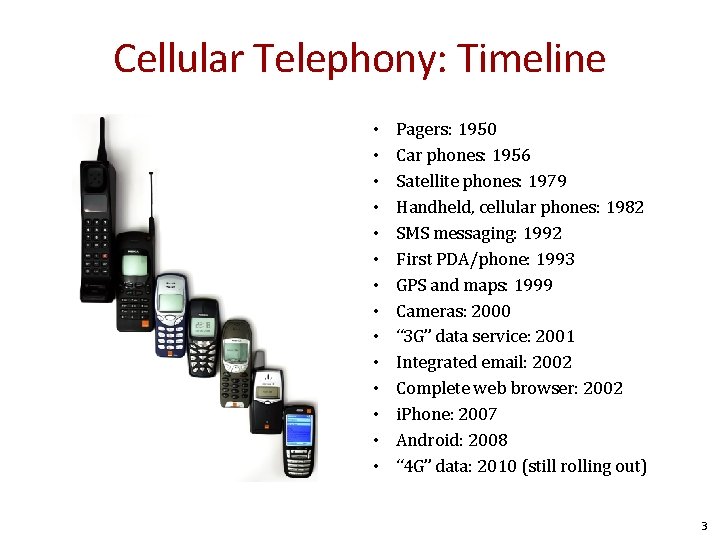
Cellular Telephony: Timeline • • • • Pagers: 1950 Car phones: 1956 Satellite phones: 1979 Handheld, cellular phones: 1982 SMS messaging: 1992 First PDA/phone: 1993 GPS and maps: 1999 Cameras: 2000 “ 3 G” data service: 2001 Integrated email: 2002 Complete web browser: 2002 i. Phone: 2007 Android: 2008 “ 4 G” data: 2010 (still rolling out) 3
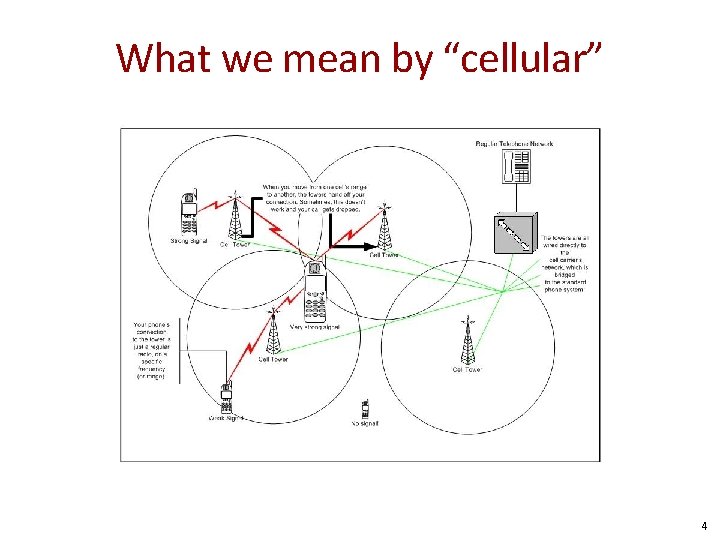
What we mean by “cellular” 4
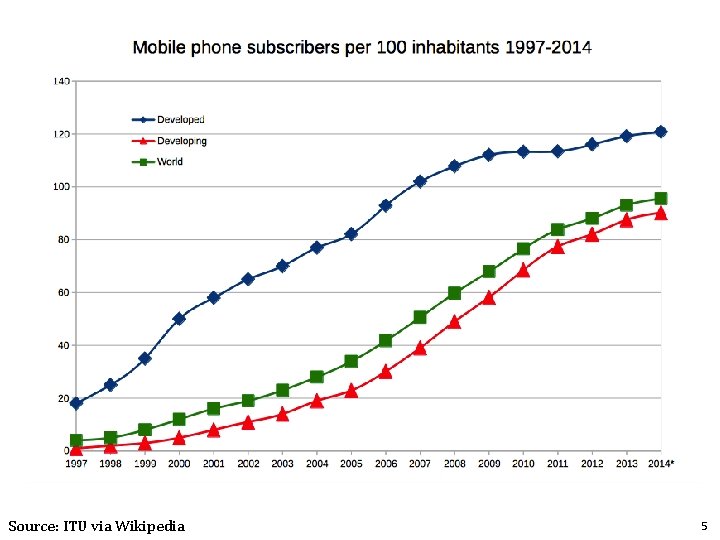
Source: ITU via Wikipedia 5
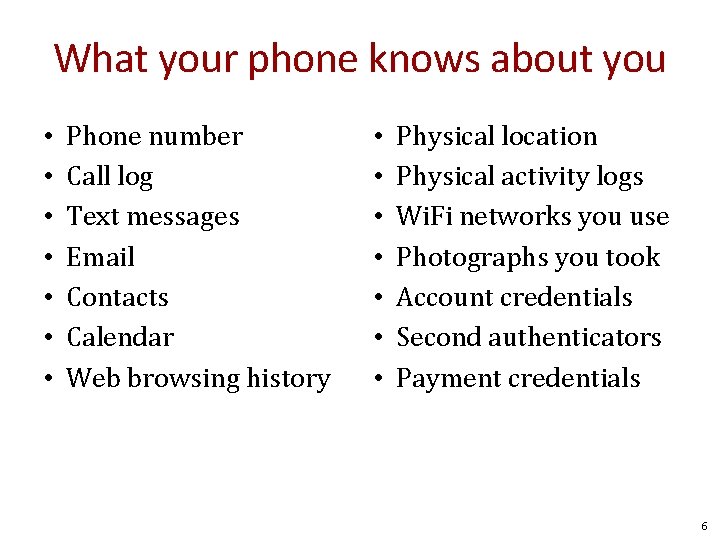
What your phone knows about you • • Phone number Call log Text messages Email Contacts Calendar Web browsing history • • Physical location Physical activity logs Wi. Fi networks you use Photographs you took Account credentials Second authenticators Payment credentials 6
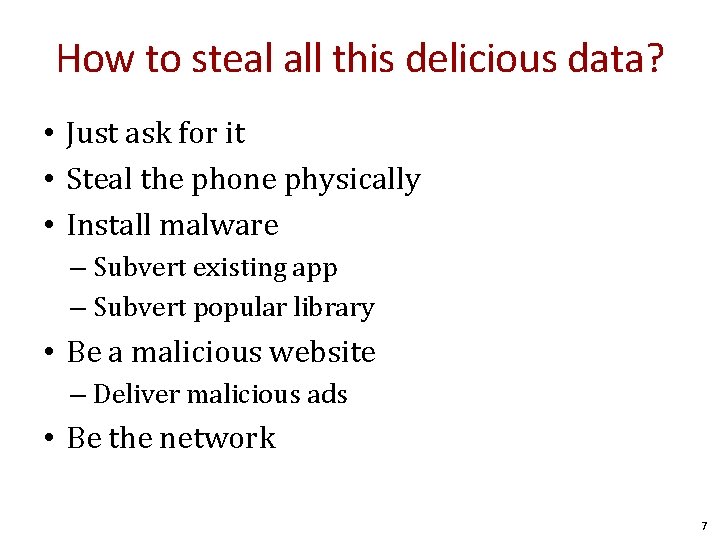
How to steal all this delicious data? • Just ask for it • Steal the phone physically • Install malware – Subvert existing app – Subvert popular library • Be a malicious website – Deliver malicious ads • Be the network 7
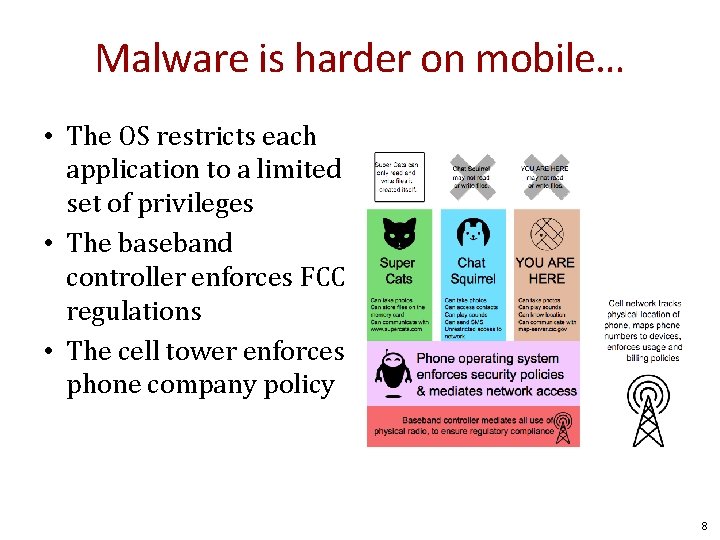
Malware is harder on mobile… • The OS restricts each application to a limited set of privileges • The baseband controller enforces FCC regulations • The cell tower enforces phone company policy 8
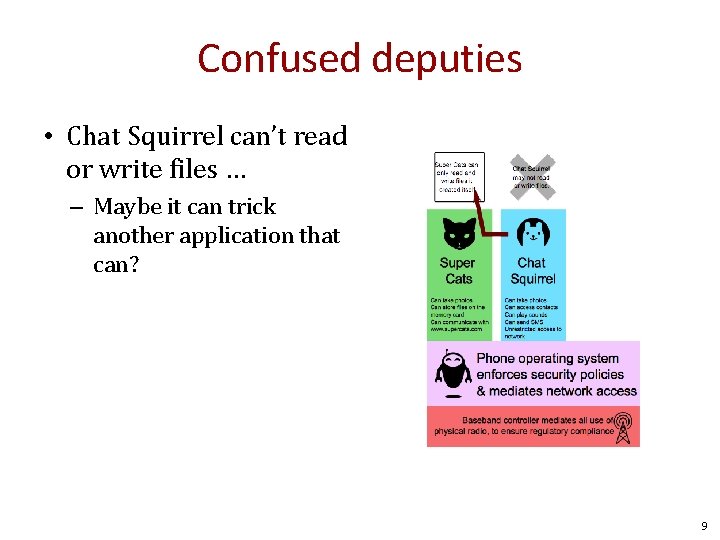
Confused deputies • Chat Squirrel can’t read or write files … – Maybe it can trick another application that can? 9
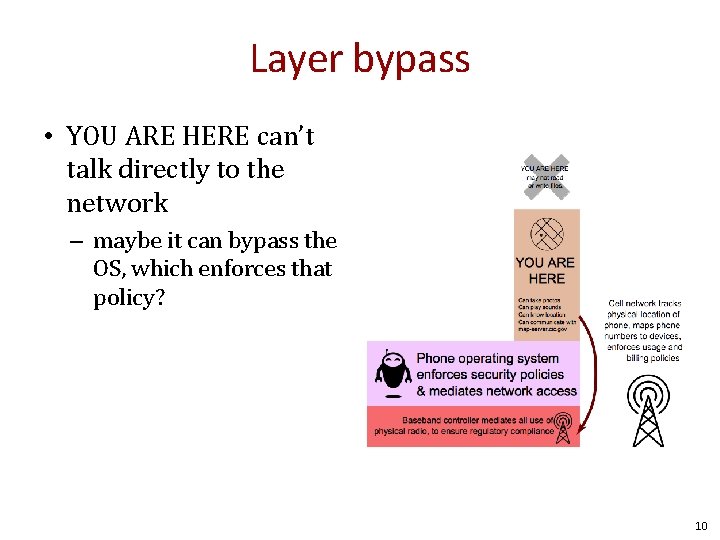
Layer bypass • YOU ARE HERE can’t talk directly to the network – maybe it can bypass the OS, which enforces that policy? 10
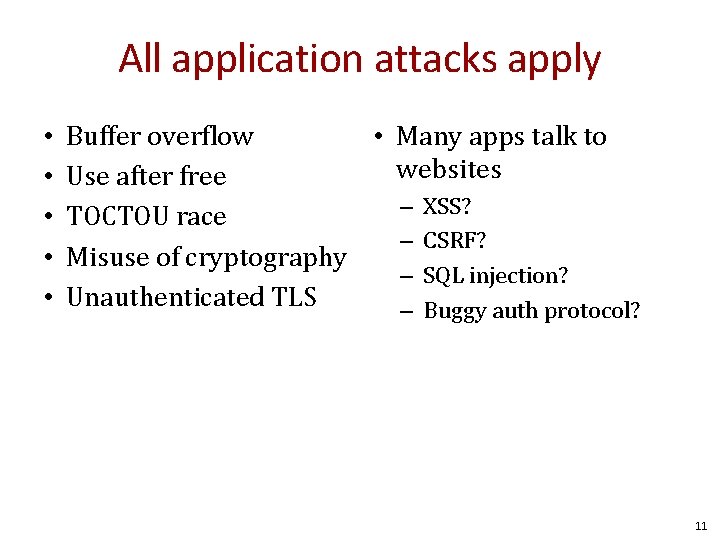
All application attacks apply • • • Buffer overflow • Many apps talk to websites Use after free – XSS? TOCTOU race – CSRF? Misuse of cryptography – SQL injection? Unauthenticated TLS – Buggy auth protocol? 11
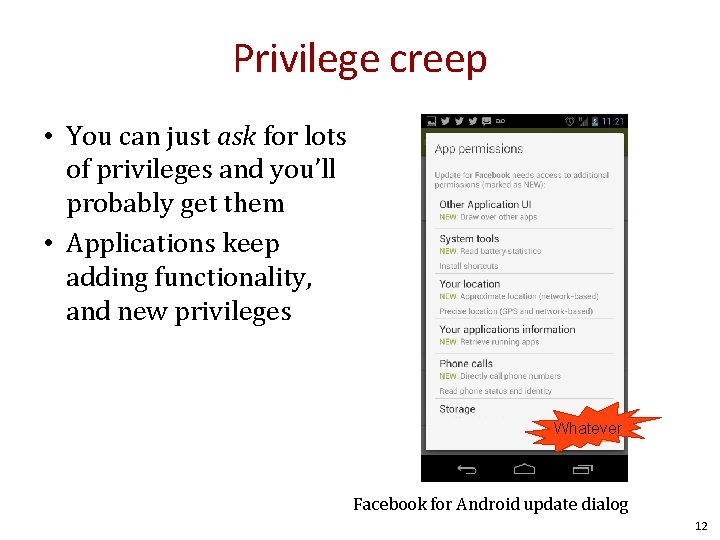
Privilege creep • You can just ask for lots of privileges and you’ll probably get them • Applications keep adding functionality, and new privileges Whatever Facebook for Android update dialog 12
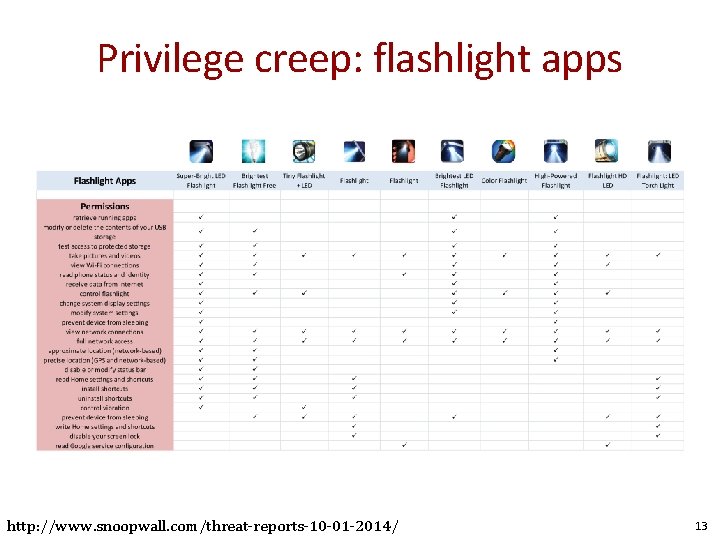
Privilege creep: flashlight apps http: //www. snoopwall. com/threat-reports-10 -01 -2014/ 13
Ad libraries are, as usual, evil • 1, 407 i. OS applications analyzed – (825 from App Store, 582 from Cydia) • Pervasive ad and app-telemetry libraries – 772 apps (55%) contain at least one such library • Send UDID and App. ID on start, with each ad-request – Ad company can build detailed usage profiles • Application has privileges it doesn’t need itself https: //iseclab. org/papers/egele-ndss 11. pdf 14
Repackaging (with malware) • • Take a legitimate application Combine it with off-the-shelf malware Re-upload to app store under new name You get the purchase price, the ad revenue, and the botnet! • 1083 of 1260 malware samples were this http: //www. ieee-security. org/TC/SP 2012/papers/4681 a 095. pdf 15
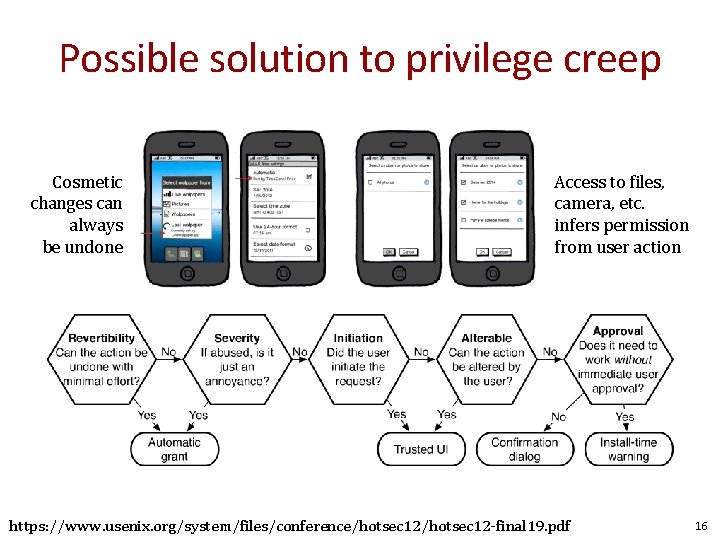
Possible solution to privilege creep Cosmetic changes can always be undone Access to files, camera, etc. infers permission from user action https: //www. usenix. org/system/files/conference/hotsec 12 -final 19. pdf 16
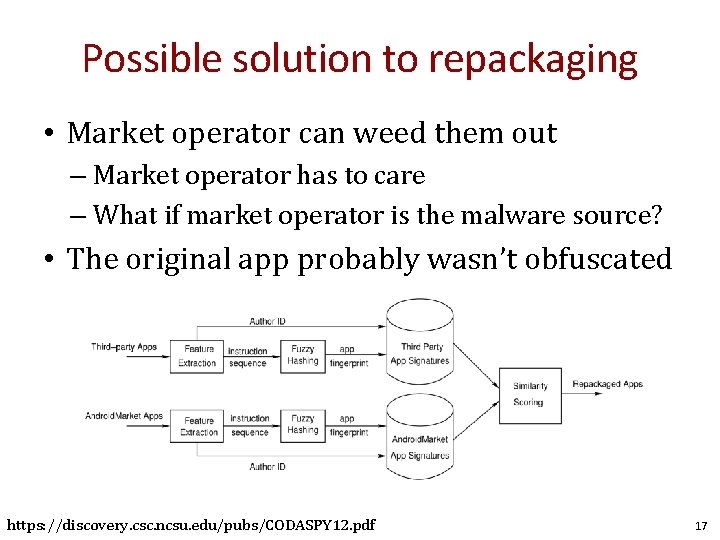
Possible solution to repackaging • Market operator can weed them out – Market operator has to care – What if market operator is the malware source? • The original app probably wasn’t obfuscated https: //discovery. csc. ncsu. edu/pubs/CODASPY 12. pdf 17
Possible solution to evil advertising 18
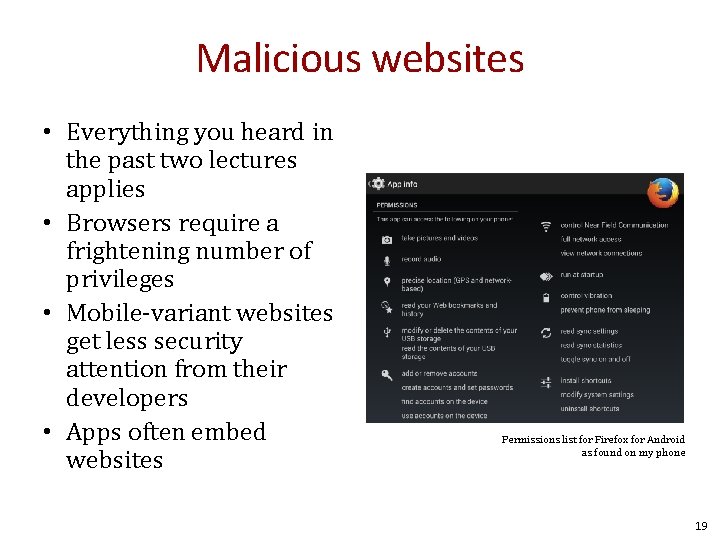
Malicious websites • Everything you heard in the past two lectures applies • Browsers require a frightening number of privileges • Mobile-variant websites get less security attention from their developers • Apps often embed websites Permissions list for Firefox for Android as found on my phone 19
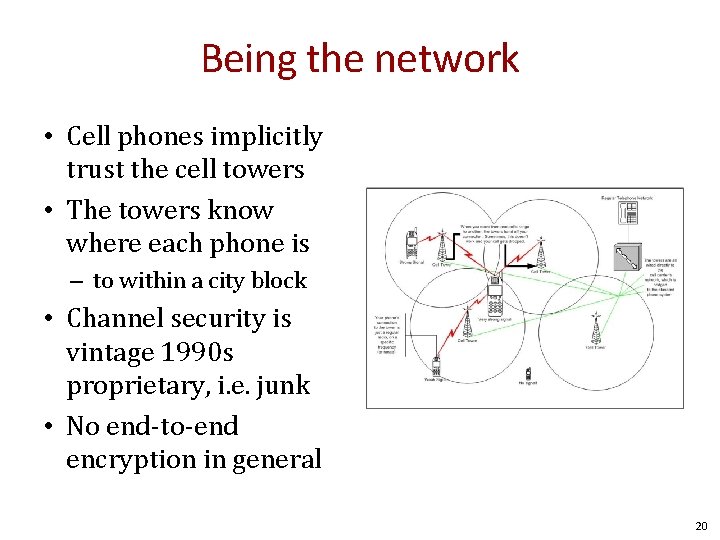
Being the network • Cell phones implicitly trust the cell towers • The towers know where each phone is – to within a city block • Channel security is vintage 1990 s proprietary, i. e. junk • No end-to-end encryption in general 20
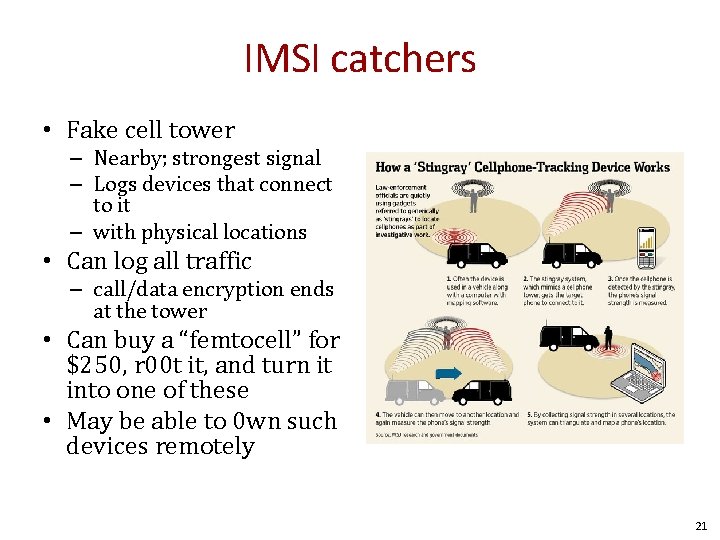
IMSI catchers • Fake cell tower – Nearby; strongest signal – Logs devices that connect to it – with physical locations • Can log all traffic – call/data encryption ends at the tower • Can buy a “femtocell” for $250, r 00 t it, and turn it into one of these • May be able to 0 wn such devices remotely 21
Channel security or lack thereof • An object lesson in Kerckhoffs’ Principle • 2 G: A 5 ciphers, developed 1987, kept secret – Reverse engineered in 1999 – A 5/2 completely broken within a month – A 5/1 partially broken 2006, completely 2010 • 3 G: KASUMI cipher, developed 1999, semipublicly – Weaknesses found 2001, 2006, 2010, 2013… – Some practical attacks, but not (yet!) as used in 3 G • Compare AES: developed 1999 -2001, publicly – Still no practical attacks 22
Protocol downgrade • 3 G and up have OK channel security, but… • Phones automatically fall back to 2 G if no 3 G service • Jam the 3 G signal from the real tower, crack the weak 2 G encryption 23
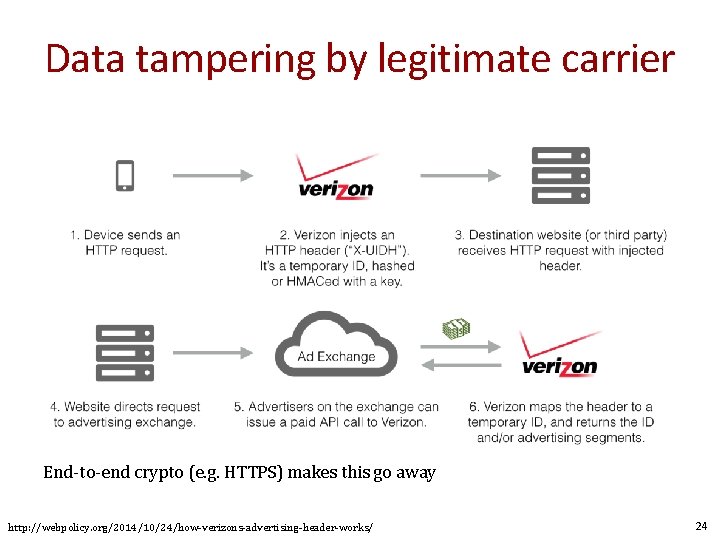
Data tampering by legitimate carrier End-to-end crypto (e. g. HTTPS) makes this go away http: //webpolicy. org/2014/10/24/how-verizons-advertising-header-works/ 24
Solution for tampering/eavesdropping • End-to-end secure channel • Data: HTTPS, VPNs – Built into i. OS and Android • Calls, text messages: need 3 rd party app – Whisper. Systems, Silent Circle, etc – Both ends have to have the software 25
Solution for location tracking • Cell towers can’t help but know where the phones are • Carriers do not need to record location history, maybe they shouldn’t • Courts should treat location tracking as an invasive search (needs a warrant) 26
Questions? 27
Further reading https: //source. android. com/devices/tech/security/ https: //www. eecs. berkeley. edu/~daw/papers/anduser-soups 12. pdf https: //www. usenix. org/system/files/conference/hotsec 12 -final 19. pdf http: //www. ieee-security. org/TC/SP 2012/papers/4681 a 095. pdf https: //iseclab. org/papers/egele-ndss 11. pdf https: //discovery. csc. ncsu. edu/pubs/CODASPY 12. pdf http: //warrantless. org/2014/09/pd-hack/ https: //media. blackhat. com/bh-us-11/Borgaonkar/BH_US_11_Ravi. Nico. Kredon_Femtocells-WP. pdf https: //www. isti. tu-berlin. de/fileadmin/fg 214/ravi/Darshak-bh 14. pdf http: //openbsc. osmocom. org/trac/raw-attachment/wiki/Osmo. Dev. Con 2012/Introduction-to-femtocells. pdf https: //srlabs. de/blog/wp-content/uploads/2010/07/Attacking. Phone_. Privacy_Karsten. Nohl_1. pdf http: //blog. cryptographyengineering. com/2013/05/a-few-thoughts-on-cellular-encryption. html http: //www. slideshare. net/grugq/mobile-opsec 28
Image sources https: //commons. wikimedia. org/wiki/File: Mobile_phone_evolution. jpg https: //commons. wikimedia. org/wiki/File: Mobile_phone_subscribers_1997 -2014_ITU. svg http: //www. visiognomy. com/diagrams/archives/2005/02/16/cell-phone-towers/ http: //thenounproject. com/term/cat/7776/ http: //thenounproject. com/term/squirrel/26718/ http: //thenounproject. com/term/map/23349/ http: //thenounproject. com/term/robot/28643/ http: //thenounproject. com/term/antenna/5467/ http: //thenextweb. com/facebook/2013/04/13/facebooks-android-app-can-now-retrieve-data-about-what-apps-you-use/ http: //www. gbeye. com/doctor-who/dr-who-daleks-exterminate-maxi-poster http: //warrantless. org/wp-content/uploads/2014/09/stingray_wsj. jpg http: //www. gerry. co. za/lessons/pics/402_lawsofphysics. jpg http: //webpolicy. org/2014/10/24/how-verizons-advertising-header-works/ 29

END
- Slides: 30