
Carnegie Mellon Recitation 12 More Malloc Lab Instructor
Carnegie Mellon Recitation 12: More Malloc Lab Instructor: TA(s) Bryant and O’Hallaron, Computer Systems: A Programmer’s Perspective, Third Edition 1
Carnegie Mellon Understanding Your Code ¢ ¢ ¢ Sketch out the heap Add Instrumentation Use tools Bryant and O’Hallaron, Computer Systems: A Programmer’s Perspective, Third Edition 2
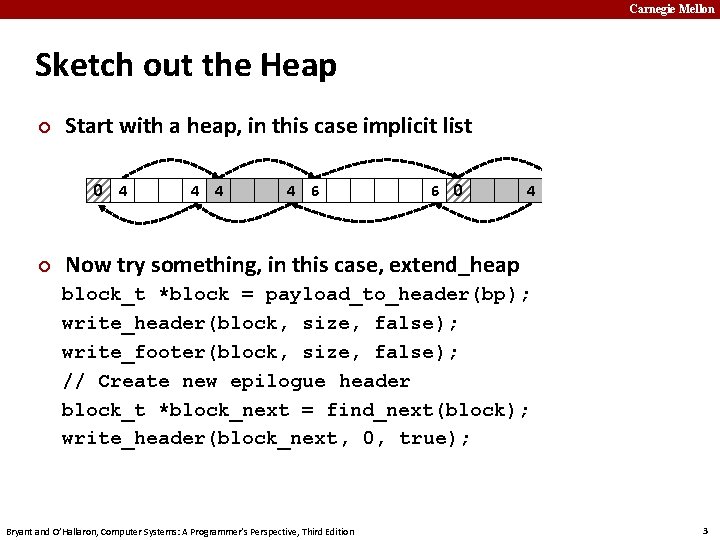
Carnegie Mellon Sketch out the Heap ¢ Start with a heap, in this case implicit list 0 4 ¢ 4 4 4 6 6 0 4 4 0 Now try something, in this case, extend_heap block_t *block = payload_to_header(bp); write_header(block, size, false); write_footer(block, size, false); // Create new epilogue header block_t *block_next = find_next(block); write_header(block_next, 0, true); Bryant and O’Hallaron, Computer Systems: A Programmer’s Perspective, Third Edition 3
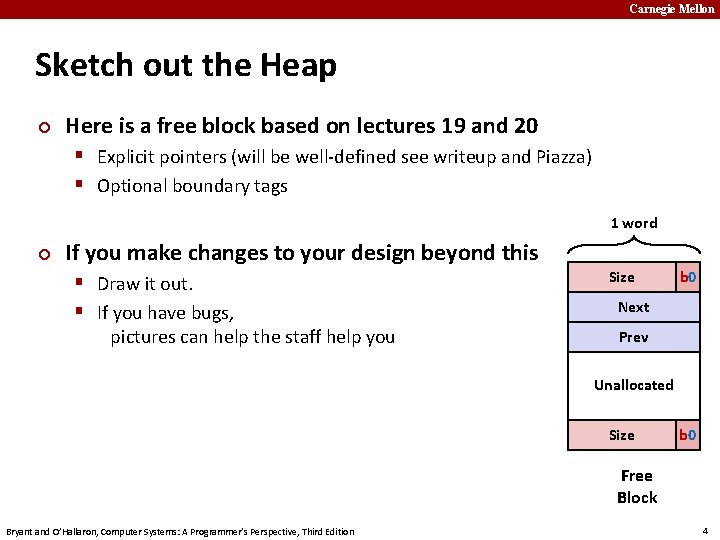
Carnegie Mellon Sketch out the Heap ¢ Here is a free block based on lectures 19 and 20 § Explicit pointers (will be well-defined see writeup and Piazza) § Optional boundary tags 1 word ¢ If you make changes to your design beyond this § Draw it out. § If you have bugs, pictures can help the staff help you Size b 0 Next Prev Unallocated Size b 0 Free Block Bryant and O’Hallaron, Computer Systems: A Programmer’s Perspective, Third Edition 4
Carnegie Mellon Add Instrumentation ¢ Remember that measurements inform insights. § Add temporary code to understand aspects of malloc § Code can violate style rules or 128 byte limits, because it is temporary ¢ Particularly important to develop insights into performance before making changes § What is expensive throughput-wise? § How much might a change benefit utilization? Bryant and O’Hallaron, Computer Systems: A Programmer’s Perspective, Third Edition 5

Carnegie Mellon Add Instrumentation example ¢ Looping in find_fit takes most of the time ¢ How efficient is your code? How might you know? § Compute the ratio of blocks viewed to calls static block_t *find_fit(size_t asize) { block_t *block; call_count++; for (block = heap_listp; get_size(block) > 0; block = find_next(block)) { block_count++; if (!(get_alloc(block)) && (asize <= get_size(block))) { return block; } } return NULL; // no fit found } 6 Bryant and O’Hallaron, Computer Systems: A Programmer’s Perspective, Third Edition
Carnegie Mellon Add Instrumentation cont. ¢ What size of requests? § How many 8 bytes or less? § How many 16 bytes or less? § What other sizes? ¢ What else could you measure? Why? ¢ Remember that although the system’s performance varies § The mdriver’s traces are deterministic § Measured results should not change between runs Bryant and O’Hallaron, Computer Systems: A Programmer’s Perspective, Third Edition 7
Carnegie Mellon Use tools ¢ Write your own – mm_checkheap() § What conditions are true in a valid heap? § Discuss. ¢ Use gdb § Sometimes augmented with checkheap or printfs § Always valuable insights Bryant and O’Hallaron, Computer Systems: A Programmer’s Perspective, Third Edition 8
Carnegie Mellon Garbled Bytes ¢ Malloc library returns a block § mdriver writes bytes into payload (using memcpy) § mdriver will check that those bytes are still present § If malloc library has overwritten any bytes, then report garbled bytes ¢ ¢ ¢ Now what? The mm_checkheap call is catching it right? If not, we want to find the garbled address and watch it Bryant and O’Hallaron, Computer Systems: A Programmer’s Perspective, Third Edition 9
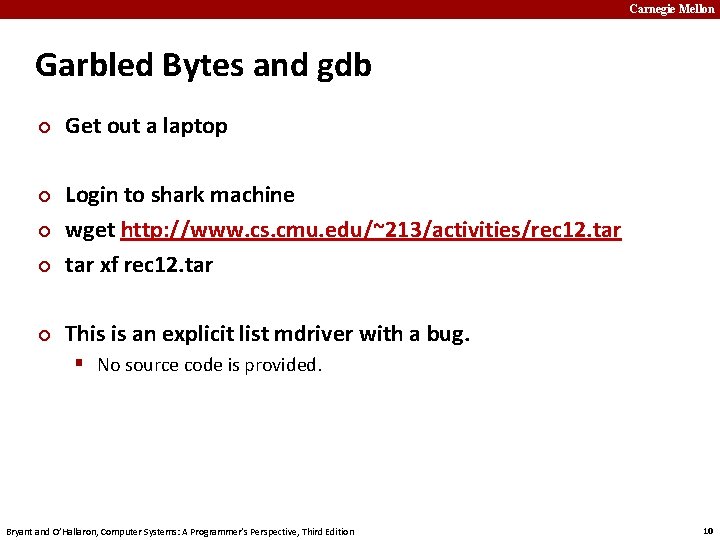
Carnegie Mellon Garbled Bytes and gdb ¢ Get out a laptop ¢ Login to shark machine wget http: //www. cs. cmu. edu/~213/activities/rec 12. tar xf rec 12. tar ¢ This is an explicit list mdriver with a bug. ¢ ¢ § No source code is provided. Bryant and O’Hallaron, Computer Systems: A Programmer’s Perspective, Third Edition 10
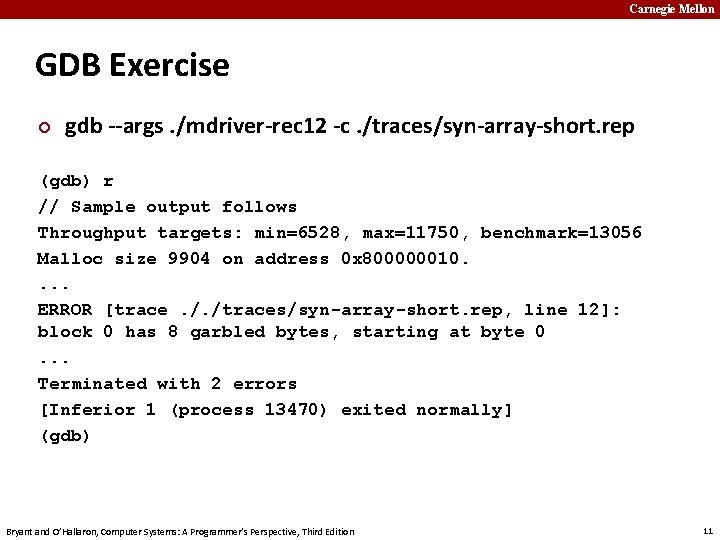
Carnegie Mellon GDB Exercise ¢ gdb --args. /mdriver-rec 12 -c. /traces/syn-array-short. rep (gdb) r // Sample output follows Throughput targets: min=6528, max=11750, benchmark=13056 Malloc size 9904 on address 0 x 800000010. . ERROR [trace. /. /traces/syn-array-short. rep, line 12]: block 0 has 8 garbled bytes, starting at byte 0. . . Terminated with 2 errors [Inferior 1 (process 13470) exited normally] (gdb) Bryant and O’Hallaron, Computer Systems: A Programmer’s Perspective, Third Edition 11
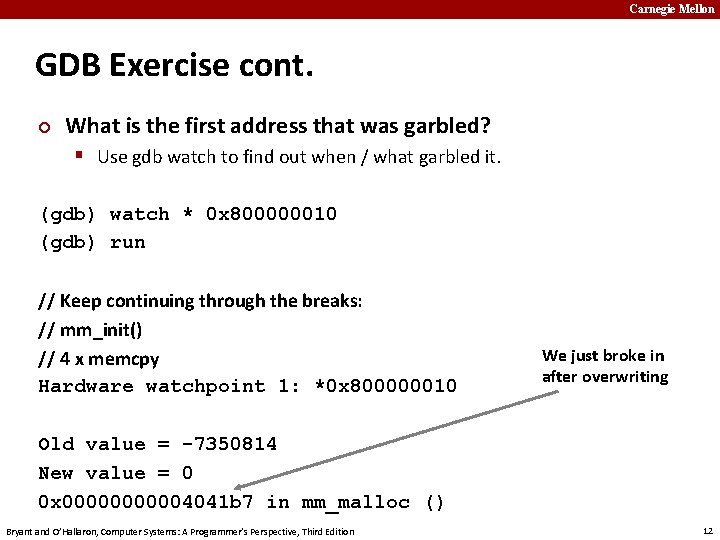
Carnegie Mellon GDB Exercise cont. ¢ What is the first address that was garbled? § Use gdb watch to find out when / what garbled it. (gdb) watch * 0 x 800000010 (gdb) run // Keep continuing through the breaks: // mm_init() // 4 x memcpy Hardware watchpoint 1: *0 x 800000010 We just broke in after overwriting Old value = -7350814 New value = 0 0 x 000004041 b 7 in mm_malloc () Bryant and O’Hallaron, Computer Systems: A Programmer’s Perspective, Third Edition 12
Carnegie Mellon Malloc. Lab ¢ Due Thursday ¢ 8% of final grade (+ 4% for checkpoint) ¢ Read the writeup ¢ Ask for help after a few hours or take a break Bryant and O’Hallaron, Computer Systems: A Programmer’s Perspective, Third Edition 13
- Slides: 13