
Structurebased Drug Design chlumail cmu edu tw http
Structure-based Drug Design 陸志豪 chlu@mail. cmu. edu. tw 生物醫學研究所 教材來源: 國立交通大學 楊進木博士 http: //gemdock. life. nctu. edu. tw

Outline n n Current state of drug discovery Structure-based drug discovery q q n Molecular docking Method of i. GEMDOCK Practice of virtual screening q q Prepare protein binding site Prepare compounds library Molecular docking Post-screening analysis http: //gemdock. life. nctu. edu. tw/dock/
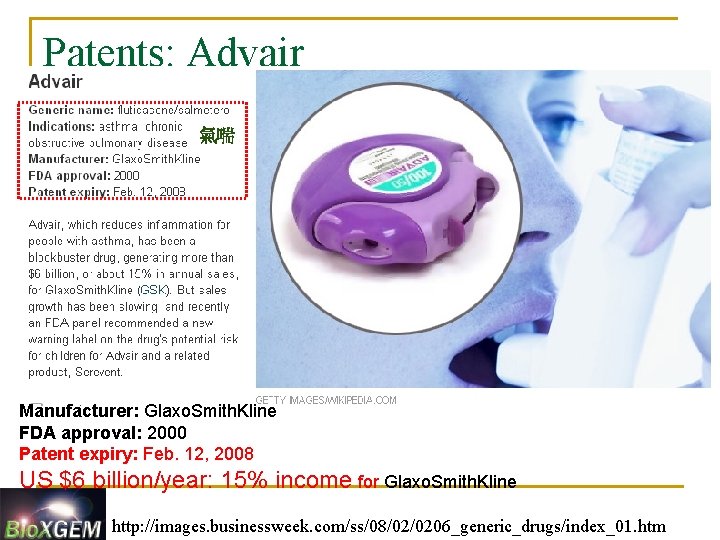
Patents: Advair 氣喘 Manufacturer: Glaxo. Smith. Kline FDA approval: 2000 Patent expiry: Feb. 12, 2008 US $6 billion/year: 15% income for Glaxo. Smith. Kline http: //images. businessweek. com/ss/08/02/0206_generic_drugs/index_01. htm
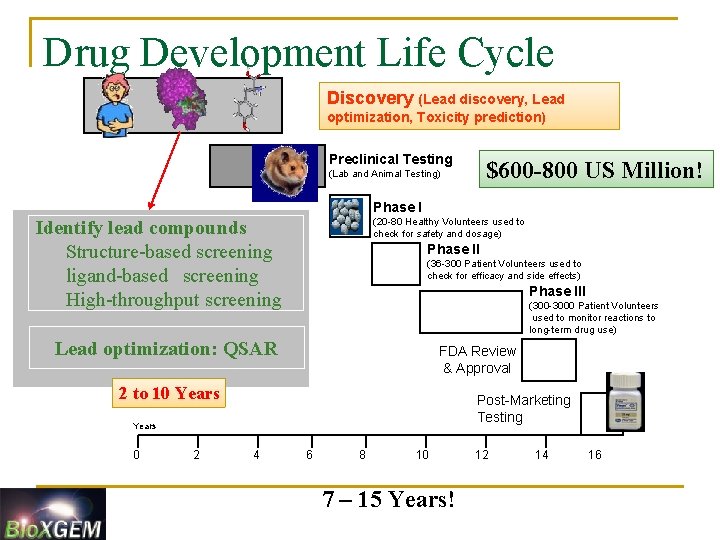
Drug Development Life Cycle Discovery (Lead discovery, Lead optimization, Toxicity prediction) Preclinical Testing $600 -800 US Million! (Lab and Animal Testing) Phase I (20 -80 Healthy Volunteers used to check for safety and dosage) Identify lead compounds Structure-based screening ligand-based screening High-throughput screening Phase II (36 -300 Patient Volunteers used to check for efficacy and side effects) Phase III (300 -3000 Patient Volunteers used to monitor reactions to long-term drug use) Lead optimization: QSAR FDA Review & Approval 2 to 10 Years Post-Marketing Testing Years 0 2 4 6 8 10 7 – 15 Years! 12 14 16
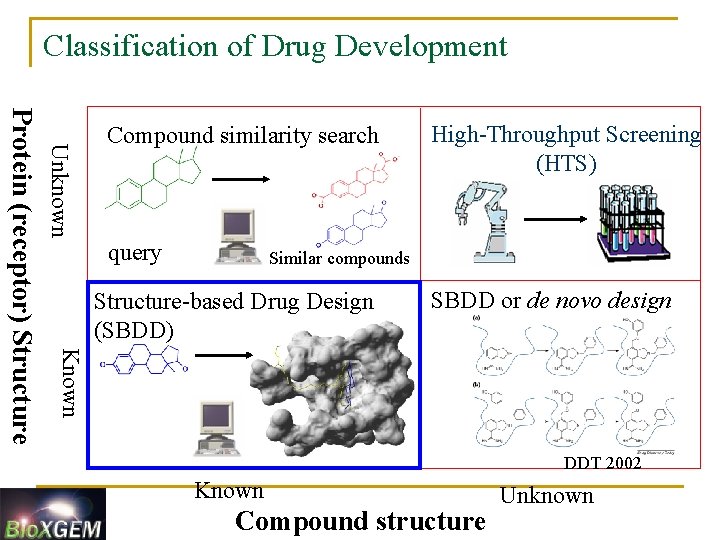
Classification of Drug Development Unknown query High-Throughput Screening (HTS) Similar compounds Structure-based Drug Design (SBDD) SBDD or de novo design Known Protein (receptor) Structure Compound similarity search DDT 2002 Known Compound structure Unknown
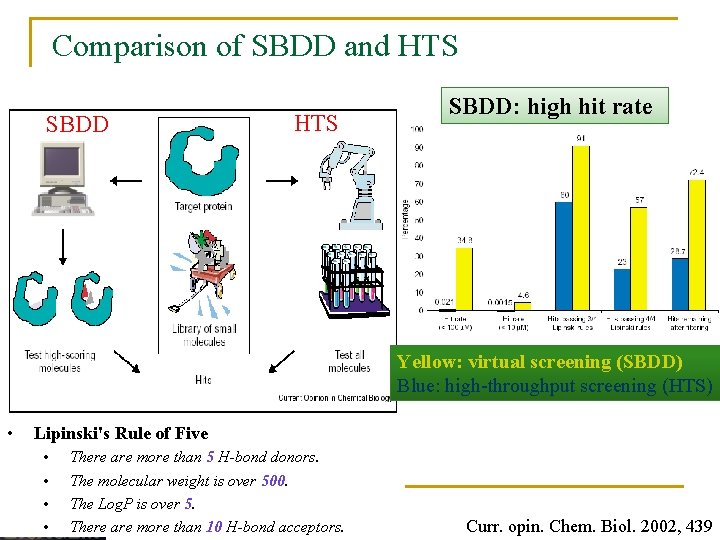
Comparison of SBDD and HTS SBDD: high hit rate Yellow: virtual screening (SBDD) Blue: high-throughput screening (HTS) • Lipinski's Rule of Five • • There are more than 5 H-bond donors. The molecular weight is over 500. The Log. P is over 5. There are more than 10 H-bond acceptors. Curr. opin. Chem. Biol. 2002, 439
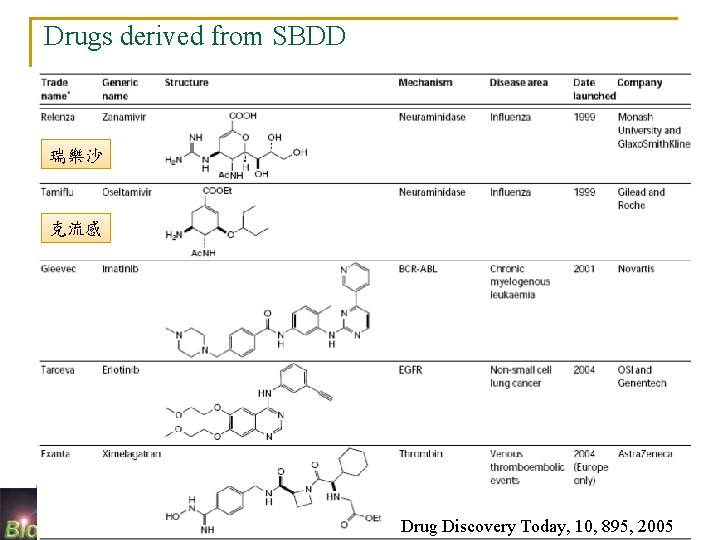
Drugs derived from SBDD 瑞樂沙 克流感 Drug Discovery Today, 10, 895, 2005
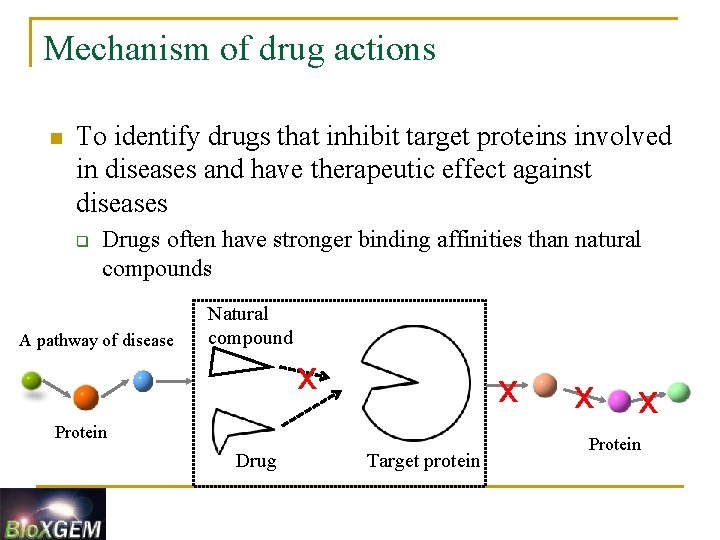
Mechanism of drug actions n To identify drugs that inhibit target proteins involved in diseases and have therapeutic effect against diseases q Drugs often have stronger binding affinities than natural compounds A pathway of disease Natural compound x x Protein Drug Target protein x x Protein
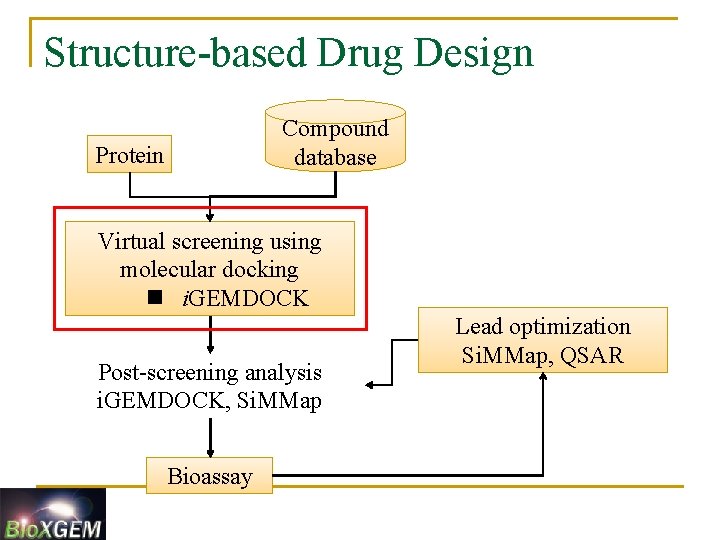
Structure-based Drug Design Compound database Protein Virtual screening using molecular docking n i. GEMDOCK Post-screening analysis i. GEMDOCK, Si. MMap Bioassay Lead optimization Si. MMap, QSAR
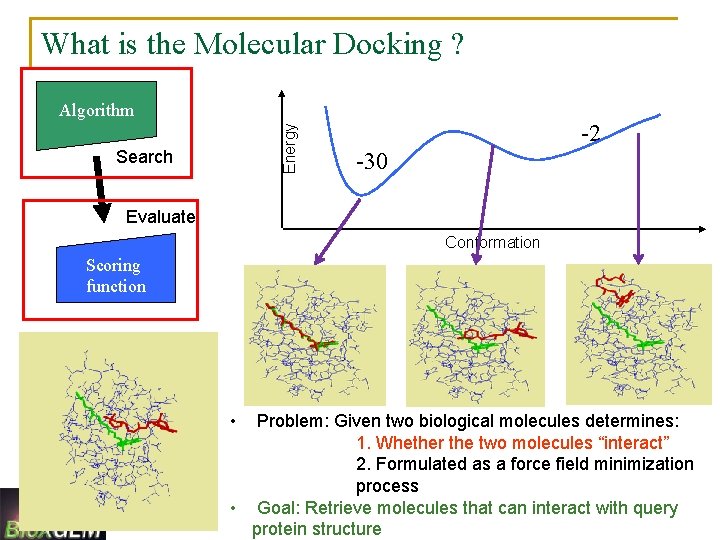
What is the Molecular Docking ? Energy Algorithm Search -2 -30 Evaluate Conformation Scoring function • Problem: Given two biological molecules determines: 1. Whether the two molecules “interact” 2. Formulated as a force field minimization process • Goal: Retrieve molecules that can interact with query protein structure
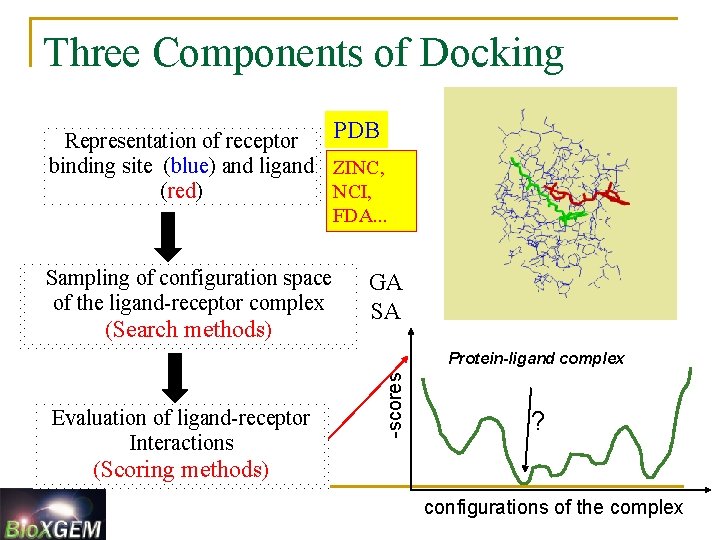
Three Components of Docking Representation of receptor PDB binding site (blue) and ligand ZINC, NCI, (red) FDA. . . Sampling of configuration space of the ligand-receptor complex (Search methods) GA SA Evaluation of ligand-receptor Interactions (Scoring methods) -scores Protein-ligand complex ? configurations of the complex
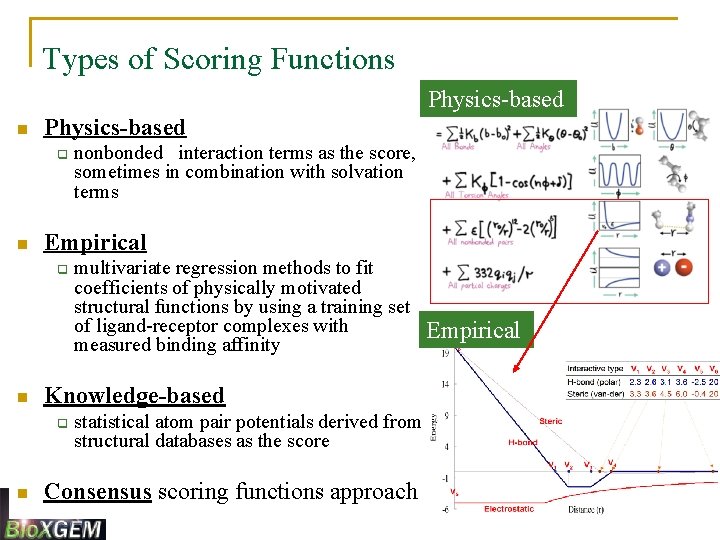
Types of Scoring Functions Physics-based n Physics-based q n Empirical q n multivariate regression methods to fit coefficients of physically motivated structural functions by using a training set of ligand-receptor complexes with measured binding affinity Empirical Knowledge-based q n nonbonded interaction terms as the score, sometimes in combination with solvation terms statistical atom pair potentials derived from structural databases as the score Consensus scoring functions approach
Docking Software GEMDOCK (Yang & Chen 2004) i. GEMDOCK (Yang & HSU 2011) DOCK: (Kuntz et al. 1982) DOCK 4. 0 (Ewing & Kuntz 1997) Auto. DOCK (Goodsell & Olson 1990) Auto. DOCK 3. 0 (Morris et al. 1998) GOLD (Jones et al. 1997) Flex. X: (Rarey et al. 1996) GLIDE: (Friesner et al. 2004) ADAM (Mizutani et al. 1994) CDOCKER (Wu et al. 2003) Combi. DOCK (Sun et al. 1998) DIVALI (Clark & Ajay 1995) Dock. Vision (Hart & Read 1992) FLOG (Miller et al. 1994) Hammerhead (Welch et al. 1996) LIBDOCK (Diller & Merz 2001) MCDOCK (Liu & Wang 1999) PRO_LEADS (Baxter et al. 1998) SDOCKER (Wu et al. 2004) QXP (Mc. Martin & Bohacek 1997) Validate (Head et al. 1996) Ø de novo design tools LUDI (Boehm 1992), BUILDER (Roe & Kuntz 1995) SMOG (De. Witte et al. 1997) CONCEPTS (Pearlman & Murcko 1996) DLD/MCSS (Stultz & Karplus 2000) Genstar (Rotstein & Murcko 1993) Group-Build (Rotstein & Murcko 1993) Grow (Moon & Howe 1991) HOOK (Eisen et al. 1994) Legend (Nishibata & Itai 1993) MCDNLG (Gehlhaar et al. 1995) SPROUT (Gillet et al. 1993)
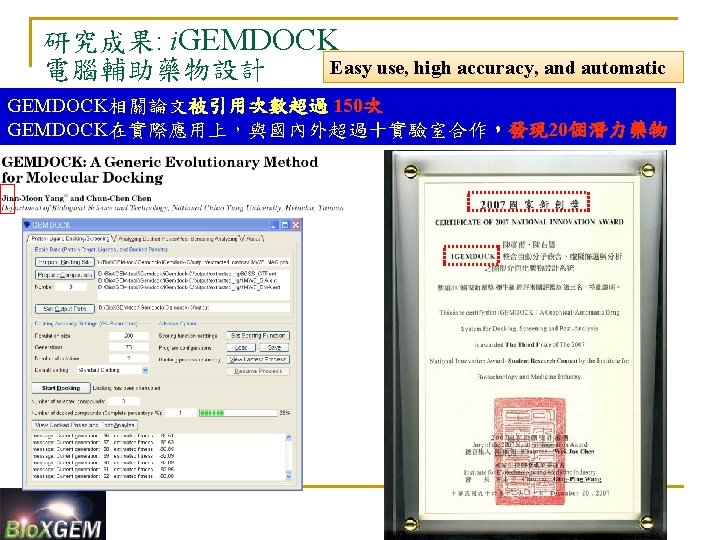
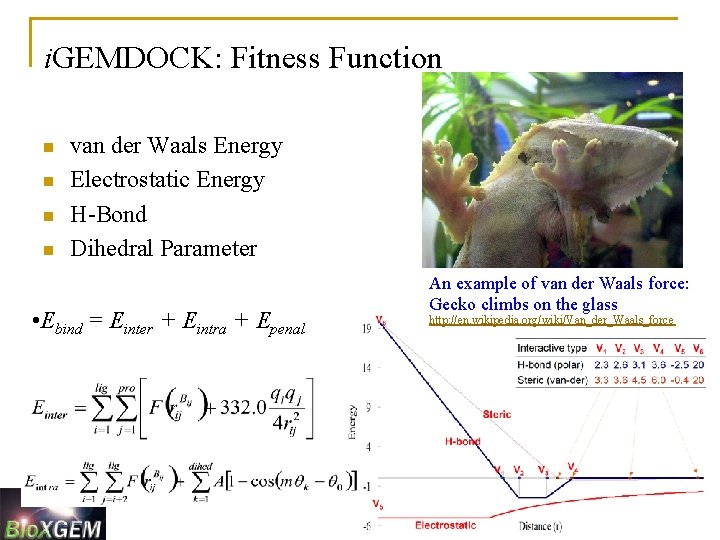
i. GEMDOCK: Fitness Function n n van der Waals Energy Electrostatic Energy H-Bond Dihedral Parameter • Ebind = Einter + Eintra + Epenal An example of van der Waals force: Gecko climbs on the glass http: //en. wikipedia. org/wiki/Van_der_Waals_force
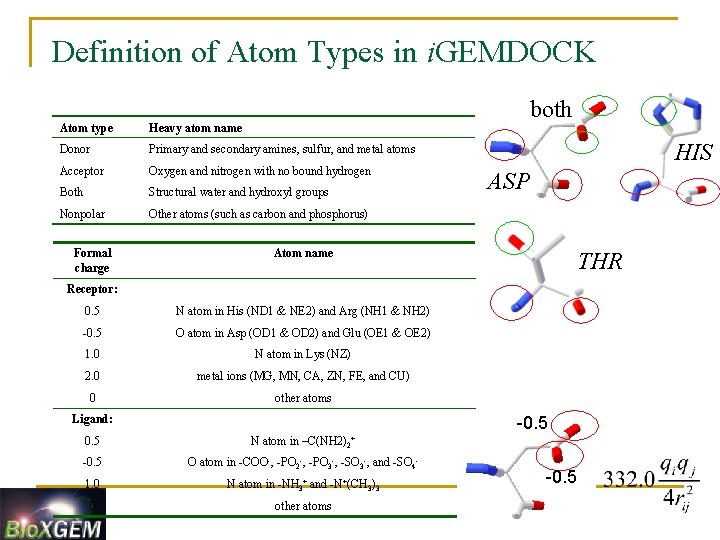
Definition of Atom Types in i. GEMDOCK both Atom type Heavy atom name Donor Primary and secondary amines, sulfur, and metal atoms Acceptor Oxygen and nitrogen with no bound hydrogen Both Structural water and hydroxyl groups Nonpolar Other atoms (such as carbon and phosphorus) Formal charge HIS ASP Atom name THR Receptor: 0. 5 N atom in His (ND 1 & NE 2) and Arg (NH 1 & NH 2) -0. 5 O atom in Asp (OD 1 & OD 2) and Glu (OE 1 & OE 2) 1. 0 N atom in Lys (NZ) 2. 0 metal ions (MG, MN, CA, ZN, FE, and CU) 0 other atoms -0. 5 Ligand: 0. 5 N atom in –C(NH 2)2 -0. 5 O atom in -COO-, -PO 2 -, -PO 3 -, -SO 3 -, and -SO 4 - 1. 0 N atom in -NH 3+ and -N+(CH 3)3 0 other atoms + -0. 5
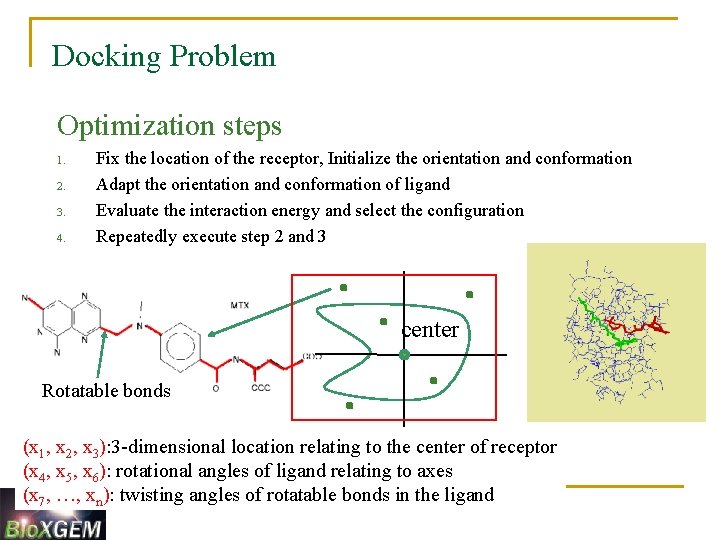
Docking Problem Optimization steps 1. 2. 3. 4. Fix the location of the receptor, Initialize the orientation and conformation Adapt the orientation and conformation of ligand Evaluate the interaction energy and select the configuration Repeatedly execute step 2 and 3 center Rotatable bonds (x 1, x 2, x 3): 3 -dimensional location relating to the center of receptor (x 4, x 5, x 6): rotational angles of ligand relating to axes (x 7, …, xn): twisting angles of rotatable bonds in the ligand
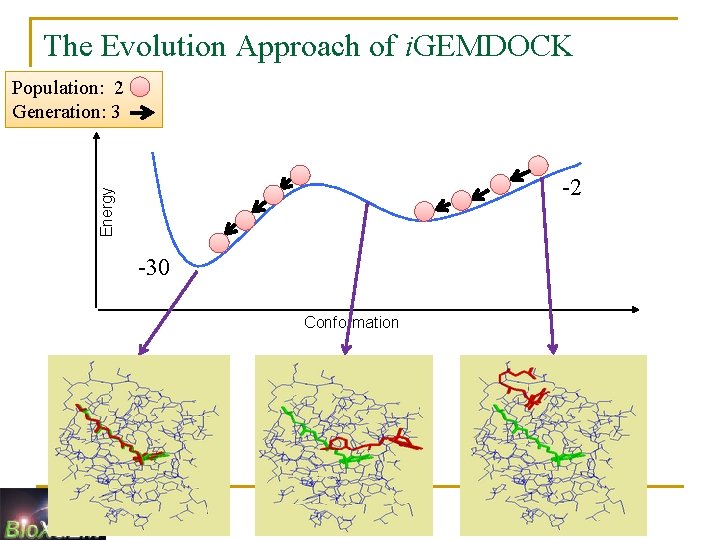
The Evolution Approach of i. GEMDOCK Population: 2 Generation: 3 Energy -2 -30 Conformation
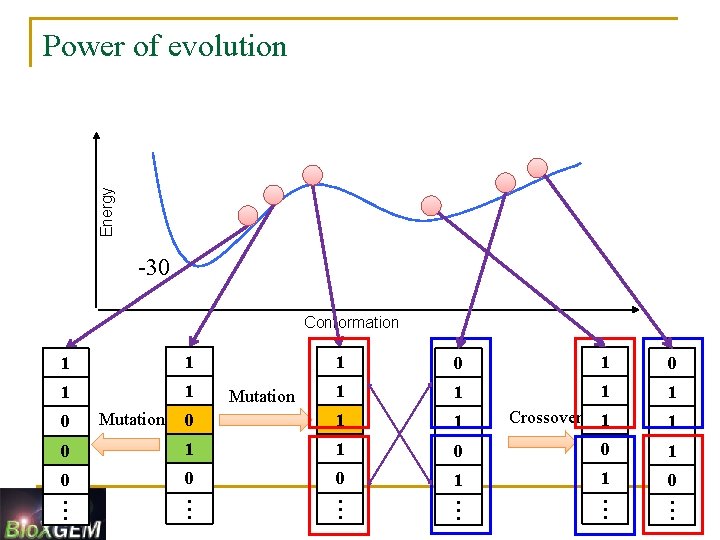
Energy Power of evolution -30 Conformation 1 1 1 0 1 1 0 0 1 0. . . 1. . . 0 Mutation Crossover
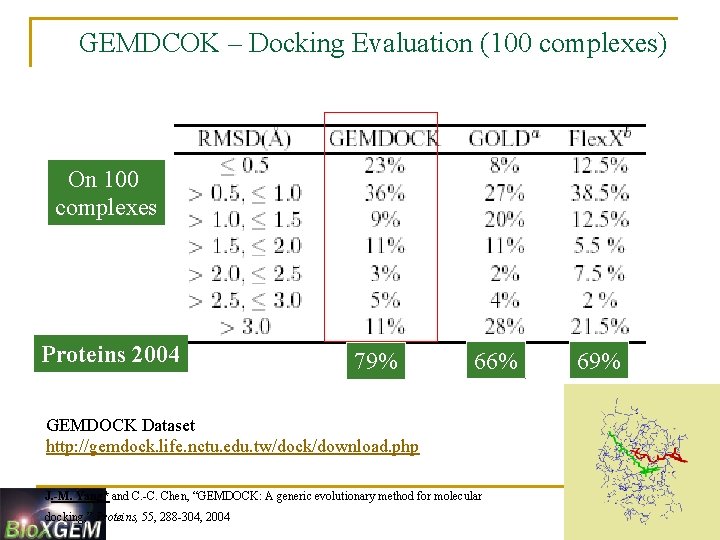
GEMDCOK – Docking Evaluation (100 complexes) On 100 complexes Proteins 2004 79% 66% GEMDOCK Dataset http: //gemdock. life. nctu. edu. tw/dock/download. php J. -M. Yang* and C. -C. Chen, “GEMDOCK: A generic evolutionary method for molecular docking, ” Proteins, 55, 288 -304, 2004 69%
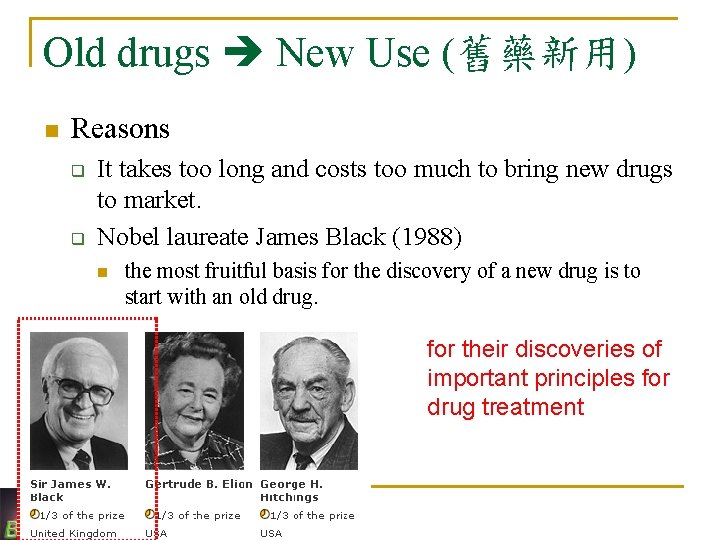
Old drugs New Use (舊藥新用) n Reasons q q It takes too long and costs too much to bring new drugs to market. Nobel laureate James Black (1988) n the most fruitful basis for the discovery of a new drug is to start with an old drug. for their discoveries of important principles for drug treatment
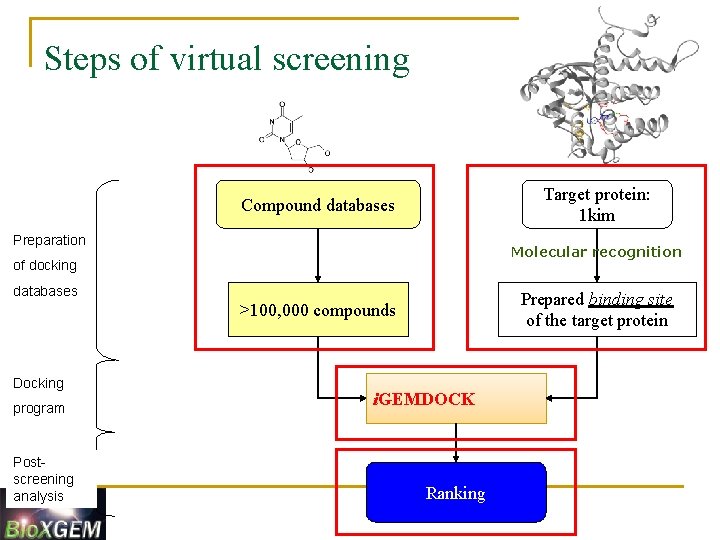
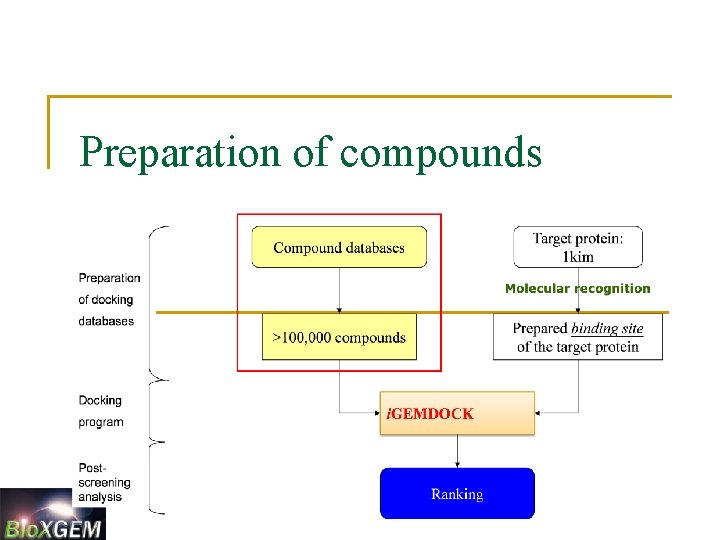
Steps of virtual screening Target protein: 1 kim Compound databases Preparation Molecular recognition of docking databases Prepared binding site of the target protein >100, 000 compounds Docking program Postscreening analysis i. GEMDOCK Ranking
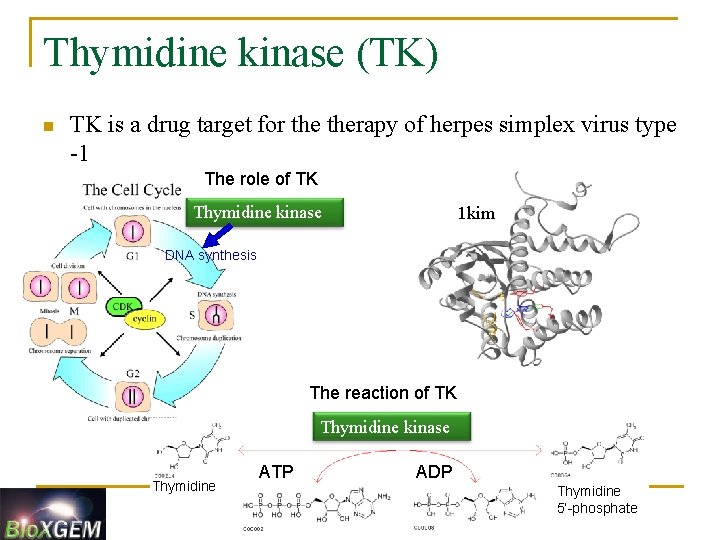
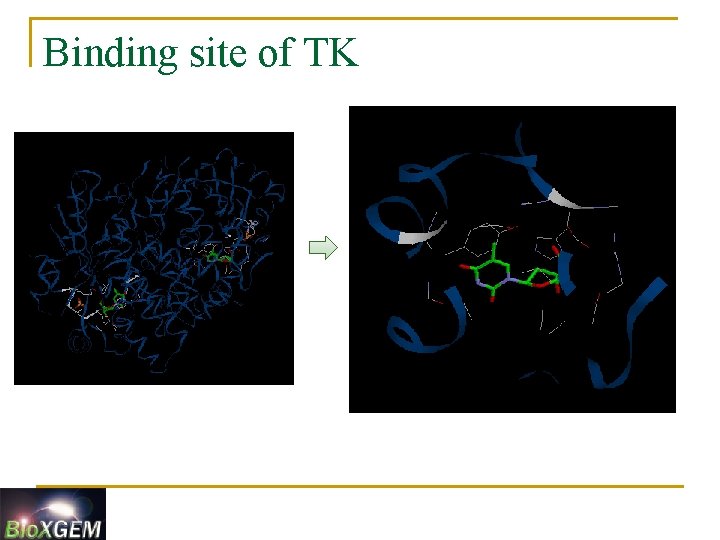
Thymidine kinase (TK) n TK is a drug target for therapy of herpes simplex virus type -1 The role of TK Thymidine kinase 1 kim DNA synthesis The reaction of TK Thymidine kinase Thymidine ATP ADP Thymidine 5’-phosphate
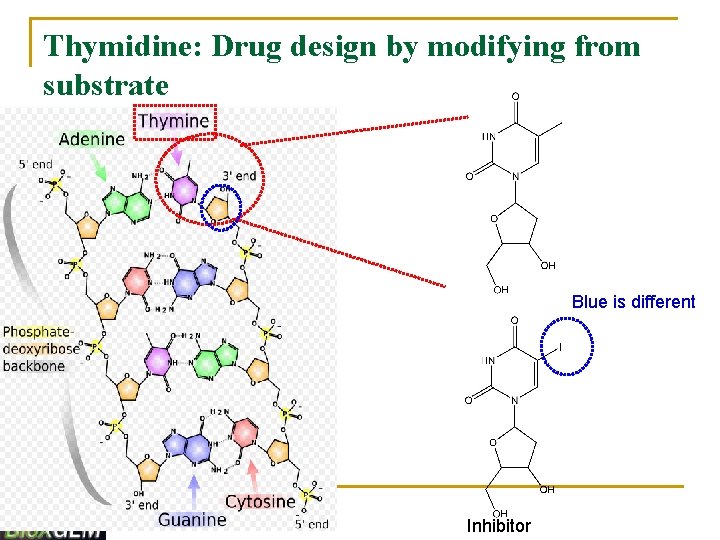
Thymidine: Drug design by modifying from substrate Blue is different Inhibitor
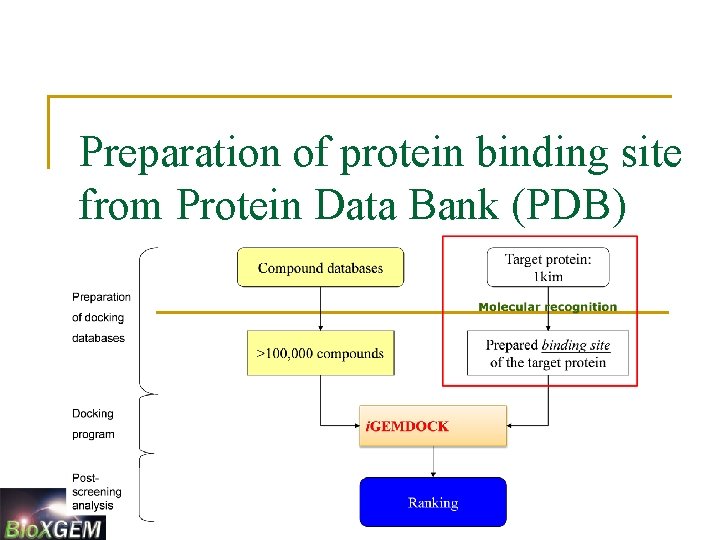
Preparation of protein binding site from Protein Data Bank (PDB)
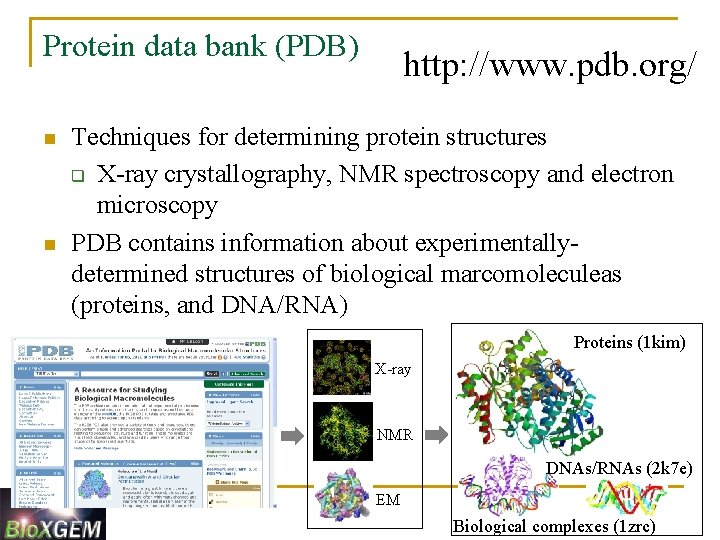
Protein data bank (PDB) n n http: //www. pdb. org/ Techniques for determining protein structures q X-ray crystallography, NMR spectroscopy and electron microscopy PDB contains information about experimentallydetermined structures of biological marcomoleculeas (proteins, and DNA/RNA) Proteins (1 kim) X-ray NMR DNAs/RNAs (2 k 7 e) EM Biological complexes (1 zrc)
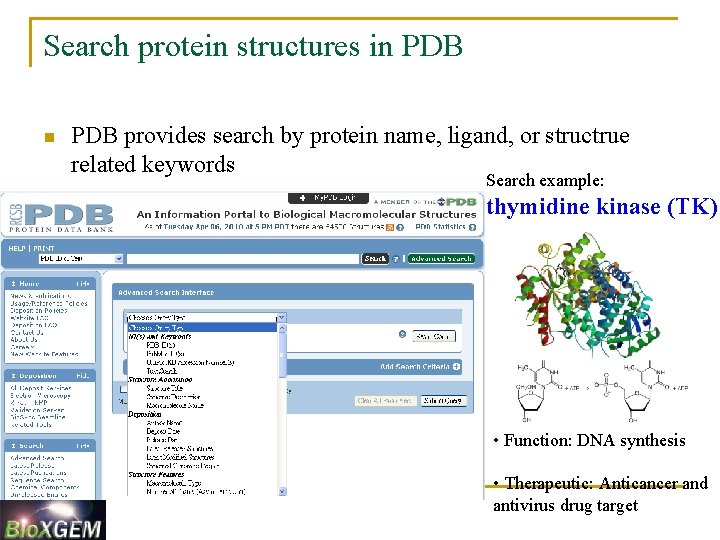
Search protein structures in PDB provides search by protein name, ligand, or structrue related keywords Search example: thymidine kinase (TK) • Function: DNA synthesis • Therapeutic: Anticancer and antivirus drug target
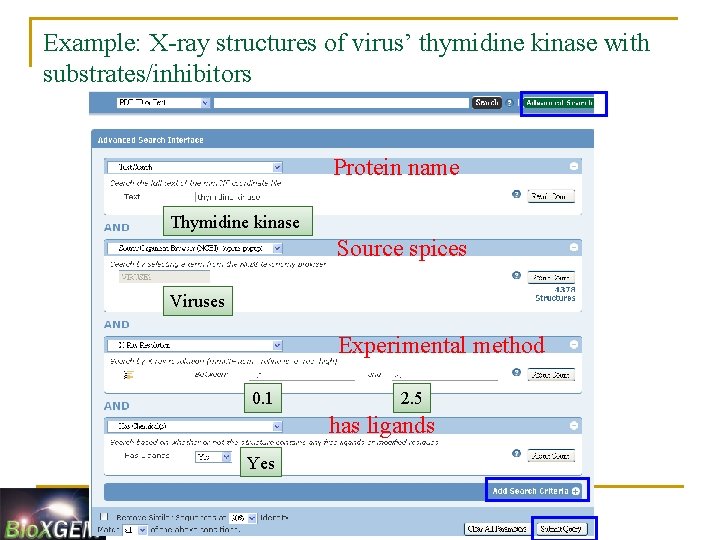
Example: X-ray structures of virus’ thymidine kinase with substrates/inhibitors Protein name Thymidine kinase Source spices Viruses Experimental method 0. 1 2. 5 has ligands Yes
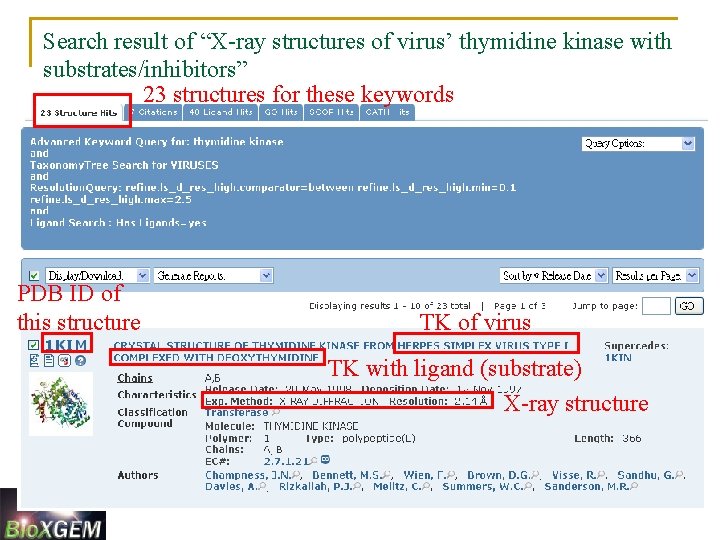
Search result of “X-ray structures of virus’ thymidine kinase with substrates/inhibitors” 23 structures for these keywords PDB ID of this structure TK of virus TK with ligand (substrate) X-ray structure
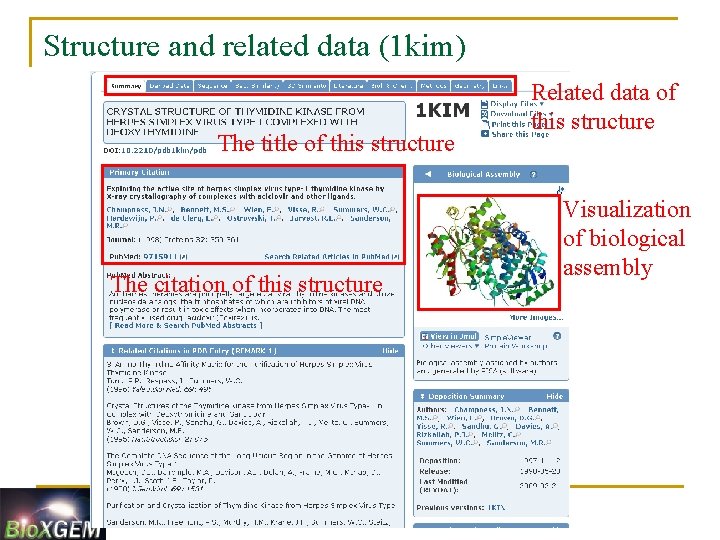
Structure and related data (1 kim) The title of this structure The citation of this structure Related data of this structure Visualization of biological assembly
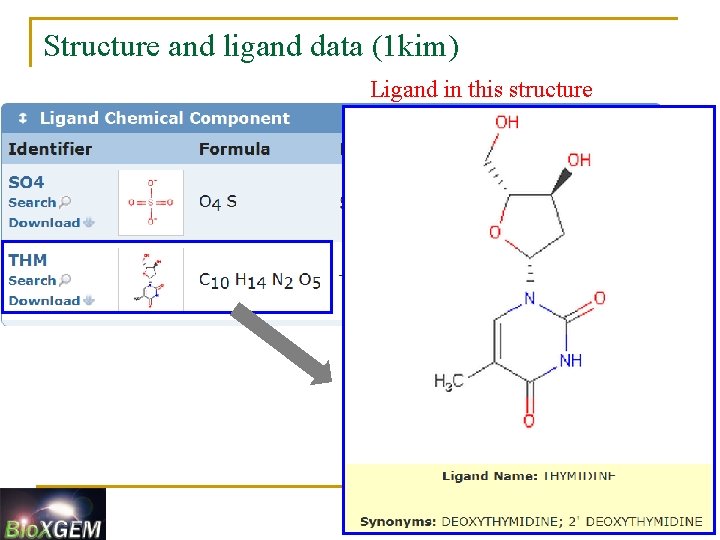
Structure and ligand data (1 kim) Ligand in this structure
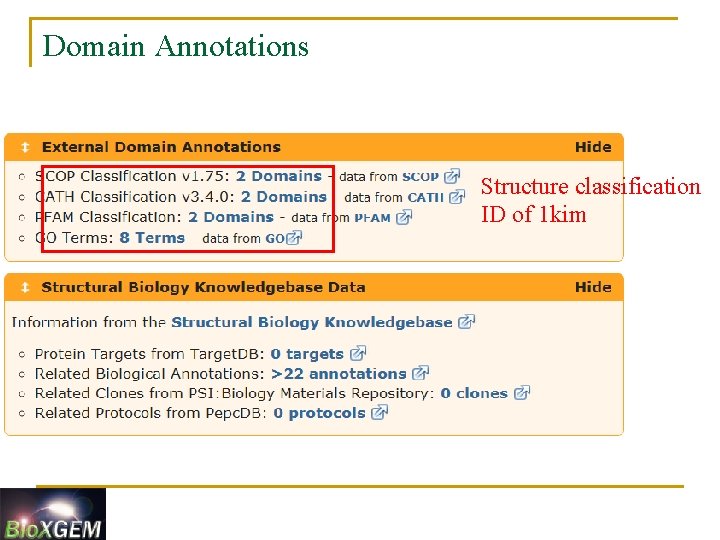
Domain Annotations Structure classification ID of 1 kim
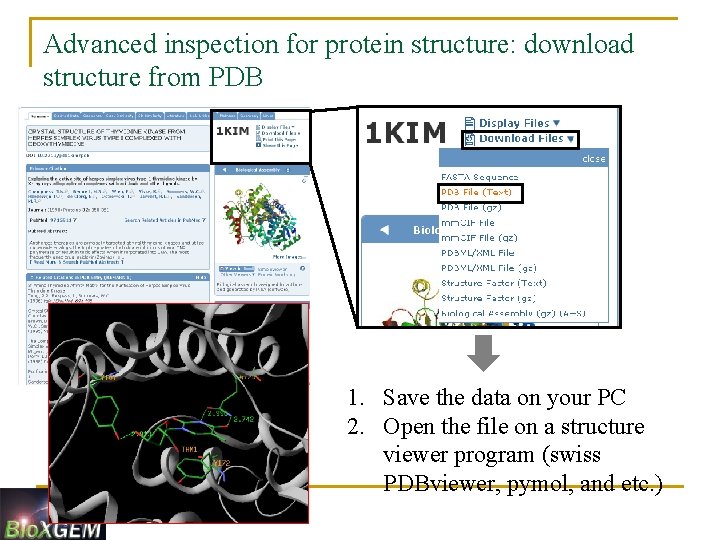
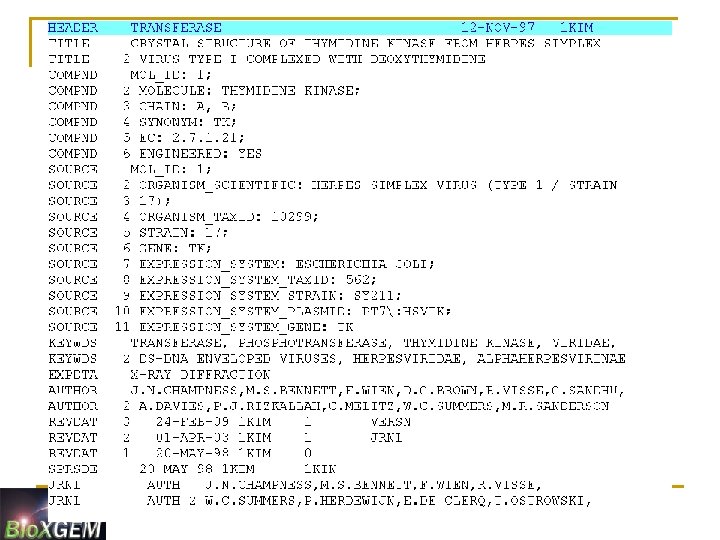
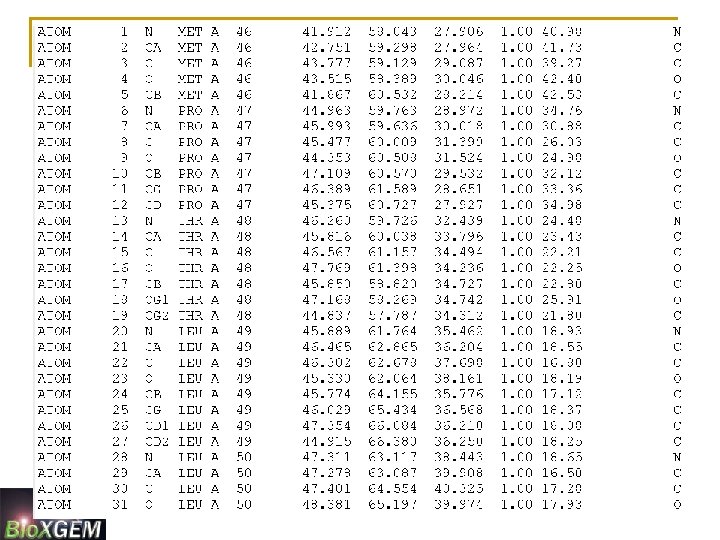
Advanced inspection for protein structure: download structure from PDB 1. Save the data on your PC 2. Open the file on a structure viewer program (swiss PDBviewer, pymol, and etc. )
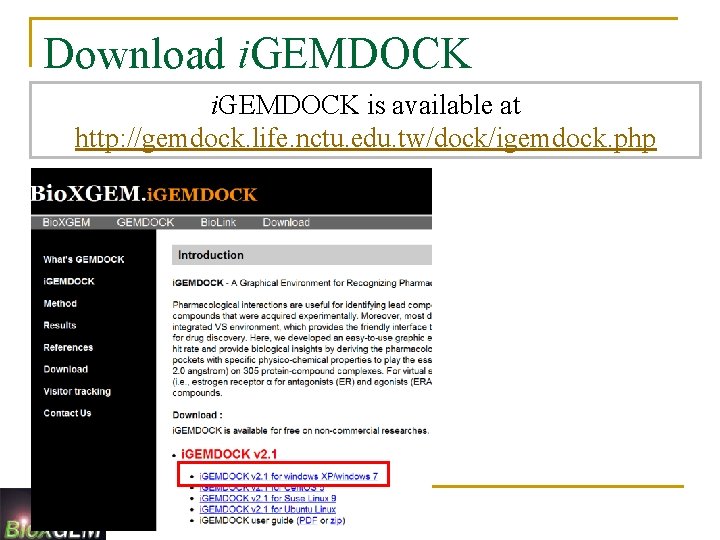
Download i. GEMDOCK is available at http: //gemdock. life. nctu. edu. tw/dock/igemdock. php
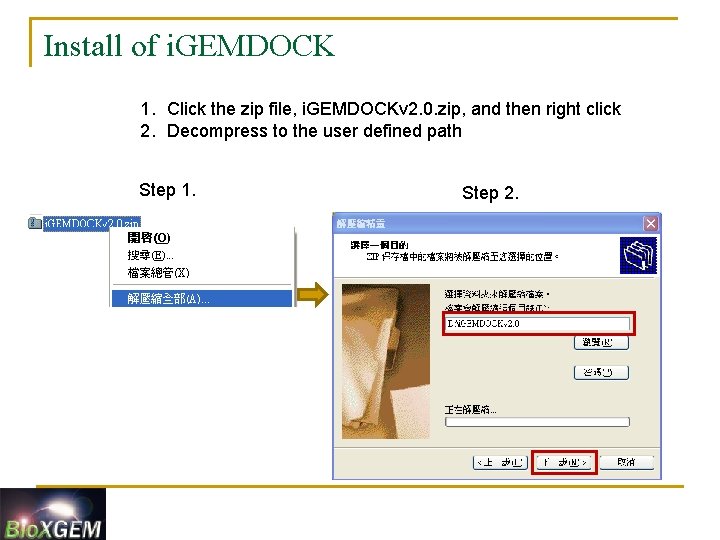
Install of i. GEMDOCK 1. Click the zip file, i. GEMDOCKv 2. 0. zip, and then right click 2. Decompress to the user defined path Step 1. Step 2.
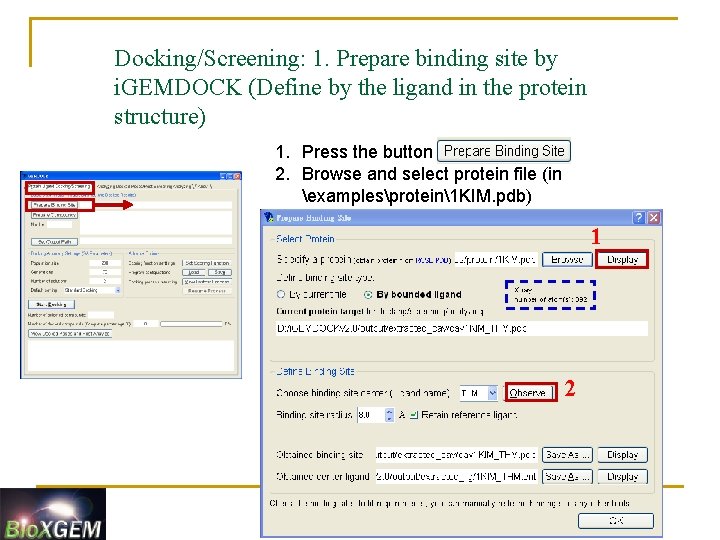
Docking/Screening: 1. Prepare binding site by i. GEMDOCK (Define by the ligand in the protein structure) 1. Press the button binding site 2. Browse and select protein file (in examplesprotein1 KIM. pdb) 1 2
Binding site of TK
Preparation of compounds
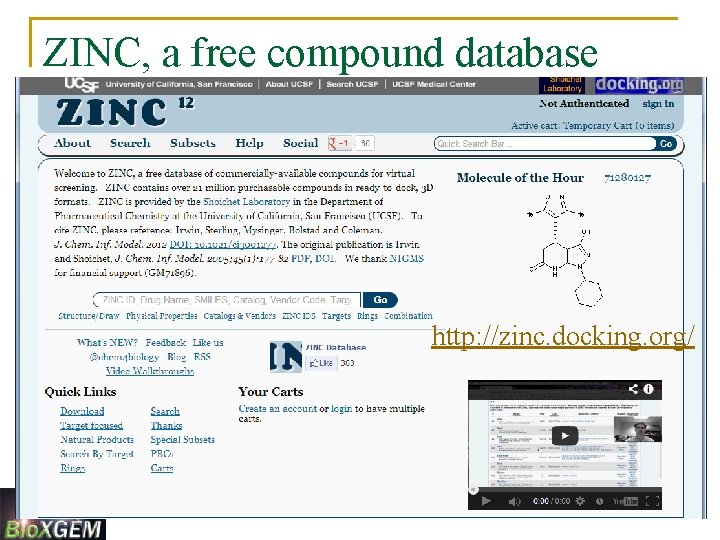
ZINC, a free compound database http: //zinc. docking. org/
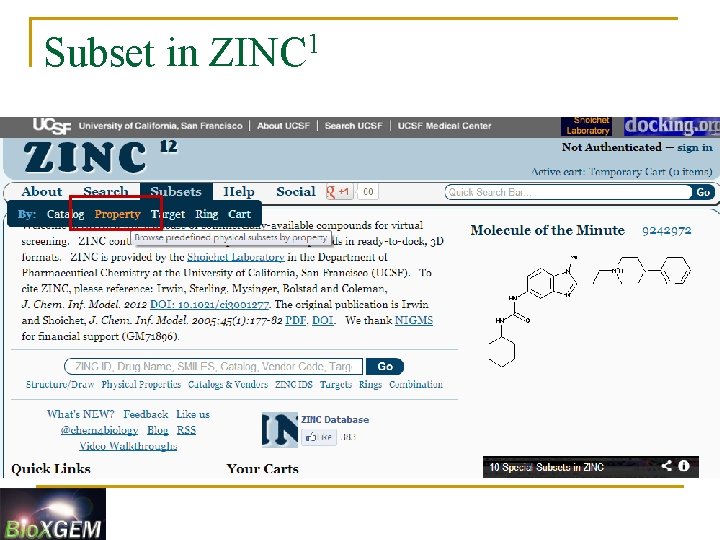
Subset in ZINC 1
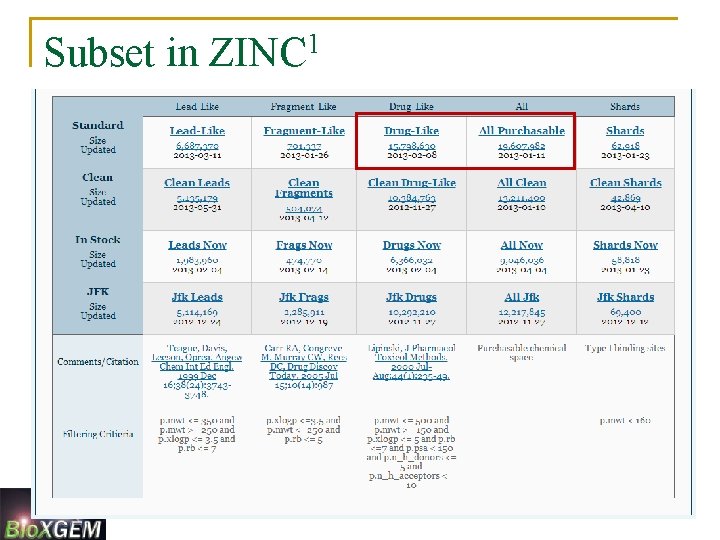
Subset in ZINC 1
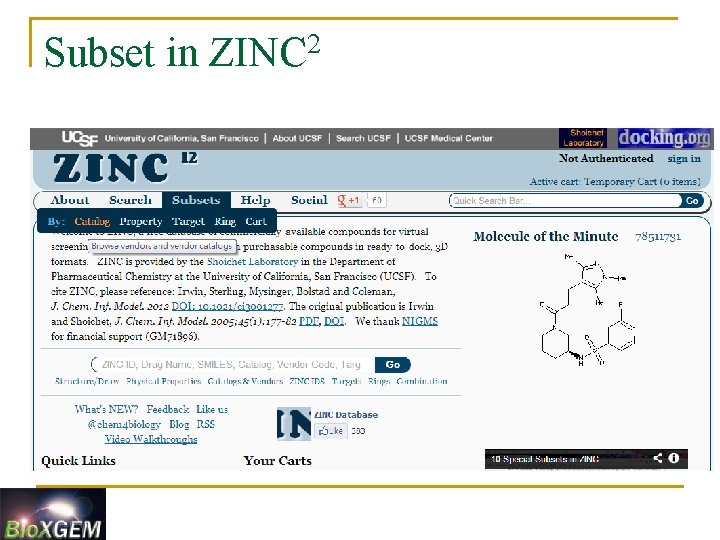
Subset in ZINC 2
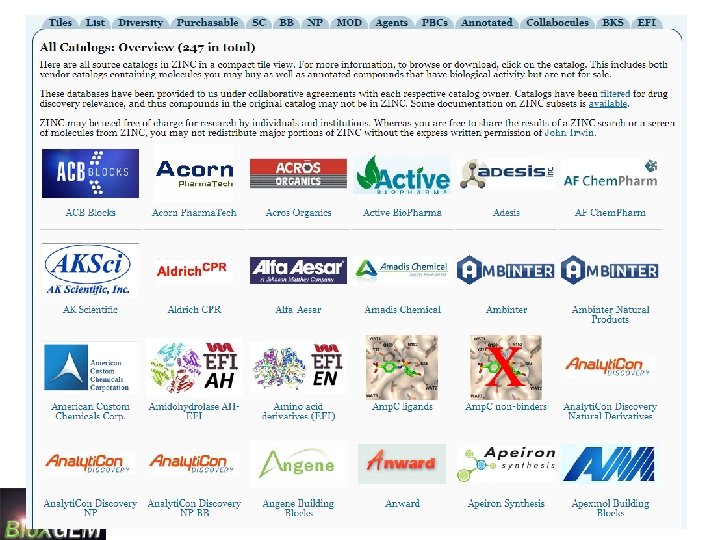
Subset in ZINC 2
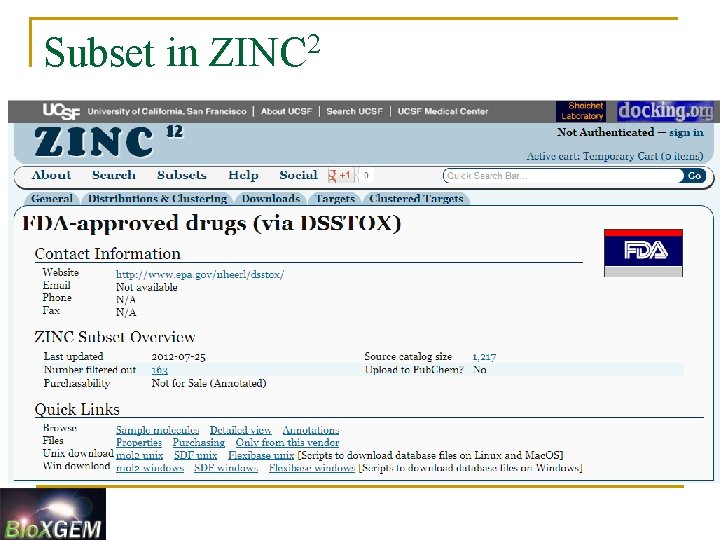
Subset in ZINC 2
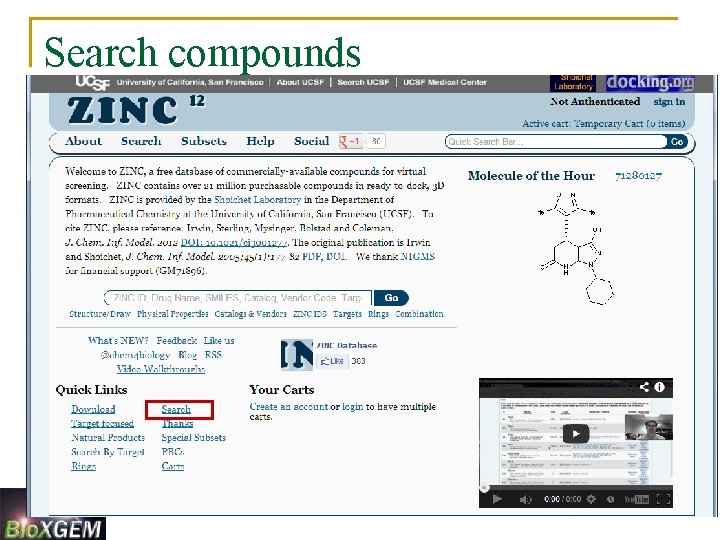
Search compounds
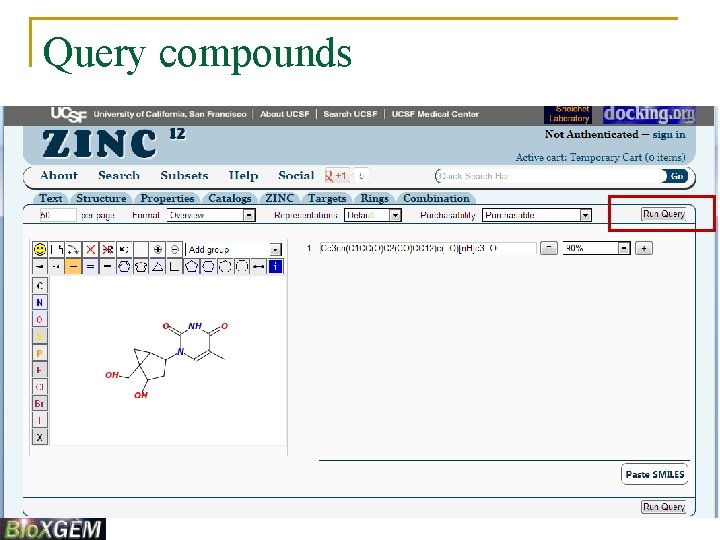
Query compounds
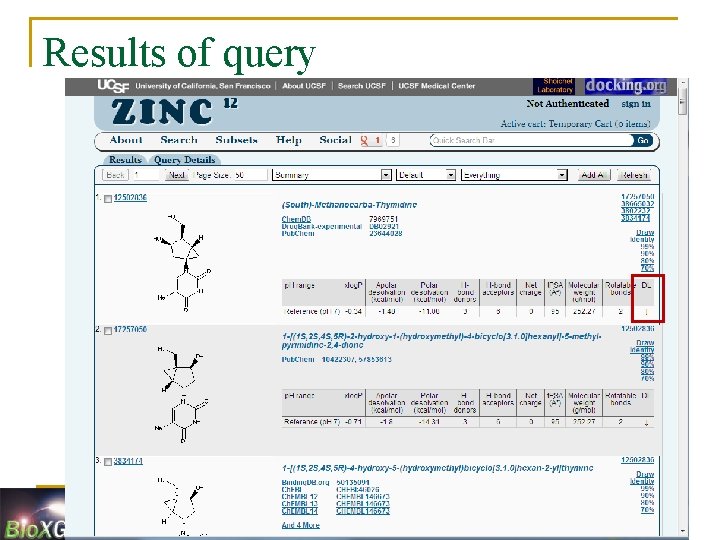
Results of query
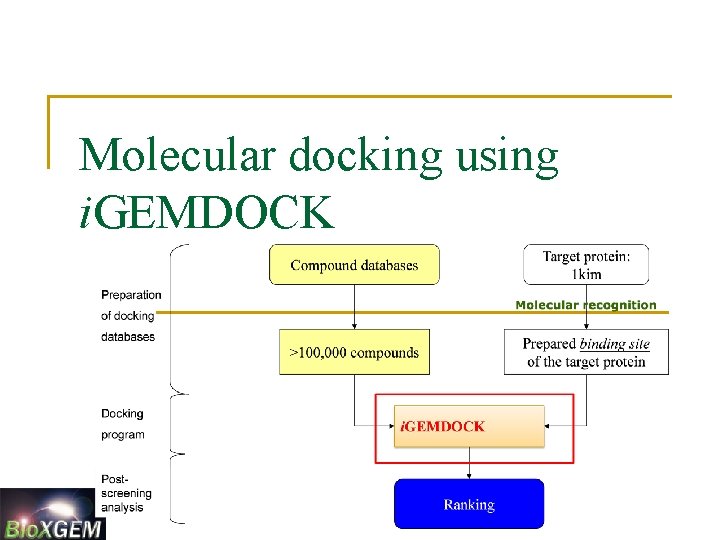
Molecular docking using i. GEMDOCK
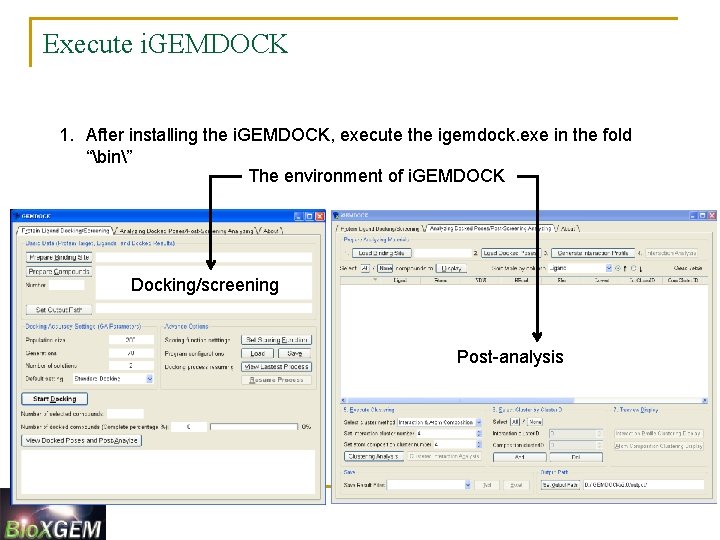
Execute i. GEMDOCK 1. After installing the i. GEMDOCK, execute the igemdock. exe in the fold “bin” The environment of i. GEMDOCK Docking/screening Post-analysis
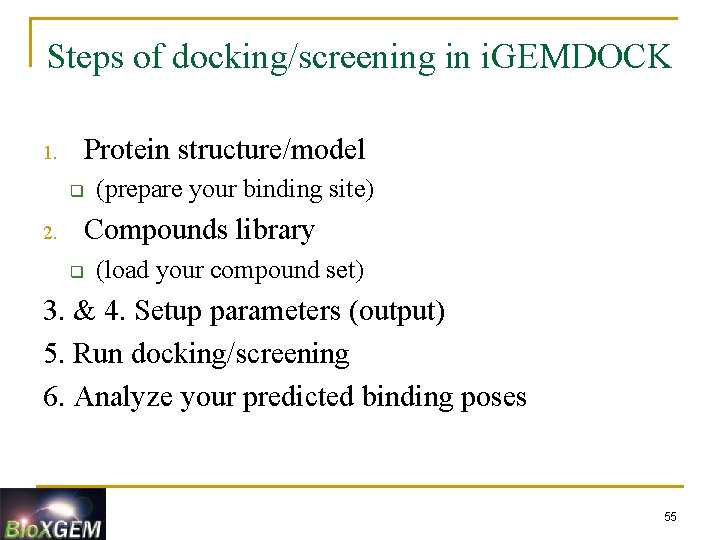
Steps of docking/screening in i. GEMDOCK 1. Protein structure/model q 2. (prepare your binding site) Compounds library q (load your compound set) 3. & 4. Setup parameters (output) 5. Run docking/screening 6. Analyze your predicted binding poses 55
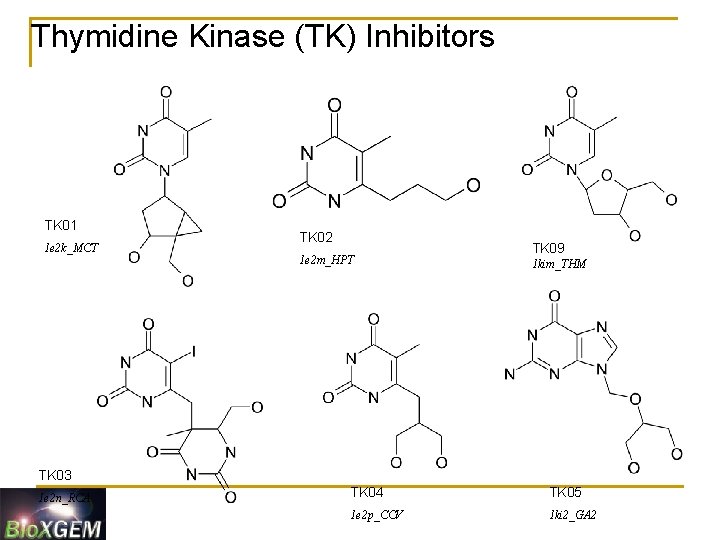
Thymidine Kinase (TK) Inhibitors TK 01 1 e 2 k_MCT TK 02 1 e 2 m_HPT TK 09 1 kim_THM TK 03 1 e 2 n_RCA TK 04 TK 05 1 e 2 p_CCV 1 ki 2_GA 2
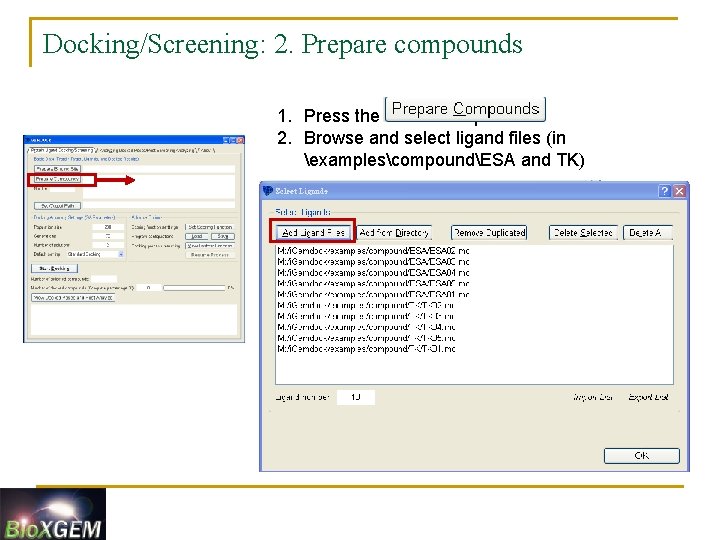
Docking/Screening: 2. Prepare compounds 1. Press the button compounds 2. Browse and select ligand files (in examplescompoundESA and TK)
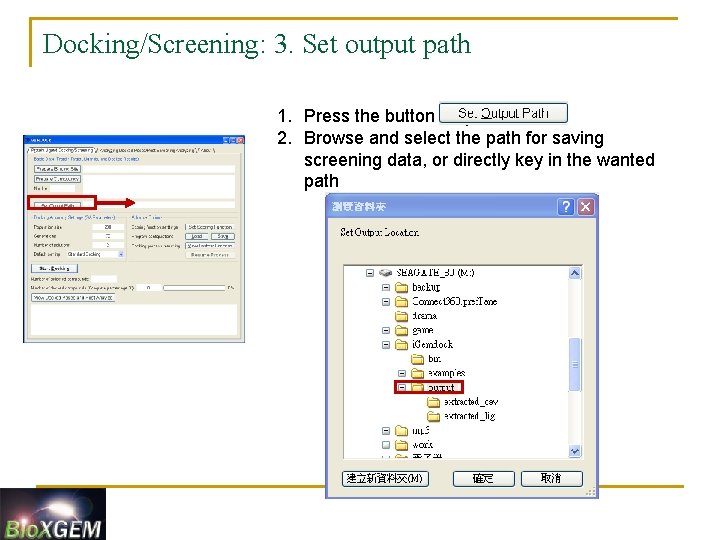
Docking/Screening: 3. Set output path 1. Press the button output 2. Browse and select the path for saving screening data, or directly key in the wanted path
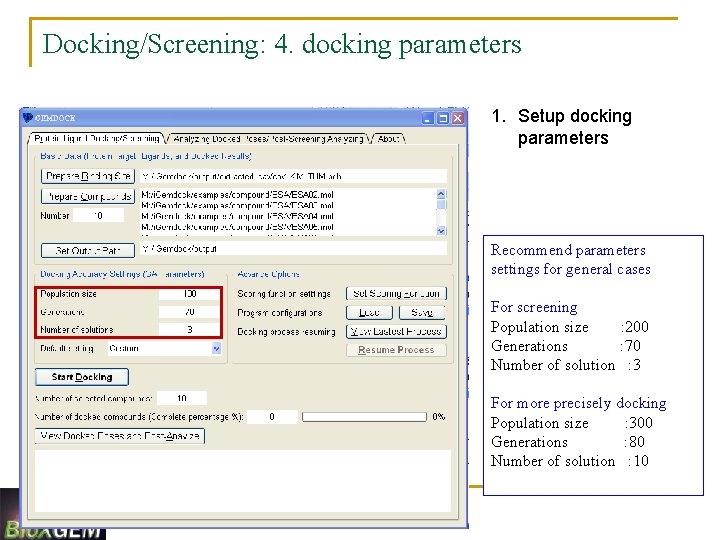
Docking/Screening: 4. docking parameters 1. Setup docking parameters Recommend parameters settings for general cases For screening Population size : 200 Generations : 70 Number of solution : 3 For more precisely docking Population size : 300 Generations : 80 Number of solution : 10
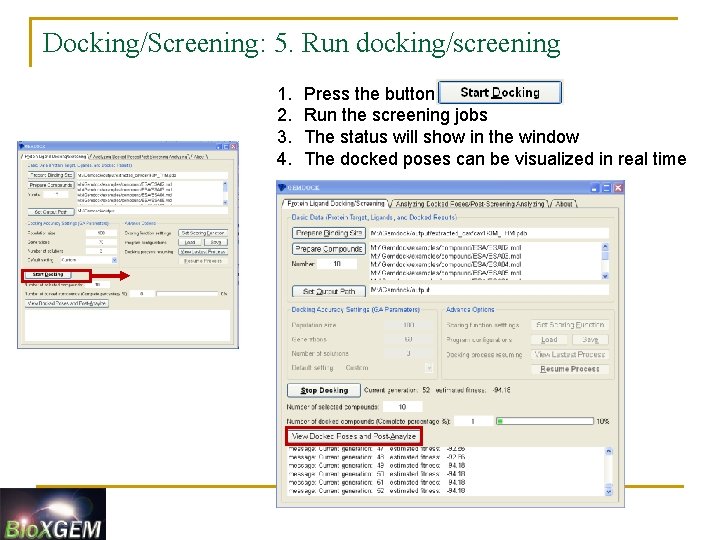
Docking/Screening: 5. Run docking/screening 1. 2. 3. 4. Press the button start Run the screening jobs The status will show in the window The docked poses can be visualized in real time
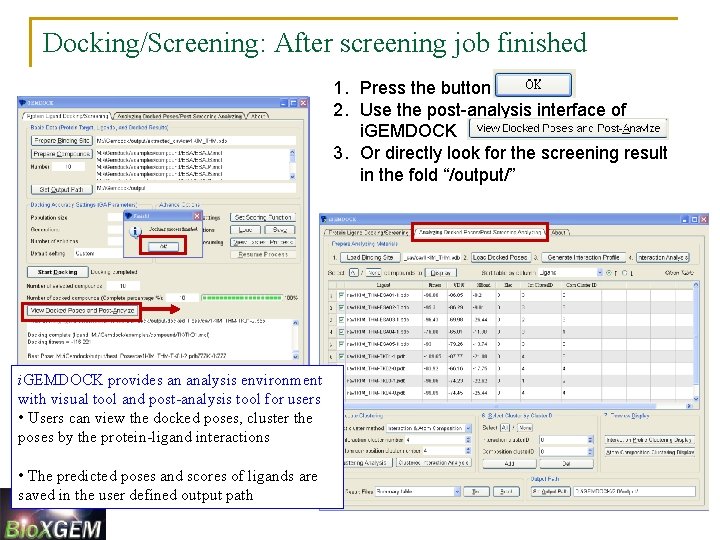
Docking/Screening: After screening job finished 1. Press the button ok 2. Use the post-analysis interface of i. GEMDOCK 3. Or directly look for the screening result in the fold “/output/” i. GEMDOCK provides an analysis environment with visual tool and post-analysis tool for users • Users can view the docked poses, cluster the poses by the protein-ligand interactions • The predicted poses and scores of ligands are saved in the user defined output path
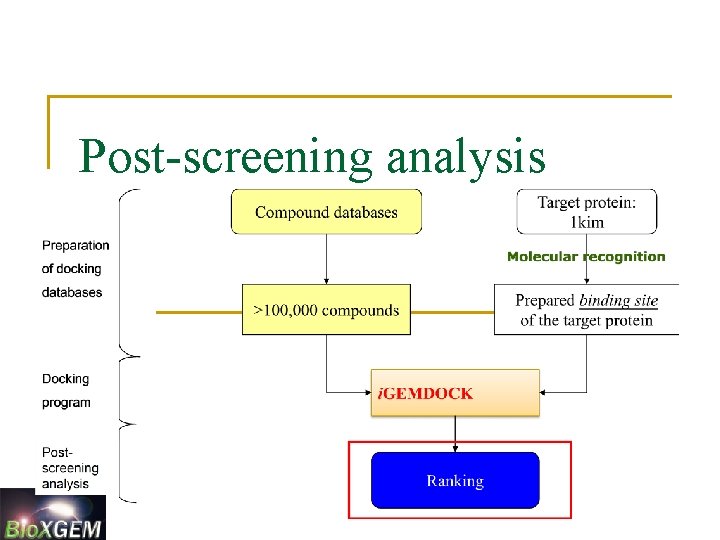
Post-screening analysis
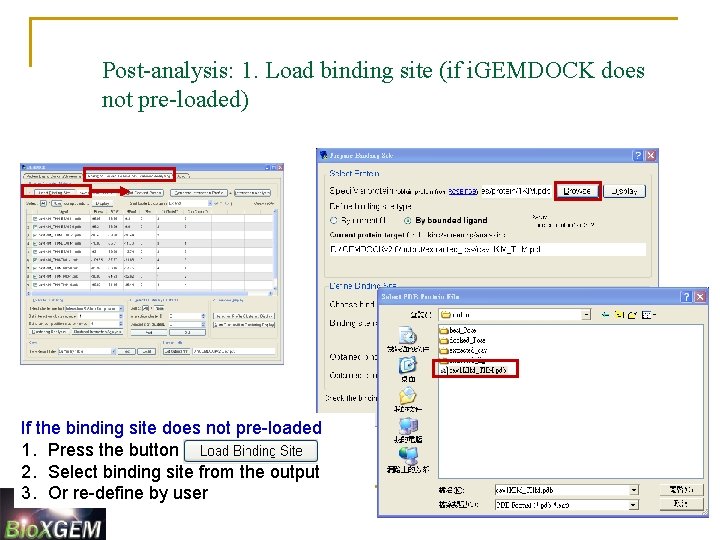
Post-analysis: 1. Load binding site (if i. GEMDOCK does not pre-loaded) If the binding site does not pre-loaded 1. Press the button binding site 2. Select binding site from the output 3. Or re-define by user
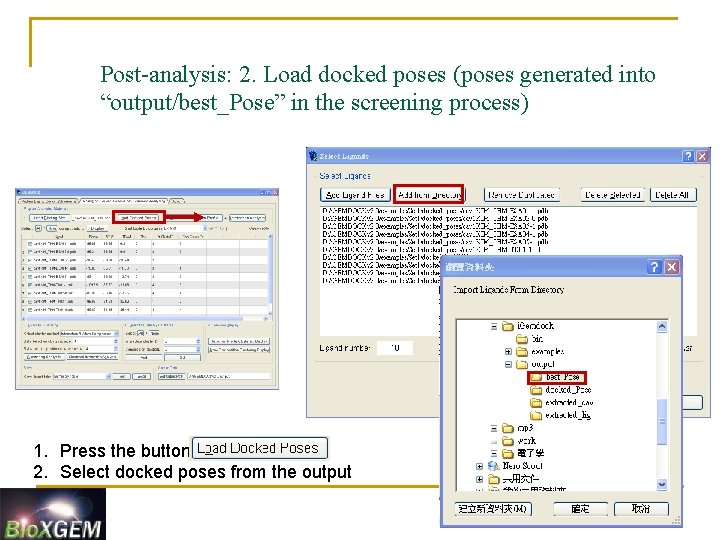
Post-analysis: 2. Load docked poses (poses generated into “output/best_Pose” in the screening process) 1. Press the button poses 2. Select docked poses from the output
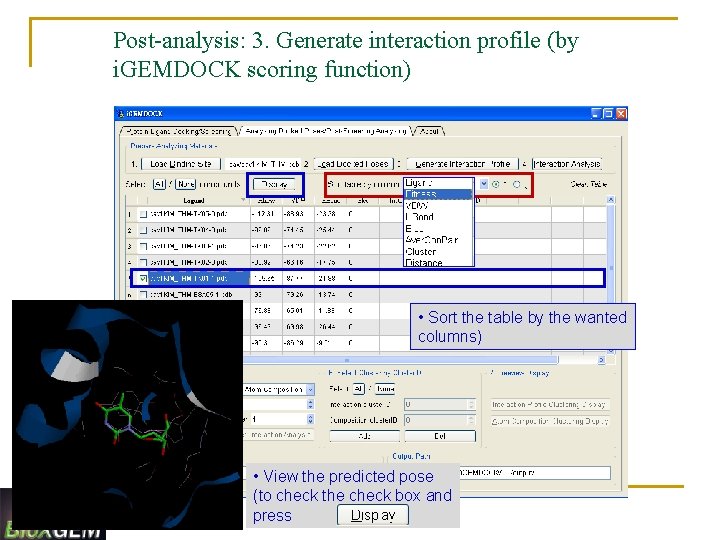
Post-analysis: 3. Generate interaction profile (by i. GEMDOCK scoring function) • Sort the table by the wanted columns) • View the predicted pose (to check the check box and press )
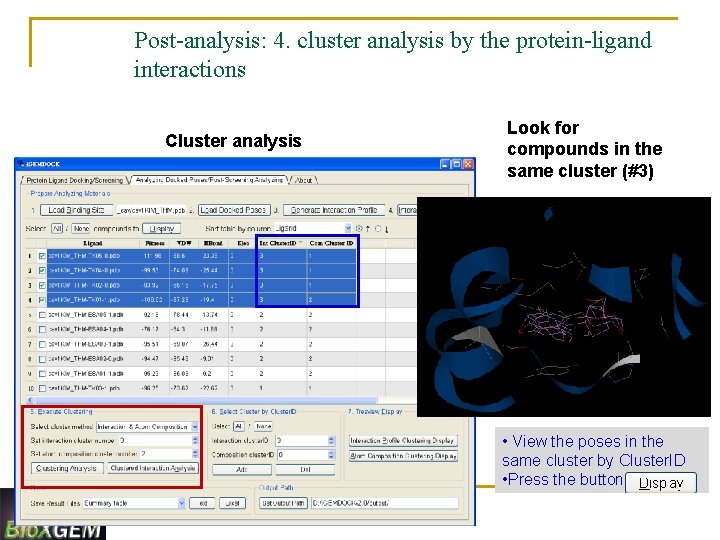
Post-analysis: 4. cluster analysis by the protein-ligand interactions Cluster analysis Look for compounds in the same cluster (#3) • View the poses in the same cluster by Cluster. ID • Press the button display
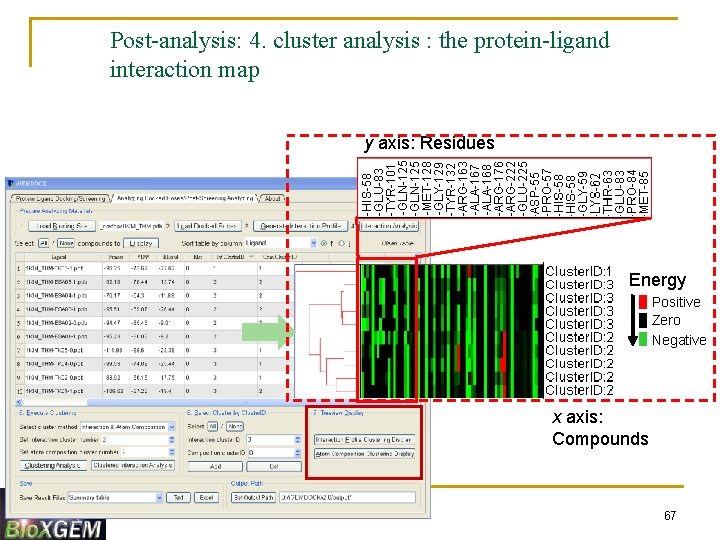
Post-analysis: 4. cluster analysis : the protein-ligand interaction map y axis: Residues Energy Positive Zero Negative x axis: Compounds 67
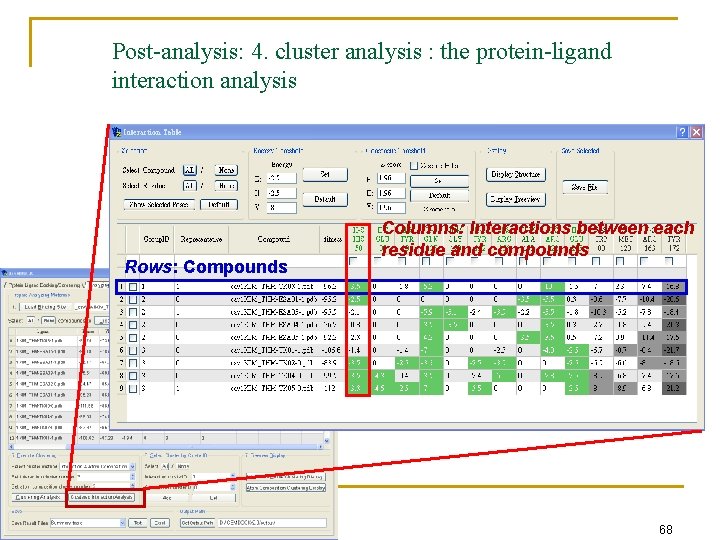
Post-analysis: 4. cluster analysis : the protein-ligand interaction analysis Rows: Compounds Columns: Interactions between each residue and compounds 68
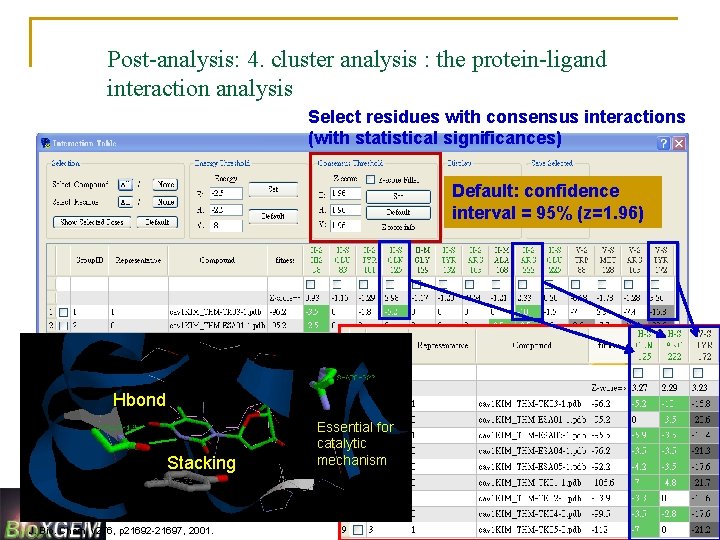
Post-analysis: 4. cluster analysis : the protein-ligand interaction analysis Select residues with consensus interactions (with statistical significances) Default: confidence interval = 95% (z=1. 96) Hbond Stacking Essential for catalytic mechanism 69 J. Bio. Chem. v 276, p 21692 -21697, 2001.
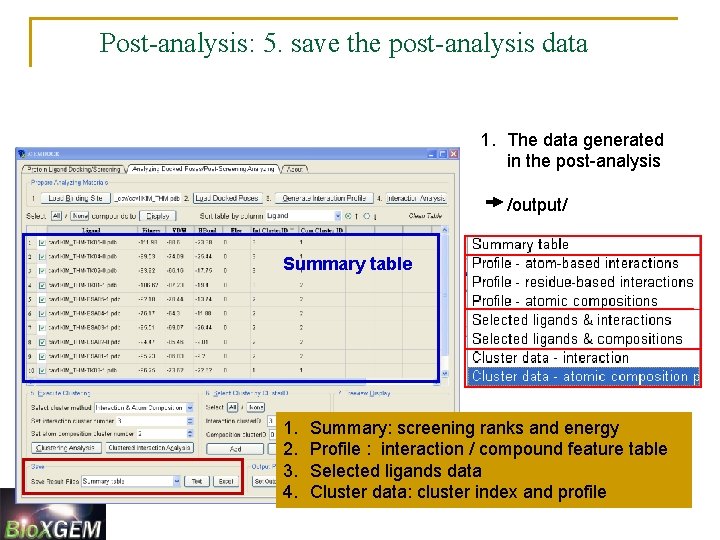
Post-analysis: 5. save the post-analysis data 1. The data generated in the post-analysis /output/ Summary table 1. 2. 3. 4. Summary: screening ranks and energy Profile : interaction / compound feature table Selected ligands data Cluster data: cluster index and profile
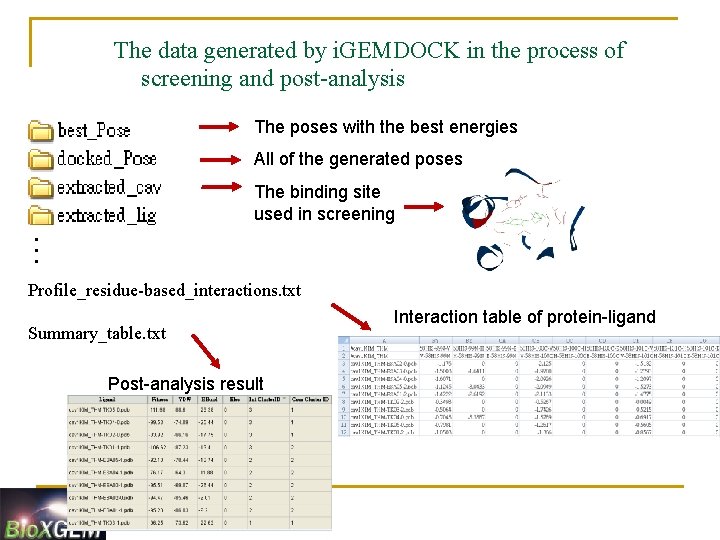
The data generated by i. GEMDOCK in the process of screening and post-analysis The poses with the best energies All of the generated poses The binding site used in screening … Profile_residue-based_interactions. txt Summary_table. txt Post-analysis result Interaction table of protein-ligand
References of i. GEMDOCK n Primary References: q q q n J. -M. Yang and C. -C. Chen, "GEMDOCK: A generic evolutionary method for molecular docking", Proteins: Structure, Function and Bioinformatics, vol. 55, pp. 288 -304, 2004. J. -M. Yang, "Development and evaluation of a generic evolutionary method for protein-ligand docking", Journal of Computational Chemistry, vol. 25, pp. 843 -857, 2004. J. -M. Yang and T. -W. Shen, "A pharmacophore-based evolutionary approach for screening selective estrogen receptor modulators", Proteins: Structure, Function and Bioinformatics, vol. 59, pp. 205 -220, 2005. J. -M. Yang, Y. -F. Chen, T. -W. Shen, B. S. Kristal, and D. F. Hsu, "Consensus Scoring Criteria for Improving Enrichment in Virtual Screening ", Journal of Chemical Information and Modeling 2005. K. -C. Hsu, Y. -F. Chen, S. -R. Lin and J. -M. Yang, "i. GEMDOCK: A Graphical Environment of enhancing GEMDOCK using pharmacological interactions and postscreening analysis, " BMC Bioinformatics, 12(Suppl 1): S 33, 2011 Selected Applications: q q q J. -M. Yang, Y. -F. Chen, Y. -Y. Tu, K. -R. Yen, and Y. -L. Yang*, “Combinatorial computation approaches identifying tetracycline derivates as flaviviruses inhibitors”, PLo. S ONE, pp. e 428. 1 - e 428. 12, 2007. E. -S. Lin, J. -M. Yang, and Y. -S. Yang, "Modeling the binding and inhibition mechanism of nucleotide and sulfotransferase using molecular docking", Journal of the Chinese Chemical Society, vol. 50, pp. 655 -663, 2003. (SCI) J. -M. Yang and T. -W. Shen, "A Pharmacophore-Based Evolutionary Approach for Screening Estrogen Receptor Antagonists", Congress of Evolutionary Computation (CEC 2004), pp. 1028 -1035, 2004.
Thanks for your attention n 聯絡資訊 q q http: //gemdock. life. nctu. edu. tw/bioxgem/ 藥物設計與系統生物實驗室 (Bio. XGEM Lab. ), 交大生物資訊所 n n PI: Jinn-Moon Yang (楊進木) Address: 75 PO-Ai Street, Hsinchu, Taiwan, 30050, ROC Office & Lab : 308 and 304 (Lab) in Experiment Building Tel: 886 - 3 -5712121 ext. 56946 E-mail: moon@faculty. nctu. edu. tw
- Slides: 73