
Carnegie Mellon 15 213 Recitation Attack Lab Your
Carnegie Mellon 15 -213 Recitation: Attack Lab Your TAs September 23 rd, 2019
Carnegie Mellon Agenda ■ Reminders ■ Stacks ■ Attack Lab Activities
Carnegie Mellon Reminders ■ Bomb Lab is due tomorrow! ■ Attack Lab is due Oct 1 st, 2019! ■ “But if you wait until the last minute, it only takes a minute!” – NOT! ■ Don’t waste your grace days on this assignment!
Carnegie Mellon Attack Lab ■ We’re letting you hijack programs by running buffer overflow attacks on them. ■ Is that not justification enough? ■ Helps you understand stack discipline and stack frames ■ Most difficult part of the midterm exam ■ Also let you defeat relatively secure programs with return oriented programming

Carnegie Mellon Stack Overview Let’s say you have the following stack diagram. What happens when you call a function? What information always goes on the stack? ret addr rsp
Carnegie Mellon Attack Lab Activities Don’t be afraid if these concepts are unfamiliar! You will be learning them this week in lecture.
Carnegie Mellon Attack Lab Activities ■ Three activities ■ Each relies on a specially crafted assembly sequence to purposefully overwrite the stack ■ Activity 1 – Overwrites the return addresses ■ Activity 2 – Writes an assembly sequence onto the stack ■ Activity 3 – Uses byte sequences in libc as the instructions
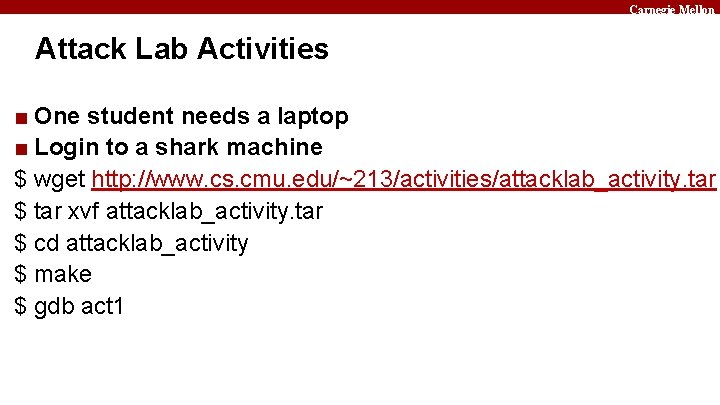
Carnegie Mellon Attack Lab Activities ■ One student needs a laptop ■ Login to a shark machine $ wget http: //www. cs. cmu. edu/~213/activities/attacklab_activity. tar $ tar xvf attacklab_activity. tar $ cd attacklab_activity $ make $ gdb act 1
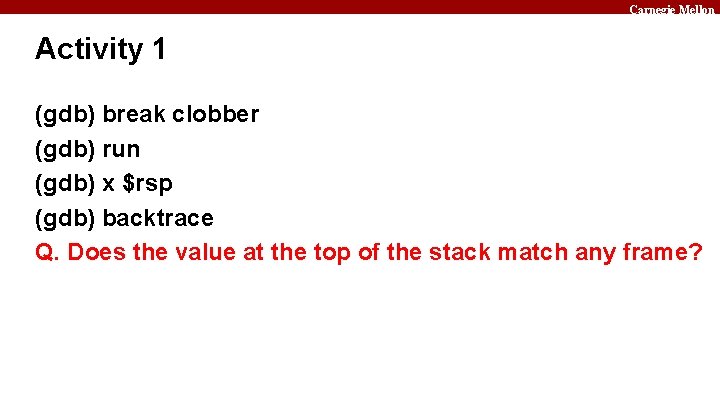
Carnegie Mellon Activity 1 (gdb) break clobber (gdb) run (gdb) x $rsp (gdb) backtrace Q. Does the value at the top of the stack match any frame?
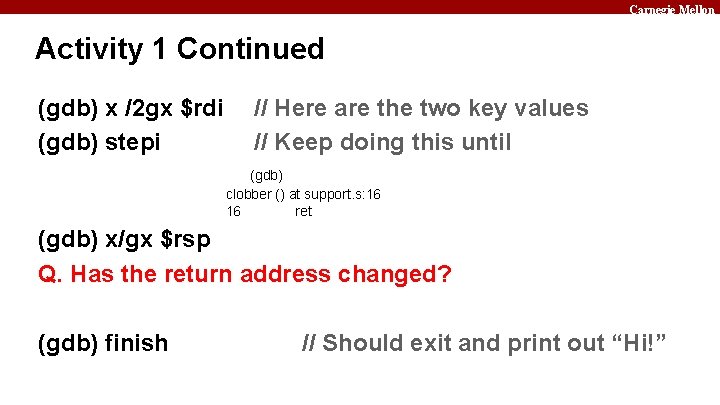
Carnegie Mellon Activity 1 Continued (gdb) x /2 gx $rdi (gdb) stepi // Here are the two key values // Keep doing this until (gdb) clobber () at support. s: 16 16 ret (gdb) x/gx $rsp Q. Has the return address changed? (gdb) finish // Should exit and print out “Hi!”
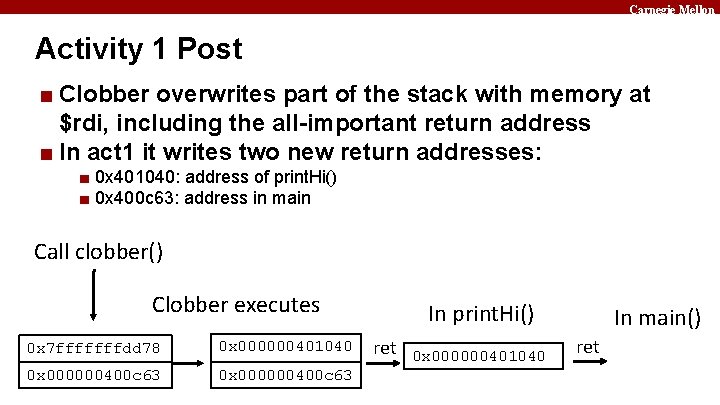
Carnegie Mellon Activity 1 Post ■ Clobber overwrites part of the stack with memory at $rdi, including the all-important return address ■ In act 1 it writes two new return addresses: ■ 0 x 401040: address of print. Hi() ■ 0 x 400 c 63: address in main Call clobber() Clobber executes 0 x 7 fffffffdd 78 0 x 000000401040 0 x 000000400 c 63 In print. Hi() ret 0 x 000000401040 In main() ret
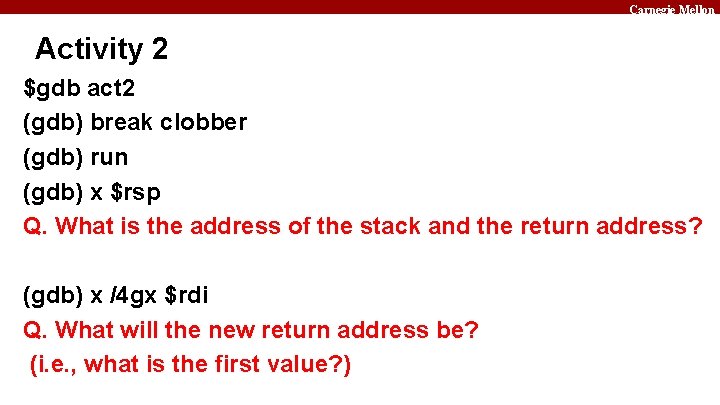
Carnegie Mellon Activity 2 $gdb act 2 (gdb) break clobber (gdb) run (gdb) x $rsp Q. What is the address of the stack and the return address? (gdb) x /4 gx $rdi Q. What will the new return address be? (i. e. , what is the first value? )
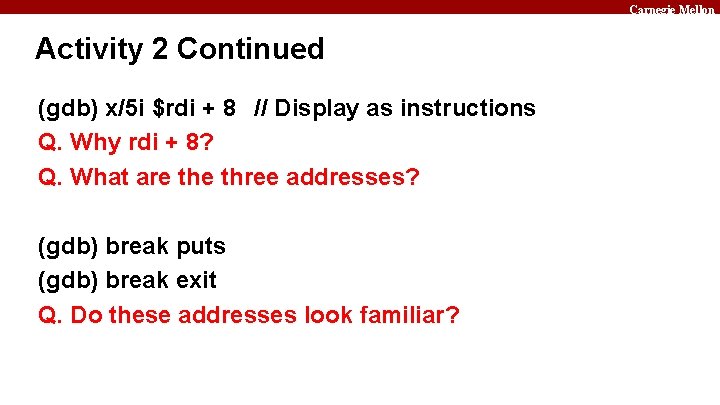
Carnegie Mellon Activity 2 Continued (gdb) x/5 i $rdi + 8 // Display as instructions Q. Why rdi + 8? Q. What are three addresses? (gdb) break puts (gdb) break exit Q. Do these addresses look familiar?
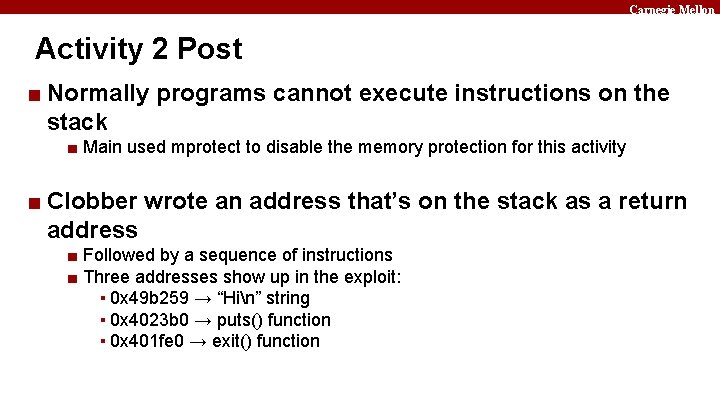
Carnegie Mellon Activity 2 Post ■ Normally programs cannot execute instructions on the stack ■ Main used mprotect to disable the memory protection for this activity ■ Clobber wrote an address that’s on the stack as a return address ■ Followed by a sequence of instructions ■ Three addresses show up in the exploit: ▪ 0 x 49 b 259 → “Hin” string ▪ 0 x 4023 b 0 → puts() function ▪ 0 x 401 fe 0 → exit() function
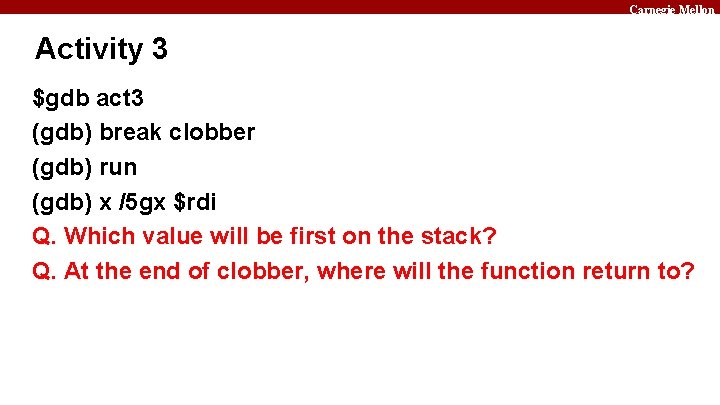
Carnegie Mellon Activity 3 $gdb act 3 (gdb) break clobber (gdb) run (gdb) x /5 gx $rdi Q. Which value will be first on the stack? Q. At the end of clobber, where will the function return to?
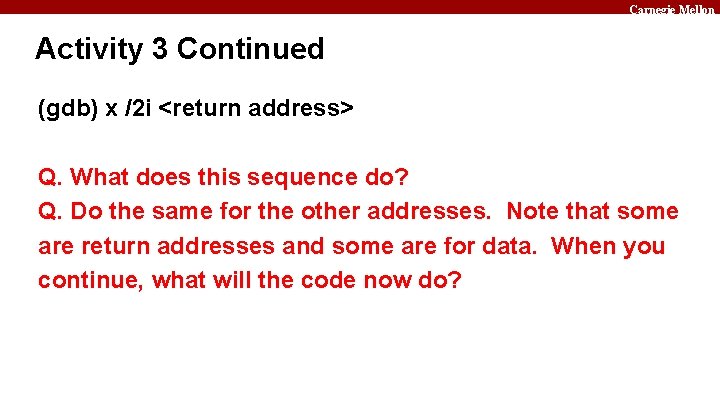
Carnegie Mellon Activity 3 Continued (gdb) x /2 i <return address> Q. What does this sequence do? Q. Do the same for the other addresses. Note that some are return addresses and some are for data. When you continue, what will the code now do?
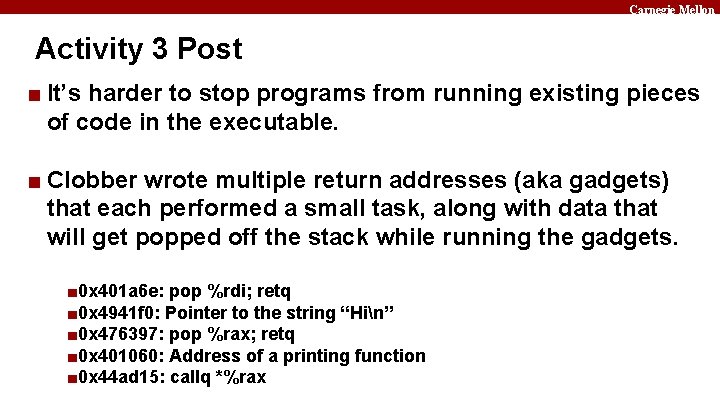
Carnegie Mellon Activity 3 Post ■ It’s harder to stop programs from running existing pieces of code in the executable. ■ Clobber wrote multiple return addresses (aka gadgets) that each performed a small task, along with data that will get popped off the stack while running the gadgets. ■ 0 x 401 a 6 e: pop %rdi; retq ■ 0 x 4941 f 0: Pointer to the string “Hin” ■ 0 x 476397: pop %rax; retq ■ 0 x 401060: Address of a printing function ■ 0 x 44 ad 15: callq *%rax
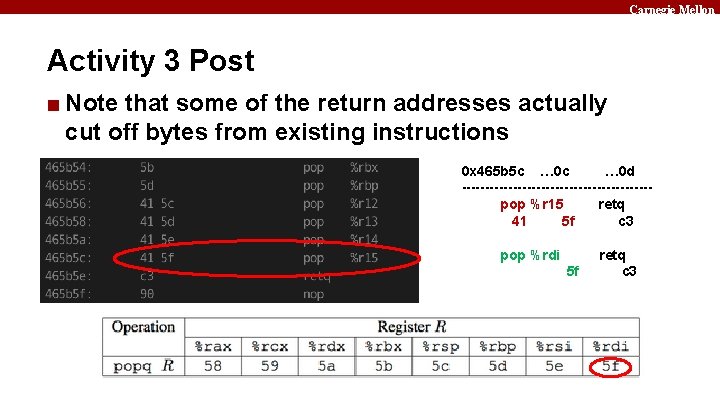
Carnegie Mellon Activity 3 Post ■ Note that some of the return addresses actually cut off bytes from existing instructions 0 x 465 b 5 c … 0 d --------------------pop %r 15 retq 41 5 f c 3 pop %rdi 5 f retq c 3
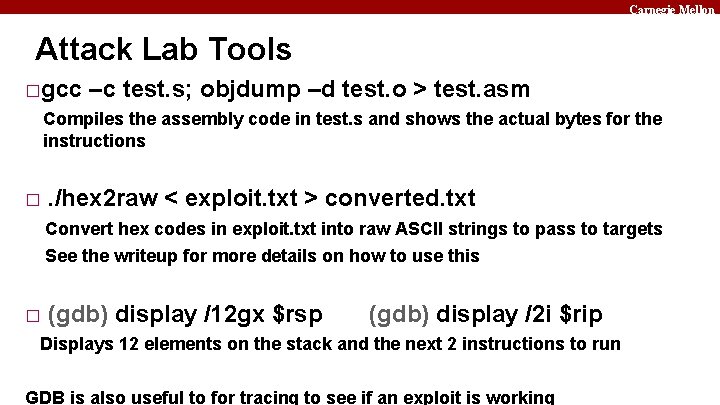
Carnegie Mellon Attack Lab Tools � gcc –c test. s; objdump –d test. o > test. asm Compiles the assembly code in test. s and shows the actual bytes for the instructions � . /hex 2 raw < exploit. txt > converted. txt Convert hex codes in exploit. txt into raw ASCII strings to pass to targets See the writeup for more details on how to use this � (gdb) display /12 gx $rsp (gdb) display /2 i $rip Displays 12 elements on the stack and the next 2 instructions to run GDB is also useful to for tracing to see if an exploit is working
Carnegie Mellon If you get stuck ■ Please read the writeup! ■ CS: APP Chapter 3 ■ View lecture notes and course FAQ at http: //www. cs. cmu. edu/~213 ■ Office hours Sunday through Friday 5: 30 -9: 30 pm in GHC 5207 ■ Post a private question on Piazza ■ man gdb, gdb's help command
- Slides: 20