Speech Recognition with CMU Sphinx Srikar Nadipally Hareesh


- Slides: 27
Speech Recognition with CMU Sphinx Srikar Nadipally Hareesh Lingareddy
What is Speech Recognition • A Speech Recognition System converts a speech signal in to textual representation
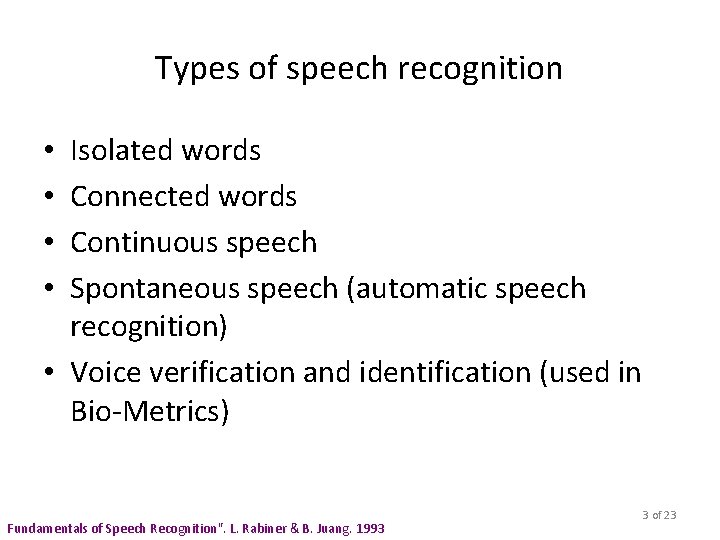
Types of speech recognition Isolated words Connected words Continuous speech Spontaneous speech (automatic speech recognition) • Voice verification and identification (used in Bio-Metrics) • • Fundamentals of Speech Recognition". L. Rabiner & B. Juang. 1993 3 of 23
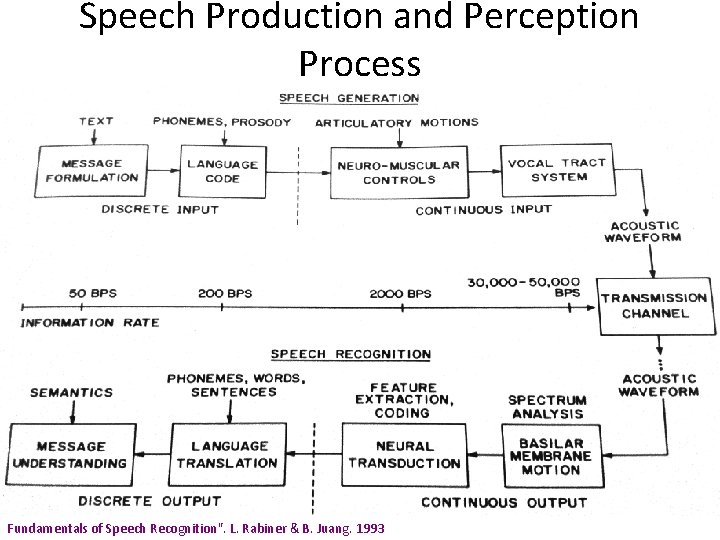
Speech Production and Perception Process Fundamentals of Speech Recognition". L. Rabiner & B. Juang. 1993
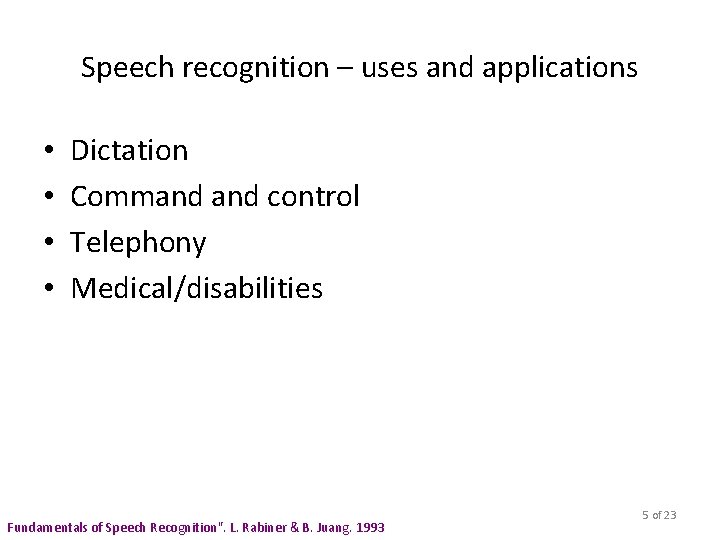
Speech recognition – uses and applications • • Dictation Command control Telephony Medical/disabilities Fundamentals of Speech Recognition". L. Rabiner & B. Juang. 1993 5 of 23
Project at a Glance - Sphinx 4 • Description o Speech recognition written entirely in the Java. TM programming language o Based upon Sphinx developed at CMU: o www. speech. cs. cmu. edu/sphinx/ • Goals o Highly flexible recognizer o Performance equal to or exceeding Sphinx 3 o Collaborate with researchers at CMU and MERL, Sun Microsystems and others
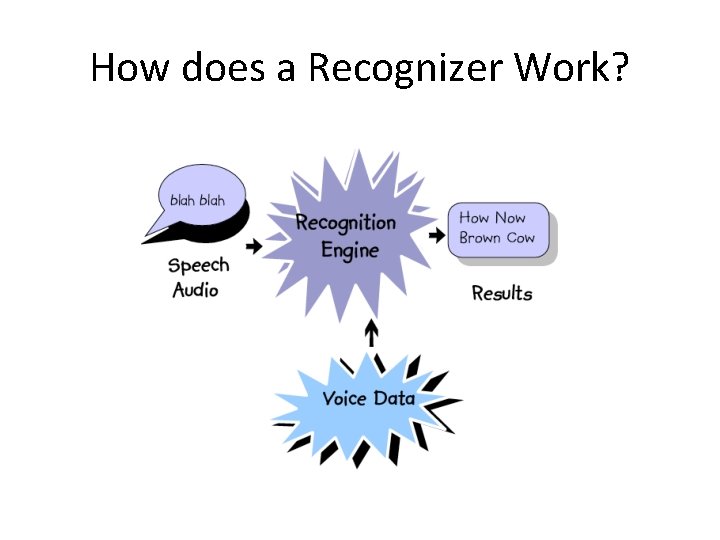
How does a Recognizer Work?
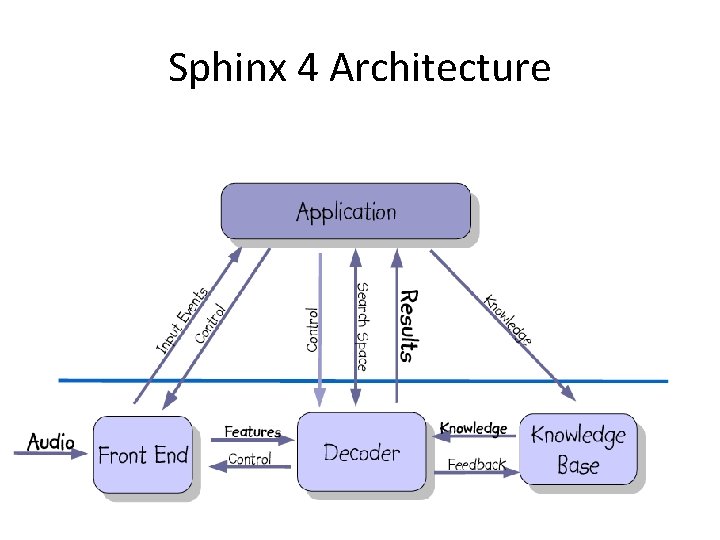
Sphinx 4 Architecture
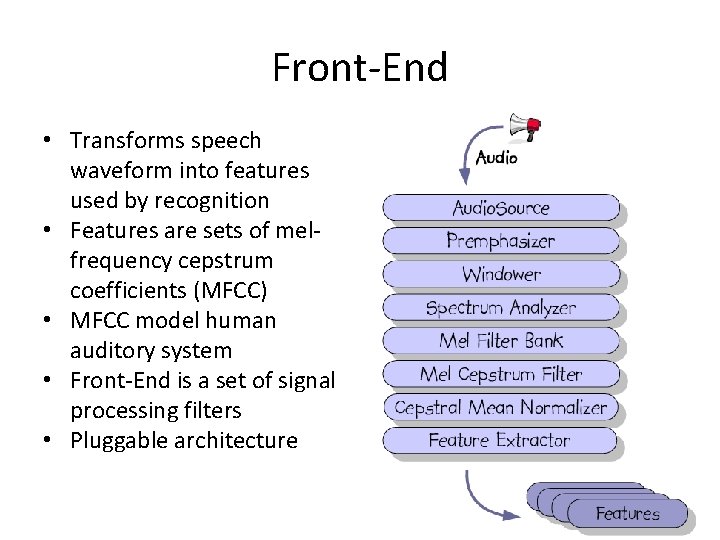
Front-End • Transforms speech waveform into features used by recognition • Features are sets of melfrequency cepstrum coefficients (MFCC) • MFCC model human auditory system • Front-End is a set of signal processing filters • Pluggable architecture
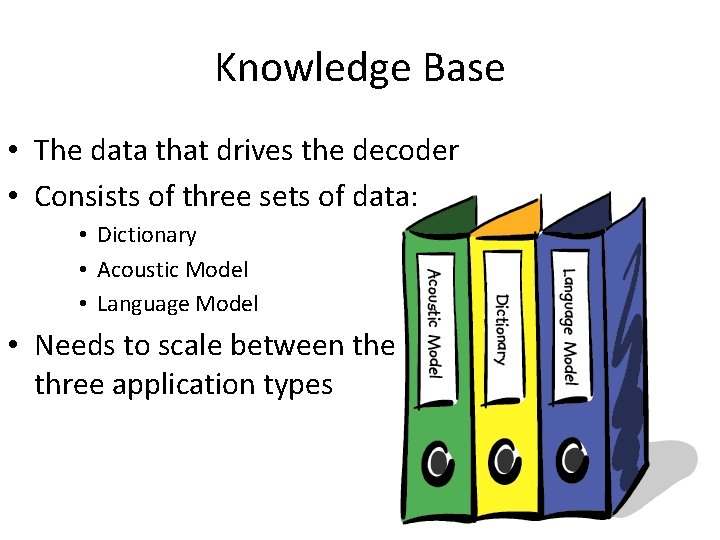
Knowledge Base • The data that drives the decoder • Consists of three sets of data: • Dictionary • Acoustic Model • Language Model • Needs to scale between the three application types
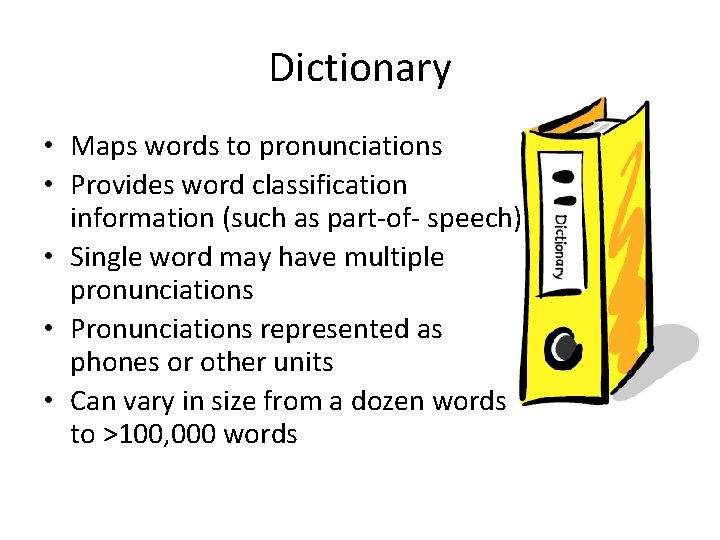
Dictionary • Maps words to pronunciations • Provides word classification information (such as part-of- speech) • Single word may have multiple pronunciations • Pronunciations represented as phones or other units • Can vary in size from a dozen words to >100, 000 words
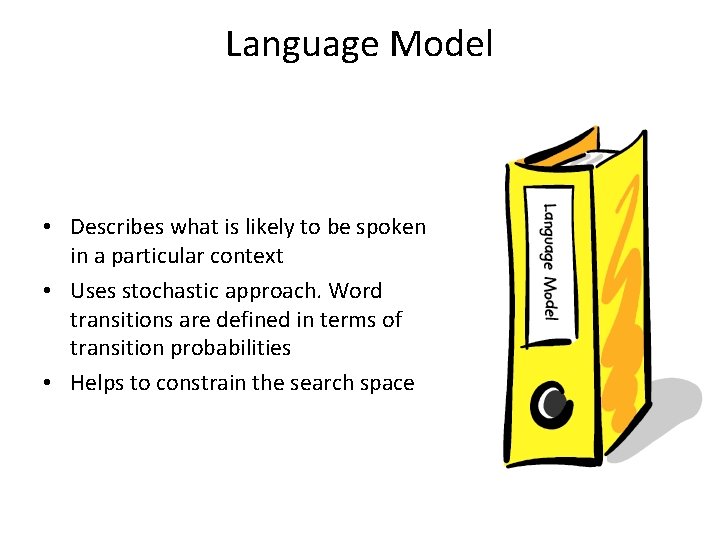
Language Model • Describes what is likely to be spoken in a particular context • Uses stochastic approach. Word transitions are defined in terms of transition probabilities • Helps to constrain the search space
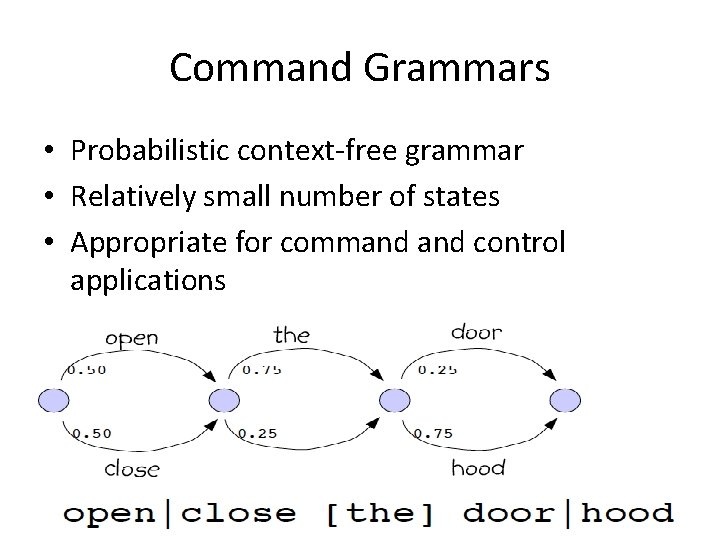
Command Grammars • Probabilistic context-free grammar • Relatively small number of states • Appropriate for command control applications
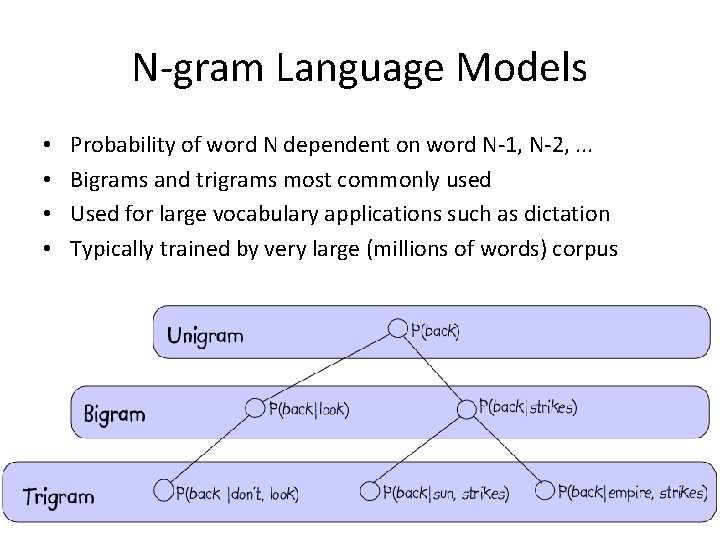
N-gram Language Models • • Probability of word N dependent on word N-1, N-2, . . . Bigrams and trigrams most commonly used Used for large vocabulary applications such as dictation Typically trained by very large (millions of words) corpus
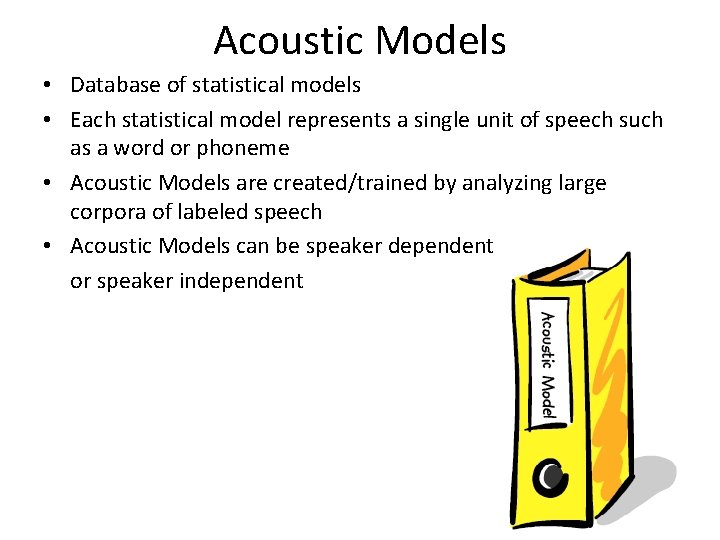
Acoustic Models • Database of statistical models • Each statistical model represents a single unit of speech such as a word or phoneme • Acoustic Models are created/trained by analyzing large corpora of labeled speech • Acoustic Models can be speaker dependent or speaker independent
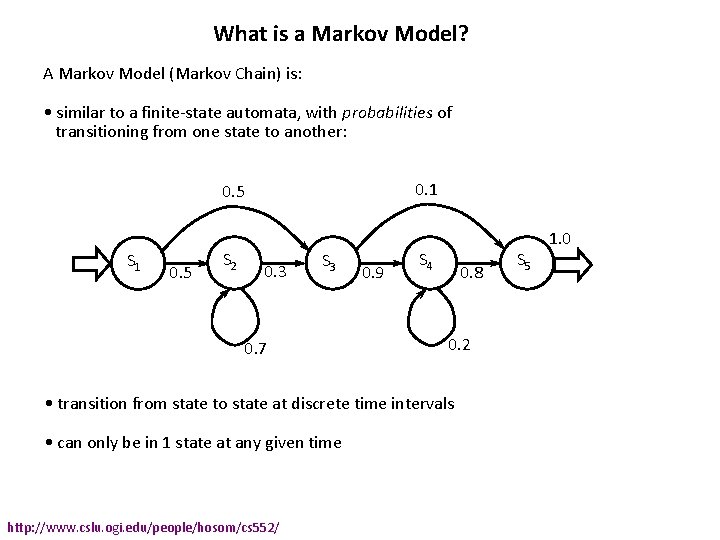
What is a Markov Model? A Markov Model (Markov Chain) is: • similar to a finite-state automata, with probabilities of transitioning from one state to another: 0. 1 0. 5 S 2 0. 3 S 3 0. 7 0. 9 S 4 0. 8 0. 2 • transition from state to state at discrete time intervals • can only be in 1 state at any given time http: //www. cslu. ogi. edu/people/hosom/cs 552/ S 5 1. 0
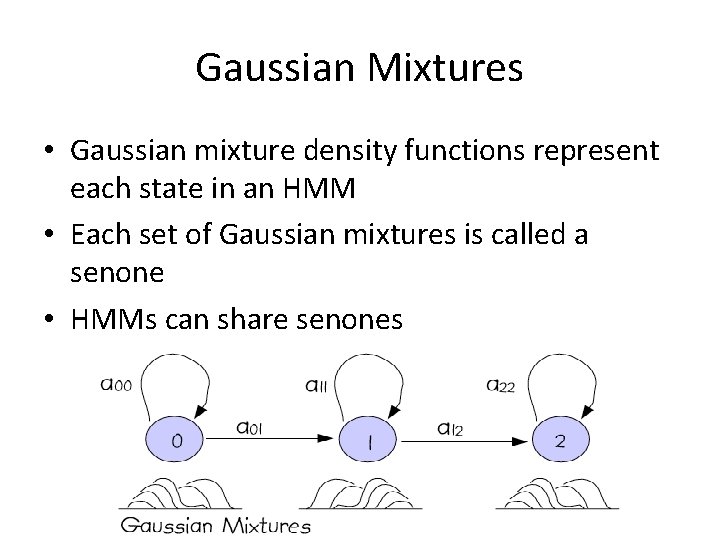
Hidden Markov Model • Hidden Markov Models represent each unit of speech in the Acoustic Model • HMMs are used by a scorer to calculate the acoustic probability for a particular unit of speech • A Typical HMM uses 3 states to model a single context dependent phoneme • Each state of an HMM is represented by a set of Gaussian mixture density functions
Gaussian Mixtures • Gaussian mixture density functions represent each state in an HMM • Each set of Gaussian mixtures is called a senone • HMMs can share senones
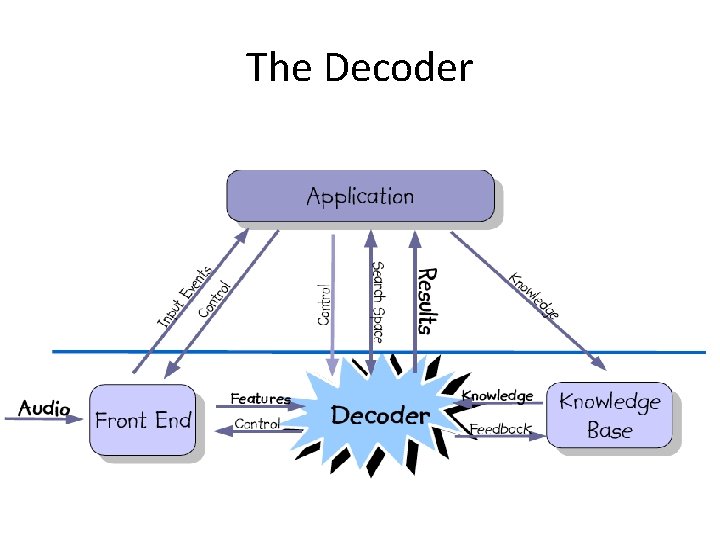
The Decoder
Decoder - heart of the recognizer • • Selects next set of likely states Scores incoming features against these states Prunes low scoring states Generates results
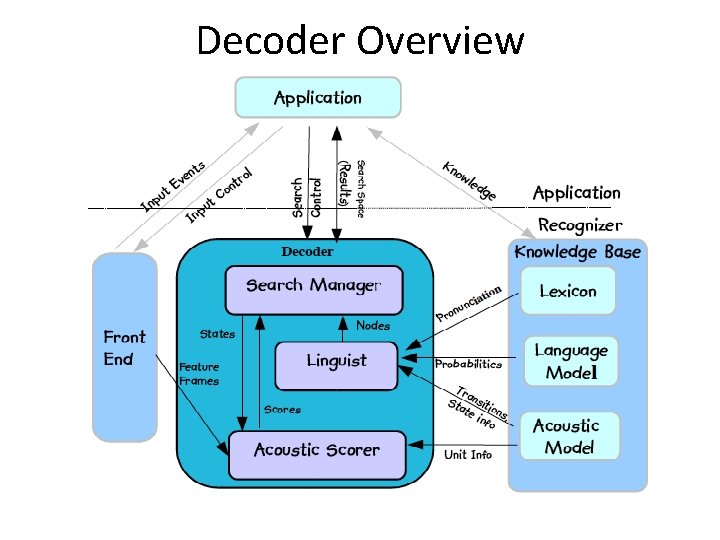
Decoder Overview
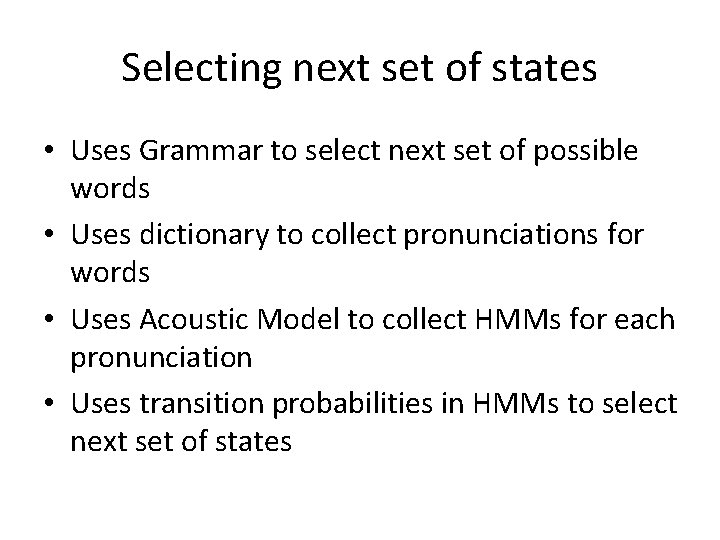
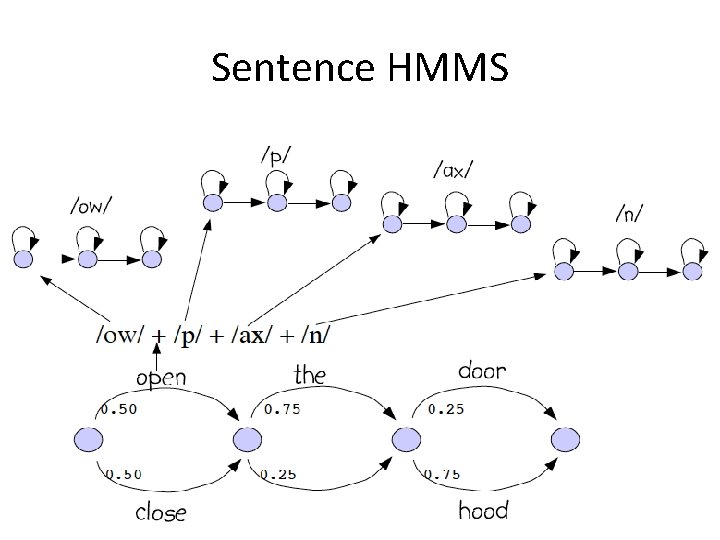
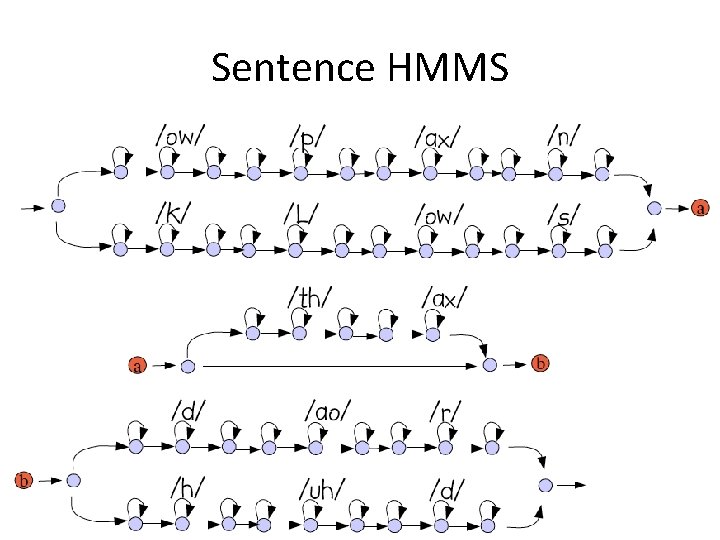
Selecting next set of states • Uses Grammar to select next set of possible words • Uses dictionary to collect pronunciations for words • Uses Acoustic Model to collect HMMs for each pronunciation • Uses transition probabilities in HMMs to select next set of states
Sentence HMMS
Sentence HMMS
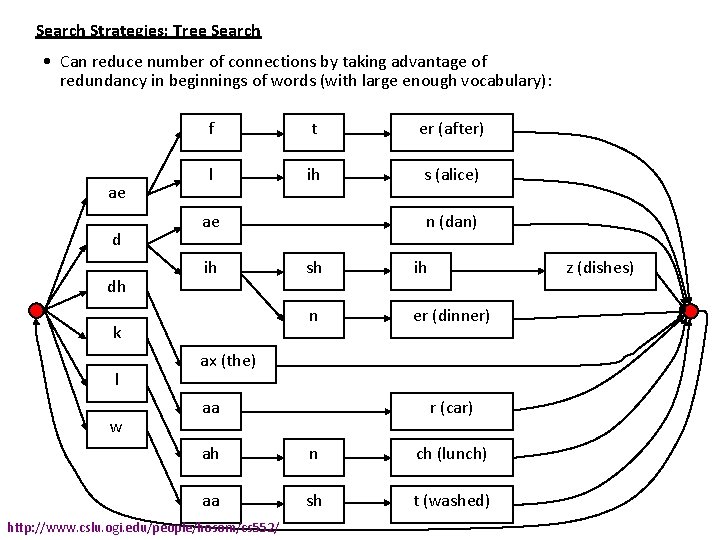
Search Strategies: Tree Search • Can reduce number of connections by taking advantage of redundancy in beginnings of words (with large enough vocabulary): ae d dh f t er (after) l ih s (alice) ae ih k l w n (dan) sh ih z (dishes) n er (dinner) ax (the) aa r (car) ah n ch (lunch) aa sh t (washed) http: //www. cslu. ogi. edu/people/hosom/cs 552/
Questions? ?
References • CMU Sphinx Project, http: //cmusphinx. sourceforge. net • Vox Forge Project, http: //www. voxforge. org