Speech Recognition Models of the Interdependence Among Prosody

- Slides: 30
Speech Recognition Models of the Interdependence Among Prosody, Syntax, and Segmental Acoustics Mark Hasegawa-Johnson Jennifer Cole, Chilin Shih, Ken Chen, Aaron Cohen, Sandra Chavarria, Heejin Kim, Taejin Yoon, Sarah Borys, and Jeung-Yoon Choi
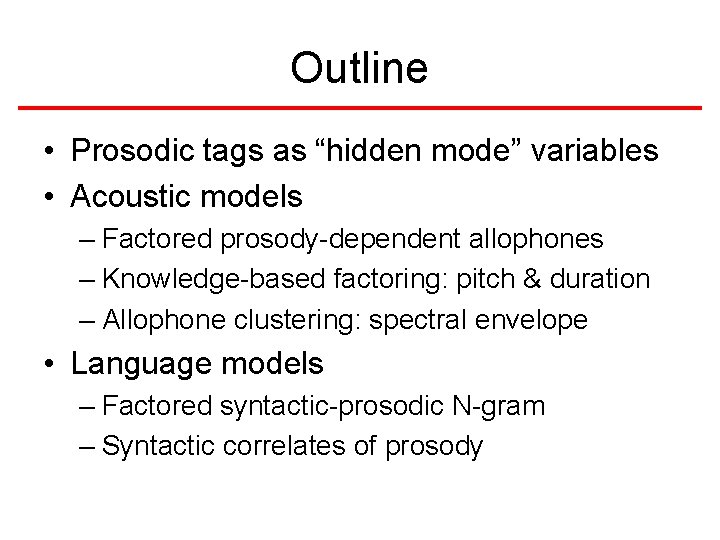
Outline • Prosodic tags as “hidden mode” variables • Acoustic models – Factored prosody-dependent allophones – Knowledge-based factoring: pitch & duration – Allophone clustering: spectral envelope • Language models – Factored syntactic-prosodic N-gram – Syntactic correlates of prosody
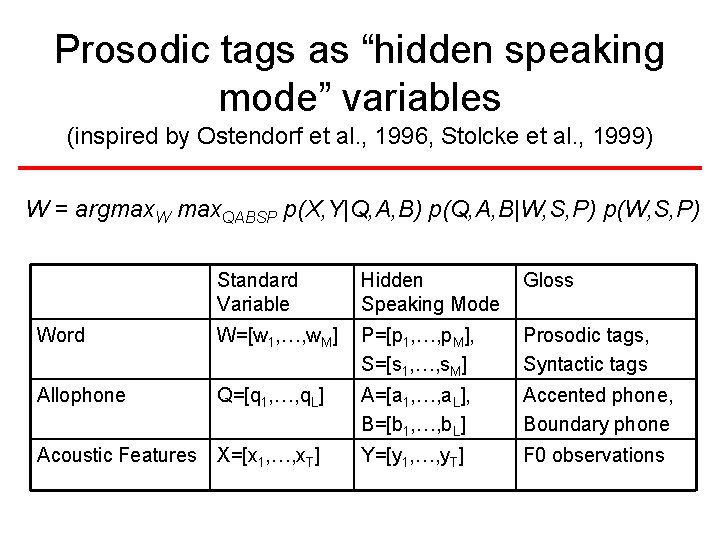
Prosodic tags as “hidden speaking mode” variables (inspired by Ostendorf et al. , 1996, Stolcke et al. , 1999) W = argmax. W max. QABSP p(X, Y|Q, A, B) p(Q, A, B|W, S, P) p(W, S, P) Standard Variable Hidden Speaking Mode Gloss Word W=[w 1, …, w. M] P=[p 1, …, p. M], S=[s 1, …, s. M] Prosodic tags, Syntactic tags Allophone Q=[q 1, …, q. L] A=[a 1, …, a. L], B=[b 1, …, b. L] Accented phone, Boundary phone Acoustic Features X=[x 1, …, x. T] Y=[y 1, …, y. T] F 0 observations
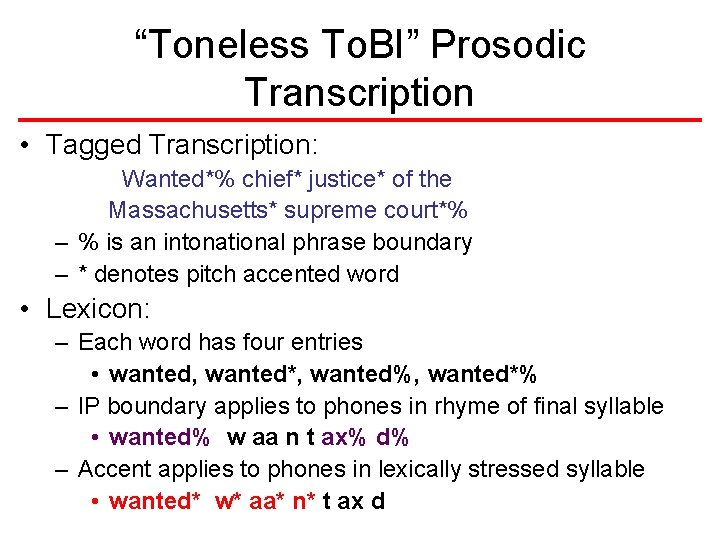
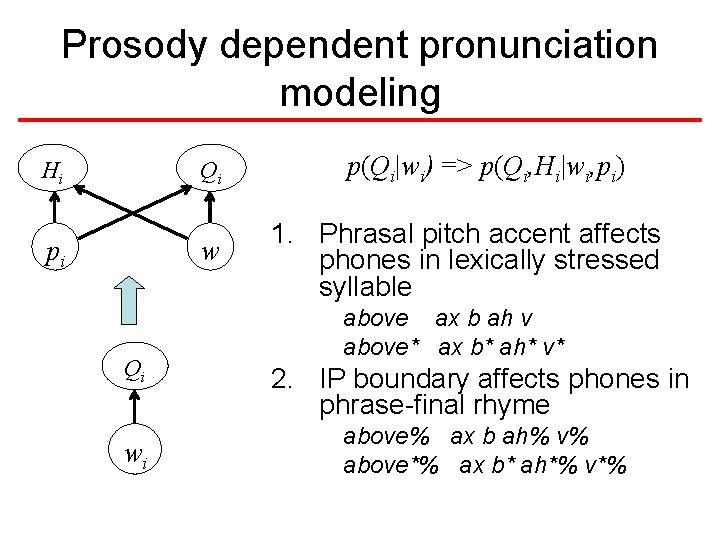
“Toneless To. BI” Prosodic Transcription • Tagged Transcription: Wanted*% chief* justice* of the Massachusetts* supreme court*% – % is an intonational phrase boundary – * denotes pitch accented word • Lexicon: – Each word has four entries • wanted, wanted*, wanted%, wanted*% – IP boundary applies to phones in rhyme of final syllable • wanted% w aa n t ax% d% – Accent applies to phones in lexically stressed syllable • wanted* w* aa* n* t ax d
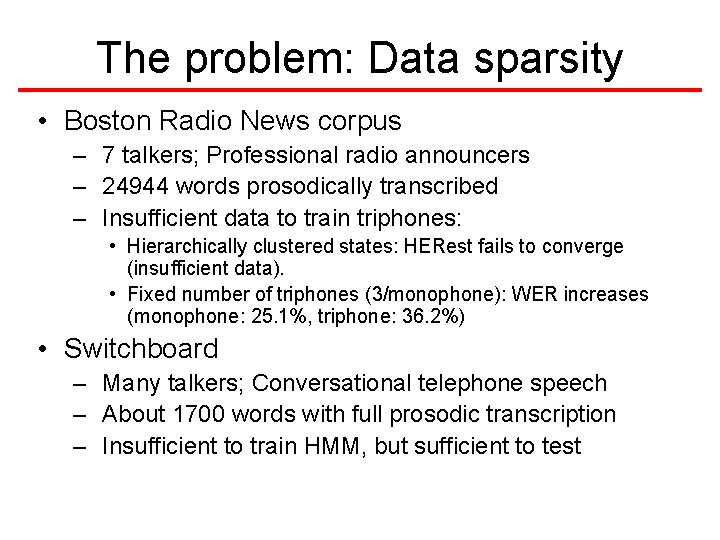
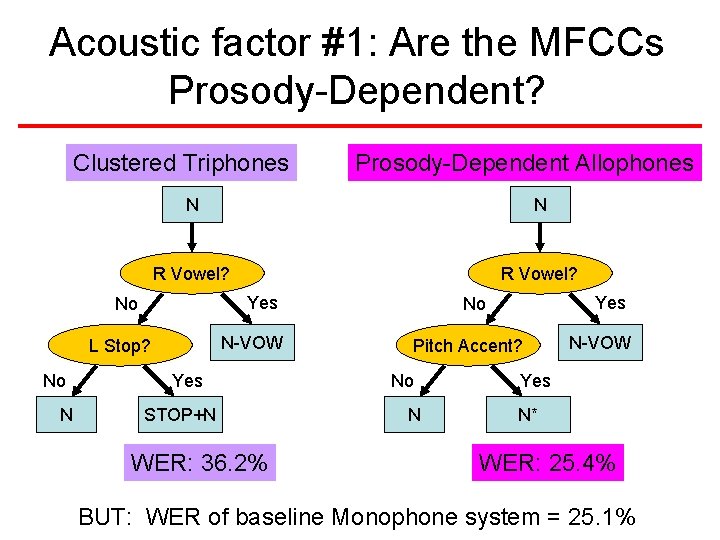
The problem: Data sparsity • Boston Radio News corpus – 7 talkers; Professional radio announcers – 24944 words prosodically transcribed – Insufficient data to train triphones: • Hierarchically clustered states: HERest fails to converge (insufficient data). • Fixed number of triphones (3/monophone): WER increases (monophone: 25. 1%, triphone: 36. 2%) • Switchboard – Many talkers; Conversational telephone speech – About 1700 words with full prosodic transcription – Insufficient to train HMM, but sufficient to test
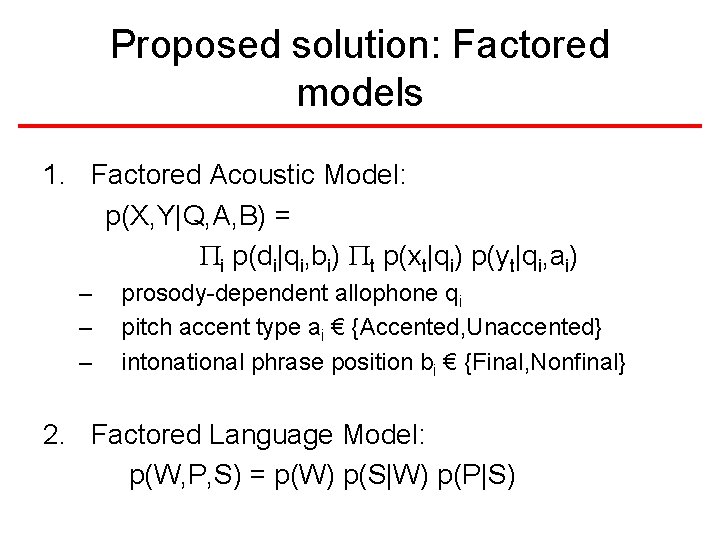
Proposed solution: Factored models 1. Factored Acoustic Model: p(X, Y|Q, A, B) = Pi p(di|qi, bi) Pt p(xt|qi) p(yt|qi, ai) – – – prosody-dependent allophone qi pitch accent type ai € {Accented, Unaccented} intonational phrase position bi € {Final, Nonfinal} 2. Factored Language Model: p(W, P, S) = p(W) p(S|W) p(P|S)
Acoustic factor #1: Are the MFCCs Prosody-Dependent? Clustered Triphones N N R Vowel? Yes No N-VOW L Stop? No N Prosody-Dependent Allophones Yes STOP+N WER: 36. 2% Yes No Pitch Accent? No N N-VOW Yes N* WER: 25. 4% BUT: WER of baseline Monophone system = 25. 1%
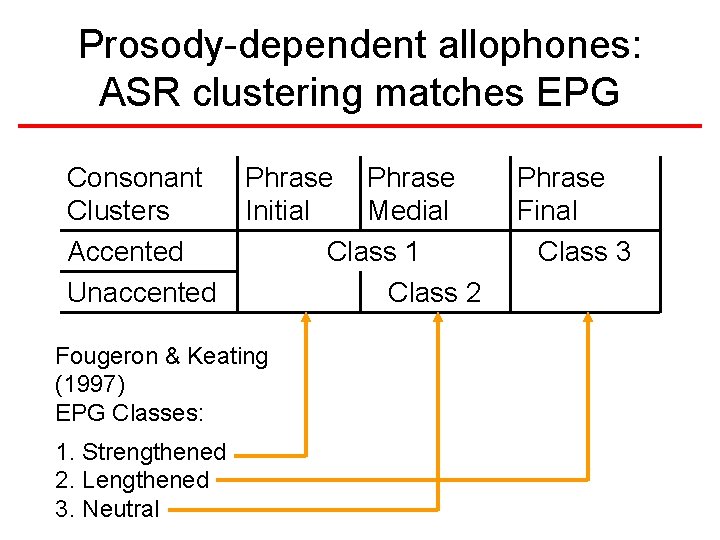
Prosody-dependent allophones: ASR clustering matches EPG Consonant Clusters Accented Unaccented Phrase Initial Medial Class 1 Class 2 Fougeron & Keating (1997) EPG Classes: 1. Strengthened 2. Lengthened 3. Neutral Phrase Final Class 3
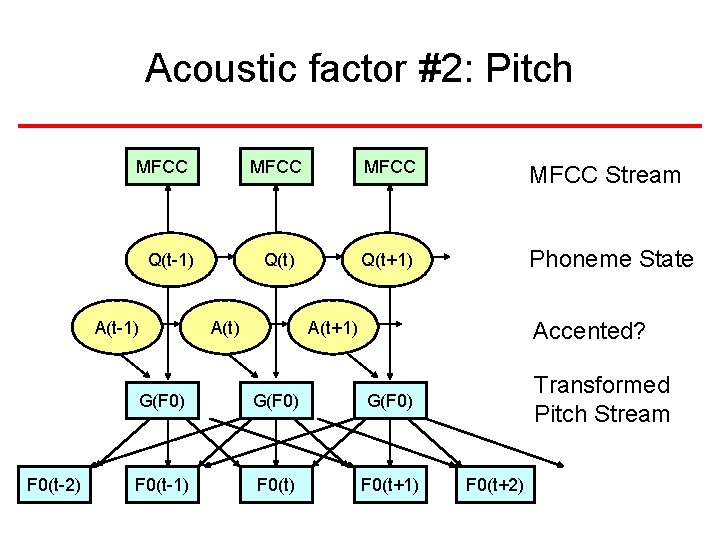
Acoustic factor #2: Pitch MFCC Q(t-1) A(t-1) F 0(t-2) MFCC Stream Q(t) Q(t+1) Phoneme State A(t) Accented? A(t+1) G(F 0) F 0(t-1) F 0(t+1) Transformed Pitch Stream F 0(t+2)
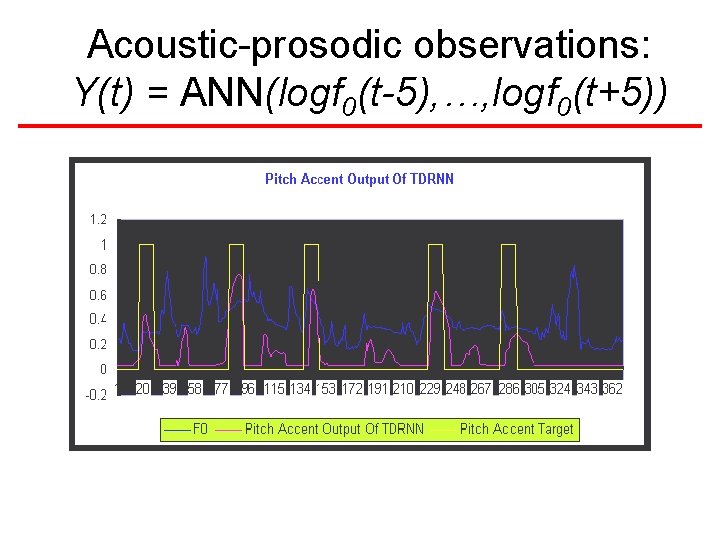
Acoustic-prosodic observations: Y(t) = ANN(logf 0(t-5), …, logf 0(t+5))
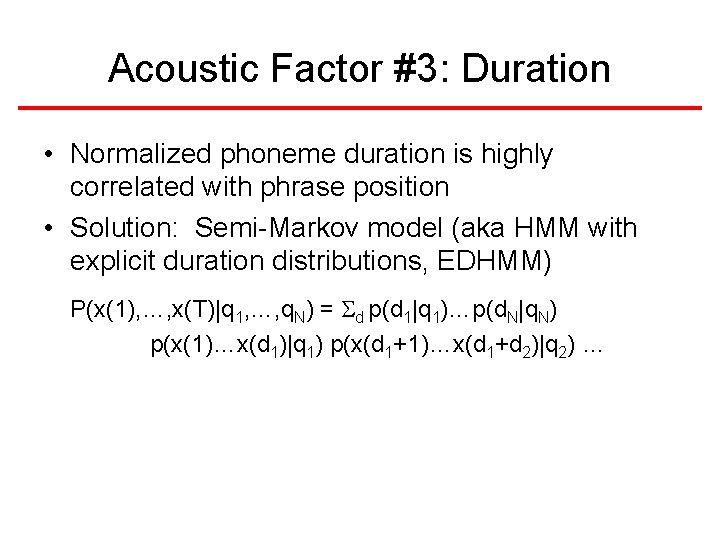
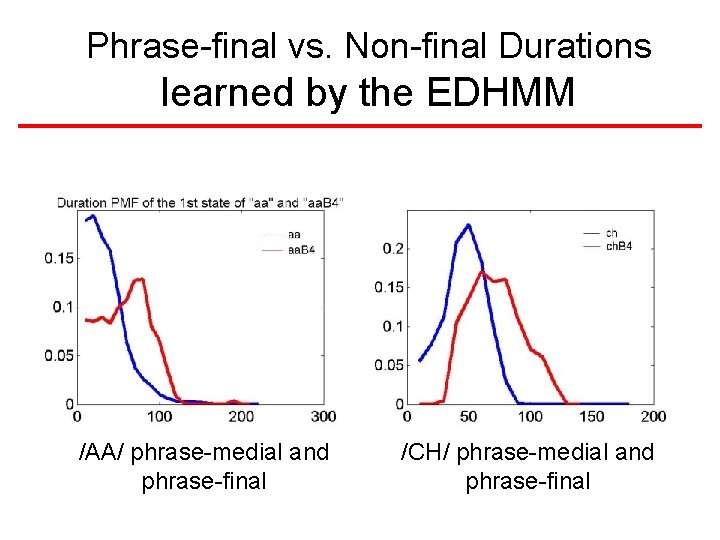
Acoustic Factor #3: Duration • Normalized phoneme duration is highly correlated with phrase position • Solution: Semi-Markov model (aka HMM with explicit duration distributions, EDHMM) P(x(1), …, x(T)|q 1, …, q. N) = Sd p(d 1|q 1)…p(d. N|q. N) p(x(1)…x(d 1)|q 1) p(x(d 1+1)…x(d 1+d 2)|q 2) …
Phrase-final vs. Non-final Durations learned by the EDHMM /AA/ phrase-medial and phrase-final /CH/ phrase-medial and phrase-final
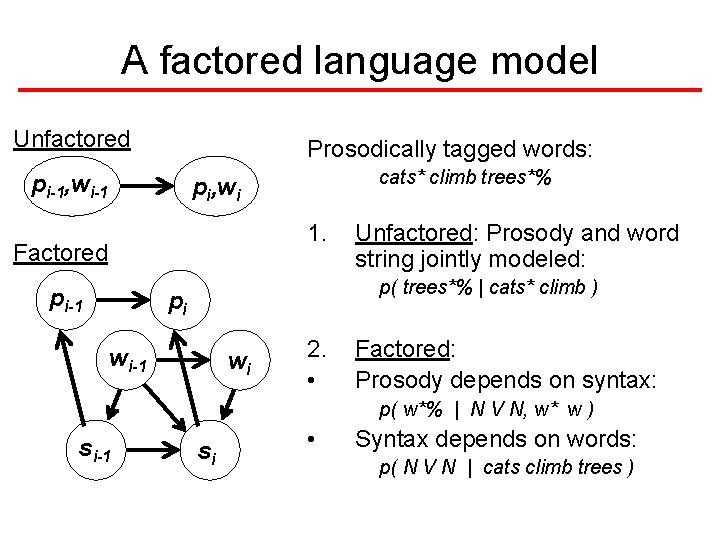
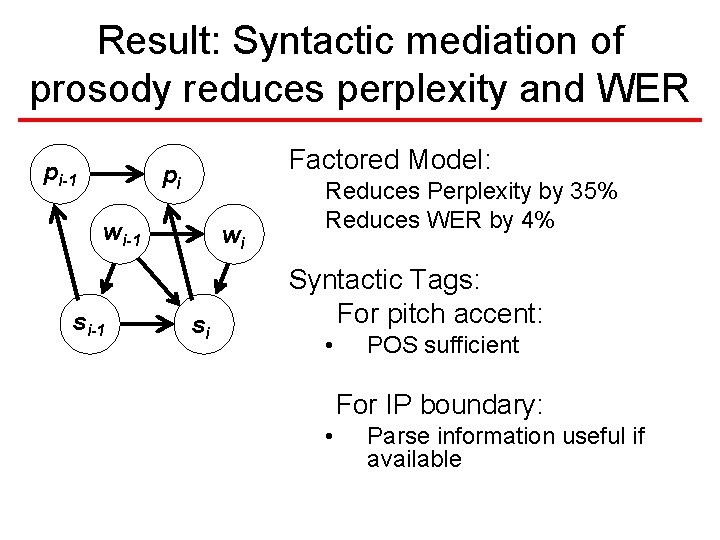
A factored language model Unfactored Prosodically tagged words: pi-1, wi-1 cats* climb trees*% pi, wi 1. Factored pi-1 Unfactored: Prosody and word string jointly modeled: p( trees*% | cats* climb ) pi wi-1 wi 2. • Factored: Prosody depends on syntax: p( w*% | N V N, w* w ) si-1 si • Syntax depends on words: p( N V N | cats climb trees )
Result: Syntactic mediation of prosody reduces perplexity and WER pi-1 Factored Model: pi wi-1 si-1 wi si Reduces Perplexity by 35% Reduces WER by 4% Syntactic Tags: For pitch accent: • POS sufficient For IP boundary: • Parse information useful if available
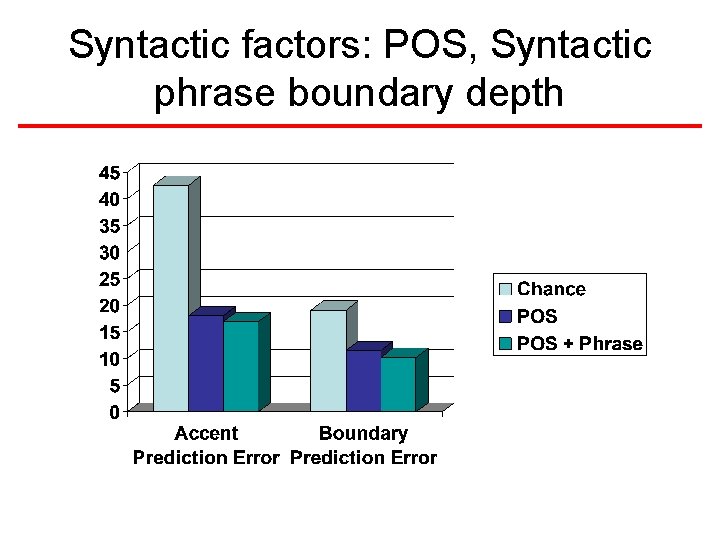
Syntactic factors: POS, Syntactic phrase boundary depth
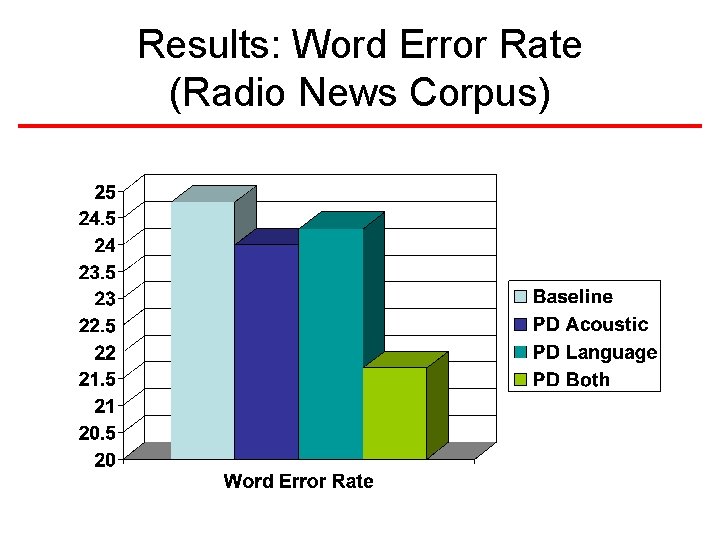
Results: Word Error Rate (Radio News Corpus)
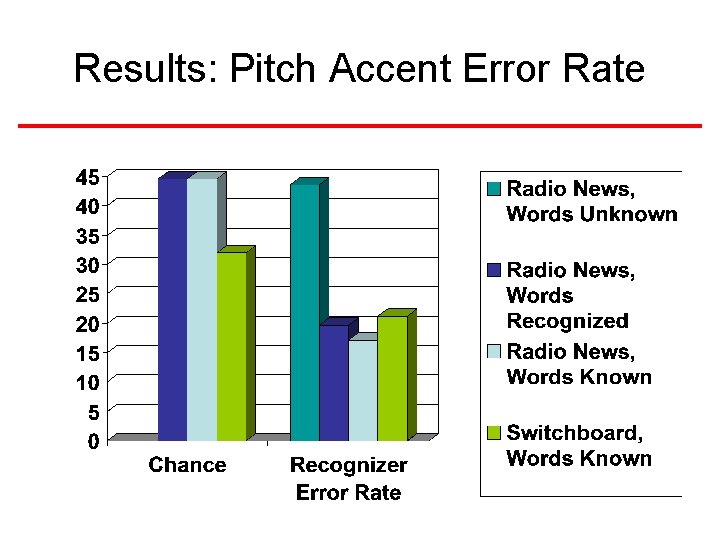
Results: Pitch Accent Error Rate
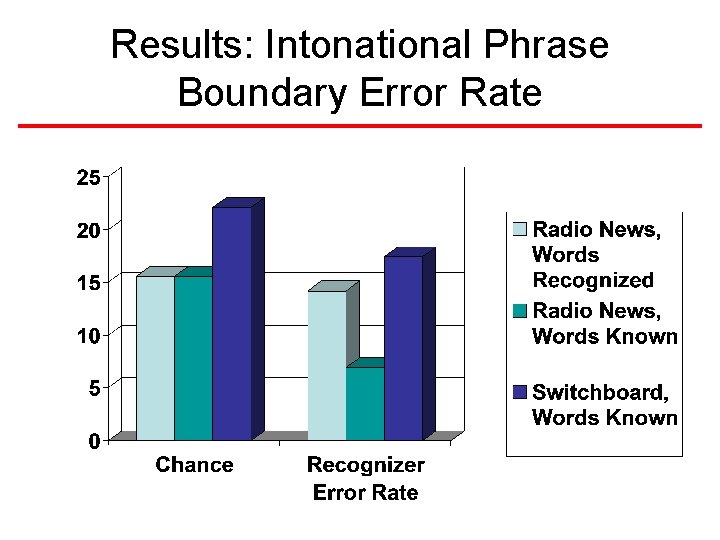
Results: Intonational Phrase Boundary Error Rate
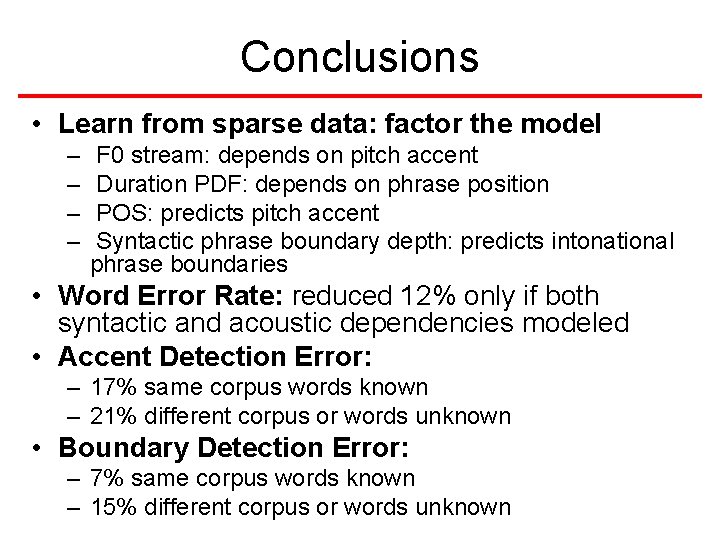
Conclusions • Learn from sparse data: factor the model – – F 0 stream: depends on pitch accent Duration PDF: depends on phrase position POS: predicts pitch accent Syntactic phrase boundary depth: predicts intonational phrase boundaries • Word Error Rate: reduced 12% only if both syntactic and acoustic dependencies modeled • Accent Detection Error: – 17% same corpus words known – 21% different corpus or words unknown • Boundary Detection Error: – 7% same corpus words known – 15% different corpus or words unknown
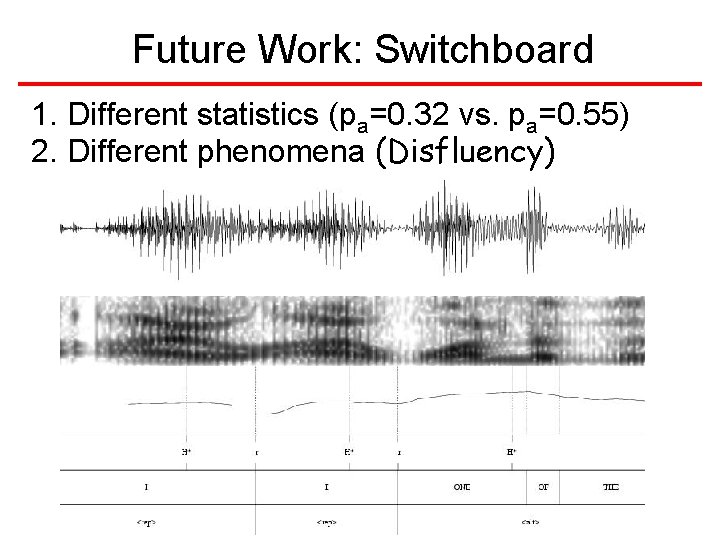
Future Work: Switchboard 1. Different statistics (pa=0. 32 vs. pa=0. 55) 2. Different phenomena (Disfluency)
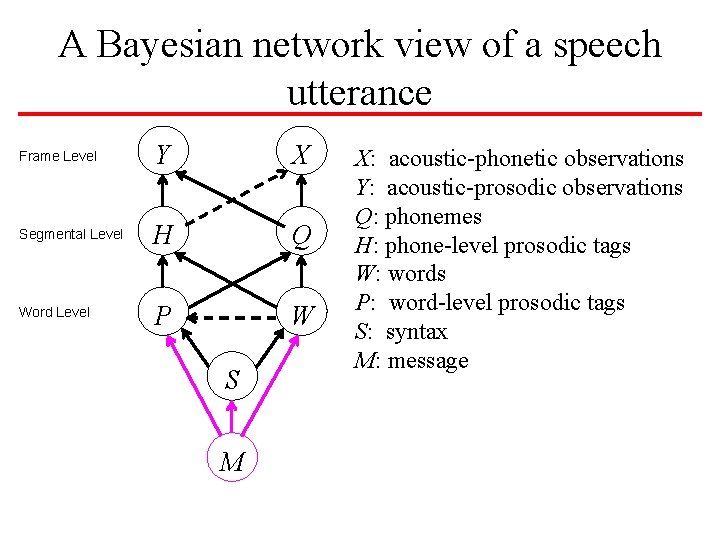
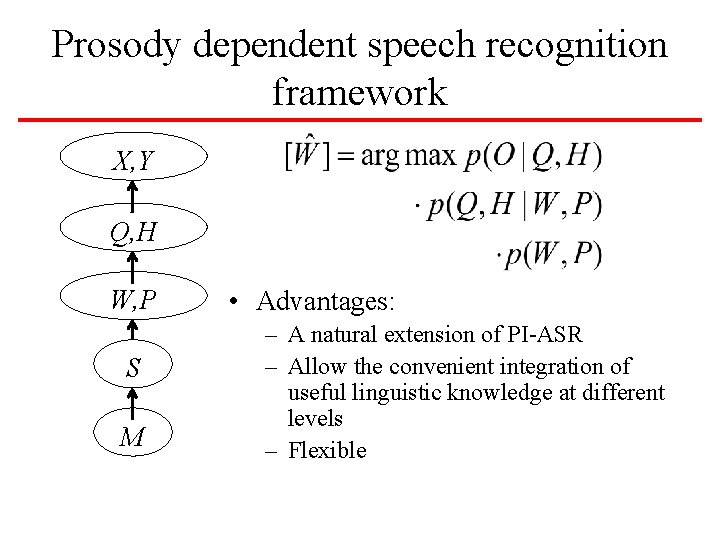
A Bayesian network view of a speech utterance Frame Level Y X Segmental Level H Q Word Level P W S M X: acoustic-phonetic observations Y: acoustic-prosodic observations Q: phonemes H: phone-level prosodic tags W: words P: word-level prosodic tags S: syntax M: message
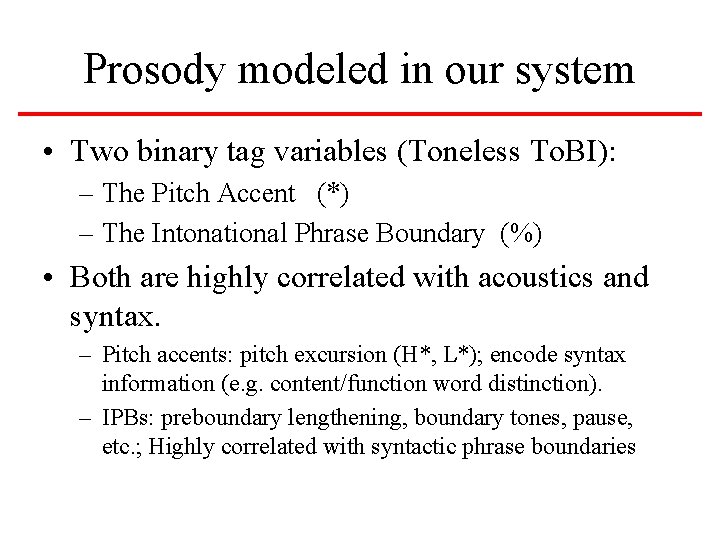
Prosody modeled in our system • Two binary tag variables (Toneless To. BI): – The Pitch Accent (*) – The Intonational Phrase Boundary (%) • Both are highly correlated with acoustics and syntax. – Pitch accents: pitch excursion (H*, L*); encode syntax information (e. g. content/function word distinction). – IPBs: preboundary lengthening, boundary tones, pause, etc. ; Highly correlated with syntactic phrase boundaries
Prosody dependent speech recognition framework X, Y Q, H W, P S M • Advantages: – A natural extension of PI-ASR – Allow the convenient integration of useful linguistic knowledge at different levels – Flexible
Prosody dependent pronunciation modeling Hi Qi pi w Qi wi p(Qi|wi) => p(Qi, Hi|wi, pi) 1. Phrasal pitch accent affects phones in lexically stressed syllable above ax b ah v above* ax b* ah* v* 2. IP boundary affects phones in phrase-final rhyme above% ax b ah% v% above*% ax b* ah*% v*%
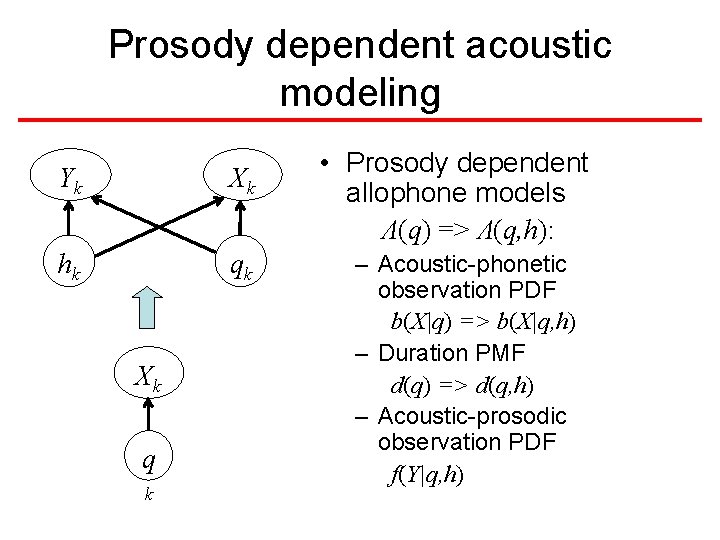
Prosody dependent acoustic modeling Yk Xk hk qk Xk q k • Prosody dependent allophone models Λ(q) => Λ(q, h): – Acoustic-phonetic observation PDF b(X|q) => b(X|q, h) – Duration PMF d(q) => d(q, h) – Acoustic-prosodic observation PDF f(Y|q, h)
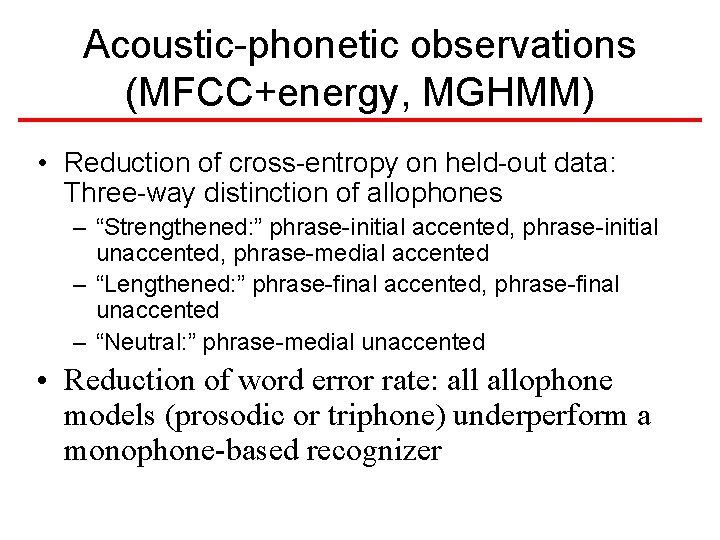
Acoustic-phonetic observations (MFCC+energy, MGHMM) • Reduction of cross-entropy on held-out data: Three-way distinction of allophones – “Strengthened: ” phrase-initial accented, phrase-initial unaccented, phrase-medial accented – “Lengthened: ” phrase-final accented, phrase-final unaccented – “Neutral: ” phrase-medial unaccented • Reduction of word error rate: allophone models (prosodic or triphone) underperform a monophone-based recognizer
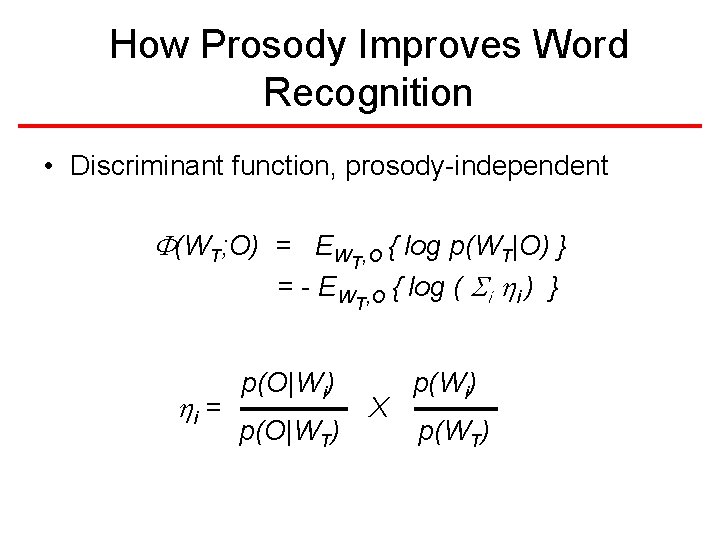
How Prosody Improves Word Recognition • Discriminant function, prosody-independent F(WT; O) = EWT, O { log p(WT|O) } = - EWT, O { log ( Si hi ) } hi = p(O|Wi) p(O|WT) X p(Wi) p(WT)
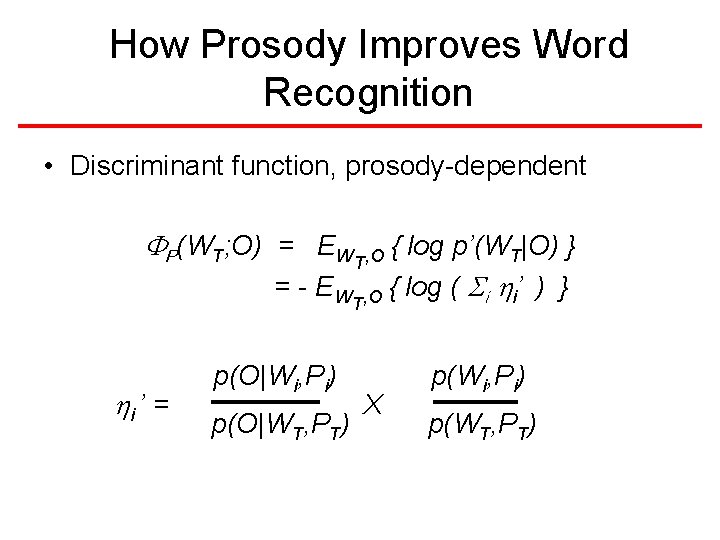
How Prosody Improves Word Recognition • Discriminant function, prosody-dependent FP(WT; O) = EWT, O { log p’(WT|O) } = - EWT, O { log ( Si hi’ ) } hi ’ = p(O|Wi, Pi) p(O|WT, PT) X p(Wi, Pi) p(WT, PT)
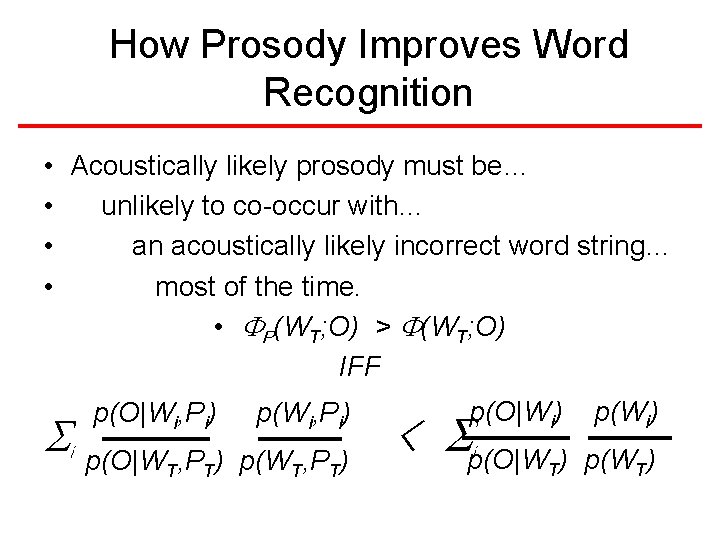
How Prosody Improves Word Recognition • Acoustically likely prosody must be… • unlikely to co-occur with… • an acoustically likely incorrect word string… • most of the time. • FP(WT; O) > F(WT; O) IFF p(O|Wi, Pi) Si p(O|W , P ) T T p(Wi, Pi) p(WT, PT) p(O|Wi) p(Wi) T p(WT) < Sp(O|W i )
The Corpus • The Boston University Radio News Corpus – – – Stories read 7 professional radio announcers 5 k vocabulary 25 k word tokens 3 hours clean speech No disfluency Expressive and well-behaved prosody • 85% utterances are selected randomly as training, 5% for development-test and the rest 10% for testing. • Small by ASR standards, but is the largest To. BItranscribed English corpus