
Intonation and Computation Analyzing Speech Prosody Julia Hirschberg
Intonation and Computation: Analyzing Speech Prosody Julia Hirschberg LSA 2017 julia@cs. columbia. edu 1
Julia Hirschberg in One Slide Technical Career • Ph. D in History, Uof. M • Asst Prof at Smith • Saw the light: Ph. D in CS, UPenn • Bell Labs/AT&T Labs: MTS and Dept Head • Move to Columbia CS • CS Chair with 6 Ph. D students Family and Fun • Married to Dan Hirschberg • Cats: Oliver and Dahlia • Hobbies: opera, plays and musicals, cooking, travel, Duolingo
Why study speech? • Today speech research most familiar to us in Spoken Dialogue Systems (SDS) – Siri, Google speech apps, Microsoft Cortana, Amazon’s Echo – SDS incorporate 2 important speech technologies • Automatic Speech Recognition (ASR) • Text-to-Speech synthesis (TTS) • Other applications depend upon these technologies • Tutoring systems: KTH’s Ville , Rosetta Stone, Carnegie Speech, Duolingo • Speech to Speech Translation: Military and rescue applications • Speech Search: Google Voice Search, IARPA Babel project for Low Resource Languages • Accessibility: Web access for visually challenged, TTS’d audio books
Other Major Speech Applications: Recognizing Speaker State • Recognizing or generating emotion, e. g. – Recognizing anger/frustration in SDS – Generating excitement/fear in games • Recognizing other speaker states – – – Confidence vs. uncertainty in tutoring systems Medical diagnosis e. g. depression, schizophrenia Degree of interest e. g. for salespeople Sleepiness for drivers Drunkenness for drivers Deception for police, military, social services
What we’ll learn in this course • How to recognize different types of “speaker state” through spoken cues (as well as lexical information) – – – – Deceptive speech Emotional speech Charisma Personality Sarcasm Mental Illness Trust 5
• How to design experiments to collect the data we need to do this • How to evaluate our results and draw conclusions from our research 6
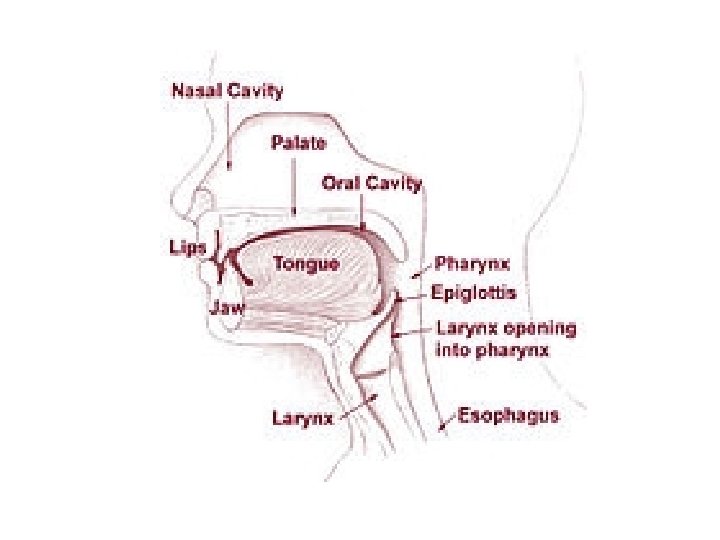
How do we produce speech? • General process of articulation – Air expelled from lungs through windpipe (trachea) leaving via mouth (mostly) and nose (nasals) (e. g. [m], [n]) – Air passing thru trachea goes thru larynx, which contains vocal folds – space between them is the glottis – When vocal folds vibrate, we get voiced sounds (e. g. [v]); o. w. voiceless (e. g. [f]) • Speech sounds differ in their place and manner of articulation
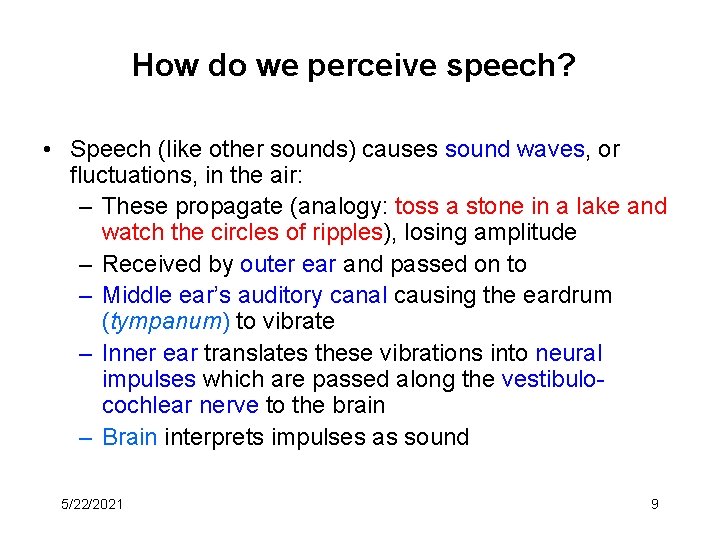
How do we perceive speech? • Speech (like other sounds) causes sound waves, or fluctuations, in the air: – These propagate (analogy: toss a stone in a lake and watch the circles of ripples), losing amplitude – Received by outer ear and passed on to – Middle ear’s auditory canal causing the eardrum (tympanum) to vibrate – Inner ear translates these vibrations into neural impulses which are passed along the vestibulocochlear nerve to the brain – Brain interprets impulses as sound 5/22/2021 9
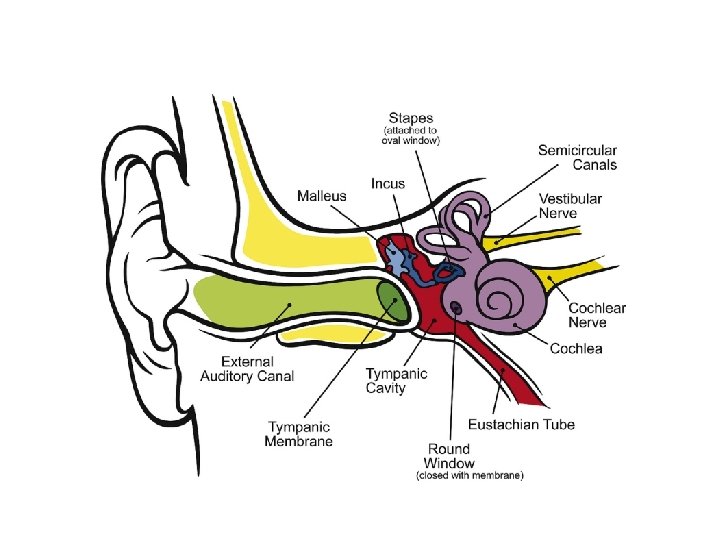
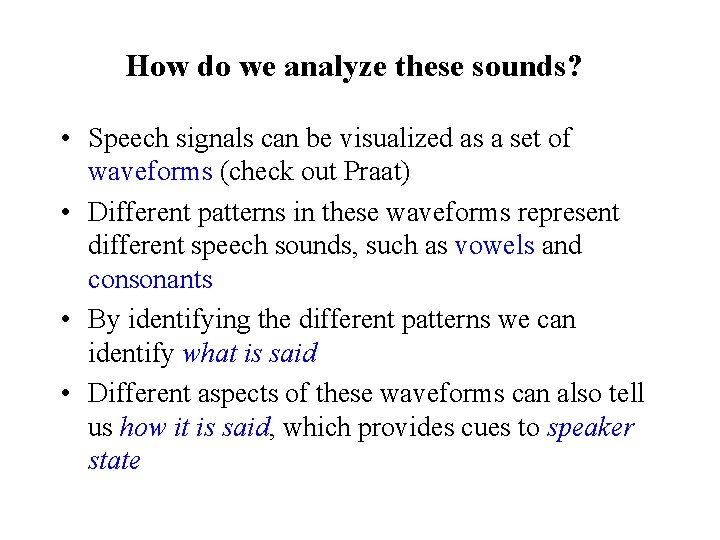
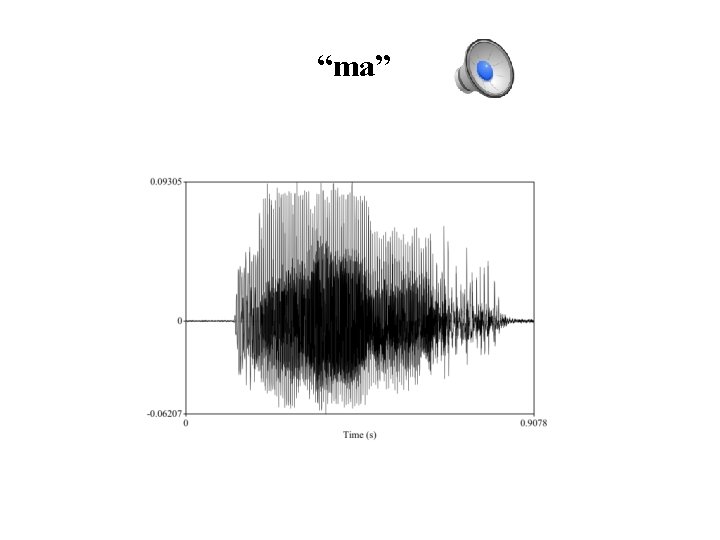
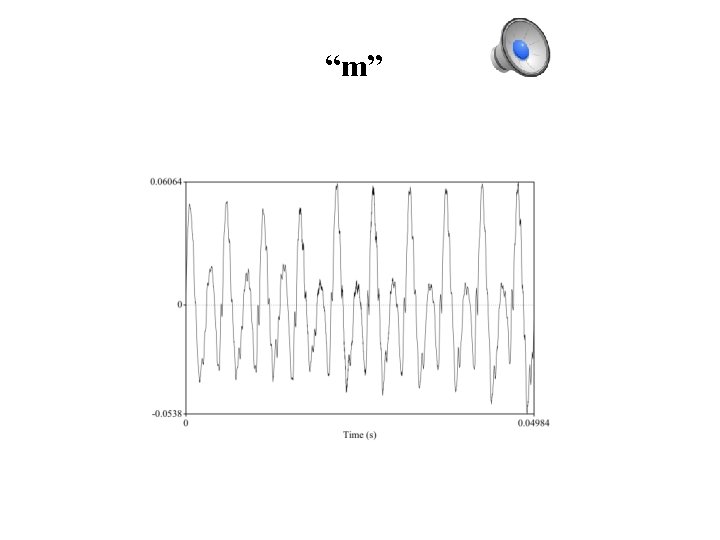
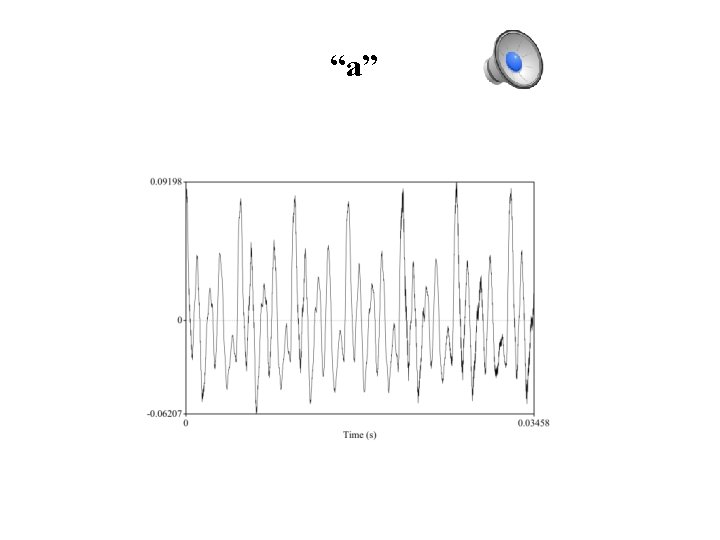
How do we analyze these sounds? • Speech signals can be visualized as a set of waveforms (check out Praat) • Different patterns in these waveforms represent different speech sounds, such as vowels and consonants • By identifying the different patterns we can identify what is said • Different aspects of these waveforms can also tell us how it is said, which provides cues to speaker state
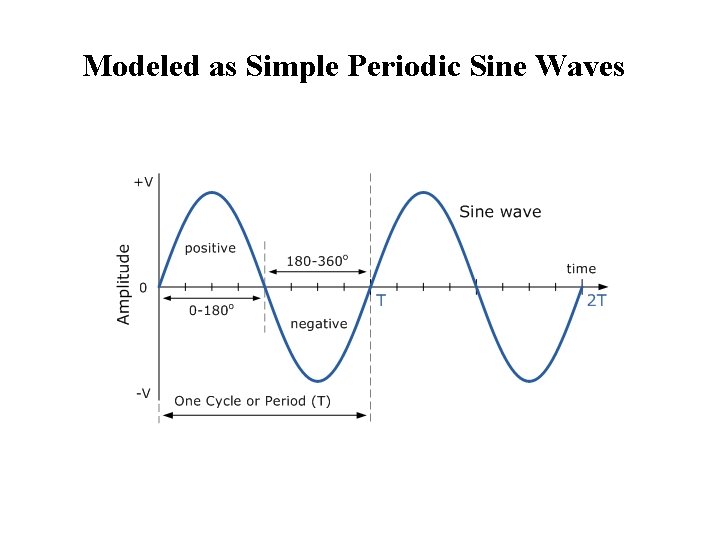
Modeled as Simple Periodic Sine Waves
Simple Periodic (Sine) Waves • Simple Periodic Waves are defined by – Frequency: how often does pattern repeat per time unit • Cycle: one repetition • Period: duration of cycle • Frequency = # cycles per time unit, e. g. sec. – Frequency in Hz = cycles per second or 1/period – E. g. 400 Hz pitch = 1/. 0025 (1 cycle has a period of. 0025; 400 cycles complete in 1 sec) • Zero crossing: where the waveform crosses the x 5/22/2021 axis 13
– Amplitude: peak deviation of pressure from normal atmospheric pressure – Phase: timing of waveform relative to a reference point 5/22/2021 14
Complex Periodic Waveforms • We rarely hear (human) simple periodic sine waves • Most speech sounds are composed of multiple sine waves – periodic or aperiodic • Vowels and voiced consonants (e. g. b, d, v, g) are composed of complex periodic waveforms 5/22/2021 15
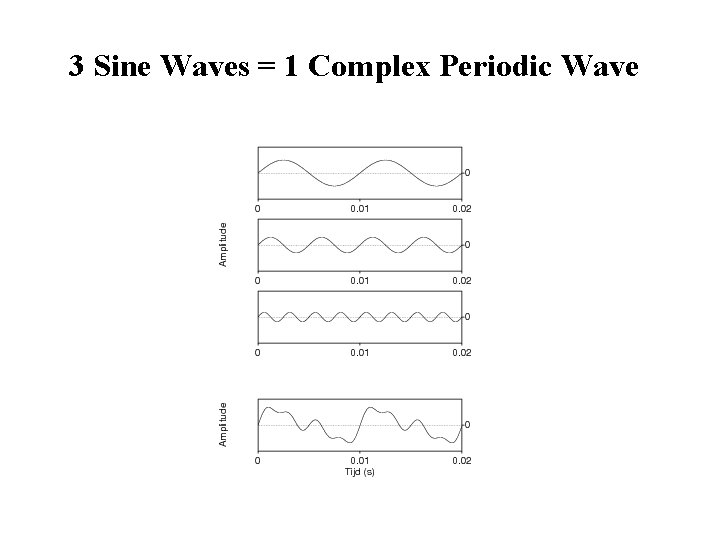
3 Sine Waves = 1 Complex Periodic Wave
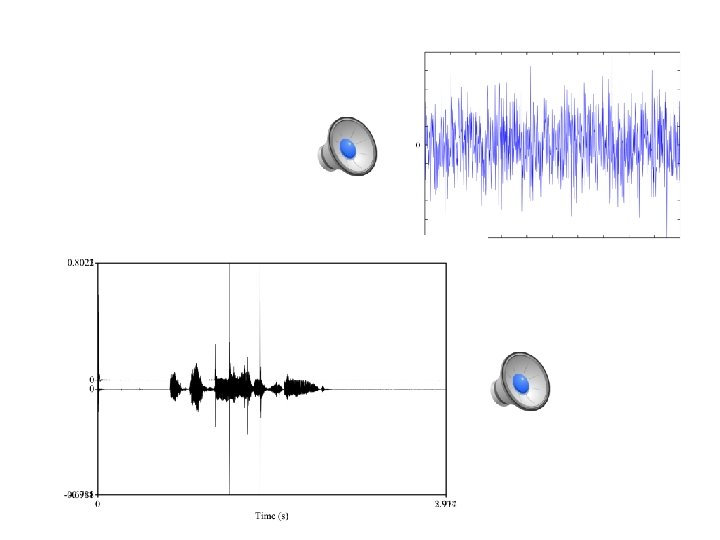
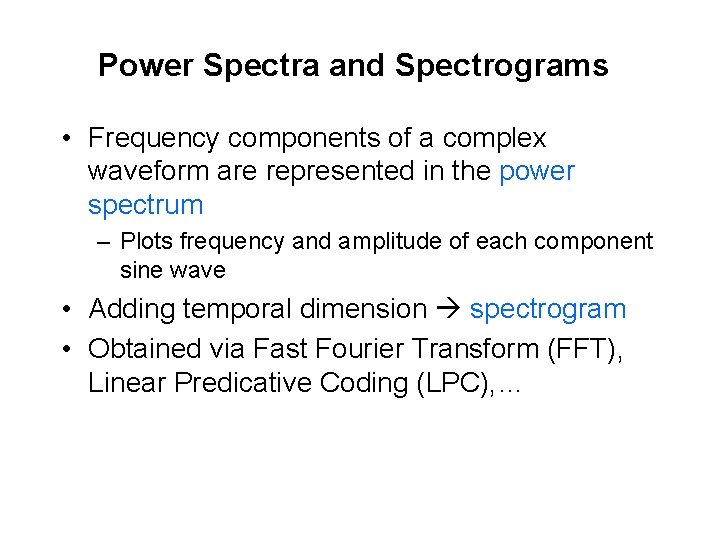
Aperiodic Waveforms • Voiceless consonants (e. g. p, t, f, k) are aperiodic – Waveforms with random or non-repeating patterns • Random aperiodic waveforms: white noise • Flat spectrum: equal amplitude for all frequency components • Transients: sudden bursts of pressure (clicks, pops, lip smacks, door slams) • Flat spectrum with single impulse 5/22/2021 20
Power Spectra and Spectrograms • Frequency components of a complex waveform are represented in the power spectrum – Plots frequency and amplitude of each component sine wave • Adding temporal dimension spectrogram • Obtained via Fast Fourier Transform (FFT), Linear Predicative Coding (LPC), …
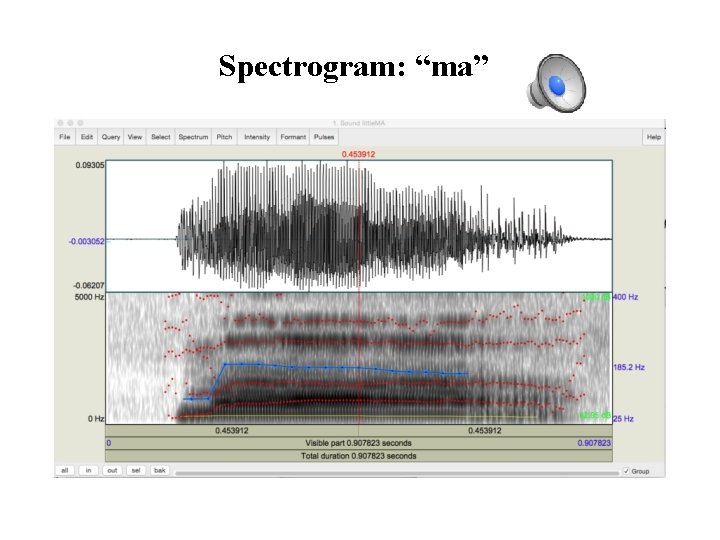
Spectrogram: “ma”
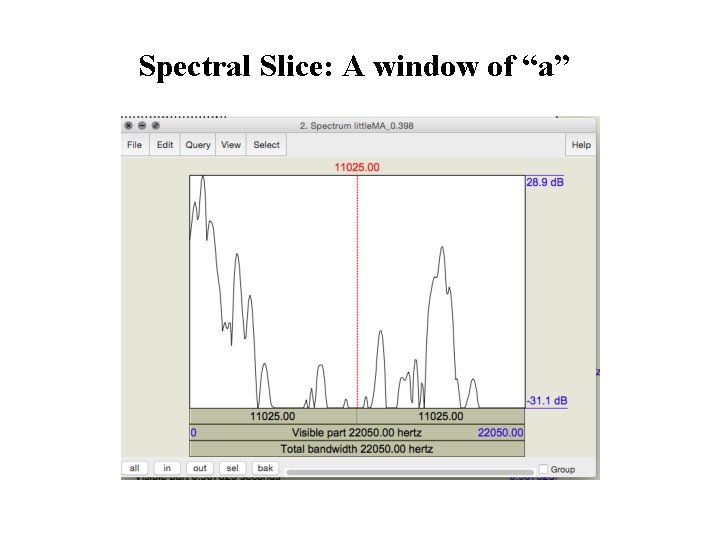
Spectral Slice: A window of “a”
Terms • Spectral slice: plots amplitude at each frequency of a window of the waveform • Spectrogram: plots changes in amplitude and frequency over time over many windows • Harmonics: components of a complex waveform that are integer multiples of the fundamental frequency (F 0) • Formants: frequency bands that are most amplified by the vocal tract
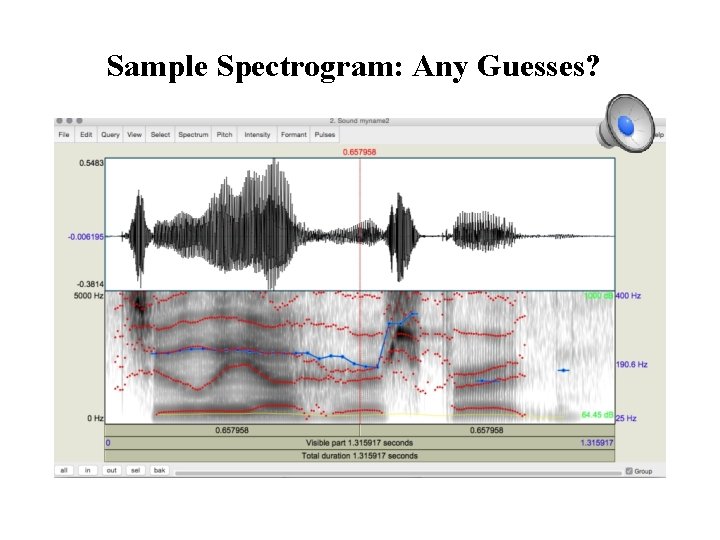
Sample Spectrogram: Any Guesses?
How do we record speech to study it? • Recording conditions depend upon purpose – A quiet office, a sound booth, an anechoic chamber • Microphones convert sounds into electrical current: oscillations of air pressure become oscillations of voltage in an electric circuit – Analog devices (e. g. tape recorders) store these as a continuous signal – Digital devices (e. g. computers, DAT) convert continuous signals into discrete signals by digitizing it 5/22/2021 27
Digitizing Speech • We cannot store every part of the speech signal so we must sample it – Different sampling rates produce different levels of quality but also different storage requirements – For many prosodic tasks, 16 Khz is sufficient • How often must we sample? – A minimum of 2 samples per cycle to capture periodicity of a waveform component at a given frequency • So… 100 Hz waveform requires 200 samples/sec
To Learn More • Read Keith Johnson. Acoustic & Auditory Phonetics (3 rd edition). Wiley. 2011. 29
Determining Not Just What is Said but How it is Said • Forensic Linguistics: ‘Kill him!’ or ‘Kill him? ’ • What information do we need to extract to distinguish these different meanings? • Can we extract this information automatically from the waveform? • Tools such as Praat, sox • What kind of information is useful and extractable? 5/22/2021 31
Pitch • Fundamental frequency (F 0): rate at which largest pattern repeats (also GCD of component frequencies) • Derived pitch features (e. g. min, max, mean, sdev) – Pitch contour (pitch-tracking plus stylization) – Pitch range, slope, prominence
Estimating (Tracking) Pitch • Pitch tracking: Estimate F 0 over time as a function of vocal fold vibration • How? Autocorrelation approach – A periodic waveform is correlated with itself since one period looks much like another – Find the period by finding the ‘lag’ (offset) between two windows on the signal for which the correlation of the windows is highest – Lag duration (T) is 1 period of waveform – Inverse is F 0 (1/T) 5/22/2021 33
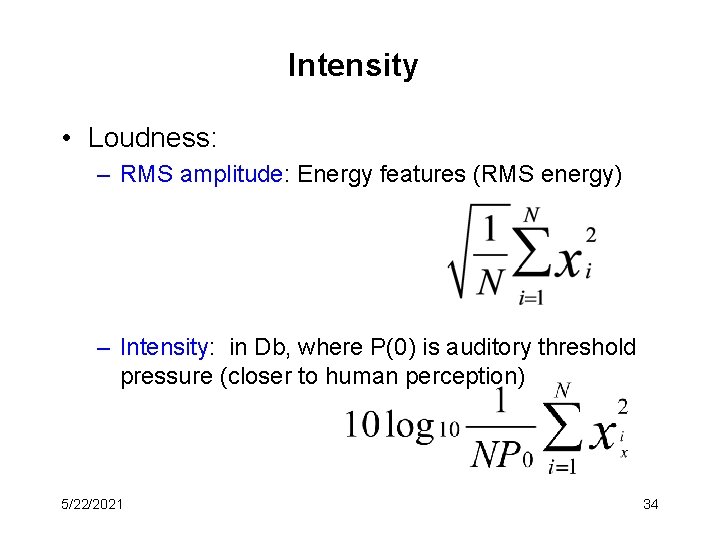
Intensity • Loudness: – RMS amplitude: Energy features (RMS energy) – Intensity: in Db, where P(0) is auditory threshold pressure (closer to human perception) 5/22/2021 34
Rhythm and Pause • Duration features – Phone / Vowel / Syllable / Phrase Durations – Normalized by Phone/Vowel Means, Speaker – Inter-Pausal Units (IPUs) • Speaking rate features (syllables per second) • Pause features (cf Benus et al ‘ 06) – Speech to pause ratio, number of long pauses – Maximum pause length
Voice Quality • Spectral tilt features: shape of the spectral envelope • Jitter: – Cycle-to-cycle variation in Fundamental Frequency of the signal – Excessive: Hoarse, harsh, rough • Shimmer: – Cycle-to-cycle variation in amplitude of the signal – Excessive: hoarse
Higher-Level Features: Prosody • Prosodic phrasing: – Indicated by pauses, phrase-final lengthening, pitch • Prosodic prominence: – Indicated by F 0, duration, intensity, voice quality • Pitch contour: – Meaningful variation in phrasing and prominence – E. g. a yes-no question vs. a statement vs. ? ?
How do we represent these differences? • Many representations have been proposed – Fujisaki’s super-positional, British School, Hirst’s INTSINT, IPO Perception Model, Gussenhoven’s To. DI, and more • American school models make a distinction between accents and boundary tones – Only two tones, which may be combined • H = high target • L = low target 5/22/2021 38
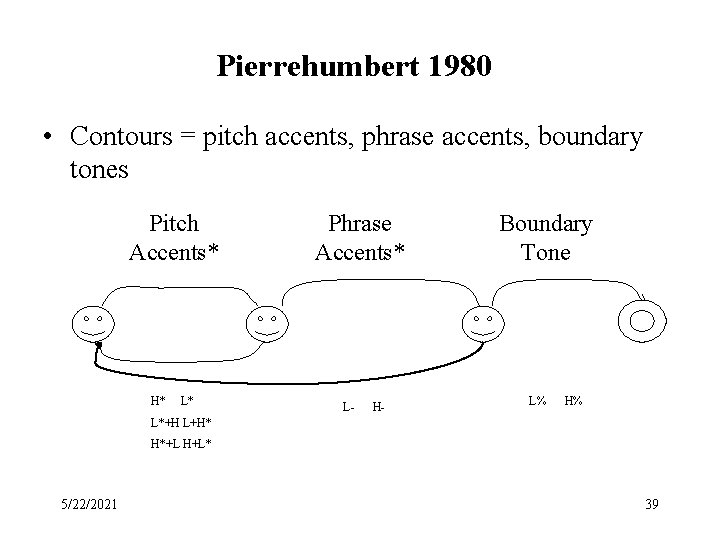
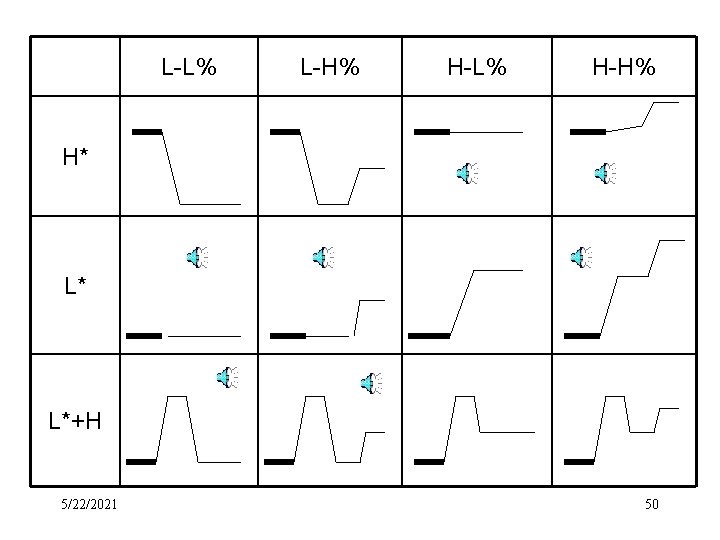
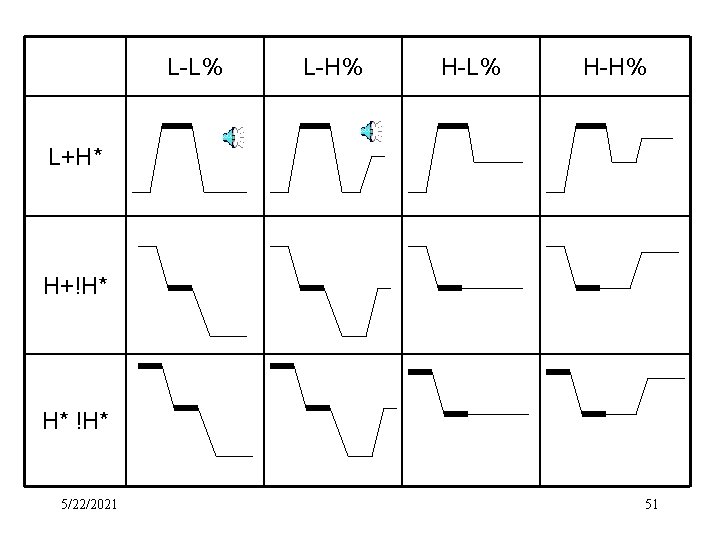
Pierrehumbert 1980 • Contours = pitch accents, phrase accents, boundary tones Pitch Accents* H* L* Phrase Accents* L- H- Boundary Tone L% H% L*+H L+H* H*+L H+L* 5/22/2021 39
Price, Ostendorf et al • Break indices: degree of juncture between words • 0 8 (none to ‘a lot’) – What I’d like is a nice roast beef sandwich. 5/22/2021 40
To(nes and)B(reak)I(ndices) • Developed by prosody researchers in four meetings over 1991 -94 • Putting Pierrehumbert ’ 80 and Price, Ostendorf, et al together • Goals: – devise common labeling scheme for Standard American English that is robust and reliable – promote collection of large, prosodically labeled, shareable corpora 5/22/2021 41
• To. BI standards also proposed for English (multi), German (multi), Greek, Dutch, Portuguese (multi), Spanish (multi), Serbo-Croatian, Slovak, Italian (multi), Swedish, Japanese, Korean, Cantonese, Mandarin, Taiwanese, Chickasaw, Bininj, and more… • Two collected volume on prosodic typology (Jun) and many papers • Courses and tutorials 5/22/2021 42
• Minimal To. BI transcription: – recording of speech – f 0 contour – To. BI tiers: • orthographic tier: words • break-index tier: degrees of junction (Price et al ‘ 89) • tonal tier: pitch accents, phrase accents, boundary tones (Pierrehumbert ‘ 80) • miscellaneous tier: disfluencies, non-speech sounds, etc. 5/22/2021 43
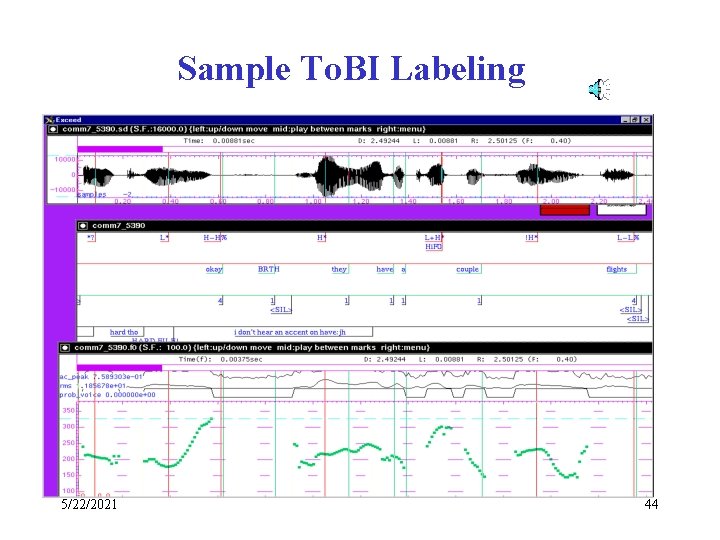
Sample To. BI Labeling 5/22/2021 44
• Online training material, available at: – http: //www. ling. ohio-state. edu/~tobi/ame_tobi/ Evaluation – Good inter-labeler reliability for expert and naive labelers: 88% agreement on presence/absence of tonal category, 81% agreement on category label, 91% agreement on break indices to within 1 level (Silverman et al. ‘ 92, Pitrelli et al ‘ 94) 5/22/2021 45
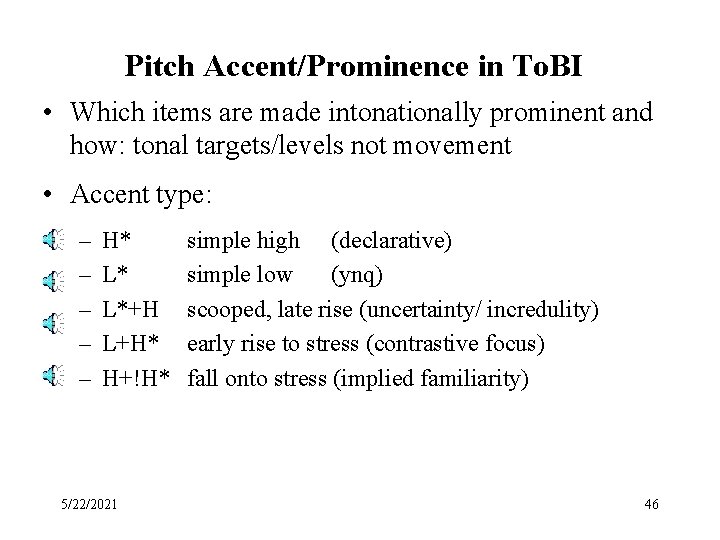
Pitch Accent/Prominence in To. BI • Which items are made intonationally prominent and how: tonal targets/levels not movement • Accent type: – – – H* L* L*+H L+H* H+!H* 5/22/2021 simple high (declarative) simple low (ynq) scooped, late rise (uncertainty/ incredulity) early rise to stress (contrastive focus) fall onto stress (implied familiarity) 46
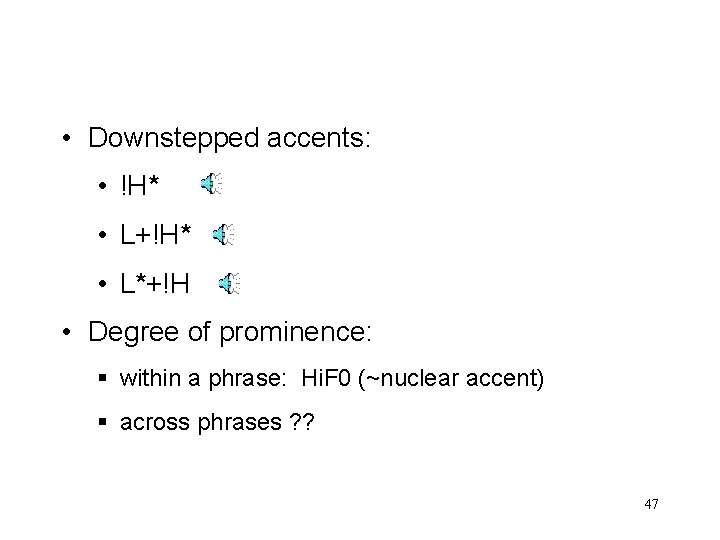
• Downstepped accents: • !H* • L+!H* • L*+!H • Degree of prominence: § within a phrase: Hi. F 0 (~nuclear accent) § across phrases ? ? 47
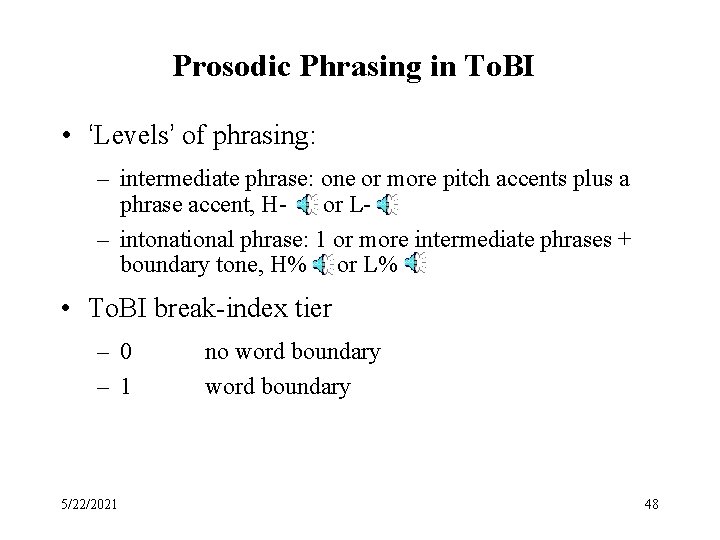
Prosodic Phrasing in To. BI • ‘Levels’ of phrasing: – intermediate phrase: one or more pitch accents plus a phrase accent, H- or L– intonational phrase: 1 or more intermediate phrases + boundary tone, H% or L% • To. BI break-index tier – 0 – 1 5/22/2021 no word boundary 48
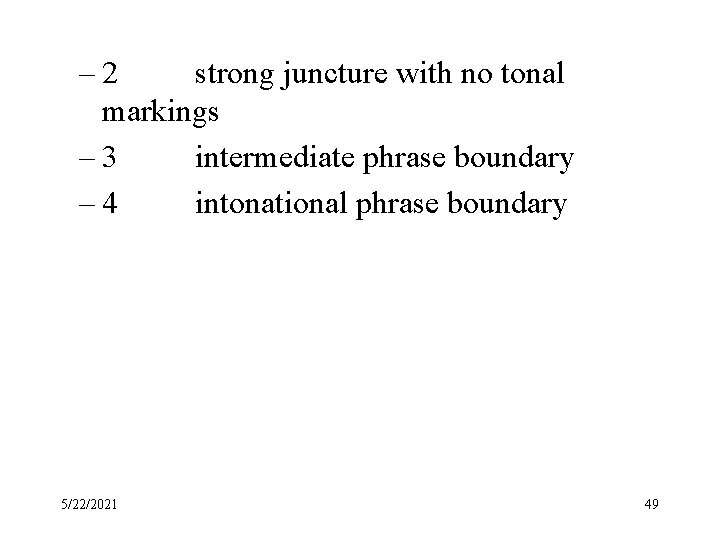
– 2 strong juncture with no tonal markings – 3 intermediate phrase boundary – 4 intonational phrase boundary 5/22/2021 49
L-L% L-H% H-L% H-H% H* L* L*+H 5/22/2021 50
L-L% L-H% H-L% H-H% L+H* H+!H* H* !H* 5/22/2021 51
Contour Examples • http: //www. cs. columbia. edu/~julia/cs 6998/cards/e xamples. html 5/22/2021 52
A Compositional Account (Pierrehumbert & Hirschberg ’ 92) • Contours convey relationships – Between current, prior, and following utterances – Between propositional content and mutual beliefs • Contour meanings are composites of the meanings of their pitch accents, phrase accents and boundary tones (hypothesis: intonational lexicon is compositional!) 5/22/2021 53
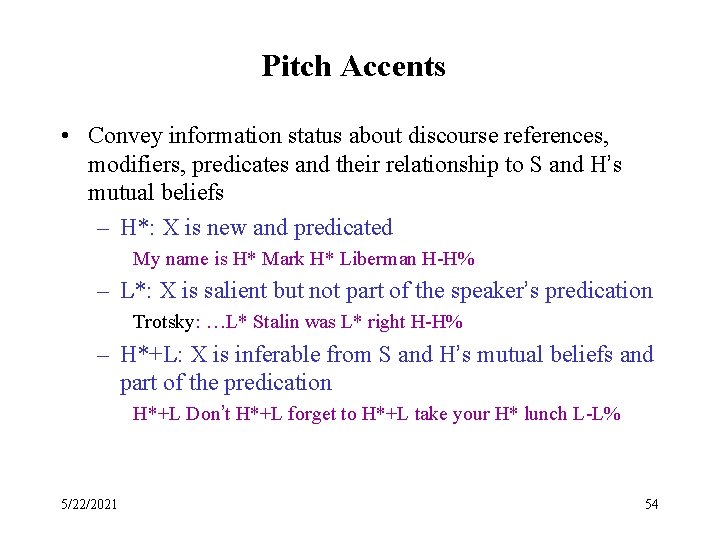
Pitch Accents • Convey information status about discourse references, modifiers, predicates and their relationship to S and H’s mutual beliefs – H*: X is new and predicated My name is H* Mark H* Liberman H-H% – L*: X is salient but not part of the speaker’s predication Trotsky: …L* Stalin was L* right H-H% – H*+L: X is inferable from S and H’s mutual beliefs and part of the predication H*+L Don’t H*+L forget to H*+L take your H* lunch L-L% 5/22/2021 54
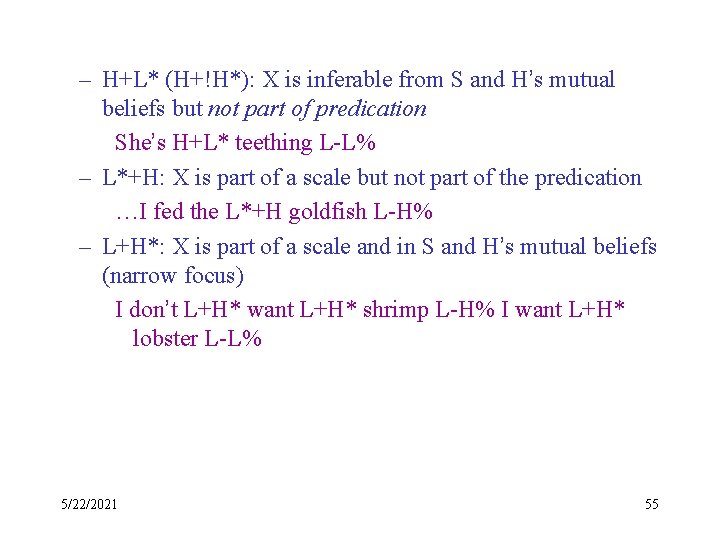
– H+L* (H+!H*): X is inferable from S and H’s mutual beliefs but not part of predication She’s H+L* teething L-L% – L*+H: X is part of a scale but not part of the predication …I fed the L*+H goldfish L-H% – L+H*: X is part of a scale and in S and H’s mutual beliefs (narrow focus) I don’t L+H* want L+H* shrimp L-H% I want L+H* lobster L-L% 5/22/2021 55
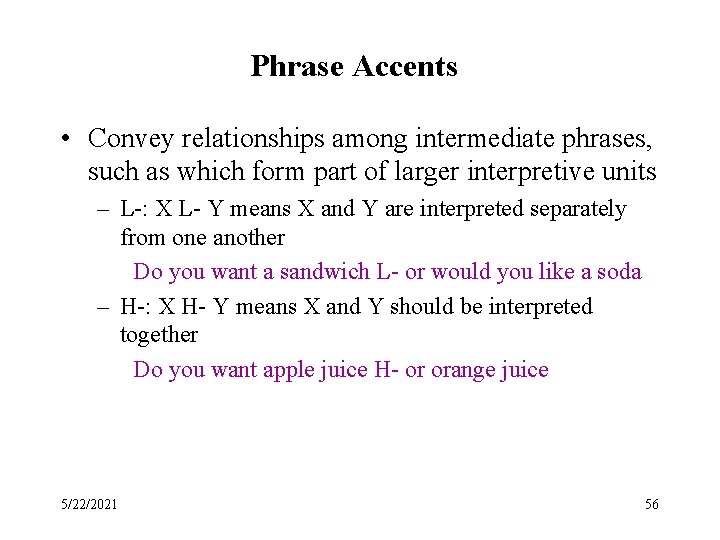
Phrase Accents • Convey relationships among intermediate phrases, such as which form part of larger interpretive units – L-: X L- Y means X and Y are interpreted separately from one another Do you want a sandwich L- or would you like a soda – H-: X H- Y means X and Y should be interpreted together Do you want apple juice H- or orange juice 5/22/2021 56
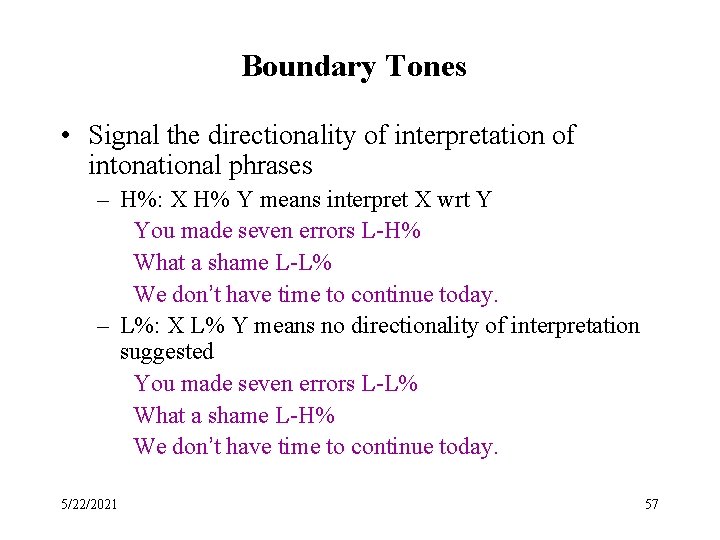
Boundary Tones • Signal the directionality of interpretation of intonational phrases – H%: X H% Y means interpret X wrt Y You made seven errors L-H% What a shame L-L% We don’t have time to continue today. – L%: X L% Y means no directionality of interpretation suggested You made seven errors L-L% What a shame L-H% We don’t have time to continue today. 5/22/2021 57
Unresolved Questions • How do the meanings of pitch accents in a single phrase combine? The L* blackboard’s painted H* orange L-L% • How do we distinguish the meaning of a phrase accent from that of a boundary tone – especially in intonational phrases with a single intermediate phrase? – E. g. H* H-L% (plateau) vs. H*H-H% (high-rise question) vs. H*L-L% (declarative) • Is this framework useful for investigating contour meaning? E. g. downstepped contours, H+L* 5/22/2021 58
How are these features useful? • Expanded vs. compressed pitch range? – Happiness vs. boredom • Louder vs. softer speech? – Anger vs. contentment • Faster vs. slower speech? – Certainty vs. uncertainty • Differences in intonational prominence? – New vs. old information • Differences in intonational phrasing? – 1 thought vs. 2 thoughts • Differences in pitch contours? – Question vs. statement 5/22/2021 59
Next Class • Deception detection and experimental design 60
- Slides: 59