Ring Recognition and Electron Identification in the RICH

- Slides: 18
Ring Recognition and Electron Identification in the RICH detector of the CBM Experiment at FAIR Semeon Lebedev GSI, Darmstadt, Germany and LIT JINR, Dubna, Russia Claudia Hoehne GSI, Darmstadt, Germany Gennady Ososkov LIT JINR, Dubna, Russia S. Lebedev@gsi. de
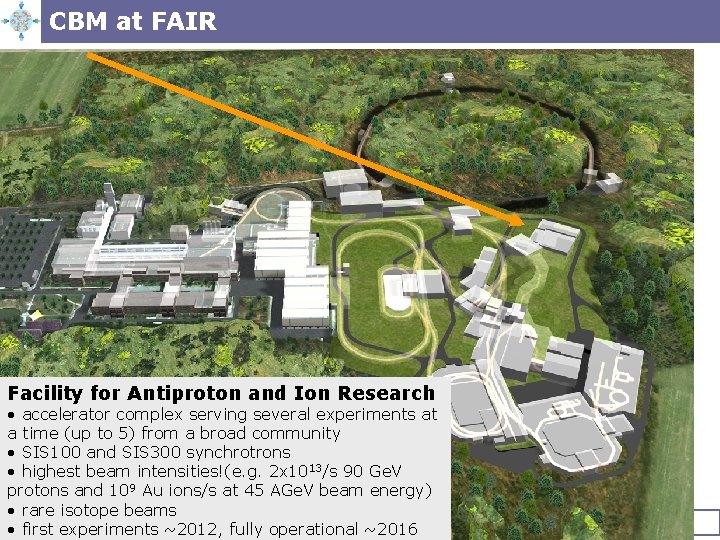
CBM at FAIR Facility for Antiproton and Ion Research • accelerator complex serving several experiments at a time (up to 5) from a broad community • SIS 100 and SIS 300 synchrotrons • highest beam intensities!(e. g. 2 x 10¹³/s 90 Ge. V protons and 109 Au ions/s at 45 AGe. V beam energy) • rare isotope beams Electron Identification ~2012, in CBM RICH CHEP 2009, 20. 03. 2009 • first experiments fully operational ~2016 2/18
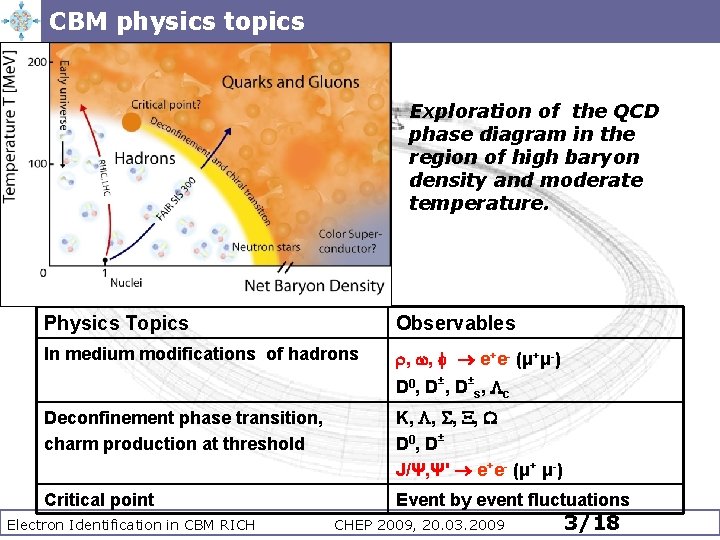
CBM physics topics Exploration of the QCD phase diagram in the region of high baryon density and moderate temperature. Physics Topics Observables In medium modifications of hadrons , , e+e- (μ+μ-) D 0, D±s, c Deconfinement phase transition, charm production at threshold K, , D 0 , D ± J/Ψ, Ψ' e+e- (μ+ μ-) Critical point Event by event fluctuations Electron Identification in CBM RICH CHEP 2009, 20. 03. 2009 3/18
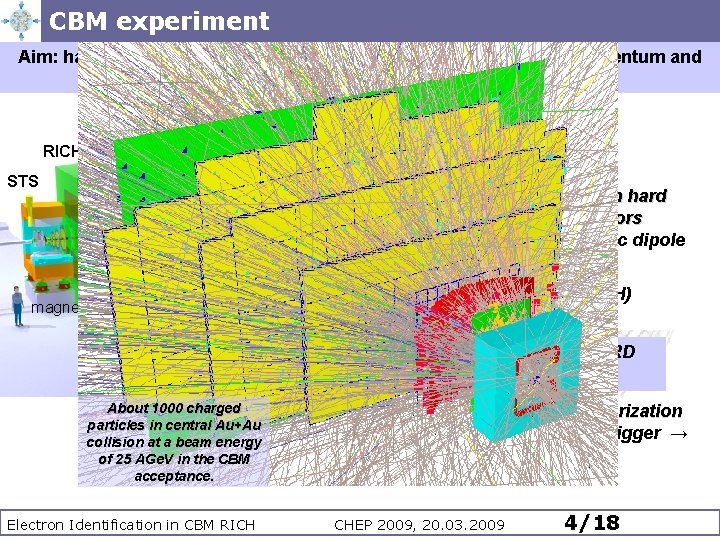
CBM experiment Aim: hadron and lepton identification in large acceptance, good momentum and secondary vertex resolution TOF RICH ECAL TRD STS PSD • tracking, momentum determination, vertex reconstruction: radiation hard silicon pixel/strip detectors (MVD+STS) in a magnetic dipole field • hadron ID: TOF (& RICH) • photons, p 0, h: ECAL magnet • electron ID: RICH & TRD p suppression 104 About 1000 charged particles in central Au+Au collision at a beam energy of 25 AGe. V in the CBM acceptance. Electron Identification in CBM RICH • PSD for event characterization • high speed DAQ and trigger → rare probes! CHEP 2009, 20. 03. 2009 4/18
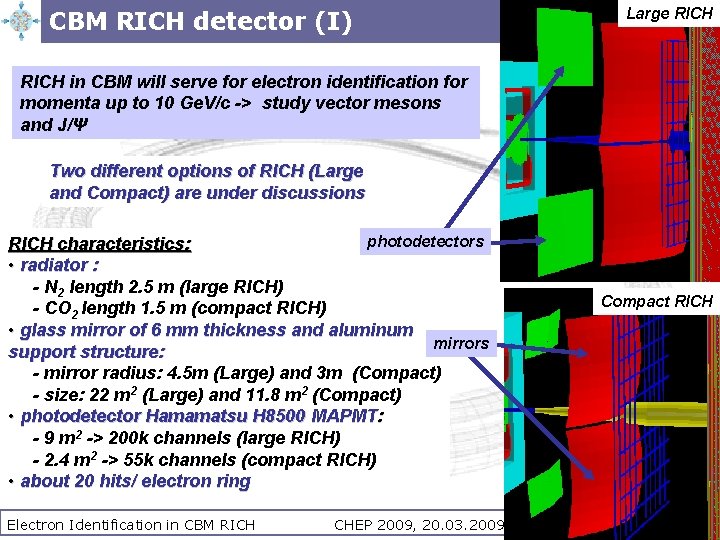
Large RICH CBM RICH detector (I) RICH in CBM will serve for electron identification for momenta up to 10 Ge. V/c -> study vector mesons and J/Ψ Two different options of RICH (Large and Compact) are under discussions photodetectors RICH characteristics: • radiator : - N 2 length 2. 5 m (large RICH) - CO 2 length 1. 5 m (compact RICH) • glass mirror of 6 mm thickness and aluminum mirrors support structure: - mirror radius: 4. 5 m (Large) and 3 m (Compact) - size: 22 m 2 (Large) and 11. 8 m 2 (Compact) • photodetector Hamamatsu H 8500 MAPMT: - 9 m 2 -> 200 k channels (large RICH) - 2. 4 m 2 -> 55 k channels (compact RICH) • about 20 hits/ electron ring Electron Identification in CBM RICH CHEP 2009, 20. 03. 2009 Compact RICH 5/18
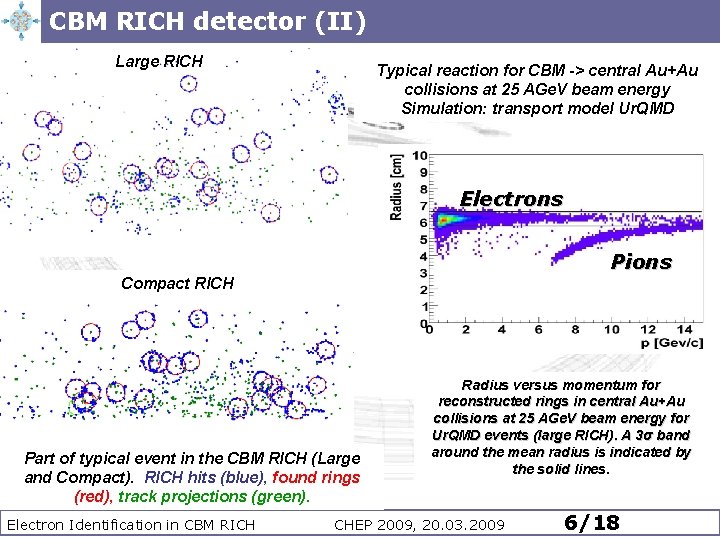
CBM RICH detector (II) Large RICH Typical reaction for CBM -> central Au+Au collisions at 25 AGe. V beam energy Simulation: transport model Ur. QMD Electrons Pions Compact RICH Part of typical event in the CBM RICH (Large and Compact). RICH hits (blue), found rings (red), track projections (green). Electron Identification in CBM RICH Radius versus momentum for reconstructed rings in central Au+Au collisions at 25 AGe. V beam energy for Ur. QMD events (large RICH). A 3σ band around the mean radius is indicated by the solid lines. CHEP 2009, 20. 03. 2009 6/18
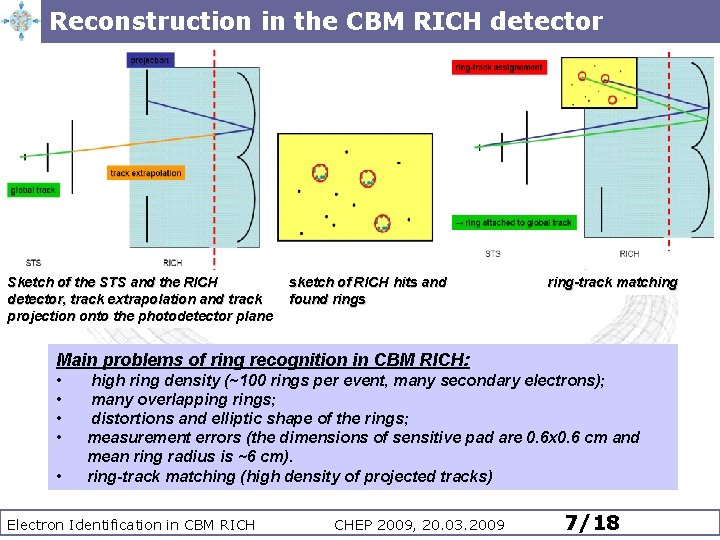
Reconstruction in the CBM RICH detector Sketch of the STS and the RICH detector, track extrapolation and track projection onto the photodetector plane sketch of RICH hits and found rings ring-track matching Main problems of ring recognition in CBM RICH: • • • high ring density (~100 rings per event, many secondary electrons); many overlapping rings; distortions and elliptic shape of the rings; measurement errors (the dimensions of sensitive pad are 0. 6 x 0. 6 cm and mean ring radius is ~6 cm). ring-track matching (high density of projected tracks) Electron Identification in CBM RICH CHEP 2009, 20. 03. 2009 7/18
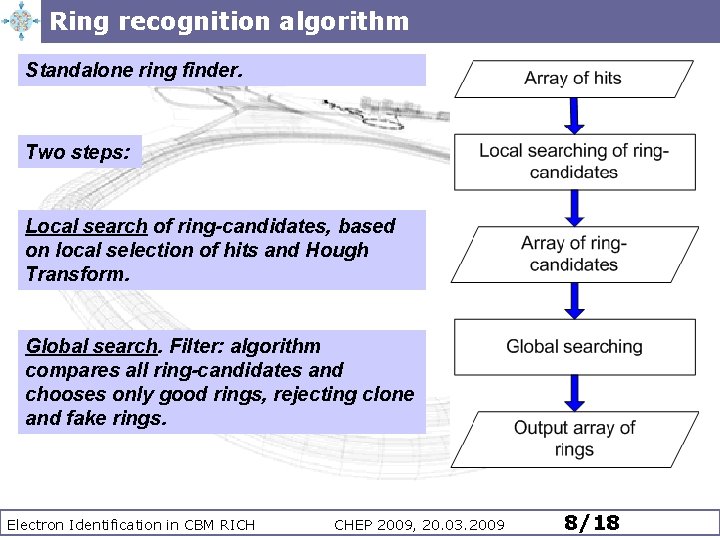
Ring recognition algorithm Standalone ring finder. Two steps: Local search of ring-candidates, based on local selection of hits and Hough Transform. Global search. Filter: algorithm compares all ring-candidates and chooses only good rings, rejecting clone and fake rings. Electron Identification in CBM RICH CHEP 2009, 20. 03. 2009 8/18
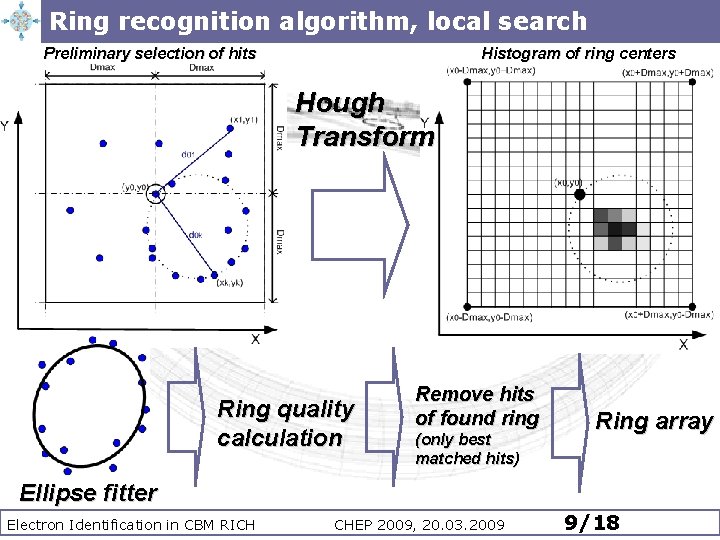
Ring recognition algorithm, local search Preliminary selection of hits Histogram of ring centers Hough Transform Ring quality calculation Remove hits of found ring (only best matched hits) Ring array Ellipse fitter Electron Identification in CBM RICH CHEP 2009, 20. 03. 2009 9/18
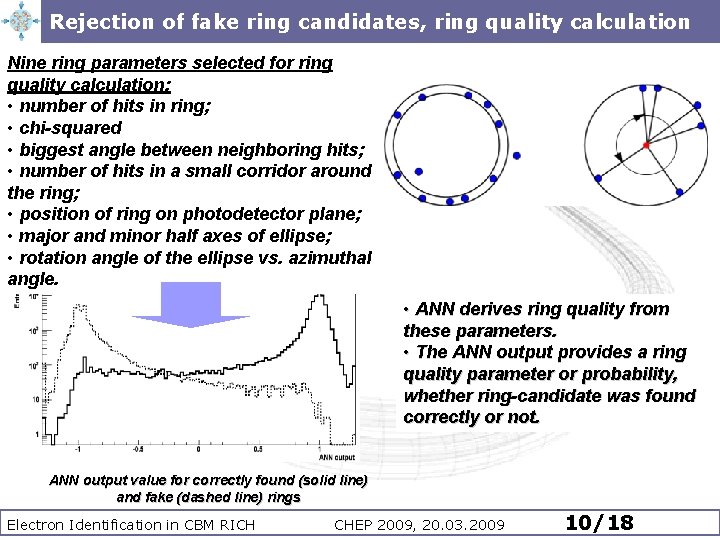
Rejection of fake ring candidates, ring quality calculation Nine ring parameters selected for ring quality calculation: • number of hits in ring; • chi-squared • biggest angle between neighboring hits; • number of hits in a small corridor around the ring; • position of ring on photodetector plane; • major and minor half axes of ellipse; • rotation angle of the ellipse vs. azimuthal angle. • ANN derives ring quality from these parameters. • The ANN output provides a ring quality parameter or probability, whether ring-candidate was found correctly or not. ANN output value for correctly found (solid line) and fake (dashed line) rings Electron Identification in CBM RICH CHEP 2009, 20. 03. 2009 10/18
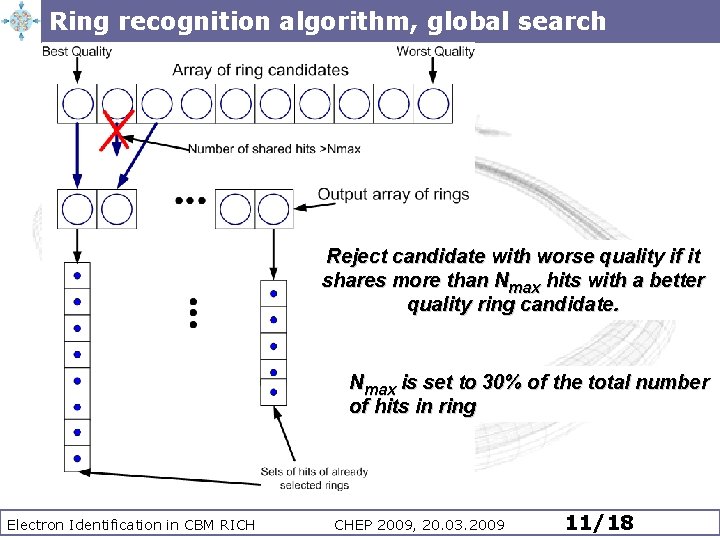
Ring recognition algorithm, global search Reject candidate with worse quality if it shares more than Nmax hits with a better quality ring candidate. Nmax is set to 30% of the total number of hits in ring Electron Identification in CBM RICH CHEP 2009, 20. 03. 2009 11/18
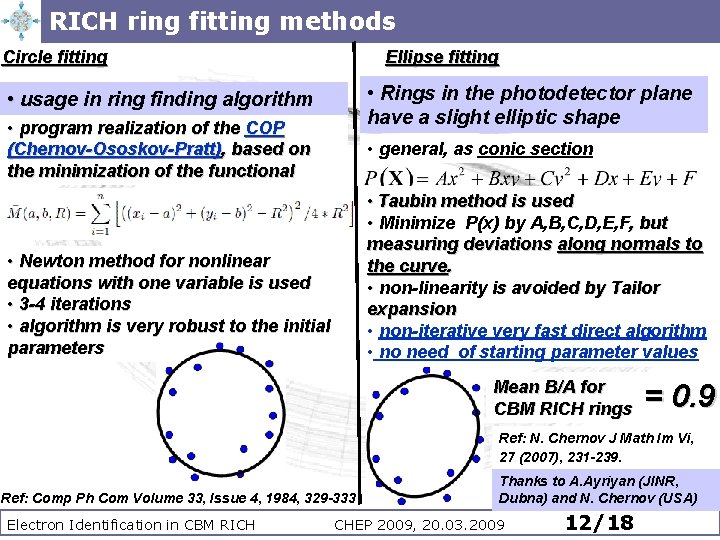
RICH ring fitting methods Circle fitting Ellipse fitting • Rings in the photodetector plane have a slight elliptic shape • usage in ring finding algorithm • program realization of the COP (Chernov-Ososkov-Pratt), based on the minimization of the functional • general, as conic section • Taubin method is used • Minimize P(x) by A, B, C, D, E, F, but measuring deviations along normals to the curve. • non-linearity is avoided by Tailor expansion • non-iterative very fast direct algorithm • no need of starting parameter values • Newton method for nonlinear equations with one variable is used • 3 -4 iterations • algorithm is very robust to the initial parameters Mean B/A for CBM RICH rings = 0. 9 Ref: N. Chernov J Math Im Vi, 27 (2007), 231 -239. Ref: Comp Ph Com Volume 33, Issue 4, 1984, 329 -333 Electron Identification in CBM RICH Thanks to A. Ayriyan (JINR, Dubna) and N. Chernov (USA) CHEP 2009, 20. 03. 2009 12/18
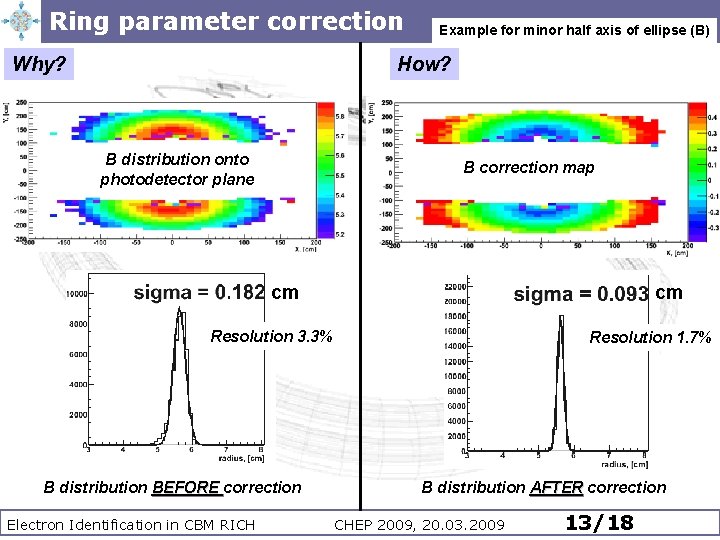
Ring parameter correction Why? Example for minor half axis of ellipse (B) How? B distribution onto photodetector plane B correction map cm cm Resolution 3. 3% B distribution BEFORE correction Electron Identification in CBM RICH Resolution 1. 7% B distribution AFTER correction CHEP 2009, 20. 03. 2009 13/18
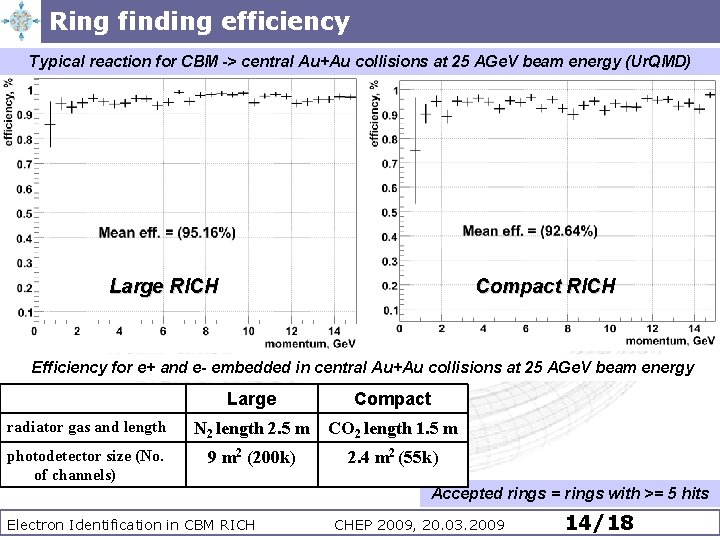
Ring finding efficiency Typical reaction for CBM -> central Au+Au collisions at 25 AGe. V beam energy (Ur. QMD) Large RICH Compact RICH Efficiency for e+ and e- embedded in central Au+Au collisions at 25 AGe. V beam energy Large radiator gas and length photodetector size (No. of channels) Compact N 2 length 2. 5 m CO 2 length 1. 5 m 9 m 2 (200 k) 2. 4 m 2 (55 k) Accepted rings = rings with >= 5 hits Electron Identification in CBM RICH CHEP 2009, 20. 03. 2009 14/18
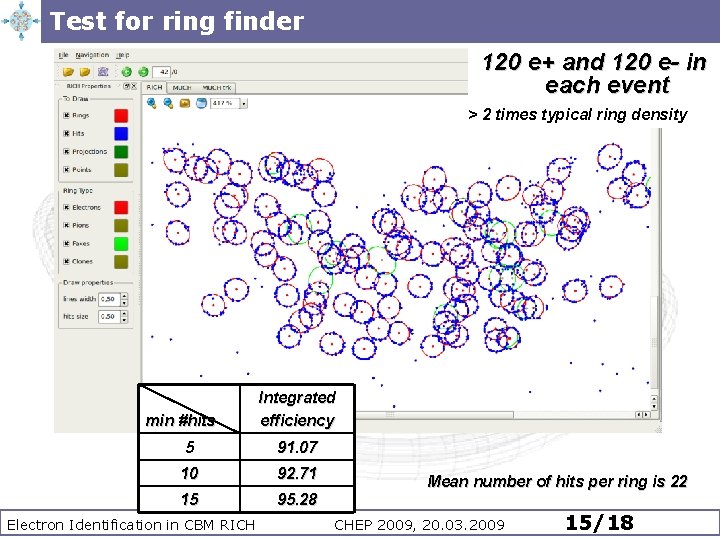
Test for ring finder 120 e+ and 120 e- in each event > 2 times typical ring density min #hits Integrated efficiency 5 91. 07 10 92. 71 15 95. 28 Electron Identification in CBM RICH Mean number of hits per ring is 22 CHEP 2009, 20. 03. 2009 15/18
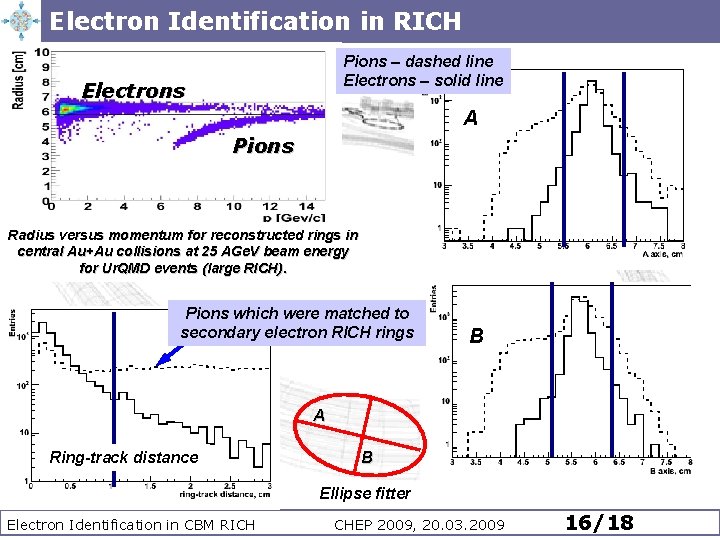
Electron Identification in RICH Pions – dashed line Electrons – solid line Electrons A Pions Radius versus momentum for reconstructed rings in central Au+Au collisions at 25 AGe. V beam energy for Ur. QMD events (large RICH). Pions which were matched to secondary electron RICH rings B A Ring-track distance B Ellipse fitter Electron Identification in CBM RICH CHEP 2009, 20. 03. 2009 16/18
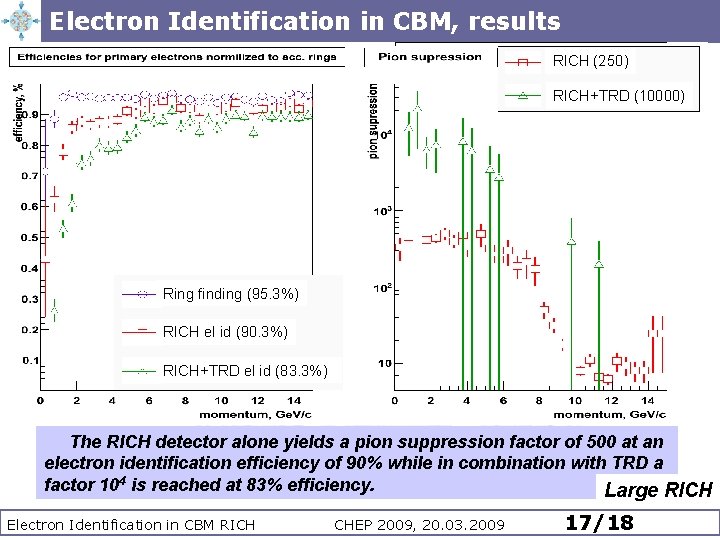
Electron Identification in CBM, results RICH (250) RICH+TRD (10000) Ring finding (95. 3%) RICH el id (90. 3%) RICH+TRD el id (83. 3%) The RICH detector alone yields a pion suppression factor of 500 at an electron identification efficiency of 90% while in combination with TRD a factor 104 is reached at 83% efficiency. Large RICH Electron Identification in CBM RICH CHEP 2009, 20. 03. 2009 17/18
Summary • Fast and efficient algorithm for ring recognition in CBM RICH was developed – based on the HT method with local selection of hits. – Fast and robust ellipse fitting algorithm has been implemented for precise estimation of ring parameters. – A global ring search algorithm was developed to select good rings, while rejecting fake and clone rings. • Time of one event reconstruction in RICH (> 100 rings) varies from 50 ms to 300 ms depending on parameters in ring recognition (fast or more efficient but slower) on a Pentium 4 2 GHz. • Ring finding algorithm has shown a very good performance and robustness to high ring multiplicity environment. Electron Identification in CBM RICH CHEP 2009, 20. 03. 2009 18/18