
Mobile App for light control by speech recognition
Mobile App for light control by speech recognition Reponsible: M. C. Carlos Torres Hernández Students names: Rendón Muñiz Nancy Jocelyn 221398 Soto Nájera Zuleydi 246852
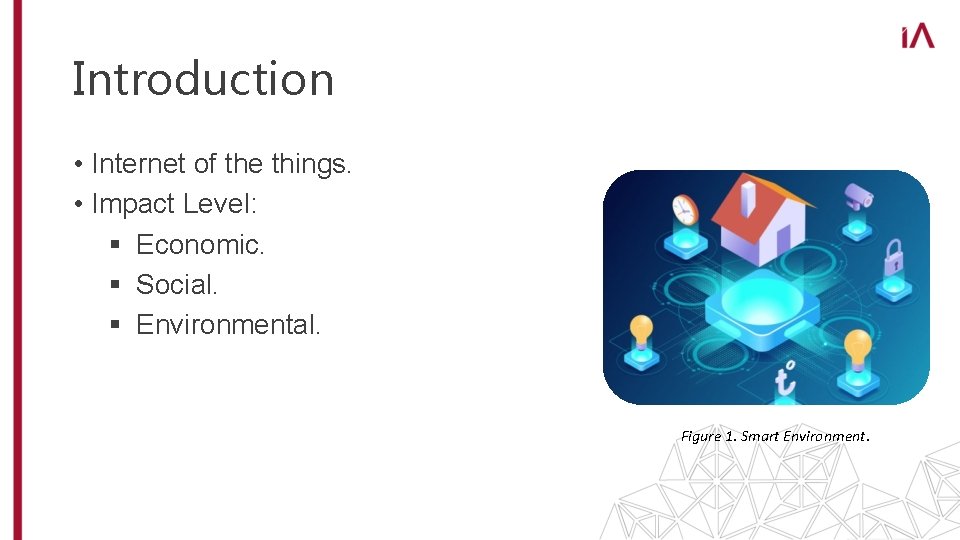
Introduction • Internet of the things. • Impact Level: § Economic. § Social. § Environmental. Figure 1. Smart Environment.
Main problem In the current market there already several systems that deal with the domotic control of homes, but most of these require devices, such as: Google home, Amazon echo dot and Homepod to interact with controllers and operate what we request. • Nowadays, the market niche is growing every day, so those interested are in a constant search for something more optimal and economical.
Objective • Develop a mobile app with connection to a voice assistant to control the operation of the lights to improve the security of the home and decrease the energy consumption.
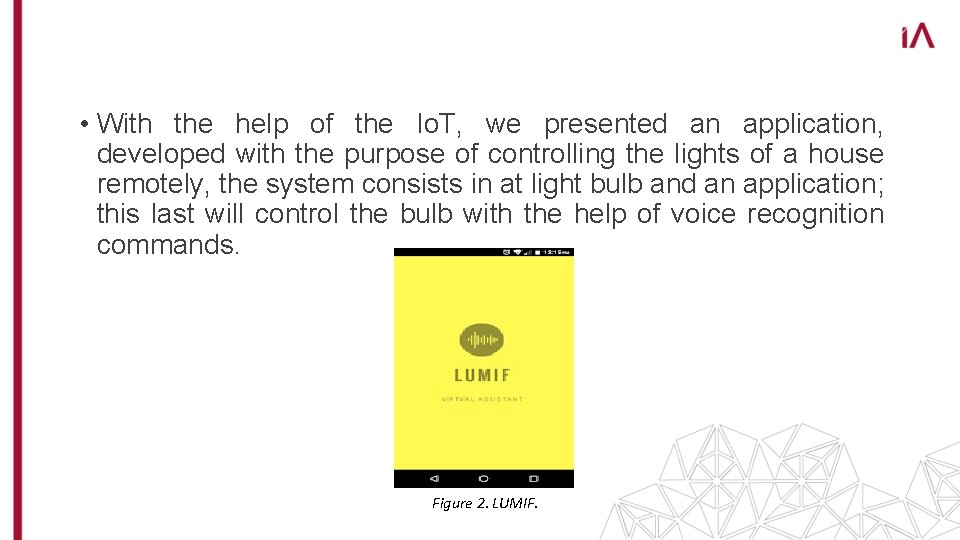
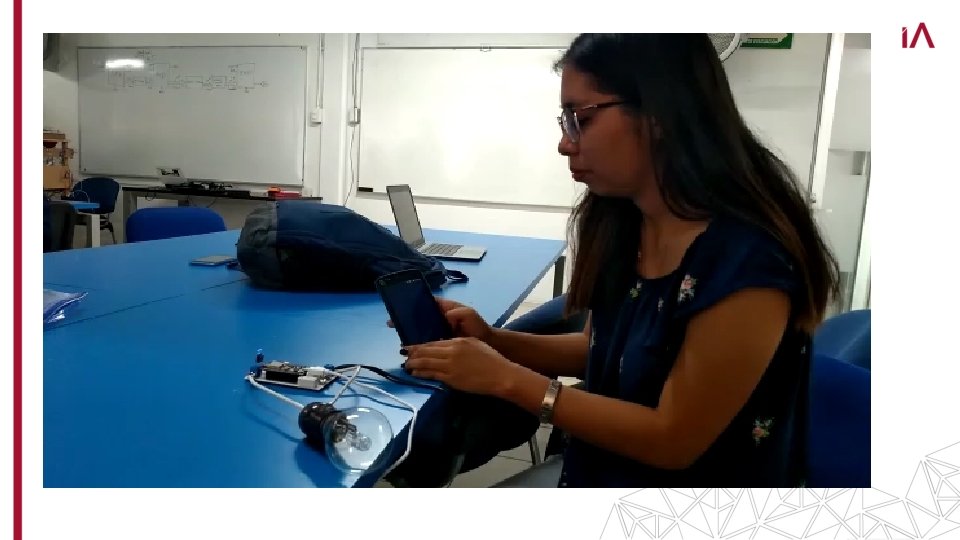
• With the help of the Io. T, we presented an application, developed with the purpose of controlling the lights of a house remotely, the system consists in at light bulb and an application; this last will control the bulb with the help of voice recognition commands. Figure 2. LUMIF.
Results At the end of this work, we have a functional prototype that can control the turn on and turn off of the light bulb, plus you can control its intensity at 4 different levels: 25%, 50%, 75%, 100%, all by voice commands. The app and the receiver are connected through a database in firebase, to which the user can access and also transmit data from that platform.
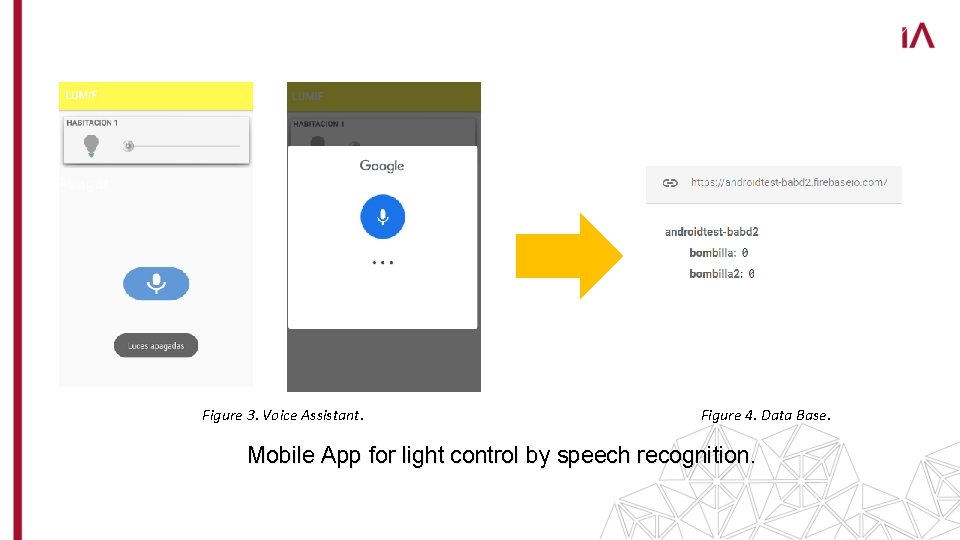
Figure 3. Voice Assistant. Figure 4. Data Base. Mobile App for light control by speech recognition.
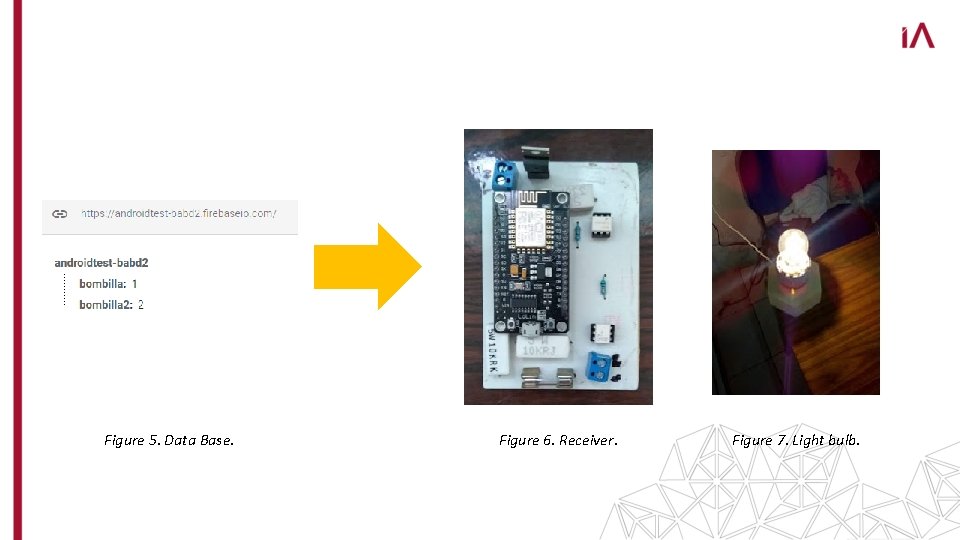
Figure 5. Data Base. Figure 6. Receiver. Figure 7. Light bulb.
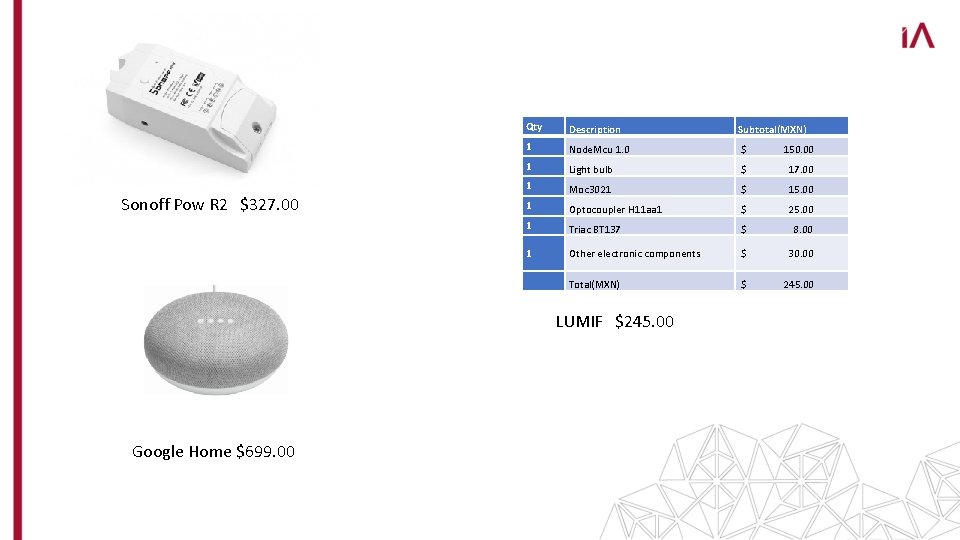
Sonoff Pow R 2 $327. 00 Qty Description Subtotal(MXN) 1 Node. Mcu 1. 0 $ 150. 00 1 Light bulb $ 17. 00 1 Moc 3021 $ 15. 00 1 Optocoupler H 11 aa 1 $ 25. 00 1 Triac BT 137 $ 8. 00 1 Other electronic components $ 30. 00 Total(MXN) $ 245. 00 LUMIF $245. 00 Google Home $699. 00
Conclutions • This work proved the implementation methodology proposed for the development of a mobile application capable of semi automatically controlling the luminaries of a home, with the help of optimal components and integrating easy-to-understand electronics. • Due to the versatility of its implementation, the mobile application can be updated easily, according to the need, it means that in the future more elements can be included to control, in order to achieve a more complete intelligent environment.
questions?
References [1] Ranger, S. (2019). What is the Io. T? Everything you need to know about the Internet of Things right now | ZDNet. [Online] ZDNet. Available at: https: //www. zdnet. com/article/what-is-the-internet-ofthings-everything-you-need-to-know-about-the-iot-right-now/ [Accessed 10 Jun. 2019]. [2] Migesa, M. (2019). Breve introducción al Internet of Things (Io. T). - Migesa Equipamiento. [Online] Migesa Equipamiento. Available at: http: //migesaequipamiento. com/introduccion-internet-of-things-iot [Accessed 10 Jun. 2019] [3] Sciencedirect. com. (2019). Smart Environment - an overview | Science. Direct Topics. [Online] Available at: https: //www. sciencedirect. com/topics/computer-science/smartenvironment [Accessed 10 Jun. 2019]. [4] Control? ¿. and Control? , ¿. (2019). ¿Qué es un Smart Home Control? - Twenergy. [online] Twenergy. com. Available at: https: //twenergy. com/a/que-es-un-smart-home-control-2403 [Accessed
- Slides: 13