
Task driven computing Zhenyu Wang David Garlan CMU
- Slides: 13
Task driven computing Zhenyu Wang, David Garlan CMU Presented By: Kalpana Banerjee
Moore’s Law Reigns Supreme Processor density Processor speed Memory capacity Disk capacity Memory cost • • •
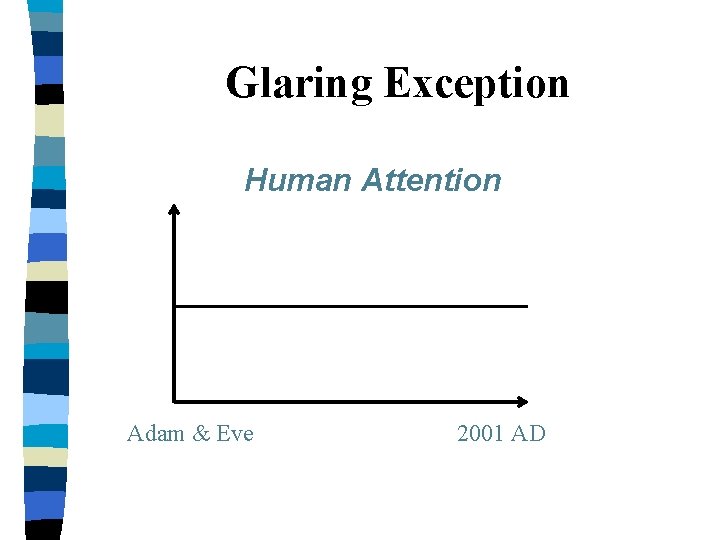
Glaring Exception Human Attention Adam & Eve 2001 AD
Motivation n No longer tied to PC’s n Conference attendee – Decides to use local Unix workstation – POP client, else telnet – X Server, else local reader n Out of limited attention span, time wasted on configuration.
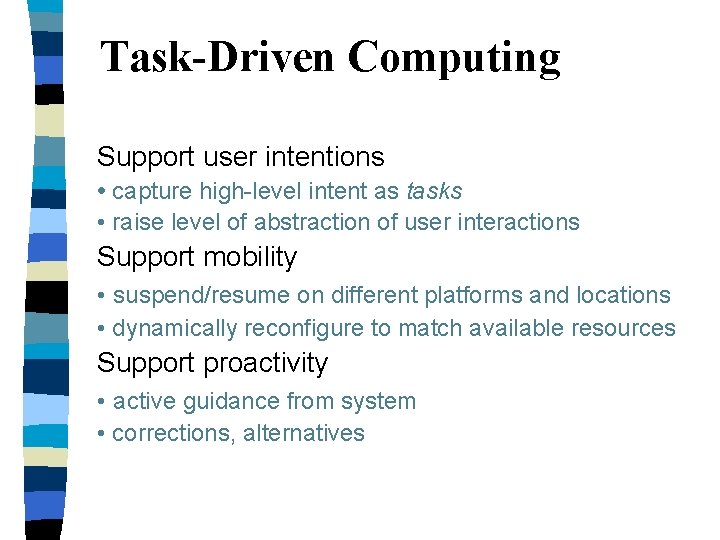
Task-Driven Computing Support user intentions • capture high-level intent as tasks • raise level of abstraction of user interactions Support mobility • suspend/resume on different platforms and locations • dynamically reconfigure to match available resources Support proactivity • active guidance from system • corrections, alternatives
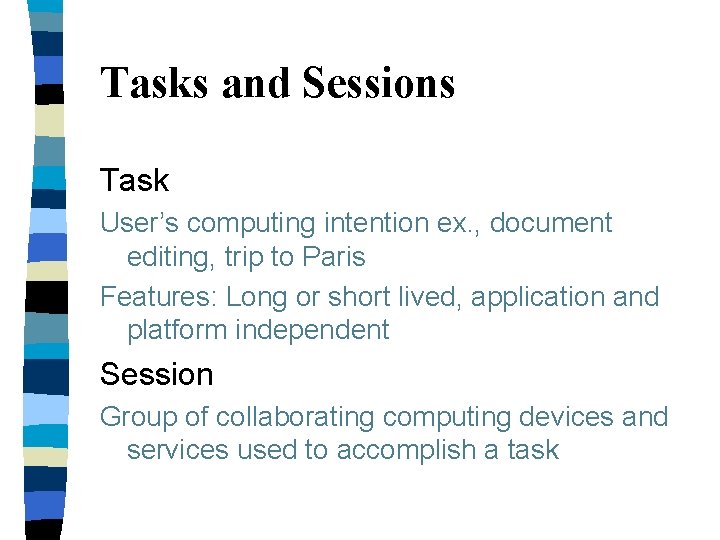
Tasks and Sessions Task User’s computing intention ex. , document editing, trip to Paris Features: Long or short lived, application and platform independent Session Group of collaborating computing devices and services used to accomplish a task
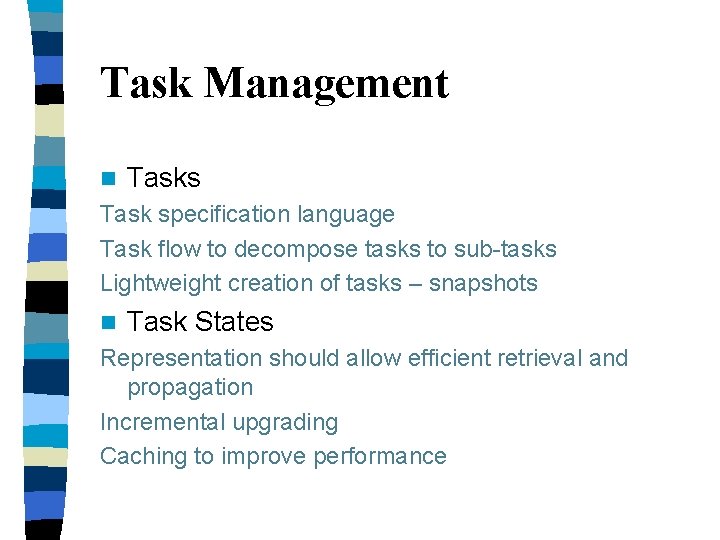
Task Management n Tasks Task specification language Task flow to decompose tasks to sub-tasks Lightweight creation of tasks – snapshots n Task States Representation should allow efficient retrieval and propagation Incremental upgrading Caching to improve performance
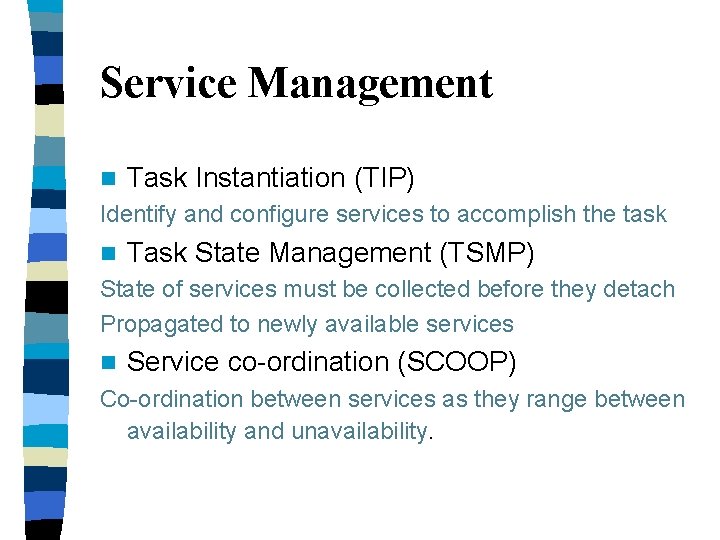
Service Management n Task Instantiation (TIP) Identify and configure services to accomplish the task n Task State Management (TSMP) State of services must be collected before they detach Propagated to newly available services n Service co-ordination (SCOOP) Co-ordination between services as they range between availability and unavailability.
Virtual Service Abstraction n Virtual service is an abstract functionality that is bound to a physical service ex. , spell check, document editing – MS Word Phone book service – cell phone, Outlook Express n State defined using structure schemas (XML), attribute value pairs ex. , document display service – name, position within document, display options
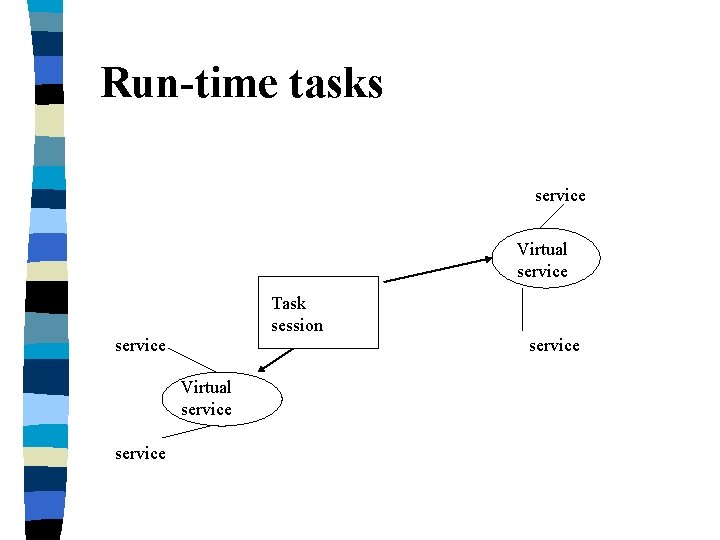
Run-time tasks service Virtual service Task Session service Virtual service
Task Instantiation/Pro-activity n TIP Find out about existing physical services Go down virtual service type tree to bind and compose physical services Configure the physical services n Pro-activity Use alternative physical resources Prompt user when resources become available Provide corrective hints
Implementation n Desk Space – A Snapshot based environment migration n SCOOP – to enable client devices to join and leave session
My conclusions n Very abstract and lacking in tangible examples n Implementation not explained n Question – is it at all feasible? ? Aura is based on it