Grammar Link Revision of the Infinitive 2021223 1



- Slides: 40
Grammar Link Revision of the Infinitive 2021/2/23 1
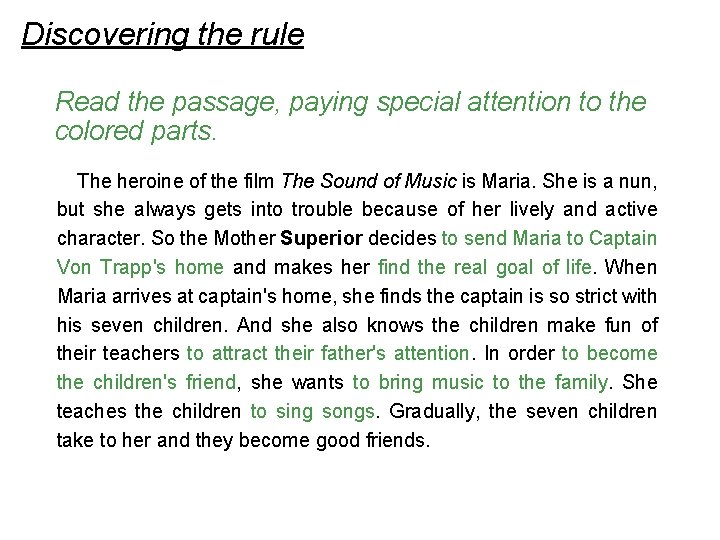
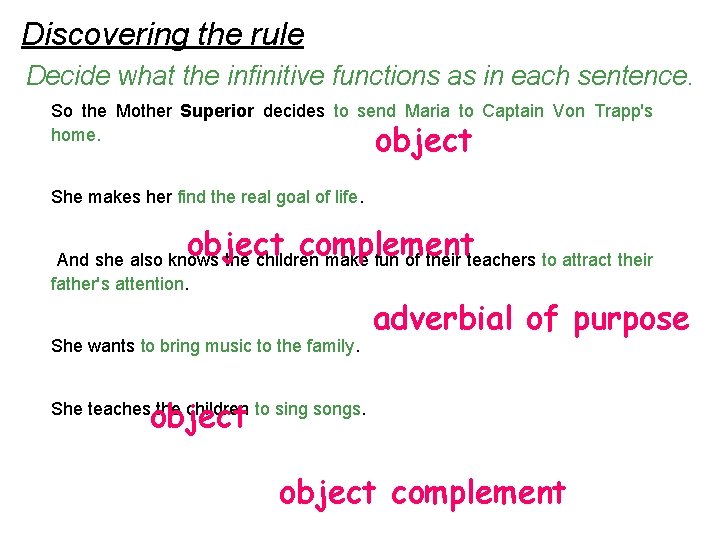
Discovering the rule Read the passage, paying special attention to the colored parts. The heroine of the film The Sound of Music is Maria. She is a nun, but she always gets into trouble because of her lively and active character. So the Mother Superior decides to send Maria to Captain Von Trapp's home and makes her find the real goal of life. When Maria arrives at captain's home, she finds the captain is so strict with his seven children. And she also knows the children make fun of their teachers to attract their father's attention. In order to become the children's friend, she wants to bring music to the family. She teaches the children to sing songs. Gradually, the seven children take to her and they become good friends.
Discovering the rule Decide what the infinitive functions as in each sentence. So the Mother Superior decides to send Maria to Captain Von Trapp's home. object She makes her find the real goal of life. object complement And she also knows the children make fun of their teachers to attract their father's attention. She wants to bring music to the family. adverbial of purpose object She teaches the children to sing songs. object complement
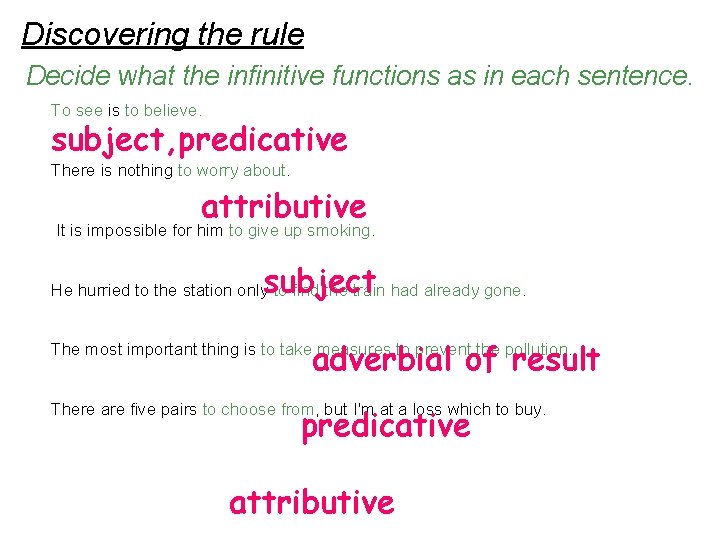
Discovering the rule Decide what the infinitive functions as in each sentence. To see is to believe. subject, predicative There is nothing to worry about. attributive It is impossible for him to give up smoking. subject He hurried to the station only to find the train had already gone. adverbial of result The most important thing is to take measures to prevent the pollution. There are five pairs to choose from, but I'm at a loss which to buy. predicative attributive
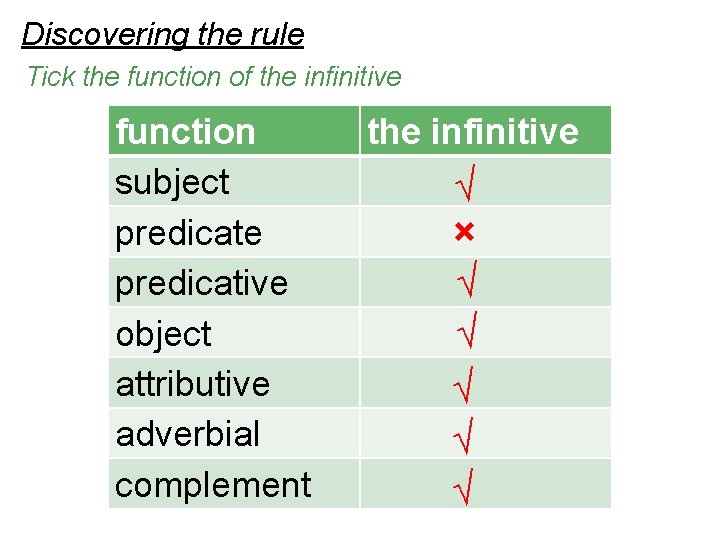
Discovering the rule Tick the function of the infinitive function subject predicate predicative object attributive adverbial complement the infinitive √ × √ √ √
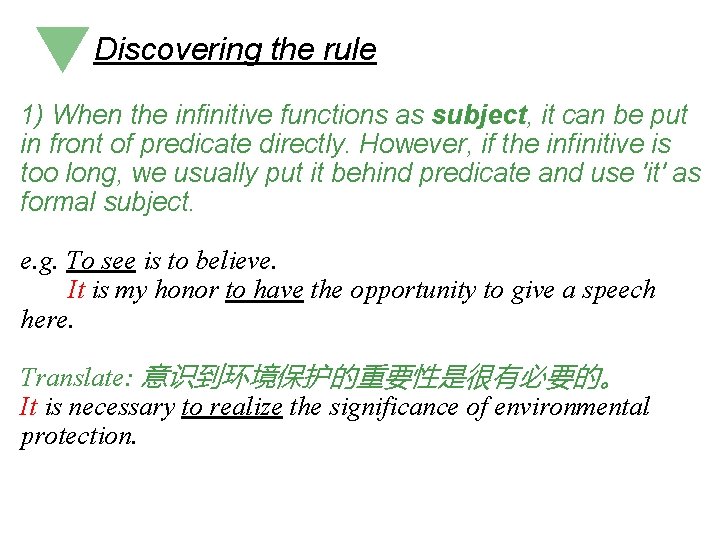
Discovering the rule 1) When the infinitive functions as subject, it can be put in front of predicate directly. However, if the infinitive is too long, we usually put it behind predicate and use 'it' as formal subject. e. g. To see is to believe. It is my honor to have the opportunity to give a speech here. Translate: 意识到环境保护的重要性是很有必要的。 It is necessary to realize the significance of environmental protection.
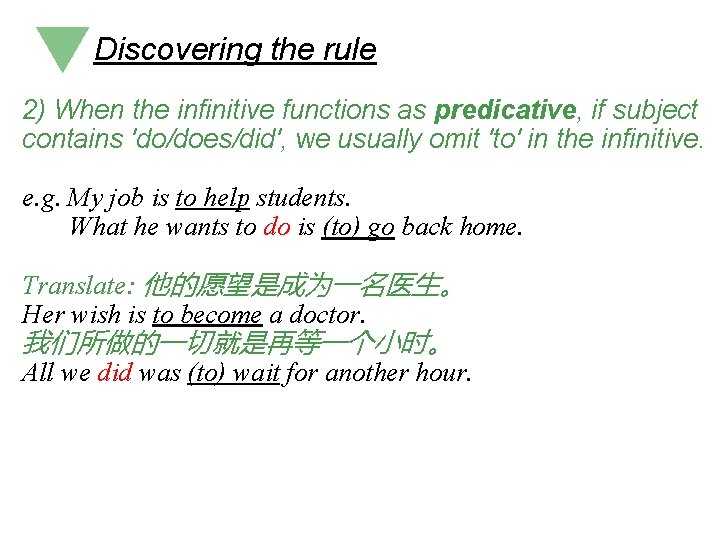
Discovering the rule 2) When the infinitive functions as predicative, if subject contains 'do/does/did', we usually omit 'to' in the infinitive. e. g. My job is to help students. What he wants to do is (to) go back home. Translate: 他的愿望是成为一名医生。 Her wish is to become a doctor. 我们所做的一切就是再等一个小时。 All we did was (to) wait for another hour.
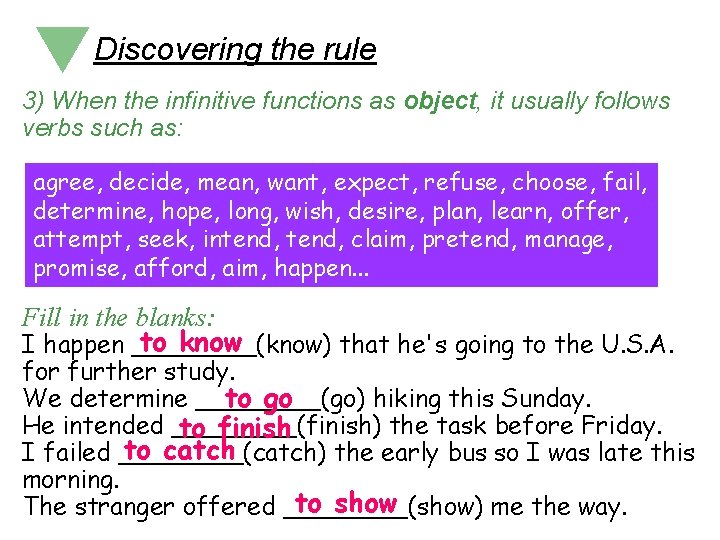
Discovering the rule 3) When the infinitive functions as object, it usually follows verbs such as: agree, decide, mean, want, expect, refuse, choose, fail, determine, hope, long, wish, desire, plan, learn, offer, attempt, seek, intend, claim, pretend, manage, promise, afford, aim, happen. . . Fill in the blanks: to know I happen ____(know) that he's going to the U. S. A. for further study. to go We determine ____(go) hiking this Sunday. He intended ____(finish) the task before Friday. to finish to catch I failed ____(catch) the early bus so I was late this morning. to show The stranger offered ____(show) me the way.
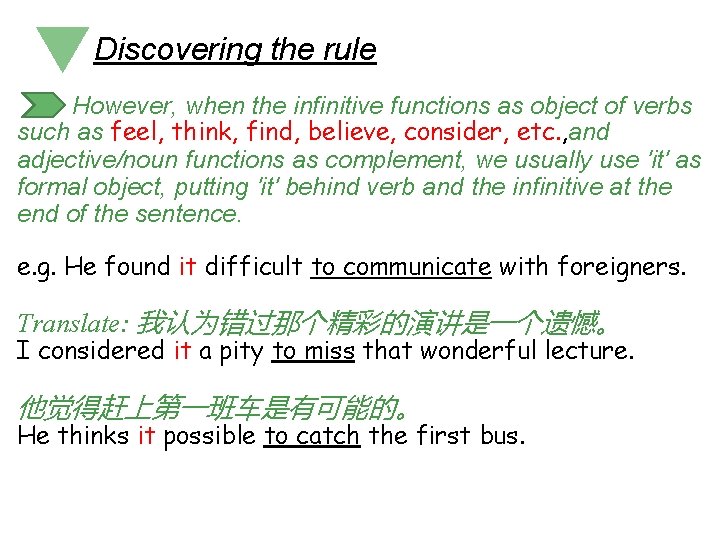
Discovering the rule However, when the infinitive functions as object of verbs such as feel, think, find, believe, consider, etc. , and adjective/noun functions as complement, we usually use 'it' as formal object, putting 'it' behind verb and the infinitive at the end of the sentence. e. g. He found it difficult to communicate with foreigners. Translate: 我认为错过那个精彩的演讲是一个遗憾。 I considered it a pity to miss that wonderful lecture. 他觉得赶上第一班车是有可能的。 He thinks it possible to catch the first bus.
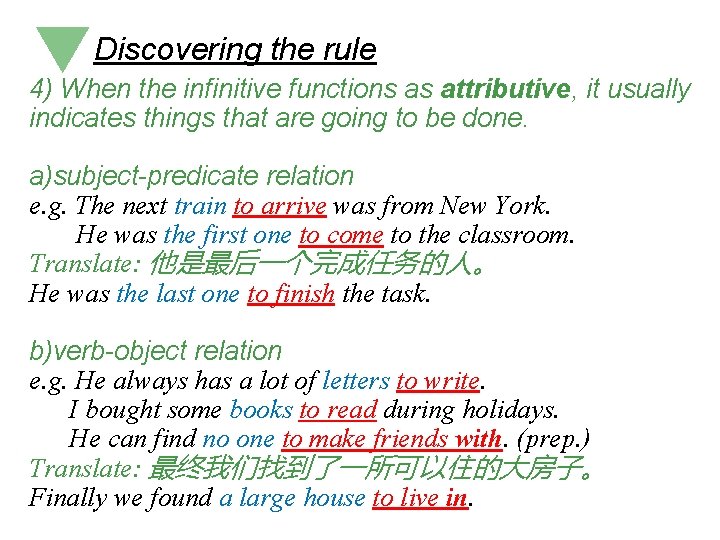
Discovering the rule 4) When the infinitive functions as attributive, it usually indicates things that are going to be done. a)subject-predicate relation e. g. The next train to arrive was from New York. He was the first one to come to the classroom. Translate: 他是最后一个完成任务的人。 He was the last one to finish the task. b)verb-object relation e. g. He always has a lot of letters to write. I bought some books to read during holidays. He can find no one to make friends with. (prep. ) Translate: 最终我们找到了一所可以住的大房子。 Finally we found a large house to live in.
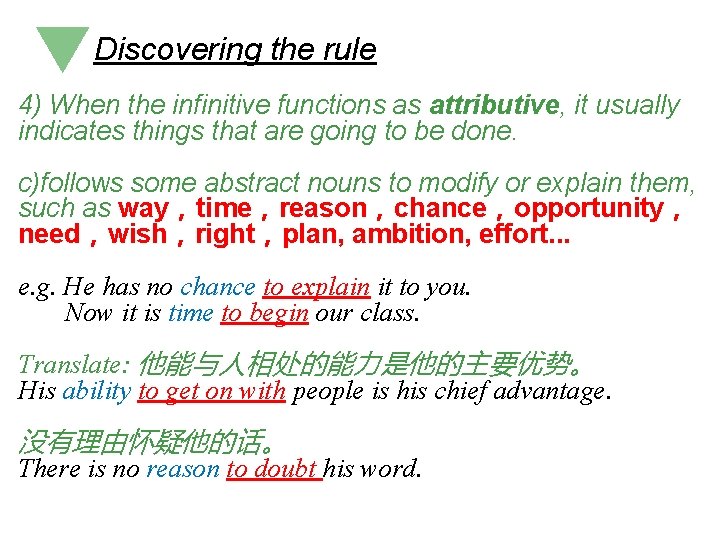
Discovering the rule 4) When the infinitive functions as attributive, it usually indicates things that are going to be done. c)follows some abstract nouns to modify or explain them, such as way,time,reason,chance,opportunity, need,wish,right,plan, ambition, effort. . . e. g. He has no chance to explain it to you. Now it is time to begin our class. Translate: 他能与人相处的能力是他的主要优势。 His ability to get on with people is his chief advantage. 没有理由怀疑他的话。 There is no reason to doubt his word.
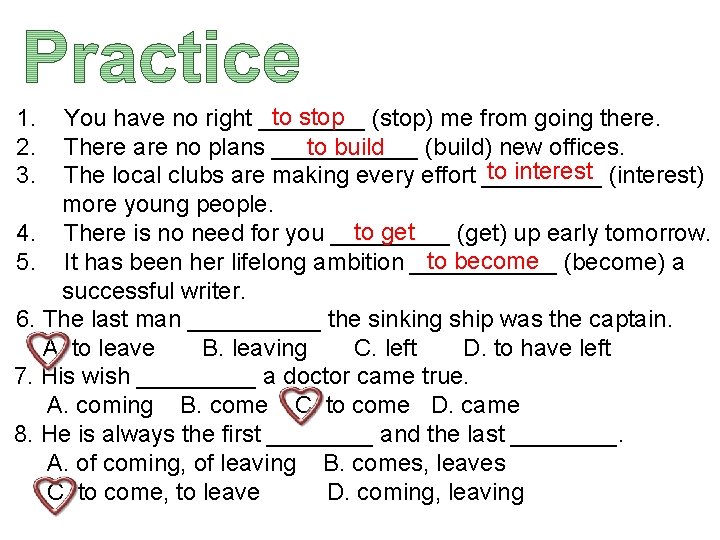
1. 2. 3. to stop (stop) me from going there. You have no right ____ There are no plans ______ (build) new offices. to build to interest (interest) The local clubs are making every effort _____ more young people. to get 4. There is no need for you _____ (get) up early tomorrow. to become (become) a 5. It has been her lifelong ambition ______ successful writer. 6. The last man _____ the sinking ship was the captain. A. to leave B. leaving C. left D. to have left 7. His wish _____ a doctor came true. A. coming B. come C. to come D. came 8. He is always the first ____ and the last ____. A. of coming, of leaving B. comes, leaves C. to come, to leave D. coming, leaving
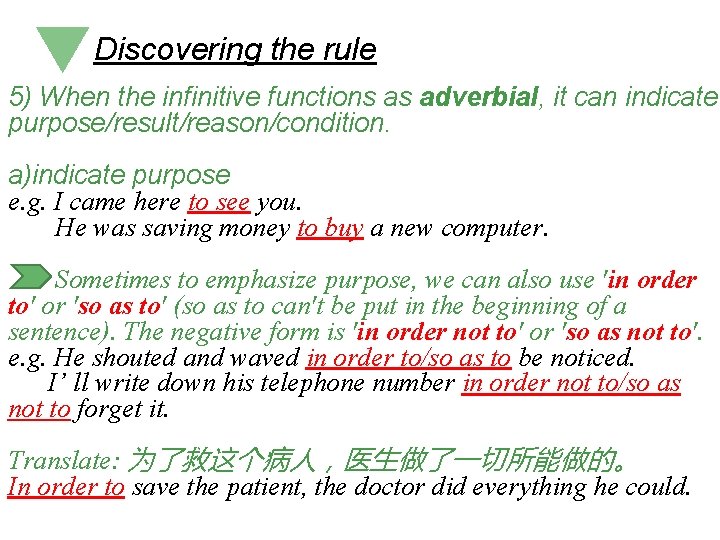
Discovering the rule 5) When the infinitive functions as adverbial, it can indicate purpose/result/reason/condition. a)indicate purpose e. g. I came here to see you. He was saving money to buy a new computer. Sometimes to emphasize purpose, we can also use 'in order to' or 'so as to' (so as to can't be put in the beginning of a sentence). The negative form is 'in order not to' or 'so as not to'. e. g. He shouted and waved in order to/so as to be noticed. I’ ll write down his telephone number in order not to/so as not to forget it. Translate: 为了救这个病人,医生做了一切所能做的。 In order to save the patient, the doctor did everything he could.
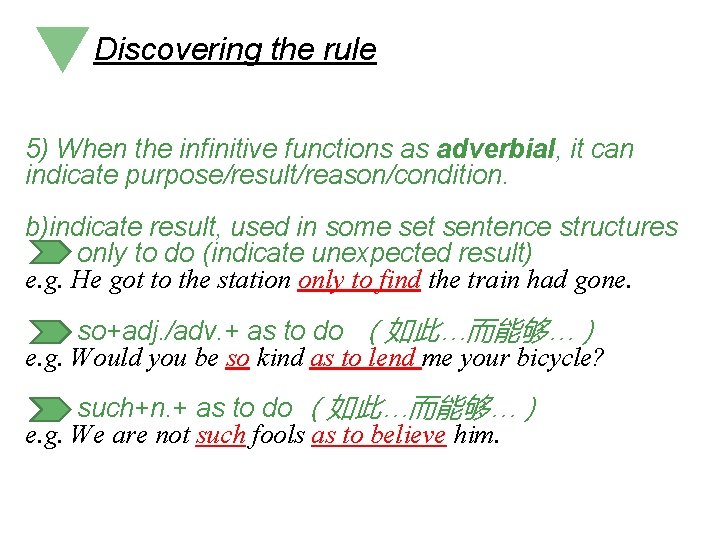
Discovering the rule 5) When the infinitive functions as adverbial, it can indicate purpose/result/reason/condition. b)indicate result, used in some set sentence structures only to do (indicate unexpected result) e. g. He got to the station only to find the train had gone. so+adj. /adv. + as to do (如此…而能够…) e. g. Would you be so kind as to lend me your bicycle? such+n. + as to do (如此…而能够…) e. g. We are not such fools as to believe him.
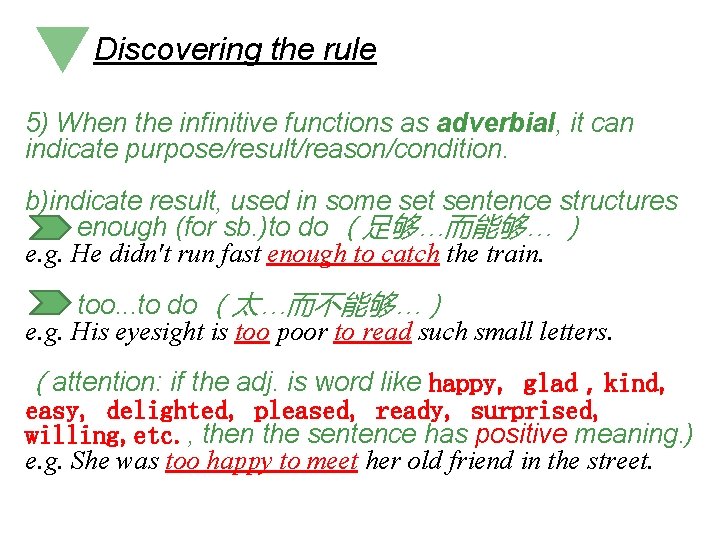
Discovering the rule 5) When the infinitive functions as adverbial, it can indicate purpose/result/reason/condition. b)indicate result, used in some set sentence structures enough (for sb. )to do (足够…而能够… ) e. g. He didn't run fast enough to catch the train. too. . . to do (太…而不能够…) e. g. His eyesight is too poor to read such small letters. (attention: if the adj. is word like happy, glad,kind, easy, delighted, pleased, ready, surprised, willing, etc. , then the sentence has positive meaning. ) e. g. She was too happy to meet her old friend in the street.
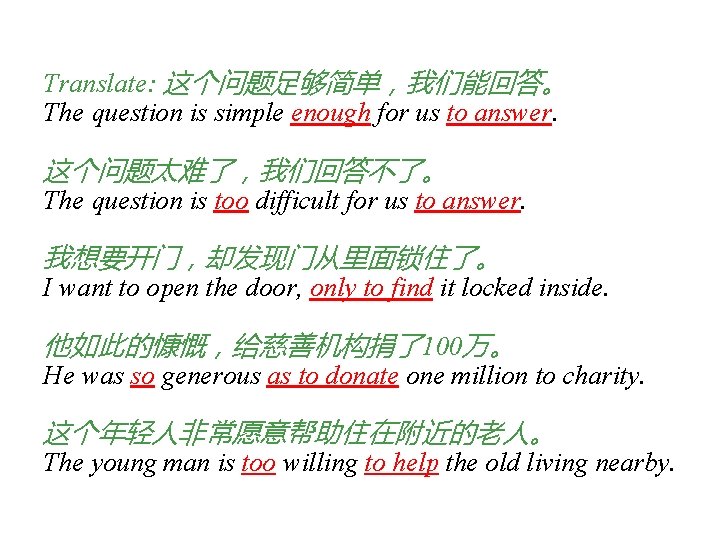
Translate: 这个问题足够简单,我们能回答。 The question is simple enough for us to answer. 这个问题太难了,我们回答不了。 The question is too difficult for us to answer. 我想要开门,却发现门从里面锁住了。 I want to open the door, only to find it locked inside. 他如此的慷慨,给慈善机构捐了100万。 He was so generous as to donate one million to charity. 这个年轻人非常愿意帮助住在附近的老人。 The young man is too willing to help the old living nearby.
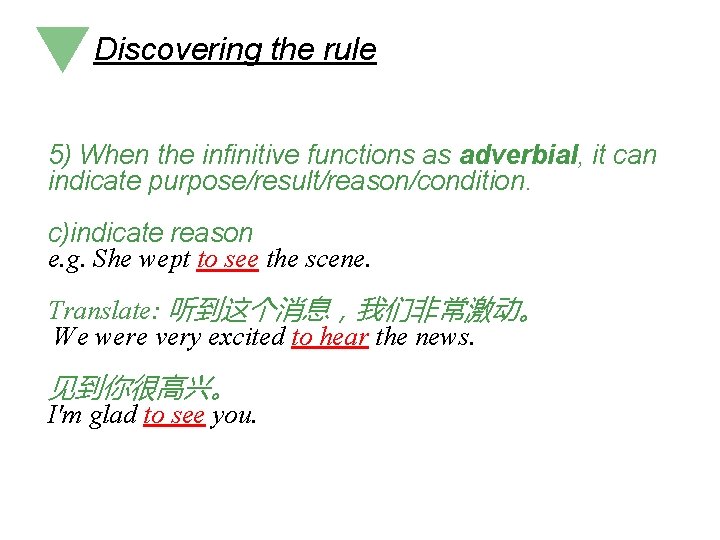
Discovering the rule 5) When the infinitive functions as adverbial, it can indicate purpose/result/reason/condition. c)indicate reason e. g. She wept to see the scene. Translate: 听到这个消息,我们非常激动。 We were very excited to hear the news. 见到你很高兴。 I'm glad to see you.
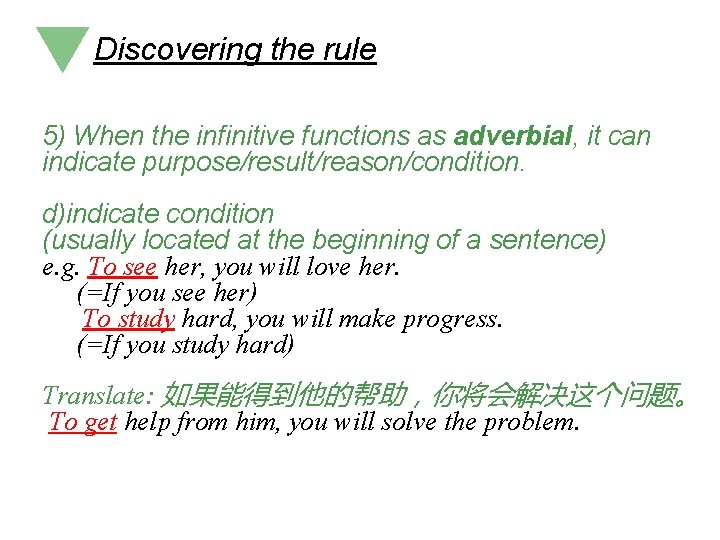
Discovering the rule 5) When the infinitive functions as adverbial, it can indicate purpose/result/reason/condition. d)indicate condition (usually located at the beginning of a sentence) e. g. To see her, you will love her. (=If you see her) To study hard, you will make progress. (=If you study hard) Translate: 如果能得到他的帮助,你将会解决这个问题。 To get help from him, you will solve the problem.
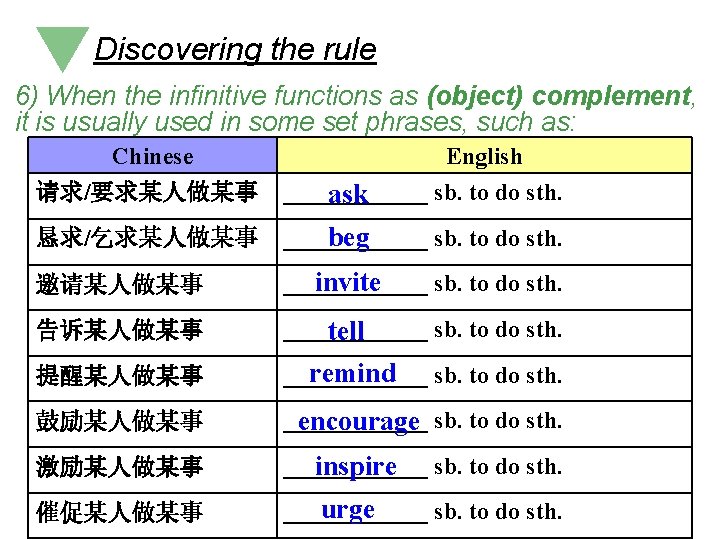
Discovering the rule 6) When the infinitive functions as (object) complement, it is usually used in some set phrases, such as: Chinese 请求/要求某人做某事 English ______ sb. to do sth. ask 恳求/乞求某人做某事 ______ sb. to do sth. beg 邀请某人做某事 invite ______ sb. to do sth. 告诉某人做某事 ______ sb. to do sth. tell 提醒某人做某事 remind sb. to do sth. ______ 鼓励某人做某事 ______ encourage sb. to do sth. 激励某人做某事 ______ inspire sb. to do sth. 催促某人做某事 urge ______ sb. to do sth.
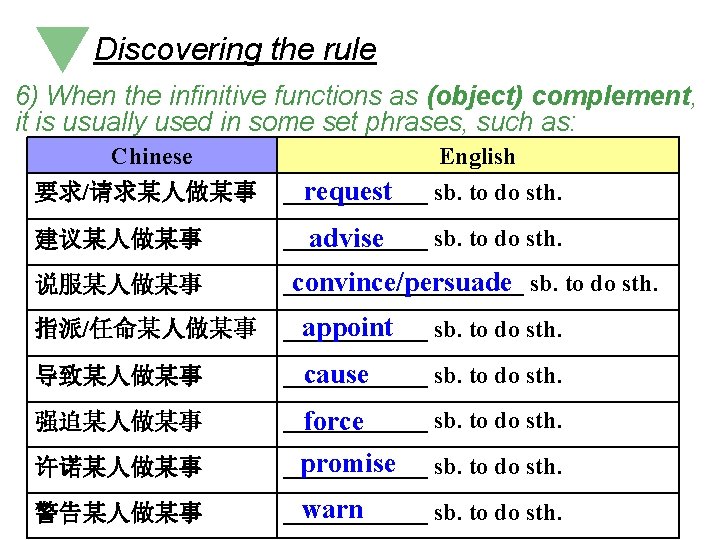
Discovering the rule 6) When the infinitive functions as (object) complement, it is usually used in some set phrases, such as: Chinese 要求/请求某人做某事 English request sb. to do sth. ______ 建议某人做某事 ______ sb. to do sth. advise 说服某人做某事 convince/persuade sb. to do sth. __________ 指派/任命某人做某事 appoint sb. to do sth. ______ 导致某人做某事 ______ sb. to do sth. cause 强迫某人做某事 ______ sb. to do sth. force 许诺某人做某事 promise sb. to do sth. ______ 警告某人做某事 warn ______ sb. to do sth.
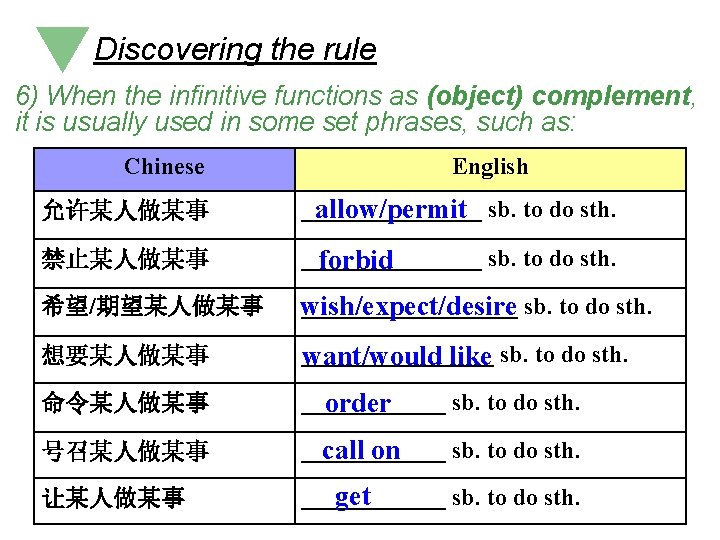
Discovering the rule 6) When the infinitive functions as (object) complement, it is usually used in some set phrases, such as: Chinese English 允许某人做某事 ________ allow/permit sb. to do sth. 禁止某人做某事 ________ sb. to do sth. forbid 希望/期望某人做某事 _________ sb. to do sth. wish/expect/desire 想要某人做某事 ________ want/would like sb. to do sth. 命令某人做某事 ______ sb. to do sth. order 号召某人做某事 ______ sb. to do sth. call on 让某人做某事 ______ sb. to do sth. get
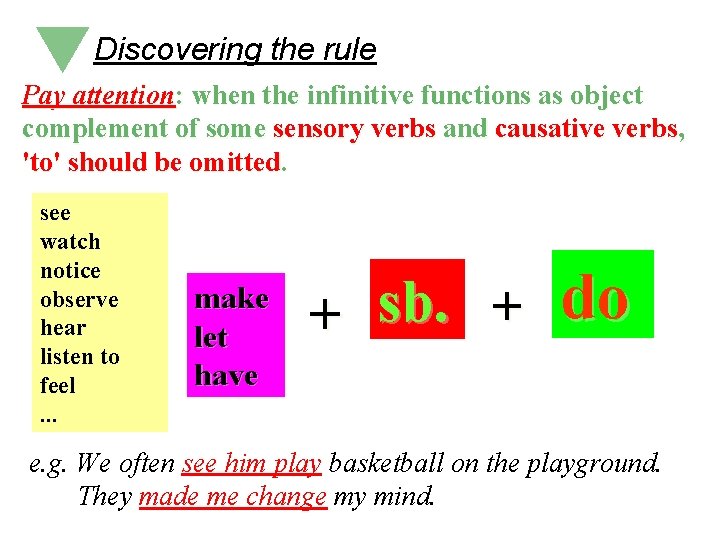
Discovering the rule Pay attention: when the infinitive functions as object complement of some sensory verbs and causative verbs, 'to' should be omitted. see watch notice observe hear listen to feel. . . make let have do sb. + + e. g. We often see him play basketball on the playground. They made me change my mind.
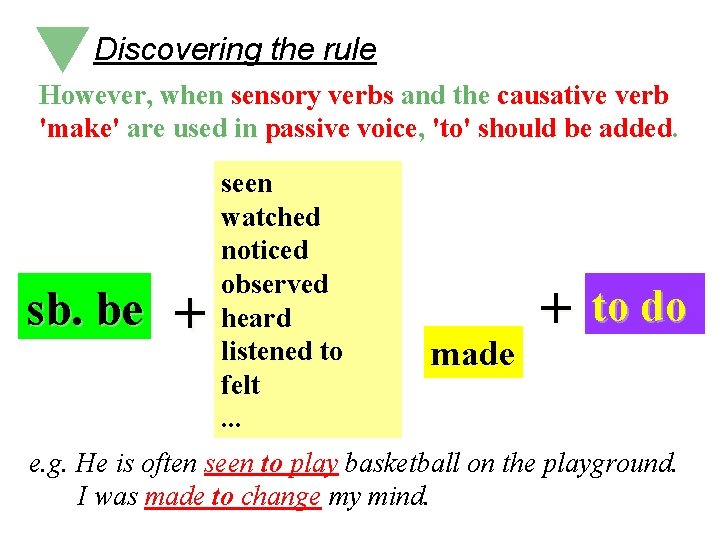
Discovering the rule However, when sensory verbs and the causative verb 'make' are used in passive voice, 'to' should be added. sb. be + seen watched noticed observed heard listened to felt. . . made + to do e. g. He is often seen to play basketball on the playground. I was made to change my mind.
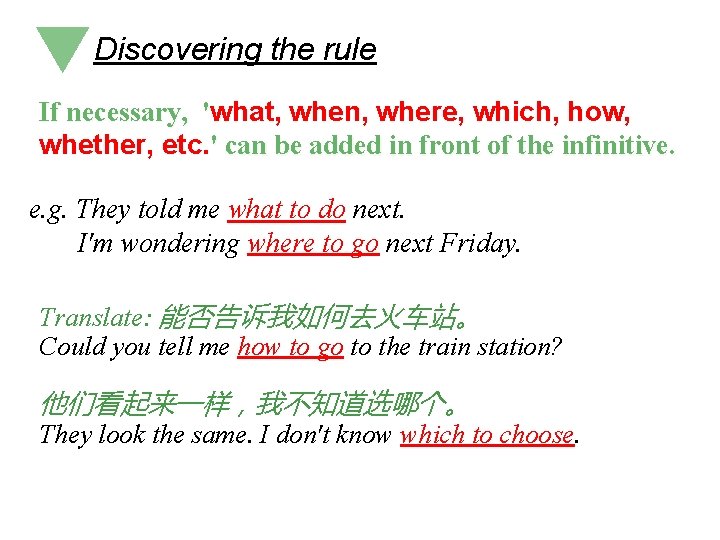
Discovering the rule If necessary, 'what, when, where, which, how, ' whether, etc. ' can be added in front of the infinitive. e. g. They told me what to do next. I'm wondering where to go next Friday. Translate: 能否告诉我如何去火车站。 Could you tell me how to go to the train station? 他们看起来一样,我不知道选哪个。 They look the same. I don't know which to choose.
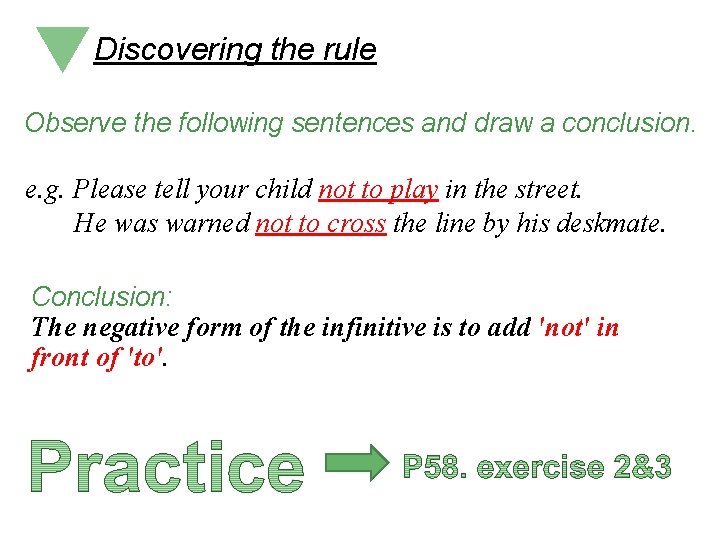
Discovering the rule Observe the following sentences and draw a conclusion. e. g. Please tell your child not to play in the street. He was warned not to cross the line by his deskmate. Conclusion: The negative form of the infinitive is to add 'not' in front of 'to'.
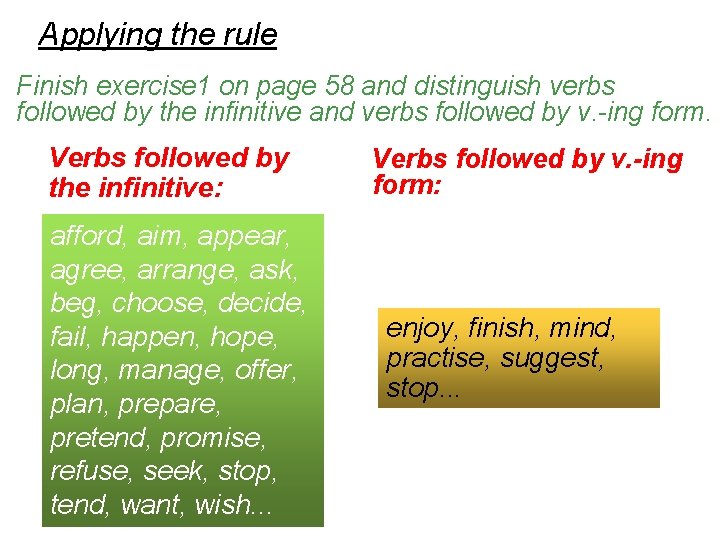
Applying the rule Finish exercise 1 on page 58 and distinguish verbs followed by the infinitive and verbs followed by v. -ing form. Verbs followed by the infinitive: afford, aim, appear, agree, arrange, ask, beg, choose, decide, fail, happen, hope, long, manage, offer, plan, prepare, pretend, promise, refuse, seek, stop, tend, want, wish. . . Verbs followed by v. -ing form: enjoy, finish, mind, practise, suggest, stop. . .
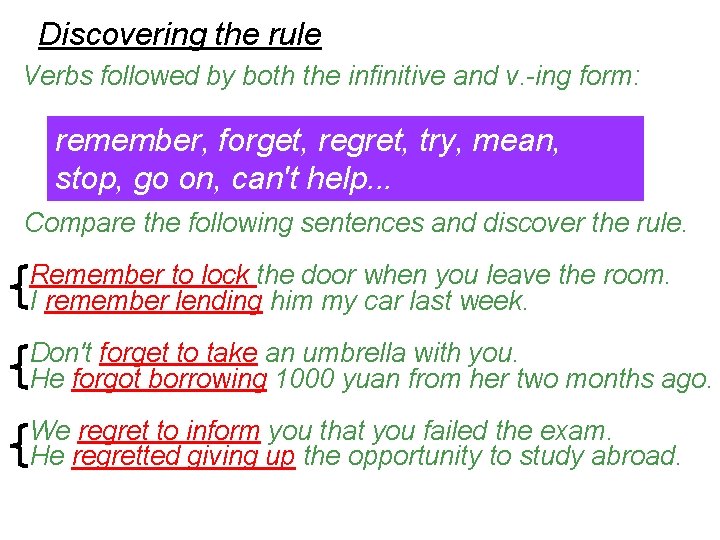
Discovering the rule Verbs followed by both the infinitive and v. -ing form: remember, forget, regret, try, mean, stop, go on, can't help. . . Compare the following sentences and discover the rule. Remember to lock the door when you leave the room. I remember lending him my car last week. Don't forget to take an umbrella with you. He forgot borrowing 1000 yuan from her two months ago. We regret to inform you that you failed the exam. He regretted giving up the opportunity to study abroad.
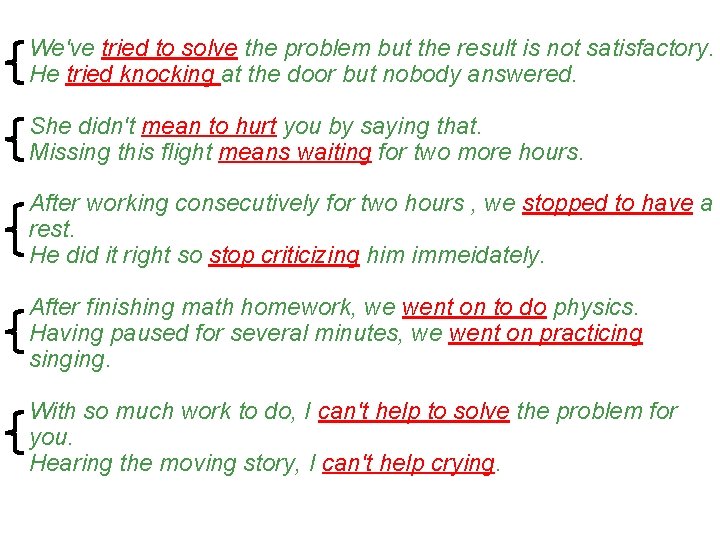
We've tried to solve the problem but the result is not satisfactory. He tried knocking at the door but nobody answered. She didn't mean to hurt you by saying that. Missing this flight means waiting for two more hours. After working consecutively for two hours , we stopped to have a rest. He did it right so stop criticizing him immeidately. After finishing math homework, we went on to do physics. Having paused for several minutes, we went on practicing singing. With so much work to do, I can't help to solve the problem for you. Hearing the moving story, I can't help crying.
Discovering the rule Conclusion: remember to do sth. remember doing sth. 记得要去做某事 记得曾经做过某事 forget to do sth. forget doing sth. 忘记做某事 忘记曾经做过某事 regret to do sth. regret doing sth. 遗憾/抱歉要做某事 后悔做过某事 try to do sth. try doing sth. 尽力做某事 尝试着做某事 mean to do sth. mean doing sth. 打算/想要做某事 意味着做某事
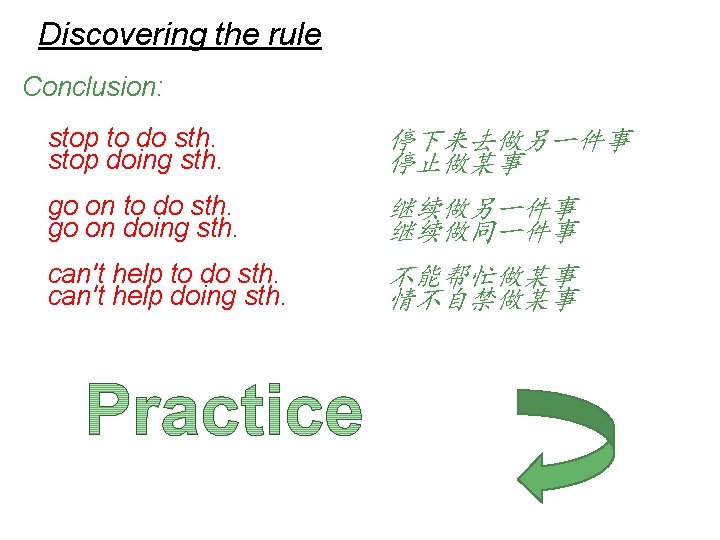
Discovering the rule Conclusion: stop to do sth. stop doing sth. 停下来去做另一件事 停止做某事 go on to do sth. go on doing sth. 继续做另一件事 继续做同一件事 can't help to do sth. can't help doing sth. 不能帮忙做某事 情不自禁做某事
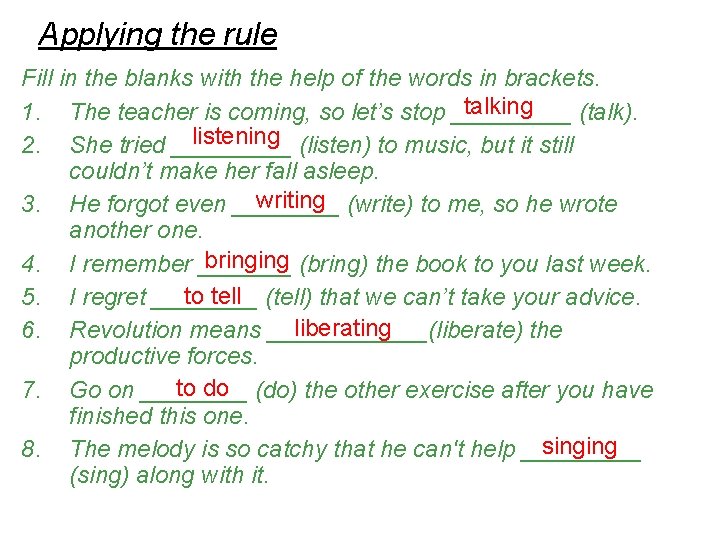
Applying the rule Fill in the blanks with the help of the words in brackets. talking 1. The teacher is coming, so let’s stop _____ (talk). listening (listen) to music, but it still 2. She tried _____ couldn’t make her fall asleep. writing (write) to me, so he wrote 3. He forgot even ____ another one. bringing (bring) the book to you last week. 4. I remember _______ to tell (tell) that we can’t take your advice. 5. I regret ____ liberating 6. Revolution means ______(liberate) the productive forces. to do (do) the other exercise after you have 7. Go on ____ finished this one. singing 8. The melody is so catchy that he can't help _____ (sing) along with it.
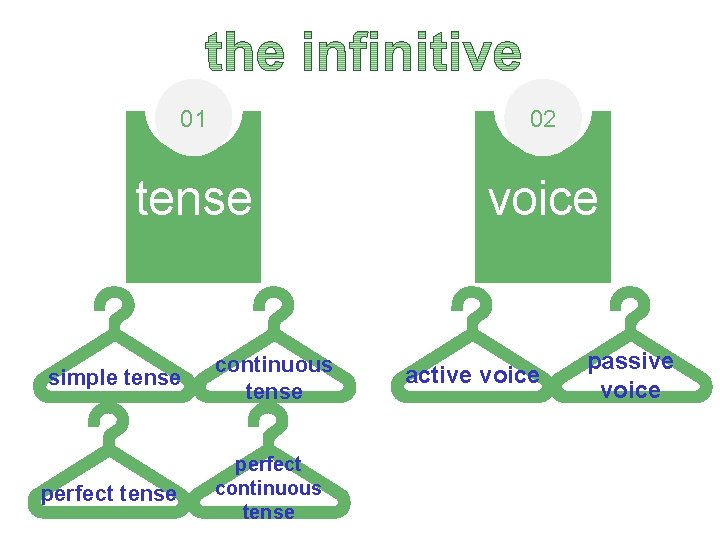
01 02 tense voice simple tense continuous tense perfect continuous tense active voice passive voice
active voice simple tense to do continuous tense perfect tense to be doing perfect continuous tense passive voice to be done ----- to have been to have done to have been doing -----
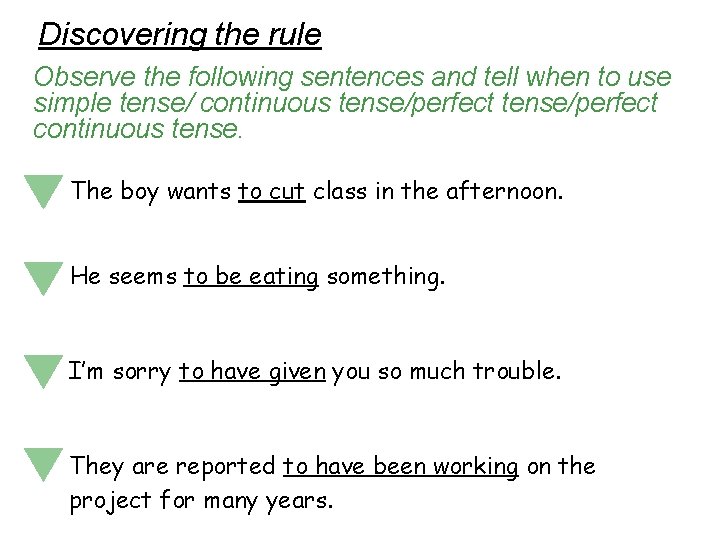
Discovering the rule Observe the following sentences and tell when to use simple tense/ continuous tense/perfect continuous tense. The boy wants to cut class in the afternoon. He seems to be eating something. I’m sorry to have given you so much trouble. They are reported to have been working on the project for many years.
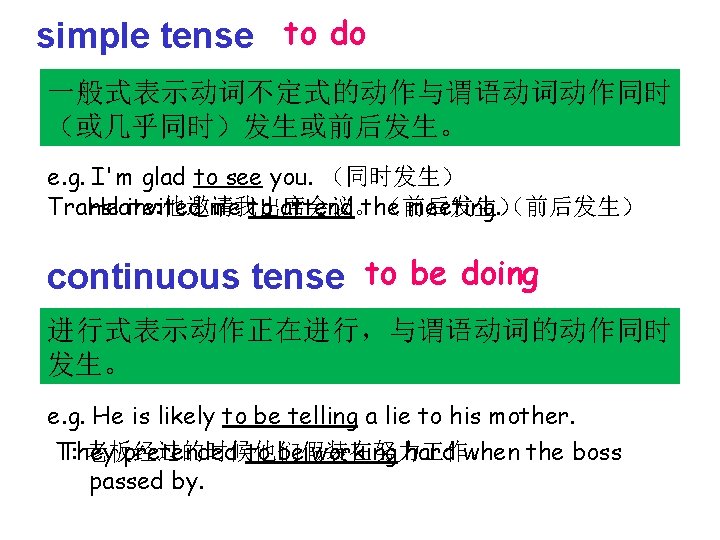
simple tense to do 一般式表示动词不定式的动作与谓语动词动作同时 (或几乎同时)发生或前后发生。 e. g. I'm glad to see you. (同时发生) Translate: 他邀请我出席会议。(前后发生) He invited me to attend the meeting. (前后发生) continuous tense to be doing 进行式表示动作正在进行,与谓语动词的动作同时 发生。 e. g. He is likely to be telling a lie to his mother. T: They 老板经过的时候他们假装在努力 作。 pretended to be working hard when the boss passed by.
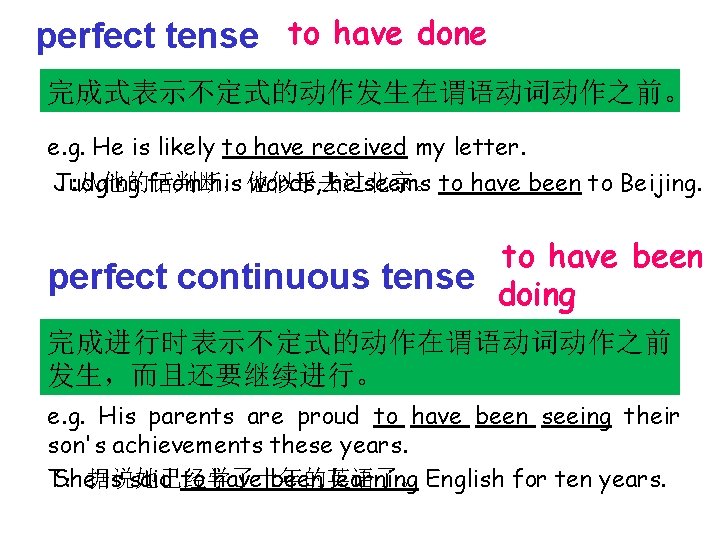
perfect tense to have done 完成式表示不定式的动作发生在谓语动词动作之前。 e. g. He is likely to have received my letter. Judging T: 从他的话判断,他似乎去过北京。 from his words, he seems to have been to Beijing. to have been perfect continuous tense doing 完成进行时表示不定式的动作在谓语动词动作之前 发生,而且还要继续进行。 e. g. His parents are proud to have been seeing their son's achievements these years. T:据说她已经学了十年的英语了。 She is said to have been learning English for ten years.
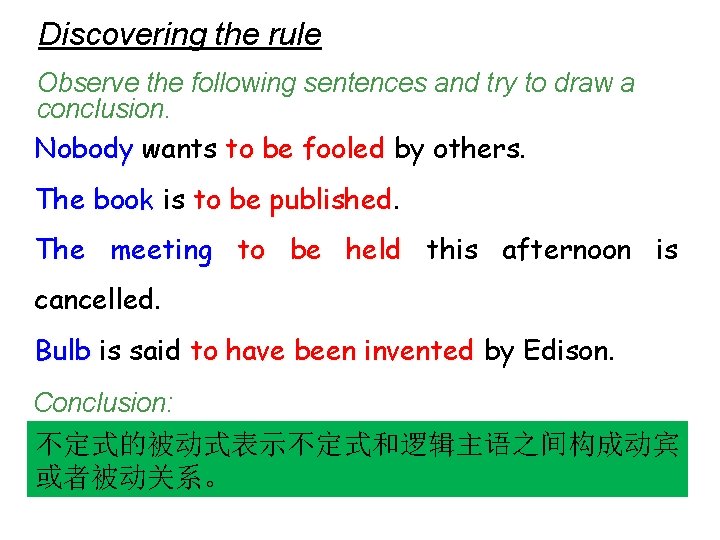
Discovering the rule Observe the following sentences and try to draw a conclusion. Nobody wants to be fooled by others. The book is to be published The meeting to be held this afternoon is cancelled. Bulb is said to have been invented by Edison. Conclusion: 不定式的被动式表示不定式和逻辑主语之间构成动宾 或者被动关系。
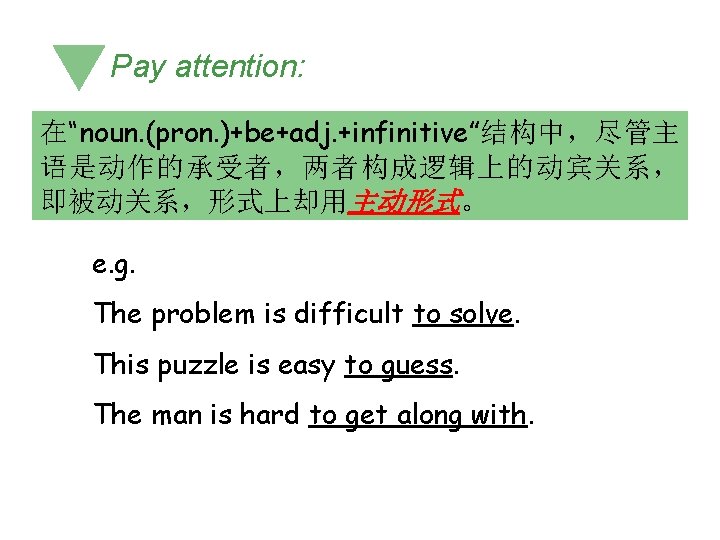
Pay attention: 在“noun. (pron. )+be+adj. +infinitive”结构中,尽管主 语是动作的承受者,两者构成逻辑上的动宾关系, 即被动关系,形式上却用主动形式。 e. g. The problem is difficult to solve. This puzzle is easy to guess. The man is hard to get along with.
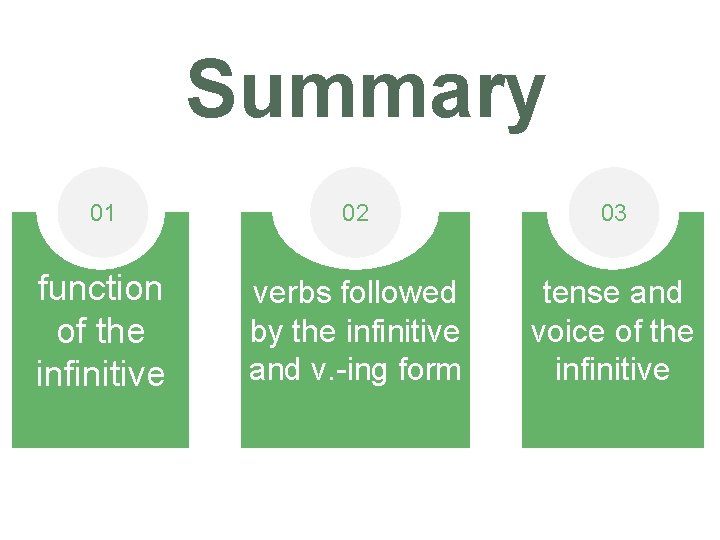
Summary 01 02 03 function of the infinitive verbs followed by the infinitive and v. -ing form tense and voice of the infinitive
2021/2/23 40