Form and function in the morphosyntax of Shilluk

- Slides: 35
Form and function in the morphosyntax of Shilluk transitive verbs Bert Remijsen Otto Gwado Ayoker University of Edinburgh 1
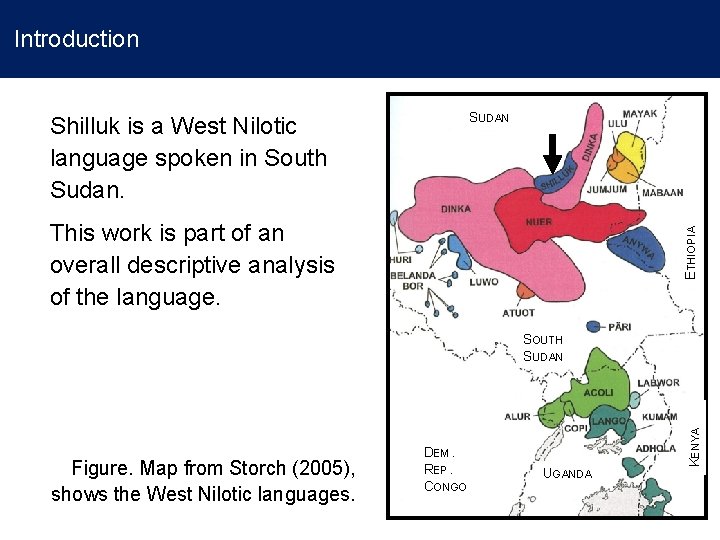
Introduction SUDAN Shilluk is a West Nilotic language spoken in South Sudan. ETHIOPIA This work is part of an overall descriptive analysis of the language. Figure. Map from Storch (2005), shows the West Nilotic languages. DEM. REP. CONGO KENYA SOUTH SUDAN UGANDA 2
Introduction This talk addresses two big questions: • What is the nature of syntactic alignment in Shilluk? Passive? Ergativity? A voice system? • How is the paradigm structured? 3
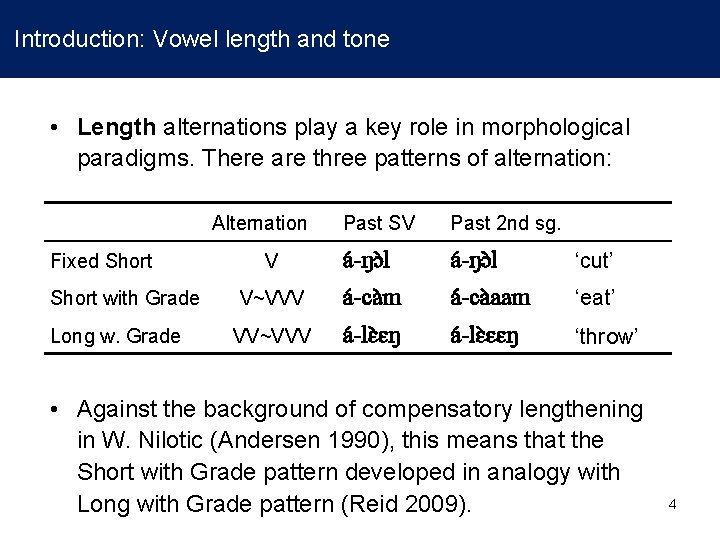
Introduction: Vowel length and tone • Length alternations play a key role in morphological paradigms. There are three patterns of alternation: Alternation Fixed Short with Grade Long w. Grade Past SV Past 2 nd sg. V a -ŋɔ l ‘cut’ V~VVV a -ca m a -ca aam ‘eat’ VV~VVV a -lɛ ɛŋ a -lɛ ɛɛŋ ‘throw’ • Against the background of compensatory lengthening in W. Nilotic (Andersen 1990), this means that the Short with Grade pattern developed in analogy with Long with Grade pattern (Reid 2009). 4
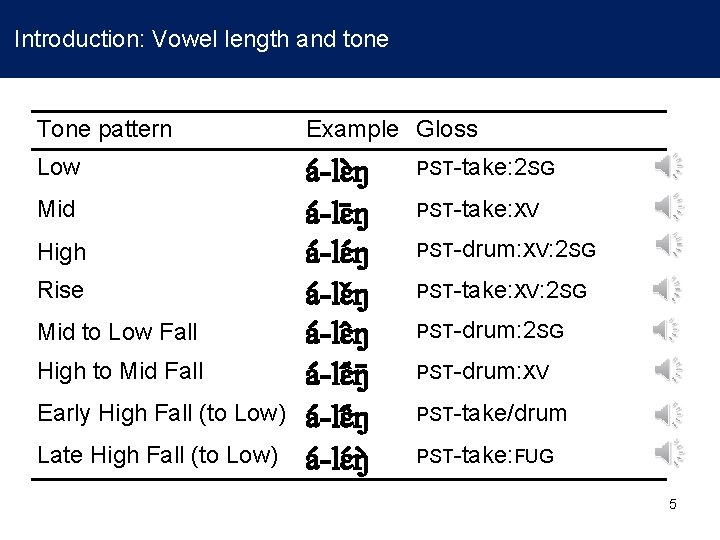
Introduction: Vowel length and tone Tone pattern Example Gloss Low a -lɛ ŋ a -lɛ ŋ Mid High Rise Mid to Low Fall High to Mid Fall Early High Fall (to Low) Late High Fall (to Low) PST-take: 2 SG PST-take: XV PST-drum: XV: 2 SG PST-take: XV: 2 SG PST-drum: XV PST-take/drum PST-take: FUG 5
Syntactic alignment in Shilluk 6
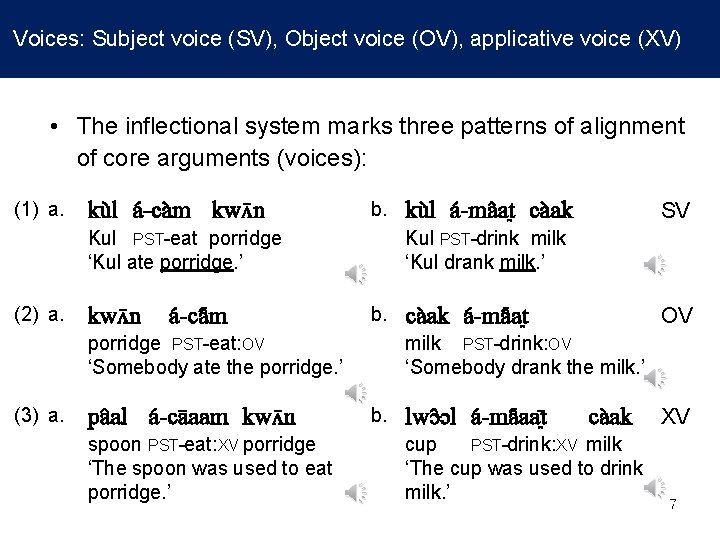
Voices: Subject voice (SV), Object voice (OV), applicative voice (XV) • The inflectional system marks three patterns of alignment of core arguments (voices): (1) a. ku l a -ca m kwʌ n b. Kul PST-eat porridge ‘Kul ate porridge. ’ (2) a. a -ca m pa al a -ca aam kwʌ n spoon PST-eat: XV porridge ‘The spoon was used to eat porridge. ’ SV ca ak a -ma at OV Kul PST-drink milk ‘Kul drank milk. ’ porridge PST-eat: OV ‘Somebody ate the porridge. ’ (3) a. ku l a -ma at ca ak milk PST-drink: OV ‘Somebody drank the milk. ’ b. lwɔ ɔl a -ma aat ca ak cup PST-drink: XV milk ‘The cup was used to drink milk. ’ XV 7
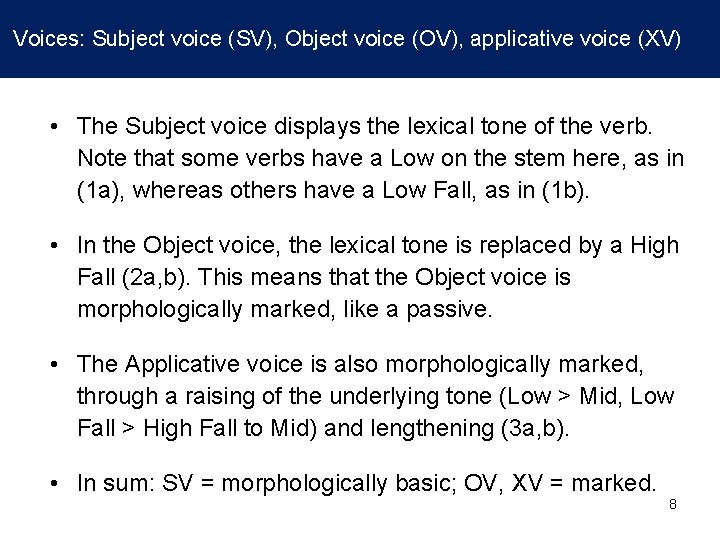
Voices: Subject voice (SV), Object voice (OV), applicative voice (XV) • The Subject voice displays the lexical tone of the verb. Note that some verbs have a Low on the stem here, as in (1 a), whereas others have a Low Fall, as in (1 b). • In the Object voice, the lexical tone is replaced by a High Fall (2 a, b). This means that the Object voice is morphologically marked, like a passive. • The Applicative voice is also morphologically marked, through a raising of the underlying tone (Low > Mid, Low Fall > High Fall to Mid) and lengthening (3 a, b). • In sum: SV = morphologically basic; OV, XV = marked. 8
Object voice (OV) is unmarked in an information-structural sense • While the Subject voice is unmarked in form, the Object voice is unmarked in function. The following two slides present two pieces of evidence, the first from elicited data, the second from a narrative. 9
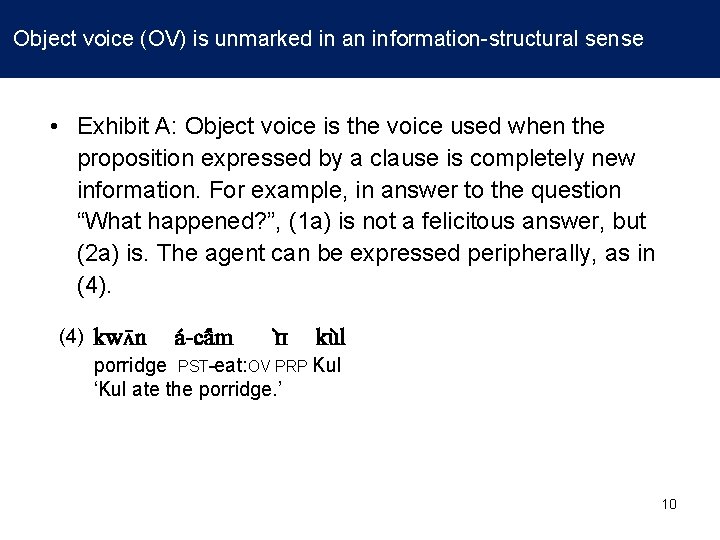
Object voice (OV) is unmarked in an information-structural sense • Exhibit A: Object voice is the voice used when the proposition expressed by a clause is completely new information. For example, in answer to the question “What happened? ”, (1 a) is not a felicitous answer, but (2 a) is. The agent can be expressed peripherally, as in (4) kwʌ n a -ca m ɪ ɪ ku l porridge PST-eat: OV PRP Kul ‘Kul ate the porridge. ’ 10
Object voice (OV) is unmarked in an information-structural sense • Exhibit B (from narrative). The first clause in (5) sets up Chol and Bol as a topic, continued in the second clause, which is reciprocal, i. e. , the topic is both subject and object. Discourse structure does not privilege either, and the unmarked constituent order is revealed: Object voice. (5) cʊ ʊl gɛ -kɪ bʊ ʊl a -be eet ga a mʌ ʌʌt ke eer a a -pi iit -gɛ n Chol PR 3 P-PRP Bol PST-stay 3 P: NCP friend: P since REL PST-grow. up-3 P ‘Chol and Bol were friends from childhood. ’ rɪ ɪ-gɛ n ma ar ɪ ɪ gɛ n kɪ mɛ n dwɔ ɔŋ REFL-PR 3 P love: OV PRP: P PR 3 P PRP IDP. Sbig ‘They love each other greatly. ’ 11
The ergativity hypothesis (Miller & Gilley 2001) 12
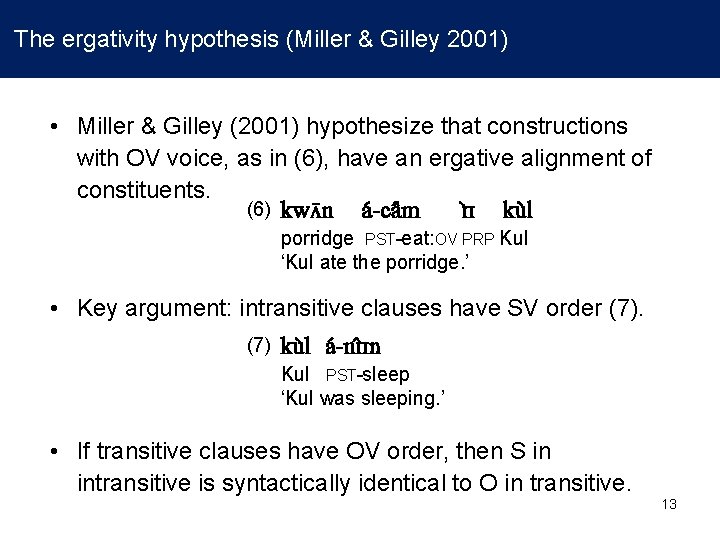
The ergativity hypothesis (Miller & Gilley 2001) • Miller & Gilley (2001) hypothesize that constructions with OV voice, as in (6), have an ergative alignment of constituents. (6) kwʌ n a -ca m ɪ ɪ ku l porridge PST-eat: OV PRP Kul ‘Kul ate the porridge. ’ • Key argument: intransitive clauses have SV order (7) ku l a -nɪ ɪn Kul PST-sleep ‘Kul was sleeping. ’ • If transitive clauses have OV order, then S in intransitive is syntactically identical to O in transitive. 13
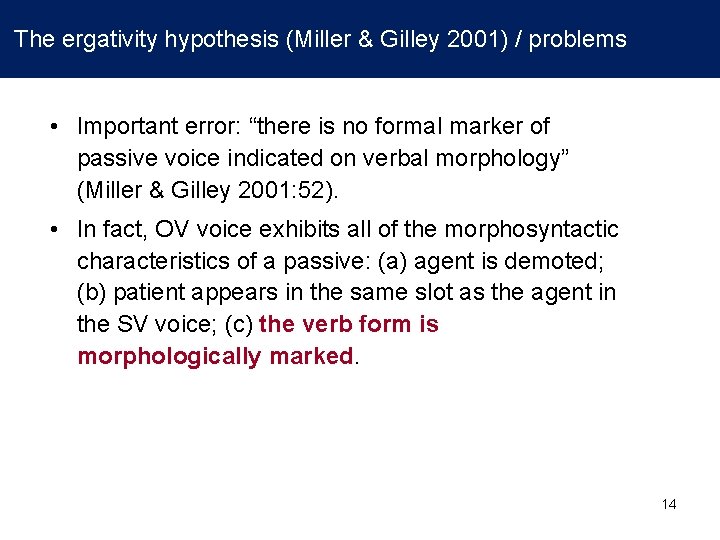
The ergativity hypothesis (Miller & Gilley 2001) / problems • Important error: “there is no formal marker of passive voice indicated on verbal morphology” (Miller & Gilley 2001: 52). • In fact, OV voice exhibits all of the morphosyntactic characteristics of a passive: (a) agent is demoted; (b) patient appears in the same slot as the agent in the SV voice; (c) the verb form is morphologically marked. 14
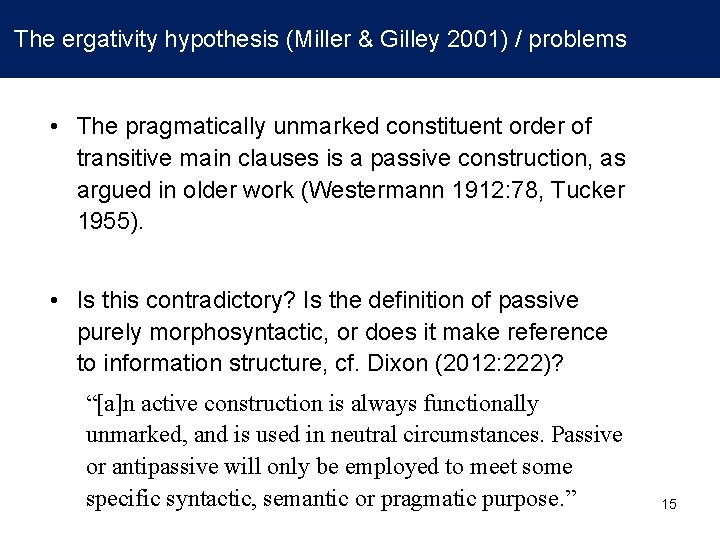
The ergativity hypothesis (Miller & Gilley 2001) / problems • The pragmatically unmarked constituent order of transitive main clauses is a passive construction, as argued in older work (Westermann 1912: 78, Tucker 1955). • Is this contradictory? Is the definition of passive purely morphosyntactic, or does it make reference to information structure, cf. Dixon (2012: 222)? “[a]n active construction is always functionally unmarked, and is used in neutral circumstances. Passive or antipassive will only be employed to meet some specific syntactic, semantic or pragmatic purpose. ” 15
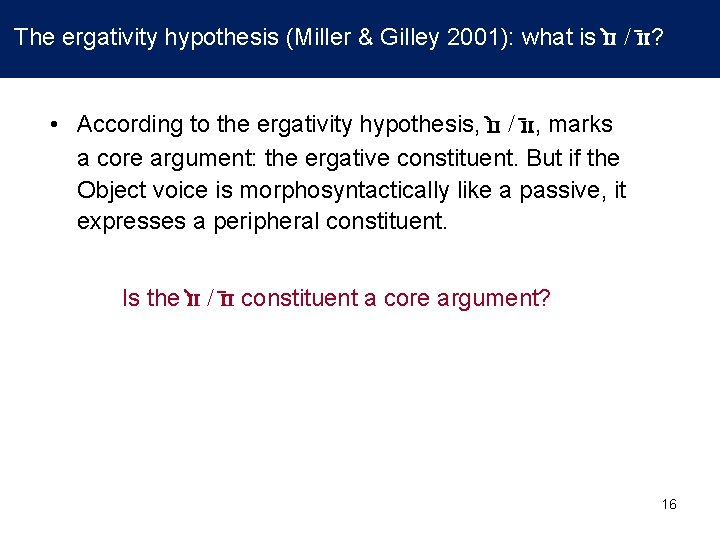
The ergativity hypothesis (Miller & Gilley 2001): what is ɪ ɪ / ɪ ɪ? • According to the ergativity hypothesis, ɪ ɪ / ɪ ɪ, marks a core argument: the ergative constituent. But if the Object voice is morphosyntactically like a passive, it expresses a peripheral constituent. Is the ɪ ɪ / ɪ ɪ constituent a core argument? 16
Evidence that ɪ ɪ / ɪ ɪ is peripheral: the distribution of {-ɔ} 17
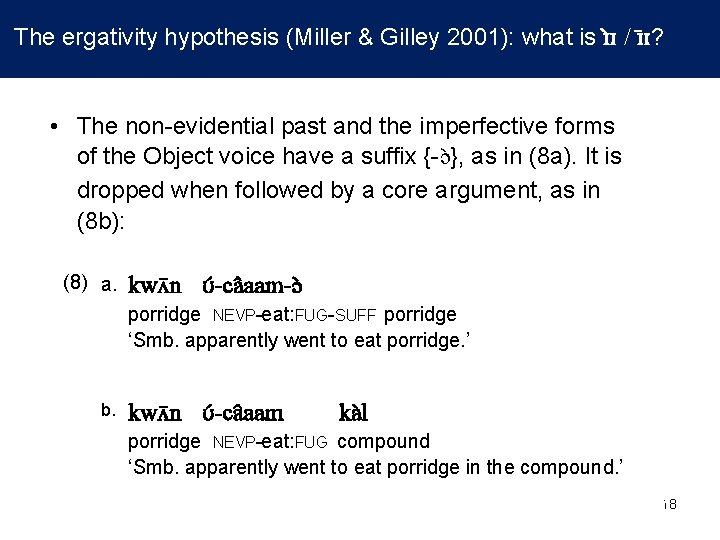
The ergativity hypothesis (Miller & Gilley 2001): what is ɪ ɪ / ɪ ɪ? • The non-evidential past and the imperfective forms of the Object voice have a suffix {-ɔ }, as in (8 a). It is dropped when followed by a core argument, as in (8 b): (8) a. kwʌ n ʊ -ca aam-ɔ porridge NEVP-eat: FUG-SUFF porridge ‘Smb. apparently went to eat porridge. ’ b. kwʌ n ʊ -ca aam ka l porridge NEVP-eat: FUG compound ‘Smb. apparently went to eat porridge in the compound. ’ 18
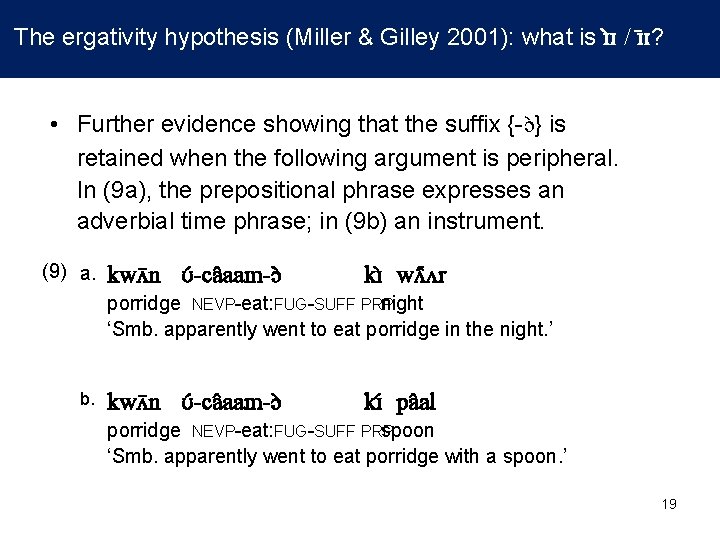
The ergativity hypothesis (Miller & Gilley 2001): what is ɪ ɪ / ɪ ɪ? • Further evidence showing that the suffix {-ɔ } is retained when the following argument is peripheral. In (9 a), the prepositional phrase expresses an adverbial time phrase; in (9 b) an instrument. (9) a. kwʌ n ʊ -ca aam-ɔ kɪ wʌ ʌr porridge NEVP-eat: FUG-SUFF PRP night ‘Smb. apparently went to eat porridge in the night. ’ b. kwʌ n ʊ -ca aam-ɔ kɪ pa al porridge NEVP-eat: FUG-SUFF PRP spoon ‘Smb. apparently went to eat porridge with a spoon. ’ 19
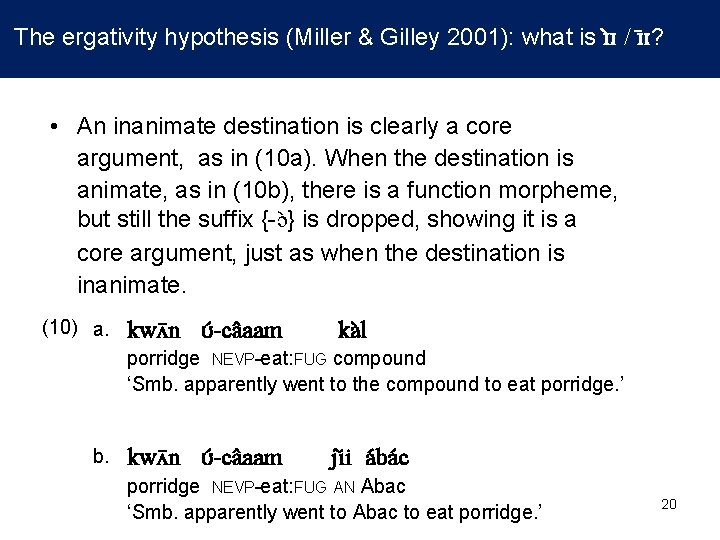
The ergativity hypothesis (Miller & Gilley 2001): what is ɪ ɪ / ɪ ɪ? • An inanimate destination is clearly a core argument, as in (10 a). When the destination is animate, as in (10 b), there is a function morpheme, but still the suffix {-ɔ } is dropped, showing it is a core argument, just as when the destination is inanimate. (10) a. kwʌ n ʊ -ca aam ka l porridge NEVP-eat: FUG compound ‘Smb. apparently went to the compound to eat porridge. ’ b. kwʌ n ʊ -ca aam ji i a ba c porridge NEVP-eat: FUG AN Abac ‘Smb. apparently went to Abac to eat porridge. ’ 20
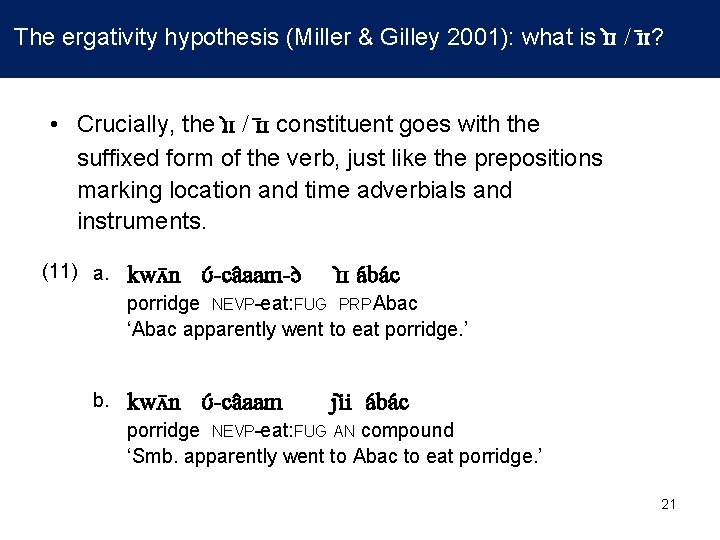
The ergativity hypothesis (Miller & Gilley 2001): what is ɪ ɪ / ɪ ɪ? • Crucially, the ɪ ɪ / ɪ ɪ constituent goes with the suffixed form of the verb, just like the prepositions marking location and time adverbials and instruments. (11) a. kwʌ n ʊ -ca aam-ɔ ɪ ɪ a ba c porridge NEVP-eat: FUG PRP Abac ‘Abac apparently went to eat porridge. ’ b. kwʌ n ʊ -ca aam ji i a ba c porridge NEVP-eat: FUG AN compound ‘Smb. apparently went to Abac to eat porridge. ’ 21
Evidence that ɪ ɪ / ɪ ɪ is peripheral: WHQ using dɛ 22
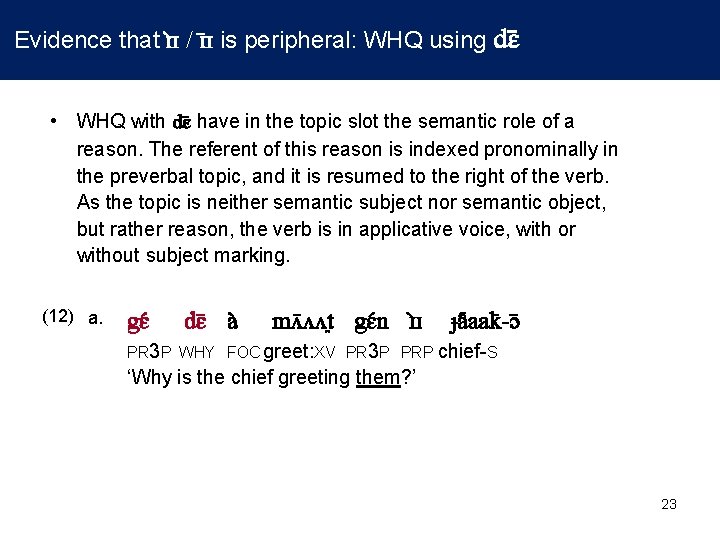
Evidence that ɪ ɪ / ɪ ɪ is peripheral: WHQ using dɛ • WHQ with dɛ have in the topic slot the semantic role of a reason. The referent of this reason is indexed pronominally in the preverbal topic, and it is resumed to the right of the verb. As the topic is neither semantic subject nor semantic object, but rather reason, the verb is in applicative voice, with or without subject marking. (12) a. gɛ dɛ a mʌ ʌʌt gɛ n ɪ ɪ ɟa aak -ɔ PR 3 P WHY FOC greet: XV PR 3 P PRP chief-S ‘Why is the chief greeting them? ’ 23
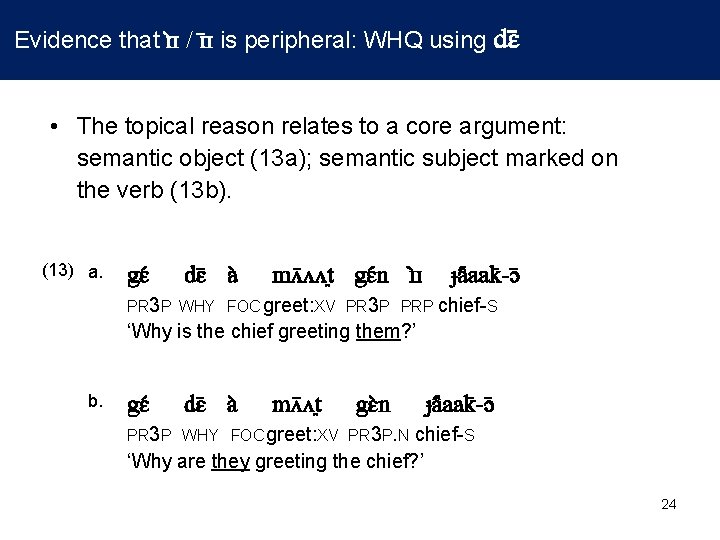
Evidence that ɪ ɪ / ɪ ɪ is peripheral: WHQ using dɛ • The topical reason relates to a core argument: semantic object (13 a); semantic subject marked on the verb (13 b). (13) a. gɛ dɛ a mʌ ʌʌt gɛ n ɪ ɪ ɟa aak -ɔ PR 3 P WHY FOC greet: XV PR 3 P PRP chief-S ‘Why is the chief greeting them? ’ b. gɛ dɛ a mʌ ʌt gɛ n ɟa aak -ɔ PR 3 P WHY FOC greet: XV PR 3 P. N chief-S ‘Why are they greeting the chief? ’ 24
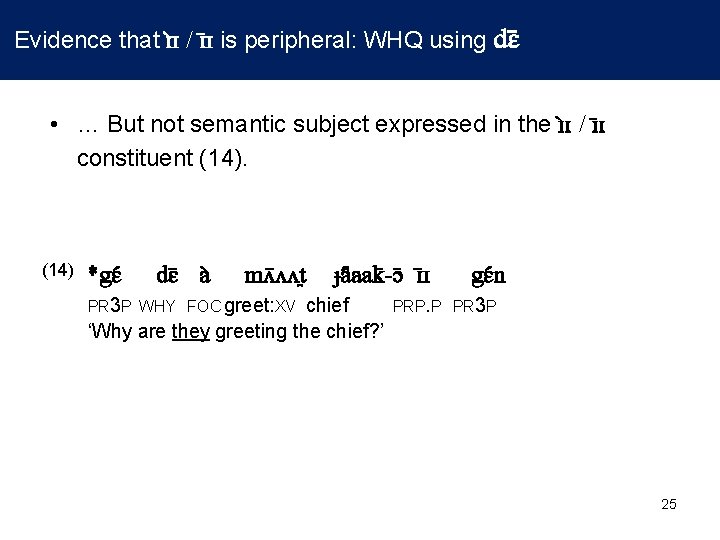
Evidence that ɪ ɪ / ɪ ɪ is peripheral: WHQ using dɛ • … But not semantic subject expressed in the ɪ ɪ / ɪ ɪ constituent (14) *gɛ dɛ a mʌ ʌʌt ɟa aak -ɔ ɪ ɪ gɛ n PR 3 P WHY FOC greet: XV chief PRP. P PR 3 P ‘Why are they greeting the chief? ’ 25
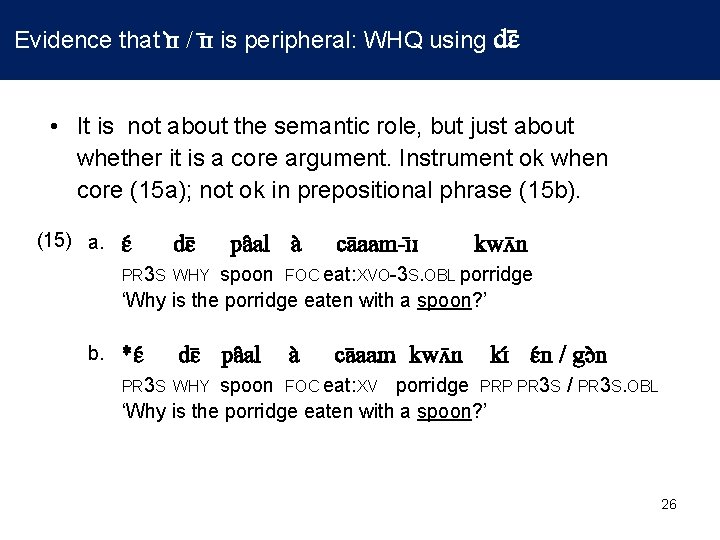
Evidence that ɪ ɪ / ɪ ɪ is peripheral: WHQ using dɛ • It is not about the semantic role, but just about whether it is a core argument. Instrument ok when core (15 a); not ok in prepositional phrase (15 b). (15) a. ɛ dɛ pa al a ca aam-ɪ ɪ kwʌ n PR 3 S WHY spoon FOC eat: XVO-3 S. OBL porridge ‘Why is the porridge eaten with a spoon? ’ b. *ɛ dɛ pa al a ca aam kwʌ n kɪ ɛ n / gɔ n PR 3 S WHY spoon FOC eat: XV porridge PRP PR 3 S / PR 3 S. OBL ‘Why is the porridge eaten with a spoon? ’ 26
What is the structure of the paradigm of Shilluk transitive verbs? 27
What is the structure of the paradigm of Shilluk transitive verbs? • In earlier work, I have approached the applicative voice (XV) on a part with benefactive and centrifugal (Remijsen, Miller-Naudé & Gilley 2016). • I now believe this is not the optimal analysis. Instead I will argue that applicative is inflectional, whereas benefactive and centrifugal are derivational. 28
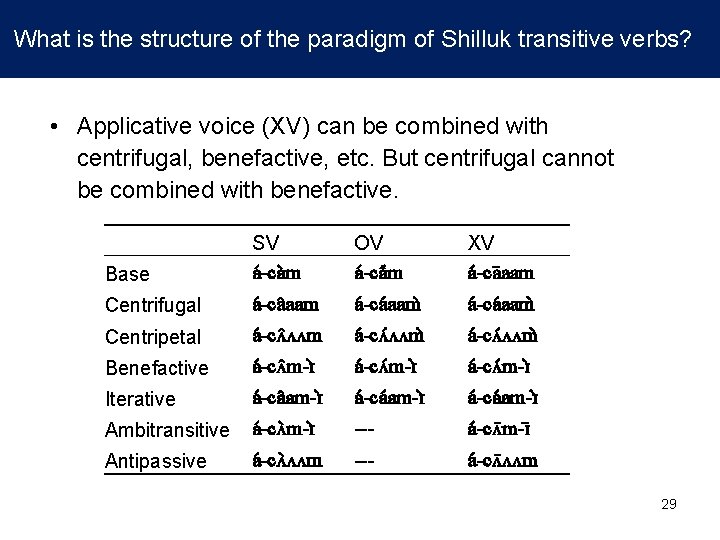
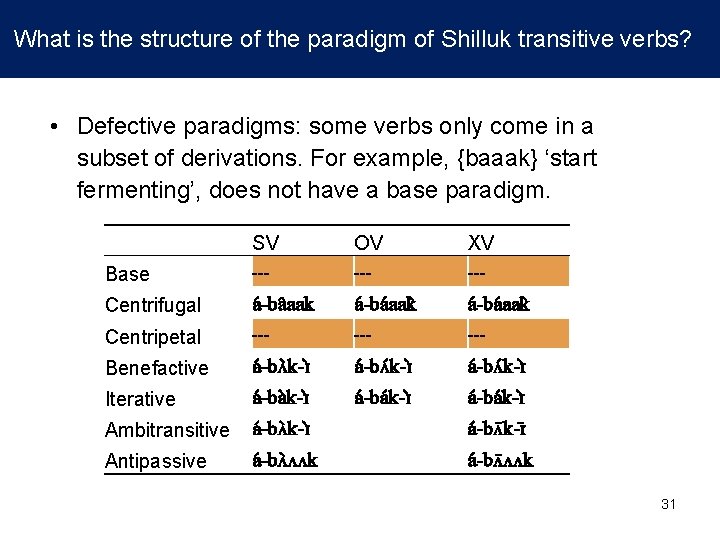
What is the structure of the paradigm of Shilluk transitive verbs? • Applicative voice (XV) can be combined with centrifugal, benefactive, etc. But centrifugal cannot be combined with benefactive. Base SV a -ca m OV a -ca m XV a -ca aam Centrifugal a -ca aam Centripetal a -cʌ ʌʌm Benefactive a -cʌ m-ɪ Iterative a -ca am-ɪ Ambitransitive a -cʌ m-ɪ --- a -cʌ m-ɪ Antipassive a -cʌ ʌʌm --- a -cʌ ʌʌm 29
What is the structure of the paradigm of Shilluk transitive verbs? • Inflection can be defined, in a language-internal way, as the part of the morphological paradigm that recurs across derivations. • A derivation may be missing: but for any derivation that exists, there will be 3 voices, a set of TAM forms, 2 subject-marked forms, and an infinitive nominalization. 30
What is the structure of the paradigm of Shilluk transitive verbs? • Defective paradigms: some verbs only come in a subset of derivations. For example, {baaak} ‘start fermenting’, does not have a base paradigm. SV OV XV Base --- --- Centrifugal a -ba aak Centripetal --- --- Benefactive a -bʌ k-ɪ Iterative a -ba k-ɪ Ambitransitive a -bʌ k-ɪ Antipassive a -bʌ ʌʌk 31
Bibliography Andersen, T. (1990). Vowel length in Western Nilotic languages. Acta Linguistica Hafniensia 22, 5 -26. Dixon, R. M. W. (2012). Basic Linguistic Theory. Oxford University Press. Miller, C. L. & L. G. Gilley (2001). Evidence for ergativity in Shilluk. Journal of African Languages and Linguistics, 22, 33 -68. Reid, T. (2009). Suprasegmentals in Shilluk nominal morphophonology. Undergraduate dissertation University of Edinburgh. Remijsen, B. , C. L. Miller-Naude & L. G. Gilley (2016). The morphology of Shilluk transitive verbs. Journal of African Languages and Lingusitics 37, 201 -245. Storch, A. (2005). The Noun Morphology of Western Nilotic. Nilo. Saharan vol. 21. Cologne: Rüdiger Köppe Verlag. 32
Acknowledgements: • SIL International, for enabling our research in South Sudan. • The Leverhulme Trust, for research funding through the project “A descriptive analysis of the Shilluk language” (RPG-2015 -055). 33
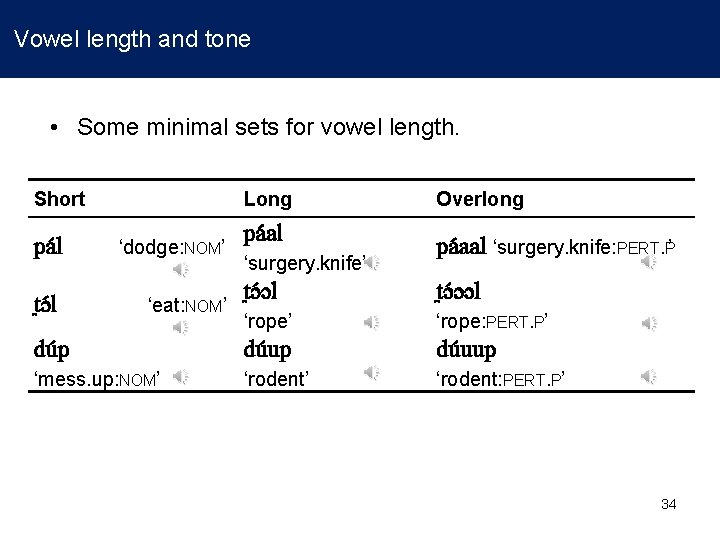
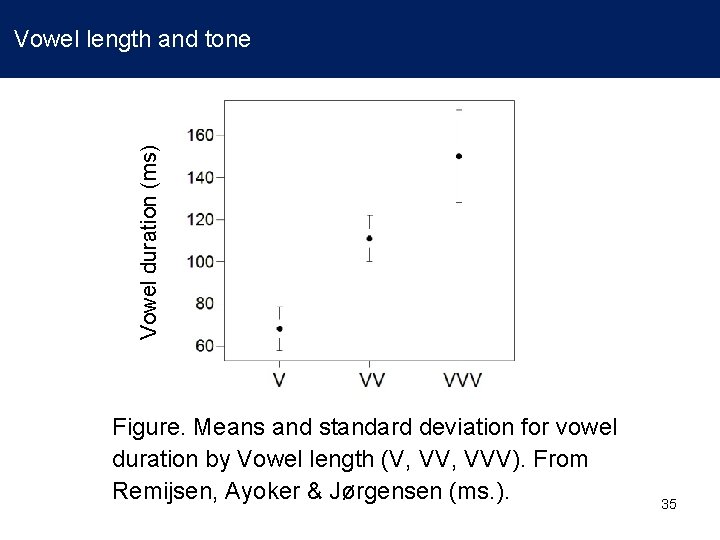
Vowel length and tone • Some minimal sets for vowel length. Short Long pa l ‘dodge: NOM’ t ɔ l ‘eat: NOM’ du p ‘mess. up: NOM’ pa al ‘surgery. knife’ Overlong pa aal ‘surgery. knife: PERT. P’ t ɔ ɔl t ɔ ɔɔl ‘rope’ ‘rope: PERT. P’ du uup ‘rodent: PERT. P’ du up ‘rodent’ 34
Vowel duration (ms) Vowel length and tone Figure. Means and standard deviation for vowel duration by Vowel length (V, VVV). From Remijsen, Ayoker & Jørgensen (ms. ). 35