DISASTER RISK INSURANCE For the Microfinance Sector PAKISTAN

- Slides: 65
DISASTER RISK INSURANCE For the Microfinance Sector PAKISTAN OCTOBER 5 T H 2017. SERENA HOTEL, ISLAMABAD.
Official Welcome Dr. Antonis Malagardis Program Director GIZ RFPI-II 2
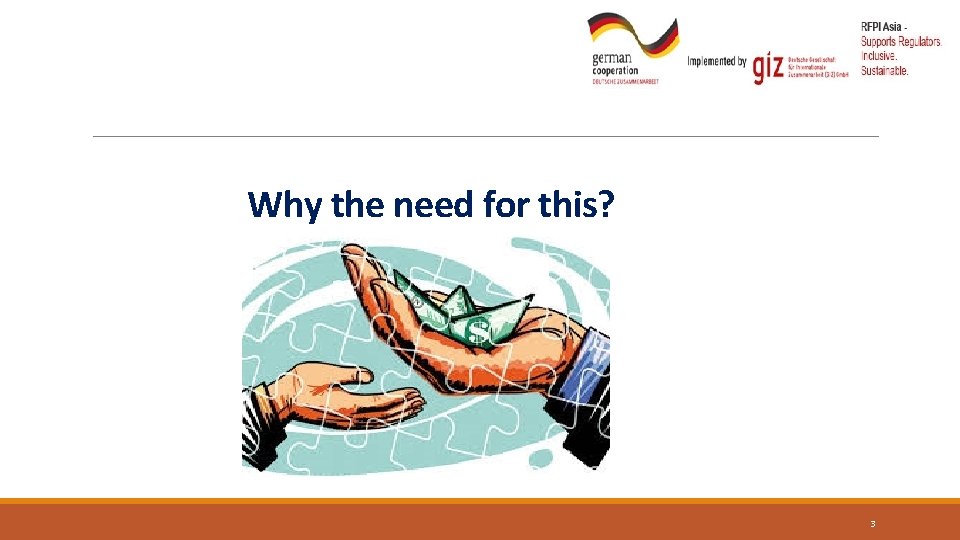
Why the need for this? 3
The Agenda 4
Lieutenant General Omar Mahmood Hayat HI(M) Chairman National Disaster Management Authority 5
Mr. Fida Hussain Samoo Commissioner (Insurance) Securities & Exchange Commission of Pakistan 6
Mr. Yasir Ashfaq Chief Executive Officer Pakistan Microfinance Investment Company 7
Mr. Ali Basharat representing Chief Executive Officer Pakistan Microfinance Network 8
The Toolkit q Aims to promote Natural Catastrophe (Nat. Cat) insurance for micro, small and medium-sized enterprises (MSMEs) q Support governments and policy makers in integrating the insurance concept in their disaster risk management (DRM) strategies q Help insurers with insights to develop suitable insurance products q Highlights Public-Private Partnerships (PPPs) for inclusive insurance markets 10
Our understanding 1. Nat. Cat events continue to be challenging for the governments 2. Decentralisation approach accentuates the challenges of coordinated implementation of strategies that have been developed 3. Ex-ante data availability is a challenge 4. Database is scattered across different ministries and institutions 5. Scientific and quantifiable national hazard map data is limited 6. Opportunities exist for insurers and reinsurers to participate in strengthening the national disaster risk strategy. 11
Microfinance & Insurance Sectors in Pakistan 12
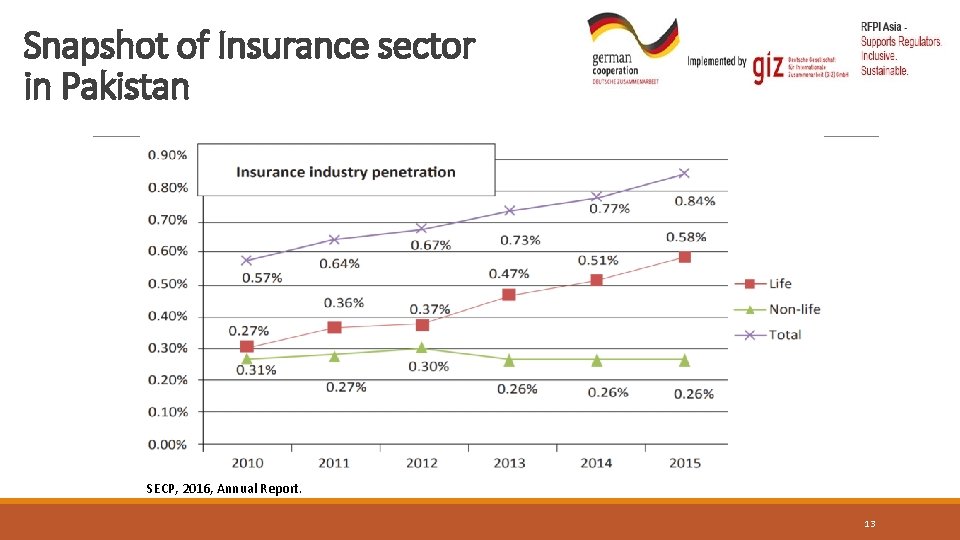
Snapshot of Insurance sector in Pakistan SECP, 2016, Annual Report. 13
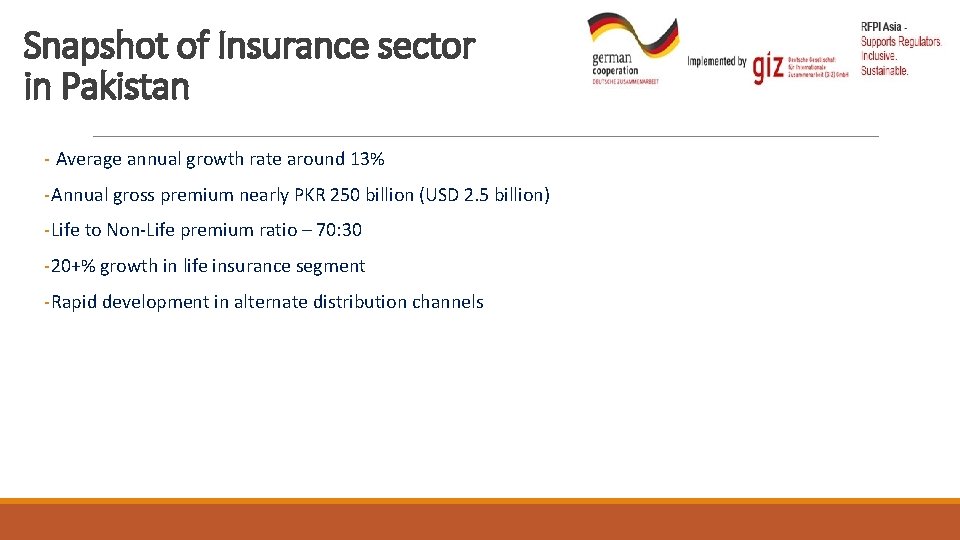
Snapshot of Insurance sector in Pakistan - Average annual growth rate around 13% - Annual gross premium nearly PKR 250 billion (USD 2. 5 billion) - Life to Non-Life premium ratio – 70: 30 - 20+% growth in life insurance segment - Rapid development in alternate distribution channels
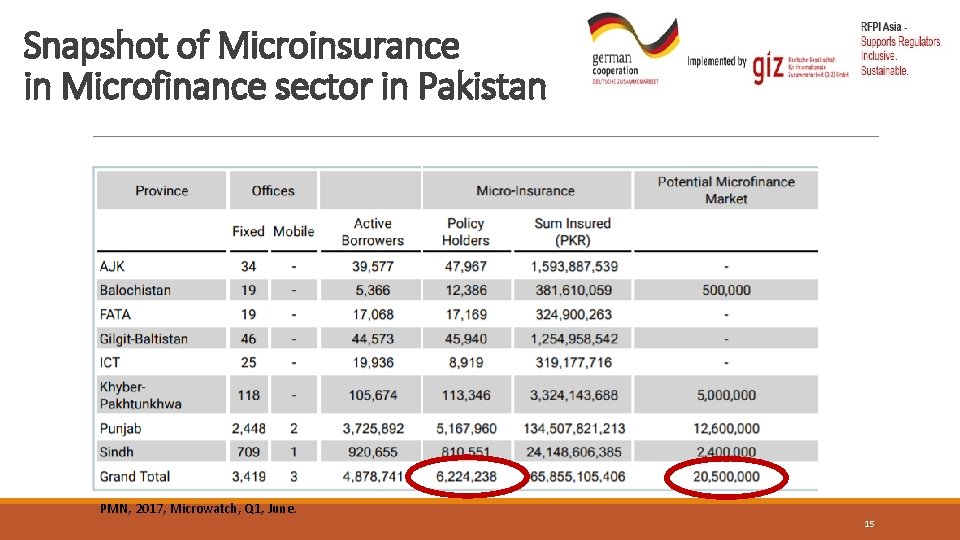
Snapshot of Microinsurance in Microfinance sector in Pakistan PMN, 2017, Microwatch, Q 1, June. 15
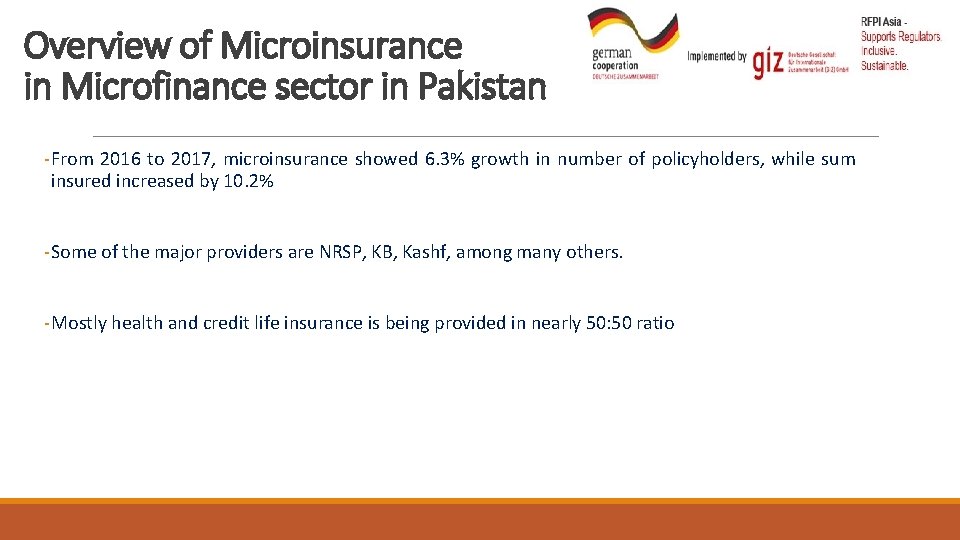
Overview of Microinsurance in Microfinance sector in Pakistan - From 2016 to 2017, microinsurance showed 6. 3% growth in number of policyholders, while sum insured increased by 10. 2% - Some of the major providers are NRSP, KB, Kashf, among many others. - Mostly health and credit life insurance is being provided in nearly 50: 50 ratio
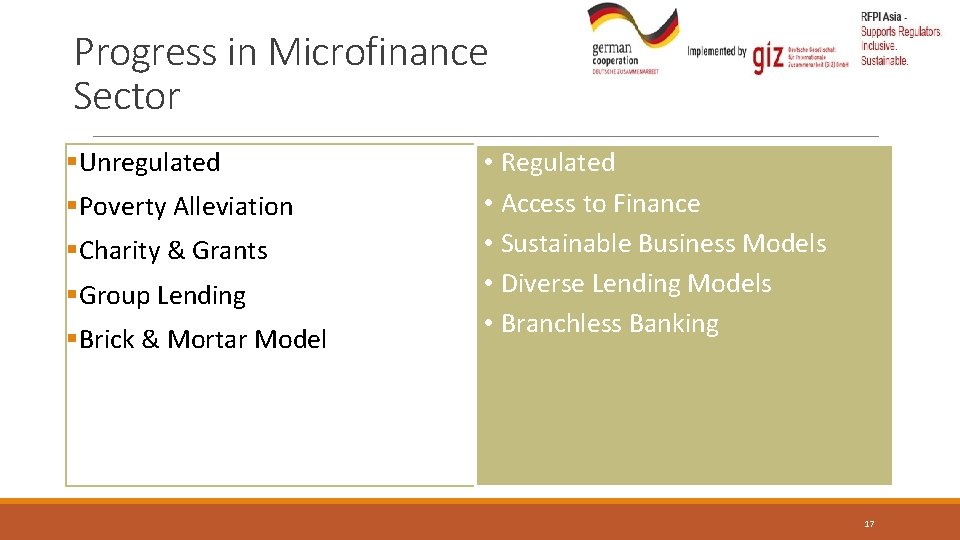
Progress in Microfinance Sector §Unregulated §Poverty Alleviation §Charity & Grants §Group Lending §Brick & Mortar Model • Regulated • Access to Finance • Sustainable Business Models • Diverse Lending Models • Branchless Banking 17
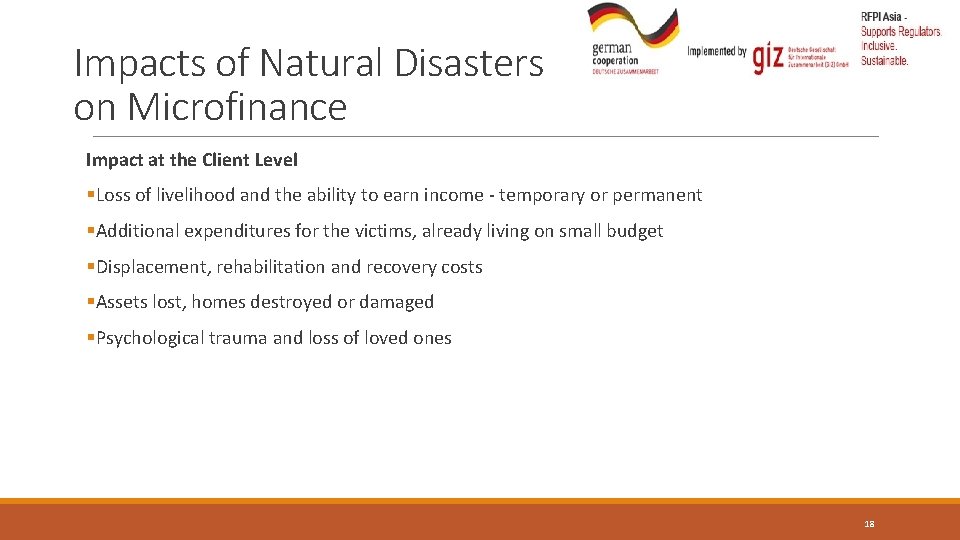
Impacts of Natural Disasters on Microfinance Impact at the Client Level §Loss of livelihood and the ability to earn income - temporary or permanent §Additional expenditures for the victims, already living on small budget §Displacement, rehabilitation and recovery costs §Assets lost, homes destroyed or damaged §Psychological trauma and loss of loved ones 18
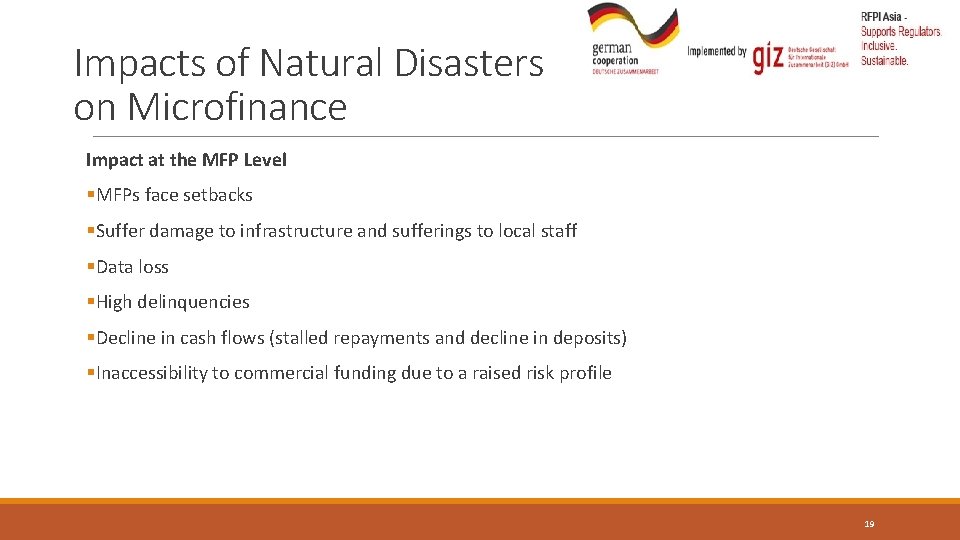
Impacts of Natural Disasters on Microfinance Impact at the MFP Level §MFPs face setbacks §Suffer damage to infrastructure and sufferings to local staff §Data loss §High delinquencies §Decline in cash flows (stalled repayments and decline in deposits) §Inaccessibility to commercial funding due to a raised risk profile 19
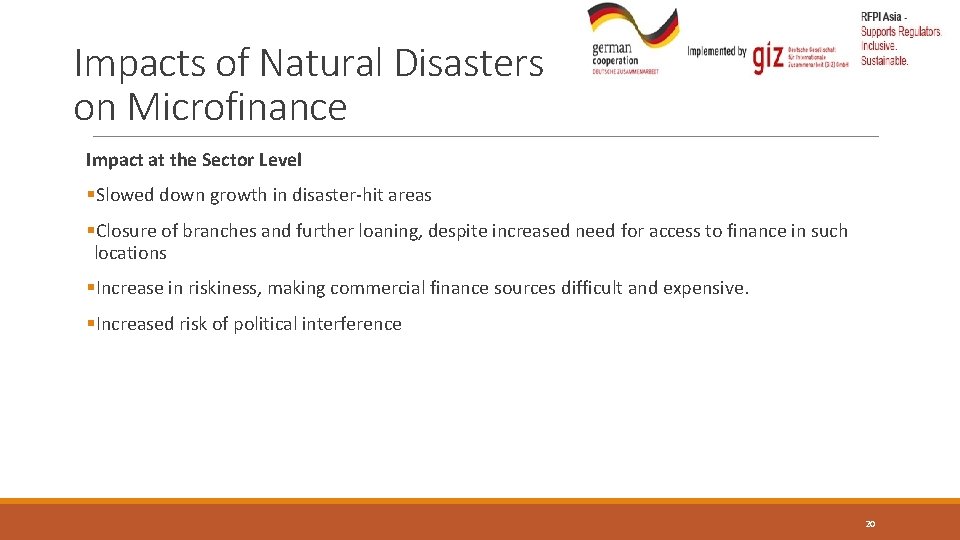
Impacts of Natural Disasters on Microfinance Impact at the Sector Level §Slowed down growth in disaster-hit areas §Closure of branches and further loaning, despite increased need for access to finance in such locations §Increase in riskiness, making commercial finance sources difficult and expensive. §Increased risk of political interference 20
What can be done? Institutional Level §Higher equity levels §Portfolio diversification §Geographical diversification §Disaster risk reduction and preparedness 21
What can be done? Sector Level §Disaster risk reduction §Disaster risk fund §Insurance solutions §Other options (like Disaster Loan Fund) 22
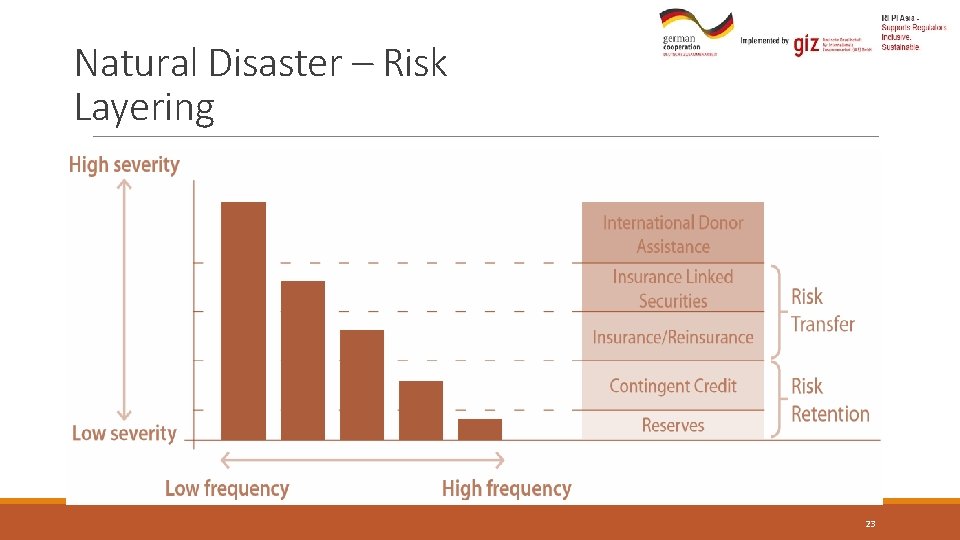
Natural Disaster – Risk Layering 23
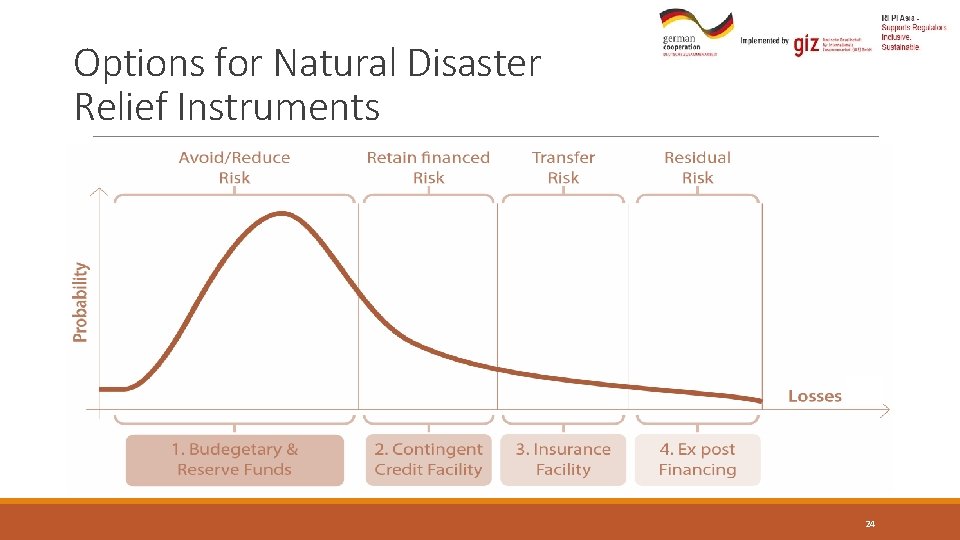
Options for Natural Disaster Relief Instruments 24
Role of Insurance in DRF and DRM What is Disaster Risk Financing (DRF)? Application of financial instruments as part of a systematic approach to managing disasters in order to anticipate, plan for, reduce, transfer, and respond to natural hazard events. 25
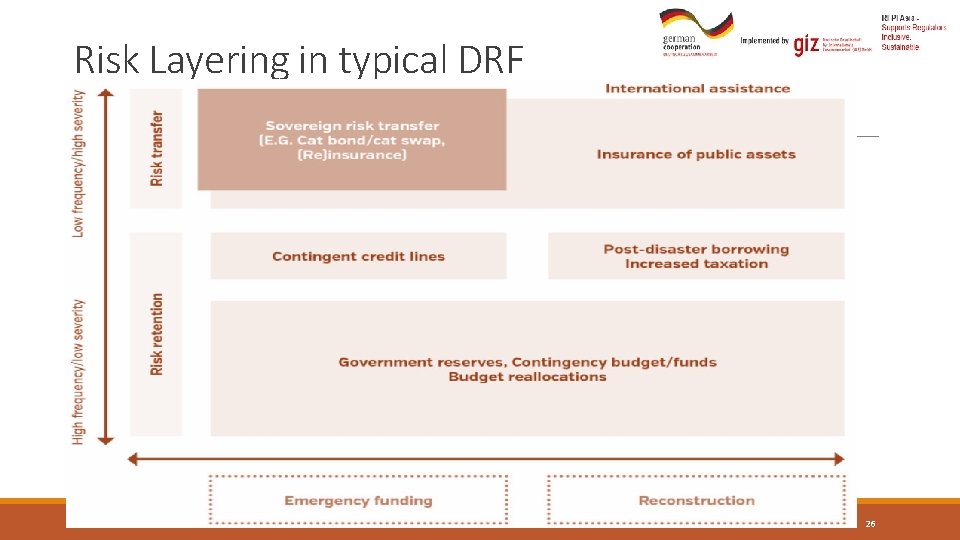
Risk Layering in typical DRF 26
Risk Layering in typical DRF Retention Assuming and managing disaster losses through own resources—e. g. , reserves, pre-disaster reallocations, or borrowing. Transferring potential future disaster losses to financial or insurance markets by paying a premium—e. g. , through traditional insurance/reinsurance. 27
Challenges 1. Regulatory Framework 2. Product Development 3. Private Sector Participation 4. Financial Literacy 5. Consumer Protection 28
National Disaster Risk Management Landscape The National Disaster Management Commission (NDMC) and the National Disaster Management Authority (NDMA). The Disaster Management Authorities (DMAs) and Provincial Disaster Risk Management (PDMAs). These groups need to strengthen collaboration to enhance a comprehensive disaster risk model. 29
Risk Assessment §Sector level risk assessment §Collection of data on hazards, vulnerabilities, losses and the potential impact of disasters §Segregation of risks in categories: § Prevention and reduction § Mitigation § Risk transfer §Decision-making and capacity building §Awareness of risks and potential action. 32
Risk Assessment §Sector level risk assessment §Collection of data on hazards, vulnerabilities, losses and the potential impact of disasters §Segregation of risks in categories: § Prevention and reduction § Mitigation § Risk transfer §Decision-making and capacity building §Awareness of risks and potential action. 33
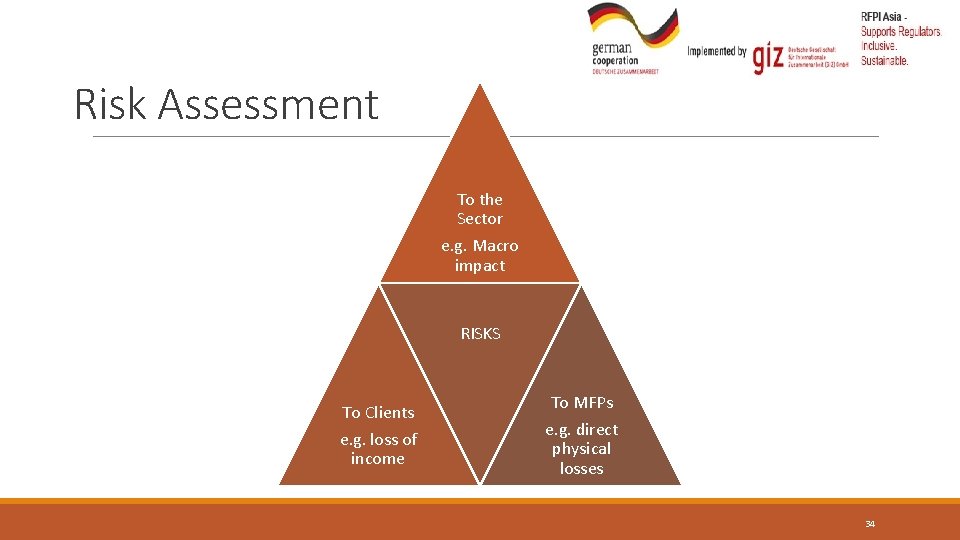
Risk Assessment To the Sector e. g. Macro impact RISKS To Clients e. g. loss of income To MFPs e. g. direct physical losses 34
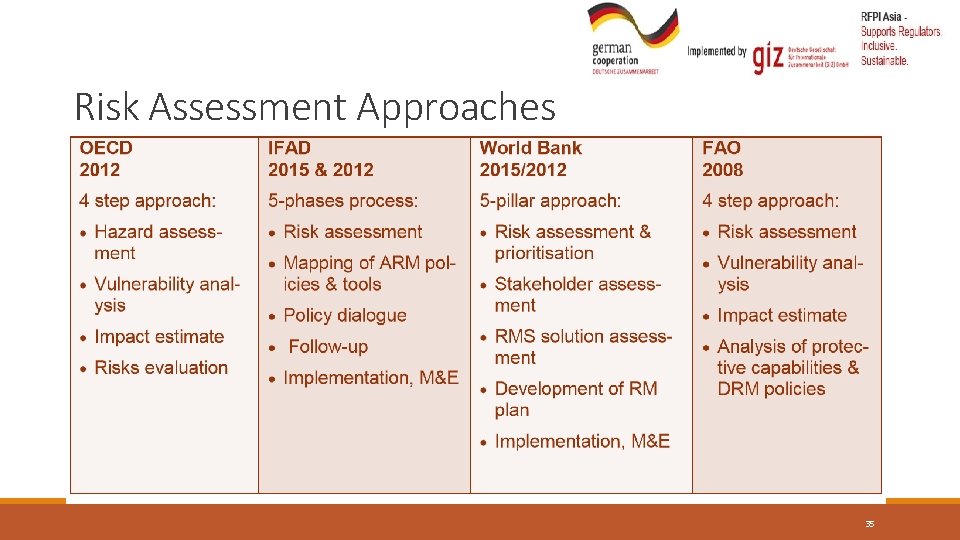
Risk Assessment Approaches 35
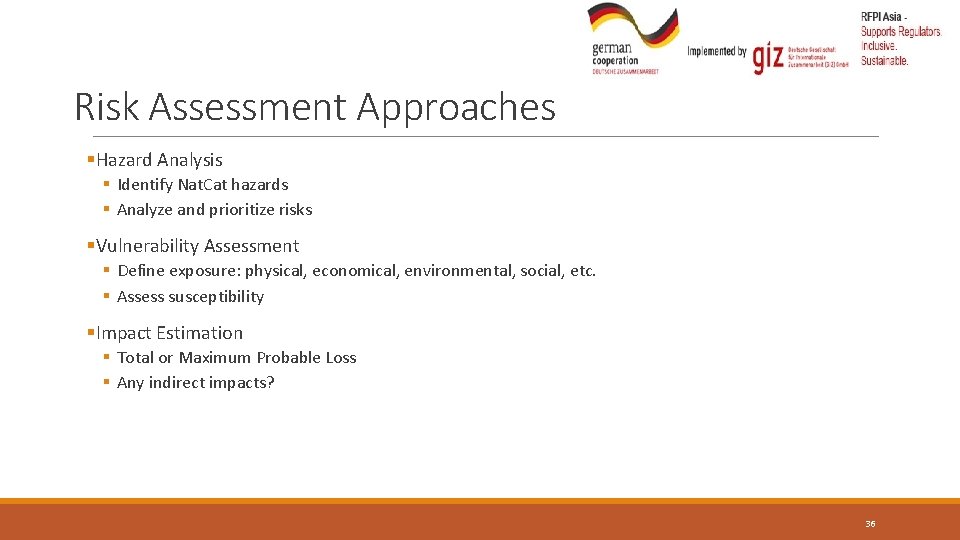
Risk Assessment Approaches §Hazard Analysis § Identify Nat. Cat hazards § Analyze and prioritize risks §Vulnerability Assessment § Define exposure: physical, economical, environmental, social, etc. § Assess susceptibility §Impact Estimation § Total or Maximum Probable Loss § Any indirect impacts? 36
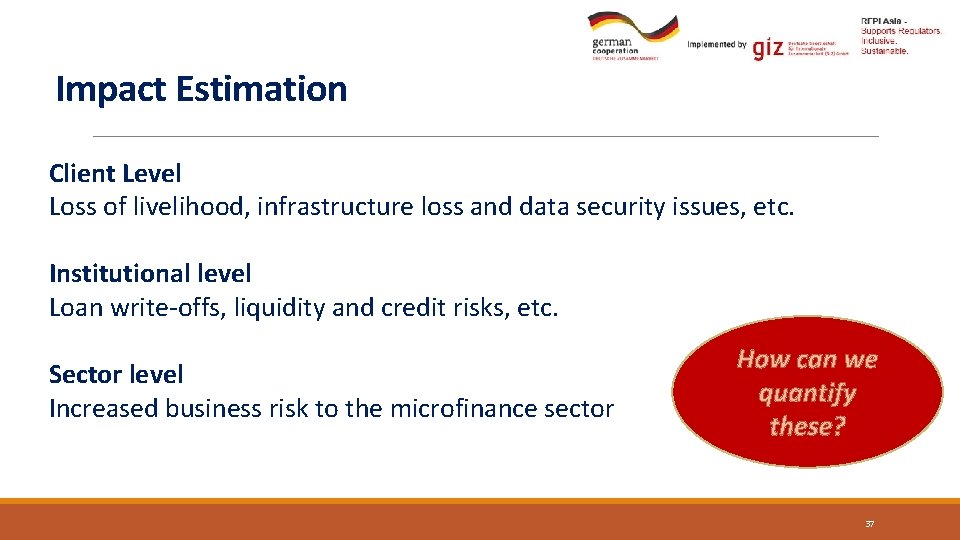
Impact Estimation Client Level Loss of livelihood, infrastructure loss and data security issues, etc. Institutional level Loan write-offs, liquidity and credit risks, etc. Sector level Increased business risk to the microfinance sector How can we quantify these? 37
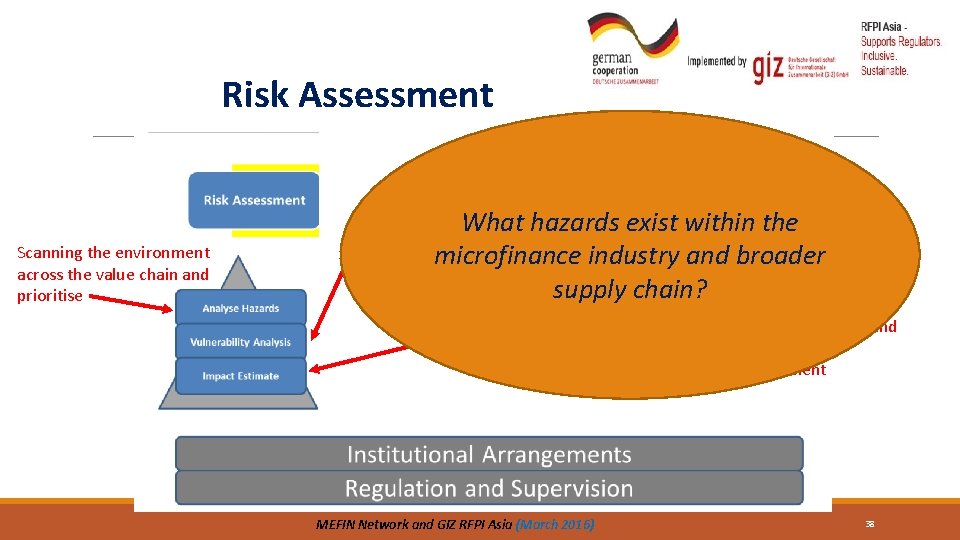
Risk Assessment Scanning the environment across the value chain and prioritise Identification of exposures according to assets or environment according to level ofexist importance What hazards within the clustered into i) Physical ii) Economic and financial microfinance and broader iii) Environmental iv) Social andindustry v) Institutional supply chain? Quantification and distinction of exposure on direct and Indirect impacts: i) chain of events ii) amplifiers iii) Spillover effects and iv) role of government MEFIN Network and GIZ RFPI Asia (March 2016) 38
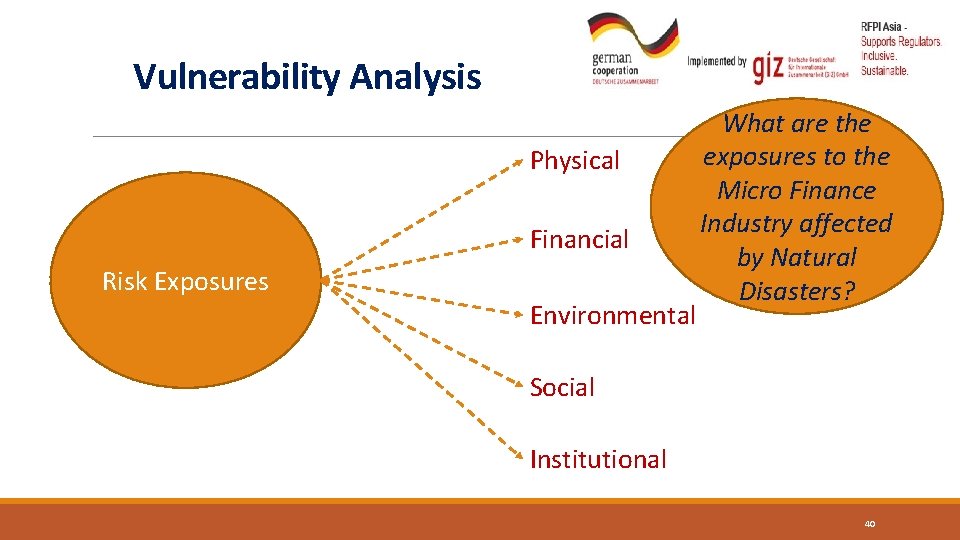
Vulnerability Analysis Physical Financial Risk Exposures Environmental What are the exposures to the Micro Finance Industry affected by Natural Disasters? Social Institutional 40
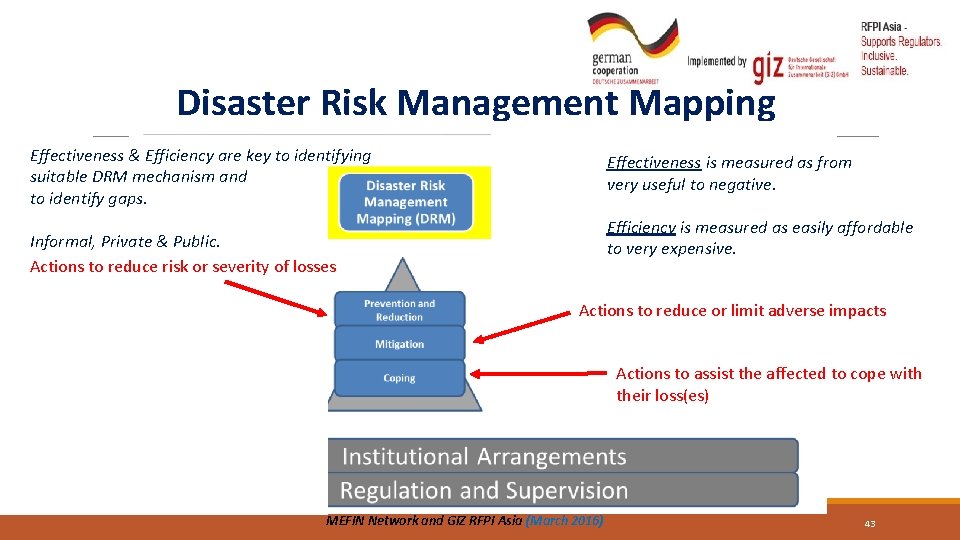
Disaster Risk Management Mapping Effectiveness & Efficiency are key to identifying suitable DRM mechanism and to identify gaps. Effectiveness is measured as from very useful to negative. Efficiency is measured as easily affordable to very expensive. Informal, Private & Public. Actions to reduce risk or severity of losses Actions to reduce or limit adverse impacts Actions to assist the affected to cope with their loss(es) MEFIN Network and GIZ RFPI Asia (March 2016) 43
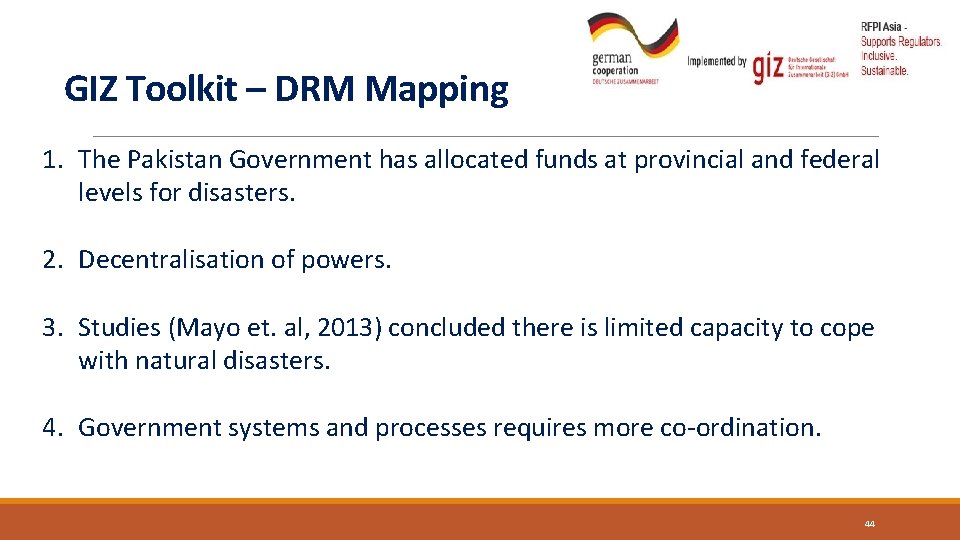
GIZ Toolkit – DRM Mapping 1. The Pakistan Government has allocated funds at provincial and federal levels for disasters. 2. Decentralisation of powers. 3. Studies (Mayo et. al, 2013) concluded there is limited capacity to cope with natural disasters. 4. Government systems and processes requires more co-ordination. 44
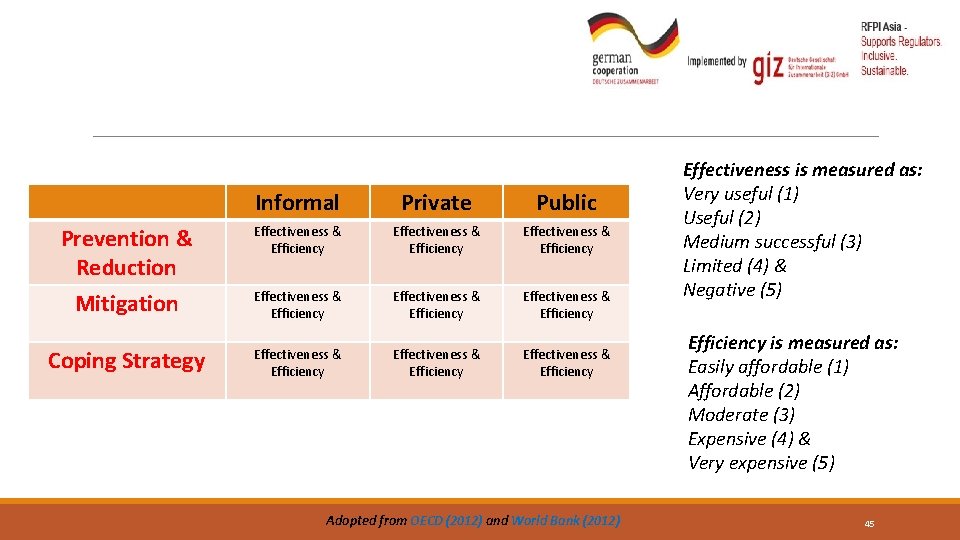
Informal Private Public Prevention & Reduction Effectiveness & Efficiency Mitigation Effectiveness & Efficiency Coping Strategy Effectiveness & Efficiency Adopted from OECD (2012) and World Bank (2012) Effectiveness is measured as: Very useful (1) Useful (2) Medium successful (3) Limited (4) & Negative (5) Efficiency is measured as: Easily affordable (1) Affordable (2) Moderate (3) Expensive (4) & Very expensive (5) 45
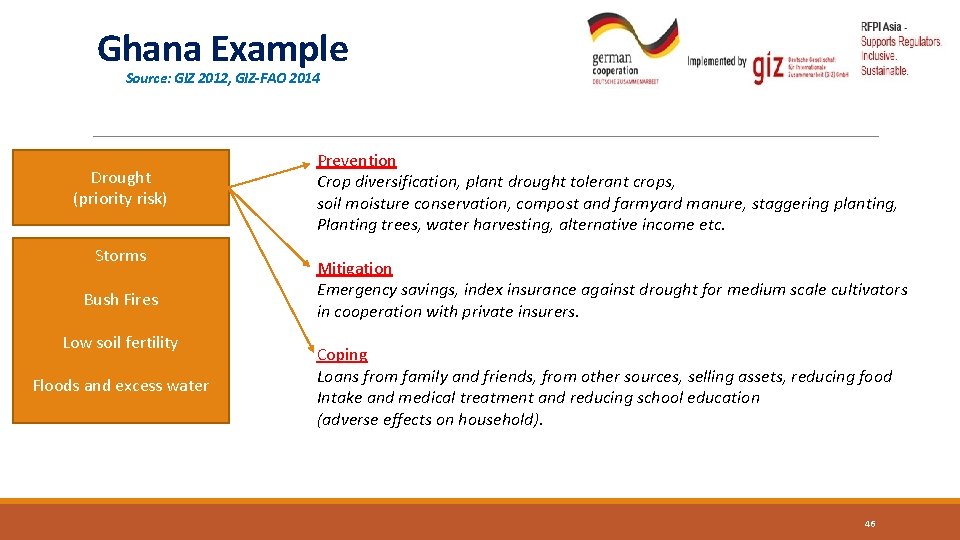
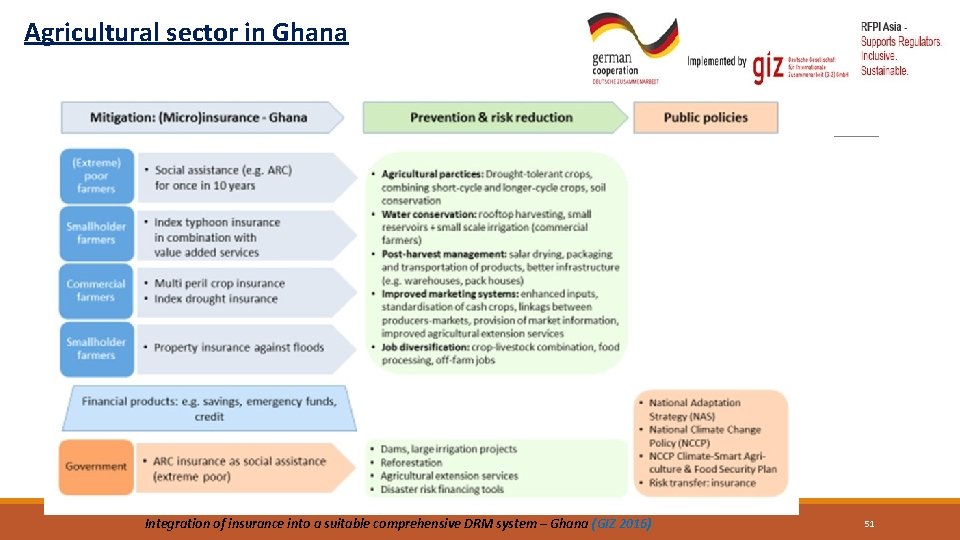
Ghana Example Source: GIZ 2012, GIZ-FAO 2014 Drought (priority risk) Storms Bush Fires Low soil fertility Floods and excess water Prevention Crop diversification, plant drought tolerant crops, soil moisture conservation, compost and farmyard manure, staggering planting, Planting trees, water harvesting, alternative income etc. Mitigation Emergency savings, index insurance against drought for medium scale cultivators in cooperation with private insurers. Coping Loans from family and friends, from other sources, selling assets, reducing food Intake and medical treatment and reducing school education (adverse effects on household). 46
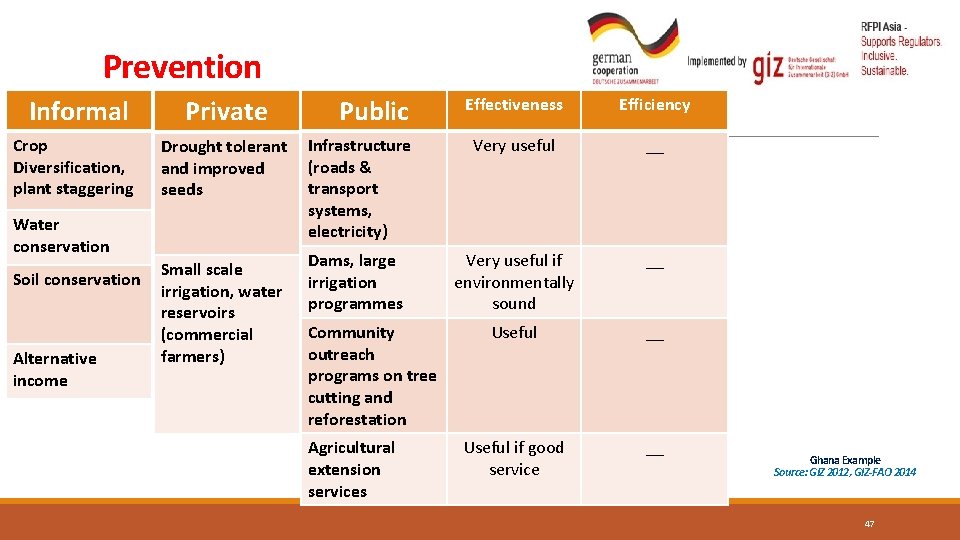
Prevention Informal Crop Diversification, plant staggering Water conservation Soil conservation Alternative income Private Effectiveness Public Effectiveness Efficiency Infrastructure Limited affordable Drought tolerant Easily Very useful (roads & and improved transport seeds systems, Limited Affordable electricity) Small scale Very useful but irrigation, water limited against reservoirs strong drought (commercial farmers) Depending on alternative Dams, large Useful Affordable irrigation programmes Community outreach __ programs on tree cutting and reforestation Agricultural extension services Effectiveness Efficiency Very__useful __ Very__ useful if environmentally sound __ Useful if good service __ Ghana Example Source: GIZ 2012, GIZ-FAO 2014 47
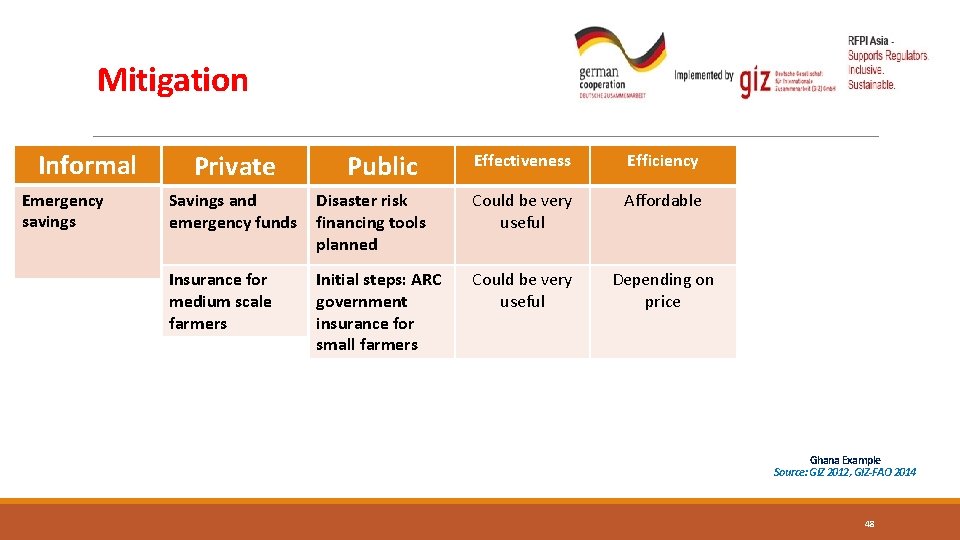
Mitigation Informal Emergency savings Effectiveness Private Efficiency Effectiveness Efficiency Useful to Savings and limited funds emergency depending on amount Insurance for medium scale farmers Disaster Very __ useful risk to financing medium tools planned Could__be very useful Affordable Initial. Useful steps: ARC government insurance for small farmers Could Affordable be very useful Depending on price Public Ghana Example Source: GIZ 2012, GIZ-FAO 2014 48
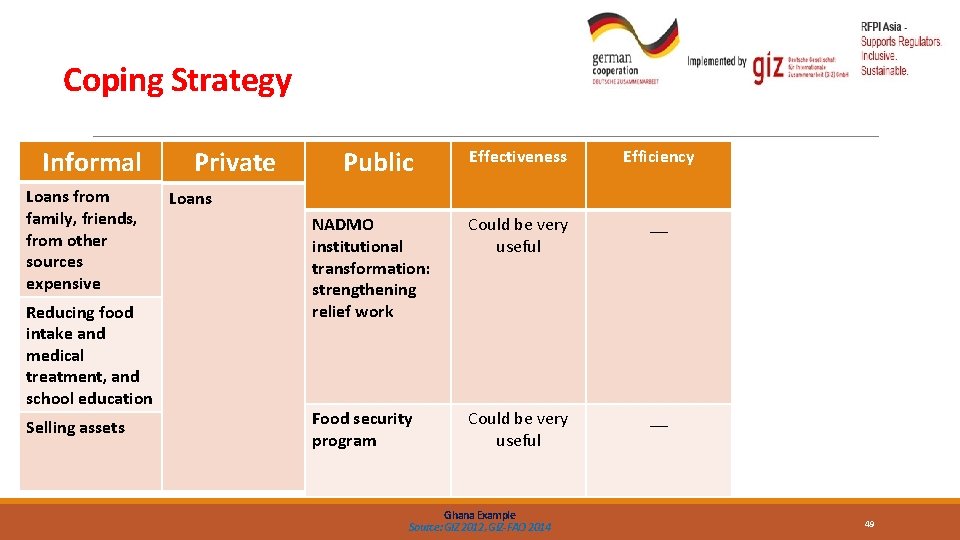
Coping Strategy Informal Effectiveness Private Loans from family, friends, from other sources expensive Important but Loans limited Reducing food intake and medical treatment, and school education Negative Selling assets Negative Public Efficiency Effectiveness Efficiency Affordable Useful – expensive NADMO Slow access Could be very useful __ Food security __ program Could be very useful Effectiveness Efficiency institutional transformation: strengthening relief work __ Ghana Example Source: GIZ 2012, GIZ-FAO 2014 __ 49
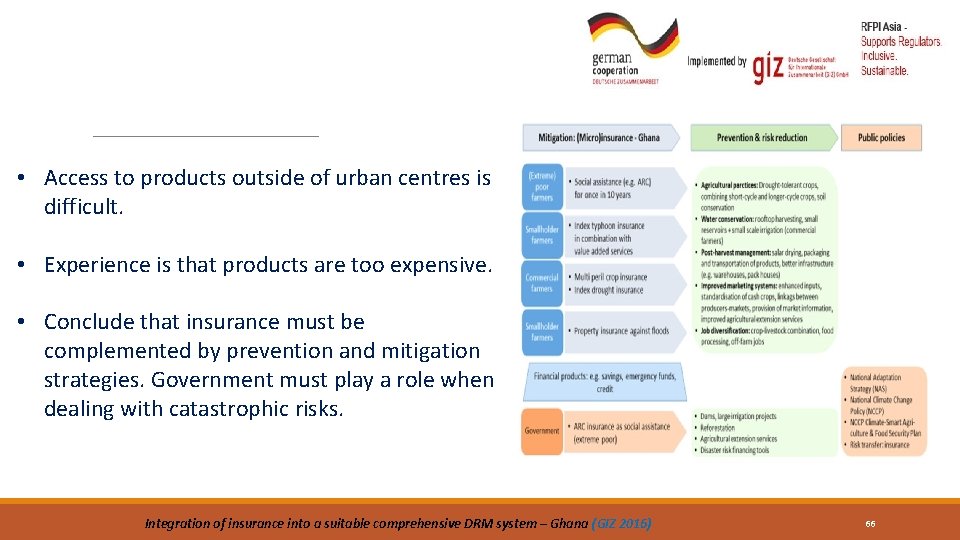
Agricultural sector in Ghana Integration of insurance into a suitable comprehensive DRM system – Ghana (GIZ 2016) 51
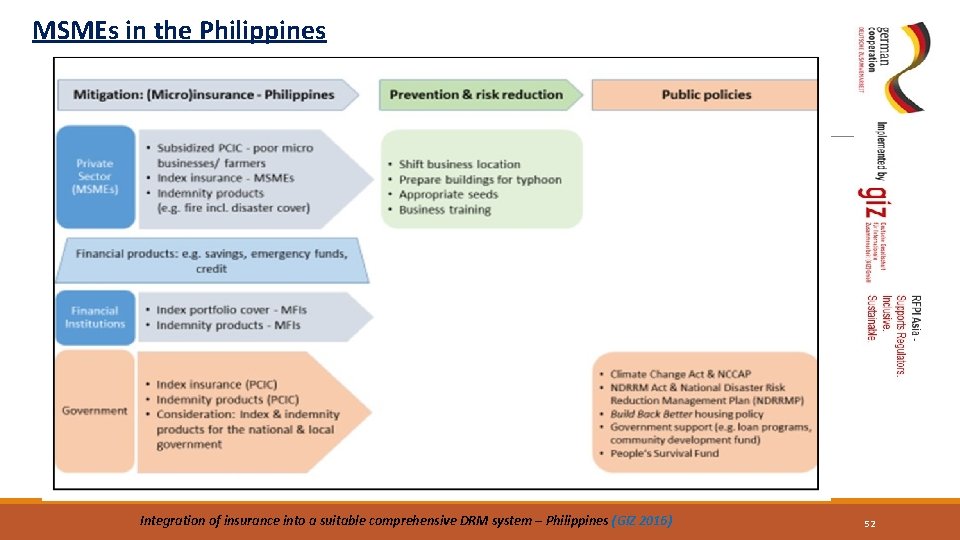
MSMEs in the Philippines Integration of insurance into a suitable comprehensive DRM system – Philippines (GIZ 2016) 52
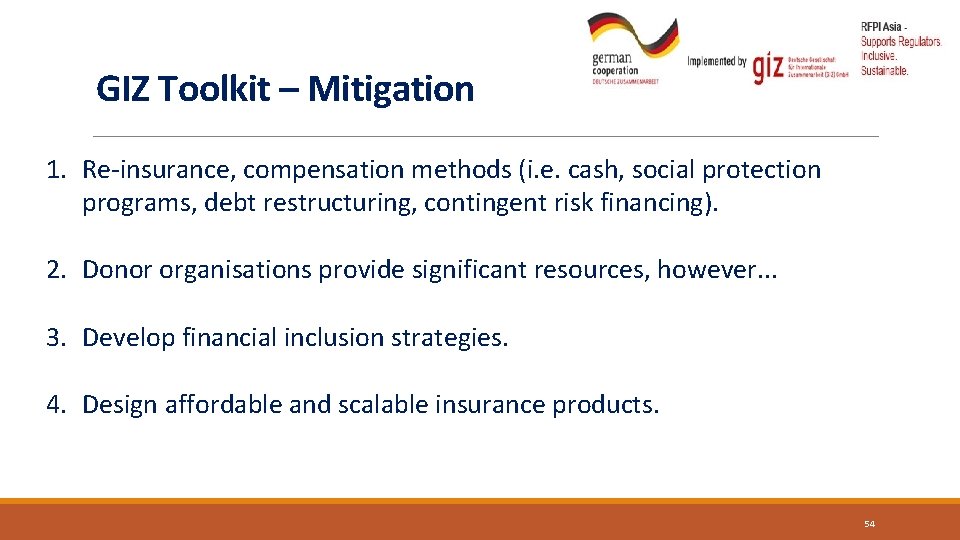
GIZ Toolkit – Mitigation 1. Re-insurance, compensation methods (i. e. cash, social protection programs, debt restructuring, contingent risk financing). 2. Donor organisations provide significant resources, however. . . 3. Develop financial inclusion strategies. 4. Design affordable and scalable insurance products. 54
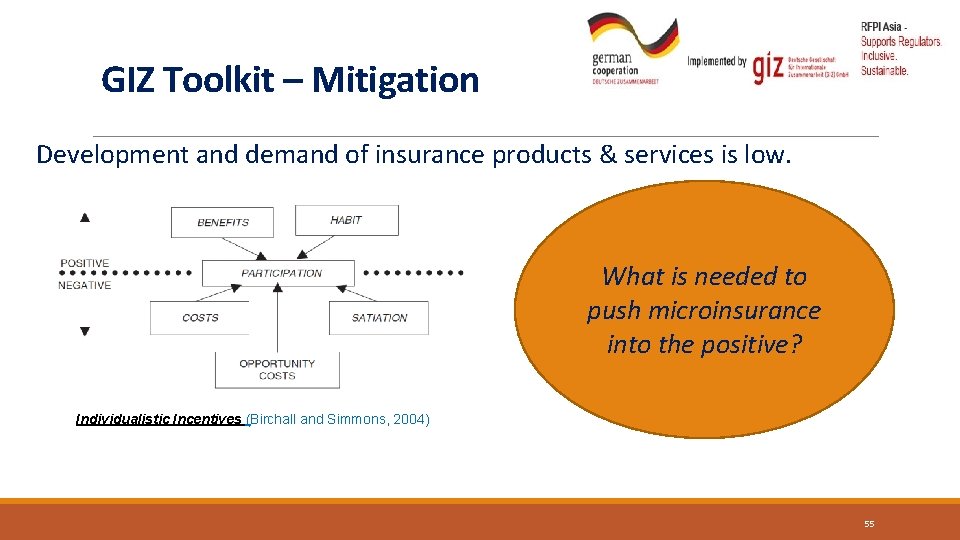
GIZ Toolkit – Mitigation Development and demand of insurance products & services is low. What is needed to push microinsurance into the positive? Individualistic Incentives (Birchall and Simmons, 2004) 55
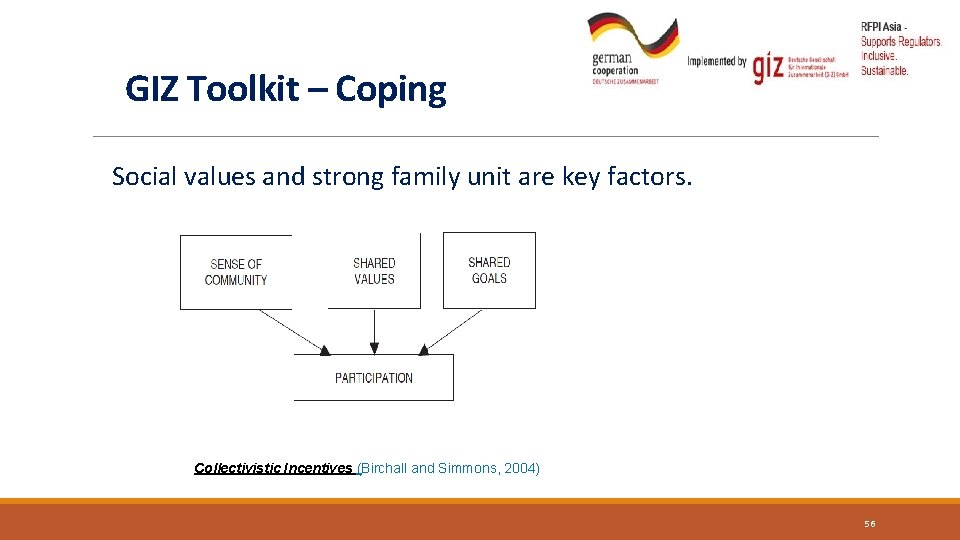
GIZ Toolkit – Coping Social values and strong family unit are key factors. Collectivistic Incentives (Birchall and Simmons, 2004) 56
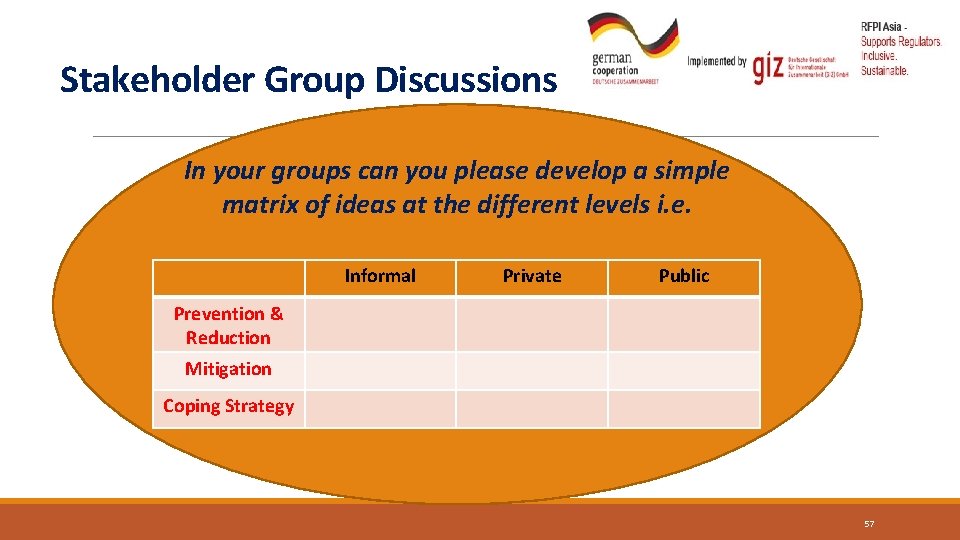
Stakeholder Group Discussions In your groups can you please develop a simple matrix of ideas at the different levels i. e. Informal Private Public Prevention & Reduction Mitigation Coping Strategy 57
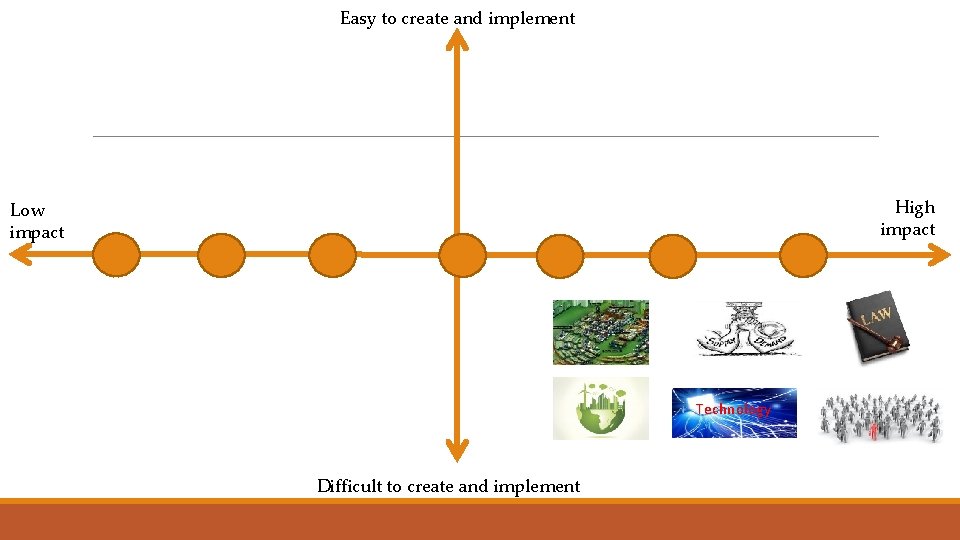
Easy to create and implement High impact Low impact Technology Difficult to create and implement
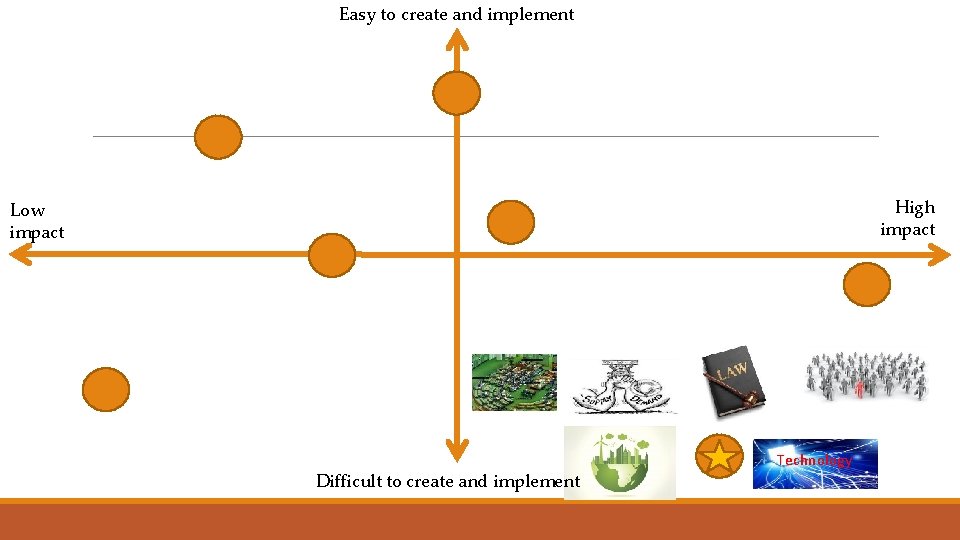
Easy to create and implement High impact Low impact Difficult to create and implement Technology
Topic: How should we protect the micro finance industry from natural disasters? 60
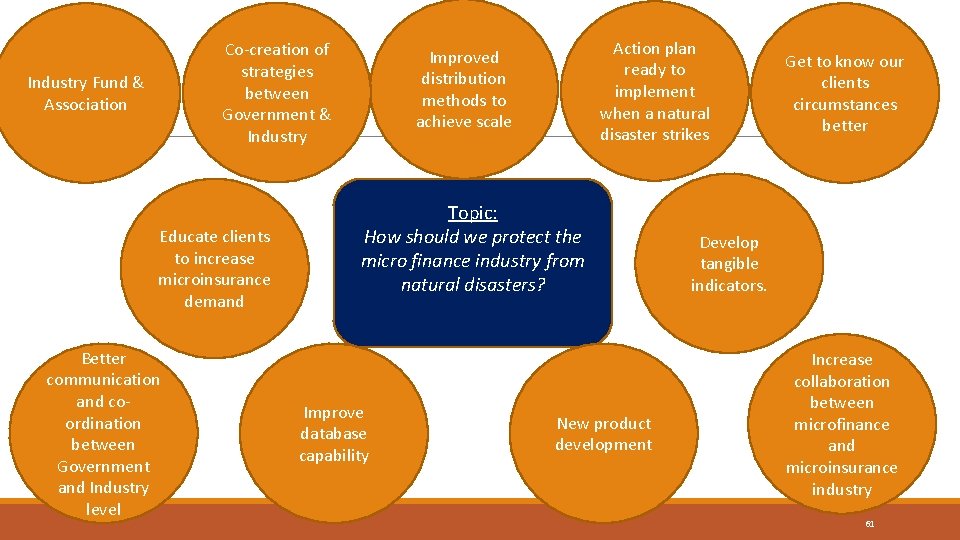
Co-creation of strategies between Government & Industry Fund & Association Educate clients to increase microinsurance demand Better communication and coordination between Government and Industry level Action plan ready to implement when a natural disaster strikes Improved distribution methods to achieve scale Topic: How should we protect the micro finance industry from natural disasters? Improve database capability New product development Get to know our clients circumstances better Develop tangible indicators. Increase collaboration between microfinance and microinsurance industry 61
Let’s see what we are doing well and where we are challenged. A quick dot vote before we move towards lunch. 62
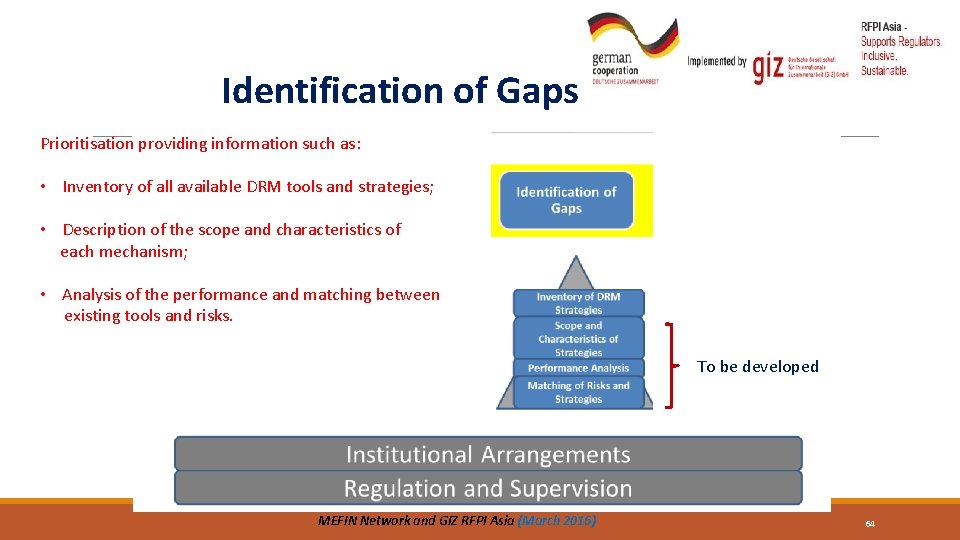
Identification of Gaps Prioritisation providing information such as: • Inventory of all available DRM tools and strategies; • Description of the scope and characteristics of each mechanism; • Analysis of the performance and matching between existing tools and risks. To be developed MEFIN Network and GIZ RFPI Asia (March 2016) 64
Gaps Identification • Based on aggregate (overall losses to GDP) and disaggregated (no major effect on GDP) figures. • Prioritisation based on methods such as IFAD (2015) Scenario Analysis. • Governments need to assess all the dimensions to define DRM gaps rather than the micro level. • The process provides a great helicopter view and evaluation of DRM tools and strategies. 65
• Access to products outside of urban centres is difficult. • Experience is that products are too expensive. • Conclude that insurance must be complemented by prevention and mitigation strategies. Government must play a role when dealing with catastrophic risks. Integration of insurance into a suitable comprehensive DRM system – Ghana (GIZ 2016) 66
Our understanding • A large amount of public and donor funds form a major part of capitalisation of MFPs. • Limited/no specific products and services tailored to natural disasters. • MFBs have access to Crop Loan Insurance Schemes and Livestock Loan Insurance Schemes. • There are no emergency loans available to clients of MFPs, as the loans are generally rescheduled or written-off; & • The Pakistan Government provides insurance schemes (Crop & Livestock), however the adoption rates are low. 67
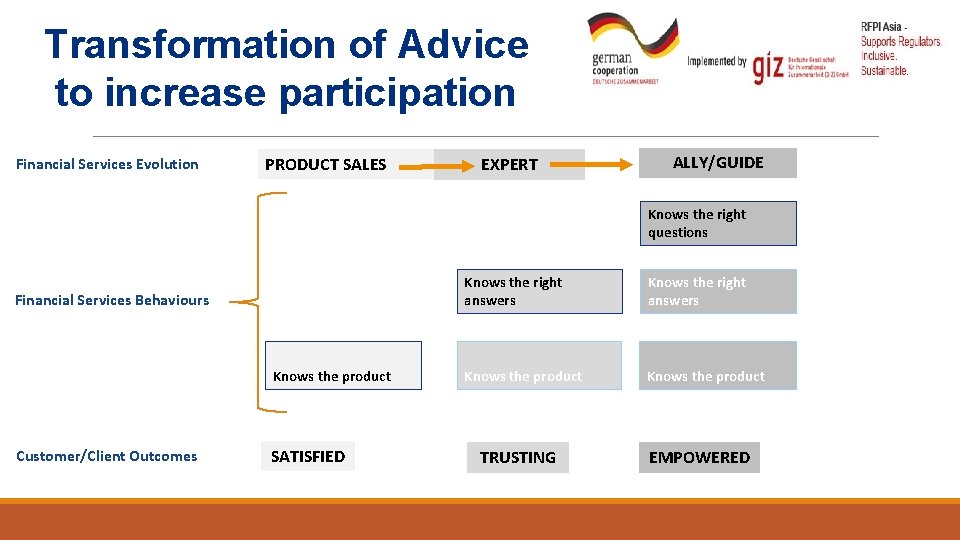
Transformation of Advice to increase participation Financial Services Evolution PRODUCT SALES EXPERT ALLY/GUIDE Knows the right questions Financial Services Behaviours Knows the product Customer/Client Outcomes SATISFIED Knows the right answers Knows the product TRUSTING EMPOWERED
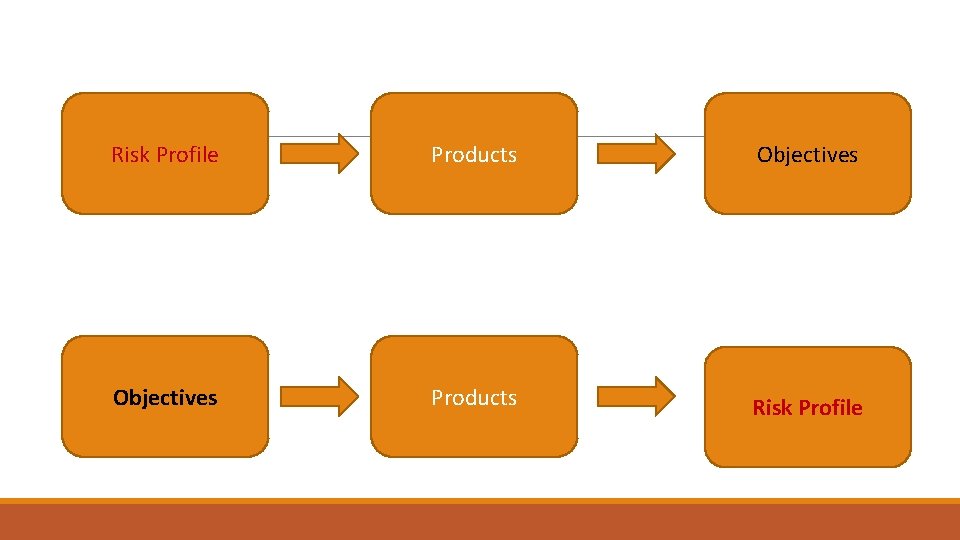
Risk Profile Products Objectives Products Risk Profile
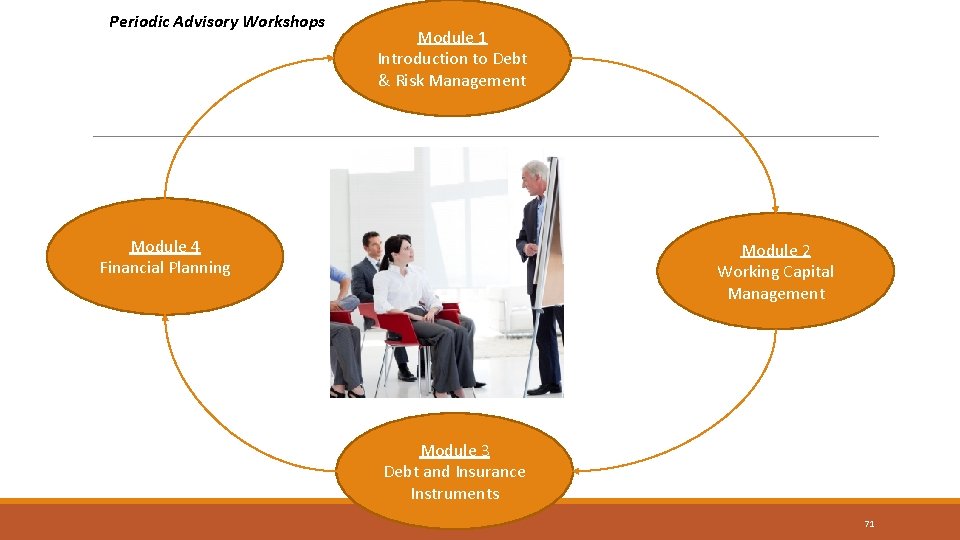
Periodic Advisory Workshops Module 1 Introduction to Debt & Risk Management Module 4 Financial Planning Module 2 Working Capital Management Module 3 Debt and Insurance Instruments 71
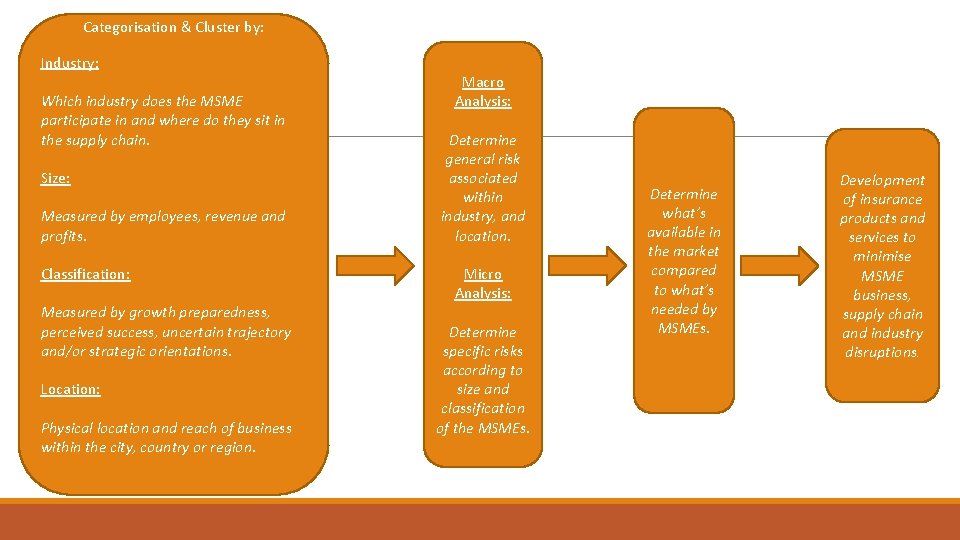
Categorisation & Cluster by: Industry: Which industry does the MSME participate in and where do they sit in the supply chain. Size: Measured by employees, revenue and profits. Classification: Measured by growth preparedness, perceived success, uncertain trajectory and/or strategic orientations. Location: Physical location and reach of business within the city, country or region. Macro Analysis: Determine general risk associated within industry, and location. Micro Analysis: Determine specific risks according to size and classification of the MSMEs. Determine what’s available in the market compared to what’s needed by MSMEs. Development of insurance products and services to minimise MSME business, supply chain and industry disruptions.
So… • • • Business Model Design Credible and useful products and services Knowledge and Database Management Knowledge Management Client Segmentation In short: Sense & Respond v Make & Sell 73
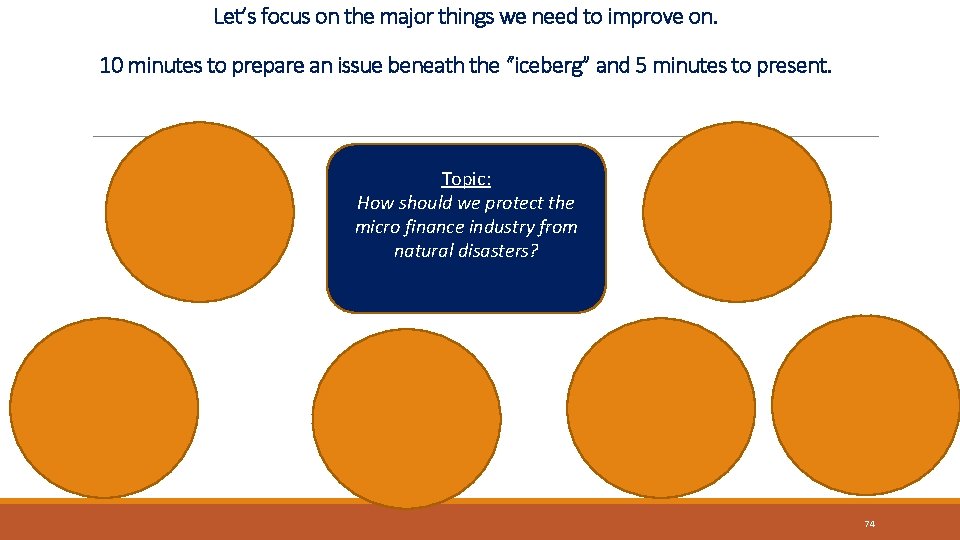
Let’s focus on the major things we need to improve on. 10 minutes to prepare an issue beneath the “iceberg” and 5 minutes to present. Topic: How should we protect the micro finance industry from natural disasters? 74
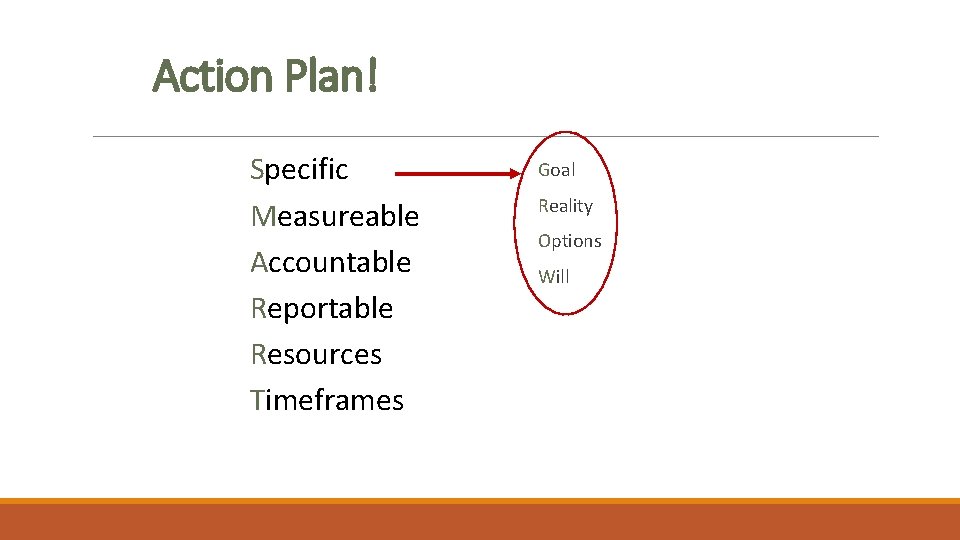
Action Plan! Specific Measureable Accountable Reportable Resources Timeframes Goal Reality Options Will