
EFFECTIVE RISK MANAGEMENT REPORTING Public Sector Risk Management
EFFECTIVE RISK MANAGEMENT REPORTING (Public Sector Risk Management Forum) Mr S Mongala CRO: Department of Telecommunications & Postal Services 8 march 2018 Building a better life for all through an enabling and sustainable world class information and communication technologies environment. 1
CONTENTS 1. Background a) b) c) RM Structure (staff compliment) The Journey REC structure 2. REC Reporting a) Success factors i. Current reporting structure ii. Templates & Value Add b) Current Challenges + Mitigations 3. Conclusion Building a better life for all through an enabling and sustainable world class information and communication technologies environment. 2
1. BACKGROUND a) RM Structure (staff compliment) • 2 officials (CRO+DD) b) The Journey From 2010 to date – no audit findings on RM • Our Approach: Top Down ü Top: - Strategic Risks ü Down: - Operational Risks • Why the approach: ü To ensure integration of systems & processes; and ü To align to Planning, Budgeting & Audit processes. c) REC structure • • • 2 Independent + 7 Internal Members (formally appointed by AC for 3 years) Internal Members (Not DDGs due to availability : CDs from different sections with key expertise) DDGs are required as ROs, Other Invitees include IA, Legal, HR and per specific matter RM is secretariat Focus: ü Key Projects and Risks; ü Achievement of strategic objectives; and ü Implementation of Annual Performance Plans. Building a better life for all through an enabling and sustainable world class information and communication technologies environment. 3
2. REC REPORTING a) Success Factors • DDG (ROs)r Vs CD (Members)a – improves availability and attendance • Currently at least 80% attendance by REC Members (quorum met in all meetings) • Reason for success = TOR does not allow representation of Members Meetings: • Meeting schedule – approved by REC and accepted by DEC (consider Parlia Coms and Other Gov Structures meeting schedules). • Incorporate in the DTPS Integrated meeting schedule. • Predictable agenda (standing agenda items = 80%) e. g. P 5 • List of confirmed REC Members & ROs (Manage period + Changes, etc) e. g. P 5 • Attendance matrix – indicate meetings + attendance for each Member, RO, and Standing Invitee e. g. P 5 • Quality [minutes + matters arising + Decision Matrix] • Decision matrix – all decisions from matters arising (closed + open) e. g. P 5 • Admin: Invitation (aft approval of REC meting schedule), Notice reminder (21 days), Agenda (14 days) & Pack (TOR = 7 days but average 5 actual days). • 4 quarterly (Ordinary Agenda) + 1 Special (Reviewed Frameworks + Schedule) Building a better life for all through an enabling and sustainable world class information and communication technologies environment. 4
2. a. Examples of reports a) Examples for section 2(a) Meetings Disclaimer: The examples are real/actual DTPS RM reports for meeting held 27 Feb 2018. ü Agenda: ü List of Confirmed REC Members & ROs: ü Attendance Matrix: ü Decision Matrix: Building a better life for all through an enabling and sustainable world class information and communication technologies environment. 5
2. REC REPORTING a) Success Factors continued i. Current reporting structure Focus: • Strategic + Operational Risk Mitigation Implementation Report (only escalated strategic + operational risks) - Quarterly - E. g. P 9 • Key strategic + operational risks reports (DEC, REC consider & recommend for approval; AC considers, comment/input & accept; DG signs-off) – Annually e. g. P 9 • Strategic + Operational Risk Registers (ROs sign their respective Branch Risks + Present in Meetings = Accountability Accepted) • Frameworks (RM + RAT + KRI + EI + FPP) – Form Gov Framework – Annually • RM Implementation Dashboard + Maturity Assessment Report – Quarterly e. g. P 9 • Governance & Compliance + Fraud Prevention Reports – Quarterly Building a better life for all through an enabling and sustainable world class information and communication technologies environment. 6

2. a. REC REPORTING a) Success Factors continued REC Reporting Structure Building a better life for all through an enabling and sustainable world class information and communication technologies environment. 7
1. REC REPORTING a) Success Factors continued i. Templates & Value Adding: • Long outstanding Decisions / Recommendations (AC Chair to DG for intervention) e. g. P 9 • Ethics & Anti-Corruption Reporting: Implementation = open meeting : Details = Closed meeting =: = Confidentiality Observed e. g. P 9 • Accountability: DG: Overall, ROs Branch Risks, RM Facilitate =: = Clarifies accountability + responsibility • Not only compliant but also effective reporting structure • Everything attended to & nothing left • Ensures focus on key issues & achievement of objectives • Currently DTPS performs at 80% average Building a better life for all through an enabling and sustainable world class information and communication technologies environment. 8
2. b. Example of Reports a) Success Factors continued i. Examples for 2(a)(ii) templates Disclaimer: The examples are real/actual DTPS RM reports for meeting held 27 Feb 2018. • Risk Mitigation Implementation Reports: • Key Risks Reports + Mitigation Strategy: • RM + FP + G&C reports: • Long Outstanding Decisions or Recommendations: Building a better life for all through an enabling and sustainable world class information and communication technologies environment. 9
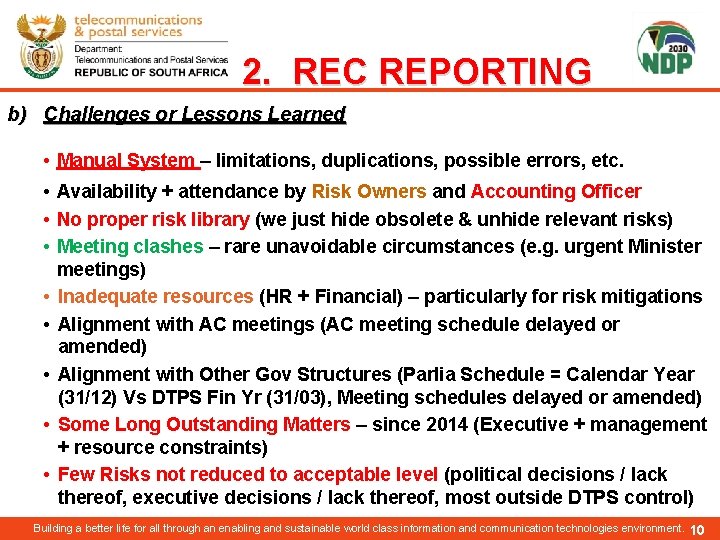
2. REC REPORTING b) Challenges or Lessons Learned • Manual System – limitations, duplications, possible errors, etc. • Availability + attendance by Risk Owners and Accounting Officer • No proper risk library (we just hide obsolete & unhide relevant risks) • Meeting clashes – rare unavoidable circumstances (e. g. urgent Minister meetings) • Inadequate resources (HR + Financial) – particularly for risk mitigations • Alignment with AC meetings (AC meeting schedule delayed or amended) • Alignment with Other Gov Structures (Parlia Schedule = Calendar Year (31/12) Vs DTPS Fin Yr (31/03), Meeting schedules delayed or amended) • Some Long Outstanding Matters – since 2014 (Executive + management + resource constraints) • Few Risks not reduced to acceptable level (political decisions / lack thereof, executive decisions / lack thereof, most outside DTPS control) Building a better life for all through an enabling and sustainable world class information and communication technologies environment. 10

3. CONCLUSION ¿¿¿ ? ? ? Building a better life for all through an enabling and sustainable world class information and communication technologies environment. 11
- Slides: 11