
Integrated Research on Disaster Risk addressing the challenge

- Slides: 13
Integrated Research on Disaster Risk addressing the challenge of natural and human-induced environmental hazards Dr. Jane Rovins, CEM Executive Director 1
Issues • • Globalization Population growth Widespread poverty Changing climate • Urban areas – Complex infrastructure – Concentration and centralization of economic and political functions – Social segregation and – Complex spatial and functional interrelationships Key question: Why, despite advances in the natural and social science of hazards and disasters, do losses continue to increase?
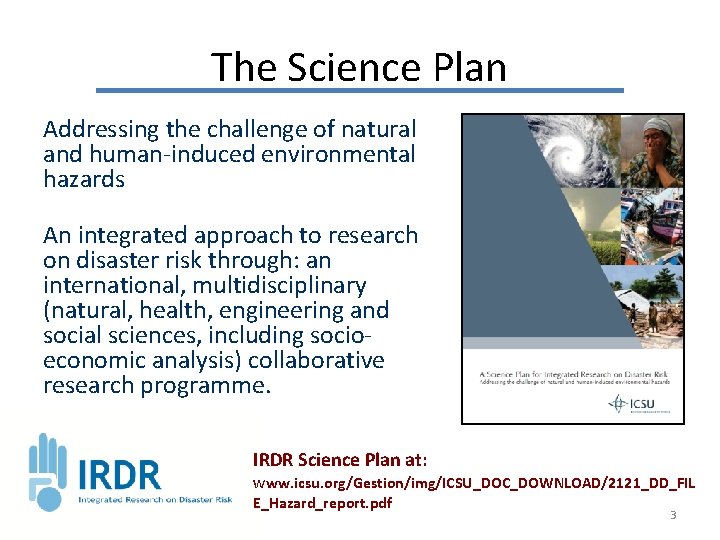
The Science Plan Addressing the challenge of natural and human-induced environmental hazards An integrated approach to research on disaster risk through: an international, multidisciplinary (natural, health, engineering and social sciences, including socioeconomic analysis) collaborative research programme. IRDR Science Plan at: www. icsu. org/Gestion/img/ICSU_DOC_DOWNLOAD/2121_DD_FIL E_Hazard_report. pdf 3
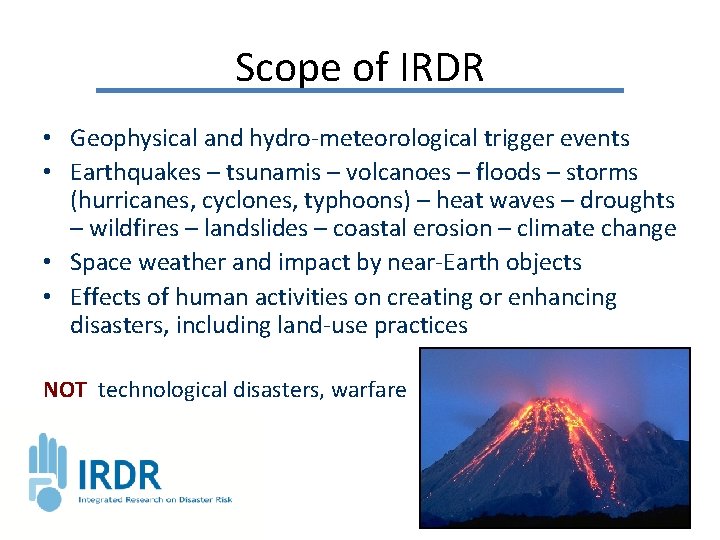
Scope of IRDR • Geophysical and hydro-meteorological trigger events • Earthquakes – tsunamis – volcanoes – floods – storms (hurricanes, cyclones, typhoons) – heat waves – droughts – wildfires – landslides – coastal erosion – climate change • Space weather and impact by near-Earth objects • Effects of human activities on creating or enhancing disasters, including land-use practices NOT technological disasters, warfare 4
Partners Sponsors • National and international science institutions • National and international development assistance agencies and funding bodies • National IRDR 5
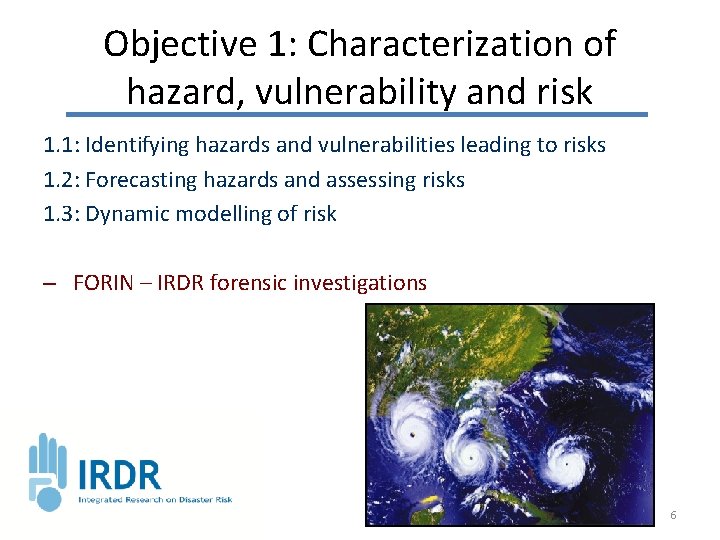
Objective 1: Characterization of hazard, vulnerability and risk 1. 1: Identifying hazards and vulnerabilities leading to risks 1. 2: Forecasting hazards and assessing risks 1. 3: Dynamic modelling of risk – FORIN – IRDR forensic investigations 6
Objective 2: Effective Decision-Making in Complex and Changing Risk Contexts 2. 1: Identifying relevant decision-making systems and their interactions 2. 2: Understanding decision-making in the context of environmental hazards 2. 3: Improving the quality of decision-making practice – AIR - Assessment and Interpretation of Risk 7
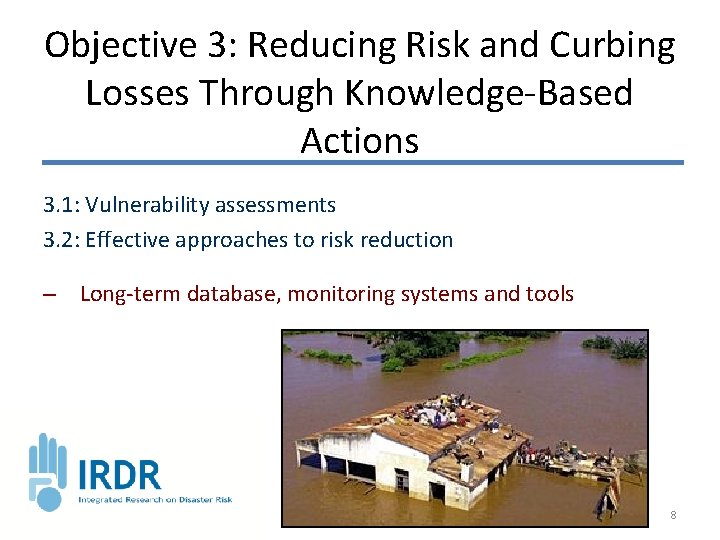
Objective 3: Reducing Risk and Curbing Losses Through Knowledge-Based Actions 3. 1: Vulnerability assessments 3. 2: Effective approaches to risk reduction – Long-term database, monitoring systems and tools 8
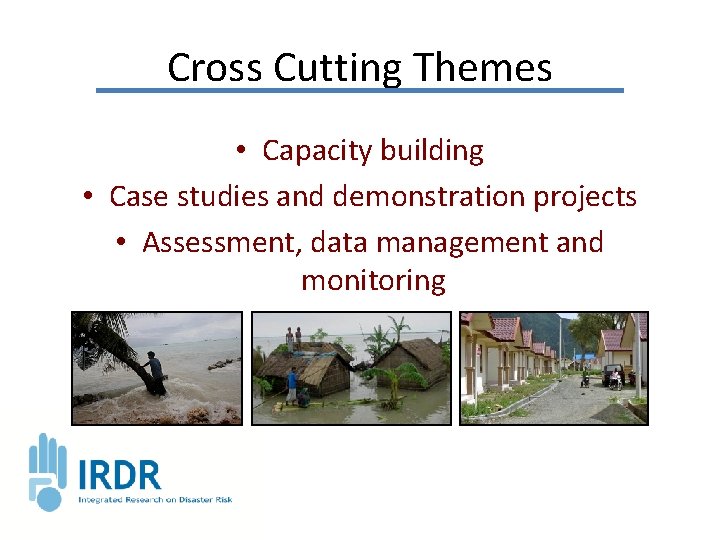
Cross Cutting Themes • Capacity building • Case studies and demonstration projects • Assessment, data management and monitoring
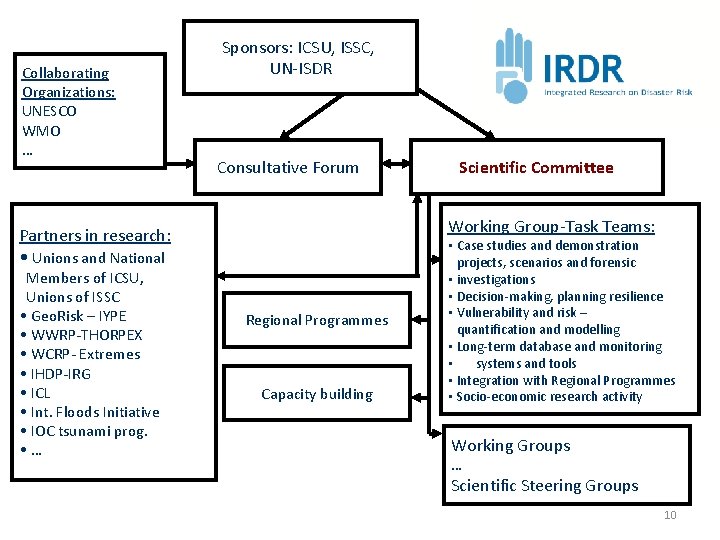
Collaborating Organizations: UNESCO WMO … Sponsors: ICSU, ISSC, UN-ISDR Consultative Forum Working Group-Task Teams: Partners in research: • Unions and National Members of ICSU, Unions of ISSC • Geo. Risk – IYPE • WWRP-THORPEX • WCRP- Extremes • IHDP-IRG • ICL • Int. Floods Initiative • IOC tsunami prog. • … Scientific Committee Regional Programmes Capacity building • Case studies and demonstration projects, scenarios and forensic • investigations • Decision-making, planning resilience • Vulnerability and risk – quantification and modelling • Long-term database and monitoring • systems and tools • Integration with Regional Programmes • Socio-economic research activity Working Groups … Scientific Steering Groups 10
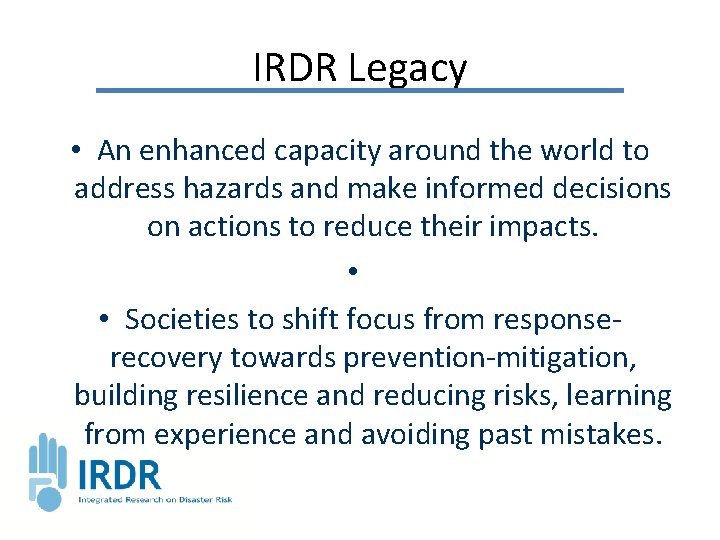
IRDR Legacy • An enhanced capacity around the world to address hazards and make informed decisions on actions to reduce their impacts. • • Societies to shift focus from responserecovery towards prevention-mitigation, building resilience and reducing risks, learning from experience and avoiding past mistakes.
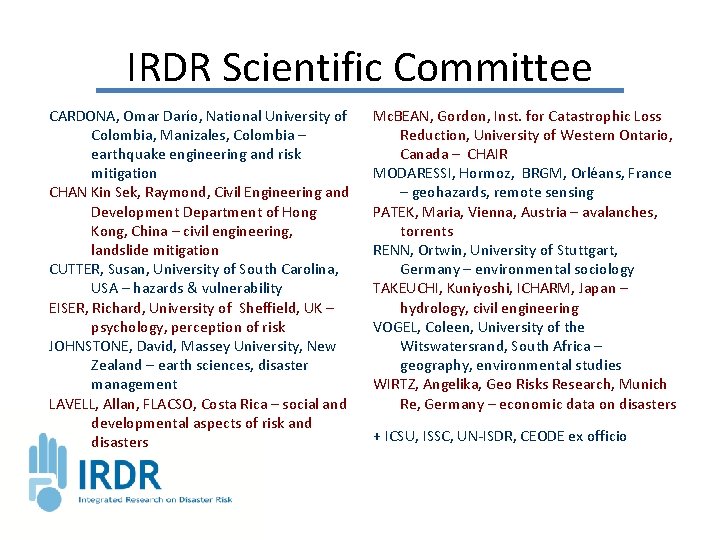
IRDR Scientific Committee CARDONA, Omar Darío, National University of Colombia, Manizales, Colombia – earthquake engineering and risk mitigation CHAN Kin Sek, Raymond, Civil Engineering and Development Department of Hong Kong, China – civil engineering, landslide mitigation CUTTER, Susan, University of South Carolina, USA – hazards & vulnerability EISER, Richard, University of Sheffield, UK – psychology, perception of risk JOHNSTONE, David, Massey University, New Zealand – earth sciences, disaster management LAVELL, Allan, FLACSO, Costa Rica – social and developmental aspects of risk and disasters Mc. BEAN, Gordon, Inst. for Catastrophic Loss Reduction, University of Western Ontario, Canada – CHAIR MODARESSI, Hormoz, BRGM, Orléans, France – geohazards, remote sensing PATEK, Maria, Vienna, Austria – avalanches, torrents RENN, Ortwin, University of Stuttgart, Germany – environmental sociology TAKEUCHI, Kuniyoshi, ICHARM, Japan – hydrology, civil engineering VOGEL, Coleen, University of the Witswatersrand, South Africa – geography, environmental studies WIRTZ, Angelika, Geo Risks Research, Munich Re, Germany – economic data on disasters + ICSU, ISSC, UN-ISDR, CEODE ex officio
Integrated Research on Disaster Risk Thank you irdr. beijing@gmail. com 13