DENTAL AMALGAM DENTAL AMALGAM An amalgam is an

- Slides: 86
DENTAL AMALGAM
DENTAL AMALGAM • An amalgam is an alloy of mercury with other metals. Dental amalgam is the mostly widely used filling material for posterior teeth. • Mercury is able to react with other metal to form a plastic mass, which is conveniently packed into a prepared cavity in a tooth. This plastic mass hardens & is stronger than any dental cement or anterior filing material.
History • 1833 – Crawcour brothers introduce amalgam to US • powdered silver coins mixed with mercury – expanded on setting • 1895 – G. V. Black develops formula for modern amalgam alloy • 67% silver, 27% tin, 5% copper, 1% zinc – overcame expansion problems
History • 1960’s – conventional low-copper lathe-cut alloys • smaller particles – first generation high-copper alloys • Dispersalloy (Caulk) – admixture of spherical Ag-Cu eutectic particles with conventional lathe-cut – eliminated gamma-2 phase
History • 1970’s – first single composition spherical • • Tytin (Kerr) ternary system (silver/tin/copper) • 1980’s – alloys similar to Dispersalloy and Tytin • 1990’s – mercury-free alloys
Classifications • Based on copper content • Based on particle shape • Based on method of adding copper • Based on Method of manufacture • Based on Zinc content • Based on Number of alloyed metal • Based on Size of alloy
BASED ON COPPER CONTENT • Low-copper alloys – 4 to 6% Cu • High-copper alloys – thought that 6% Cu was maximum amount • due to fear of excessive corrosion and expansion – Now contain 9 to 30% Cu • at expense of Ag
Based On Particle Shape • Lathe cut – low Cu • – New True Dentalloy high Cu • ANA 2000 • Admixture – high Cu • Dispersalloy, Valiant Ph. D
Based On Particle Shape (cont) • Spherical – low Cu • – Cavex SF high Cu • Tytin, Valiant
Based on Method of Adding Copper • Single Composition Lathe-Cut (SCL) • Single Composition Spherical (SCS) • Admixture: Lathe-cut + Spherical Eutectic (ALE) • Admixture: Lathe-cut + Single Composition Spherical (ALSCS)
Based on Method of Manufacture • Lathe cut alloy • Spherical alloy • Irregular particle alloy.
Based on Zinc Content • Zinc containing alloys – contain more than 0. 01% Zinc • Zinc free alloys – contain < 0. 01% Zinc.
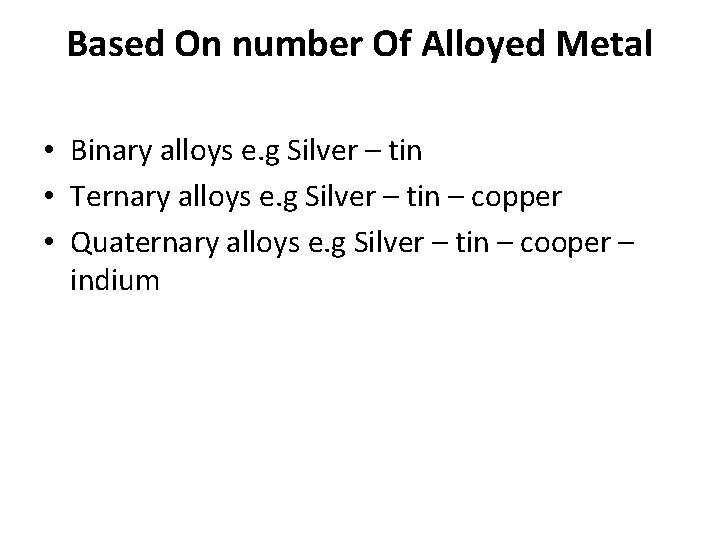
Based On number Of Alloyed Metal • Binary alloys e. g Silver – tin • Ternary alloys e. g Silver – tin – copper • Quaternary alloys e. g Silver – tin – cooper – indium
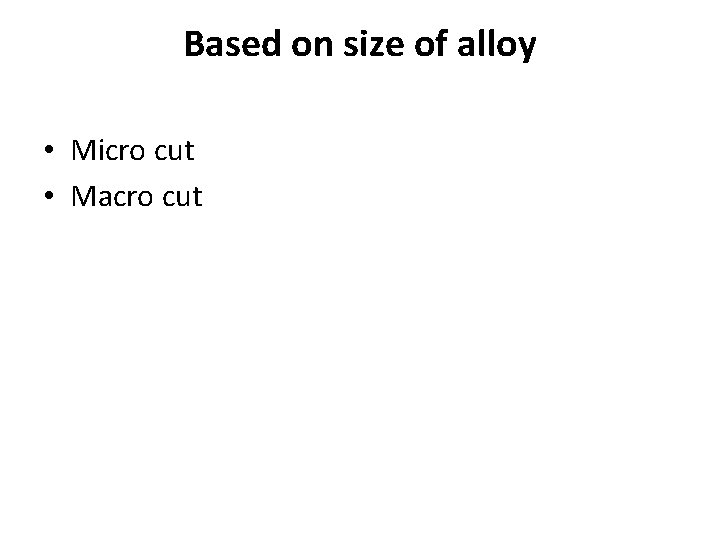
Based on size of alloy • Micro cut • Macro cut
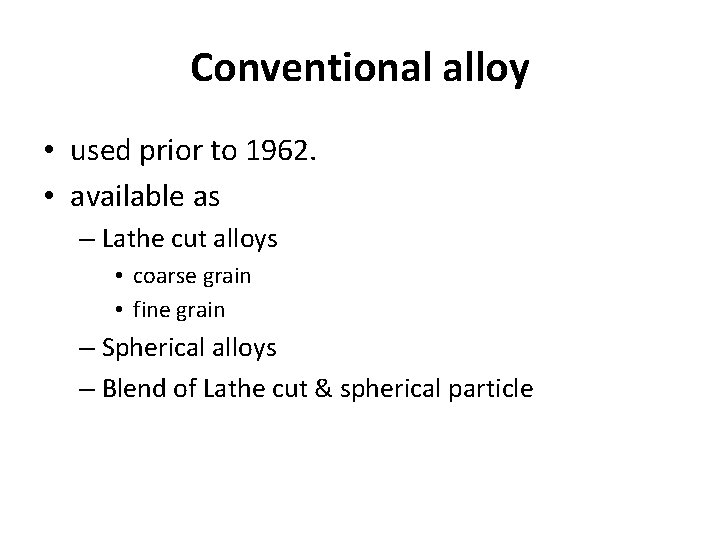
Conventional alloy • used prior to 1962. • available as – Lathe cut alloys • coarse grain • fine grain – Spherical alloys – Blend of Lathe cut & spherical particle
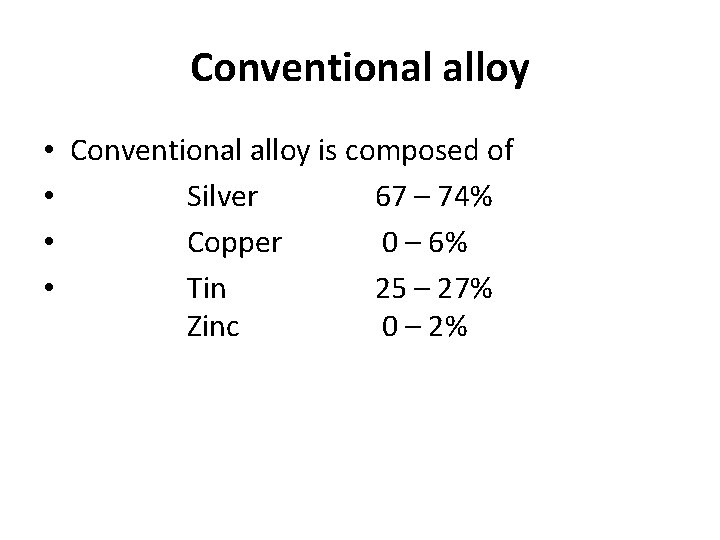
Conventional alloy • Conventional alloy is composed of • Silver 67 – 74% • Copper 0 – 6% • Tin 25 – 27% Zinc 0 – 2%
Conventional alloy • Some alloys contain or have contained up to 2 – 3 % mercury, such alloys amalgamate more rapidly. • These constituents are present in the alloy in metallic Phases mainly (Ag 3 sn) gamma. Ag 4 sn (Beta) Cu 3 sn (epsilon) & Cusn 5 (eta). • Silver imparts strength to the set amalgam & also resists corrosion. Copper when added in small quantities in the traditional alloy, replaces some of the silver & imparts the same desirable properties to the alloy.
Conventional alloy • Some silver amalgam alloys contain Zinc which acts as a scavenger for Oxygen during manufacture of the alloy, preventing the oxidation of its other ingredient. • The superior clinical performance of amalgam containing Zinc is due to the initial corrosion of the zinc content which thus delays the corrosion of Tin in either the Sn 8 ltg (gamma-2 r) or the Cu 6 sn (eta)phase. • Mercury, where present in small quantities, is provided to facilitate amalgamation. Alloys containing mercury are known as pre amalgamated or pre mercurized alloys.
High – copper Alloys • These are based on the dispersion hardening principle. The aim is to eliminate the gamma – 2 phase from the set amalgam, thus enhancing the physical properties & corrosion resistance of the restoration.
TYPES OF HIGH – COPPER ALLOYS • Admixed or dispersion or blended alloys • Single composition or single phase copper rich or uni composition alloy
Admixed or dispersion or blended alloys • contain 2 parts by weight of conventional composition. Lathe cut particle plus one part by weight of spheres of a silver - Cu eutectic alloy (70% Ag Cu – 30%). the content may be increased to 12% by adding Ag – Cu eutectic particle to the traditional amalgam alloy. • Silver 69% • Tin 17% • Copper 13% • Zinc 1%
Admixture: Lathe-cut + Spherical Eutectic (ALE) • Composition – – – 2/3 conventional lathe cut (3% Cu) 1/3 high Cu spherical eutectic (28% Cu) overall 12% Cu, 1% Zn • Initial reaction produces gamma 2 – no gamma 2 within two years • Example – Dispersalloy (Caulk)
Admixture: Lathe-cut + Single Composition Spherical (ALSCS) • High Cu in both lathe-cut and spherical components – 19% Cu • Epsilon layer forms on both components • 0. 5% palladium added – reinforce grain boundaries on gamma 1 • Example – Valiant Ph. D (Ivoclar Vivadent)
Single composition or single phase copper rich or uni composition alloy • the react able copper in the alloy is increased to 13% by weight by making use of the spherical particle system which contains Ag 3 Sn and Cu 3 Sn in a single particle alloys.
Types of single composition alloys • Ternary alloys in spherical form, either • Silver 60% or Silver 40% • Tin 25% or Tin 30% • Cu 15% or Cu 30% • Ternary alloy in spheroidal form • Quaternary alloys in spheroidal form • Silver 50% • Cu 13% • Tin 24% • Indium
Single Composition Lathe-Cut (SCL) • More Hg needed than spherical alloys • High condensation force needed due to lathe cut • 20% Cu • Example – ANA 2000 (Nordiska Dental)
Single Composition Spherical (SCS) • Spherical particles wet easier with Hg – less Hg needed (42%) • Less condensation force, larger condenser • Gamma particles as 20 micron spheres – with epsilon layer on surface • Examples – – Tytin (Kerr) Valiant (Ivoclar Vivadent)
• Amalgam alloys containing as high as 28. 5% Copper are now available and the increase in Copper content is at the expense of Silver which may be as low as 40% in some of the high – copper alloys.
Lathe – cut alloy • The manufacturer melts together the constituent metals to form an ingot. The ingot is cut on a lathe its produce shavings which are subsequently reduced in size by ball – milling. The shavings are subjected to heat treatment which results in the homogenization and ageing of the alloy.
Spherical Alloy • The molten alloy is atomized in a stream of inert gas i. e spraying the molten alloy into an inert atmosphere. The droplets of alloy solidify as spheres. This produces a mixture of spherical particles of different sizes, those larger than 50 um in diameter are discarded. This alloy is heat treated by a modified ageing process. • I
Spherical Alloy cont • Less condensation pressure is required to produce clinically acceptable amalgam restorations. It is easier to utilize spherical alloys where it would be difficult to exert high condensation pressure required for the lathe – cut alloy. e. g in large class V cavities. Easier is carve and the carved surface is generally smoother. Some of the high Copper spherical alloys have 1 hr strength approaching the 24 hr strength of conventional alloys. • Because of their flow, The amalgam is easily extruded part the edge of the matrix band & this creates a cervical overhang when packing a class II cavity, if the matrix is not properly wedged
IRREGULAR PARTICLE ALLOY • Produced by atomization of the molten alloys through a nozzle under high pressure just like the spherical alloy. Offer more resistance to condensation than spherical alloy, easier to carve than lathe – cut.
Admixed Alloy • Developed in 1963. Comprises the lathe cut and the spherical alloys in a proportion which varies with manufacturers. Most admixtures contain 2/3 rd of lathe cut alloy and a 3 rd of high copper spherical alloy. The spherical particles under unfavorable conditions tend to separate from the lathe cut particles. This is overcome by producing the alloy in pellets.
Constituents in Amalgam • Basic – Silver – Tin – Copper – Mercury • Others – Zinc – Indium – Palladium
Basic Constituents • Silver (Ag) • Whitens the alloy • Decreases creep, reacts very readily in mercury and makes amalgamation of the alloy easier. • Increases strength • Increases expansion on setting • Increases tarnish resistance in the resulting amalgam
Basic Constituents • Tin (Sn) • controls reacton between Silver and Mercury. Without tin the reaction would be too fast and the setting expansion would be unacceptable. • Decreases Strength and hardness. • Decreases the resistance to tarnish and corrosion, hence the tin content should be controlled. • decreases expansion • increases setting time
Basic Constituents Copper (Cu) ties up tin • reducing gamma-2 formation – reduces tarnish and corrosion – reduces creep • reduces marginal deterioration • Increases hardness and strength of the amalgam • Increases setting expansion
Basic Constituents • Mercury (Hg) • A small amount of mercury (3%) added to the alloy in pre – amalgamated alloys produces a more rapid reaction. – activates reaction – only pure metal that is liquid at room temperature – spherical alloys • require less mercury – smaller surface area easier to wet » 40 to 45% Hg – admixed alloys • require more mercury – lathe-cut particles more difficult to wet » 45 to 50% Hg
Other Constituents • Zinc (Zn) – used in manufacturing – Zinc acts as a scavenger or deoxidizer, during manufacture, thus prevents the oxidation of important elements like Silver, Copper or Tin in the fusion of the alloy. • decreases oxidation of other elements – sacrificial anode – provides better clinical performance • • less marginal breakdown in small amounts, it does not influence the setting reaction or properties of amalgam. Alloys without Zinc are more brittle and amalgam formed by them are less plastic. – causes delayed expansion with low Cu alloys • • if contaminated with moisture during condensation/manipulation H 2 O + Zn Zn. O + H 2
Other Constituents • Indium (In) – decreases surface tension • reduces amount of mercury necessary • reduces emitted mercury vapor – reduces creep and marginal breakdown – increases strength – must be used in admixed alloys – example • Indisperse (Indisperse Distributing Company) – 5% indium
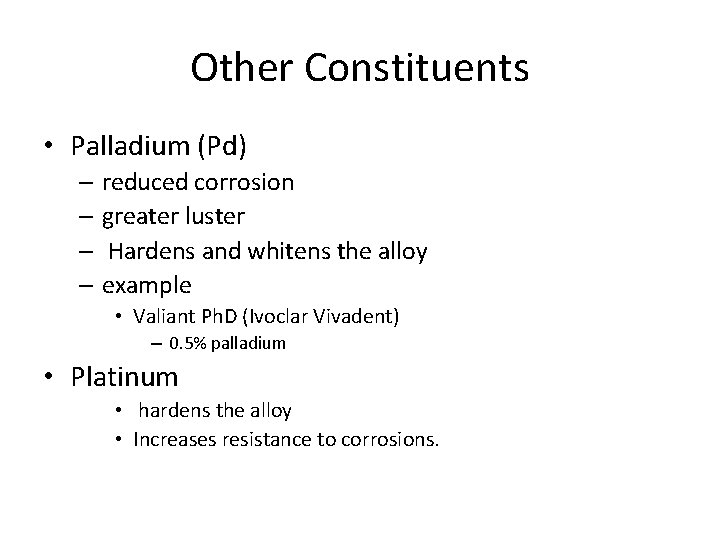
Other Constituents • Palladium (Pd) – reduced corrosion – greater luster – Hardens and whitens the alloy – example • Valiant Ph. D (Ivoclar Vivadent) – 0. 5% palladium • Platinum • hardens the alloy • Increases resistance to corrosions.
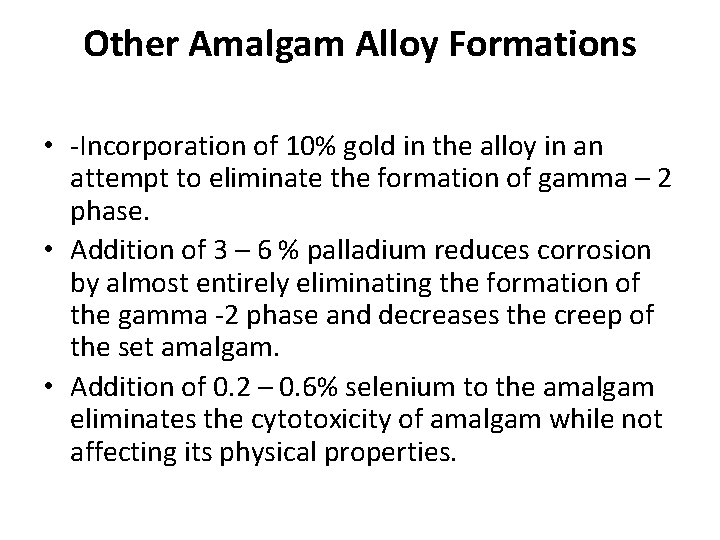
Other Amalgam Alloy Formations • -Incorporation of 10% gold in the alloy in an attempt to eliminate the formation of gamma – 2 phase. • Addition of 3 – 6 % palladium reduces corrosion by almost entirely eliminating the formation of the gamma -2 phase and decreases the creep of the set amalgam. • Addition of 0. 2 – 0. 6% selenium to the amalgam eliminates the cytotoxicity of amalgam while not affecting its physical properties.
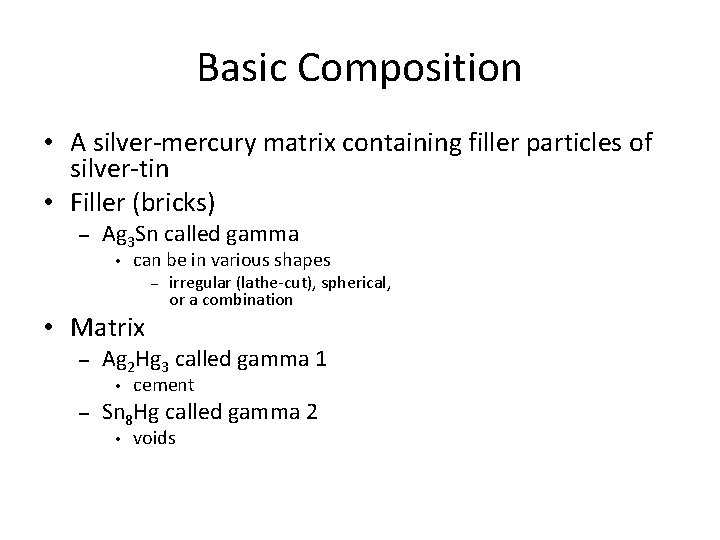
Basic Composition • A silver-mercury matrix containing filler particles of silver-tin • Filler (bricks) – Ag 3 Sn called gamma • can be in various shapes – irregular (lathe-cut), spherical, or a combination • Matrix – Ag 2 Hg 3 called gamma 1 • – cement Sn 8 Hg called gamma 2 • voids
Basic Setting Reactions • Conventional low-copper alloys • Admixed high-copper alloys • Single composition high-copper alloys
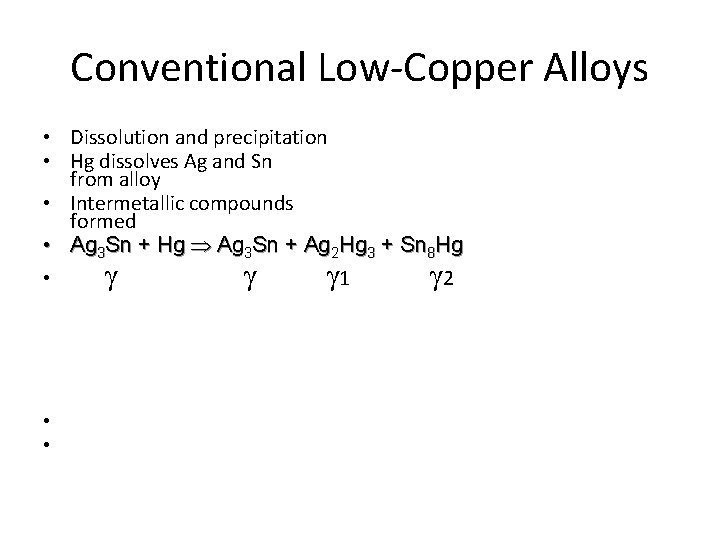
Conventional Low-Copper Alloys • Dissolution and precipitation • Hg dissolves Ag and Sn from alloy • Intermetallic compounds formed • Ag 3 Sn + Hg Þ Ag 3 Sn + Ag 2 Hg 3 + Sn 8 Hg • 1 2 •
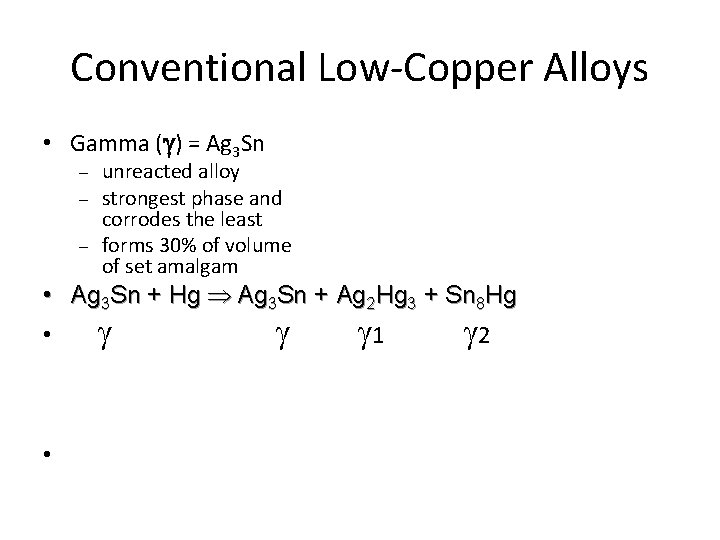
Conventional Low-Copper Alloys • Gamma ( ) = Ag 3 Sn – – – unreacted alloy strongest phase and corrodes the least forms 30% of volume of set amalgam • Ag 3 Sn + Hg Þ Ag 3 Sn + Ag 2 Hg 3 + Sn 8 Hg • 1 2 •
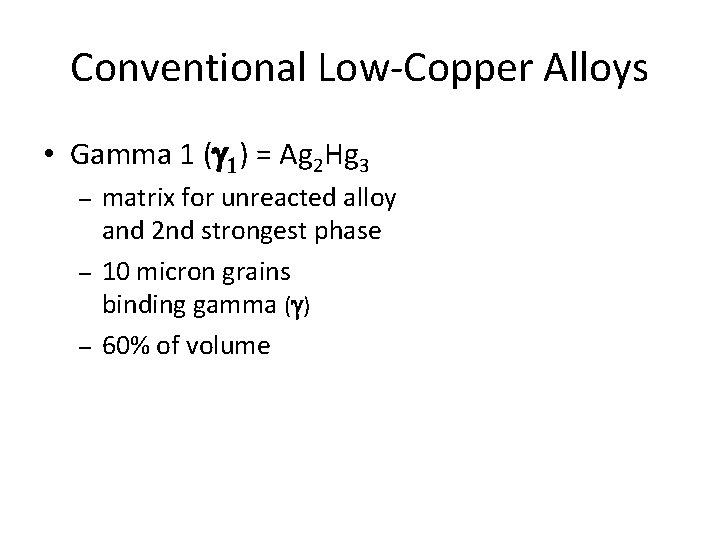
Conventional Low-Copper Alloys • Gamma 1 ( 1) = Ag 2 Hg 3 – – – matrix for unreacted alloy and 2 nd strongest phase 10 micron grains binding gamma ( ) 60% of volume
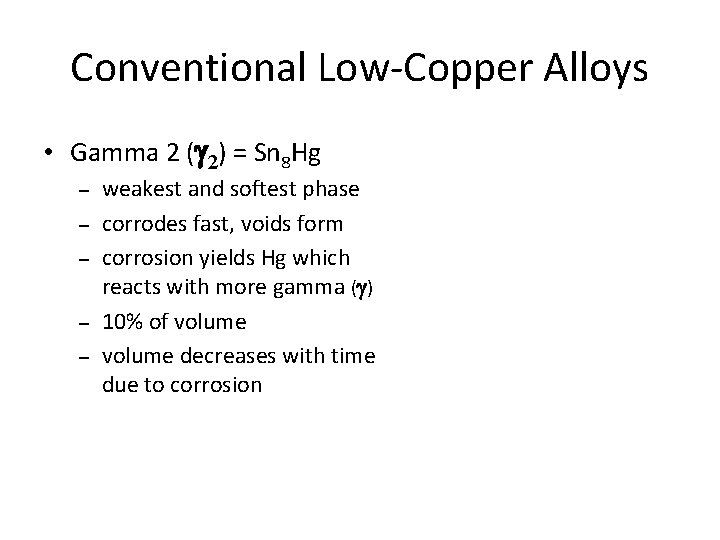
Conventional Low-Copper Alloys • Gamma 2 ( 2) = Sn 8 Hg – – – weakest and softest phase corrodes fast, voids form corrosion yields Hg which reacts with more gamma ( ) 10% of volume decreases with time due to corrosion
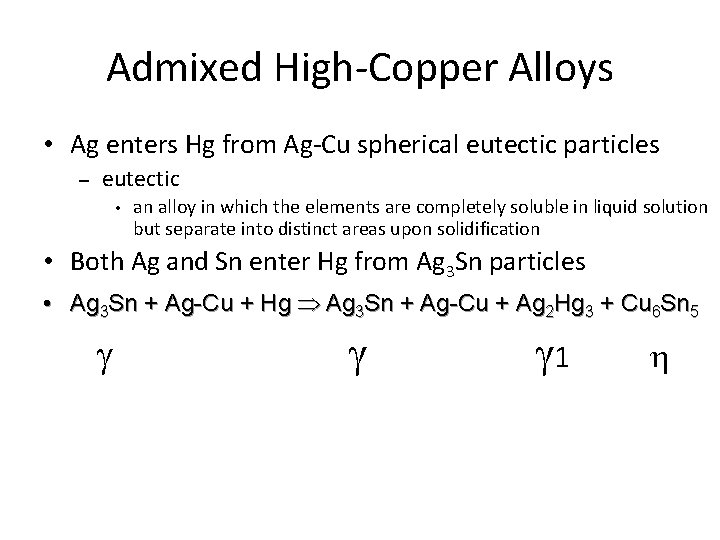
Admixed High-Copper Alloys • Ag enters Hg from Ag-Cu spherical eutectic particles – eutectic • an alloy in which the elements are completely soluble in liquid solution but separate into distinct areas upon solidification • Both Ag and Sn enter Hg from Ag 3 Sn particles • Ag 3 Sn + Ag-Cu + Hg Þ Ag 3 Sn + Ag-Cu + Ag 2 Hg 3 + Cu 6 Sn 5 1
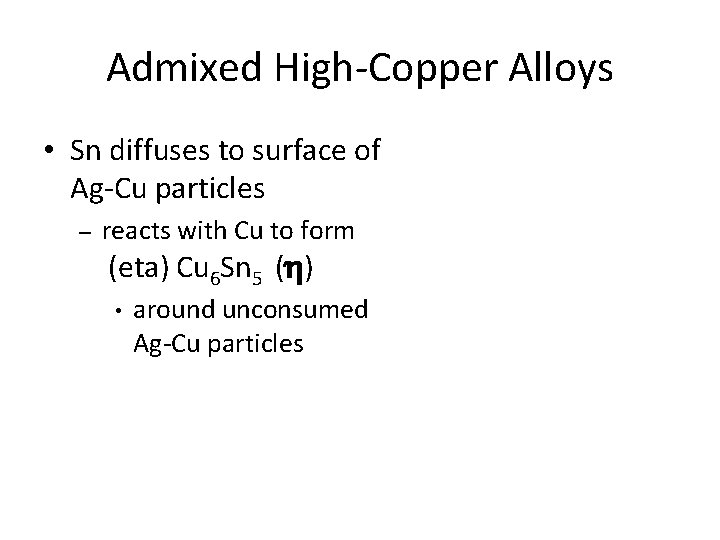
Admixed High-Copper Alloys • Sn diffuses to surface of Ag-Cu particles – reacts with Cu to form (eta) Cu 6 Sn 5 ( ) • around unconsumed Ag-Cu particles
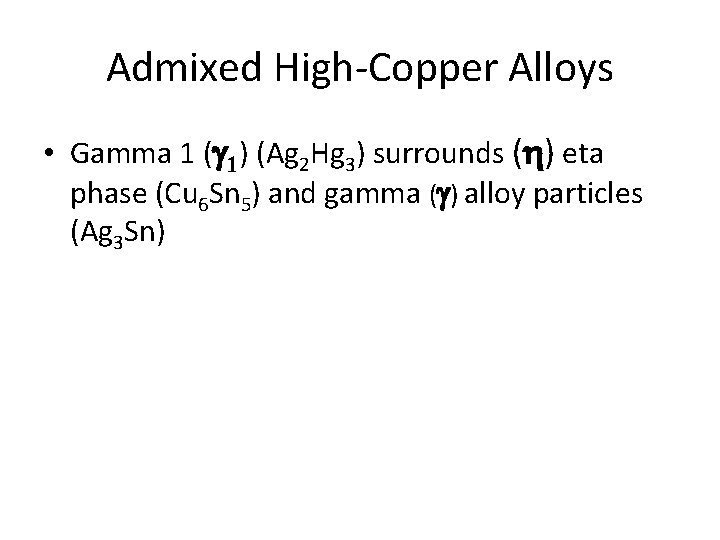
Admixed High-Copper Alloys • Gamma 1 ( 1) (Ag 2 Hg 3) surrounds ( ) eta phase (Cu 6 Sn 5) and gamma ( ) alloy particles (Ag 3 Sn)
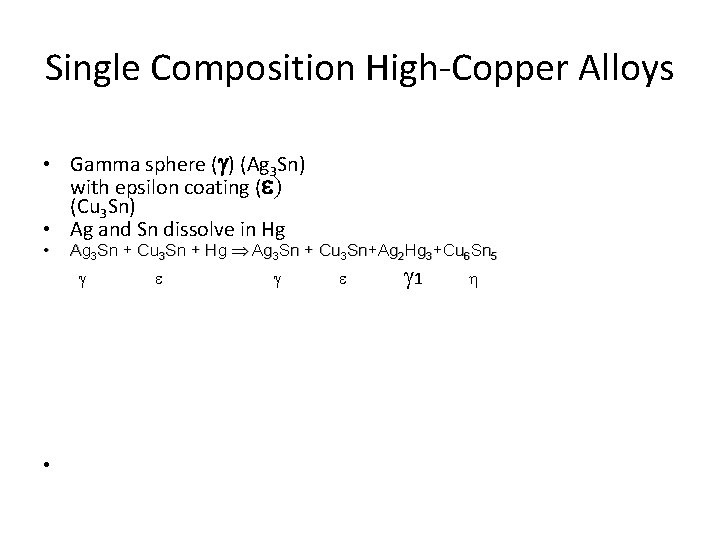
Single Composition High-Copper Alloys • Gamma sphere ( ) (Ag 3 Sn) with epsilon coating ( ) (Cu 3 Sn) • Ag and Sn dissolve in Hg • Ag 3 Sn + Cu 3 Sn + Hg Þ Ag 3 Sn + Cu 3 Sn+Ag 2 Hg 3+Cu 6 Sn 5 • 1
Single Composition High-Copper Alloys • Gamma 1 ( 1) (Ag 2 Hg 3) crystals grow binding together partiallydissolved gamma ( ) alloy particles (Ag 3 Sn) • Epsilon ( ) (Cu 3 Sn) develops crystals on surface of gamma particle (Ag 3 Sn) in the form of eta ( ) (Cu 6 Sn 5) – – reduces creep prevents gamma-2 formation
Manufacturing Process • Lathe-cut alloys – – Ag & Sn melted together alloy cooled • – heat treat • – – phases solidify 400 ºC for 8 hours grind, then mill to 25 - 50 microns heat treat to release stresses of grinding
Manufacturing Process • Spherical alloys – – melt alloy atomize • – spheres form as particles cool sizes range from 5 - 40 microns • variety improves condensability
MANIPULATION • • • This will involve Proportioning Trituration Condensation Trimming and carving Polishing.
Proportioning • Mercury; required quantity obtained by weighing or by using a volume dispenser. • Alloy; proportioned by • – weighing • – Using tables of alloy (particularly with mechanical mixing) • – Using Volume dispenser • – Having envelopes with pre – weighed quantities. •
Alloy/Mercury Ratio • In the final set amalgam, it is desirable to have less than 50% Mercury. • Two techniques have been recommended. • The use of an alloy/mercury ratio of 5/7 or 5/8. The excess mercury makes the trituration easier, giving a smooth plastic mix of material. Before insertion into the cavity, excess mercury is removed from the mix by squeezing it in a dental napkin.
Alloy/Mercury Ratio • Minimal Mercury technique or Eames technique. About equal weights of alloy and mercury are used and no mercury is squeezed out of the mix before condensation. This method is used in conjunction with mechanical mixing. • Powdered alloy and mercury are currently pre dispensed in capsules. The partition between the alloy and mercury may be broken under a press and the mixture is triturated mechanically.
Trituration • The main aim of trituration or mixing is to wet the surfaces of the amalgam alloy particles with mercury which then diffuses into the surfaces of the particles. After trituration a homogenous plastic mass is obtained. • There are Two ways of trituration; • Hand mixing • Mechanical mixing
Hand mixing • This is done using a glass mortar and pestle. The inner surface of the mortar is roughened to increase the friction between the amalgam and the surface. Carborundum paste can be used occasionally to maintain a rough surface.
Mechanical Mixing • The proportioned alloy and Mercury can be mixed mechanically in a capsule either with or without a stainless steel or plastic pestle. The mechanical amalgamators have time switches to ensure a correct and reproducible mixing time. The trituration time will depend both on the type of alloy and the speed of the mixer. • Spherical alloys will require less amalgamation time than do lathe – cut alloys. A large mix requires slightly longer mixing time than a smaller one.
Mechanical Trituration Advantages 1) Shorter mixing time 2) More standardized procedure 3) Requires less mercury when compared to hand mixing Under Triturated Mix Is rough and grainy and may crumble Gives a rough surface after carving, tarnish and corrosion can occur • Has lower compressive and tensile strengths • Mix hardens too rapidly and excess mercury will remain • Higher creep for conventional and admixed amalgam alloys. • •
Mechanical Trituration • Normal Mix Cohesive with a shiny surface, smooth and soft consistency May be warm when removed from the capsule It has the best comprehensive and tensile strengths. Carved surface retains its lustre after polishing, hence there is increased resistance to tarnish and corrosion • When dropped from a height of about 25 – 27 cm to a hard surface, the mass should remain at the same point of contact with the hard surface • Amalgam mass should be capsule of reproducing minute details. • •
Mechanical Trituration • Over – Trituration • The mix is soupy, difficult to remove from capsule and too plastic to manipulate • Working time is decreased • Higher contraction of the amalgam • Strength of lathe – cut alloys is increased and decreased in high copper alloys • Creep is increased • Over-trituration is better than undertrituration.
Mulling • This is actually a continuation of trituration. It is done to improve the homogeneity of the mass and get a single consistent mix. Can be accomplished in two ways; • The mix is enveloped in a dry piece of rubber dam and vigorously rubbed between the first finger and thumb, or the thumb of one hand palm of another hand for 2 – 5 seconds. • After trituration the pestle is removed and the mix is triturated in the pestle free capsule for 2 – 3 seconds.
Condensation • • • After trituration Amalgam packed into the cavity and condensed. Aim – Decrease Mercury content – Adapt amalgam to the cavity wall. – Prevents formation of voids in the restoration. Condensation increases the strength and decreases the creep of amalgam. Condensation must always be accomplished within the four walls and floor. If one or more walls of the cavity are missing a matrix may be used to compensate for it. Amalgam should be condensed into the cavity in small increments. Condensation time should not exceed the period recommended by the manufacturers and this is usually 3 minute. Amalgam may be condensed with an amalgam plugger or a mechanical condenser. Long delay between mixing and condensation, results in weaker amalgam Increased mercury content and creep. Improper adaptation to the cavity. Bonding between increments will be poor.
Trimming And Carving • Amalgam is overfilled into the cavity and the mercury rich surface layer is trimmed away. • Carving of an amalgam restoration enables the anatomical form and function of the tooth to be restored without occlusal interferences. It also ensures that poorly condensed surface amalgam is removed.
BURNISHING, • After carving, the restoration is smoothened by burnishing the surface and margins.
FINISHING AND POLISHING This results in an amalgam restoration which • is more resistant to corrosion and the life of the restoration is therefore prolonged. • Feels smother, more natural to the patient’s tongue and less injurious to the oral mucosa • Accumulates less dental plague, decreasing the chances of recurrent caries. • Improves the surface hardness and transverse strength of amalgam restorations. • Provides greater opportunity for the redistribution of the surface atoms over the surface of the amalgam as an amorphous.
Material-Related Variables • • Dimensional change Strength Corrosion Creep
Dimensional Change • Most high-copper amalgams undergo a net contraction • Contraction leaves marginal gap – initial leakage • post-operative sensitivity – reduced with corrosion over time
Dimensional Change • Net contraction – type of alloy • spherical alloys have more contraction – less mercury – condensation technique • greater condensation = higher contraction – trituration time • overtrituration causes higher contraction
Strength • Develops slowly – 1 hr: 40 to 60% of maximum – 24 hrs: 90% of maximum • Spherical alloys strengthen faster – require less mercury • Higher compressive vs. tensile strength • Weak in thin sections – unsupported edges fracture
Corrosion • Reduces strength • Seals margins – low copper • 6 months – – – Sn. O 2, Sn. Cl gamma-2 phase high copper • 6 - 24 months – Sn. O 2 , Sn. Cl, Cu. Cl – eta-phase (Cu 6 Sn 5)
Creep • Slow deformation of amalgam placed under a constant load – • load less than that necessary to produce fracture Gamma 2 dramatically affects creep rate – slow strain rates produces plastic deformation • allows gamma-1 grains to slide • Correlates with marginal breakdown
Creep • High-copper amalgams have creep resistance – prevention of gamma-2 phase • requires >12% Cu total – single composition spherical • eta (Cu 6 Sn 5) embedded in gamma-1 grains – interlock – admixture • eta (Cu 6 Sn 5) around Ag-Cu particles – improves bonding to gamma 1
Dentist-Controlled Variables • Manipulation – – trituration condensation burnishing polishing
Trituration • Mixing time – refer to manufacturer recommendations • Click here for details • Overtrituration – “hot” mix • – – sticks to capsule decreases working / setting time slight increase in setting contraction • Undertrituration – grainy, crumbly mix
Condensation • Forces – lathe-cut alloys • small condensers • high force – spherical alloys • large condensers • less sensitive to amount of force • vertical / lateral with vibratory motion – admixture alloys • intermediate handling between lathe-cut and spherical
Burnishing • Pre-carve – removes excess mercury – improves margin adaptation • Post-carve – improves smoothness • Combined – less leakage
Early Finishing • After initial set – – – prophy cup with pumice provides initial smoothness to restorations recommended for spherical amalgams
Polishing • • Increased smoothness Decreased plaque retention Decreased corrosion Clinically effective? – no improvement in marginal integrity
Handling Characteristics • Spherical – advantages • easier to condense – around pins • hardens rapidly • smoother polish – disadvantages • difficult to achieve tight contacts • higher tendency for overhangs
Handling Characteristics • Admixed – advantages • easy to achieve tight contacts • good polish – disadvantages • hardens slowly – lower early strength
Why Amalgam? • Inexpensive • Ease of use • Proven track record – >100 years • Familiarity • Resin-free – less allergies than composite